

#mcp
mcp
20,451 views
76 Discussing
Hot
Latest

·
--
ORBIO 在 Robinhood Chain 上刚刚冲了一波狠行情——市值短时顶到 2138 万美元,当前 1960 万美元,24 小时涨幅 201.4%。
真正让人留意的不是这一波拉盘,而是它做的事:ORBIO 持有者可以从代币交易手续费里持续拿到 OpenRouter 的 AI 积分,能直接调用 Claude 等大模型。积分想留就用,想变现就挂到市场打折出售,形成了一小圈闭环。
更狠的是团队同步推了 Orbio MCP,让 AI Agent 能自己申领积分、创建 / 轮换 / 撤销 API Key——把"AI Agent 用 AI"这件事做成了可自动化的链路。
当然,这种小市值+高弹性的标的波动极大,$AI 叙事能不能接得住还得看后续积分分发和市场流动性,追涨之前建议把位置放轻。
#AI #MCP
ORBIO 在 Robinhood Chain 上刚刚冲了一波狠行情——市值短时顶到 2138 万美元,当前 1960 万美元,24 小时涨幅 201.4%。
真正让人留意的不是这一波拉盘,而是它做的事:ORBIO 持有者可以从代币交易手续费里持续拿到 OpenRouter 的 AI 积分,能直接调用 Claude 等大模型。积分想留就用,想变现就挂到市场打折出售,形成了一小圈闭环。
更狠的是团队同步推了 Orbio MCP,让 AI Agent 能自己申领积分、创建 / 轮换 / 撤销 API Key——把"AI Agent 用 AI"这件事做成了可自动化的链路。
当然,这种小市值+高弹性的标的波动极大,$AI 叙事能不能接得住还得看后续积分分发和市场流动性,追涨之前建议把位置放轻。
#AI #MCP
真正让人留意的不是这一波拉盘,而是它做的事:ORBIO 持有者可以从代币交易手续费里持续拿到 OpenRouter 的 AI 积分,能直接调用 Claude 等大模型。积分想留就用,想变现就挂到市场打折出售,形成了一小圈闭环。
更狠的是团队同步推了 Orbio MCP,让 AI Agent 能自己申领积分、创建 / 轮换 / 撤销 API Key——把"AI Agent 用 AI"这件事做成了可自动化的链路。
当然,这种小市值+高弹性的标的波动极大,$AI 叙事能不能接得住还得看后续积分分发和市场流动性,追涨之前建议把位置放轻。
#AI #MCP
50

·
--
From Answering to Acting: How Binance Agent OS Works in PracticeAI is moving from simply answering questions to actually taking action. In crypto, that shift could be significant — and Binance Agent OS is designed to provide the infrastructure that makes it possible.
Instead of an AI agent merely telling you that Bitcoin is moving, imagine an agent that can access market data, monitor positions, evaluate conditions and interact with trading infrastructure — all within permissions and limits defined by the user.
That is the idea behind Binance Agent OS.
What Is Binance Agent OS?
Binance Agent OS is a developer toolkit that connects AI agents to Binance through the Model Context Protocol (MCP), APIs and ready-made skills.
The system allows agents to access crypto and TradFi market data, track portfolios, interact with trading functions, automate payments and, where supported, interact with on-chain services.
The important part is that the agent does not need unrestricted access.
Binance describes the architecture around three principles: connect, build and control. Developers can connect an existing AI-agent stack, build workflows using Binance infrastructure and establish permissions, accounts and limits for individual agents.
From AI Conversation to Action
Consider a simple trading workflow.
A user could ask an AI agent to monitor BTC and identify a specific market condition. Through the Binance MCP server, the agent can access the relevant Binance tools and data.
The workflow can look like this:
User request → AI agent → Binance MCP → market data → analysis → permitted action
The MCP layer acts as the bridge between the AI agent and Binance infrastructure.
This is where the difference between a traditional chatbot and an AI agent becomes clearer.
A chatbot might answer: “BTC is trading at X.”
An agent connected to financial infrastructure could potentially retrieve the relevant data, evaluate a predefined condition and initiate an allowed action — subject to the permissions and controls established by the user.
Binance says Agent OS can allow agents to monitor markets, react to signals and act when specified conditions are met.
Why MCP Matters
Model Context Protocol (MCP) is an open standard designed to allow AI applications to connect with external data and services.
For Binance Agent OS, the Binance MCP server provides a structured connection between an AI agent and Binance tools.
The setup is designed around three steps:
1. Add the Binance MCP Server
2. Authenticate the server
3. Activate the agent
That makes MCP more than a technical buzzword. It becomes the connection layer that allows an AI agent to interact with financial infrastructure.
The Guardrails Are the Important Part
Giving an AI access to financial systems raises an obvious question: How much authority should the agent have?
This is where controls matter.
Binance Agent OS emphasizes configurable permissions, accounts and limits. An agent can therefore be designed around a defined operating perimeter rather than being given unlimited authority.
That distinction could become increasingly important as AI agents move deeper into financial workflows.
The goal isn't simply to make AI more autonomous.
It is to make autonomous financial actions more controlled and auditable.
The Bigger Picture
Binance Agent OS represents a broader shift from AI that provides information to AI that can interact with financial infrastructure.
Market data, trading, payments, portfolio tracking and on-chain functionality can become tools available to AI agents through established Binance infrastructure.
That is why agentic finance is worth watching.
The future may not be about asking an AI, “What should I do?”
It may increasingly be about giving an AI clearly defined rules, permissions and objectives — and allowing it to execute within those boundaries.
For developers, traders and crypto users, Binance Agent OS offers a practical look at what that future could look like.
Explore Binance Agent OS: [Binance Agent OS](https://www.binance.com/es/agent-os?utm_source=chatgpt.com)
Interested in BNB? Explore Binance's official Buy BNB option here: [Buy BNB on Binance](https://www.binance.com/en/buy-sell-crypto/bnb?utm_source=chatgpt.com)
Not financial advice. Crypto assets are volatile and AI-generated outputs can contain errors or outdated information. Always do your own research (DYOR) and understand the risks before trading or investing.
#BinanceAgentOS #AgenticFinance #MCP
From Answering to Acting: How Binance Agent OS Works in Practice
AI is moving from simply answering questions to actually taking action. In crypto, that shift could be significant — and Binance Agent OS is designed to provide the infrastructure that makes it possible.
Instead of an AI agent merely telling you that Bitcoin is moving, imagine an agent that can access market data, monitor positions, evaluate conditions and interact with trading infrastructure — all within permissions and limits defined by the user.
That is the idea behind Binance Agent OS.
What Is Binance Agent OS?
Binance Agent OS is a developer toolkit that connects AI agents to Binance through the Model Context Protocol (MCP), APIs and ready-made skills.
The system allows agents to access crypto and TradFi market data, track portfolios, interact with trading functions, automate payments and, where supported, interact with on-chain services.
The important part is that the agent does not need unrestricted access.
Binance describes the architecture around three principles: connect, build and control. Developers can connect an existing AI-agent stack, build workflows using Binance infrastructure and establish permissions, accounts and limits for individual agents.
From AI Conversation to Action
Consider a simple trading workflow.
A user could ask an AI agent to monitor BTC and identify a specific market condition. Through the Binance MCP server, the agent can access the relevant Binance tools and data.
The workflow can look like this:
User request → AI agent → Binance MCP → market data → analysis → permitted action
The MCP layer acts as the bridge between the AI agent and Binance infrastructure.
This is where the difference between a traditional chatbot and an AI agent becomes clearer.
A chatbot might answer: “BTC is trading at X.”
An agent connected to financial infrastructure could potentially retrieve the relevant data, evaluate a predefined condition and initiate an allowed action — subject to the permissions and controls established by the user.
Binance says Agent OS can allow agents to monitor markets, react to signals and act when specified conditions are met.
Why MCP Matters
Model Context Protocol (MCP) is an open standard designed to allow AI applications to connect with external data and services.
For Binance Agent OS, the Binance MCP server provides a structured connection between an AI agent and Binance tools.
The setup is designed around three steps:
1. Add the Binance MCP Server
2. Authenticate the server
3. Activate the agent
That makes MCP more than a technical buzzword. It becomes the connection layer that allows an AI agent to interact with financial infrastructure.
The Guardrails Are the Important Part
Giving an AI access to financial systems raises an obvious question: How much authority should the agent have?
This is where controls matter.
Binance Agent OS emphasizes configurable permissions, accounts and limits. An agent can therefore be designed around a defined operating perimeter rather than being given unlimited authority.
That distinction could become increasingly important as AI agents move deeper into financial workflows.
The goal isn't simply to make AI more autonomous.
It is to make autonomous financial actions more controlled and auditable.
The Bigger Picture
Binance Agent OS represents a broader shift from AI that provides information to AI that can interact with financial infrastructure.
Market data, trading, payments, portfolio tracking and on-chain functionality can become tools available to AI agents through established Binance infrastructure.
That is why agentic finance is worth watching.
The future may not be about asking an AI, “What should I do?”
It may increasingly be about giving an AI clearly defined rules, permissions and objectives — and allowing it to execute within those boundaries.
For developers, traders and crypto users, Binance Agent OS offers a practical look at what that future could look like.
Explore Binance Agent OS: Binance Agent OS
Interested in BNB? Explore Binance's official Buy BNB option here: Buy BNB on Binance
Not financial advice. Crypto assets are volatile and AI-generated outputs can contain errors or outdated information. Always do your own research (DYOR) and understand the risks before trading or investing.
#BinanceAgentOS #AgenticFinance #MCP
Instead of an AI agent merely telling you that Bitcoin is moving, imagine an agent that can access market data, monitor positions, evaluate conditions and interact with trading infrastructure — all within permissions and limits defined by the user.
That is the idea behind Binance Agent OS.
What Is Binance Agent OS?
Binance Agent OS is a developer toolkit that connects AI agents to Binance through the Model Context Protocol (MCP), APIs and ready-made skills.
The system allows agents to access crypto and TradFi market data, track portfolios, interact with trading functions, automate payments and, where supported, interact with on-chain services.
The important part is that the agent does not need unrestricted access.
Binance describes the architecture around three principles: connect, build and control. Developers can connect an existing AI-agent stack, build workflows using Binance infrastructure and establish permissions, accounts and limits for individual agents.
From AI Conversation to Action
Consider a simple trading workflow.
A user could ask an AI agent to monitor BTC and identify a specific market condition. Through the Binance MCP server, the agent can access the relevant Binance tools and data.
The workflow can look like this:
User request → AI agent → Binance MCP → market data → analysis → permitted action
The MCP layer acts as the bridge between the AI agent and Binance infrastructure.
This is where the difference between a traditional chatbot and an AI agent becomes clearer.
A chatbot might answer: “BTC is trading at X.”
An agent connected to financial infrastructure could potentially retrieve the relevant data, evaluate a predefined condition and initiate an allowed action — subject to the permissions and controls established by the user.
Binance says Agent OS can allow agents to monitor markets, react to signals and act when specified conditions are met.
Why MCP Matters
Model Context Protocol (MCP) is an open standard designed to allow AI applications to connect with external data and services.
For Binance Agent OS, the Binance MCP server provides a structured connection between an AI agent and Binance tools.
The setup is designed around three steps:
1. Add the Binance MCP Server
2. Authenticate the server
3. Activate the agent
That makes MCP more than a technical buzzword. It becomes the connection layer that allows an AI agent to interact with financial infrastructure.
The Guardrails Are the Important Part
Giving an AI access to financial systems raises an obvious question: How much authority should the agent have?
This is where controls matter.
Binance Agent OS emphasizes configurable permissions, accounts and limits. An agent can therefore be designed around a defined operating perimeter rather than being given unlimited authority.
That distinction could become increasingly important as AI agents move deeper into financial workflows.
The goal isn't simply to make AI more autonomous.
It is to make autonomous financial actions more controlled and auditable.
The Bigger Picture
Binance Agent OS represents a broader shift from AI that provides information to AI that can interact with financial infrastructure.
Market data, trading, payments, portfolio tracking and on-chain functionality can become tools available to AI agents through established Binance infrastructure.
That is why agentic finance is worth watching.
The future may not be about asking an AI, “What should I do?”
It may increasingly be about giving an AI clearly defined rules, permissions and objectives — and allowing it to execute within those boundaries.
For developers, traders and crypto users, Binance Agent OS offers a practical look at what that future could look like.
Explore Binance Agent OS: Binance Agent OS
Interested in BNB? Explore Binance's official Buy BNB option here: Buy BNB on Binance
Not financial advice. Crypto assets are volatile and AI-generated outputs can contain errors or outdated information. Always do your own research (DYOR) and understand the risks before trading or investing.
#BinanceAgentOS #AgenticFinance #MCP
1
118

·
--
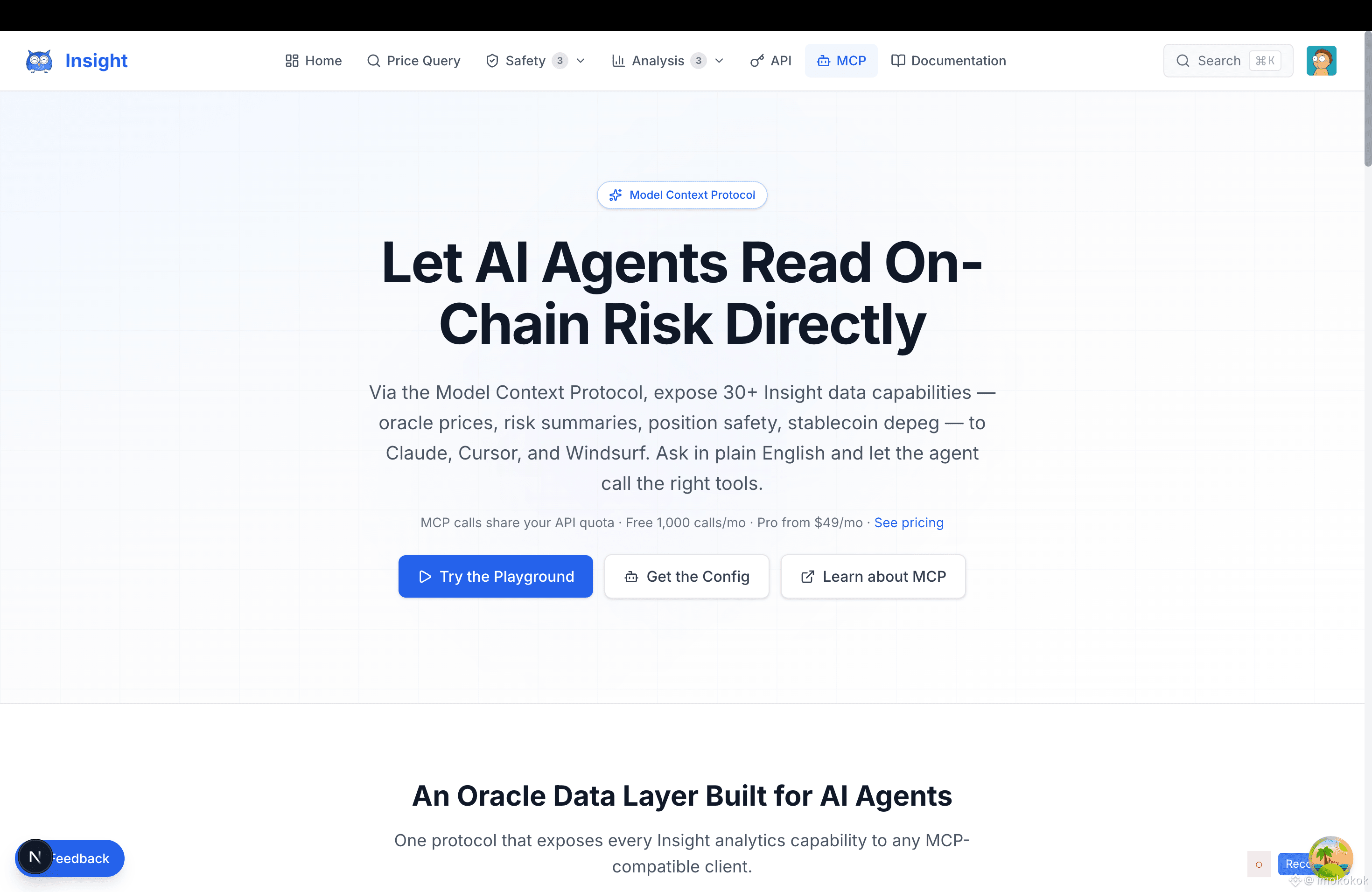
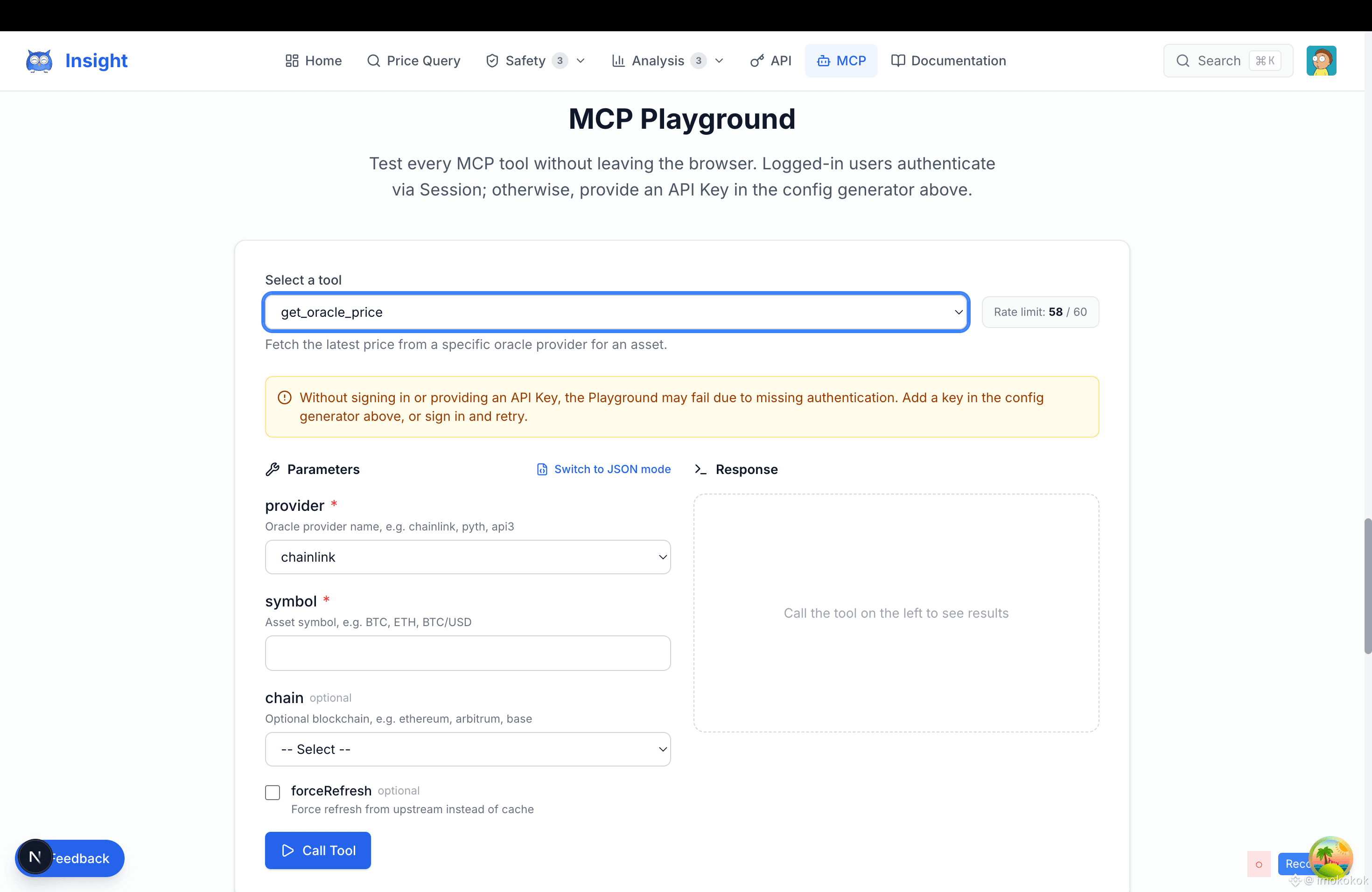
Insight MCP is live — bring oracle intelligence directly into your AI agent.
After weeks of shipping, I'm excited to open up oracleinsight.xyz as a Model Context Protocol server. Claude, Cursor, Cline, Goose, ChatGPT, and any MCP client can now call 30+ tools to:
- Fetch prices & manipulation-resistant consensus across 10+ oracle providers
- Monitor stablecoin & LST pegs in real time
- Check DeFi position safety and liquidation risk
- Compare oracle deviations, latency, and cross-chain spreads
- Pull daily risk reports and incident feeds
No SQL. No dashboards. Just ask.
Built on the same REST API that powers the web app, with plan-aware auth, rate limits, and monthly quotas out of the box.
🔗 Connect: https://oracleinsight.xyz/api/mcp 📄 Docs: https://oracleinsight.xyz/mcp 🐙 Source: GitHub.com/imokokok/Insight
#oracles #mcp
Insight MCP is live — bring oracle intelligence directly into your AI agent.
After weeks of shipping, I'm excited to open up oracleinsight.xyz as a Model Context Protocol server. Claude, Cursor, Cline, Goose, ChatGPT, and any MCP client can now call 30+ tools to:
- Fetch prices & manipulation-resistant consensus across 10+ oracle providers
- Monitor stablecoin & LST pegs in real time
- Check DeFi position safety and liquidation risk
- Compare oracle deviations, latency, and cross-chain spreads
- Pull daily risk reports and incident feeds
No SQL. No dashboards. Just ask.
Built on the same REST API that powers the web app, with plan-aware auth, rate limits, and monthly quotas out of the box.
🔗 Connect: https://oracleinsight.xyz/api/mcp 📄 Docs: https://oracleinsight.xyz/mcp 🐙 Source: GitHub.com/imokokok/Insight
#oracles #mcp
After weeks of shipping, I'm excited to open up oracleinsight.xyz as a Model Context Protocol server. Claude, Cursor, Cline, Goose, ChatGPT, and any MCP client can now call 30+ tools to:
- Fetch prices & manipulation-resistant consensus across 10+ oracle providers
- Monitor stablecoin & LST pegs in real time
- Check DeFi position safety and liquidation risk
- Compare oracle deviations, latency, and cross-chain spreads
- Pull daily risk reports and incident feeds
No SQL. No dashboards. Just ask.
Built on the same REST API that powers the web app, with plan-aware auth, rate limits, and monthly quotas out of the box.
🔗 Connect: https://oracleinsight.xyz/api/mcp 📄 Docs: https://oracleinsight.xyz/mcp 🐙 Source: GitHub.com/imokokok/Insight
#oracles #mcp
72

·
--
🤔 MCP係乜?30秒搞明
MCP = Model Context Protocol
諗下USB-C:
• 以前每部手機唔同充電線
• USB-C統一咗所有線
MCP就係AI Agent嘅USB-C:
• 以前每個工具唔同API
• MCP統一咗所有連接
MCPize = 300+工具即用
→ mcpize.com/?ref=J7N8N
#MCP #AI入門
🤔 MCP係乜?30秒搞明
MCP = Model Context Protocol
諗下USB-C:
• 以前每部手機唔同充電線
• USB-C統一咗所有線
MCP就係AI Agent嘅USB-C:
• 以前每個工具唔同API
• MCP統一咗所有連接
MCPize = 300+工具即用
→ mcpize.com/?ref=J7N8N
#MCP #AI入門
MCP = Model Context Protocol
諗下USB-C:
• 以前每部手機唔同充電線
• USB-C統一咗所有線
MCP就係AI Agent嘅USB-C:
• 以前每個工具唔同API
• MCP統一咗所有連接
MCPize = 300+工具即用
→ mcpize.com/?ref=J7N8N
#MCP #AI入門
45


·
--
Bullish
Verified
Binance Agent OS: AI Agents Can Now Connect Directly to Binance
Binance just launched Binance Agent OS, and the interesting part is not just the MCP integration.
It is a broader developer platform that brings together Binance APIs, Wallet Agentic Hub, x402, Skill Hub, and MCP into one ecosystem for building AI-powered crypto applications.
The Binance MCP Server gives compatible AI applications a standardized way to access supported Binance capabilities, subject to user authorization and account eligibility.
Depending on the permissions granted, an agent can:
• Read market data such as tickers, order books, candlesticks and funding rates
• Check Agentic sub-account balances and positions
• Trade supported Spot, Margin, Convert, USDⓈ-M Futures and COIN-M Futures products
One detail I think matters a lot: there is no withdrawal permission through the MCP integration. Agents cannot withdraw funds to external addresses.
The access is also isolated through a dedicated Agentic sub-account, so users should only fund it with assets they are comfortable making available for authorized agent activity.
Compatible AI tools currently include Claude, Claude Code, Codex, ChatGPT and VS Code.
For developers, this could make Binance integrations much less fragmented. Instead of building separate connections for every agent workflow, MCP provides a common layer for discovering and using supported Binance tools.
For users, the bigger question is how much control they want to give an AI agent over their account.
AI can automate actions, but permissions still matter. Always review what an agent is authorized to do before connecting or approving transactions.
Binance Agent OS: [https://www.binance.com/en/support/announcement/detail/07d45cdd3831498f8a4ff339031a8480](https://www.binance.com/en/support/announcement/detail/07d45cdd3831498f8a4ff339031a8480)
#Binance #BinanceAgentOS #MCP #AIAgents
{future}(BNBUSDT)
Binance Agent OS: AI Agents Can Now Connect Directly to Binance
Binance just launched Binance Agent OS, and the interesting part is not just the MCP integration.
It is a broader developer platform that brings together Binance APIs, Wallet Agentic Hub, x402, Skill Hub, and MCP into one ecosystem for building AI-powered crypto applications.
The Binance MCP Server gives compatible AI applications a standardized way to access supported Binance capabilities, subject to user authorization and account eligibility.
Depending on the permissions granted, an agent can:
• Read market data such as tickers, order books, candlesticks and funding rates
• Check Agentic sub-account balances and positions
• Trade supported Spot, Margin, Convert, USDⓈ-M Futures and COIN-M Futures products
One detail I think matters a lot: there is no withdrawal permission through the MCP integration. Agents cannot withdraw funds to external addresses.
The access is also isolated through a dedicated Agentic sub-account, so users should only fund it with assets they are comfortable making available for authorized agent activity.
Compatible AI tools currently include Claude, Claude Code, Codex, ChatGPT and VS Code.
For developers, this could make Binance integrations much less fragmented. Instead of building separate connections for every agent workflow, MCP provides a common layer for discovering and using supported Binance tools.
For users, the bigger question is how much control they want to give an AI agent over their account.
AI can automate actions, but permissions still matter. Always review what an agent is authorized to do before connecting or approving transactions.
Binance Agent OS: https://www.binance.com/en/support/announcement/detail/07d45cdd3831498f8a4ff339031a8480
#Binance #BinanceAgentOS #MCP #AIAgents
Binance just launched Binance Agent OS, and the interesting part is not just the MCP integration.
It is a broader developer platform that brings together Binance APIs, Wallet Agentic Hub, x402, Skill Hub, and MCP into one ecosystem for building AI-powered crypto applications.
The Binance MCP Server gives compatible AI applications a standardized way to access supported Binance capabilities, subject to user authorization and account eligibility.
Depending on the permissions granted, an agent can:
• Read market data such as tickers, order books, candlesticks and funding rates
• Check Agentic sub-account balances and positions
• Trade supported Spot, Margin, Convert, USDⓈ-M Futures and COIN-M Futures products
One detail I think matters a lot: there is no withdrawal permission through the MCP integration. Agents cannot withdraw funds to external addresses.
The access is also isolated through a dedicated Agentic sub-account, so users should only fund it with assets they are comfortable making available for authorized agent activity.
Compatible AI tools currently include Claude, Claude Code, Codex, ChatGPT and VS Code.
For developers, this could make Binance integrations much less fragmented. Instead of building separate connections for every agent workflow, MCP provides a common layer for discovering and using supported Binance tools.
For users, the bigger question is how much control they want to give an AI agent over their account.
AI can automate actions, but permissions still matter. Always review what an agent is authorized to do before connecting or approving transactions.
Binance Agent OS: https://www.binance.com/en/support/announcement/detail/07d45cdd3831498f8a4ff339031a8480
#Binance #BinanceAgentOS #MCP #AIAgents
1
1
264

·
--
$BEAN STRATEGY SHIFT – FROM GUI TO MCP INTEGRATION 🔥
The new generation BeanPod phone is pivoting away from GUI automation towards MCP service integration. This removes a major compliance risk and opens the door for deeper partnerships with super apps like Alibaba and Tencent. The stockpile has jumped from 30,000 to hundreds of thousands of units — a clear signal the company is moving from experimental to commercial scale.
Will this MCP-first approach attract more developers to the ecosystem?
Not financial advice. Always manage your risk.
#BEAN #TechStrategy #MCP #MobileEcosystem
🔥
$BEAN STRATEGY SHIFT – FROM GUI TO MCP INTEGRATION 🔥
The new generation BeanPod phone is pivoting away from GUI automation towards MCP service integration. This removes a major compliance risk and opens the door for deeper partnerships with super apps like Alibaba and Tencent. The stockpile has jumped from 30,000 to hundreds of thousands of units — a clear signal the company is moving from experimental to commercial scale.
Will this MCP-first approach attract more developers to the ecosystem?
Not financial advice. Always manage your risk.
#BEAN #TechStrategy #MCP #MobileEcosystem
🔥
The new generation BeanPod phone is pivoting away from GUI automation towards MCP service integration. This removes a major compliance risk and opens the door for deeper partnerships with super apps like Alibaba and Tencent. The stockpile has jumped from 30,000 to hundreds of thousands of units — a clear signal the company is moving from experimental to commercial scale.
Will this MCP-first approach attract more developers to the ecosystem?
Not financial advice. Always manage your risk.
#BEAN #TechStrategy #MCP #MobileEcosystem
🔥
56

·
--
🔥 У Base з’явилась підтримка MCP для управління ончейн-операціями через ШІ-агентів
📍 Base представила Base MCP — спеціальний шлюз для інтеграції Base Account із ШІ-агентами. Тепер користувачі можуть здійснювати ончейн-операції прямо в чаті: переказувати активи, свапати токени, перевіряти баланси та взаємодіяти з DeFi-протоколами.
🖇 Рішення підтримує MCP-сумісні ШІ-клієнти, серед яких Claude, ChatGPT, Codex та Cursor.
🤖 ШІ-агенти можуть формувати транзакції, але не мають доступу до коштів чи приватних ключів користувача. Кожна дія потребує ручного підтвердження власником гаманця.
🔐 У Base підкреслили, що архітектура MCP повністю ізольована від приватних ключів, а всі транзакції підписуються лише після особистого підтвердження користувача.
#Base #AI #MCP #DeFi #Crypto
🔥 У Base з’явилась підтримка MCP для управління ончейн-операціями через ШІ-агентів
📍 Base представила Base MCP — спеціальний шлюз для інтеграції Base Account із ШІ-агентами. Тепер користувачі можуть здійснювати ончейн-операції прямо в чаті: переказувати активи, свапати токени, перевіряти баланси та взаємодіяти з DeFi-протоколами.
🖇 Рішення підтримує MCP-сумісні ШІ-клієнти, серед яких Claude, ChatGPT, Codex та Cursor.
🤖 ШІ-агенти можуть формувати транзакції, але не мають доступу до коштів чи приватних ключів користувача. Кожна дія потребує ручного підтвердження власником гаманця.
🔐 У Base підкреслили, що архітектура MCP повністю ізольована від приватних ключів, а всі транзакції підписуються лише після особистого підтвердження користувача.
#Base #AI #MCP #DeFi #Crypto
📍 Base представила Base MCP — спеціальний шлюз для інтеграції Base Account із ШІ-агентами. Тепер користувачі можуть здійснювати ончейн-операції прямо в чаті: переказувати активи, свапати токени, перевіряти баланси та взаємодіяти з DeFi-протоколами.
🖇 Рішення підтримує MCP-сумісні ШІ-клієнти, серед яких Claude, ChatGPT, Codex та Cursor.
🤖 ШІ-агенти можуть формувати транзакції, але не мають доступу до коштів чи приватних ключів користувача. Кожна дія потребує ручного підтвердження власником гаманця.
🔐 У Base підкреслили, що архітектура MCP повністю ізольована від приватних ключів, а всі транзакції підписуються лише після особистого підтвердження користувача.
#Base #AI #MCP #DeFi #Crypto
5
149

·
--
Bullish
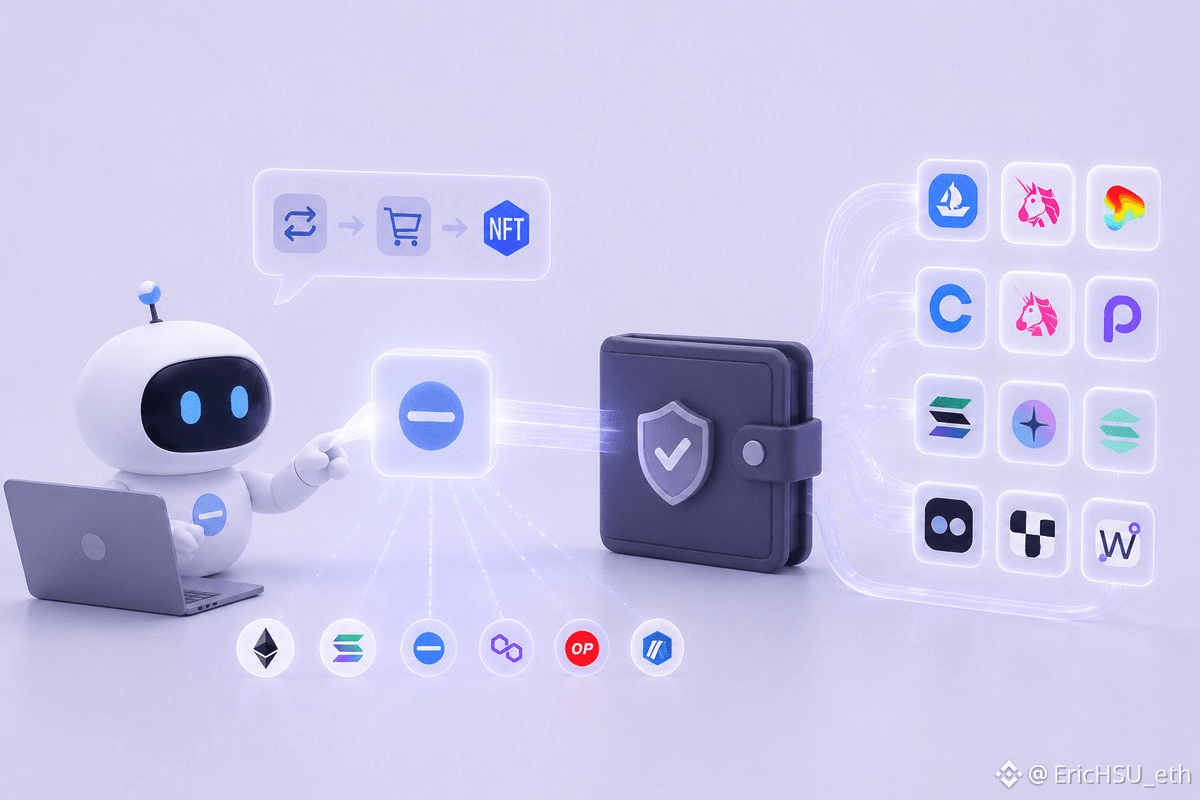
GM☕️ base MCP 升级了,一口气拉了 13 个项目把 agent 接上链。
比如 Opensea,现在 AI agent 能直接帮你 swap、买 NFT、mint,跨 6 条链,「无需注册、无需设置,开箱即用」。
2 月就聊过,当时 Phantom 出 MCP server,链上钱包大概率会变成 agent 的默认执行入口。现在 Base 直接把一排应用做成 plugin 了。
我自己也有在交互过一些 Agent 相关的链上操作,奈何太小白,对于底层逻辑一直搞不太清楚。Agent 替我点链上交易,签名和授权到底放到哪一步?
越是丝滑的执行,越要搞清楚它背后拿了什么权限。方便和风险,从来是一体的。工具会用就是竞争力。但真要放 agent 自己碰钱包,肯定是先要用 burn wallet 体验才行。
#Base #MCP
GM☕️ base MCP 升级了,一口气拉了 13 个项目把 agent 接上链。
比如 Opensea,现在 AI agent 能直接帮你 swap、买 NFT、mint,跨 6 条链,「无需注册、无需设置,开箱即用」。
2 月就聊过,当时 Phantom 出 MCP server,链上钱包大概率会变成 agent 的默认执行入口。现在 Base 直接把一排应用做成 plugin 了。
我自己也有在交互过一些 Agent 相关的链上操作,奈何太小白,对于底层逻辑一直搞不太清楚。Agent 替我点链上交易,签名和授权到底放到哪一步?
越是丝滑的执行,越要搞清楚它背后拿了什么权限。方便和风险,从来是一体的。工具会用就是竞争力。但真要放 agent 自己碰钱包,肯定是先要用 burn wallet 体验才行。
#Base #MCP
比如 Opensea,现在 AI agent 能直接帮你 swap、买 NFT、mint,跨 6 条链,「无需注册、无需设置,开箱即用」。
2 月就聊过,当时 Phantom 出 MCP server,链上钱包大概率会变成 agent 的默认执行入口。现在 Base 直接把一排应用做成 plugin 了。
我自己也有在交互过一些 Agent 相关的链上操作,奈何太小白,对于底层逻辑一直搞不太清楚。Agent 替我点链上交易,签名和授权到底放到哪一步?
越是丝滑的执行,越要搞清楚它背后拿了什么权限。方便和风险,从来是一体的。工具会用就是竞争力。但真要放 agent 自己碰钱包,肯定是先要用 burn wallet 体验才行。
#Base #MCP
126


Article
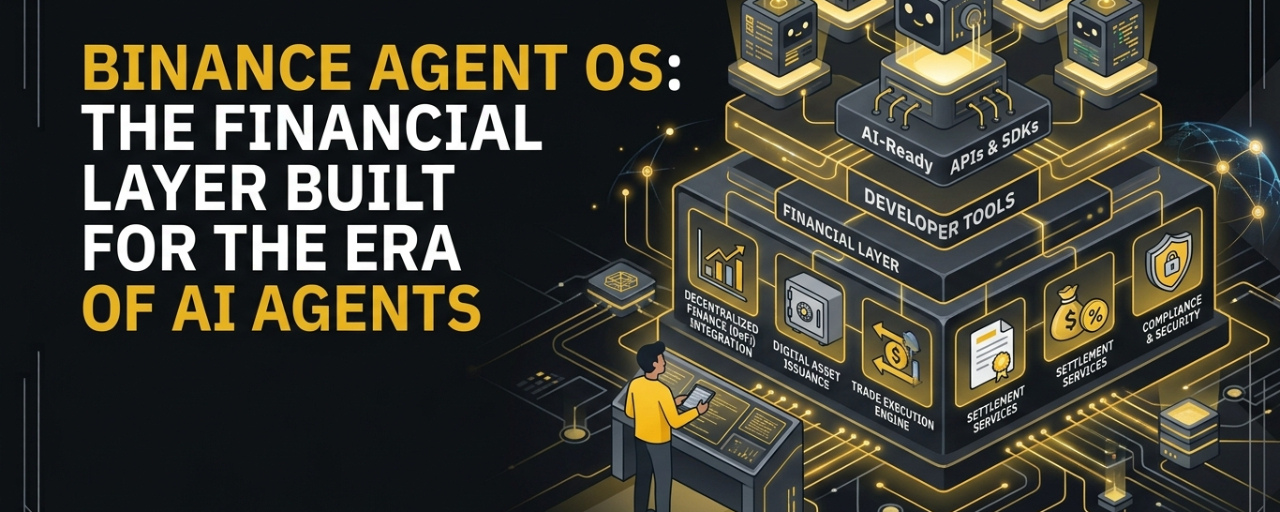
Binance Agent OS: The Financial Layer Built for the Era of AI AgentsAI is entering a different phase.
For years, the dominant model was simple: ask AI a question, receive an answer.
Now, AI agents are increasingly being designed to do more. They can retrieve information, use external tools, coordinate workflows, and when authorized take actions on behalf of users.
That creates a new infrastructure problem.
If an AI agent is going to interact with financial markets, it needs more than intelligence. It needs real-time market access, defined permissions, execution infrastructure, and controls around what it is allowed to do.
This is where Binance Agent OS comes in.
Launched in August 2026, Agent OS is a developer platform designed to connect compatible AI applications and agents with Binance capabilities through user-controlled permissions. Its architecture brings together Binance APIs, the Wallet Agentic Hub, x402, Skill Hub, and Model Context Protocol (MCP) support.
The bigger idea is straightforward:
AI can provide the intelligence. Agent OS provides a controlled path to financial infrastructure.
From AI That Answers to AI That Acts
The first generation of generative AI largely lived inside a conversation window.
You asked:
“What is Bitcoin's current price?”
The model answered.
An agentic system changes the workflow.
You might instead ask an agent to monitor a market, retrieve account information, analyze a position, or prepare a trade. With the appropriate permissions and supported functionality, the agent can interact with external systems rather than simply describing what a user could do.
That distinction matters enormously in finance.
A chatbot can tell you that an asset moved 5%.
A connected agent can retrieve the market data directly.
A chatbot can explain how an order works.
A connected agent can interact with the trading infrastructure subject to the permissions and controls established by the user.
Binance Agent OS is designed around this second model.
Its MCP integration provides a standardized way for compatible AI applications to connect with Binance. The Binance MCP Server currently supports market-data and trading functionality, while other Agent OS tools extend toward wallets, payments, and on-chain capabilities.
Why MCP Matters
The important piece underneath this architecture is Model Context Protocol, or MCP.
MCP is an open standard for connecting AI applications with external tools and services through a structured interface. Instead of every AI application having to build a completely different integration for every service, MCP provides a common way for agents to discover and use tools.
Its ecosystem has expanded rapidly.
By early 2026, MCP had reached approximately 97 million monthly SDK downloads and more than 10,000 public servers, with support across major AI ecosystems including OpenAI, Google, Microsoft and AWS. That does not mean MCP itself is a financial system. It is the connection layer.
Binance Agent OS uses that connection layer to give AI applications a standardized route into Binance-supported financial capabilities.
That is an important architectural distinction.
MCP connects the agent to the tool. Agent OS defines the Binance capabilities and permissions available through that connection.
The Financial Layer AI Agents Have Been Missing
AI agents can reason about markets, but reasoning alone does not create financial utility.
An agent needs access to the underlying infrastructure.
With Binance Agent OS, compatible agents can, depending on eligibility and permissions:
access live market information;view balances and positions within the Agentic environment;interact with supported trading functions;transfer funds between wallets inside the Agentic sub-account; andconnect to other Binance tools for wallet, payment and on-chain workflows.
The Binance MCP integration does not provide a withdrawal scope to external addresses, and authorization takes place through a dedicated Agentic sub-account isolated from the main account. That architecture is important because financial automation has a fundamentally different risk profile from ordinary software automation.
An AI agent scheduling a meeting and an AI agent moving financial assets are not equivalent problems. The second requires much stronger boundaries.
AI Advises. Users Define the Perimeter.
The most important part of Agent OS may not be the AI itself.
It is the permission model around the AI.
Binance's architecture gives users control over what an agent can access and how much capital is available to it. The Agentic sub-account is separate from the main account, and users only transfer into it the assets they are willing to make available for agent activity.
This creates a concept that could become increasingly important as agentic finance develops:
controlled autonomy.
The objective is not necessarily to give an AI unlimited authority.
Instead, the user establishes the boundaries first.
The agent can then operate inside those boundaries.
For supported actions, users are asked to review the operation details before confirming submission. Binance's current Agent OS design also includes controls for disconnecting agents, while the Agentic environment prevents external withdrawals through the MCP integration.
In other words, the architecture separates intelligence from authority.
An AI model may decide what it thinks should happen.
The financial infrastructure determines what it is actually permitted to do.
That separation is critical.
Why Security Becomes More Important as AI Gains Access
Giving software access to financial infrastructure introduces a different class of security questions.
What can the agent access?
How much money can it use?
Can it withdraw?
Can the user revoke access?
Where does the activity take place?
What happens if the agent behaves unexpectedly?
Binance Agent OS addresses these questions through several layers, including permission scopes, a dedicated Agentic sub-account, funding boundaries and restrictions on external withdrawals.
There is also Binance's broader security infrastructure behind the account.
The Secure Asset Fund for Users (SAFU) exists as an emergency reserve designed to protect users in extreme circumstances. Binance's latest published information values SAFU at approximately US$1 billion, although the value and composition can change with market conditions.
SAFU should not be interpreted as making AI trading risk-free. An agent can still make a bad decision, execute an unfavorable trade, or expose a user to market losses.
The point is different:
Agentic finance needs both intelligent software and financial-grade controls.
The Agent Economy Is Becoming a Real Market
The potential market for agentic AI is also expanding rapidly, although forecasts vary depending on what researchers include in the category.
For example, Grand View Research has projected the enterprise agentic AI market at roughly $24.5 billion by 2030, while MarketsandMarkets estimates the AI agents market could reach approximately $52.6 billion over the same period. The difference illustrates how early the category still is and how differently analysts define it.
The exact number matters less than the structural change behind it.
If millions of AI agents eventually perform tasks for individuals and businesses, those agents will need access to the same infrastructure humans use today:
data → applications → payments → markets → settlement.
That is where crypto and blockchain infrastructure become particularly interesting.
Crypto markets already operate digitally and continuously. Market data is available through APIs. Assets can move programmatically. Smart contracts can execute according to predefined rules. The environment is naturally compatible with software agents.
From Financial App to Agent Infrastructure
This is why Binance Agent OS is more significant than simply adding an AI chatbot to an exchange.
The underlying proposition is different.
Instead of asking users to manually move between an AI application and a financial platform, the architecture allows an agent to become an interface between the user and financial infrastructure.
Imagine an agent that can monitor market conditions, retrieve portfolio information, explain what changed, prepare an action, and within permissions established by the user—interact with the relevant Binance functionality.
The interface becomes conversational.
The infrastructure remains financial.
And the user remains the authority defining the boundaries.
That could eventually change how people interact with exchanges.
The exchange may increasingly become less of a place users manually navigate and more of a financial infrastructure layer that software can securely interact with.
The Bigger Picture: AI Needs Markets
The AI race has largely focused on models.
Who has the best reasoning?
Who has the fastest inference?
Who has the largest context window?
But an agent economy introduces another question:
What can the agent actually do?
An intelligent agent without access to useful infrastructure is still limited to recommendations.
Give it access without controls, and the risk increases dramatically.
The emerging model is therefore somewhere in between:
intelligence + connectivity + permissions + execution + oversight.
Binance Agent OS is an attempt to build that financial layer.
MCP provides the standardized connection.
Binance provides the financial infrastructure.
The user defines the permissions.
And the agent provides the intelligence needed to navigate increasingly complex workflows.
The Next Financial Interface May Not Look Like an Exchange
The most interesting implication of Agent OS is not that AI can trade crypto.
It is that financial interaction itself may become increasingly agentic.
Instead of opening an application, searching for an asset, checking a chart, calculating an amount and manually placing an order, a user could increasingly communicate with an AI system that understands the available financial tools and operates within predefined boundaries.
That does not eliminate the need for human judgment.
It changes where that judgment happens.
The user sets the objective, permissions and limits.
The agent handles the interaction.
The infrastructure handles execution and controls.
That is the architecture required if AI is going to move from simply talking about finance to actually interacting with financial markets.
The agent economy is still being built.
But one thing is becoming clearer:
AI agents will need financial infrastructure.
Binance Agent OS is building a connection between the two.
Disclaimer
This article is for educational and informational purposes only and does not constitute financial, investment, trading, or other professional advice. Agent OS features, supported products, permissions, and availability may vary by user, jurisdiction, and eligibility. AI-generated or agent-executed actions can result in losses. Always review permissions and transaction details carefully and conduct your own research.
#Binance #AgentOS #AIAgents #mcp #crypto
Binance Agent OS: The Financial Layer Built for the Era of AI Agents
AI is entering a different phase.
For years, the dominant model was simple: ask AI a question, receive an answer.
Now, AI agents are increasingly being designed to do more. They can retrieve information, use external tools, coordinate workflows, and when authorized take actions on behalf of users.
That creates a new infrastructure problem.
If an AI agent is going to interact with financial markets, it needs more than intelligence. It needs real-time market access, defined permissions, execution infrastructure, and controls around what it is allowed to do.
This is where Binance Agent OS comes in.
Launched in August 2026, Agent OS is a developer platform designed to connect compatible AI applications and agents with Binance capabilities through user-controlled permissions. Its architecture brings together Binance APIs, the Wallet Agentic Hub, x402, Skill Hub, and Model Context Protocol (MCP) support.
The bigger idea is straightforward:
AI can provide the intelligence. Agent OS provides a controlled path to financial infrastructure.
From AI That Answers to AI That Acts
The first generation of generative AI largely lived inside a conversation window.
You asked:
“What is Bitcoin's current price?”
The model answered.
An agentic system changes the workflow.
You might instead ask an agent to monitor a market, retrieve account information, analyze a position, or prepare a trade. With the appropriate permissions and supported functionality, the agent can interact with external systems rather than simply describing what a user could do.
That distinction matters enormously in finance.
A chatbot can tell you that an asset moved 5%.
A connected agent can retrieve the market data directly.
A chatbot can explain how an order works.
A connected agent can interact with the trading infrastructure subject to the permissions and controls established by the user.
Binance Agent OS is designed around this second model.
Its MCP integration provides a standardized way for compatible AI applications to connect with Binance. The Binance MCP Server currently supports market-data and trading functionality, while other Agent OS tools extend toward wallets, payments, and on-chain capabilities.
Why MCP Matters
The important piece underneath this architecture is Model Context Protocol, or MCP.
MCP is an open standard for connecting AI applications with external tools and services through a structured interface. Instead of every AI application having to build a completely different integration for every service, MCP provides a common way for agents to discover and use tools.
Its ecosystem has expanded rapidly.
By early 2026, MCP had reached approximately 97 million monthly SDK downloads and more than 10,000 public servers, with support across major AI ecosystems including OpenAI, Google, Microsoft and AWS. That does not mean MCP itself is a financial system. It is the connection layer.
Binance Agent OS uses that connection layer to give AI applications a standardized route into Binance-supported financial capabilities.
That is an important architectural distinction.
MCP connects the agent to the tool. Agent OS defines the Binance capabilities and permissions available through that connection.
The Financial Layer AI Agents Have Been Missing
AI agents can reason about markets, but reasoning alone does not create financial utility.
An agent needs access to the underlying infrastructure.
With Binance Agent OS, compatible agents can, depending on eligibility and permissions:
access live market information;view balances and positions within the Agentic environment;interact with supported trading functions;transfer funds between wallets inside the Agentic sub-account; andconnect to other Binance tools for wallet, payment and on-chain workflows.
The Binance MCP integration does not provide a withdrawal scope to external addresses, and authorization takes place through a dedicated Agentic sub-account isolated from the main account. That architecture is important because financial automation has a fundamentally different risk profile from ordinary software automation.
An AI agent scheduling a meeting and an AI agent moving financial assets are not equivalent problems. The second requires much stronger boundaries.
AI Advises. Users Define the Perimeter.
The most important part of Agent OS may not be the AI itself.
It is the permission model around the AI.
Binance's architecture gives users control over what an agent can access and how much capital is available to it. The Agentic sub-account is separate from the main account, and users only transfer into it the assets they are willing to make available for agent activity.
This creates a concept that could become increasingly important as agentic finance develops:
controlled autonomy.
The objective is not necessarily to give an AI unlimited authority.
Instead, the user establishes the boundaries first.
The agent can then operate inside those boundaries.
For supported actions, users are asked to review the operation details before confirming submission. Binance's current Agent OS design also includes controls for disconnecting agents, while the Agentic environment prevents external withdrawals through the MCP integration.
In other words, the architecture separates intelligence from authority.
An AI model may decide what it thinks should happen.
The financial infrastructure determines what it is actually permitted to do.
That separation is critical.
Why Security Becomes More Important as AI Gains Access
Giving software access to financial infrastructure introduces a different class of security questions.
What can the agent access?
How much money can it use?
Can it withdraw?
Can the user revoke access?
Where does the activity take place?
What happens if the agent behaves unexpectedly?
Binance Agent OS addresses these questions through several layers, including permission scopes, a dedicated Agentic sub-account, funding boundaries and restrictions on external withdrawals.
There is also Binance's broader security infrastructure behind the account.
The Secure Asset Fund for Users (SAFU) exists as an emergency reserve designed to protect users in extreme circumstances. Binance's latest published information values SAFU at approximately US$1 billion, although the value and composition can change with market conditions.
SAFU should not be interpreted as making AI trading risk-free. An agent can still make a bad decision, execute an unfavorable trade, or expose a user to market losses.
The point is different:
Agentic finance needs both intelligent software and financial-grade controls.
The Agent Economy Is Becoming a Real Market
The potential market for agentic AI is also expanding rapidly, although forecasts vary depending on what researchers include in the category.
For example, Grand View Research has projected the enterprise agentic AI market at roughly $24.5 billion by 2030, while MarketsandMarkets estimates the AI agents market could reach approximately $52.6 billion over the same period. The difference illustrates how early the category still is and how differently analysts define it.
The exact number matters less than the structural change behind it.
If millions of AI agents eventually perform tasks for individuals and businesses, those agents will need access to the same infrastructure humans use today:
data → applications → payments → markets → settlement.
That is where crypto and blockchain infrastructure become particularly interesting.
Crypto markets already operate digitally and continuously. Market data is available through APIs. Assets can move programmatically. Smart contracts can execute according to predefined rules. The environment is naturally compatible with software agents.
From Financial App to Agent Infrastructure
This is why Binance Agent OS is more significant than simply adding an AI chatbot to an exchange.
The underlying proposition is different.
Instead of asking users to manually move between an AI application and a financial platform, the architecture allows an agent to become an interface between the user and financial infrastructure.
Imagine an agent that can monitor market conditions, retrieve portfolio information, explain what changed, prepare an action, and within permissions established by the user—interact with the relevant Binance functionality.
The interface becomes conversational.
The infrastructure remains financial.
And the user remains the authority defining the boundaries.
That could eventually change how people interact with exchanges.
The exchange may increasingly become less of a place users manually navigate and more of a financial infrastructure layer that software can securely interact with.
The Bigger Picture: AI Needs Markets
The AI race has largely focused on models.
Who has the best reasoning?
Who has the fastest inference?
Who has the largest context window?
But an agent economy introduces another question:
What can the agent actually do?
An intelligent agent without access to useful infrastructure is still limited to recommendations.
Give it access without controls, and the risk increases dramatically.
The emerging model is therefore somewhere in between:
intelligence + connectivity + permissions + execution + oversight.
Binance Agent OS is an attempt to build that financial layer.
MCP provides the standardized connection.
Binance provides the financial infrastructure.
The user defines the permissions.
And the agent provides the intelligence needed to navigate increasingly complex workflows.
The Next Financial Interface May Not Look Like an Exchange
The most interesting implication of Agent OS is not that AI can trade crypto.
It is that financial interaction itself may become increasingly agentic.
Instead of opening an application, searching for an asset, checking a chart, calculating an amount and manually placing an order, a user could increasingly communicate with an AI system that understands the available financial tools and operates within predefined boundaries.
That does not eliminate the need for human judgment.
It changes where that judgment happens.
The user sets the objective, permissions and limits.
The agent handles the interaction.
The infrastructure handles execution and controls.
That is the architecture required if AI is going to move from simply talking about finance to actually interacting with financial markets.
The agent economy is still being built.
But one thing is becoming clearer:
AI agents will need financial infrastructure.
Binance Agent OS is building a connection between the two.
Disclaimer
This article is for educational and informational purposes only and does not constitute financial, investment, trading, or other professional advice. Agent OS features, supported products, permissions, and availability may vary by user, jurisdiction, and eligibility. AI-generated or agent-executed actions can result in losses. Always review permissions and transaction details carefully and conduct your own research.
#Binance #AgentOS #AIAgents #mcp #crypto
For years, the dominant model was simple: ask AI a question, receive an answer.
Now, AI agents are increasingly being designed to do more. They can retrieve information, use external tools, coordinate workflows, and when authorized take actions on behalf of users.
That creates a new infrastructure problem.
If an AI agent is going to interact with financial markets, it needs more than intelligence. It needs real-time market access, defined permissions, execution infrastructure, and controls around what it is allowed to do.
This is where Binance Agent OS comes in.
Launched in August 2026, Agent OS is a developer platform designed to connect compatible AI applications and agents with Binance capabilities through user-controlled permissions. Its architecture brings together Binance APIs, the Wallet Agentic Hub, x402, Skill Hub, and Model Context Protocol (MCP) support.
The bigger idea is straightforward:
AI can provide the intelligence. Agent OS provides a controlled path to financial infrastructure.
From AI That Answers to AI That Acts
The first generation of generative AI largely lived inside a conversation window.
You asked:
“What is Bitcoin's current price?”
The model answered.
An agentic system changes the workflow.
You might instead ask an agent to monitor a market, retrieve account information, analyze a position, or prepare a trade. With the appropriate permissions and supported functionality, the agent can interact with external systems rather than simply describing what a user could do.
That distinction matters enormously in finance.
A chatbot can tell you that an asset moved 5%.
A connected agent can retrieve the market data directly.
A chatbot can explain how an order works.
A connected agent can interact with the trading infrastructure subject to the permissions and controls established by the user.
Binance Agent OS is designed around this second model.
Its MCP integration provides a standardized way for compatible AI applications to connect with Binance. The Binance MCP Server currently supports market-data and trading functionality, while other Agent OS tools extend toward wallets, payments, and on-chain capabilities.
Why MCP Matters
The important piece underneath this architecture is Model Context Protocol, or MCP.
MCP is an open standard for connecting AI applications with external tools and services through a structured interface. Instead of every AI application having to build a completely different integration for every service, MCP provides a common way for agents to discover and use tools.
Its ecosystem has expanded rapidly.
By early 2026, MCP had reached approximately 97 million monthly SDK downloads and more than 10,000 public servers, with support across major AI ecosystems including OpenAI, Google, Microsoft and AWS. That does not mean MCP itself is a financial system. It is the connection layer.
Binance Agent OS uses that connection layer to give AI applications a standardized route into Binance-supported financial capabilities.
That is an important architectural distinction.
MCP connects the agent to the tool. Agent OS defines the Binance capabilities and permissions available through that connection.
The Financial Layer AI Agents Have Been Missing
AI agents can reason about markets, but reasoning alone does not create financial utility.
An agent needs access to the underlying infrastructure.
With Binance Agent OS, compatible agents can, depending on eligibility and permissions:
access live market information;view balances and positions within the Agentic environment;interact with supported trading functions;transfer funds between wallets inside the Agentic sub-account; andconnect to other Binance tools for wallet, payment and on-chain workflows.
The Binance MCP integration does not provide a withdrawal scope to external addresses, and authorization takes place through a dedicated Agentic sub-account isolated from the main account. That architecture is important because financial automation has a fundamentally different risk profile from ordinary software automation.
An AI agent scheduling a meeting and an AI agent moving financial assets are not equivalent problems. The second requires much stronger boundaries.
AI Advises. Users Define the Perimeter.
The most important part of Agent OS may not be the AI itself.
It is the permission model around the AI.
Binance's architecture gives users control over what an agent can access and how much capital is available to it. The Agentic sub-account is separate from the main account, and users only transfer into it the assets they are willing to make available for agent activity.
This creates a concept that could become increasingly important as agentic finance develops:
controlled autonomy.
The objective is not necessarily to give an AI unlimited authority.
Instead, the user establishes the boundaries first.
The agent can then operate inside those boundaries.
For supported actions, users are asked to review the operation details before confirming submission. Binance's current Agent OS design also includes controls for disconnecting agents, while the Agentic environment prevents external withdrawals through the MCP integration.
In other words, the architecture separates intelligence from authority.
An AI model may decide what it thinks should happen.
The financial infrastructure determines what it is actually permitted to do.
That separation is critical.
Why Security Becomes More Important as AI Gains Access
Giving software access to financial infrastructure introduces a different class of security questions.
What can the agent access?
How much money can it use?
Can it withdraw?
Can the user revoke access?
Where does the activity take place?
What happens if the agent behaves unexpectedly?
Binance Agent OS addresses these questions through several layers, including permission scopes, a dedicated Agentic sub-account, funding boundaries and restrictions on external withdrawals.
There is also Binance's broader security infrastructure behind the account.
The Secure Asset Fund for Users (SAFU) exists as an emergency reserve designed to protect users in extreme circumstances. Binance's latest published information values SAFU at approximately US$1 billion, although the value and composition can change with market conditions.
SAFU should not be interpreted as making AI trading risk-free. An agent can still make a bad decision, execute an unfavorable trade, or expose a user to market losses.
The point is different:
Agentic finance needs both intelligent software and financial-grade controls.
The Agent Economy Is Becoming a Real Market
The potential market for agentic AI is also expanding rapidly, although forecasts vary depending on what researchers include in the category.
For example, Grand View Research has projected the enterprise agentic AI market at roughly $24.5 billion by 2030, while MarketsandMarkets estimates the AI agents market could reach approximately $52.6 billion over the same period. The difference illustrates how early the category still is and how differently analysts define it.
The exact number matters less than the structural change behind it.
If millions of AI agents eventually perform tasks for individuals and businesses, those agents will need access to the same infrastructure humans use today:
data → applications → payments → markets → settlement.
That is where crypto and blockchain infrastructure become particularly interesting.
Crypto markets already operate digitally and continuously. Market data is available through APIs. Assets can move programmatically. Smart contracts can execute according to predefined rules. The environment is naturally compatible with software agents.
From Financial App to Agent Infrastructure
This is why Binance Agent OS is more significant than simply adding an AI chatbot to an exchange.
The underlying proposition is different.
Instead of asking users to manually move between an AI application and a financial platform, the architecture allows an agent to become an interface between the user and financial infrastructure.
Imagine an agent that can monitor market conditions, retrieve portfolio information, explain what changed, prepare an action, and within permissions established by the user—interact with the relevant Binance functionality.
The interface becomes conversational.
The infrastructure remains financial.
And the user remains the authority defining the boundaries.
That could eventually change how people interact with exchanges.
The exchange may increasingly become less of a place users manually navigate and more of a financial infrastructure layer that software can securely interact with.
The Bigger Picture: AI Needs Markets
The AI race has largely focused on models.
Who has the best reasoning?
Who has the fastest inference?
Who has the largest context window?
But an agent economy introduces another question:
What can the agent actually do?
An intelligent agent without access to useful infrastructure is still limited to recommendations.
Give it access without controls, and the risk increases dramatically.
The emerging model is therefore somewhere in between:
intelligence + connectivity + permissions + execution + oversight.
Binance Agent OS is an attempt to build that financial layer.
MCP provides the standardized connection.
Binance provides the financial infrastructure.
The user defines the permissions.
And the agent provides the intelligence needed to navigate increasingly complex workflows.
The Next Financial Interface May Not Look Like an Exchange
The most interesting implication of Agent OS is not that AI can trade crypto.
It is that financial interaction itself may become increasingly agentic.
Instead of opening an application, searching for an asset, checking a chart, calculating an amount and manually placing an order, a user could increasingly communicate with an AI system that understands the available financial tools and operates within predefined boundaries.
That does not eliminate the need for human judgment.
It changes where that judgment happens.
The user sets the objective, permissions and limits.
The agent handles the interaction.
The infrastructure handles execution and controls.
That is the architecture required if AI is going to move from simply talking about finance to actually interacting with financial markets.
The agent economy is still being built.
But one thing is becoming clearer:
AI agents will need financial infrastructure.
Binance Agent OS is building a connection between the two.
Disclaimer
This article is for educational and informational purposes only and does not constitute financial, investment, trading, or other professional advice. Agent OS features, supported products, permissions, and availability may vary by user, jurisdiction, and eligibility. AI-generated or agent-executed actions can result in losses. Always review permissions and transaction details carefully and conduct your own research.
#Binance #AgentOS #AIAgents #mcp #crypto
68

Article
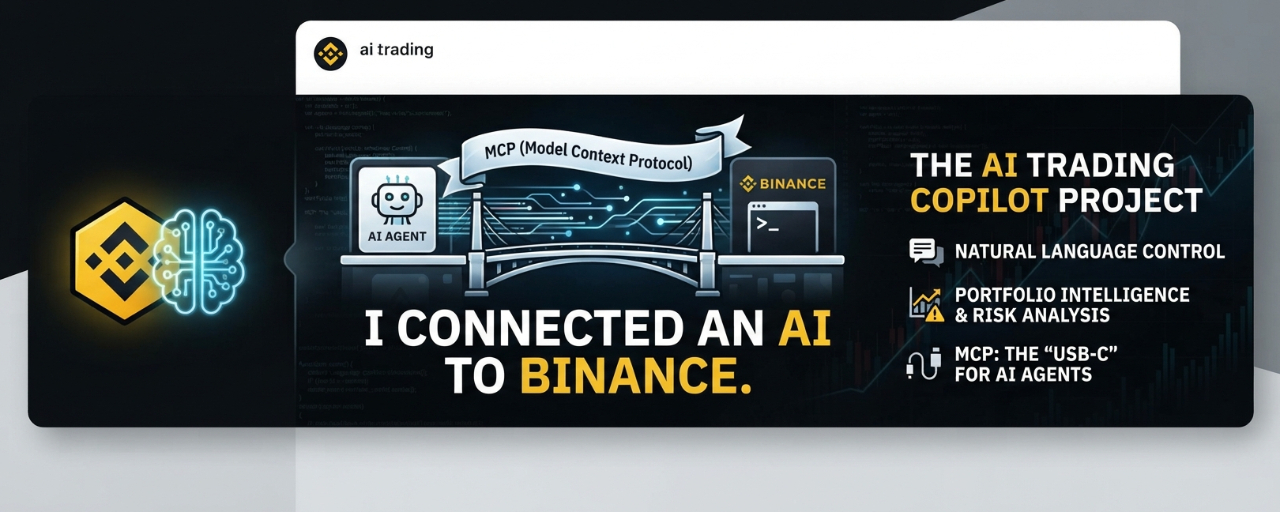
I connected an AI directly to Binance. Here's what I learned.For the past few weeks, I've been building a project: an AI Trading Copilot connected to Binance Agent OS via MCP. Trading terminal, portfolio dashboard, and market intelligence—all controllable using natural language.
A quick reminder for those unfamiliar: MCP (Model Context Protocol) is basically the USB-C port for AI agents. Previously, each AI had to have a custom-built connector for each service. With MCP, a server exposes its capabilities once, and any compatible agent can connect to it. Binance has published its own: agent.binance.com/mcp/agentic.
What this really changes:
The AI doesn't "predict" the market. Forget about it. What it does well is something else entirely—and it's underrated:
It reads your portfolio and tells you what you refuse to see (your "diversification" in 8 altcoins that all move together, for example).It transforms "show me my worst trades of the month and why" into a 3-second query instead of a Sunday spreadsheet.It monitors tirelessly, without ego, without FOMO at 3 a.m.
The 3 lessons I learned from the build:
Demo mode isn't optional; it's the product. My app starts with TRADING_ENABLED=false by default. An AI agent with access to real orders from the first line of code is like learning to drive on the highway. The real work isn't the model; it's the context. A brilliant AI with bad portfolio data gives bad advice with perfect confidence. 80% of my time is spent on the data layer.UX decides everything. Nobody wants to chat with their wallet for 20 minutes. The right interface is a dashboard that responds, not a chatbot that displays charts.
The next crypto wave won't be "an AI that trades for you." It will be "an AI that stops you from making the mistake you were about to make."
I'm documenting the entire build here. Want to see more? Tell me which part interests you: the architecture, the MCP, or the UX.
#AI #Binance #mcp #BuildInPublic #Web3
I connected an AI directly to Binance. Here's what I learned.
For the past few weeks, I've been building a project: an AI Trading Copilot connected to Binance Agent OS via MCP. Trading terminal, portfolio dashboard, and market intelligence—all controllable using natural language.
A quick reminder for those unfamiliar: MCP (Model Context Protocol) is basically the USB-C port for AI agents. Previously, each AI had to have a custom-built connector for each service. With MCP, a server exposes its capabilities once, and any compatible agent can connect to it. Binance has published its own: agent.binance.com/mcp/agentic.
What this really changes:
The AI doesn't "predict" the market. Forget about it. What it does well is something else entirely—and it's underrated:
It reads your portfolio and tells you what you refuse to see (your "diversification" in 8 altcoins that all move together, for example).It transforms "show me my worst trades of the month and why" into a 3-second query instead of a Sunday spreadsheet.It monitors tirelessly, without ego, without FOMO at 3 a.m.
The 3 lessons I learned from the build:
Demo mode isn't optional; it's the product. My app starts with TRADING_ENABLED=false by default. An AI agent with access to real orders from the first line of code is like learning to drive on the highway. The real work isn't the model; it's the context. A brilliant AI with bad portfolio data gives bad advice with perfect confidence. 80% of my time is spent on the data layer.UX decides everything. Nobody wants to chat with their wallet for 20 minutes. The right interface is a dashboard that responds, not a chatbot that displays charts.
The next crypto wave won't be "an AI that trades for you." It will be "an AI that stops you from making the mistake you were about to make."
I'm documenting the entire build here. Want to see more? Tell me which part interests you: the architecture, the MCP, or the UX.
#AI #Binance #mcp #BuildInPublic #Web3
A quick reminder for those unfamiliar: MCP (Model Context Protocol) is basically the USB-C port for AI agents. Previously, each AI had to have a custom-built connector for each service. With MCP, a server exposes its capabilities once, and any compatible agent can connect to it. Binance has published its own: agent.binance.com/mcp/agentic.
What this really changes:
The AI doesn't "predict" the market. Forget about it. What it does well is something else entirely—and it's underrated:
It reads your portfolio and tells you what you refuse to see (your "diversification" in 8 altcoins that all move together, for example).It transforms "show me my worst trades of the month and why" into a 3-second query instead of a Sunday spreadsheet.It monitors tirelessly, without ego, without FOMO at 3 a.m.
The 3 lessons I learned from the build:
Demo mode isn't optional; it's the product. My app starts with TRADING_ENABLED=false by default. An AI agent with access to real orders from the first line of code is like learning to drive on the highway. The real work isn't the model; it's the context. A brilliant AI with bad portfolio data gives bad advice with perfect confidence. 80% of my time is spent on the data layer.UX decides everything. Nobody wants to chat with their wallet for 20 minutes. The right interface is a dashboard that responds, not a chatbot that displays charts.
The next crypto wave won't be "an AI that trades for you." It will be "an AI that stops you from making the mistake you were about to make."
I'm documenting the entire build here. Want to see more? Tell me which part interests you: the architecture, the MCP, or the UX.
#AI #Binance #mcp #BuildInPublic #Web3
1
89

Innovation Crypto : Qu'est-ce que le Model Context Protocol (MCP) ?
🧠 MCP : Le pont entre l'Intelligence Artificielle et le Web3
Avec le développement de Binance Agent OS, un terme revient en force : le MCP (Model Context Protocol).
🌐 Pourquoi est-ce une révolution ?
Le MCP permet aux grands modèles de langage (LLM) de lire en temps réel des données de marché complexes.
Il permet à l'IA d'interagir directement avec la blockchain via des sous-comptes sécurisés.
L'utilisateur conserve un contrôle strict : retraits bloqués, limites d'exposition et validation d'ordres.
L'exécution d'analyses et de stratégies Spot assistée par IA devient accessible à tous.
Pensez-vous que l'IA va surpasser le trading manuel dans les prochaines années ?
#BinanceAgentOS #MCP #AI #CryptoTech #Web3
Innovation Crypto : Qu'est-ce que le Model Context Protocol (MCP) ?
🧠 MCP : Le pont entre l'Intelligence Artificielle et le Web3
Avec le développement de Binance Agent OS, un terme revient en force : le MCP (Model Context Protocol).
🌐 Pourquoi est-ce une révolution ?
Le MCP permet aux grands modèles de langage (LLM) de lire en temps réel des données de marché complexes.
Il permet à l'IA d'interagir directement avec la blockchain via des sous-comptes sécurisés.
L'utilisateur conserve un contrôle strict : retraits bloqués, limites d'exposition et validation d'ordres.
L'exécution d'analyses et de stratégies Spot assistée par IA devient accessible à tous.
Pensez-vous que l'IA va surpasser le trading manuel dans les prochaines années ?
#BinanceAgentOS #MCP #AI #CryptoTech #Web3
🧠 MCP : Le pont entre l'Intelligence Artificielle et le Web3
Avec le développement de Binance Agent OS, un terme revient en force : le MCP (Model Context Protocol).
🌐 Pourquoi est-ce une révolution ?
Le MCP permet aux grands modèles de langage (LLM) de lire en temps réel des données de marché complexes.
Il permet à l'IA d'interagir directement avec la blockchain via des sous-comptes sécurisés.
L'utilisateur conserve un contrôle strict : retraits bloqués, limites d'exposition et validation d'ordres.
L'exécution d'analyses et de stratégies Spot assistée par IA devient accessible à tous.
Pensez-vous que l'IA va surpasser le trading manuel dans les prochaines années ?
#BinanceAgentOS #MCP #AI #CryptoTech #Web3
32
·
--
Article
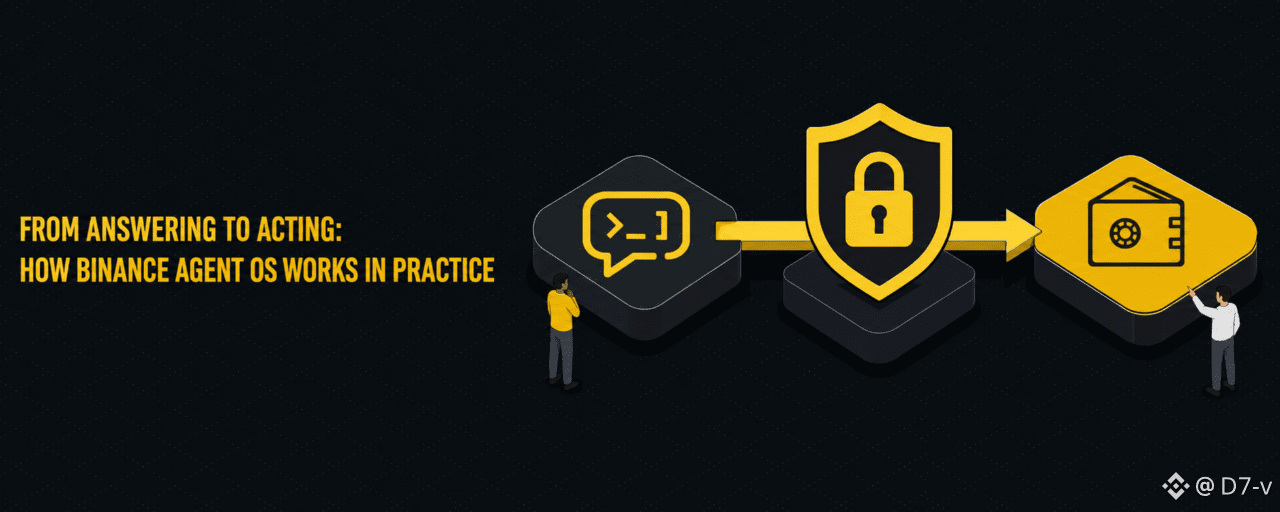
From Answering to Acting: How Binance Agent OS Works in PracticeAsk an AI chatbot what Bitcoin is trading at, and it will answer. Ask it to actually buy some — safely, inside limits you control, with a paper trail — and until recently, that was where the conversation stopped. Binance Agent OS closes that gap. It's the infrastructure that turns an AI agent from a talker into a doer, letting tools like Claude, Cursor, and ChatGPT read live Binance market data and place real trades through a standardized, auditable connection called MCP.
This isn't a future roadmap item. It's live, and it works in a specific, observable way: an agent connects, you grant it scopes, it reads markets freely, and it asks permission before it touches a single dollar. That combination — real capability plus real guardrails — is what turns "AI agent" from a buzzword into something you can actually trust with a slice of your portfolio.
Why This Matters for the Agent Era
AI agents are moving out of chat windows and into workflows: booking travel, managing calendars, writing code, and now, trading crypto. The missing piece was always a safe, standardized way for an agent to act on a financial platform without either (a) handing it raw API keys and hoping for the best, or (b) locking it out of anything useful.
Binance Agent OS solves this by packaging Binance's trading and market-data infrastructure behind the Model Context Protocol (MCP) — an open standard that lets AI applications discover and use external tools in a structured way. Instead of every developer building a custom Binance integration for their AI agent, MCP gives any compatible client (Claude Code, Cursor, ChatGPT, Codex) a single, standardized doorway in.
For anyone tracking where crypto and AI are converging, this is a meaningful signal: exchanges are no longer just building APIs for developers — they're building permission systems for autonomous agents. That shift matters for traders, developers, and anyone thinking about the next phase of automated finance.
The Building Blocks: MCP, Sub-Accounts, and Scopes
Before looking at a real session, it helps to understand the three pieces that make Agent OS work.
1. The MCP Server
The Binance MCP Server is the connection layer. It's a single endpoint (https://agent.binance.com/mcp/agentic) that any MCP-compatible AI client can attach to over HTTP. Once connected, the AI can discover which Binance tools it's allowed to use — market data, account info, trading, transfers — without the user ever pasting an API key into a chat window.
2. The Agentic Sub-Account
This is the safety perimeter. Rather than granting an AI access to your main Binance account, Agent OS creates a dedicated Agentic sub-account — a fully isolated wallet that starts empty. You manually transfer funds into it from your main account; the agent itself can never pull money in from outside. If something goes wrong, the blast radius is limited to whatever you funded that sub-account with.
3. Permission Scopes
You decide exactly what the agent can do, choosing from four scopes:
Market data — public, read-only, no authentication required (tickers, order books, candlesticks, funding rates)Account — view Agentic sub-account balances, positions, and bills, plus an optional read-only view of your main accountTrade — spot, margin, convert, USDⓈ-M and COIN-M futures, limited to what you grant and what your account is authorized forTransfer — move funds between wallets inside the same Agentic sub-account (e.g., Spot to Futures)
Notably, there is no withdrawal scope. An agent connected through Binance Agent OS can never move funds to an external address — a hard boundary that Binance built in by design.
Step-by-Step: Connecting an AI Agent to Binance
Here's what actually happens when you set this up, using Claude Code as an example (Cursor and ChatGPT follow the same pattern with client-specific steps):
Add the MCP server. In your terminal, run: claude mcp add binance-mcp-server --transport http https://agent.binance.com/mcp/agenticOpen the MCP menu. Type /mcp in your agent environment to list connected servers, including binance-mcp-server.Authenticate. Select the server and choose "Authenticate" — your browser opens a Binance login and authorization page.Choose your agent and set permissions. Pick which AI agent you're connecting, then toggle exactly which scopes and products it can access. Anything left off stays inaccessible until you turn it on.Fund the Agentic sub-account. Go to Profile → Dashboard → Sub-account → Asset Management → Transfer, and move in only what you're comfortable letting the agent trade.
Binance is explicit on one safety point: never paste the MCP endpoint into an AI chat and ask it to "install" the server, and never open the endpoint directly in a browser. Follow the client-specific setup steps instead — this avoids phishing-style misuse of the connection URL.
A Real Session: Market Data, Balances, and a Confirmed Trade
This is where Agent OS moves from concept to something you can watch happen. A typical session looks like this:
Step 1 — Check the market (read-only, runs instantly):
"What's BTCUSDT trading at, and how's it moved over 24h?"
The agent calls the market-data tool and returns live price and 24-hour change. No confirmation needed — reads never touch your balance.
Step 2 — Check your balance:
"What do I have in my Agentic account?"
The agent reads sub-account balances across Spot, Margin, and Futures wallets.
Step 3 — Place a trade (write action — confirmation required):
"Buy $100 of BNB at market on spot."
The agent restates the full order — symbol, side, order type, amount — and waits for explicit approval before submitting anything. This is the step where real funds move, and Binance's design forces a human checkpoint here every time.
Step 4 — Verify the result:
"Did that fill? What's my BNB balance now?"
The agent checks order status and the updated balance, closing the loop.
This confirm-before-execute pattern applies to every non-read action: new orders, cancellations, and internal transfers between sub-account wallets. The agent can analyze and recommend freely, but it can't spend without a "yes."
The Guardrails That Make This Auditable
What separates Binance Agent OS from a risky "give the bot your keys" setup is the layered control system:
Scope-based permissions you can adjust anytime (disconnect and reconnect to change what's granted)Sub-account isolation, so trading never touches your main holdings or personal data like KYC details or emailNo withdrawal scope, ever — funds can move between wallets inside the sub-account but never leave to an external addressConfirm-before-execute on every trade, cancel, and transferDisconnect agents at any time from Profile → Dashboard → Sub-account → Account ManagementEmergency stop — a single action that disconnects all connected agents and cancels every open spot, margin, and futures order in that Agentic account
Binance also monitors trading activity that flows through Agent OS and applies its standard exchange-level controls to resulting orders, while the agent's underlying reasoning and external data sources stay inside the AI application itself.
What Agent OS Can't Do (Yet)
It's worth being clear-eyed about current limits. The MCP server today covers market data plus Spot, Margin, Convert, and Futures trading. Payment settlement (via Binance's x402 programmable payments) and broader on-chain wallet actions are part of the wider Agent OS toolkit but are not yet fully wired into the MCP layer — they're accessed through separate Binance APIs and the Wallet Agentic Hub for now. This is a phased rollout, not a finished product, and Binance has signaled more capability is coming.
Key Takeaways
Binance Agent OS connects MCP-compatible AI agents (Claude, Cursor, ChatGPT, Codex) directly to Binance market data and trading functions.All agent activity happens inside an isolated Agentic sub-account that you fund manually — the agent can never pull money from your main account.Access is scope-based: Market data, Account, Trade, and Transfer — you choose what's enabled.There is no withdrawal scope, and every trade, cancel, or transfer requires your explicit confirmation.An emergency stop button lets you instantly disconnect agents and cancel all open positions in the sub-account.Payments and on-chain features are still expanding beyond the initial MCP release.
FAQ
What is Binance Agent OS?
It's Binance's developer platform that connects AI applications and agents to Binance's trading, market-data, wallet, and payment infrastructure, using the Model Context Protocol (MCP) as the standardized connection layer.
Which AI tools work with Binance Agent OS?
Any MCP-compatible client over Streamable HTTP, including Claude Code, Claude Desktop, ChatGPT, Codex, Cursor, and VS Code-based agents.
Can an AI agent withdraw my funds?
No. The Binance MCP Server has no withdrawal scope. Agents can trade and transfer funds between wallets inside the Agentic sub-account only, never to an external address.
Do I need to give the AI my Binance API keys?
No. Authentication happens through a Binance login and authorization flow in your browser — no local API key management is required.
Is every trade automatic once I connect an agent?
No. Every trade, cancellation, or internal transfer requires you to confirm the specific order details before it's submitted.
What happens if I want to stop an agent immediately?
Use the "Emergency stop" control in Sub-account → Account Management. It disconnects all agents and cancels all open spot, margin, and futures orders in that account in one step.
#BinanceAgentOS #MCP #AIAgents #CryptoTrading #Binance
From Answering to Acting: How Binance Agent OS Works in Practice
Ask an AI chatbot what Bitcoin is trading at, and it will answer. Ask it to actually buy some — safely, inside limits you control, with a paper trail — and until recently, that was where the conversation stopped. Binance Agent OS closes that gap. It's the infrastructure that turns an AI agent from a talker into a doer, letting tools like Claude, Cursor, and ChatGPT read live Binance market data and place real trades through a standardized, auditable connection called MCP.
This isn't a future roadmap item. It's live, and it works in a specific, observable way: an agent connects, you grant it scopes, it reads markets freely, and it asks permission before it touches a single dollar. That combination — real capability plus real guardrails — is what turns "AI agent" from a buzzword into something you can actually trust with a slice of your portfolio.
Why This Matters for the Agent Era
AI agents are moving out of chat windows and into workflows: booking travel, managing calendars, writing code, and now, trading crypto. The missing piece was always a safe, standardized way for an agent to act on a financial platform without either (a) handing it raw API keys and hoping for the best, or (b) locking it out of anything useful.
Binance Agent OS solves this by packaging Binance's trading and market-data infrastructure behind the Model Context Protocol (MCP) — an open standard that lets AI applications discover and use external tools in a structured way. Instead of every developer building a custom Binance integration for their AI agent, MCP gives any compatible client (Claude Code, Cursor, ChatGPT, Codex) a single, standardized doorway in.
For anyone tracking where crypto and AI are converging, this is a meaningful signal: exchanges are no longer just building APIs for developers — they're building permission systems for autonomous agents. That shift matters for traders, developers, and anyone thinking about the next phase of automated finance.
The Building Blocks: MCP, Sub-Accounts, and Scopes
Before looking at a real session, it helps to understand the three pieces that make Agent OS work.
1. The MCP Server
The Binance MCP Server is the connection layer. It's a single endpoint (https://agent.binance.com/mcp/agentic) that any MCP-compatible AI client can attach to over HTTP. Once connected, the AI can discover which Binance tools it's allowed to use — market data, account info, trading, transfers — without the user ever pasting an API key into a chat window.
2. The Agentic Sub-Account
This is the safety perimeter. Rather than granting an AI access to your main Binance account, Agent OS creates a dedicated Agentic sub-account — a fully isolated wallet that starts empty. You manually transfer funds into it from your main account; the agent itself can never pull money in from outside. If something goes wrong, the blast radius is limited to whatever you funded that sub-account with.
3. Permission Scopes
You decide exactly what the agent can do, choosing from four scopes:
Market data — public, read-only, no authentication required (tickers, order books, candlesticks, funding rates)Account — view Agentic sub-account balances, positions, and bills, plus an optional read-only view of your main accountTrade — spot, margin, convert, USDⓈ-M and COIN-M futures, limited to what you grant and what your account is authorized forTransfer — move funds between wallets inside the same Agentic sub-account (e.g., Spot to Futures)
Notably, there is no withdrawal scope. An agent connected through Binance Agent OS can never move funds to an external address — a hard boundary that Binance built in by design.
Step-by-Step: Connecting an AI Agent to Binance
Here's what actually happens when you set this up, using Claude Code as an example (Cursor and ChatGPT follow the same pattern with client-specific steps):
Add the MCP server. In your terminal, run: claude mcp add binance-mcp-server --transport http https://agent.binance.com/mcp/agenticOpen the MCP menu. Type /mcp in your agent environment to list connected servers, including binance-mcp-server.Authenticate. Select the server and choose "Authenticate" — your browser opens a Binance login and authorization page.Choose your agent and set permissions. Pick which AI agent you're connecting, then toggle exactly which scopes and products it can access. Anything left off stays inaccessible until you turn it on.Fund the Agentic sub-account. Go to Profile → Dashboard → Sub-account → Asset Management → Transfer, and move in only what you're comfortable letting the agent trade.
Binance is explicit on one safety point: never paste the MCP endpoint into an AI chat and ask it to "install" the server, and never open the endpoint directly in a browser. Follow the client-specific setup steps instead — this avoids phishing-style misuse of the connection URL.
A Real Session: Market Data, Balances, and a Confirmed Trade
This is where Agent OS moves from concept to something you can watch happen. A typical session looks like this:
Step 1 — Check the market (read-only, runs instantly):
"What's BTCUSDT trading at, and how's it moved over 24h?"
The agent calls the market-data tool and returns live price and 24-hour change. No confirmation needed — reads never touch your balance.
Step 2 — Check your balance:
"What do I have in my Agentic account?"
The agent reads sub-account balances across Spot, Margin, and Futures wallets.
Step 3 — Place a trade (write action — confirmation required):
"Buy $100 of BNB at market on spot."
The agent restates the full order — symbol, side, order type, amount — and waits for explicit approval before submitting anything. This is the step where real funds move, and Binance's design forces a human checkpoint here every time.
Step 4 — Verify the result:
"Did that fill? What's my BNB balance now?"
The agent checks order status and the updated balance, closing the loop.
This confirm-before-execute pattern applies to every non-read action: new orders, cancellations, and internal transfers between sub-account wallets. The agent can analyze and recommend freely, but it can't spend without a "yes."
The Guardrails That Make This Auditable
What separates Binance Agent OS from a risky "give the bot your keys" setup is the layered control system:
Scope-based permissions you can adjust anytime (disconnect and reconnect to change what's granted)Sub-account isolation, so trading never touches your main holdings or personal data like KYC details or emailNo withdrawal scope, ever — funds can move between wallets inside the sub-account but never leave to an external addressConfirm-before-execute on every trade, cancel, and transferDisconnect agents at any time from Profile → Dashboard → Sub-account → Account ManagementEmergency stop — a single action that disconnects all connected agents and cancels every open spot, margin, and futures order in that Agentic account
Binance also monitors trading activity that flows through Agent OS and applies its standard exchange-level controls to resulting orders, while the agent's underlying reasoning and external data sources stay inside the AI application itself.
What Agent OS Can't Do (Yet)
It's worth being clear-eyed about current limits. The MCP server today covers market data plus Spot, Margin, Convert, and Futures trading. Payment settlement (via Binance's x402 programmable payments) and broader on-chain wallet actions are part of the wider Agent OS toolkit but are not yet fully wired into the MCP layer — they're accessed through separate Binance APIs and the Wallet Agentic Hub for now. This is a phased rollout, not a finished product, and Binance has signaled more capability is coming.
Key Takeaways
Binance Agent OS connects MCP-compatible AI agents (Claude, Cursor, ChatGPT, Codex) directly to Binance market data and trading functions.All agent activity happens inside an isolated Agentic sub-account that you fund manually — the agent can never pull money from your main account.Access is scope-based: Market data, Account, Trade, and Transfer — you choose what's enabled.There is no withdrawal scope, and every trade, cancel, or transfer requires your explicit confirmation.An emergency stop button lets you instantly disconnect agents and cancel all open positions in the sub-account.Payments and on-chain features are still expanding beyond the initial MCP release.
FAQ
What is Binance Agent OS?
It's Binance's developer platform that connects AI applications and agents to Binance's trading, market-data, wallet, and payment infrastructure, using the Model Context Protocol (MCP) as the standardized connection layer.
Which AI tools work with Binance Agent OS?
Any MCP-compatible client over Streamable HTTP, including Claude Code, Claude Desktop, ChatGPT, Codex, Cursor, and VS Code-based agents.
Can an AI agent withdraw my funds?
No. The Binance MCP Server has no withdrawal scope. Agents can trade and transfer funds between wallets inside the Agentic sub-account only, never to an external address.
Do I need to give the AI my Binance API keys?
No. Authentication happens through a Binance login and authorization flow in your browser — no local API key management is required.
Is every trade automatic once I connect an agent?
No. Every trade, cancellation, or internal transfer requires you to confirm the specific order details before it's submitted.
What happens if I want to stop an agent immediately?
Use the "Emergency stop" control in Sub-account → Account Management. It disconnects all agents and cancels all open spot, margin, and futures orders in that account in one step.
#BinanceAgentOS #MCP #AIAgents #CryptoTrading #Binance
This isn't a future roadmap item. It's live, and it works in a specific, observable way: an agent connects, you grant it scopes, it reads markets freely, and it asks permission before it touches a single dollar. That combination — real capability plus real guardrails — is what turns "AI agent" from a buzzword into something you can actually trust with a slice of your portfolio.
Why This Matters for the Agent Era
AI agents are moving out of chat windows and into workflows: booking travel, managing calendars, writing code, and now, trading crypto. The missing piece was always a safe, standardized way for an agent to act on a financial platform without either (a) handing it raw API keys and hoping for the best, or (b) locking it out of anything useful.
Binance Agent OS solves this by packaging Binance's trading and market-data infrastructure behind the Model Context Protocol (MCP) — an open standard that lets AI applications discover and use external tools in a structured way. Instead of every developer building a custom Binance integration for their AI agent, MCP gives any compatible client (Claude Code, Cursor, ChatGPT, Codex) a single, standardized doorway in.
For anyone tracking where crypto and AI are converging, this is a meaningful signal: exchanges are no longer just building APIs for developers — they're building permission systems for autonomous agents. That shift matters for traders, developers, and anyone thinking about the next phase of automated finance.
The Building Blocks: MCP, Sub-Accounts, and Scopes
Before looking at a real session, it helps to understand the three pieces that make Agent OS work.
1. The MCP Server
The Binance MCP Server is the connection layer. It's a single endpoint (https://agent.binance.com/mcp/agentic) that any MCP-compatible AI client can attach to over HTTP. Once connected, the AI can discover which Binance tools it's allowed to use — market data, account info, trading, transfers — without the user ever pasting an API key into a chat window.
2. The Agentic Sub-Account
This is the safety perimeter. Rather than granting an AI access to your main Binance account, Agent OS creates a dedicated Agentic sub-account — a fully isolated wallet that starts empty. You manually transfer funds into it from your main account; the agent itself can never pull money in from outside. If something goes wrong, the blast radius is limited to whatever you funded that sub-account with.
3. Permission Scopes
You decide exactly what the agent can do, choosing from four scopes:
Market data — public, read-only, no authentication required (tickers, order books, candlesticks, funding rates)Account — view Agentic sub-account balances, positions, and bills, plus an optional read-only view of your main accountTrade — spot, margin, convert, USDⓈ-M and COIN-M futures, limited to what you grant and what your account is authorized forTransfer — move funds between wallets inside the same Agentic sub-account (e.g., Spot to Futures)
Notably, there is no withdrawal scope. An agent connected through Binance Agent OS can never move funds to an external address — a hard boundary that Binance built in by design.
Step-by-Step: Connecting an AI Agent to Binance
Here's what actually happens when you set this up, using Claude Code as an example (Cursor and ChatGPT follow the same pattern with client-specific steps):
Add the MCP server. In your terminal, run: claude mcp add binance-mcp-server --transport http https://agent.binance.com/mcp/agenticOpen the MCP menu. Type /mcp in your agent environment to list connected servers, including binance-mcp-server.Authenticate. Select the server and choose "Authenticate" — your browser opens a Binance login and authorization page.Choose your agent and set permissions. Pick which AI agent you're connecting, then toggle exactly which scopes and products it can access. Anything left off stays inaccessible until you turn it on.Fund the Agentic sub-account. Go to Profile → Dashboard → Sub-account → Asset Management → Transfer, and move in only what you're comfortable letting the agent trade.
Binance is explicit on one safety point: never paste the MCP endpoint into an AI chat and ask it to "install" the server, and never open the endpoint directly in a browser. Follow the client-specific setup steps instead — this avoids phishing-style misuse of the connection URL.
A Real Session: Market Data, Balances, and a Confirmed Trade
This is where Agent OS moves from concept to something you can watch happen. A typical session looks like this:
Step 1 — Check the market (read-only, runs instantly):
"What's BTCUSDT trading at, and how's it moved over 24h?"
The agent calls the market-data tool and returns live price and 24-hour change. No confirmation needed — reads never touch your balance.
Step 2 — Check your balance:
"What do I have in my Agentic account?"
The agent reads sub-account balances across Spot, Margin, and Futures wallets.
Step 3 — Place a trade (write action — confirmation required):
"Buy $100 of BNB at market on spot."
The agent restates the full order — symbol, side, order type, amount — and waits for explicit approval before submitting anything. This is the step where real funds move, and Binance's design forces a human checkpoint here every time.
Step 4 — Verify the result:
"Did that fill? What's my BNB balance now?"
The agent checks order status and the updated balance, closing the loop.
This confirm-before-execute pattern applies to every non-read action: new orders, cancellations, and internal transfers between sub-account wallets. The agent can analyze and recommend freely, but it can't spend without a "yes."
The Guardrails That Make This Auditable
What separates Binance Agent OS from a risky "give the bot your keys" setup is the layered control system:
Scope-based permissions you can adjust anytime (disconnect and reconnect to change what's granted)Sub-account isolation, so trading never touches your main holdings or personal data like KYC details or emailNo withdrawal scope, ever — funds can move between wallets inside the sub-account but never leave to an external addressConfirm-before-execute on every trade, cancel, and transferDisconnect agents at any time from Profile → Dashboard → Sub-account → Account ManagementEmergency stop — a single action that disconnects all connected agents and cancels every open spot, margin, and futures order in that Agentic account
Binance also monitors trading activity that flows through Agent OS and applies its standard exchange-level controls to resulting orders, while the agent's underlying reasoning and external data sources stay inside the AI application itself.
What Agent OS Can't Do (Yet)
It's worth being clear-eyed about current limits. The MCP server today covers market data plus Spot, Margin, Convert, and Futures trading. Payment settlement (via Binance's x402 programmable payments) and broader on-chain wallet actions are part of the wider Agent OS toolkit but are not yet fully wired into the MCP layer — they're accessed through separate Binance APIs and the Wallet Agentic Hub for now. This is a phased rollout, not a finished product, and Binance has signaled more capability is coming.
Key Takeaways
Binance Agent OS connects MCP-compatible AI agents (Claude, Cursor, ChatGPT, Codex) directly to Binance market data and trading functions.All agent activity happens inside an isolated Agentic sub-account that you fund manually — the agent can never pull money from your main account.Access is scope-based: Market data, Account, Trade, and Transfer — you choose what's enabled.There is no withdrawal scope, and every trade, cancel, or transfer requires your explicit confirmation.An emergency stop button lets you instantly disconnect agents and cancel all open positions in the sub-account.Payments and on-chain features are still expanding beyond the initial MCP release.
FAQ
What is Binance Agent OS?
It's Binance's developer platform that connects AI applications and agents to Binance's trading, market-data, wallet, and payment infrastructure, using the Model Context Protocol (MCP) as the standardized connection layer.
Which AI tools work with Binance Agent OS?
Any MCP-compatible client over Streamable HTTP, including Claude Code, Claude Desktop, ChatGPT, Codex, Cursor, and VS Code-based agents.
Can an AI agent withdraw my funds?
No. The Binance MCP Server has no withdrawal scope. Agents can trade and transfer funds between wallets inside the Agentic sub-account only, never to an external address.
Do I need to give the AI my Binance API keys?
No. Authentication happens through a Binance login and authorization flow in your browser — no local API key management is required.
Is every trade automatic once I connect an agent?
No. Every trade, cancellation, or internal transfer requires you to confirm the specific order details before it's submitted.
What happens if I want to stop an agent immediately?
Use the "Emergency stop" control in Sub-account → Account Management. It disconnects all agents and cancels all open spot, margin, and futures orders in that account in one step.
#BinanceAgentOS #MCP #AIAgents #CryptoTrading #Binance
1
145
·
--
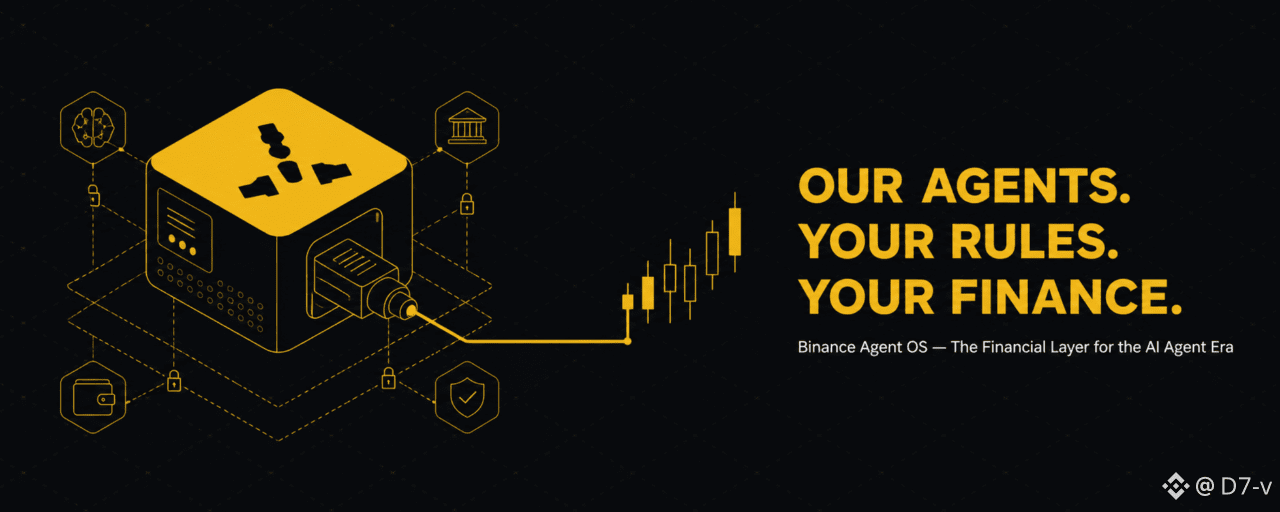
Article
Our Agents, Your Rules, Your Finance: Why Binance Is Building the Financial Layer for the AI AgentAI Agents Are Done Just Answering Questions
For the last few years, AI has mostly lived in a chat box. You ask, it answers. But that era is quietly ending. AI agents are now writing code, booking flights, managing calendars, and — increasingly — touching real money. The moment software starts acting instead of just responding, it needs a way to reach financial markets the same way a human trader does: reading prices, checking balances, and executing trades.
That shift is exactly what Binance Agent OS is built for. Launched August 20, 2026 as part of Binance Intelligence, Agent OS is a developer platform designed to be the financial capability layer for AI agents, letting tools like ChatGPT, Claude Code, Codex, and VS Code connect directly to Binance's markets, wallets, and trading infrastructure under permissions the user controls.
What Is Binance Agent OS?
Binance Agent OS isn't a single product — it's a toolkit that bundles several existing pieces of Binance's infrastructure into one coherent access layer for AI:
Binance APIs — the trading and account infrastructure Binance has offered developers for yearsBinance Wallet Agentic Hub — agent-facing wallet operationsBinance x402 — a programmable payments layer for machine-to-machine settlementBinance Skill Hub — a curated library of ready-made agent skillsMCP Server support — the new piece that ties everything together
Think of Agent OS as Binance's "universal socket" for AI agents — instead of every developer building a custom integration to talk to Binance, they plug into one standardized layer.
The MCP Connection: How AI Agents "Plug Into" Binance
This launch centers on the Model Context Protocol (MCP) — an open standard already adopted by major AI players like OpenAI, Google, Microsoft, and AWS to let AI applications discover and use external tools. MCP is what makes it possible for an AI running inside Claude Code or ChatGPT to say "check the BTC order book" or "place a spot order" without a developer hardcoding that specific request.
Binance's implementation is called the Binance MCP Server, reachable at a single endpoint: https://agent.binance.com/mcp/agentic. Any MCP-compatible client that supports Streamable HTTP can connect to it. Binance's own support docs name five:
ChatGPT (via plugin)Claude CodeClaudeCodexVS Code
(Binance's press release names Cursor instead of VS Code in the same slot — the two official write-ups don't fully agree, a sign the supported-client list is still settling post-launch. )
Once connected, the agent doesn't need users to manage API keys locally — authentication happens through the Binance account itself, and the user grants specific scopes of access.
What an AI Agent Can Actually Do (And Can't)
This is where Binance's design gets interesting — and where "your rules" stops being a marketing line and starts being a technical one. According to Binance's own documentation, once a user authorizes an agent, they can grant it scopes to:
Read market data — tickers, order books, candlesticks, and funding rates, with no authentication requiredCheck balances — view Agentic sub-account balances, positions, and bills, plus an optional read-only view of the main accountTrade — access Spot, Margin, Convert, USDⓈ-M Futures, and COIN-M Futures functions, depending on granted scopesTransfer — move funds between wallets inside the Agentic sub-account (e.g., Spot to Futures)
Just as important is what agents cannot do. Binance has explicitly built in guardrails:
Agents cannot withdraw funds to external addressesAgents cannot transfer assets from a user's main account into the Agentic sub-account directlyAgents cannot access non-trading personal account data like email addresses or KYC information
Beyond crypto, Binance describes Agent OS as spanning "crypto and traditional markets." The clearest on-ramp for that today is bStocks, Binance's tokenized-stock product, which had just passed $500 million in assets under management around the same time. Binance hasn't published which stocks or how many are covered under Agent OS specifically — so read "broader markets" as a stated direction, not a finalized catalog.
Why User-Controlled Permissions Matter
Handing an AI agent access to your trading account sounds risky — and it can be, if done carelessly. Binance's architecture addresses this through dedicated Agentic sub-accounts. Every agent operates inside its own segregated sub-account, not your main wallet, with:
No withdrawal scope built into the integration at all — an agent cannot send funds to an external address, full stopNo path to pull money out of your main account either — you have to manually transfer funds into the sub-account yourselfManagement handled separately from your main wallet, under Profile → Sub-Accounts → Account Management
This matters because it separates capability from exposure. An agent might technically be able to trade futures, but it can only touch the funds you deliberately deposited into that isolated sub-account — not your entire portfolio. (Binance's public materials don't spell out granular per-toggle permission controls or daily spending caps beyond this structural isolation — worth confirming directly in your account settings before funding an agent.)
Practical Example: Connecting an Agent in Claude Code
Binance's own instructions boil down to two things: add the MCP endpoint to a compatible client, then fund the sub-account. Layered onto Claude Code's normal way of registering an MCP server, here's what that looks like in practice:
Open your terminal and run: claude mcp add binance-mcp-server --transport http https://agent.binance.com/mcp/agenticType /mcp in Claude Code to list connected MCP servers, confirming binance-mcp-server appearsSelect the server and choose Authenticate — this redirects to a Binance login/authorization pageChoose which agent you want to connectSet granular permissions — enabling or disabling specific features and productsFund your Agentic sub-account via Profile → Dashboard → Sub-account → Asset Management → Transfer
From that point, the AI agent can read live market data and, within the permissions you set, execute trades — all traceable back to that sub-account.
Why This Matters for the AI Agent Era
The broader significance here isn't just "Binance added a chatbot feature." It's that finance is becoming a native capability for AI, not an external tool AI has to awkwardly bolt on. As Binance puts it, instead of AI just answering questions, an AI with MCP access can take actions on your behalf.
That reframes the risk conversation. It's no longer just "can the AI hallucinate a wrong answer" — it's "can the AI place a wrong trade." Binance's response is to build the plumbing so that when that moment arrives, there's an auditable, permissioned perimeter around it: scoped access, segregated funds, no external withdrawals, and monitoring on trading activity initiated through the platform.
For traders and developers experimenting with AI-driven strategies, this also lowers the technical bar significantly. Instead of writing custom integration code against Binance's REST APIs, a developer can point an MCP-compatible agent at one endpoint and get standardized access to spot, margin, futures, and convert markets.
Key Takeaways
Binance Agent OS is a developer platform connecting AI agents (ChatGPT, Claude Code, Claude, Codex, VS Code) to Binance's trading, market data, wallet, and payment infrastructure.The Binance MCP Server uses the open Model Context Protocol standard to let compatible AI clients discover and use Binance tools without managing local API keys.Agents operate inside dedicated Agentic sub-accounts isolated from the main wallet, with no withdrawal scope built into the integration at all.Supported functions include reading market data, checking balances, trading Spot/Margin/Convert/Futures, and transferring funds within the sub-account — but not external withdrawals or main-account transfers.Binance says Agent OS reaches into "traditional markets" too, with bStocks (tokenized stocks, ~$500M AUM) as the clearest on-ramp — exact stock coverage isn't published yet.
FAQ
What is Binance Agent OS?
It's a developer platform launched by Binance that lets AI applications and agents connect to Binance's trading, market data, wallet, and payment capabilities through user-controlled permissions.
What is MCP and why does Binance use it?
MCP (Model Context Protocol) is an open standard that lets AI applications discover and use external tools in a standardized way, already adopted by major AI providers. Binance uses it so agents in Claude Code, ChatGPT, or Codex can connect to Binance without custom, one-off integrations.
Can an AI agent withdraw my funds through Binance Agent OS?
No. Agents cannot withdraw crypto to external addresses, and they cannot transfer funds from your main account into the Agentic sub-account directly.
Which AI tools work with the Binance MCP Server?
Any compatible client supporting MCP over Streamable HTTP. Binance's support docs name ChatGPT, Claude Code, Claude, Codex, and VS Code; its press release names Cursor in place of VS Code — the two lists don't fully match, so check Binance's current docs for the up-to-date set.
Do I need to share my API keys with an AI agent?
No. Authentication happens through your Binance account via the MCP connection, so you don't need to manage or expose API keys locally.
What markets can an agent trade on Binance Agent OS?
Currently Spot, Margin, Convert, USDⓈ-M Futures, and COIN-M Futures, depending on the permissions granted and what your account is authorized to use.
#BinanceAgentOS #MCP #AIAgents #CryptoTrading #Binance
Our Agents, Your Rules, Your Finance: Why Binance Is Building the Financial Layer for the AI Agent
AI Agents Are Done Just Answering Questions
For the last few years, AI has mostly lived in a chat box. You ask, it answers. But that era is quietly ending. AI agents are now writing code, booking flights, managing calendars, and — increasingly — touching real money. The moment software starts acting instead of just responding, it needs a way to reach financial markets the same way a human trader does: reading prices, checking balances, and executing trades.
That shift is exactly what Binance Agent OS is built for. Launched August 20, 2026 as part of Binance Intelligence, Agent OS is a developer platform designed to be the financial capability layer for AI agents, letting tools like ChatGPT, Claude Code, Codex, and VS Code connect directly to Binance's markets, wallets, and trading infrastructure under permissions the user controls.
What Is Binance Agent OS?
Binance Agent OS isn't a single product — it's a toolkit that bundles several existing pieces of Binance's infrastructure into one coherent access layer for AI:
Binance APIs — the trading and account infrastructure Binance has offered developers for yearsBinance Wallet Agentic Hub — agent-facing wallet operationsBinance x402 — a programmable payments layer for machine-to-machine settlementBinance Skill Hub — a curated library of ready-made agent skillsMCP Server support — the new piece that ties everything together
Think of Agent OS as Binance's "universal socket" for AI agents — instead of every developer building a custom integration to talk to Binance, they plug into one standardized layer.
The MCP Connection: How AI Agents "Plug Into" Binance
This launch centers on the Model Context Protocol (MCP) — an open standard already adopted by major AI players like OpenAI, Google, Microsoft, and AWS to let AI applications discover and use external tools. MCP is what makes it possible for an AI running inside Claude Code or ChatGPT to say "check the BTC order book" or "place a spot order" without a developer hardcoding that specific request.
Binance's implementation is called the Binance MCP Server, reachable at a single endpoint: https://agent.binance.com/mcp/agentic. Any MCP-compatible client that supports Streamable HTTP can connect to it. Binance's own support docs name five:
ChatGPT (via plugin)Claude CodeClaudeCodexVS Code
(Binance's press release names Cursor instead of VS Code in the same slot — the two official write-ups don't fully agree, a sign the supported-client list is still settling post-launch. )
Once connected, the agent doesn't need users to manage API keys locally — authentication happens through the Binance account itself, and the user grants specific scopes of access.
What an AI Agent Can Actually Do (And Can't)
This is where Binance's design gets interesting — and where "your rules" stops being a marketing line and starts being a technical one. According to Binance's own documentation, once a user authorizes an agent, they can grant it scopes to:
Read market data — tickers, order books, candlesticks, and funding rates, with no authentication requiredCheck balances — view Agentic sub-account balances, positions, and bills, plus an optional read-only view of the main accountTrade — access Spot, Margin, Convert, USDⓈ-M Futures, and COIN-M Futures functions, depending on granted scopesTransfer — move funds between wallets inside the Agentic sub-account (e.g., Spot to Futures)
Just as important is what agents cannot do. Binance has explicitly built in guardrails:
Agents cannot withdraw funds to external addressesAgents cannot transfer assets from a user's main account into the Agentic sub-account directlyAgents cannot access non-trading personal account data like email addresses or KYC information
Beyond crypto, Binance describes Agent OS as spanning "crypto and traditional markets." The clearest on-ramp for that today is bStocks, Binance's tokenized-stock product, which had just passed $500 million in assets under management around the same time. Binance hasn't published which stocks or how many are covered under Agent OS specifically — so read "broader markets" as a stated direction, not a finalized catalog.
Why User-Controlled Permissions Matter
Handing an AI agent access to your trading account sounds risky — and it can be, if done carelessly. Binance's architecture addresses this through dedicated Agentic sub-accounts. Every agent operates inside its own segregated sub-account, not your main wallet, with:
No withdrawal scope built into the integration at all — an agent cannot send funds to an external address, full stopNo path to pull money out of your main account either — you have to manually transfer funds into the sub-account yourselfManagement handled separately from your main wallet, under Profile → Sub-Accounts → Account Management
This matters because it separates capability from exposure. An agent might technically be able to trade futures, but it can only touch the funds you deliberately deposited into that isolated sub-account — not your entire portfolio. (Binance's public materials don't spell out granular per-toggle permission controls or daily spending caps beyond this structural isolation — worth confirming directly in your account settings before funding an agent.)
Practical Example: Connecting an Agent in Claude Code
Binance's own instructions boil down to two things: add the MCP endpoint to a compatible client, then fund the sub-account. Layered onto Claude Code's normal way of registering an MCP server, here's what that looks like in practice:
Open your terminal and run: claude mcp add binance-mcp-server --transport http https://agent.binance.com/mcp/agenticType /mcp in Claude Code to list connected MCP servers, confirming binance-mcp-server appearsSelect the server and choose Authenticate — this redirects to a Binance login/authorization pageChoose which agent you want to connectSet granular permissions — enabling or disabling specific features and productsFund your Agentic sub-account via Profile → Dashboard → Sub-account → Asset Management → Transfer
From that point, the AI agent can read live market data and, within the permissions you set, execute trades — all traceable back to that sub-account.
Why This Matters for the AI Agent Era
The broader significance here isn't just "Binance added a chatbot feature." It's that finance is becoming a native capability for AI, not an external tool AI has to awkwardly bolt on. As Binance puts it, instead of AI just answering questions, an AI with MCP access can take actions on your behalf.
That reframes the risk conversation. It's no longer just "can the AI hallucinate a wrong answer" — it's "can the AI place a wrong trade." Binance's response is to build the plumbing so that when that moment arrives, there's an auditable, permissioned perimeter around it: scoped access, segregated funds, no external withdrawals, and monitoring on trading activity initiated through the platform.
For traders and developers experimenting with AI-driven strategies, this also lowers the technical bar significantly. Instead of writing custom integration code against Binance's REST APIs, a developer can point an MCP-compatible agent at one endpoint and get standardized access to spot, margin, futures, and convert markets.
Key Takeaways
Binance Agent OS is a developer platform connecting AI agents (ChatGPT, Claude Code, Claude, Codex, VS Code) to Binance's trading, market data, wallet, and payment infrastructure.The Binance MCP Server uses the open Model Context Protocol standard to let compatible AI clients discover and use Binance tools without managing local API keys.Agents operate inside dedicated Agentic sub-accounts isolated from the main wallet, with no withdrawal scope built into the integration at all.Supported functions include reading market data, checking balances, trading Spot/Margin/Convert/Futures, and transferring funds within the sub-account — but not external withdrawals or main-account transfers.Binance says Agent OS reaches into "traditional markets" too, with bStocks (tokenized stocks, ~$500M AUM) as the clearest on-ramp — exact stock coverage isn't published yet.
FAQ
What is Binance Agent OS?
It's a developer platform launched by Binance that lets AI applications and agents connect to Binance's trading, market data, wallet, and payment capabilities through user-controlled permissions.
What is MCP and why does Binance use it?
MCP (Model Context Protocol) is an open standard that lets AI applications discover and use external tools in a standardized way, already adopted by major AI providers. Binance uses it so agents in Claude Code, ChatGPT, or Codex can connect to Binance without custom, one-off integrations.
Can an AI agent withdraw my funds through Binance Agent OS?
No. Agents cannot withdraw crypto to external addresses, and they cannot transfer funds from your main account into the Agentic sub-account directly.
Which AI tools work with the Binance MCP Server?
Any compatible client supporting MCP over Streamable HTTP. Binance's support docs name ChatGPT, Claude Code, Claude, Codex, and VS Code; its press release names Cursor in place of VS Code — the two lists don't fully match, so check Binance's current docs for the up-to-date set.
Do I need to share my API keys with an AI agent?
No. Authentication happens through your Binance account via the MCP connection, so you don't need to manage or expose API keys locally.
What markets can an agent trade on Binance Agent OS?
Currently Spot, Margin, Convert, USDⓈ-M Futures, and COIN-M Futures, depending on the permissions granted and what your account is authorized to use.
#BinanceAgentOS #MCP #AIAgents #CryptoTrading #Binance
For the last few years, AI has mostly lived in a chat box. You ask, it answers. But that era is quietly ending. AI agents are now writing code, booking flights, managing calendars, and — increasingly — touching real money. The moment software starts acting instead of just responding, it needs a way to reach financial markets the same way a human trader does: reading prices, checking balances, and executing trades.
That shift is exactly what Binance Agent OS is built for. Launched August 20, 2026 as part of Binance Intelligence, Agent OS is a developer platform designed to be the financial capability layer for AI agents, letting tools like ChatGPT, Claude Code, Codex, and VS Code connect directly to Binance's markets, wallets, and trading infrastructure under permissions the user controls.
What Is Binance Agent OS?
Binance Agent OS isn't a single product — it's a toolkit that bundles several existing pieces of Binance's infrastructure into one coherent access layer for AI:
Binance APIs — the trading and account infrastructure Binance has offered developers for yearsBinance Wallet Agentic Hub — agent-facing wallet operationsBinance x402 — a programmable payments layer for machine-to-machine settlementBinance Skill Hub — a curated library of ready-made agent skillsMCP Server support — the new piece that ties everything together
Think of Agent OS as Binance's "universal socket" for AI agents — instead of every developer building a custom integration to talk to Binance, they plug into one standardized layer.
The MCP Connection: How AI Agents "Plug Into" Binance
This launch centers on the Model Context Protocol (MCP) — an open standard already adopted by major AI players like OpenAI, Google, Microsoft, and AWS to let AI applications discover and use external tools. MCP is what makes it possible for an AI running inside Claude Code or ChatGPT to say "check the BTC order book" or "place a spot order" without a developer hardcoding that specific request.
Binance's implementation is called the Binance MCP Server, reachable at a single endpoint: https://agent.binance.com/mcp/agentic. Any MCP-compatible client that supports Streamable HTTP can connect to it. Binance's own support docs name five:
ChatGPT (via plugin)Claude CodeClaudeCodexVS Code
(Binance's press release names Cursor instead of VS Code in the same slot — the two official write-ups don't fully agree, a sign the supported-client list is still settling post-launch. )
Once connected, the agent doesn't need users to manage API keys locally — authentication happens through the Binance account itself, and the user grants specific scopes of access.
What an AI Agent Can Actually Do (And Can't)
This is where Binance's design gets interesting — and where "your rules" stops being a marketing line and starts being a technical one. According to Binance's own documentation, once a user authorizes an agent, they can grant it scopes to:
Read market data — tickers, order books, candlesticks, and funding rates, with no authentication requiredCheck balances — view Agentic sub-account balances, positions, and bills, plus an optional read-only view of the main accountTrade — access Spot, Margin, Convert, USDⓈ-M Futures, and COIN-M Futures functions, depending on granted scopesTransfer — move funds between wallets inside the Agentic sub-account (e.g., Spot to Futures)
Just as important is what agents cannot do. Binance has explicitly built in guardrails:
Agents cannot withdraw funds to external addressesAgents cannot transfer assets from a user's main account into the Agentic sub-account directlyAgents cannot access non-trading personal account data like email addresses or KYC information
Beyond crypto, Binance describes Agent OS as spanning "crypto and traditional markets." The clearest on-ramp for that today is bStocks, Binance's tokenized-stock product, which had just passed $500 million in assets under management around the same time. Binance hasn't published which stocks or how many are covered under Agent OS specifically — so read "broader markets" as a stated direction, not a finalized catalog.
Why User-Controlled Permissions Matter
Handing an AI agent access to your trading account sounds risky — and it can be, if done carelessly. Binance's architecture addresses this through dedicated Agentic sub-accounts. Every agent operates inside its own segregated sub-account, not your main wallet, with:
No withdrawal scope built into the integration at all — an agent cannot send funds to an external address, full stopNo path to pull money out of your main account either — you have to manually transfer funds into the sub-account yourselfManagement handled separately from your main wallet, under Profile → Sub-Accounts → Account Management
This matters because it separates capability from exposure. An agent might technically be able to trade futures, but it can only touch the funds you deliberately deposited into that isolated sub-account — not your entire portfolio. (Binance's public materials don't spell out granular per-toggle permission controls or daily spending caps beyond this structural isolation — worth confirming directly in your account settings before funding an agent.)
Practical Example: Connecting an Agent in Claude Code
Binance's own instructions boil down to two things: add the MCP endpoint to a compatible client, then fund the sub-account. Layered onto Claude Code's normal way of registering an MCP server, here's what that looks like in practice:
Open your terminal and run: claude mcp add binance-mcp-server --transport http https://agent.binance.com/mcp/agenticType /mcp in Claude Code to list connected MCP servers, confirming binance-mcp-server appearsSelect the server and choose Authenticate — this redirects to a Binance login/authorization pageChoose which agent you want to connectSet granular permissions — enabling or disabling specific features and productsFund your Agentic sub-account via Profile → Dashboard → Sub-account → Asset Management → Transfer
From that point, the AI agent can read live market data and, within the permissions you set, execute trades — all traceable back to that sub-account.
Why This Matters for the AI Agent Era
The broader significance here isn't just "Binance added a chatbot feature." It's that finance is becoming a native capability for AI, not an external tool AI has to awkwardly bolt on. As Binance puts it, instead of AI just answering questions, an AI with MCP access can take actions on your behalf.
That reframes the risk conversation. It's no longer just "can the AI hallucinate a wrong answer" — it's "can the AI place a wrong trade." Binance's response is to build the plumbing so that when that moment arrives, there's an auditable, permissioned perimeter around it: scoped access, segregated funds, no external withdrawals, and monitoring on trading activity initiated through the platform.
For traders and developers experimenting with AI-driven strategies, this also lowers the technical bar significantly. Instead of writing custom integration code against Binance's REST APIs, a developer can point an MCP-compatible agent at one endpoint and get standardized access to spot, margin, futures, and convert markets.
Key Takeaways
Binance Agent OS is a developer platform connecting AI agents (ChatGPT, Claude Code, Claude, Codex, VS Code) to Binance's trading, market data, wallet, and payment infrastructure.The Binance MCP Server uses the open Model Context Protocol standard to let compatible AI clients discover and use Binance tools without managing local API keys.Agents operate inside dedicated Agentic sub-accounts isolated from the main wallet, with no withdrawal scope built into the integration at all.Supported functions include reading market data, checking balances, trading Spot/Margin/Convert/Futures, and transferring funds within the sub-account — but not external withdrawals or main-account transfers.Binance says Agent OS reaches into "traditional markets" too, with bStocks (tokenized stocks, ~$500M AUM) as the clearest on-ramp — exact stock coverage isn't published yet.
FAQ
What is Binance Agent OS?
It's a developer platform launched by Binance that lets AI applications and agents connect to Binance's trading, market data, wallet, and payment capabilities through user-controlled permissions.
What is MCP and why does Binance use it?
MCP (Model Context Protocol) is an open standard that lets AI applications discover and use external tools in a standardized way, already adopted by major AI providers. Binance uses it so agents in Claude Code, ChatGPT, or Codex can connect to Binance without custom, one-off integrations.
Can an AI agent withdraw my funds through Binance Agent OS?
No. Agents cannot withdraw crypto to external addresses, and they cannot transfer funds from your main account into the Agentic sub-account directly.
Which AI tools work with the Binance MCP Server?
Any compatible client supporting MCP over Streamable HTTP. Binance's support docs name ChatGPT, Claude Code, Claude, Codex, and VS Code; its press release names Cursor in place of VS Code — the two lists don't fully match, so check Binance's current docs for the up-to-date set.
Do I need to share my API keys with an AI agent?
No. Authentication happens through your Binance account via the MCP connection, so you don't need to manage or expose API keys locally.
What markets can an agent trade on Binance Agent OS?
Currently Spot, Margin, Convert, USDⓈ-M Futures, and COIN-M Futures, depending on the permissions granted and what your account is authorized to use.
#BinanceAgentOS #MCP #AIAgents #CryptoTrading #Binance
1
37

·
--
Bearish
🤖 AI meets blockchain data. $SKYAI just pumped 325% in 7 days and it just hit a new ATH. Is the move over or just getting started? Here's the quick read 👇
SKYAI/USDT | Price: ~$0.72 | Bias: 🟢 BULLISH — But ATH zone needs respect
🧱 MAJOR LEVELS
🔴 Resistance — $0.77 to $1.00
ATH hit $0.7797 just recently and price is knocking on that door right now. Above $0.77 is full price discovery — exciting but unpredictable. The $1.00 psychological level is the next big target if momentum sustains. LiveCoinWatch
🟢 Support — $0.014 to $0.10
SKYAI launched at $0.0143 in October 2025 and the $0.014 to $0.10 zone is the macro floor of the entire move. This is the foundation that built everything.
📍 SHORT TERM TRIGGERS
⚡ Immediate Resistance — $0.77 to $0.80
Current ATH zone. Early signs of profit-taking already visible near recent highs. This is the wall right now. Bitget
⚡ Immediate Support — $0.44 to $0.50
Key breakout support sits around $0.44 — holding above this level could allow SKYAI to extend its rally. Pullback here with volume is your cleanest entry.
🎯 DIRECTION — Bearish but respect the ATH 📈
Up 52.8% in 24 hours and 324.8% in 7 days with $223M in daily volume. TradingView moving average rating is strong buy across all timeframes. The AI plus MCP narrative is one of the hottest plays in the market right now and SKYAI sits right in the middle of it. But this is an ATH breakout — momentum is real but so is the risk of a sharp pullback.
📈 Above $0.80 on daily close — price discovery opens. Targets $1.00 then $1.20. Enter on breakout or retest of $0.65.
📉 Below $0.44 on 4H close — structure breaks. Revisit $0.30 to $0.35. Step aside and wait.
💬 AI narrative is not slowing down. SKYAI has real infrastructure behind it — MCP data services, 10B+ rows of on-chain data, and a $700M market cap that still has room if the sector keeps rotating. But never chase an ATH without a plan. Know your stop before you enter.
#SKYAI #AIcrypto #MCP #BNBchain
NF — Not financial advice.
{future}(SKYAIUSDT)
🤖 AI meets blockchain data. $SKYAI just pumped 325% in 7 days and it just hit a new ATH. Is the move over or just getting started? Here's the quick read 👇
SKYAI/USDT | Price: ~$0.72 | Bias: 🟢 BULLISH — But ATH zone needs respect
🧱 MAJOR LEVELS
🔴 Resistance — $0.77 to $1.00
ATH hit $0.7797 just recently and price is knocking on that door right now. Above $0.77 is full price discovery — exciting but unpredictable. The $1.00 psychological level is the next big target if momentum sustains. LiveCoinWatch
🟢 Support — $0.014 to $0.10
SKYAI launched at $0.0143 in October 2025 and the $0.014 to $0.10 zone is the macro floor of the entire move. This is the foundation that built everything.
📍 SHORT TERM TRIGGERS
⚡ Immediate Resistance — $0.77 to $0.80
Current ATH zone. Early signs of profit-taking already visible near recent highs. This is the wall right now. Bitget
⚡ Immediate Support — $0.44 to $0.50
Key breakout support sits around $0.44 — holding above this level could allow SKYAI to extend its rally. Pullback here with volume is your cleanest entry.
🎯 DIRECTION — Bearish but respect the ATH 📈
Up 52.8% in 24 hours and 324.8% in 7 days with $223M in daily volume. TradingView moving average rating is strong buy across all timeframes. The AI plus MCP narrative is one of the hottest plays in the market right now and SKYAI sits right in the middle of it. But this is an ATH breakout — momentum is real but so is the risk of a sharp pullback.
📈 Above $0.80 on daily close — price discovery opens. Targets $1.00 then $1.20. Enter on breakout or retest of $0.65.
📉 Below $0.44 on 4H close — structure breaks. Revisit $0.30 to $0.35. Step aside and wait.
💬 AI narrative is not slowing down. SKYAI has real infrastructure behind it — MCP data services, 10B+ rows of on-chain data, and a $700M market cap that still has room if the sector keeps rotating. But never chase an ATH without a plan. Know your stop before you enter.
#SKYAI #AIcrypto #MCP #BNBchain
NF — Not financial advice.
SKYAI/USDT | Price: ~$0.72 | Bias: 🟢 BULLISH — But ATH zone needs respect
🧱 MAJOR LEVELS
🔴 Resistance — $0.77 to $1.00
ATH hit $0.7797 just recently and price is knocking on that door right now. Above $0.77 is full price discovery — exciting but unpredictable. The $1.00 psychological level is the next big target if momentum sustains. LiveCoinWatch
🟢 Support — $0.014 to $0.10
SKYAI launched at $0.0143 in October 2025 and the $0.014 to $0.10 zone is the macro floor of the entire move. This is the foundation that built everything.
📍 SHORT TERM TRIGGERS
⚡ Immediate Resistance — $0.77 to $0.80
Current ATH zone. Early signs of profit-taking already visible near recent highs. This is the wall right now. Bitget
⚡ Immediate Support — $0.44 to $0.50
Key breakout support sits around $0.44 — holding above this level could allow SKYAI to extend its rally. Pullback here with volume is your cleanest entry.
🎯 DIRECTION — Bearish but respect the ATH 📈
Up 52.8% in 24 hours and 324.8% in 7 days with $223M in daily volume. TradingView moving average rating is strong buy across all timeframes. The AI plus MCP narrative is one of the hottest plays in the market right now and SKYAI sits right in the middle of it. But this is an ATH breakout — momentum is real but so is the risk of a sharp pullback.
📈 Above $0.80 on daily close — price discovery opens. Targets $1.00 then $1.20. Enter on breakout or retest of $0.65.
📉 Below $0.44 on 4H close — structure breaks. Revisit $0.30 to $0.35. Step aside and wait.
💬 AI narrative is not slowing down. SKYAI has real infrastructure behind it — MCP data services, 10B+ rows of on-chain data, and a $700M market cap that still has room if the sector keeps rotating. But never chase an ATH without a plan. Know your stop before you enter.
#SKYAI #AIcrypto #MCP #BNBchain
NF — Not financial advice.
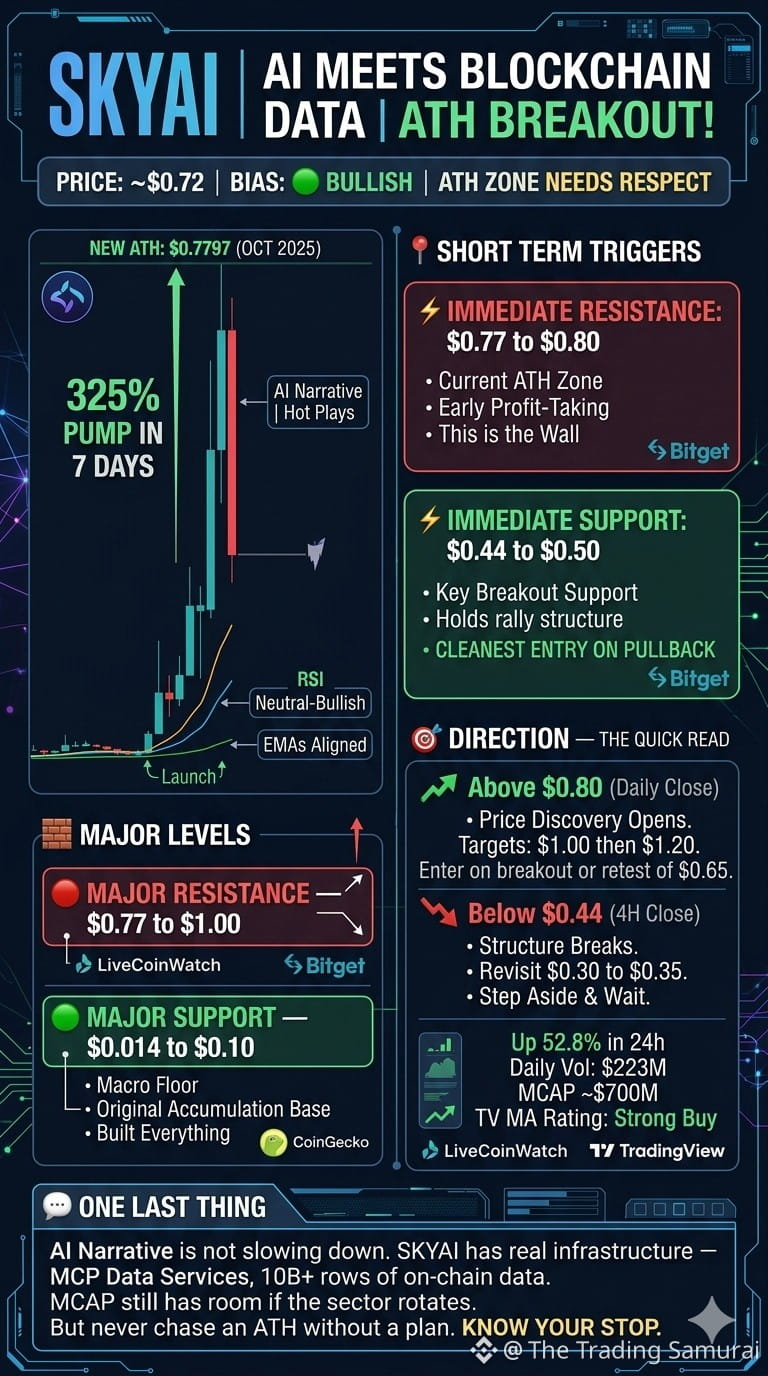
1
319

Log in to explore more content
Join global crypto users on Binance Square
⚡️ Get latest and useful information about crypto.
💬 Trusted by the world’s largest crypto exchange.
👍 Discover real insights from verified creators.
Email / Phone number
Trending Topics
1
#UKFCAOpensCryptoFirmAuthorization
8 views
21 Discussing
2
#JapanMOFStudyGroupOnTokenizedGovtBonds
592 views
72 Discussing
3
#QNTRises287%
16,785 views
363 Discussing
4
#TrumpRejectsAIRulesForVoluntaryAudits
16,192 views
446 Discussing
5
#BitgetHotWalletBreachTiedToThirdPartySecurityFlaw
8,038 views
310 Discussing
6
#OpenAIUnveilsAlwaysOnAgentDots
7,787 views
337 Discussing
7
#ChainlinkLaunchesBankSWIFTLedgerFramework
8,387 views
259 Discussing
8
#EarningsSeason
516,306 views
3,736 Discussing
9
#ZcashApproves$1.5MBugBounty
96 views
3 Discussing
10
#SECChairWantsStockMarketsOnChain
12,803 views
248 Discussing