

#bitcoincore32.1raisespeerconnectionlimit
bitcoincore32.1raisespeerconnectionlimit
Hot
Latest

#bitcoincore32.1raisespeerconnectionlimit
🚨 BITCOIN JUST GOT UNBREAKABLE: CORE RAISES LIMIT 125 → 200! 🚨
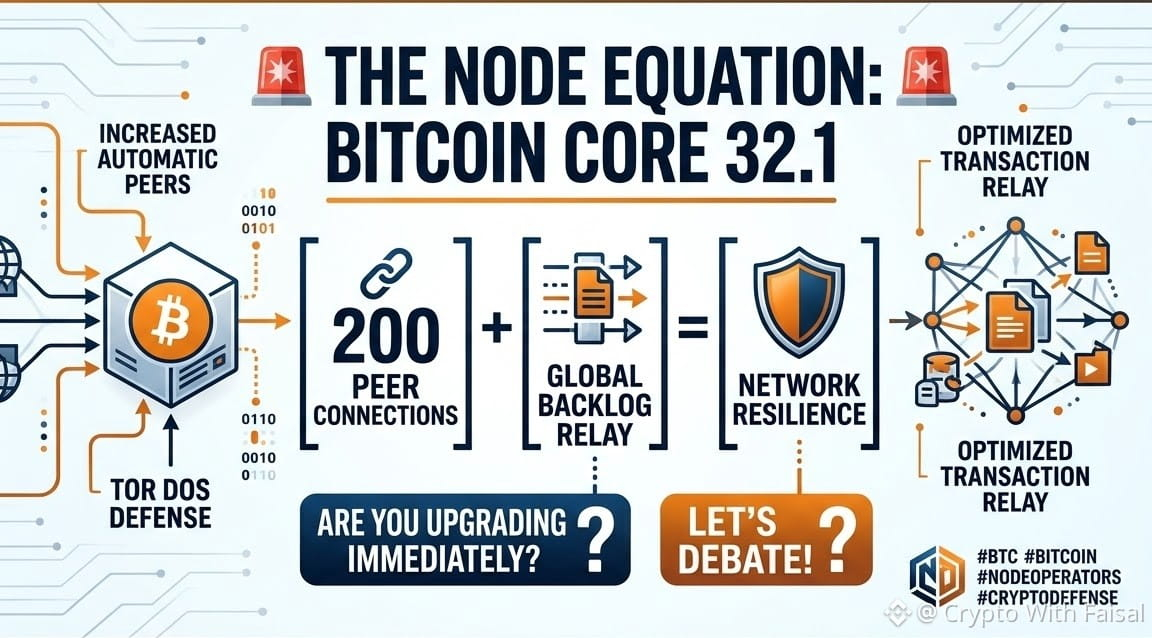
THE NODE EQUATION: BITCOIN CORE 32.1
Everyone is talking about price, but smart money is watching THIS upgrade! Let's break down why Bitcoin just became unstoppable using pure math 🧮👇
(200 Peer Connections) + (Global Backlog Relay) + (PoW Defense) = MAXIMUM Network Resilience 🛡️
Here is the exact formula driving this pump in network health:
The Expansion:
(200 Connections) - (125 Old Limit) = +60% More Power. The largest capacity haul in YEARS!
The Defense:
(Tor PoW Shield) = DoS Attacks DEAD. Nodes are now protected from malicious floods.
The Efficiency:
(Per-Peer Queue ❌) → (Global Backlog ✅) = Memory Leak FIXED + CPU Saved.
The Breakdown:
On Oct 27, Bitcoin Core dropped v32.1. While retail was panicking, devs quietly made the network 60% bigger, faster, and safer. This is how you build a network that lasts 100 years.
Wall Street wants ETF, but Bitcoin wants STRONG NODES. And it just got them.
Is your node updated for the 200-connection era? Or are you still stuck at 125? Let's debate below! 👇
$BTC
#Bitcoin #BTC #BlackRock #CryptoNews

299

Verified
#bitcoincore32.1raisespeerconnectionlimit
🚨 THE NODE EQUATION: BITCOIN CORE 32.1 🚨
A critical upgrade just dropped for Bitcoin full nodes, and it’s a massive win for network health! Let’s break down the new release using pure math 🧮👇
(200 Peer Connections) + (Global Backlog Relay) = Network Resilience 🛡️
Here is the exact formula driving the Bitcoin network update today:
The Upgrade Breakdown:
(The Input) = Bitcoin Core has released version 32.1.
The Expansion: It increases the default maximum number of automatic peer connections from 125 to 200 .
The Defense: It adds proof-of-work defenses for Tor hidden services to fight DoS attacks.
The Efficiency: It utilizes a "global-backlog" approach to transaction relay rate limiting, optimizing memory and CPU use.
The Breakdown:
Fewer peers means slower block and transaction propagation. By boosting connections and securing Tor nodes, Bitcoin Core 32.1 significantly hardens the network against censorship and DoS attempts while lowering resource requirements for node operators.
If you are a node operator, are you upgrading immediately, or waiting to test? Let's debate! 👇💬
$BTC
{future}(BTCUSDT)
$ETH
{future}(ETHUSDT)
$BNB
{future}(BNBUSDT)
#Bitcoin #CryptoSecurity #NodeOperators #BinanceSquare
#bitcoincore32.1raisespeerconnectionlimit
🚨 THE NODE EQUATION: BITCOIN CORE 32.1 🚨
A critical upgrade just dropped for Bitcoin full nodes, and it’s a massive win for network health! Let’s break down the new release using pure math 🧮👇
(200 Peer Connections) + (Global Backlog Relay) = Network Resilience 🛡️
Here is the exact formula driving the Bitcoin network update today:
The Upgrade Breakdown:
(The Input) = Bitcoin Core has released version 32.1.
The Expansion: It increases the default maximum number of automatic peer connections from 125 to 200 .
The Defense: It adds proof-of-work defenses for Tor hidden services to fight DoS attacks.
The Efficiency: It utilizes a "global-backlog" approach to transaction relay rate limiting, optimizing memory and CPU use.
The Breakdown:
Fewer peers means slower block and transaction propagation. By boosting connections and securing Tor nodes, Bitcoin Core 32.1 significantly hardens the network against censorship and DoS attempts while lowering resource requirements for node operators.
If you are a node operator, are you upgrading immediately, or waiting to test? Let's debate! 👇💬
$BTC
$ETH
$BNB
#Bitcoin #CryptoSecurity #NodeOperators #BinanceSquare
Tim Berners-Lee WorldWideWeb The World Archie EFF ARPANET:
@Square-Creator-6081246fb8a9 Este incremento no es un simple capricho de ancho de banda. Al elevar el límite de conexiones automáticas, los desarrolladores buscan reforzar la topología de la red global de Bitcoin, haciéndola mucho más densa y resistente ante posibles ataques de eclipse o intentos de aislamiento de nodos.
2
2
849

·
--
#BitcoinCore32.1RaisesPeerConnectionLimit
Bitcoin Core has officially released version 32.1, a critical security and maintenance update that significantly strengthens the peer-to-peer (P2P) network architecture. The most notable adjustment under the hood is an increase in the default maximum number of automatic peer connections from 125 to 200. [1, 2, 3]
This version was deployed as a swift technical response alongside the disclosure of three "easily discoverable" vulnerabilities, including a bug that could allow a malicious peer to crash Windows, macOS, and BSD-based nodes. [1, 2]
$ACT
{future}(ACTUSDT)
$BANK
{future}(BANKUSDT)
$DOGE
{future}(DOGEUSDT)
#BitcoinCore32EntersFinalTesting
#BitcoinCore32
#BitcoinWarnings
#BitcoinCore32.1RaisesPeerConnectionLimit
Bitcoin Core has officially released version 32.1, a critical security and maintenance update that significantly strengthens the peer-to-peer (P2P) network architecture. The most notable adjustment under the hood is an increase in the default maximum number of automatic peer connections from 125 to 200. [1, 2, 3]
This version was deployed as a swift technical response alongside the disclosure of three "easily discoverable" vulnerabilities, including a bug that could allow a malicious peer to crash Windows, macOS, and BSD-based nodes. [1, 2]
$ACT
$BANK
$DOGE
#BitcoinCore32EntersFinalTesting
#BitcoinCore32
#BitcoinWarnings


34

·
--
#BitcoinCore32.1RaisesPeerConnectionLimit
🚀 $BTC Core 32.1 just raised the default peer connection limit from 125 to 200!
More inbound slots reserved for block-relay-only peers — stronger network resilience and better decentralization without extra resource strain.
Quiet but powerful upgrades like this keep $BTC ’s backbone rock-solid. Node runners, time to update!
$BTC
#Bitcoin #BTC #BitcoinCore #NodeOperators
{spot}(BTCUSDT)
#BitcoinCore32.1RaisesPeerConnectionLimit
🚀 $BTC Core 32.1 just raised the default peer connection limit from 125 to 200!
More inbound slots reserved for block-relay-only peers — stronger network resilience and better decentralization without extra resource strain.
Quiet but powerful upgrades like this keep $BTC ’s backbone rock-solid. Node runners, time to update!
$BTC
#Bitcoin #BTC #BitcoinCore #NodeOperators

67

·
--
#BitcoinCore32.1RaisesPeerConnectionLimit
Title: Network Upgrade: Bitcoin Core 32.1 Raises Peer Connection Limits
A new update is making waves in the dev community. Bitcoin Core 32.1 has officially raised the peer connection limit.
While this might sound highly technical, it’s a massive win for network resilience. By allowing nodes to connect to more peers, the network becomes more robust against certain types of attacks, improves block propagation times, and enhances overall node stability. This is especially relevant following recent disclosures regarding node vulnerabilities.
The Trader's Take:
Fundamentals matter. A healthier, more resilient base layer is always a long-term bullish signal for $BTC. While this won't cause an instant price pump, it strengthens the foundation of the asset you hold.
Stay updated, run the latest software, and secure your nodes! ⚙️

1
58

·
--
#BitcoinCore32.1RaisesPeerConnectionLimit
🚀 Bitcoin Core 32.1: A Stronger Foundation for the Bitcoin Network! ₿
A significant update has arrived for Bitcoin Core! 🔥
The new Bitcoin Core 32.1 release increases the default maximum number of automatic peer connections from 125 to 200, creating more capacity for inbound connections and supporting Bitcoin's peer-to-peer network.
💡 Why does this matter?
🔹 More connection capacity: The default limit rises to 200 connections.
🔹 Network improvements: Updated transaction-relay controls help reduce memory and CPU usage during periods of high transaction volume.
🔹 Continued development: Bug fixes and performance improvements help strengthen Bitcoin Core.
📌 Important: The increase does not automatically mean Bitcoin's price will rise. It is a technical improvement to the network software, not a direct price catalyst.
💬 What do you think? Will continued technical development help make Bitcoin's network more resilient in the long run?
Share your thoughts below! 👇
#BitcoinCore32.1 #Bitcoin #BTC #BitcoinDevelopment #Blockchain #CryptoNews #BinanceSquare

57


·
--
#BitcoinCore32.1RaisesPeerConnectionLimit
Bitcoin Core 32.1 Raises the Default Peer Limit to 200: What It Means for the Network
$BTC
{spot}(BTCUSDT)
Bitcoin Core 32.1, published on October 27, raises the default maximum number of automatic peer connections from 125 to 200. The extra capacity is for inbound block-relay-only peers, since the number of automatic outbound connections is unchanged. By default, transaction-relaying peers can use at most 50% of inbound slots, and the new -inboundrelaypercent option lets operators change that. Anyone who wants the old behavior can set -maxconnections=125 -inboundrelaypercent=100, and values above 2,000 are now clamped with a warning. The release follows the cancelled 32.0, which was tagged but never fully announced because of last-minute issues, and 32.1 is also among the versions carrying this week's security fixes.
My take: this is a quiet but useful network-health change. Block-relay-only connections don't relay transactions, which developers argue makes the network graph harder to map and improves resistance to partitioning. Adding 75 more slots, all inbound, lets reachable nodes serve more peers without transaction relay crowding them out. The trade-off falls on operators, since every connection uses memory and bandwidth, so anyone on limited hardware or a capped connection should check their settings. This has no direct price impact, but infrastructure upgrades like this are part of what keeps Bitcoin decentralized and resilient.
Will you run the new default of 200 connections or cap it lower? Let me know below 👇
This is my analysis, not financial advice.
Follow me for more trading content and market updates.
#bitcoin #BTC #BinanceSquare
#BitcoinCore32.1RaisesPeerConnectionLimit
Bitcoin Core 32.1 Raises the Default Peer Limit to 200: What It Means for the Network
$BTC
Bitcoin Core 32.1, published on October 27, raises the default maximum number of automatic peer connections from 125 to 200. The extra capacity is for inbound block-relay-only peers, since the number of automatic outbound connections is unchanged. By default, transaction-relaying peers can use at most 50% of inbound slots, and the new -inboundrelaypercent option lets operators change that. Anyone who wants the old behavior can set -maxconnections=125 -inboundrelaypercent=100, and values above 2,000 are now clamped with a warning. The release follows the cancelled 32.0, which was tagged but never fully announced because of last-minute issues, and 32.1 is also among the versions carrying this week's security fixes.
My take: this is a quiet but useful network-health change. Block-relay-only connections don't relay transactions, which developers argue makes the network graph harder to map and improves resistance to partitioning. Adding 75 more slots, all inbound, lets reachable nodes serve more peers without transaction relay crowding them out. The trade-off falls on operators, since every connection uses memory and bandwidth, so anyone on limited hardware or a capped connection should check their settings. This has no direct price impact, but infrastructure upgrades like this are part of what keeps Bitcoin decentralized and resilient.
Will you run the new default of 200 connections or cap it lower? Let me know below 👇
This is my analysis, not financial advice.
Follow me for more trading content and market updates.
#bitcoin #BTC #BinanceSquare
1
115

·
--

Article
Bitcoin Core 32.1 Exposes the Hard Trade-Off Between Network Resilience and the Cost of DecentralizaCrypto conversations usually go straight to price. @bitcoin is up, Bitcoin is down, transaction fees are rising, or another upgrade is making headlines. But honestly, there's a whole side of Bitcoin that rarely gets the attention it deserves: the infrastructure quietly keeping the network connected. Sometimes, that's where the biggest engineering questions begin.
Bitcoin Core 32.1 raises the default maximum number of automatic peer connections from 125 to 200. Sounds simple enough. But there's a detail worth noticing: the number of automatic outbound connections stays the same. The extra capacity mainly creates more room for inbound connections, particularly block-relay-only peers. These peers help spread blocks across the network without participating in ordinary transaction relay. It's a targeted change, not a command telling every node to connect to 200 peers. Actual connections still depend on configuration, network conditions, and available resources.
More connections don't automatically mean a stronger Bitcoin network.
Look, the real question is who those connections lead to. A node might connect to 200 peers and still rely heavily on a handful of hosting providers or interconnected networks. On paper, that looks like plenty of redundancy. In reality, several connections can share the same underlying weaknesses. If many peers depend on similar infrastructure, a single disruption could affect more of them than their individual connection counts suggest. That's the problem with measuring resilience by numbers alone.
An eclipse attack makes this issue even more interesting. The goal is to isolate a node or manipulate the view of the network it receives. An attacker doesn't need to control Bitcoin as a whole to create problems for an individual node. More connection slots can give that node additional opportunities to maintain independent communication paths. But opportunities aren't guarantees. Peer selection, address discovery, connection churn, and the actual distribution of network infrastructure all matter.
A node needs independent paths, not just a longer contact list.
So, what does this extra connectivity cost? Every additional peer can consume memory, bandwidth, CPU time, socket resources, and file descriptors. The exact impact depends on how those peers behave and how much traffic they generate. Block-relay-only connections can reduce exposure to ordinary transaction-relay traffic, but they're not free. They still exchange protocol messages and require resources to maintain. For someone operating a node on modest hardware or a tightly constrained hosting plan, that overhead matters. There's a practical limit to how much additional connectivity can be supported comfortably.
Bitcoin Core also uses connection-allocation rules to balance different networking needs. The default inbound relay percentage setting limits transaction-relaying peers to 50% of inbound connection slots, preserving capacity for other inbound connections, including block-relay-only peers. With a default maximum of 200 connections and 11 automatic outbound connections, the nominal inbound capacity is 189, subject to other connection-management constraints. Under the default allocation, transaction-relaying peers can occupy roughly half of those inbound slots. But this isn't a guarantee of network diversity. It simply controls how connection capacity is allocated.
Bitcoin can make room for diversity. It can't guarantee it.
Honestly, the configuration details are easy to overlook. Operators who have explicitly configured their maximum connection count shouldn't assume their chosen value automatically increases with the new default. Bitcoin Core 32.1 also clamps values above 2,000 and issues a warning, reflecting the risks associated with extremely high connection counts. Pushing that limit higher doesn't necessarily improve anything. Without enough memory, bandwidth, or operating-system resources, additional connections can create more operational pressure than practical benefit. Sometimes, more really is just more.
It's also important to understand what this update doesn't change. There's no new zero-knowledge proof system, no new consensus rule, and no change to Bitcoin's smart-contract execution model. The focus is peer-to-peer networking and the practical conditions needed to keep independent nodes connected. Any compliance implications are indirect, involving areas such as hosting arrangements, availability, and infrastructure monitoring. This is a networking adjustment, not a new privacy or regulatory-compliance feature.
So, how should its impact be judged? Start with the actual data. Are nodes maintaining more diverse peer connections? Is connection churn changing? What happens to bandwidth, memory usage, and CPU load? Do blocks continue propagating reliably when several peers disappear or parts of the network become unavailable? Those measurements tell us far more than the maximum connection count ever could. A configured limit shows what's permitted, not what happens in practice.
The real win would be better network resilience without making independent nodes harder to operate.
That's the trade-off worth watching with Bitcoin Core 32.1. Raising the default limit from 125 to 200 creates more room for connections, particularly block-relay-only peers. Whether that translates into stronger resilience depends on how operators use that capacity and whether their connections genuinely improve network diversity. A node isn't more independent just because it has more peers. It becomes more resilient when those peers provide reliable, genuinely independent paths for receiving and verifying information.
And that's the bigger point. Bitcoin's decentralization doesn't come from a single setting or a bigger number on a configuration screen. It depends on whether ordinary participants can keep running their own nodes, maintain useful connections, and verify the network without relying entirely on someone else's infrastructure. More connectivity is useful. Independent connectivity is what really counts.
#BitcoinCore32.1RaisesPeerConnectionLimit $BTC
{future}(BTCUSDT)
Bitcoin Core 32.1 Exposes the Hard Trade-Off Between Network Resilience and the Cost of Decentraliza
Crypto conversations usually go straight to price. @Bitcoin is up, Bitcoin is down, transaction fees are rising, or another upgrade is making headlines. But honestly, there's a whole side of Bitcoin that rarely gets the attention it deserves: the infrastructure quietly keeping the network connected. Sometimes, that's where the biggest engineering questions begin.
Bitcoin Core 32.1 raises the default maximum number of automatic peer connections from 125 to 200. Sounds simple enough. But there's a detail worth noticing: the number of automatic outbound connections stays the same. The extra capacity mainly creates more room for inbound connections, particularly block-relay-only peers. These peers help spread blocks across the network without participating in ordinary transaction relay. It's a targeted change, not a command telling every node to connect to 200 peers. Actual connections still depend on configuration, network conditions, and available resources.
More connections don't automatically mean a stronger Bitcoin network.
Look, the real question is who those connections lead to. A node might connect to 200 peers and still rely heavily on a handful of hosting providers or interconnected networks. On paper, that looks like plenty of redundancy. In reality, several connections can share the same underlying weaknesses. If many peers depend on similar infrastructure, a single disruption could affect more of them than their individual connection counts suggest. That's the problem with measuring resilience by numbers alone.
An eclipse attack makes this issue even more interesting. The goal is to isolate a node or manipulate the view of the network it receives. An attacker doesn't need to control Bitcoin as a whole to create problems for an individual node. More connection slots can give that node additional opportunities to maintain independent communication paths. But opportunities aren't guarantees. Peer selection, address discovery, connection churn, and the actual distribution of network infrastructure all matter.
A node needs independent paths, not just a longer contact list.
So, what does this extra connectivity cost? Every additional peer can consume memory, bandwidth, CPU time, socket resources, and file descriptors. The exact impact depends on how those peers behave and how much traffic they generate. Block-relay-only connections can reduce exposure to ordinary transaction-relay traffic, but they're not free. They still exchange protocol messages and require resources to maintain. For someone operating a node on modest hardware or a tightly constrained hosting plan, that overhead matters. There's a practical limit to how much additional connectivity can be supported comfortably.
Bitcoin Core also uses connection-allocation rules to balance different networking needs. The default inbound relay percentage setting limits transaction-relaying peers to 50% of inbound connection slots, preserving capacity for other inbound connections, including block-relay-only peers. With a default maximum of 200 connections and 11 automatic outbound connections, the nominal inbound capacity is 189, subject to other connection-management constraints. Under the default allocation, transaction-relaying peers can occupy roughly half of those inbound slots. But this isn't a guarantee of network diversity. It simply controls how connection capacity is allocated.
Bitcoin can make room for diversity. It can't guarantee it.
Honestly, the configuration details are easy to overlook. Operators who have explicitly configured their maximum connection count shouldn't assume their chosen value automatically increases with the new default. Bitcoin Core 32.1 also clamps values above 2,000 and issues a warning, reflecting the risks associated with extremely high connection counts. Pushing that limit higher doesn't necessarily improve anything. Without enough memory, bandwidth, or operating-system resources, additional connections can create more operational pressure than practical benefit. Sometimes, more really is just more.
It's also important to understand what this update doesn't change. There's no new zero-knowledge proof system, no new consensus rule, and no change to Bitcoin's smart-contract execution model. The focus is peer-to-peer networking and the practical conditions needed to keep independent nodes connected. Any compliance implications are indirect, involving areas such as hosting arrangements, availability, and infrastructure monitoring. This is a networking adjustment, not a new privacy or regulatory-compliance feature.
So, how should its impact be judged? Start with the actual data. Are nodes maintaining more diverse peer connections? Is connection churn changing? What happens to bandwidth, memory usage, and CPU load? Do blocks continue propagating reliably when several peers disappear or parts of the network become unavailable? Those measurements tell us far more than the maximum connection count ever could. A configured limit shows what's permitted, not what happens in practice.
The real win would be better network resilience without making independent nodes harder to operate.
That's the trade-off worth watching with Bitcoin Core 32.1. Raising the default limit from 125 to 200 creates more room for connections, particularly block-relay-only peers. Whether that translates into stronger resilience depends on how operators use that capacity and whether their connections genuinely improve network diversity. A node isn't more independent just because it has more peers. It becomes more resilient when those peers provide reliable, genuinely independent paths for receiving and verifying information.
And that's the bigger point. Bitcoin's decentralization doesn't come from a single setting or a bigger number on a configuration screen. It depends on whether ordinary participants can keep running their own nodes, maintain useful connections, and verify the network without relying entirely on someone else's infrastructure. More connectivity is useful. Independent connectivity is what really counts.
#BitcoinCore32.1RaisesPeerConnectionLimit $BTC
83

·
--
Bearish
#bitcoincore32.1raisespeerconnectionlimit Bitcoin Core 32.1 introduces a notable network upgrade by raising the default peer connection limit for nodes. This technical adjustment directly impacts how the decentralized network propagates data globally. By allowing individual nodes to maintain more simultaneous connections, the update aims to significantly enhance transaction relay speeds and overall network resilience against localized congestion.
For node operators, this means increased bandwidth and memory utilization, which could slightly raise the barrier to entry for running a standard node on lower-end hardware. However, for the broader ecosystem, a more densely connected peer-to-peer topology fundamentally strengthens Bitcoin’s censorship resistance and ensures much faster block propagation during periods of intense on-chain activity.
From a market perspective, protocol-level upgrades rarely trigger immediate price action, but they undeniably reinforce the underlying fundamental investment thesis. Traders should not expect sudden spot volatility based solely on this backend release. Instead, this signals continued developer optimization focused on long-term scalability and network security. Watch for network hash rate stability and global node count metrics over the coming weeks to accurately gauge the upgrade's real-world adoption.
#Bitcoin #BTC #CryptoNews #Blockchain
$BTC $ETH $SOL
{future}(SOLUSDT)
{future}(ETHUSDT)
{future}(BTCUSDT)
#bitcoincore32.1raisespeerconnectionlimit Bitcoin Core 32.1 introduces a notable network upgrade by raising the default peer connection limit for nodes. This technical adjustment directly impacts how the decentralized network propagates data globally. By allowing individual nodes to maintain more simultaneous connections, the update aims to significantly enhance transaction relay speeds and overall network resilience against localized congestion.
For node operators, this means increased bandwidth and memory utilization, which could slightly raise the barrier to entry for running a standard node on lower-end hardware. However, for the broader ecosystem, a more densely connected peer-to-peer topology fundamentally strengthens Bitcoin’s censorship resistance and ensures much faster block propagation during periods of intense on-chain activity.
From a market perspective, protocol-level upgrades rarely trigger immediate price action, but they undeniably reinforce the underlying fundamental investment thesis. Traders should not expect sudden spot volatility based solely on this backend release. Instead, this signals continued developer optimization focused on long-term scalability and network security. Watch for network hash rate stability and global node count metrics over the coming weeks to accurately gauge the upgrade's real-world adoption.
#Bitcoin #BTC #CryptoNews #Blockchain
$BTC $ETH $SOL

199

·
--
Bearish
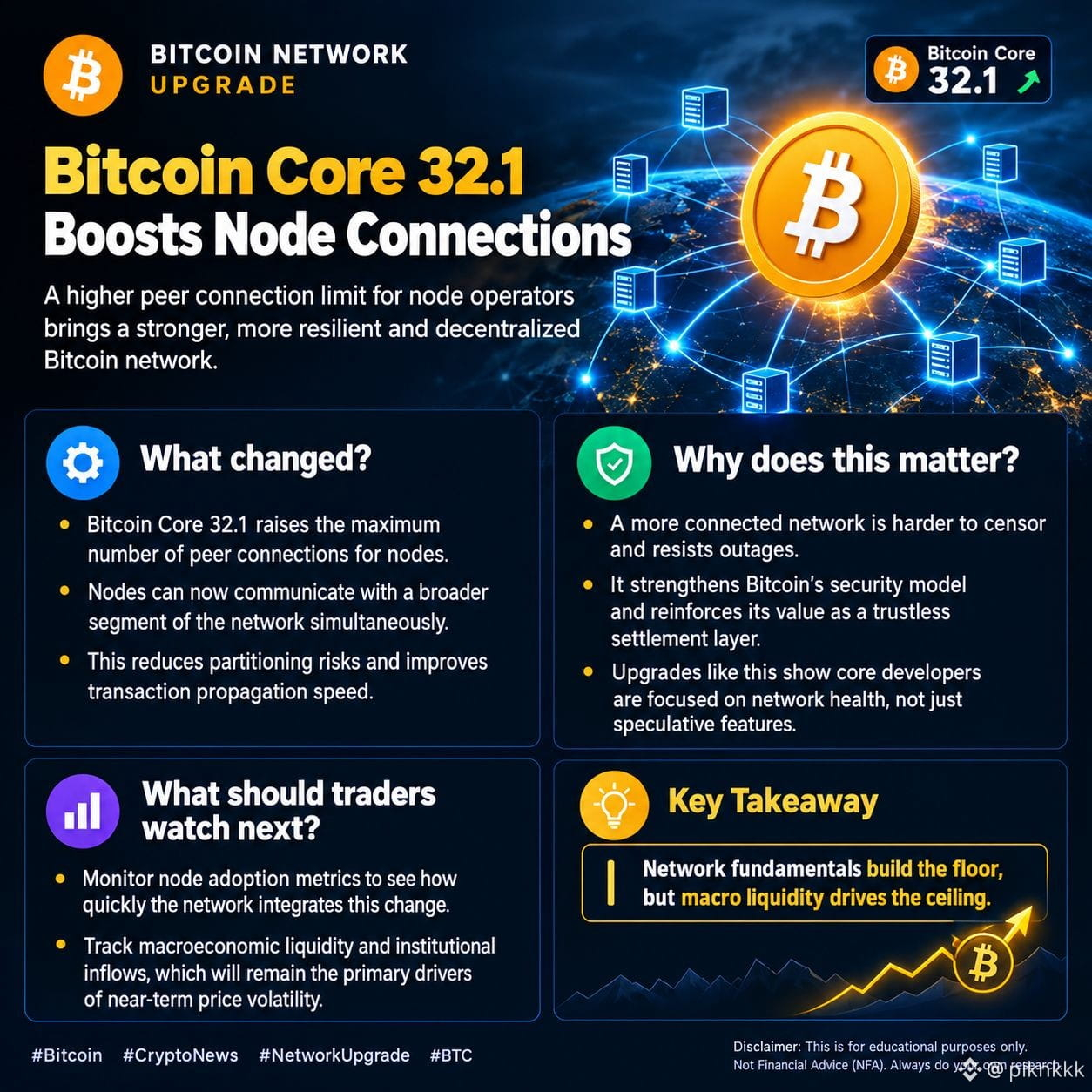
#bitcoincore32.1raisespeerconnectionlimit Bitcoin network fundamentals just received a significant upgrade. The release of Bitcoin Core 32.1 introduces a higher peer connection limit for node operators, a technical shift carrying meaningful implications for network resilience and decentralization.
What changed? By raising the maximum number of peer connections, the update allows nodes to communicate with a broader network segment simultaneously. This reduces partitioning risks and improves transaction propagation speed.
Why does this matter? While protocol upgrades do not directly dictate short-term price action, they strengthen the underlying security model. A highly connected network is harder to censor and resists outages, reinforcing Bitcoin’s value as a trustless settlement layer.
Market sentiment often fixates on immediate price catalysts, but long-term viability relies on continuous infrastructural improvements. This update signals that core developers remain focused on optimizing network health over speculative features.
What should traders watch next? Monitor node adoption metrics to see how quickly the network integrates this change. Additionally, track macroeconomic liquidity and institutional inflows, which will remain the primary drivers of near-term price volatility. Network fundamentals build the floor, but macro liquidity drives the ceiling.
#Bitcoin #CryptoNews #NetworkUpgrade #BTC
$BTC $ETH $SOL
{future}(SOLUSDT)
{future}(ETHUSDT)
{future}(BTCUSDT)
#bitcoincore32.1raisespeerconnectionlimit Bitcoin network fundamentals just received a significant upgrade. The release of Bitcoin Core 32.1 introduces a higher peer connection limit for node operators, a technical shift carrying meaningful implications for network resilience and decentralization.
What changed? By raising the maximum number of peer connections, the update allows nodes to communicate with a broader network segment simultaneously. This reduces partitioning risks and improves transaction propagation speed.
Why does this matter? While protocol upgrades do not directly dictate short-term price action, they strengthen the underlying security model. A highly connected network is harder to censor and resists outages, reinforcing Bitcoin’s value as a trustless settlement layer.
Market sentiment often fixates on immediate price catalysts, but long-term viability relies on continuous infrastructural improvements. This update signals that core developers remain focused on optimizing network health over speculative features.
What should traders watch next? Monitor node adoption metrics to see how quickly the network integrates this change. Additionally, track macroeconomic liquidity and institutional inflows, which will remain the primary drivers of near-term price volatility. Network fundamentals build the floor, but macro liquidity drives the ceiling.
#Bitcoin #CryptoNews #NetworkUpgrade #BTC
$BTC $ETH $SOL
241

·
--
#bitcoincore32.1raisespeerconnectionlimit
🚨 BITCOIN EST DEVENU INÉBRANLABLE : CORE RELÈVE LA LIMITE DE 125 À 200 ! 🚨
L’ÉQUATION DES NŒUDS : BITCOIN CORE 32.1
Tout le monde parle du prix, mais les investisseurs avisés surveillent CETTE mise à niveau ! Voyons pourquoi Bitcoin est devenu inarrêtable grâce aux maths pures 🧮👇
(200 connexions entre pairs) + (Relais de la file d’attente globale) + (Défense PoW) = Résilience MAXIMALE du réseau 🛡️
Voici la formule exacte qui explique cette amélioration de la santé du réseau :
L’expansion :
(200 connexions) - (ancienne limite de 125) = +60 % de capacité. La plus forte hausse depuis des ANNÉES !
La défense :
(Bouclier PoW de Tor) = Attaques par déni de service ÉLIMINÉES. Les nœuds sont désormais protégés contre les inondations malveillantes.
L’efficacité :
(File par pair ❌) → (File d’attente globale ✅) = Fuite de mémoire CORRIGÉE + CPU économisé.
Le résumé :
Le 27 octobre, Bitcoin Core a publié la version 32.1. Tandis que les investisseurs particuliers paniquaient, les développeurs ont discrètement rendu le réseau 60 % plus grand, plus rapide et plus sûr. C’est ainsi qu’on construit un réseau capable de durer 100 ans.
Wall Street veut des ETF, mais Bitcoin veut des NŒUDS ROBUSTES. Et il vient de les obtenir.
Votre nœud est-il à jour pour l’ère des 200 connexions ? Ou êtes-vous toujours bloqué à 125 ? Débattons dans les commentaires ! 👇
$IDOL
{future}(IDOLUSDT)
$APR
{future}(APRUSDT)
$INIT
{future}(INITUSDT)
#bitcoincore32.1raisespeerconnectionlimit
🚨 BITCOIN EST DEVENU INÉBRANLABLE : CORE RELÈVE LA LIMITE DE 125 À 200 ! 🚨
L’ÉQUATION DES NŒUDS : BITCOIN CORE 32.1
Tout le monde parle du prix, mais les investisseurs avisés surveillent CETTE mise à niveau ! Voyons pourquoi Bitcoin est devenu inarrêtable grâce aux maths pures 🧮👇
(200 connexions entre pairs) + (Relais de la file d’attente globale) + (Défense PoW) = Résilience MAXIMALE du réseau 🛡️
Voici la formule exacte qui explique cette amélioration de la santé du réseau :
L’expansion :
(200 connexions) - (ancienne limite de 125) = +60 % de capacité. La plus forte hausse depuis des ANNÉES !
La défense :
(Bouclier PoW de Tor) = Attaques par déni de service ÉLIMINÉES. Les nœuds sont désormais protégés contre les inondations malveillantes.
L’efficacité :
(File par pair ❌) → (File d’attente globale ✅) = Fuite de mémoire CORRIGÉE + CPU économisé.
Le résumé :
Le 27 octobre, Bitcoin Core a publié la version 32.1. Tandis que les investisseurs particuliers paniquaient, les développeurs ont discrètement rendu le réseau 60 % plus grand, plus rapide et plus sûr. C’est ainsi qu’on construit un réseau capable de durer 100 ans.
Wall Street veut des ETF, mais Bitcoin veut des NŒUDS ROBUSTES. Et il vient de les obtenir.
Votre nœud est-il à jour pour l’ère des 200 connexions ? Ou êtes-vous toujours bloqué à 125 ? Débattons dans les commentaires ! 👇
$IDOL
$APR
$INIT

Abu Fahadأ:
💛
1
270

·
--
#BitcoinCore32.1RaisesPeerConnectionLimit* Bitcoin Core 32.1:
رفع حد اتصالات الأقران ماذا يعني فعلياً؟ ...
أُطلقت نسخة Bitcoin Core 32.1 في 27 أكتوبر 2026، وهي النسخة الرئيسية المتاحة حالياً بعد أن لم تُطلق نسخة 32.0 رسمياً بسبب مشكلات ظهرت في اللحظات الأخيرة. التحديث لا يغيّر قواعد إجماع Bitcoin ولا عدد العملات ولا آلية التعدين؛ بل يركز على تشغيل العقد، كفاءة الشبكة، والخصوصية. (bitcoincore.org)
التغيير الرئيسي: الحد الافتراضي لاتصالات الأقران أصبح 200
ترفع النسخة 32.1 الحد الافتراضي لاتصالات العقدة بأقران الشبكة تلقائياً من 125 إلى 200 اتصال. المقصود بالأقران هو العقد الأخرى التي تتبادل معها عقدتك معلومات الكتل والمعاملات.
لماذا يهم ذلك؟
اتصالات أكثر تعني خيارات أوسع لتلقي البيانات ونشرها عبر الشبكة.
قد تتحسن قدرة العقدة على البقاء متصلة عندما تنقطع بعض الاتصالات أو تكون ضعيفة.
زيادة التنوع في الأقران يمكن أن تدعم متانة طبقة الشبكة ضد الأعطال الموضعية أو الاعتماد على عدد محدود من المسارات.
لكنها ليست زيادة “مجانية” دائماً: كل اتصال إضافي يستهلك جزءاً من عرض النطاق والذاكرة والموارد. لذلك قد تكون الاستضافة المنزلية أو الأجهزة محدودة الإمكانات أكثر حساسية لهذا التغيير من الخوادم المخصصة.
لماذا لم تتحول الزيادة إلى عبء كبير على الذاكرة؟
يتضمن 32.1 إعادة تصميم مهمة في طريقة ترحيل المعاملات. سابقاً، كانت آلية الحد من إرسال المعاملات تعمل بدرجة أكبر لكل نظير على حدة؛ أما الآن، فتستخدم العقدة تراكماً عالمياً مشتركاً للحد من معدل الإرسال.
الهدف هو خفض استهلاك الذاكرة ووحدة المعالجة المركزية عند ارتفاع نشاط المعاملات، خصوصاً مع زيادة عدد الأقران. يبقى الحد الافتراضي لإرسال المعاملات عند 14 معاملة في الثانية، مع تعزيز قدره 2.5 مرة للاتصالات الصادرة التي تبدأها العقدة، وأضاف التحديث أيضاً حد عرض نطاق قدره 12 ميغابايت من المعاملات لكل 10 دقائق مع سماح باندفاع مؤقت أعلى. (bitcoincore.org)
بعبارة أبسط: زيادة عدد الاتصالات تساعد العقدة على البقاء متصلة، بينما التغيير في قائمة الانتظار يحاول منع هذه الزيادة من تحويل ضغط المعاملات إلى استهلاك متضخم للموارد.
تحسينات الخصوصية والأمان
يتضمن التحديث كذلك:
دفاعات إثبات العمل لخدمات Tor المخفية التي تنشئها Bitcoin Core تلقائياً، إذا كان برنامج Tor يدعمها. الهدف هو رفع تكلفة بعض أنماط الإساءة أو الإغراق على تلك الخدمات. (bitcoincore.org)
إصلاح احتمال كشف عنوان IP للمرسل عند استخدام إرسال معاملة عبر RPC مع تفعيل خيار البث الخاص. هذا الأمر يهم مشغلي العقد الذين يستخدمون هذه الإعدادات المتقدمة، وليس معظم المستخدمين العاديين. (bitcoincore.org)
الإصدارات 29.x وما قبلها أصبحت خارج نطاق الدعم ولن تتلقى تحديثات جديدة؛ ومن يستخدم نسخة قديمة يحتاج إلى التخطيط للترقية إلى إصدار مدعوم. (bitcoincore.org)
كما نشر مشروع Bitcoin Core تحديثات أمنية للإصدارات المدعومة، تشمل معالجة حالات يمكن فيها لنظير خبيث استنزاف ذاكرة عقد تعمل على أنظمة غير Linux باستخدام بيانات TCP عاجلة، إضافة إلى حالة أخرى متعلقة بالنمو غير المحدود للذاكرة مع أقران قدامى متوقفين. (bitcoincore.org)
ما الأثر على مستخدم Bitcoin العادي؟
إذا كنت تحفظ BTC أو تتداول فقط، فلن تحتاج غالباً إلى فعل شيء بسبب هذا التحديث؛ لا توجد عملية نقل عملات أو تغيير في المحفظة مفروض على المستخدمين.
أما إذا كنت تدير عقدة Bitcoin Core:
راجع الذاكرة، سرعة الإنترنت، وحدود الاتصال لدى مزودك قبل الترقية.
حد الاتصالات الأعلى مفيد عادة للعقد ذات الموارد الجيدة، لكنه قد لا يكون مناسباً تلقائياً للأجهزة محدودة الموارد.
استخدم فقط حزم التثبيت الرسمية، وتحقق من التوقيعات أو التجزئات عند الإمكان.
احرص على نسخ احتياطية للمحفظة قبل أي تحديث برمجي رئيسي.
هل لهذه الأخبار أثر مباشر على سعر BTC؟
لا يوجد أثر سعري ميكانيكي أو فوري. هذا تحديث للبنية التحتية لبرنامج العقد، وليس تغييراً في ندرة Bitcoin أو سياسة الشبكة النقدية. قد يُنظر إليه على المدى الطويل كتحسين للكفاءة والمرونة والخصوصية، لكن حركة السعر القصيرة المدى تظل مرتبطة أكثر بالسيولة، الاقتصاد الكلي، تدفقات السوق، ومراكز المشتقات.
الخلاصة: Bitcoin Core 32.1 يرفع السقف الافتراضي لاتصالات الأقران إلى 200، ويعوض جانباً من الكلفة التشغيلية عبر تنظيم أكثر كفاءة لترحيل المعاملات. إنه تحديث تقني مهم لمشغلي العقد وصحة الشبكة، لكنه لا يغير قواعد Bitcoin الأساسية ولا يشكل محفزاً سعرياً مباشراً. (github.com)
$BTC
#BitcoinCore32.1RaisesPeerConnectionLimit
#BitcoinCore32.1RaisesPeerConnectionLimit
* Bitcoin Core 32.1:
رفع حد اتصالات الأقران ماذا يعني فعلياً؟ ...
أُطلقت نسخة Bitcoin Core 32.1 في 27 أكتوبر 2026، وهي النسخة الرئيسية المتاحة حالياً بعد أن لم تُطلق نسخة 32.0 رسمياً بسبب مشكلات ظهرت في اللحظات الأخيرة. التحديث لا يغيّر قواعد إجماع Bitcoin ولا عدد العملات ولا آلية التعدين؛ بل يركز على تشغيل العقد، كفاءة الشبكة، والخصوصية. (bitcoincore.org)
التغيير الرئيسي: الحد الافتراضي لاتصالات الأقران أصبح 200
ترفع النسخة 32.1 الحد الافتراضي لاتصالات العقدة بأقران الشبكة تلقائياً من 125 إلى 200 اتصال. المقصود بالأقران هو العقد الأخرى التي تتبادل معها عقدتك معلومات الكتل والمعاملات.
لماذا يهم ذلك؟
اتصالات أكثر تعني خيارات أوسع لتلقي البيانات ونشرها عبر الشبكة.
قد تتحسن قدرة العقدة على البقاء متصلة عندما تنقطع بعض الاتصالات أو تكون ضعيفة.
زيادة التنوع في الأقران يمكن أن تدعم متانة طبقة الشبكة ضد الأعطال الموضعية أو الاعتماد على عدد محدود من المسارات.
لكنها ليست زيادة “مجانية” دائماً: كل اتصال إضافي يستهلك جزءاً من عرض النطاق والذاكرة والموارد. لذلك قد تكون الاستضافة المنزلية أو الأجهزة محدودة الإمكانات أكثر حساسية لهذا التغيير من الخوادم المخصصة.
لماذا لم تتحول الزيادة إلى عبء كبير على الذاكرة؟
يتضمن 32.1 إعادة تصميم مهمة في طريقة ترحيل المعاملات. سابقاً، كانت آلية الحد من إرسال المعاملات تعمل بدرجة أكبر لكل نظير على حدة؛ أما الآن، فتستخدم العقدة تراكماً عالمياً مشتركاً للحد من معدل الإرسال.
الهدف هو خفض استهلاك الذاكرة ووحدة المعالجة المركزية عند ارتفاع نشاط المعاملات، خصوصاً مع زيادة عدد الأقران. يبقى الحد الافتراضي لإرسال المعاملات عند 14 معاملة في الثانية، مع تعزيز قدره 2.5 مرة للاتصالات الصادرة التي تبدأها العقدة، وأضاف التحديث أيضاً حد عرض نطاق قدره 12 ميغابايت من المعاملات لكل 10 دقائق مع سماح باندفاع مؤقت أعلى. (bitcoincore.org)
بعبارة أبسط: زيادة عدد الاتصالات تساعد العقدة على البقاء متصلة، بينما التغيير في قائمة الانتظار يحاول منع هذه الزيادة من تحويل ضغط المعاملات إلى استهلاك متضخم للموارد.
تحسينات الخصوصية والأمان
يتضمن التحديث كذلك:
دفاعات إثبات العمل لخدمات Tor المخفية التي تنشئها Bitcoin Core تلقائياً، إذا كان برنامج Tor يدعمها. الهدف هو رفع تكلفة بعض أنماط الإساءة أو الإغراق على تلك الخدمات. (bitcoincore.org)
إصلاح احتمال كشف عنوان IP للمرسل عند استخدام إرسال معاملة عبر RPC مع تفعيل خيار البث الخاص. هذا الأمر يهم مشغلي العقد الذين يستخدمون هذه الإعدادات المتقدمة، وليس معظم المستخدمين العاديين. (bitcoincore.org)
الإصدارات 29.x وما قبلها أصبحت خارج نطاق الدعم ولن تتلقى تحديثات جديدة؛ ومن يستخدم نسخة قديمة يحتاج إلى التخطيط للترقية إلى إصدار مدعوم. (bitcoincore.org)
كما نشر مشروع Bitcoin Core تحديثات أمنية للإصدارات المدعومة، تشمل معالجة حالات يمكن فيها لنظير خبيث استنزاف ذاكرة عقد تعمل على أنظمة غير Linux باستخدام بيانات TCP عاجلة، إضافة إلى حالة أخرى متعلقة بالنمو غير المحدود للذاكرة مع أقران قدامى متوقفين. (bitcoincore.org)
ما الأثر على مستخدم Bitcoin العادي؟
إذا كنت تحفظ BTC أو تتداول فقط، فلن تحتاج غالباً إلى فعل شيء بسبب هذا التحديث؛ لا توجد عملية نقل عملات أو تغيير في المحفظة مفروض على المستخدمين.
أما إذا كنت تدير عقدة Bitcoin Core:
راجع الذاكرة، سرعة الإنترنت، وحدود الاتصال لدى مزودك قبل الترقية.
حد الاتصالات الأعلى مفيد عادة للعقد ذات الموارد الجيدة، لكنه قد لا يكون مناسباً تلقائياً للأجهزة محدودة الموارد.
استخدم فقط حزم التثبيت الرسمية، وتحقق من التوقيعات أو التجزئات عند الإمكان.
احرص على نسخ احتياطية للمحفظة قبل أي تحديث برمجي رئيسي.
هل لهذه الأخبار أثر مباشر على سعر BTC؟
لا يوجد أثر سعري ميكانيكي أو فوري. هذا تحديث للبنية التحتية لبرنامج العقد، وليس تغييراً في ندرة Bitcoin أو سياسة الشبكة النقدية. قد يُنظر إليه على المدى الطويل كتحسين للكفاءة والمرونة والخصوصية، لكن حركة السعر القصيرة المدى تظل مرتبطة أكثر بالسيولة، الاقتصاد الكلي، تدفقات السوق، ومراكز المشتقات.
الخلاصة: Bitcoin Core 32.1 يرفع السقف الافتراضي لاتصالات الأقران إلى 200، ويعوض جانباً من الكلفة التشغيلية عبر تنظيم أكثر كفاءة لترحيل المعاملات. إنه تحديث تقني مهم لمشغلي العقد وصحة الشبكة، لكنه لا يغير قواعد Bitcoin الأساسية ولا يشكل محفزاً سعرياً مباشراً. (github.com)
$BTC
#BitcoinCore32.1RaisesPeerConnectionLimit
22

·
--
Bullish
#bitcoincore32.1raisespeerconnectionlimit
Bitcoin Core vừa lên đời bản 32.1, nâng giới hạn kết nối từ 125 lên 200 anh em.
Mạng lưới giờ như nồi lẩu buffet, càng đông càng vui, giao dịch mượt mà không lo nghẽn CPU!
Nhưng khoan, đi kèm là combo 3 lỗ hổng chí mạng. Kẻ xấu có thể dùng "ảo thuật" làm sập các nút mạng chạy Windows/macOS hoặc "gặm" sạch bộ nhớ. Anh em dùng Linux thì kê gối ngủ ngon, còn lại thì chuẩn bị tinh thần... sập nguồn lúc nửa đêm.
Trader phải làm gì? Đơn giản là cập nhật lên bản mới nhất ngay để vá lỗi, bớt dùng Win/Mac để chạy node, và quan trọng nhất: Thắt dây an toàn, chuẩn bị đón bão biến động!
Đây không phải lời khuyên tài chính. Đăng ký tài khoản mới nhập mã: VINHTOCDO hoặc link: [https://www.binance.com/register?ref=VINHTOCDO](https://www.binance.com/register?ref=VINHTOCDO) để nhận ưu đãi!
Click giao dịch bên dưới để ủng hộ tôi: $BTC
{spot}(BTCUSDT)
$SOL
{spot}(SOLUSDT)
$BNB
{spot}(BNBUSDT)
#BitcoinCore #CryptoUpdate #BlockchainSecurity #BTC #CryptoTrading #VINHTOCDO
#bitcoincore32.1raisespeerconnectionlimit
Bitcoin Core vừa lên đời bản 32.1, nâng giới hạn kết nối từ 125 lên 200 anh em.
Mạng lưới giờ như nồi lẩu buffet, càng đông càng vui, giao dịch mượt mà không lo nghẽn CPU!
Nhưng khoan, đi kèm là combo 3 lỗ hổng chí mạng. Kẻ xấu có thể dùng "ảo thuật" làm sập các nút mạng chạy Windows/macOS hoặc "gặm" sạch bộ nhớ. Anh em dùng Linux thì kê gối ngủ ngon, còn lại thì chuẩn bị tinh thần... sập nguồn lúc nửa đêm.
Trader phải làm gì? Đơn giản là cập nhật lên bản mới nhất ngay để vá lỗi, bớt dùng Win/Mac để chạy node, và quan trọng nhất: Thắt dây an toàn, chuẩn bị đón bão biến động!
Đây không phải lời khuyên tài chính. Đăng ký tài khoản mới nhập mã: VINHTOCDO hoặc link: https://www.binance.com/register?ref=VINHTOCDO để nhận ưu đãi!
Click giao dịch bên dưới để ủng hộ tôi: $BTC
$SOL
$BNB
#BitcoinCore #CryptoUpdate #BlockchainSecurity #BTC #CryptoTrading #VINHTOCDO

3
2.1k

#bitcoincore32.1raisespeerconnectionlimit
#writetoearn
🏦🛡️Bitcoin Core 32.1 se despliega: Una actualización de defensa total que expande las autopistas de la red p2p
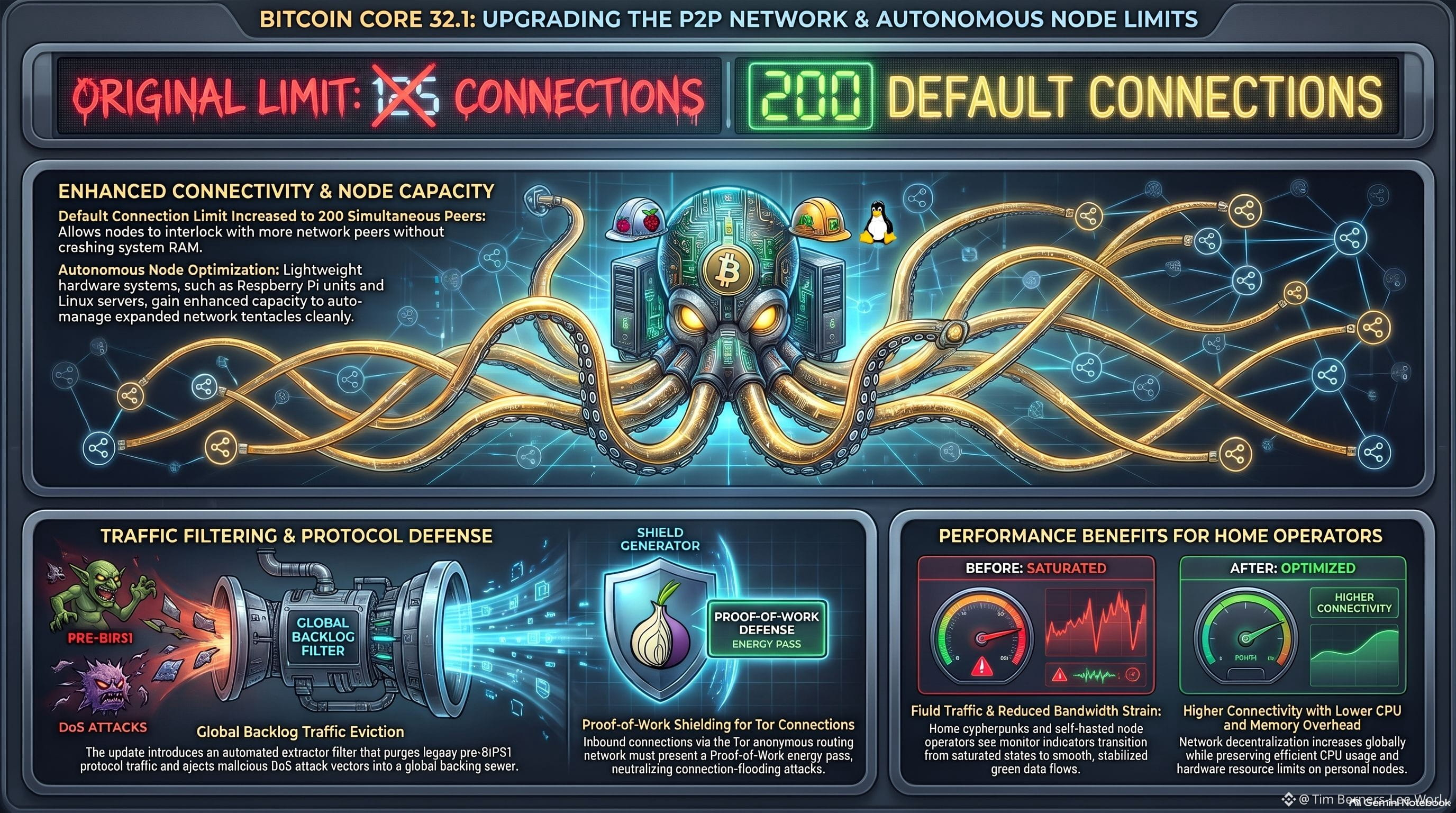
🏦🛡️En una respuesta técnica fulminante y coordinada tras la divulgación de vulnerabilidades de esta semana, el equipo de desarrollo de Bitcoin Core ha liberado oficialmente la versión 32.1 de su software de referencia. Aunque en la superficie este parche se presenta como una actualización menor de mantenimiento, en el fondo introduce modificaciones críticas en la arquitectura de red P2P (peer-to-peer), destacando un incremento en el límite por defecto de conexiones automáticas entre pares, que pasa de 125 a 200.
🏦🛡️Este incremento no es un simple capricho de ancho de banda. Al elevar el límite de conexiones automáticas, los desarrolladores buscan reforzar la topología de la red global de Bitcoin, haciéndola mucho más densa y resistente ante posibles ataques de eclipse o intentos de aislamiento de nodos. Para evitar que esta mayor apertura sature las computadoras domésticas que sostienen la red, la versión 32.1 introduce un sistema de limitación de tasa basado en un "backlog global", el cual reduce drásticamente el uso de CPU y memoria RAM cuando el volumen de transacciones en la mempool se dispara.
🏦🛡️El paquete defensivo de la actualización se completa con la implementación de defensas basadas en prueba de trabajo (PoW) para los servicios ocultos de la red Tor. Esto cierra la puerta a una de las tácticas de denegación de servicio (DoS) más comunes de los últimos meses, donde actores maliciosos aprovechaban el anonimato de Tor para abrumar los nodos con solicitudes de conexión falsas. 🏦🛡️Con el lanzamiento de la 32.1, la consigna para la comunidad minera, las casas de cambio y los operadores de nodos caseros es inequívoca: actualizar de inmediato no solo soluciona los fallos del pasado martes, sino que dota a la infraestructura de Bitcoin de los músculos necesarios para el ecosistema de 2027.$BTC $BTC
{future}(BTCUSDT)
#bitcoincore32.1raisespeerconnectionlimit
#writetoearn
🏦🛡️Bitcoin Core 32.1 se despliega: Una actualización de defensa total que expande las autopistas de la red p2p
🏦🛡️En una respuesta técnica fulminante y coordinada tras la divulgación de vulnerabilidades de esta semana, el equipo de desarrollo de Bitcoin Core ha liberado oficialmente la versión 32.1 de su software de referencia. Aunque en la superficie este parche se presenta como una actualización menor de mantenimiento, en el fondo introduce modificaciones críticas en la arquitectura de red P2P (peer-to-peer), destacando un incremento en el límite por defecto de conexiones automáticas entre pares, que pasa de 125 a 200.
🏦🛡️Este incremento no es un simple capricho de ancho de banda. Al elevar el límite de conexiones automáticas, los desarrolladores buscan reforzar la topología de la red global de Bitcoin, haciéndola mucho más densa y resistente ante posibles ataques de eclipse o intentos de aislamiento de nodos. Para evitar que esta mayor apertura sature las computadoras domésticas que sostienen la red, la versión 32.1 introduce un sistema de limitación de tasa basado en un "backlog global", el cual reduce drásticamente el uso de CPU y memoria RAM cuando el volumen de transacciones en la mempool se dispara.
🏦🛡️El paquete defensivo de la actualización se completa con la implementación de defensas basadas en prueba de trabajo (PoW) para los servicios ocultos de la red Tor. Esto cierra la puerta a una de las tácticas de denegación de servicio (DoS) más comunes de los últimos meses, donde actores maliciosos aprovechaban el anonimato de Tor para abrumar los nodos con solicitudes de conexión falsas. 🏦🛡️Con el lanzamiento de la 32.1, la consigna para la comunidad minera, las casas de cambio y los operadores de nodos caseros es inequívoca: actualizar de inmediato no solo soluciona los fallos del pasado martes, sino que dota a la infraestructura de Bitcoin de los músculos necesarios para el ecosistema de 2027.$BTC $BTC
Crypto With Faisal:
upgrading immediately not only fixes last Tuesday’s bugs, but also gives Bitcoin’s infrastructure the muscle it needs for the 2027 ecosystem.
2
1
441

A PUTIN CALLS ELON MUSK A "GENIUS"
HERE'S WHY IT MATTERS!
Russian President Vladimir Putin has
praised Elon Musk's achievements in
satellite technology, highlighting SpaceX's
Starlink network as Russia works to
develop its own satellite internet system.
Putin also said Russia maintains contact
with American partners, including Musk, to
help avoid interference between satellites
and maintain order in orbit.
The bigger picture? Satellite internet is
becoming an increasingly important part of
global connectivity, technology
competition, and digital infrastructure.
For the crypto community, reliable internet
access can help people reach blockchain
networks and digital financial services,
although connectivity alone does not
guarantee adoption.
#CanMicrosoftDeliverOnAI #CanGoogleDefindItsCore #FedWatch #BitcoinCore32.1RaisesPeerConnectionLimit #RussiaPlansStandardizedTestForCryptoInvestors



Russtam 198:
Starlink
1
1
994

·
--
#fedwatch
🚨 THE FED HELD RATES — BUT TWO OFFICIALS WANTED ANOTHER HIKE! ARE ALTCOIN BULLS CELEBRATING TOO EARLY? 👀🔥
Everyone saw the Fed pause.
But here's what most traders missed…
TWO Fed officials actually voted to RAISE rates by 25 basis points.
🏦 OCTOBER FOMC RESULTS:
✅ Rates held at 3.75%–4.00%
🔴 Lisa Cook: Wanted a 25 bps hike
🔴 Beth Hammack: Wanted a 25 bps hike
📊 Final vote: 10–2
And the Fed still says inflation remains elevated.
SO WHAT DOES THIS MEAN FOR TRADERS?
🥇 $XAU: A stronger dollar and higher yields could put gold under pressure.
🥈 $XAG: Silver could see sharper moves as rate expectations shift.
🔥 $SOL: Risk appetite matters. More hawkish signals could weigh on high-beta crypto.
🐸 $DOGE: Speculative rallies could struggle if liquidity conditions tighten.
💥 HERE'S THE REAL TRAP…
A Fed pause isn't the same as a dovish Fed.
🐂 BULLISH: Inflation cools → Rate-hike expectations fade → Gold and risk assets could recover.
🐻 BEARISH: Inflation stays hot → December hike fears grow → Dollar strengthens and speculative assets face pressure.
THE FED DIDN'T HIKE. BUT THE HAWKS ARE STILL IN THE ROOM.
Not financial advice. DYOR.
{future}(XAGUSDT)
{future}(XAUUSDT)
{future}(DOGEUSDT)
#CanMicrosoftDeliverOnAI #CanGoogleDefindItsCore #BitcoinCore32.1RaisesPeerConnectionLimit #RippleExpects$900MAnnualizedProductRevenueRunRate
#fedwatch
🚨 THE FED HELD RATES — BUT TWO OFFICIALS WANTED ANOTHER HIKE! ARE ALTCOIN BULLS CELEBRATING TOO EARLY? 👀🔥
Everyone saw the Fed pause.
But here's what most traders missed…
TWO Fed officials actually voted to RAISE rates by 25 basis points.
🏦 OCTOBER FOMC RESULTS:
✅ Rates held at 3.75%–4.00%
🔴 Lisa Cook: Wanted a 25 bps hike
🔴 Beth Hammack: Wanted a 25 bps hike
📊 Final vote: 10–2
And the Fed still says inflation remains elevated.
SO WHAT DOES THIS MEAN FOR TRADERS?
🥇 $XAU: A stronger dollar and higher yields could put gold under pressure.
🥈 $XAG: Silver could see sharper moves as rate expectations shift.
🔥 $SOL: Risk appetite matters. More hawkish signals could weigh on high-beta crypto.
🐸 $DOGE: Speculative rallies could struggle if liquidity conditions tighten.
💥 HERE'S THE REAL TRAP…
A Fed pause isn't the same as a dovish Fed.
🐂 BULLISH: Inflation cools → Rate-hike expectations fade → Gold and risk assets could recover.
🐻 BEARISH: Inflation stays hot → December hike fears grow → Dollar strengthens and speculative assets face pressure.
THE FED DIDN'T HIKE. BUT THE HAWKS ARE STILL IN THE ROOM.
Not financial advice. DYOR.
#CanMicrosoftDeliverOnAI #CanGoogleDefindItsCore #BitcoinCore32.1RaisesPeerConnectionLimit #RippleExpects$900MAnnualizedProductRevenueRunRate

3
3.1k

·
--
Bullish
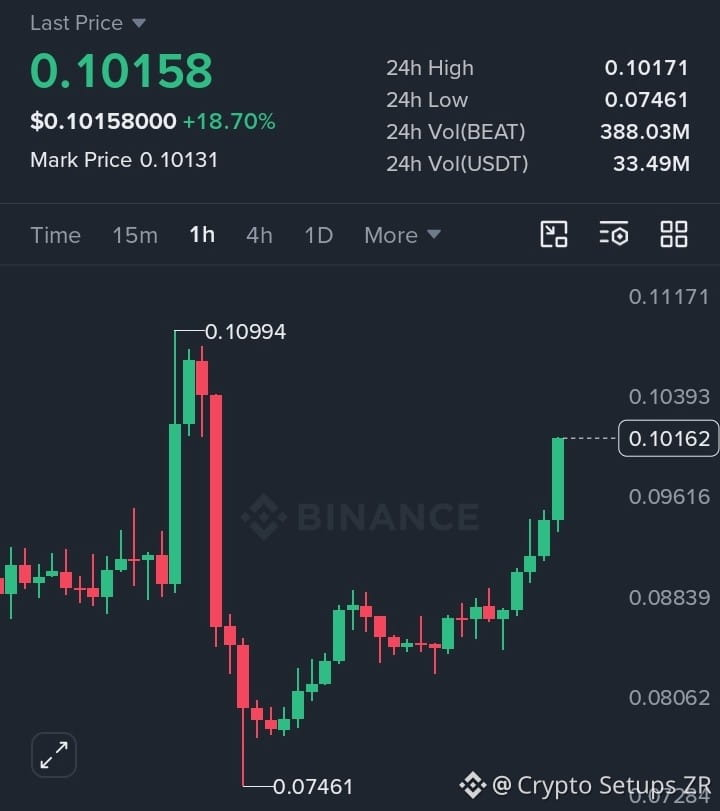
$BEAT Flying Like Skyrocket..🟢‼️
From 0.0746 Straight Into 0.1016 In Pure Rocket Fuel 💥0.110 Next Liquidity Target Loading Fast.. Don't Miss The Move 🎯🤑
{future}(BEATUSDT)
$EVAA
{future}(EVAAUSDT)
$Q
{future}(QUSDT)
#FedWatch #BitcoinCore32.1RaisesPeerConnectionLimit #EarningsSeason
$BEAT Flying Like Skyrocket..🟢‼️
From 0.0746 Straight Into 0.1016 In Pure Rocket Fuel 💥0.110 Next Liquidity Target Loading Fast.. Don't Miss The Move 🎯🤑
$EVAA
$Q
#FedWatch #BitcoinCore32.1RaisesPeerConnectionLimit #EarningsSeason
From 0.0746 Straight Into 0.1016 In Pure Rocket Fuel 💥0.110 Next Liquidity Target Loading Fast.. Don't Miss The Move 🎯🤑
$EVAA
$Q
#FedWatch #BitcoinCore32.1RaisesPeerConnectionLimit #EarningsSeason
Crypto Setups ZR
·
--
Bullish$APR Woke Up For Round TWO..💥‼️
From 0.04561 Dip Straight Into 0.05177.. 0.05375 High Next Chapter 🎯 Don't Miss It
$Q
$EVAA
#CanMicrosoftDeliverOnAI #CanGoogleDefindItsCore #FedWatch
From 0.04561 Dip Straight Into 0.05177.. 0.05375 High Next Chapter 🎯 Don't Miss It
$Q
$EVAA
#CanMicrosoftDeliverOnAI #CanGoogleDefindItsCore #FedWatch
AI Signal بركة:
Bids at 0.099 are stacked deep.
31
1
7
2.4k

·
--
🐸 $PEPE is trading near $0.00000486, with short-term price pressure.📉 Trend: Momentum looks weak after rejection near $0.00000508.
📊 Resistance: $0.00000508 is the key level to watch for a potential breakout.
🟢 Bullish Scenario: A breakout with strong volume could support another upward move.
🔴 Bearish Scenario: If selling continues, PEPE could retest lower support levels.
⚠️ Risk: I’ll wait for confirmation before taking a trade. Are you bullish or bearish on PEPE? #PEPE #FedWatch #BitcoinCore32.1RaisesPeerConnectionLimit
{spot}(PEPEUSDT)
🐸 $PEPE is trading near $0.00000486, with short-term price pressure.📉 Trend: Momentum looks weak after rejection near $0.00000508.
📊 Resistance: $0.00000508 is the key level to watch for a potential breakout.
🟢 Bullish Scenario: A breakout with strong volume could support another upward move.
🔴 Bearish Scenario: If selling continues, PEPE could retest lower support levels.
⚠️ Risk: I’ll wait for confirmation before taking a trade. Are you bullish or bearish on PEPE? #PEPE #FedWatch #BitcoinCore32.1RaisesPeerConnectionLimit
98

🇧🇩 I’m from Bangladesh! My favorite coins are $MOVR $LUNC & $ICP 🚀🔥
Now Your turn! What are your favorites? 👇
#CanMicrosoftDeliverOnAI #CanGoogleDefindItsCore #EarningsSeason #BitcoinCore32.1RaisesPeerConnectionLimit
🇧🇩 I’m from Bangladesh! My favorite coins are $MOVR $LUNC & $ICP 🚀🔥
Now Your turn! What are your favorites? 👇
#CanMicrosoftDeliverOnAI #CanGoogleDefindItsCore #EarningsSeason #BitcoinCore32.1RaisesPeerConnectionLimit
Now Your turn! What are your favorites? 👇
#CanMicrosoftDeliverOnAI #CanGoogleDefindItsCore #EarningsSeason #BitcoinCore32.1RaisesPeerConnectionLimit


Myx Rex:
is p2p safe in bangladesh...
46
2
35
10.9k

·
--
Verified
🔥🔥🔥🔥🔥🔥🔥
Google to Help Store Bitcoin
Google Cloud has updated its MPC service for the institutional custody of Bitcoin, currently in the pre-testing phase.
📊 The technology distributes control over the key among multiple parties, reducing the risk of unauthorized access.
While an official launch has not yet been announced, Google is strengthening its position in the crypto market.
#CanGoogleDefindItsCore #BitcoinCore32.1RaisesPeerConnectionLimit
$GOOGLB
{spot}(GOOGLBUSDT)
$GOOGL
{future}(GOOGLUSDT)
🔥🔥🔥🔥🔥🔥🔥
Google to Help Store Bitcoin
Google Cloud has updated its MPC service for the institutional custody of Bitcoin, currently in the pre-testing phase.
📊 The technology distributes control over the key among multiple parties, reducing the risk of unauthorized access.
While an official launch has not yet been announced, Google is strengthening its position in the crypto market.
#CanGoogleDefindItsCore #BitcoinCore32.1RaisesPeerConnectionLimit
$GOOGLB
$GOOGL

cryptogirl007:
$GOOGLB spot CVD is diverging positively on this custody news, so where is your invalidation level?
1
10
590
Log in to explore more content
Join global crypto users on Binance Square
⚡️ Get latest and useful information about crypto.
💬 Trusted by the world’s largest crypto exchange.
👍 Discover real insights from verified creators.
Email / Phone number
Trending Topics
1
#FedWatch
16.1M views
37,725 Discussing
2
#Nasdaq100FuturesFall0.9%
1,049 views
55 Discussing
3
#BitcoinCore32.1RaisesPeerConnectionLimit
14,868 views
395 Discussing
4
#VisaStablecoinSettlementTops$25BAnnualized
207 views
9 Discussing
5
#WestpacToCapCryptoPaymentsAtAUD10KPerMonth
4,496 views
118 Discussing
6
#RussiaPlansStandardizedTestForCryptoInvestors
5,866 views
149 Discussing
7
#EarningsSeason
6.2M views
30,701 Discussing
8
#BitcoinCoreIdentifiesThreeVulnerabilities
22,651 views
410 Discussing
9
#CanGoogleDefindItsCore
435,352 views
3,191 Discussing
10
#CanMicrosoftDeliverOnAI
690,692 views
4,486 Discussing