
DoubleZero Official
53 Posts

DoubleZero Official
 Square Verified
Report
Block User
The network that moves new finance. Receive Wall-Street grade data feeds, publish data, and out-pace the internet over dedicated global fiber.
0 Following
211 Followers
36 Liked
Posts
All
Videos
The difference between public-internet routing and dedicated fiber is measurable ⚡
For trading systems following $HYPE and $SUI the path information takes can influence how quickly it arrives.
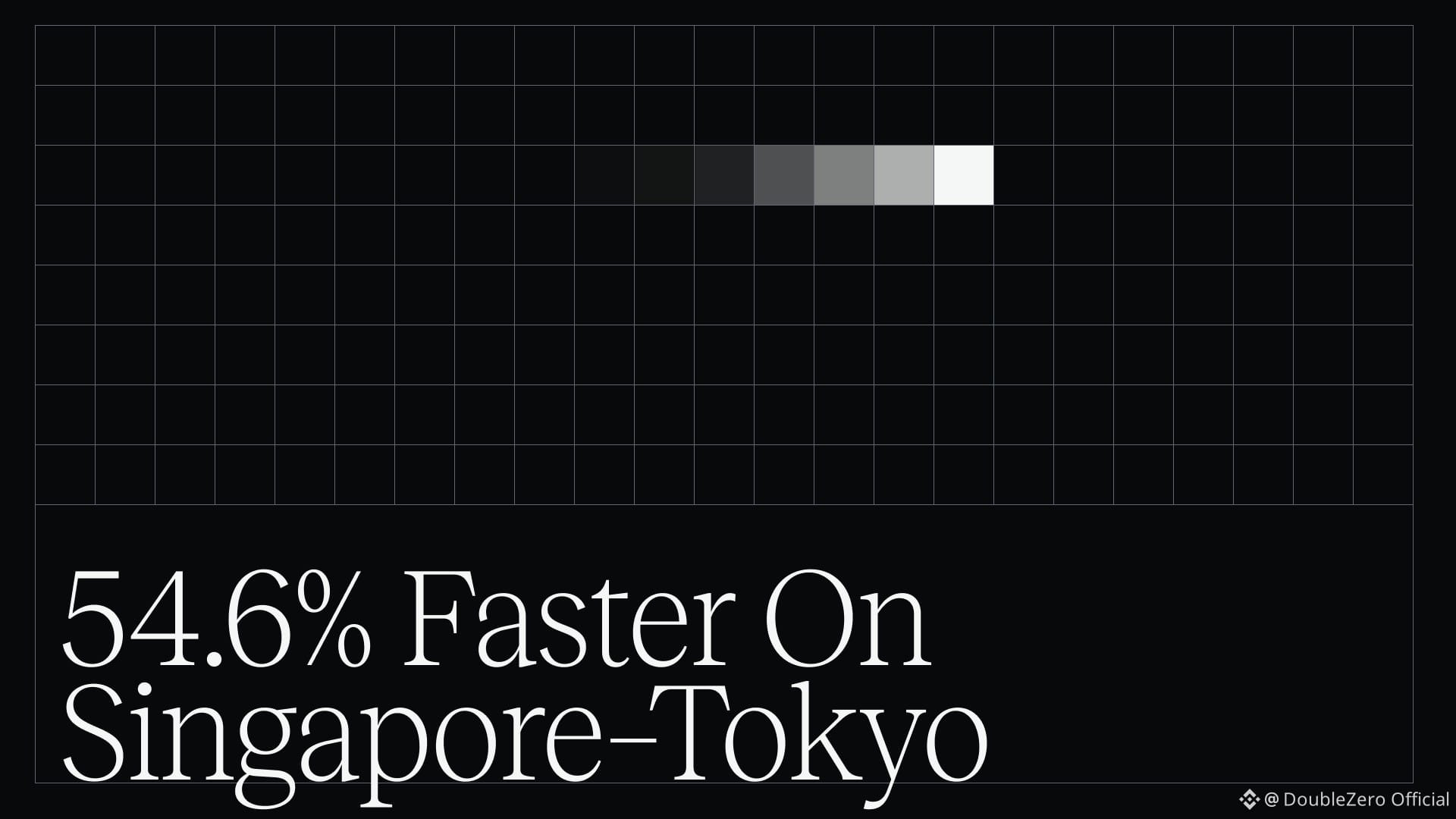
In DoubleZero's October 23 Fiber Friday update, its Singapore–Tokyo link recorded:
DoubleZero RTT: 65.8ms
Public internet RTT: 144.9ms
That's a 54.6% improvement in round-trip time on the measured route.
The update also reported DoubleZero links performing 21.3% faster on average.
Dedicated networking isn't just a theoretical infrastructure advantage.
It's something you can measure.
#trading
1
1.7k
Verified
DoubleZero Edge is expanding from distributing market data to enabling builders to publish it 🧱
For participants following $HYPE and $LINK markets, access to timely information is essential.
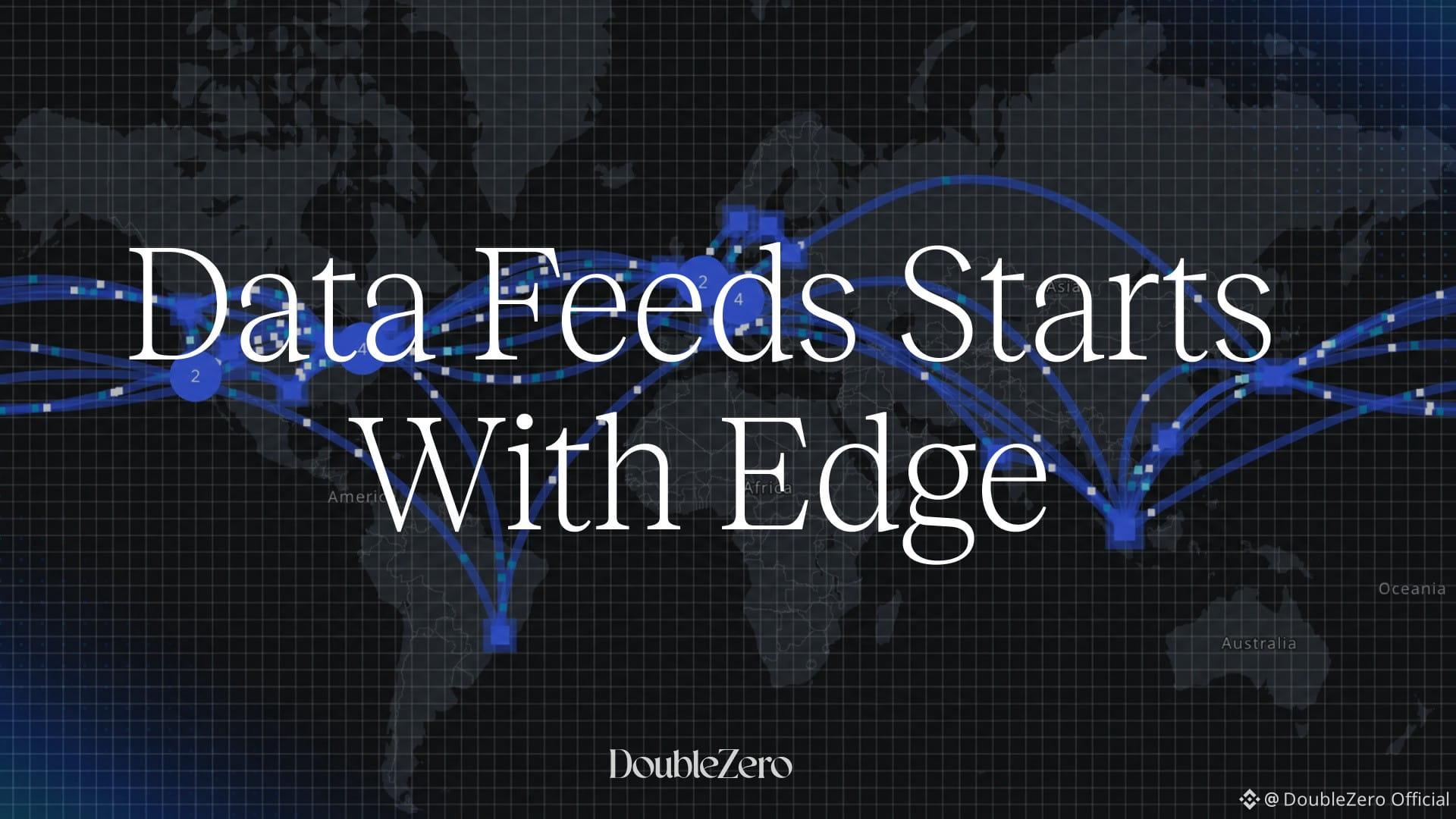
Edge for Builders brings a new capability to the network: permissionless deployment of data feeds.
Applications and exchanges can build their own distribution infrastructure using DoubleZero's low-latency multicast network.
With its testnet release, Edge for Builders marks another step toward making real-time financial data infrastructure accessible to more developers.
More builders. More potential feeds. A bigger network.
#Hyperliquid
1
1.3k
·
--
Bullish
The most powerful networks become more useful as they grow 🌐
In an increasingly interconnected crypto market, participants following $HYPE and assets such as $LINK depend on access to information across different venues and systems.
But the opportunity isn't simply connecting more endpoints.
It's making those connections more valuable.
DoubleZero Edge demonstrates this through its expanding market-data distribution model.
Every additional feed increases the range of information available through the network.
Every new connected consumer expands the potential audience for participating data producers.
And shared infrastructure makes it possible for these relationships to develop without requiring an entirely separate distribution network for every market.
That's how network effects begin to compound.
More sources.
More connected participants.
More opportunities for information to move efficiently.
DoubleZero is building the connectivity foundation for a more interconnected financial ecosystem.
#defi
1
315
·
--
Bullish
The next wave of crypto activity needs infrastructure built to handle it 🔥
As ecosystems like $SUI and $AVAX continue developing, the demand for communication between distributed systems becomes increasingly important.
More applications create more interactions.
More trading creates more market data.
More activity places greater demands on the networks connecting participants.
The visible growth happens at the application layer.
But the infrastructure underneath those applications determines how effectively information can move.
That's where DoubleZero comes in.
DoubleZero provides dedicated networking designed for high-performance distributed systems.
And Edge extends that foundation into real-time financial data distribution.
Together, they address the connectivity requirements behind increasingly active blockchain and trading ecosystems.
The next chapter of crypto won't be powered by applications alone.
It will also depend on the infrastructure making those applications possible.
#trading
2
2.3k
·
--
Bullish
DoubleZero Edge is more than a way to access individual market-data feeds 📈
The $HYPE ecosystem demonstrates the importance of real-time perpetual market data, while activity around $AVAX shows how widely trading opportunities can spread across crypto.
Different markets attract different participants.
Different strategies require different information.
And market-data infrastructure needs to accommodate that diversity.
DoubleZero Edge is building a distribution layer that connects multiple data sources through shared infrastructure.
With feeds from markets including Kalshi and Hyperliquid, Edge demonstrates how different categories of financial information can be brought into the same network.
Each addition expands the range of information available to participants.
And every expansion strengthens the broader proposition.
The opportunity isn't limited to any individual feed.
It's the infrastructure connecting an expanding universe of financial markets.
#DataFi
2
330
The more markets connect, the more powerful shared infrastructure becomes 🚀
Trading firms following $HYPE and monitoring assets such as $LINK need access to different sources of information.
Each new venue can introduce additional technical requirements.
Different feeds.
Different formats.
Different distribution systems.
DoubleZero Edge brings market-data distribution into a shared infrastructure model.
Instead of treating every new feed as an entirely separate networking challenge, participants can access multiple sources through an expanding distribution layer.
That creates a compounding opportunity.
More feeds increase the information available to connected consumers.
More consumers increase the potential reach of participating data producers.
And the network becomes more useful as both sides grow.
That's the value of infrastructure designed to expand with the markets it serves.
#trading
1
211
Faster execution unlocks more potential. Faster networking helps deliver it ⚡
High-performance ecosystems like $SUI and $AVAX demonstrate how much attention blockchain development gives to throughput and execution.
But execution is only one part of distributed performance.
Validators and other network participants still need to exchange information.
And as systems process more activity, their communication requirements can increase.
A powerful machine cannot eliminate the time required for data to travel across a physical network.
That makes connectivity a scaling challenge of its own.
DoubleZero addresses that layer directly.
By building dedicated networking for distributed systems, DoubleZero helps improve the infrastructure carrying information between machines.
Better execution expands what a blockchain can process.
Better networking helps those improvements translate into performance across the system.
The next leap in blockchain infrastructure goes beyond compute.
#Trading #Aİ
1
267
·
--
Bullish
Every market-data feed has two sides. DoubleZero Edge connects them 📡
Whether traders are following $SUI or building strategies around $LINK access to timely information is fundamental.
But there's another side to the equation.
The venues producing that information need to distribute it efficiently.
Exchanges generate constantly changing prices, trades and order-book updates.
Market makers, trading firms and automated strategies consume that information to make decisions.
DoubleZero Edge provides infrastructure connecting these two sides.
Data producers gain a distribution channel.
Data consumers gain access to an expanding collection of feeds through shared infrastructure.
And as participation grows, the network becomes increasingly useful to both.
This is bigger than one exchange or one feed.
It's about building the infrastructure through which modern financial information moves.
#defi
197
·
--
Bullish
Before a trading system can react, information has to reach it. 🌐
Markets around $HYPE and assets such as $AVAX generate information that trading systems need to process continuously.
But that information doesn't teleport from an exchange to a trader.
It travels.
Through physical connections.
Across routers.
Between data centers.
Over fiber networks connecting machines that may be thousands of kilometers apart.
Every stage of that journey affects how quickly information becomes available.
And for automated strategies, the arrival time of market data can influence when a decision is made.
This is why networking is part of trading performance.
DoubleZero Edge provides infrastructure designed to distribute real-time market data with low latency and consistency.
Because getting better information is valuable.
Getting that information when it matters is what makes it useful.
#DataFi
1
395
·
--
Bullish
Crypto markets move fast. The infrastructure underneath them needs to move faster 🔥
When activity increases across ecosystems like $SUI and $AVAX more information needs to move between participants.
More orders.
More updates.
More automated decisions.
More systems communicating simultaneously.
That activity creates demand beyond the applications traders see on their screens.
Underneath every trading interface is an infrastructure layer responsible for delivering the information those applications depend on.
DoubleZero focuses on that foundation.
Its dedicated network is designed to support the communication requirements of high-performance distributed systems.
And DoubleZero Edge extends that infrastructure into real-time market-data distribution.
The bigger the opportunity in crypto markets becomes, the more important the infrastructure supporting those markets is.
The next generation of finance needs networking built for its demands.
#TradingSignals
2
475
·
--
Bullish
The real power of DoubleZero Edge grows with every market it connects 📡
Trading activity around $HYPE and assets such as $LINK highlights how many different markets and ecosystems sophisticated participants need to follow.
Every market generates its own streams of information.
And historically, accessing more sources often meant maintaining more integrations.
DoubleZero Edge changes that model.
By bringing multiple real-time market-data feeds into a shared distribution layer, Edge gives participants a way to access an expanding range of information through the same underlying infrastructure.
Kalshi adds one category of market data.
Hyperliquid adds another.
As more sources join, the same connection becomes more useful.
And as more consumers connect, Edge becomes a more valuable distribution channel for data producers.
That's how a collection of feeds starts becoming a network.
#defi #Web3
2
207
The fastest connection isn't always the most valuable. The most predictable one can be ⚡
For trading systems following $HYPE markets and strategies operating around $SUI the timing of information matters.
A connection that delivers data in 10ms most of the time but occasionally takes 100ms introduces uncertainty.
That uncertainty has a name: jitter.
For automated trading systems, unpredictable delivery times can complicate everything from pricing decisions to risk management.
DoubleZero addresses the networking layer directly, providing dedicated infrastructure designed for consistent, low-latency communication.
The goal isn't simply to move information quickly once.
It's to make fast, reliable delivery something systems can consistently depend on.
In markets where every millisecond matters, predictability is a performance advantage.
#trading #TradingSignals
2
296
·
--
Bullish
Faster blockchains need faster networks to reach their full potential ⚡
$SOL can increase execution performance, and validators can run increasingly powerful hardware. $SUI can pursue its own approach to high-throughput architecture.
But every distributed system eventually encounters the same physical reality:
Machines have to communicate.
As blockchains process more activity, the amount of information moving between their participants grows too. Improving compute doesn't automatically improve the infrastructure carrying those messages across the world.
That's why networking is a scaling challenge of its own.
DoubleZero targets that layer directly, building dedicated connectivity for distributed systems rather than relying on improvements higher in the stack to solve the physical movement of data underneath them.
Scaling execution pushes performance forward.
Scaling the network connecting it pushes the ceiling even higher.
#defi #sol
2
206
Crypto runs in the cloud. But the cloud still runs on cables 🔌
A $SOL validator can execute software on powerful hardware, while applications across $ETH can optimize code endlessly, but information still has to physically travel between machines.
That journey is easy to forget.
Packets move through routers, fiber and data centers across cities, countries and continents before another machine can act on them.
Which means blockchain performance isn’t purely a software problem.
DoubleZero brings the physical path underneath distributed systems into the infrastructure conversation by creating dedicated networking designed around moving their traffic.
Consensus can improve.
Execution can improve.
Hardware can improve.
But eventually, one computer still needs to communicate with another.
The network between them is part of the stack too.
#solana #DataFi
2
187
·
--
Bullish
Every market-data problem has two sides.
A trading firm following $SOL wants information delivered as quickly and reliably as possible.
A venue serving markets around assets such as $BTC has the opposite problem: getting constantly changing information out to participants efficiently.
DoubleZero Edge can sit between those two needs.
On one side are exchanges, venues and other data producers generating information.
On the other are traders, market makers and institutions consuming it.
Edge provides infrastructure through which that information can move.
That creates an interesting dynamic as the network expands: more data sources can make Edge more useful for consumers, while more connected consumers can make the network more useful as a distribution channel.
The opportunity isn’t simply faster data.
Its infrastructure connects the people producing financial information with the people whose systems depend on receiving it.
#bitcoin #DataFi
2
196
·
--
Bullish
The real story behind DoubleZero Edge 📡
Hyperliquid brings perpetual market data from the $HYPE ecosystem.
Elsewhere, the scale of trading around assets such as $BTC demonstrates just how valuable continuously updated market information has become.
Now consider what happens as Edge adds more sources.
Instead of building separate infrastructure to access every new market, participants can connect to an expanding distribution layer carrying multiple categories of real-time data.
That changes the value proposition.
Every additional feed potentially makes the same underlying connection more useful to consumers, while a growing base of connected participants can make Edge a more useful distribution channel for data producers.
Kalshi expands the data available through Edge.
Hyperliquid expands it again.
The individual feeds matter.
But the network they are collectively building could matter considerably more.
#bitcoin #hype
1
246
·
--
Bullish
What if unused bandwidth could become productive blockchain infrastructure? 🧵
Networks like $MON need enormous amounts of connectivity as validators exchange information globally, while the growth of ecosystems such as $SUI shows how much performance increasingly matters to modern blockchain applications.
All of these validators need to be connected. And DoubleZero approaches connectivity differently.
Rather than relying on a single provider to build every piece of the network, contributors can supply links and capacity to DoubleZero.
That changes bandwidth from something networks simply purchase into something participants can contribute.
As demand for the network grows, contributors have an economic reason to provide additional capacity on DoubleZero’s Edge service.
More capacity can support more traffic, while additional traffic creates greater demand for the infrastructure underneath it.
It’s a model where the physical resources required to scale distributed systems don’t necessarily have to come from one company.
They can come from a network. A decentralised international hub.
#DeFi #altcoins
1
442
Blockchains have specialized almost everything except the network connecting them. 🌐
$SOL has pushed execution and validator performance forward, while ecosystems such as $AVAX have explored different architectures for scaling distributed systems.
Yet underneath all of that innovation sits something surprisingly ordinary:
The public internet.
Validator messages compete for infrastructure designed to carry everything from video streams and cloud applications to emails and social media.
DoubleZero introduces another approach.
Its network is designed specifically around the requirements of high-performance distributed systems, giving critical traffic dedicated infrastructure rather than forcing every packet through the same general-purpose environment.
We’ve built specialized hardware for crypto.
Specialized software.
Specialized consensus mechanisms.
Specialized networking is the next piece of the stack.
You could say, we’re special ourselves.
#Macro #altcoins
233
How do you trade on unpredictable infrastructure? ⚡
High-performance ecosystems like $AVAX and $SUI depend on more than fast execution. They also need reliable networking to move critical information between machines.
The biggest problem with the public internet isn’t always speed. It’s consistency. Network congestion and unpredictable routing can introduce delays that distributed systems cannot control.
This variability in network delay is called jitter. When jitter is high, data arrival times become less predictable.
A validator might have a perfectly good connection one moment, while congestion elsewhere on the public internet changes how packets travel.
What matters is whether data arrives consistently.
If one message takes 20ms and the next suddenly takes 100ms, systems have to account for that variance. At blockchain scale, unpredictable networking can become another constraint on performance.
DoubleZero addresses this problem by giving distributed systems access to purpose-built network infrastructure rather than relying entirely on general-purpose internet routes.
Because the next generation of blockchain performance won’t just depend on moving data faster. It will also depend on delivering it consistently and predictably.
#AvalancheAVAX #SUI🔥
1
249
Partly True
What happens when network usage directly funds network growth? 🔄
DoubleZero now carries more than 64% of Solana’s staked $SOL representing roughly $33B in connected value as validators across SOL choose dedicated fiber infrastructure over routing entirely through the public internet.
That usage is designed to create an economic flywheel.
When Edge generates revenue, that revenue is converted into $2Z
A portion of those tokens is burned, while the remainder flows to the contributors supplying the links and capacity that power the network.
More usage → more revenue → more support for contributors → more network capacity.
And as contributors add capacity, DoubleZero can support more traffic, more applications and ultimately more usage.
The result is a circular model where growth in network demand doesn’t just create revenue.
It helps fund the infrastructure needed for the network to grow again.
#sol #Altcoin
1
1
498
Log in to explore more content
Join global crypto users on Binance Square
⚡️ Get latest and useful information about crypto.
💬 Trusted by the world’s largest crypto exchange.
👍 Discover real insights from verified creators.
Email / Phone number
Trending Topics
BinanceReopensWithdrawalsForHYPE&APT
65,723 views
853 Discussing
Binance Re-Enables Withdrawals for HYPE and APT, Extends List of Restored Assets
Binance News
·32 Likes
·22k views
SouthKoreaDraftLawTargets15To20%ShareholderCap
65,158 views
560 Discussing
TradFiForBeginners
167,308 views
1,755 Discussing