
#bondyields
bondyields
18,430 views
329 Discussing
Hot
Latest

The U.S. Treasury market saw strong buying during today’s trading session. The 5-year Treasury yield plunged 14.33 basis points intraday, breaking through multiple moving-average support levels to reach 4.825%—its lowest level since September 23. This sharp move signals that safe-haven flows are accelerating back into short- and medium-term sovereign bonds, while technical pressure on the yield curve is showing clear signs of easing.
From a macro trading perspective, a single-day decline of more than 14 basis points is highly significant in the bond market and often signals a material softening in market expectations for the terminal rate of future rate hikes. The spread pressures stemming from the previous tightening cycle are beginning to ease at the margin, as bullish forces quickly gather at key technical levels, lifting bond prices out of their bottom range.
For financial markets overall, the rapid pullback in Treasury yields has eased discount-rate pressures across asset classes. This has increased resistance to further gains in the U.S. Dollar Index, creating a very favorable window for a liquidity-driven rebound in commodities and high-valuation assets that had previously been weighed down by high interest rates. Risk appetite across markets is showing signs of a positive recovery.
For crypto markets, the significant decline in risk-free rates is a clear signal that liquidity conditions are improving. As funding costs fall, risk assets led by $BTC could see strong rebound momentum at current technical support levels, with market sentiment rapidly shifting from defense to a more aggressive positioning phase.📈
#BondYields #InterestRates #CryptoMarket
55

·
--
European sovereign debt markets showed signs of a sharp deterioration today. The spread between French and German 10-year government bonds widened rapidly to 161 basis points, setting a new high since the European sovereign debt crisis in November 2011. Meanwhile, the Belgium-Germany spread also climbed to 104.08 basis points, reaching a near 13-year high.
As core eurozone countries, France and Germany, along with Belgium and Germany, have seen their spreads widen sharply in tandem, signaling a concentrated surge in market concerns about the fiscal sustainability of non-German core members. This not only means a substantial repricing of sovereign risk premiums between Europe’s second-tier economies and its core, but also exposes deep-seated institutional investor wariness about pressure on European public debt.
Widening sovereign spreads are intensifying potential capital pressures on Europe’s banking sector and weighing heavily on the overall valuation of euro-denominated assets, in turn driving up the safe-haven premium in the global financial system. Against a backdrop of structurally rising borrowing costs, global liquidity conditions face the real prospect of tightening further.
For crypto assets, although cracks in traditional sovereign credit theoretically strengthen the decentralization narrative, risk assets generally face forced position cuts in the early stages of liquidity tightening and safe-haven-driven markets. If pressure on European debt spreads, crypto markets, led by $BTC , may remain under pressure in the short term.
#EuropeanDebt #BondYields #MacroRisk
14

·
--
European financial markets saw rising sovereign debt tensions today, as the 10-year French-German bond yield spread widened to 161 basis points, its highest level since November 2011. Meanwhile, Belgium’s 10-year yield spread over Germany also surged to 104.08 basis points, a new 13-year high.
The record widening of yield spreads reflects investors’ deep concerns about fiscal risks and political instability in the Eurozone. Markets are repricing sovereign credit risk with far greater caution than previously expected.
A wave of bond sell-offs has driven capital toward safe havens, pushing the USD/JPY exchange rate down to 157.11, its lowest level in three weeks. Global risk appetite is declining rapidly amid spreading sovereign debt pressures.
For crypto, short-term defensive sentiment could limit inflows into $BTC. However, prolonged sovereign debt risks could help strengthen the position of decentralized assets over the long term. 📊
#Eurozone #BondYields #MacroEconomics
European financial markets saw rising sovereign debt tensions today, as the 10-year French-German bond yield spread widened to 161 basis points, its highest level since November 2011. Meanwhile, Belgium’s 10-year yield spread over Germany also surged to 104.08 basis points, a new 13-year high.
The record widening of yield spreads reflects investors’ deep concerns about fiscal risks and political instability in the Eurozone. Markets are repricing sovereign credit risk with far greater caution than previously expected.
A wave of bond sell-offs has driven capital toward safe havens, pushing the USD/JPY exchange rate down to 157.11, its lowest level in three weeks. Global risk appetite is declining rapidly amid spreading sovereign debt pressures.
For crypto, short-term defensive sentiment could limit inflows into $BTC . However, prolonged sovereign debt risks could help strengthen the position of decentralized assets over the long term. 📊
#Eurozone #BondYields #MacroEconomics
220

·
--
European sovereign debt markets saw a notable move today, with France’s 10-year government bond yield rising 4 basis points intraday to close at around 5.039%. This key yield level set a new high for the bond in nearly 24 years, quickly drawing significant attention from major global macro hedge funds and interest-rate traders. The move signals a profound structural adjustment in borrowing costs for Europe’s core countries.
As the eurozone’s second-largest core economy after Germany, France’s benchmark government bond yield breaking above 5% and reaching a more than 20-year high is a significant indicator. It reflects market concerns about the complex combination of stagnant European economic growth and persistent inflation, even as investors price in expectations of prolonged monetary tightening. At the same time, the sharp rise in borrowing costs has prompted further discussion about fiscal deficits and refinancing pressures facing highly indebted sovereigns.
In traditional financial markets, the surge in French government bond yields has further reinforced expectations that global interest rates will remain “higher for longer.” Elevated risk-free yields are weighing to some extent on valuations of risk assets such as equities, prompting some defensive capital to flow back into high-yield fixed-income products. Major institutions are repeatedly weighing tighter liquidity against sovereign credit risks, keeping cross-asset allocation sentiment broadly neutral and cautious.
For crypto assets, the high returns on traditional fixed-income assets continue to raise the opportunity cost of holding cryptocurrencies. Against this high-interest-rate macro backdrop, inflows of incremental over-the-counter liquidity may remain relatively restrained, and the market could continue to be driven by competition for existing capital in the short term. On the other hand, some crypto investors are also keeping a close eye on mounting pressure in traditional sovereign debt markets, watching to see whether it could spur demand for safe-haven and hedging allocations to decentralized hard assets such as $BTC .
#BondYields #MacroEconomics #CryptoMarket
45
France’s 10-year government bond yield rose 4 basis points during today’s European session to 5.039%, officially setting a new high not seen in nearly 24 years. This breach of a landmark level directly reflects the intense tussle over liquidity and fiscal premiums in European sovereign debt markets.
Technically, long-dated European bond yields have broken through key resistance, indicating that the market has largely absorbed and priced in advance a tighter environment that will be both more severe and more persistent. Although the surge in yields has raised borrowing costs in the short term, it often signals that selling pressure on traditional sovereign bonds is nearing the end of oversold territory, with macro tail risks now being fully priced in.
Across asset classes, peaking yields are typically accompanied by declining volatility in foreign exchange and fixed-income markets. As sovereign credit spreads show signs of repricing, the U.S. Dollar Index and U.S. Treasury yields may diverge, providing a fresh catalyst for global capital seeking pockets of attractive returns.
For crypto assets, the soaring cost of traditional sovereign debt denominated in fiat currencies is pushing liquidity to seek decentralized inflation hedges. If sovereign bond yields consolidate near extreme levels, spillover capital may flow back into high-beta risk assets. After weathering a macro stress test, $BTC and major cryptocurrencies may, in fact, have greater valuation resilience. 📈
#BondYields #MacroEconomics #CryptoLiquidity
41
·
--
European financial markets saw notable volatility in today's trading session, as the yield on 10-year French government bonds rose 4 basis points to 5.039%. This is the highest yield in 24 years, reflecting mounting pressure from a sharp sell-off in government debt.
Borrowing costs reaching a more-than-two-decade high point to growing investor concerns about France's fiscal position and budget deficit. Rising yield pressures not only increase the country's refinancing costs but also raise the risk of financial fragmentation within the euro area.
This development is putting significant pressure on traditional financial markets, tightening the cost of capital across the Eurozone. Rising yields are weakening the appeal of equities and putting downward pressure on the EUR amid continued uncertainty about regional economic growth.
For crypto markets, elevated risk-free yields may temporarily curb speculative flows into highly volatile assets. Even so, persistent public debt risks in developed economies also support the case for holding $BTC as a hedge against long-term fiscal risks.
#BondYields #MacroEconomy #Eurozone
9
·
--
The results of the U.S. Treasury’s latest 20-year bond auction showed that the winning yield reached its highest level since January 1986. This closely watched auction directly reflects the severe pressure facing the long end of the sovereign debt market.
Long-term Treasury yields breaking through multi-decade highs signal mounting market concerns about persistent U.S. inflation and expanding fiscal deficits. They also mean that investors are demanding a significantly higher risk premium to hold Treasuries over the long term, putting earlier optimism about policy easing to a serious test.
The continued surge in benchmark yields will have a systemic tightening effect on global financial conditions. Elevated risk-free rates will not only push up the U.S. dollar index but also directly weigh on risk-asset valuations, prompting global capital to flow back more rapidly into traditional fixed-income assets.
For crypto markets, the macro liquidity environment is continuing to deteriorate. With funding costs remaining high, digital assets, including $BTC , are unlikely to attract ample new buying in the short term. Investors should remain highly alert to downside risks from receding liquidity.
#US10Y #BondYields #MacroEconomics
198
A landmark technical breakout has emerged in European bond markets today. France’s 10-year government bond yield surged past the key 5% threshold, reaching its highest level since July 2002. Meanwhile, the risk indicator for French sovereign bonds climbed rapidly to nearly 160 basis points, hitting its highest range in almost 15 years.
Technically, bond yields have broken through a structural resistance level that held for more than two decades, firmly establishing an upward trend in the macro interest-rate baseline. The extreme reading in a key risk-premium indicator not only reflects a repricing of traditional sovereign assets, but is also forcing existing capital to accelerate its search for alternatives that offer inflation protection and zero default risk.
Across asset classes, the sharp breakout in long-term European interest rates has breached the valuation floor for traditional fiat assets. Safe-haven demand is rising in foreign-exchange markets, while the continued deterioration in sovereign credit premiums is eroding the safe-haven status of traditional government bonds, prompting liquidity to flow into assets with greater pricing autonomy.
For crypto markets, the growing cracks in the pricing of traditional sovereign credit are becoming the best catalyst for decentralized assets. As yields on underlying fiat assets peak and credit quality erodes, core assets such as $BTC are demonstrating strong antifragile properties. Outflows from traditional fixed income will inject fresh bullish momentum into overall liquidity.📈
#BondYields #France #MacroEconomics
146

·
--
European sovereign debt markets experienced severe turmoil today as France's 10-year government bond yield touched 5%, reaching its highest level since July 2002. Simultaneously, the French bond risk spread widened toward 160 basis points, hitting a 15-year peak amid mounting fiscal and political pressures in the eurozone.
This spike represents a critical milestone in European fiscal stability. French borrowing costs crossing the 5% threshold signals that investors are demanding a significantly higher risk premium, challenging the historical view of French sovereign debt as a core European safe haven alongside German Bunds.
The widening spread puts direct downward pressure on the euro while tightening overall financial conditions across Europe. Rising sovereign yields usually lift corporate borrowing costs, dampening equity market momentum and keeping currency volatility elevated as investors reassess debt sustainability across the continent.
For crypto assets, persistent turbulence in traditional sovereign debt highlights the role of decentralized, non-sovereign alternatives. While short-term liquidity contractions can create risk-off headwinds for $BTC, growing concerns over European fiscal discipline continue to strengthen the long-term hedge narrative for Bitcoin.
#EuropeanDebt #BondYields #MacroEconomics
European sovereign debt markets experienced severe turmoil today as France's 10-year government bond yield touched 5%, reaching its highest level since July 2002. Simultaneously, the French bond risk spread widened toward 160 basis points, hitting a 15-year peak amid mounting fiscal and political pressures in the eurozone.
This spike represents a critical milestone in European fiscal stability. French borrowing costs crossing the 5% threshold signals that investors are demanding a significantly higher risk premium, challenging the historical view of French sovereign debt as a core European safe haven alongside German Bunds.
The widening spread puts direct downward pressure on the euro while tightening overall financial conditions across Europe. Rising sovereign yields usually lift corporate borrowing costs, dampening equity market momentum and keeping currency volatility elevated as investors reassess debt sustainability across the continent.
For crypto assets, persistent turbulence in traditional sovereign debt highlights the role of decentralized, non-sovereign alternatives. While short-term liquidity contractions can create risk-off headwinds for $BTC , growing concerns over European fiscal discipline continue to strengthen the long-term hedge narrative for Bitcoin.
#EuropeanDebt #BondYields #MacroEconomics
14
·
--
Following the release of the latest US macroeconomic data, benchmark US Treasury yields rose again, with the 10-year Treasury yield climbing 3.8 basis points intraday to 5.125%. Against a backdrop of greater-than-expected economic resilience, long-term Treasury yields have remained elevated, directly reflecting the market’s increasingly firm pricing of a prolonged period of restrictive monetary policy.
This move is especially significant because the 10-year Treasury yield has not only breached a key psychological threshold, but also upended the market’s earlier optimism about a rate-cutting cycle. Persistent inflation concerns and solid real-economy data are forcing traders to continually scale back their bets on a monetary policy pivot, while rising risk-free rates continue to put pressure on valuation models.
In traditional financial markets, rising Treasury yields have directly increased global borrowing costs and boosted the appeal of dollar-denominated assets, putting clear valuation pressure on high-priced growth assets such as stocks. The combination of tighter liquidity and elevated funding costs is gradually draining speculative leverage from global markets.
For crypto markets, risk-free yields topping 5.1% mean a sharply higher opportunity cost for allocating to non-yielding risk assets, making new inflows more cautious. If long-term yields continue to test higher levels, core assets such as $BTC may face sustained liquidity pressures and downside risks. ⚠️
#US10Y #BondYields #MacroEconomics
82
·
--
European and U.S. bond markets saw strong buying amid sharp volatility in tech stocks, as safe-haven sentiment spread rapidly. The yield on 10-year U.S. Treasuries fell 10 basis points to 5.089%, while the yield on 10-year German government bonds dropped 8.5 basis points to 3.3819%. Benchmark yields in France and Italy also fell by more than 10 basis points, touching multiweek lows.
The bond rally came even as inflation data remained resilient, making the move seem rather counterintuitive. Analysts point out that the main driver was a sharp pullback in the AI sector, which prompted a reassessment of overall economic growth expectations. This pushed large amounts of institutional capital out of high-valuation growth stocks and into traditional sovereign bonds in search of a more reliable hedge.
For macro assets, a broad decline in yields typically provides some liquidity relief, but selling pressure on risk assets in the equity market is still being absorbed. As investors reassess valuations and demand for safe havens, volatility is rising across asset classes, and the market is undergoing a pronounced shift in style.
For crypto markets, cooling risk appetite is having a two-sided effect. On the one hand, safe-haven sentiment is dampening enthusiasm for highly leveraged speculation. On the other, falling risk-free yields could leave room for liquidity to flow into leading assets such as $BTC over the medium term. Whether capital flows back in further will need to be watched closely. 📉
#BondYields #MacroEconomics #CryptoMarket
80
·
--
European and US bond markets saw significant safe-haven buying amid a sharp sell-off in tech stocks, driving benchmark government bond yields in several countries substantially lower. The US 10-year Treasury yield plunged 10 basis points in a single day to 5.089%, while Germany’s 10-year government bond yield fell 8.5 basis points to 3.3819%, its lowest level since September 9. Yields on 10-year French and Italian government bonds also fell by 11.5 and 10 basis points, respectively. Prashant Newnaha, senior strategist at TD Securities, noted that although US CPI came in unexpectedly higher, the collapse in AI-related stocks rapidly cooled growth expectations, making government bonds once again a key tool for hedging equity risk.
This trend highlights deep-seated tensions in the current macroeconomic environment. On one hand, sticky inflation and persistent expectations of monetary tightening—as reflected in the outlook of major institutions such as UBS, which now expects the Fed to continue raising rates through March 2027—remain firmly in place. On the other hand, the collapse of high-valuation growth sectors is forcing markets to price in recession risks earlier. The traditional bond-market pricing logic driven by inflation has been abruptly reversed by safe-haven demand for liquidity, triggered by the deflation of equity valuations.
For traditional financial markets, the sharp decline in yields has temporarily masked the pressures of the tightening cycle. But it reflects serious concerns about corporate earnings expectations and the fundamentals of macroeconomic growth. If the divergence between stocks and bonds continues to widen, funds may flow further out of high-risk growth sectors and into more predictable defensive cash-like assets or safe-haven sovereign bonds, putting heavy pressure on cross-market valuation frameworks.
In the crypto-asset space, this liquidity withdrawal and valuation reset originating in tech stocks should likewise not be overlooked. Although falling bond yields typically provide marginal support for non-yielding assets, if the market’s central narrative shifts from monetary easing to broad-based risk aversion and deleveraging, high-beta risk assets such as $BTC will still face severe downside risks and repricing pressure. 📉
#BondYields #MacroRisk #CryptoMarkets
36
·
--
Global financial markets saw a volatile trading session today as a wave of selling in AI technology stocks triggered a flight to safe-haven assets. The yield on 10-year U.S. Treasuries plunged 10 basis points to 5.089%. The yield on 10-year German government bonds also fell 8.5 basis points to 3.3819%, its lowest level since September 9.
This move is particularly noteworthy because bond prices surged immediately after newly released U.S. CPI data unexpectedly came in higher. The slump in AI stocks quickly overshadowed inflation concerns, fueling pessimism about economic growth and prompting large sums of money to flee into hedging instruments.
European bond yields also fell sharply across the board, with 10-year French and Italian yields declining 11.5 and 10 basis points, respectively. Markets are repricing assets as pressure from equities spills over into the broader macroeconomic outlook.
For crypto markets, short-term risk-off sentiment could weigh on the prices of $BTC and highly sensitive altcoins. However, the rapid cooling in bond yields is also easing valuation pressures, potentially paving the way for speculative capital to return once equity markets stabilize. 📉
#BondYields #MacroEconomics #MarketCorrection
144

·
--
Bullish
#fedminutesfocusonoctoberpause
$MAGIC
{future}(MAGICUSDT)
📊 Crypto doesn’t compete for capital in isolation.
When Treasury yields rise, government debt can become more attractive to investors seeking income. That can make the competition for money tougher for volatile assets like Bitcoin and Ethereum.
Still, yields are only part of the picture. Crypto demand, regulation, and developments within the industry also matter.
How closely do you follow bond yields alongside crypto?
$BTC $ETH #BondYields #cryptoeducation #FinancialMarkets
#fedminutesfocusonoctoberpause
$MAGIC
📊 Crypto doesn’t compete for capital in isolation.
When Treasury yields rise, government debt can become more attractive to investors seeking income. That can make the competition for money tougher for volatile assets like Bitcoin and Ethereum.
Still, yields are only part of the picture. Crypto demand, regulation, and developments within the industry also matter.
How closely do you follow bond yields alongside crypto?
$BTC $ETH #BondYields #cryptoeducation #FinancialMarkets

518

CoinShares suggests that mounting US debt fears and rising bond yields could dictate Bitcoin's trajectory as fund inflows moderate after a massive surge.
#BondYields #BitcoinMacro
CoinShares suggests that mounting US debt fears and rising bond yields could dictate Bitcoin's trajectory as fund inflows moderate after a massive surge.
#BondYields #BitcoinMacro
#BondYields #BitcoinMacro
46

·
--
Japanese Bond Yields Hit 40-Year High 🚨
Japanese bond yields have surged to their highest levels in 40 years, sparking market jitters. The recent budget announcement, combined with a warning from Prime Minister Takaichi, has raised concerns among investors. This significant increase in bond yields is likely to have a ripple effect on the global economy, potentially influencing interest rates and currency markets. As a result, investors are becoming increasingly cautious, leading to a shift in market sentiment. The impact of this development will be closely watched, as it may have far-reaching implications for the financial markets. #Crypto #Markets #BondYields #Economy #Investing
Japanese bond yields have surged to their highest levels in 40 years, sparking market jitters. The recent budget announcement, combined with a warning from Prime Minister Takaichi, has raised concerns among investors. This significant increase in bond yields is likely to have a ripple effect on the global economy, potentially influencing interest rates and currency markets. As a result, investors are becoming increasingly cautious, leading to a shift in market sentiment. The impact of this development will be closely watched, as it may have far-reaching implications for the financial markets. #Crypto #Markets #BondYields #Economy #Investing
7

·
--
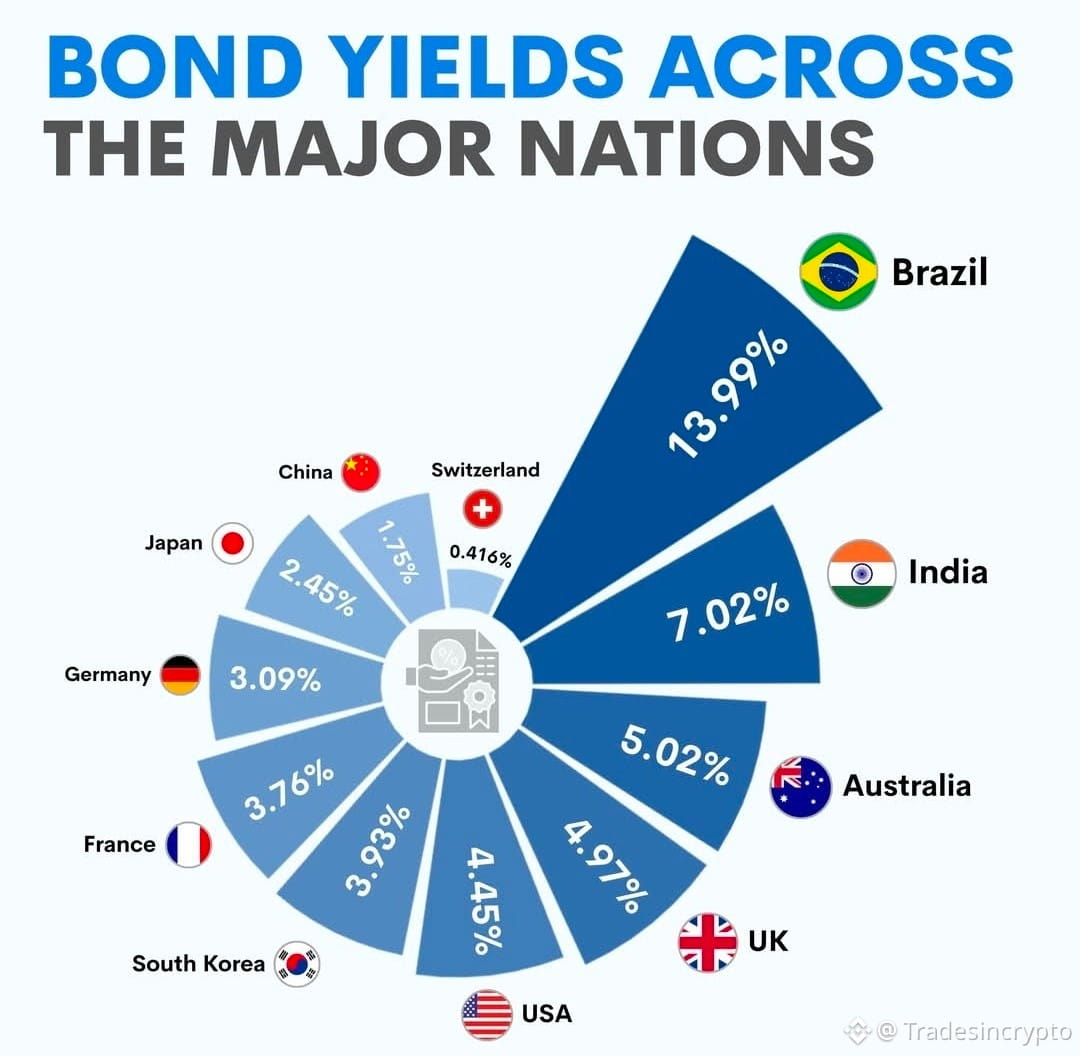
🇧🇷Brazil’s 10-year bond yield sits at 13.99%, nearly double India’s 7.02%, while Switzerland offers just 0.41%, showing how vastly risk premiums differ across major economies.
#Investing #BondYields #GlobalMacro #SovereignDebt
$BTC
$ETH
$BNB
🇧🇷Brazil’s 10-year bond yield sits at 13.99%, nearly double India’s 7.02%, while Switzerland offers just 0.41%, showing how vastly risk premiums differ across major economies.
#Investing #BondYields #GlobalMacro #SovereignDebt
$BTC
$ETH
$BNB
#Investing #BondYields #GlobalMacro #SovereignDebt
$BTC
$ETH
$BNB
60

·
--
Bullish
South Korea's 30-Year Bond Yield Hits Record High
South Korea’s long-term borrowing costs have spiked, with the 30-year government bond yield surging to historical record highs.
As central banks navigate inflation pressure and shifting monetary policies, rising sovereign bond yields signal tightening liquidity and heightened volatility across global financial markets.
Key Highlights:
Global Macro Impact: Higher bond yields traditionally draw capital away from risk assets toward fixed-income markets.
Liquidity Watch: Spikes in long-term rates often signal broader macroeconomic tightening across Asian and global equity markets.
Crypto Correlation: As traditional yields climb, traders monitor whether risk assets (like Crypto and Tech stocks) face short-term liquidity pressure.
Disclaimer: This post is for informational and educational purposes only and does not constitute financial or investment advice. Always conduct your own independent research (DYOR) before making any market decisions.
$BTC
{future}(BTCUSDT)
$ETH
{future}(ETHUSDT)
$BNB
{future}(BNBUSDT)
#macroeconomy #BondYields #GlobalMarkets #CryptoNews #dyor
South Korea's 30-Year Bond Yield Hits Record High
South Korea’s long-term borrowing costs have spiked, with the 30-year government bond yield surging to historical record highs.
As central banks navigate inflation pressure and shifting monetary policies, rising sovereign bond yields signal tightening liquidity and heightened volatility across global financial markets.
Key Highlights:
Global Macro Impact: Higher bond yields traditionally draw capital away from risk assets toward fixed-income markets.
Liquidity Watch: Spikes in long-term rates often signal broader macroeconomic tightening across Asian and global equity markets.
Crypto Correlation: As traditional yields climb, traders monitor whether risk assets (like Crypto and Tech stocks) face short-term liquidity pressure.
Disclaimer: This post is for informational and educational purposes only and does not constitute financial or investment advice. Always conduct your own independent research (DYOR) before making any market decisions.
$BTC
$ETH
$BNB
#macroeconomy #BondYields #GlobalMarkets #CryptoNews #dyor

1
5
145
·
--
The UK debt market witnessed a historic milestone as the average yield on 10-year UK government bonds surged to 5.383%, reaching its highest level since 1999. Meanwhile, European natural gas prices saw downward pressure on Tuesday morning during ongoing US-Iran diplomatic talks in New York.
This spike in UK bond yields to a 25-year high highlights persistent structural inflation concerns and aggressive monetary policy expectations across European sovereign debt. The simultaneous drop in natural gas prices, driven by mild weather and recovering Norwegian supply, provides only selective relief against broader macroeconomic tightening.
Surging gilt yields increase borrowing costs across global fixed-income markets, typically strengthening sovereign yields worldwide and exerting downward pressure on risk assets. Higher benchmark yields make traditional fixed income increasingly attractive, pulling capital away from equities and alternative asset classes.
For the cryptocurrency market, prolonged spikes in major sovereign yields tighten global liquidity and increase the opportunity cost of holding non-yielding assets. Investors should expect continued volatility across $BTC and altcoins as macro funds de-risk in response to elevated debt yields.
#BondYields #UKEconomy #MacroEconomics
122
The geopolitical situation between the US and Iran continues to escalate, keeping oil prices high and triggering intense turmoil across global bond markets. US Treasury yields surged across the board; the 10-year Treasury yield jumped by 11 basis points to 5.27% at one point, setting a nearly 19-year high, while the 30-year yield rose in tandem to 5.55%. In Asia-Pacific early trading, including New Zealand and Australian government bond futures, markets opened lower under pressure, reflecting that expectations the Fed will keep tightening amid renewed inflation risk are gaining momentum.
Chris Larkin, an analyst at Morgan Stanley, noted that unless there are major surprises in labor data, market attention remains focused on interest rates and energy costs. From a technical perspective, Treasury yields that spike to multi-year highs are often accompanied by the exhaustion of short-term momentum, with rate indicators approaching the severely overbought zone. This kind of extreme sentiment unwind typically signals that the final phase of bond selling pressure is underway.
Looking at cross-asset performance, a run-up in yields to the top often coincides with a short-term peak in the US dollar index, while the cost pressures brought by commodities have largely been priced in by the market. When borrowing costs and the risk-free rate hit key resistance levels, the bottoming-and-rebound process in the fixed-income market should gradually ease the overall financial environment’s pressure from tighter liquidity.
As for the crypto market, the thorough release of expectations for higher interest rates actually provides interim downside support for risk assets. As macro headwinds near key support levels are effectively digested, with risk-off sentiment easing, capital may be able to flow back into high-Beta assets. $BTC shows strong resilience and staying power; if inflation expectations stabilize, it is highly likely to see a breakout rebound trading scenario. 📈
#BondYields #Inflation #CryptoMarket
92
Log in to explore more content
Join global crypto users on Binance Square
⚡️ Get latest and useful information about crypto.
💬 Trusted by the world’s largest crypto exchange.
👍 Discover real insights from verified creators.
Email / Phone number
Trending Topics
1
#CPITestsDecemberRateOutlook
709,554 views
3,256 Discussing
2
#NvidiaInvestigatesAfterHuang’sAffairApology
264,300 views
2,078 Discussing
3
#AnthropicRejectsIPODelayValuationinQuestion
66,748 views
618 Discussing
4
#US-IranTalksFuelStrongStockMarketRebound
10,583 views
152 Discussing
5
#BitcoinFiveWeeklyLosses
289,759 views
2,447 Discussing
6
#AIChipSlumpNasdaq
163,477 views
1,490 Discussing
7
#CryptoLiquidationsReach$1.16BIn24Hours
25,888 views
60 Discussing
8
#StrategyBuys1037BTCLastWeek
6,114 views
72 Discussing
9
#NYSEToUseAvalancheToSettleTokenizedStocks
4,599 views
45 Discussing
10
#TradFiForBeginners
385,910 views
2,705 Discussing