

#usjobopeningsfalltofivemonthlow
usjobopeningsfalltofivemonthlow
Hot
Latest

·
--
Verified
US job openings fall to five month low — what it means for Fed and markets
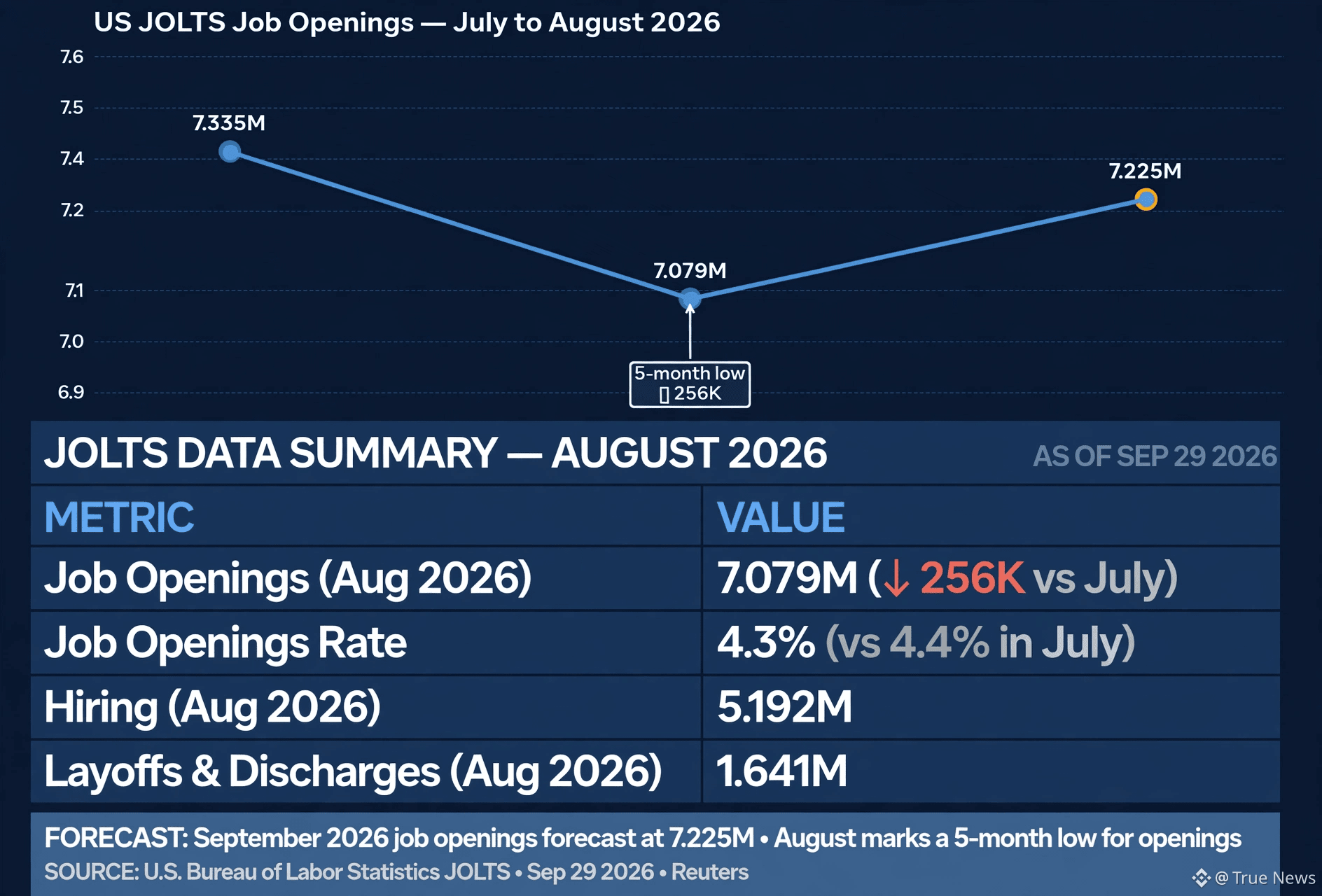
What's happening: JOLTS report for August 2026 shows job openings fell by 256K to 7.079 million, a five-month low, from revised 7.335 million in July. Forecast was 7.225 million. Job openings rate dropped to 4.3% from 4.4%. Hiring rose to 5.192 million and layoffs fell to 1.641 million, showing low-hire, low-fire market.
My take: This is cooling, not collapsing. Demand for workers is softening but layoffs remain low at 1.0% rate, so employers are not firing, just not hiring fast. For markets, this gives Fed room to focus on inflation after raising to 3.75%-4.00%. I expect rate sensitive sectors like tech and small caps to stay volatile, but no recession signal yet. I am watching S&P 500 near 4,100 support for next entry, no trade yet, studying labor trend.
Data source: US Bureau of Labor Statistics JOLTS Sep 29 2026 via Reuters
Follow me for more macro breakdowns.
#JOLTS #USEconomy #Fed#usjobopeningsfalltofivemonthlow
US job openings fall to five month low — what it means for Fed and markets
What's happening: JOLTS report for August 2026 shows job openings fell by 256K to 7.079 million, a five-month low, from revised 7.335 million in July. Forecast was 7.225 million. Job openings rate dropped to 4.3% from 4.4%. Hiring rose to 5.192 million and layoffs fell to 1.641 million, showing low-hire, low-fire market.
My take: This is cooling, not collapsing. Demand for workers is softening but layoffs remain low at 1.0% rate, so employers are not firing, just not hiring fast. For markets, this gives Fed room to focus on inflation after raising to 3.75%-4.00%. I expect rate sensitive sectors like tech and small caps to stay volatile, but no recession signal yet. I am watching S&P 500 near 4,100 support for next entry, no trade yet, studying labor trend.
Data source: US Bureau of Labor Statistics JOLTS Sep 29 2026 via Reuters
Follow me for more macro breakdowns.
#JOLTS #USEconomy #Fed#usjobopeningsfalltofivemonthlow
What's happening: JOLTS report for August 2026 shows job openings fell by 256K to 7.079 million, a five-month low, from revised 7.335 million in July. Forecast was 7.225 million. Job openings rate dropped to 4.3% from 4.4%. Hiring rose to 5.192 million and layoffs fell to 1.641 million, showing low-hire, low-fire market.
My take: This is cooling, not collapsing. Demand for workers is softening but layoffs remain low at 1.0% rate, so employers are not firing, just not hiring fast. For markets, this gives Fed room to focus on inflation after raising to 3.75%-4.00%. I expect rate sensitive sectors like tech and small caps to stay volatile, but no recession signal yet. I am watching S&P 500 near 4,100 support for next entry, no trade yet, studying labor trend.
Data source: US Bureau of Labor Statistics JOLTS Sep 29 2026 via Reuters
Follow me for more macro breakdowns.
#JOLTS #USEconomy #Fed#usjobopeningsfalltofivemonthlow
فن السيوله:
نعم
3
3
2.2k
·
--
🚨 US LABOR MARKET ALERT: Job Openings Crash to 5-Month Low!
The US job market is cooling down fast!
According to the latest JOLTS Report (Bureau of Labor Statistics) released Tuesday, Sept 29, 2026:
📉 Key
Job Openings: 7.079 Million - Down by 256,000 in August This is the lowest level since March - a five-month low Forecast was 7.225M, so it missed badly, showing weaker demandJuly data was revised UP to 7.335M from 7.271M
But here is the twist:
Hiring INCREASED by 46,000 to 5.192M (Rate 3.3%) Layoffs DROPPED by 61,000 to 1.641M (Rate 1.0%) - companies are NOT firing We are in a "low-hire, low-fire" market
What it means for Crypto & Fed?
Market stability gives Fed room to fight inflation. Fed already hiked rate by 25 bps to 3.75%-4.00% (first hike in 3 years) and markets now price a 70.3% chance of another hike in October. Less easy money = pressure on risk assets like BTC.
Is the US heading for a slowdown?
#USJobs #JOLTS #Economy #Fed #BinanceNews #Crypto#usjobopeningsfalltofivemonthlow
🚨 US LABOR MARKET ALERT: Job Openings Crash to 5-Month Low!
The US job market is cooling down fast!
According to the latest JOLTS Report (Bureau of Labor Statistics) released Tuesday, Sept 29, 2026:
📉 Key
Job Openings: 7.079 Million - Down by 256,000 in August This is the lowest level since March - a five-month low Forecast was 7.225M, so it missed badly, showing weaker demandJuly data was revised UP to 7.335M from 7.271M
But here is the twist:
Hiring INCREASED by 46,000 to 5.192M (Rate 3.3%) Layoffs DROPPED by 61,000 to 1.641M (Rate 1.0%) - companies are NOT firing We are in a "low-hire, low-fire" market
What it means for Crypto & Fed?
Market stability gives Fed room to fight inflation. Fed already hiked rate by 25 bps to 3.75%-4.00% (first hike in 3 years) and markets now price a 70.3% chance of another hike in October. Less easy money = pressure on risk assets like BTC.
Is the US heading for a slowdown?
#USJobs #JOLTS #Economy #Fed #BinanceNews #Crypto#usjobopeningsfalltofivemonthlow
The US job market is cooling down fast!
According to the latest JOLTS Report (Bureau of Labor Statistics) released Tuesday, Sept 29, 2026:
📉 Key
Job Openings: 7.079 Million - Down by 256,000 in August This is the lowest level since March - a five-month low Forecast was 7.225M, so it missed badly, showing weaker demandJuly data was revised UP to 7.335M from 7.271M
But here is the twist:
Hiring INCREASED by 46,000 to 5.192M (Rate 3.3%) Layoffs DROPPED by 61,000 to 1.641M (Rate 1.0%) - companies are NOT firing We are in a "low-hire, low-fire" market
What it means for Crypto & Fed?
Market stability gives Fed room to fight inflation. Fed already hiked rate by 25 bps to 3.75%-4.00% (first hike in 3 years) and markets now price a 70.3% chance of another hike in October. Less easy money = pressure on risk assets like BTC.
Is the US heading for a slowdown?
#USJobs #JOLTS #Economy #Fed #BinanceNews #Crypto#usjobopeningsfalltofivemonthlow
1
2.8k

$BTC U.S. Job Openings Are CoolingAugust JOLTS data showed U.S. job openings falling 256K to 7.079M, the lowest in five months and below the 7.225M forecast.
But this isn't a collapse:
• Hiring rose to 5.192M
• Layoffs fell to 1.641M
• Layoff rate stayed at just 1.0%
So the signal is more “slower hiring” than “mass layoffs.”
For markets, this matters because the labor data feeds directly into the Fed’s rate outlook. With the Fed currently at 3.75%–4.00%, traders will be watching the next jobs and inflation reports closely.
I’m watching $BTC for how it reacts to changing rate expectations.
#usjobopeningsfalltofivemonthlow #JOLTS #USEconomy #Fed
$BTC U.S. Job Openings Are Cooling
August JOLTS data showed U.S. job openings falling 256K to 7.079M, the lowest in five months and below the 7.225M forecast.
But this isn't a collapse:
• Hiring rose to 5.192M
• Layoffs fell to 1.641M
• Layoff rate stayed at just 1.0%
So the signal is more “slower hiring” than “mass layoffs.”
For markets, this matters because the labor data feeds directly into the Fed’s rate outlook. With the Fed currently at 3.75%–4.00%, traders will be watching the next jobs and inflation reports closely.
I’m watching $BTC for how it reacts to changing rate expectations.
#usjobopeningsfalltofivemonthlow #JOLTS #USEconomy #Fed
But this isn't a collapse:
• Hiring rose to 5.192M
• Layoffs fell to 1.641M
• Layoff rate stayed at just 1.0%
So the signal is more “slower hiring” than “mass layoffs.”
For markets, this matters because the labor data feeds directly into the Fed’s rate outlook. With the Fed currently at 3.75%–4.00%, traders will be watching the next jobs and inflation reports closely.
I’m watching $BTC for how it reacts to changing rate expectations.
#usjobopeningsfalltofivemonthlow #JOLTS #USEconomy #Fed
206 Atlas:
The logic holds, but BTC is already pricing in this normalization. Why assume the Fed will cut aggressively just because hiring slowed slightly?
1
419

·
--
Bullish
#usjobopeningsfalltofivemonthlow 📊 US Job Openings Hit 5-Month Low: Macro Implications for Crypto
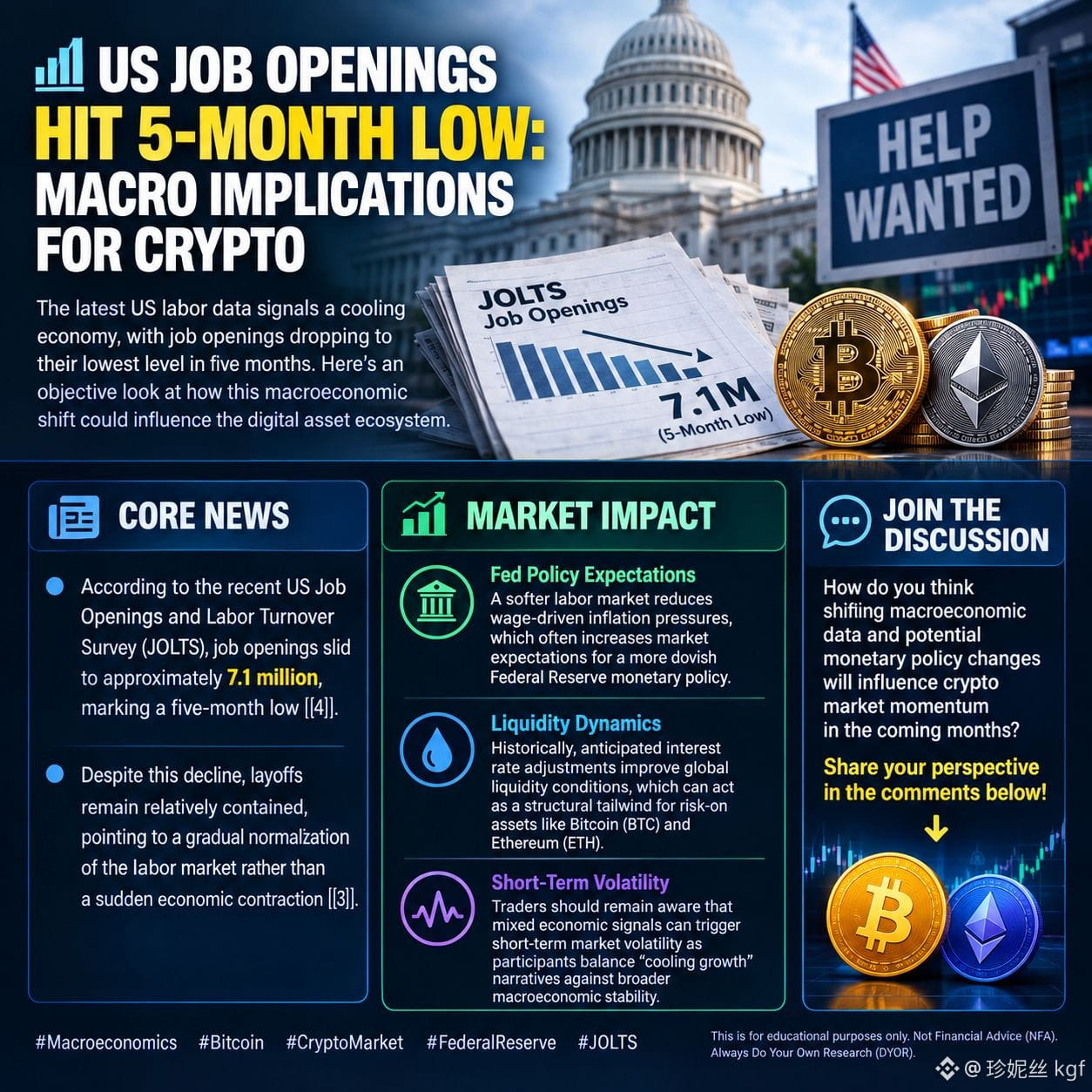
The latest US labor data signals a cooling economy, with job openings dropping to their lowest level in five months. Here’s an objective look at how this macroeconomic shift could influence the digital asset ecosystem.
📰 Core News
• According to the recent US Job Openings and Labor Turnover Survey (JOLTS), job openings slid to approximately 7.1 million, marking a five-month low [[4]].
• Despite this decline, layoffs remain relatively contained, pointing to a gradual normalization of the labor market rather than a sudden economic contraction [[3]].
📈 Market Impact
• Fed Policy Expectations A softer labor market reduces wage-driven inflation pressures, which often increases market expectations for a more dovish Federal Reserve monetary policy.
• Liquidity Dynamics Historically, anticipated interest rate adjustments improve global liquidity conditions, which can act as a structural tailwind for risk-on assets like Bitcoin (BTC) and Ethereum (ETH).
•Short-Term Volatility Traders should remain aware that mixed economic signals can trigger short-term market volatility as participants balance "cooling growth" narratives against broader macroeconomic stability.
💬 Join the Discussion
How do you think shifting macroeconomic data and potential monetary policy changes will influence crypto market momentum in the coming months? Share your perspective in the comments below! 👇
#Macroeconomics #Bitcoin #CryptoMarket #FederalReserve #JOLTS
This is for educational purposes only. Not Financial Advice (NFA). Always Do Your Own Research (DYOR).
$ICP $CELO $ETHFI
{future}(ETHFIUSDT)
{future}(CELOUSDT)
{future}(ICPUSDT)
#usjobopeningsfalltofivemonthlow 📊 US Job Openings Hit 5-Month Low: Macro Implications for Crypto
The latest US labor data signals a cooling economy, with job openings dropping to their lowest level in five months. Here’s an objective look at how this macroeconomic shift could influence the digital asset ecosystem.
📰 Core News
• According to the recent US Job Openings and Labor Turnover Survey (JOLTS), job openings slid to approximately 7.1 million, marking a five-month low [[4]].
• Despite this decline, layoffs remain relatively contained, pointing to a gradual normalization of the labor market rather than a sudden economic contraction [[3]].
📈 Market Impact
• Fed Policy Expectations A softer labor market reduces wage-driven inflation pressures, which often increases market expectations for a more dovish Federal Reserve monetary policy.
• Liquidity Dynamics Historically, anticipated interest rate adjustments improve global liquidity conditions, which can act as a structural tailwind for risk-on assets like Bitcoin (BTC) and Ethereum (ETH).
•Short-Term Volatility Traders should remain aware that mixed economic signals can trigger short-term market volatility as participants balance "cooling growth" narratives against broader macroeconomic stability.
💬 Join the Discussion
How do you think shifting macroeconomic data and potential monetary policy changes will influence crypto market momentum in the coming months? Share your perspective in the comments below! 👇
#Macroeconomics #Bitcoin #CryptoMarket #FederalReserve #JOLTS
This is for educational purposes only. Not Financial Advice (NFA). Always Do Your Own Research (DYOR).
$ICP $CELO $ETHFI
The latest US labor data signals a cooling economy, with job openings dropping to their lowest level in five months. Here’s an objective look at how this macroeconomic shift could influence the digital asset ecosystem.
📰 Core News
• According to the recent US Job Openings and Labor Turnover Survey (JOLTS), job openings slid to approximately 7.1 million, marking a five-month low [[4]].
• Despite this decline, layoffs remain relatively contained, pointing to a gradual normalization of the labor market rather than a sudden economic contraction [[3]].
📈 Market Impact
• Fed Policy Expectations A softer labor market reduces wage-driven inflation pressures, which often increases market expectations for a more dovish Federal Reserve monetary policy.
• Liquidity Dynamics Historically, anticipated interest rate adjustments improve global liquidity conditions, which can act as a structural tailwind for risk-on assets like Bitcoin (BTC) and Ethereum (ETH).
•Short-Term Volatility Traders should remain aware that mixed economic signals can trigger short-term market volatility as participants balance "cooling growth" narratives against broader macroeconomic stability.
💬 Join the Discussion
How do you think shifting macroeconomic data and potential monetary policy changes will influence crypto market momentum in the coming months? Share your perspective in the comments below! 👇
#Macroeconomics #Bitcoin #CryptoMarket #FederalReserve #JOLTS
This is for educational purposes only. Not Financial Advice (NFA). Always Do Your Own Research (DYOR).
$ICP $CELO $ETHFI
2
673

#USJobOpeningsFallToFiveMonthLow
The data suggests a “low-hire, low-fire” Companies are cautious about hiring, but they are also not laying off workers aggressively. This could remain important for the Federal Reserve’s interest rate decisions and the broader US economy.
{spot}(USD1USDT)
US job openings fell by 256,000 to 7.08 million in August 2026, the lowest level in five months and below expectations of 7.23 million. Layoffs also declined, while hiring increased slightly to 5.19 million.
#Mahanadi $USD1
{spot}(BTCUSDT)
{spot}(AAPLBUSDT)
#USJobOpeningsFallToFiveMonthLow
The data suggests a “low-hire, low-fire” Companies are cautious about hiring, but they are also not laying off workers aggressively. This could remain important for the Federal Reserve’s interest rate decisions and the broader US economy.
US job openings fell by 256,000 to 7.08 million in August 2026, the lowest level in five months and below expectations of 7.23 million. Layoffs also declined, while hiring increased slightly to 5.19 million.
#Mahanadi $USD1
The data suggests a “low-hire, low-fire” Companies are cautious about hiring, but they are also not laying off workers aggressively. This could remain important for the Federal Reserve’s interest rate decisions and the broader US economy.
US job openings fell by 256,000 to 7.08 million in August 2026, the lowest level in five months and below expectations of 7.23 million. Layoffs also declined, while hiring increased slightly to 5.19 million.
#Mahanadi $USD1

US JOB DATA 🇺🇲
From Digital Mahanadi
MF7866:
thank you
1
29

·
--
#USJobOpeningsFallToFiveMonthLow
USJobOpeningsFallToFiveMonthLow - DOVISH FOR CRYPTO! 📉📈
BREAKING: US Job Openings fell to 7.08M in August (lowest since March) from 7.34M in July - below 7.2M forecast!
JOLTS report today:
• Openings down 256K
• Layoffs remain low = soft landing
• Hiring up slightly
What it means for crypto: Weak labor market = Fed MUST cut rates faster. Less jobs = more money printing coming.
This is why I stay long $ATOMUSDT. My position is -1.41% right now because market is scared short-term, but macro is turning BULLISH for Q4.
Sept jobs report Friday expects only 90-95K jobs vs 162K in Aug. If that misses, rate cut odds explode and alts fly.
Buy the fear, sell the euphoria. Long alts when jobs data weakens.
#ATOMUSDT #JOLTS #FederalReserve #CryptoNews
#USJobOpeningsFallToFiveMonthLow
USJobOpeningsFallToFiveMonthLow - DOVISH FOR CRYPTO! 📉📈
BREAKING: US Job Openings fell to 7.08M in August (lowest since March) from 7.34M in July - below 7.2M forecast!
JOLTS report today:
• Openings down 256K
• Layoffs remain low = soft landing
• Hiring up slightly
What it means for crypto: Weak labor market = Fed MUST cut rates faster. Less jobs = more money printing coming.
This is why I stay long $ATOMUSDT. My position is -1.41% right now because market is scared short-term, but macro is turning BULLISH for Q4.
Sept jobs report Friday expects only 90-95K jobs vs 162K in Aug. If that misses, rate cut odds explode and alts fly.
Buy the fear, sell the euphoria. Long alts when jobs data weakens.
#ATOMUSDT #JOLTS #FederalReserve #CryptoNews
USJobOpeningsFallToFiveMonthLow - DOVISH FOR CRYPTO! 📉📈
BREAKING: US Job Openings fell to 7.08M in August (lowest since March) from 7.34M in July - below 7.2M forecast!
JOLTS report today:
• Openings down 256K
• Layoffs remain low = soft landing
• Hiring up slightly
What it means for crypto: Weak labor market = Fed MUST cut rates faster. Less jobs = more money printing coming.
This is why I stay long $ATOMUSDT. My position is -1.41% right now because market is scared short-term, but macro is turning BULLISH for Q4.
Sept jobs report Friday expects only 90-95K jobs vs 162K in Aug. If that misses, rate cut odds explode and alts fly.
Buy the fear, sell the euphoria. Long alts when jobs data weakens.
#ATOMUSDT #JOLTS #FederalReserve #CryptoNews
142

·
--
Verified
#usjobopeningsfalltofivemonthlow
🇺🇸 U.S. job openings just fell to their lowest level in five months.
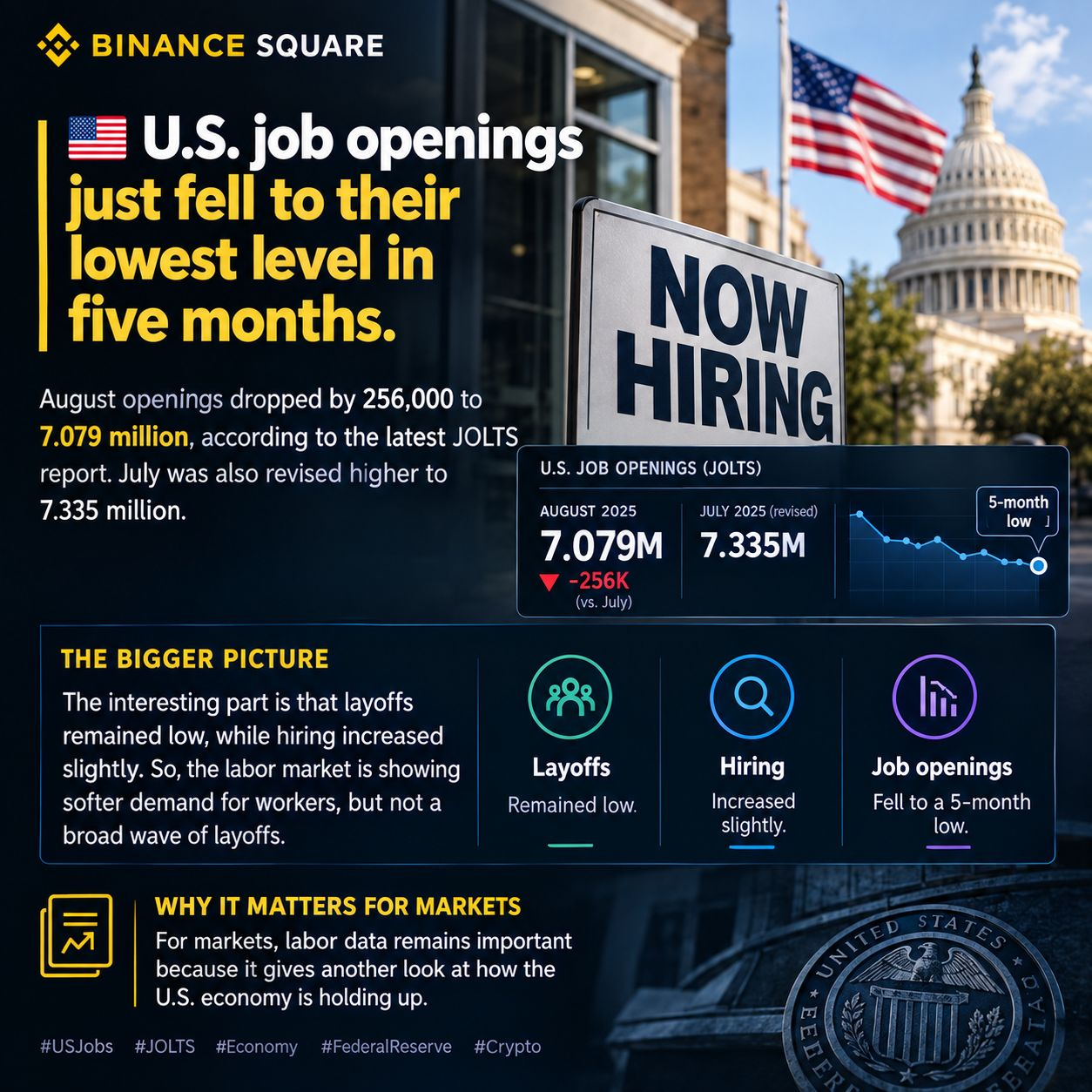
August openings dropped by 256,000 to 7.079 million, according to the latest JOLTS report. July was also revised higher to 7.335 million.
The interesting part is that layoffs remained low, while hiring increased slightly. So the labor market is showing softer demand for workers, but not a broad wave of layoffs.
For markets, labor data remains important because it gives another look at how the U.S. economy is holding up.
#USJobs #jolts #economy #FederalReserve #crypto
#usjobopeningsfalltofivemonthlow
🇺🇸 U.S. job openings just fell to their lowest level in five months.
August openings dropped by 256,000 to 7.079 million, according to the latest JOLTS report. July was also revised higher to 7.335 million.
The interesting part is that layoffs remained low, while hiring increased slightly. So the labor market is showing softer demand for workers, but not a broad wave of layoffs.
For markets, labor data remains important because it gives another look at how the U.S. economy is holding up.
#USJobs #jolts #economy #FederalReserve #crypto
🇺🇸 U.S. job openings just fell to their lowest level in five months.
August openings dropped by 256,000 to 7.079 million, according to the latest JOLTS report. July was also revised higher to 7.335 million.
The interesting part is that layoffs remained low, while hiring increased slightly. So the labor market is showing softer demand for workers, but not a broad wave of layoffs.
For markets, labor data remains important because it gives another look at how the U.S. economy is holding up.
#USJobs #jolts #economy #FederalReserve #crypto
52

·
--
Bullish
#USJobOpeningsFallToFiveMonthLow
U.S. job openings fell by 256,000 to 7.079 million in August, the lowest level since March and below economists’ 7.225 million estimate.
The important detail is that layoffs also remained low, while hiring increased modestly. That suggests the labor market is cooling rather than experiencing a broad wave of job losses.
For markets, traders will be watching upcoming employment data and how the weaker demand for workers affects expectations around Federal Reserve policy, interest rates, and risk assets such as crypto. The JOLTS survey also has a relatively low response rate, so the data should be interpreted with some caution.
#Binance #USJobs #JOLTS #Fed #CryptoMarket
#USJobOpeningsFallToFiveMonthLow
U.S. job openings fell by 256,000 to 7.079 million in August, the lowest level since March and below economists’ 7.225 million estimate.
The important detail is that layoffs also remained low, while hiring increased modestly. That suggests the labor market is cooling rather than experiencing a broad wave of job losses.
For markets, traders will be watching upcoming employment data and how the weaker demand for workers affects expectations around Federal Reserve policy, interest rates, and risk assets such as crypto. The JOLTS survey also has a relatively low response rate, so the data should be interpreted with some caution.
#Binance #USJobs #JOLTS #Fed #CryptoMarket
U.S. job openings fell by 256,000 to 7.079 million in August, the lowest level since March and below economists’ 7.225 million estimate.
The important detail is that layoffs also remained low, while hiring increased modestly. That suggests the labor market is cooling rather than experiencing a broad wave of job losses.
For markets, traders will be watching upcoming employment data and how the weaker demand for workers affects expectations around Federal Reserve policy, interest rates, and risk assets such as crypto. The JOLTS survey also has a relatively low response rate, so the data should be interpreted with some caution.
#Binance #USJobs #JOLTS #Fed #CryptoMarket
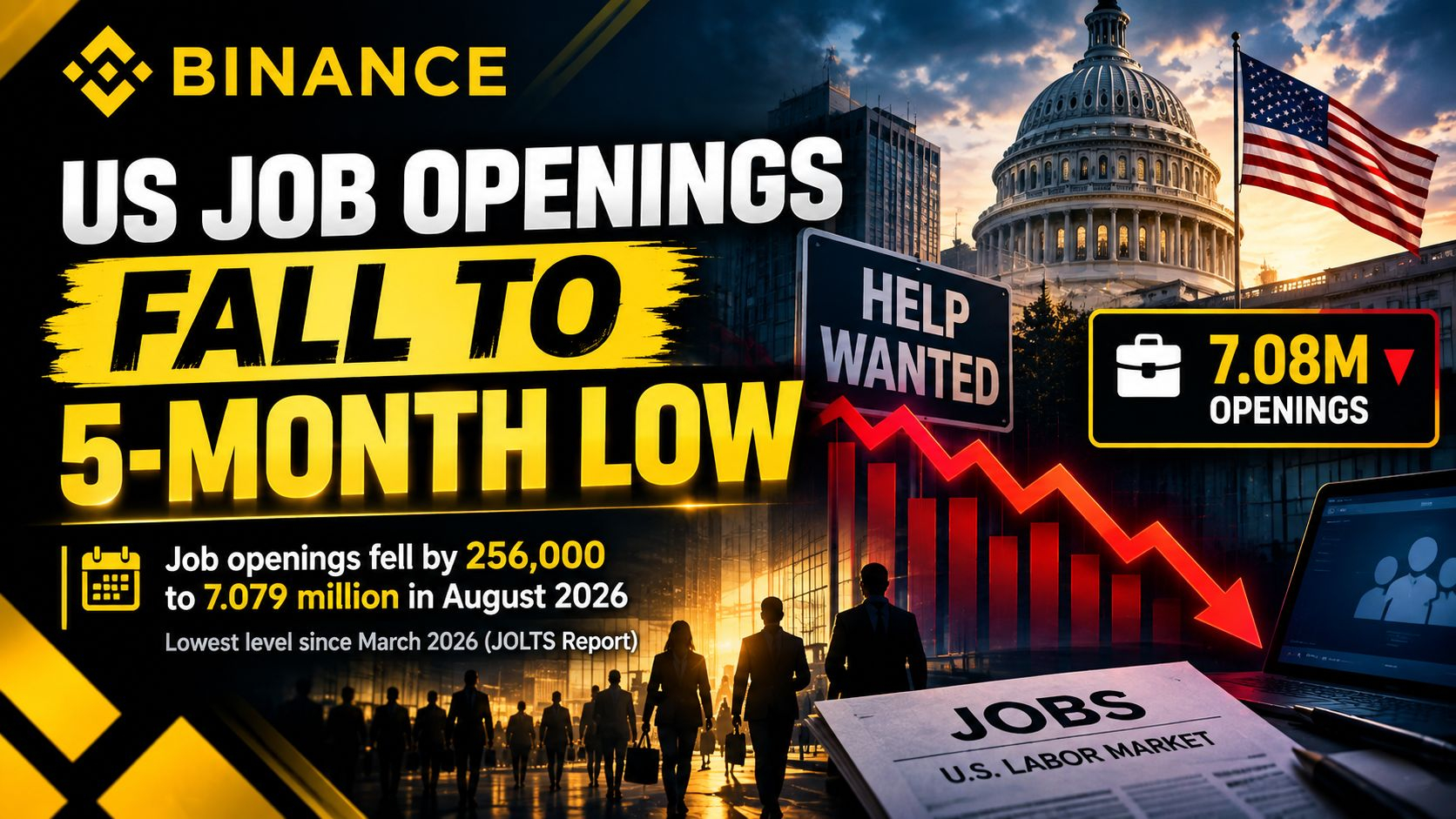
96

🔥 WHY CRYPTO INVESTORS ARE WATCHING JOBS DATA
US job openings have dropped to a five-month low, while layoffs remain historically low.
That combination keeps labor-market data firmly in focus as markets assess the path for monetary policy. $BTC $ETH $SOL $ADA
#usjobopeningsfalltofivemonthlow
🔥 WHY CRYPTO INVESTORS ARE WATCHING JOBS DATA
US job openings have dropped to a five-month low, while layoffs remain historically low.
That combination keeps labor-market data firmly in focus as markets assess the path for monetary policy. $BTC $ETH $SOL $ADA
#usjobopeningsfalltofivemonthlow
US job openings have dropped to a five-month low, while layoffs remain historically low.
That combination keeps labor-market data firmly in focus as markets assess the path for monetary policy. $BTC $ETH $SOL $ADA
#usjobopeningsfalltofivemonthlow
380
·
--
Article
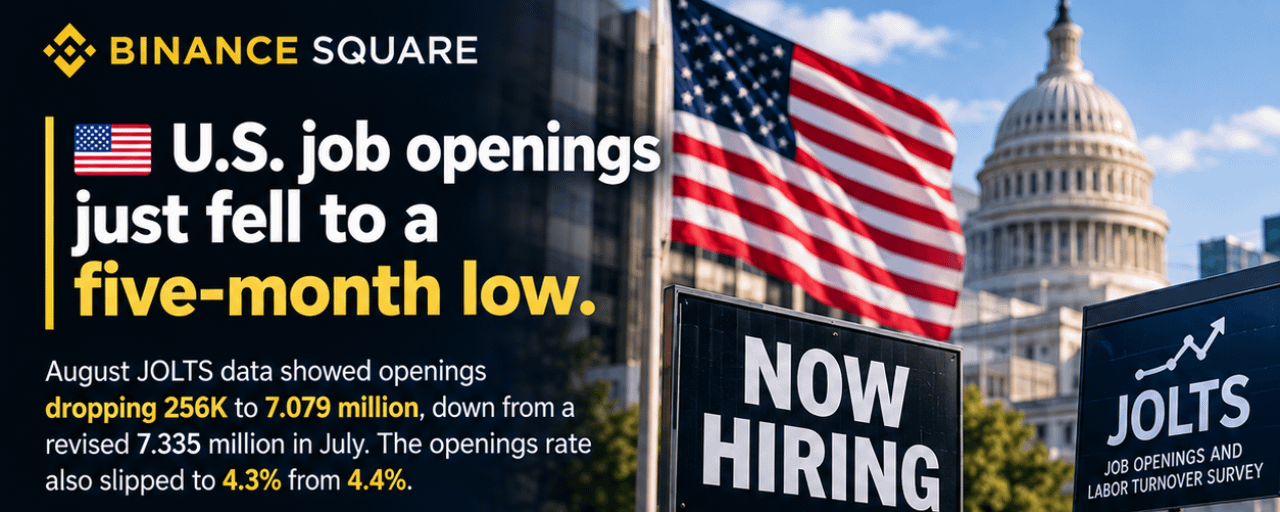
U.S. Job Openings Fall to Five-Month Low as Labor Market Shows Signs of Cooling#usjobopeningsfalltofivemonthlow
🇺🇸 U.S. job openings just fell to a five-month low.
August JOLTS data showed job openings dropping 256K to 7.079 million, compared with a revised 7.335 million in July. The openings rate also slipped from 4.4% to 4.3%.
But this doesn’t look like a sharp deterioration in hiring. Hiring rose to 5.192 million, while layoffs fell to 1.641 million.
That points to a labor market where employers are becoming more cautious about adding workers, without a major increase in job cuts.
For the Fed, softer labor demand adds another data point to watch alongside inflation and other economic indicators.
For markets, the bigger question is whether this cooling remains gradual or starts spreading into broader weakness.
Is the U.S. labor market simply normalizing, or is a deeper slowdown beginning to emerge?
#JOLTS #USEconomy #Fed #Markets
U.S. Job Openings Fall to Five-Month Low as Labor Market Shows Signs of Cooling
#usjobopeningsfalltofivemonthlow
🇺🇸 U.S. job openings just fell to a five-month low.
August JOLTS data showed job openings dropping 256K to 7.079 million, compared with a revised 7.335 million in July. The openings rate also slipped from 4.4% to 4.3%.
But this doesn’t look like a sharp deterioration in hiring. Hiring rose to 5.192 million, while layoffs fell to 1.641 million.
That points to a labor market where employers are becoming more cautious about adding workers, without a major increase in job cuts.
For the Fed, softer labor demand adds another data point to watch alongside inflation and other economic indicators.
For markets, the bigger question is whether this cooling remains gradual or starts spreading into broader weakness.
Is the U.S. labor market simply normalizing, or is a deeper slowdown beginning to emerge?
#JOLTS #USEconomy #Fed #Markets
🇺🇸 U.S. job openings just fell to a five-month low.
August JOLTS data showed job openings dropping 256K to 7.079 million, compared with a revised 7.335 million in July. The openings rate also slipped from 4.4% to 4.3%.
But this doesn’t look like a sharp deterioration in hiring. Hiring rose to 5.192 million, while layoffs fell to 1.641 million.
That points to a labor market where employers are becoming more cautious about adding workers, without a major increase in job cuts.
For the Fed, softer labor demand adds another data point to watch alongside inflation and other economic indicators.
For markets, the bigger question is whether this cooling remains gradual or starts spreading into broader weakness.
Is the U.S. labor market simply normalizing, or is a deeper slowdown beginning to emerge?
#JOLTS #USEconomy #Fed #Markets
2
·
--
#usjobopeningsfalltofivemonthlow
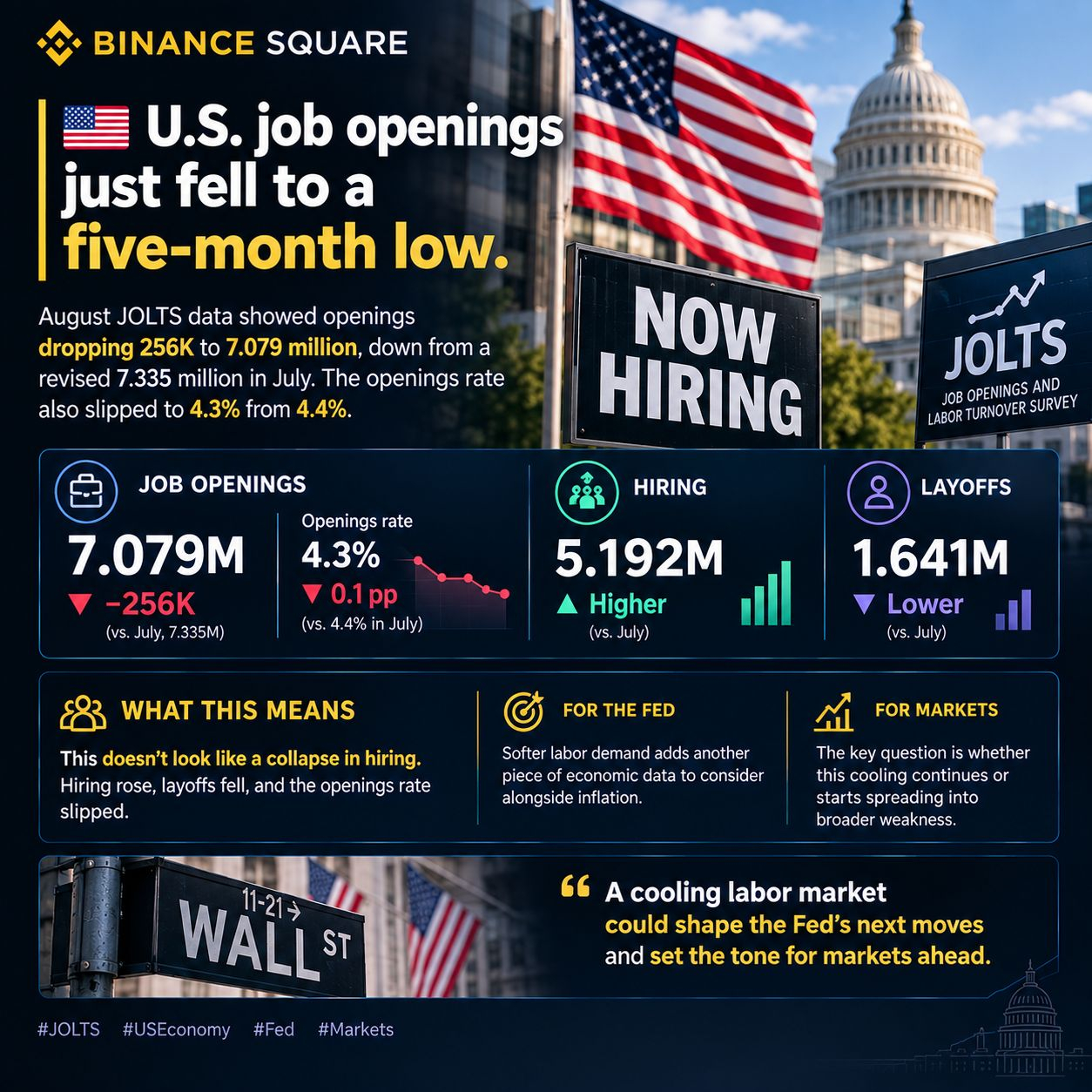
🇺🇸 U.S. job openings just fell to a five-month low.
August JOLTS data showed openings dropping 256K to 7.079 million, down from a revised 7.335 million in July. The openings rate also slipped to 4.3% from 4.4%.
But this doesn’t look like a collapse in hiring. Hiring actually rose to 5.192 million, while layoffs fell to 1.641 million. That points to a labor market where employers are hiring more cautiously without significantly increasing layoffs.
For the Fed, softer labor demand adds another piece of economic data to consider alongside inflation.
For markets, the key question is whether this cooling continues or starts spreading into broader weakness.
#jolts #USEconomy IndiaExport #Fed #markets
#usjobopeningsfalltofivemonthlow
🇺🇸 U.S. job openings just fell to a five-month low.
August JOLTS data showed openings dropping 256K to 7.079 million, down from a revised 7.335 million in July. The openings rate also slipped to 4.3% from 4.4%.
But this doesn’t look like a collapse in hiring. Hiring actually rose to 5.192 million, while layoffs fell to 1.641 million. That points to a labor market where employers are hiring more cautiously without significantly increasing layoffs.
For the Fed, softer labor demand adds another piece of economic data to consider alongside inflation.
For markets, the key question is whether this cooling continues or starts spreading into broader weakness.
#jolts #USEconomy IndiaExport #Fed #markets
🇺🇸 U.S. job openings just fell to a five-month low.
August JOLTS data showed openings dropping 256K to 7.079 million, down from a revised 7.335 million in July. The openings rate also slipped to 4.3% from 4.4%.
But this doesn’t look like a collapse in hiring. Hiring actually rose to 5.192 million, while layoffs fell to 1.641 million. That points to a labor market where employers are hiring more cautiously without significantly increasing layoffs.
For the Fed, softer labor demand adds another piece of economic data to consider alongside inflation.
For markets, the key question is whether this cooling continues or starts spreading into broader weakness.
#jolts #USEconomy IndiaExport #Fed #markets
3

·
--
Verified
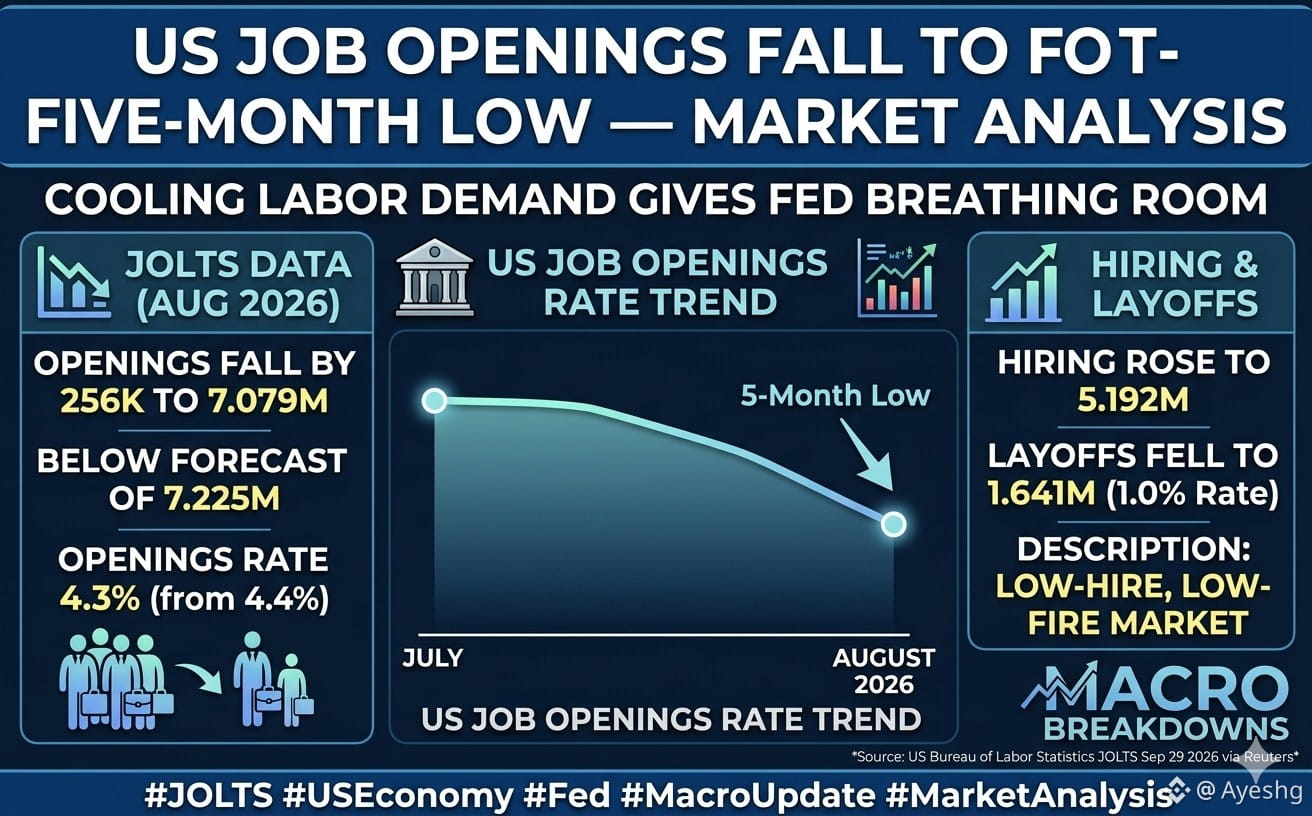
#usjobopeningsfalltofivemonthlow 🚨 US JOB OPENINGS FALL TO 5-MONTH LOW — WHAT DOES IT MEAN FOR THE FED?
The latest JOLTS report shows U.S. job openings fell by 256K to 7.079M in August, below the 7.225M market expectation. July was revised higher to 7.335M.
📊 Key numbers:
• Job openings: 7.079M
• Openings rate: 4.3%
• Hires: 5.192M
• Layoffs: 1.641M
• Layoff rate: 1.0%
The important detail: hiring is cooling, but layoffs remain low.
That points toward a softer labor market rather than an outright employment shock. August payrolls also increased by 162K while unemployment remained at 4.1%.
🏦 WHY IT MATTERS FOR MARKETS
A weaker hiring environment can influence expectations around future Fed policy, but the JOLTS report alone doesn't determine the Fed's next move. Inflation data and upcoming employment reports will remain important.
👀 My focus now:
• Labor-market trend
• Inflation data
• Treasury yields
• $SPX and $NDX reaction
• Upcoming September jobs report
I'm watching the data before taking a new position. No trade yet — just studying the labor trend.
Source: U.S. Bureau of Labor Statistics / Reuters
#JOLTS #USEconomy #Fed #USStocks #SPX #NDX #Macro #CryptoNews
#usjobopeningsfalltofivemonthlow 🚨 US JOB OPENINGS FALL TO 5-MONTH LOW — WHAT DOES IT MEAN FOR THE FED?
The latest JOLTS report shows U.S. job openings fell by 256K to 7.079M in August, below the 7.225M market expectation. July was revised higher to 7.335M.
📊 Key numbers:
• Job openings: 7.079M
• Openings rate: 4.3%
• Hires: 5.192M
• Layoffs: 1.641M
• Layoff rate: 1.0%
The important detail: hiring is cooling, but layoffs remain low.
That points toward a softer labor market rather than an outright employment shock. August payrolls also increased by 162K while unemployment remained at 4.1%.
🏦 WHY IT MATTERS FOR MARKETS
A weaker hiring environment can influence expectations around future Fed policy, but the JOLTS report alone doesn't determine the Fed's next move. Inflation data and upcoming employment reports will remain important.
👀 My focus now:
• Labor-market trend
• Inflation data
• Treasury yields
• $SPX and $NDX reaction
• Upcoming September jobs report
I'm watching the data before taking a new position. No trade yet — just studying the labor trend.
Source: U.S. Bureau of Labor Statistics / Reuters
#JOLTS #USEconomy #Fed #USStocks #SPX #NDX #Macro #CryptoNews
The latest JOLTS report shows U.S. job openings fell by 256K to 7.079M in August, below the 7.225M market expectation. July was revised higher to 7.335M.
📊 Key numbers:
• Job openings: 7.079M
• Openings rate: 4.3%
• Hires: 5.192M
• Layoffs: 1.641M
• Layoff rate: 1.0%
The important detail: hiring is cooling, but layoffs remain low.
That points toward a softer labor market rather than an outright employment shock. August payrolls also increased by 162K while unemployment remained at 4.1%.
🏦 WHY IT MATTERS FOR MARKETS
A weaker hiring environment can influence expectations around future Fed policy, but the JOLTS report alone doesn't determine the Fed's next move. Inflation data and upcoming employment reports will remain important.
👀 My focus now:
• Labor-market trend
• Inflation data
• Treasury yields
• $SPX and $NDX reaction
• Upcoming September jobs report
I'm watching the data before taking a new position. No trade yet — just studying the labor trend.
Source: U.S. Bureau of Labor Statistics / Reuters
#JOLTS #USEconomy #Fed #USStocks #SPX #NDX #Macro #CryptoNews
8

·
--
#usjobopeningsfalltofivemonthlow
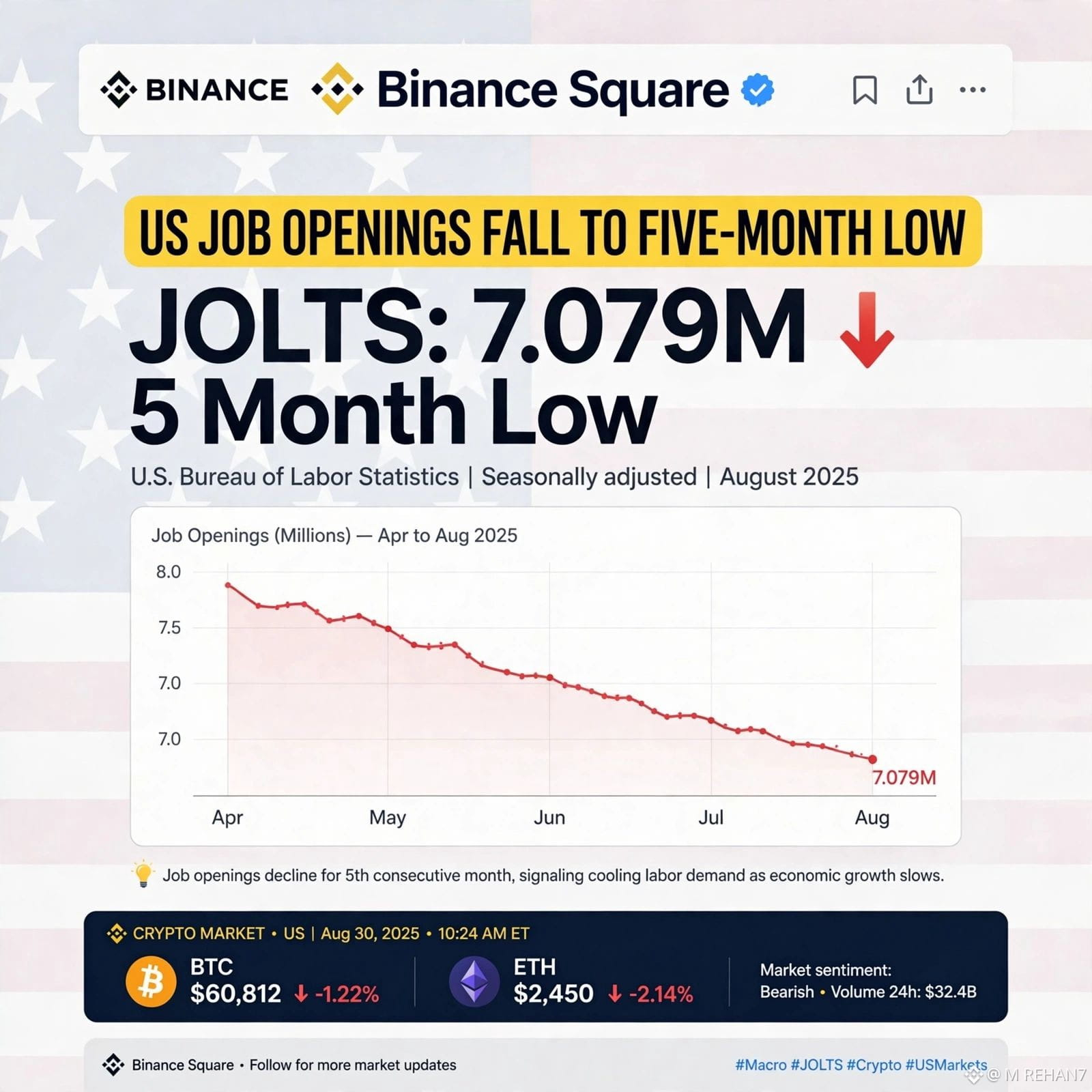
US JOB OPENINGS FALL TO FIVE-MONTH LOW
JOLTS: 7.079M • 5 Month Low ↓
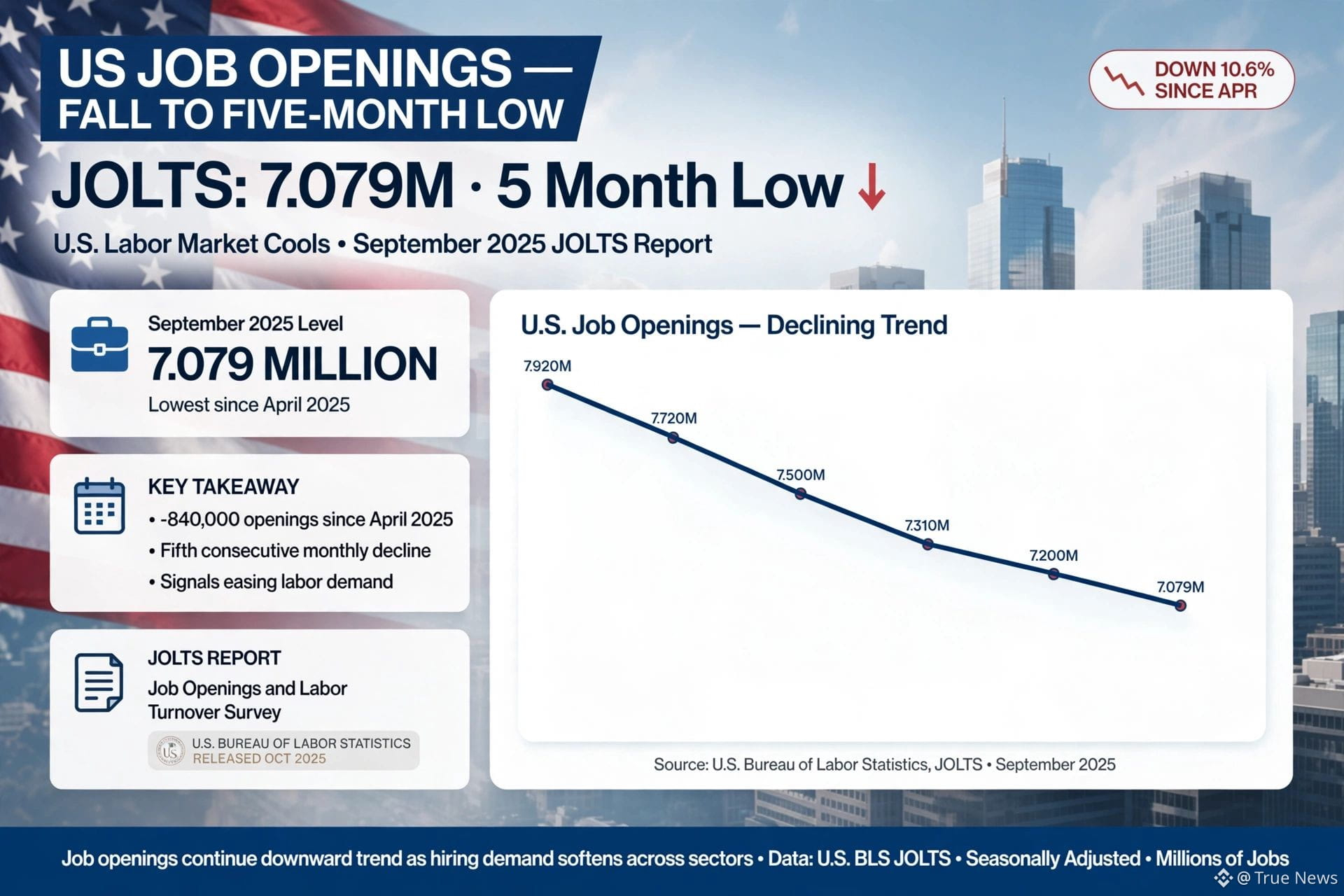
JOLTS Report Aug 2025: 7.079M openings, lowest since April 2025. Down 256K MoM, missed 7.225M forecast.
Trend: Job openings decline 5th month — labor demand cooling.
Crypto Impact: Fed rate 3.75%-4.00% after hike. 70.3% chance of Oct hike — short-term bearish for $BTC $ETH.
$BTC $ETH
#USjobs #JOLTS #Crypto #USJobOpeningsFallToFiveMonthLow
#usjobopeningsfalltofivemonthlow
US JOB OPENINGS FALL TO FIVE-MONTH LOW
JOLTS: 7.079M • 5 Month Low ↓
JOLTS Report Aug 2025: 7.079M openings, lowest since April 2025. Down 256K MoM, missed 7.225M forecast.
Trend: Job openings decline 5th month — labor demand cooling.
Crypto Impact: Fed rate 3.75%-4.00% after hike. 70.3% chance of Oct hike — short-term bearish for $BTC $ETH .
$BTC $ETH
#USjobs #JOLTS #Crypto #USJobOpeningsFallToFiveMonthLow
US JOB OPENINGS FALL TO FIVE-MONTH LOW
JOLTS: 7.079M • 5 Month Low ↓
JOLTS Report Aug 2025: 7.079M openings, lowest since April 2025. Down 256K MoM, missed 7.225M forecast.
Trend: Job openings decline 5th month — labor demand cooling.
Crypto Impact: Fed rate 3.75%-4.00% after hike. 70.3% chance of Oct hike — short-term bearish for $BTC $ETH .
$BTC $ETH
#USjobs #JOLTS #Crypto #USJobOpeningsFallToFiveMonthLow
1
1
57

·
--
New topic about job openings makes the hot list|Layoffs don’t surge in tandem|For XMR, I’ll wait before $548.6 is confirmed
My view is to first distinguish between two paths for a cooling jobs market, rather than translating “fewer openings” directly into “all crypto prices will rise.” A drop in financing costs is one path; weaker income and reduced risk tolerance is another. For XMR, I keep a zero position and wait for both the price and the real trading channels to confirm.
A new topic appears on the forum: USJobOpeningsFallToFiveMonthLow. The page shows zero views and only two people discussing it, which suggests the topic is just emerging—not that it has already formed a large buying order.
Unlike my prior focus on employees’ intention to quit, this time I specifically check whether employers are actively cutting jobs, to judge whether the headline alone is enough to support a conclusion of an “employment collapse.”
On September 29, the U.S. Bureau of Labor Statistics released the August JOLTS report. Job openings were about 7.10 million, and hiring was about 5.20 million. The official description says the two are little changed. Layoffs and discharges were about 1.60 million, or 1%—also with no obvious change. This is the August survey, not real-time unemployment numbers at the end of September, and not a rate cut decision already made by the central bank.
I also re-check the official Table 5: revised layoffs and discharges for July are 1.72 million; the early August value is 1.64 million—down by 0.01 million. It’s possible for the numbers to be trending downward while the statistical changes are still not significant; you can’t just screenshot “job openings fall,” omit the fact that layoffs didn’t surge, and you also can’t treat the initial value as an unchangeable final conclusion.
Why does this matter to the crypto market? My independent assessment is: if hiring demand slows while layoffs remain stable, the market may discuss a mild cooling. If layoffs then turn into a sustained increase, the path where consumption and risk appetite face pressure becomes more important. Either scenario must be evaluated together with the original text on inflation and policy—you can’t assume a loose outlook based on a single headline. Privacy features don’t equal an isolation from changes in dollar liquidity and overall risk appetite. XMR also can’t be treated as a volatility-free safe haven because of that.
Market reality: At 00:13 Beijing time, Kraken’s latest XMR/USD trade is $543.75; over the rolling 24 hours it ranges from $527.20 to $548.29. It’s still within the range. The quotes are in dollars, not USDT, and there isn’t enough evidence to attribute the move to this report. $548.6 is a confirmation line I set manually, not a target price provided by the data publisher.
If I were trading this myself: I’m not participating and my position is zero; I only consider unleveraged spot longs. I would put in at most 0.3% of total capital only if the full hour closes above $548.6, then the pullback from $547 to $548.6 holds—and assuming the platform trading and required deposits/withdrawals are functioning normally. Conditions: if it’s 552, I cut the position in half; if it reaches 557, I fully close. Hard stop at 542, or if there’s a full close below $547 for two consecutive hours, I fully exit. If it breaks down below 527 before activation, I cancel the plan and jump to the target without chasing or averaging down losses. Any later data revisions that weaken the thesis, abnormal channel behavior, or a failed breakout will撤回 participation conditions. A plan not triggered is not a trade fill, and not a profit.
Sources: [BLS release](https://www.bls.gov/news.release/jolts.nr0.htm), [Layoffs Table 5](https://www.bls.gov/news.release/jolts.t05.htm).
#USJobOpeningsFallToFiveMonthLow #XMR
The above is only personal market observation and does not constitute investment advice.
New topic about job openings makes the hot list|Layoffs don’t surge in tandem|For XMR, I’ll wait before $548.6 is confirmed
My view is to first distinguish between two paths for a cooling jobs market, rather than translating “fewer openings” directly into “all crypto prices will rise.” A drop in financing costs is one path; weaker income and reduced risk tolerance is another. For XMR, I keep a zero position and wait for both the price and the real trading channels to confirm.
A new topic appears on the forum: USJobOpeningsFallToFiveMonthLow. The page shows zero views and only two people discussing it, which suggests the topic is just emerging—not that it has already formed a large buying order.
Unlike my prior focus on employees’ intention to quit, this time I specifically check whether employers are actively cutting jobs, to judge whether the headline alone is enough to support a conclusion of an “employment collapse.”
On September 29, the U.S. Bureau of Labor Statistics released the August JOLTS report. Job openings were about 7.10 million, and hiring was about 5.20 million. The official description says the two are little changed. Layoffs and discharges were about 1.60 million, or 1%—also with no obvious change. This is the August survey, not real-time unemployment numbers at the end of September, and not a rate cut decision already made by the central bank.
I also re-check the official Table 5: revised layoffs and discharges for July are 1.72 million; the early August value is 1.64 million—down by 0.01 million. It’s possible for the numbers to be trending downward while the statistical changes are still not significant; you can’t just screenshot “job openings fall,” omit the fact that layoffs didn’t surge, and you also can’t treat the initial value as an unchangeable final conclusion.
Why does this matter to the crypto market? My independent assessment is: if hiring demand slows while layoffs remain stable, the market may discuss a mild cooling. If layoffs then turn into a sustained increase, the path where consumption and risk appetite face pressure becomes more important. Either scenario must be evaluated together with the original text on inflation and policy—you can’t assume a loose outlook based on a single headline. Privacy features don’t equal an isolation from changes in dollar liquidity and overall risk appetite. XMR also can’t be treated as a volatility-free safe haven because of that.
Market reality: At 00:13 Beijing time, Kraken’s latest XMR/USD trade is $543.75; over the rolling 24 hours it ranges from $527.20 to $548.29. It’s still within the range. The quotes are in dollars, not USDT, and there isn’t enough evidence to attribute the move to this report. $548.6 is a confirmation line I set manually, not a target price provided by the data publisher.
If I were trading this myself: I’m not participating and my position is zero; I only consider unleveraged spot longs. I would put in at most 0.3% of total capital only if the full hour closes above $548.6, then the pullback from $547 to $548.6 holds—and assuming the platform trading and required deposits/withdrawals are functioning normally. Conditions: if it’s 552, I cut the position in half; if it reaches 557, I fully close. Hard stop at 542, or if there’s a full close below $547 for two consecutive hours, I fully exit. If it breaks down below 527 before activation, I cancel the plan and jump to the target without chasing or averaging down losses. Any later data revisions that weaken the thesis, abnormal channel behavior, or a failed breakout will撤回 participation conditions. A plan not triggered is not a trade fill, and not a profit.
Sources: [BLS release](https://www.bls.gov/news.release/jolts.nr0.htm), [Layoffs Table 5](https://www.bls.gov/news.release/jolts.t05.htm).
#USJobOpeningsFallToFiveMonthLow #XMR
The above is only personal market observation and does not constitute investment advice.
My view is to first distinguish between two paths for a cooling jobs market, rather than translating “fewer openings” directly into “all crypto prices will rise.” A drop in financing costs is one path; weaker income and reduced risk tolerance is another. For XMR, I keep a zero position and wait for both the price and the real trading channels to confirm.
A new topic appears on the forum: USJobOpeningsFallToFiveMonthLow. The page shows zero views and only two people discussing it, which suggests the topic is just emerging—not that it has already formed a large buying order.
Unlike my prior focus on employees’ intention to quit, this time I specifically check whether employers are actively cutting jobs, to judge whether the headline alone is enough to support a conclusion of an “employment collapse.”
On September 29, the U.S. Bureau of Labor Statistics released the August JOLTS report. Job openings were about 7.10 million, and hiring was about 5.20 million. The official description says the two are little changed. Layoffs and discharges were about 1.60 million, or 1%—also with no obvious change. This is the August survey, not real-time unemployment numbers at the end of September, and not a rate cut decision already made by the central bank.
I also re-check the official Table 5: revised layoffs and discharges for July are 1.72 million; the early August value is 1.64 million—down by 0.01 million. It’s possible for the numbers to be trending downward while the statistical changes are still not significant; you can’t just screenshot “job openings fall,” omit the fact that layoffs didn’t surge, and you also can’t treat the initial value as an unchangeable final conclusion.
Why does this matter to the crypto market? My independent assessment is: if hiring demand slows while layoffs remain stable, the market may discuss a mild cooling. If layoffs then turn into a sustained increase, the path where consumption and risk appetite face pressure becomes more important. Either scenario must be evaluated together with the original text on inflation and policy—you can’t assume a loose outlook based on a single headline. Privacy features don’t equal an isolation from changes in dollar liquidity and overall risk appetite. XMR also can’t be treated as a volatility-free safe haven because of that.
Market reality: At 00:13 Beijing time, Kraken’s latest XMR/USD trade is $543.75; over the rolling 24 hours it ranges from $527.20 to $548.29. It’s still within the range. The quotes are in dollars, not USDT, and there isn’t enough evidence to attribute the move to this report. $548.6 is a confirmation line I set manually, not a target price provided by the data publisher.
If I were trading this myself: I’m not participating and my position is zero; I only consider unleveraged spot longs. I would put in at most 0.3% of total capital only if the full hour closes above $548.6, then the pullback from $547 to $548.6 holds—and assuming the platform trading and required deposits/withdrawals are functioning normally. Conditions: if it’s 552, I cut the position in half; if it reaches 557, I fully close. Hard stop at 542, or if there’s a full close below $547 for two consecutive hours, I fully exit. If it breaks down below 527 before activation, I cancel the plan and jump to the target without chasing or averaging down losses. Any later data revisions that weaken the thesis, abnormal channel behavior, or a failed breakout will撤回 participation conditions. A plan not triggered is not a trade fill, and not a profit.
Sources: [BLS release](https://www.bls.gov/news.release/jolts.nr0.htm), [Layoffs Table 5](https://www.bls.gov/news.release/jolts.t05.htm).
#USJobOpeningsFallToFiveMonthLow #XMR
The above is only personal market observation and does not constitute investment advice.

9

#USJobOpeningsFallToFiveMonthLow
U.S. job openings fell to a five-month low of 7.079 million in August 2026, down by 256,000 from a revised 7.335 million in July. The latest figures, released by the U.S. Bureau of Labor Statistics (BLS) in its monthly Job Openings and Labor Turnover Survey (JOLTS) report, missed economists' consensus forecasts of roughly 7.2 million available vacancies.
#USJobOpeningsFallToFiveMonthLow
U.S. job openings fell to a five-month low of 7.079 million in August 2026, down by 256,000 from a revised 7.335 million in July. The latest figures, released by the U.S. Bureau of Labor Statistics (BLS) in its monthly Job Openings and Labor Turnover Survey (JOLTS) report, missed economists' consensus forecasts of roughly 7.2 million available vacancies.
U.S. job openings fell to a five-month low of 7.079 million in August 2026, down by 256,000 from a revised 7.335 million in July. The latest figures, released by the U.S. Bureau of Labor Statistics (BLS) in its monthly Job Openings and Labor Turnover Survey (JOLTS) report, missed economists' consensus forecasts of roughly 7.2 million available vacancies.
1
2

·
--
#USJobOpeningsFallToFiveMonthLow
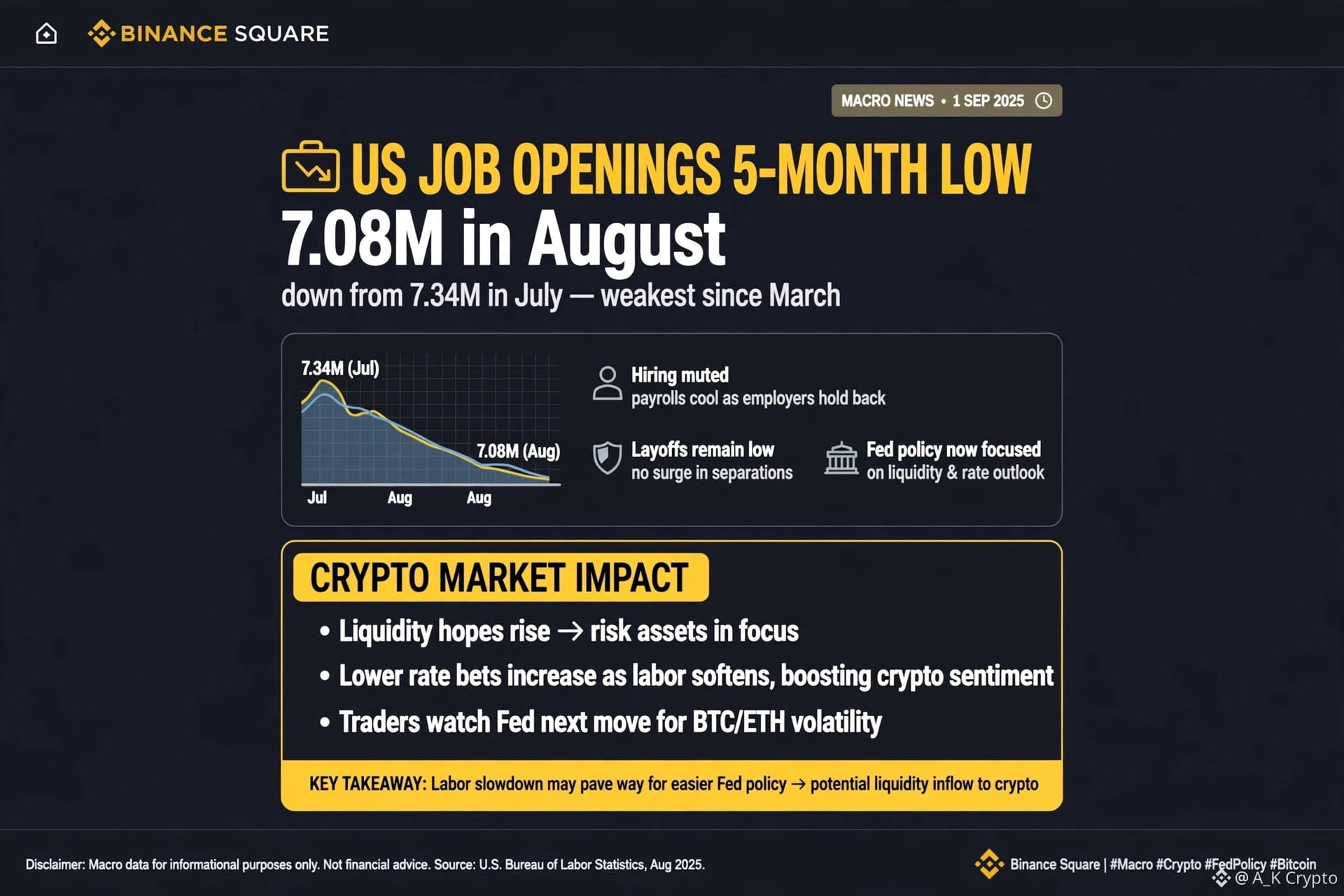
🚨 US JOB OPENINGS JUST HIT A 5-MONTH LOW!
🇺🇸 U.S. job openings fell to 7.08M in August, down from 7.34M in July — the weakest level since March.
📉 Hiring is still muted, while layoffs remain low.
For crypto traders, softer labor data keeps Fed policy and liquidity firmly in focus.
Cooling U.S. labor demand could strengthen expectations for easier Fed policy, potentially supporting risk assets and crypto. But weaker employment also signals slowing economic momentum. I’m watching Treasury yields, the dollar, and upcoming labor data closely. Volatility could remain elevated as markets balance liquidity hopes against recession concerns.
#Bitcoin #Crypto #USJobs #Fed #BTC
#USJobOpeningsFallToFiveMonthLow
🚨 US JOB OPENINGS JUST HIT A 5-MONTH LOW!
🇺🇸 U.S. job openings fell to 7.08M in August, down from 7.34M in July — the weakest level since March.
📉 Hiring is still muted, while layoffs remain low.
For crypto traders, softer labor data keeps Fed policy and liquidity firmly in focus.
Cooling U.S. labor demand could strengthen expectations for easier Fed policy, potentially supporting risk assets and crypto. But weaker employment also signals slowing economic momentum. I’m watching Treasury yields, the dollar, and upcoming labor data closely. Volatility could remain elevated as markets balance liquidity hopes against recession concerns.
#Bitcoin #Crypto #USJobs #Fed #BTC
🚨 US JOB OPENINGS JUST HIT A 5-MONTH LOW!
🇺🇸 U.S. job openings fell to 7.08M in August, down from 7.34M in July — the weakest level since March.
📉 Hiring is still muted, while layoffs remain low.
For crypto traders, softer labor data keeps Fed policy and liquidity firmly in focus.
Cooling U.S. labor demand could strengthen expectations for easier Fed policy, potentially supporting risk assets and crypto. But weaker employment also signals slowing economic momentum. I’m watching Treasury yields, the dollar, and upcoming labor data closely. Volatility could remain elevated as markets balance liquidity hopes against recession concerns.
#Bitcoin #Crypto #USJobs #Fed #BTC
1
39
📊 THE US LABOR MARKET IS SHOWING A MIXED PICTURE
Job openings fell by 256K in August, but hiring rose by 46K and layoffs fell by 61K.
Markets will now watch Friday's employment report for another read on economic conditions. $BTC $ETH $BNB $AVAX
#usjobopeningsfalltofivemonthlow
📊 THE US LABOR MARKET IS SHOWING A MIXED PICTURE
Job openings fell by 256K in August, but hiring rose by 46K and layoffs fell by 61K.
Markets will now watch Friday's employment report for another read on economic conditions. $BTC $ETH $BNB $AVAX
#usjobopeningsfalltofivemonthlow
Job openings fell by 256K in August, but hiring rose by 46K and layoffs fell by 61K.
Markets will now watch Friday's employment report for another read on economic conditions. $BTC $ETH $BNB $AVAX
#usjobopeningsfalltofivemonthlow
23
⚡ JOBS DATA IS IN
US job openings: 7.079M
Previous: 7.335M
Hiring: 5.192M
Layoffs: 1.641M
A cooler openings number alongside low layoffs makes this an important macro signal for markets. $BTC $ETH $LINK
#usjobopeningsfalltofivemonthlow
⚡ JOBS DATA IS IN
US job openings: 7.079M
Previous: 7.335M
Hiring: 5.192M
Layoffs: 1.641M
A cooler openings number alongside low layoffs makes this an important macro signal for markets. $BTC $ETH $LINK
#usjobopeningsfalltofivemonthlow
US job openings: 7.079M
Previous: 7.335M
Hiring: 5.192M
Layoffs: 1.641M
A cooler openings number alongside low layoffs makes this an important macro signal for markets. $BTC $ETH $LINK
#usjobopeningsfalltofivemonthlow
1
21
🌍 A KEY MACRO SIGNAL JUST DROPPED
US job openings slipped to 7.08M in August, the weakest reading since March.
The labor market isn't showing a surge in layoffs, but employers are still cautious about adding workers. $BTC $ETH $SOL $XRP
#usjobopeningsfalltofivemonthlow
🌍 A KEY MACRO SIGNAL JUST DROPPED
US job openings slipped to 7.08M in August, the weakest reading since March.
The labor market isn't showing a surge in layoffs, but employers are still cautious about adding workers. $BTC $ETH $SOL $XRP
#usjobopeningsfalltofivemonthlow
US job openings slipped to 7.08M in August, the weakest reading since March.
The labor market isn't showing a surge in layoffs, but employers are still cautious about adding workers. $BTC $ETH $SOL $XRP
#usjobopeningsfalltofivemonthlow
23
📉 US JOB OPENINGS HIT A 5-MONTH LOW
August job openings fell to 7.079M, down from 7.335M in July.
Hiring actually increased while layoffs declined, creating a mixed picture for the US labor market. $BTC $ETH $BNB
#usjobopeningsfalltofivemonthlow
📉 US JOB OPENINGS HIT A 5-MONTH LOW
August job openings fell to 7.079M, down from 7.335M in July.
Hiring actually increased while layoffs declined, creating a mixed picture for the US labor market. $BTC $ETH $BNB
#usjobopeningsfalltofivemonthlow
August job openings fell to 7.079M, down from 7.335M in July.
Hiring actually increased while layoffs declined, creating a mixed picture for the US labor market. $BTC $ETH $BNB
#usjobopeningsfalltofivemonthlow
10
Log in to explore more content
Join global crypto users on Binance Square
⚡️ Get latest and useful information about crypto.
💬 Trusted by the world’s largest crypto exchange.
👍 Discover real insights from verified creators.
Email / Phone number
Trending Topics
1
#EarningsSeason
187,933 views
1,737 Discussing
2
#BitwiseLaunchesFirstSpotNEARETF
5,437 views
216 Discussing
3
#USJobOpeningsFallToFiveMonthLow
8,551 views
162 Discussing
4
#ECBToTestAIAgentsInDigitalEuroPayments
12,131 views
328 Discussing
5
#JapanFSABacksFourthStablecoinTradeSettlementPilot
13,913 views
380 Discussing
6
#BitgetHackerFailsToMoveStolenFunds
28,122 views
513 Discussing
7
#BitMineETHHoldingsTop6Million
25,504 views
641 Discussing
8
#StrategyAdds1666BTCHoldingsReach847666
21,839 views
451 Discussing
9
#NvidiaApproves$150BBuyback
4,280 views
68 Discussing
10
#OpenAIDelaysGPT6.1OverSafetyIssues
34,063 views
815 Discussing