
0xSignal
343 Posts

0xSignal
Report
Block User
Signal over noise. 📡Making Money 1st.
RWA x Memecoins | On-Chain Intel Before Hype.
Micro-cap scout | Data doesn't lie. | Web3 Research Analyst 🔬
Open Trade
Frequent Trader
7.4 Months
47 Following
105 Followers
582 Liked
Posts
Portfolio
All
Quotes
PINNED
·
--

Article
RWA: Wrong Metric Everyone's WatchingHello Mates, everyone's tracking RWA market cap.
Wrong metric.
Ask this instead: which part of the infrastructure is actually getting paid?
Not the ticker. The rails underneath it.
Who controls issuance
Where tokenized funds actually get deployed
Which chains are attracting regulated products
Who runs custody and compliance
That's where the real fees flow. Not the hype.
RWA isn't a 2-month narrative. Legal frameworks, institutional trust, liquidity — these take years, not weeks.
The crowd will chase tickers like $ONDO and $CFG.
I'm watching the structure — who gets paid when this actually scales.
Not financial advice. Always verify issuer docs and legal wrapper before touching anything.
#CryptoAdoption
#RWA #Tokenization
Which part of the stack do you think captures the most value — issuance, custody, or the chains themselves?
$ONDO $CFG
Follow @OnChainSulaiman for the next breakdown.
RWA: Wrong Metric Everyone's Watching
Hello Mates, everyone's tracking RWA market cap.
Wrong metric.
Ask this instead: which part of the infrastructure is actually getting paid?
Not the ticker. The rails underneath it.
Who controls issuance
Where tokenized funds actually get deployed
Which chains are attracting regulated products
Who runs custody and compliance
That's where the real fees flow. Not the hype.
RWA isn't a 2-month narrative. Legal frameworks, institutional trust, liquidity — these take years, not weeks.
The crowd will chase tickers like $ONDO and $CFG .
I'm watching the structure — who gets paid when this actually scales.
Not financial advice. Always verify issuer docs and legal wrapper before touching anything.
#CryptoAdoption
#RWA #Tokenization
Which part of the stack do you think captures the most value — issuance, custody, or the chains themselves?
$ONDO $CFG
Follow @0xSignal for the next breakdown.
Wrong metric.
Ask this instead: which part of the infrastructure is actually getting paid?
Not the ticker. The rails underneath it.
Who controls issuance
Where tokenized funds actually get deployed
Which chains are attracting regulated products
Who runs custody and compliance
That's where the real fees flow. Not the hype.
RWA isn't a 2-month narrative. Legal frameworks, institutional trust, liquidity — these take years, not weeks.
The crowd will chase tickers like $ONDO and $CFG .
I'm watching the structure — who gets paid when this actually scales.
Not financial advice. Always verify issuer docs and legal wrapper before touching anything.
#CryptoAdoption
#RWA #Tokenization
Which part of the stack do you think captures the most value — issuance, custody, or the chains themselves?
$ONDO $CFG
Follow @0xSignal for the next breakdown.
3
106
PINNED
·
--
Partly True
Article
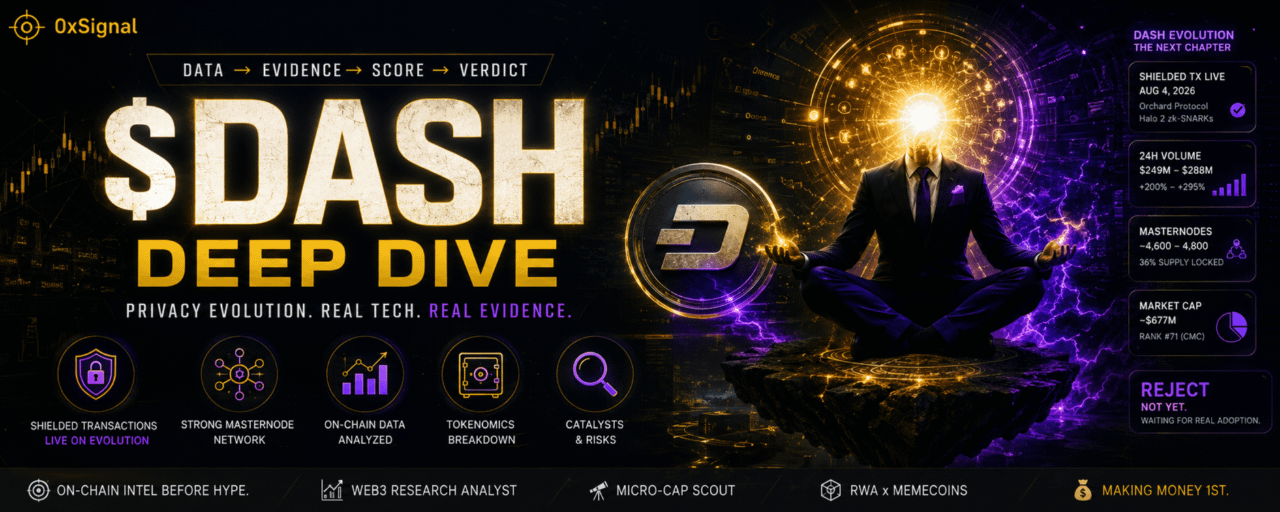
$DASH Just Pumped 35% — But the Real Story Is Hidden Beneath the Price🧠 0xSIGNAL RESEARCH — $DASH DEEP DIVE
DATA → EVIDENCE → SCORE → VERDICT
Report Date: September 5, 2026
Analyst: 0xSignal Research
⚡ SNAPSHOT
One number needs context: liquidity.
DASH has recently traded through roughly 42–74 in a very short period around DashCon 2026. That's a huge range for an asset of this size.
So I wouldn't treat the current 52–53 price as a stable valuation. It's a fast-moving market where position size and execution matter.
🔥 WHY DASH IS MOVING
The current rally isn't happening in isolation.
Privacy coins have been one of crypto's strongest narratives, and DASH is now trying to reposition itself directly inside that trade.
Historically, DASH was primarily known as a payments-focused cryptocurrency with optional privacy features.
That's changing.
The biggest development is the rollout of shielded transactions on Evolution mainnet on August 4, 2026, using Zcash's Orchard protocol and Halo 2 zk-SNARK technology.
This matters because DASH is no longer asking the market to value privacy as a secondary feature.
It's trying to make privacy part of the core product.
The timing is also favorable.
Zcash and Monero have already demonstrated that the market is willing to assign significant valuations to privacy-focused assets.
But there's a catch:
DASH is late.
ZEC and XMR already own most of the mindshare.
DASH now has to prove it can take market share rather than simply benefit from the same narrative.
Assessment: 6/10
Sources: CoinGecko, ByteTree Research, Paybis, CoinMarketCap
🛠️ THE PRODUCT IS FINALLY HERE
This is the strongest part of the DASH story.
DASH is a 12-year-old network with a functioning two-tier architecture built around miners and masternodes.
InstantSend, ChainLocks and PrivateSend aren't future promises. They're established network features.
Evolution has also continued to ship.
Dash Platform v4.1.0 arrived on July 27, 2026, adding features including username transfers, Android/Kotlin SDKs and DashPay improvements.
Then came the bigger upgrade.
Shielded transactions went live on August 4.
That's important because this is an actual mainnet deployment—not a roadmap announcement.
The first notable merchant integration also arrived through NanoGPT, announced at DashCon 2026.
The rollout isn't complete yet.
Shielded Android support is targeted for September, and DashPay still needs to catch up with shielded functionality.
Still, the core privacy upgrade is live.
That's a meaningful change in the investment story.
Assessment: 7/10
Sources: dash.org official blog/roadmap, MEXC News, CoinMarketCap AI updates
👥 THE BIG QUESTION: ARE PEOPLE ACTUALLY USING IT?
This is where the thesis becomes harder.
DASH has roughly 4,600–4,800 active masternodes, depending on the source and date.
That's a real infrastructure base.
But masternodes don't automatically equal users.
What I really want to see is growth in:
Shielded transaction volumeActive shielded addressesWallet activityMerchant usageOverall transaction growth
The available evidence doesn't give us enough confidence yet.
DashSpend and DashPay exist, but independently verified active-user and transaction-growth figures weren't available in the sources reviewed.
NanoGPT is a useful first example, but one merchant integration doesn't establish a broad adoption trend.
This is probably the single biggest missing piece in the DASH thesis.
The technology has arrived. Now the market needs to see usage.
Assessment: 5/10
Sources: dashpay/dash GitHub wiki, Bitget research guide, dash.org
🪙 TOKENOMICS: BETTER THAN IT LOOKS, BUT NOT PERFECT
DASH has a hard maximum supply of 18,921,005 coins.
Approximately 45% of block rewards go to miners, 45% to masternodes and 10% to the treasury.
The masternode structure is particularly interesting.
Around 4.6M DASH, roughly 36% of circulating supply, is locked as masternode collateral.
That reduces the immediately tradable float.
It doesn't guarantee higher prices, but it does create a structural difference from assets where almost the entire supply is liquid.
The weakness is that DASH doesn't have a burn or buyback mechanism.
Emission continues, although it declines by roughly 7% every 383 days.
So the tokenomics are relatively disciplined, but they're not exceptional.
Assessment: 5/10
Sources: CoinMarketCap, dash.org docs, Crypto News Navigator
💰 FOLLOW THE MONEY — AND BE CAREFUL WITH THE LIQUIDITY
Trading volume exploded alongside the recent move.
Reported 24h volume reached roughly $249M–$288M, representing an increase of approximately 200–295% versus the previous day.
The timing makes sense: DashCon plus the shielded-mainnet narrative created a clear catalyst.
But there's another signal I care about more.
DASH has shown extremely wide price dispersion over a short period.
If an asset can move from roughly $42 to $74 around the same event window, liquidity is clearly something traders need to respect.
We also didn't find reliable independent data covering whale movements, exchange inflows/outflows or smart-money positioning.
So there's evidence of increased trading activity.
There's not enough evidence yet to tell us who is driving it or whether the demand will remain after the event cycle ends.
Assessment: 4/10
Sources: CoinMarketCap, CoinGecko, Bybit, multiple price-tracking aggregators
🧑💻 TEAM & EXECUTION
DASH has survived long enough to have something most newer projects don't: a proven operating history.
Founder Evan Duffield stepped away from day-to-day leadership in 2017 and now serves as an advisor.
Ryan Taylor has led Dash Core Group since 2017.
The core organization is estimated at roughly 40 people in 2026, down from approximately 46 in 2023.
The treasury system is also notable.
About 10% of block rewards goes into a governance-controlled treasury, giving DASH a native funding mechanism for development.
The problem is execution speed.
Evolution took years longer than initially expected.
Several shielded features also slipped before finally shipping in August 2026.
So the team is clearly still building.
But investors shouldn't ignore the historical delivery record.
Assessment: 6/10
Sources: dash.org news archive, LeadIQ, GetLatka, Finance Magnates
🎯 CAN DASH ACTUALLY 10X?
Let's forget the headline for a moment and do the math.
At approximately $52.87 and a ~$677M circulating market cap:
A $6.78B market cap isn't impossible in this sector.
For context, the September 2026 snapshot puts Monero around $9.8B and Zcash above $16B.
So DASH doesn't need to become the biggest privacy asset to reach $528.
It needs to capture a meaningful piece of the market currently assigned to ZEC and XMR.
That's possible.
But "possible" and "probable" are very different things.
🚀 WHAT COULD DRIVE THE NEXT MOVE?
1. Shielded Android
The September 2026 beta could make the new privacy functionality significantly more accessible.
2. Merchant adoption
NanoGPT is an interesting first step.
The real signal would be several independent merchants integrating shielded payments.
3. Privacy-sector rotation
If capital continues moving into privacy coins, smaller assets can benefit disproportionately.
DASH is considerably smaller than ZEC and XMR, which creates more room for percentage-based repricing.
⚠️ WHAT COULD BREAK THE THESIS?
Regulation
DASH carries an "Alleged SEC Securities" tag on major trackers.
Privacy assets also face increasing regulatory pressure, including EU restrictions expected to phase in by 2027.
That doesn't guarantee future delistings or enforcement.
It does make regulation a material risk.
Competition
Zcash and Monero are roughly 15–25x larger by market cap and already dominate the privacy narrative.
DASH has to compete for attention, liquidity and capital against much stronger incumbents.
Liquidity
The recent price swings are a warning.
Large moves on moderate absolute volume can create significant slippage.
Execution
The shielded upgrade is live, which is positive.
But DASH's history of delayed roadmap delivery means future announcements should be treated as expectations until they become working products.
Security
CoinGecko/CER showed a 32% security score as of September 4, 2026, while CertiK's separate rating was more favorable at 4.1.
The disagreement itself is worth noting.
I'd treat this as an area requiring additional diligence rather than declaring either a clean pass or a failure.
🐂 THE BULL CASE
The bullish version is simple.
Evolution works.
Shielded transactions gain meaningful adoption.
Android support arrives.
More merchants integrate shielded payments.
DASH becomes a credible third major privacy asset instead of a legacy payments project trying to catch the next narrative.
If that happens while capital continues flowing into privacy, the valuation gap with ZEC and XMR gives DASH significant room to re-rate.
That's where the 5X–10X argument becomes interesting.
⚖️ THE BASE CASE
DASH gets a strong narrative-driven revaluation.
The privacy upgrade attracts attention.
Price moves higher.
Then the excitement fades.
The market waits for actual usage data.
If shielded transactions, active addresses and merchant activity don't continue growing, investors may decide that the technology upgrade is interesting—but not enough to justify a permanent valuation reset.
🐻 THE BEAR CASE
The privacy rollout disappoints.
Mobile support gets delayed.
Regulatory pressure increases.
Liquidity remains weak.
The privacy narrative loses momentum.
Under that scenario, the recent rally could unwind and DASH could revisit the $30–40 region seen before the DashCon-driven move.
🚨 FINAL VERDICT: REJECT
DASH is a legitimate project.
It has been operating for more than a decade, development is active, and the latest shielded transaction upgrade is a genuine technological improvement.
But the investment case isn't proven yet.
The biggest problem isn't the technology.
It's adoption.
DASH has finally shipped the product that could make its privacy narrative much stronger. Now it needs to demonstrate that users, merchants and the broader ecosystem actually want it.
Right now, the available evidence isn't strong enough.
The competitive environment is also difficult. Zcash and Monero already dominate the privacy category, while DASH is entering the race with a smaller market cap, weaker mindshare and a history of delayed execution.
Then add regulatory uncertainty and thin liquidity.
The 10X math is possible.
The evidence isn't there yet to make it probable.
What would change my view?
I don't need another conference or another headline.
I want to see the numbers:
Shielded transaction volumeActive shielded addressesMerchant adoptionWallet activitySustained network usageDemand that survives after the current hype fades
If those metrics start trending higher, DASH deserves another look.
For now: REJECT.
Not because DASH is dead.
Because the evidence hasn't earned the conviction yet.
Data → Evidence → Score → Verdict.
Not financial advice. DYOR.
— 0xSignal Research
#DASH
$DASH Just Pumped 35% — But the Real Story Is Hidden Beneath the Price
🧠 0xSIGNAL RESEARCH — $DASH DEEP DIVE
DATA → EVIDENCE → SCORE → VERDICT
Report Date: September 5, 2026
Analyst: 0xSignal Research
⚡ SNAPSHOT
One number needs context: liquidity.
DASH has recently traded through roughly 42–74 in a very short period around DashCon 2026. That's a huge range for an asset of this size.
So I wouldn't treat the current 52–53 price as a stable valuation. It's a fast-moving market where position size and execution matter.
🔥 WHY DASH IS MOVING
The current rally isn't happening in isolation.
Privacy coins have been one of crypto's strongest narratives, and DASH is now trying to reposition itself directly inside that trade.
Historically, DASH was primarily known as a payments-focused cryptocurrency with optional privacy features.
That's changing.
The biggest development is the rollout of shielded transactions on Evolution mainnet on August 4, 2026, using Zcash's Orchard protocol and Halo 2 zk-SNARK technology.
This matters because DASH is no longer asking the market to value privacy as a secondary feature.
It's trying to make privacy part of the core product.
The timing is also favorable.
Zcash and Monero have already demonstrated that the market is willing to assign significant valuations to privacy-focused assets.
But there's a catch:
DASH is late.
ZEC and XMR already own most of the mindshare.
DASH now has to prove it can take market share rather than simply benefit from the same narrative.
Assessment: 6/10
Sources: CoinGecko, ByteTree Research, Paybis, CoinMarketCap
🛠️ THE PRODUCT IS FINALLY HERE
This is the strongest part of the DASH story.
DASH is a 12-year-old network with a functioning two-tier architecture built around miners and masternodes.
InstantSend, ChainLocks and PrivateSend aren't future promises. They're established network features.
Evolution has also continued to ship.
Dash Platform v4.1.0 arrived on July 27, 2026, adding features including username transfers, Android/Kotlin SDKs and DashPay improvements.
Then came the bigger upgrade.
Shielded transactions went live on August 4.
That's important because this is an actual mainnet deployment—not a roadmap announcement.
The first notable merchant integration also arrived through NanoGPT, announced at DashCon 2026.
The rollout isn't complete yet.
Shielded Android support is targeted for September, and DashPay still needs to catch up with shielded functionality.
Still, the core privacy upgrade is live.
That's a meaningful change in the investment story.
Assessment: 7/10
Sources: dash.org official blog/roadmap, MEXC News, CoinMarketCap AI updates
👥 THE BIG QUESTION: ARE PEOPLE ACTUALLY USING IT?
This is where the thesis becomes harder.
DASH has roughly 4,600–4,800 active masternodes, depending on the source and date.
That's a real infrastructure base.
But masternodes don't automatically equal users.
What I really want to see is growth in:
Shielded transaction volumeActive shielded addressesWallet activityMerchant usageOverall transaction growth
The available evidence doesn't give us enough confidence yet.
DashSpend and DashPay exist, but independently verified active-user and transaction-growth figures weren't available in the sources reviewed.
NanoGPT is a useful first example, but one merchant integration doesn't establish a broad adoption trend.
This is probably the single biggest missing piece in the DASH thesis.
The technology has arrived. Now the market needs to see usage.
Assessment: 5/10
Sources: dashpay/dash GitHub wiki, Bitget research guide, dash.org
🪙 TOKENOMICS: BETTER THAN IT LOOKS, BUT NOT PERFECT
DASH has a hard maximum supply of 18,921,005 coins.
Approximately 45% of block rewards go to miners, 45% to masternodes and 10% to the treasury.
The masternode structure is particularly interesting.
Around 4.6M DASH, roughly 36% of circulating supply, is locked as masternode collateral.
That reduces the immediately tradable float.
It doesn't guarantee higher prices, but it does create a structural difference from assets where almost the entire supply is liquid.
The weakness is that DASH doesn't have a burn or buyback mechanism.
Emission continues, although it declines by roughly 7% every 383 days.
So the tokenomics are relatively disciplined, but they're not exceptional.
Assessment: 5/10
Sources: CoinMarketCap, dash.org docs, Crypto News Navigator
💰 FOLLOW THE MONEY — AND BE CAREFUL WITH THE LIQUIDITY
Trading volume exploded alongside the recent move.
Reported 24h volume reached roughly $249M–$288M, representing an increase of approximately 200–295% versus the previous day.
The timing makes sense: DashCon plus the shielded-mainnet narrative created a clear catalyst.
But there's another signal I care about more.
DASH has shown extremely wide price dispersion over a short period.
If an asset can move from roughly $42 to $74 around the same event window, liquidity is clearly something traders need to respect.
We also didn't find reliable independent data covering whale movements, exchange inflows/outflows or smart-money positioning.
So there's evidence of increased trading activity.
There's not enough evidence yet to tell us who is driving it or whether the demand will remain after the event cycle ends.
Assessment: 4/10
Sources: CoinMarketCap, CoinGecko, Bybit, multiple price-tracking aggregators
🧑💻 TEAM & EXECUTION
DASH has survived long enough to have something most newer projects don't: a proven operating history.
Founder Evan Duffield stepped away from day-to-day leadership in 2017 and now serves as an advisor.
Ryan Taylor has led Dash Core Group since 2017.
The core organization is estimated at roughly 40 people in 2026, down from approximately 46 in 2023.
The treasury system is also notable.
About 10% of block rewards goes into a governance-controlled treasury, giving DASH a native funding mechanism for development.
The problem is execution speed.
Evolution took years longer than initially expected.
Several shielded features also slipped before finally shipping in August 2026.
So the team is clearly still building.
But investors shouldn't ignore the historical delivery record.
Assessment: 6/10
Sources: dash.org news archive, LeadIQ, GetLatka, Finance Magnates
🎯 CAN DASH ACTUALLY 10X?
Let's forget the headline for a moment and do the math.
At approximately $52.87 and a ~$677M circulating market cap:
A $6.78B market cap isn't impossible in this sector.
For context, the September 2026 snapshot puts Monero around $9.8B and Zcash above $16B.
So DASH doesn't need to become the biggest privacy asset to reach $528.
It needs to capture a meaningful piece of the market currently assigned to ZEC and XMR.
That's possible.
But "possible" and "probable" are very different things.
🚀 WHAT COULD DRIVE THE NEXT MOVE?
1. Shielded Android
The September 2026 beta could make the new privacy functionality significantly more accessible.
2. Merchant adoption
NanoGPT is an interesting first step.
The real signal would be several independent merchants integrating shielded payments.
3. Privacy-sector rotation
If capital continues moving into privacy coins, smaller assets can benefit disproportionately.
DASH is considerably smaller than ZEC and XMR, which creates more room for percentage-based repricing.
⚠️ WHAT COULD BREAK THE THESIS?
Regulation
DASH carries an "Alleged SEC Securities" tag on major trackers.
Privacy assets also face increasing regulatory pressure, including EU restrictions expected to phase in by 2027.
That doesn't guarantee future delistings or enforcement.
It does make regulation a material risk.
Competition
Zcash and Monero are roughly 15–25x larger by market cap and already dominate the privacy narrative.
DASH has to compete for attention, liquidity and capital against much stronger incumbents.
Liquidity
The recent price swings are a warning.
Large moves on moderate absolute volume can create significant slippage.
Execution
The shielded upgrade is live, which is positive.
But DASH's history of delayed roadmap delivery means future announcements should be treated as expectations until they become working products.
Security
CoinGecko/CER showed a 32% security score as of September 4, 2026, while CertiK's separate rating was more favorable at 4.1.
The disagreement itself is worth noting.
I'd treat this as an area requiring additional diligence rather than declaring either a clean pass or a failure.
🐂 THE BULL CASE
The bullish version is simple.
Evolution works.
Shielded transactions gain meaningful adoption.
Android support arrives.
More merchants integrate shielded payments.
DASH becomes a credible third major privacy asset instead of a legacy payments project trying to catch the next narrative.
If that happens while capital continues flowing into privacy, the valuation gap with ZEC and XMR gives DASH significant room to re-rate.
That's where the 5X–10X argument becomes interesting.
⚖️ THE BASE CASE
DASH gets a strong narrative-driven revaluation.
The privacy upgrade attracts attention.
Price moves higher.
Then the excitement fades.
The market waits for actual usage data.
If shielded transactions, active addresses and merchant activity don't continue growing, investors may decide that the technology upgrade is interesting—but not enough to justify a permanent valuation reset.
🐻 THE BEAR CASE
The privacy rollout disappoints.
Mobile support gets delayed.
Regulatory pressure increases.
Liquidity remains weak.
The privacy narrative loses momentum.
Under that scenario, the recent rally could unwind and DASH could revisit the $30–40 region seen before the DashCon-driven move.
🚨 FINAL VERDICT: REJECT
DASH is a legitimate project.
It has been operating for more than a decade, development is active, and the latest shielded transaction upgrade is a genuine technological improvement.
But the investment case isn't proven yet.
The biggest problem isn't the technology.
It's adoption.
DASH has finally shipped the product that could make its privacy narrative much stronger. Now it needs to demonstrate that users, merchants and the broader ecosystem actually want it.
Right now, the available evidence isn't strong enough.
The competitive environment is also difficult. Zcash and Monero already dominate the privacy category, while DASH is entering the race with a smaller market cap, weaker mindshare and a history of delayed execution.
Then add regulatory uncertainty and thin liquidity.
The 10X math is possible.
The evidence isn't there yet to make it probable.
What would change my view?
I don't need another conference or another headline.
I want to see the numbers:
Shielded transaction volumeActive shielded addressesMerchant adoptionWallet activitySustained network usageDemand that survives after the current hype fades
If those metrics start trending higher, DASH deserves another look.
For now: REJECT.
Not because DASH is dead.
Because the evidence hasn't earned the conviction yet.
Data → Evidence → Score → Verdict.
Not financial advice. DYOR.
— 0xSignal Research
#DASH
DATA → EVIDENCE → SCORE → VERDICT
Report Date: September 5, 2026
Analyst: 0xSignal Research
⚡ SNAPSHOT
One number needs context: liquidity.
DASH has recently traded through roughly 42–74 in a very short period around DashCon 2026. That's a huge range for an asset of this size.
So I wouldn't treat the current 52–53 price as a stable valuation. It's a fast-moving market where position size and execution matter.
🔥 WHY DASH IS MOVING
The current rally isn't happening in isolation.
Privacy coins have been one of crypto's strongest narratives, and DASH is now trying to reposition itself directly inside that trade.
Historically, DASH was primarily known as a payments-focused cryptocurrency with optional privacy features.
That's changing.
The biggest development is the rollout of shielded transactions on Evolution mainnet on August 4, 2026, using Zcash's Orchard protocol and Halo 2 zk-SNARK technology.
This matters because DASH is no longer asking the market to value privacy as a secondary feature.
It's trying to make privacy part of the core product.
The timing is also favorable.
Zcash and Monero have already demonstrated that the market is willing to assign significant valuations to privacy-focused assets.
But there's a catch:
DASH is late.
ZEC and XMR already own most of the mindshare.
DASH now has to prove it can take market share rather than simply benefit from the same narrative.
Assessment: 6/10
Sources: CoinGecko, ByteTree Research, Paybis, CoinMarketCap
🛠️ THE PRODUCT IS FINALLY HERE
This is the strongest part of the DASH story.
DASH is a 12-year-old network with a functioning two-tier architecture built around miners and masternodes.
InstantSend, ChainLocks and PrivateSend aren't future promises. They're established network features.
Evolution has also continued to ship.
Dash Platform v4.1.0 arrived on July 27, 2026, adding features including username transfers, Android/Kotlin SDKs and DashPay improvements.
Then came the bigger upgrade.
Shielded transactions went live on August 4.
That's important because this is an actual mainnet deployment—not a roadmap announcement.
The first notable merchant integration also arrived through NanoGPT, announced at DashCon 2026.
The rollout isn't complete yet.
Shielded Android support is targeted for September, and DashPay still needs to catch up with shielded functionality.
Still, the core privacy upgrade is live.
That's a meaningful change in the investment story.
Assessment: 7/10
Sources: dash.org official blog/roadmap, MEXC News, CoinMarketCap AI updates
👥 THE BIG QUESTION: ARE PEOPLE ACTUALLY USING IT?
This is where the thesis becomes harder.
DASH has roughly 4,600–4,800 active masternodes, depending on the source and date.
That's a real infrastructure base.
But masternodes don't automatically equal users.
What I really want to see is growth in:
Shielded transaction volumeActive shielded addressesWallet activityMerchant usageOverall transaction growth
The available evidence doesn't give us enough confidence yet.
DashSpend and DashPay exist, but independently verified active-user and transaction-growth figures weren't available in the sources reviewed.
NanoGPT is a useful first example, but one merchant integration doesn't establish a broad adoption trend.
This is probably the single biggest missing piece in the DASH thesis.
The technology has arrived. Now the market needs to see usage.
Assessment: 5/10
Sources: dashpay/dash GitHub wiki, Bitget research guide, dash.org
🪙 TOKENOMICS: BETTER THAN IT LOOKS, BUT NOT PERFECT
DASH has a hard maximum supply of 18,921,005 coins.
Approximately 45% of block rewards go to miners, 45% to masternodes and 10% to the treasury.
The masternode structure is particularly interesting.
Around 4.6M DASH, roughly 36% of circulating supply, is locked as masternode collateral.
That reduces the immediately tradable float.
It doesn't guarantee higher prices, but it does create a structural difference from assets where almost the entire supply is liquid.
The weakness is that DASH doesn't have a burn or buyback mechanism.
Emission continues, although it declines by roughly 7% every 383 days.
So the tokenomics are relatively disciplined, but they're not exceptional.
Assessment: 5/10
Sources: CoinMarketCap, dash.org docs, Crypto News Navigator
💰 FOLLOW THE MONEY — AND BE CAREFUL WITH THE LIQUIDITY
Trading volume exploded alongside the recent move.
Reported 24h volume reached roughly $249M–$288M, representing an increase of approximately 200–295% versus the previous day.
The timing makes sense: DashCon plus the shielded-mainnet narrative created a clear catalyst.
But there's another signal I care about more.
DASH has shown extremely wide price dispersion over a short period.
If an asset can move from roughly $42 to $74 around the same event window, liquidity is clearly something traders need to respect.
We also didn't find reliable independent data covering whale movements, exchange inflows/outflows or smart-money positioning.
So there's evidence of increased trading activity.
There's not enough evidence yet to tell us who is driving it or whether the demand will remain after the event cycle ends.
Assessment: 4/10
Sources: CoinMarketCap, CoinGecko, Bybit, multiple price-tracking aggregators
🧑💻 TEAM & EXECUTION
DASH has survived long enough to have something most newer projects don't: a proven operating history.
Founder Evan Duffield stepped away from day-to-day leadership in 2017 and now serves as an advisor.
Ryan Taylor has led Dash Core Group since 2017.
The core organization is estimated at roughly 40 people in 2026, down from approximately 46 in 2023.
The treasury system is also notable.
About 10% of block rewards goes into a governance-controlled treasury, giving DASH a native funding mechanism for development.
The problem is execution speed.
Evolution took years longer than initially expected.
Several shielded features also slipped before finally shipping in August 2026.
So the team is clearly still building.
But investors shouldn't ignore the historical delivery record.
Assessment: 6/10
Sources: dash.org news archive, LeadIQ, GetLatka, Finance Magnates
🎯 CAN DASH ACTUALLY 10X?
Let's forget the headline for a moment and do the math.
At approximately $52.87 and a ~$677M circulating market cap:
A $6.78B market cap isn't impossible in this sector.
For context, the September 2026 snapshot puts Monero around $9.8B and Zcash above $16B.
So DASH doesn't need to become the biggest privacy asset to reach $528.
It needs to capture a meaningful piece of the market currently assigned to ZEC and XMR.
That's possible.
But "possible" and "probable" are very different things.
🚀 WHAT COULD DRIVE THE NEXT MOVE?
1. Shielded Android
The September 2026 beta could make the new privacy functionality significantly more accessible.
2. Merchant adoption
NanoGPT is an interesting first step.
The real signal would be several independent merchants integrating shielded payments.
3. Privacy-sector rotation
If capital continues moving into privacy coins, smaller assets can benefit disproportionately.
DASH is considerably smaller than ZEC and XMR, which creates more room for percentage-based repricing.
⚠️ WHAT COULD BREAK THE THESIS?
Regulation
DASH carries an "Alleged SEC Securities" tag on major trackers.
Privacy assets also face increasing regulatory pressure, including EU restrictions expected to phase in by 2027.
That doesn't guarantee future delistings or enforcement.
It does make regulation a material risk.
Competition
Zcash and Monero are roughly 15–25x larger by market cap and already dominate the privacy narrative.
DASH has to compete for attention, liquidity and capital against much stronger incumbents.
Liquidity
The recent price swings are a warning.
Large moves on moderate absolute volume can create significant slippage.
Execution
The shielded upgrade is live, which is positive.
But DASH's history of delayed roadmap delivery means future announcements should be treated as expectations until they become working products.
Security
CoinGecko/CER showed a 32% security score as of September 4, 2026, while CertiK's separate rating was more favorable at 4.1.
The disagreement itself is worth noting.
I'd treat this as an area requiring additional diligence rather than declaring either a clean pass or a failure.
🐂 THE BULL CASE
The bullish version is simple.
Evolution works.
Shielded transactions gain meaningful adoption.
Android support arrives.
More merchants integrate shielded payments.
DASH becomes a credible third major privacy asset instead of a legacy payments project trying to catch the next narrative.
If that happens while capital continues flowing into privacy, the valuation gap with ZEC and XMR gives DASH significant room to re-rate.
That's where the 5X–10X argument becomes interesting.
⚖️ THE BASE CASE
DASH gets a strong narrative-driven revaluation.
The privacy upgrade attracts attention.
Price moves higher.
Then the excitement fades.
The market waits for actual usage data.
If shielded transactions, active addresses and merchant activity don't continue growing, investors may decide that the technology upgrade is interesting—but not enough to justify a permanent valuation reset.
🐻 THE BEAR CASE
The privacy rollout disappoints.
Mobile support gets delayed.
Regulatory pressure increases.
Liquidity remains weak.
The privacy narrative loses momentum.
Under that scenario, the recent rally could unwind and DASH could revisit the $30–40 region seen before the DashCon-driven move.
🚨 FINAL VERDICT: REJECT
DASH is a legitimate project.
It has been operating for more than a decade, development is active, and the latest shielded transaction upgrade is a genuine technological improvement.
But the investment case isn't proven yet.
The biggest problem isn't the technology.
It's adoption.
DASH has finally shipped the product that could make its privacy narrative much stronger. Now it needs to demonstrate that users, merchants and the broader ecosystem actually want it.
Right now, the available evidence isn't strong enough.
The competitive environment is also difficult. Zcash and Monero already dominate the privacy category, while DASH is entering the race with a smaller market cap, weaker mindshare and a history of delayed execution.
Then add regulatory uncertainty and thin liquidity.
The 10X math is possible.
The evidence isn't there yet to make it probable.
What would change my view?
I don't need another conference or another headline.
I want to see the numbers:
Shielded transaction volumeActive shielded addressesMerchant adoptionWallet activitySustained network usageDemand that survives after the current hype fades
If those metrics start trending higher, DASH deserves another look.
For now: REJECT.
Not because DASH is dead.
Because the evidence hasn't earned the conviction yet.
Data → Evidence → Score → Verdict.
Not financial advice. DYOR.
— 0xSignal Research
#DASH
1
5
138
·
--
Article
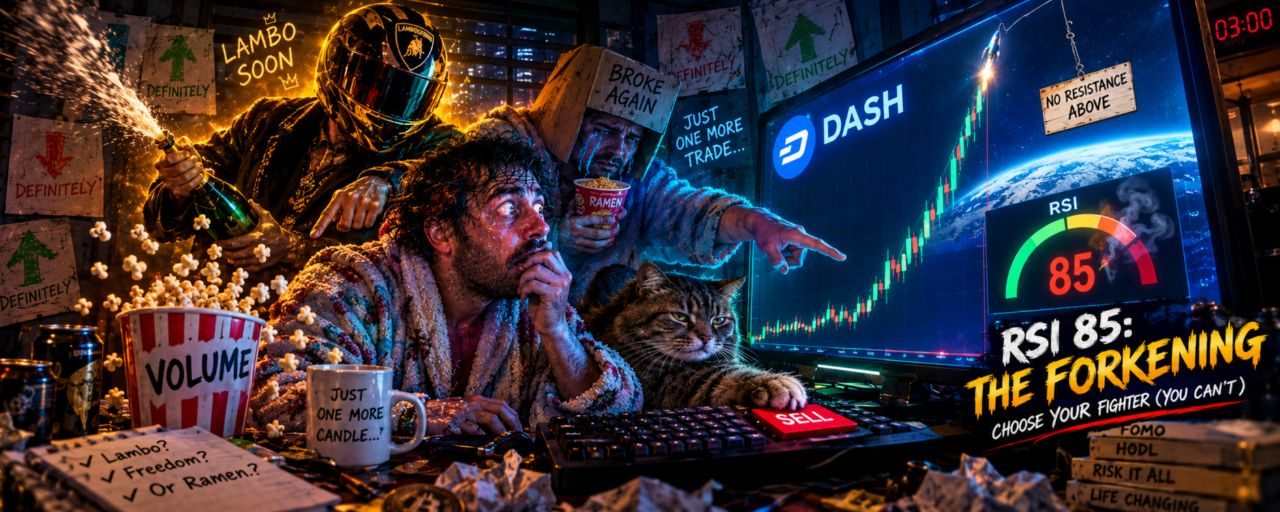
DASH Is At 85 RSI With Nothing Above It. That's Not a Green Light — It's a Fork.Everyone chasing $DASH right now is reading the breakout as confirmation. I'm reading the RSI print as a question the chart hasn't answered yet.
An RSI near 85 with no immediate resistance overhead is one of the more binary setups in crypto. It doesn't tell you the direction of the next move. It tells you the current move is stretched further than usual, and stretched moves resolve one of two ways — they extend violently because there's nothing structurally in the way, or they snap because there's nothing structurally holding them up either. Same fact, two opposite outcomes, and the fact alone doesn't pick one.
The setup
FACT: DASH's RSI is printing near 85, per coverage — a level well into overbought territory by standard technical thresholds.
FACT: No immediate resistance level is currently identified above the current price.
INTERPRETATION: The absence of resistance means there's no obvious price ceiling forcing a pullback on technical grounds alone. That's the bull case for extension. But it also means there's no established support structure recently tested on the way up — the move has outrun the levels that would normally validate it. That's the bear case for a fast reversion.
There is no confirmed HYPOTHESIS on which way this resolves. Anyone telling you RSI at 85 is definitionally about to reverse, or definitionally about to keep running, is stating a rule of thumb as if it were a law. It isn't. Overbought conditions can persist for extended periods in strong trends, and they can also be the exact moment before a sharp mean reversion. The RSI level is a fact about stretch, not a forecast about direction.
Why the obvious read is incomplete
The standard reflex to a high RSI is "overbought, due for a pullback." That reflex exists because it's often right — most extreme RSI prints do eventually mean-revert. But "eventually" is doing a lot of work in that sentence. Extended RSI in an asset with genuinely fresh catalyst-driven demand can keep climbing well past what looks unsustainable, especially with no resistance forcing sellers to defend a level.
The market's possible blind spot isn't "DASH is overbought" — everyone can see that. The blind spot is treating overbought as a timing signal on its own, when it's really a volatility-and-magnitude signal. It tells you the next move is likely to be large. It doesn't tell you which way.
BEFORE → CHANGE → NOW → NEXT
BEFORE: DASH trading within a more typical range, RSI not flagged as extreme.
CHANGE: Price extension pushes RSI to ~85 with no resistance level identified above current price.
CURRENT STATE: Stretched technical condition, unresolved directionally, elevated volatility risk in either direction.
POSSIBLE NEXT: Continuation — RSI stays elevated or climbs further as the move extends with no ceiling to stop it, common when a fresh catalyst or momentum wave is still building. Or reversion — a sharp pullback as the extended move runs out of new buyers and profit-taking hits without any support level established to catch it.
The thesis, stated carefully
The evidence suggests DASH is at a genuine inflection point where the next move — in either direction — is likely to be sharp rather than gradual, given the combination of extreme RSI and the absence of overhead resistance. This is not a call that DASH will pump or dump. It's a statement that the current setup has low odds of just drifting sideways.
The bullish continuation case weakens if volume starts declining while price keeps grinding higher — a sign the move is running on thinner and thinner participation. The bearish reversion case weakens if price holds current levels for several sessions without a pullback, which would suggest the extension is being absorbed rather than chased.
What confirms which side wins
Not the RSI number itself — watch what happens to volume alongside it. Rising volume with rising price into further overbought territory favors continuation. Flat or declining volume at these levels, especially alongside any signs of stalling candles, favors a snap-back.
What I'm watching next
Not whether DASH goes up or down from here. I'm watching whether volume expands or contracts as RSI stays pinned near this level over the next few sessions — that's what separates an overbought market that's about to run further from one that's about to give it all back.
#DASH #RSIAlert #Overbought #CryptoVolatility #TechnicalAnalysis
DASH Is At 85 RSI With Nothing Above It. That's Not a Green Light — It's a Fork.
Everyone chasing $DASH right now is reading the breakout as confirmation. I'm reading the RSI print as a question the chart hasn't answered yet.
An RSI near 85 with no immediate resistance overhead is one of the more binary setups in crypto. It doesn't tell you the direction of the next move. It tells you the current move is stretched further than usual, and stretched moves resolve one of two ways — they extend violently because there's nothing structurally in the way, or they snap because there's nothing structurally holding them up either. Same fact, two opposite outcomes, and the fact alone doesn't pick one.
The setup
FACT: DASH's RSI is printing near 85, per coverage — a level well into overbought territory by standard technical thresholds.
FACT: No immediate resistance level is currently identified above the current price.
INTERPRETATION: The absence of resistance means there's no obvious price ceiling forcing a pullback on technical grounds alone. That's the bull case for extension. But it also means there's no established support structure recently tested on the way up — the move has outrun the levels that would normally validate it. That's the bear case for a fast reversion.
There is no confirmed HYPOTHESIS on which way this resolves. Anyone telling you RSI at 85 is definitionally about to reverse, or definitionally about to keep running, is stating a rule of thumb as if it were a law. It isn't. Overbought conditions can persist for extended periods in strong trends, and they can also be the exact moment before a sharp mean reversion. The RSI level is a fact about stretch, not a forecast about direction.
Why the obvious read is incomplete
The standard reflex to a high RSI is "overbought, due for a pullback." That reflex exists because it's often right — most extreme RSI prints do eventually mean-revert. But "eventually" is doing a lot of work in that sentence. Extended RSI in an asset with genuinely fresh catalyst-driven demand can keep climbing well past what looks unsustainable, especially with no resistance forcing sellers to defend a level.
The market's possible blind spot isn't "DASH is overbought" — everyone can see that. The blind spot is treating overbought as a timing signal on its own, when it's really a volatility-and-magnitude signal. It tells you the next move is likely to be large. It doesn't tell you which way.
BEFORE → CHANGE → NOW → NEXT
BEFORE: DASH trading within a more typical range, RSI not flagged as extreme.
CHANGE: Price extension pushes RSI to ~85 with no resistance level identified above current price.
CURRENT STATE: Stretched technical condition, unresolved directionally, elevated volatility risk in either direction.
POSSIBLE NEXT: Continuation — RSI stays elevated or climbs further as the move extends with no ceiling to stop it, common when a fresh catalyst or momentum wave is still building. Or reversion — a sharp pullback as the extended move runs out of new buyers and profit-taking hits without any support level established to catch it.
The thesis, stated carefully
The evidence suggests DASH is at a genuine inflection point where the next move — in either direction — is likely to be sharp rather than gradual, given the combination of extreme RSI and the absence of overhead resistance. This is not a call that DASH will pump or dump. It's a statement that the current setup has low odds of just drifting sideways.
The bullish continuation case weakens if volume starts declining while price keeps grinding higher — a sign the move is running on thinner and thinner participation. The bearish reversion case weakens if price holds current levels for several sessions without a pullback, which would suggest the extension is being absorbed rather than chased.
What confirms which side wins
Not the RSI number itself — watch what happens to volume alongside it. Rising volume with rising price into further overbought territory favors continuation. Flat or declining volume at these levels, especially alongside any signs of stalling candles, favors a snap-back.
What I'm watching next
Not whether DASH goes up or down from here. I'm watching whether volume expands or contracts as RSI stays pinned near this level over the next few sessions — that's what separates an overbought market that's about to run further from one that's about to give it all back.
#DASH #RSIAlert #Overbought #CryptoVolatility #TechnicalAnalysis
An RSI near 85 with no immediate resistance overhead is one of the more binary setups in crypto. It doesn't tell you the direction of the next move. It tells you the current move is stretched further than usual, and stretched moves resolve one of two ways — they extend violently because there's nothing structurally in the way, or they snap because there's nothing structurally holding them up either. Same fact, two opposite outcomes, and the fact alone doesn't pick one.
The setup
FACT: DASH's RSI is printing near 85, per coverage — a level well into overbought territory by standard technical thresholds.
FACT: No immediate resistance level is currently identified above the current price.
INTERPRETATION: The absence of resistance means there's no obvious price ceiling forcing a pullback on technical grounds alone. That's the bull case for extension. But it also means there's no established support structure recently tested on the way up — the move has outrun the levels that would normally validate it. That's the bear case for a fast reversion.
There is no confirmed HYPOTHESIS on which way this resolves. Anyone telling you RSI at 85 is definitionally about to reverse, or definitionally about to keep running, is stating a rule of thumb as if it were a law. It isn't. Overbought conditions can persist for extended periods in strong trends, and they can also be the exact moment before a sharp mean reversion. The RSI level is a fact about stretch, not a forecast about direction.
Why the obvious read is incomplete
The standard reflex to a high RSI is "overbought, due for a pullback." That reflex exists because it's often right — most extreme RSI prints do eventually mean-revert. But "eventually" is doing a lot of work in that sentence. Extended RSI in an asset with genuinely fresh catalyst-driven demand can keep climbing well past what looks unsustainable, especially with no resistance forcing sellers to defend a level.
The market's possible blind spot isn't "DASH is overbought" — everyone can see that. The blind spot is treating overbought as a timing signal on its own, when it's really a volatility-and-magnitude signal. It tells you the next move is likely to be large. It doesn't tell you which way.
BEFORE → CHANGE → NOW → NEXT
BEFORE: DASH trading within a more typical range, RSI not flagged as extreme.
CHANGE: Price extension pushes RSI to ~85 with no resistance level identified above current price.
CURRENT STATE: Stretched technical condition, unresolved directionally, elevated volatility risk in either direction.
POSSIBLE NEXT: Continuation — RSI stays elevated or climbs further as the move extends with no ceiling to stop it, common when a fresh catalyst or momentum wave is still building. Or reversion — a sharp pullback as the extended move runs out of new buyers and profit-taking hits without any support level established to catch it.
The thesis, stated carefully
The evidence suggests DASH is at a genuine inflection point where the next move — in either direction — is likely to be sharp rather than gradual, given the combination of extreme RSI and the absence of overhead resistance. This is not a call that DASH will pump or dump. It's a statement that the current setup has low odds of just drifting sideways.
The bullish continuation case weakens if volume starts declining while price keeps grinding higher — a sign the move is running on thinner and thinner participation. The bearish reversion case weakens if price holds current levels for several sessions without a pullback, which would suggest the extension is being absorbed rather than chased.
What confirms which side wins
Not the RSI number itself — watch what happens to volume alongside it. Rising volume with rising price into further overbought territory favors continuation. Flat or declining volume at these levels, especially alongside any signs of stalling candles, favors a snap-back.
What I'm watching next
Not whether DASH goes up or down from here. I'm watching whether volume expands or contracts as RSI stays pinned near this level over the next few sessions — that's what separates an overbought market that's about to run further from one that's about to give it all back.
#DASH #RSIAlert #Overbought #CryptoVolatility #TechnicalAnalysis
1
1
1.1k
·
--
Three scenarios, no prediction attached:
🐂 Bull: shielded adoption grows, Android beta lands well, $DASH re-rates toward ZEC/XMR-style valuations.
⚖️ Base: hype fades once the conference cycle ends, market waits for real usage data before re-rating further.
🐻 Bear: adoption disappoints, regulation tightens, liquidity stays thin — price gives back the DashCon-era gains, back toward the $30-40 zone.
#DASH #0xSignal
Three scenarios, no prediction attached:
🐂 Bull: shielded adoption grows, Android beta lands well, $DASH re-rates toward ZEC/XMR-style valuations.
⚖️ Base: hype fades once the conference cycle ends, market waits for real usage data before re-rating further.
🐻 Bear: adoption disappoints, regulation tightens, liquidity stays thin — price gives back the DashCon-era gains, back toward the $30-40 zone.
#DASH #0xSignal
🐂 Bull: shielded adoption grows, Android beta lands well, $DASH re-rates toward ZEC/XMR-style valuations.
⚖️ Base: hype fades once the conference cycle ends, market waits for real usage data before re-rating further.
🐻 Bear: adoption disappoints, regulation tightens, liquidity stays thin — price gives back the DashCon-era gains, back toward the $30-40 zone.
#DASH #0xSignal
116
·
--
Team/execution history: $DASH Core Group led by Ryan Taylor since 2017, ~40-person team. 10% treasury funding model gives it a native dev-funding mechanism most projects don't have. But Evolution took years longer than originally planned, and shielded features slipped multiple times before finally shipping in August. Track record: real, but slow.
#DASH #0xSignal
Team/execution history: $DASH Core Group led by Ryan Taylor since 2017, ~40-person team. 10% treasury funding model gives it a native dev-funding mechanism most projects don't have. But Evolution took years longer than originally planned, and shielded features slipped multiple times before finally shipping in August. Track record: real, but slow.
#DASH #0xSignal
#DASH #0xSignal
271
·
--
Regulatory reality check: $DASH carries an "Alleged SEC Securities" tag on major trackers, and has already been delisted from Bybit (DASH/USDT) and OKX (Jan 2026). Privacy coins broadly face tightening EU rules expected to phase in by 2027. This is a real, ongoing risk factor — not FUD.
#DASH #0xSignal
Regulatory reality check: $DASH carries an "Alleged SEC Securities" tag on major trackers, and has already been delisted from Bybit (DASH/USDT) and OKX (Jan 2026). Privacy coins broadly face tightening EU rules expected to phase in by 2027. This is a real, ongoing risk factor — not FUD.
#DASH #0xSignal
#DASH #0xSignal
1
201
·
--
@SulemaOFCrypto Bro Write about $SUI
{spot}(SUIUSDT)
@Sulaiman 零号猎人 Bro Write about $SUI

Sulaiman 零号猎人
·
--
$SUI
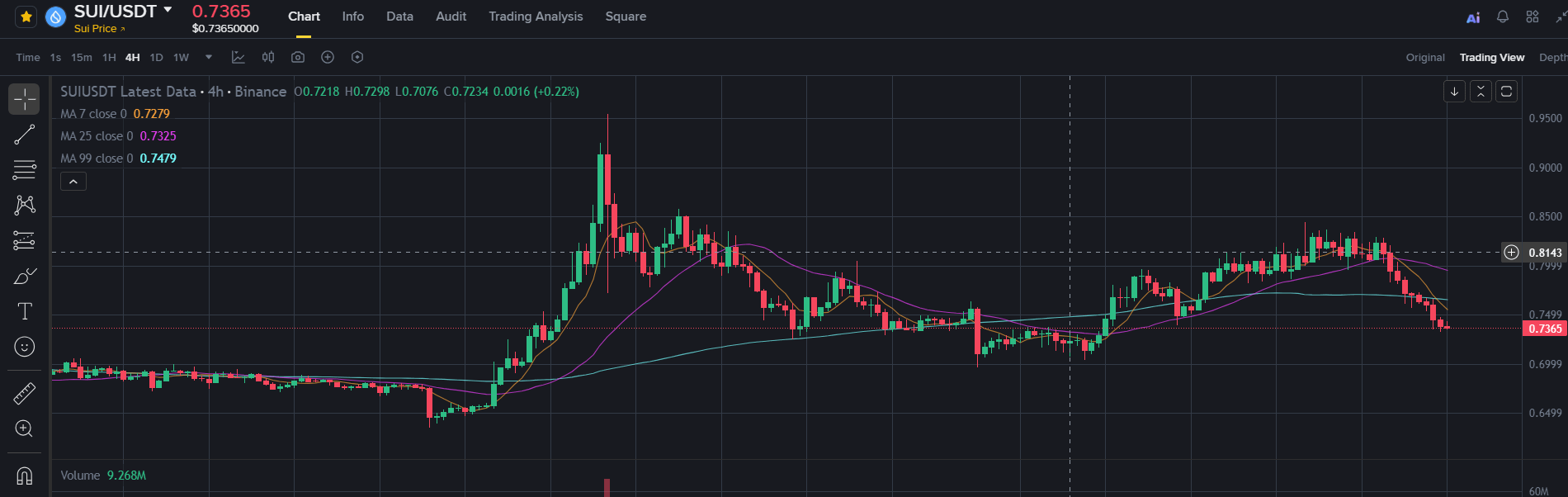
SUI has been falling for a long time, and now it finally looks like it's trying to stop.
The price rebounded off its lows and is holding steady instead of dropping further.
That doesn't mean the fall is over, but it's the first real sign buyers are stepping back in.
Watching to see if it holds. Bullish or too early?
Follow for updates.
SUI has been falling for a long time, and now it finally looks like it's trying to stop.
The price rebounded off its lows and is holding steady instead of dropping further.
That doesn't mean the fall is over, but it's the first real sign buyers are stepping back in.
Watching to see if it holds. Bullish or too early?
Follow for updates.
1
48
·
--
$RAY
$RAY
Sulaiman 零号猎人
·
--
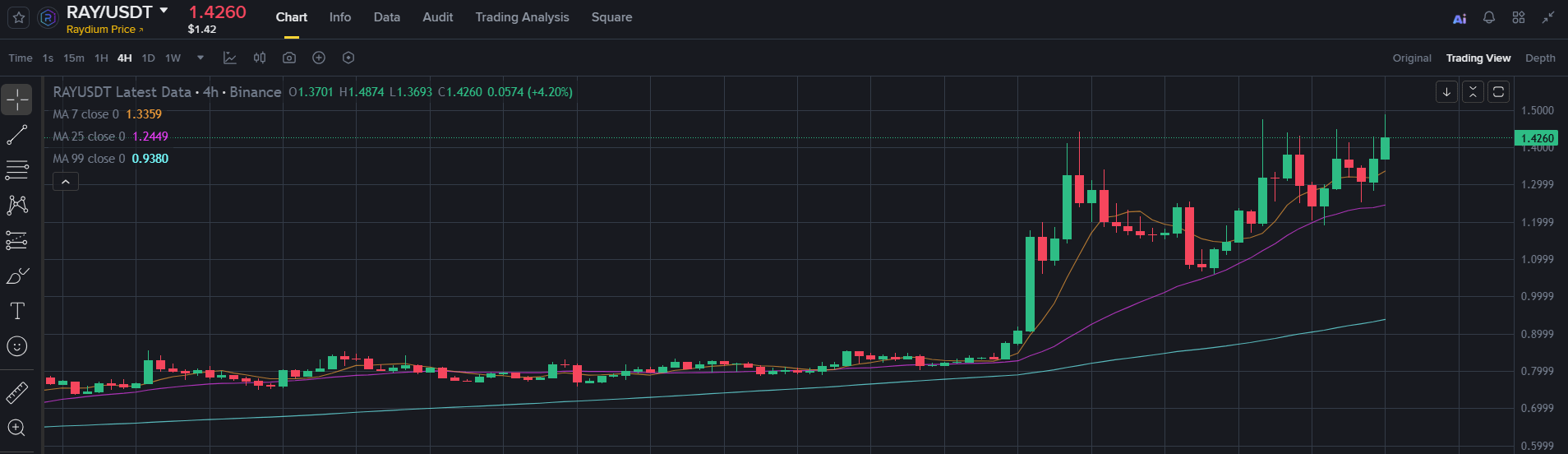
Raydium's token supply is shrinking while most alts inflate. Nobody's pricing that in.
RAY buybacks hit $640K in a single day, the largest in 19 months, pushing cumulative repurchases past 30% of circulating supply, funded entirely by protocol fees.
$640K buyback, Sept 9, 19-month high
Q2 xStocks volume: $1.63B, tripled YoY
RAY reclaimed $1 after June's $0.53 low
12% of every swap fee auto-routes to buybacks, on-chain
Hidden angle: Market treats this as a memecoin bounce. It's a fee-buyback flywheel, closer to equity buybacks than speculation.
Supply compression plus expanding fees creates asymmetric upside if volume holds through the Sept 14 Solana Summit, where SEC Chair Atkins headlines.
Buyback pace sustains post-Summit.
xStocks volume stalls, breaking the flywheel.
Undervalued deflationary mechanism, or a narrative that fades after the Summit?
#RAYBuyback #SolanaSummit2026 #xStocks #DeflationaryDeFi #RaydiumFlywheel
RAY buybacks hit $640K in a single day, the largest in 19 months, pushing cumulative repurchases past 30% of circulating supply, funded entirely by protocol fees.
$640K buyback, Sept 9, 19-month high
Q2 xStocks volume: $1.63B, tripled YoY
RAY reclaimed $1 after June's $0.53 low
12% of every swap fee auto-routes to buybacks, on-chain
Hidden angle: Market treats this as a memecoin bounce. It's a fee-buyback flywheel, closer to equity buybacks than speculation.
Supply compression plus expanding fees creates asymmetric upside if volume holds through the Sept 14 Solana Summit, where SEC Chair Atkins headlines.
Buyback pace sustains post-Summit.
xStocks volume stalls, breaking the flywheel.
Undervalued deflationary mechanism, or a narrative that fades after the Summit?
#RAYBuyback #SolanaSummit2026 #xStocks #DeflationaryDeFi #RaydiumFlywheel
1
4
·
--
Bullish
Sulaiman 零号猎人
·
--
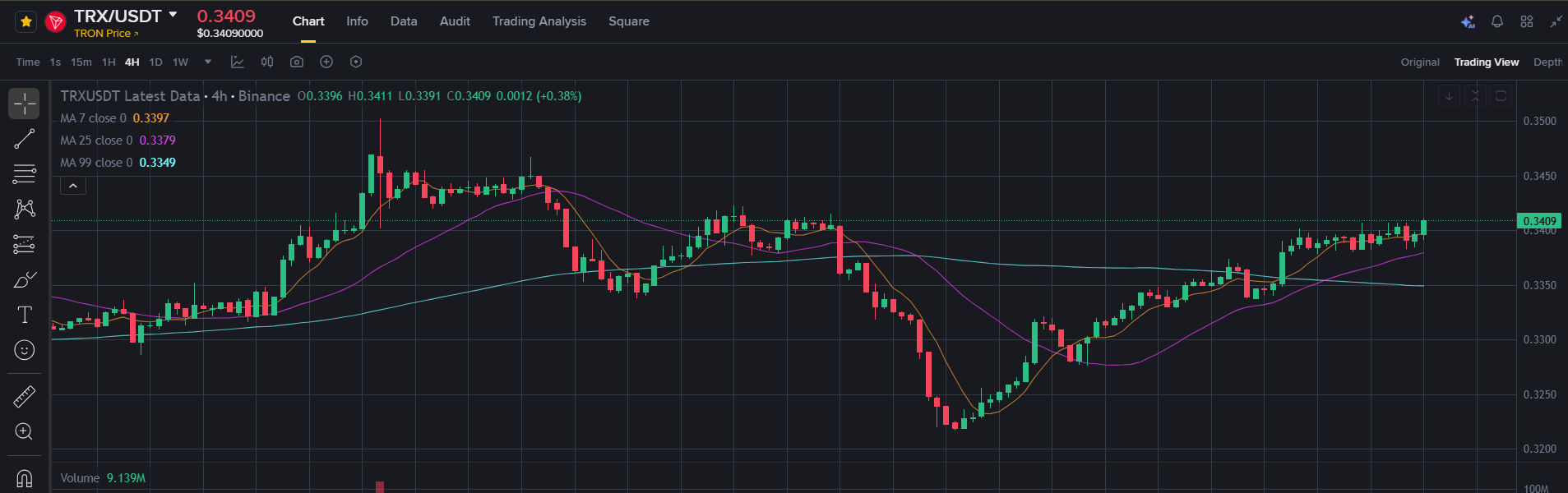
TRX just got its first-ever US ETF, and honestly, the price is barely reacting.
Canary Capital launched a staked TRX ETF on Cboe this week. That's real institutional access, first of its kind for this coin. Justin Sun called it a huge moment.
Meanwhile network usage is stronger than ever — stablecoin volume on TRON just crossed $28 billion in locked value. But price is still stuck in the same range it's been fighting for weeks.
Feels like the news hasn't caught up to the price yet, or the market just isn't convinced yet.
What do you think — is this ETF a real turning point or just noise for now?
#TRX #TRXETF #Tron
Canary Capital launched a staked TRX ETF on Cboe this week. That's real institutional access, first of its kind for this coin. Justin Sun called it a huge moment.
Meanwhile network usage is stronger than ever — stablecoin volume on TRON just crossed $28 billion in locked value. But price is still stuck in the same range it's been fighting for weeks.
Feels like the news hasn't caught up to the price yet, or the market just isn't convinced yet.
What do you think — is this ETF a real turning point or just noise for now?
#TRX #TRXETF #Tron
2
2
·
--
Sulaiman 零号猎人
·
--
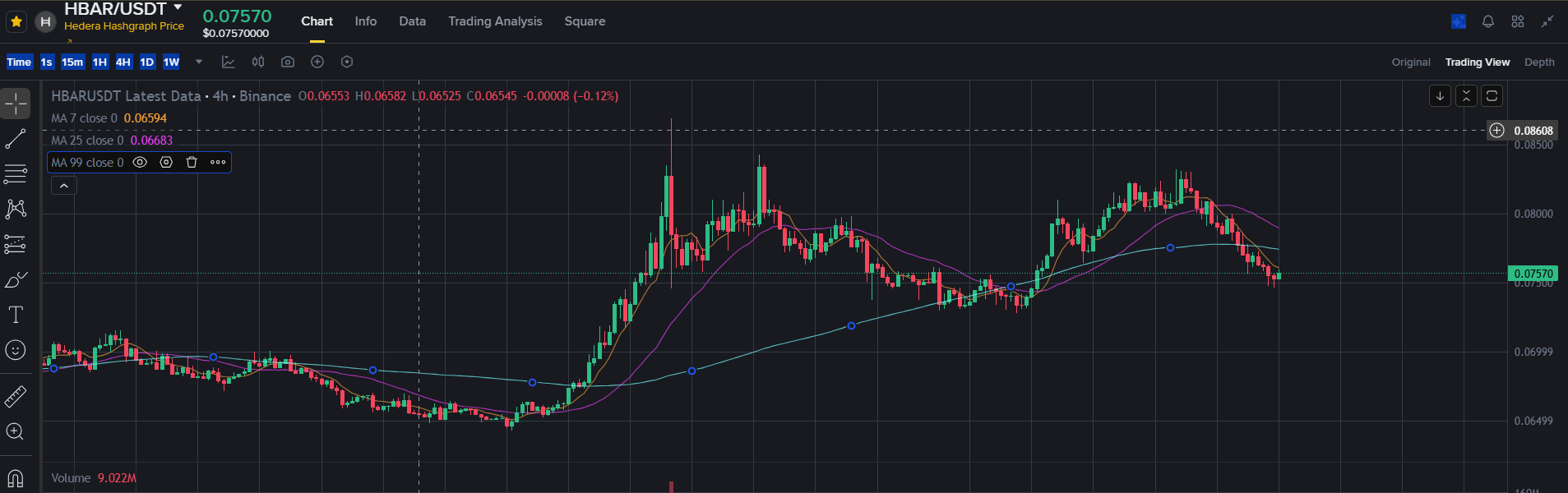
HBAR tried to break out again this month and buyers just couldn't push it through — same story as last time. Right now the coin feels stuck, caught between people wanting to buy the dip and others still taking profits, with neither side really winning.
#hbar #HBARUSDT
#hbar #HBARUSDT
14
·
--
Just flagging — $CL isn't a crypto token. It's Binance's WTI crude oil perpetual (launched April 2026), not a coin. But the move underneath is genuinely relevant to crypto right now.
Everyone's watching the calm on BTC today.
But the real signal is oil quietly ripping in the background.
WTI just hit $97.19, up over 15% in 30 days and its highest level since May — driven by escalating US-Iran tensions, attacks near the Strait of Hormuz, and Houthi strikes on Saudi energy infrastructure.
Here's why that matters for crypto: rising oil feeds directly into inflation expectations, right into a week where CME FedWatch already prices a 56-63% chance of a Fed rate *hike* on September 16.
Oil spiking into a hawkish Fed decision is not a background story — it's a direct input to it.
I'd watch whether WTI holds above $95 into today's CPI print. A hot number plus expensive oil is the combination that could push hike odds even higher.
Is the crypto market pricing in this oil-inflation link at all yet?
#WTI #FOMC #Inflation #CL
Just flagging — $CL isn't a crypto token. It's Binance's WTI crude oil perpetual (launched April 2026), not a coin. But the move underneath is genuinely relevant to crypto right now.
Everyone's watching the calm on BTC today.
But the real signal is oil quietly ripping in the background.
WTI just hit $97.19, up over 15% in 30 days and its highest level since May — driven by escalating US-Iran tensions, attacks near the Strait of Hormuz, and Houthi strikes on Saudi energy infrastructure.
Here's why that matters for crypto: rising oil feeds directly into inflation expectations, right into a week where CME FedWatch already prices a 56-63% chance of a Fed rate *hike* on September 16.
Oil spiking into a hawkish Fed decision is not a background story — it's a direct input to it.
I'd watch whether WTI holds above $95 into today's CPI print. A hot number plus expensive oil is the combination that could push hike odds even higher.
Is the crypto market pricing in this oil-inflation link at all yet?
#WTI #FOMC #Inflation #CL
Everyone's watching the calm on BTC today.
But the real signal is oil quietly ripping in the background.
WTI just hit $97.19, up over 15% in 30 days and its highest level since May — driven by escalating US-Iran tensions, attacks near the Strait of Hormuz, and Houthi strikes on Saudi energy infrastructure.
Here's why that matters for crypto: rising oil feeds directly into inflation expectations, right into a week where CME FedWatch already prices a 56-63% chance of a Fed rate *hike* on September 16.
Oil spiking into a hawkish Fed decision is not a background story — it's a direct input to it.
I'd watch whether WTI holds above $95 into today's CPI print. A hot number plus expensive oil is the combination that could push hike odds even higher.
Is the crypto market pricing in this oil-inflation link at all yet?
#WTI #FOMC #Inflation #CL
1
2
149
·
--
Partly True
Everyone's watching RAY pump 19% today, up 61% over the past week.
The real signal isn't the price — it's that Raydium's on-chain fees are growing even faster than the token.
Raydium's DEX fees on Solana are up roughly 316-363% over the past 30 days, outpacing Orca and other Solana DEXs by a wide margin. That's not speculative flow — that's actual trading volume moving through the protocol. And Raydium allocates 12% of trading fees directly to RAY buybacks.
That's the part most people scrolling past the green candle are missing: when fee growth outpaces price growth, the buyback mechanism keeps absorbing supply even if the speculative rally cools off.
I'd watch whether RAY can hold above $0.876 on a daily close — that's the level that would confirm this isn't just a short squeeze riding Solana's broader move.
Is this fee growth catching up to price, or is price about to catch up to fee growth?
#RAY #Raydium #Solana
Everyone's watching RAY pump 19% today, up 61% over the past week.
The real signal isn't the price — it's that Raydium's on-chain fees are growing even faster than the token.
Raydium's DEX fees on Solana are up roughly 316-363% over the past 30 days, outpacing Orca and other Solana DEXs by a wide margin. That's not speculative flow — that's actual trading volume moving through the protocol. And Raydium allocates 12% of trading fees directly to RAY buybacks.
That's the part most people scrolling past the green candle are missing: when fee growth outpaces price growth, the buyback mechanism keeps absorbing supply even if the speculative rally cools off.
I'd watch whether RAY can hold above $0.876 on a daily close — that's the level that would confirm this isn't just a short squeeze riding Solana's broader move.
Is this fee growth catching up to price, or is price about to catch up to fee growth?
#RAY #Raydium #Solana
The real signal isn't the price — it's that Raydium's on-chain fees are growing even faster than the token.
Raydium's DEX fees on Solana are up roughly 316-363% over the past 30 days, outpacing Orca and other Solana DEXs by a wide margin. That's not speculative flow — that's actual trading volume moving through the protocol. And Raydium allocates 12% of trading fees directly to RAY buybacks.
That's the part most people scrolling past the green candle are missing: when fee growth outpaces price growth, the buyback mechanism keeps absorbing supply even if the speculative rally cools off.
I'd watch whether RAY can hold above $0.876 on a daily close — that's the level that would confirm this isn't just a short squeeze riding Solana's broader move.
Is this fee growth catching up to price, or is price about to catch up to fee growth?
#RAY #Raydium #Solana
37
·
--
Partly True
Everyone's watching LSK's 16% green candle today.
The real signal is what's scheduled for September 27.
LSK just bounced off an all-time low of $0.070 hit on August 3, and now trades near $0.1245. That context matters — this is a recovery move off a bottom, not a breakout to new territory. Total supply is 400M, with about 226M circulating.
Here's the part getting less attention: starting September 27, the Lisk community votes on whether to burn 100 million LSK — a quarter of total supply. That's the kind of structural decision that matters more than any single day's candle.
I'd watch how price behaves into that vote date. If LSK holds above $0.10 heading into September 27, the market may already be pricing in a "yes."
Is today's pump front-running the burn vote, or just a dead-cat bounce off the ATL?
#LSK #Lisk #TokenBurn
Everyone's watching LSK's 16% green candle today.
The real signal is what's scheduled for September 27.
LSK just bounced off an all-time low of $0.070 hit on August 3, and now trades near $0.1245. That context matters — this is a recovery move off a bottom, not a breakout to new territory. Total supply is 400M, with about 226M circulating.
Here's the part getting less attention: starting September 27, the Lisk community votes on whether to burn 100 million LSK — a quarter of total supply. That's the kind of structural decision that matters more than any single day's candle.
I'd watch how price behaves into that vote date. If LSK holds above $0.10 heading into September 27, the market may already be pricing in a "yes."
Is today's pump front-running the burn vote, or just a dead-cat bounce off the ATL?
#LSK #Lisk #TokenBurn
The real signal is what's scheduled for September 27.
LSK just bounced off an all-time low of $0.070 hit on August 3, and now trades near $0.1245. That context matters — this is a recovery move off a bottom, not a breakout to new territory. Total supply is 400M, with about 226M circulating.
Here's the part getting less attention: starting September 27, the Lisk community votes on whether to burn 100 million LSK — a quarter of total supply. That's the kind of structural decision that matters more than any single day's candle.
I'd watch how price behaves into that vote date. If LSK holds above $0.10 heading into September 27, the market may already be pricing in a "yes."
Is today's pump front-running the burn vote, or just a dead-cat bounce off the ATL?
#LSK #Lisk #TokenBurn
2
80
·
--
Everyone's watching VTHO rip 33%+ on the perp board today.
The real signal isn't the price — it's the volume-to-market-cap ratio.
VTHO is trading near $0.000706 with a market cap around $72.3M — and 24h volume just hit ~$74.68M. That means roughly the entire float turned over in a day. RSI is sitting at 87.
I'd normally read a green candle like this as accumulation. But when volume exceeds market cap and RSI is deep in overbought territory with no fresh catalyst (the last real network upgrade was back in August), it usually means fast money rotating in and out, not new holders settling in.
I'd watch whether volume stays above $50M tomorrow. If it collapses back to the $2M range, this was a flush, not a trend.
Does this look like accumulation to you, or exhaustion?
#VTHO #VeChain #Overbought
Everyone's watching VTHO rip 33%+ on the perp board today.
The real signal isn't the price — it's the volume-to-market-cap ratio.
VTHO is trading near $0.000706 with a market cap around $72.3M — and 24h volume just hit ~$74.68M. That means roughly the entire float turned over in a day. RSI is sitting at 87.
I'd normally read a green candle like this as accumulation. But when volume exceeds market cap and RSI is deep in overbought territory with no fresh catalyst (the last real network upgrade was back in August), it usually means fast money rotating in and out, not new holders settling in.
I'd watch whether volume stays above $50M tomorrow. If it collapses back to the $2M range, this was a flush, not a trend.
Does this look like accumulation to you, or exhaustion?
#VTHO #VeChain #Overbought
The real signal isn't the price — it's the volume-to-market-cap ratio.
VTHO is trading near $0.000706 with a market cap around $72.3M — and 24h volume just hit ~$74.68M. That means roughly the entire float turned over in a day. RSI is sitting at 87.
I'd normally read a green candle like this as accumulation. But when volume exceeds market cap and RSI is deep in overbought territory with no fresh catalyst (the last real network upgrade was back in August), it usually means fast money rotating in and out, not new holders settling in.
I'd watch whether volume stays above $50M tomorrow. If it collapses back to the $2M range, this was a flush, not a trend.
Does this look like accumulation to you, or exhaustion?
#VTHO #VeChain #Overbought
95
·
--
Everyone's still trading the "Fed cuts, crypto pumps" playbook. That script might be outdated this month.
BTC's real setup isn't about a cut — it's about whether the market has actually priced a hike.
CME FedWatch has 25bp hike odds at 56-63% for the September 16 meeting, up sharply after Fed Chair Warsh's hawkish Jackson Hole remarks. Yet crypto market cap is still up 17.6% this month and sentiment sits at 69 (Greed).
That's the interesting part — risk assets rallying into a meeting where a hike, not a cut, is the base case on paper.
I'd watch today's CPI print. A hot number pushes hike odds higher and tests whether this "greed despite hawkish Fed" setup actually holds.
Does the market know something the Fed doesn't, or is it just not paying attention yet?
#FedRateHike #BTC #FOMC
Everyone's still trading the "Fed cuts, crypto pumps" playbook. That script might be outdated this month.
BTC's real setup isn't about a cut — it's about whether the market has actually priced a hike.
CME FedWatch has 25bp hike odds at 56-63% for the September 16 meeting, up sharply after Fed Chair Warsh's hawkish Jackson Hole remarks. Yet crypto market cap is still up 17.6% this month and sentiment sits at 69 (Greed).
That's the interesting part — risk assets rallying into a meeting where a hike, not a cut, is the base case on paper.
I'd watch today's CPI print. A hot number pushes hike odds higher and tests whether this "greed despite hawkish Fed" setup actually holds.
Does the market know something the Fed doesn't, or is it just not paying attention yet?
#FedRateHike #BTC #FOMC
BTC's real setup isn't about a cut — it's about whether the market has actually priced a hike.
CME FedWatch has 25bp hike odds at 56-63% for the September 16 meeting, up sharply after Fed Chair Warsh's hawkish Jackson Hole remarks. Yet crypto market cap is still up 17.6% this month and sentiment sits at 69 (Greed).
That's the interesting part — risk assets rallying into a meeting where a hike, not a cut, is the base case on paper.
I'd watch today's CPI print. A hot number pushes hike odds higher and tests whether this "greed despite hawkish Fed" setup actually holds.
Does the market know something the Fed doesn't, or is it just not paying attention yet?
#FedRateHike #BTC #FOMC
51
·
--
Verified
EVERYONE IS WATCHING whether the CLARITY Act vote passes on September 15.
BUT THE REAL SIGNAL IS the margin it passes by.
Here's the thing — Kalshi already prices a Senate vote before October 1 at 91%. That's basically decided. Yet Polymarket, on the exact same bill, gives it only 17% odds of actually becoming law in 2026. Same legislation, same week, two wildly different confidence levels.
That gap exists because September 15 is a cloture vote — permission to start debating, not a final passage vote. Floor amendments, House reconciliation, and a presidential signature all still sit ahead. Capital Alpha's Ian Katz recently cut his own enactment estimate from 40% to 25%.
So the vote happening isn't the story. What matters is how many Democrats cross the aisle — 7 is the bare minimum. A comfortable double-digit margin tells you passage odds are about to reprice higher. A knife-edge 60 tells you nothing changed.
If cloture clears but Polymarket's odds barely move, that's your confirmation the market already saw through the headline.
What would actually change your mind here — the vote itself, or the margin?
#ClarityAct #XRP #PredictionMarkets
EVERYONE IS WATCHING whether the CLARITY Act vote passes on September 15.
BUT THE REAL SIGNAL IS the margin it passes by.
Here's the thing — Kalshi already prices a Senate vote before October 1 at 91%. That's basically decided. Yet Polymarket, on the exact same bill, gives it only 17% odds of actually becoming law in 2026. Same legislation, same week, two wildly different confidence levels.
That gap exists because September 15 is a cloture vote — permission to start debating, not a final passage vote. Floor amendments, House reconciliation, and a presidential signature all still sit ahead. Capital Alpha's Ian Katz recently cut his own enactment estimate from 40% to 25%.
So the vote happening isn't the story. What matters is how many Democrats cross the aisle — 7 is the bare minimum. A comfortable double-digit margin tells you passage odds are about to reprice higher. A knife-edge 60 tells you nothing changed.
If cloture clears but Polymarket's odds barely move, that's your confirmation the market already saw through the headline.
What would actually change your mind here — the vote itself, or the margin?
#ClarityAct #XRP #PredictionMarkets
BUT THE REAL SIGNAL IS the margin it passes by.
Here's the thing — Kalshi already prices a Senate vote before October 1 at 91%. That's basically decided. Yet Polymarket, on the exact same bill, gives it only 17% odds of actually becoming law in 2026. Same legislation, same week, two wildly different confidence levels.
That gap exists because September 15 is a cloture vote — permission to start debating, not a final passage vote. Floor amendments, House reconciliation, and a presidential signature all still sit ahead. Capital Alpha's Ian Katz recently cut his own enactment estimate from 40% to 25%.
So the vote happening isn't the story. What matters is how many Democrats cross the aisle — 7 is the bare minimum. A comfortable double-digit margin tells you passage odds are about to reprice higher. A knife-edge 60 tells you nothing changed.
If cloture clears but Polymarket's odds barely move, that's your confirmation the market already saw through the headline.
What would actually change your mind here — the vote itself, or the margin?
#ClarityAct #XRP #PredictionMarkets
1
1
94
·
--
The RWA trade may be shifting beneath the surface.
I think ONDO has room to run if tokenization evolves from asset launches into real financial infrastructure.
* ICE/tZERO announced tokenized-securities infrastructure collaboration on Aug. 31.
* Ondo reports **>$1B TVL** in its tokenized-stock ecosystem.
* Tokenized securities are gaining DeFi utility and potential stablecoin settlement rails.
The interesting part: the winners may be the rails, not just the assets.
Confirmation: watch institutional issuance, settlement and tokenized volume move from announcements into production.
Is ONDO becoming an infrastructure play rather than just another RWA token?
#ONDO #RWA #Tokenization
The RWA trade may be shifting beneath the surface.
I think ONDO has room to run if tokenization evolves from asset launches into real financial infrastructure.
* ICE/tZERO announced tokenized-securities infrastructure collaboration on Aug. 31.
* Ondo reports **>$1B TVL** in its tokenized-stock ecosystem.
* Tokenized securities are gaining DeFi utility and potential stablecoin settlement rails.
The interesting part: the winners may be the rails, not just the assets.
Confirmation: watch institutional issuance, settlement and tokenized volume move from announcements into production.
Is ONDO becoming an infrastructure play rather than just another RWA token?
#ONDO #RWA #Tokenization
I think ONDO has room to run if tokenization evolves from asset launches into real financial infrastructure.
* ICE/tZERO announced tokenized-securities infrastructure collaboration on Aug. 31.
* Ondo reports **>$1B TVL** in its tokenized-stock ecosystem.
* Tokenized securities are gaining DeFi utility and potential stablecoin settlement rails.
The interesting part: the winners may be the rails, not just the assets.
Confirmation: watch institutional issuance, settlement and tokenized volume move from announcements into production.
Is ONDO becoming an infrastructure play rather than just another RWA token?
#ONDO #RWA #Tokenization
2
1
152
·
--
Why does “Bitcoin ETF” news so often mean $IBIT?
That isn’t just a headline pattern. It may be shaping how the market measures institutional Bitcoin demand.
WHAT CHANGED?
IBIT has become the dominant reference point in Bitcoin ETF coverage, frequently accounting for roughly 60–80% of the attention.
EVIDENCE
• BlackRock’s IBIT is one of the largest spot Bitcoin ETFs.
• ETF headlines increasingly use IBIT flows as an institutional-demand proxy.
• That concentrates the narrative around one vehicle.
HIDDEN ANGLE:
The market may be watching **ETF demand through a single lens**, potentially overlooking what flows across the broader ETF complex are saying.
THESIS:
If IBIT dominance reflects genuine institutional concentration, its flows should increasingly lead broader spot-ETF flow trends.
CONFIRMATION:
IBIT inflows consistently coinciding with strong aggregate ETF inflows.
INVALIDATION:
IBIT remains strong while broader ETF demand weakens materially.
Final thought:
When one ticker becomes the headline for an entire market, are we measuring demand—or measuring attention?
#btc #CLARITYAct
Why does “Bitcoin ETF” news so often mean $IBIT?
That isn’t just a headline pattern. It may be shaping how the market measures institutional Bitcoin demand.
WHAT CHANGED?
IBIT has become the dominant reference point in Bitcoin ETF coverage, frequently accounting for roughly 60–80% of the attention.
EVIDENCE
• BlackRock’s IBIT is one of the largest spot Bitcoin ETFs.
• ETF headlines increasingly use IBIT flows as an institutional-demand proxy.
• That concentrates the narrative around one vehicle.
HIDDEN ANGLE:
The market may be watching **ETF demand through a single lens**, potentially overlooking what flows across the broader ETF complex are saying.
THESIS:
If IBIT dominance reflects genuine institutional concentration, its flows should increasingly lead broader spot-ETF flow trends.
CONFIRMATION:
IBIT inflows consistently coinciding with strong aggregate ETF inflows.
INVALIDATION:
IBIT remains strong while broader ETF demand weakens materially.
Final thought:
When one ticker becomes the headline for an entire market, are we measuring demand—or measuring attention?
#btc #CLARITYAct
That isn’t just a headline pattern. It may be shaping how the market measures institutional Bitcoin demand.
WHAT CHANGED?
IBIT has become the dominant reference point in Bitcoin ETF coverage, frequently accounting for roughly 60–80% of the attention.
EVIDENCE
• BlackRock’s IBIT is one of the largest spot Bitcoin ETFs.
• ETF headlines increasingly use IBIT flows as an institutional-demand proxy.
• That concentrates the narrative around one vehicle.
HIDDEN ANGLE:
The market may be watching **ETF demand through a single lens**, potentially overlooking what flows across the broader ETF complex are saying.
THESIS:
If IBIT dominance reflects genuine institutional concentration, its flows should increasingly lead broader spot-ETF flow trends.
CONFIRMATION:
IBIT inflows consistently coinciding with strong aggregate ETF inflows.
INVALIDATION:
IBIT remains strong while broader ETF demand weakens materially.
Final thought:
When one ticker becomes the headline for an entire market, are we measuring demand—or measuring attention?
#btc #CLARITYAct
2
6
·
--
The Fed isn't the only thing scheduled for September 15.
While everyone watches the FOMC meeting that week, a separate vote sits on the same calendar: the Senate's cloture vote on the CLARITY Act — the bill that would finally define how DeFi and token issuance get regulated in the US.
FACT: It cleared the Senate Banking Committee 15-9 in May — the first Senate committee to ever advance comprehensive crypto market-structure legislation. It's been delayed twice since, but this time it has a locked procedural date, not an open-ended stall.
INTERPRETATION: If the DeFi/token-issuance exemption language survives, it removes a compliance blocker that has kept institutions out of altcoins for years — regardless of any single token's fundamentals.
I have no flow or positioning data yet showing anyone is front-running this. That's exactly why I'm watching it now, not after.
What breaks the thesis: another delay, or a watered-down final text.
$ZEC $DASH $MINA
NFA. #ZeroResearch #CLARITYAct #DeFi #Altcoins
The Fed isn't the only thing scheduled for September 15.
While everyone watches the FOMC meeting that week, a separate vote sits on the same calendar: the Senate's cloture vote on the CLARITY Act — the bill that would finally define how DeFi and token issuance get regulated in the US.
FACT: It cleared the Senate Banking Committee 15-9 in May — the first Senate committee to ever advance comprehensive crypto market-structure legislation. It's been delayed twice since, but this time it has a locked procedural date, not an open-ended stall.
INTERPRETATION: If the DeFi/token-issuance exemption language survives, it removes a compliance blocker that has kept institutions out of altcoins for years — regardless of any single token's fundamentals.
I have no flow or positioning data yet showing anyone is front-running this. That's exactly why I'm watching it now, not after.
What breaks the thesis: another delay, or a watered-down final text.
$ZEC $DASH $MINA
NFA. #ZeroResearch #CLARITYAct #DeFi #Altcoins
While everyone watches the FOMC meeting that week, a separate vote sits on the same calendar: the Senate's cloture vote on the CLARITY Act — the bill that would finally define how DeFi and token issuance get regulated in the US.
FACT: It cleared the Senate Banking Committee 15-9 in May — the first Senate committee to ever advance comprehensive crypto market-structure legislation. It's been delayed twice since, but this time it has a locked procedural date, not an open-ended stall.
INTERPRETATION: If the DeFi/token-issuance exemption language survives, it removes a compliance blocker that has kept institutions out of altcoins for years — regardless of any single token's fundamentals.
I have no flow or positioning data yet showing anyone is front-running this. That's exactly why I'm watching it now, not after.
What breaks the thesis: another delay, or a watered-down final text.
$ZEC $DASH $MINA
NFA. #ZeroResearch #CLARITYAct #DeFi #Altcoins
1
2
712
Log in to explore more content
Join global crypto users on Binance Square
⚡️ Get latest and useful information about crypto.
💬 Trusted by the world’s largest crypto exchange.
👍 Discover real insights from verified creators.
Email / Phone number
Trending Topics
CryptoLiquidations$674MIn24H
106 views
13 Discussing
📉 MARKET LIQUIDATION ALERT: $674M Wiped Out in 24 Hours
Data from CoinGlass reveals massive volatility over the last 24 hours, triggering $674 Million in forced liquidations across major exchanges (Binance, Bybit, OKX).
📍 The Numbers Breakdown:
Total Liquidated Volume: $674.00 Million
Short Liquidations: $381.00 Million (56.5% of total)
Long Liquidations: $292.00 Million (43.5% of total)
💡 Key Takeaways for Traders:
Short Squeeze Pressure: The heavy concentration in short liquidations ($381M) signals aggressive upward spikes sweeping over-leveraged bears before price action stabilized.
Two-Way Volatility: With long traders also losing $292M, the market experienced severe stop-hunting and liquidation wicks in both directions.
Cascading Market Orders: High leverage on $BTC and$ETH triggered automated forced market sales, creating rapid domino-style volatility.
💬 Market Debate:
Was this liquidations cascade the final leverage flush before a continuation breakout, or are we heading for deeper downside? Drop your bias below! 👇
Click here to view the chart 👇️
$XRP #CPIwatch #CryptoLiquidations$674MIn24H #RevolutConfirmsFakeGovEmailDataBreach #CanadaOSFISaysTokenizedDepositsEqualTraditionalDeposits #NvidiaInTalksToInvestUpTo$10BInAnthropicIPO
KimHotbae
·0 Likes
·45 views
RevolutConfirmsFakeGovEmailDataBreach
3,280 views
152 Discussing
CanadaOSFISaysTokenizedDepositsEqualTraditionalDeposits
459 views
28 Discussing