

ChristianRLbx
788 Posts

ChristianRLbx
Report
Block User
38 Following
621 Followers
970 Liked
Posts
All
Quotes
Live
PINNED
🧠 The $AKE Market Maker: A Pattern of Systematic Manipulation
According to EmberCN, the AKE pump was orchestrated by the same market maker that manipulated $SIREN , XPIN, and $BTR . All four tokens followed the same pattern:
{future}(AKEUSDT)
{future}(XPINUSDT)
1. Washout: they violently drive the price down (AKE fell 60% in early July).
2. Massive pump: they blast the price out of control (AKE went from $0.00019 to $0.01 in a month, a 52x pump).
3. Distribution: they sell at the highs to retail buyers who buy due to FOMO. The same wallets that executed the AKE pump moved XPIN to Binance Alpha.
The evidence is compelling: the addresses linked to SIREN are the same ones that manipulated AKE and moved XPIN. It’s a pattern documented on-chain.
⚖️ Spot strategy for those who still want to enter
AKE’s volatility is extreme. If you decide to enter, the key is timing, position sizing, and extreme risk management.
Key levels (September 3):
· Resistance: $0.01324 - $0.01382 / $0.0148 - $0.0160
· Immediate support: $0.0118 - $0.0120 (entry zone for a bounce)
· Strong support: $0.00952 (200 EMA on 1h)
· Structural support: $0.0081 - $0.0083
LONG setup (Spot):
· Entry: pullback to $0.0118 - $0.0120
· Stop Loss: $0.0112
· Targets: TP1 $0.0134 - $0.0138 / TP2 $0.0148 - $0.0160
Risk management:
· No leverage. Volatility is extreme.
· Risk only 1-2% of your capital.
· Don’t buy at the peak ($0.0133-$0.0145 is resistance).
· Use limit orders (superficial liquidity).
AKE isn’t an investment—it’s a bet where a few hands have total control. Extreme risk management is non-optional.
#AKE #Whale.Alert #pump
🧠 The $AKE Market Maker: A Pattern of Systematic Manipulation
According to EmberCN, the AKE pump was orchestrated by the same market maker that manipulated $SIREN , XPIN, and $BTR . All four tokens followed the same pattern:
1. Washout: they violently drive the price down (AKE fell 60% in early July).
2. Massive pump: they blast the price out of control (AKE went from $0.00019 to $0.01 in a month, a 52x pump).
3. Distribution: they sell at the highs to retail buyers who buy due to FOMO. The same wallets that executed the AKE pump moved XPIN to Binance Alpha.
The evidence is compelling: the addresses linked to SIREN are the same ones that manipulated AKE and moved XPIN. It’s a pattern documented on-chain.
⚖️ Spot strategy for those who still want to enter
AKE’s volatility is extreme. If you decide to enter, the key is timing, position sizing, and extreme risk management.
Key levels (September 3):
· Resistance: $0.01324 - $0.01382 / $0.0148 - $0.0160
· Immediate support: $0.0118 - $0.0120 (entry zone for a bounce)
· Strong support: $0.00952 (200 EMA on 1h)
· Structural support: $0.0081 - $0.0083
LONG setup (Spot):
· Entry: pullback to $0.0118 - $0.0120
· Stop Loss: $0.0112
· Targets: TP1 $0.0134 - $0.0138 / TP2 $0.0148 - $0.0160
Risk management:
· No leverage. Volatility is extreme.
· Risk only 1-2% of your capital.
· Don’t buy at the peak ($0.0133-$0.0145 is resistance).
· Use limit orders (superficial liquidity).
AKE isn’t an investment—it’s a bet where a few hands have total control. Extreme risk management is non-optional.
#AKE #Whale.Alert #pump
According to EmberCN, the AKE pump was orchestrated by the same market maker that manipulated $SIREN , XPIN, and $BTR . All four tokens followed the same pattern:
1. Washout: they violently drive the price down (AKE fell 60% in early July).
2. Massive pump: they blast the price out of control (AKE went from $0.00019 to $0.01 in a month, a 52x pump).
3. Distribution: they sell at the highs to retail buyers who buy due to FOMO. The same wallets that executed the AKE pump moved XPIN to Binance Alpha.
The evidence is compelling: the addresses linked to SIREN are the same ones that manipulated AKE and moved XPIN. It’s a pattern documented on-chain.
⚖️ Spot strategy for those who still want to enter
AKE’s volatility is extreme. If you decide to enter, the key is timing, position sizing, and extreme risk management.
Key levels (September 3):
· Resistance: $0.01324 - $0.01382 / $0.0148 - $0.0160
· Immediate support: $0.0118 - $0.0120 (entry zone for a bounce)
· Strong support: $0.00952 (200 EMA on 1h)
· Structural support: $0.0081 - $0.0083
LONG setup (Spot):
· Entry: pullback to $0.0118 - $0.0120
· Stop Loss: $0.0112
· Targets: TP1 $0.0134 - $0.0138 / TP2 $0.0148 - $0.0160
Risk management:
· No leverage. Volatility is extreme.
· Risk only 1-2% of your capital.
· Don’t buy at the peak ($0.0133-$0.0145 is resistance).
· Use limit orders (superficial liquidity).
AKE isn’t an investment—it’s a bet where a few hands have total control. Extreme risk management is non-optional.
#AKE #Whale.Alert #pump

5
1.5k
PINNED
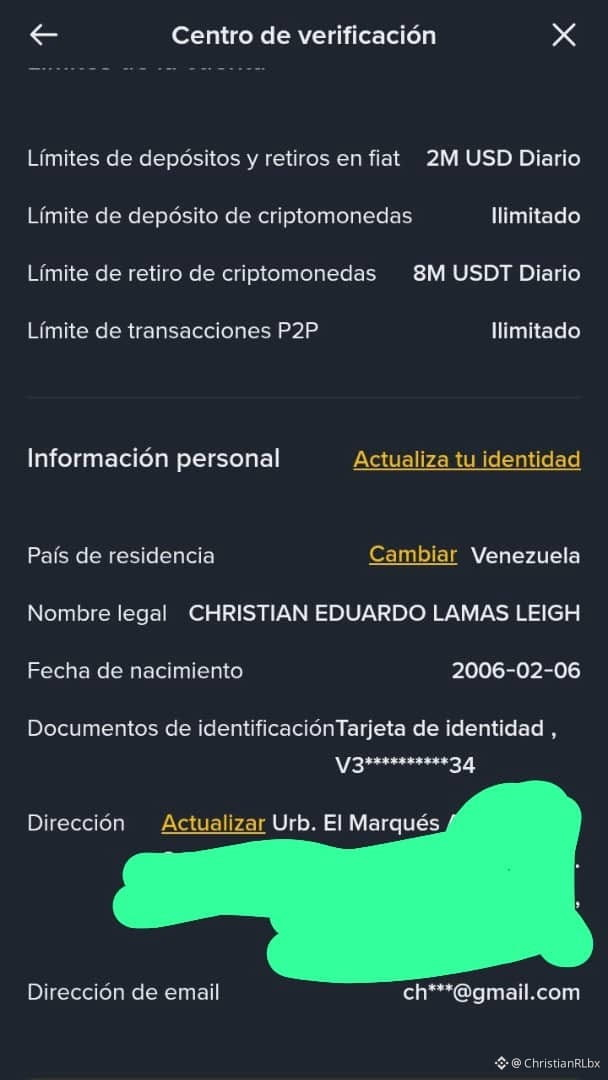
attention Venezuela ❗how to upload proof of address?
with the new Binance donation campaign, many people are affected and want to know how to meet the requirements, which is why I’m creating this post with several reference images on how to verify yourself. The important thing is that after following all the steps and entering the address plus the document they will ask for (it must be valid for a maximum of 3 months), the documents can be an RIF, water/electricity bills, and bank account statements. That is the option that worked best for me, since the RIF was from more than 3 months ago. If you have any questions, write in the comments.
maximum sharing to help those affected ❗
#TerremotoVenezuela #venezuela #ayudaparavenezuela #ayudahumanitaria
attention Venezuela ❗how to upload proof of address?
with the new Binance donation campaign, many people are affected and want to know how to meet the requirements, which is why I’m creating this post with several reference images on how to verify yourself. The important thing is that after following all the steps and entering the address plus the document they will ask for (it must be valid for a maximum of 3 months), the documents can be an RIF, water/electricity bills, and bank account statements. That is the option that worked best for me, since the RIF was from more than 3 months ago. If you have any questions, write in the comments.
maximum sharing to help those affected ❗
#TerremotoVenezuela #venezuela #ayudaparavenezuela #ayudahumanitaria
with the new Binance donation campaign, many people are affected and want to know how to meet the requirements, which is why I’m creating this post with several reference images on how to verify yourself. The important thing is that after following all the steps and entering the address plus the document they will ask for (it must be valid for a maximum of 3 months), the documents can be an RIF, water/electricity bills, and bank account statements. That is the option that worked best for me, since the RIF was from more than 3 months ago. If you have any questions, write in the comments.
maximum sharing to help those affected ❗
#TerremotoVenezuela #venezuela #ayudaparavenezuela #ayudahumanitaria


205
23
160
134.4k
⚡ ASYMMETRIC RISK MANAGEMENT IN A TWO-SIDED DAY
A professional quantitative system is not judged only when the market moves up in a straight line, but by how it protects the accumulated capital when the structure flips.
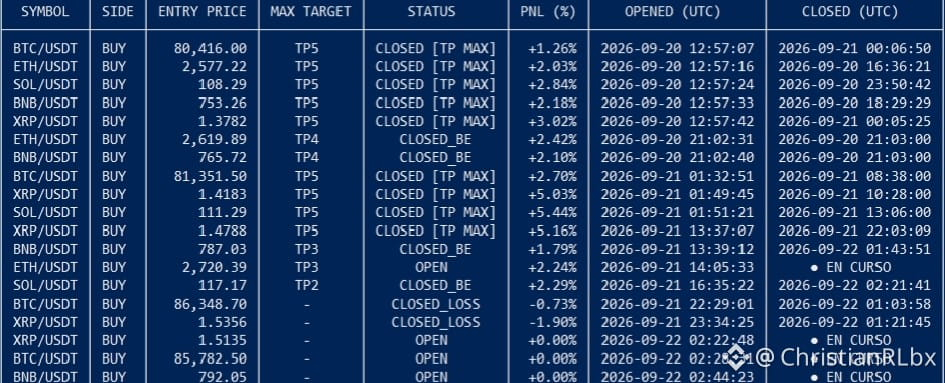
The session on September 21 was a microstructure case study: a first phase of clean trending expansion and a second nighttime phase of strong corrective shakeout.
This is how the Finite State Machine (FSM) of the algorithmic engine responded:
1️⃣ Full capture of the trending expansion:
The algorithm did not close prematurely. It rode the momentum with staggered partial fills until reaching the maximum target (4 fulls at TP5: $BTC +2.70%, $SOL +5.44% and $XRP with two hits of +5.03% and +5.16%).
2️⃣ Neutralization of risk at zero cost (Breakeven):
When the buying impulse began to lose traction in the afternoon (BNB and SOL), the system had already secured partial profits and moved the Stop Loss to the entry price. Instead of turning into pullback losses, both positions closed shielded, totaling +1.79% and +2.29% without exposing the account.
3️⃣ Bounded and deterministic losses:
During the nighttime shakeout before the session close, the dynamic Stop Loss cut risk immediately (-0.73% in BTC and -1.90% in XRP), containing any drawdown without manual intervention.
📊 Consolidated Session Balance (Closed):
• 4 full impacts at TP5
• 2 breakeven exits protected with secured partials
• 2 stop-loss exits controlled
📈 Net Realized PnL: +19.78% (Spot/1x)
The mathematical edge is not about predicting the future, but about letting winning runs play out through asymmetric targets and cutting risk to zero when the market shifts regimes.
Direct audit extracted from the production ledger. We keep building. 🚀
#XRPRises8% #BTC #RiskManagement #CryptoQuant #PythonTrading
⚡ ASYMMETRIC RISK MANAGEMENT IN A TWO-SIDED DAY
A professional quantitative system is not judged only when the market moves up in a straight line, but by how it protects the accumulated capital when the structure flips.
The session on September 21 was a microstructure case study: a first phase of clean trending expansion and a second nighttime phase of strong corrective shakeout.
This is how the Finite State Machine (FSM) of the algorithmic engine responded:
1️⃣ Full capture of the trending expansion:
The algorithm did not close prematurely. It rode the momentum with staggered partial fills until reaching the maximum target (4 fulls at TP5: $BTC +2.70%, $SOL +5.44% and $XRP with two hits of +5.03% and +5.16%).
2️⃣ Neutralization of risk at zero cost (Breakeven):
When the buying impulse began to lose traction in the afternoon (BNB and SOL), the system had already secured partial profits and moved the Stop Loss to the entry price. Instead of turning into pullback losses, both positions closed shielded, totaling +1.79% and +2.29% without exposing the account.
3️⃣ Bounded and deterministic losses:
During the nighttime shakeout before the session close, the dynamic Stop Loss cut risk immediately (-0.73% in BTC and -1.90% in XRP), containing any drawdown without manual intervention.
📊 Consolidated Session Balance (Closed):
• 4 full impacts at TP5
• 2 breakeven exits protected with secured partials
• 2 stop-loss exits controlled
📈 Net Realized PnL: +19.78% (Spot/1x)
The mathematical edge is not about predicting the future, but about letting winning runs play out through asymmetric targets and cutting risk to zero when the market shifts regimes.
Direct audit extracted from the production ledger. We keep building. 🚀
#XRPRises8% #BTC #RiskManagement #CryptoQuant #PythonTrading
A professional quantitative system is not judged only when the market moves up in a straight line, but by how it protects the accumulated capital when the structure flips.
The session on September 21 was a microstructure case study: a first phase of clean trending expansion and a second nighttime phase of strong corrective shakeout.
This is how the Finite State Machine (FSM) of the algorithmic engine responded:
1️⃣ Full capture of the trending expansion:
The algorithm did not close prematurely. It rode the momentum with staggered partial fills until reaching the maximum target (4 fulls at TP5: $BTC +2.70%, $SOL +5.44% and $XRP with two hits of +5.03% and +5.16%).
2️⃣ Neutralization of risk at zero cost (Breakeven):
When the buying impulse began to lose traction in the afternoon (BNB and SOL), the system had already secured partial profits and moved the Stop Loss to the entry price. Instead of turning into pullback losses, both positions closed shielded, totaling +1.79% and +2.29% without exposing the account.
3️⃣ Bounded and deterministic losses:
During the nighttime shakeout before the session close, the dynamic Stop Loss cut risk immediately (-0.73% in BTC and -1.90% in XRP), containing any drawdown without manual intervention.
📊 Consolidated Session Balance (Closed):
• 4 full impacts at TP5
• 2 breakeven exits protected with secured partials
• 2 stop-loss exits controlled
📈 Net Realized PnL: +19.78% (Spot/1x)
The mathematical edge is not about predicting the future, but about letting winning runs play out through asymmetric targets and cutting risk to zero when the market shifts regimes.
Direct audit extracted from the production ledger. We keep building. 🚀
#XRPRises8% #BTC #RiskManagement #CryptoQuant #PythonTrading
1
234
Live Audit of Binance Futures: 100% effectiveness in Sunday’s session and the path to v2.0
When we designed this quantitative engine in Python, the premise was not “guessing the market,” but structuring deterministic risk management based on Finite State Machines (FSM) and volatility control.
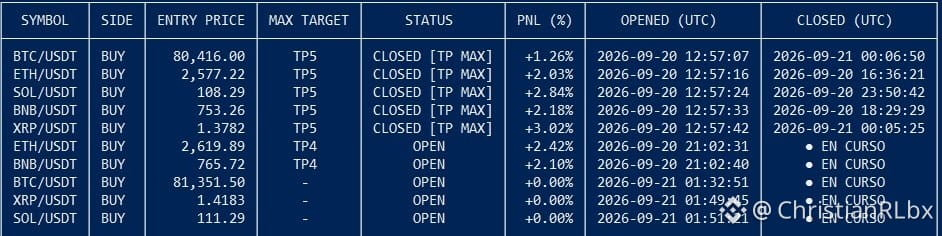
Yesterday, Sunday, during the pre-weekly opening liquidity injection, the system ran an impeccable session audited in SQLite WAL:
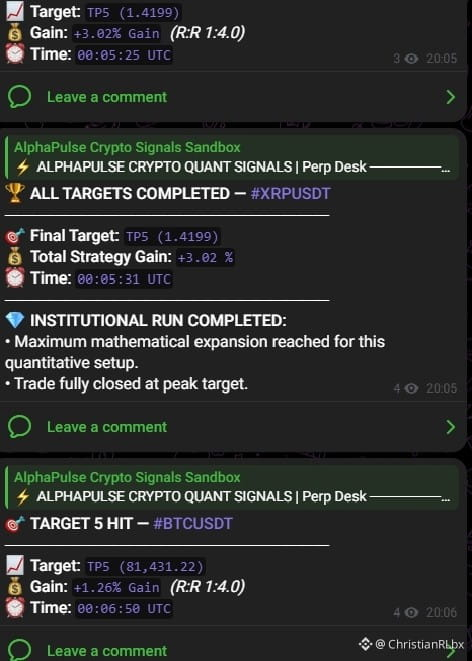
📊 Batch Metrics (5/5 at TP5 - Closed Target Max):
• $ETH : TP5 reached (+2.06%)
• $SOL: TP5 reached (+3.77%)
• $XRP: TP5 reached (+4.03%)
• $BNB : TP5 reached (+2.16%)
• $BTC : TP5 reached (+1.26%)
👉 Basket gross performance: +13.28% (no leverage).
⚙️ The real edge: Transparency and v2.0 on the way
A perfect day doesn’t mean an infallible system. In algorithmic trading, streaks exist, but solidity is measured in the statistical sample.
Currently, the bot runs on its base version while we accumulate the control sample of 100 live operations. With that closed log, we’ll analyze slippage, the actual drawdown, and the R:R ratios to calibrate v2.0—where we’ll incorporate new assets and dynamic optimizations using ATR.
Algorithmic trading isn’t luck; it’s mathematics, iteration, and discipline in code.
💬 For developers and quants: how many trades do you consider the minimum to audit the robustness of a model in derivatives? I’ll read your answers below. 👇
#AlgorithmicTrading #BTC #QuantTrading #BTCBreaks80K #CryptoTradingInsights
Live Audit of Binance Futures: 100% effectiveness in Sunday’s session and the path to v2.0
When we designed this quantitative engine in Python, the premise was not “guessing the market,” but structuring deterministic risk management based on Finite State Machines (FSM) and volatility control.
Yesterday, Sunday, during the pre-weekly opening liquidity injection, the system ran an impeccable session audited in SQLite WAL:
📊 Batch Metrics (5/5 at TP5 - Closed Target Max):
• $ETH : TP5 reached (+2.06%)
• $SOL: TP5 reached (+3.77%)
• $XRP: TP5 reached (+4.03%)
• $BNB : TP5 reached (+2.16%)
• $BTC : TP5 reached (+1.26%)
👉 Basket gross performance: +13.28% (no leverage).
⚙️ The real edge: Transparency and v2.0 on the way
A perfect day doesn’t mean an infallible system. In algorithmic trading, streaks exist, but solidity is measured in the statistical sample.
Currently, the bot runs on its base version while we accumulate the control sample of 100 live operations. With that closed log, we’ll analyze slippage, the actual drawdown, and the R:R ratios to calibrate v2.0—where we’ll incorporate new assets and dynamic optimizations using ATR.
Algorithmic trading isn’t luck; it’s mathematics, iteration, and discipline in code.
💬 For developers and quants: how many trades do you consider the minimum to audit the robustness of a model in derivatives? I’ll read your answers below. 👇
#AlgorithmicTrading #BTC #QuantTrading #BTCBreaks80K #CryptoTradingInsights
When we designed this quantitative engine in Python, the premise was not “guessing the market,” but structuring deterministic risk management based on Finite State Machines (FSM) and volatility control.
Yesterday, Sunday, during the pre-weekly opening liquidity injection, the system ran an impeccable session audited in SQLite WAL:
📊 Batch Metrics (5/5 at TP5 - Closed Target Max):
• $ETH : TP5 reached (+2.06%)
• $SOL: TP5 reached (+3.77%)
• $XRP: TP5 reached (+4.03%)
• $BNB : TP5 reached (+2.16%)
• $BTC : TP5 reached (+1.26%)
👉 Basket gross performance: +13.28% (no leverage).
⚙️ The real edge: Transparency and v2.0 on the way
A perfect day doesn’t mean an infallible system. In algorithmic trading, streaks exist, but solidity is measured in the statistical sample.
Currently, the bot runs on its base version while we accumulate the control sample of 100 live operations. With that closed log, we’ll analyze slippage, the actual drawdown, and the R:R ratios to calibrate v2.0—where we’ll incorporate new assets and dynamic optimizations using ATR.
Algorithmic trading isn’t luck; it’s mathematics, iteration, and discipline in code.
💬 For developers and quants: how many trades do you consider the minimum to audit the robustness of a model in derivatives? I’ll read your answers below. 👇
#AlgorithmicTrading #BTC #QuantTrading #BTCBreaks80K #CryptoTradingInsights
1
238
Why algorithmic execution outperforms manual trading: Block management on Binance Futures
The market doesn’t move in isolation; when directional liquidity enters, major pairs react in sync. A manual trader often hesitates or splits attention across charts, losing optimal execution.
This is how our Python engine managed the expansion that happened this afternoon, directly against the Binance Futures API:
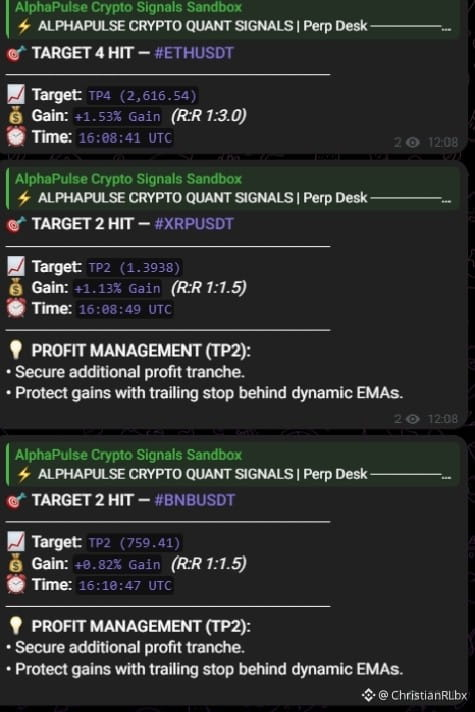
📊 Live Quantitative Execution:
• $ETH USDT: Clean expansion up to Target 4 (2,616.54), securing an R:R ratio of 1:3.0 (+1.53%).
• $XRP USDT: Target 2 reached (1.3938) with R:R 1:1.5 (+1.13%).
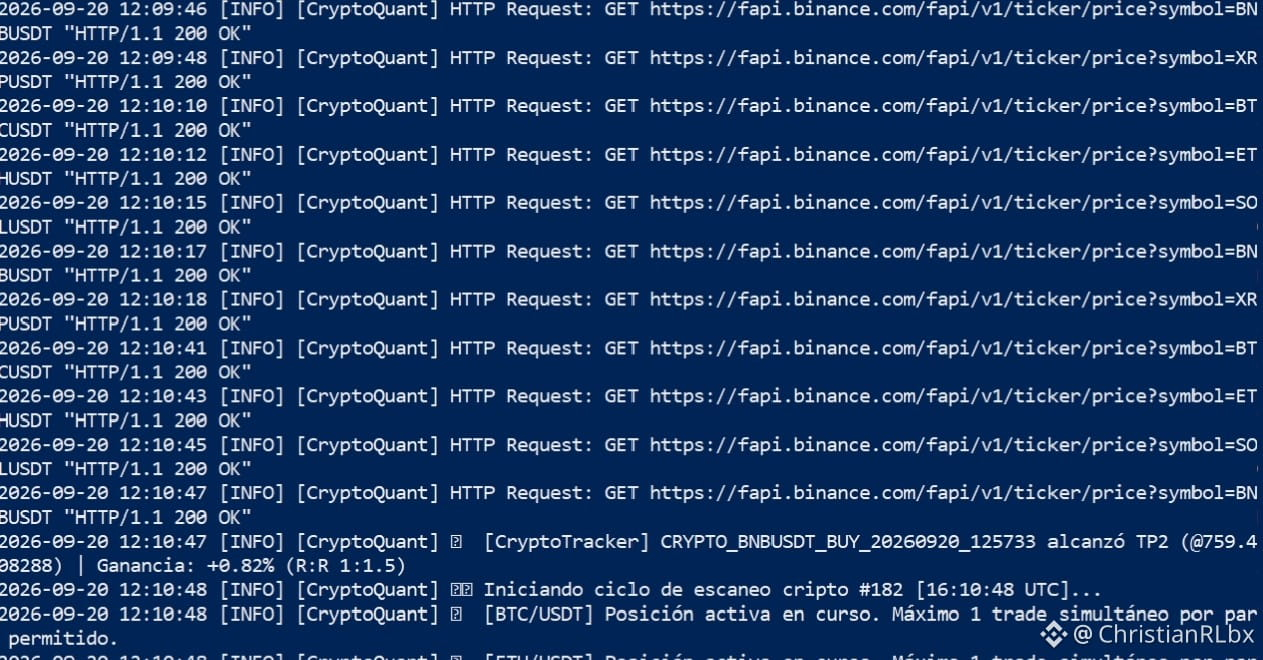
• $BNB USDT: Target 2 reached (759.41) with R:R 1:1.5 (+0.82%).
{spot}(ETHUSDT)
{spot}(XRPUSDT)
{spot}(BNBUSDT)
⚙️ System Architecture:
1. Strict exposure rule: Maximum 1 simultaneous position per pair to avoid over-leveraging on correlations.
2. Dynamic trailing: Once TP1 is surpassed, breakeven is activated and the trailing stop locks in profit legs behind the dynamic EMAs.
3. Continuous monitoring via REST/WebSocket with no discretionary intervention or emotional bias.
Quantitative trading is about defining clear mathematical rules and letting the machine execute with precision.
💬 Do you operate multiple pairs manually, or do you prefer to automate partial closes with scripts? I’ll read your answers below. 👇
#AlgorithmicTrading #ETH #xrp #bnb #RiskManagement
Why algorithmic execution outperforms manual trading: Block management on Binance Futures
The market doesn’t move in isolation; when directional liquidity enters, major pairs react in sync. A manual trader often hesitates or splits attention across charts, losing optimal execution.
This is how our Python engine managed the expansion that happened this afternoon, directly against the Binance Futures API:
📊 Live Quantitative Execution:
• $ETH USDT: Clean expansion up to Target 4 (2,616.54), securing an R:R ratio of 1:3.0 (+1.53%).
• $XRP USDT: Target 2 reached (1.3938) with R:R 1:1.5 (+1.13%).
• $BNB USDT: Target 2 reached (759.41) with R:R 1:1.5 (+0.82%).
⚙️ System Architecture:
1. Strict exposure rule: Maximum 1 simultaneous position per pair to avoid over-leveraging on correlations.
2. Dynamic trailing: Once TP1 is surpassed, breakeven is activated and the trailing stop locks in profit legs behind the dynamic EMAs.
3. Continuous monitoring via REST/WebSocket with no discretionary intervention or emotional bias.
Quantitative trading is about defining clear mathematical rules and letting the machine execute with precision.
💬 Do you operate multiple pairs manually, or do you prefer to automate partial closes with scripts? I’ll read your answers below. 👇
#AlgorithmicTrading #ETH #xrp #bnb #RiskManagement
The market doesn’t move in isolation; when directional liquidity enters, major pairs react in sync. A manual trader often hesitates or splits attention across charts, losing optimal execution.
This is how our Python engine managed the expansion that happened this afternoon, directly against the Binance Futures API:
📊 Live Quantitative Execution:
• $ETH USDT: Clean expansion up to Target 4 (2,616.54), securing an R:R ratio of 1:3.0 (+1.53%).
• $XRP USDT: Target 2 reached (1.3938) with R:R 1:1.5 (+1.13%).
• $BNB USDT: Target 2 reached (759.41) with R:R 1:1.5 (+0.82%).
⚙️ System Architecture:
1. Strict exposure rule: Maximum 1 simultaneous position per pair to avoid over-leveraging on correlations.
2. Dynamic trailing: Once TP1 is surpassed, breakeven is activated and the trailing stop locks in profit legs behind the dynamic EMAs.
3. Continuous monitoring via REST/WebSocket with no discretionary intervention or emotional bias.
Quantitative trading is about defining clear mathematical rules and letting the machine execute with precision.
💬 Do you operate multiple pairs manually, or do you prefer to automate partial closes with scripts? I’ll read your answers below. 👇
#AlgorithmicTrading #ETH #xrp #bnb #RiskManagement
1
1
254
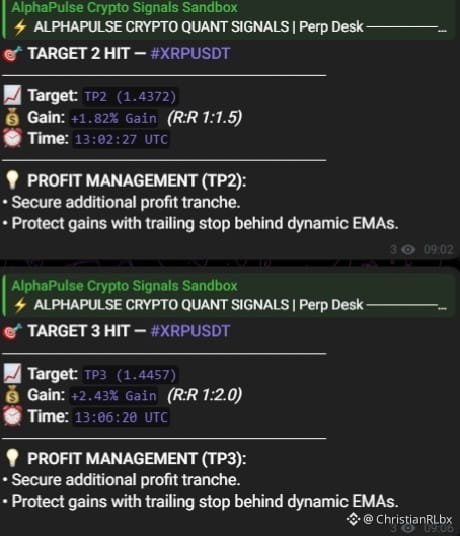
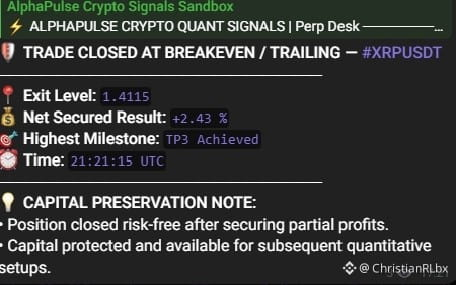
From +2.43% to zero: Why moving the Stop to Breakeven saved this futures trade in $XRP
80% of traders give back their profits over the weekend due to the same mistake: not locking in gains during the expansion and allowing a winning position to turn into a loss.
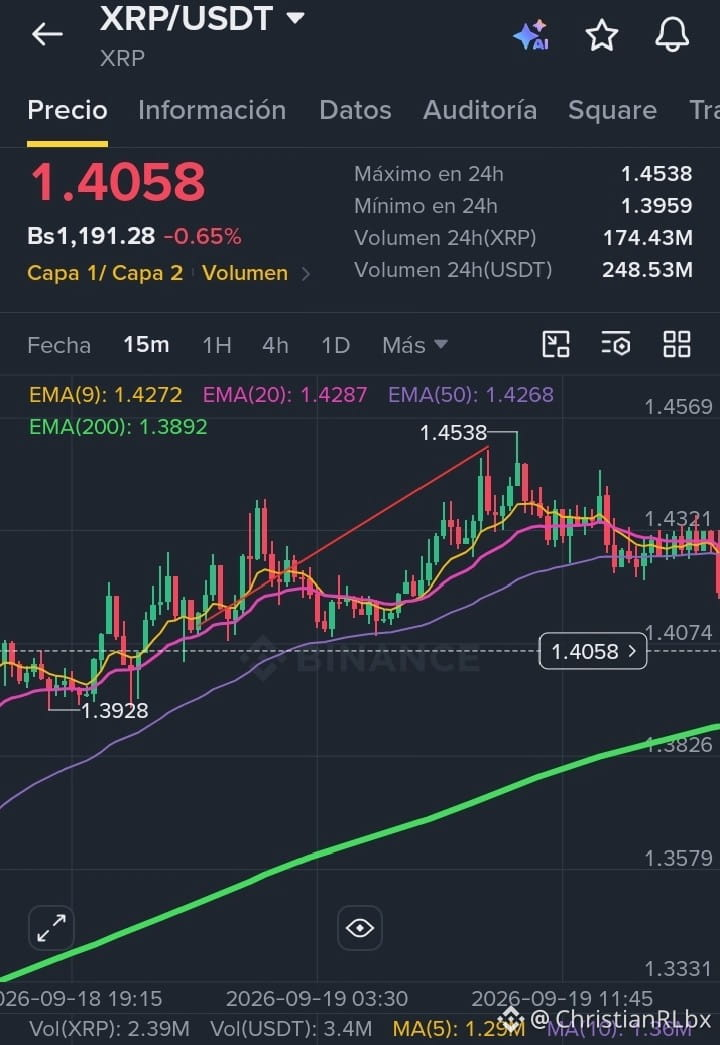
Yesterday we saw the perfect example in the perpetual futures of $XRP :📊 Quantitative Execution Breakdown:
• Setup: Long $XRPUSDT Perp (Dynamic M15 pullback + Bullish H1 bias)
• Entry: 1.4115 USDT
• Initial Stop Loss: 1.3944 USDT (-1.21% / 2.0x ATR)
• Target 1 (1.4286): ✅ Hit (+1.21%) ➔ Take 50% and move Stop to Breakeven.
• Target 2 (1.4372): ✅ Hit (+1.82%)
• Target 3 (1.4457): ✅ Hit (+2.43% / R:R 1:2.0) ➔ Additional profits secured. 📉 What happened next:
After reaching the TP3 target at 13:06 UTC, buy volume ran out and the market started a correction lasting more than 8 hours, which ended up sweeping through the entry price. What’s the result for a retail trader without algorithmic management? A trade that had accumulated more than 2.4% profit ends up touching the original Stop Loss or closing in panic with a red balance. What’s the result of the quantitative engine? Automatic closure at Breakeven at 21:21 UTC with a protected net result of +2.43% on the account. 💡 The Mathematical Rule:
In derivatives markets, your statistical advantage (edge) lies in removing the desk risk after the first impulse. Securing partials and moving the Stop Loss to the entry price turns the trade into a risk-free asset (risk-free). If the market continues to TP5, you maximize profits; if it reverses due to lack of liquidity, your capital remains intact. 💬 Question for the community:When trading futures, do you prefer taking fixed partials in R:R ratios 1:1 and 1:2, or do you let the full position run, assuming the risk that it will come back to the entry? I read you in the comments.
👇#TradingQuant #XRP #RiskManagement #Quantitativetrading #TradingSignals
{future}(XRPUSDT)
From +2.43% to zero: Why moving the Stop to Breakeven saved this futures trade in $XRP
80% of traders give back their profits over the weekend due to the same mistake: not locking in gains during the expansion and allowing a winning position to turn into a loss.
Yesterday we saw the perfect example in the perpetual futures of $XRP :📊 Quantitative Execution Breakdown:
• Setup: Long $XRPUSDT Perp (Dynamic M15 pullback + Bullish H1 bias)
• Entry: 1.4115 USDT
• Initial Stop Loss: 1.3944 USDT (-1.21% / 2.0x ATR)
• Target 1 (1.4286): ✅ Hit (+1.21%) ➔ Take 50% and move Stop to Breakeven.
• Target 2 (1.4372): ✅ Hit (+1.82%)
• Target 3 (1.4457): ✅ Hit (+2.43% / R:R 1:2.0) ➔ Additional profits secured. 📉 What happened next:
After reaching the TP3 target at 13:06 UTC, buy volume ran out and the market started a correction lasting more than 8 hours, which ended up sweeping through the entry price. What’s the result for a retail trader without algorithmic management? A trade that had accumulated more than 2.4% profit ends up touching the original Stop Loss or closing in panic with a red balance. What’s the result of the quantitative engine? Automatic closure at Breakeven at 21:21 UTC with a protected net result of +2.43% on the account. 💡 The Mathematical Rule:
In derivatives markets, your statistical advantage (edge) lies in removing the desk risk after the first impulse. Securing partials and moving the Stop Loss to the entry price turns the trade into a risk-free asset (risk-free). If the market continues to TP5, you maximize profits; if it reverses due to lack of liquidity, your capital remains intact. 💬 Question for the community:When trading futures, do you prefer taking fixed partials in R:R ratios 1:1 and 1:2, or do you let the full position run, assuming the risk that it will come back to the entry? I read you in the comments.
👇#TradingQuant #XRP #RiskManagement #Quantitativetrading #TradingSignals
80% of traders give back their profits over the weekend due to the same mistake: not locking in gains during the expansion and allowing a winning position to turn into a loss.
Yesterday we saw the perfect example in the perpetual futures of $XRP :📊 Quantitative Execution Breakdown:
• Setup: Long $XRPUSDT Perp (Dynamic M15 pullback + Bullish H1 bias)
• Entry: 1.4115 USDT
• Initial Stop Loss: 1.3944 USDT (-1.21% / 2.0x ATR)
• Target 1 (1.4286): ✅ Hit (+1.21%) ➔ Take 50% and move Stop to Breakeven.
• Target 2 (1.4372): ✅ Hit (+1.82%)
• Target 3 (1.4457): ✅ Hit (+2.43% / R:R 1:2.0) ➔ Additional profits secured. 📉 What happened next:
After reaching the TP3 target at 13:06 UTC, buy volume ran out and the market started a correction lasting more than 8 hours, which ended up sweeping through the entry price. What’s the result for a retail trader without algorithmic management? A trade that had accumulated more than 2.4% profit ends up touching the original Stop Loss or closing in panic with a red balance. What’s the result of the quantitative engine? Automatic closure at Breakeven at 21:21 UTC with a protected net result of +2.43% on the account. 💡 The Mathematical Rule:
In derivatives markets, your statistical advantage (edge) lies in removing the desk risk after the first impulse. Securing partials and moving the Stop Loss to the entry price turns the trade into a risk-free asset (risk-free). If the market continues to TP5, you maximize profits; if it reverses due to lack of liquidity, your capital remains intact. 💬 Question for the community:When trading futures, do you prefer taking fixed partials in R:R ratios 1:1 and 1:2, or do you let the full position run, assuming the risk that it will come back to the entry? I read you in the comments.
👇#TradingQuant #XRP #RiskManagement #Quantitativetrading #TradingSignals
1
382
$XRP shakes off failure from the CLARITY Act and jumps 7%: can it hold?
The U.S. Senate rejected the CLARITY Act procedural motion with a 49-50 vote, effectively killing the bill for 2026. The news triggered a bloodbath in the market: $493 million liquidated** in 24 hours, with Bitcoin falling to **$75,560 and Ethereum dropping -3.8%.
However, XRP has defied the bearish trend and is up 9% over the last 24 hours, trading near **$1.40**. Order book data shows **institutional accumulation** in the **$1.30-$1.32** area, while immediate resistance sits at **$1.45. The asset has benefited from a clearer regulatory status (recognized as a digital commodity by the SEC and the CFTC in March) and from the growth of its RLUSD ecosystem.
Meanwhile, $NEAR surged an incredible 19% today and is trading around 3.63**, supported by interest in its decentralized AI infrastructure.
{spot}(XRPUSDT)
{spot}(NEARUSDT)
{spot}(BTCUSDT)
#Institutional desks and liquidity providers are monitoring the order books closely. Market participants are assessing support and resistance levels across all active timeframes.
#xrp #Near $BTC #BTCBreaks80K #BullRunAhead
$XRP shakes off failure from the CLARITY Act and jumps 7%: can it hold?
The U.S. Senate rejected the CLARITY Act procedural motion with a 49-50 vote, effectively killing the bill for 2026. The news triggered a bloodbath in the market: $493 million liquidated** in 24 hours, with Bitcoin falling to **$75,560 and Ethereum dropping -3.8%.
However, XRP has defied the bearish trend and is up 9% over the last 24 hours, trading near **$1.40**. Order book data shows **institutional accumulation** in the **$1.30-$1.32** area, while immediate resistance sits at **$1.45. The asset has benefited from a clearer regulatory status (recognized as a digital commodity by the SEC and the CFTC in March) and from the growth of its RLUSD ecosystem.
Meanwhile, $NEAR surged an incredible 19% today and is trading around 3.63**, supported by interest in its decentralized AI infrastructure.
#Institutional desks and liquidity providers are monitoring the order books closely. Market participants are assessing support and resistance levels across all active timeframes.
#xrp #Near $BTC #BTCBreaks80K #BullRunAhead
The U.S. Senate rejected the CLARITY Act procedural motion with a 49-50 vote, effectively killing the bill for 2026. The news triggered a bloodbath in the market: $493 million liquidated** in 24 hours, with Bitcoin falling to **$75,560 and Ethereum dropping -3.8%.
However, XRP has defied the bearish trend and is up 9% over the last 24 hours, trading near **$1.40**. Order book data shows **institutional accumulation** in the **$1.30-$1.32** area, while immediate resistance sits at **$1.45. The asset has benefited from a clearer regulatory status (recognized as a digital commodity by the SEC and the CFTC in March) and from the growth of its RLUSD ecosystem.
Meanwhile, $NEAR surged an incredible 19% today and is trading around 3.63**, supported by interest in its decentralized AI infrastructure.
#Institutional desks and liquidity providers are monitoring the order books closely. Market participants are assessing support and resistance levels across all active timeframes.
#xrp #Near $BTC #BTCBreaks80K #BullRunAhead

2
518
Verified
📊 Zcash ETF: split 3 for 1 explained
Grayscale’s Zcash ETF (ZCSH) announced a 3-for-1 split less than a month after its launch. It’s not negative: it’s a sign of success.
⚖️ What is a 3-for-1 split?
It doesn’t change the value of your investment. It triples your shares and divides the share price by 3.
Example: 10 shares at $300 ($3,000 total value) → 30 shares at $100 (same $3,000 total value).
📅 Key dates
· Sept 28: record date. You receive 2 additional shares for each one.
· Sept 29: distribution of new shares.
· Sept 30: trading starts with the adjusted price.
🚀 Why do it?
To make the ETF more accessible to retail investors. The price per share drops dramatically, allowing more people to get in.
📈 Context: resounding success
· +$233M in net inflows since launch (Aug 25).
· +$112M in a single day (Sept 8).
· ~$890M in net assets.
· +$11,000M in cumulative volume.
{spot}(ZECUSDT)
This success matches a historic rally of $ZEC , which reached $1,521 (effective new ATH). Hashrate rose +28% and difficulty set a record at 291M.
🧠 What is ZCSH?
It’s a regulated vehicle that lets traditional investors gain exposure to ZEC without buying the crypto directly. Since launch, it’s been one of the best-performing crypto ETFs.
In short: the split is a response to success and a move to attract more investors. It doesn’t change the value— it just makes the shares more accessible.
Do you have a position in ZCSH or are you considering entering after the split? 👇
#Zcash #zec #etf #Grayscale #analisis
📊 Zcash ETF: split 3 for 1 explained
Grayscale’s Zcash ETF (ZCSH) announced a 3-for-1 split less than a month after its launch. It’s not negative: it’s a sign of success.
⚖️ What is a 3-for-1 split?
It doesn’t change the value of your investment. It triples your shares and divides the share price by 3.
Example: 10 shares at $300 ($3,000 total value) → 30 shares at $100 (same $3,000 total value).
📅 Key dates
· Sept 28: record date. You receive 2 additional shares for each one.
· Sept 29: distribution of new shares.
· Sept 30: trading starts with the adjusted price.
🚀 Why do it?
To make the ETF more accessible to retail investors. The price per share drops dramatically, allowing more people to get in.
📈 Context: resounding success
· +$233M in net inflows since launch (Aug 25).
· +$112M in a single day (Sept 8).
· ~$890M in net assets.
· +$11,000M in cumulative volume.
This success matches a historic rally of $ZEC , which reached $1,521 (effective new ATH). Hashrate rose +28% and difficulty set a record at 291M.
🧠 What is ZCSH?
It’s a regulated vehicle that lets traditional investors gain exposure to ZEC without buying the crypto directly. Since launch, it’s been one of the best-performing crypto ETFs.
In short: the split is a response to success and a move to attract more investors. It doesn’t change the value— it just makes the shares more accessible.
Do you have a position in ZCSH or are you considering entering after the split? 👇
#Zcash #zec #etf #Grayscale #analisis
Grayscale’s Zcash ETF (ZCSH) announced a 3-for-1 split less than a month after its launch. It’s not negative: it’s a sign of success.
⚖️ What is a 3-for-1 split?
It doesn’t change the value of your investment. It triples your shares and divides the share price by 3.
Example: 10 shares at $300 ($3,000 total value) → 30 shares at $100 (same $3,000 total value).
📅 Key dates
· Sept 28: record date. You receive 2 additional shares for each one.
· Sept 29: distribution of new shares.
· Sept 30: trading starts with the adjusted price.
🚀 Why do it?
To make the ETF more accessible to retail investors. The price per share drops dramatically, allowing more people to get in.
📈 Context: resounding success
· +$233M in net inflows since launch (Aug 25).
· +$112M in a single day (Sept 8).
· ~$890M in net assets.
· +$11,000M in cumulative volume.
This success matches a historic rally of $ZEC , which reached $1,521 (effective new ATH). Hashrate rose +28% and difficulty set a record at 291M.
🧠 What is ZCSH?
It’s a regulated vehicle that lets traditional investors gain exposure to ZEC without buying the crypto directly. Since launch, it’s been one of the best-performing crypto ETFs.
In short: the split is a response to success and a move to attract more investors. It doesn’t change the value— it just makes the shares more accessible.
Do you have a position in ZCSH or are you considering entering after the split? 👇
#Zcash #zec #etf #Grayscale #analisis

2
635
💰 Hyperliquid launches native loans: $269M on the first day
Hyperliquid has launched a manual native lending system on its mainnet. Users can deposit $HYPE or $BTC as collateral to borrow $USDC and USDT. The success was immediate: $269 million borrowed in the first day.
⚙️ How does it work?
· LTV: up to 65% of the value of HYPE and 50% of BTC.
· Liquidation: if collateral falls below 82.5% (HYPE) or 75% (BTC).
· Rates: updated every hour based on pool utilization. Initial rate: 5% per year.
· Infrastructure: runs on HyperCore, the same as the portfolio margin system.
📈 Market impact
· HYPE hit a new all-time high above $90 after the announcement.
· The USDC supply in the pool surpassed $408 million, with utilization of 68.3% and a 3.08% return for depositors.
⚠️ Risks to consider
· Collateral dependency: the price of HYPE directly affects borrowing capacity and liquidation risk.
· Chain risk: Hyperliquid has suffered exploits in the past, though the modular design aims to isolate lending risk.
· Regulatory pressure: the CFTC is under pressure to regulate the platform.
{future}(HYPEUSDT)
{spot}(BTCUSDT)
🧠 Why does it matter?
Hyperliquid adds a layer of credit to its ecosystem, giving HYPE a more direct use case beyond trading. It’s a step toward becoming a complete financial platform, not just a perpetual exchange.
Do you think native loans will push HYPE to new highs? 👇
#Hyperliquid #HYPE #DeFi #analisis #BTC
💰 Hyperliquid launches native loans: $269M on the first day
Hyperliquid has launched a manual native lending system on its mainnet. Users can deposit $HYPE or $BTC as collateral to borrow $USDC and USDT. The success was immediate: $269 million borrowed in the first day.
⚙️ How does it work?
· LTV: up to 65% of the value of HYPE and 50% of BTC.
· Liquidation: if collateral falls below 82.5% (HYPE) or 75% (BTC).
· Rates: updated every hour based on pool utilization. Initial rate: 5% per year.
· Infrastructure: runs on HyperCore, the same as the portfolio margin system.
📈 Market impact
· HYPE hit a new all-time high above $90 after the announcement.
· The USDC supply in the pool surpassed $408 million, with utilization of 68.3% and a 3.08% return for depositors.
⚠️ Risks to consider
· Collateral dependency: the price of HYPE directly affects borrowing capacity and liquidation risk.
· Chain risk: Hyperliquid has suffered exploits in the past, though the modular design aims to isolate lending risk.
· Regulatory pressure: the CFTC is under pressure to regulate the platform.
🧠 Why does it matter?
Hyperliquid adds a layer of credit to its ecosystem, giving HYPE a more direct use case beyond trading. It’s a step toward becoming a complete financial platform, not just a perpetual exchange.
Do you think native loans will push HYPE to new highs? 👇
#Hyperliquid #HYPE #DeFi #analisis #BTC
Hyperliquid has launched a manual native lending system on its mainnet. Users can deposit $HYPE or $BTC as collateral to borrow $USDC and USDT. The success was immediate: $269 million borrowed in the first day.
⚙️ How does it work?
· LTV: up to 65% of the value of HYPE and 50% of BTC.
· Liquidation: if collateral falls below 82.5% (HYPE) or 75% (BTC).
· Rates: updated every hour based on pool utilization. Initial rate: 5% per year.
· Infrastructure: runs on HyperCore, the same as the portfolio margin system.
📈 Market impact
· HYPE hit a new all-time high above $90 after the announcement.
· The USDC supply in the pool surpassed $408 million, with utilization of 68.3% and a 3.08% return for depositors.
⚠️ Risks to consider
· Collateral dependency: the price of HYPE directly affects borrowing capacity and liquidation risk.
· Chain risk: Hyperliquid has suffered exploits in the past, though the modular design aims to isolate lending risk.
· Regulatory pressure: the CFTC is under pressure to regulate the platform.
🧠 Why does it matter?
Hyperliquid adds a layer of credit to its ecosystem, giving HYPE a more direct use case beyond trading. It’s a step toward becoming a complete financial platform, not just a perpetual exchange.
Do you think native loans will push HYPE to new highs? 👇
#Hyperliquid #HYPE #DeFi #analisis #BTC

1
205
🚨 🚨 The SEC opens the $77 trillion stock market to tokenization after rejecting the CLARITY Act
📌 Key Points:
• The SEC granted a 5-year Innovation Exemption to allow the trading of U.S. stocks on blockchain platforms.
• The regulatory framework emerges two days after the U.S. Senate froze the CLARITY Act on the structure of the crypto market.
• The move represents a massive institutional push for the tokenization of Real-World Assets (RWAs).
💡 Market Impact:
Massive injection of institutional legitimacy for RWA infrastructure, increasing demand for enterprise-grade blockchain networks and on-chain liquidity.
{spot}(BTCUSDT)
{spot}(ETHUSDT)
{spot}(ZECUSDT)
$BTC $ETH $ZEC
#CryptoAlert #USWeeklyJoblessClaimsFallTo196K #SEC #BTC #zec
🚨 🚨 The SEC opens the $77 trillion stock market to tokenization after rejecting the CLARITY Act
📌 Key Points:
• The SEC granted a 5-year Innovation Exemption to allow the trading of U.S. stocks on blockchain platforms.
• The regulatory framework emerges two days after the U.S. Senate froze the CLARITY Act on the structure of the crypto market.
• The move represents a massive institutional push for the tokenization of Real-World Assets (RWAs).
💡 Market Impact:
Massive injection of institutional legitimacy for RWA infrastructure, increasing demand for enterprise-grade blockchain networks and on-chain liquidity.
$BTC $ETH $ZEC
#CryptoAlert #USWeeklyJoblessClaimsFallTo196K #SEC #BTC #zec
📌 Key Points:
• The SEC granted a 5-year Innovation Exemption to allow the trading of U.S. stocks on blockchain platforms.
• The regulatory framework emerges two days after the U.S. Senate froze the CLARITY Act on the structure of the crypto market.
• The move represents a massive institutional push for the tokenization of Real-World Assets (RWAs).
💡 Market Impact:
Massive injection of institutional legitimacy for RWA infrastructure, increasing demand for enterprise-grade blockchain networks and on-chain liquidity.
$BTC $ETH $ZEC
#CryptoAlert #USWeeklyJoblessClaimsFallTo196K #SEC #BTC #zec


3
427
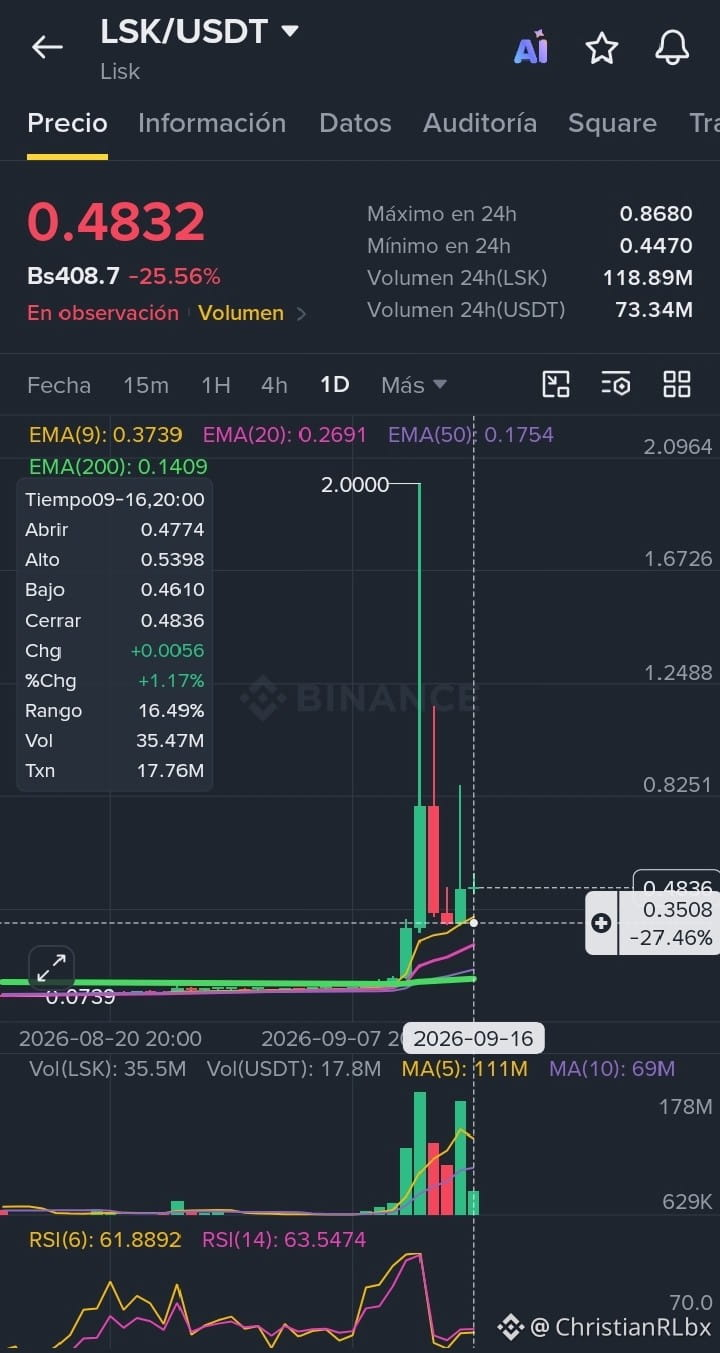
🚨 $LSK : from $2.37 to $0.48 in 4 days — the FOMO lesson
LSK is the perfect case study for why vertical rises without fundamentals are a trap.
📉 The numbers
Momentum Price
Peak (Sep 13) $2.37
Current (Sep 17) $0.48
Drop from the peak -80%
Daily change -25%
{spot}(LSKUSDT)
In four days, it erased almost the entire run-up. Those who bought at $2.00 are **-76%**. Those who bought at $1.00 are -52%.
🎭 The full pattern
1. Short squeeze: $33.68M in shorts liquidated. It jumped from $0.20 to $2.37 due to forced buying, not real demand.
2. CEO transfer: 3.3M of LSK (~$3.79M) moved to Binance right after the peak.
3. The burn was never voted on: the catalyst was fake.
4. Monitoring Tag: Binance had already warned about the risk.
5. Final dump: with no real buyers, the price collapsed.
🧠 The lesson
A +1,085% rise in one day isn’t an opportunity—it’s a warning. Vertical moves in low-liquidity tokens, with concentrated supply, without a confirmed catalyst, and with a risk label are traps for retail traders.
Buying at the peak is the "exit liquidity" for insiders. It wasn’t luck: it was FOMO versus risk management.
Did you learn the lesson with LSK? 👇
#LSK #FOMO #RiskManagementMastery #analisis #DumpandDump
🚨 $LSK : from $2.37 to $0.48 in 4 days — the FOMO lesson
LSK is the perfect case study for why vertical rises without fundamentals are a trap.
📉 The numbers
Momentum Price
Peak (Sep 13) $2.37
Current (Sep 17) $0.48
Drop from the peak -80%
Daily change -25%
In four days, it erased almost the entire run-up. Those who bought at $2.00 are **-76%**. Those who bought at $1.00 are -52%.
🎭 The full pattern
1. Short squeeze: $33.68M in shorts liquidated. It jumped from $0.20 to $2.37 due to forced buying, not real demand.
2. CEO transfer: 3.3M of LSK (~$3.79M) moved to Binance right after the peak.
3. The burn was never voted on: the catalyst was fake.
4. Monitoring Tag: Binance had already warned about the risk.
5. Final dump: with no real buyers, the price collapsed.
🧠 The lesson
A +1,085% rise in one day isn’t an opportunity—it’s a warning. Vertical moves in low-liquidity tokens, with concentrated supply, without a confirmed catalyst, and with a risk label are traps for retail traders.
Buying at the peak is the "exit liquidity" for insiders. It wasn’t luck: it was FOMO versus risk management.
Did you learn the lesson with LSK? 👇
#LSK #FOMO #RiskManagementMastery #analisis #DumpandDump
LSK is the perfect case study for why vertical rises without fundamentals are a trap.
📉 The numbers
Momentum Price
Peak (Sep 13) $2.37
Current (Sep 17) $0.48
Drop from the peak -80%
Daily change -25%
In four days, it erased almost the entire run-up. Those who bought at $2.00 are **-76%**. Those who bought at $1.00 are -52%.
🎭 The full pattern
1. Short squeeze: $33.68M in shorts liquidated. It jumped from $0.20 to $2.37 due to forced buying, not real demand.
2. CEO transfer: 3.3M of LSK (~$3.79M) moved to Binance right after the peak.
3. The burn was never voted on: the catalyst was fake.
4. Monitoring Tag: Binance had already warned about the risk.
5. Final dump: with no real buyers, the price collapsed.
🧠 The lesson
A +1,085% rise in one day isn’t an opportunity—it’s a warning. Vertical moves in low-liquidity tokens, with concentrated supply, without a confirmed catalyst, and with a risk label are traps for retail traders.
Buying at the peak is the "exit liquidity" for insiders. It wasn’t luck: it was FOMO versus risk management.
Did you learn the lesson with LSK? 👇
#LSK #FOMO #RiskManagementMastery #analisis #DumpandDump
1
866
🚨 🚨 What’s happening with Ethereum’s price now that the Clarity Act has failed?
📌 Key Points:
• High-impact development reported by BeInCrypto: prioritized tracking in the crypto ecosystem.
• Institutional desks and market makers monitor volatility and liquidity at $ETH .
• Order rotation increases toward key support and resistance levels on 4H timeframes.
💡 Market Impact:
This event reshapes short-term liquidity expectations for ETH. Volume confirmation in the upcoming sessions will be crucial to avoid market traps.
{spot}(ETHUSDT)
{spot}(BTCUSDT)
{spot}(ZECUSDT)
#CryptoAlert #FedRateWatch #TRUMP #CLARITYAct #ETH $ZEC $BTC
🚨 🚨 What’s happening with Ethereum’s price now that the Clarity Act has failed?
📌 Key Points:
• High-impact development reported by BeInCrypto: prioritized tracking in the crypto ecosystem.
• Institutional desks and market makers monitor volatility and liquidity at $ETH .
• Order rotation increases toward key support and resistance levels on 4H timeframes.
💡 Market Impact:
This event reshapes short-term liquidity expectations for ETH. Volume confirmation in the upcoming sessions will be crucial to avoid market traps.
#CryptoAlert #FedRateWatch #TRUMP #CLARITYAct #ETH $ZEC $BTC
📌 Key Points:
• High-impact development reported by BeInCrypto: prioritized tracking in the crypto ecosystem.
• Institutional desks and market makers monitor volatility and liquidity at $ETH .
• Order rotation increases toward key support and resistance levels on 4H timeframes.
💡 Market Impact:
This event reshapes short-term liquidity expectations for ETH. Volume confirmation in the upcoming sessions will be crucial to avoid market traps.
#CryptoAlert #FedRateWatch #TRUMP #CLARITYAct #ETH $ZEC $BTC


1
227
🚨 🚨 Trump demands a 3% cut in interest rates after the Fed’s rate hike led by Warsh to 4%
📌 Key Points:
• Fed Chair Kevin Warsh implemented the first rate hike since 2023, bringing rates to 4% and warning of further increases.
• Donald Trump responded by demanding an aggressive cut of 300 basis points to take the interest rate to 1%.
• Growing friction between the White House and the Federal Reserve is increasing global macroeconomic uncertainty.
💡 Market Impact:
Tightening monetary policy and political tension are putting pressure on dollar liquidity, increasing short-term volatility in Bitcoin and risk assets.
{spot}(BTCUSDT)
{spot}(ETHUSDT)
{spot}(ZECUSDT)
$BTC $ETH $ZEC #CryptoAlerts #FedRateWatch #ZcashRises6% #TRUMP #BitcoinFalls4%
🚨 🚨 Trump demands a 3% cut in interest rates after the Fed’s rate hike led by Warsh to 4%
📌 Key Points:
• Fed Chair Kevin Warsh implemented the first rate hike since 2023, bringing rates to 4% and warning of further increases.
• Donald Trump responded by demanding an aggressive cut of 300 basis points to take the interest rate to 1%.
• Growing friction between the White House and the Federal Reserve is increasing global macroeconomic uncertainty.
💡 Market Impact:
Tightening monetary policy and political tension are putting pressure on dollar liquidity, increasing short-term volatility in Bitcoin and risk assets.
$BTC $ETH $ZEC #CryptoAlerts #FedRateWatch #ZcashRises6% #TRUMP #BitcoinFalls4%
📌 Key Points:
• Fed Chair Kevin Warsh implemented the first rate hike since 2023, bringing rates to 4% and warning of further increases.
• Donald Trump responded by demanding an aggressive cut of 300 basis points to take the interest rate to 1%.
• Growing friction between the White House and the Federal Reserve is increasing global macroeconomic uncertainty.
💡 Market Impact:
Tightening monetary policy and political tension are putting pressure on dollar liquidity, increasing short-term volatility in Bitcoin and risk assets.
$BTC $ETH $ZEC #CryptoAlerts #FedRateWatch #ZcashRises6% #TRUMP #BitcoinFalls4%


1
113
🚨 🚨 The Fed raises rates to 4%: Why do 16 officials insist that the hikes aren't over yet?
📌 Key Points:
• The Federal Reserve approved a 25-basis-point increase in interest rates, setting the target range between 3.75% and 4.00%.
• The decision was backed unanimously by the 12 voting officials, marking the first rate hike recorded since 2023.
• The official projections show that 16 of the 18 committee members expect at least one additional increase before the cycle ends.
💡 Market Impact:
A more restrictive monetary stance than expected tends to drain liquidity from risk assets. This could pressure the price of $BTC and altcoins in the short term, increasing volatility as traders rework their macroeconomic expectations.
{spot}(BTCUSDT)
{spot}(XRPUSDT)
{spot}(ETHUSDT)
$ETH $BNB #CryptoAlert #FedRateWatch #BTC #BitcoinFalls4% #XRPSinks10%
🚨 🚨 The Fed raises rates to 4%: Why do 16 officials insist that the hikes aren't over yet?
📌 Key Points:
• The Federal Reserve approved a 25-basis-point increase in interest rates, setting the target range between 3.75% and 4.00%.
• The decision was backed unanimously by the 12 voting officials, marking the first rate hike recorded since 2023.
• The official projections show that 16 of the 18 committee members expect at least one additional increase before the cycle ends.
💡 Market Impact:
A more restrictive monetary stance than expected tends to drain liquidity from risk assets. This could pressure the price of $BTC and altcoins in the short term, increasing volatility as traders rework their macroeconomic expectations.
$ETH $BNB #CryptoAlert #FedRateWatch #BTC #BitcoinFalls4% #XRPSinks10%
📌 Key Points:
• The Federal Reserve approved a 25-basis-point increase in interest rates, setting the target range between 3.75% and 4.00%.
• The decision was backed unanimously by the 12 voting officials, marking the first rate hike recorded since 2023.
• The official projections show that 16 of the 18 committee members expect at least one additional increase before the cycle ends.
💡 Market Impact:
A more restrictive monetary stance than expected tends to drain liquidity from risk assets. This could pressure the price of $BTC and altcoins in the short term, increasing volatility as traders rework their macroeconomic expectations.
$ETH $BNB #CryptoAlert #FedRateWatch #BTC #BitcoinFalls4% #XRPSinks10%


2
117
🚨 🚨 The CFTC and the SEC toughen their stance on cryptocurrencies after the rejection of the Clarity Act
📌 Key Points:
• The U.S. Senate failed to advance the Clarity Act, pausing key crypto legislation in Congress.
• Michael Selig and Paul Atkins committed to using the CFTC and SEC’s existing executive powers to provide regulatory certainty to the sector.
• The agencies take control of regulatory oversight using their existing authority in the absence of a legal framework approved by lawmakers.
💡 Market Impact:
The lack of a formal law extends legislative uncertainty, but more aggressive oversight by the SEC and the CFTC could drive short-term volatility and increase compliance pressure on trading platforms.
{spot}(BTCUSDT)
{spot}(ETHUSDT)
{spot}(XRPUSDT)
$BTC $ETH #CryptoAlert #FedRateWatch #BTC #BitcoinFalls4%
🚨 🚨 The CFTC and the SEC toughen their stance on cryptocurrencies after the rejection of the Clarity Act
📌 Key Points:
• The U.S. Senate failed to advance the Clarity Act, pausing key crypto legislation in Congress.
• Michael Selig and Paul Atkins committed to using the CFTC and SEC’s existing executive powers to provide regulatory certainty to the sector.
• The agencies take control of regulatory oversight using their existing authority in the absence of a legal framework approved by lawmakers.
💡 Market Impact:
The lack of a formal law extends legislative uncertainty, but more aggressive oversight by the SEC and the CFTC could drive short-term volatility and increase compliance pressure on trading platforms.
$BTC $ETH #CryptoAlert #FedRateWatch #BTC #BitcoinFalls4%
📌 Key Points:
• The U.S. Senate failed to advance the Clarity Act, pausing key crypto legislation in Congress.
• Michael Selig and Paul Atkins committed to using the CFTC and SEC’s existing executive powers to provide regulatory certainty to the sector.
• The agencies take control of regulatory oversight using their existing authority in the absence of a legal framework approved by lawmakers.
💡 Market Impact:
The lack of a formal law extends legislative uncertainty, but more aggressive oversight by the SEC and the CFTC could drive short-term volatility and increase compliance pressure on trading platforms.
$BTC $ETH #CryptoAlert #FedRateWatch #BTC #BitcoinFalls4%


4
368
🚨 🚨 Circle launches the Arc mainnet with BlackRock and Visa as validators and mints 10 billion ARC tokens
📌 Key Points:
• Circle executed the genesis minting of 10 billion ARC tokens to kick off its main network.
• Global financial giants like BlackRock and Visa actively participate as validator nodes in the new infrastructure.
• Despite the mainnet already being operational, Circle has not yet announced a date for the public launch of the ARC token.
💡 Market Impact:
The direct integration of giants like BlackRock and Visa exponentially strengthens the narrative around Real-World Assets (RWA) and Web3 payments infrastructure. This boosts institutional confidence and lays the groundwork for a major influx of liquidity from TradFi into the ecosystem.
$USDC $BTC $ETH #CryptoAlert
🚨 🚨 Circle launches the Arc mainnet with BlackRock and Visa as validators and mints 10 billion ARC tokens
📌 Key Points:
• Circle executed the genesis minting of 10 billion ARC tokens to kick off its main network.
• Global financial giants like BlackRock and Visa actively participate as validator nodes in the new infrastructure.
• Despite the mainnet already being operational, Circle has not yet announced a date for the public launch of the ARC token.
💡 Market Impact:
The direct integration of giants like BlackRock and Visa exponentially strengthens the narrative around Real-World Assets (RWA) and Web3 payments infrastructure. This boosts institutional confidence and lays the groundwork for a major influx of liquidity from TradFi into the ecosystem.
$USDC $BTC $ETH #CryptoAlert
📌 Key Points:
• Circle executed the genesis minting of 10 billion ARC tokens to kick off its main network.
• Global financial giants like BlackRock and Visa actively participate as validator nodes in the new infrastructure.
• Despite the mainnet already being operational, Circle has not yet announced a date for the public launch of the ARC token.
💡 Market Impact:
The direct integration of giants like BlackRock and Visa exponentially strengthens the narrative around Real-World Assets (RWA) and Web3 payments infrastructure. This boosts institutional confidence and lays the groundwork for a major influx of liquidity from TradFi into the ecosystem.
$USDC $BTC $ETH #CryptoAlert

2
473
🚨 🚨 Bitcoin and $XRP are waiting for the Fed after the failure of the CLARITY Act
📌 Key Points:
• High-impact development reported by BeInCrypto: priority follow-up in the crypto ecosystem.
• Institutional desks and market makers monitor volatility and liquidity in $BTC $XRP .
• Order rotation increases toward key support and resistance levels on 4H timeframes.
💡 Market Impact:
This event reshapes short-term liquidity expectations in BTC XRP. Confirmation of volume in the upcoming sessions will be crucial to avoid market traps.
{spot}(XRPUSDT)
{spot}(BTCUSDT)
#CryptoAlert #FedRateWatch #Fed #XRPSinks10% #BitcoinFalls4%
🚨 🚨 Bitcoin and $XRP are waiting for the Fed after the failure of the CLARITY Act
📌 Key Points:
• High-impact development reported by BeInCrypto: priority follow-up in the crypto ecosystem.
• Institutional desks and market makers monitor volatility and liquidity in $BTC $XRP .
• Order rotation increases toward key support and resistance levels on 4H timeframes.
💡 Market Impact:
This event reshapes short-term liquidity expectations in BTC XRP. Confirmation of volume in the upcoming sessions will be crucial to avoid market traps.
#CryptoAlert #FedRateWatch #Fed #XRPSinks10% #BitcoinFalls4%
📌 Key Points:
• High-impact development reported by BeInCrypto: priority follow-up in the crypto ecosystem.
• Institutional desks and market makers monitor volatility and liquidity in $BTC $XRP .
• Order rotation increases toward key support and resistance levels on 4H timeframes.
💡 Market Impact:
This event reshapes short-term liquidity expectations in BTC XRP. Confirmation of volume in the upcoming sessions will be crucial to avoid market traps.
#CryptoAlert #FedRateWatch #Fed #XRPSinks10% #BitcoinFalls4%

1
394
🚨 🚨 Why did the CLARITY Law fail, and will cryptocurrencies face an even bigger drop in prices?
📌 Key Points:
• The U.S. Senate blocked the progress of the CLARITY Law after a procedural vote of 49-50, falling far short of the 60 votes needed for approval.
• The rejection represents one of the biggest legislative setbacks for the crypto industry in years, halting the effort to establish a clear regulatory framework.
• Legal uncertainty once again dominates the U.S. landscape, driving volatility and caution among investors following the legislative ruling.
💡 Market Impact:
Regulatory gridlock creates a bearish sentiment in the short term, discouraging massive institutional capital inflows and forcing major assets to test key liquidity support levels.
{spot}(BTCUSDT)
{spot}(SOLUSDT)
{spot}(ETHUSDT)
$BTC $ETH $XRP #CryptoAlert #FedRateWatch #BTC #crashmarket
🚨 🚨 Why did the CLARITY Law fail, and will cryptocurrencies face an even bigger drop in prices?
📌 Key Points:
• The U.S. Senate blocked the progress of the CLARITY Law after a procedural vote of 49-50, falling far short of the 60 votes needed for approval.
• The rejection represents one of the biggest legislative setbacks for the crypto industry in years, halting the effort to establish a clear regulatory framework.
• Legal uncertainty once again dominates the U.S. landscape, driving volatility and caution among investors following the legislative ruling.
💡 Market Impact:
Regulatory gridlock creates a bearish sentiment in the short term, discouraging massive institutional capital inflows and forcing major assets to test key liquidity support levels.
$BTC $ETH $XRP #CryptoAlert #FedRateWatch #BTC #crashmarket
📌 Key Points:
• The U.S. Senate blocked the progress of the CLARITY Law after a procedural vote of 49-50, falling far short of the 60 votes needed for approval.
• The rejection represents one of the biggest legislative setbacks for the crypto industry in years, halting the effort to establish a clear regulatory framework.
• Legal uncertainty once again dominates the U.S. landscape, driving volatility and caution among investors following the legislative ruling.
💡 Market Impact:
Regulatory gridlock creates a bearish sentiment in the short term, discouraging massive institutional capital inflows and forcing major assets to test key liquidity support levels.
$BTC $ETH $XRP #CryptoAlert #FedRateWatch #BTC #crashmarket


2
186
🚨 🚨 Wall Street bets on a Fed rate hike: What does it mean for Bitcoin, bonds, and Trump?
📌 Key Points:
• Practically all of the major banks on Wall Street expect the first increase in interest rates by the Federal Reserve in three years.
• Although financial markets have largely priced in this restrictive move, liquidity in risk assets such as $BTC could face short-term pressures.
• The geopolitical and electoral implications of tighter monetary policy could generate a deeper impact than the rate hike itself.
💡 Market Impact:
A higher-rate environment usually drains liquidity from markets with higher volatility. However, since the move has been largely absorbed, Bitcoin could seek key support zones to consolidate institutional accumulation, even though in the short term the altcoins are being affected.
{spot}(BTCUSDT)
{spot}(ETHUSDT)
{spot}(SOLUSDT)
#FedRateWatch #CryptoAlert #Fed $SOL #sol $XRP
🚨 🚨 Wall Street bets on a Fed rate hike: What does it mean for Bitcoin, bonds, and Trump?
📌 Key Points:
• Practically all of the major banks on Wall Street expect the first increase in interest rates by the Federal Reserve in three years.
• Although financial markets have largely priced in this restrictive move, liquidity in risk assets such as $BTC could face short-term pressures.
• The geopolitical and electoral implications of tighter monetary policy could generate a deeper impact than the rate hike itself.
💡 Market Impact:
A higher-rate environment usually drains liquidity from markets with higher volatility. However, since the move has been largely absorbed, Bitcoin could seek key support zones to consolidate institutional accumulation, even though in the short term the altcoins are being affected.
#FedRateWatch #CryptoAlert #Fed $SOL #sol $XRP
📌 Key Points:
• Practically all of the major banks on Wall Street expect the first increase in interest rates by the Federal Reserve in three years.
• Although financial markets have largely priced in this restrictive move, liquidity in risk assets such as $BTC could face short-term pressures.
• The geopolitical and electoral implications of tighter monetary policy could generate a deeper impact than the rate hike itself.
💡 Market Impact:
A higher-rate environment usually drains liquidity from markets with higher volatility. However, since the move has been largely absorbed, Bitcoin could seek key support zones to consolidate institutional accumulation, even though in the short term the altcoins are being affected.
#FedRateWatch #CryptoAlert #Fed $SOL #sol $XRP

2
1.2k
·
--
Bearish
🩸 Bloodbath: CLARITY Act rejected and $493M liquidated
The Senate rejected the CLARITY Act procedural motion by 49-50 votes. The bill is dead until 2026. The market crashed.
📉 The bloodbath in numbers
· Total liquidations: $493 million in 24h.
· Long liquidations: $299M (60% of the total).
· $BTC : $147M liquidated. Dropped to **$75,560**, the September low.
· $ETH : $206M** liquidated, the biggest in the market. Dropped to **~$2,424 (-3.8%).
· Largest individual liquidation: $11.76M on Binance-ETHUSDT.
Fear & Greed remains at 68-69 (greed), but the technical structure is completely wrecked.
⚖️ Why did it fail?
It needed 60 votes. Republicans have 53, needing 7 Democrats. The obstacles: stablecoin reward programs, ethical rules for officials, and opposition from 18 state attorneys general. The result: regulatory uncertainty persists and the SEC/CFTC will keep regulating case by case.
🎯 Key levels
· Immediate support: $75,500-$76,000. If broken → $72,000-$74,000.
· Major support: $70,000 (200-day moving average).
· Resistance: $80,000-$80,500.
· Wednesday 16: the Fed decides. 86% probability of a hike. A hawkish tone would worsen the drop.
🧠 Strategy
· If you're in: adjust stops at $75,500-$76,000.
· If you want to enter: DO NOT buy the panic. Wait for the Fed.
· Watch the ETFs: $463M in outflows over four sessions, the first weekly drop since June. Without support, rebounds run out of fuel.
{spot}(ETHUSDT)
{spot}(BTCUSDT)
{spot}(SOLUSDT)
The market is in “risk-off” mode. Patience and risk management are not optional.
Do you think Bitcoin will lose the $75,500? 👇
#CLARITYAct #bitcoin #LiquidationAlert $SOL #analisis #FedRateWatch
🩸 Bloodbath: CLARITY Act rejected and $493M liquidated
The Senate rejected the CLARITY Act procedural motion by 49-50 votes. The bill is dead until 2026. The market crashed.
📉 The bloodbath in numbers
· Total liquidations: $493 million in 24h.
· Long liquidations: $299M (60% of the total).
· $BTC : $147M liquidated. Dropped to **$75,560**, the September low.
· $ETH : $206M** liquidated, the biggest in the market. Dropped to **~$2,424 (-3.8%).
· Largest individual liquidation: $11.76M on Binance-ETHUSDT.
Fear & Greed remains at 68-69 (greed), but the technical structure is completely wrecked.
⚖️ Why did it fail?
It needed 60 votes. Republicans have 53, needing 7 Democrats. The obstacles: stablecoin reward programs, ethical rules for officials, and opposition from 18 state attorneys general. The result: regulatory uncertainty persists and the SEC/CFTC will keep regulating case by case.
🎯 Key levels
· Immediate support: $75,500-$76,000. If broken → $72,000-$74,000.
· Major support: $70,000 (200-day moving average).
· Resistance: $80,000-$80,500.
· Wednesday 16: the Fed decides. 86% probability of a hike. A hawkish tone would worsen the drop.
🧠 Strategy
· If you're in: adjust stops at $75,500-$76,000.
· If you want to enter: DO NOT buy the panic. Wait for the Fed.
· Watch the ETFs: $463M in outflows over four sessions, the first weekly drop since June. Without support, rebounds run out of fuel.
The market is in “risk-off” mode. Patience and risk management are not optional.
Do you think Bitcoin will lose the $75,500? 👇
#CLARITYAct #bitcoin #LiquidationAlert $SOL #analisis #FedRateWatch
The Senate rejected the CLARITY Act procedural motion by 49-50 votes. The bill is dead until 2026. The market crashed.
📉 The bloodbath in numbers
· Total liquidations: $493 million in 24h.
· Long liquidations: $299M (60% of the total).
· $BTC : $147M liquidated. Dropped to **$75,560**, the September low.
· $ETH : $206M** liquidated, the biggest in the market. Dropped to **~$2,424 (-3.8%).
· Largest individual liquidation: $11.76M on Binance-ETHUSDT.
Fear & Greed remains at 68-69 (greed), but the technical structure is completely wrecked.
⚖️ Why did it fail?
It needed 60 votes. Republicans have 53, needing 7 Democrats. The obstacles: stablecoin reward programs, ethical rules for officials, and opposition from 18 state attorneys general. The result: regulatory uncertainty persists and the SEC/CFTC will keep regulating case by case.
🎯 Key levels
· Immediate support: $75,500-$76,000. If broken → $72,000-$74,000.
· Major support: $70,000 (200-day moving average).
· Resistance: $80,000-$80,500.
· Wednesday 16: the Fed decides. 86% probability of a hike. A hawkish tone would worsen the drop.
🧠 Strategy
· If you're in: adjust stops at $75,500-$76,000.
· If you want to enter: DO NOT buy the panic. Wait for the Fed.
· Watch the ETFs: $463M in outflows over four sessions, the first weekly drop since June. Without support, rebounds run out of fuel.
The market is in “risk-off” mode. Patience and risk management are not optional.
Do you think Bitcoin will lose the $75,500? 👇
#CLARITYAct #bitcoin #LiquidationAlert $SOL #analisis #FedRateWatch

2
4
2.1k
Log in to explore more content
Join global crypto users on Binance Square
⚡️ Get latest and useful information about crypto.
💬 Trusted by the world’s largest crypto exchange.
👍 Discover real insights from verified creators.
Email / Phone number
Trending Topics
BitwiseFilesFinalNEARSpotETFProspectus
8,553 views
363 Discussing
#bitwisefilesfinalnearspotetfprospectus 🏛️ Institutional Crypto Expansion: Bitwise Files Final NEAR Spot ETF Prospectus
The push for regulated altcoin investment products is accelerating rapidly. A major traditional asset manager has just taken a definitive step toward bringing the NEAR Protocol to traditional finance.
📰 The Core News
Bitwise, a prominent crypto asset manager, has officially filed the final prospectus for its proposed spot NEAR ETF. This critical regulatory milestone indicates that the fund is moving through the final stages of the review process, awaiting the green light from regulators before it can be listed and traded.
📊 Market Impact & Analysis
• 🏦 Institutional Validation This filing demonstrates growing institutional confidence in Layer-1 networks beyond the market leaders, recognizing NEAR's technological infrastructure and long-term viability.
• 💧 Potential Liquidity If approved, a spot ETF creates a regulated bridge, potentially introducing substantial traditional capital and new liquidity into the NEAR ecosystem.
• 📈 The Altcoin ETF Trend This move underscores a broader market shift. Asset managers are actively diversifying their regulated crypto product suites, expanding their focus to prominent altcoins following the regulatory precedents set by Bitcoin and Ethereum.
💭 Discussion
Do you believe the rollout of spot altcoin ETFs will successfully decentralize institutional capital across various Layer-1 blockchains, or will the majority of traditional inflows remain heavily concentrated in Bitcoin and Ethereum? Share your analysis in the comments! 👇
#NEAR #Bitwise #CryptoETF #InstitutionalCrypto #Layer1
This is for educational purposes only. Not Financial Advice (NFA). Always Do Your Own Research (DYOR).
$QNT $GLMR $QI
珍妮丝 kgf
·5 Likes
·3.9k views
BitgetHackerMoves$83MStolenXRP
13,974 views
83 Discussing
SOLSpotETFWeeklyInflow$188M
5,546 views
66 Discussing