
#contratosinteligentes
contratosinteligentes
10,226 views
32 Discussing
Hot
Latest

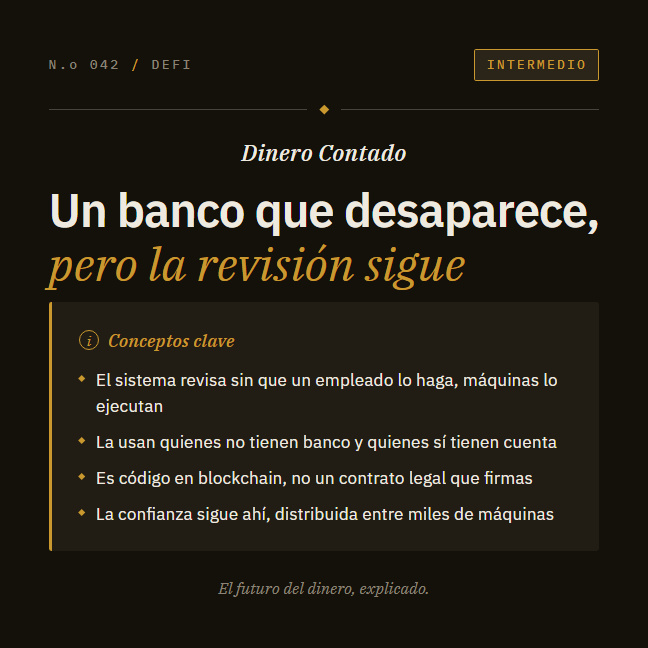
When you take out a loan without going through a bank, someone still checks that you pay on time.
The bank disappears from the picture, but the review doesn’t. Before, an employee approved your loan by reviewing paperwork and your history. Now, that review is done by code running on thousands of computers connected to one another. This code is called a smart contract, and it does something simple: it executes the rules only when they’re met, without anyone having to manually say yes. If you lend 100 and the contract charges a 2 fee, the borrower receives 98. Nobody negotiates that number in an office. It was already written into the code.
This whole system, where money moves and is validated without asking a bank or any other intermediary for permission, is what’s known as decentralized finance.
KEY CONCEPTS
- Thinking that decentralized finance means nobody checks anything is a mistake: the review still exists; it’s just carried out by a network of computers following code instead of a bank employee.
- It’s not a system just for people without access to traditional banking: people with regular bank accounts also use it to move money faster or pay lower fees.
- A smart contract isn’t a legal contract like the ones you sign with a lawyer: it’s code that runs on a blockchain, and what it does is limited to what that code says—nothing more.
This isn’t magic, nor is it the end of trust. It’s the same trust as always, distributed among thousands of computers instead of locked away in a single bank’s vault.
Transparency: Binance may pay us a commission if you trade after clicking an asset symbol or a price link in this post.
#FinanzasDescentralizadas #ContratosInteligentes #Blockchain #Cryptocurrencies
1
297

·
--
🧩 SMART CONTRACT GUIDE FOR BEGINNERS💥 WHAT ARE THEY AND WHY ARE THEY THE FOUNDATION OF EVERYTHING?
A smart contract is a program that runs automatically when certain conditions are met.
No lawyers or notaries are needed. The code enforces the rules.
👇 Answer with 🧩 if you already know what they are, or with 👀 if you want to learn
📌 HOW DOES A SMART CONTRACT WORK?
It’s like a vending machine:
- You put in a coin (send crypto)
- The machine gives you a product (the contract performs the action)
- There’s no going back or room for debate
🧩 SMART CONTRACT GUIDE FOR BEGINNERS
💥 WHAT ARE THEY AND WHY ARE THEY THE FOUNDATION OF EVERYTHING?
A smart contract is a program that runs automatically when certain conditions are met.
No lawyers or notaries are needed. The code enforces the rules.
👇 Answer with 🧩 if you already know what they are, or with 👀 if you want to learn
📌 HOW DOES A SMART CONTRACT WORK?
It’s like a vending machine:
- You put in a coin (send crypto)
- The machine gives you a product (the contract performs the action)
- There’s no going back or room for debate
1
119
A smart contract is neither a contract nor smart. It’s a marketing phrase awkwardly slapped onto it.
Let’s imagine something simple: if A deposits 20 $ETH before Friday, the code releases those funds to B. Nobody signs paperwork or calls a notary. The code checks the condition and acts on its own.
What if the condition isn’t met? The code doesn’t need anyone to decide: it simply doesn’t release the funds.
Under the hood, the code lives as copies on thousands of computers that agree on each block of data, linked together with a cryptographic signature that’s almost impossible to break. Each node runs the same copy, so the result is the same for everyone.
This is what they call a smart contract.
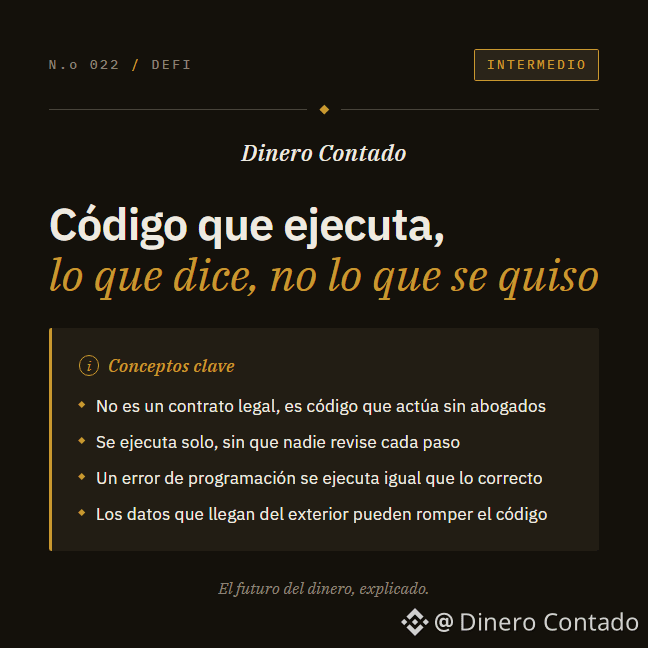
But here’s what almost nobody tells you: the code does what it says, not what the team meant. If there’s a bug, it still executes. And since it’s already been published on the network, nobody can go in and fix a line. Fixing it means publishing a new contract or migrating the entire network, and that’s neither quick nor free.
KEY CONCEPTS
- It isn’t a legal contract signed in front of lawyers. It’s code that runs on its own, without traditional legal recourse.
- It doesn’t need a person to check every step. By design, it executes without constant human supervision.
- A programming error doesn’t stop the code from running. It executes anyway, because it can’t distinguish intention from outcome.
- Many contracts rely on oracles to read external data. If the oracle fails, the contract fails—even if its code is perfect.
When people talk about a DeFi hack, this is almost always the cause: a line of code doing exactly what it said, not what someone imagined.
Transparency: Binance may pay us a commission if you trade after clicking an asset symbol or price link in this post.
#ContratosInteligentes #Blockchain #Ethereum #CryptoEducation
1
399

·
--
NEAR Intents explains the $3.8 million incident: what changed
On October 16, Alex Shevchenko, head of NEAR Intents, published a report on an incident that occurred between September 29 and October 1, 2026.
According to the report, a bug in deposit notifications left balances recorded even after the tokens had been returned. This discrepancy made it possible to withdraw approximately $3.8 million. The team said the issue was in the Intents contract.
CertiK’s October 8 analysis describes USDT payments from the bridge treasury on BNB Smart Chain. Distinguishing between the affected contract, the bridge, and the network helps clarify the scope of the incident.
Shevchenko says the funds were fully recovered on October 2, within 36 hours of detection. He also says affected users were compensated, without specifying that every compensation was made within that timeframe.
The fix was deployed on October 2. Following another critical report, the notification feature was removed on the 7th. The team added checks that compare user balances with the contract’s tokens and trigger an automatic pause if they do not match.
Market update: at 18:03 UTC on October 17, NEAR was trading at 4.923 USDT on Binance, down 1.93% over 24 hours. This price movement does not prove that the report caused it. To assess the risk, it is important to check the fixes and how the routes are functioning; recovering funds in this case does not guarantee they will be recovered in another incident.
$NEAR $USDT $BNB
Educational content. Not financial advice.
#NEAR #DeFi #Seguridad #SmartContracts

107

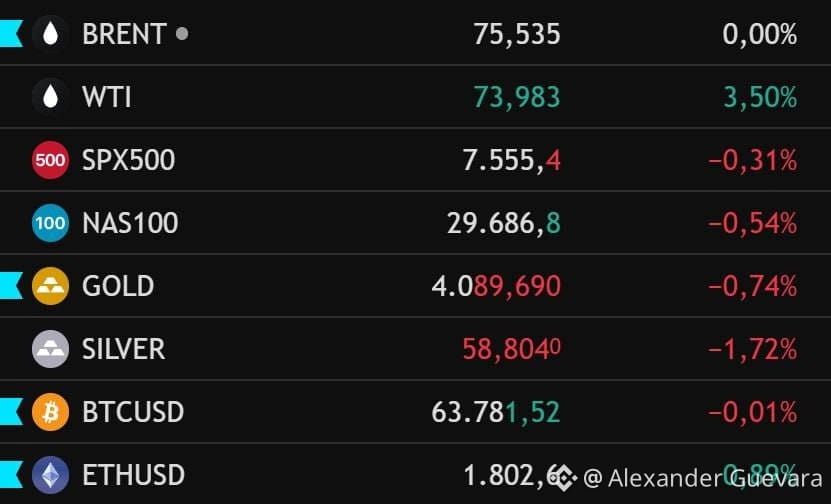
🛢 The #petróleo opens higher after mutual attacks by the US and Iran.
#iran #MineralExploration #Inversiones #ContratosInteligentes $BZ $XAU $XAG
🛢 The #petróleo opens higher after mutual attacks by the US and Iran.
#iran #MineralExploration #Inversiones #ContratosInteligentes $BZ $XAU $XAG
#iran #MineralExploration #Inversiones #ContratosInteligentes $BZ $XAU $XAG
3
307

·
--
Article
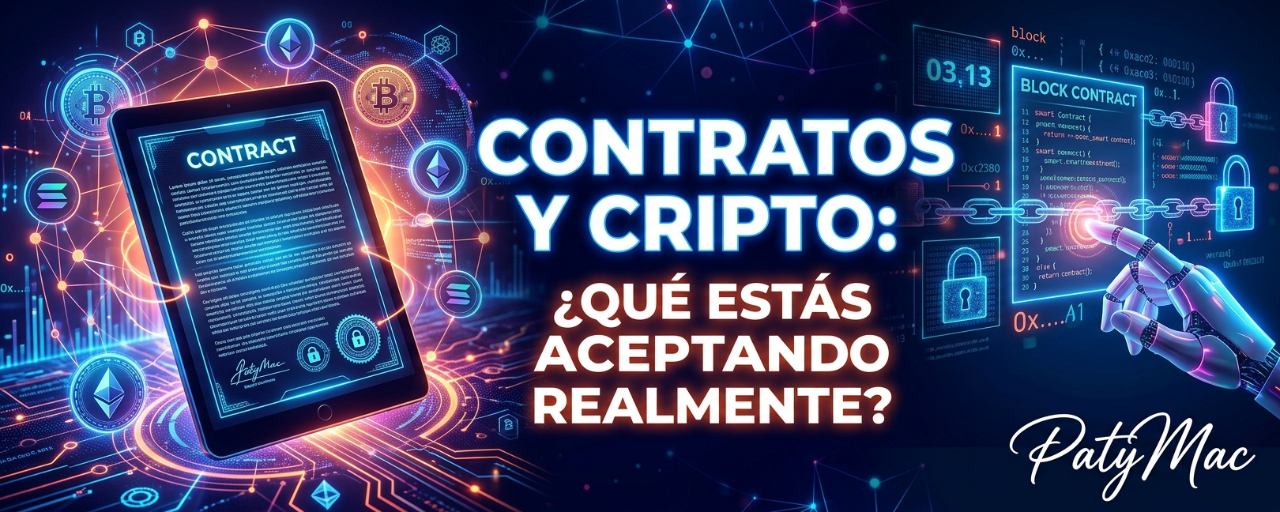
CONTRACTS AND CRYPTO: WHAT ARE YOU REALLY AGREEING TO?There is a phrase that we’ve probably all seen:
“I have read and accept the terms and conditions.”
And then we click on:
ACCEPT.
But let’s be honest:
How many people really read the entire document before starting to trade cryptocurrencies?
And here appears a legal issue that I consider fundamental:
When we trade crypto, we are also entering into contractual relationships.
Not everything is blockchain.
Not everything is code.
Not everything is technology.
There are also:
contracts, obligations, rights, jurisdiction, and dispute resolution mechanisms.
CONTRACTS AND CRYPTO: WHAT ARE YOU REALLY AGREEING TO?
There is a phrase that we’ve probably all seen:
“I have read and accept the terms and conditions.”
And then we click on:
ACCEPT.
But let’s be honest:
How many people really read the entire document before starting to trade cryptocurrencies?
And here appears a legal issue that I consider fundamental:
When we trade crypto, we are also entering into contractual relationships.
Not everything is blockchain.
Not everything is code.
Not everything is technology.
There are also:
contracts, obligations, rights, jurisdiction, and dispute resolution mechanisms.
216

·
--

Article
🧩 THE PEPE CASE! 60 MILLION LOCKED! LESSONS FROM A TRAP IN THE CONTRACT💥 THE STORY EVERY CRYPTO INVESTOR SHOULD KNOW
A person bought billions of PEPE tokens almost at launch for about 26 bucks
His wallet soared to over 60 million dollars
But he could never touch that money
👇 Respond with 🧩 if you already knew about this case or with 👀 if it surprises you
📌 WHAT EXACTLY HAPPENED?
The creators of PEPE included a hidden feature in the smart contract
That feature allowed blocking specific addresses so they couldn't sell or transfer
🧩 THE PEPE CASE! 60 MILLION LOCKED! LESSONS FROM A TRAP IN THE CONTRACT
💥 THE STORY EVERY CRYPTO INVESTOR SHOULD KNOW
A person bought billions of PEPE tokens almost at launch for about 26 bucks
His wallet soared to over 60 million dollars
But he could never touch that money
👇 Respond with 🧩 if you already knew about this case or with 👀 if it surprises you
📌 WHAT EXACTLY HAPPENED?
The creators of PEPE included a hidden feature in the smart contract
That feature allowed blocking specific addresses so they couldn't sell or transfer
1
88
#Educate the #POPULATION=PROFESSIONAL TRAINING #contratosinteligentes
#CNS
#Educate the #POPULATION=PROFESSIONAL TRAINING #contratosinteligentes
#CNS
#CNS
1
1
4
475
Log in to explore more content
Join global crypto users on Binance Square
⚡️ Get latest and useful information about crypto.
💬 Trusted by the world’s largest crypto exchange.
👍 Discover real insights from verified creators.
Email / Phone number
Trending Topics
1
#NvidiaInvestigatesAfterHuang’sAffairApology
17,202 views
256 Discussing
2
#BitcoinFiveWeeklyLosses
31,755 views
687 Discussing
3
#AIChipSlumpNasdaq
17,035 views
384 Discussing
4
#EthereumSpotETFsPost$365MWeeklyOutflow
587 views
23 Discussing
5
#TradFiForBeginners
255,668 views
2,286 Discussing
6
#SouthKoreaDraftLawTargets15To20%ShareholderCap
183,082 views
950 Discussing
7
#KeplrAdvisesSocialLoginUsersToTransferAssets
86,212 views
656 Discussing
8
#TetherPlans€28.8MForJuventusCapitalIncrease
59,695 views
482 Discussing
9
#JobsReportRaisesHikeOdds
1M views
4,668 Discussing
10
#CPITestsDecemberRateOutlook
477,063 views
2,048 Discussing