

#cftc
cftc
1.9M views
4,533 Discussing
Hot
Latest

·
--
U.S. regulation of crypto trading platforms is moving toward an “opt-in federal tier.”
According to reports by PANews and others, CFTC Chair Mike Selig said that while Congress has yet to legislate, the commission is advancing a voluntary federal registration path for crypto exchanges. Ordinary spot platforms will generally continue to operate under state money-transmitter licenses, while platforms offering retail users margin, leverage, or financing are more likely to fall under CFTC jurisdiction and require registration. The accompanying CTX/CAM proposals are still in the public-comment stage, with the comment period reportedly closing around mid-December.
How to read this: Don’t mistake “voluntary registration” for “an immediate, uniform license for the entire market.” First, distinguish among three tiers: state licensing for spot-only platforms, the federal tier for retail platforms offering leverage, and existing derivatives-licensed platforms expanding their offerings. What matters more to traders is which tier their platform falls under, and which rules govern customer funds and dispute resolution. Until the rules are finalized, keep an eye on the draft and the timeline for formal proposals—not the slogans.
#CFTC #Selig #加密监管 #Exchange
6

·
--
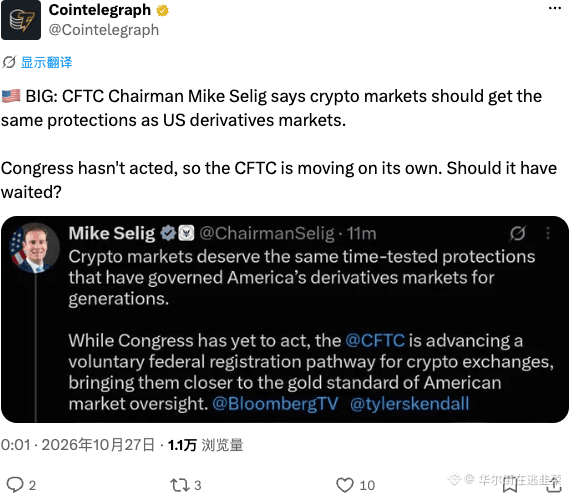
CFTC Chair Selig says crypto markets should receive the same treatment as U.S. stock futures. Congress is still dragging its feet, so regulators have gotten impatient and are taking matters into their own hands. This is basically the moment they officially bring the wild child into the fold. If they want to regulate it, then play by the rules—no empty gestures.
#CryptoRegulation #CFTC
#CryptoRegulation #CFTC
1

CFTC Chair Selig says he wants to set up “voluntary registration” for crypto exchanges, and within an hour, JUST IN accounts had reposted it verbatim all over the feed. Hate to be a downer, but the key word is “voluntary.”
The CLARITY Act passed the House last July, but got stuck in the Senate last month. The CFTC isn’t waiting around, so it’s opening a door on its own. The question is: who’ll walk through it? Offshore exchanges don’t cater to U.S. retail traders looking for leverage in the first place, so they have no reason to voluntarily sign up for things like segregating customer funds and market surveillance. The ones likely to line up are basically the few already looking to legally offer leveraged trading to U.S. retail customers—and all they’re waiting for is a license they can put on their marketing materials.
So this is good news for licensed platforms and major exchanges that can absorb the cost of compliance—not for the altcoins you’re holding. There’s no rulebook or timeline yet, just “we’re working on it.”
Breaking-news accounts translate “in the works” into “the U.S. fully embraces crypto” because it drives traffic. There are two things to watch for: whether they publish the registration requirements and fees, and whether any major exchange publicly says it plans to apply. Until then, this is just talk.
#CFTC #CryptoRegulation

Latest remarks from the CFTC chair: While congressional legislation has yet to become law, the commission is advancing a path for crypto exchanges to pursue “voluntary federal registration,” bringing platforms closer to U.S. market regulatory standards.
This is not a green light. Rather, it allows exchanges to align with protections long used in U.S. derivatives markets, such as disclosure, market oversight, and customer protection. In the short term, the voluntary framework gives compliant platforms a clearer path to engage with regulators; in the long term, regulatory certainty remains key to institutional investment and user trust.
It is still unclear when Congress will act, but exchanges cannot simply wait. Platforms that demonstrate their compliance capabilities sooner may be better positioned to take the initiative in the next round of U.S. market access.
#CFTC #加密监管 #Compliance

·
--
The CFTC chair has sent a clear message: Congress hasn’t acted, so regulators will. A voluntary federal registration pathway for crypto exchanges is moving forward, aiming to bring platforms closer to the risk management, disclosure, and customer protection standards of U.S. derivatives markets.
The key word is “voluntary,” but the practical impact may be anything but mild. Once registration standards, audit requirements, and market oversight mechanisms are clear, major exchanges are likely to apply voluntarily to gain the trust of the U.S. market. Unregistered platforms, meanwhile, may face implicit barriers when it comes to banking, institutional clients, and compliant assets.
For the industry, this is more predictable than ambiguous enforcement. For users, stronger protections also mean more conservative platform operations and listing decisions. U.S. regulatory compliance is accelerating, and exchanges are shifting their competitive focus from traffic to licensing, risk management, and transparency.
#CFTC #加密监管 #U.S. market

CFTC Chair Mike Selig said that while Congress has yet to complete crypto legislation, the commission is advancing a voluntary federal registration pathway for crypto exchanges, bringing platforms closer to U.S. market regulatory standards.
He believes crypto markets should also benefit from the investor protections that have long been in place in U.S. derivatives markets. In the short term, registration may increase platforms’ compliance costs; in the long term, clear rules could help rebuild trust and attract traditional capital. Key issues going forward include whether the scope of registration, capital requirements, and enforcement rules can strike a balance between innovation and safety.#CFTC #加密合规 #U.S.Regulation
He believes crypto markets should also benefit from the investor protections that have long been in place in U.S. derivatives markets. In the short term, registration may increase platforms’ compliance costs; in the long term, clear rules could help rebuild trust and attract traditional capital. Key issues going forward include whether the scope of registration, capital requirements, and enforcement rules can strike a balance between innovation and safety.#CFTC #加密合规 #U.S.Regulation

·
--
CFTC Chair Mike Selig said that while Congress has yet to complete crypto legislation, the Commission is working to steer crypto exchanges toward “voluntary federal registration,” bringing their operations more in line with U.S. market regulatory standards.
What does this mean?
1. Regulatory coordination is moving forward early: Rather than wait for a bill from Congress, the CFTC is providing a registration framework that can be put into practice.
2. Investor protection is front and center: He wants the crypto market to have safeguards similar to those in the U.S. derivatives market.
3. For exchanges, voluntary registration could become an important credential for earning the trust of U.S. users and institutions—but it also means stricter compliance, disclosure, and risk-management requirements.
In the short term, this does not mean a full opening of the market. In the long term, it could establish clearer entry rules for U.S. crypto trading platforms. Regulatory clarity is often a prerequisite for large-scale investment from traditional finance.
#CFTC #加密监管 #U.S.Market

·
--
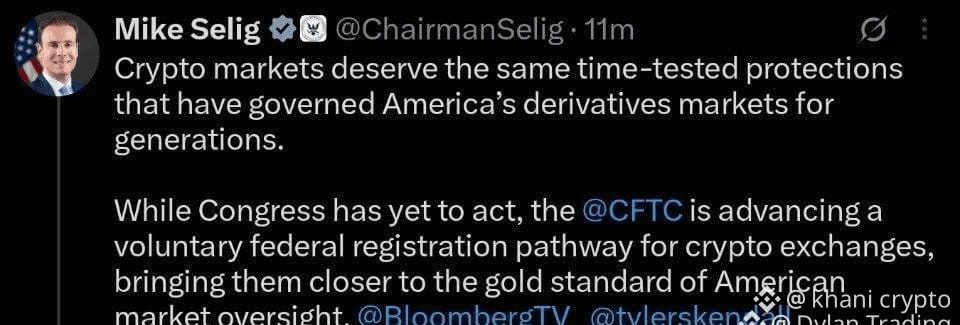
🚨 Breaking: Mike Selig, Chairman of the U.S. Commodity Futures Trading Commission (CFTC), announces a move to grant digital asset markets regulatory protection similar to U.S. derivatives markets! ⚖️
The U.S. Congress has not yet passed comprehensive legislation to regulate the crypto sector, raising questions about the agency acting on its own.
🔹 Supporters believe that moving quickly could strengthen investor protection and reduce risks.
🔹 Critics think the agency should have waited for clarity in the legislative framework before taking new steps.
🔹 Decentralized platforms may face additional legal questions regarding the scope of the regulator’s authority.
📊 What is the potential impact on the market?
Stricter regulatory requirements could increase compliance costs for companies, but they may also strengthen financial institutions’ confidence in the digital asset market.
As for the impact on prices, it remains uncertain, although the market may react positively to any developments that improve regulatory clarity. 📈
👀 Coins worth watching:
$BEAMX
$CHIP
$BULLA
💬 Do you think increased regulation will attract more institutions to the crypto market, or will it impose additional constraints on innovation?
#Crypto #CFTC #Bitcoin #Altcoins #Bina
{future}(BULLAUSDT)
{future}(CHIPUSDT)
{future}(BEAMXUSDT)
🚨 Breaking: Mike Selig, Chairman of the U.S. Commodity Futures Trading Commission (CFTC), announces a move to grant digital asset markets regulatory protection similar to U.S. derivatives markets! ⚖️
The U.S. Congress has not yet passed comprehensive legislation to regulate the crypto sector, raising questions about the agency acting on its own.
🔹 Supporters believe that moving quickly could strengthen investor protection and reduce risks.
🔹 Critics think the agency should have waited for clarity in the legislative framework before taking new steps.
🔹 Decentralized platforms may face additional legal questions regarding the scope of the regulator’s authority.
📊 What is the potential impact on the market?
Stricter regulatory requirements could increase compliance costs for companies, but they may also strengthen financial institutions’ confidence in the digital asset market.
As for the impact on prices, it remains uncertain, although the market may react positively to any developments that improve regulatory clarity. 📈
👀 Coins worth watching:
$BEAMX
$CHIP
$BULLA
💬 Do you think increased regulation will attract more institutions to the crypto market, or will it impose additional constraints on innovation?
#Crypto #CFTC #Bitcoin #Altcoins #Bina
132
·
--
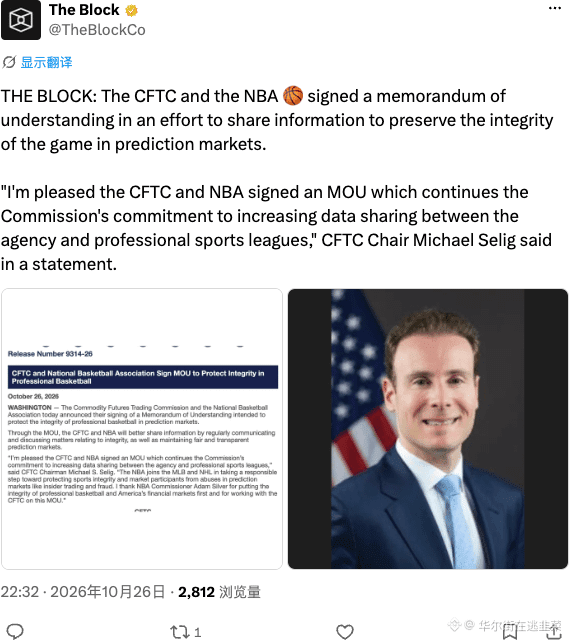
The CFTC and NBA signed an MOU to share data on prediction markets and keep games from being manipulated by the “bookies.” It’s regulators and traditional sports teaming up: ostensibly to protect game outcomes, but really to get in and carve up the pie. Going forward, compliance will be the name of the game for sports prediction markets. This narrative has solid momentum.
$NBA $PREDICTION #CFTC
$NBA $PREDICTION #CFTC
11

·
--
🎯 The CFTC signed a memorandum of understanding with the NBA—pretty slick
📰 The stated goal is to protect the integrity of professional basketball events on prediction markets. In other words, officials are endorsing sports contracts while setting insider-trading rules in advance
💬 U.S. regulators played this one well. Instead of shutting down prediction markets, they’re talking compliance—which shows this sector is being brought into the fold. Sports markets may soon get a lot more legitimate
🏷️ #预测市场 #CFTC #监管合规 #SportsContracts

·
--
Came across this on Trade Handle: CFTC enforcement director David Miller said at a NEXTPredict event in New York that there have been—and may still be—investigations into candidates trading contracts tied to their own races. Campaign staff using confidential information gained through their jobs to trade event contracts could also constitute insider trading. They’ll be keeping an eye on the markets on election night.
The key point: At the 10/22 event, he declined to discuss specific midterm cases but confirmed that investigations involving “some candidates” are underway. The event also touched on an investigation into suspicious crude oil futures trading around the Iran conflict, and the prospect of large offshore prediction markets that want to serve Americans moving toward registration. Responding to civil penalties in the White House teleprompter case, he also said, “Whoever it is, insider trading has to be dealt with.”
With the midterms approaching, regulators seem to be keeping a noticeably closer eye on event contracts than on chat rooms.
#CFTC #预测市场 #MidtermElections
3

🚨 NEW: Commodity exchanges including CME are pressing the CFTC to reject Kalshi’s proposed perpetual oil futures contract over market integrity risks, per Bloomberg.
#Crypto #CFTC
🚨 NEW: Commodity exchanges including CME are pressing the CFTC to reject Kalshi’s proposed perpetual oil futures contract over market integrity risks, per Bloomberg.
#Crypto #CFTC
#Crypto #CFTC

1
238
·
--
Spotted on Finance Magnates / Bloomberg: Commodity giants join forces to urge the CFTC to block Kalshi’s crude oil “perpetuals.”
Key details: Prediction market Kalshi applied to the CFTC on October 20 to list WTIPERP, a WTI contract with no expiration date. It references near-month NYMEX futures pricing, has a daily funding rate that keeps it close to spot prices, is cash-settled at 100 barrels per contract (about one-tenth the size of a standard crude oil futures contract), and does not trade on weekends. Two days later, the Commodity Markets Council—which includes members such as CME, NYMEX, and ICE Futures U.S.—wrote to the CFTC, saying oil perpetuals threaten market integrity and urging it not to approve the contract. It also called for cooperation with foreign regulators to restrict U.S. retail traders from using VPNs to access offshore commodity platforms.
Background: Kalshi had already launched WTI futures with expiration dates, reportedly seeing about $57 million in daily trading volume and leverage of up to around 5.9x. WTIPERP is still under review. The CFTC has at least 45 days to review it (extendable to 90 days), and trading cannot begin without approval.
The crypto world’s perpetual-futures model is trying to move into the physical oil market, and traditional futures players have already made an effort to stop it.
#Kalshi #CFTC #CrudeOil
391

Verified
Decentralized exchanges are starting to proactively embrace regulation. Perpetuals DEX Lighter announced on its Q3 investor call that it will formally submit applications to the U.S. CFTC for derivatives licenses in November, seeking both a DCM (Designated Contract Market) and a DCO (Derivatives Clearing Organization) license. It aims to become the first on-chain perpetuals exchange licensed by the CFTC. LIT surged more than 20% in response, climbing to around $3.90. The team has been in discussions with regulators for 11 months, and its initial target is U.S. institutional clients, not retail traders. The CFTC review window can be as long as 280 days, so approval is far from certain. But the direction is clear: Robinhood Chain integrated with it long ago, with trading revenue split 50/50, and on-chain derivatives are becoming part of the mainstream financial system. Until the licenses are granted, it’s all still just an expectation.#CFTC #永续合约 #Regulation
Decentralized exchanges are starting to proactively embrace regulation. Perpetuals DEX Lighter announced on its Q3 investor call that it will formally submit applications to the U.S. CFTC for derivatives licenses in November, seeking both a DCM (Designated Contract Market) and a DCO (Derivatives Clearing Organization) license. It aims to become the first on-chain perpetuals exchange licensed by the CFTC. LIT surged more than 20% in response, climbing to around $3.90. The team has been in discussions with regulators for 11 months, and its initial target is U.S. institutional clients, not retail traders. The CFTC review window can be as long as 280 days, so approval is far from certain. But the direction is clear: Robinhood Chain integrated with it long ago, with trading revenue split 50/50, and on-chain derivatives are becoming part of the mainstream financial system. Until the licenses are granted, it’s all still just an expectation.#CFTC #永续合约 #Regulation
696
·
--
This is worth keeping an eye on, TokenPost: CFTC Chair Selig said crypto exchanges can choose between state licenses and federal registration based on their business models. Federal registration is an option, not a requirement—and a one-size-fits-all national regime would require an act of Congress.
The context is the ANPRM issued on 10/5 (Regulation CTX / CAM): for retail crypto transactions involving margin, leverage, or financing, the CFTC is considering tailored federal rules. Ordinary spot trading will mostly remain under state money-transmission and licensing frameworks (such as New York’s BitLicense). He favors uniform standards for interstate business.
These are not final rules yet; the comment period runs through 12/14. The next question is how the “optional federal pathway” will work in practice—or whether Congress will go further. That’s more concrete than simply calling for regulatory clarity.
$BTC #加密监管 #CFTC

90

·
--
⚠️ Could buying BTC with the full purchase price still be regulated as a “futures” transaction? Everyone should take a look at this CFTC proposal
📌 What happened:
In early October, the CFTC published a proposed Regulation CTX / CAM framework, which the media began discussing widely on October 21:
• If a platform has ever “offered” leverage or financing, even if you decline it and pay in full, your transaction could still fall within the scope of retail commodity transaction regulation (CEA 2(c)(2)(D))
• The exemption requires “actual delivery” within 28 days—the coins must reach a wallet you control (you hold the private keys); simply recording them on the exchange’s internal ledger doesn’t count
• The public comment period ends December 14; this is not a final rule yet
🧭 My take:
1️⃣ The headwind is “compliance costs,” not the coins themselves—more platforms may be pushed to obtain a federal license (CAM) or restrict leverage for U.S. users
2️⃣ “Not your keys” now has another regulatory footnote, which could give the self-custody narrative a boost
3️⃣ But there’s still a lot of uncertainty at the draft stage, so don’t treat this as a rule that’s already in effect
📊 Market: BTC around $81.3K, 24h -3.7% (CoinGecko); ETH $2,383; Fear & Greed Index at 68 (Greed). Range: $80K–$87K, with $80K as the bull-bear dividing line.
💬 Would you rather move your coins to your own wallet or keep them on an exchange? Let’s talk in the comments 👇
$BTC $ETH
#CFTC #加密监管 #Bitcoin
These are my personal opinions only and do not constitute investment advice
1

·
--
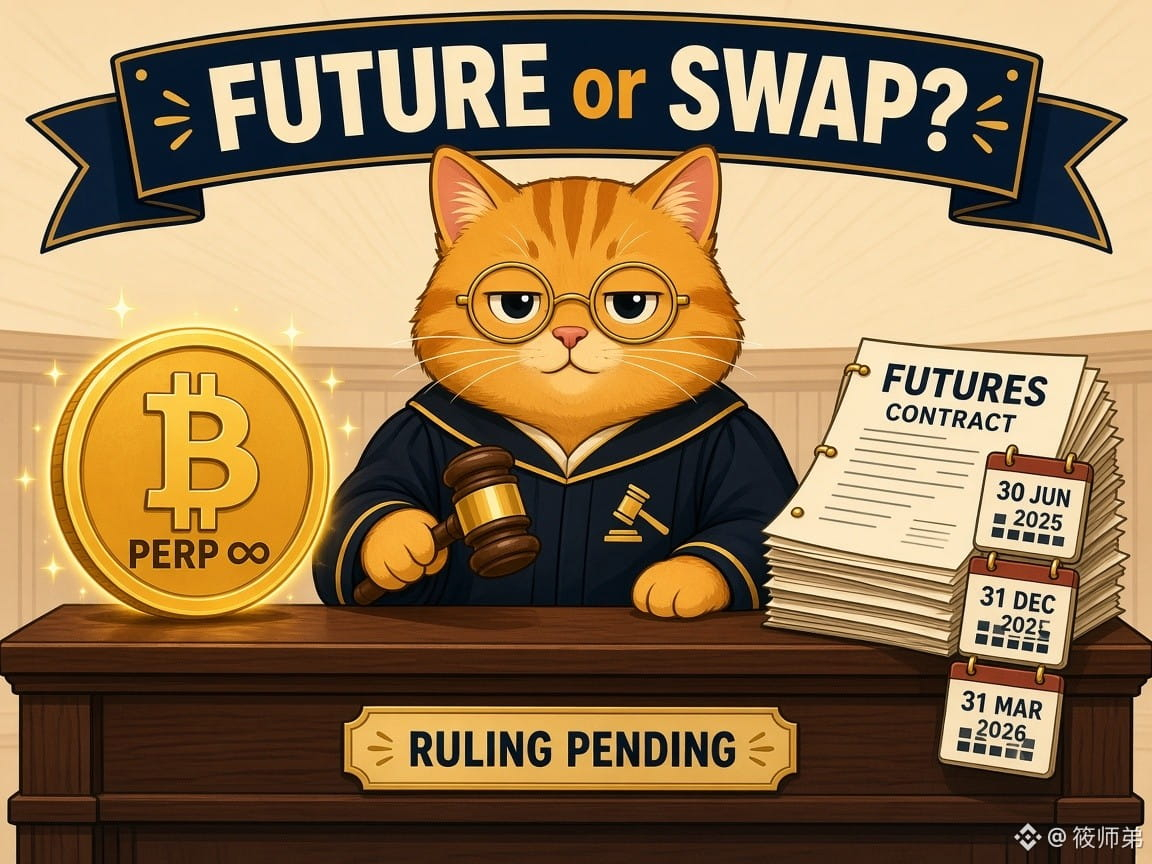
The fate of U.S. perpetual contracts hangs in the balance: CME’s lawsuit against the CFTC enters countdown to a ruling
📌 In June, CME sued the CFTC, seeking to overturn its May 29 order approving the regulation of Kalshi’s Bitcoin perpetual contracts as “futures.” CME argues that perpetual contracts have no expiration date and are essentially “swaps” (Reuters/CoinDesk)
📌 On October 16, the CFTC filed its response, arguing that CME has not shown it was harmed and lacks standing to sue. It also cited CME’s own data: crypto futures trading volume rose from 2.66 million contracts in May to 3.28 million in September, an increase of about 23% (CoinDesk/CryptoWatchDesk)
📌 All written arguments on the motion to dismiss have been completed, and the case is awaiting a federal judge’s ruling. If the case proceeds, cross-motions for summary judgment are due November 20. Kalshi has self-certified perpetual contracts for ETH, SOL, XRP, LINK, and SUI (complaint)
📌 TD Cowen analyst Seiberg believes CME may still have the upper hand, and is concerned that perpetual contracts could grow ever larger during the lawsuit, making them difficult to roll back later
【Viewpoint】This is not just a dispute between exchanges, but a battle over whether “perpetual contracts can operate compliantly in the United States.” If they are classified as futures, U.S.-based platforms could rapidly expand perpetual contracts and attract some offshore leveraged capital. If they are classified as swaps, the higher barriers and compliance costs would largely impede their expansion in the U.S.
【Opportunities/Risks】
1️⃣ Watch for the ruling on the motion to dismiss: dismissal would benefit the expansion of U.S.-based perpetual contracts and related platforms; if the motion is denied, uncertainty could continue into December and beyond
2️⃣ The liquidity of coins with perpetual contracts already listed (BTC/ETH/SOL/XRP, etc.) on compliant derivatives platforms in the U.S. is tied to this case
3️⃣ Risk: If the contracts are ultimately ruled to be swaps, existing positions and products could face delisting or migration, and leveraged capital may flow back offshore
Do you think U.S. perpetual contracts will ultimately be classified as “futures” or “swaps”?
#永续合约 #CFTC #加密监管 #BTC
$BTC $SOL
For reference only; not investment advice
626

Think cash payment keeps bitcoin outside futures regulation? The CFTC says: not necessarily.
In a 109-page advance notice (Oct 5; comments due Dec 14), the agency sketches a preliminary read: under commodity law, a retail purchase offered with leverage, margin, or financing can be treated like a futures contract without actual delivery inside 28 days.
The kicker: declining the loan doesn't settle it. If the platform's terms offered financing, a fully paid cash buy stays in scope until delivery. And delivery means real control — private keys, not a balance on the exchange's internal ledger. Moving coins to a self-custody wallet generally satisfies it.
Why it matters: whether coins ever leave the exchange's books is a regulatory question. Exchanges must weigh contract terms and custody structure — not just how you paid.
Honest note: consultation-stage, not a final rule — and the CFTC keeps anti-fraud authority either way.
Which exchange sits on the most retail flow that could get reclassified?
$BTC $82,948 (+0.2%), $ETH $2,444 (-0.1%) — no sharp reaction to the headline. NFA. DYOR.
#Bitcoin #CFTC #CryptoRegulation #Futures
34

·
--
Binance.US and Blockchain.com have filed applications with the CFTC to launch regulated prediction markets. These are applications, not approvals: approval or launch has not yet been confirmed. Crypto companies are moving beyond token trading and expanding their product offerings. For the $BNB ecosystem, this is another sign that major exchanges are seeking new sources of revenue amid a prolonged downturn.
Will prediction markets be the next big thing for exchanges? 👇
#PredictionMarkets #CFTC #BinanceUS
Will prediction markets be the next big thing for exchanges? 👇
#PredictionMarkets #CFTC #BinanceUS
1
278
Log in to explore more content
Join global crypto users on Binance Square
⚡️ Get latest and useful information about crypto.
💬 Trusted by the world’s largest crypto exchange.
👍 Discover real insights from verified creators.
Email / Phone number
Trending Topics
1
#BinancePick
2.9M views
149,321 Discussing
2
#EarningsSeason
5.2M views
25,491 Discussing
3
#AnthropicTTMRevenueGrewAbout1200%
7,725 views
224 Discussing
4
#AnthropicS1ExpectedToday
11,068 views
212 Discussing
5
#SouthKoreaReportedlyWeighsFourthCryptoTaxDelay
19,230 views
349 Discussing
6
#FranklinTempletonFilesForTwoDividendToBitcoinETFs
26,176 views
455 Discussing
7
#StrategyMSTRSurpassesNasdaqInMarketCap
20,051 views
339 Discussing
8
#CanadaProposesStablecoinRedemptionWithin3BusinessDays
920 views
33 Discussing
9
#ElectrumWalletBugLetRogueServersStealFunds
23,465 views
426 Discussing
10
#ArgentineCourtDismissesLIBRACaseAgainstMilei
35,444 views
523 Discussing