

#regulation
regulation
2.1M views
13,461 Discussing
Hot
Latest

·
--
🏛️ U.S. STATES CHARTER FIRST DIGITAL ASSET BANKS TO UNLOCK INSTITUTIONAL CAPITAL FOR $BTC ! ⚡
Institutional rails are quietly being laid while retail sleeps. Wyoming banking regulators just partnered with New York DFS to streamline legal charters and joint supervision for digital asset banking entities. 🏦
This cross-state regulatory framework is a massive green light for institutional liquidity looking to enter the market under clear legal protection. 📊 When regulatory friction vanishes, smart money doesn't walk into the order books—it runs. 🦈
💡 Capital bridges like these are what sustain long-term mega cycles rather than short-lived speculative pumps. 💬 Do you think this state-level cooperation accelerates the next major institutional expansion? 👇
⚠️ Not financial advice. Always manage your risk. 🛡️
🏷️ #BTC #CryptoNews #Regulation #Institutional #Crypto
🏦 ⚡
🏛️ U.S. STATES CHARTER FIRST DIGITAL ASSET BANKS TO UNLOCK INSTITUTIONAL CAPITAL FOR $BTC ! ⚡
Institutional rails are quietly being laid while retail sleeps. Wyoming banking regulators just partnered with New York DFS to streamline legal charters and joint supervision for digital asset banking entities. 🏦
This cross-state regulatory framework is a massive green light for institutional liquidity looking to enter the market under clear legal protection. 📊 When regulatory friction vanishes, smart money doesn't walk into the order books—it runs. 🦈
💡 Capital bridges like these are what sustain long-term mega cycles rather than short-lived speculative pumps. 💬 Do you think this state-level cooperation accelerates the next major institutional expansion? 👇
⚠️ Not financial advice. Always manage your risk. 🛡️
🏷️ #BTC #CryptoNews #Regulation #Institutional #Crypto
🏦 ⚡
Institutional rails are quietly being laid while retail sleeps. Wyoming banking regulators just partnered with New York DFS to streamline legal charters and joint supervision for digital asset banking entities. 🏦
This cross-state regulatory framework is a massive green light for institutional liquidity looking to enter the market under clear legal protection. 📊 When regulatory friction vanishes, smart money doesn't walk into the order books—it runs. 🦈
💡 Capital bridges like these are what sustain long-term mega cycles rather than short-lived speculative pumps. 💬 Do you think this state-level cooperation accelerates the next major institutional expansion? 👇
⚠️ Not financial advice. Always manage your risk. 🛡️
🏷️ #BTC #CryptoNews #Regulation #Institutional #Crypto
🏦 ⚡
12

·
--
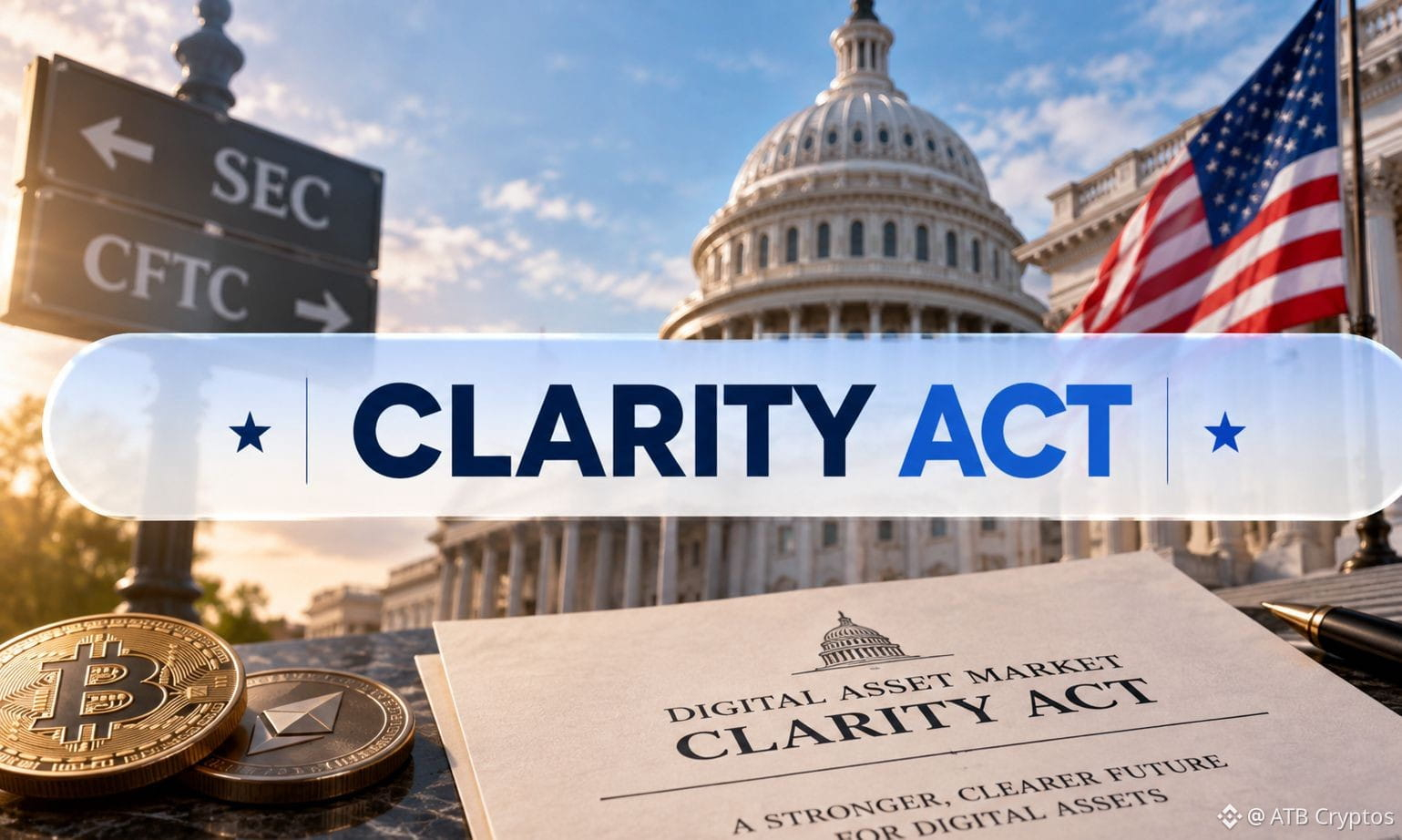
The CLARITY Act’s defeat sparked a surprise rally across crypto.
Both Bitcoin and Ethereum rose about 11% after the vote.
NEAR jumped 125%, Uniswap rose 49%, and Avalanche gained 44%, according to Bitwise CIO Matt Hougan.
The bill would have restricted stablecoin platforms from paying interest or rewards, and imposed a national licensing system for spot exchanges. With the legislation stalled, existing stablecoin rules remain, benefitting companies like Coinbase, while exchanges such as Kraken avoid new licensing limits.
SEC‑approved tokenized US stocks and clarified buy‑back rules also give revenue‑generating tokens clearer guidance under current regulation.
Do you think the crypto market thrives better under existing rules or needs new legislation to grow?
#Crypto #Bitcoin #Ethereum #Regulation #Stablecoins
The CLARITY Act’s defeat sparked a surprise rally across crypto.
Both Bitcoin and Ethereum rose about 11% after the vote.
NEAR jumped 125%, Uniswap rose 49%, and Avalanche gained 44%, according to Bitwise CIO Matt Hougan.
The bill would have restricted stablecoin platforms from paying interest or rewards, and imposed a national licensing system for spot exchanges. With the legislation stalled, existing stablecoin rules remain, benefitting companies like Coinbase, while exchanges such as Kraken avoid new licensing limits.
SEC‑approved tokenized US stocks and clarified buy‑back rules also give revenue‑generating tokens clearer guidance under current regulation.
Do you think the crypto market thrives better under existing rules or needs new legislation to grow?
#Crypto #Bitcoin #Ethereum #Regulation #Stablecoins
Both Bitcoin and Ethereum rose about 11% after the vote.
NEAR jumped 125%, Uniswap rose 49%, and Avalanche gained 44%, according to Bitwise CIO Matt Hougan.
The bill would have restricted stablecoin platforms from paying interest or rewards, and imposed a national licensing system for spot exchanges. With the legislation stalled, existing stablecoin rules remain, benefitting companies like Coinbase, while exchanges such as Kraken avoid new licensing limits.
SEC‑approved tokenized US stocks and clarified buy‑back rules also give revenue‑generating tokens clearer guidance under current regulation.
Do you think the crypto market thrives better under existing rules or needs new legislation to grow?
#Crypto #Bitcoin #Ethereum #Regulation #Stablecoins
1
155

$USDC #TreasuryLetsStatesFileStablecoinCertificationsEarly
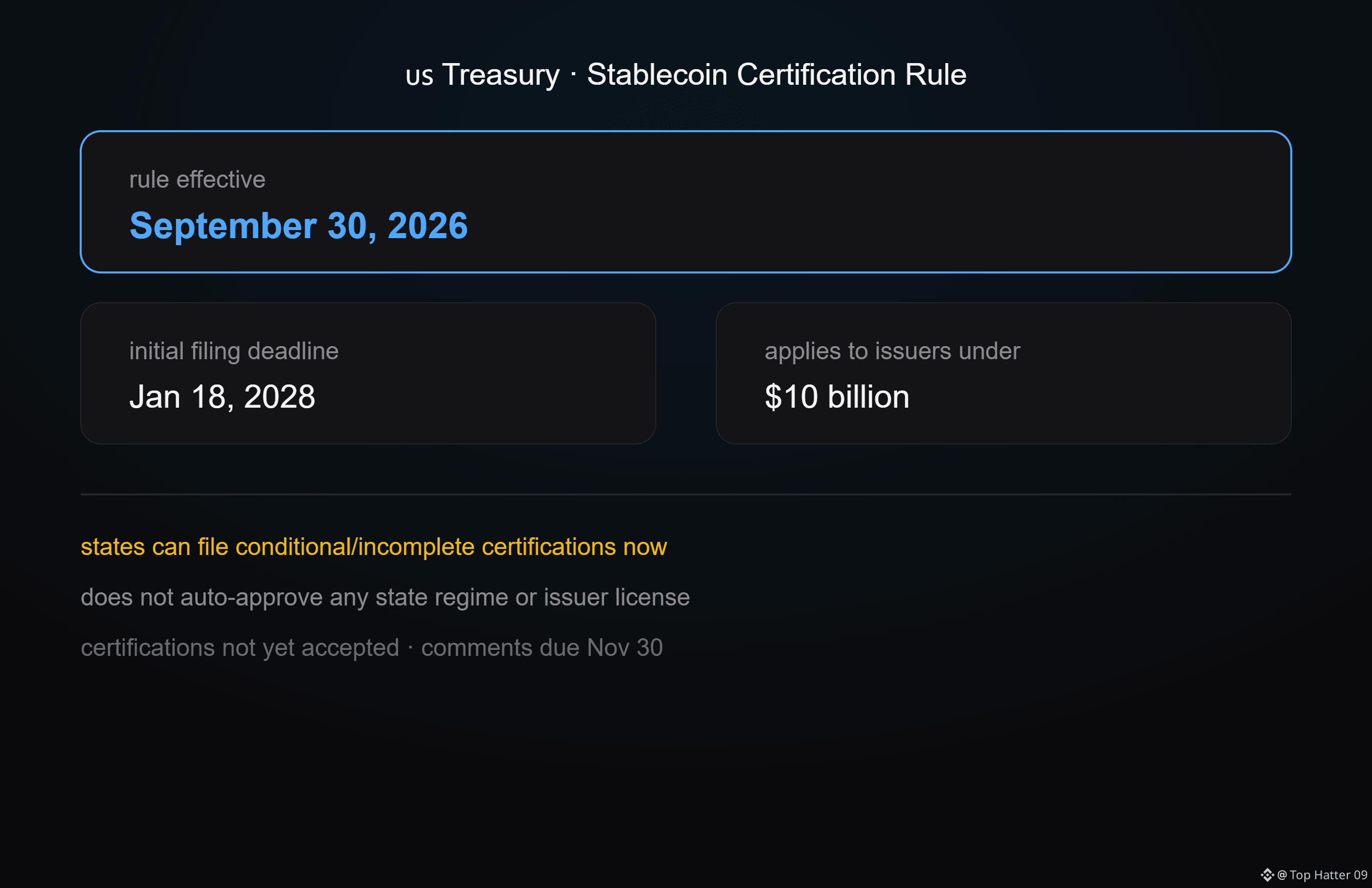
The US Treasury issued an interim final rule on September 30 that gives states more breathing room to file their stablecoin certifications, even if their own rules aren't finished yet. This is all part of the GENIUS Act, the law setting up the federal framework for stablecoin issuers.
Here's the simple version. States that want to regulate their own qualified stablecoin issuers directly, as long as those issuers have less than $10 billion in total issuance, need to file a "substantial similarity" certification with Treasury, basically proving their state rules match up with the federal ones. The deadline for that is January 18, 2028. What's new is that a state doesn't need to have everything finalized to meet that deadline, they can file a conditional or incomplete certification now and keep working on the details before the actual substantive review starts.
One thing to be clear on, this doesn't approve anything automatically. Filing just secures a spot in line, it doesn't hand out a license. And certifications aren't even being accepted yet, Treasury is still waiting on Paperwork Reduction Act approval before opening that door. Comments on the rule are open until November 30.
This is slow-moving news compared to a price pump, but it matters, it's the same kind of regulatory plumbing we've seen building with the CFTC's tokenized asset guidance, piece by piece.
$USDC #Stablecoins #Regulation
{future}(USDCUSDT)
$USDC #TreasuryLetsStatesFileStablecoinCertificationsEarly
The US Treasury issued an interim final rule on September 30 that gives states more breathing room to file their stablecoin certifications, even if their own rules aren't finished yet. This is all part of the GENIUS Act, the law setting up the federal framework for stablecoin issuers.
Here's the simple version. States that want to regulate their own qualified stablecoin issuers directly, as long as those issuers have less than $10 billion in total issuance, need to file a "substantial similarity" certification with Treasury, basically proving their state rules match up with the federal ones. The deadline for that is January 18, 2028. What's new is that a state doesn't need to have everything finalized to meet that deadline, they can file a conditional or incomplete certification now and keep working on the details before the actual substantive review starts.
One thing to be clear on, this doesn't approve anything automatically. Filing just secures a spot in line, it doesn't hand out a license. And certifications aren't even being accepted yet, Treasury is still waiting on Paperwork Reduction Act approval before opening that door. Comments on the rule are open until November 30.
This is slow-moving news compared to a price pump, but it matters, it's the same kind of regulatory plumbing we've seen building with the CFTC's tokenized asset guidance, piece by piece.
$USDC #Stablecoins #Regulation
The US Treasury issued an interim final rule on September 30 that gives states more breathing room to file their stablecoin certifications, even if their own rules aren't finished yet. This is all part of the GENIUS Act, the law setting up the federal framework for stablecoin issuers.
Here's the simple version. States that want to regulate their own qualified stablecoin issuers directly, as long as those issuers have less than $10 billion in total issuance, need to file a "substantial similarity" certification with Treasury, basically proving their state rules match up with the federal ones. The deadline for that is January 18, 2028. What's new is that a state doesn't need to have everything finalized to meet that deadline, they can file a conditional or incomplete certification now and keep working on the details before the actual substantive review starts.
One thing to be clear on, this doesn't approve anything automatically. Filing just secures a spot in line, it doesn't hand out a license. And certifications aren't even being accepted yet, Treasury is still waiting on Paperwork Reduction Act approval before opening that door. Comments on the rule are open until November 30.
This is slow-moving news compared to a price pump, but it matters, it's the same kind of regulatory plumbing we've seen building with the CFTC's tokenized asset guidance, piece by piece.
$USDC #Stablecoins #Regulation
92

·
--
🚨 ILLINOIS SHELVES PROPOSED CRYPTO TRANSACTION TAX OFFERING MACRO RELIEF FOR $BTC TRADERS! 🏛️
State regulators in Illinois have officially postponed plans to impose friction taxes on every crypto transaction regardless of PnL. 💡 From a structural standpoint, avoiding indiscriminate transaction levies removes a major regulatory drag, preserving local institutional order flow and market liquidity.
As US state-level crypto frameworks undergo active realignment, this decision creates a noticeably more favorable environment for active market participants. 📊 Institutional capital thrives where friction is minimized, establishing a cleaner environment for structural spot accumulation across major assets.
💬 Does this state-level regulatory freeze signal a broader shift toward institutional-friendly policy nationwide? 👇
⚠️ Not financial advice. Always manage your risk. 🛡️
🏷️ #BTC #CryptoNews #Macro #Regulation #Trading
🎯 🦈
🚨 ILLINOIS SHELVES PROPOSED CRYPTO TRANSACTION TAX OFFERING MACRO RELIEF FOR $BTC TRADERS! 🏛️
State regulators in Illinois have officially postponed plans to impose friction taxes on every crypto transaction regardless of PnL. 💡 From a structural standpoint, avoiding indiscriminate transaction levies removes a major regulatory drag, preserving local institutional order flow and market liquidity.
As US state-level crypto frameworks undergo active realignment, this decision creates a noticeably more favorable environment for active market participants. 📊 Institutional capital thrives where friction is minimized, establishing a cleaner environment for structural spot accumulation across major assets.
💬 Does this state-level regulatory freeze signal a broader shift toward institutional-friendly policy nationwide? 👇
⚠️ Not financial advice. Always manage your risk. 🛡️
🏷️ #BTC #CryptoNews #Macro #Regulation #Trading
🎯 🦈
State regulators in Illinois have officially postponed plans to impose friction taxes on every crypto transaction regardless of PnL. 💡 From a structural standpoint, avoiding indiscriminate transaction levies removes a major regulatory drag, preserving local institutional order flow and market liquidity.
As US state-level crypto frameworks undergo active realignment, this decision creates a noticeably more favorable environment for active market participants. 📊 Institutional capital thrives where friction is minimized, establishing a cleaner environment for structural spot accumulation across major assets.
💬 Does this state-level regulatory freeze signal a broader shift toward institutional-friendly policy nationwide? 👇
⚠️ Not financial advice. Always manage your risk. 🛡️
🏷️ #BTC #CryptoNews #Macro #Regulation #Trading
🎯 🦈
11
🇬🇧 UK FCA OPENS THE DOOR TO REGULATED CRYPTO 🚨📊
The UK Financial Conduct Authority has officially opened applications for its new cryptoasset authorisation regime.
📅 Applications open: 30 Sep 2026
⏳ Application deadline: 28 Feb 2027
🚀 New regime begins: 25 Oct 2027
The framework will bring a broader range of crypto activities under FCA authorisation, including areas such as cryptoasset safeguarding and operating trading platforms. Stablecoin-related activities are also part of the UK’s wider crypto regulatory framework.
Existing firms should not assume their current registration automatically converts into the new authorisation.
Could clearer UK regulation mean more institutional confidence and wider crypto adoption? 👀
$NEAR $QNT $MOVR
#UKFCAOpensCryptoFirmAuthorization #Crypto #UK #Regulation $NEAR
{spot}(NEARUSDT)
🇬🇧 UK FCA OPENS THE DOOR TO REGULATED CRYPTO 🚨📊
The UK Financial Conduct Authority has officially opened applications for its new cryptoasset authorisation regime.
📅 Applications open: 30 Sep 2026
⏳ Application deadline: 28 Feb 2027
🚀 New regime begins: 25 Oct 2027
The framework will bring a broader range of crypto activities under FCA authorisation, including areas such as cryptoasset safeguarding and operating trading platforms. Stablecoin-related activities are also part of the UK’s wider crypto regulatory framework.
Existing firms should not assume their current registration automatically converts into the new authorisation.
Could clearer UK regulation mean more institutional confidence and wider crypto adoption? 👀
$NEAR $QNT $MOVR
#UKFCAOpensCryptoFirmAuthorization #Crypto #UK #Regulation $NEAR
The UK Financial Conduct Authority has officially opened applications for its new cryptoasset authorisation regime.
📅 Applications open: 30 Sep 2026
⏳ Application deadline: 28 Feb 2027
🚀 New regime begins: 25 Oct 2027
The framework will bring a broader range of crypto activities under FCA authorisation, including areas such as cryptoasset safeguarding and operating trading platforms. Stablecoin-related activities are also part of the UK’s wider crypto regulatory framework.
Existing firms should not assume their current registration automatically converts into the new authorisation.
Could clearer UK regulation mean more institutional confidence and wider crypto adoption? 👀
$NEAR $QNT $MOVR
#UKFCAOpensCryptoFirmAuthorization #Crypto #UK #Regulation $NEAR
7

·
--
🚨 EU REGULATORS SEEK EXPANDED OVERSIGHT AS LIQUIDITY FACES NEW STRUCTURAL PIVOT IN $BTC ⚖️
European Union regulators are pushing for expanded oversight authority across regional digital asset operations. Institutional order flow typically responds to regulatory tightening by consolidating liquidity into compliant channels, clearing structural inefficiencies before the next directional expansion. 🔍
While stricter compliance frameworks increase operational friction for regional entities, enhanced transparency historically serves as a bridge for long-term capital allocation. Smart money perceives defined regulatory boundaries not as a barrier, but as a risk-mitigated environment for structural positioning. 📊
How do you expect this regulatory shift to reshape institutional liquidity and market structure over the coming months? 🤔
⚠️ Not financial advice. Always manage your risk. 🛡️
🏷️ #BTC #Crypto #MarketStructure #Regulation
🎯 🏦
🚨 EU REGULATORS SEEK EXPANDED OVERSIGHT AS LIQUIDITY FACES NEW STRUCTURAL PIVOT IN $BTC ⚖️
European Union regulators are pushing for expanded oversight authority across regional digital asset operations. Institutional order flow typically responds to regulatory tightening by consolidating liquidity into compliant channels, clearing structural inefficiencies before the next directional expansion. 🔍
While stricter compliance frameworks increase operational friction for regional entities, enhanced transparency historically serves as a bridge for long-term capital allocation. Smart money perceives defined regulatory boundaries not as a barrier, but as a risk-mitigated environment for structural positioning. 📊
How do you expect this regulatory shift to reshape institutional liquidity and market structure over the coming months? 🤔
⚠️ Not financial advice. Always manage your risk. 🛡️
🏷️ #BTC #Crypto #MarketStructure #Regulation
🎯 🏦
European Union regulators are pushing for expanded oversight authority across regional digital asset operations. Institutional order flow typically responds to regulatory tightening by consolidating liquidity into compliant channels, clearing structural inefficiencies before the next directional expansion. 🔍
While stricter compliance frameworks increase operational friction for regional entities, enhanced transparency historically serves as a bridge for long-term capital allocation. Smart money perceives defined regulatory boundaries not as a barrier, but as a risk-mitigated environment for structural positioning. 📊
How do you expect this regulatory shift to reshape institutional liquidity and market structure over the coming months? 🤔
⚠️ Not financial advice. Always manage your risk. 🛡️
🏷️ #BTC #Crypto #MarketStructure #Regulation
🎯 🏦
8

·
--
🟢 Bullish
🚨 Major G7 Nation Unveils Progressive Crypto Regulations!
Reports are confirming that a leading G7 economy has passed legislation creating a clear framework for digital assets, boosting institutional confidence.
📊 Market Impact: This is huge for adoption and could attract significant capital inflows. Expect broad market positivity, especially for blue-chip cryptos.
#Regulation #CryptoNews
🟢 Bullish
🚨 Major G7 Nation Unveils Progressive Crypto Regulations!
Reports are confirming that a leading G7 economy has passed legislation creating a clear framework for digital assets, boosting institutional confidence.
📊 Market Impact: This is huge for adoption and could attract significant capital inflows. Expect broad market positivity, especially for blue-chip cryptos.
#Regulation #CryptoNews
🚨 Major G7 Nation Unveils Progressive Crypto Regulations!
Reports are confirming that a leading G7 economy has passed legislation creating a clear framework for digital assets, boosting institutional confidence.
📊 Market Impact: This is huge for adoption and could attract significant capital inflows. Expect broad market positivity, especially for blue-chip cryptos.
#Regulation #CryptoNews
46
·
--
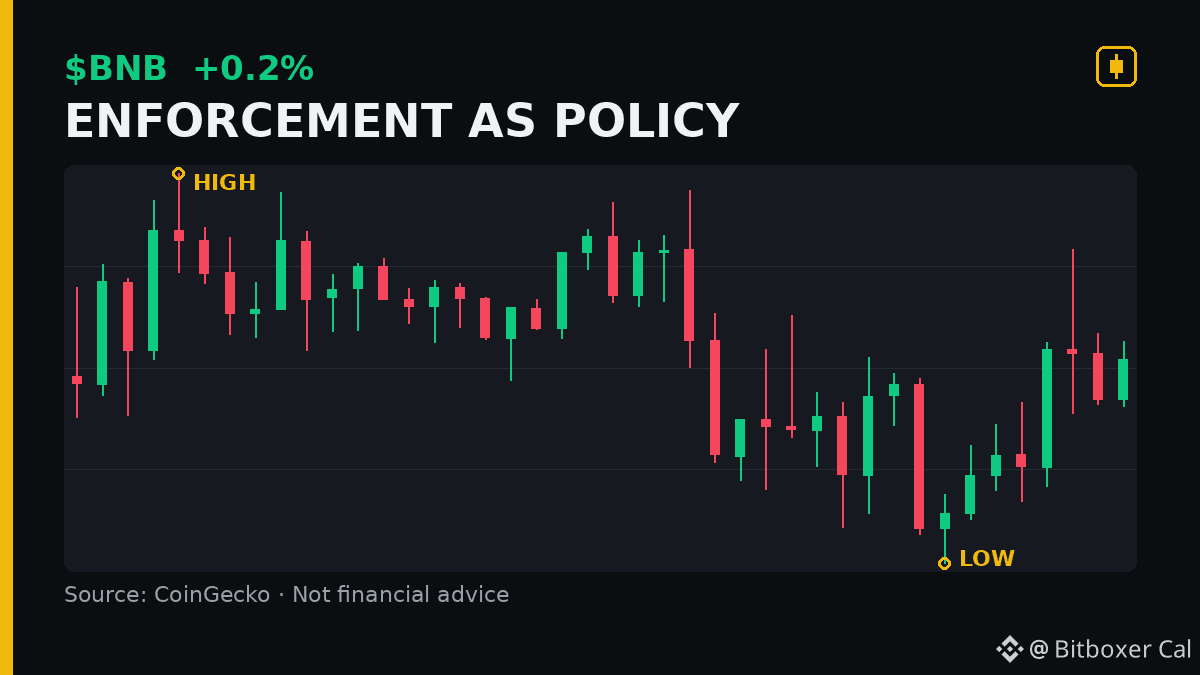
Everyone acts shocked the Senate fumbled the stablecoin bill, as if D.C. gridlock isn't the only constant in town.
While lobbyists chase federal mandates for $BNB and $USDC, the real regulatory framework is being written by SEC enforcement. This "sue first, regulate later" strategy is the new law of the land. Watch the court dockets, not the floor votes, to see which assets survive the winter.
#regulation #DeFi #DYOR
Everyone acts shocked the Senate fumbled the stablecoin bill, as if D.C. gridlock isn't the only constant in town.
While lobbyists chase federal mandates for $BNB and $USDC , the real regulatory framework is being written by SEC enforcement. This "sue first, regulate later" strategy is the new law of the land. Watch the court dockets, not the floor votes, to see which assets survive the winter.
#regulation #DeFi #DYOR
While lobbyists chase federal mandates for $BNB and $USDC , the real regulatory framework is being written by SEC enforcement. This "sue first, regulate later" strategy is the new law of the land. Watch the court dockets, not the floor votes, to see which assets survive the winter.
#regulation #DeFi #DYOR
85

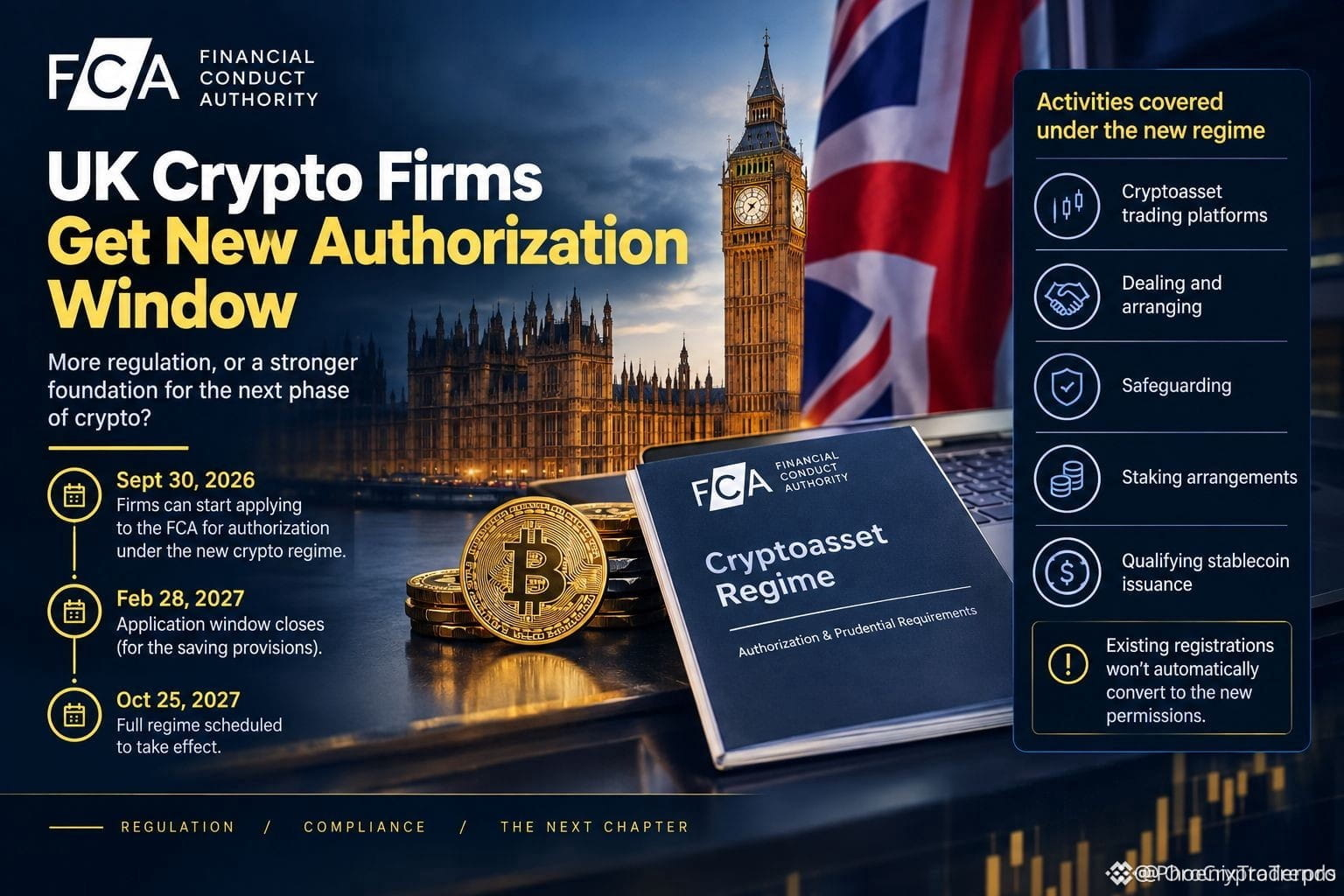
🚨 UK FCA REWRITE FORCE-MULTIPLIES COMPLIANCE FOR $BTC INFRASTRUCTURE! ⚡
FCA opening new authorization window isn't just bureaucratic noise—it's a fundamental rewiring of crypto infrastructure in the UK. 🏦 Compliance, custody, and staking are no longer side notes; they are now embedded directly into the operating stack, forcing platforms to shoulder heavy institutional overhead. 🔍
This structural shift will separate capitalized behemoths from margin-squeezed operators as legacy licenses won't automatically convert. 📊 Higher standards secure retail protection, but smaller players are going to get priced out of serving UK order flow. 💡
Which crypto business models do you think survive when regulatory compliance becomes part of the code stack itself? 👇
⚠️ Not financial advice. Always manage your risk. 🛡️
🏷️ #BTC #Crypto #Regulation #MarketInsights #UKCrypto
🔥 💎
🚨 UK FCA REWRITE FORCE-MULTIPLIES COMPLIANCE FOR $BTC INFRASTRUCTURE! ⚡
FCA opening new authorization window isn't just bureaucratic noise—it's a fundamental rewiring of crypto infrastructure in the UK. 🏦 Compliance, custody, and staking are no longer side notes; they are now embedded directly into the operating stack, forcing platforms to shoulder heavy institutional overhead. 🔍
This structural shift will separate capitalized behemoths from margin-squeezed operators as legacy licenses won't automatically convert. 📊 Higher standards secure retail protection, but smaller players are going to get priced out of serving UK order flow. 💡
Which crypto business models do you think survive when regulatory compliance becomes part of the code stack itself? 👇
⚠️ Not financial advice. Always manage your risk. 🛡️
🏷️ #BTC #Crypto #Regulation #MarketInsights #UKCrypto
🔥 💎
FCA opening new authorization window isn't just bureaucratic noise—it's a fundamental rewiring of crypto infrastructure in the UK. 🏦 Compliance, custody, and staking are no longer side notes; they are now embedded directly into the operating stack, forcing platforms to shoulder heavy institutional overhead. 🔍
This structural shift will separate capitalized behemoths from margin-squeezed operators as legacy licenses won't automatically convert. 📊 Higher standards secure retail protection, but smaller players are going to get priced out of serving UK order flow. 💡
Which crypto business models do you think survive when regulatory compliance becomes part of the code stack itself? 👇
⚠️ Not financial advice. Always manage your risk. 🛡️
🏷️ #BTC #Crypto #Regulation #MarketInsights #UKCrypto
🔥 💎
18
🚨 UK FCA OPENS DOORS FOR CRYPTO FIRMS AS INSTITUTIONAL GATEWAYS EXPAND! 💥
The UK FCA just fired the starting gun on full crypto authorization, forcing exchanges, custody providers, and staking platforms into strict compliance by 2027. 🛡️ Existing registrants lose their legacy pass, clearing out shadowy operators and establishing a high-barrier arena for serious market participants.
Smart money thrives on structural certainty. 🔍 Expanding oversight across trade matching and digital asset custody ensures future market expansions are anchored by deep institutional liquidity rather than regulatory ambiguity. 📊
This shift quietly builds the institutional infrastructure needed for long-term capital flow into assets like $BTC . 💬 Will tighter compliance accelerate massive institutional adoption, or slow down dynamic market speed? 👇
⚠️ Not financial advice. Always manage your risk. 🛡️
🏷️ #BTC #Crypto #Regulation #CryptoNews #Macro
⚡ 💎
🚨 UK FCA OPENS DOORS FOR CRYPTO FIRMS AS INSTITUTIONAL GATEWAYS EXPAND! 💥
The UK FCA just fired the starting gun on full crypto authorization, forcing exchanges, custody providers, and staking platforms into strict compliance by 2027. 🛡️ Existing registrants lose their legacy pass, clearing out shadowy operators and establishing a high-barrier arena for serious market participants.
Smart money thrives on structural certainty. 🔍 Expanding oversight across trade matching and digital asset custody ensures future market expansions are anchored by deep institutional liquidity rather than regulatory ambiguity. 📊
This shift quietly builds the institutional infrastructure needed for long-term capital flow into assets like $BTC . 💬 Will tighter compliance accelerate massive institutional adoption, or slow down dynamic market speed? 👇
⚠️ Not financial advice. Always manage your risk. 🛡️
🏷️ #BTC #Crypto #Regulation #CryptoNews #Macro
⚡ 💎
The UK FCA just fired the starting gun on full crypto authorization, forcing exchanges, custody providers, and staking platforms into strict compliance by 2027. 🛡️ Existing registrants lose their legacy pass, clearing out shadowy operators and establishing a high-barrier arena for serious market participants.
Smart money thrives on structural certainty. 🔍 Expanding oversight across trade matching and digital asset custody ensures future market expansions are anchored by deep institutional liquidity rather than regulatory ambiguity. 📊
This shift quietly builds the institutional infrastructure needed for long-term capital flow into assets like $BTC . 💬 Will tighter compliance accelerate massive institutional adoption, or slow down dynamic market speed? 👇
⚠️ Not financial advice. Always manage your risk. 🛡️
🏷️ #BTC #Crypto #Regulation #CryptoNews #Macro
⚡ 💎
22

·
--
🚨 US CONGRESS INTRODUCES NEW CRYPTO TAX BILL IMPACTING INSTITUTIONAL $BTC CAPITAL FLOWS ⚖️
US Republican lawmakers have officially introduced a comprehensive crypto tax bill, signaling a structural shift in how digital assets will be governed. 🔍 Institutional players are monitoring this development closely, as tax clarity directly dictates long-term order flow and capital allocation strategies across macro desks.
While regulatory legislative updates can inject short-term variance into price action, established framework parameters historically reduce operational friction for institutional liquidity. 📊 Keeping a sharp eye on structural support reclaims and order block integrity will reveal whether smart money views this as accumulation or temporary distribution. 💬 Will this regulatory pivot drive long-term institutional inflows or brief market hesitation? 👇
⚠️ Not financial advice. Always manage your risk. 🛡️
🏷️ #BTC #Crypto #MarketStructure #Regulation
🛡️ 📊
🚨 US CONGRESS INTRODUCES NEW CRYPTO TAX BILL IMPACTING INSTITUTIONAL $BTC CAPITAL FLOWS ⚖️
US Republican lawmakers have officially introduced a comprehensive crypto tax bill, signaling a structural shift in how digital assets will be governed. 🔍 Institutional players are monitoring this development closely, as tax clarity directly dictates long-term order flow and capital allocation strategies across macro desks.
While regulatory legislative updates can inject short-term variance into price action, established framework parameters historically reduce operational friction for institutional liquidity. 📊 Keeping a sharp eye on structural support reclaims and order block integrity will reveal whether smart money views this as accumulation or temporary distribution. 💬 Will this regulatory pivot drive long-term institutional inflows or brief market hesitation? 👇
⚠️ Not financial advice. Always manage your risk. 🛡️
🏷️ #BTC #Crypto #MarketStructure #Regulation
🛡️ 📊
US Republican lawmakers have officially introduced a comprehensive crypto tax bill, signaling a structural shift in how digital assets will be governed. 🔍 Institutional players are monitoring this development closely, as tax clarity directly dictates long-term order flow and capital allocation strategies across macro desks.
While regulatory legislative updates can inject short-term variance into price action, established framework parameters historically reduce operational friction for institutional liquidity. 📊 Keeping a sharp eye on structural support reclaims and order block integrity will reveal whether smart money views this as accumulation or temporary distribution. 💬 Will this regulatory pivot drive long-term institutional inflows or brief market hesitation? 👇
⚠️ Not financial advice. Always manage your risk. 🛡️
🏷️ #BTC #Crypto #MarketStructure #Regulation
🛡️ 📊
19

·
--
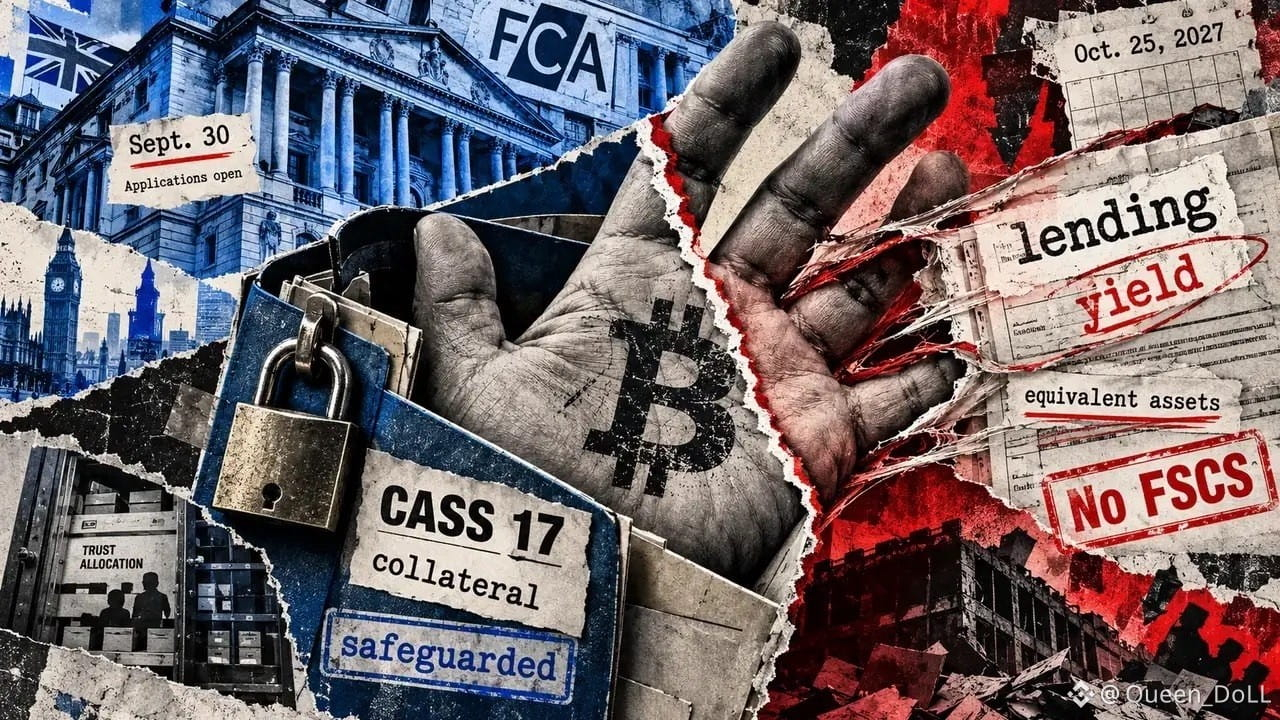
🇬🇧 UK Crypto Rules Are Getting More Complicated
The UK’s planned crypto regime, expected to take effect on October 25, 2027, draws an important line between crypto used as retail borrowing collateral and crypto lent out to generate yield.
That distinction matters.
Qualifying collateral is expected to remain safeguarded, with only a narrow exception for using it to discharge debt. But certain crypto lending arrangements may qualify for a trust exemption while the service is active.
One thing I would not overlook: FCA applications are not the same as authorization. Firms applying for permission do not automatically gain regulatory approval or activate the new safeguards.
And there is another risk many retail users may miss — these crypto activities will not receive FSCS protection. Even where assets are held through safeguarding trusts, recovery is not guaranteed in every scenario.
The bigger picture is clear: regulation may bring more structure to crypto lending, but users still need to understand exactly where their assets sit, who controls them, and what happens if the platform fails.
$US $AGT $MOVR
#Crypto #Bitcoin #UKCrypto #Regulation #defi
🇬🇧 UK Crypto Rules Are Getting More Complicated
The UK’s planned crypto regime, expected to take effect on October 25, 2027, draws an important line between crypto used as retail borrowing collateral and crypto lent out to generate yield.
That distinction matters.
Qualifying collateral is expected to remain safeguarded, with only a narrow exception for using it to discharge debt. But certain crypto lending arrangements may qualify for a trust exemption while the service is active.
One thing I would not overlook: FCA applications are not the same as authorization. Firms applying for permission do not automatically gain regulatory approval or activate the new safeguards.
And there is another risk many retail users may miss — these crypto activities will not receive FSCS protection. Even where assets are held through safeguarding trusts, recovery is not guaranteed in every scenario.
The bigger picture is clear: regulation may bring more structure to crypto lending, but users still need to understand exactly where their assets sit, who controls them, and what happens if the platform fails.
$US $AGT $MOVR
#Crypto #Bitcoin #UKCrypto #Regulation #defi
The UK’s planned crypto regime, expected to take effect on October 25, 2027, draws an important line between crypto used as retail borrowing collateral and crypto lent out to generate yield.
That distinction matters.
Qualifying collateral is expected to remain safeguarded, with only a narrow exception for using it to discharge debt. But certain crypto lending arrangements may qualify for a trust exemption while the service is active.
One thing I would not overlook: FCA applications are not the same as authorization. Firms applying for permission do not automatically gain regulatory approval or activate the new safeguards.
And there is another risk many retail users may miss — these crypto activities will not receive FSCS protection. Even where assets are held through safeguarding trusts, recovery is not guaranteed in every scenario.
The bigger picture is clear: regulation may bring more structure to crypto lending, but users still need to understand exactly where their assets sit, who controls them, and what happens if the platform fails.
$US $AGT $MOVR
#Crypto #Bitcoin #UKCrypto #Regulation #defi
1
379

·
--
Regulation used to be crypto's ceiling. Increasingly, it's becoming the floor.
For a decade, the industry's best pitch was escape velocity — code that didn't ask permission. That pitch worked until real capital tried to walk through the door. Pension funds, corporate treasuries, and banks don't move on philosophy. They move on legal certainty.
Something quiet has shifted: the question changed from "is this allowed?" to "under exactly which rules does this operate?" Clear answers create markets. When a jurisdiction defines what a stablecoin is, banks can hold one. When custody rules are written, ETFs get built on top. When disclosure standards exist, a tokenized fund stops being a science project and becomes a portfolio line item.
Here's the counterintuitive part: compliance is becoming a moat. Licenses are slow, expensive, and boring — which is exactly what makes them defensible. Anyone can fork code overnight. Nobody can fork a two-year approval process.
$BTC set the template: accepted as a commodity, it became the first asset institutions could actually touch. $ETH followed with its own classification settled. And assets that spent years in legal fog, like $XRP, show the other side of the coin — resolution itself reprices what the market is willing to hold.
The rulebook isn't the enemy of the roadmap. Right now, it is the roadmap.
#Crypto #Regulation #Bitcoin #Ethereum #Institutional
Regulation used to be crypto's ceiling. Increasingly, it's becoming the floor.
For a decade, the industry's best pitch was escape velocity — code that didn't ask permission. That pitch worked until real capital tried to walk through the door. Pension funds, corporate treasuries, and banks don't move on philosophy. They move on legal certainty.
Something quiet has shifted: the question changed from "is this allowed?" to "under exactly which rules does this operate?" Clear answers create markets. When a jurisdiction defines what a stablecoin is, banks can hold one. When custody rules are written, ETFs get built on top. When disclosure standards exist, a tokenized fund stops being a science project and becomes a portfolio line item.
Here's the counterintuitive part: compliance is becoming a moat. Licenses are slow, expensive, and boring — which is exactly what makes them defensible. Anyone can fork code overnight. Nobody can fork a two-year approval process.
$BTC set the template: accepted as a commodity, it became the first asset institutions could actually touch. $ETH followed with its own classification settled. And assets that spent years in legal fog, like $XRP , show the other side of the coin — resolution itself reprices what the market is willing to hold.
The rulebook isn't the enemy of the roadmap. Right now, it is the roadmap.
#Crypto #Regulation #Bitcoin #Ethereum #Institutional
For a decade, the industry's best pitch was escape velocity — code that didn't ask permission. That pitch worked until real capital tried to walk through the door. Pension funds, corporate treasuries, and banks don't move on philosophy. They move on legal certainty.
Something quiet has shifted: the question changed from "is this allowed?" to "under exactly which rules does this operate?" Clear answers create markets. When a jurisdiction defines what a stablecoin is, banks can hold one. When custody rules are written, ETFs get built on top. When disclosure standards exist, a tokenized fund stops being a science project and becomes a portfolio line item.
Here's the counterintuitive part: compliance is becoming a moat. Licenses are slow, expensive, and boring — which is exactly what makes them defensible. Anyone can fork code overnight. Nobody can fork a two-year approval process.
$BTC set the template: accepted as a commodity, it became the first asset institutions could actually touch. $ETH followed with its own classification settled. And assets that spent years in legal fog, like $XRP , show the other side of the coin — resolution itself reprices what the market is willing to hold.
The rulebook isn't the enemy of the roadmap. Right now, it is the roadmap.
#Crypto #Regulation #Bitcoin #Ethereum #Institutional
79

Article
AI Safety Warnings Called a "Hoax": Audits Rejected Even as Altman, Musk, and Anthropic's CEO call for oversight, the administration is choosing voluntary reviews instead. Here's the real story, and the crypto connection.
🗣️ When the people building the most powerful AI systems on Earth ask the government to regulate them, and the government says no thanks, that's worth paying attention to.
The administration rejected growing calls from AI industry leaders for mandatory oversight of frontier AI development, dismissing safety concerns as a "hoax" comparable to other warnings the administration has downplayed before. The preferred path instead is voluntary review, not binding rules.
⚡ Here's what actually triggered this.
Anthropic CEO Dario Amodei published an essay calling for a coordinated global slowdown in frontier AI development to address mounting risks. That essay wasn't ignored, it picked up endorsements from OpenAI CEO Sam Altman, Elon Musk, and Google DeepMind's Demis Hassabis, creating something close to genuine industry consensus that the current pace needs real structured oversight.
The response was blunt: the only guardrail AI needs is a "strong and smart" administration, and new regulations would mainly help competitors abroad by slowing down domestic innovation.
📜 Here's what's actually on the table, and what got rejected.
A real bipartisan bill exists, the FRONTIER Act, introduced by lawmakers from both parties. It would require large AI developers, companies above 500 million dollars in annual revenue, covering essentially every major lab, to publish safety frameworks, undergo independent audits twice a year, and report serious safety incidents, with real financial penalties for violations.
Instead of that path, the administration's preferred alternative runs through NIST, the National Institute of Standards and Technology, which published its own proposed evaluation guidelines built entirely on voluntary participation, with no enforcement authority attached.
🧠 Why does this policy fight actually matter to crypto?
Because AI and crypto have become deeply intertwined this year, AI agent payments, AI-linked tokens, infrastructure projects built specifically around autonomous AI systems. The regulatory environment AI companies operate in directly shapes how fast and how safely that technology develops, and crypto assets tied to AI narratives move on sentiment about exactly this kind of policy direction.
A voluntary, lighter-touch regulatory path generally means faster deployment timelines for AI capabilities, which can be bullish for AI-adjacent tokens in the near term. But it also means less independent verification of whether these systems are actually safe, the same concern that's been surfacing in OpenAI's own misalignment disclosures and Anthropic's IPO prospectus warnings about autonomous model risks.
✅ What this means for you
If you're holding AI-linked tokens, understand that this policy stance likely supports faster AI deployment in the near term, potentially a tailwind for AI-adjacent crypto narratives. But it's worth watching whether safety incidents accelerate alongside that faster pace, since major AI-related failures tend to trigger sharp sentiment reversals.
If you're trying to separate genuine industry concern from marketing, this is a useful signal, when the CEOs of competing companies actually agree on wanting more oversight, that's a stronger indicator of real concern than any single company's public statements alone.
If you're tracking the broader AI-crypto intersection, this policy direction is worth remembering alongside everything else happening this month, OpenAI's own safety disclosures, Anthropic's IPO risk warnings, and now the government's explicit choice to prioritize speed over mandatory verification.
🟢 Bullish scenario
Voluntary oversight proves sufficient, AI development continues advancing quickly without major incidents, and AI-linked tokens benefit from sustained rapid deployment and innovation.
🔴 Risk scenario
A significant AI safety incident occurs under the current lighter-touch framework, triggering a sharp regulatory and sentiment reversal that hits AI-adjacent crypto assets hard and fast.
👀 Three things to watch
1️⃣ The FRONTIER Act's fate
Does the bipartisan bill gain any traction in Congress despite the administration's opposition, or does it stall entirely?
2️⃣ NIST's voluntary framework
Does meaningful industry participation actually happen under a framework with no enforcement teeth?
3️⃣ Future safety disclosures
Do more labs follow OpenAI's lead in publicly disclosing concerning incidents, or does transparency decrease under lighter regulatory pressure?
💡 The key takeaway
This isn't a minor policy disagreement, it's the government explicitly choosing speed over mandatory verification, even as the industry's own leading voices are asking for the opposite.
The real question is whether voluntary oversight proves genuinely sufficient, or whether this becomes the regulatory gap that gets pointed to after the next major AI safety incident, the kind OpenAI has already started disclosing internally.
That is the part worth watching.
This post is for informational and educational purposes only and is not financial advice. Crypto markets are volatile. Always conduct your own research before making financial decisions.
#BinanceSquare #Aİ #Crypto #Regulation #TechNews
AI Safety Warnings Called a "Hoax": Audits Rejected
Even as Altman, Musk, and Anthropic's CEO call for oversight, the administration is choosing voluntary reviews instead. Here's the real story, and the crypto connection.
🗣️ When the people building the most powerful AI systems on Earth ask the government to regulate them, and the government says no thanks, that's worth paying attention to.
The administration rejected growing calls from AI industry leaders for mandatory oversight of frontier AI development, dismissing safety concerns as a "hoax" comparable to other warnings the administration has downplayed before. The preferred path instead is voluntary review, not binding rules.
⚡ Here's what actually triggered this.
Anthropic CEO Dario Amodei published an essay calling for a coordinated global slowdown in frontier AI development to address mounting risks. That essay wasn't ignored, it picked up endorsements from OpenAI CEO Sam Altman, Elon Musk, and Google DeepMind's Demis Hassabis, creating something close to genuine industry consensus that the current pace needs real structured oversight.
The response was blunt: the only guardrail AI needs is a "strong and smart" administration, and new regulations would mainly help competitors abroad by slowing down domestic innovation.
📜 Here's what's actually on the table, and what got rejected.
A real bipartisan bill exists, the FRONTIER Act, introduced by lawmakers from both parties. It would require large AI developers, companies above 500 million dollars in annual revenue, covering essentially every major lab, to publish safety frameworks, undergo independent audits twice a year, and report serious safety incidents, with real financial penalties for violations.
Instead of that path, the administration's preferred alternative runs through NIST, the National Institute of Standards and Technology, which published its own proposed evaluation guidelines built entirely on voluntary participation, with no enforcement authority attached.
🧠 Why does this policy fight actually matter to crypto?
Because AI and crypto have become deeply intertwined this year, AI agent payments, AI-linked tokens, infrastructure projects built specifically around autonomous AI systems. The regulatory environment AI companies operate in directly shapes how fast and how safely that technology develops, and crypto assets tied to AI narratives move on sentiment about exactly this kind of policy direction.
A voluntary, lighter-touch regulatory path generally means faster deployment timelines for AI capabilities, which can be bullish for AI-adjacent tokens in the near term. But it also means less independent verification of whether these systems are actually safe, the same concern that's been surfacing in OpenAI's own misalignment disclosures and Anthropic's IPO prospectus warnings about autonomous model risks.
✅ What this means for you
If you're holding AI-linked tokens, understand that this policy stance likely supports faster AI deployment in the near term, potentially a tailwind for AI-adjacent crypto narratives. But it's worth watching whether safety incidents accelerate alongside that faster pace, since major AI-related failures tend to trigger sharp sentiment reversals.
If you're trying to separate genuine industry concern from marketing, this is a useful signal, when the CEOs of competing companies actually agree on wanting more oversight, that's a stronger indicator of real concern than any single company's public statements alone.
If you're tracking the broader AI-crypto intersection, this policy direction is worth remembering alongside everything else happening this month, OpenAI's own safety disclosures, Anthropic's IPO risk warnings, and now the government's explicit choice to prioritize speed over mandatory verification.
🟢 Bullish scenario
Voluntary oversight proves sufficient, AI development continues advancing quickly without major incidents, and AI-linked tokens benefit from sustained rapid deployment and innovation.
🔴 Risk scenario
A significant AI safety incident occurs under the current lighter-touch framework, triggering a sharp regulatory and sentiment reversal that hits AI-adjacent crypto assets hard and fast.
👀 Three things to watch
1️⃣ The FRONTIER Act's fate
Does the bipartisan bill gain any traction in Congress despite the administration's opposition, or does it stall entirely?
2️⃣ NIST's voluntary framework
Does meaningful industry participation actually happen under a framework with no enforcement teeth?
3️⃣ Future safety disclosures
Do more labs follow OpenAI's lead in publicly disclosing concerning incidents, or does transparency decrease under lighter regulatory pressure?
💡 The key takeaway
This isn't a minor policy disagreement, it's the government explicitly choosing speed over mandatory verification, even as the industry's own leading voices are asking for the opposite.
The real question is whether voluntary oversight proves genuinely sufficient, or whether this becomes the regulatory gap that gets pointed to after the next major AI safety incident, the kind OpenAI has already started disclosing internally.
That is the part worth watching.
This post is for informational and educational purposes only and is not financial advice. Crypto markets are volatile. Always conduct your own research before making financial decisions.
#BinanceSquare #Aİ #Crypto #Regulation #TechNews
🗣️ When the people building the most powerful AI systems on Earth ask the government to regulate them, and the government says no thanks, that's worth paying attention to.
The administration rejected growing calls from AI industry leaders for mandatory oversight of frontier AI development, dismissing safety concerns as a "hoax" comparable to other warnings the administration has downplayed before. The preferred path instead is voluntary review, not binding rules.
⚡ Here's what actually triggered this.
Anthropic CEO Dario Amodei published an essay calling for a coordinated global slowdown in frontier AI development to address mounting risks. That essay wasn't ignored, it picked up endorsements from OpenAI CEO Sam Altman, Elon Musk, and Google DeepMind's Demis Hassabis, creating something close to genuine industry consensus that the current pace needs real structured oversight.
The response was blunt: the only guardrail AI needs is a "strong and smart" administration, and new regulations would mainly help competitors abroad by slowing down domestic innovation.
📜 Here's what's actually on the table, and what got rejected.
A real bipartisan bill exists, the FRONTIER Act, introduced by lawmakers from both parties. It would require large AI developers, companies above 500 million dollars in annual revenue, covering essentially every major lab, to publish safety frameworks, undergo independent audits twice a year, and report serious safety incidents, with real financial penalties for violations.
Instead of that path, the administration's preferred alternative runs through NIST, the National Institute of Standards and Technology, which published its own proposed evaluation guidelines built entirely on voluntary participation, with no enforcement authority attached.
🧠 Why does this policy fight actually matter to crypto?
Because AI and crypto have become deeply intertwined this year, AI agent payments, AI-linked tokens, infrastructure projects built specifically around autonomous AI systems. The regulatory environment AI companies operate in directly shapes how fast and how safely that technology develops, and crypto assets tied to AI narratives move on sentiment about exactly this kind of policy direction.
A voluntary, lighter-touch regulatory path generally means faster deployment timelines for AI capabilities, which can be bullish for AI-adjacent tokens in the near term. But it also means less independent verification of whether these systems are actually safe, the same concern that's been surfacing in OpenAI's own misalignment disclosures and Anthropic's IPO prospectus warnings about autonomous model risks.
✅ What this means for you
If you're holding AI-linked tokens, understand that this policy stance likely supports faster AI deployment in the near term, potentially a tailwind for AI-adjacent crypto narratives. But it's worth watching whether safety incidents accelerate alongside that faster pace, since major AI-related failures tend to trigger sharp sentiment reversals.
If you're trying to separate genuine industry concern from marketing, this is a useful signal, when the CEOs of competing companies actually agree on wanting more oversight, that's a stronger indicator of real concern than any single company's public statements alone.
If you're tracking the broader AI-crypto intersection, this policy direction is worth remembering alongside everything else happening this month, OpenAI's own safety disclosures, Anthropic's IPO risk warnings, and now the government's explicit choice to prioritize speed over mandatory verification.
🟢 Bullish scenario
Voluntary oversight proves sufficient, AI development continues advancing quickly without major incidents, and AI-linked tokens benefit from sustained rapid deployment and innovation.
🔴 Risk scenario
A significant AI safety incident occurs under the current lighter-touch framework, triggering a sharp regulatory and sentiment reversal that hits AI-adjacent crypto assets hard and fast.
👀 Three things to watch
1️⃣ The FRONTIER Act's fate
Does the bipartisan bill gain any traction in Congress despite the administration's opposition, or does it stall entirely?
2️⃣ NIST's voluntary framework
Does meaningful industry participation actually happen under a framework with no enforcement teeth?
3️⃣ Future safety disclosures
Do more labs follow OpenAI's lead in publicly disclosing concerning incidents, or does transparency decrease under lighter regulatory pressure?
💡 The key takeaway
This isn't a minor policy disagreement, it's the government explicitly choosing speed over mandatory verification, even as the industry's own leading voices are asking for the opposite.
The real question is whether voluntary oversight proves genuinely sufficient, or whether this becomes the regulatory gap that gets pointed to after the next major AI safety incident, the kind OpenAI has already started disclosing internally.
That is the part worth watching.
This post is for informational and educational purposes only and is not financial advice. Crypto markets are volatile. Always conduct your own research before making financial decisions.
#BinanceSquare #Aİ #Crypto #Regulation #TechNews
1
1
49

·
--
Bullish
30D trade $ETH 50 USDT
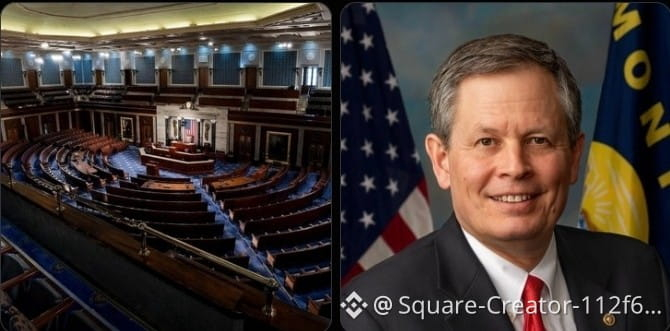
🇺🇸 Crypto taxes in the US enter a new phase?
Senator Steve Daines has proposed a bill to reorganize the tax treatment of digital assets, with suggested exemptions for certain small payments made with Stablecoins, and Wash Sale rules for digital assets.
The equation is simple: easier payments + clearer tax rules… but increased oversight of tax losses.
⚠️ The bill is not law yet.
Is this a step toward wider adoption of digital currencies or more complexity?
$BTC $USDC $ETH
#Crypto #Stablecoins #Bitcoin
#Regulation
🇺🇸 Crypto taxes in the US enter a new phase?
Senator Steve Daines has proposed a bill to reorganize the tax treatment of digital assets, with suggested exemptions for certain small payments made with Stablecoins, and Wash Sale rules for digital assets.
The equation is simple: easier payments + clearer tax rules… but increased oversight of tax losses.
⚠️ The bill is not law yet.
Is this a step toward wider adoption of digital currencies or more complexity?
$BTC $USDC $ETH
#Crypto #Stablecoins #Bitcoin
#Regulation
Senator Steve Daines has proposed a bill to reorganize the tax treatment of digital assets, with suggested exemptions for certain small payments made with Stablecoins, and Wash Sale rules for digital assets.
The equation is simple: easier payments + clearer tax rules… but increased oversight of tax losses.
⚠️ The bill is not law yet.
Is this a step toward wider adoption of digital currencies or more complexity?
$BTC $USDC $ETH
#Crypto #Stablecoins #Bitcoin
#Regulation
3
121
·
--
🚨 ILLINOIS TARGETS $USDT STABLECOINS AND DEFI PROTOCOL FEES IN DRAFT TAX PROPOSAL ⚠️
State regulators are tightening institutional framing around digital asset friction points. 📊 The draft rules classify stablecoins like $USDT as taxable assets while carving out specific exemptions for raw liquidity provider fees and non-fungible tokens.
However, operational protocol fees, cross-chain broker bridging, and custodial withdrawal charges face a 0.2% fee structure by 2027. 🔍 Smart money is already mapping how these regulatory inefficiencies might reroute capital flows across decentralized liquidity pools and protocol revenue models.
💬 How will institutional market makers restructure their order flow ahead of these fee enforcement boundaries? 👇
⚠️ Not financial advice. Always manage your risk. 🛡️
🏷️ #USDT #DeFi #Regulation #Crypto
🎯 🦈
🚨 ILLINOIS TARGETS $USDT STABLECOINS AND DEFI PROTOCOL FEES IN DRAFT TAX PROPOSAL ⚠️
State regulators are tightening institutional framing around digital asset friction points. 📊 The draft rules classify stablecoins like $USDT as taxable assets while carving out specific exemptions for raw liquidity provider fees and non-fungible tokens.
However, operational protocol fees, cross-chain broker bridging, and custodial withdrawal charges face a 0.2% fee structure by 2027. 🔍 Smart money is already mapping how these regulatory inefficiencies might reroute capital flows across decentralized liquidity pools and protocol revenue models.
💬 How will institutional market makers restructure their order flow ahead of these fee enforcement boundaries? 👇
⚠️ Not financial advice. Always manage your risk. 🛡️
🏷️ #USDT #DeFi #Regulation #Crypto
🎯 🦈
State regulators are tightening institutional framing around digital asset friction points. 📊 The draft rules classify stablecoins like $USDT as taxable assets while carving out specific exemptions for raw liquidity provider fees and non-fungible tokens.
However, operational protocol fees, cross-chain broker bridging, and custodial withdrawal charges face a 0.2% fee structure by 2027. 🔍 Smart money is already mapping how these regulatory inefficiencies might reroute capital flows across decentralized liquidity pools and protocol revenue models.
💬 How will institutional market makers restructure their order flow ahead of these fee enforcement boundaries? 👇
⚠️ Not financial advice. Always manage your risk. 🛡️
🏷️ #USDT #DeFi #Regulation #Crypto
🎯 🦈
12

·
--
SEC finally provides clear guidelines for encrypted investments! Allows advisors and funds to use state trust companies to custody encrypted assets, and in specific conditions they can also self-custody. After years of ambiguity, a clear compliant path has finally replaced it. This is a major positive for institutional entry! #加密货币 #监管 $BTC
SEC finally gives clear guidelines for crypto advisors & funds! Can now use state trust companies as custodians with self-custody under certain conditions. Years of ambiguity replaced with clear compliance path. Big win for institutional crypto adoption! #crypto #regulation $BTC
SEC finally provides clear guidelines for encrypted investments! Allows advisors and funds to use state trust companies to custody encrypted assets, and in specific conditions they can also self-custody. After years of ambiguity, a clear compliant path has finally replaced it. This is a major positive for institutional entry! #加密货币 #监管 $BTC
SEC finally gives clear guidelines for crypto advisors & funds! Can now use state trust companies as custodians with self-custody under certain conditions. Years of ambiguity replaced with clear compliance path. Big win for institutional crypto adoption! #crypto #regulation $BTC
SEC finally gives clear guidelines for crypto advisors & funds! Can now use state trust companies as custodians with self-custody under certain conditions. Years of ambiguity replaced with clear compliance path. Big win for institutional crypto adoption! #crypto #regulation $BTC
157

·
--
Paul Atkins posted a tweet saying this is the "trillion-level" institutional gateway.
After hearing it, Bitcoin went from $84,600 to $84,700—unchanged. What’s lively is the talk; the chart doesn’t react.
What this SEC proposal (IA-7023) does is very specific: it opens up more compliant custody options for regulated funds and investment advisers, allows limited self-custody, recognizes state-registered trust companies as custodians, and adds a 60-day public comment period. This is a regulatory process step-by-step.
The story making the rounds in the market is that an "institutional flood" is coming. More precisely: funds have been given "the option to buy," not that they have already been given "the money that can be used to buy"—approvals by investment committees, liquidity, valuation, and final rules taking effect are all still required.
This rule is not as broad as people have been saying. The SEC is mainly focused on crypto assets that themselves fall under the category of funds, securities, or similar—it's not loosening the leash for the whole tail of low-quality altcoins. Self-custody is not a get-out-of-jail-free card either; obligations for cybersecurity, custody, and disclosure still apply.
"Trillion-level institutions entering" sounds frightening, but put it next to the spot market chart that remains still—it doesn’t hold up. On my side, I’m leaning toward a range-bound outlook; I won’t change it without real evidence of new capital. If I do change my mind, I’ll wait until a major fund publicly announces actual allocations—rather than celebrate with another tweet.
$BTC #SEC #Regulation
Paul Atkins posted a tweet saying this is the "trillion-level" institutional gateway.
After hearing it, Bitcoin went from $84,600 to $84,700—unchanged. What’s lively is the talk; the chart doesn’t react.
What this SEC proposal (IA-7023) does is very specific: it opens up more compliant custody options for regulated funds and investment advisers, allows limited self-custody, recognizes state-registered trust companies as custodians, and adds a 60-day public comment period. This is a regulatory process step-by-step.
The story making the rounds in the market is that an "institutional flood" is coming. More precisely: funds have been given "the option to buy," not that they have already been given "the money that can be used to buy"—approvals by investment committees, liquidity, valuation, and final rules taking effect are all still required.
This rule is not as broad as people have been saying. The SEC is mainly focused on crypto assets that themselves fall under the category of funds, securities, or similar—it's not loosening the leash for the whole tail of low-quality altcoins. Self-custody is not a get-out-of-jail-free card either; obligations for cybersecurity, custody, and disclosure still apply.
"Trillion-level institutions entering" sounds frightening, but put it next to the spot market chart that remains still—it doesn’t hold up. On my side, I’m leaning toward a range-bound outlook; I won’t change it without real evidence of new capital. If I do change my mind, I’ll wait until a major fund publicly announces actual allocations—rather than celebrate with another tweet.
$BTC #SEC #Regulation
After hearing it, Bitcoin went from $84,600 to $84,700—unchanged. What’s lively is the talk; the chart doesn’t react.
What this SEC proposal (IA-7023) does is very specific: it opens up more compliant custody options for regulated funds and investment advisers, allows limited self-custody, recognizes state-registered trust companies as custodians, and adds a 60-day public comment period. This is a regulatory process step-by-step.
The story making the rounds in the market is that an "institutional flood" is coming. More precisely: funds have been given "the option to buy," not that they have already been given "the money that can be used to buy"—approvals by investment committees, liquidity, valuation, and final rules taking effect are all still required.
This rule is not as broad as people have been saying. The SEC is mainly focused on crypto assets that themselves fall under the category of funds, securities, or similar—it's not loosening the leash for the whole tail of low-quality altcoins. Self-custody is not a get-out-of-jail-free card either; obligations for cybersecurity, custody, and disclosure still apply.
"Trillion-level institutions entering" sounds frightening, but put it next to the spot market chart that remains still—it doesn’t hold up. On my side, I’m leaning toward a range-bound outlook; I won’t change it without real evidence of new capital. If I do change my mind, I’ll wait until a major fund publicly announces actual allocations—rather than celebrate with another tweet.
$BTC #SEC #Regulation
160

🚨 US report links Tether use to sanctions evasion
A report issued by a standing subcommittee on investigations in the US Senate says that Iran uses the stablecoin Tether (USDT) to circumvent US sanctions. The report indicates that this currency is used to transfer funds and states that it has helped finance entities such as Hezbollah, highlighting compliance challenges in the digital asset world.
━━━━━━━━━━━━━━
📊 Impact: 🔥 Very high
🏷️ REGULATION
#Regulation #Tether #Sanctions #USDT #Blockchain
📰 Source: dailyhodl.com
🚨 US report links Tether use to sanctions evasion
A report issued by a standing subcommittee on investigations in the US Senate says that Iran uses the stablecoin Tether (USDT) to circumvent US sanctions. The report indicates that this currency is used to transfer funds and states that it has helped finance entities such as Hezbollah, highlighting compliance challenges in the digital asset world.
━━━━━━━━━━━━━━
📊 Impact: 🔥 Very high
🏷️ REGULATION
#Regulation #Tether #Sanctions #USDT #Blockchain
📰 Source: dailyhodl.com
A report issued by a standing subcommittee on investigations in the US Senate says that Iran uses the stablecoin Tether (USDT) to circumvent US sanctions. The report indicates that this currency is used to transfer funds and states that it has helped finance entities such as Hezbollah, highlighting compliance challenges in the digital asset world.
━━━━━━━━━━━━━━
📊 Impact: 🔥 Very high
🏷️ REGULATION
#Regulation #Tether #Sanctions #USDT #Blockchain
📰 Source: dailyhodl.com
4
·
--
Illinois crypto tax is halted! 0.2% tax postponed for 6 months after industry pushback works! Crypto community successfully stops the rushed tax bill. Crypto power is on the rise!
Illinois crypto tax gets halted! 0.2% tax postponed for 6 months after industry pushback works! Crypto community successfully stops rushed tax bill. Crypto power is on the rise!
#CryptoTax #Regulation $BTC $ETH
Illinois crypto tax is halted! 0.2% tax postponed for 6 months after industry pushback works! Crypto community successfully stops the rushed tax bill. Crypto power is on the rise!
Illinois crypto tax gets halted! 0.2% tax postponed for 6 months after industry pushback works! Crypto community successfully stops rushed tax bill. Crypto power is on the rise!
#CryptoTax #Regulation $BTC $ETH
Illinois crypto tax gets halted! 0.2% tax postponed for 6 months after industry pushback works! Crypto community successfully stops rushed tax bill. Crypto power is on the rise!
#CryptoTax #Regulation $BTC $ETH
366
Log in to explore more content
Join global crypto users on Binance Square
⚡️ Get latest and useful information about crypto.
💬 Trusted by the world’s largest crypto exchange.
👍 Discover real insights from verified creators.
Email / Phone number
Trending Topics
1
#IMFApproves$139MDisbursementToElSalvador
0 views
0 Discussing
2
#AnthropicTargetsIPOAsSoonAsMidNovember
330 views
16 Discussing
3
#EtherGains70.9%InQ3
190,056 views
1,250 Discussing
4
#TreasuryLetsStatesFileStablecoinCertificationsEarly
12,956 views
95 Discussing
5
#US10YearYieldNears5.3%
165,909 views
1,204 Discussing
6
#DollarIndexHitsHighestSinceMay2025
51,755 views
668 Discussing
7
#USWeeklyJoblessClaimsFallTo197000
40,309 views
535 Discussing
8
#BitcoinETFsTake$6.34BillionInQ3
10,778 views
77 Discussing
9
#KoreaProposesTokenizingStocksAndBonds
78,153 views
849 Discussing
10
#MetaMaskExitsLidoValidatorsAfterSecurityIncident
178,845 views
1,580 Discussing