

#polymarketbankfailurebetsdrawfdicconcern
polymarketbankfailurebetsdrawfdicconcern
Hot
Latest

·
--
#polymarketbankfailurebetsdrawfdicconcern
🚨 Market Alert: Bank Failure Bets on Polymarket Draw FDIC Concern
The Situation: The financial world is buzzing as a high-stakes prediction market on Polymarket—specifically betting on the probability of major bank failures—has drawn serious attention and concern from regulators, including the FDIC. This has created a volatile feedback loop where market sentiment directly influences regulatory scrutiny, driving massive volume and volatility across the sector.
What This Means for Traders: When prediction markets for financial distress gain this much traction, it signals extreme market stress and elevated systemic risk. Traders are closely monitoring contagion risk across the banking sector, making it a critical moment for risk management and sector rotation.
Highlighted Tradeable Coins to Watch:
$BTC (Bitcoin): The ultimate macro hedge. As concerns over fiat banking stability rise, traders frequently rotate capital into Bitcoin as a decentralized, non-sovereign store of value.
$ETH (Ethereum): Leading the decentralized finance (DeFi) ecosystem. If the traditional banking sector faces pressure, increased attention often turns to on-chain finance and lending protocols built on Ethereum.
$BNB (Binance Coin): As a proxy for exchange health and broader market sentiment, tracking how major exchange tokens react to sudden financial news provides insights into overall market liquidity and trader confidence.
Are you hedging against systemic risk or watching from the sidelines? Let's discuss your strategy in the comments below! 👇
{spot}(BTCUSDT)
{spot}(ETHUSDT)
{spot}(BNBUSDT)
#Polymarket #FDIC #BankingSector #PredictionMarkets
#polymarketbankfailurebetsdrawfdicconcern
🚨 Market Alert: Bank Failure Bets on Polymarket Draw FDIC Concern
The Situation: The financial world is buzzing as a high-stakes prediction market on Polymarket—specifically betting on the probability of major bank failures—has drawn serious attention and concern from regulators, including the FDIC. This has created a volatile feedback loop where market sentiment directly influences regulatory scrutiny, driving massive volume and volatility across the sector.
What This Means for Traders: When prediction markets for financial distress gain this much traction, it signals extreme market stress and elevated systemic risk. Traders are closely monitoring contagion risk across the banking sector, making it a critical moment for risk management and sector rotation.
Highlighted Tradeable Coins to Watch:
$BTC (Bitcoin): The ultimate macro hedge. As concerns over fiat banking stability rise, traders frequently rotate capital into Bitcoin as a decentralized, non-sovereign store of value.
$ETH (Ethereum): Leading the decentralized finance (DeFi) ecosystem. If the traditional banking sector faces pressure, increased attention often turns to on-chain finance and lending protocols built on Ethereum.
$BNB (Binance Coin): As a proxy for exchange health and broader market sentiment, tracking how major exchange tokens react to sudden financial news provides insights into overall market liquidity and trader confidence.
Are you hedging against systemic risk or watching from the sidelines? Let's discuss your strategy in the comments below! 👇
#Polymarket #FDIC #BankingSector #PredictionMarkets
🚨 Market Alert: Bank Failure Bets on Polymarket Draw FDIC Concern
The Situation: The financial world is buzzing as a high-stakes prediction market on Polymarket—specifically betting on the probability of major bank failures—has drawn serious attention and concern from regulators, including the FDIC. This has created a volatile feedback loop where market sentiment directly influences regulatory scrutiny, driving massive volume and volatility across the sector.
What This Means for Traders: When prediction markets for financial distress gain this much traction, it signals extreme market stress and elevated systemic risk. Traders are closely monitoring contagion risk across the banking sector, making it a critical moment for risk management and sector rotation.
Highlighted Tradeable Coins to Watch:
$BTC (Bitcoin): The ultimate macro hedge. As concerns over fiat banking stability rise, traders frequently rotate capital into Bitcoin as a decentralized, non-sovereign store of value.
$ETH (Ethereum): Leading the decentralized finance (DeFi) ecosystem. If the traditional banking sector faces pressure, increased attention often turns to on-chain finance and lending protocols built on Ethereum.
$BNB (Binance Coin): As a proxy for exchange health and broader market sentiment, tracking how major exchange tokens react to sudden financial news provides insights into overall market liquidity and trader confidence.
Are you hedging against systemic risk or watching from the sidelines? Let's discuss your strategy in the comments below! 👇
#Polymarket #FDIC #BankingSector #PredictionMarkets

ILHAM_SIREGAR:
Penipu Tai
berita sampah yang entah apa pengaruhnya
2
2.6k


·
--
Bullish
Verified
#polymarketbankfailurebetsdrawfdicconcern
Polymarket’s Bank Failure Bets Raise Questions About Market Signals
A market designed to predict banking stress could also influence how people react to it.
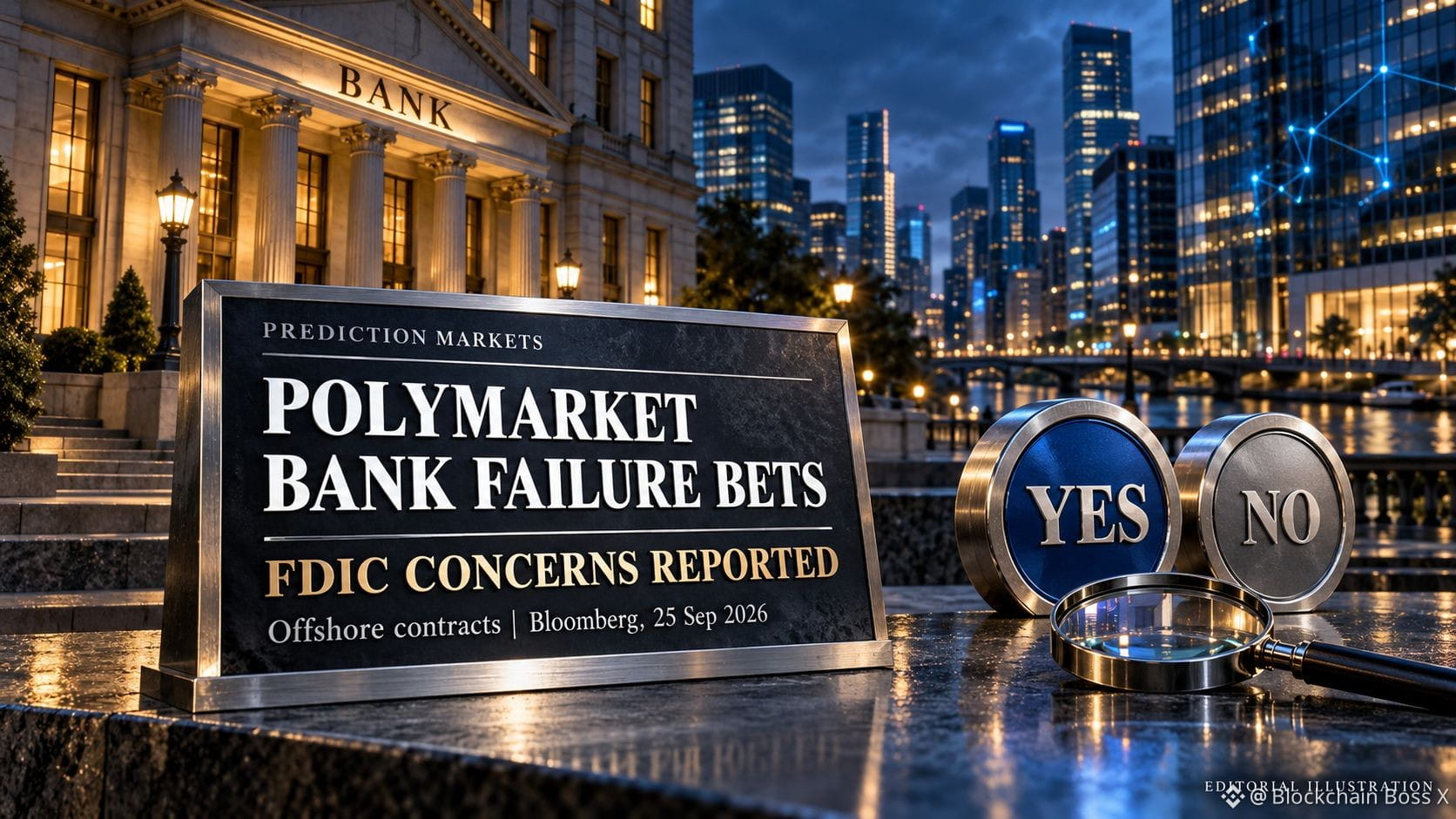
Bloomberg reported on September 25, citing people familiar with internal discussions, that FDIC officials raised concerns about contracts on Polymarket’s offshore platform tied to individual bank failures. One worry is whether larger markets could eventually amplify depositor fears and contribute to a bank run. The FDIC declined to comment.
The report put trading volume in the year-end contracts at roughly $76,000 and said Polymarket’s separate U.S. exchange does not offer these bets. Polymarket argues that its markets broaden access to information and can help counter unfounded panic.
My take: A traded probability is not a diagnosis of bank solvency. In markets with limited liquidity, a small number of trades may significantly affect displayed odds. Sharing those odds without volume, spread or timing context could mislead readers.
I’d examine transaction history, concentration among participants and contract settlement rules before treating a price change as meaningful information. Bank filings and official regulatory disclosures remain essential to checking the underlying story.
The quality of a prediction market depends partly on how clearly its limitations are communicated.
How should platforms preserve useful market information while reducing the risk of spreading panic?
#PolymarketBankFailureBetsDrawFDICConcern #PredictionMarkets #Banking
$PHA $ARK $SAGA
{future}(SAGAUSDT)
{future}(ARKUSDT)
{future}(PHAUSDT)
#polymarketbankfailurebetsdrawfdicconcern
Polymarket’s Bank Failure Bets Raise Questions About Market Signals
A market designed to predict banking stress could also influence how people react to it.
Bloomberg reported on September 25, citing people familiar with internal discussions, that FDIC officials raised concerns about contracts on Polymarket’s offshore platform tied to individual bank failures. One worry is whether larger markets could eventually amplify depositor fears and contribute to a bank run. The FDIC declined to comment.
The report put trading volume in the year-end contracts at roughly $76,000 and said Polymarket’s separate U.S. exchange does not offer these bets. Polymarket argues that its markets broaden access to information and can help counter unfounded panic.
My take: A traded probability is not a diagnosis of bank solvency. In markets with limited liquidity, a small number of trades may significantly affect displayed odds. Sharing those odds without volume, spread or timing context could mislead readers.
I’d examine transaction history, concentration among participants and contract settlement rules before treating a price change as meaningful information. Bank filings and official regulatory disclosures remain essential to checking the underlying story.
The quality of a prediction market depends partly on how clearly its limitations are communicated.
How should platforms preserve useful market information while reducing the risk of spreading panic?
#PolymarketBankFailureBetsDrawFDICConcern #PredictionMarkets #Banking
$PHA $ARK $SAGA
Polymarket’s Bank Failure Bets Raise Questions About Market Signals
A market designed to predict banking stress could also influence how people react to it.
Bloomberg reported on September 25, citing people familiar with internal discussions, that FDIC officials raised concerns about contracts on Polymarket’s offshore platform tied to individual bank failures. One worry is whether larger markets could eventually amplify depositor fears and contribute to a bank run. The FDIC declined to comment.
The report put trading volume in the year-end contracts at roughly $76,000 and said Polymarket’s separate U.S. exchange does not offer these bets. Polymarket argues that its markets broaden access to information and can help counter unfounded panic.
My take: A traded probability is not a diagnosis of bank solvency. In markets with limited liquidity, a small number of trades may significantly affect displayed odds. Sharing those odds without volume, spread or timing context could mislead readers.
I’d examine transaction history, concentration among participants and contract settlement rules before treating a price change as meaningful information. Bank filings and official regulatory disclosures remain essential to checking the underlying story.
The quality of a prediction market depends partly on how clearly its limitations are communicated.
How should platforms preserve useful market information while reducing the risk of spreading panic?
#PolymarketBankFailureBetsDrawFDICConcern #PredictionMarkets #Banking
$PHA $ARK $SAGA
2
3.1k

·
--
POLYMARKET JUST CROSSED A LINE REGULATORS REALLY DON’T LIKE. 🚨
Polymarket is now offering bets on whether major banks like JPMorgan, Bank of America and Wells Fargo could fail — and the FDIC is reportedly paying attention
The concern isn’t the current size of the bets.
It’s the feedback loop.
If enough traders start pricing in a bank failure, those odds can spread across social media, scare depositors, and potentially create the very panic the market is betting on.
That’s the nightmare scenario regulators are watching.
For now, volumes are still relatively small — about $76K across the latest bank-failure contracts — but an earlier batch reached roughly $591K.
Polymarket argues these markets improve price discovery and make hidden risk easier for the public to see. Regulators are asking a darker question:
What happens when prediction markets stop predicting fear… and start amplifying it?
{future}(ZECUSDT)
{future}(XRPUSDT)
{future}(AKEUSDT)
$ZEC $XRP $AKE
#polymarketbankfailurebetsdrawfdicconcern #BlackRockBuildsTokenizedPortfoliosForOndo #BitwiseFilesToListNEARETFOnNYSEArca #SECCommissionerPeirceToLeaveOct2 #SECSaysBuybacksUpgradesDontMakeTokenSecurity
POLYMARKET JUST CROSSED A LINE REGULATORS REALLY DON’T LIKE. 🚨
Polymarket is now offering bets on whether major banks like JPMorgan, Bank of America and Wells Fargo could fail — and the FDIC is reportedly paying attention
The concern isn’t the current size of the bets.
It’s the feedback loop.
If enough traders start pricing in a bank failure, those odds can spread across social media, scare depositors, and potentially create the very panic the market is betting on.
That’s the nightmare scenario regulators are watching.
For now, volumes are still relatively small — about $76K across the latest bank-failure contracts — but an earlier batch reached roughly $591K.
Polymarket argues these markets improve price discovery and make hidden risk easier for the public to see. Regulators are asking a darker question:
What happens when prediction markets stop predicting fear… and start amplifying it?
$ZEC $XRP $AKE
#polymarketbankfailurebetsdrawfdicconcern #BlackRockBuildsTokenizedPortfoliosForOndo #BitwiseFilesToListNEARETFOnNYSEArca #SECCommissionerPeirceToLeaveOct2 #SECSaysBuybacksUpgradesDontMakeTokenSecurity
Polymarket is now offering bets on whether major banks like JPMorgan, Bank of America and Wells Fargo could fail — and the FDIC is reportedly paying attention
The concern isn’t the current size of the bets.
It’s the feedback loop.
If enough traders start pricing in a bank failure, those odds can spread across social media, scare depositors, and potentially create the very panic the market is betting on.
That’s the nightmare scenario regulators are watching.
For now, volumes are still relatively small — about $76K across the latest bank-failure contracts — but an earlier batch reached roughly $591K.
Polymarket argues these markets improve price discovery and make hidden risk easier for the public to see. Regulators are asking a darker question:
What happens when prediction markets stop predicting fear… and start amplifying it?
$ZEC $XRP $AKE
#polymarketbankfailurebetsdrawfdicconcern #BlackRockBuildsTokenizedPortfoliosForOndo #BitwiseFilesToListNEARETFOnNYSEArca #SECCommissionerPeirceToLeaveOct2 #SECSaysBuybacksUpgradesDontMakeTokenSecurity
503

·
--
🚨 POLYMARKET BANK FAILURE BETS DRAW FDIC CONCERN
Polymarket contracts betting on potential U.S. bank failures are drawing scrutiny from FDIC officials, who are concerned about possible risks to financial stability.
👀 Prediction markets are entering a new regulatory spotlight.
#Polymarket #Banking #FDIC $BTC
{spot}(BTCUSDT)
#polymarketbankfailurebetsdrawfdicconcern
🚨 POLYMARKET BANK FAILURE BETS DRAW FDIC CONCERN
Polymarket contracts betting on potential U.S. bank failures are drawing scrutiny from FDIC officials, who are concerned about possible risks to financial stability.
👀 Prediction markets are entering a new regulatory spotlight.
#Polymarket #Banking #FDIC $BTC
#polymarketbankfailurebetsdrawfdicconcern
Polymarket contracts betting on potential U.S. bank failures are drawing scrutiny from FDIC officials, who are concerned about possible risks to financial stability.
👀 Prediction markets are entering a new regulatory spotlight.
#Polymarket #Banking #FDIC $BTC
#polymarketbankfailurebetsdrawfdicconcern
490

·
--
🚨 Polymarket is now taking bets on MAJOR bank failures - and the FDIC is NOT happy!
According to Bloomberg Sep 26, prediction market Polymarket has contracts on whether giants like JPMorgan, Wells Fargo & Bank of America will FAIL.
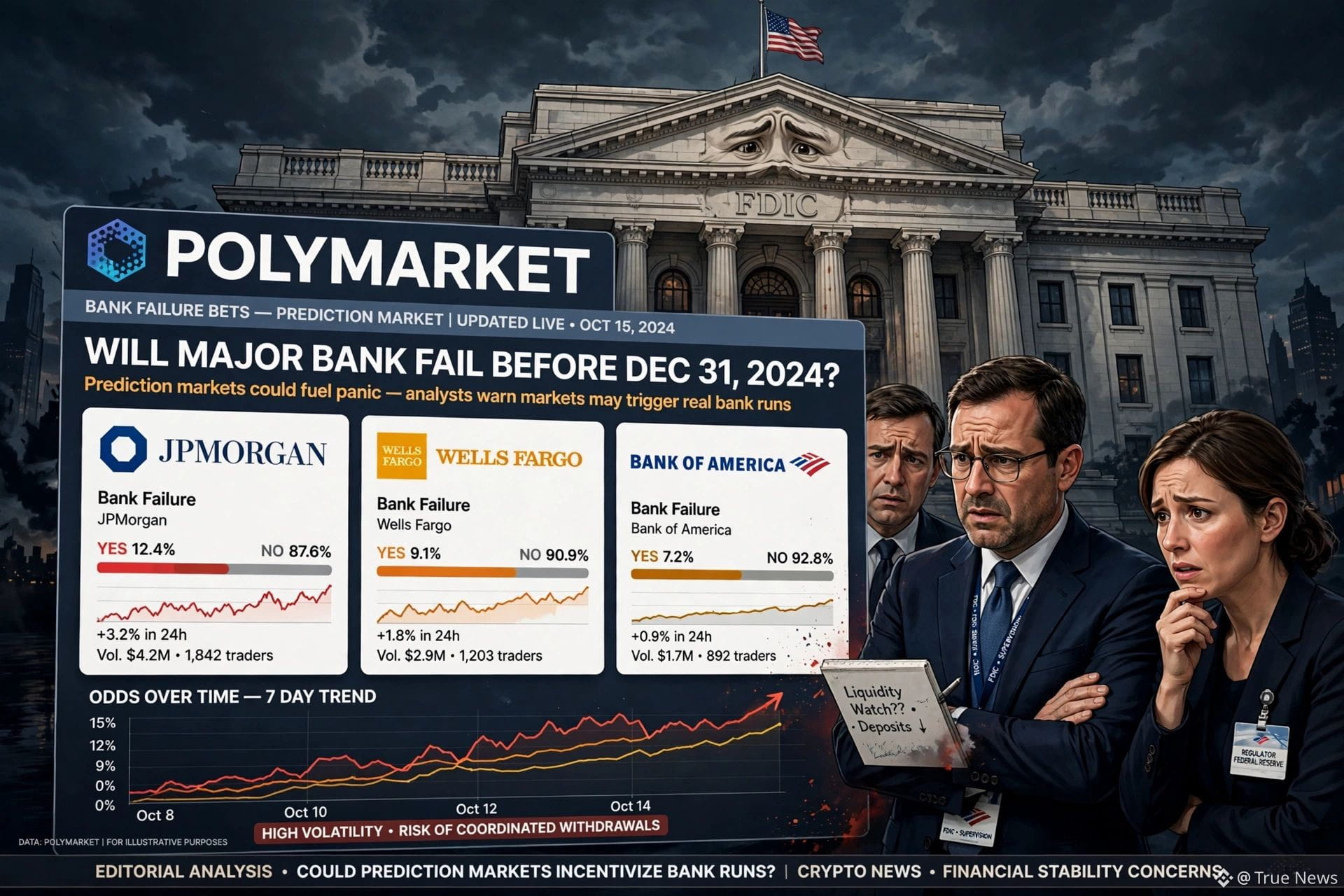
FDIC & Congress are concerned: If enough traders price in a failure, those odds can spread on social media, scare depositors, and CREATE the very bank run it's betting on. 😱
Current volume is small ($76K), but the feedback loop is the real danger.
Even Kalshi called it "in poor taste" and ex-FDIC head Sheila Bair warned of dangerous incentives.
Is prediction market going too far? Should bank failures be bettable?
#Polymarket #FDIC #Banking #CryptoNews #polymarketbankfailurebetsdrawfdicconcern
🚨 Polymarket is now taking bets on MAJOR bank failures - and the FDIC is NOT happy!
According to Bloomberg Sep 26, prediction market Polymarket has contracts on whether giants like JPMorgan, Wells Fargo & Bank of America will FAIL.
FDIC & Congress are concerned: If enough traders price in a failure, those odds can spread on social media, scare depositors, and CREATE the very bank run it's betting on. 😱
Current volume is small ($76K), but the feedback loop is the real danger.
Even Kalshi called it "in poor taste" and ex-FDIC head Sheila Bair warned of dangerous incentives.
Is prediction market going too far? Should bank failures be bettable?
#Polymarket #FDIC #Banking #CryptoNews #polymarketbankfailurebetsdrawfdicconcern
According to Bloomberg Sep 26, prediction market Polymarket has contracts on whether giants like JPMorgan, Wells Fargo & Bank of America will FAIL.
FDIC & Congress are concerned: If enough traders price in a failure, those odds can spread on social media, scare depositors, and CREATE the very bank run it's betting on. 😱
Current volume is small ($76K), but the feedback loop is the real danger.
Even Kalshi called it "in poor taste" and ex-FDIC head Sheila Bair warned of dangerous incentives.
Is prediction market going too far? Should bank failures be bettable?
#Polymarket #FDIC #Banking #CryptoNews #polymarketbankfailurebetsdrawfdicconcern
1
121

·
--
🚨 Bank Failure Bets Are Rising — Should We Pay Attention?
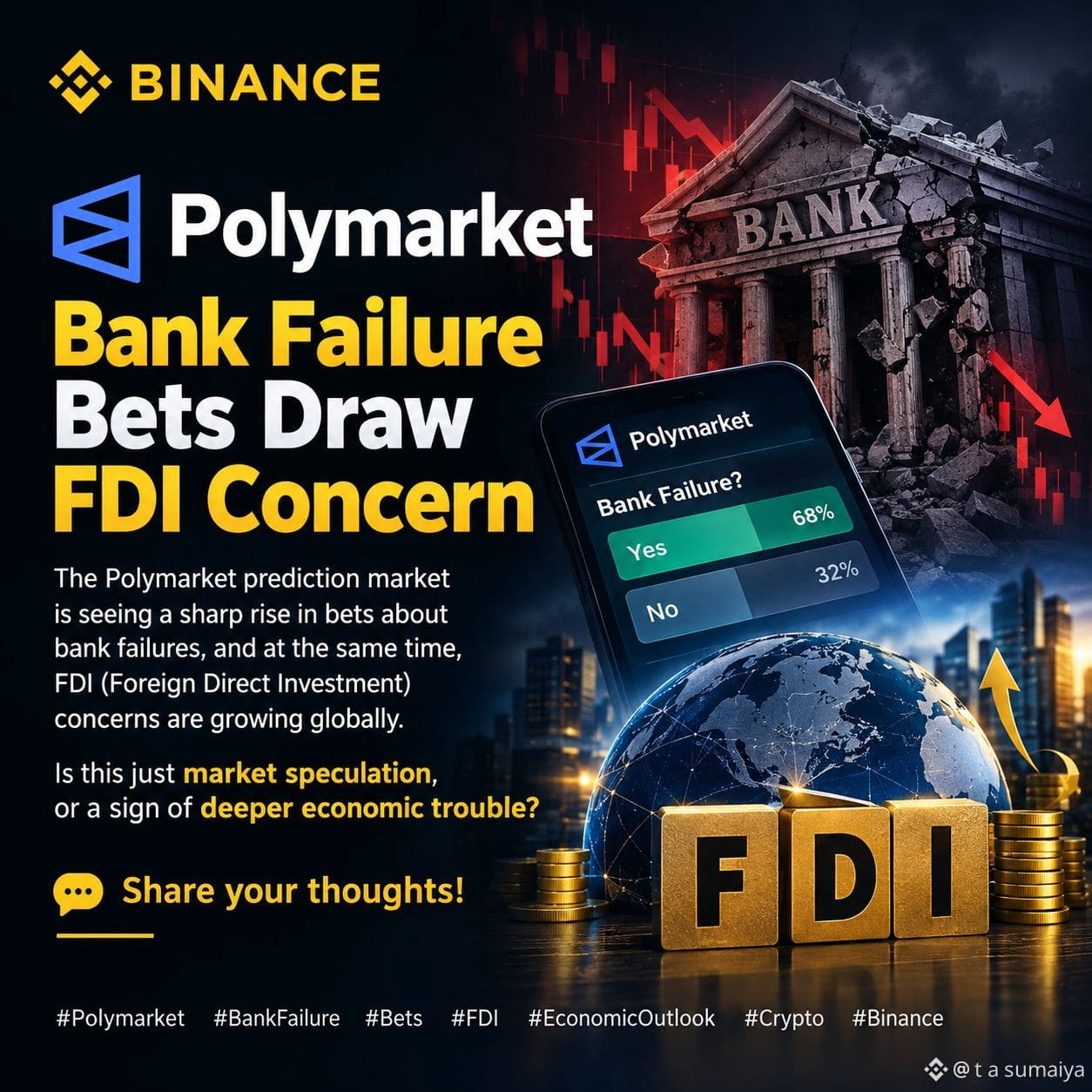
Polymarket is seeing growing interest in prediction markets related to potential bank failures, while concerns around FDI (Foreign Direct Investment) are also attracting attention.
📉 Could this be a sign of increasing uncertainty in global financial markets?
Or is it simply another wave of market speculation?
Prediction markets can reflect what traders and participants are thinking—but they don’t necessarily predict what will actually happen.
🌍 Banking + FDI + Global Markets = A trend worth watching.
💬 What do you think? Market signal or market noise?
#PolymarketBankFailureBetsDrawFDICConcern #FDI #crypto #Binance #MarketTrends
🚨 Bank Failure Bets Are Rising — Should We Pay Attention?
Polymarket is seeing growing interest in prediction markets related to potential bank failures, while concerns around FDI (Foreign Direct Investment) are also attracting attention.
📉 Could this be a sign of increasing uncertainty in global financial markets?
Or is it simply another wave of market speculation?
Prediction markets can reflect what traders and participants are thinking—but they don’t necessarily predict what will actually happen.
🌍 Banking + FDI + Global Markets = A trend worth watching.
💬 What do you think? Market signal or market noise?
#PolymarketBankFailureBetsDrawFDICConcern #FDI #crypto #Binance #MarketTrends
Polymarket is seeing growing interest in prediction markets related to potential bank failures, while concerns around FDI (Foreign Direct Investment) are also attracting attention.
📉 Could this be a sign of increasing uncertainty in global financial markets?
Or is it simply another wave of market speculation?
Prediction markets can reflect what traders and participants are thinking—but they don’t necessarily predict what will actually happen.
🌍 Banking + FDI + Global Markets = A trend worth watching.
💬 What do you think? Market signal or market noise?
#PolymarketBankFailureBetsDrawFDICConcern #FDI #crypto #Binance #MarketTrends
24

$BTC Polymarket Bank Bets Get FDIC AttentionPolymarket contracts betting on the failure of major banks like JPMorgan, Bank of America and Wells Fargo are drawing attention from FDIC officials. 👀
The interesting part:
📊 Current trading volume is still relatively small.
⚠️ Regulators are concerned about what could happen if these markets grow and start amplifying fear around specific banks.
🏦 The bigger issue is the possibility of market speculation contributing to real-world deposit runs.
For crypto, I’m watching:
$BTC — macro and risk sentiment
$ETH — DeFi and on-chain finance
$BNB — broader crypto liquidity
This doesn't mean a banking crisis is happening.
It means prediction markets are becoming important enough that regulators are watching their potential impact on financial stability.
Would you treat these markets as useful signals or potential sources of unnecessary fear?
#polymarketbankfailurebetsdrawfdicconcern #Polymarket #FDIC #BankingSector #PredictionMarkets #BTC #ETH #BNB #Bitcoin #Ethereum #Crypto #BinanceSquare
$BTC Polymarket Bank Bets Get FDIC Attention
Polymarket contracts betting on the failure of major banks like JPMorgan, Bank of America and Wells Fargo are drawing attention from FDIC officials. 👀
The interesting part:
📊 Current trading volume is still relatively small.
⚠️ Regulators are concerned about what could happen if these markets grow and start amplifying fear around specific banks.
🏦 The bigger issue is the possibility of market speculation contributing to real-world deposit runs.
For crypto, I’m watching:
$BTC — macro and risk sentiment
$ETH — DeFi and on-chain finance
$BNB — broader crypto liquidity
This doesn't mean a banking crisis is happening.
It means prediction markets are becoming important enough that regulators are watching their potential impact on financial stability.
Would you treat these markets as useful signals or potential sources of unnecessary fear?
#polymarketbankfailurebetsdrawfdicconcern #Polymarket #FDIC #BankingSector #PredictionMarkets #BTC #ETH #BNB #Bitcoin #Ethereum #Crypto #BinanceSquare
The interesting part:
📊 Current trading volume is still relatively small.
⚠️ Regulators are concerned about what could happen if these markets grow and start amplifying fear around specific banks.
🏦 The bigger issue is the possibility of market speculation contributing to real-world deposit runs.
For crypto, I’m watching:
$BTC — macro and risk sentiment
$ETH — DeFi and on-chain finance
$BNB — broader crypto liquidity
This doesn't mean a banking crisis is happening.
It means prediction markets are becoming important enough that regulators are watching their potential impact on financial stability.
Would you treat these markets as useful signals or potential sources of unnecessary fear?
#polymarketbankfailurebetsdrawfdicconcern #Polymarket #FDIC #BankingSector #PredictionMarkets #BTC #ETH #BNB #Bitcoin #Ethereum #Crypto #BinanceSquare
206 Atlas:
FDIC scrutiny on bank failure bets is noise until volume spikes. Don't confuse regulatory curiosity with immediate market impact.
1
38

·
--
#PolymarketBankFailureBetsDrawFDICConcern
Polymarket Bank-Failure Bets Draw FDIC Concern
Prediction-market contracts allowing traders to bet on the potential failure of major banks are drawing scrutiny from U.S. banking regulators, according to a Bloomberg report published September 25. The contracts on Polymarket include wagers involving banks such as Wells Fargo, JPMorgan Chase and Bank of America. �
Yahoo Finance +1
The markets remain relatively small. Contracts concerning individual banks have generally attracted hundreds to thousands of dollars, while bets on banks failing by the end of 2026 have generated about $76,000 in volume. An earlier set of contracts focused on failures by July recorded approximately $591,000 in trading volume. �
Yahoo Finance
The Federal Deposit Insurance Corporation (FDIC) reportedly discussed whether such contracts could create financial-stability risks if they expanded substantially. Officials were also concerned about potential conflicts involving FDIC employees because the agency maintains confidential information about banks experiencing financial problems. Existing ethics rules were ultimately considered sufficient to prevent improper trading by agency personnel, according to the report. �
Yahoo Finance
A key concern is the possibility that heavily traded failure contracts could amplify rumors and encourage depositors to withdraw funds, potentially contributing to a bank run. Supporters of prediction markets argue the contracts can instead aggregate information and provide an additional real-time signal about perceived risks. �
Yahoo Finance
Polymarket's offshore platform offers the bank-failure contracts and says Americans are prohibited from trading there. Its U.S. platform, which operates under Commodity Futures Trading Commission oversight, does not currently offer contracts on individual bank failures. �
Yahoo Finance
The controversy highlights the growing regulatory debate over prediction markets and whether contracts tied directly to financial-system stability should be permitted.$NVDA.US $AAPL.US
#PolymarketBankFailureBetsDrawFDICConcern
Polymarket Bank-Failure Bets Draw FDIC Concern
Prediction-market contracts allowing traders to bet on the potential failure of major banks are drawing scrutiny from U.S. banking regulators, according to a Bloomberg report published September 25. The contracts on Polymarket include wagers involving banks such as Wells Fargo, JPMorgan Chase and Bank of America. �
Yahoo Finance +1
The markets remain relatively small. Contracts concerning individual banks have generally attracted hundreds to thousands of dollars, while bets on banks failing by the end of 2026 have generated about $76,000 in volume. An earlier set of contracts focused on failures by July recorded approximately $591,000 in trading volume. �
Yahoo Finance
The Federal Deposit Insurance Corporation (FDIC) reportedly discussed whether such contracts could create financial-stability risks if they expanded substantially. Officials were also concerned about potential conflicts involving FDIC employees because the agency maintains confidential information about banks experiencing financial problems. Existing ethics rules were ultimately considered sufficient to prevent improper trading by agency personnel, according to the report. �
Yahoo Finance
A key concern is the possibility that heavily traded failure contracts could amplify rumors and encourage depositors to withdraw funds, potentially contributing to a bank run. Supporters of prediction markets argue the contracts can instead aggregate information and provide an additional real-time signal about perceived risks. �
Yahoo Finance
Polymarket's offshore platform offers the bank-failure contracts and says Americans are prohibited from trading there. Its U.S. platform, which operates under Commodity Futures Trading Commission oversight, does not currently offer contracts on individual bank failures. �
Yahoo Finance
The controversy highlights the growing regulatory debate over prediction markets and whether contracts tied directly to financial-system stability should be permitted.$NVDA.US $AAPL.US
Polymarket Bank-Failure Bets Draw FDIC Concern
Prediction-market contracts allowing traders to bet on the potential failure of major banks are drawing scrutiny from U.S. banking regulators, according to a Bloomberg report published September 25. The contracts on Polymarket include wagers involving banks such as Wells Fargo, JPMorgan Chase and Bank of America. �
Yahoo Finance +1
The markets remain relatively small. Contracts concerning individual banks have generally attracted hundreds to thousands of dollars, while bets on banks failing by the end of 2026 have generated about $76,000 in volume. An earlier set of contracts focused on failures by July recorded approximately $591,000 in trading volume. �
Yahoo Finance
The Federal Deposit Insurance Corporation (FDIC) reportedly discussed whether such contracts could create financial-stability risks if they expanded substantially. Officials were also concerned about potential conflicts involving FDIC employees because the agency maintains confidential information about banks experiencing financial problems. Existing ethics rules were ultimately considered sufficient to prevent improper trading by agency personnel, according to the report. �
Yahoo Finance
A key concern is the possibility that heavily traded failure contracts could amplify rumors and encourage depositors to withdraw funds, potentially contributing to a bank run. Supporters of prediction markets argue the contracts can instead aggregate information and provide an additional real-time signal about perceived risks. �
Yahoo Finance
Polymarket's offshore platform offers the bank-failure contracts and says Americans are prohibited from trading there. Its U.S. platform, which operates under Commodity Futures Trading Commission oversight, does not currently offer contracts on individual bank failures. �
Yahoo Finance
The controversy highlights the growing regulatory debate over prediction markets and whether contracts tied directly to financial-system stability should be permitted.$NVDA.US $AAPL.US
NVDAUS+0.22%
AAPLUS+1.44%
5

🚨 POLYMARKET BANK-FAILURE BETS DRAW FDIC CONCERN 🏦⚠️
Polymarket is facing fresh scrutiny over prediction-market contracts tied to potential bank failures.
📌 Contracts have allowed traders to speculate on whether major banks such as JPMorgan, Bank of America and Wells Fargo could fail by the end of 2026.
📊 Reported trading volume remains relatively small, but FDIC officials are concerned that larger markets could potentially influence depositor behavior and contribute to financial instability.
🔎 Another issue being discussed is whether people with access to nonpublic information could misuse prediction markets.
Polymarket argues that prediction markets can aggregate information and provide real-time signals about financial risks.
The debate highlights a bigger question for the crypto and prediction-market industry:
Can prediction markets improve information discovery without creating new financial risks? 👀
⚠️ This is news and educational content, not financial advice
{future}(POLYXUSDT)
#PolymarketBankFailureBetsDrawFDICConcern
🚨 POLYMARKET BANK-FAILURE BETS DRAW FDIC CONCERN 🏦⚠️
Polymarket is facing fresh scrutiny over prediction-market contracts tied to potential bank failures.
📌 Contracts have allowed traders to speculate on whether major banks such as JPMorgan, Bank of America and Wells Fargo could fail by the end of 2026.
📊 Reported trading volume remains relatively small, but FDIC officials are concerned that larger markets could potentially influence depositor behavior and contribute to financial instability.
🔎 Another issue being discussed is whether people with access to nonpublic information could misuse prediction markets.
Polymarket argues that prediction markets can aggregate information and provide real-time signals about financial risks.
The debate highlights a bigger question for the crypto and prediction-market industry:
Can prediction markets improve information discovery without creating new financial risks? 👀
⚠️ This is news and educational content, not financial advice
#PolymarketBankFailureBetsDrawFDICConcern
Polymarket is facing fresh scrutiny over prediction-market contracts tied to potential bank failures.
📌 Contracts have allowed traders to speculate on whether major banks such as JPMorgan, Bank of America and Wells Fargo could fail by the end of 2026.
📊 Reported trading volume remains relatively small, but FDIC officials are concerned that larger markets could potentially influence depositor behavior and contribute to financial instability.
🔎 Another issue being discussed is whether people with access to nonpublic information could misuse prediction markets.
Polymarket argues that prediction markets can aggregate information and provide real-time signals about financial risks.
The debate highlights a bigger question for the crypto and prediction-market industry:
Can prediction markets improve information discovery without creating new financial risks? 👀
⚠️ This is news and educational content, not financial advice
#PolymarketBankFailureBetsDrawFDICConcern
14

·
--
Market Alert: Polymarket Bets on Bank Failures Spark Regulator ConcernA fascinating intersection of prediction markets, banking stability, and regulation is emerging. Recent reports confirm that U.S. financial regulators, specifically the FDIC, are monitoring Polymarket contracts that allow traders to bet on the failure of major global banks.
The Core Conflict: Pricing Risk vs. Creating Risk
The central debate is about a critical feedback loop. Unlike shorting a stock, these contracts are direct wagers on a bank's survival.
Regulator View (FDIC): Regulators are concerned that visible, concentrated bets on a bank's probability of failure could actually trigger the event. Seeing a high "failure probability" signal on a public market could cause a crisis of confidence, spooking depositors and accelerating a real-world liquidity crisis (a bank run).
Prediction Market View (Polymarket): The platform argues that these markets reduce information asymmetry. They provide an open, real-time signal, aggregating diverse information that was previously confined to a few elite financial firms, thus giving ordinary investors a better tool for monitoring financial risk.
Visualizing the Market Dynamic
The attached images illustrate the concept:
Prediction Market Dashboard: A conceptual layout of what a Polymarket dashboard for banking failure bets might look like.
The Feedback Loop: A simplified diagram showing the potentially dangerous relationship between public failure pricing and depositor behavior.
Key Takeaway for Crypto Investors
While trading volume on these specific contracts is still small, this development has broader implications for the crypto asset class.
Increased Regulatory Scrutiny: This issue is likely to accelerate discussions about regulating prediction markets, especially when they touch systemic financial infrastructure. This could lead to tighter oversight across the decentralized forecasting sector.
Sentiment Factor: If these contracts gain traction, they could become a new high-visibility indicator of systemic risk, which traditionally affects risk appetite for all assets, including crypto.
We are watching to see if regulators take concrete enforcement action against these contracts or if they continue to view them as a "useful, if volatile, tool."
What's your take? Do public betting markets provide valuable transparency, or are they dangerous destabilizers of the core banking system? Share your thoughts below. 👇
#PolymarketBankFailureBetsDrawFDICConcern #BTC☀️ #BlackRockBuildsTokenizedPortfoliosForOndo $ETH
Market Alert: Polymarket Bets on Bank Failures Spark Regulator Concern
A fascinating intersection of prediction markets, banking stability, and regulation is emerging. Recent reports confirm that U.S. financial regulators, specifically the FDIC, are monitoring Polymarket contracts that allow traders to bet on the failure of major global banks.
The Core Conflict: Pricing Risk vs. Creating Risk
The central debate is about a critical feedback loop. Unlike shorting a stock, these contracts are direct wagers on a bank's survival.
Regulator View (FDIC): Regulators are concerned that visible, concentrated bets on a bank's probability of failure could actually trigger the event. Seeing a high "failure probability" signal on a public market could cause a crisis of confidence, spooking depositors and accelerating a real-world liquidity crisis (a bank run).
Prediction Market View (Polymarket): The platform argues that these markets reduce information asymmetry. They provide an open, real-time signal, aggregating diverse information that was previously confined to a few elite financial firms, thus giving ordinary investors a better tool for monitoring financial risk.
Visualizing the Market Dynamic
The attached images illustrate the concept:
Prediction Market Dashboard: A conceptual layout of what a Polymarket dashboard for banking failure bets might look like.
The Feedback Loop: A simplified diagram showing the potentially dangerous relationship between public failure pricing and depositor behavior.
Key Takeaway for Crypto Investors
While trading volume on these specific contracts is still small, this development has broader implications for the crypto asset class.
Increased Regulatory Scrutiny: This issue is likely to accelerate discussions about regulating prediction markets, especially when they touch systemic financial infrastructure. This could lead to tighter oversight across the decentralized forecasting sector.
Sentiment Factor: If these contracts gain traction, they could become a new high-visibility indicator of systemic risk, which traditionally affects risk appetite for all assets, including crypto.
We are watching to see if regulators take concrete enforcement action against these contracts or if they continue to view them as a "useful, if volatile, tool."
What's your take? Do public betting markets provide valuable transparency, or are they dangerous destabilizers of the core banking system? Share your thoughts below. 👇
#PolymarketBankFailureBetsDrawFDICConcern #BTC☀️ #BlackRockBuildsTokenizedPortfoliosForOndo $ETH
The Core Conflict: Pricing Risk vs. Creating Risk
The central debate is about a critical feedback loop. Unlike shorting a stock, these contracts are direct wagers on a bank's survival.
Regulator View (FDIC): Regulators are concerned that visible, concentrated bets on a bank's probability of failure could actually trigger the event. Seeing a high "failure probability" signal on a public market could cause a crisis of confidence, spooking depositors and accelerating a real-world liquidity crisis (a bank run).
Prediction Market View (Polymarket): The platform argues that these markets reduce information asymmetry. They provide an open, real-time signal, aggregating diverse information that was previously confined to a few elite financial firms, thus giving ordinary investors a better tool for monitoring financial risk.
Visualizing the Market Dynamic
The attached images illustrate the concept:
Prediction Market Dashboard: A conceptual layout of what a Polymarket dashboard for banking failure bets might look like.
The Feedback Loop: A simplified diagram showing the potentially dangerous relationship between public failure pricing and depositor behavior.
Key Takeaway for Crypto Investors
While trading volume on these specific contracts is still small, this development has broader implications for the crypto asset class.
Increased Regulatory Scrutiny: This issue is likely to accelerate discussions about regulating prediction markets, especially when they touch systemic financial infrastructure. This could lead to tighter oversight across the decentralized forecasting sector.
Sentiment Factor: If these contracts gain traction, they could become a new high-visibility indicator of systemic risk, which traditionally affects risk appetite for all assets, including crypto.
We are watching to see if regulators take concrete enforcement action against these contracts or if they continue to view them as a "useful, if volatile, tool."
What's your take? Do public betting markets provide valuable transparency, or are they dangerous destabilizers of the core banking system? Share your thoughts below. 👇
#PolymarketBankFailureBetsDrawFDICConcern #BTC☀️ #BlackRockBuildsTokenizedPortfoliosForOndo $ETH
humkash:
Please Follow me. I Followed you back. Please like my post.
1
1
34

#polymarketbankfailurebetsdrawfdicconcern
🚨 TradFi is Sweating Over Polymarket! 🚨
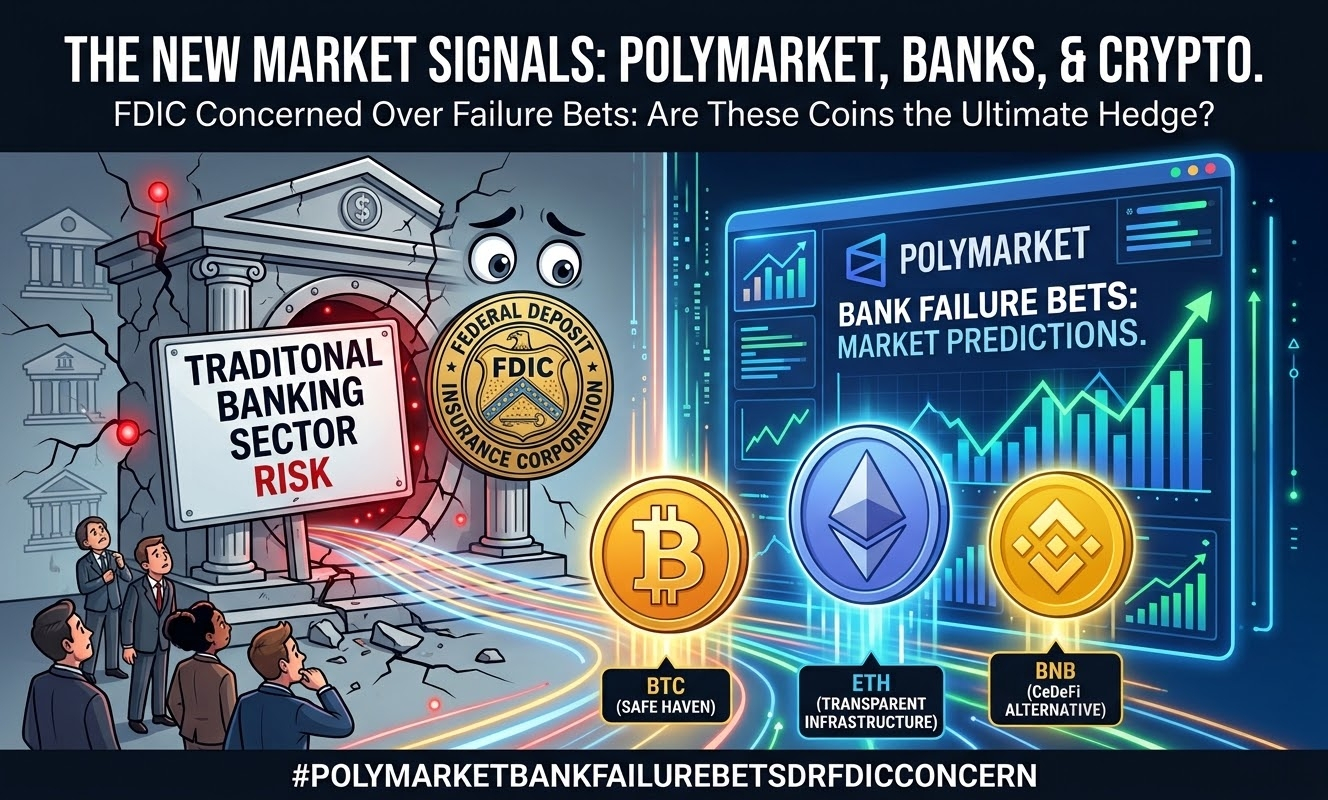
The FDIC is officially monitoring Polymarket contracts that let users bet on the failure of major banks like Wells Fargo and JPMorgan. Regulators fear these transparent, on-chain prediction markets could expose banking instability and spark real-world bank runs.
While legacy banking worries about its fragile foundation, crypto's blue chips are perfectly positioned for the fallout:
🔥 $BTC (Bitcoin): The Ultimate Safe Haven
Born directly from the 2008 financial crisis, Bitcoin is the perfect hedge against systemic banking collapse. When TradFi trembles, BTC shines as a non-sovereign store of value.
🔥 $ETH (Ethereum): The Infrastructure of Truth
Polymarket operates on Ethereum's wider ecosystem. The FDIC’s concern proves the power of smart contracts: offering transparent, real-time market signals that ordinary investors can access. ETH is the undisputed settlement layer replacing opaque systems.
🔥 $BNB (Binance Coin): The Scalable Alternative
As trust in traditional banks erodes, robust CeDeFi ecosystems powered by BNB provide borderless, highly liquid financial alternatives, ready to absorb capital fleeing legacy bottlenecks.
Prediction markets don't cause bank runs; they just expose the cracks.
Not financial advice. Always DYOR.
#FDIC #predictionmarket #Polymarket #BankingSector
{future}(BTCUSDT)
{future}(ETHUSDT)
{future}(BNBUSDT)
#polymarketbankfailurebetsdrawfdicconcern
🚨 TradFi is Sweating Over Polymarket! 🚨
The FDIC is officially monitoring Polymarket contracts that let users bet on the failure of major banks like Wells Fargo and JPMorgan. Regulators fear these transparent, on-chain prediction markets could expose banking instability and spark real-world bank runs.
While legacy banking worries about its fragile foundation, crypto's blue chips are perfectly positioned for the fallout:
🔥 $BTC (Bitcoin): The Ultimate Safe Haven
Born directly from the 2008 financial crisis, Bitcoin is the perfect hedge against systemic banking collapse. When TradFi trembles, BTC shines as a non-sovereign store of value.
🔥 $ETH (Ethereum): The Infrastructure of Truth
Polymarket operates on Ethereum's wider ecosystem. The FDIC’s concern proves the power of smart contracts: offering transparent, real-time market signals that ordinary investors can access. ETH is the undisputed settlement layer replacing opaque systems.
🔥 $BNB (Binance Coin): The Scalable Alternative
As trust in traditional banks erodes, robust CeDeFi ecosystems powered by BNB provide borderless, highly liquid financial alternatives, ready to absorb capital fleeing legacy bottlenecks.
Prediction markets don't cause bank runs; they just expose the cracks.
Not financial advice. Always DYOR.
#FDIC #predictionmarket #Polymarket #BankingSector
🚨 TradFi is Sweating Over Polymarket! 🚨
The FDIC is officially monitoring Polymarket contracts that let users bet on the failure of major banks like Wells Fargo and JPMorgan. Regulators fear these transparent, on-chain prediction markets could expose banking instability and spark real-world bank runs.
While legacy banking worries about its fragile foundation, crypto's blue chips are perfectly positioned for the fallout:
🔥 $BTC (Bitcoin): The Ultimate Safe Haven
Born directly from the 2008 financial crisis, Bitcoin is the perfect hedge against systemic banking collapse. When TradFi trembles, BTC shines as a non-sovereign store of value.
🔥 $ETH (Ethereum): The Infrastructure of Truth
Polymarket operates on Ethereum's wider ecosystem. The FDIC’s concern proves the power of smart contracts: offering transparent, real-time market signals that ordinary investors can access. ETH is the undisputed settlement layer replacing opaque systems.
🔥 $BNB (Binance Coin): The Scalable Alternative
As trust in traditional banks erodes, robust CeDeFi ecosystems powered by BNB provide borderless, highly liquid financial alternatives, ready to absorb capital fleeing legacy bottlenecks.
Prediction markets don't cause bank runs; they just expose the cracks.
Not financial advice. Always DYOR.
#FDIC #predictionmarket #Polymarket #BankingSector
70

·
--
#PolymarketBankFailureBetsDrawFDICConcern
$AAPL.US $
$Polymarket is facing attention over prediction-market contracts tied to potential U.S. bank failures. The bets have reportedly raised concerns at the FDIC about whether markets should allow speculation around sensitive financial events.
The debate highlights a growing question: how far should prediction markets go when real-world financial stability is involved? Supporters argue these markets can provide useful signals, while regulators may worry about incentives and public confidence.
For now, the issue remains a broader discussion around prediction markets, financial risk, and regulatory oversight.
#PolymarketBankFailureBetsDrawFDICConcern
$AAPL.US $
$Polymarket is facing attention over prediction-market contracts tied to potential U.S. bank failures. The bets have reportedly raised concerns at the FDIC about whether markets should allow speculation around sensitive financial events.
The debate highlights a growing question: how far should prediction markets go when real-world financial stability is involved? Supporters argue these markets can provide useful signals, while regulators may worry about incentives and public confidence.
For now, the issue remains a broader discussion around prediction markets, financial risk, and regulatory oversight.
$AAPL.US $
$Polymarket is facing attention over prediction-market contracts tied to potential U.S. bank failures. The bets have reportedly raised concerns at the FDIC about whether markets should allow speculation around sensitive financial events.
The debate highlights a growing question: how far should prediction markets go when real-world financial stability is involved? Supporters argue these markets can provide useful signals, while regulators may worry about incentives and public confidence.
For now, the issue remains a broader discussion around prediction markets, financial risk, and regulatory oversight.
AAPLUS+1.44%
87

#PolymarketBankFailureBetsDrawFDICConcern Polymarket contracts betting on potential failures of major banks are drawing attention from the FDIC, amid concerns that such markets could amplify fear or contribute to bank-run risks if they grow significantly.
The contracts reportedly involve banks including Wells Fargo, JPMorgan Chase, Bank of America and Deutsche Bank. Current trading volumes remain relatively small, but regulators are watching the potential financial-stability implications.
#Polymarket #Crypto #CryptoNews #PredictionMarkets #FDIC #Banking #BankFailure #FinancialMarkets #Finance #Blockchain #Web3 #DigitalAssets #DeFi #Bitcoin #Ethereum #MarketNews $BTC
{spot}(BTCUSDT)
#PolymarketBankFailureBetsDrawFDICConcern Polymarket contracts betting on potential failures of major banks are drawing attention from the FDIC, amid concerns that such markets could amplify fear or contribute to bank-run risks if they grow significantly.
The contracts reportedly involve banks including Wells Fargo, JPMorgan Chase, Bank of America and Deutsche Bank. Current trading volumes remain relatively small, but regulators are watching the potential financial-stability implications.
#Polymarket #Crypto #CryptoNews #PredictionMarkets #FDIC #Banking #BankFailure #FinancialMarkets #Finance #Blockchain #Web3 #DigitalAssets #DeFi #Bitcoin #Ethereum #MarketNews $BTC
The contracts reportedly involve banks including Wells Fargo, JPMorgan Chase, Bank of America and Deutsche Bank. Current trading volumes remain relatively small, but regulators are watching the potential financial-stability implications.
#Polymarket #Crypto #CryptoNews #PredictionMarkets #FDIC #Banking #BankFailure #FinancialMarkets #Finance #Blockchain #Web3 #DigitalAssets #DeFi #Bitcoin #Ethereum #MarketNews $BTC
1
106

#PolymarketBankFailureBetsDrawFDICConcern
🚨🏦 POLYMARKET’S BANK-FAILURE BETS ARE ON THE FDIC RADAR! 👀
Prediction markets are now attracting attention around a sensitive topic — whether banks could fail. 💥
🎯 Users are making predictions
🏦 Bank-failure scenarios are gaining attention
🇺🇸 FDIC concerns are entering the conversation
👀 And crypto markets are watching closely
This isn’t just another prediction-market headline.
When banking + prediction markets + regulation collide, the market usually starts paying attention. ⚠️
I’m watching the next developments closely.
Headline → Reaction → Volume → Market confirmation.
$BANK
{future}(BANKUSDT)
$ARK
{future}(ARKUSDT)
$MUBARAK
{future}(MUBARAKUSDT)
DYOR • NFA • Manage Risk ⚠️
#Binance #bank #MUBARAK #ARK
#PolymarketBankFailureBetsDrawFDICConcern
🚨🏦 POLYMARKET’S BANK-FAILURE BETS ARE ON THE FDIC RADAR! 👀
Prediction markets are now attracting attention around a sensitive topic — whether banks could fail. 💥
🎯 Users are making predictions
🏦 Bank-failure scenarios are gaining attention
🇺🇸 FDIC concerns are entering the conversation
👀 And crypto markets are watching closely
This isn’t just another prediction-market headline.
When banking + prediction markets + regulation collide, the market usually starts paying attention. ⚠️
I’m watching the next developments closely.
Headline → Reaction → Volume → Market confirmation.
$BANK
$ARK
$MUBARAK
DYOR • NFA • Manage Risk ⚠️
#Binance #bank #MUBARAK #ARK
🚨🏦 POLYMARKET’S BANK-FAILURE BETS ARE ON THE FDIC RADAR! 👀
Prediction markets are now attracting attention around a sensitive topic — whether banks could fail. 💥
🎯 Users are making predictions
🏦 Bank-failure scenarios are gaining attention
🇺🇸 FDIC concerns are entering the conversation
👀 And crypto markets are watching closely
This isn’t just another prediction-market headline.
When banking + prediction markets + regulation collide, the market usually starts paying attention. ⚠️
I’m watching the next developments closely.
Headline → Reaction → Volume → Market confirmation.
$BANK
$ARK
$MUBARAK
DYOR • NFA • Manage Risk ⚠️
#Binance #bank #MUBARAK #ARK
344

·
--
#PolymarketBankFailureBetsDrawFDICConcern
#PolymarketBankFailureBetsDrawFDICConcern
Polymarket bets on potential bank failures are drawing attention from the FDIC, raising questions about prediction markets, financial stability, and regulatory oversight. The debate highlights the growing intersection between crypto, betting markets, and traditional finance.
#PolymarketBankFailureBetsDrawFDICConcern
#PolymarketBankFailureBetsDrawFDICConcern
Polymarket bets on potential bank failures are drawing attention from the FDIC, raising questions about prediction markets, financial stability, and regulatory oversight. The debate highlights the growing intersection between crypto, betting markets, and traditional finance.
#PolymarketBankFailureBetsDrawFDICConcern
Polymarket bets on potential bank failures are drawing attention from the FDIC, raising questions about prediction markets, financial stability, and regulatory oversight. The debate highlights the growing intersection between crypto, betting markets, and traditional finance.
67

·
--
Bullish
#polymarketbankfailurebetsdrawfdicconcern
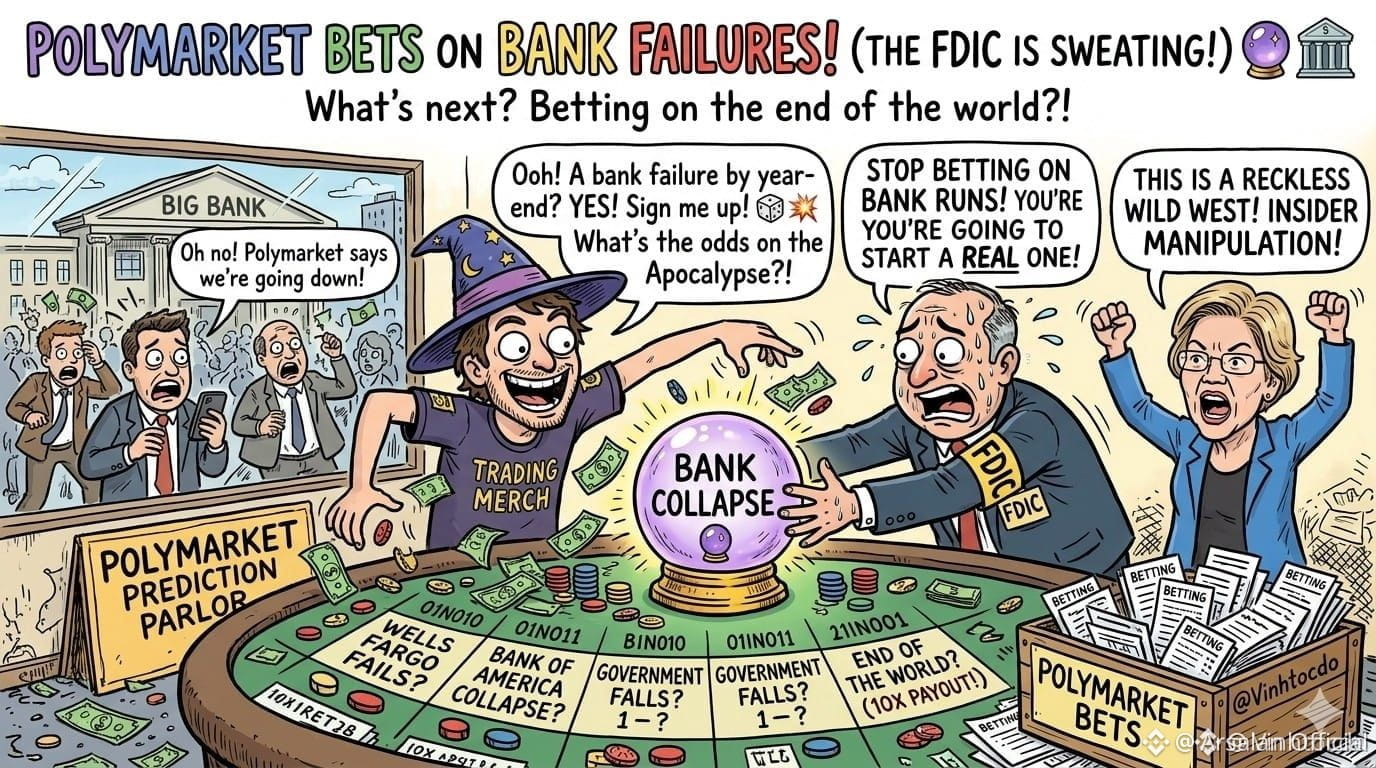
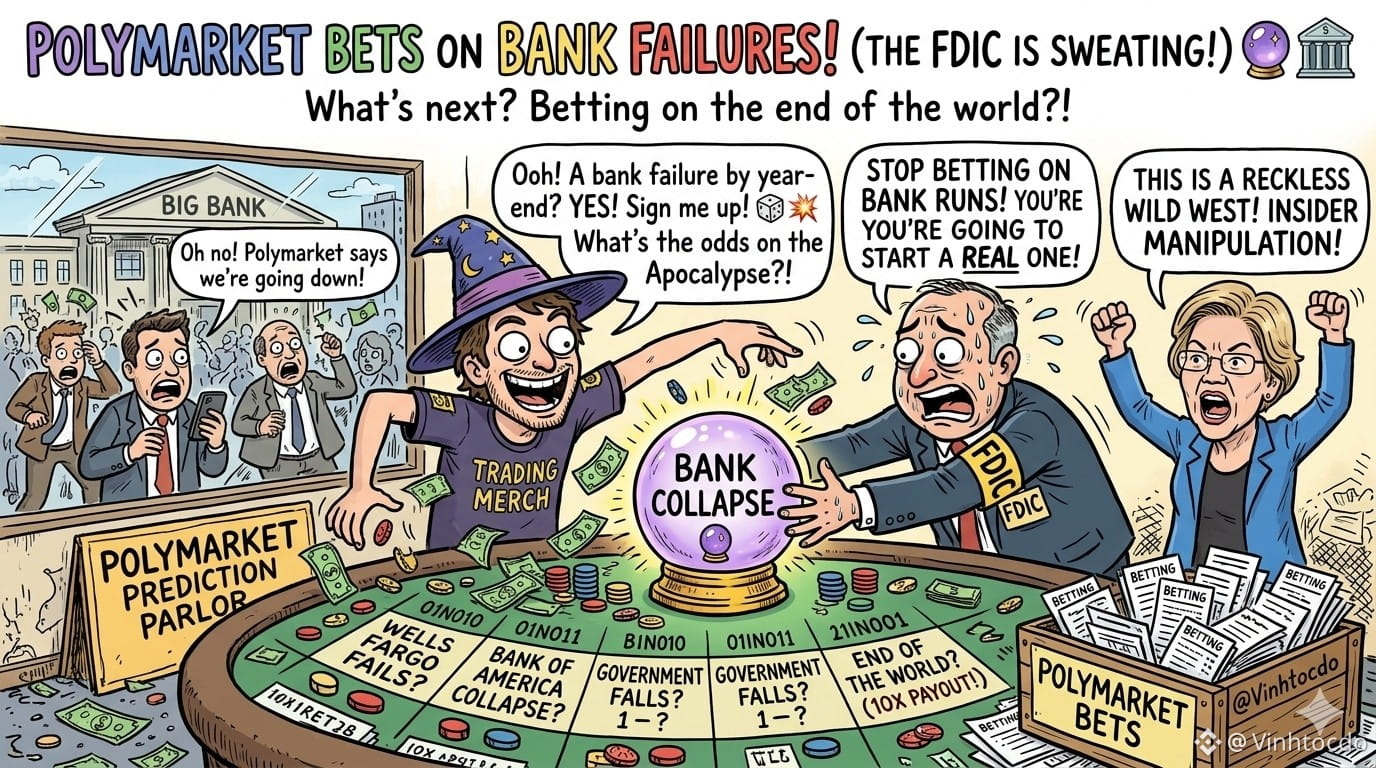
Polymarket is betting on bank collapses, and the FDIC is officially sweating! 🔮🏦
Somebody stop Polymarket degens! They are literally using the platform like a crystal ball to bet on whether banking giants like Wells Fargo or Bank of America will fail by year-end. This has raised massive red flags for the FDIC. What’s next? Betting on which government falls first? Or predicting the end of the world for a quick 10x payout? 🌍💥
Critics like Elizabeth Warren say it's a reckless Wild West that could spark a real-world bank run through social media panic!
What should smart traders do? 🛠️
📌 Follow the sentiment: These prediction markets aggregate crowd-sourced data faster than traditional news.
📈 Secure your cash: Don't let rumors panic you, but make sure your crypto capital is spread safely.
Disclaimer: This is personal opinion, not financial advice.
👇 Click and trade below to support me:
💰 $BTC
{future}(BTCUSDT)
| 💰 $BNB
{future}(BNBUSDT)
| 💰 $ETH
{future}(ETHUSDT)
📌 Referral Code: VINHTOCDO
🔗 Join Binance: [https://www.binance.com/register?ref=VINHTOCDO](https://www.binance.com/register?ref=VINHTOCDO)
#Polymarket #FDICConcern #BankFailureBets #VINHTOCDO #CryptoRegulation #PredictionMarkets
#polymarketbankfailurebetsdrawfdicconcern
Polymarket is betting on bank collapses, and the FDIC is officially sweating! 🔮🏦
Somebody stop Polymarket degens! They are literally using the platform like a crystal ball to bet on whether banking giants like Wells Fargo or Bank of America will fail by year-end. This has raised massive red flags for the FDIC. What’s next? Betting on which government falls first? Or predicting the end of the world for a quick 10x payout? 🌍💥
Critics like Elizabeth Warren say it's a reckless Wild West that could spark a real-world bank run through social media panic!
What should smart traders do? 🛠️
📌 Follow the sentiment: These prediction markets aggregate crowd-sourced data faster than traditional news.
📈 Secure your cash: Don't let rumors panic you, but make sure your crypto capital is spread safely.
Disclaimer: This is personal opinion, not financial advice.
👇 Click and trade below to support me:
💰 $BTC
| 💰 $BNB
| 💰 $ETH
📌 Referral Code: VINHTOCDO
🔗 Join Binance: https://www.binance.com/register?ref=VINHTOCDO
#Polymarket #FDICConcern #BankFailureBets #VINHTOCDO #CryptoRegulation #PredictionMarkets
Polymarket is betting on bank collapses, and the FDIC is officially sweating! 🔮🏦
Somebody stop Polymarket degens! They are literally using the platform like a crystal ball to bet on whether banking giants like Wells Fargo or Bank of America will fail by year-end. This has raised massive red flags for the FDIC. What’s next? Betting on which government falls first? Or predicting the end of the world for a quick 10x payout? 🌍💥
Critics like Elizabeth Warren say it's a reckless Wild West that could spark a real-world bank run through social media panic!
What should smart traders do? 🛠️
📌 Follow the sentiment: These prediction markets aggregate crowd-sourced data faster than traditional news.
📈 Secure your cash: Don't let rumors panic you, but make sure your crypto capital is spread safely.
Disclaimer: This is personal opinion, not financial advice.
👇 Click and trade below to support me:
💰 $BTC
| 💰 $BNB
| 💰 $ETH
📌 Referral Code: VINHTOCDO
🔗 Join Binance: https://www.binance.com/register?ref=VINHTOCDO
#Polymarket #FDICConcern #BankFailureBets #VINHTOCDO #CryptoRegulation #PredictionMarkets
3
101

·
--
Article
Polymarket Bank Failure Bets Draw FDIC Concern#polymarketbankfailurebetsdrawfdicconcern
Polymarket’s Bank-Failure Bets Draw FDIC Scrutiny
Prediction markets are moving into a regulatory gray area as Polymarket contracts tied to the potential failure of major banks attract attention from U.S. officials.
Polymarket currently hosts markets asking whether banks including Wells Fargo, JPMorgan Chase, Bank of America and Deutsche Bank will fail by the end of 2026. The overall market remains relatively small, with Polymarket currently showing roughly $76,000 in volume across the broader bank-failure market. Individual contracts are much smaller, with some carrying only a few hundred dollars and others several thousand dollars in volume.
So why would regulators care about markets this small?
According to Bloomberg, officials at the Federal Deposit Insurance Corporation (FDIC) and lawmakers are concerned about what could happen if these contracts become significantly larger.
The issue isn't simply whether traders are correctly predicting a bank's financial condition.
The concern is whether a concentrated market betting on a specific bank's failure could eventually influence public perception of that institution — and, in an extreme scenario, contribute to a bank run.
That creates a different type of risk.
Could a prediction become part of the event?
Prediction markets are designed to aggregate information by allowing participants to trade contracts tied to future outcomes.
Polymarket has argued that this can provide a real-time signal about what market participants believe could happen. From that perspective, a bank-failure market could potentially surface concerns that might otherwise be difficult to observe.
Regulators are considering the opposite possibility: that a widely visible market predicting a bank's collapse could itself influence sentiment.
If traders see a rapidly rising probability attached to a bank failure, depositors and other market participants could interpret that price as a warning — regardless of whether the underlying probability reflects reliable financial information.
That creates a feedback loop worth watching:
Concern → prediction market activity → increased public attention → more concern.
At sufficient scale, regulators may have to consider whether the market is simply measuring perceived risk or potentially helping amplify it.
There is also an insider-information question
The FDIC discussions reportedly extend beyond the prediction markets themselves.
Officials have considered whether existing ethics rules adequately prevent FDIC personnel from trading on nonpublic information related to banks.
That issue is particularly sensitive because bank regulators can have access to information that isn't immediately available to the broader market.
Prediction markets tied directly to bank failures therefore raise questions about who can participate, what information they have access to, and whether existing safeguards are sufficient.
The contracts have specific definitions
It's also important not to treat a Polymarket "bank failure" contract as a simple question of whether a bank's stock falls or the institution experiences financial stress.
The current market rules define failure through specific regulatory and legal events, including situations involving insolvency, regulatory resolution, liquidation, certain government interventions, or regulator-directed transfers of a bank's assets and liabilities.
That distinction matters because a bank can experience market stress without necessarily meeting the contract's definition of "failure."
Why this could become a bigger regulatory issue
For now, these markets remain tiny compared with the scale of the banking system and Polymarket's broader activity.
But the regulatory question isn't necessarily about today's volume.
It's about what happens if prediction markets connected to financial stability become much larger and more influential.
That puts regulators in an unusual position. Prediction markets can potentially provide information about expectations and perceived risks, but markets tied to sensitive financial institutions could also interact with the very events they're attempting to measure.
The debate therefore goes beyond Polymarket.
As prediction markets expand into financial and economic outcomes, regulators may increasingly have to determine where information discovery ends and potential market impact begins.
For traders, the bigger question isn't simply what probability a prediction market assigns to a bank failure.
It's whether these markets can remain useful information tools without becoming another source of financial instability themselves.
#Polymarket #FDIC #PredictionMarkets #Banking #Crypto
Polymarket Bank Failure Bets Draw FDIC Concern
#polymarketbankfailurebetsdrawfdicconcern
Polymarket’s Bank-Failure Bets Draw FDIC Scrutiny
Prediction markets are moving into a regulatory gray area as Polymarket contracts tied to the potential failure of major banks attract attention from U.S. officials.
Polymarket currently hosts markets asking whether banks including Wells Fargo, JPMorgan Chase, Bank of America and Deutsche Bank will fail by the end of 2026. The overall market remains relatively small, with Polymarket currently showing roughly $76,000 in volume across the broader bank-failure market. Individual contracts are much smaller, with some carrying only a few hundred dollars and others several thousand dollars in volume.
So why would regulators care about markets this small?
According to Bloomberg, officials at the Federal Deposit Insurance Corporation (FDIC) and lawmakers are concerned about what could happen if these contracts become significantly larger.
The issue isn't simply whether traders are correctly predicting a bank's financial condition.
The concern is whether a concentrated market betting on a specific bank's failure could eventually influence public perception of that institution — and, in an extreme scenario, contribute to a bank run.
That creates a different type of risk.
Could a prediction become part of the event?
Prediction markets are designed to aggregate information by allowing participants to trade contracts tied to future outcomes.
Polymarket has argued that this can provide a real-time signal about what market participants believe could happen. From that perspective, a bank-failure market could potentially surface concerns that might otherwise be difficult to observe.
Regulators are considering the opposite possibility: that a widely visible market predicting a bank's collapse could itself influence sentiment.
If traders see a rapidly rising probability attached to a bank failure, depositors and other market participants could interpret that price as a warning — regardless of whether the underlying probability reflects reliable financial information.
That creates a feedback loop worth watching:
Concern → prediction market activity → increased public attention → more concern.
At sufficient scale, regulators may have to consider whether the market is simply measuring perceived risk or potentially helping amplify it.
There is also an insider-information question
The FDIC discussions reportedly extend beyond the prediction markets themselves.
Officials have considered whether existing ethics rules adequately prevent FDIC personnel from trading on nonpublic information related to banks.
That issue is particularly sensitive because bank regulators can have access to information that isn't immediately available to the broader market.
Prediction markets tied directly to bank failures therefore raise questions about who can participate, what information they have access to, and whether existing safeguards are sufficient.
The contracts have specific definitions
It's also important not to treat a Polymarket "bank failure" contract as a simple question of whether a bank's stock falls or the institution experiences financial stress.
The current market rules define failure through specific regulatory and legal events, including situations involving insolvency, regulatory resolution, liquidation, certain government interventions, or regulator-directed transfers of a bank's assets and liabilities.
That distinction matters because a bank can experience market stress without necessarily meeting the contract's definition of "failure."
Why this could become a bigger regulatory issue
For now, these markets remain tiny compared with the scale of the banking system and Polymarket's broader activity.
But the regulatory question isn't necessarily about today's volume.
It's about what happens if prediction markets connected to financial stability become much larger and more influential.
That puts regulators in an unusual position. Prediction markets can potentially provide information about expectations and perceived risks, but markets tied to sensitive financial institutions could also interact with the very events they're attempting to measure.
The debate therefore goes beyond Polymarket.
As prediction markets expand into financial and economic outcomes, regulators may increasingly have to determine where information discovery ends and potential market impact begins.
For traders, the bigger question isn't simply what probability a prediction market assigns to a bank failure.
It's whether these markets can remain useful information tools without becoming another source of financial instability themselves.
#Polymarket #FDIC #PredictionMarkets #Banking #Crypto
Polymarket’s Bank-Failure Bets Draw FDIC Scrutiny
Prediction markets are moving into a regulatory gray area as Polymarket contracts tied to the potential failure of major banks attract attention from U.S. officials.
Polymarket currently hosts markets asking whether banks including Wells Fargo, JPMorgan Chase, Bank of America and Deutsche Bank will fail by the end of 2026. The overall market remains relatively small, with Polymarket currently showing roughly $76,000 in volume across the broader bank-failure market. Individual contracts are much smaller, with some carrying only a few hundred dollars and others several thousand dollars in volume.
So why would regulators care about markets this small?
According to Bloomberg, officials at the Federal Deposit Insurance Corporation (FDIC) and lawmakers are concerned about what could happen if these contracts become significantly larger.
The issue isn't simply whether traders are correctly predicting a bank's financial condition.
The concern is whether a concentrated market betting on a specific bank's failure could eventually influence public perception of that institution — and, in an extreme scenario, contribute to a bank run.
That creates a different type of risk.
Could a prediction become part of the event?
Prediction markets are designed to aggregate information by allowing participants to trade contracts tied to future outcomes.
Polymarket has argued that this can provide a real-time signal about what market participants believe could happen. From that perspective, a bank-failure market could potentially surface concerns that might otherwise be difficult to observe.
Regulators are considering the opposite possibility: that a widely visible market predicting a bank's collapse could itself influence sentiment.
If traders see a rapidly rising probability attached to a bank failure, depositors and other market participants could interpret that price as a warning — regardless of whether the underlying probability reflects reliable financial information.
That creates a feedback loop worth watching:
Concern → prediction market activity → increased public attention → more concern.
At sufficient scale, regulators may have to consider whether the market is simply measuring perceived risk or potentially helping amplify it.
There is also an insider-information question
The FDIC discussions reportedly extend beyond the prediction markets themselves.
Officials have considered whether existing ethics rules adequately prevent FDIC personnel from trading on nonpublic information related to banks.
That issue is particularly sensitive because bank regulators can have access to information that isn't immediately available to the broader market.
Prediction markets tied directly to bank failures therefore raise questions about who can participate, what information they have access to, and whether existing safeguards are sufficient.
The contracts have specific definitions
It's also important not to treat a Polymarket "bank failure" contract as a simple question of whether a bank's stock falls or the institution experiences financial stress.
The current market rules define failure through specific regulatory and legal events, including situations involving insolvency, regulatory resolution, liquidation, certain government interventions, or regulator-directed transfers of a bank's assets and liabilities.
That distinction matters because a bank can experience market stress without necessarily meeting the contract's definition of "failure."
Why this could become a bigger regulatory issue
For now, these markets remain tiny compared with the scale of the banking system and Polymarket's broader activity.
But the regulatory question isn't necessarily about today's volume.
It's about what happens if prediction markets connected to financial stability become much larger and more influential.
That puts regulators in an unusual position. Prediction markets can potentially provide information about expectations and perceived risks, but markets tied to sensitive financial institutions could also interact with the very events they're attempting to measure.
The debate therefore goes beyond Polymarket.
As prediction markets expand into financial and economic outcomes, regulators may increasingly have to determine where information discovery ends and potential market impact begins.
For traders, the bigger question isn't simply what probability a prediction market assigns to a bank failure.
It's whether these markets can remain useful information tools without becoming another source of financial instability themselves.
#Polymarket #FDIC #PredictionMarkets #Banking #Crypto
1
66
·
--
#polymarketbankfailurebetsdrawfdicconcern
🚨 Polymarket’s bank-failure bets just caught the FDIC’s attention — but the concern isn’t really about today’s trading volume.
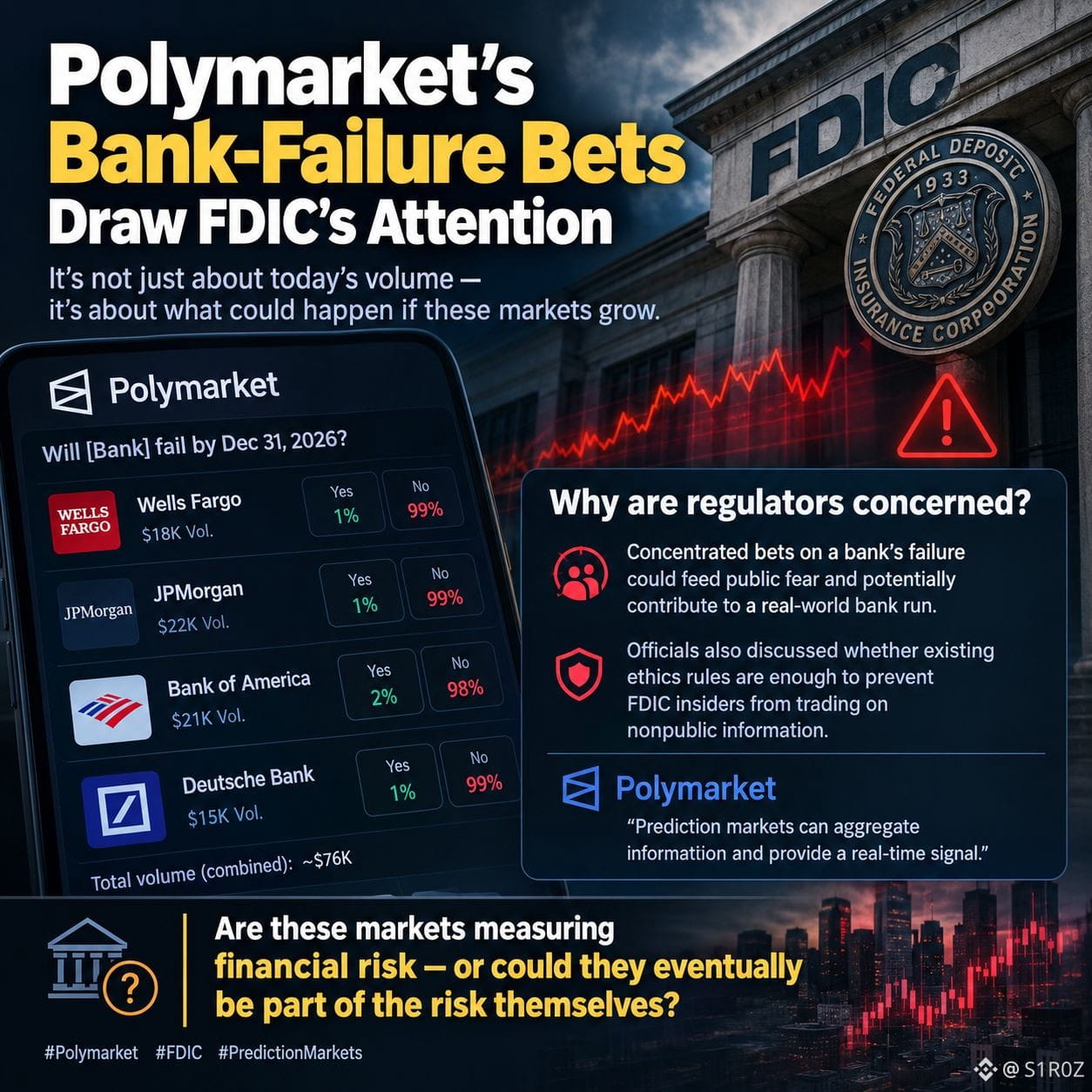
Polymarket currently has markets asking whether major banks such as Wells Fargo, JPMorgan, Bank of America and Deutsche Bank will fail by the end of 2026. The contracts are still tiny, with about $76K in combined volume across the current bank-failure markets.
So why are regulators paying attention?
According to Bloomberg, FDIC officials are concerned that if these markets grow, concentrated bets on a bank’s failure could feed public fear and potentially contribute to a real-world bank run. Officials also discussed whether existing ethics rules sufficiently prevent FDIC insiders from trading on nonpublic information.
Polymarket argues prediction markets can instead aggregate information and provide a real-time signal.
That creates a much bigger question:
Are these markets measuring financial risk — or could they eventually become part of the risk themselves?
#Polymarket #FDIC #PredictionMarkets
#polymarketbankfailurebetsdrawfdicconcern
🚨 Polymarket’s bank-failure bets just caught the FDIC’s attention — but the concern isn’t really about today’s trading volume.
Polymarket currently has markets asking whether major banks such as Wells Fargo, JPMorgan, Bank of America and Deutsche Bank will fail by the end of 2026. The contracts are still tiny, with about $76K in combined volume across the current bank-failure markets.
So why are regulators paying attention?
According to Bloomberg, FDIC officials are concerned that if these markets grow, concentrated bets on a bank’s failure could feed public fear and potentially contribute to a real-world bank run. Officials also discussed whether existing ethics rules sufficiently prevent FDIC insiders from trading on nonpublic information.
Polymarket argues prediction markets can instead aggregate information and provide a real-time signal.
That creates a much bigger question:
Are these markets measuring financial risk — or could they eventually become part of the risk themselves?
#Polymarket #FDIC #PredictionMarkets
🚨 Polymarket’s bank-failure bets just caught the FDIC’s attention — but the concern isn’t really about today’s trading volume.
Polymarket currently has markets asking whether major banks such as Wells Fargo, JPMorgan, Bank of America and Deutsche Bank will fail by the end of 2026. The contracts are still tiny, with about $76K in combined volume across the current bank-failure markets.
So why are regulators paying attention?
According to Bloomberg, FDIC officials are concerned that if these markets grow, concentrated bets on a bank’s failure could feed public fear and potentially contribute to a real-world bank run. Officials also discussed whether existing ethics rules sufficiently prevent FDIC insiders from trading on nonpublic information.
Polymarket argues prediction markets can instead aggregate information and provide a real-time signal.
That creates a much bigger question:
Are these markets measuring financial risk — or could they eventually become part of the risk themselves?
#Polymarket #FDIC #PredictionMarkets
2
91

·
--
Bullish
#PolymarketBankFailureBetsDrawFDICConcern
Recent reporting says wagers on whether major banks such as Wells Fargo, JPMorgan Chase, and Bank of America could fail have drawn attention from FDIC officials. The concern is that, if such markets grew substantially, they could amplify rumors and potentially contribute to depositor panic or a bank run.
A key point is that the current trading activity is relatively small: contracts covering U.S. bank failures by the end of 2026 had about $76,000 in total volume, according to the report. The FDIC also discussed whether its ethics rules adequately prevent employees with confidential information from trading these contracts; officials concluded the existing rules were sufficient.
For a short discussion:
“Polymarket’s bank-failure contracts are raising an important debate about prediction markets and financial stability. While the current trading volume is small, regulators are concerned that larger markets could amplify rumors or create incentives to spread panic. The issue highlights the need to balance information discovery with safeguards against manipulation and insider trading.”
$POLYX
{future}(POLYXUSDT)
#PolymarketBankFailureBetsDrawFDICConcern
Recent reporting says wagers on whether major banks such as Wells Fargo, JPMorgan Chase, and Bank of America could fail have drawn attention from FDIC officials. The concern is that, if such markets grew substantially, they could amplify rumors and potentially contribute to depositor panic or a bank run.
A key point is that the current trading activity is relatively small: contracts covering U.S. bank failures by the end of 2026 had about $76,000 in total volume, according to the report. The FDIC also discussed whether its ethics rules adequately prevent employees with confidential information from trading these contracts; officials concluded the existing rules were sufficient.
For a short discussion:
“Polymarket’s bank-failure contracts are raising an important debate about prediction markets and financial stability. While the current trading volume is small, regulators are concerned that larger markets could amplify rumors or create incentives to spread panic. The issue highlights the need to balance information discovery with safeguards against manipulation and insider trading.”
$POLYX
Recent reporting says wagers on whether major banks such as Wells Fargo, JPMorgan Chase, and Bank of America could fail have drawn attention from FDIC officials. The concern is that, if such markets grew substantially, they could amplify rumors and potentially contribute to depositor panic or a bank run.
A key point is that the current trading activity is relatively small: contracts covering U.S. bank failures by the end of 2026 had about $76,000 in total volume, according to the report. The FDIC also discussed whether its ethics rules adequately prevent employees with confidential information from trading these contracts; officials concluded the existing rules were sufficient.
For a short discussion:
“Polymarket’s bank-failure contracts are raising an important debate about prediction markets and financial stability. While the current trading volume is small, regulators are concerned that larger markets could amplify rumors or create incentives to spread panic. The issue highlights the need to balance information discovery with safeguards against manipulation and insider trading.”
$POLYX
337

·
--
After investigation, due to a large number of failed bets, PolymarketBank has fallen into financial distress and faces potential bankruptcy risk, prompting regulators to question whether the related business complies with the protection standards of the FDIC (Federal Deposit Insurance Corporation). As a participant in the crypto finance sector, I believe PolymarketBank’s failure serves as a warning that decentralized derivatives markets still have shortcomings in regulation and risk control. Investors should remain vigilant, and platforms should strengthen risk-control mechanisms to ensure the safety of funds. #PolymarketBankFailureBetsDrawFDICConcern
After investigation, due to a large number of failed bets, PolymarketBank has fallen into financial distress and faces potential bankruptcy risk, prompting regulators to question whether the related business complies with the protection standards of the FDIC (Federal Deposit Insurance Corporation). As a participant in the crypto finance sector, I believe PolymarketBank’s failure serves as a warning that decentralized derivatives markets still have shortcomings in regulation and risk control. Investors should remain vigilant, and platforms should strengthen risk-control mechanisms to ensure the safety of funds. #PolymarketBankFailureBetsDrawFDICConcern
10
Log in to explore more content
Join global crypto users on Binance Square
⚡️ Get latest and useful information about crypto.
💬 Trusted by the world’s largest crypto exchange.
👍 Discover real insights from verified creators.
Email / Phone number
Trending Topics
1
#CircleMints500MUSDCOnSolana
494 views
68 Discussing
2
#PolymarketBankFailureBetsDrawFDICConcern
10,012 views
358 Discussing
3
#BlackRockBuildsTokenizedPortfoliosForOndo
7,815 views
248 Discussing
4
#BitwiseFilesToListNEARETFOnNYSEArca
8,380 views
242 Discussing
5
#SECCommissionerPeirceToLeaveOct2
8,728 views
201 Discussing
6
#SECSaysBuybacksUpgradesDontMakeTokenSecurity
10,885 views
189 Discussing
7
#StrategyProposesDailyDividendsForPreferreds
1,616 views
54 Discussing
8
#CircleTetherFreezeBitgetHackerWallet
639 views
32 Discussing
9
#CoinMarketCapCompletesCoinglassAcquisition
2,973 views
61 Discussing
10
#QNTRises39%
74,838 views
1,336 Discussing