
Noor Ul Hassan CBT
121 Posts

Noor Ul Hassan CBT
Report
Block User
Your 360 view of crypto 🚀 Trends, memes & insights to keep you ahead.
Open Trade
Frequent Trader
2.1 Years
6 Following
61 Followers
61 Liked
Posts
Portfolio
All
Quotes
Videos
Bitcoin holders have been stuck choosing between security and utility for years — either you self-custody and your BTC just sits idle, or you wrap/bridge it and take on trust risk. @babylonlabs_io 's Trustless Bitcoin Vaults (TBV) actually solve this: your BTC stays locked on the native Bitcoin chain the whole time, never wrapped, never bridged, never handed to a custodian. Withdrawals are only unlocked by verified proofs enforced at the protocol level. That means you can borrow stablecoins against your BTC (via the Aave integration) while still holding your own keys. This is the kind of primitive that finally makes Bitcoin productive without breaking its core promise of self-custody. Bullish on where $BABY infrastructure is heading.#baby
Bitcoin holders have been stuck choosing between security and utility for years — either you self-custody and your BTC just sits idle, or you wrap/bridge it and take on trust risk. @BabylonLabs_io 's Trustless Bitcoin Vaults (TBV) actually solve this: your BTC stays locked on the native Bitcoin chain the whole time, never wrapped, never bridged, never handed to a custodian. Withdrawals are only unlocked by verified proofs enforced at the protocol level. That means you can borrow stablecoins against your BTC (via the Aave integration) while still holding your own keys. This is the kind of primitive that finally makes Bitcoin productive without breaking its core promise of self-custody. Bullish on where $BABY infrastructure is heading.#baby
94
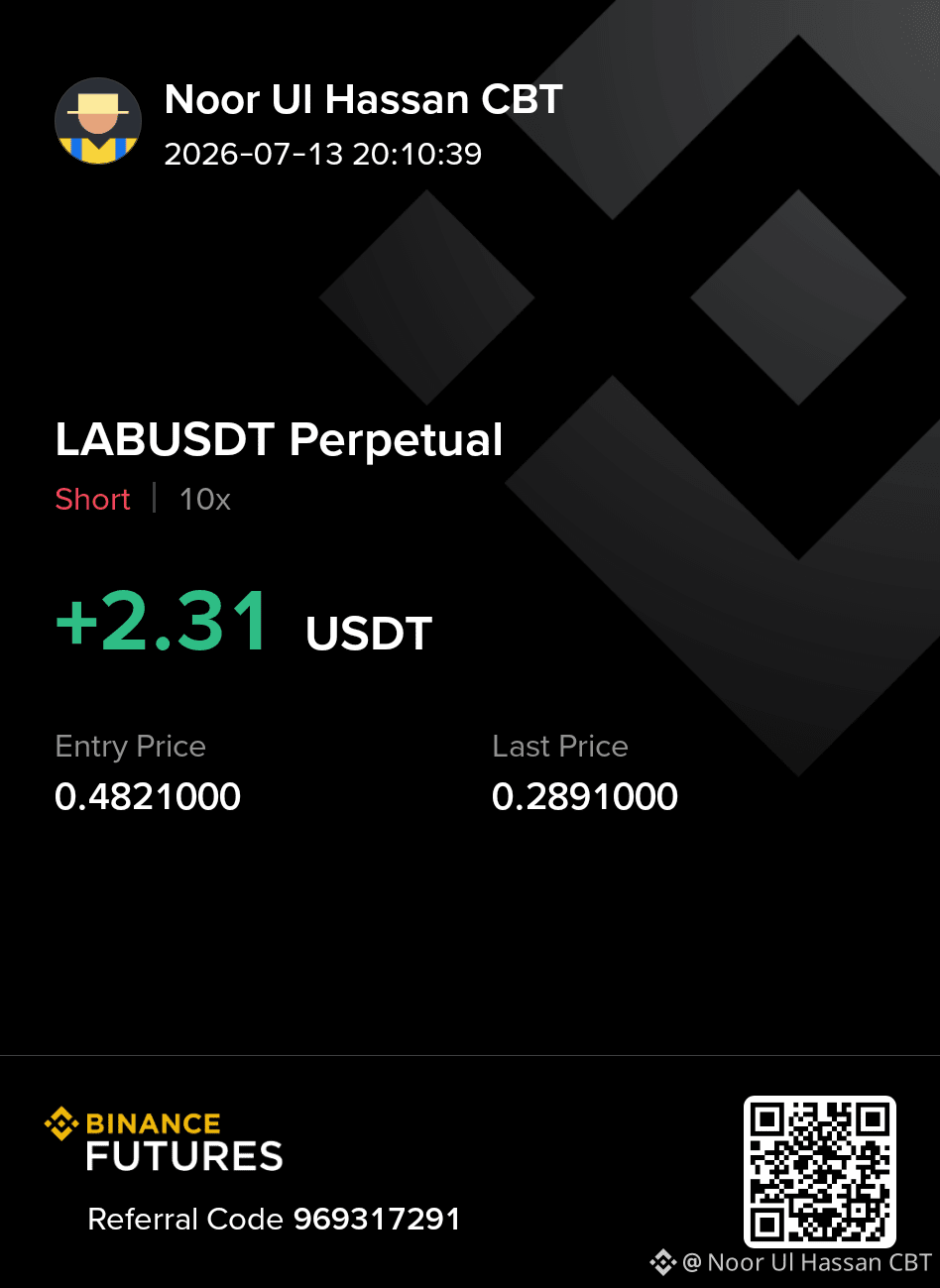
$LAB dumping more and more.
probably gonna stop below 0.20$
Still feasible for a short entry 🤑🤑.
$BTC $BNB
#Labs #bnb #BinanceTurns9
$LAB dumping more and more.
probably gonna stop below 0.20$
Still feasible for a short entry 🤑🤑.
$BTC $BNB
#Labs #bnb #BinanceTurns9
probably gonna stop below 0.20$
Still feasible for a short entry 🤑🤑.
$BTC $BNB
#Labs #bnb #BinanceTurns9
95
Article
Why Onchain Capital Needs an Authorization Layer, Not Just a Settlement LayerBlockchains are excellent at one job: settlement. Once a transaction is signed, value moves from one wallet to another, final and irreversible. But in traditional finance, settlement is only the last step of a much longer process. Before anything clears, there are checks — compliance screening, risk limits, identity verification, policy approval. Crypto never really solved this part. That work got pushed offchain, where it's inconsistent, opaque, and nearly impossible to verify. An institution's risk limits often just live in a PDF somewhere, not in code, and rules that exist only as a promise tend to fail exactly when they're needed most.
This is the gap @NewtonProtocol is built to close. With Mainnet Beta now live on Base and Ethereum, Newton acts as an authorization layer that sits alongside settlement, enforcing policy in real time rather than after the fact. When a transaction is initiated, a lightweight hook routes it to Newton's network, where operators evaluate it against rules written in Rego, a declarative policy language. The result is a cryptographic attestation — a verifiable receipt proving the transaction met the required conditions. Every one of these evaluations is checked on the Newton Explorer, so nothing has to be taken on trust.
Security comes from a decentralized operator set backed by restaked collateral through EigenLayer, meaning no single party controls the outcome. Mainnet Beta also brings an expanding data oracle ecosystem into the fold — partners like Chainalysis for sanctions screening, Credora for risk ratings, RedStone for pricing, and Webacy for wallet reputation — each one a composable building block that vault curators and developers can plug into their own policies.
The bigger implication: vault curators no longer have to ask depositors to simply trust that they'll follow the rules. With Newton, those rules can be made enforceable onchain, checked before execution rather than audited after the fact. That's a meaningful shift for how institutional capital might eventually move onchain at scale.
$NEWT is the token underpinning this authorization layer, and Mainnet Beta is the first real test of it enforcing rules on live capital. #Newt #BinanceTurns9 #BTC走势分析
Why Onchain Capital Needs an Authorization Layer, Not Just a Settlement Layer
Blockchains are excellent at one job: settlement. Once a transaction is signed, value moves from one wallet to another, final and irreversible. But in traditional finance, settlement is only the last step of a much longer process. Before anything clears, there are checks — compliance screening, risk limits, identity verification, policy approval. Crypto never really solved this part. That work got pushed offchain, where it's inconsistent, opaque, and nearly impossible to verify. An institution's risk limits often just live in a PDF somewhere, not in code, and rules that exist only as a promise tend to fail exactly when they're needed most.
This is the gap @NewtonProtocol is built to close. With Mainnet Beta now live on Base and Ethereum, Newton acts as an authorization layer that sits alongside settlement, enforcing policy in real time rather than after the fact. When a transaction is initiated, a lightweight hook routes it to Newton's network, where operators evaluate it against rules written in Rego, a declarative policy language. The result is a cryptographic attestation — a verifiable receipt proving the transaction met the required conditions. Every one of these evaluations is checked on the Newton Explorer, so nothing has to be taken on trust.
Security comes from a decentralized operator set backed by restaked collateral through EigenLayer, meaning no single party controls the outcome. Mainnet Beta also brings an expanding data oracle ecosystem into the fold — partners like Chainalysis for sanctions screening, Credora for risk ratings, RedStone for pricing, and Webacy for wallet reputation — each one a composable building block that vault curators and developers can plug into their own policies.
The bigger implication: vault curators no longer have to ask depositors to simply trust that they'll follow the rules. With Newton, those rules can be made enforceable onchain, checked before execution rather than audited after the fact. That's a meaningful shift for how institutional capital might eventually move onchain at scale.
$NEWT is the token underpinning this authorization layer, and Mainnet Beta is the first real test of it enforcing rules on live capital. #Newt #BinanceTurns9 #BTC走势分析
This is the gap @NewtonProtocol is built to close. With Mainnet Beta now live on Base and Ethereum, Newton acts as an authorization layer that sits alongside settlement, enforcing policy in real time rather than after the fact. When a transaction is initiated, a lightweight hook routes it to Newton's network, where operators evaluate it against rules written in Rego, a declarative policy language. The result is a cryptographic attestation — a verifiable receipt proving the transaction met the required conditions. Every one of these evaluations is checked on the Newton Explorer, so nothing has to be taken on trust.
Security comes from a decentralized operator set backed by restaked collateral through EigenLayer, meaning no single party controls the outcome. Mainnet Beta also brings an expanding data oracle ecosystem into the fold — partners like Chainalysis for sanctions screening, Credora for risk ratings, RedStone for pricing, and Webacy for wallet reputation — each one a composable building block that vault curators and developers can plug into their own policies.
The bigger implication: vault curators no longer have to ask depositors to simply trust that they'll follow the rules. With Newton, those rules can be made enforceable onchain, checked before execution rather than audited after the fact. That's a meaningful shift for how institutional capital might eventually move onchain at scale.
$NEWT is the token underpinning this authorization layer, and Mainnet Beta is the first real test of it enforcing rules on live capital. #Newt #BinanceTurns9 #BTC走势分析
3
81
Onchain capital moves fast, but the rules meant to govern it haven't kept pace — that's the gap Newton Protocol is closing. With Mainnet Beta now live on Base and Ethereum, @NewtonProtocol turns policy from a promise into something enforced onchain: every action checked, every decision independently verifiable via zero-knowledge proofs, no need to trust a middleman. Risk, compliance, and identity checks that used to live in a document now live in code. This is the authorization layer crypto has been missing to safely carry institutional-scale capital. $NEWT
#newt $NEWT
Onchain capital moves fast, but the rules meant to govern it haven't kept pace — that's the gap Newton Protocol is closing. With Mainnet Beta now live on Base and Ethereum, @NewtonProtocol turns policy from a promise into something enforced onchain: every action checked, every decision independently verifiable via zero-knowledge proofs, no need to trust a middleman. Risk, compliance, and identity checks that used to live in a document now live in code. This is the authorization layer crypto has been missing to safely carry institutional-scale capital. $NEWT
#newt $NEWT
#newt $NEWT
1
76
The smartest money in DeFi is quietly stacking $BR and nobody's talking about it.
@Bedrock 2.0 just made Bitcoin actually USEFUL in DeFi:
→ Stake BTC, get brBTC
→ Earn yield across 12+ chains
→ Keep full liquidity the entire time
This is what BTCFi was always supposed to be.
#BTC走势分析 #defi #Crypto #BtcfiSummer☀️
#bedrock $BR
The smartest money in DeFi is quietly stacking $BR and nobody's talking about it.
@Bedrock 2.0 just made Bitcoin actually USEFUL in DeFi:
→ Stake BTC, get brBTC
→ Earn yield across 12+ chains
→ Keep full liquidity the entire time
This is what BTCFi was always supposed to be.
#BTC走势分析 #defi #Crypto #BtcfiSummer☀️
#bedrock $BR
@Bedrock 2.0 just made Bitcoin actually USEFUL in DeFi:
→ Stake BTC, get brBTC
→ Earn yield across 12+ chains
→ Keep full liquidity the entire time
This is what BTCFi was always supposed to be.
#BTC走势分析 #defi #Crypto #BtcfiSummer☀️
#bedrock $BR
79
Hold and wait
80%
Sell for alt coins
20%
Restake on BR, earn yield
0%
5 votes • Voting closed
124
Smart investors follow smart projects. @GeniusOfficial is one of those rare gems that combines innovation with real utility. $GENIUS isn't just a token, it's a movement. Are you part of it? #genius $GENIUS
Smart investors follow smart projects. @GeniusOfficial is one of those rare gems that combines innovation with real utility. $GENIUS isn't just a token, it's a movement. Are you part of it? #genius $GENIUS
78
What makes @Bedrock unique is its non-rebasing token model (like uniBTC and uniETH) that grows in value rather than quantity, making DeFi integrations seamless. Bedrock 2.0 is pushing boundaries by removing oracle reliance for on-chain calculations. Secure, decentralized, and community-driven. Accumulating $BR is getting very interesting for long-term yields. #bedrock $BR
What makes @Bedrock unique is its non-rebasing token model (like uniBTC and uniETH) that grows in value rather than quantity, making DeFi integrations seamless. Bedrock 2.0 is pushing boundaries by removing oracle reliance for on-chain calculations. Secure, decentralized, and community-driven. Accumulating $BR is getting very interesting for long-term yields. #bedrock $BR
99
·
--
Bullish
Making moves today!
Just converted some USDT over to $GENIUS . Always keeping an eye on new opportunities in the market.
Who else is holding or trading $GENIUS right now? Let's discuss below! 👇
P.S. - Don't forget to claim the "Best Wishes" Red Packet I attached as a thank you for all the support! 🧧
#genius #CryptoTrading #altcoins #redpacket #Web3
Making moves today!
Just converted some USDT over to $GENIUS . Always keeping an eye on new opportunities in the market.
Who else is holding or trading $GENIUS right now? Let's discuss below! 👇
P.S. - Don't forget to claim the "Best Wishes" Red Packet I attached as a thank you for all the support! 🧧
#genius #CryptoTrading #altcoins #redpacket #Web3
Just converted some USDT over to $GENIUS . Always keeping an eye on new opportunities in the market.
Who else is holding or trading $GENIUS right now? Let's discuss below! 👇
P.S. - Don't forget to claim the "Best Wishes" Red Packet I attached as a thank you for all the support! 🧧
#genius #CryptoTrading #altcoins #redpacket #Web3

Best Wishes
From Noor Ul Hassan CBT
1
299
·
--
Bearish
Infrastructure wins long term. 🚀
Fabric Foundation isn’t just launching another token — it’s building real utility around automation, coordination, and scalable Web3 systems. The vision behind @FabricFND positions $ROBO as more than hype — it’s about powering the next layer of decentralized efficiency. Watching this closely.
#robo $ROBO
#NVDATopsEarnings #BTC
Infrastructure wins long term. 🚀
Fabric Foundation isn’t just launching another token — it’s building real utility around automation, coordination, and scalable Web3 systems. The vision behind @Fabric Foundation positions $ROBO as more than hype — it’s about powering the next layer of decentralized efficiency. Watching this closely.
#robo $ROBO
#NVDATopsEarnings #BTC
Fabric Foundation isn’t just launching another token — it’s building real utility around automation, coordination, and scalable Web3 systems. The vision behind @Fabric Foundation positions $ROBO as more than hype — it’s about powering the next layer of decentralized efficiency. Watching this closely.
#robo $ROBO
#NVDATopsEarnings #BTC
28
Article
Smarter Web3 Starts Here: @mira_network & $MIRA #MiraThe convergence of AI and blockchain is no longer theoretical — it’s becoming the foundation of the next digital era. While many projects talk about innovation, @mira_network is actively building intelligent infrastructure designed to bring verifiable, decentralized intelligence on-chain. That’s a major shift.
What makes $MIRA interesting isn’t just token speculation — it’s the role it can play in powering AI-driven coordination, validation, and trust mechanisms within decentralized ecosystems. As Web3 matures, raw scalability won’t be enough. Networks will need smarter systems that can process, validate, and adapt in real time. That’s where Mira’s vision stands out.
We are entering a phase where data integrity, autonomous systems, and transparent AI outputs will matter more than ever. Projects that focus on infrastructure — not noise — often shape the long-term landscape. Watching how @mira_network positions $MIRA within this evolution is something serious builders and investors shouldn’t ignore.
The next wave of blockchain growth may not just be faster chains — it may be smarter ones.
#Mira
Smarter Web3 Starts Here: @mira_network & $MIRA #Mira
The convergence of AI and blockchain is no longer theoretical — it’s becoming the foundation of the next digital era. While many projects talk about innovation, @mira_network is actively building intelligent infrastructure designed to bring verifiable, decentralized intelligence on-chain. That’s a major shift.
What makes $MIRA interesting isn’t just token speculation — it’s the role it can play in powering AI-driven coordination, validation, and trust mechanisms within decentralized ecosystems. As Web3 matures, raw scalability won’t be enough. Networks will need smarter systems that can process, validate, and adapt in real time. That’s where Mira’s vision stands out.
We are entering a phase where data integrity, autonomous systems, and transparent AI outputs will matter more than ever. Projects that focus on infrastructure — not noise — often shape the long-term landscape. Watching how @mira_network positions $MIRA within this evolution is something serious builders and investors shouldn’t ignore.
The next wave of blockchain growth may not just be faster chains — it may be smarter ones.
#Mira
What makes $MIRA interesting isn’t just token speculation — it’s the role it can play in powering AI-driven coordination, validation, and trust mechanisms within decentralized ecosystems. As Web3 matures, raw scalability won’t be enough. Networks will need smarter systems that can process, validate, and adapt in real time. That’s where Mira’s vision stands out.
We are entering a phase where data integrity, autonomous systems, and transparent AI outputs will matter more than ever. Projects that focus on infrastructure — not noise — often shape the long-term landscape. Watching how @mira_network positions $MIRA within this evolution is something serious builders and investors shouldn’t ignore.
The next wave of blockchain growth may not just be faster chains — it may be smarter ones.
#Mira
3
23
·
--
Bearish
What if the next breakout AI + Web3 project is hiding in plain sight? 👀
@mira_network is building intelligent infrastructure that could redefine how data and trust work on-chain. Early attention matters. $MIRA isn’t just a token — it’s access to the future of decentralized intelligence.
#mira $MIRA #MarketRebound
What if the next breakout AI + Web3 project is hiding in plain sight? 👀
@Mira - Trust Layer of AI is building intelligent infrastructure that could redefine how data and trust work on-chain. Early attention matters. $MIRA isn’t just a token — it’s access to the future of decentralized intelligence.
#mira $MIRA #MarketRebound
@Mira - Trust Layer of AI is building intelligent infrastructure that could redefine how data and trust work on-chain. Early attention matters. $MIRA isn’t just a token — it’s access to the future of decentralized intelligence.
#mira $MIRA #MarketRebound
14
·
--
Bearish
$ESP is looking at a market correction.
A short position seems the best option right now.
$PTB $SIREN
#esp #BTC100kNext? #CPIWatch
$ESP is looking at a market correction.
A short position seems the best option right now.
$PTB $SIREN
#esp #BTC100kNext? #CPIWatch
A short position seems the best option right now.
$PTB $SIREN
#esp #BTC100kNext? #CPIWatch
428
just made a fair profit on $SPACE
currently in the process of market retracement
$BTC $ETH
#MarketRebound #Binance #BTC
just made a fair profit on $SPACE
currently in the process of market retracement
$BTC $ETH
#MarketRebound #Binance #BTC
currently in the process of market retracement
$BTC $ETH
#MarketRebound #Binance #BTC
168
Article
🏗️ Building the Future of Finance: Why Dusk is the L1 for the RWA EraAs we enter February 2026, the conversation around blockchain has shifted from pure speculation to "Institutional Readiness." While many Layer 1s are struggling to balance transparency with privacy, @Dusk has officially emerged as the definitive solution for the Real-World Asset (RWA) sector.
🛡️ The Power of Auditable Privacy
The primary roadblock for institutions has always been the "Privacy Paradox": How do you keep sensitive financial data private while remaining 100% compliant with regulations like MiCA?
Through its unique Segregated Byzantine Agreement (SBA) consensus and zero-knowledge proofs (ZK-proofs), $Dusk allows for "Auditable Privacy." This means transaction details remain encrypted from the public, yet authorized regulators can verify compliance without compromising user data. It is the only way to bring multi-million euro securities onto the blockchain.
🚀 DuskEVM: The Gateway for Solidity Developers
The January 2026 launch of the DuskEVM mainnet was a game-changer. For the first time, Ethereum developers can deploy their existing Solidity smart contracts directly onto a privacy-preserving L1. By integrating tools like Chainlink CCIP and the MiCA-compliant EURQ stablecoin, Dusk has created a plug-and-play environment for regulated DeFi.
💼 Real Assets, Real Volume
Dusk isn't just a "tech experiment." Through its partnership with the Dutch regulated exchange NPEX, the ecosystem is currently onboarding over €300 million in tokenized SME securities. This isn't "retail hype"—this is the migration of traditional financial rails onto a faster, cheaper, and more secure infrastructure.
💎 The Role of $DUSK
In 2026, the $DUSK token is the lifeblood of this new economy. It is used for:
* Staking: Securing the network with a 1,000 $DUSK minimum.
* Gas Fees: Powering private transactions and smart contract execution.
* Governance: Allowing the community to shape the future of a truly decentralized financial system.
The "Year of the RWA" is here, and it is being built on #Dusk.
#MarketCorrection #WhaleDeRiskETH #WarshFedPolicyOutlook #EthereumLayer2Rethink?
🏗️ Building the Future of Finance: Why Dusk is the L1 for the RWA Era
As we enter February 2026, the conversation around blockchain has shifted from pure speculation to "Institutional Readiness." While many Layer 1s are struggling to balance transparency with privacy, @Dusk has officially emerged as the definitive solution for the Real-World Asset (RWA) sector.
🛡️ The Power of Auditable Privacy
The primary roadblock for institutions has always been the "Privacy Paradox": How do you keep sensitive financial data private while remaining 100% compliant with regulations like MiCA?
Through its unique Segregated Byzantine Agreement (SBA) consensus and zero-knowledge proofs (ZK-proofs), $Dusk allows for "Auditable Privacy." This means transaction details remain encrypted from the public, yet authorized regulators can verify compliance without compromising user data. It is the only way to bring multi-million euro securities onto the blockchain.
🚀 DuskEVM: The Gateway for Solidity Developers
The January 2026 launch of the DuskEVM mainnet was a game-changer. For the first time, Ethereum developers can deploy their existing Solidity smart contracts directly onto a privacy-preserving L1. By integrating tools like Chainlink CCIP and the MiCA-compliant EURQ stablecoin, Dusk has created a plug-and-play environment for regulated DeFi.
💼 Real Assets, Real Volume
Dusk isn't just a "tech experiment." Through its partnership with the Dutch regulated exchange NPEX, the ecosystem is currently onboarding over €300 million in tokenized SME securities. This isn't "retail hype"—this is the migration of traditional financial rails onto a faster, cheaper, and more secure infrastructure.
💎 The Role of $DUSK
In 2026, the $DUSK token is the lifeblood of this new economy. It is used for:
* Staking: Securing the network with a 1,000 $DUSK minimum.
* Gas Fees: Powering private transactions and smart contract execution.
* Governance: Allowing the community to shape the future of a truly decentralized financial system.
The "Year of the RWA" is here, and it is being built on #Dusk.
#MarketCorrection #WhaleDeRiskETH #WarshFedPolicyOutlook #EthereumLayer2Rethink?
🛡️ The Power of Auditable Privacy
The primary roadblock for institutions has always been the "Privacy Paradox": How do you keep sensitive financial data private while remaining 100% compliant with regulations like MiCA?
Through its unique Segregated Byzantine Agreement (SBA) consensus and zero-knowledge proofs (ZK-proofs), $Dusk allows for "Auditable Privacy." This means transaction details remain encrypted from the public, yet authorized regulators can verify compliance without compromising user data. It is the only way to bring multi-million euro securities onto the blockchain.
🚀 DuskEVM: The Gateway for Solidity Developers
The January 2026 launch of the DuskEVM mainnet was a game-changer. For the first time, Ethereum developers can deploy their existing Solidity smart contracts directly onto a privacy-preserving L1. By integrating tools like Chainlink CCIP and the MiCA-compliant EURQ stablecoin, Dusk has created a plug-and-play environment for regulated DeFi.
💼 Real Assets, Real Volume
Dusk isn't just a "tech experiment." Through its partnership with the Dutch regulated exchange NPEX, the ecosystem is currently onboarding over €300 million in tokenized SME securities. This isn't "retail hype"—this is the migration of traditional financial rails onto a faster, cheaper, and more secure infrastructure.
💎 The Role of $DUSK
In 2026, the $DUSK token is the lifeblood of this new economy. It is used for:
* Staking: Securing the network with a 1,000 $DUSK minimum.
* Gas Fees: Powering private transactions and smart contract execution.
* Governance: Allowing the community to shape the future of a truly decentralized financial system.
The "Year of the RWA" is here, and it is being built on #Dusk.
#MarketCorrection #WhaleDeRiskETH #WarshFedPolicyOutlook #EthereumLayer2Rethink?
26
Institutional finance isn't looking for "just another L1"—they need auditable privacy. @Dusk_Foundation is solving this by merging ZK-proofs with regulatory compliance. With the recent Mainnet launch and the DuskEVM bringing Solidity developers into a private, compliant ecosystem, $DUSK is no longer just a "privacy coin"—it's the settlement layer for Real-World Assets.
Seeing over €200M in securities from NPEX moving on-chain is the real-world validation this space has been waiting for. The transition from "testing" to "revenue" is officially here. 📈
#dusk $DUSK
#BTC #btc70k #WarshFedPolicyOutlook #RiskAssetsMarketShock
Institutional finance isn't looking for "just another L1"—they need auditable privacy. @Dusk is solving this by merging ZK-proofs with regulatory compliance. With the recent Mainnet launch and the DuskEVM bringing Solidity developers into a private, compliant ecosystem, $DUSK is no longer just a "privacy coin"—it's the settlement layer for Real-World Assets.
Seeing over €200M in securities from NPEX moving on-chain is the real-world validation this space has been waiting for. The transition from "testing" to "revenue" is officially here. 📈
#dusk $DUSK
#BTC #btc70k #WarshFedPolicyOutlook #RiskAssetsMarketShock
Seeing over €200M in securities from NPEX moving on-chain is the real-world validation this space has been waiting for. The transition from "testing" to "revenue" is officially here. 📈
#dusk $DUSK
#BTC #btc70k #WarshFedPolicyOutlook #RiskAssetsMarketShock
5
Article
🚀 Why Specialization is Winning: Is @plasma the Final Boss of Stablecoin Settlement?In the previous bull cycles, we saw a race for "General Purpose" L1s. Everyone wanted to be the "Ethereum Killer," trying to host everything from monkey NFTs to complex DeFi loans on a single chain. But in February 2026, the market has matured. We’ve realized that a chain trying to do everything often ends up being mediocre at the one thing that actually matters: Payments.
This is where @Plasma and the $XPL token are changing the conversation.
💳 The "Zero-Fee" USDT Breakthrough
The biggest friction point in crypto has always been the "Gas Fee Barrier." For a newcomer, having to buy ETH or SOL just to send a few dollars of USDT is a UX nightmare. Plasma has solved this at the protocol level. By utilizing a native paymaster system, Plasma allows for true zero-fee USDT transfers.
This isn't just a marketing gimmick or a temporary subsidy; it’s a structural feature of the Layer 1. When you use the Plasma network, you can move digital dollars as easily—and as cheaply—as sending an email. This is the "Green Lane" for global liquidity that the industry has been waiting for.
🛡️ Bitcoin-Anchored Security & EVM Versatility
While speed and cost are vital, security is non-negotiable for institutional adoption. @undefined takes a unique "Best of Both Worlds" approach:
* Bitcoin-Anchored: It periodically saves its state to the Bitcoin blockchain, inheriting an institutional grade of finality and security.
* EVM Compatible: Developers can port their favorite Ethereum dApps directly to the network without rewriting a single line of code.
By combining the rock-solid foundation of BTC with the flexibility of the Ethereum Virtual Machine, $XPL isn't just a token—it’s the fuel for a high-performance settlement engine.
🏦 Beyond the Blockchain: Plasma One
The real "Alpha" for 2026 is the rollout of Plasma One. This isn't just a wallet; it’s a stablecoin-native neobank and card accepted at over 150 million merchants worldwide. By bridging the gap between on-chain liquidity and off-chain spending, Plasma is fulfilling the original promise of Satoshi: a peer-to-peer electronic cash system.
📈 Market Sentiment: Noise vs. Signal
As of today, the Fear & Greed Index sits in "Extreme Fear" (11). While short-term price action is volatile, the fundamentals of the Plasma ecosystem are strengthening. With major token unlocks not scheduled until mid-2026, the current phase is one of deep accumulation and infrastructure building.
The era of speculative "ghost chains" is ending. The era of specialized, utility-driven infrastructure is here. Are you watching the noise, or are you watching the rails?
#Plasma #Stablecoins #Web3Payments #CryptoInfrastructure #XPL
🚀 Why Specialization is Winning: Is @plasma the Final Boss of Stablecoin Settlement?
In the previous bull cycles, we saw a race for "General Purpose" L1s. Everyone wanted to be the "Ethereum Killer," trying to host everything from monkey NFTs to complex DeFi loans on a single chain. But in February 2026, the market has matured. We’ve realized that a chain trying to do everything often ends up being mediocre at the one thing that actually matters: Payments.
This is where @Plasma and the $XPL token are changing the conversation.
💳 The "Zero-Fee" USDT Breakthrough
The biggest friction point in crypto has always been the "Gas Fee Barrier." For a newcomer, having to buy ETH or SOL just to send a few dollars of USDT is a UX nightmare. Plasma has solved this at the protocol level. By utilizing a native paymaster system, Plasma allows for true zero-fee USDT transfers.
This isn't just a marketing gimmick or a temporary subsidy; it’s a structural feature of the Layer 1. When you use the Plasma network, you can move digital dollars as easily—and as cheaply—as sending an email. This is the "Green Lane" for global liquidity that the industry has been waiting for.
🛡️ Bitcoin-Anchored Security & EVM Versatility
While speed and cost are vital, security is non-negotiable for institutional adoption. @undefined takes a unique "Best of Both Worlds" approach:
* Bitcoin-Anchored: It periodically saves its state to the Bitcoin blockchain, inheriting an institutional grade of finality and security.
* EVM Compatible: Developers can port their favorite Ethereum dApps directly to the network without rewriting a single line of code.
By combining the rock-solid foundation of BTC with the flexibility of the Ethereum Virtual Machine, $XPL isn't just a token—it’s the fuel for a high-performance settlement engine.
🏦 Beyond the Blockchain: Plasma One
The real "Alpha" for 2026 is the rollout of Plasma One. This isn't just a wallet; it’s a stablecoin-native neobank and card accepted at over 150 million merchants worldwide. By bridging the gap between on-chain liquidity and off-chain spending, Plasma is fulfilling the original promise of Satoshi: a peer-to-peer electronic cash system.
📈 Market Sentiment: Noise vs. Signal
As of today, the Fear & Greed Index sits in "Extreme Fear" (11). While short-term price action is volatile, the fundamentals of the Plasma ecosystem are strengthening. With major token unlocks not scheduled until mid-2026, the current phase is one of deep accumulation and infrastructure building.
The era of speculative "ghost chains" is ending. The era of specialized, utility-driven infrastructure is here. Are you watching the noise, or are you watching the rails?
#Plasma #Stablecoins #Web3Payments #CryptoInfrastructure #XPL
This is where @Plasma and the $XPL token are changing the conversation.
💳 The "Zero-Fee" USDT Breakthrough
The biggest friction point in crypto has always been the "Gas Fee Barrier." For a newcomer, having to buy ETH or SOL just to send a few dollars of USDT is a UX nightmare. Plasma has solved this at the protocol level. By utilizing a native paymaster system, Plasma allows for true zero-fee USDT transfers.
This isn't just a marketing gimmick or a temporary subsidy; it’s a structural feature of the Layer 1. When you use the Plasma network, you can move digital dollars as easily—and as cheaply—as sending an email. This is the "Green Lane" for global liquidity that the industry has been waiting for.
🛡️ Bitcoin-Anchored Security & EVM Versatility
While speed and cost are vital, security is non-negotiable for institutional adoption. @undefined takes a unique "Best of Both Worlds" approach:
* Bitcoin-Anchored: It periodically saves its state to the Bitcoin blockchain, inheriting an institutional grade of finality and security.
* EVM Compatible: Developers can port their favorite Ethereum dApps directly to the network without rewriting a single line of code.
By combining the rock-solid foundation of BTC with the flexibility of the Ethereum Virtual Machine, $XPL isn't just a token—it’s the fuel for a high-performance settlement engine.
🏦 Beyond the Blockchain: Plasma One
The real "Alpha" for 2026 is the rollout of Plasma One. This isn't just a wallet; it’s a stablecoin-native neobank and card accepted at over 150 million merchants worldwide. By bridging the gap between on-chain liquidity and off-chain spending, Plasma is fulfilling the original promise of Satoshi: a peer-to-peer electronic cash system.
📈 Market Sentiment: Noise vs. Signal
As of today, the Fear & Greed Index sits in "Extreme Fear" (11). While short-term price action is volatile, the fundamentals of the Plasma ecosystem are strengthening. With major token unlocks not scheduled until mid-2026, the current phase is one of deep accumulation and infrastructure building.
The era of speculative "ghost chains" is ending. The era of specialized, utility-driven infrastructure is here. Are you watching the noise, or are you watching the rails?
#Plasma #Stablecoins #Web3Payments #CryptoInfrastructure #XPL
1
6
Log in to explore more content
Join global crypto users on Binance Square
⚡️ Get latest and useful information about crypto.
💬 Trusted by the world’s largest crypto exchange.
👍 Discover real insights from verified creators.
Email / Phone number
Trending Topics
USAugustPPIRisesLessThanExpected
7,932 views
250 Discussing
🚨 US AUG PPI: Rises LESS Than Expected! Bullish for Crypto? 🚀
PPI +0.4% MoM as expected, but CORE PPI only +0.2% vs +0.3% expected - cooling!
What it means:
• Wholesale inflation softer than feared
• Fed rate hike chance now 62% - but dovish signals coming
• Core PCE revisions expected downward - bullish
• BTC usually pumps on softer PPI
Fed meeting Sep 15-16 - Market now expects pause, not hike?
Is this the green light for Q4 rally?
#Bitcoin #PPI #Fed #CryptoNews #BTC#usaugustppiriseslessthanexpected
True News
·1 Likes
·1.1k views
SECApprovesNasdaqTexasCommodityTrustRule
6,998 views
265 Discussing
ECBRaisesRatesSecondTimeTo2.5%
4,290 views
181 Discussing