

BBFT INFO
4 Posts

BBFT INFO
Report
Block User
Follow me if you want to become Zero to Hero! Crypto Insights | Market Trends | Learn • Analyze • Grow . DYOR | Building Wealth in Web3
Open Trade
Frequent Trader
7.1 Months
0 Following
0 Followers
0 Liked
Posts
Portfolio
All
Quotes
·
--

Article
Binance Crypto Hack 2026: $6.3 Billion Theft, North Korea Connection, and What Investors Need to do?Binance Crypto Hack 2026: $6.3 Billion Theft, North Korea Connection, and What Investors Need to Know
Description: Explore the reported Binance crypto hack of 2026, the $6.3 billion theft, the alleged North Korean connection, frozen assets, Binance's response, and essential cryptocurrency security tips.
Category: Cryptocurrency | Blockchain Security | Crypto News
Binance Faces a Major Cybersecurity Crisis
On October 29, 2026, Binance, one of the world's largest cryptocurrency exchanges, reportedly experienced a major cybersecurity incident involving unauthorized cryptocurrency transfers.
The incident involved approximately $6.3 billion in crypto assets, making it one of the largest reported cryptocurrency thefts in the industry's history.
The incident raised serious concerns about exchange security, internal access controls, blockchain infrastructure, and the safety of digital assets.
Binance stated that it would take responsibility for the financial losses resulting from the incident and assured users that customer funds would remain protected.
How Did the Binance Hack Happen?
According to the initial investigation, attackers allegedly exploited a security breach involving a compromised DevOps engineer's laptop.
The attackers reportedly used unauthorized access to Binance's infrastructure and withdrawal systems to initiate suspicious transactions.
Key findings included:
- A suspected security breach involving an employee device.
- Unauthorized cryptocurrency withdrawals from hot wallets.
- Transfers involving multiple blockchain networks.
- No initial evidence confirming that wallet private keys had been directly leaked.
- Temporary restrictions on certain withdrawal services during the investigation.
The company continued investigating the incident and working to strengthen its security infrastructure.
How Much Was Stolen?
The reported financial impact of the incident was approximately $6.3 billion.
Details| Reported Amount
Estimated crypto assets affected| $6.3 billion
Approximate value in Indian rupees| ₹50,000+ crore
Assets reportedly frozen| Around $3 billion
Responsibility for customer losses| Binance
Blockchain partners and asset issuers reportedly helped identify and freeze certain suspicious funds.
However, freezing assets does not necessarily mean that all stolen cryptocurrency has been recovered.
North Korea Connection: What Did the FBI Say?
On October 31, 2026, the FBI reportedly attributed the attack to TraderTraitor, a cyber activity group associated with North Korea.
According to the investigation, the attackers were moving stolen cryptocurrency through multiple wallets and converting assets, including Ethereum (ETH), in an effort to obscure their transaction trails.
Common laundering techniques in cryptocurrency-related cybercrime include:
- Moving assets through multiple wallet addresses.
- Using cross-chain bridges.
- Swapping tokens through decentralized exchanges.
- Splitting funds into smaller transactions.
- Attempting to obscure transaction origins.
Although blockchain transactions are publicly traceable, complex transaction patterns can make investigations and asset recovery challenging.
Binance's Response and Recovery Measures
Binance reportedly took several measures to contain the incident and protect customers.
These included:
1. Investigating the affected withdrawal infrastructure.
2. Revoking suspicious access permissions.
3. Coordinating with blockchain analytics companies and law enforcement.
4. Tracking and freezing potentially stolen assets.
5. Using company resources and its SAFU fund to address losses.
6. Strengthening security controls and reviewing internal access systems.
Binance also stated that customer losses resulting from the incident would not be passed on to users.
Important: Withdrawal availability may vary by cryptocurrency and blockchain network. Users should check the official Binance platform for current service status.
Are Binance Users' Funds Safe?
Binance has stated that customer funds are protected and that the company will bear responsibility for losses arising from the incident.
However, investors should understand that:
- Exchange assurances do not eliminate all cryptocurrency risks.
- Withdrawal services may be temporarily restricted during security investigations.
- Holding crypto on an exchange involves custodial risk.
- Proof of Reserves does not independently guarantee protection against every possible cyberattack.
- Users should rely on official announcements rather than social media rumors.
Investors should avoid panic selling or making rushed transactions based solely on unverified reports.
Essential Cryptocurrency Security Tips
The incident highlights several important security practices for crypto investors.
1. Enable Strong Two-Factor Authentication
Use an authenticator app or hardware security key instead of relying only on SMS-based authentication.
2. Enable Withdrawal Address Whitelisting
Allow withdrawals only to pre-approved wallet addresses wherever the exchange supports this feature.
3. Avoid Suspicious Links and Files
Never open unexpected attachments or download files from unknown sources, even if they appear to come from a company employee or exchange representative.
4. Secure API Keys
If you use trading bots or third-party applications, restrict API permissions and disable withdrawal access unless absolutely necessary.
5. Consider Self-Custody for Long-Term Holdings
Hardware wallets can provide additional control over long-term crypto holdings. However, users must securely protect their recovery phrase and private keys.
6. Verify Official Announcements
Be cautious of fake recovery services, fraudulent support messages, and phishing links claiming to help recover stolen cryptocurrency.
CoinDCX Security Concerns: A Separate Incidents
Reports in October 2026 also discussed suspicious outflows involving older wallet addresses associated with CoinDCX.
CoinDCX reportedly denied that its active wallets had been compromised and stated that the activity involved previously compromised addresses.
This incident is separate from the reported Binance hack and should not be treated as the same security event.
Conclusion: A Wake-Up Call for the Crypto Industry
The reported Binance hack of 2026 highlights the importance of cybersecurity across the cryptocurrency ecosystem.
Blockchain technology alone cannot guarantee complete security. Exchange infrastructure, employee devices, access permissions, withdrawal systems, and internal security procedures are equally important.
Although Binance has reportedly committed to covering customer losses, the incident reinforces the need for investors to take digital asset security seriously.
Before investing in cryptocurrency, always DYOR (Do Your Own Research), understand the risks, and never invest more than you can afford to lose.
Disclaimer: This article is for educational and informational purposes only. It does not constitute financial or investment advices
Binance Hack 2026, Binance Crypto News, Binance Security Breach, $6.3 Billion Crypto Hack, North Korea Crypto Hack, TraderTraitor, Cryptocurrency Security, Crypto News India, Binance Withdrawal Update
#Binance #CryptoHack #CryptoNews #BlockchainSecurity #bitcoin #Ethereum #cryptoindia #NorthKoreaHackers orea #TraderTraitor #DYOR* #BBFTINFO
Binance Crypto Hack 2026: $6.3 Billion Theft, North Korea Connection, and What Investors Need to do?
Binance Crypto Hack 2026: $6.3 Billion Theft, North Korea Connection, and What Investors Need to Know
Description: Explore the reported Binance crypto hack of 2026, the $6.3 billion theft, the alleged North Korean connection, frozen assets, Binance's response, and essential cryptocurrency security tips.
Category: Cryptocurrency | Blockchain Security | Crypto News
Binance Faces a Major Cybersecurity Crisis
On October 29, 2026, Binance, one of the world's largest cryptocurrency exchanges, reportedly experienced a major cybersecurity incident involving unauthorized cryptocurrency transfers.
The incident involved approximately $6.3 billion in crypto assets, making it one of the largest reported cryptocurrency thefts in the industry's history.
The incident raised serious concerns about exchange security, internal access controls, blockchain infrastructure, and the safety of digital assets.
Binance stated that it would take responsibility for the financial losses resulting from the incident and assured users that customer funds would remain protected.
How Did the Binance Hack Happen?
According to the initial investigation, attackers allegedly exploited a security breach involving a compromised DevOps engineer's laptop.
The attackers reportedly used unauthorized access to Binance's infrastructure and withdrawal systems to initiate suspicious transactions.
Key findings included:
- A suspected security breach involving an employee device.
- Unauthorized cryptocurrency withdrawals from hot wallets.
- Transfers involving multiple blockchain networks.
- No initial evidence confirming that wallet private keys had been directly leaked.
- Temporary restrictions on certain withdrawal services during the investigation.
The company continued investigating the incident and working to strengthen its security infrastructure.
How Much Was Stolen?
The reported financial impact of the incident was approximately $6.3 billion.
Details| Reported Amount
Estimated crypto assets affected| $6.3 billion
Approximate value in Indian rupees| ₹50,000+ crore
Assets reportedly frozen| Around $3 billion
Responsibility for customer losses| Binance
Blockchain partners and asset issuers reportedly helped identify and freeze certain suspicious funds.
However, freezing assets does not necessarily mean that all stolen cryptocurrency has been recovered.
North Korea Connection: What Did the FBI Say?
On October 31, 2026, the FBI reportedly attributed the attack to TraderTraitor, a cyber activity group associated with North Korea.
According to the investigation, the attackers were moving stolen cryptocurrency through multiple wallets and converting assets, including Ethereum (ETH), in an effort to obscure their transaction trails.
Common laundering techniques in cryptocurrency-related cybercrime include:
- Moving assets through multiple wallet addresses.
- Using cross-chain bridges.
- Swapping tokens through decentralized exchanges.
- Splitting funds into smaller transactions.
- Attempting to obscure transaction origins.
Although blockchain transactions are publicly traceable, complex transaction patterns can make investigations and asset recovery challenging.
Binance's Response and Recovery Measures
Binance reportedly took several measures to contain the incident and protect customers.
These included:
1. Investigating the affected withdrawal infrastructure.
2. Revoking suspicious access permissions.
3. Coordinating with blockchain analytics companies and law enforcement.
4. Tracking and freezing potentially stolen assets.
5. Using company resources and its SAFU fund to address losses.
6. Strengthening security controls and reviewing internal access systems.
Binance also stated that customer losses resulting from the incident would not be passed on to users.
Important: Withdrawal availability may vary by cryptocurrency and blockchain network. Users should check the official Binance platform for current service status.
Are Binance Users' Funds Safe?
Binance has stated that customer funds are protected and that the company will bear responsibility for losses arising from the incident.
However, investors should understand that:
- Exchange assurances do not eliminate all cryptocurrency risks.
- Withdrawal services may be temporarily restricted during security investigations.
- Holding crypto on an exchange involves custodial risk.
- Proof of Reserves does not independently guarantee protection against every possible cyberattack.
- Users should rely on official announcements rather than social media rumors.
Investors should avoid panic selling or making rushed transactions based solely on unverified reports.
Essential Cryptocurrency Security Tips
The incident highlights several important security practices for crypto investors.
1. Enable Strong Two-Factor Authentication
Use an authenticator app or hardware security key instead of relying only on SMS-based authentication.
2. Enable Withdrawal Address Whitelisting
Allow withdrawals only to pre-approved wallet addresses wherever the exchange supports this feature.
3. Avoid Suspicious Links and Files
Never open unexpected attachments or download files from unknown sources, even if they appear to come from a company employee or exchange representative.
4. Secure API Keys
If you use trading bots or third-party applications, restrict API permissions and disable withdrawal access unless absolutely necessary.
5. Consider Self-Custody for Long-Term Holdings
Hardware wallets can provide additional control over long-term crypto holdings. However, users must securely protect their recovery phrase and private keys.
6. Verify Official Announcements
Be cautious of fake recovery services, fraudulent support messages, and phishing links claiming to help recover stolen cryptocurrency.
CoinDCX Security Concerns: A Separate Incidents
Reports in October 2026 also discussed suspicious outflows involving older wallet addresses associated with CoinDCX.
CoinDCX reportedly denied that its active wallets had been compromised and stated that the activity involved previously compromised addresses.
This incident is separate from the reported Binance hack and should not be treated as the same security event.
Conclusion: A Wake-Up Call for the Crypto Industry
The reported Binance hack of 2026 highlights the importance of cybersecurity across the cryptocurrency ecosystem.
Blockchain technology alone cannot guarantee complete security. Exchange infrastructure, employee devices, access permissions, withdrawal systems, and internal security procedures are equally important.
Although Binance has reportedly committed to covering customer losses, the incident reinforces the need for investors to take digital asset security seriously.
Before investing in cryptocurrency, always DYOR (Do Your Own Research), understand the risks, and never invest more than you can afford to lose.
Disclaimer: This article is for educational and informational purposes only. It does not constitute financial or investment advices
Binance Hack 2026, Binance Crypto News, Binance Security Breach, $6.3 Billion Crypto Hack, North Korea Crypto Hack, TraderTraitor, Cryptocurrency Security, Crypto News India, Binance Withdrawal Update
#Binance #CryptoHack #CryptoNews #BlockchainSecurity #bitcoin #Ethereum #cryptoindia #NorthKoreaHackers orea #TraderTraitor #DYOR* #BBFTINFO
50
·
--
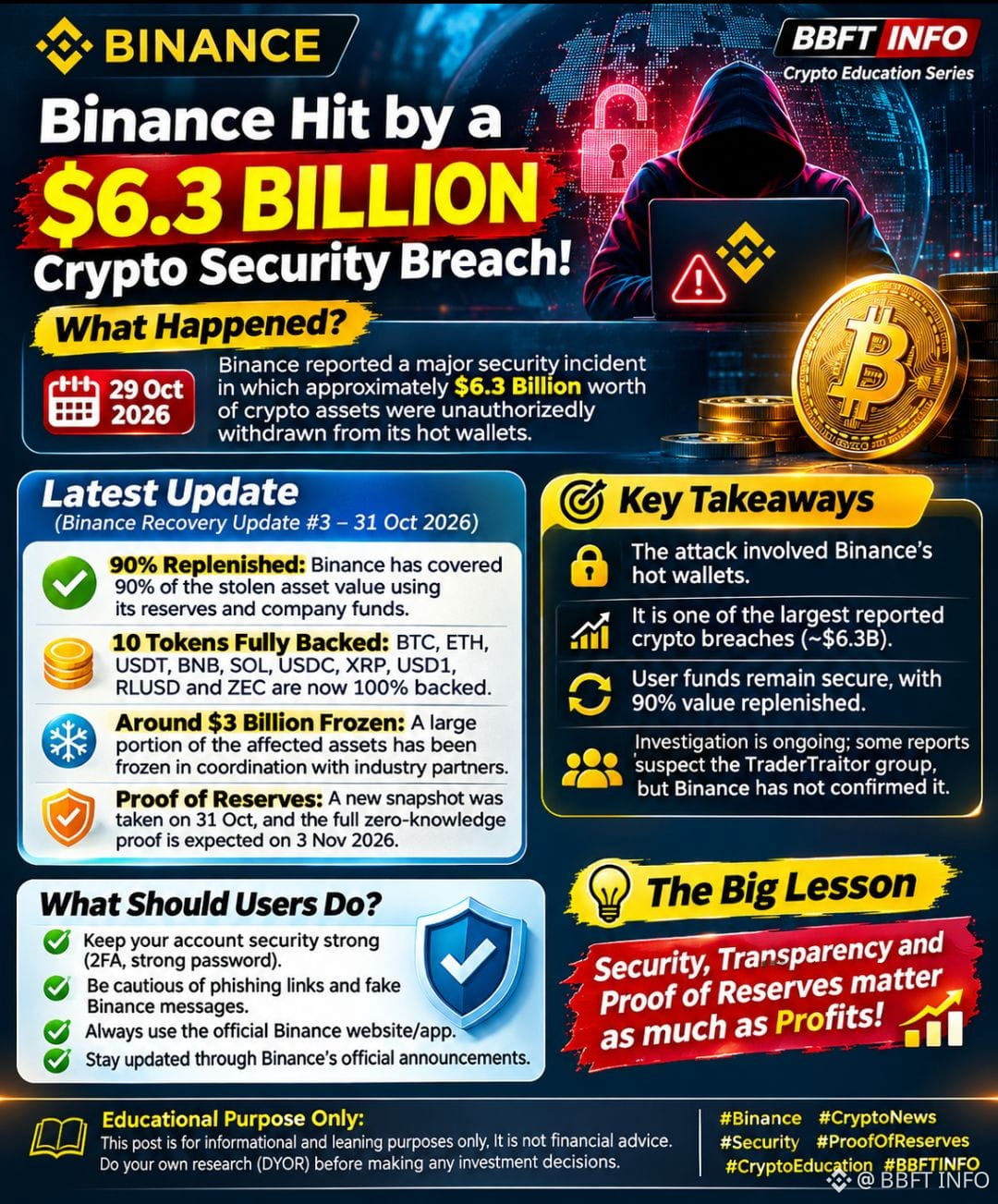
🚨 BINANCE $6.3 BILLION HACK: MAJOR RECOVERY UPDATE!
The crypto industry has witnessed one of its biggest security incidents.
On October 29, 2026, Binance reported unauthorized withdrawals from its hot wallets, resulting in approximately $6.3 BILLION in stolen crypto assets.
But here's the latest development! 👇
🔥 90% OF THE STOLEN ASSET VALUE REPLENISHED
According to Binance's official Recovery Update (October 31):
✅ 10 cryptocurrencies are now reported as 100% backed:
BTC, ETH, USDT, BNB, SOL, USDC, XRP, USD1, RLUSD and ZEC.
🔐 Approximately $3 billion in affected assets had been frozen through coordination with industry partners.
📊 A new Proof of Reserves snapshot was taken on October 31, with the full zero-knowledge proof estimated for November 3.
💰 Binance has committed to covering the financial impact of the incident through SAFU and company funds.
WHAT ABOUT THE HACKERS?
The investigation is still ongoing. Some blockchain intelligence firms suspect the TraderTraitor group, but Binance has not officially confirmed the attackers' identity.
⚠️ THE BIG LESSON FOR EVERY CRYPTO INVESTOR:
Security, transparency and Proof of Reserves matter just as much as profits.
Do you think this recovery will restore confidence in centralized crypto exchanges?
👇 Share your thoughts!
#Binance #CryptoNews🔒📰🚫 #Binancehacked #ProofOfReserves #SAFU #BlockchainSecurity #CryptoCommunity #BTC☀ #Web3
73
·
--
Bullish
Crypto Investing: Smart Risk Management Matters More Than Quick Profits 📊
The crypto market offers opportunities, but volatility and uncertainty make risk management essential.
Here are 5 important principles every crypto investor should follow:
🔹 Do Your Own Research (DYOR): Understand a project's fundamentals before investing.
🔹 Protect Your Capital: Never invest money you cannot afford to lose.
🔹 Avoid Emotional Trading: Fear and greed can lead to poor decisions.
🔹 Use Risk Management Tools: Consider stop-loss orders and appropriate position sizing.
🔹 Stay Secure: Enable 2FA and never share your passwords or private keys.
Remember: Successful investing is not just about making profits — it's also about protecting your capital and making informed decisions.
Learn first. Manage risk. Invest responsibly.
#bitcoin #RiskManagement #CryptoEducation💡🚀 #DYOR* #blockchain
86
·
--
it's a good news 🗞️
it's a good news 🗞️


Binance News
·
--
Two Addresses Holding About 1.28 Billion USDT Frozen
Two addresses holding approximately 313 million and 971 million USDT, respectively, were frozen between 5:10 and 5:11 (UTC+8). According to ChainCatcher, Whale Alert tracked the freezes, which affected about 1.28 billion USDT in total.
7
Log in to explore more content
Join global crypto users on Binance Square
⚡️ Get latest and useful information about crypto.
💬 Trusted by the world’s largest crypto exchange.
👍 Discover real insights from verified creators.
Email / Phone number
Trending Topics
BinanceToResumePhaseOneOfWithdrawals
3,841 views
221 Discussing
Security Incident | Recovery Update #4: Withdrawals Resume in Phases (2026-11-01)
Binance Announcement
·218 Likes
·238.4k views
BinanceHadAlreadyCovered$6BofHackLoss
1,248 views
43 Discussing
FBIConfirmsNorthKoreaIsResponsibleForBinanceCryptoHack
7,040 views
54 Discussing