
#web3infrastructure
web3infrastructure
207,917 views
2,967 Discussing
Hot
Latest

·
--
Have you heard of the Pons concept in crypto? In anatomy, the pons is the vital brainstem structure that links the brain to the body, serving as a communication highway. In the rapidly evolving Web3 space, we are seeing the rise of the digital Pons: the crucial infrastructure connecting artificial intelligence, decentralized physical infrastructure networks (DePIN), and cross-chain protocols.
As the crypto market matures, the focus is shifting from isolated layer-1 blockchains to seamless interoperability. This is where the concept of the Pons becomes highly relevant. Cross-chain bridges and interoperability protocols are acting as the neural connectors of the decentralized world. Without these bridges, liquidity remains fragmented, and ecosystems cannot scale.
Furthermore, with the massive boom in AI-driven crypto projects, the need for a Web3 Pons is more urgent than ever. Decentralized AI agents require seamless communication channels to share data, execute smart contracts across different chains, and access computational power from DePIN networks. The protocols building these high-speed, secure communication pathways are essentially constructing the brainstem of the future global supercomputer.
For smart investors and developers, tracking these connector protocols is key. While high-profile layer-1 networks get most of the spotlight, the infrastructure that connects them often holds the most untapped potential. Whether you are looking at interoperability giants or emerging AI-decentralized routing networks, the Pons of Web3 is where the real utility lies.
Keep your eyes on the connectors. The future of crypto is not just about building bigger brains, but about ensuring they are wired together perfectly.
What are your favorite bridging or connectivity protocols in Web3 right now? Let us know in the comments.
#Web3Infrastructure #CryptoBridges #Interoperability
Have you heard of the Pons concept in crypto? In anatomy, the pons is the vital brainstem structure that links the brain to the body, serving as a communication highway. In the rapidly evolving Web3 space, we are seeing the rise of the digital Pons: the crucial infrastructure connecting artificial intelligence, decentralized physical infrastructure networks (DePIN), and cross-chain protocols.
As the crypto market matures, the focus is shifting from isolated layer-1 blockchains to seamless interoperability. This is where the concept of the Pons becomes highly relevant. Cross-chain bridges and interoperability protocols are acting as the neural connectors of the decentralized world. Without these bridges, liquidity remains fragmented, and ecosystems cannot scale.
Furthermore, with the massive boom in AI-driven crypto projects, the need for a Web3 Pons is more urgent than ever. Decentralized AI agents require seamless communication channels to share data, execute smart contracts across different chains, and access computational power from DePIN networks. The protocols building these high-speed, secure communication pathways are essentially constructing the brainstem of the future global supercomputer.
For smart investors and developers, tracking these connector protocols is key. While high-profile layer-1 networks get most of the spotlight, the infrastructure that connects them often holds the most untapped potential. Whether you are looking at interoperability giants or emerging AI-decentralized routing networks, the Pons of Web3 is where the real utility lies.
Keep your eyes on the connectors. The future of crypto is not just about building bigger brains, but about ensuring they are wired together perfectly.
What are your favorite bridging or connectivity protocols in Web3 right now? Let us know in the comments.
#Web3Infrastructure #CryptoBridges #Interoperability
As the crypto market matures, the focus is shifting from isolated layer-1 blockchains to seamless interoperability. This is where the concept of the Pons becomes highly relevant. Cross-chain bridges and interoperability protocols are acting as the neural connectors of the decentralized world. Without these bridges, liquidity remains fragmented, and ecosystems cannot scale.
Furthermore, with the massive boom in AI-driven crypto projects, the need for a Web3 Pons is more urgent than ever. Decentralized AI agents require seamless communication channels to share data, execute smart contracts across different chains, and access computational power from DePIN networks. The protocols building these high-speed, secure communication pathways are essentially constructing the brainstem of the future global supercomputer.
For smart investors and developers, tracking these connector protocols is key. While high-profile layer-1 networks get most of the spotlight, the infrastructure that connects them often holds the most untapped potential. Whether you are looking at interoperability giants or emerging AI-decentralized routing networks, the Pons of Web3 is where the real utility lies.
Keep your eyes on the connectors. The future of crypto is not just about building bigger brains, but about ensuring they are wired together perfectly.
What are your favorite bridging or connectivity protocols in Web3 right now? Let us know in the comments.
#Web3Infrastructure #CryptoBridges #Interoperability
41

·
--
#Write2Earn
🚀 The Future of Quantum-Classical Ledgers is Here.
What happens when you integrate real-time quantum manifold physics directly into distributed ledger state validation?
We’ve been building under the radar, and early simulation benchmarks for our hybrid Geometric Fractal Quantum Field Theory (GFQFT) Quantum Blockchain System are in:
⚡ 107.6+ TPS measured throughput in concurrent stress testing
⏱️ 9.29 ms average transaction latency
🛡️ 100% Adversarial Classification Accuracy (38/38 legitimate transactions accepted, 62/62 attack vectors rejected with zero false positives)
🌐 Native ISO 20022 Integration for institutional interbank settlement payloads
Instead of relying solely on energy-heavy computation, our framework introduces a physics-informed physical admissibility gate to verify transaction feasibility at the manifold level before ledger commitment.
Quantum-assisted security. Institutional settlement speeds. ZERO MINING WASTE.
Mainnet/QPU validation pathways are actively in progress.
Who’s ready for the next evolution of Web3 infrastructure? 👇
#QuantumComputingRevolution #blockchain #fintech #ISO20022 #Web3Infrastructure
Vote below and drop your thoughts in the comments! What’s the biggest drawback of today's blockchain consensus mechanisms?
#Write2Earn
🚀 The Future of Quantum-Classical Ledgers is Here.
What happens when you integrate real-time quantum manifold physics directly into distributed ledger state validation?
We’ve been building under the radar, and early simulation benchmarks for our hybrid Geometric Fractal Quantum Field Theory (GFQFT) Quantum Blockchain System are in:
⚡ 107.6+ TPS measured throughput in concurrent stress testing
⏱️ 9.29 ms average transaction latency
🛡️ 100% Adversarial Classification Accuracy (38/38 legitimate transactions accepted, 62/62 attack vectors rejected with zero false positives)
🌐 Native ISO 20022 Integration for institutional interbank settlement payloads
Instead of relying solely on energy-heavy computation, our framework introduces a physics-informed physical admissibility gate to verify transaction feasibility at the manifold level before ledger commitment.
Quantum-assisted security. Institutional settlement speeds. ZERO MINING WASTE.
Mainnet/QPU validation pathways are actively in progress.
Who’s ready for the next evolution of Web3 infrastructure? 👇
#QuantumComputingRevolution #blockchain #fintech #ISO20022 #Web3Infrastructure
Vote below and drop your thoughts in the comments! What’s the biggest drawback of today's blockchain consensus mechanisms?
🚀 The Future of Quantum-Classical Ledgers is Here.
What happens when you integrate real-time quantum manifold physics directly into distributed ledger state validation?
We’ve been building under the radar, and early simulation benchmarks for our hybrid Geometric Fractal Quantum Field Theory (GFQFT) Quantum Blockchain System are in:
⚡ 107.6+ TPS measured throughput in concurrent stress testing
⏱️ 9.29 ms average transaction latency
🛡️ 100% Adversarial Classification Accuracy (38/38 legitimate transactions accepted, 62/62 attack vectors rejected with zero false positives)
🌐 Native ISO 20022 Integration for institutional interbank settlement payloads
Instead of relying solely on energy-heavy computation, our framework introduces a physics-informed physical admissibility gate to verify transaction feasibility at the manifold level before ledger commitment.
Quantum-assisted security. Institutional settlement speeds. ZERO MINING WASTE.
Mainnet/QPU validation pathways are actively in progress.
Who’s ready for the next evolution of Web3 infrastructure? 👇
#QuantumComputingRevolution #blockchain #fintech #ISO20022 #Web3Infrastructure
Vote below and drop your thoughts in the comments! What’s the biggest drawback of today's blockchain consensus mechanisms?
Excessive Energy Waste (PoW)
Cap. Central/Lockups (POS)
Latency/Scalability Bottleneck
Post-Quantum Attacks
4 day(s) left
64

·
--
Bullish
$LINK isn’t just another altcoin in a portfolio; it’s the indispensable infrastructure layer bridging traditional finance with decentralized systems.
While retail capital chases short lived hype cycles, institutional adoption of tokenized Real World Assets (RWAs) and crosschain messaging via CCIP relies heavily on secure, decentralized oracle networks.
Building a sustainable position means looking past daily volatility and focusing on foundational network utility.
When your thesis is anchored in protocol indispensability rather than price action, patience becomes your greatest edge.
#Chainlink #CryptoStrategy #Web3Infrastructure #SmartContracts
{spot}(LINKUSDT)
$LINK isn’t just another altcoin in a portfolio; it’s the indispensable infrastructure layer bridging traditional finance with decentralized systems.
While retail capital chases short lived hype cycles, institutional adoption of tokenized Real World Assets (RWAs) and crosschain messaging via CCIP relies heavily on secure, decentralized oracle networks.
Building a sustainable position means looking past daily volatility and focusing on foundational network utility.
When your thesis is anchored in protocol indispensability rather than price action, patience becomes your greatest edge.
#Chainlink #CryptoStrategy #Web3Infrastructure #SmartContracts
While retail capital chases short lived hype cycles, institutional adoption of tokenized Real World Assets (RWAs) and crosschain messaging via CCIP relies heavily on secure, decentralized oracle networks.
Building a sustainable position means looking past daily volatility and focusing on foundational network utility.
When your thesis is anchored in protocol indispensability rather than price action, patience becomes your greatest edge.
#Chainlink #CryptoStrategy #Web3Infrastructure #SmartContracts
1
93

·
--
AI infrastructure is quietly becoming the most important narrative in crypto — and most traders are still focused on price action instead of the buildout happening underneath.
Here's the shift worth watching: AI agents need persistent, permissionless compute rails. They need wallets they control, payment channels they can open autonomously, and settlement layers that don't require human approval at every step. That describes crypto infrastructure exactly.
$ETH is already being used as the settlement layer for early AI agent frameworks. $SOL's low-latency, high-throughput design makes it the natural fit for machine-to-machine micropayments. $BNB Chain's fee structure is attracting AI-native dApps that need to run thousands of micro-transactions per session.
The thesis isn't complicated: AI generates demand for programmable money. Crypto is programmable money. The convergence isn't hypothetical — it's already in production in dozens of projects that won't make the front page until they're too big to ignore.
The teams building AI-native financial infrastructure right now are not waiting for a bull market signal. They're building because the tooling is finally ready. That's historically been a very good time to pay attention.
#CryptoAI #AIAgents #Web3Infrastructure #BinanceSquare
AI infrastructure is quietly becoming the most important narrative in crypto — and most traders are still focused on price action instead of the buildout happening underneath.
Here's the shift worth watching: AI agents need persistent, permissionless compute rails. They need wallets they control, payment channels they can open autonomously, and settlement layers that don't require human approval at every step. That describes crypto infrastructure exactly.
$ETH is already being used as the settlement layer for early AI agent frameworks. $SOL 's low-latency, high-throughput design makes it the natural fit for machine-to-machine micropayments. $BNB Chain's fee structure is attracting AI-native dApps that need to run thousands of micro-transactions per session.
The thesis isn't complicated: AI generates demand for programmable money. Crypto is programmable money. The convergence isn't hypothetical — it's already in production in dozens of projects that won't make the front page until they're too big to ignore.
The teams building AI-native financial infrastructure right now are not waiting for a bull market signal. They're building because the tooling is finally ready. That's historically been a very good time to pay attention.
#CryptoAI #AIAgents #Web3Infrastructure #BinanceSquare
Here's the shift worth watching: AI agents need persistent, permissionless compute rails. They need wallets they control, payment channels they can open autonomously, and settlement layers that don't require human approval at every step. That describes crypto infrastructure exactly.
$ETH is already being used as the settlement layer for early AI agent frameworks. $SOL 's low-latency, high-throughput design makes it the natural fit for machine-to-machine micropayments. $BNB Chain's fee structure is attracting AI-native dApps that need to run thousands of micro-transactions per session.
The thesis isn't complicated: AI generates demand for programmable money. Crypto is programmable money. The convergence isn't hypothetical — it's already in production in dozens of projects that won't make the front page until they're too big to ignore.
The teams building AI-native financial infrastructure right now are not waiting for a bull market signal. They're building because the tooling is finally ready. That's historically been a very good time to pay attention.
#CryptoAI #AIAgents #Web3Infrastructure #BinanceSquare
66

Have you noticed how most traders obsess over direct compute plays while ignoring the infrastructure quietly printing billions?
Too many retail investors end up holding the bag on volatile crypto AI tokens because they chase retail hype instead of tracking where real enterprise revenue actually flows. When you FOMO into low-liquidity narrative coins without checking underlying tech pipelines, you usually end up buying someone else's exit.
Look at $AVGO as a textbook case of how serious infrastructure captures value. Wall Street expects about $29.4B in revenue and an EPS near $3.24 for Q3, but the headline figures barely scratch the surface. Broadcom previously guided for roughly $16B in pure AI semiconductor revenue alone, driven by surging enterprise demand for custom AI accelerators.
This enterprise shift from generic compute to specialized custom silicon matters for decentralized compute networks like $RENDER and data pipeline protocols like $NEAR. As tech giants build proprietary AI hardware, the spillover effect directly dictates which decentralized protocols will survive on actual utility versus pure speculation.
Do you think decentralized AI networks can capture enterprise demand, or will traditional hardware giants dominate the entire stack?
#AI #CryptoAnalysis #Web3Infrastructure
Have you noticed how most traders obsess over direct compute plays while ignoring the infrastructure quietly printing billions?
Too many retail investors end up holding the bag on volatile crypto AI tokens because they chase retail hype instead of tracking where real enterprise revenue actually flows. When you FOMO into low-liquidity narrative coins without checking underlying tech pipelines, you usually end up buying someone else's exit.
Look at $AVGO as a textbook case of how serious infrastructure captures value. Wall Street expects about $29.4B in revenue and an EPS near $3.24 for Q3, but the headline figures barely scratch the surface. Broadcom previously guided for roughly $16B in pure AI semiconductor revenue alone, driven by surging enterprise demand for custom AI accelerators.
This enterprise shift from generic compute to specialized custom silicon matters for decentralized compute networks like $RENDER and data pipeline protocols like $NEAR . As tech giants build proprietary AI hardware, the spillover effect directly dictates which decentralized protocols will survive on actual utility versus pure speculation.
Do you think decentralized AI networks can capture enterprise demand, or will traditional hardware giants dominate the entire stack?
#AI #CryptoAnalysis #Web3Infrastructure
Too many retail investors end up holding the bag on volatile crypto AI tokens because they chase retail hype instead of tracking where real enterprise revenue actually flows. When you FOMO into low-liquidity narrative coins without checking underlying tech pipelines, you usually end up buying someone else's exit.
Look at $AVGO as a textbook case of how serious infrastructure captures value. Wall Street expects about $29.4B in revenue and an EPS near $3.24 for Q3, but the headline figures barely scratch the surface. Broadcom previously guided for roughly $16B in pure AI semiconductor revenue alone, driven by surging enterprise demand for custom AI accelerators.
This enterprise shift from generic compute to specialized custom silicon matters for decentralized compute networks like $RENDER and data pipeline protocols like $NEAR . As tech giants build proprietary AI hardware, the spillover effect directly dictates which decentralized protocols will survive on actual utility versus pure speculation.
Do you think decentralized AI networks can capture enterprise demand, or will traditional hardware giants dominate the entire stack?
#AI #CryptoAnalysis #Web3Infrastructure

42

🚨 DATA CENTER FRICTION THREATENS CENTRALIZED CLOUD AS $0G PREPARES FOR DECENTRALIZED RECLIMATION ⚡
Tightening regulatory screws on centralized tech giants are forcing Web3 infrastructure to pivot hard toward sovereign data networks. 📊 As traditional data centers face mounting crossfire, decentralized compute and data availability protocols like $HEMI , $0G, and $SKR are entering a massive valuation discovery phase.
Smart capital is already front-running this architectural shift, anticipating heavy capital rotation out of legacy cloud dependencies into trustless alternatives. ⚡ Expect sharp volatility as order flow reprices protocols positioning themselves as the resilient backbones of the next infrastructure cycle. 💬 How fast do you think Web3 protocols will completely decouple from traditional centralized cloud providers? 👇
⚠️ Not financial advice. Always manage your risk. 🛡️
🏷️ #0G #HEMI #SKR #Crypto #Web3Infrastructure
⚡ 💎
🚨 DATA CENTER FRICTION THREATENS CENTRALIZED CLOUD AS $0G PREPARES FOR DECENTRALIZED RECLIMATION ⚡
Tightening regulatory screws on centralized tech giants are forcing Web3 infrastructure to pivot hard toward sovereign data networks. 📊 As traditional data centers face mounting crossfire, decentralized compute and data availability protocols like $HEMI , $0G, and $SKR are entering a massive valuation discovery phase.
Smart capital is already front-running this architectural shift, anticipating heavy capital rotation out of legacy cloud dependencies into trustless alternatives. ⚡ Expect sharp volatility as order flow reprices protocols positioning themselves as the resilient backbones of the next infrastructure cycle. 💬 How fast do you think Web3 protocols will completely decouple from traditional centralized cloud providers? 👇
⚠️ Not financial advice. Always manage your risk. 🛡️
🏷️ #0G #HEMI #SKR #Crypto #Web3Infrastructure
⚡ 💎
Tightening regulatory screws on centralized tech giants are forcing Web3 infrastructure to pivot hard toward sovereign data networks. 📊 As traditional data centers face mounting crossfire, decentralized compute and data availability protocols like $HEMI , $0G, and $SKR are entering a massive valuation discovery phase.
Smart capital is already front-running this architectural shift, anticipating heavy capital rotation out of legacy cloud dependencies into trustless alternatives. ⚡ Expect sharp volatility as order flow reprices protocols positioning themselves as the resilient backbones of the next infrastructure cycle. 💬 How fast do you think Web3 protocols will completely decouple from traditional centralized cloud providers? 👇
⚠️ Not financial advice. Always manage your risk. 🛡️
🏷️ #0G #HEMI #SKR #Crypto #Web3Infrastructure
⚡ 💎


201

·
--
The encryption industry is moving from "rough growth" to "regulated operations", and the financial and tax infrastructure is the most critical station on this train.
FinTax has just completed its seed round, with joint investment from Amber Group and PUNDI AI. It focuses on providing complete accounting and tax solutions for crypto users. Every on-chain transaction should be verifiable, and every token holder should be able to face tax filing with peace of mind.
As exchange compliance, DeFi audits, and NFT income tax gradually come under regulators’ scrutiny, a tool that can connect wallet data, automatically categorize asset classes, and generate compliant tax reports is no longer just a nice-to-have—it is the infrastructure that helps crypto users move from gray areas to sunny, compliant trading.
It’s worth keeping an eye on the startup teams driving this direction.#CryptoTax #Web3Infrastructure
The encryption industry is moving from "rough growth" to "regulated operations", and the financial and tax infrastructure is the most critical station on this train.
FinTax has just completed its seed round, with joint investment from Amber Group and PUNDI AI. It focuses on providing complete accounting and tax solutions for crypto users. Every on-chain transaction should be verifiable, and every token holder should be able to face tax filing with peace of mind.
As exchange compliance, DeFi audits, and NFT income tax gradually come under regulators’ scrutiny, a tool that can connect wallet data, automatically categorize asset classes, and generate compliant tax reports is no longer just a nice-to-have—it is the infrastructure that helps crypto users move from gray areas to sunny, compliant trading.
It’s worth keeping an eye on the startup teams driving this direction.#CryptoTax #Web3Infrastructure
FinTax has just completed its seed round, with joint investment from Amber Group and PUNDI AI. It focuses on providing complete accounting and tax solutions for crypto users. Every on-chain transaction should be verifiable, and every token holder should be able to face tax filing with peace of mind.
As exchange compliance, DeFi audits, and NFT income tax gradually come under regulators’ scrutiny, a tool that can connect wallet data, automatically categorize asset classes, and generate compliant tax reports is no longer just a nice-to-have—it is the infrastructure that helps crypto users move from gray areas to sunny, compliant trading.
It’s worth keeping an eye on the startup teams driving this direction.#CryptoTax #Web3Infrastructure
6
·
--
AI agents don't need bank accounts. They need programmable money.
As autonomous AI systems move from research to real-world deployment, one bottleneck keeps showing up: payment infrastructure. Traditional finance was built for humans — KYC, ACH delays, monthly statements. None of that works when an AI needs to pay for compute, data, or API calls in milliseconds.
This is where $ETH, $SOL, and $BNB start looking less like speculative assets and more like critical infrastructure.
On-chain payments are permissionless. An AI agent can hold a wallet, receive income, pay expenses, and settle contracts — without a human co-signer or a bank approval. $ETH smart contracts can encode the business logic. $SOL handles the throughput. $BNB covers micro-payments at near-zero cost on BNB Chain.
The question isn't whether AI agents will use crypto. The first wave already does. The question is which networks become the default rails.
Networks that win this race won't just win developer adoption — they'll win machine adoption. And machine transaction volume at scale will dwarf anything retail traders have ever moved.
The AI economy needs money that moves at AI speed. Position accordingly.
#AIcrypto #Web3Infrastructure #BlockchainAdoption #CryptoInsights
AI agents don't need bank accounts. They need programmable money.
As autonomous AI systems move from research to real-world deployment, one bottleneck keeps showing up: payment infrastructure. Traditional finance was built for humans — KYC, ACH delays, monthly statements. None of that works when an AI needs to pay for compute, data, or API calls in milliseconds.
This is where $ETH , $SOL , and $BNB start looking less like speculative assets and more like critical infrastructure.
On-chain payments are permissionless. An AI agent can hold a wallet, receive income, pay expenses, and settle contracts — without a human co-signer or a bank approval. $ETH smart contracts can encode the business logic. $SOL handles the throughput. $BNB covers micro-payments at near-zero cost on BNB Chain.
The question isn't whether AI agents will use crypto. The first wave already does. The question is which networks become the default rails.
Networks that win this race won't just win developer adoption — they'll win machine adoption. And machine transaction volume at scale will dwarf anything retail traders have ever moved.
The AI economy needs money that moves at AI speed. Position accordingly.
#AIcrypto #Web3Infrastructure #BlockchainAdoption #CryptoInsights
As autonomous AI systems move from research to real-world deployment, one bottleneck keeps showing up: payment infrastructure. Traditional finance was built for humans — KYC, ACH delays, monthly statements. None of that works when an AI needs to pay for compute, data, or API calls in milliseconds.
This is where $ETH , $SOL , and $BNB start looking less like speculative assets and more like critical infrastructure.
On-chain payments are permissionless. An AI agent can hold a wallet, receive income, pay expenses, and settle contracts — without a human co-signer or a bank approval. $ETH smart contracts can encode the business logic. $SOL handles the throughput. $BNB covers micro-payments at near-zero cost on BNB Chain.
The question isn't whether AI agents will use crypto. The first wave already does. The question is which networks become the default rails.
Networks that win this race won't just win developer adoption — they'll win machine adoption. And machine transaction volume at scale will dwarf anything retail traders have ever moved.
The AI economy needs money that moves at AI speed. Position accordingly.
#AIcrypto #Web3Infrastructure #BlockchainAdoption #CryptoInsights
50
·
--
The next wave of crypto adoption will not come from retail or institutions — it will come from machines.
AI agents are already executing trades, managing wallets, and routing payments autonomously. The question is no longer whether AI will use crypto. The question is which infrastructure captures the most machine-generated volume.
AI agents need settlement rails that are fast, cheap, programmable, and censorship-resistant. Traditional banking was never built for non-human actors. Stablecoins and smart contract networks were. The GENIUS Act legitimized stablecoin infrastructure right as AI agent deployment accelerates — that convergence is the real trade.
$ETH leads with smart contract composability and account abstraction, making it the natural AI agent coordination layer. $BNB powers programmable money at scale with BNB Chain AI integrations. $SOL adds high throughput and sub-cent fees ideal for micropayment loops.
The machines do not care about price action. They care about uptime, finality speed, and fee predictability. Position accordingly.
#AIAgents #Web3Infrastructure #CryptoAI #BinanceSquare
The next wave of crypto adoption will not come from retail or institutions — it will come from machines.
AI agents are already executing trades, managing wallets, and routing payments autonomously. The question is no longer whether AI will use crypto. The question is which infrastructure captures the most machine-generated volume.
AI agents need settlement rails that are fast, cheap, programmable, and censorship-resistant. Traditional banking was never built for non-human actors. Stablecoins and smart contract networks were. The GENIUS Act legitimized stablecoin infrastructure right as AI agent deployment accelerates — that convergence is the real trade.
$ETH leads with smart contract composability and account abstraction, making it the natural AI agent coordination layer. $BNB powers programmable money at scale with BNB Chain AI integrations. $SOL adds high throughput and sub-cent fees ideal for micropayment loops.
The machines do not care about price action. They care about uptime, finality speed, and fee predictability. Position accordingly.
#AIAgents #Web3Infrastructure #CryptoAI #BinanceSquare
AI agents are already executing trades, managing wallets, and routing payments autonomously. The question is no longer whether AI will use crypto. The question is which infrastructure captures the most machine-generated volume.
AI agents need settlement rails that are fast, cheap, programmable, and censorship-resistant. Traditional banking was never built for non-human actors. Stablecoins and smart contract networks were. The GENIUS Act legitimized stablecoin infrastructure right as AI agent deployment accelerates — that convergence is the real trade.
$ETH leads with smart contract composability and account abstraction, making it the natural AI agent coordination layer. $BNB powers programmable money at scale with BNB Chain AI integrations. $SOL adds high throughput and sub-cent fees ideal for micropayment loops.
The machines do not care about price action. They care about uptime, finality speed, and fee predictability. Position accordingly.
#AIAgents #Web3Infrastructure #CryptoAI #BinanceSquare
1
112
·
--
AI agents do not just use crypto — they are increasingly being designed around it.
Most crypto discussions focus on what humans do with blockchains: trade, store, borrow. But a fast-moving shift is underway. Autonomous AI agents need permissionless, programmable money to function at scale — and crypto infrastructure is the only stack built for that.
Consider what an AI agent actually needs to operate autonomously: micropayments without KYC friction, deterministic smart contract execution, trustless multi-party settlement, and composable financial primitives it can call like code. TradFi offers none of that. Ethereum and Solana are already the proving grounds — agent frameworks are deploying wallets, signing transactions, and interacting with DeFi protocols without any human in the loop.
Low-fee chains with customizable execution environments are positioning as infrastructure for enterprise AI agent deployments. This is not speculative — agent economies paying each other in stablecoins are already running on testnets.
The implication for holders: chains with programmable accounts, cheap execution, and strong dev tooling are not just DeFi plays anymore. They are AI infrastructure plays. That dual demand curve is one of the most underpriced dynamics in crypto right now.
AI + crypto is not a narrative. It is a convergence. The chains that win that overlap will look very different in 24 months.
$ETH $BNB $SOL
#CryptoAI #Web3Infrastructure #AIAgents #BinanceSquare
AI agents do not just use crypto — they are increasingly being designed around it.
Most crypto discussions focus on what humans do with blockchains: trade, store, borrow. But a fast-moving shift is underway. Autonomous AI agents need permissionless, programmable money to function at scale — and crypto infrastructure is the only stack built for that.
Consider what an AI agent actually needs to operate autonomously: micropayments without KYC friction, deterministic smart contract execution, trustless multi-party settlement, and composable financial primitives it can call like code. TradFi offers none of that. Ethereum and Solana are already the proving grounds — agent frameworks are deploying wallets, signing transactions, and interacting with DeFi protocols without any human in the loop.
Low-fee chains with customizable execution environments are positioning as infrastructure for enterprise AI agent deployments. This is not speculative — agent economies paying each other in stablecoins are already running on testnets.
The implication for holders: chains with programmable accounts, cheap execution, and strong dev tooling are not just DeFi plays anymore. They are AI infrastructure plays. That dual demand curve is one of the most underpriced dynamics in crypto right now.
AI + crypto is not a narrative. It is a convergence. The chains that win that overlap will look very different in 24 months.
$ETH $BNB $SOL
#CryptoAI #Web3Infrastructure #AIAgents #BinanceSquare
Most crypto discussions focus on what humans do with blockchains: trade, store, borrow. But a fast-moving shift is underway. Autonomous AI agents need permissionless, programmable money to function at scale — and crypto infrastructure is the only stack built for that.
Consider what an AI agent actually needs to operate autonomously: micropayments without KYC friction, deterministic smart contract execution, trustless multi-party settlement, and composable financial primitives it can call like code. TradFi offers none of that. Ethereum and Solana are already the proving grounds — agent frameworks are deploying wallets, signing transactions, and interacting with DeFi protocols without any human in the loop.
Low-fee chains with customizable execution environments are positioning as infrastructure for enterprise AI agent deployments. This is not speculative — agent economies paying each other in stablecoins are already running on testnets.
The implication for holders: chains with programmable accounts, cheap execution, and strong dev tooling are not just DeFi plays anymore. They are AI infrastructure plays. That dual demand curve is one of the most underpriced dynamics in crypto right now.
AI + crypto is not a narrative. It is a convergence. The chains that win that overlap will look very different in 24 months.
$ETH $BNB $SOL
#CryptoAI #Web3Infrastructure #AIAgents #BinanceSquare
56
·
--
The DePIN (Decentralized Physical Infrastructure Networks) sector is absolutely booming, and one project quietly building a massive paradigm shift is Acurast. While traditional cloud computing relies on massive, energy-hungry data centers controlled by centralized giants, Acurast takes a completely different approach. It leverages the compute power of something you likely have lying in a drawer right now: old smartphones.
By repurposing decommissioned mobile phones, Acurast is establishing a decentralized, serverless cloud. But how does it ensure security? The secret lies in the Hardware Security Modules and Trusted Execution Environments (TEEs) already built into modern mobile processors. This hardware-level security ensures that the compute is completely tamper-proof and trustless. No one, not even the owner of the phone, can manipulate the execution of the code.
This setup offers a triple-win scenario. First, it is highly cost-effective, drastically lowering the barrier to entry for developers compared to traditional Web2 cloud services. Second, it is highly sustainable, breathing new life into electronic waste instead of building massive new server farms. Third, it provides true decentralization, distributing compute globally across thousands of individual mobile devices.
For developers, Acurast opens up endless possibilities. From deploying decentralized oracles to running complex off-chain computations and fetching Web2 APIs securely, it acts as a universal execution layer. It is a zero-trust environment where developers do not have to trust a centralized middleman.
As Web3 continues to merge with real-world infrastructure, DePIN projects like Acurast are proving that decentralized networks can be faster, cheaper, and more secure than traditional alternatives. Keep an eye on this space as the demand for decentralized compute grows.
#DePIN #Acurast #Web3Infrastructure
The DePIN (Decentralized Physical Infrastructure Networks) sector is absolutely booming, and one project quietly building a massive paradigm shift is Acurast. While traditional cloud computing relies on massive, energy-hungry data centers controlled by centralized giants, Acurast takes a completely different approach. It leverages the compute power of something you likely have lying in a drawer right now: old smartphones.
By repurposing decommissioned mobile phones, Acurast is establishing a decentralized, serverless cloud. But how does it ensure security? The secret lies in the Hardware Security Modules and Trusted Execution Environments (TEEs) already built into modern mobile processors. This hardware-level security ensures that the compute is completely tamper-proof and trustless. No one, not even the owner of the phone, can manipulate the execution of the code.
This setup offers a triple-win scenario. First, it is highly cost-effective, drastically lowering the barrier to entry for developers compared to traditional Web2 cloud services. Second, it is highly sustainable, breathing new life into electronic waste instead of building massive new server farms. Third, it provides true decentralization, distributing compute globally across thousands of individual mobile devices.
For developers, Acurast opens up endless possibilities. From deploying decentralized oracles to running complex off-chain computations and fetching Web2 APIs securely, it acts as a universal execution layer. It is a zero-trust environment where developers do not have to trust a centralized middleman.
As Web3 continues to merge with real-world infrastructure, DePIN projects like Acurast are proving that decentralized networks can be faster, cheaper, and more secure than traditional alternatives. Keep an eye on this space as the demand for decentralized compute grows.
#DePIN #Acurast #Web3Infrastructure
By repurposing decommissioned mobile phones, Acurast is establishing a decentralized, serverless cloud. But how does it ensure security? The secret lies in the Hardware Security Modules and Trusted Execution Environments (TEEs) already built into modern mobile processors. This hardware-level security ensures that the compute is completely tamper-proof and trustless. No one, not even the owner of the phone, can manipulate the execution of the code.
This setup offers a triple-win scenario. First, it is highly cost-effective, drastically lowering the barrier to entry for developers compared to traditional Web2 cloud services. Second, it is highly sustainable, breathing new life into electronic waste instead of building massive new server farms. Third, it provides true decentralization, distributing compute globally across thousands of individual mobile devices.
For developers, Acurast opens up endless possibilities. From deploying decentralized oracles to running complex off-chain computations and fetching Web2 APIs securely, it acts as a universal execution layer. It is a zero-trust environment where developers do not have to trust a centralized middleman.
As Web3 continues to merge with real-world infrastructure, DePIN projects like Acurast are proving that decentralized networks can be faster, cheaper, and more secure than traditional alternatives. Keep an eye on this space as the demand for decentralized compute grows.
#DePIN #Acurast #Web3Infrastructure
86

·
--
💾🌐 Filecoin (FIL) — Decentralized storage for the Web3 world!
What if you could store your data over a decentralized network instead of relying on a single central server? 🤔
That’s the core goal of Filecoin: a decentralized storage network that lets users store data and rent storage space from service providers around the world.
🔹 Name: Filecoin
🔹 Ticker: FIL
🔹 Category: Web3 / Decentralized Storage
🔹 Purpose: Store data in a decentralized way
🔹 Technology: Blockchain + IPFS
💡 The system is built on a decentralized storage marketplace, where storage providers can offer the available space they have in exchange for rewards in FIL.
🌐 Filecoin aims to turn cloud storage into a global decentralized marketplace.
#Filecoin #FIL #Web3 #Crypto #Blockchain #DePIN #DecentralizedStorage #IPFS #Web3Infrastructure
💾🌐 Filecoin (FIL) — Decentralized storage for the Web3 world!
What if you could store your data over a decentralized network instead of relying on a single central server? 🤔
That’s the core goal of Filecoin: a decentralized storage network that lets users store data and rent storage space from service providers around the world.
🔹 Name: Filecoin
🔹 Ticker: FIL
🔹 Category: Web3 / Decentralized Storage
🔹 Purpose: Store data in a decentralized way
🔹 Technology: Blockchain + IPFS
💡 The system is built on a decentralized storage marketplace, where storage providers can offer the available space they have in exchange for rewards in FIL.
🌐 Filecoin aims to turn cloud storage into a global decentralized marketplace.
#Filecoin #FIL #Web3 #Crypto #Blockchain #DePIN #DecentralizedStorage #IPFS #Web3Infrastructure
What if you could store your data over a decentralized network instead of relying on a single central server? 🤔
That’s the core goal of Filecoin: a decentralized storage network that lets users store data and rent storage space from service providers around the world.
🔹 Name: Filecoin
🔹 Ticker: FIL
🔹 Category: Web3 / Decentralized Storage
🔹 Purpose: Store data in a decentralized way
🔹 Technology: Blockchain + IPFS
💡 The system is built on a decentralized storage marketplace, where storage providers can offer the available space they have in exchange for rewards in FIL.
🌐 Filecoin aims to turn cloud storage into a global decentralized marketplace.
#Filecoin #FIL #Web3 #Crypto #Blockchain #DePIN #DecentralizedStorage #IPFS #Web3Infrastructure
158

·
--
Reclaim Your Data Sovereignty: The Future of DeAI with OpenLedgerDo you know what the most valuable commodity on the internet is today? It's your data. But unfortunately, centralized tech companies collect it for free, hide it on their closed servers, and then rake in billions using AI models built on our own data. This data monopoly is not only unfair, but it also fosters bias and distrust in AI.
Reclaim Your Data Sovereignty: The Future of DeAI with OpenLedger
Do you know what the most valuable commodity on the internet is today? It's your data. But unfortunately, centralized tech companies collect it for free, hide it on their closed servers, and then rake in billions using AI models built on our own data. This data monopoly is not only unfair, but it also fosters bias and distrust in AI.
126

The Architectural Edge of Decentralized AI: Deep Dive into OpenLedgerThe current cryptocurrency market landscape is undergoing a massive paradigm shift. While the retail hype heavily rotates around speculative assets, the smart money is quietly flowing into foundational infrastructure—specifically at the intersection of Artificial Intelligence (AI) and Web3. Decentralized AI (DeAI) is no longer just a narrative; it is becoming a structural necessity. At the forefront of this evolution stands @OpenLedger, a project solving the ultimate bottleneck of AI development: data centralization.
The Core Problem in Modern AI
To understand why the market is paying attention to $OPEN , you have to understand the inherent flaw in traditional AI development. Tech monopolies dominate because they control massive, centralized data silos. This centralized data model creates censorship risks, unfair monetization strategies, and lack of transparency in how models are trained.
@Openledger introduces a robust, Web3-native infrastructure layer designed explicitly for decentralised data lifecycle management and verifiable model training. By creating an open, permissionless ecosystem for high-quality data processing, validation, and storage, they are essentially democratizing the fuel that powers tomorrow's AI models.
Structural Advantages & Market Relevance
What makes this project highly compelling from an analytical standpoint is its seamless integration into existing developer workflows. Leveraging EVM-compatible architecture ensures that developers can easily bridge data, liquidity, and smart contract logic without facing massive technological friction.
By allowing data contributors to retain ownership and earn fair monetization via cryptographic attribution, a sustainable, self-reinforcing flywheel is created. As data demand exponentially increases, the utility and fundamental necessity of the underlying infrastructure grow alongside it.
The Bottom Line for Traders
When analyzing early-stage tech infrastructure, the key is to look for platforms addressing real-world operational bottlenecks. As regulatory scrutiny over AI data privacy increases globally, decentralized data layers will become mandatory, not optional. Keeping a sharp eye on how the $OPEN ecosystem scales its node network and data pipelines will be crucial for timing the structural breakout of this sector.
#OpenLedger #DeAI #Web3Infrastructure #CryptoAnalysis
$OPEN
{spot}(OPENUSDT)
The Architectural Edge of Decentralized AI: Deep Dive into OpenLedger
The current cryptocurrency market landscape is undergoing a massive paradigm shift. While the retail hype heavily rotates around speculative assets, the smart money is quietly flowing into foundational infrastructure—specifically at the intersection of Artificial Intelligence (AI) and Web3. Decentralized AI (DeAI) is no longer just a narrative; it is becoming a structural necessity. At the forefront of this evolution stands @OpenLedger, a project solving the ultimate bottleneck of AI development: data centralization.
The Core Problem in Modern AI
To understand why the market is paying attention to $OPEN , you have to understand the inherent flaw in traditional AI development. Tech monopolies dominate because they control massive, centralized data silos. This centralized data model creates censorship risks, unfair monetization strategies, and lack of transparency in how models are trained.
@OpenLedger introduces a robust, Web3-native infrastructure layer designed explicitly for decentralised data lifecycle management and verifiable model training. By creating an open, permissionless ecosystem for high-quality data processing, validation, and storage, they are essentially democratizing the fuel that powers tomorrow's AI models.
Structural Advantages & Market Relevance
What makes this project highly compelling from an analytical standpoint is its seamless integration into existing developer workflows. Leveraging EVM-compatible architecture ensures that developers can easily bridge data, liquidity, and smart contract logic without facing massive technological friction.
By allowing data contributors to retain ownership and earn fair monetization via cryptographic attribution, a sustainable, self-reinforcing flywheel is created. As data demand exponentially increases, the utility and fundamental necessity of the underlying infrastructure grow alongside it.
The Bottom Line for Traders
When analyzing early-stage tech infrastructure, the key is to look for platforms addressing real-world operational bottlenecks. As regulatory scrutiny over AI data privacy increases globally, decentralized data layers will become mandatory, not optional. Keeping a sharp eye on how the $OPEN ecosystem scales its node network and data pipelines will be crucial for timing the structural breakout of this sector.
#OpenLedger #DeAI #Web3Infrastructure #CryptoAnalysis
$OPEN
The Core Problem in Modern AI
To understand why the market is paying attention to $OPEN , you have to understand the inherent flaw in traditional AI development. Tech monopolies dominate because they control massive, centralized data silos. This centralized data model creates censorship risks, unfair monetization strategies, and lack of transparency in how models are trained.
@OpenLedger introduces a robust, Web3-native infrastructure layer designed explicitly for decentralised data lifecycle management and verifiable model training. By creating an open, permissionless ecosystem for high-quality data processing, validation, and storage, they are essentially democratizing the fuel that powers tomorrow's AI models.
Structural Advantages & Market Relevance
What makes this project highly compelling from an analytical standpoint is its seamless integration into existing developer workflows. Leveraging EVM-compatible architecture ensures that developers can easily bridge data, liquidity, and smart contract logic without facing massive technological friction.
By allowing data contributors to retain ownership and earn fair monetization via cryptographic attribution, a sustainable, self-reinforcing flywheel is created. As data demand exponentially increases, the utility and fundamental necessity of the underlying infrastructure grow alongside it.
The Bottom Line for Traders
When analyzing early-stage tech infrastructure, the key is to look for platforms addressing real-world operational bottlenecks. As regulatory scrutiny over AI data privacy increases globally, decentralized data layers will become mandatory, not optional. Keeping a sharp eye on how the $OPEN ecosystem scales its node network and data pipelines will be crucial for timing the structural breakout of this sector.
#OpenLedger #DeAI #Web3Infrastructure #CryptoAnalysis
$OPEN
58

·
--
We need to stop treating decentralized node placement like a basic game of Risk.
Most people look at a global map of nodes and think, "Great, we have global coverage." But a recent latency test I ran on @OpenGradient proved just how deceptive a pretty map can be.
The scheduler did exactly what it was programmed to do: it routed a request to the absolute closest inference node geographically. On paper, it was a flawless decision. In reality, it was a disaster.
The local node didn’t have the specific model ready and had to start pulling it from scratch. Meanwhile, a "warm" node slightly further away was sitting completely idle, ready to go. Because of a blind spot in routing, the shortest physical distance turned into the slowest execution time.
This is the hidden trap. Decentralized AI routing isn't a geography problem; it’s a fluid coordination problem.If you're only measuring physical distance, you're ignoring real-time GPU capacity, queue bottlenecks, live model states, and failure correlations.
Worse, visual distribution is often an illusion. You can place two nodes in entirely different cities, but if they rely on the same cloud provider, the same underlying operator, or the same regional fiber backbone, they aren't independent. They represent a shared failure point waiting to happen.
The complexity goes even deeper when you realize that full nodes shouldn't even share the same footprint as inference nodes. Their priority is optimizing proof propagation, not user ping. Then you throw data nodes into the mix, where being close to the data source matters way more than being close to the end-user.
Traditional facility-location models can map these trade-offs, but the real wildcard is how the economic incentives will drive node deployment.
The next milestone for $OPG shouldn't be about spreading nodes randomly across a map. It’s about whether new infrastructure actually plugs these invisible latency gaps and cuts down the shared dependencies that users actually experience.
#OPG #OpenGradient #DeAI #Web3Infrastructure
We need to stop treating decentralized node placement like a basic game of Risk.
Most people look at a global map of nodes and think, "Great, we have global coverage." But a recent latency test I ran on @OpenGradient proved just how deceptive a pretty map can be.
The scheduler did exactly what it was programmed to do: it routed a request to the absolute closest inference node geographically. On paper, it was a flawless decision. In reality, it was a disaster.
The local node didn’t have the specific model ready and had to start pulling it from scratch. Meanwhile, a "warm" node slightly further away was sitting completely idle, ready to go. Because of a blind spot in routing, the shortest physical distance turned into the slowest execution time.
This is the hidden trap. Decentralized AI routing isn't a geography problem; it’s a fluid coordination problem.If you're only measuring physical distance, you're ignoring real-time GPU capacity, queue bottlenecks, live model states, and failure correlations.
Worse, visual distribution is often an illusion. You can place two nodes in entirely different cities, but if they rely on the same cloud provider, the same underlying operator, or the same regional fiber backbone, they aren't independent. They represent a shared failure point waiting to happen.
The complexity goes even deeper when you realize that full nodes shouldn't even share the same footprint as inference nodes. Their priority is optimizing proof propagation, not user ping. Then you throw data nodes into the mix, where being close to the data source matters way more than being close to the end-user.
Traditional facility-location models can map these trade-offs, but the real wildcard is how the economic incentives will drive node deployment.
The next milestone for $OPG shouldn't be about spreading nodes randomly across a map. It’s about whether new infrastructure actually plugs these invisible latency gaps and cuts down the shared dependencies that users actually experience.
#OPG #OpenGradient #DeAI #Web3Infrastructure
Most people look at a global map of nodes and think, "Great, we have global coverage." But a recent latency test I ran on @OpenGradient proved just how deceptive a pretty map can be.
The scheduler did exactly what it was programmed to do: it routed a request to the absolute closest inference node geographically. On paper, it was a flawless decision. In reality, it was a disaster.
The local node didn’t have the specific model ready and had to start pulling it from scratch. Meanwhile, a "warm" node slightly further away was sitting completely idle, ready to go. Because of a blind spot in routing, the shortest physical distance turned into the slowest execution time.
This is the hidden trap. Decentralized AI routing isn't a geography problem; it’s a fluid coordination problem.If you're only measuring physical distance, you're ignoring real-time GPU capacity, queue bottlenecks, live model states, and failure correlations.
Worse, visual distribution is often an illusion. You can place two nodes in entirely different cities, but if they rely on the same cloud provider, the same underlying operator, or the same regional fiber backbone, they aren't independent. They represent a shared failure point waiting to happen.
The complexity goes even deeper when you realize that full nodes shouldn't even share the same footprint as inference nodes. Their priority is optimizing proof propagation, not user ping. Then you throw data nodes into the mix, where being close to the data source matters way more than being close to the end-user.
Traditional facility-location models can map these trade-offs, but the real wildcard is how the economic incentives will drive node deployment.
The next milestone for $OPG shouldn't be about spreading nodes randomly across a map. It’s about whether new infrastructure actually plugs these invisible latency gaps and cuts down the shared dependencies that users actually experience.
#OPG #OpenGradient #DeAI #Web3Infrastructure
100
·
--
Article
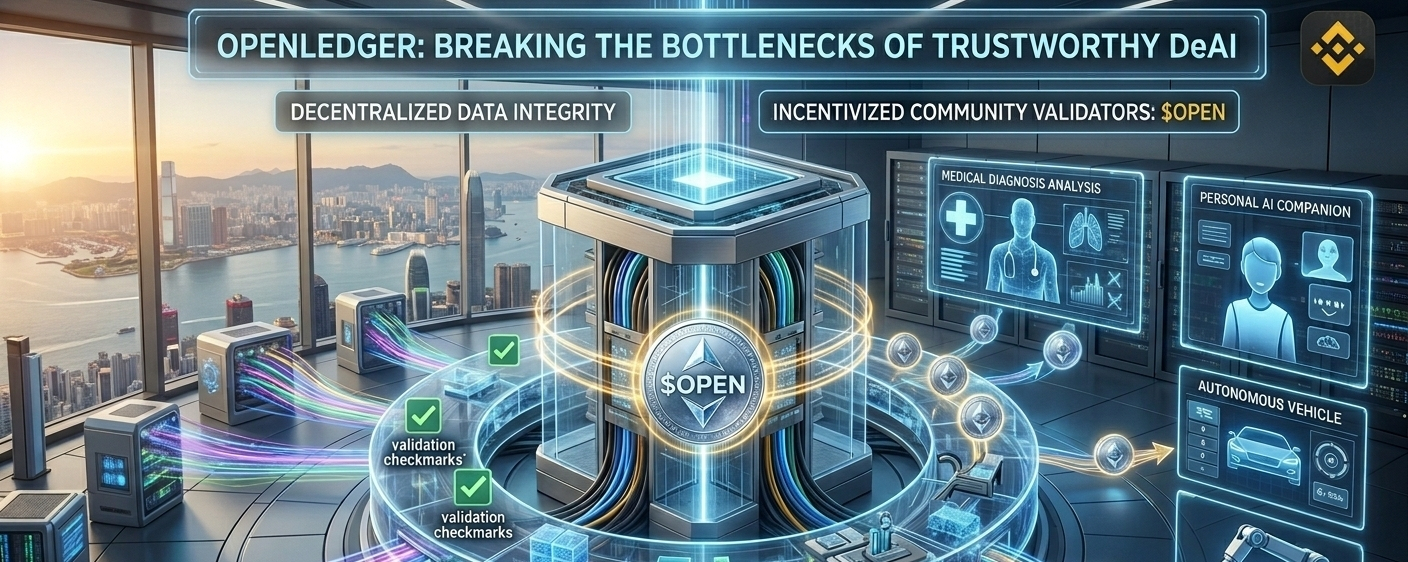
The Blueprint for Autonomous AI: Unlocking Verified Data on OpenLedgerAs Artificial Intelligence continues its rapid ascent, the industry faces a fundamental crisis: trust. Centralized data repositories, where AI training data currently resides, are opaque and vulnerable to bias and manipulation. This creates AI models that can be compromised or produce harmful 'hallucinations.' A truly decentralized AI ecosystem (DeAI) cannot function without a foundation of trustworthy data that is both secure and auditable. We need a way to verify the data supply chain.
This is precisely where @Openledger steps in, positioning itself as the foundational infrastructure for Decentralized AI. Rather than just another dApp, OpenLedger is building specialized data pipelines designed specifically for DeAI model training. It utilizes a decentralized network of validators to crowdsource, clean, and verify data before it ever reaches the AI models. This creates a cryptographically verifiable history of data provenance, ensuring that every piece of information used for training is high-integrity and authentic.
Central to this decentralized infrastructure is the $OPEN token. This isn't just a speculative asset; it is the economic engine that makes the entire system functional. Validators are incentivized to provide rigorous, high-quality data checks because they earn $OPEN rewards for their validated work. This aligns technical data integrity with financial incentives, creating a robust, community-driven ecosystem. The token model ensures the long-term sustainability and security of the decentralized data supply chain.
OpenLedger is mapping a future where data is sovereign, secure, and available for verifiable intelligence. By solving the critical bottleneck of decentralized data integrity, they are providing the blueprint for autonomous, trustworthy AI. It's time to build a smarter, decentralized intelligence.
#OpenLedger #DeAI #Web3Infrastructure #DataIntegrity
The Blueprint for Autonomous AI: Unlocking Verified Data on OpenLedger
As Artificial Intelligence continues its rapid ascent, the industry faces a fundamental crisis: trust. Centralized data repositories, where AI training data currently resides, are opaque and vulnerable to bias and manipulation. This creates AI models that can be compromised or produce harmful 'hallucinations.' A truly decentralized AI ecosystem (DeAI) cannot function without a foundation of trustworthy data that is both secure and auditable. We need a way to verify the data supply chain.
This is precisely where @OpenLedger steps in, positioning itself as the foundational infrastructure for Decentralized AI. Rather than just another dApp, OpenLedger is building specialized data pipelines designed specifically for DeAI model training. It utilizes a decentralized network of validators to crowdsource, clean, and verify data before it ever reaches the AI models. This creates a cryptographically verifiable history of data provenance, ensuring that every piece of information used for training is high-integrity and authentic.
Central to this decentralized infrastructure is the $OPEN token. This isn't just a speculative asset; it is the economic engine that makes the entire system functional. Validators are incentivized to provide rigorous, high-quality data checks because they earn $OPEN rewards for their validated work. This aligns technical data integrity with financial incentives, creating a robust, community-driven ecosystem. The token model ensures the long-term sustainability and security of the decentralized data supply chain.
OpenLedger is mapping a future where data is sovereign, secure, and available for verifiable intelligence. By solving the critical bottleneck of decentralized data integrity, they are providing the blueprint for autonomous, trustworthy AI. It's time to build a smarter, decentralized intelligence.
#OpenLedger #DeAI #Web3Infrastructure #DataIntegrity
This is precisely where @OpenLedger steps in, positioning itself as the foundational infrastructure for Decentralized AI. Rather than just another dApp, OpenLedger is building specialized data pipelines designed specifically for DeAI model training. It utilizes a decentralized network of validators to crowdsource, clean, and verify data before it ever reaches the AI models. This creates a cryptographically verifiable history of data provenance, ensuring that every piece of information used for training is high-integrity and authentic.
Central to this decentralized infrastructure is the $OPEN token. This isn't just a speculative asset; it is the economic engine that makes the entire system functional. Validators are incentivized to provide rigorous, high-quality data checks because they earn $OPEN rewards for their validated work. This aligns technical data integrity with financial incentives, creating a robust, community-driven ecosystem. The token model ensures the long-term sustainability and security of the decentralized data supply chain.
OpenLedger is mapping a future where data is sovereign, secure, and available for verifiable intelligence. By solving the critical bottleneck of decentralized data integrity, they are providing the blueprint for autonomous, trustworthy AI. It's time to build a smarter, decentralized intelligence.
#OpenLedger #DeAI #Web3Infrastructure #DataIntegrity
61
·
--
Article
Title: The AI Gold Rush is Here: Why OpenLedger is Selling the Ultimate "Pickaxes" ⛏️There is a famous saying about the 19th-century gold rush: the people who made the most reliable fortunes weren't the ones digging for gold, but the ones selling the pickaxes and shovels. We are currently living through the biggest technological gold rush of our lifetime—the Artificial Intelligence boom. Everyone is rushing to build the flashiest AI models, but they are all hitting the exact same wall: the desperate need for high-quality, verifiable data.
This is exactly why @Openledger is one of the most fundamentally important projects in the Web3 space right now. Instead of trying to build just another AI chatbot, OpenLedger is building the pickaxes. They are constructing a robust, decentralized data infrastructure specifically designed for the DeAI (Decentralized AI) ecosystem. By crowdsourcing and verifying data on-chain, they ensure that AI models are trained on unbiased, tamper-proof information rather than centralized corporate silos.
The economic engine powering this massive infrastructure play is the $OPEN token. This token isn't just for show; it is the vital utility that rewards data providers, incentivizes validators, and secures the entire network. When you understand that clean data is the most valuable commodity of the 21st century, the utility of the $OPEN token becomes incredibly clear.
If you want to position yourself smartly in the crypto and AI narrative, look at the infrastructure builders. Look at who is supplying the raw materials. @Openledger is laying the foundation for the future of DeAI.
#OpenLedger #DeAI #Web3Infrastructure #CryptoInvestment
Title: The AI Gold Rush is Here: Why OpenLedger is Selling the Ultimate "Pickaxes" ⛏️
There is a famous saying about the 19th-century gold rush: the people who made the most reliable fortunes weren't the ones digging for gold, but the ones selling the pickaxes and shovels. We are currently living through the biggest technological gold rush of our lifetime—the Artificial Intelligence boom. Everyone is rushing to build the flashiest AI models, but they are all hitting the exact same wall: the desperate need for high-quality, verifiable data.
This is exactly why @OpenLedger is one of the most fundamentally important projects in the Web3 space right now. Instead of trying to build just another AI chatbot, OpenLedger is building the pickaxes. They are constructing a robust, decentralized data infrastructure specifically designed for the DeAI (Decentralized AI) ecosystem. By crowdsourcing and verifying data on-chain, they ensure that AI models are trained on unbiased, tamper-proof information rather than centralized corporate silos.
The economic engine powering this massive infrastructure play is the $OPEN token. This token isn't just for show; it is the vital utility that rewards data providers, incentivizes validators, and secures the entire network. When you understand that clean data is the most valuable commodity of the 21st century, the utility of the $OPEN token becomes incredibly clear.
If you want to position yourself smartly in the crypto and AI narrative, look at the infrastructure builders. Look at who is supplying the raw materials. @OpenLedger is laying the foundation for the future of DeAI.
#OpenLedger #DeAI #Web3Infrastructure #CryptoInvestment
This is exactly why @OpenLedger is one of the most fundamentally important projects in the Web3 space right now. Instead of trying to build just another AI chatbot, OpenLedger is building the pickaxes. They are constructing a robust, decentralized data infrastructure specifically designed for the DeAI (Decentralized AI) ecosystem. By crowdsourcing and verifying data on-chain, they ensure that AI models are trained on unbiased, tamper-proof information rather than centralized corporate silos.
The economic engine powering this massive infrastructure play is the $OPEN token. This token isn't just for show; it is the vital utility that rewards data providers, incentivizes validators, and secures the entire network. When you understand that clean data is the most valuable commodity of the 21st century, the utility of the $OPEN token becomes incredibly clear.
If you want to position yourself smartly in the crypto and AI narrative, look at the infrastructure builders. Look at who is supplying the raw materials. @OpenLedger is laying the foundation for the future of DeAI.
#OpenLedger #DeAI #Web3Infrastructure #CryptoInvestment
50
·
--
Article
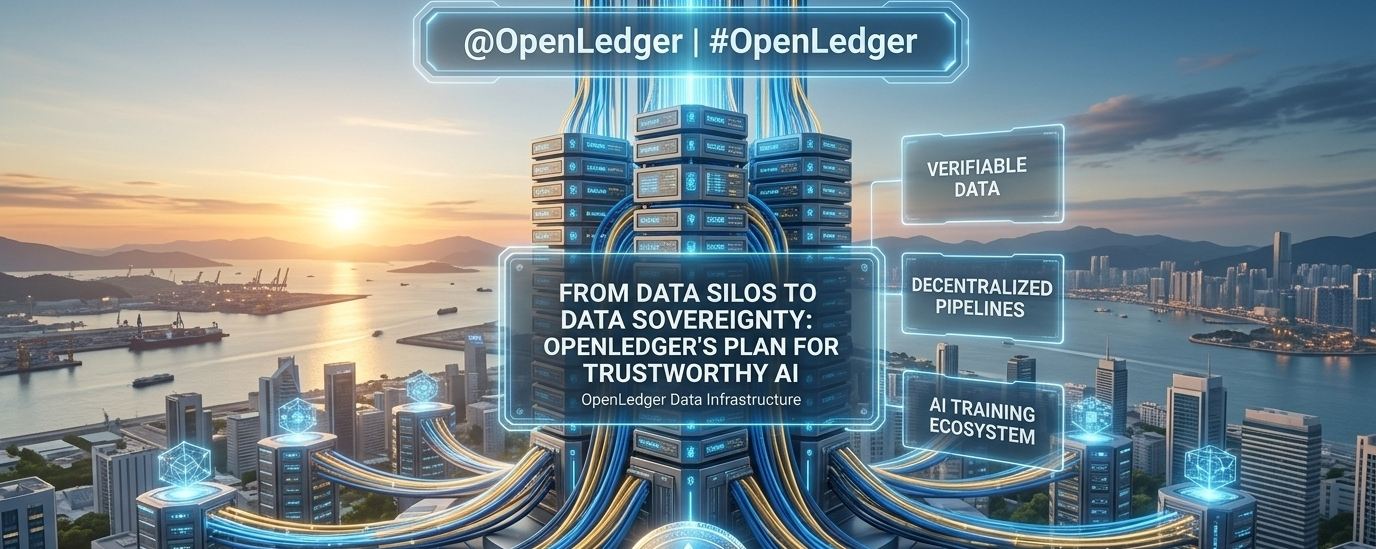
Breaking the Data Bottlenecks: OpenLedger’s Vision for Trustworthy AIAs Artificial Intelligence continues to evolve, the demand for high-quality, diverse data has become its single greatest challenge. However, the vast majority of valuable data is currently locked within the centralized silos of a few massive tech corporations. This centralization creates significant data bottlenecks, leading to algorithmic bias, restricted innovation, and a fundamental lack of trust in AI models. For DeAI to reach its full potential, we must break down these barriers and establish a new data sovereignty paradigm.
This is precisely the mission of @Openledger , an innovative project creating a foundational, specialized data infrastructure for Decentralized AI. By leveraging blockchain technology, OpenLedger allows developers to build and deploy transparent, secure, and verifiable data pipelines. Instead of relying on a single central entity, the data layer is validated by a decentralized community of users. This crowdsourced and validated data ecosystem ensures that AI models are trained on diverse, authentic, and high-integrity datasets, significantly enhancing their reliability and fairness.
At the core of this decentralized infrastructure is the $OPEN token. The token serves as the essential utility engine powering the network. It functions as the primary mechanism for incentivizing high-quality data contributions, rewarding data validators, and securing the entire data supply chain. As the sector matures, the demand for verified data will directly increase the utility of $OPEN , linking its growth intrinsically to the advancement of decentralized AI. For those paying attention to the Web3 and AI convergence, OpenLedger is a strategic opportunity to participate in building the future of trustworthy intelligence.
Drop a LIKE if you believe in trustworthy AI, follow the progress, and #OpenLedger.
#OpenLedger #DeAI #Web3Infrastructure #DataSovereignty #OPEN
Breaking the Data Bottlenecks: OpenLedger’s Vision for Trustworthy AI
As Artificial Intelligence continues to evolve, the demand for high-quality, diverse data has become its single greatest challenge. However, the vast majority of valuable data is currently locked within the centralized silos of a few massive tech corporations. This centralization creates significant data bottlenecks, leading to algorithmic bias, restricted innovation, and a fundamental lack of trust in AI models. For DeAI to reach its full potential, we must break down these barriers and establish a new data sovereignty paradigm.
This is precisely the mission of @OpenLedger , an innovative project creating a foundational, specialized data infrastructure for Decentralized AI. By leveraging blockchain technology, OpenLedger allows developers to build and deploy transparent, secure, and verifiable data pipelines. Instead of relying on a single central entity, the data layer is validated by a decentralized community of users. This crowdsourced and validated data ecosystem ensures that AI models are trained on diverse, authentic, and high-integrity datasets, significantly enhancing their reliability and fairness.
At the core of this decentralized infrastructure is the $OPEN token. The token serves as the essential utility engine powering the network. It functions as the primary mechanism for incentivizing high-quality data contributions, rewarding data validators, and securing the entire data supply chain. As the sector matures, the demand for verified data will directly increase the utility of $OPEN , linking its growth intrinsically to the advancement of decentralized AI. For those paying attention to the Web3 and AI convergence, OpenLedger is a strategic opportunity to participate in building the future of trustworthy intelligence.
Drop a LIKE if you believe in trustworthy AI, follow the progress, and #OpenLedger.
#OpenLedger #DeAI #Web3Infrastructure #DataSovereignty #OPEN
This is precisely the mission of @OpenLedger , an innovative project creating a foundational, specialized data infrastructure for Decentralized AI. By leveraging blockchain technology, OpenLedger allows developers to build and deploy transparent, secure, and verifiable data pipelines. Instead of relying on a single central entity, the data layer is validated by a decentralized community of users. This crowdsourced and validated data ecosystem ensures that AI models are trained on diverse, authentic, and high-integrity datasets, significantly enhancing their reliability and fairness.
At the core of this decentralized infrastructure is the $OPEN token. The token serves as the essential utility engine powering the network. It functions as the primary mechanism for incentivizing high-quality data contributions, rewarding data validators, and securing the entire data supply chain. As the sector matures, the demand for verified data will directly increase the utility of $OPEN , linking its growth intrinsically to the advancement of decentralized AI. For those paying attention to the Web3 and AI convergence, OpenLedger is a strategic opportunity to participate in building the future of trustworthy intelligence.
Drop a LIKE if you believe in trustworthy AI, follow the progress, and #OpenLedger.
#OpenLedger #DeAI #Web3Infrastructure #DataSovereignty #OPEN
1
86

·
--
The AI Blockchain Evolution: Why @OpenLedger is Rewriting the Rules of the Data EconomyThe intersection of Artificial Intelligence (AI) and Decentralized Physical Infrastructure Networks (DePIN) is arguably the most explosive narrative in Web3 today. While traditional AI development remains heavily gatekept by centralized tech monopolies, a paradigm shift is happening on-chain. Leading this charge is @OpenLedger, the world's first AI-native blockchain designed specifically to democratize, secure, and monetize the entire AI lifecycle.
Solving the Centralized AI Crisis
Right now, general-purpose LLMs face massive hurdles: data manipulation risks, a lack of transparency in training models, and zero rewards for the communities that actually create the data. @Openledger changes the game by introducing an EVM-compatible Layer 2 framework that makes data, models, and AI agents fully liquid, traceable, and composable.
At the heart of this ecosystem are three key innovations:
Datanets: Community-owned, on-chain data hubs focused on specific domains (e.g., legal, medical, or niche tech datasets) that allow users to securely contribute high-quality data.
Proof of Attribution (PoA): This groundbreaking protocol tracks exactly how much a specific piece of data influences an AI model's output, ensuring completely transparent data provenance.
ModelFactory & OpenLoRA: A zero-code infrastructure layer allowing developers to fine-tune specialized language models (SLMs) efficiently without needing massive, expensive server farms.
Real Utility Behind the $OPEN Token
Unlike many speculative tokens riding the AI wave, the native token $OPEN serves as the literal lifeblood of the network. It handles network gas fees, powers the deployment of custom models, and facilitates real-time, fair rewards for data contributors and node operators.
By tying token utility directly to compute power and dataset curation, OpenLedger is shifting the narrative from "hype" to sustainable infrastructure. Backed by industry titans and designed for scalability, this ecosystem is proving that decentralized intelligence is not just a concept—it is the future.
Keep an eye on how this narrative unfolds as user-owned AI takes center stage.
#OpenLedger #DePIN #DecentralizedAI #Web3Infrastructure
The AI Blockchain Evolution: Why @OpenLedger is Rewriting the Rules of the Data Economy
The intersection of Artificial Intelligence (AI) and Decentralized Physical Infrastructure Networks (DePIN) is arguably the most explosive narrative in Web3 today. While traditional AI development remains heavily gatekept by centralized tech monopolies, a paradigm shift is happening on-chain. Leading this charge is @OpenLedger, the world's first AI-native blockchain designed specifically to democratize, secure, and monetize the entire AI lifecycle.
Solving the Centralized AI Crisis
Right now, general-purpose LLMs face massive hurdles: data manipulation risks, a lack of transparency in training models, and zero rewards for the communities that actually create the data. @OpenLedger changes the game by introducing an EVM-compatible Layer 2 framework that makes data, models, and AI agents fully liquid, traceable, and composable.
At the heart of this ecosystem are three key innovations:
Datanets: Community-owned, on-chain data hubs focused on specific domains (e.g., legal, medical, or niche tech datasets) that allow users to securely contribute high-quality data.
Proof of Attribution (PoA): This groundbreaking protocol tracks exactly how much a specific piece of data influences an AI model's output, ensuring completely transparent data provenance.
ModelFactory & OpenLoRA: A zero-code infrastructure layer allowing developers to fine-tune specialized language models (SLMs) efficiently without needing massive, expensive server farms.
Real Utility Behind the $OPEN Token
Unlike many speculative tokens riding the AI wave, the native token $OPEN serves as the literal lifeblood of the network. It handles network gas fees, powers the deployment of custom models, and facilitates real-time, fair rewards for data contributors and node operators.
By tying token utility directly to compute power and dataset curation, OpenLedger is shifting the narrative from "hype" to sustainable infrastructure. Backed by industry titans and designed for scalability, this ecosystem is proving that decentralized intelligence is not just a concept—it is the future.
Keep an eye on how this narrative unfolds as user-owned AI takes center stage.
#OpenLedger #DePIN #DecentralizedAI #Web3Infrastructure
Solving the Centralized AI Crisis
Right now, general-purpose LLMs face massive hurdles: data manipulation risks, a lack of transparency in training models, and zero rewards for the communities that actually create the data. @OpenLedger changes the game by introducing an EVM-compatible Layer 2 framework that makes data, models, and AI agents fully liquid, traceable, and composable.
At the heart of this ecosystem are three key innovations:
Datanets: Community-owned, on-chain data hubs focused on specific domains (e.g., legal, medical, or niche tech datasets) that allow users to securely contribute high-quality data.
Proof of Attribution (PoA): This groundbreaking protocol tracks exactly how much a specific piece of data influences an AI model's output, ensuring completely transparent data provenance.
ModelFactory & OpenLoRA: A zero-code infrastructure layer allowing developers to fine-tune specialized language models (SLMs) efficiently without needing massive, expensive server farms.
Real Utility Behind the $OPEN Token
Unlike many speculative tokens riding the AI wave, the native token $OPEN serves as the literal lifeblood of the network. It handles network gas fees, powers the deployment of custom models, and facilitates real-time, fair rewards for data contributors and node operators.
By tying token utility directly to compute power and dataset curation, OpenLedger is shifting the narrative from "hype" to sustainable infrastructure. Backed by industry titans and designed for scalability, this ecosystem is proving that decentralized intelligence is not just a concept—it is the future.
Keep an eye on how this narrative unfolds as user-owned AI takes center stage.
#OpenLedger #DePIN #DecentralizedAI #Web3Infrastructure
62

🌩️ The Stress Test: Why Verifiable AI Infrastructure is the Ultimate Flex for Web3
Most Web3 infrastructure looks flawless when the network is quiet. But we all know what happens when gas fees spike, activity explodes, and everyone rushes for the exit at once. Human nature takes over, systems clog, and theoretical assumptions fall apart.
That is exactly the chaos that @OpenGradient (#OPG) is built to withstand.
🤖 Moving Beyond Just "Distributed AI"
OpenGradient isn’t just about tossing AI models onto a network and hoping for the best. It’s tackling the real bottleneck: decentralized verification.
Think of it like a massive global delivery network. When demand is low, everything arrives on time. But when a massive surge hits, warehouses back up, drivers get rerouted, and small inefficiencies trigger a total system meltdown.
In the AI world, that "meltdown" looks like computation bottlenecks and broken trust. As decentralized applications (dApps) scale, just getting an answer from an AI model isn't enough. You have to prove:
Where that answer came from.
How it was generated.
That no single provider tampered with the result.
⚖️ The Ultimate Crypto Paradox: Trust vs. Efficiency
OpenGradient’s recent technical milestones show serious momentum in verifiable AI execution and network expansion. But the ultimate challenge for $OPG remains the ultimate challenge for Web3: Can a network maintain absolute trust without sacrificing hyper-efficiency?
Usually, these two goals move in opposite directions. When the next major market surge collides with these systems, we’ll see which networks are actually built for the future, and which ones were just enjoying the quiet.
Keep your eyes on the infrastructure layer.
What are your thoughts on the intersection of AI and decentralized verification? Drop your comments below! 👇
#OPG $OPG #AI #DeFi #Web3Infrastructure
🌩️ The Stress Test: Why Verifiable AI Infrastructure is the Ultimate Flex for Web3
Most Web3 infrastructure looks flawless when the network is quiet. But we all know what happens when gas fees spike, activity explodes, and everyone rushes for the exit at once. Human nature takes over, systems clog, and theoretical assumptions fall apart.
That is exactly the chaos that @OpenGradient (#OPG) is built to withstand.
🤖 Moving Beyond Just "Distributed AI"
OpenGradient isn’t just about tossing AI models onto a network and hoping for the best. It’s tackling the real bottleneck: decentralized verification.
Think of it like a massive global delivery network. When demand is low, everything arrives on time. But when a massive surge hits, warehouses back up, drivers get rerouted, and small inefficiencies trigger a total system meltdown.
In the AI world, that "meltdown" looks like computation bottlenecks and broken trust. As decentralized applications (dApps) scale, just getting an answer from an AI model isn't enough. You have to prove:
Where that answer came from.
How it was generated.
That no single provider tampered with the result.
⚖️ The Ultimate Crypto Paradox: Trust vs. Efficiency
OpenGradient’s recent technical milestones show serious momentum in verifiable AI execution and network expansion. But the ultimate challenge for $OPG remains the ultimate challenge for Web3: Can a network maintain absolute trust without sacrificing hyper-efficiency?
Usually, these two goals move in opposite directions. When the next major market surge collides with these systems, we’ll see which networks are actually built for the future, and which ones were just enjoying the quiet.
Keep your eyes on the infrastructure layer.
What are your thoughts on the intersection of AI and decentralized verification? Drop your comments below! 👇
#OPG $OPG #AI #DeFi #Web3Infrastructure
Most Web3 infrastructure looks flawless when the network is quiet. But we all know what happens when gas fees spike, activity explodes, and everyone rushes for the exit at once. Human nature takes over, systems clog, and theoretical assumptions fall apart.
That is exactly the chaos that @OpenGradient (#OPG) is built to withstand.
🤖 Moving Beyond Just "Distributed AI"
OpenGradient isn’t just about tossing AI models onto a network and hoping for the best. It’s tackling the real bottleneck: decentralized verification.
Think of it like a massive global delivery network. When demand is low, everything arrives on time. But when a massive surge hits, warehouses back up, drivers get rerouted, and small inefficiencies trigger a total system meltdown.
In the AI world, that "meltdown" looks like computation bottlenecks and broken trust. As decentralized applications (dApps) scale, just getting an answer from an AI model isn't enough. You have to prove:
Where that answer came from.
How it was generated.
That no single provider tampered with the result.
⚖️ The Ultimate Crypto Paradox: Trust vs. Efficiency
OpenGradient’s recent technical milestones show serious momentum in verifiable AI execution and network expansion. But the ultimate challenge for $OPG remains the ultimate challenge for Web3: Can a network maintain absolute trust without sacrificing hyper-efficiency?
Usually, these two goals move in opposite directions. When the next major market surge collides with these systems, we’ll see which networks are actually built for the future, and which ones were just enjoying the quiet.
Keep your eyes on the infrastructure layer.
What are your thoughts on the intersection of AI and decentralized verification? Drop your comments below! 👇
#OPG $OPG #AI #DeFi #Web3Infrastructure
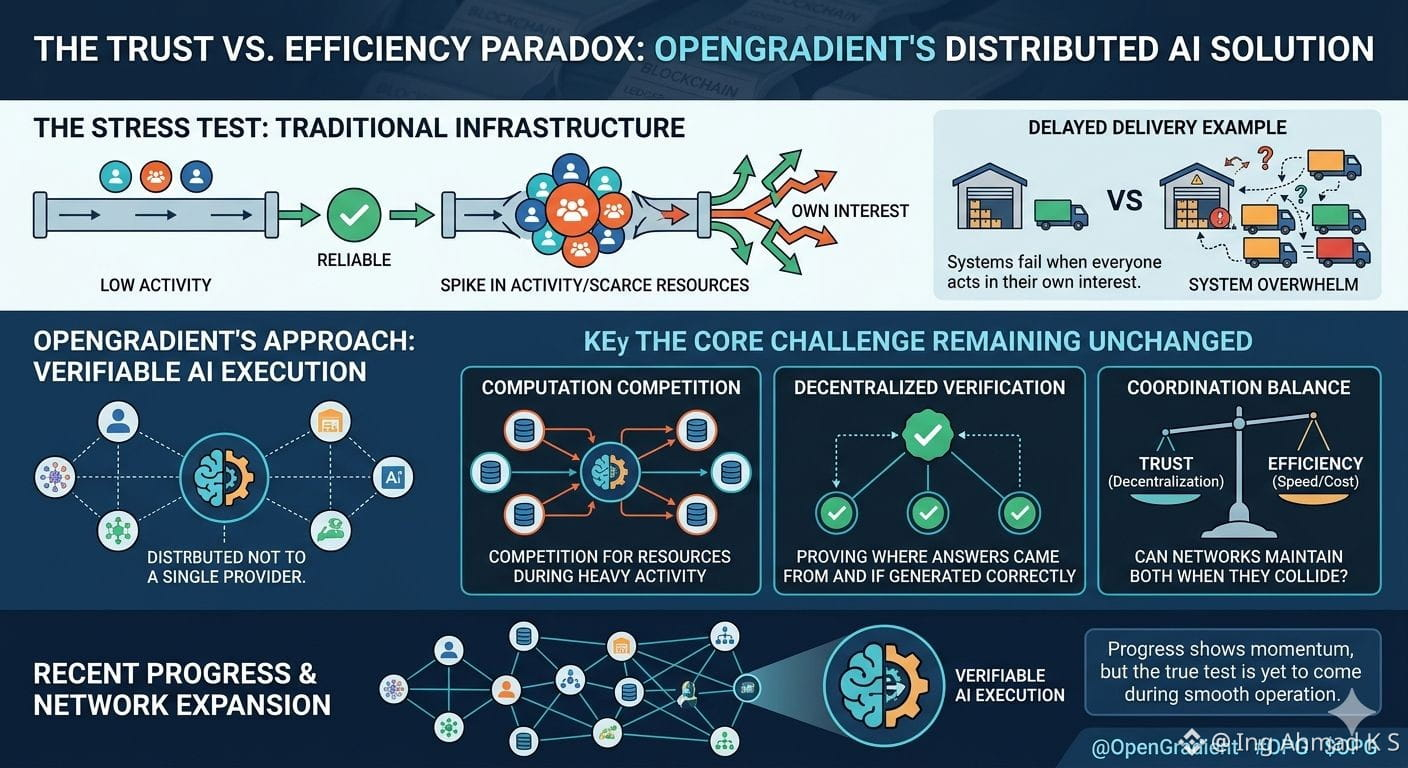
5
1
101
Log in to explore more content
Join global crypto users on Binance Square
⚡️ Get latest and useful information about crypto.
💬 Trusted by the world’s largest crypto exchange.
👍 Discover real insights from verified creators.
Email / Phone number
Trending Topics
1
#AppleDebutsFoldablePhone
24,900 views
530 Discussing
2
#TSMCAugustRevenueUp53.3%YoY
135 views
56 Discussing
3
#IranSaysReadyToEscalateWarWithUS
2,580 views
104 Discussing
4
#EUExtendsCentralContactPointToCASPs
6,611 views
188 Discussing
5
#US10YTreasuryYieldHitsHighestSinceNov2023
25,306 views
413 Discussing
6
#USTreasuryToBuyBackUpTo$6BLongDatedDebt
16,959 views
165 Discussing
7
#BitcoinSurpasses$79K
66,768 views
278 Discussing
8
#BrentCrudeTops$100
124,561 views
404 Discussing
9
#USADPWeeklyEmploymentRises12000
109,424 views
1,326 Discussing
10
#BankOfAmericaGroupPilotsUSBDCStablecoin
81,620 views
1,053 Discussing