

#openledger
openledger
17.3M views
202,843 Discussing
Hot
Latest

·
--
Bullish
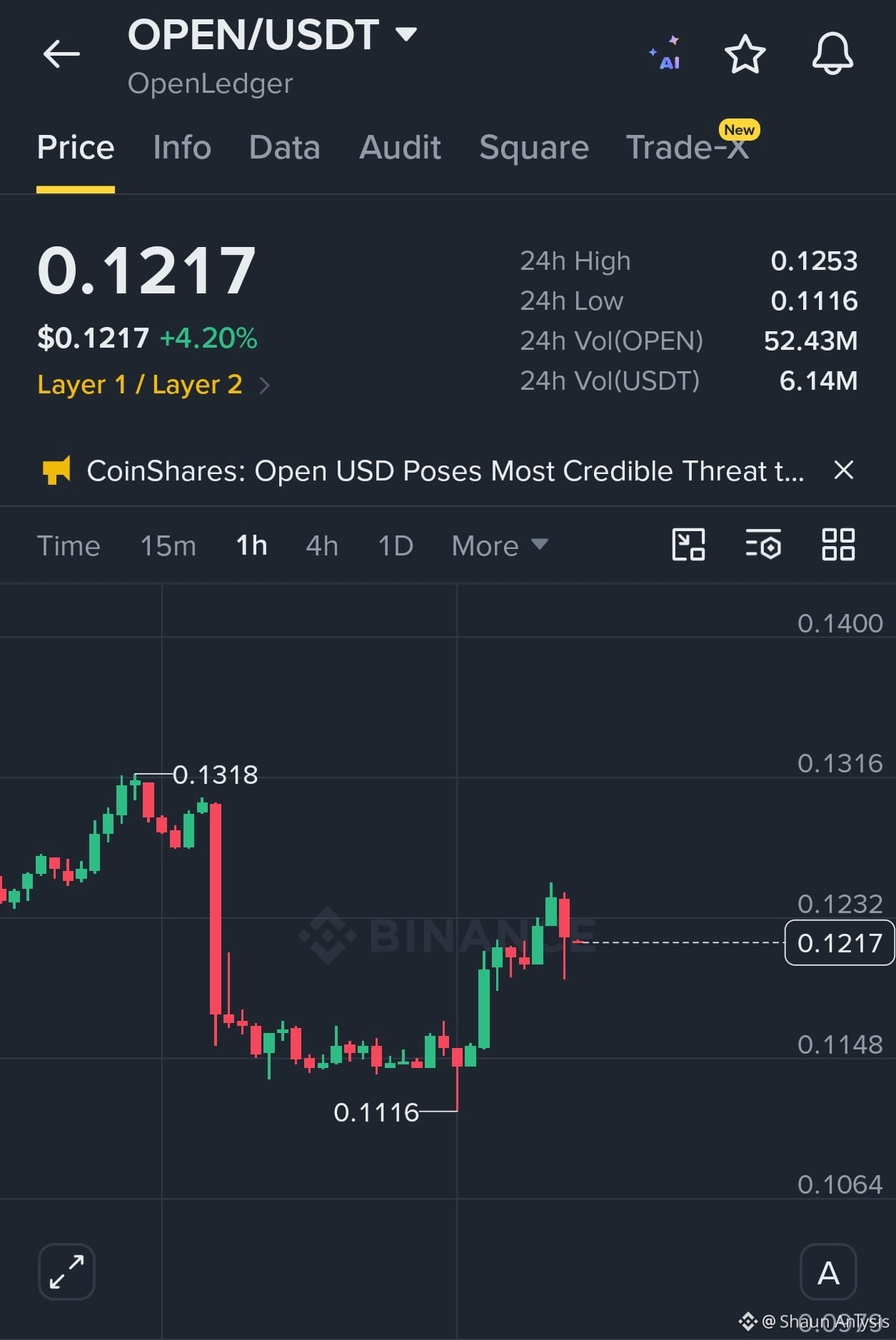
#OpenLedger just printed a textbook V-shaped recovery—don't miss the next leg up.
After a sharp flush to 0.1116, $OPEN has bounced hard, reclaiming the 0.12 handle and currently sitting at 0.1217 (+4.20% on the day). The 1H chart shows a clear shift in momentum as buyers defend the lows and push back toward the 24H high of 0.1253.
Bullish
Entry:0.1180 – 0.1220
SL:0.1100
TP1:0.1318
{future}(OPENUSDT)
#OpenLedger just printed a textbook V-shaped recovery—don't miss the next leg up.
After a sharp flush to 0.1116, $OPEN has bounced hard, reclaiming the 0.12 handle and currently sitting at 0.1217 (+4.20% on the day). The 1H chart shows a clear shift in momentum as buyers defend the lows and push back toward the 24H high of 0.1253.
Bullish
Entry:0.1180 – 0.1220
SL:0.1100
TP1:0.1318
After a sharp flush to 0.1116, $OPEN has bounced hard, reclaiming the 0.12 handle and currently sitting at 0.1217 (+4.20% on the day). The 1H chart shows a clear shift in momentum as buyers defend the lows and push back toward the 24H high of 0.1253.
Bullish
Entry:0.1180 – 0.1220
SL:0.1100
TP1:0.1318
1
98

·
--
Bullish
Partly True
*OPEN: A Quiet AI Opportunity Near The Bottom*
While many focus on popular AI coins, OpenLedger (OPEN) is trading near its lowest price ever.
From $1.84 to $0.11, a large correction of 94 percent. Is this a bottom?
Here is what makes OpenLedger interesting:
OpenLedger is building infrastructure for AI, where data, models, and AI agents receive payments automatically. Think of AI agents paying for verified data on-chain. This is called agentic payments, and OpenLedger aims to lead this sector.
Market cap is around $43M while volume is $31M. That is over 71 percent turnover, showing strong interest and active accumulation.
Token unlocks are happening. About 612k tokens daily around October 8th. Small unlocks create short-term pressure, but also long-term opportunity.
It is listed on major exchanges like Upbit, Bithumb, and Binance, with strong liquidity.
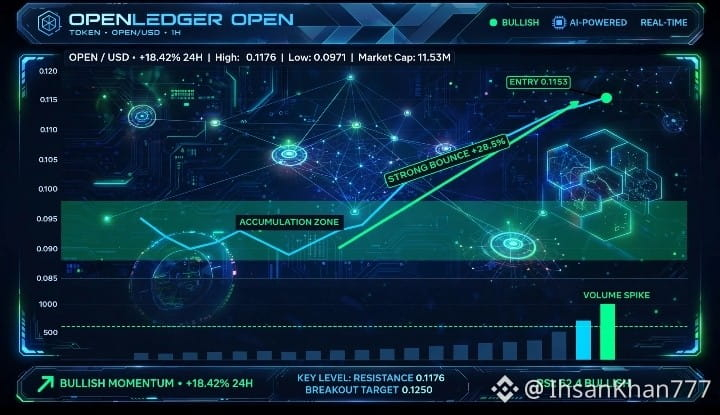
I bought OPEN at $0.1153 near the low range. This is not financial advice, but early infrastructure often looks quiet before growth.
#OpenLedger
#OpenAI
#BestTimeToBuy
#Market_Update
#BullRunTips
$OPEN
$BTC
$BNB
@XG297174
@dengshen
@eggtartcake_grape
@haoge666
@Square-Creator-f92ceb7e7882c
@Square-Creator-d4cc116ea2fe
@SGD852568
@Square-Creator-f0c9a305b41a7
@z12123444
@Square-Creator-9bd28167d172
@NUTS_btc
@heyi
@CZ
@Openledger
@Biswap_Dex
@MagVerse
@EASY7777
@KZG6886
@Z0628
@JavierDot
@oanicai
*OPEN: A Quiet AI Opportunity Near The Bottom*
While many focus on popular AI coins, OpenLedger (OPEN) is trading near its lowest price ever.
From $1.84 to $0.11, a large correction of 94 percent. Is this a bottom?
Here is what makes OpenLedger interesting:
OpenLedger is building infrastructure for AI, where data, models, and AI agents receive payments automatically. Think of AI agents paying for verified data on-chain. This is called agentic payments, and OpenLedger aims to lead this sector.
Market cap is around $43M while volume is $31M. That is over 71 percent turnover, showing strong interest and active accumulation.
Token unlocks are happening. About 612k tokens daily around October 8th. Small unlocks create short-term pressure, but also long-term opportunity.
It is listed on major exchanges like Upbit, Bithumb, and Binance, with strong liquidity.
I bought OPEN at $0.1153 near the low range. This is not financial advice, but early infrastructure often looks quiet before growth.
#OpenLedger
#OpenAI
#BestTimeToBuy
#Market_Update
#BullRunTips
$OPEN
$BTC
$BNB
@K线人生飞哥
@比特币预言家
@Eggtartcake
@交易员张张子
@华尔街倩倩子
@猩火Bro
@Flash闪光灯
@乐天eth
@加密大格格
@klxmBobo
@Nuts坚果
@Yi He
@CZ
@OpenLedger
@Qordman crypto
@MagVerse
@EASY喊單哥
@KZG Crypto 口罩哥
@Whale韭阴针鲸0628
@_WHALE_
@Oanic AI
While many focus on popular AI coins, OpenLedger (OPEN) is trading near its lowest price ever.
From $1.84 to $0.11, a large correction of 94 percent. Is this a bottom?
Here is what makes OpenLedger interesting:
OpenLedger is building infrastructure for AI, where data, models, and AI agents receive payments automatically. Think of AI agents paying for verified data on-chain. This is called agentic payments, and OpenLedger aims to lead this sector.
Market cap is around $43M while volume is $31M. That is over 71 percent turnover, showing strong interest and active accumulation.
Token unlocks are happening. About 612k tokens daily around October 8th. Small unlocks create short-term pressure, but also long-term opportunity.
It is listed on major exchanges like Upbit, Bithumb, and Binance, with strong liquidity.
I bought OPEN at $0.1153 near the low range. This is not financial advice, but early infrastructure often looks quiet before growth.
#OpenLedger
#OpenAI
#BestTimeToBuy
#Market_Update
#BullRunTips
$OPEN
$BTC
$BNB
@K线人生飞哥
@比特币预言家
@Eggtartcake
@交易员张张子
@华尔街倩倩子
@猩火Bro
@Flash闪光灯
@乐天eth
@加密大格格
@klxmBobo
@Nuts坚果
@Yi He
@CZ
@OpenLedger
@Qordman crypto
@MagVerse
@EASY喊單哥
@KZG Crypto 口罩哥
@Whale韭阴针鲸0628
@_WHALE_
@Oanic AI
4
870

#openledger $OPEN The OpenLedger campaign is creating serious excitement across the crypto community, and for good reason. As blockchain technology continues to evolve, OpenLedger is positioning itself as a project focused on innovation, transparency, and community-driven growth.
Participating in the Binance OpenLedger campaign is more than just completing tasks and earning rewards—it's a chance to become part of a growing ecosystem before wider adoption takes place. Early supporters often gain valuable experience, build stronger connections within the community, and position themselves for future opportunities.
What makes this campaign even more attractive is the combination of learning, engagement, and rewards. Whether you're a seasoned crypto enthusiast or a newcomer exploring Web3, OpenLedger offers a great way to stay active and informed while potentially benefiting from the project's growth.
Don't just watch from the sidelines—join the conversation, complete the campaign activities, and discover why so many users are keeping a close eye on OpenLedger. The next big opportunity could be closer than you think! 🔥
#OpenLedger #BinanceSquare #Crypto #Web3 #Airdrop #Blockchain #BinanceCampaign #CryptoCommunity
#openledger $OPEN The OpenLedger campaign is creating serious excitement across the crypto community, and for good reason. As blockchain technology continues to evolve, OpenLedger is positioning itself as a project focused on innovation, transparency, and community-driven growth.
Participating in the Binance OpenLedger campaign is more than just completing tasks and earning rewards—it's a chance to become part of a growing ecosystem before wider adoption takes place. Early supporters often gain valuable experience, build stronger connections within the community, and position themselves for future opportunities.
What makes this campaign even more attractive is the combination of learning, engagement, and rewards. Whether you're a seasoned crypto enthusiast or a newcomer exploring Web3, OpenLedger offers a great way to stay active and informed while potentially benefiting from the project's growth.
Don't just watch from the sidelines—join the conversation, complete the campaign activities, and discover why so many users are keeping a close eye on OpenLedger. The next big opportunity could be closer than you think! 🔥
#OpenLedger #BinanceSquare #Crypto #Web3 #Airdrop #Blockchain #BinanceCampaign #CryptoCommunity
Participating in the Binance OpenLedger campaign is more than just completing tasks and earning rewards—it's a chance to become part of a growing ecosystem before wider adoption takes place. Early supporters often gain valuable experience, build stronger connections within the community, and position themselves for future opportunities.
What makes this campaign even more attractive is the combination of learning, engagement, and rewards. Whether you're a seasoned crypto enthusiast or a newcomer exploring Web3, OpenLedger offers a great way to stay active and informed while potentially benefiting from the project's growth.
Don't just watch from the sidelines—join the conversation, complete the campaign activities, and discover why so many users are keeping a close eye on OpenLedger. The next big opportunity could be closer than you think! 🔥
#OpenLedger #BinanceSquare #Crypto #Web3 #Airdrop #Blockchain #BinanceCampaign #CryptoCommunity
84

An open ledger is a transparent, shared record system where every transaction is publicly visible and verifiable by anyone. Unlike private databases, it removes the need for a central authority because trust comes from distributed consensus. Most famously used in blockchain technology, an open ledger records entries chronologically, making them tamper-proof once confirmed. This transparency reduces fraud, increases accountability, and allows independent auditing without permission. Businesses, governments, and financial systems use open ledgers to track assets, contracts, and payments openly. While it boosts trust, privacy must be managed carefully since data is public. Overall, open ledgers promote fairness by giving all participants equal access to the same truthful information.
#openledger $OPEN @Openledger
An open ledger is a transparent, shared record system where every transaction is publicly visible and verifiable by anyone. Unlike private databases, it removes the need for a central authority because trust comes from distributed consensus. Most famously used in blockchain technology, an open ledger records entries chronologically, making them tamper-proof once confirmed. This transparency reduces fraud, increases accountability, and allows independent auditing without permission. Businesses, governments, and financial systems use open ledgers to track assets, contracts, and payments openly. While it boosts trust, privacy must be managed carefully since data is public. Overall, open ledgers promote fairness by giving all participants equal access to the same truthful information.
#openledger $OPEN @OpenLedger
#openledger $OPEN @OpenLedger
121

·
--
Back in the day, what freaked me out about cross-chain was not the slowness, but that moment when you think nothing's happening, you accidentally click again, and suddenly that one action turns into two. When that happens, it's embarrassing to go back and review: was it the system that didn’t make the status clear, or did I just lose my cool? The more you try to automate the bridge process, the deadlier this pitfall becomes, because repeating an action doesn’t just mean 'a little loss'; it completely messes up the logic.
So now, when I look at the EVM Bridge of @Openledger , I have a pretty straightforward standard to test it: can this bridging step become a clear checkpoint, instead of a 'boundary-less action'? When OctoClaw generates an action, if this step is cross-chain, I want it to bind 'this bridge action' to a unique reference: if you trigger the same action again, the system shouldn’t just quietly run it again, but clearly inform you—this transaction is ongoing/completed/not allowed to repeat. Trading agents can keep building the link, no problem, but for high-risk actions like bridging, we must cut out 'repeat execution' first; otherwise, the more automated it gets, the more it feels like stepping on a landmine.
Today, I’ll leave one acceptance criterion: when the same bridge action is triggered again, can the system return the same execution reference and provide a clear status (in progress/completed), while also refusing to create a second bridge? If it can do that, I’ll consider the Bridge as capable; if not, I’d rather leave this step for manual confirmation.
@Openledger $OPEN #OpenLedger
Back in the day, what freaked me out about cross-chain was not the slowness, but that moment when you think nothing's happening, you accidentally click again, and suddenly that one action turns into two. When that happens, it's embarrassing to go back and review: was it the system that didn’t make the status clear, or did I just lose my cool? The more you try to automate the bridge process, the deadlier this pitfall becomes, because repeating an action doesn’t just mean 'a little loss'; it completely messes up the logic.
So now, when I look at the EVM Bridge of @OpenLedger , I have a pretty straightforward standard to test it: can this bridging step become a clear checkpoint, instead of a 'boundary-less action'? When OctoClaw generates an action, if this step is cross-chain, I want it to bind 'this bridge action' to a unique reference: if you trigger the same action again, the system shouldn’t just quietly run it again, but clearly inform you—this transaction is ongoing/completed/not allowed to repeat. Trading agents can keep building the link, no problem, but for high-risk actions like bridging, we must cut out 'repeat execution' first; otherwise, the more automated it gets, the more it feels like stepping on a landmine.
Today, I’ll leave one acceptance criterion: when the same bridge action is triggered again, can the system return the same execution reference and provide a clear status (in progress/completed), while also refusing to create a second bridge? If it can do that, I’ll consider the Bridge as capable; if not, I’d rather leave this step for manual confirmation.
@OpenLedger $OPEN #OpenLedger
So now, when I look at the EVM Bridge of @OpenLedger , I have a pretty straightforward standard to test it: can this bridging step become a clear checkpoint, instead of a 'boundary-less action'? When OctoClaw generates an action, if this step is cross-chain, I want it to bind 'this bridge action' to a unique reference: if you trigger the same action again, the system shouldn’t just quietly run it again, but clearly inform you—this transaction is ongoing/completed/not allowed to repeat. Trading agents can keep building the link, no problem, but for high-risk actions like bridging, we must cut out 'repeat execution' first; otherwise, the more automated it gets, the more it feels like stepping on a landmine.
Today, I’ll leave one acceptance criterion: when the same bridge action is triggered again, can the system return the same execution reference and provide a clear status (in progress/completed), while also refusing to create a second bridge? If it can do that, I’ll consider the Bridge as capable; if not, I’d rather leave this step for manual confirmation.
@OpenLedger $OPEN #OpenLedger

188

·
--
A few days ago, my cousin who does e-commerce came to me with a bunch of hype about #OpenLedger , saying that if he fed some user behavior data in, he could swap it for $OPEN and asked if it was a guaranteed profit. I didn’t rush to pour cold water on it; I first dumped my batch of anonymized store transaction data into DataNet to test the waters. On the surface, the on-chain verification was indeed smooth, with every piece of valid data tagged for attribution, and the ledger was crystal clear. But after running a full cycle, I realized: you have zero pricing power.
The sneakiest part is that the value of your data isn’t determined by you at all; it all depends on whether the terminal model actually digests the parameters you fed it. My batch of consumer preference data, which I thought was super valuable, didn’t hit the sweet spot of the current model fine-tuning, and the tokens distributed on-chain ended up being pitifully small, barely covering the bandwidth fees for running nodes. In contrast, my neighbor’s random dump of mediocre open-source data ended up getting more dividends because it hit the peak usage time just right. This isn’t about sharing rewards based on contribution; it’s purely a gamble on the model's appetite. $LAB
What’s even more chilling is that once your exclusive data is packaged and submitted, the mainnet index forcibly keeps a snapshot of the features. In plain terms, your little stash of private goods is half-publicly laid out for the whole network to see. The officials use zero-knowledge proofs as a shield, claiming that the data never leaves the local environment, but if I follow the submission logic down the line, the metadata features still need to be uploaded. You think you’ve locked the sovereignty, but the core information has already been quietly extracted.
To be fair, using cryptography to stamp out labor's hard-earned profits with anti-counterfeit marks is indeed hardcore, and the attribution mechanism does give retail investors a seat at the table. But as long as the pricing power is firmly held by algorithms and whales, this deadlock won’t break, and the grassroots contributors will always be seen as cheap consumables dictated by the model’s appetite. I advised my cousin not to jump in headfirst and to just use some spare cash to run some interactions and figure out the ropes; once the mainnet calls for real data and it becomes clear who’s actually setting the prices, it won’t be too late to place a bet. #BTC
#OpenLedger $OPEN @Openledger
{alpha}(560x7ec43cf65f1663f820427c62a5780b8f2e25593a)
{spot}(OPENUSDT)
A few days ago, my cousin who does e-commerce came to me with a bunch of hype about #OpenLedger , saying that if he fed some user behavior data in, he could swap it for $OPEN and asked if it was a guaranteed profit. I didn’t rush to pour cold water on it; I first dumped my batch of anonymized store transaction data into DataNet to test the waters. On the surface, the on-chain verification was indeed smooth, with every piece of valid data tagged for attribution, and the ledger was crystal clear. But after running a full cycle, I realized: you have zero pricing power.
The sneakiest part is that the value of your data isn’t determined by you at all; it all depends on whether the terminal model actually digests the parameters you fed it. My batch of consumer preference data, which I thought was super valuable, didn’t hit the sweet spot of the current model fine-tuning, and the tokens distributed on-chain ended up being pitifully small, barely covering the bandwidth fees for running nodes. In contrast, my neighbor’s random dump of mediocre open-source data ended up getting more dividends because it hit the peak usage time just right. This isn’t about sharing rewards based on contribution; it’s purely a gamble on the model's appetite. $LAB
What’s even more chilling is that once your exclusive data is packaged and submitted, the mainnet index forcibly keeps a snapshot of the features. In plain terms, your little stash of private goods is half-publicly laid out for the whole network to see. The officials use zero-knowledge proofs as a shield, claiming that the data never leaves the local environment, but if I follow the submission logic down the line, the metadata features still need to be uploaded. You think you’ve locked the sovereignty, but the core information has already been quietly extracted.
To be fair, using cryptography to stamp out labor's hard-earned profits with anti-counterfeit marks is indeed hardcore, and the attribution mechanism does give retail investors a seat at the table. But as long as the pricing power is firmly held by algorithms and whales, this deadlock won’t break, and the grassroots contributors will always be seen as cheap consumables dictated by the model’s appetite. I advised my cousin not to jump in headfirst and to just use some spare cash to run some interactions and figure out the ropes; once the mainnet calls for real data and it becomes clear who’s actually setting the prices, it won’t be too late to place a bet. #BTC
#OpenLedger $OPEN @OpenLedger
The sneakiest part is that the value of your data isn’t determined by you at all; it all depends on whether the terminal model actually digests the parameters you fed it. My batch of consumer preference data, which I thought was super valuable, didn’t hit the sweet spot of the current model fine-tuning, and the tokens distributed on-chain ended up being pitifully small, barely covering the bandwidth fees for running nodes. In contrast, my neighbor’s random dump of mediocre open-source data ended up getting more dividends because it hit the peak usage time just right. This isn’t about sharing rewards based on contribution; it’s purely a gamble on the model's appetite. $LAB
What’s even more chilling is that once your exclusive data is packaged and submitted, the mainnet index forcibly keeps a snapshot of the features. In plain terms, your little stash of private goods is half-publicly laid out for the whole network to see. The officials use zero-knowledge proofs as a shield, claiming that the data never leaves the local environment, but if I follow the submission logic down the line, the metadata features still need to be uploaded. You think you’ve locked the sovereignty, but the core information has already been quietly extracted.
To be fair, using cryptography to stamp out labor's hard-earned profits with anti-counterfeit marks is indeed hardcore, and the attribution mechanism does give retail investors a seat at the table. But as long as the pricing power is firmly held by algorithms and whales, this deadlock won’t break, and the grassroots contributors will always be seen as cheap consumables dictated by the model’s appetite. I advised my cousin not to jump in headfirst and to just use some spare cash to run some interactions and figure out the ropes; once the mainnet calls for real data and it becomes clear who’s actually setting the prices, it won’t be too late to place a bet. #BTC
#OpenLedger $OPEN @OpenLedger
数据定价权到底归谁说了算
0%
归因标签是馅饼还是陷阱
100%
1 votes • Voting closed
1
115

·
--
Article
The infrastructure breaks where memory becomes valuableI didn’t take it seriously at first.
not because OpenLedger sounded empty. more because I’ve watched enough crypto infrastructure cycles to know how quickly serious ideas get flattened into narratives. one month it’s coordination. then ownership. then verification. then “open” everything. and for a while, the language feels clean enough to believe.
then the system meets incentives.
and incentives are never clean.
Maybe that’s too harsh. maybe Im just tired from watching protocols slowly become less about their original problem and more about the markets that formed around them. but that fatigue is hard to switch off, especially with anything sitting between AI, data, ownership, and economic rewards.
because this one is not just abstract.
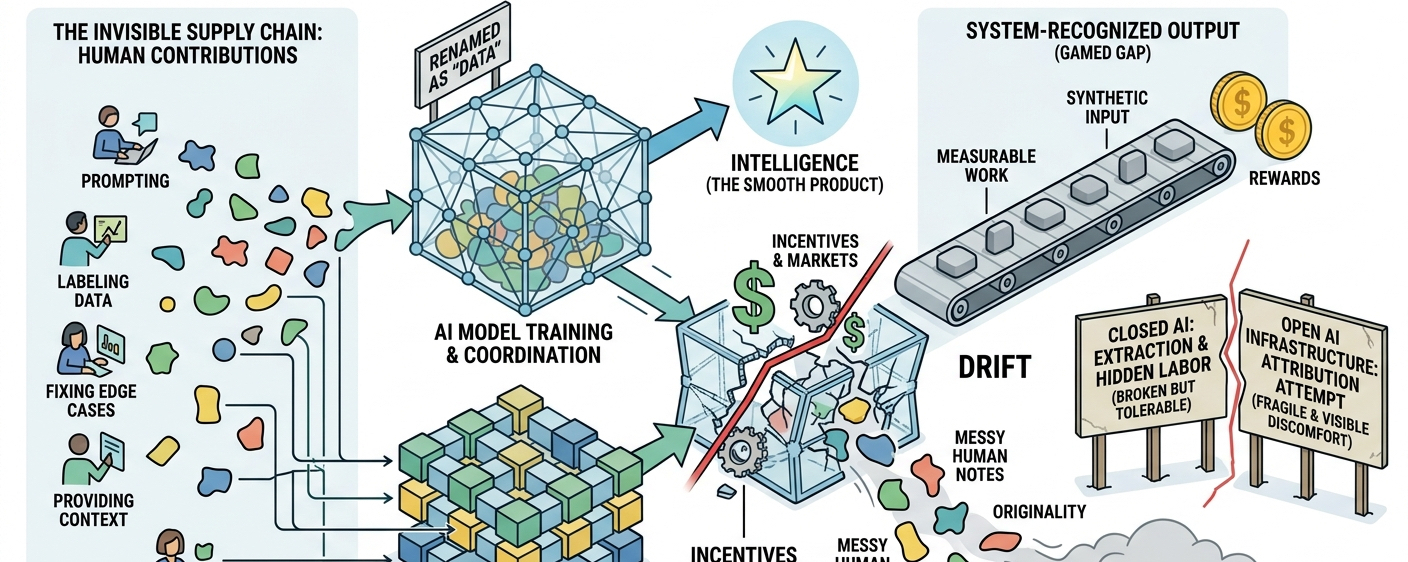
AI systems are already built from human traces. prompts, corrections, labels, examples, feedback, preference signals, domain knowledge, small pieces of judgment. most of it looks almost invisible while it is happening. someone fixes an edge case. someone labels something more carefully. someone provides context the model would never have understood alone.
then the model improves.
then everyone calls it intelligence.
and the human part gets renamed as data.
I keep coming back to attribution.
there is something necessary there, even if I don’t fully trust where it leads. if intelligence has a supply chain, maybe that supply chain should not stay hidden inside closed systems. maybe contributors should not disappear the moment their input becomes economically useful. maybe a system like OpenLedger matters because it tries to make that disappearance harder.
not perfectly.
not cleanly.
but enough to make the discomfort visible.
That’s where my curiosity starts. then the old skepticism comes back almost immediately.
because attribution changes once it becomes financial. before money enters, it sounds fair. remember who helped. trace what mattered. reward useful contribution. make model coordination less opaque.
after money enters, people study the memory layer.
they learn what gets counted. they learn the verifier. they produce toward the scoring system. useful work and measurable work begin to separate, quietly at first, then faster once the rewards are large enough to justify gaming the gap.
It works in theory. Most things do.
The problem isn’t really the technology… or not only the technology. the problem is that human contribution is soft around the edges. context is soft. originality is soft. usefulness can arrive late, after the model changes, after other inputs surround it, after nobody remembers which small correction actually mattered.
a messy human note might be more valuable than a polished dataset.
synthetic input might look cleaner than actual judgment.
copied work might fit the attribution system better than the original thing it copied.
so who gets remembered?
the person who helped, or the person the system could recognize?
That part keeps bothering me more than it should.
and then there is the old Web3 drift. open systems rarely recentralize with some dramatic announcement. they narrow through convenience. through fatigue. through dashboards, indexes, quality scores, operators dispute layers, and all the invisible infrastructure nobody wants to audit forever.
AI infrastructure feels especially fragile there because the invisible layers are the real layers. attribution logic, contribution scoring, filtering, model coordination. those layers decide what counts. and once they decide what counts, they decide who exists economically.
still, I can’t dismiss OpenLedger.
centralized AI has not earned that comfort either. closed datasets, vague ownership, invisible labor, extraction hidden behind smooth products. that version already feels broken, just easier to tolerate because the machinery stays private.
maybe OpenLedger makes the machinery harder to hide.
maybe that matters.
or maybe once incentives get sharp enough, the system built to remember human contribution starts remembering only the parts that fit neatly inside its acounting, while the rest slips back into the model, useful and unnamed.
$OPEN @Openledger #OpenLedger
{spot}(OPENUSDT)
The infrastructure breaks where memory becomes valuable
I didn’t take it seriously at first.
not because OpenLedger sounded empty. more because I’ve watched enough crypto infrastructure cycles to know how quickly serious ideas get flattened into narratives. one month it’s coordination. then ownership. then verification. then “open” everything. and for a while, the language feels clean enough to believe.
then the system meets incentives.
and incentives are never clean.
Maybe that’s too harsh. maybe Im just tired from watching protocols slowly become less about their original problem and more about the markets that formed around them. but that fatigue is hard to switch off, especially with anything sitting between AI, data, ownership, and economic rewards.
because this one is not just abstract.
AI systems are already built from human traces. prompts, corrections, labels, examples, feedback, preference signals, domain knowledge, small pieces of judgment. most of it looks almost invisible while it is happening. someone fixes an edge case. someone labels something more carefully. someone provides context the model would never have understood alone.
then the model improves.
then everyone calls it intelligence.
and the human part gets renamed as data.
I keep coming back to attribution.
there is something necessary there, even if I don’t fully trust where it leads. if intelligence has a supply chain, maybe that supply chain should not stay hidden inside closed systems. maybe contributors should not disappear the moment their input becomes economically useful. maybe a system like OpenLedger matters because it tries to make that disappearance harder.
not perfectly.
not cleanly.
but enough to make the discomfort visible.
That’s where my curiosity starts. then the old skepticism comes back almost immediately.
because attribution changes once it becomes financial. before money enters, it sounds fair. remember who helped. trace what mattered. reward useful contribution. make model coordination less opaque.
after money enters, people study the memory layer.
they learn what gets counted. they learn the verifier. they produce toward the scoring system. useful work and measurable work begin to separate, quietly at first, then faster once the rewards are large enough to justify gaming the gap.
It works in theory. Most things do.
The problem isn’t really the technology… or not only the technology. the problem is that human contribution is soft around the edges. context is soft. originality is soft. usefulness can arrive late, after the model changes, after other inputs surround it, after nobody remembers which small correction actually mattered.
a messy human note might be more valuable than a polished dataset.
synthetic input might look cleaner than actual judgment.
copied work might fit the attribution system better than the original thing it copied.
so who gets remembered?
the person who helped, or the person the system could recognize?
That part keeps bothering me more than it should.
and then there is the old Web3 drift. open systems rarely recentralize with some dramatic announcement. they narrow through convenience. through fatigue. through dashboards, indexes, quality scores, operators dispute layers, and all the invisible infrastructure nobody wants to audit forever.
AI infrastructure feels especially fragile there because the invisible layers are the real layers. attribution logic, contribution scoring, filtering, model coordination. those layers decide what counts. and once they decide what counts, they decide who exists economically.
still, I can’t dismiss OpenLedger.
centralized AI has not earned that comfort either. closed datasets, vague ownership, invisible labor, extraction hidden behind smooth products. that version already feels broken, just easier to tolerate because the machinery stays private.
maybe OpenLedger makes the machinery harder to hide.
maybe that matters.
or maybe once incentives get sharp enough, the system built to remember human contribution starts remembering only the parts that fit neatly inside its acounting, while the rest slips back into the model, useful and unnamed.
$OPEN @OpenLedger #OpenLedger
not because OpenLedger sounded empty. more because I’ve watched enough crypto infrastructure cycles to know how quickly serious ideas get flattened into narratives. one month it’s coordination. then ownership. then verification. then “open” everything. and for a while, the language feels clean enough to believe.
then the system meets incentives.
and incentives are never clean.
Maybe that’s too harsh. maybe Im just tired from watching protocols slowly become less about their original problem and more about the markets that formed around them. but that fatigue is hard to switch off, especially with anything sitting between AI, data, ownership, and economic rewards.
because this one is not just abstract.
AI systems are already built from human traces. prompts, corrections, labels, examples, feedback, preference signals, domain knowledge, small pieces of judgment. most of it looks almost invisible while it is happening. someone fixes an edge case. someone labels something more carefully. someone provides context the model would never have understood alone.
then the model improves.
then everyone calls it intelligence.
and the human part gets renamed as data.
I keep coming back to attribution.
there is something necessary there, even if I don’t fully trust where it leads. if intelligence has a supply chain, maybe that supply chain should not stay hidden inside closed systems. maybe contributors should not disappear the moment their input becomes economically useful. maybe a system like OpenLedger matters because it tries to make that disappearance harder.
not perfectly.
not cleanly.
but enough to make the discomfort visible.
That’s where my curiosity starts. then the old skepticism comes back almost immediately.
because attribution changes once it becomes financial. before money enters, it sounds fair. remember who helped. trace what mattered. reward useful contribution. make model coordination less opaque.
after money enters, people study the memory layer.
they learn what gets counted. they learn the verifier. they produce toward the scoring system. useful work and measurable work begin to separate, quietly at first, then faster once the rewards are large enough to justify gaming the gap.
It works in theory. Most things do.
The problem isn’t really the technology… or not only the technology. the problem is that human contribution is soft around the edges. context is soft. originality is soft. usefulness can arrive late, after the model changes, after other inputs surround it, after nobody remembers which small correction actually mattered.
a messy human note might be more valuable than a polished dataset.
synthetic input might look cleaner than actual judgment.
copied work might fit the attribution system better than the original thing it copied.
so who gets remembered?
the person who helped, or the person the system could recognize?
That part keeps bothering me more than it should.
and then there is the old Web3 drift. open systems rarely recentralize with some dramatic announcement. they narrow through convenience. through fatigue. through dashboards, indexes, quality scores, operators dispute layers, and all the invisible infrastructure nobody wants to audit forever.
AI infrastructure feels especially fragile there because the invisible layers are the real layers. attribution logic, contribution scoring, filtering, model coordination. those layers decide what counts. and once they decide what counts, they decide who exists economically.
still, I can’t dismiss OpenLedger.
centralized AI has not earned that comfort either. closed datasets, vague ownership, invisible labor, extraction hidden behind smooth products. that version already feels broken, just easier to tolerate because the machinery stays private.
maybe OpenLedger makes the machinery harder to hide.
maybe that matters.
or maybe once incentives get sharp enough, the system built to remember human contribution starts remembering only the parts that fit neatly inside its acounting, while the rest slips back into the model, useful and unnamed.
$OPEN @OpenLedger #OpenLedger
2
1
140

·
--

Article
Who Is Actually Getting Paid? A Quiet Look at OpenLedger’s Idea@Openledger .. I’ve seen this before… maybe a few months ago. The chart was just doing its usual thing… up down up down. But my mind got stuck on one strange question.
Who is actually getting paid?
No no seriously… everyone keeps talking about AI data, models, future big vision. Okay, fair enough. Nice words. But if all of this is really working… then who is actually earning the money? I’m looking at it, but the answer doesn’t feel that clear.
Then I saw #OpenLedger and this “attribution” idea. Sounds like a big fancy word… but maybe it’s simple at the core.
You give data… and it doesn’t just disappear inside a machine like a ghost. They’re trying to track where the data came from. If your data helps the model, then maybe… just maybe… you get rewarded. That’s how I understand it… maybe.
And honestly… I find this idea kind of interesting.
Because usually, data contributors are invisible. They clean, write, organize everything… and then boom, the model becomes valuable and everyone forgets who actually did the work.
OpenLedger is basically saying… “wait… maybe we should remember.”
But as a trader… I don’t get impressed by ideas alone. The market doesn’t pay for narratives. The market pays for usage.
So the real questions are:
Are people actually bringing data?
Are they staying?
Are the models actually being used?
Or is everyone just coming, farming rewards, taking selfies, and leaving?
Because that’s what will decide everything.
The $OPEN chart right now doesn’t really look like the market is saying “this is the winner.” More like… “okay… show me first.”
And honestly… that’s fair.
Because attribution sounds nice, but AI systems are messy. Really messy.
How do you measure the impact of one dataset?
Small expert data vs massive public data… which one matters more?
If 10 people submit the same thing… who gets the reward?
That’s where it gets complicated.
Still… I’m watching.
Because if this actually works… if real contributors stay, models improve, and real usage happens… then something interesting could happen here.
But if it turns into another reward-farming cycle…
Then yeah… the market will move on faster than the narrative.
So right now… not super bullish, not super bearish.
Just standing in the corner watching…
“Okay… interesting idea… now show me proof.”
Need more evidence.
Need more users.
And most importantly, need people to stay even after the rewards stop feeling shiny.
Until then… I’m watching. Waiting. Observing.
@Openledger #OpenLedger $OPEN
{future}(OPENUSDT)
Who Is Actually Getting Paid? A Quiet Look at OpenLedger’s Idea
@OpenLedger .. I’ve seen this before… maybe a few months ago. The chart was just doing its usual thing… up down up down. But my mind got stuck on one strange question.
Who is actually getting paid?
No no seriously… everyone keeps talking about AI data, models, future big vision. Okay, fair enough. Nice words. But if all of this is really working… then who is actually earning the money? I’m looking at it, but the answer doesn’t feel that clear.
Then I saw #OpenLedger and this “attribution” idea. Sounds like a big fancy word… but maybe it’s simple at the core.
You give data… and it doesn’t just disappear inside a machine like a ghost. They’re trying to track where the data came from. If your data helps the model, then maybe… just maybe… you get rewarded. That’s how I understand it… maybe.
And honestly… I find this idea kind of interesting.
Because usually, data contributors are invisible. They clean, write, organize everything… and then boom, the model becomes valuable and everyone forgets who actually did the work.
OpenLedger is basically saying… “wait… maybe we should remember.”
But as a trader… I don’t get impressed by ideas alone. The market doesn’t pay for narratives. The market pays for usage.
So the real questions are:
Are people actually bringing data?
Are they staying?
Are the models actually being used?
Or is everyone just coming, farming rewards, taking selfies, and leaving?
Because that’s what will decide everything.
The $OPEN chart right now doesn’t really look like the market is saying “this is the winner.” More like… “okay… show me first.”
And honestly… that’s fair.
Because attribution sounds nice, but AI systems are messy. Really messy.
How do you measure the impact of one dataset?
Small expert data vs massive public data… which one matters more?
If 10 people submit the same thing… who gets the reward?
That’s where it gets complicated.
Still… I’m watching.
Because if this actually works… if real contributors stay, models improve, and real usage happens… then something interesting could happen here.
But if it turns into another reward-farming cycle…
Then yeah… the market will move on faster than the narrative.
So right now… not super bullish, not super bearish.
Just standing in the corner watching…
“Okay… interesting idea… now show me proof.”
Need more evidence.
Need more users.
And most importantly, need people to stay even after the rewards stop feeling shiny.
Until then… I’m watching. Waiting. Observing.
@OpenLedger #OpenLedger $OPEN
Who is actually getting paid?
No no seriously… everyone keeps talking about AI data, models, future big vision. Okay, fair enough. Nice words. But if all of this is really working… then who is actually earning the money? I’m looking at it, but the answer doesn’t feel that clear.
Then I saw #OpenLedger and this “attribution” idea. Sounds like a big fancy word… but maybe it’s simple at the core.
You give data… and it doesn’t just disappear inside a machine like a ghost. They’re trying to track where the data came from. If your data helps the model, then maybe… just maybe… you get rewarded. That’s how I understand it… maybe.
And honestly… I find this idea kind of interesting.
Because usually, data contributors are invisible. They clean, write, organize everything… and then boom, the model becomes valuable and everyone forgets who actually did the work.
OpenLedger is basically saying… “wait… maybe we should remember.”
But as a trader… I don’t get impressed by ideas alone. The market doesn’t pay for narratives. The market pays for usage.
So the real questions are:
Are people actually bringing data?
Are they staying?
Are the models actually being used?
Or is everyone just coming, farming rewards, taking selfies, and leaving?
Because that’s what will decide everything.
The $OPEN chart right now doesn’t really look like the market is saying “this is the winner.” More like… “okay… show me first.”
And honestly… that’s fair.
Because attribution sounds nice, but AI systems are messy. Really messy.
How do you measure the impact of one dataset?
Small expert data vs massive public data… which one matters more?
If 10 people submit the same thing… who gets the reward?
That’s where it gets complicated.
Still… I’m watching.
Because if this actually works… if real contributors stay, models improve, and real usage happens… then something interesting could happen here.
But if it turns into another reward-farming cycle…
Then yeah… the market will move on faster than the narrative.
So right now… not super bullish, not super bearish.
Just standing in the corner watching…
“Okay… interesting idea… now show me proof.”
Need more evidence.
Need more users.
And most importantly, need people to stay even after the rewards stop feeling shiny.
Until then… I’m watching. Waiting. Observing.
@OpenLedger #OpenLedger $OPEN
14
5
299

·
--
#openledger $OPEN @Openledger
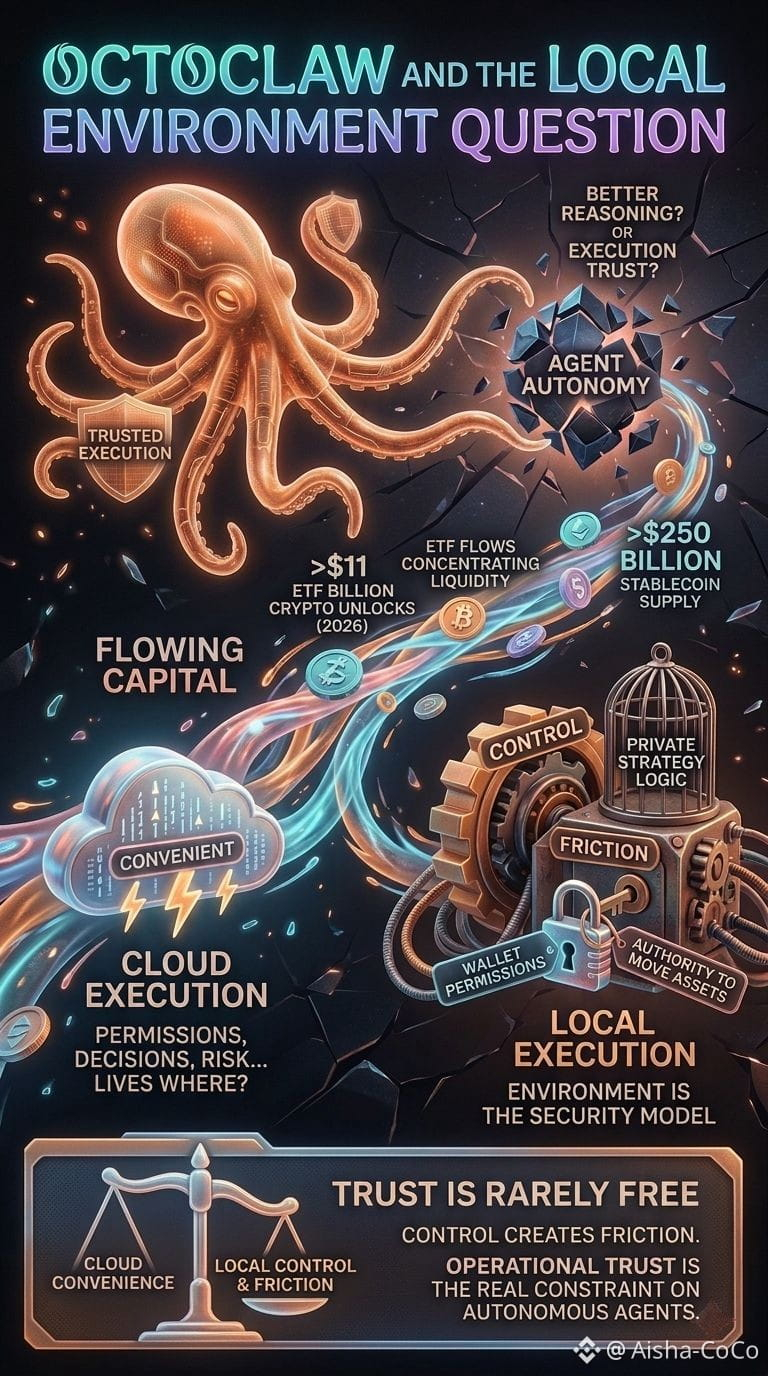
I Myself assuming that better AI agents mostly needed better reasoning. The more I looked at systems like OctoClaw, The less convinced I became.
My view is simple: agent autonomy matters less Than execution trust. On the surface, local operation looks like a privacy feature. Underneath, it changes where decisions, permissions, and risk actually live. If an agent handles walleet permissions meaning the authority to move assets or private straTegy logic, the environment Running those actions becomes part of the security model.
That feels increasingly relevant when over $11 billiion in crypto token unlocks are expected across 2026, ETF flows continue concentrating liquidity, and stablecoin supply has moved above $250 billion. Those numbers point to larger pools of capital and more Automated behavior, not necessarily better judgment.
The trade-off is obvious. Cloud execution is convenient; local execution offers more control. But control creates friction. Opereational trust is rarely free, and that may be the real constraint on autonoMous Agents.
{future}(OPENUSDT)
#openledger $OPEN @OpenLedger
I Myself assuming that better AI agents mostly needed better reasoning. The more I looked at systems like OctoClaw, The less convinced I became.
My view is simple: agent autonomy matters less Than execution trust. On the surface, local operation looks like a privacy feature. Underneath, it changes where decisions, permissions, and risk actually live. If an agent handles walleet permissions meaning the authority to move assets or private straTegy logic, the environment Running those actions becomes part of the security model.
That feels increasingly relevant when over $11 billiion in crypto token unlocks are expected across 2026, ETF flows continue concentrating liquidity, and stablecoin supply has moved above $250 billion. Those numbers point to larger pools of capital and more Automated behavior, not necessarily better judgment.
The trade-off is obvious. Cloud execution is convenient; local execution offers more control. But control creates friction. Opereational trust is rarely free, and that may be the real constraint on autonoMous Agents.
I Myself assuming that better AI agents mostly needed better reasoning. The more I looked at systems like OctoClaw, The less convinced I became.
My view is simple: agent autonomy matters less Than execution trust. On the surface, local operation looks like a privacy feature. Underneath, it changes where decisions, permissions, and risk actually live. If an agent handles walleet permissions meaning the authority to move assets or private straTegy logic, the environment Running those actions becomes part of the security model.
That feels increasingly relevant when over $11 billiion in crypto token unlocks are expected across 2026, ETF flows continue concentrating liquidity, and stablecoin supply has moved above $250 billion. Those numbers point to larger pools of capital and more Automated behavior, not necessarily better judgment.
The trade-off is obvious. Cloud execution is convenient; local execution offers more control. But control creates friction. Opereational trust is rarely free, and that may be the real constraint on autonoMous Agents.

7
8
384

·
--
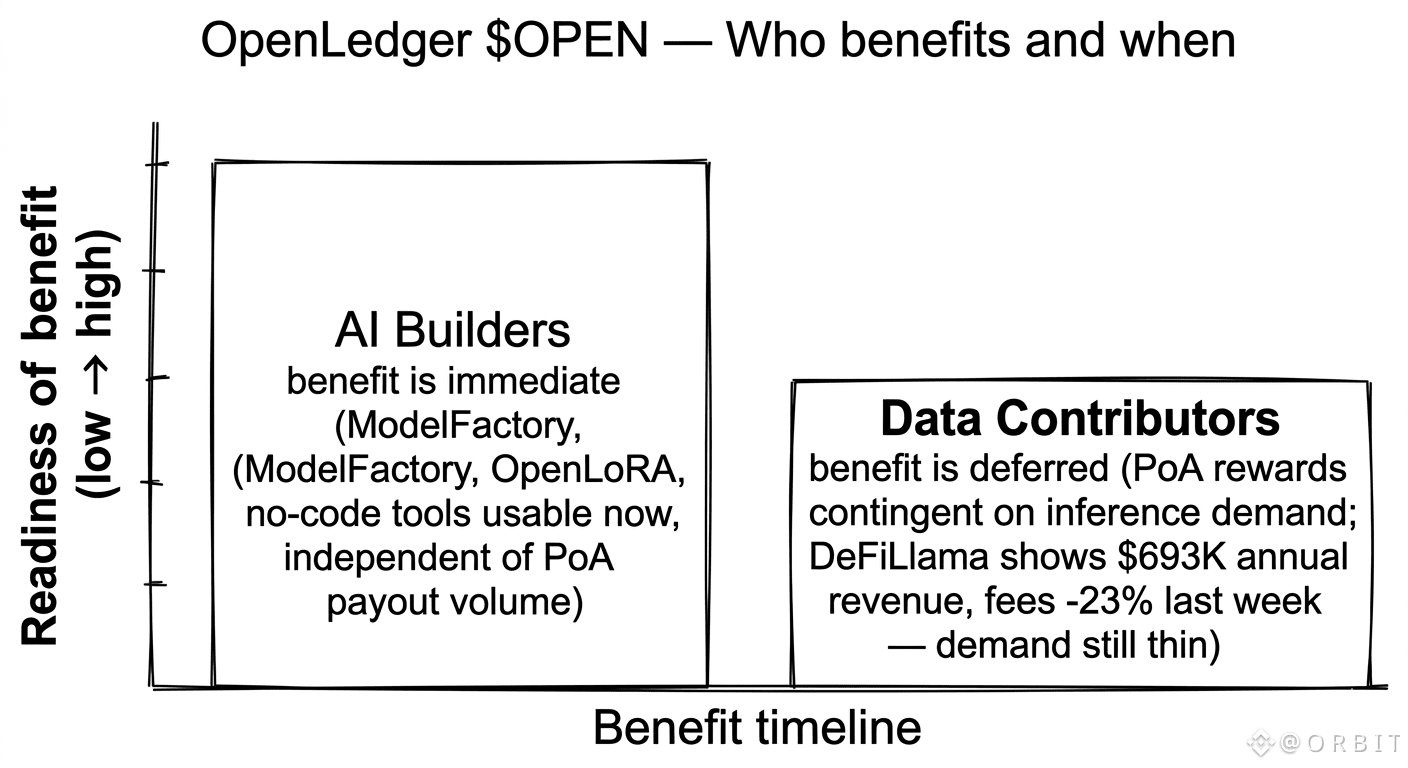
The part that stayed with me from the OpenLedger $OPEN #OpenLedger @Openledger task was how the two beneficiary groups — AI builders and data contributors — are on very different timelines, even though the pitch presents them as arriving together. Builders get immediate utility: ModelFactory works today, no-code fine-tuning works today, OpenLoRA deploys models without heavy infrastructure overhead. That value is front-loaded and doesn't depend on the Proof of Attribution flywheel spinning. Contributors are different. Their rewards only materialize when models built on their Datanets are actually queried at scale — but DeFiLlama shows annual protocol revenue sitting at $693K with fees down 23% in the past week, which suggests inference demand is still light. The design is coherent; the sequencing just matters more than the framing admits. Builders come in, build on the infrastructure, models sit waiting. Contributors have already uploaded, already contributed, already earned their attribution records… and are now waiting on demand that hasn't fully arrived yet. Whether that gap closes depends entirely on whether the builders who showed up actually ship products people use.
The part that stayed with me from the OpenLedger $OPEN #OpenLedger @OpenLedger task was how the two beneficiary groups — AI builders and data contributors — are on very different timelines, even though the pitch presents them as arriving together. Builders get immediate utility: ModelFactory works today, no-code fine-tuning works today, OpenLoRA deploys models without heavy infrastructure overhead. That value is front-loaded and doesn't depend on the Proof of Attribution flywheel spinning. Contributors are different. Their rewards only materialize when models built on their Datanets are actually queried at scale — but DeFiLlama shows annual protocol revenue sitting at $693K with fees down 23% in the past week, which suggests inference demand is still light. The design is coherent; the sequencing just matters more than the framing admits. Builders come in, build on the infrastructure, models sit waiting. Contributors have already uploaded, already contributed, already earned their attribution records… and are now waiting on demand that hasn't fully arrived yet. Whether that gap closes depends entirely on whether the builders who showed up actually ship products people use.
1
340

·
--
Bullish
I’m watching OpenLedger with a calm mind because I’ve seen enough crypto cycles to know that a strong narrative can attract attention very quickly, but attention alone does not make a project important.
OpenLedger sounds interesting because it is trying to deal with a real problem inside AI. Data, models, agents, and human input are creating value everywhere, but the value is not always tracked clearly. Many people contribute to AI systems in different ways, but most of that contribution stays invisible. OpenLedger wants to make those contributions more useful, more traceable, and more monetizable.
That idea makes sense to me.
But I’m not rushing to call it a winner.
The real question is not whether OpenLedger sounds good. The real question is whether people actually need it.
Are developers building on it because it solves a real problem?
Are data contributors bringing valuable data, or are they only chasing rewards?
Are models and agents creating real economic activity, or is most of the activity still driven by hype?
Is OPEN being used because the network needs it, or because traders are following the AI narrative?
These are the questions I care about.
I’ve already seen DeFi, GameFi, metaverse tokens, modular chains, AI coins, and many other narratives come and go. Every cycle brings projects that sound powerful in the beginning. Some become real infrastructure. Most fade when incentives disappear and attention moves somewhere else.
That is why I look at OpenLedger carefully.
The project has potential because AI will need better systems for attribution, data ownership, trust, and coordination. If OpenLedger can help data contributors, model builders, and AI agents work together in a real economy, then it could become more than just another token.
But potential is not proof.
#OpenLedger @Openledger $OPEN
{future}(OPENUSDT)
I’m watching OpenLedger with a calm mind because I’ve seen enough crypto cycles to know that a strong narrative can attract attention very quickly, but attention alone does not make a project important.
OpenLedger sounds interesting because it is trying to deal with a real problem inside AI. Data, models, agents, and human input are creating value everywhere, but the value is not always tracked clearly. Many people contribute to AI systems in different ways, but most of that contribution stays invisible. OpenLedger wants to make those contributions more useful, more traceable, and more monetizable.
That idea makes sense to me.
But I’m not rushing to call it a winner.
The real question is not whether OpenLedger sounds good. The real question is whether people actually need it.
Are developers building on it because it solves a real problem?
Are data contributors bringing valuable data, or are they only chasing rewards?
Are models and agents creating real economic activity, or is most of the activity still driven by hype?
Is OPEN being used because the network needs it, or because traders are following the AI narrative?
These are the questions I care about.
I’ve already seen DeFi, GameFi, metaverse tokens, modular chains, AI coins, and many other narratives come and go. Every cycle brings projects that sound powerful in the beginning. Some become real infrastructure. Most fade when incentives disappear and attention moves somewhere else.
That is why I look at OpenLedger carefully.
The project has potential because AI will need better systems for attribution, data ownership, trust, and coordination. If OpenLedger can help data contributors, model builders, and AI agents work together in a real economy, then it could become more than just another token.
But potential is not proof.
#OpenLedger @OpenLedger $OPEN
OpenLedger sounds interesting because it is trying to deal with a real problem inside AI. Data, models, agents, and human input are creating value everywhere, but the value is not always tracked clearly. Many people contribute to AI systems in different ways, but most of that contribution stays invisible. OpenLedger wants to make those contributions more useful, more traceable, and more monetizable.
That idea makes sense to me.
But I’m not rushing to call it a winner.
The real question is not whether OpenLedger sounds good. The real question is whether people actually need it.
Are developers building on it because it solves a real problem?
Are data contributors bringing valuable data, or are they only chasing rewards?
Are models and agents creating real economic activity, or is most of the activity still driven by hype?
Is OPEN being used because the network needs it, or because traders are following the AI narrative?
These are the questions I care about.
I’ve already seen DeFi, GameFi, metaverse tokens, modular chains, AI coins, and many other narratives come and go. Every cycle brings projects that sound powerful in the beginning. Some become real infrastructure. Most fade when incentives disappear and attention moves somewhere else.
That is why I look at OpenLedger carefully.
The project has potential because AI will need better systems for attribution, data ownership, trust, and coordination. If OpenLedger can help data contributors, model builders, and AI agents work together in a real economy, then it could become more than just another token.
But potential is not proof.
#OpenLedger @OpenLedger $OPEN
1
134


Article
Why OpenLedger ($OPEN) Is Entering One of the Biggest Trends in Crypto and AIYo; Binance Square FanFollow! The crypto market is always looking for the next major narrative. Over the past few years, we have seen DeFi, NFTs, Layer 2 networks, and Real World Assets gain attention. Today, one of the strongest trends is the combination of Artificial Intelligence and blockchain technology.
This is where OpenLedger ($OPEN) becomes interesting.
Many AI systems rely on huge amounts of data, but the people who contribute that data often receive little recognition or reward. OpenLedger is working on a different approach. Its goal is to create an ecosystem where data contributors, developers, and AI builders can all participate in the value they help create.
What makes this idea attractive is its focus on fairness and transparency. Instead of treating data as something that disappears into a black box, OpenLedger aims to track contributions and create a system where value can be shared more openly.
As AI adoption continues to accelerate around the world, the demand for high-quality data and reliable attribution is also increasing. This creates an opportunity for infrastructure projects that can connect AI innovation with blockchain transparency.
For me, the most exciting part is that OpenLedger is not simply following a trend. It is trying to build the foundation that could support future AI economies. In a market where many projects focus on short-term attention, infrastructure-focused projects often create lasting value.
The AI sector is still in its early stages, and no one knows exactly which platforms will become leaders. However, projects that solve real problems tend to attract long-term interest. That is one reason why more people are starting to keep an eye on $OPEN.
The future of AI may not only be about building smarter models. It may also be about creating fair systems where everyone who contributes can benefit from the growth of the ecosystem.
$OPEN @Openledger #OpenLedger
{spot}(OPENUSDT)
Why OpenLedger ($OPEN) Is Entering One of the Biggest Trends in Crypto and AI
Yo; Binance Square FanFollow! The crypto market is always looking for the next major narrative. Over the past few years, we have seen DeFi, NFTs, Layer 2 networks, and Real World Assets gain attention. Today, one of the strongest trends is the combination of Artificial Intelligence and blockchain technology.
This is where OpenLedger ($OPEN ) becomes interesting.
Many AI systems rely on huge amounts of data, but the people who contribute that data often receive little recognition or reward. OpenLedger is working on a different approach. Its goal is to create an ecosystem where data contributors, developers, and AI builders can all participate in the value they help create.
What makes this idea attractive is its focus on fairness and transparency. Instead of treating data as something that disappears into a black box, OpenLedger aims to track contributions and create a system where value can be shared more openly.
As AI adoption continues to accelerate around the world, the demand for high-quality data and reliable attribution is also increasing. This creates an opportunity for infrastructure projects that can connect AI innovation with blockchain transparency.
For me, the most exciting part is that OpenLedger is not simply following a trend. It is trying to build the foundation that could support future AI economies. In a market where many projects focus on short-term attention, infrastructure-focused projects often create lasting value.
The AI sector is still in its early stages, and no one knows exactly which platforms will become leaders. However, projects that solve real problems tend to attract long-term interest. That is one reason why more people are starting to keep an eye on $OPEN .
The future of AI may not only be about building smarter models. It may also be about creating fair systems where everyone who contributes can benefit from the growth of the ecosystem.
$OPEN @OpenLedger #OpenLedger
This is where OpenLedger ($OPEN ) becomes interesting.
Many AI systems rely on huge amounts of data, but the people who contribute that data often receive little recognition or reward. OpenLedger is working on a different approach. Its goal is to create an ecosystem where data contributors, developers, and AI builders can all participate in the value they help create.
What makes this idea attractive is its focus on fairness and transparency. Instead of treating data as something that disappears into a black box, OpenLedger aims to track contributions and create a system where value can be shared more openly.
As AI adoption continues to accelerate around the world, the demand for high-quality data and reliable attribution is also increasing. This creates an opportunity for infrastructure projects that can connect AI innovation with blockchain transparency.
For me, the most exciting part is that OpenLedger is not simply following a trend. It is trying to build the foundation that could support future AI economies. In a market where many projects focus on short-term attention, infrastructure-focused projects often create lasting value.
The AI sector is still in its early stages, and no one knows exactly which platforms will become leaders. However, projects that solve real problems tend to attract long-term interest. That is one reason why more people are starting to keep an eye on $OPEN .
The future of AI may not only be about building smarter models. It may also be about creating fair systems where everyone who contributes can benefit from the growth of the ecosystem.
$OPEN @OpenLedger #OpenLedger
99

Why OpenLedger Could Play an Important Role in Decentralized AI
Artificial Intelligence is becoming one of the most influential technologies of our time. However, many AI systems rely on centralized data sources and infrastructure, which can create limitations in transparency, ownership, and accessibility. OpenLedger is working to address these challenges through a decentralized approach.
OpenLedger aims to build an ecosystem where data contributors, developers, and users can participate in the growth of AI networks while maintaining transparency through blockchain technology. This model encourages collaboration and rewards participants for providing valuable resources and data.
The $OPEN token serves as an important component of the ecosystem, helping facilitate incentives, network participation, and community engagement. As decentralized AI continues to gain attention, projects like OpenLedger may help create a more open and fair environment for innovation.
The combination of blockchain technology and AI has the potential to unlock new opportunities across industries. OpenLedger's vision of decentralized data contribution and AI development is a concept worth watching as the ecosystem evolves.
Follow @OpenLedger to stay updated on the latest announcements, partnerships, and ecosystem developments.
$OPEN #OpenLedger
Why OpenLedger Could Play an Important Role in Decentralized AI
Artificial Intelligence is becoming one of the most influential technologies of our time. However, many AI systems rely on centralized data sources and infrastructure, which can create limitations in transparency, ownership, and accessibility. OpenLedger is working to address these challenges through a decentralized approach.
OpenLedger aims to build an ecosystem where data contributors, developers, and users can participate in the growth of AI networks while maintaining transparency through blockchain technology. This model encourages collaboration and rewards participants for providing valuable resources and data.
The $OPEN token serves as an important component of the ecosystem, helping facilitate incentives, network participation, and community engagement. As decentralized AI continues to gain attention, projects like OpenLedger may help create a more open and fair environment for innovation.
The combination of blockchain technology and AI has the potential to unlock new opportunities across industries. OpenLedger's vision of decentralized data contribution and AI development is a concept worth watching as the ecosystem evolves.
Follow @OpenLedger to stay updated on the latest announcements, partnerships, and ecosystem developments.
$OPEN #OpenLedger
Artificial Intelligence is becoming one of the most influential technologies of our time. However, many AI systems rely on centralized data sources and infrastructure, which can create limitations in transparency, ownership, and accessibility. OpenLedger is working to address these challenges through a decentralized approach.
OpenLedger aims to build an ecosystem where data contributors, developers, and users can participate in the growth of AI networks while maintaining transparency through blockchain technology. This model encourages collaboration and rewards participants for providing valuable resources and data.
The $OPEN token serves as an important component of the ecosystem, helping facilitate incentives, network participation, and community engagement. As decentralized AI continues to gain attention, projects like OpenLedger may help create a more open and fair environment for innovation.
The combination of blockchain technology and AI has the potential to unlock new opportunities across industries. OpenLedger's vision of decentralized data contribution and AI development is a concept worth watching as the ecosystem evolves.
Follow @OpenLedger to stay updated on the latest announcements, partnerships, and ecosystem developments.
$OPEN #OpenLedger
155

Article
Who Will Own the Future of AI?$OPEN
Artificial intelligence is rapidly becoming one of the most influential technologies of our time. Every day, AI is helping businesses automate processes, improving decision-making, generating content, and transforming entire industries. While the world continues to focus on faster models and smarter systems, an equally important question is beginning to emerge:
Who will own the value created by AI?
This question is becoming increasingly relevant because AI does not exist in isolation. Every intelligent system depends on data, contributors, developers, and communities. Without these elements, even the most advanced AI models would have little practical value. Yet in many cases, the benefits generated by AI are not distributed evenly among the people who help create that value.
As the technology matures, the conversation is gradually shifting away from pure innovation and toward transparency, ownership, and participation. The future of AI may not be defined solely by how intelligent machines become, but by how fairly ecosystems reward those who contribute to their growth.
This is where projects like OpenLedger enter the discussion.
OpenLedger is exploring an idea that many believe could become increasingly important in the coming years: creating a more open relationship between artificial intelligence, data, and blockchain technology. Rather than concentrating solely on technological advancement, the project appears focused on building infrastructure that encourages transparency and collaboration within the AI economy.
One of the biggest challenges facing modern AI systems is the question of data ownership. Data has become one of the most valuable resources in the digital world. Every search, interaction, transaction, and contribution generates information that can be used to improve intelligent systems. However, the individuals responsible for generating this data often have limited visibility into how it is utilized or how value is created from it.
As awareness around this issue grows, demand for more transparent systems is likely to increase. People want greater control over their digital contributions. They want accountability, fairness, and clarity regarding how information is collected, shared, and rewarded.
Blockchain technology offers potential solutions to many of these challenges. By introducing transparency, verifiable records, and decentralized participation, blockchain can create environments where trust does not rely entirely on centralized organizations. When combined with artificial intelligence, this approach may open new possibilities for collaboration and innovation.
The intersection of blockchain and AI is particularly exciting because both technologies complement each other in meaningful ways. AI excels at processing information and generating insights, while blockchain provides transparency, security, and traceability. Together, they have the potential to create systems that are not only intelligent but also accountable.
However, technology alone is never enough.
History shows that successful ecosystems are built by communities. Behind every major technological breakthrough is a network of developers, contributors, educators, supporters, and users who help transform ideas into practical solutions. Community participation often determines whether a project can sustain momentum beyond its initial launch.
This is why ecosystem development remains one of the most important indicators of long-term potential. Projects that continue attracting builders and contributors often demonstrate stronger resilience during periods of market uncertainty. While trends may come and go, active communities frequently become the foundation that supports future growth.
Another important factor is consistency. The cryptocurrency industry has witnessed countless projects rise quickly on excitement and speculation. Many attract attention during favorable market conditions, only to disappear when enthusiasm fades. Sustainable growth usually follows a different path.
Projects that focus on continuous improvement, ecosystem expansion, and real-world utility often have a greater chance of remaining relevant over time. Progress may be slower, but the foundations tend to be stronger. Long-term success is rarely built overnight.
OpenLedger appears to be positioning itself within this long-term perspective. Its focus on decentralized AI infrastructure, transparency, and participation aligns with several major trends currently shaping the technology sector. As AI adoption continues to accelerate globally, the demand for trustworthy and collaborative ecosystems may become increasingly important.
Of course, every emerging project faces challenges. Execution, adoption, competition, and technological development all influence future outcomes. No project is guaranteed success, and investors should always conduct their own research before making decisions.
Nevertheless, the broader vision behind OpenLedger reflects an important shift taking place across the digital economy. The conversation is evolving from simply building smarter systems to creating fairer and more transparent ecosystems.
The next chapter of artificial intelligence may not belong exclusively to the companies with the largest models or the most computing power. It may belong to the ecosystems that successfully combine innovation with transparency, ownership, and community participation.
As blockchain and AI continue moving closer together, projects exploring this intersection could play a meaningful role in shaping the future. OpenLedger is one of those projects, making it a platform worth watching as the next generation of technology continues to unfold.
What are your thoughts on the future of decentralized AI and the role OpenLedger could play in this evolving landscape?
$OPEN
#OpenLedger
@Openledger
Who Will Own the Future of AI?
$OPEN
Artificial intelligence is rapidly becoming one of the most influential technologies of our time. Every day, AI is helping businesses automate processes, improving decision-making, generating content, and transforming entire industries. While the world continues to focus on faster models and smarter systems, an equally important question is beginning to emerge:
Who will own the value created by AI?
This question is becoming increasingly relevant because AI does not exist in isolation. Every intelligent system depends on data, contributors, developers, and communities. Without these elements, even the most advanced AI models would have little practical value. Yet in many cases, the benefits generated by AI are not distributed evenly among the people who help create that value.
As the technology matures, the conversation is gradually shifting away from pure innovation and toward transparency, ownership, and participation. The future of AI may not be defined solely by how intelligent machines become, but by how fairly ecosystems reward those who contribute to their growth.
This is where projects like OpenLedger enter the discussion.
OpenLedger is exploring an idea that many believe could become increasingly important in the coming years: creating a more open relationship between artificial intelligence, data, and blockchain technology. Rather than concentrating solely on technological advancement, the project appears focused on building infrastructure that encourages transparency and collaboration within the AI economy.
One of the biggest challenges facing modern AI systems is the question of data ownership. Data has become one of the most valuable resources in the digital world. Every search, interaction, transaction, and contribution generates information that can be used to improve intelligent systems. However, the individuals responsible for generating this data often have limited visibility into how it is utilized or how value is created from it.
As awareness around this issue grows, demand for more transparent systems is likely to increase. People want greater control over their digital contributions. They want accountability, fairness, and clarity regarding how information is collected, shared, and rewarded.
Blockchain technology offers potential solutions to many of these challenges. By introducing transparency, verifiable records, and decentralized participation, blockchain can create environments where trust does not rely entirely on centralized organizations. When combined with artificial intelligence, this approach may open new possibilities for collaboration and innovation.
The intersection of blockchain and AI is particularly exciting because both technologies complement each other in meaningful ways. AI excels at processing information and generating insights, while blockchain provides transparency, security, and traceability. Together, they have the potential to create systems that are not only intelligent but also accountable.
However, technology alone is never enough.
History shows that successful ecosystems are built by communities. Behind every major technological breakthrough is a network of developers, contributors, educators, supporters, and users who help transform ideas into practical solutions. Community participation often determines whether a project can sustain momentum beyond its initial launch.
This is why ecosystem development remains one of the most important indicators of long-term potential. Projects that continue attracting builders and contributors often demonstrate stronger resilience during periods of market uncertainty. While trends may come and go, active communities frequently become the foundation that supports future growth.
Another important factor is consistency. The cryptocurrency industry has witnessed countless projects rise quickly on excitement and speculation. Many attract attention during favorable market conditions, only to disappear when enthusiasm fades. Sustainable growth usually follows a different path.
Projects that focus on continuous improvement, ecosystem expansion, and real-world utility often have a greater chance of remaining relevant over time. Progress may be slower, but the foundations tend to be stronger. Long-term success is rarely built overnight.
OpenLedger appears to be positioning itself within this long-term perspective. Its focus on decentralized AI infrastructure, transparency, and participation aligns with several major trends currently shaping the technology sector. As AI adoption continues to accelerate globally, the demand for trustworthy and collaborative ecosystems may become increasingly important.
Of course, every emerging project faces challenges. Execution, adoption, competition, and technological development all influence future outcomes. No project is guaranteed success, and investors should always conduct their own research before making decisions.
Nevertheless, the broader vision behind OpenLedger reflects an important shift taking place across the digital economy. The conversation is evolving from simply building smarter systems to creating fairer and more transparent ecosystems.
The next chapter of artificial intelligence may not belong exclusively to the companies with the largest models or the most computing power. It may belong to the ecosystems that successfully combine innovation with transparency, ownership, and community participation.
As blockchain and AI continue moving closer together, projects exploring this intersection could play a meaningful role in shaping the future. OpenLedger is one of those projects, making it a platform worth watching as the next generation of technology continues to unfold.
What are your thoughts on the future of decentralized AI and the role OpenLedger could play in this evolving landscape?
$OPEN
#OpenLedger
@Openledger
Artificial intelligence is rapidly becoming one of the most influential technologies of our time. Every day, AI is helping businesses automate processes, improving decision-making, generating content, and transforming entire industries. While the world continues to focus on faster models and smarter systems, an equally important question is beginning to emerge:
Who will own the value created by AI?
This question is becoming increasingly relevant because AI does not exist in isolation. Every intelligent system depends on data, contributors, developers, and communities. Without these elements, even the most advanced AI models would have little practical value. Yet in many cases, the benefits generated by AI are not distributed evenly among the people who help create that value.
As the technology matures, the conversation is gradually shifting away from pure innovation and toward transparency, ownership, and participation. The future of AI may not be defined solely by how intelligent machines become, but by how fairly ecosystems reward those who contribute to their growth.
This is where projects like OpenLedger enter the discussion.
OpenLedger is exploring an idea that many believe could become increasingly important in the coming years: creating a more open relationship between artificial intelligence, data, and blockchain technology. Rather than concentrating solely on technological advancement, the project appears focused on building infrastructure that encourages transparency and collaboration within the AI economy.
One of the biggest challenges facing modern AI systems is the question of data ownership. Data has become one of the most valuable resources in the digital world. Every search, interaction, transaction, and contribution generates information that can be used to improve intelligent systems. However, the individuals responsible for generating this data often have limited visibility into how it is utilized or how value is created from it.
As awareness around this issue grows, demand for more transparent systems is likely to increase. People want greater control over their digital contributions. They want accountability, fairness, and clarity regarding how information is collected, shared, and rewarded.
Blockchain technology offers potential solutions to many of these challenges. By introducing transparency, verifiable records, and decentralized participation, blockchain can create environments where trust does not rely entirely on centralized organizations. When combined with artificial intelligence, this approach may open new possibilities for collaboration and innovation.
The intersection of blockchain and AI is particularly exciting because both technologies complement each other in meaningful ways. AI excels at processing information and generating insights, while blockchain provides transparency, security, and traceability. Together, they have the potential to create systems that are not only intelligent but also accountable.
However, technology alone is never enough.
History shows that successful ecosystems are built by communities. Behind every major technological breakthrough is a network of developers, contributors, educators, supporters, and users who help transform ideas into practical solutions. Community participation often determines whether a project can sustain momentum beyond its initial launch.
This is why ecosystem development remains one of the most important indicators of long-term potential. Projects that continue attracting builders and contributors often demonstrate stronger resilience during periods of market uncertainty. While trends may come and go, active communities frequently become the foundation that supports future growth.
Another important factor is consistency. The cryptocurrency industry has witnessed countless projects rise quickly on excitement and speculation. Many attract attention during favorable market conditions, only to disappear when enthusiasm fades. Sustainable growth usually follows a different path.
Projects that focus on continuous improvement, ecosystem expansion, and real-world utility often have a greater chance of remaining relevant over time. Progress may be slower, but the foundations tend to be stronger. Long-term success is rarely built overnight.
OpenLedger appears to be positioning itself within this long-term perspective. Its focus on decentralized AI infrastructure, transparency, and participation aligns with several major trends currently shaping the technology sector. As AI adoption continues to accelerate globally, the demand for trustworthy and collaborative ecosystems may become increasingly important.
Of course, every emerging project faces challenges. Execution, adoption, competition, and technological development all influence future outcomes. No project is guaranteed success, and investors should always conduct their own research before making decisions.
Nevertheless, the broader vision behind OpenLedger reflects an important shift taking place across the digital economy. The conversation is evolving from simply building smarter systems to creating fairer and more transparent ecosystems.
The next chapter of artificial intelligence may not belong exclusively to the companies with the largest models or the most computing power. It may belong to the ecosystems that successfully combine innovation with transparency, ownership, and community participation.
As blockchain and AI continue moving closer together, projects exploring this intersection could play a meaningful role in shaping the future. OpenLedger is one of those projects, making it a platform worth watching as the next generation of technology continues to unfold.
What are your thoughts on the future of decentralized AI and the role OpenLedger could play in this evolving landscape?
$OPEN
#OpenLedger
@Openledger
4
4
132

·
--
#openledger $OPEN @Openledger
One afternoon, I was testing OctoClaw and had it execute a series of tasks related to DeFi research. Everything was running pretty smoothly until the seventh step in the workflow. The agent came to a wrong conclusion about the liquidity pool of a protocol I was tracking. Not just a minor mistake. We're talking the kind of error where if I had trusted it and placed a real order, I would have lost real money.
And I sat there asking a question that I think few people stop to consider: who takes responsibility for that mistake?
With ChatGPT or Claude, the answer is simple: "AI disclaimer, use at your own risk." But with OctoClaw on OpenLedger, there's something different. Every action of the agent is recorded on-chain. The execution trace is immutable. If the agent is wrong, the evidence of that mistake exists forever and is verifiable by anyone. It was the first time I saw AI accountability transform from an abstract concept into a technical guarantee.
That mistake from OctoClaw made me trust OpenLedger more than anything else. Because I could pinpoint exactly where it went wrong, why, and had enough context to decide whether to trust the agent next time. That's something no other AI agent has offered me.
Have you ever let an AI agent take real action with real money, and what made you trust enough to do that?
#openledger $OPEN @OpenLedger
One afternoon, I was testing OctoClaw and had it execute a series of tasks related to DeFi research. Everything was running pretty smoothly until the seventh step in the workflow. The agent came to a wrong conclusion about the liquidity pool of a protocol I was tracking. Not just a minor mistake. We're talking the kind of error where if I had trusted it and placed a real order, I would have lost real money.
And I sat there asking a question that I think few people stop to consider: who takes responsibility for that mistake?
With ChatGPT or Claude, the answer is simple: "AI disclaimer, use at your own risk." But with OctoClaw on OpenLedger, there's something different. Every action of the agent is recorded on-chain. The execution trace is immutable. If the agent is wrong, the evidence of that mistake exists forever and is verifiable by anyone. It was the first time I saw AI accountability transform from an abstract concept into a technical guarantee.
That mistake from OctoClaw made me trust OpenLedger more than anything else. Because I could pinpoint exactly where it went wrong, why, and had enough context to decide whether to trust the agent next time. That's something no other AI agent has offered me.
Have you ever let an AI agent take real action with real money, and what made you trust enough to do that?
One afternoon, I was testing OctoClaw and had it execute a series of tasks related to DeFi research. Everything was running pretty smoothly until the seventh step in the workflow. The agent came to a wrong conclusion about the liquidity pool of a protocol I was tracking. Not just a minor mistake. We're talking the kind of error where if I had trusted it and placed a real order, I would have lost real money.
And I sat there asking a question that I think few people stop to consider: who takes responsibility for that mistake?
With ChatGPT or Claude, the answer is simple: "AI disclaimer, use at your own risk." But with OctoClaw on OpenLedger, there's something different. Every action of the agent is recorded on-chain. The execution trace is immutable. If the agent is wrong, the evidence of that mistake exists forever and is verifiable by anyone. It was the first time I saw AI accountability transform from an abstract concept into a technical guarantee.
That mistake from OctoClaw made me trust OpenLedger more than anything else. Because I could pinpoint exactly where it went wrong, why, and had enough context to decide whether to trust the agent next time. That's something no other AI agent has offered me.
Have you ever let an AI agent take real action with real money, and what made you trust enough to do that?
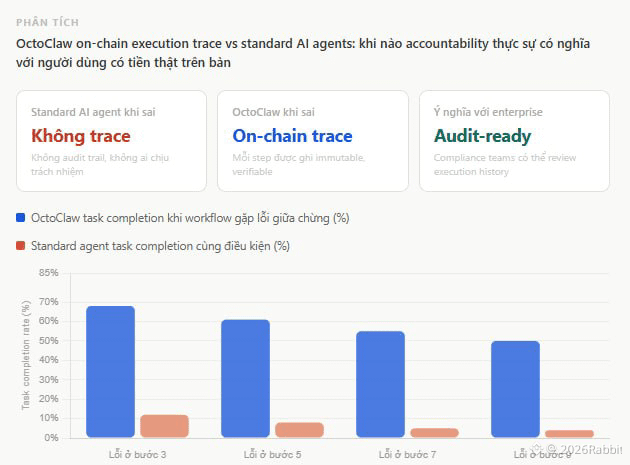
192

·
--
I've been spending the last couple of days just hanging out in the governance section of OpenLedger, watching those big whales cast their votes. The more I see, the more I think this so-called decentralized governance is a polished joke. On the surface, everyone can propose and vote, sounds super democratic, but if you dig into the distribution of voting power, you'll realize that the small fry's votes are barely enough to tickle the big players. $LAB
I've followed a few rounds of proposals, and the patterns are crystal clear. The so-called dynamic weight adjustments, today they're suddenly skewing rewards towards text data to cozy up to a big model team; tomorrow, the wind shifts again, and they're subsidizing video rendering. They market these adjustments as optimizing the ecosystem and responding to demand, but the decision-makers are still those few early addresses holding massive chips. Retail investors in this system aren't co-builders; they're more like cheap voting tools manipulated by algorithms and capital, with proposals already predetermined, and voting is just a formality for show.
What’s even sneakier is the kind of traffic manipulation that feels like coercion. The tokens released each month are entirely determined by the real lockup amounts and call frequencies of various vertical networks, forcing subnet teams to use real operational data to fight for funds. It sounds fair, but if you break it down, once the early bonus phase is depleted, those whales holding massive chips will definitely form private alliances, creating a few shell networks to play hot potato, wildly extracting inflation rewards and draining the retail investors' profit pools. What’s left to balance this capital collusion is a deadlock that teams can't escape. $BTC
I’m not saying this project isn’t viable; they have the guts to write the distribution logic directly into the code and not rely on human governance, which is indeed rare in the space. But the centralization risks in governance are very real. Until the issue of whale alliances is resolved, retail investors better recognize their position at the table and not delude themselves into thinking they can change the rules as shareholders. #OpenLedger $OPEN @Openledger
I've been spending the last couple of days just hanging out in the governance section of OpenLedger, watching those big whales cast their votes. The more I see, the more I think this so-called decentralized governance is a polished joke. On the surface, everyone can propose and vote, sounds super democratic, but if you dig into the distribution of voting power, you'll realize that the small fry's votes are barely enough to tickle the big players. $LAB
I've followed a few rounds of proposals, and the patterns are crystal clear. The so-called dynamic weight adjustments, today they're suddenly skewing rewards towards text data to cozy up to a big model team; tomorrow, the wind shifts again, and they're subsidizing video rendering. They market these adjustments as optimizing the ecosystem and responding to demand, but the decision-makers are still those few early addresses holding massive chips. Retail investors in this system aren't co-builders; they're more like cheap voting tools manipulated by algorithms and capital, with proposals already predetermined, and voting is just a formality for show.
What’s even sneakier is the kind of traffic manipulation that feels like coercion. The tokens released each month are entirely determined by the real lockup amounts and call frequencies of various vertical networks, forcing subnet teams to use real operational data to fight for funds. It sounds fair, but if you break it down, once the early bonus phase is depleted, those whales holding massive chips will definitely form private alliances, creating a few shell networks to play hot potato, wildly extracting inflation rewards and draining the retail investors' profit pools. What’s left to balance this capital collusion is a deadlock that teams can't escape. $BTC
I’m not saying this project isn’t viable; they have the guts to write the distribution logic directly into the code and not rely on human governance, which is indeed rare in the space. But the centralization risks in governance are very real. Until the issue of whale alliances is resolved, retail investors better recognize their position at the table and not delude themselves into thinking they can change the rules as shareholders. #OpenLedger $OPEN @OpenLedger
I've followed a few rounds of proposals, and the patterns are crystal clear. The so-called dynamic weight adjustments, today they're suddenly skewing rewards towards text data to cozy up to a big model team; tomorrow, the wind shifts again, and they're subsidizing video rendering. They market these adjustments as optimizing the ecosystem and responding to demand, but the decision-makers are still those few early addresses holding massive chips. Retail investors in this system aren't co-builders; they're more like cheap voting tools manipulated by algorithms and capital, with proposals already predetermined, and voting is just a formality for show.
What’s even sneakier is the kind of traffic manipulation that feels like coercion. The tokens released each month are entirely determined by the real lockup amounts and call frequencies of various vertical networks, forcing subnet teams to use real operational data to fight for funds. It sounds fair, but if you break it down, once the early bonus phase is depleted, those whales holding massive chips will definitely form private alliances, creating a few shell networks to play hot potato, wildly extracting inflation rewards and draining the retail investors' profit pools. What’s left to balance this capital collusion is a deadlock that teams can't escape. $BTC
I’m not saying this project isn’t viable; they have the guts to write the distribution logic directly into the code and not rely on human governance, which is indeed rare in the space. But the centralization risks in governance are very real. Until the issue of whale alliances is resolved, retail investors better recognize their position at the table and not delude themselves into thinking they can change the rules as shareholders. #OpenLedger $OPEN @OpenLedger
散户投票权重有多惨
33%
动态权重调整谁说了算
67%
3 votes • Voting closed
2
1
539

·
--
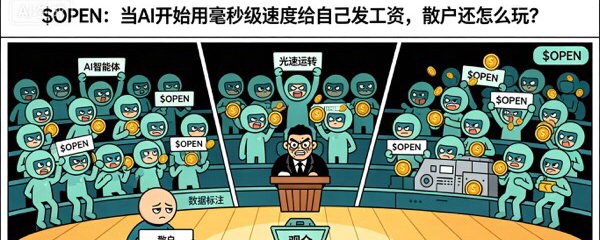
Article
$OPEN: When AI starts paying itself in milliseconds, how can retail traders keep playing?To be honest, when I first stumbled upon OpenLedger, I almost swiped away. Another one of those "upload data, pay per use" old tricks? But after trying it out, it actually sends $OPEN automatically every time it's called, like a supplier who’s been ignored suddenly getting a paycheck. For those creators who’ve been getting ragged on by big companies for years, this really hits home.
But I calmed down and the more I thought about it, the more it didn’t sit right.
Proof of attribution sounds great, but in practice, it’s a total black box. With models having billions of parameters, how can you accurately determine what portion of my labeled data contributed? The white paper provides a solution for crypto economics but doesn’t address my biggest fear: what if someone repackages the same data repeatedly to farm weights, or the algorithm misattributes credit? How does this trust system hold up? I triple-check the address whenever I make a transfer; I can’t just ignore that kind of risk.
$OPEN: When AI starts paying itself in milliseconds, how can retail traders keep playing?
To be honest, when I first stumbled upon OpenLedger, I almost swiped away. Another one of those "upload data, pay per use" old tricks? But after trying it out, it actually sends $OPEN automatically every time it's called, like a supplier who’s been ignored suddenly getting a paycheck. For those creators who’ve been getting ragged on by big companies for years, this really hits home.
But I calmed down and the more I thought about it, the more it didn’t sit right.
Proof of attribution sounds great, but in practice, it’s a total black box. With models having billions of parameters, how can you accurately determine what portion of my labeled data contributed? The white paper provides a solution for crypto economics but doesn’t address my biggest fear: what if someone repackages the same data repeatedly to farm weights, or the algorithm misattributes credit? How does this trust system hold up? I triple-check the address whenever I make a transfer; I can’t just ignore that kind of risk.
But I calmed down and the more I thought about it, the more it didn’t sit right.
Proof of attribution sounds great, but in practice, it’s a total black box. With models having billions of parameters, how can you accurately determine what portion of my labeled data contributed? The white paper provides a solution for crypto economics but doesn’t address my biggest fear: what if someone repackages the same data repeatedly to farm weights, or the algorithm misattributes credit? How does this trust system hold up? I triple-check the address whenever I make a transfer; I can’t just ignore that kind of risk.
1
146


The hidden mess I see in OpenLedger is the model name that stays clean while the checkpoint underneath changes.
A builder can train through Model Factory, test the output, connect it to an app, and call the model by the same saved name. Everything looks usable. The answer comes back. The integration does not break.
Then the hard part starts after the model already works.
Which exact checkpoint answered the user?
Not the model name. Not the workspace label. The checkpoint. If a newer run replaces the tested one behind the same endpoint, the builder may be looking at yesterday’s approval while today’s response came from a different model state.
The proof needs to stay close to the call. tested_checkpoint, deployed_checkpoint, endpoint_alias, response_hash. Without that, the app can behave normally while the audit trail is already split.
The visible consequence lands on the builder. They can approve one model, ship another by accident, then have no clean way to explain why a live answer changed after deployment.
That is where OPEN has pressure on it. Value should not attach to a friendly model label. It should attach to the checkpoint that actually served the response.
A saved model name is convenient. If it hides the checkpoint, it becomes the place a builder loses control. #OpenLedger $OPEN @Openledger $XEC $BOB
The hidden mess I see in OpenLedger is the model name that stays clean while the checkpoint underneath changes.
A builder can train through Model Factory, test the output, connect it to an app, and call the model by the same saved name. Everything looks usable. The answer comes back. The integration does not break.
Then the hard part starts after the model already works.
Which exact checkpoint answered the user?
Not the model name. Not the workspace label. The checkpoint. If a newer run replaces the tested one behind the same endpoint, the builder may be looking at yesterday’s approval while today’s response came from a different model state.
The proof needs to stay close to the call. tested_checkpoint, deployed_checkpoint, endpoint_alias, response_hash. Without that, the app can behave normally while the audit trail is already split.
The visible consequence lands on the builder. They can approve one model, ship another by accident, then have no clean way to explain why a live answer changed after deployment.
That is where OPEN has pressure on it. Value should not attach to a friendly model label. It should attach to the checkpoint that actually served the response.
A saved model name is convenient. If it hides the checkpoint, it becomes the place a builder loses control. #OpenLedger $OPEN @OpenLedger $XEC $BOB
A builder can train through Model Factory, test the output, connect it to an app, and call the model by the same saved name. Everything looks usable. The answer comes back. The integration does not break.
Then the hard part starts after the model already works.
Which exact checkpoint answered the user?
Not the model name. Not the workspace label. The checkpoint. If a newer run replaces the tested one behind the same endpoint, the builder may be looking at yesterday’s approval while today’s response came from a different model state.
The proof needs to stay close to the call. tested_checkpoint, deployed_checkpoint, endpoint_alias, response_hash. Without that, the app can behave normally while the audit trail is already split.
The visible consequence lands on the builder. They can approve one model, ship another by accident, then have no clean way to explain why a live answer changed after deployment.
That is where OPEN has pressure on it. Value should not attach to a friendly model label. It should attach to the checkpoint that actually served the response.
A saved model name is convenient. If it hides the checkpoint, it becomes the place a builder loses control. #OpenLedger $OPEN @OpenLedger $XEC $BOB
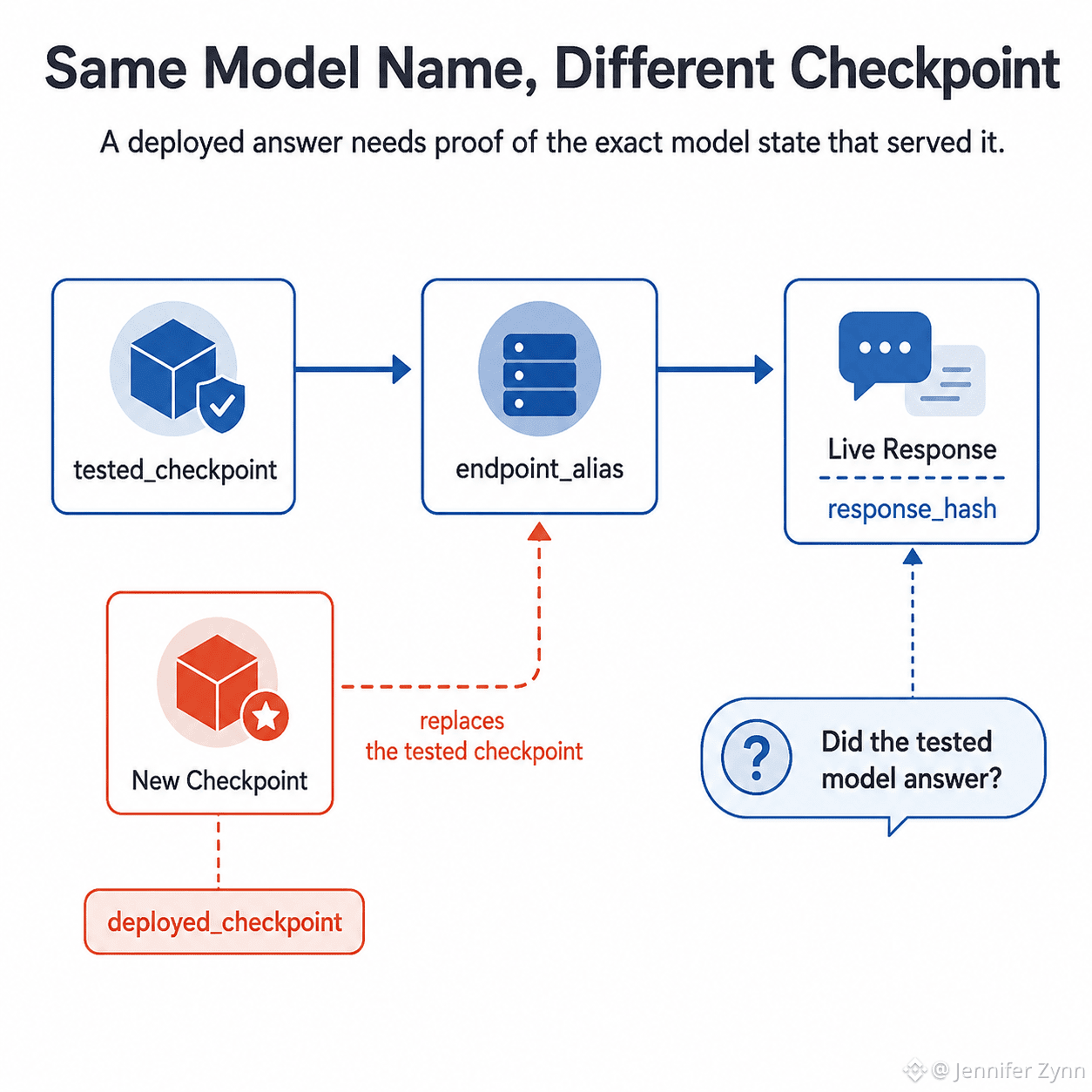
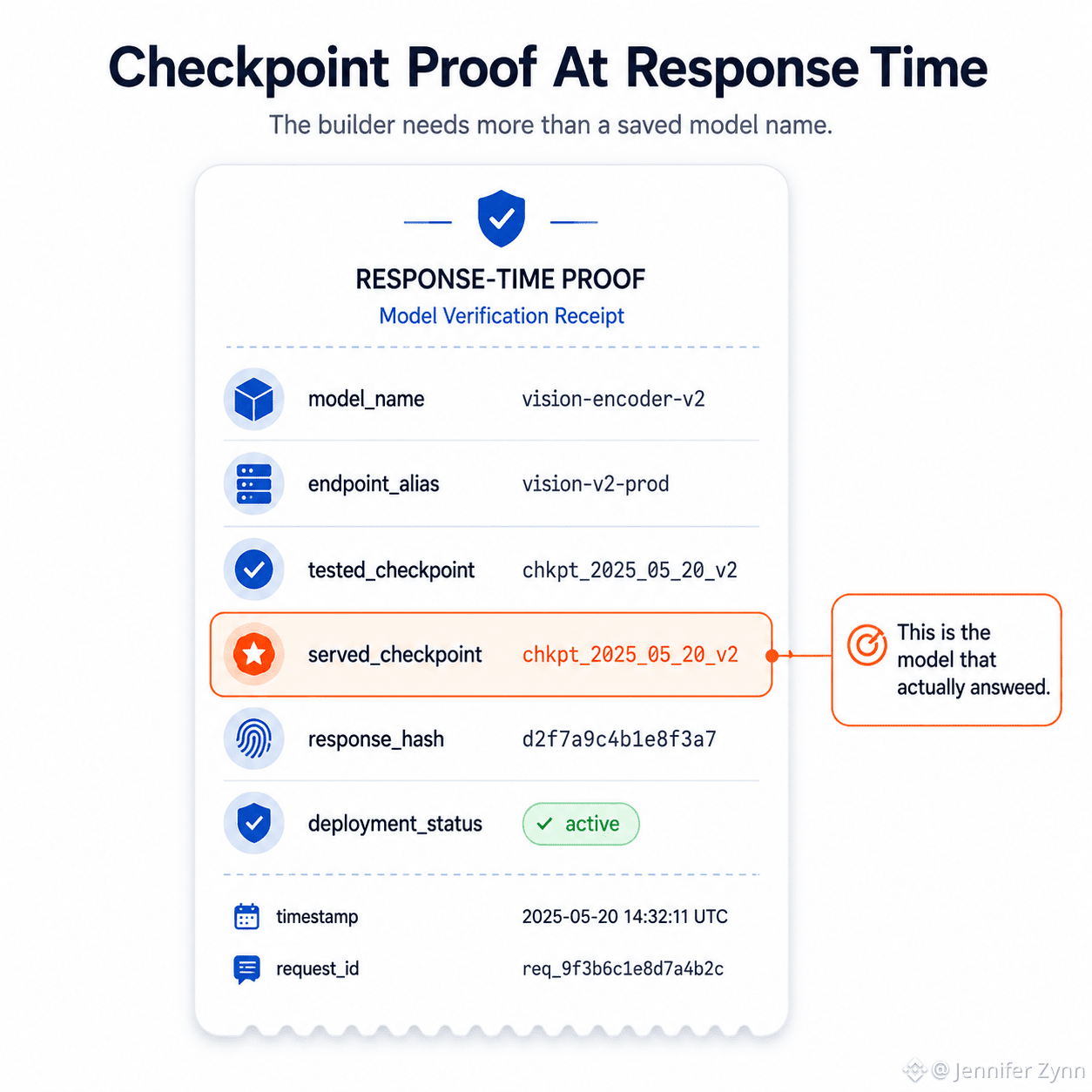
3
443

·
--
Data ownership in AI is often spoken about as if it is already clearly defined, but in practice it still feels unsettled. Attribution systems like OpenLedger bring structure to something that has historically been vague. They make contribution visible, they map where data flows, and they introduce a level of transparency that was missing for a long time.
But visibility alone does not fully translate into ownership. The legal and ethical meaning of control over data is still separate from the technical ability to trace it. Blockchain can record origin and movement with precision, yet it does not automatically resolve questions of permission, withdrawal, or long-term rights.
There is also a deeper mismatch between permanence and privacy frameworks. Systems built for immutable records do not easily align with expectations shaped by modern data protection laws. At the same time, most of the data powering current AI systems already exists outside any clean consent structure, which makes the challenge even harder to address in hindsight.
@Openledger #openledger $OPEN
{spot}(OPENUSDT)
Data ownership in AI is often spoken about as if it is already clearly defined, but in practice it still feels unsettled. Attribution systems like OpenLedger bring structure to something that has historically been vague. They make contribution visible, they map where data flows, and they introduce a level of transparency that was missing for a long time.
But visibility alone does not fully translate into ownership. The legal and ethical meaning of control over data is still separate from the technical ability to trace it. Blockchain can record origin and movement with precision, yet it does not automatically resolve questions of permission, withdrawal, or long-term rights.
There is also a deeper mismatch between permanence and privacy frameworks. Systems built for immutable records do not easily align with expectations shaped by modern data protection laws. At the same time, most of the data powering current AI systems already exists outside any clean consent structure, which makes the challenge even harder to address in hindsight.
@OpenLedger #openledger $OPEN
But visibility alone does not fully translate into ownership. The legal and ethical meaning of control over data is still separate from the technical ability to trace it. Blockchain can record origin and movement with precision, yet it does not automatically resolve questions of permission, withdrawal, or long-term rights.
There is also a deeper mismatch between permanence and privacy frameworks. Systems built for immutable records do not easily align with expectations shaped by modern data protection laws. At the same time, most of the data powering current AI systems already exists outside any clean consent structure, which makes the challenge even harder to address in hindsight.
@OpenLedger #openledger $OPEN
4
9
361

·
--
While working through CreatorPad, one thing became impossible to ignore: attribution becomes much harder the moment complexity increases.
OpenLedger aims to make every contribution measurable, yet the challenge isn't tracking influence—it's deciding how much influence truly matters. The deeper the chain of inputs, the easier it becomes for meaningful contributors to disappear behind simplified scoring models.
The real test for AI attribution isn't transparency. It's whether long-tail contributors can retain their share of value as networks scale.
@Openledger | #OpenLedger
$OPEN
{future}(OPENUSDT)
While working through CreatorPad, one thing became impossible to ignore: attribution becomes much harder the moment complexity increases.
OpenLedger aims to make every contribution measurable, yet the challenge isn't tracking influence—it's deciding how much influence truly matters. The deeper the chain of inputs, the easier it becomes for meaningful contributors to disappear behind simplified scoring models.
The real test for AI attribution isn't transparency. It's whether long-tail contributors can retain their share of value as networks scale.
@OpenLedger | #OpenLedger
$OPEN
OpenLedger aims to make every contribution measurable, yet the challenge isn't tracking influence—it's deciding how much influence truly matters. The deeper the chain of inputs, the easier it becomes for meaningful contributors to disappear behind simplified scoring models.
The real test for AI attribution isn't transparency. It's whether long-tail contributors can retain their share of value as networks scale.
@OpenLedger | #OpenLedger
$OPEN
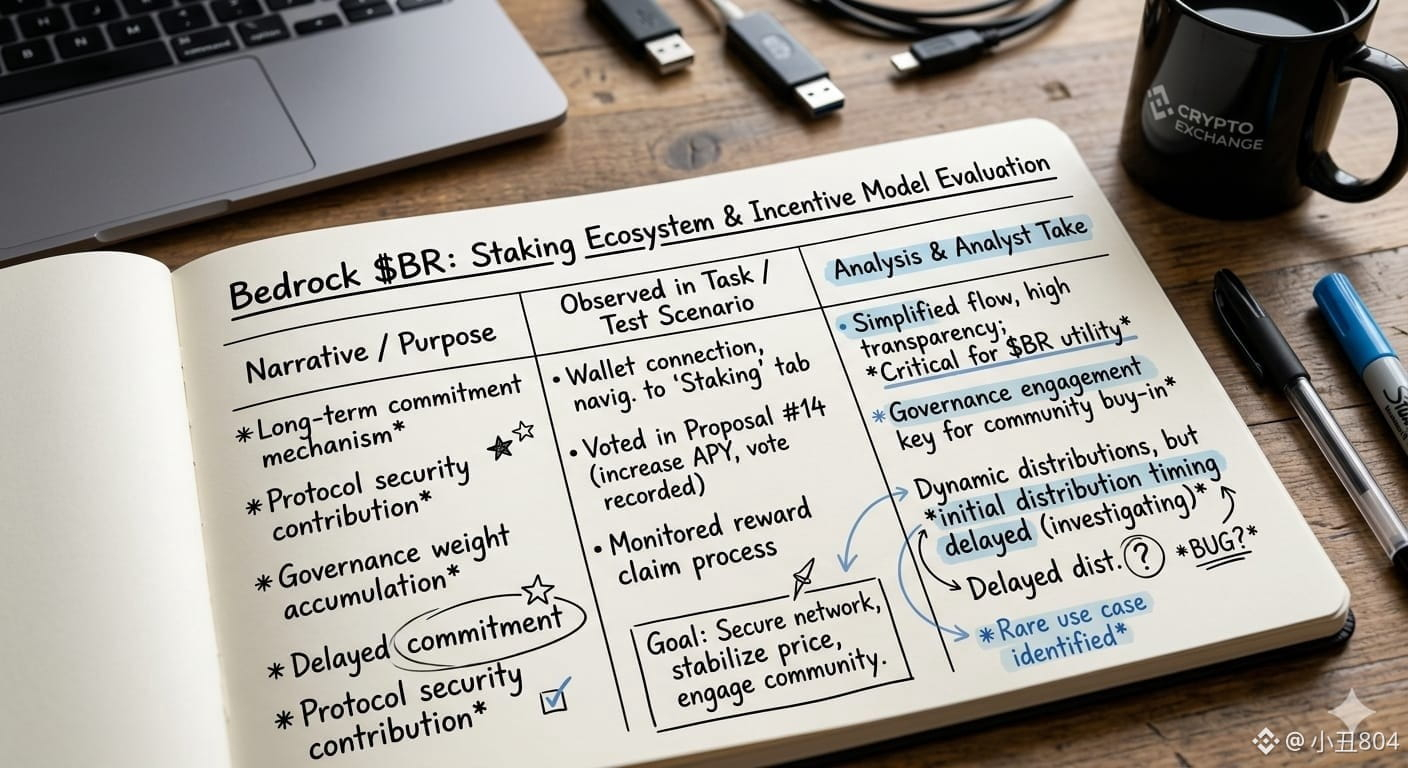
2
2
63
Log in to explore more content
Join global crypto users on Binance Square
⚡️ Get latest and useful information about crypto.
💬 Trusted by the world’s largest crypto exchange.
👍 Discover real insights from verified creators.
Email / Phone number
Trending Topics
1
#BinanceRestoresWithdrawalsForDOGE&OPNetworks
524 views
22 Discussing
2
#BinanceRestoresWithdrawalsForXRP&BaseNetworks
792 views
40 Discussing
3
#BinanceRestoresWithdrawalsForEthereumNetwork&BNBSmartChain
1,631 views
49 Discussing
4
#BinanceUpdatesProofofReservesAddresses
7,933 views
268 Discussing
5
#BinanceToResumePhaseOneOfWithdrawals
30,344 views
604 Discussing
6
#BinanceHadAlreadyCovered$6BofHackLoss
2,832 views
74 Discussing
7
#FBIConfirmsNorthKoreaIsResponsibleForBinanceCryptoHack
19,478 views
84 Discussing
8
#BinanceSAFUFundTransferCompleted7499BTC
100,996 views
1,508 Discussing
9
#CZDismissesClaimsBinanceHackWasPredicted
8,795 views
209 Discussing
10
#BinanceRecovery90% of stolen assets
238,624 views
236 Discussing