
倔犟的小土豆
730 Posts

倔犟的小土豆
Report
Block User
希望有一天我也会变得很优秀!
60 Following
4.2K+ Followers
492 Liked
Posts
All
Quotes
Live
PINNED
·
--
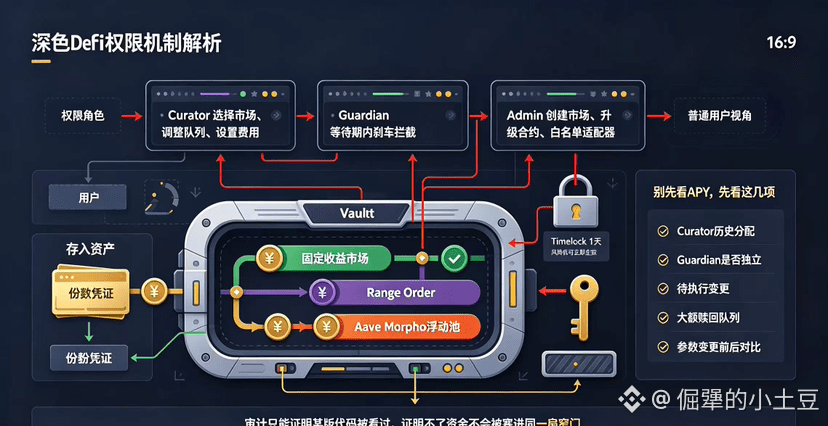
After reading the Vault permissions documentation for TermMax, I found the phrase “passively earn fixed yield” should bold not “fixed yield,” but “who is actually doing the work for you.”
Vault itself follows the ERC-4626 standard: users deposit assets and receive shares. The Curator selects markets, builds Range Orders, manages the capital queues, and sets the pricing curve. Idle funds can also be deployed into floating pools like Aave and Morpho. For ordinary users, it’s convenient—complex term management is packaged into a single entry. This kind of productization is indeed smoother than moving through markets and doing manual “brick-laying” yourself, one by one.
But “less work” doesn’t mean “less trust.” The Curator can determine where capital flows, and can also submit updates such as market whitelists, performance fees, and timelock adjustments. The Guardian can revoke changes that increase risk during the waiting period. The default waiting period is 1 day, while risk-reducing actions can take effect immediately. This design is like having a person sitting next to the fund manager with a brake pedal—yet the steering wheel is still not in the depositor’s hands.
One layer up, the protocol also has roles like DEFAULT_ADMIN, PAUSER, CONFIGURATOR, and more: creating markets, upgrading contracts, whitelisting adapter adjustments, and updating certain configurations. The oracle is more sensitive—price update sources have their own waiting mechanisms and backup sources. The official publication of permissions and the multisig entry points is a definite plus. But publicizing permissions doesn’t mean permissions vanish—it just tells you which wall the keys are mounted on.
So when evaluating Vault, I don’t look at the page APY first. I look at the Curator’s historical allocations, whether the Guardian is independent, and whether pending changes can be understood by ordinary users. Then I look at how the queue is arranged during large redemptions. Ideally, there should also be a before-and-after comparison table for every parameter change. Audits can only prove that a particular version of code was reviewed; they can’t prove the manager won’t shove liquidity through the same narrow door.
What TermMax is truly trying to sell isn’t “saving you clicks.” It’s “making judgments on your behalf while keeping the power constrained.” The first half already exists as a product feature—the second half depends on long-term on-chain records, not on the names of roles.
#termmax @TermMax
After reading the Vault permissions documentation for TermMax, I found the phrase “passively earn fixed yield” should bold not “fixed yield,” but “who is actually doing the work for you.”
Vault itself follows the ERC-4626 standard: users deposit assets and receive shares. The Curator selects markets, builds Range Orders, manages the capital queues, and sets the pricing curve. Idle funds can also be deployed into floating pools like Aave and Morpho. For ordinary users, it’s convenient—complex term management is packaged into a single entry. This kind of productization is indeed smoother than moving through markets and doing manual “brick-laying” yourself, one by one.
But “less work” doesn’t mean “less trust.” The Curator can determine where capital flows, and can also submit updates such as market whitelists, performance fees, and timelock adjustments. The Guardian can revoke changes that increase risk during the waiting period. The default waiting period is 1 day, while risk-reducing actions can take effect immediately. This design is like having a person sitting next to the fund manager with a brake pedal—yet the steering wheel is still not in the depositor’s hands.
One layer up, the protocol also has roles like DEFAULT_ADMIN, PAUSER, CONFIGURATOR, and more: creating markets, upgrading contracts, whitelisting adapter adjustments, and updating certain configurations. The oracle is more sensitive—price update sources have their own waiting mechanisms and backup sources. The official publication of permissions and the multisig entry points is a definite plus. But publicizing permissions doesn’t mean permissions vanish—it just tells you which wall the keys are mounted on.
So when evaluating Vault, I don’t look at the page APY first. I look at the Curator’s historical allocations, whether the Guardian is independent, and whether pending changes can be understood by ordinary users. Then I look at how the queue is arranged during large redemptions. Ideally, there should also be a before-and-after comparison table for every parameter change. Audits can only prove that a particular version of code was reviewed; they can’t prove the manager won’t shove liquidity through the same narrow door.
What TermMax is truly trying to sell isn’t “saving you clicks.” It’s “making judgments on your behalf while keeping the power constrained.” The first half already exists as a product feature—the second half depends on long-term on-chain records, not on the names of roles.
#termmax @TermMax
Vault itself follows the ERC-4626 standard: users deposit assets and receive shares. The Curator selects markets, builds Range Orders, manages the capital queues, and sets the pricing curve. Idle funds can also be deployed into floating pools like Aave and Morpho. For ordinary users, it’s convenient—complex term management is packaged into a single entry. This kind of productization is indeed smoother than moving through markets and doing manual “brick-laying” yourself, one by one.
But “less work” doesn’t mean “less trust.” The Curator can determine where capital flows, and can also submit updates such as market whitelists, performance fees, and timelock adjustments. The Guardian can revoke changes that increase risk during the waiting period. The default waiting period is 1 day, while risk-reducing actions can take effect immediately. This design is like having a person sitting next to the fund manager with a brake pedal—yet the steering wheel is still not in the depositor’s hands.
One layer up, the protocol also has roles like DEFAULT_ADMIN, PAUSER, CONFIGURATOR, and more: creating markets, upgrading contracts, whitelisting adapter adjustments, and updating certain configurations. The oracle is more sensitive—price update sources have their own waiting mechanisms and backup sources. The official publication of permissions and the multisig entry points is a definite plus. But publicizing permissions doesn’t mean permissions vanish—it just tells you which wall the keys are mounted on.
So when evaluating Vault, I don’t look at the page APY first. I look at the Curator’s historical allocations, whether the Guardian is independent, and whether pending changes can be understood by ordinary users. Then I look at how the queue is arranged during large redemptions. Ideally, there should also be a before-and-after comparison table for every parameter change. Audits can only prove that a particular version of code was reviewed; they can’t prove the manager won’t shove liquidity through the same narrow door.
What TermMax is truly trying to sell isn’t “saving you clicks.” It’s “making judgments on your behalf while keeping the power constrained.” The first half already exists as a product feature—the second half depends on long-term on-chain records, not on the names of roles.
#termmax @TermMax
4
1
3
103
·
--
#币安神算子 Why did I use a 100U fee coupon and then it showed as invalid? Isn't that misleading?
#币安神算子 Why did I use a 100U fee coupon and then it showed as invalid? Isn't that misleading?
·
--
2
·
--
#币安神算子 How does the person in first place have so many points? Do they win every single match? I'm so jealous!
#币安神算子 How does the person in first place have so many points? Do they win every single match? I'm so jealous!
·
--
#币安神算子 got ripped off again. The 5,000 points I worked so hard to accumulate suddenly dropped to zero. This is just too hard, sob sob!
#币安神算子 got ripped off again. The 5,000 points I worked so hard to accumulate suddenly dropped to zero. This is just too hard, sob sob!
·
--
#币安神算子 It's a new month. I hope it treats me a little better and lets me make the leaderboard for once. It's so hard for me.
#币安神算子 It's a new month. I hope it treats me a little better and lets me make the leaderboard for once. It's so hard for me.
·
--
#币安神算子 Can someone tell me how much of the final reward I can get if I never make it onto the leaderboard?
#币安神算子 Can someone tell me how much of the final reward I can get if I never make it onto the leaderboard?
·
--
#币安神算子 claimed the points. It’s the same thing every day—I’m so fed up. Can’t you let me win just once?
#币安神算子 claimed the points. It’s the same thing every day—I’m so fed up. Can’t you let me win just once?
1
·
--
#币安神算子 How much longer until this event ends? It feels like I lose every day. Good thing it's just points—if it were U, I'd be absolutely furious.
#币安神算子 How much longer until this event ends? It feels like I lose every day. Good thing it's just points—if it were U, I'd be absolutely furious.
·
--
#币安神算子 , claim your points. How many points do you have now? Mine resets to zero every day. It's so frustrating.
#币安神算子 , claim your points. How many points do you have now? Mine resets to zero every day. It's so frustrating.
5
·
--
#币安神算子 I'll be eager to claim points, but when will you let me win for once?
#币安神算子 I'll be eager to claim points, but when will you let me win for once?
3
·
--
#币安神算子 : I use up all the points I collect every day. It's really fun!
#币安神算子 : I use up all the points I collect every day. It's really fun!
4
·
--
#币安神算子 Is this the weekly task points? Can it be redeemed for rewards at the end?
#币安神算子 Is this the weekly task points? Can it be redeemed for rewards at the end?
6
·
--
#币安神算子 There are lots of predictions today, but I don't understand any of them. I'll just place a random bet and leave it to luck.
#币安神算子 There are lots of predictions today, but I don't understand any of them. I'll just place a random bet and leave it to luck.
68
·
--
#币安神算子 finally won one too—I'm finally over 1,000 points. How many all-ins will it take to reach 10,000 points?
#币安神算子 finally won one too—I'm finally over 1,000 points. How many all-ins will it take to reach 10,000 points?
1
·
--
#币安神算子 : Today is my third day checking in. I've lost it all over the past few days, hahaha. Hope I can hit it big one day.
#币安神算子 : Today is my third day checking in. I've lost it all over the past few days, hahaha. Hope I can hit it big one day.
55
·
--
#币安神算子 , can we make the leaderboard today? Keep up the great work—let’s give it our all! Just getting on the leaderboard is enough.
#币安神算子 , can we make the leaderboard today? Keep up the great work—let’s give it our all! Just getting on the leaderboard is enough.
6
·
--
#币安神算子 How exactly does this event work? Why do I still lose when I place an order at the last minute? Can someone teach me?
#币安神算子 How exactly does this event work? Why do I still lose when I place an order at the last minute? Can someone teach me?
75
·
--
I was bored today, so I went and looked through Dusk’s ecosystem page.
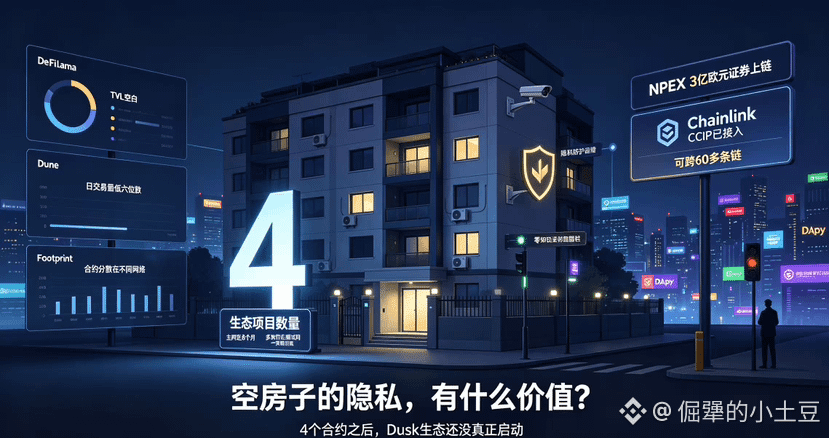
The official data page lists the projects in the ecosystem. I counted—there are 4. A Layer 1 that went live on the mainnet about 8 months ago, and its ecosystem has only 4 projects. I flipped through Dune, DeFiLlama, and Footprint—turns out they’re either blank, or those same 4 contracts keep showing up again and again. Those 4 contracts are spread across different networks, and most of them are still in testnet stage.
Compare that with other L1s that launched on the mainnet around the same time: their ecosystem projects usually number at least dozens or even hundreds. The DApp list is so long you can’t finish paging through it in three screens. With Dusk, you flip one page and it’s done.
Someone might say, “Dusk focuses on institutions, so it doesn’t need a lot of DApps.” But the number—4 contracts—can’t even be considered a “starting stage.” A chain without an ecosystem is like a luxury residential complex that no one lives in. You install the best door locks and the most expensive surveillance system, but what are you protecting—an empty house? What value does an empty house’s privacy have?
Then I checked the TVL data again. DeFiLlama shows TVL as blank, and daily transactions are only in the low six figures. NPEX’s collaboration is indeed Dusk’s biggest selling point—the promise of €300 million in tokenized securities sounds impressive. But one collaboration can’t support an entire chain. I browsed around in the community and, besides NPEX, I couldn’t find a second decent enterprise-level partnership. Also, “the size of existing assets” doesn’t equal “active on-chain settlement.” Analyses have pointed out that the gap between “numbers announced” and “what actually gets implemented” is extremely large.
In January 2026, Dusk and Chainlink fully connected CCIP. Theoretically, the NPEX security tokens issued on Dusk could be bridged to more than 60 chains. But if the infrastructure is set up and nobody uses it, it’s basically wasted effort.
If by the end of this year Dusk still has fewer than two digits of contracts, then I really won’t be able to keep pretending to myself. A privacy chain with no users has meaningless privacy—you need users first, before privacy even needs to be protected. Right now there isn’t even anyone, so privacy has turned into self-congratulation.
The current state of those 4 contracts makes it crystal clear to me that this ecosystem hasn’t truly started. Mainnet stability is only step one. Whether developers come, and whether they can stay—that’s the key. The value of a chain ultimately depends on what runs on it.
#dusk $DUSK @Dusk
I was bored today, so I went and looked through Dusk’s ecosystem page.
The official data page lists the projects in the ecosystem. I counted—there are 4. A Layer 1 that went live on the mainnet about 8 months ago, and its ecosystem has only 4 projects. I flipped through Dune, DeFiLlama, and Footprint—turns out they’re either blank, or those same 4 contracts keep showing up again and again. Those 4 contracts are spread across different networks, and most of them are still in testnet stage.
Compare that with other L1s that launched on the mainnet around the same time: their ecosystem projects usually number at least dozens or even hundreds. The DApp list is so long you can’t finish paging through it in three screens. With Dusk, you flip one page and it’s done.
Someone might say, “Dusk focuses on institutions, so it doesn’t need a lot of DApps.” But the number—4 contracts—can’t even be considered a “starting stage.” A chain without an ecosystem is like a luxury residential complex that no one lives in. You install the best door locks and the most expensive surveillance system, but what are you protecting—an empty house? What value does an empty house’s privacy have?
Then I checked the TVL data again. DeFiLlama shows TVL as blank, and daily transactions are only in the low six figures. NPEX’s collaboration is indeed Dusk’s biggest selling point—the promise of €300 million in tokenized securities sounds impressive. But one collaboration can’t support an entire chain. I browsed around in the community and, besides NPEX, I couldn’t find a second decent enterprise-level partnership. Also, “the size of existing assets” doesn’t equal “active on-chain settlement.” Analyses have pointed out that the gap between “numbers announced” and “what actually gets implemented” is extremely large.
In January 2026, Dusk and Chainlink fully connected CCIP. Theoretically, the NPEX security tokens issued on Dusk could be bridged to more than 60 chains. But if the infrastructure is set up and nobody uses it, it’s basically wasted effort.
If by the end of this year Dusk still has fewer than two digits of contracts, then I really won’t be able to keep pretending to myself. A privacy chain with no users has meaningless privacy—you need users first, before privacy even needs to be protected. Right now there isn’t even anyone, so privacy has turned into self-congratulation.
The current state of those 4 contracts makes it crystal clear to me that this ecosystem hasn’t truly started. Mainnet stability is only step one. Whether developers come, and whether they can stay—that’s the key. The value of a chain ultimately depends on what runs on it.
#dusk $DUSK @Dusk
The official data page lists the projects in the ecosystem. I counted—there are 4. A Layer 1 that went live on the mainnet about 8 months ago, and its ecosystem has only 4 projects. I flipped through Dune, DeFiLlama, and Footprint—turns out they’re either blank, or those same 4 contracts keep showing up again and again. Those 4 contracts are spread across different networks, and most of them are still in testnet stage.
Compare that with other L1s that launched on the mainnet around the same time: their ecosystem projects usually number at least dozens or even hundreds. The DApp list is so long you can’t finish paging through it in three screens. With Dusk, you flip one page and it’s done.
Someone might say, “Dusk focuses on institutions, so it doesn’t need a lot of DApps.” But the number—4 contracts—can’t even be considered a “starting stage.” A chain without an ecosystem is like a luxury residential complex that no one lives in. You install the best door locks and the most expensive surveillance system, but what are you protecting—an empty house? What value does an empty house’s privacy have?
Then I checked the TVL data again. DeFiLlama shows TVL as blank, and daily transactions are only in the low six figures. NPEX’s collaboration is indeed Dusk’s biggest selling point—the promise of €300 million in tokenized securities sounds impressive. But one collaboration can’t support an entire chain. I browsed around in the community and, besides NPEX, I couldn’t find a second decent enterprise-level partnership. Also, “the size of existing assets” doesn’t equal “active on-chain settlement.” Analyses have pointed out that the gap between “numbers announced” and “what actually gets implemented” is extremely large.
In January 2026, Dusk and Chainlink fully connected CCIP. Theoretically, the NPEX security tokens issued on Dusk could be bridged to more than 60 chains. But if the infrastructure is set up and nobody uses it, it’s basically wasted effort.
If by the end of this year Dusk still has fewer than two digits of contracts, then I really won’t be able to keep pretending to myself. A privacy chain with no users has meaningless privacy—you need users first, before privacy even needs to be protected. Right now there isn’t even anyone, so privacy has turned into self-congratulation.
The current state of those 4 contracts makes it crystal clear to me that this ecosystem hasn’t truly started. Mainnet stability is only step one. Whether developers come, and whether they can stay—that’s the key. The value of a chain ultimately depends on what runs on it.
#dusk $DUSK @Dusk
87
·
--
When it comes to the Dusk project, I’ve been watching it for quite a while.
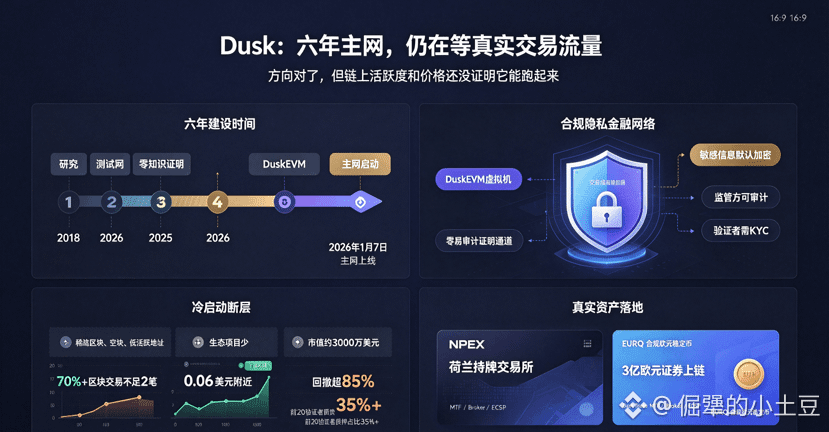
It started in 2018, and only went live on the mainnet in January this year—six years of grinding in between. Unlike the privacy projects on the market that “encrypt everything,” Dusk takes a different route: it stitches privacy and compliance together, specifically serving regulated financial scenarios. On January 7, 2026, the mainnet will officially launch, and DuskEVM will go live at the same time. It is fully compatible with Solidity. Developers migrating from Ethereum generally don’t need to change their code. The core component, Hedger, adds a privacy layer to EVM transactions using zero-knowledge proofs. Sensitive information is encrypted by default, but it keeps an auditable channel for regulators. Validators need to complete KYC—something many people criticize as “not decentralized enough.” But I think it’s an honest response to what finance is really about: real-world financial systems rely on clearly defined accountability chains, so if something goes wrong, you know who to call.
What truly makes it feel different is its execution. Dusk has an official partnership with the regulated Dutch exchange NPEX. On the NPEX platform, more than €300 million in securities assets are set to be moved onto the chain. DuskTrade obtained EU MTF, Broker, and ECSP licenses. Quantoz also issued a compliant euro stablecoin, EURQ, through Dusk. These are real assets running—not demos on a testnet.
But every coin has two sides. The mainnet has been live for almost eight months now, and there are only a few projects listed on the official ecosystem page. In over 70% of blocks, the number of transactions is fewer than two, and you often see consecutive empty blocks. In early August, the price hovered around $0.06, with a market cap of a little over $30 million. Compared with the peak earlier this year, it’s pulled back more than 85%. In June, Binance even delisted the DUSK/BTC trading pair. And the community is arguing, too—among 200 validators, the top 20 control more than 35% of the staked supply.
I recognize the technical direction: people have long struggled to find a balance between privacy and compliance, and Dusk has indeed found a spot where it can actually work. The NPEX partnership also shows that this logic isn’t just spinning wheels. But the price has already gone through a round of emotion-driven pumping. Whether it can be converted into sustained user growth and on-chain activity remains unclear right now. I’ll keep watching to see whether the €300 million assets on NPEX can truly generate ongoing trading flow, and whether genuinely useful applications will grow on DuskEVM. Until then, I’ll watch—no action.
#dusk $DUSK @Dusk
When it comes to the Dusk project, I’ve been watching it for quite a while.
It started in 2018, and only went live on the mainnet in January this year—six years of grinding in between. Unlike the privacy projects on the market that “encrypt everything,” Dusk takes a different route: it stitches privacy and compliance together, specifically serving regulated financial scenarios. On January 7, 2026, the mainnet will officially launch, and DuskEVM will go live at the same time. It is fully compatible with Solidity. Developers migrating from Ethereum generally don’t need to change their code. The core component, Hedger, adds a privacy layer to EVM transactions using zero-knowledge proofs. Sensitive information is encrypted by default, but it keeps an auditable channel for regulators. Validators need to complete KYC—something many people criticize as “not decentralized enough.” But I think it’s an honest response to what finance is really about: real-world financial systems rely on clearly defined accountability chains, so if something goes wrong, you know who to call.
What truly makes it feel different is its execution. Dusk has an official partnership with the regulated Dutch exchange NPEX. On the NPEX platform, more than €300 million in securities assets are set to be moved onto the chain. DuskTrade obtained EU MTF, Broker, and ECSP licenses. Quantoz also issued a compliant euro stablecoin, EURQ, through Dusk. These are real assets running—not demos on a testnet.
But every coin has two sides. The mainnet has been live for almost eight months now, and there are only a few projects listed on the official ecosystem page. In over 70% of blocks, the number of transactions is fewer than two, and you often see consecutive empty blocks. In early August, the price hovered around $0.06, with a market cap of a little over $30 million. Compared with the peak earlier this year, it’s pulled back more than 85%. In June, Binance even delisted the DUSK/BTC trading pair. And the community is arguing, too—among 200 validators, the top 20 control more than 35% of the staked supply.
I recognize the technical direction: people have long struggled to find a balance between privacy and compliance, and Dusk has indeed found a spot where it can actually work. The NPEX partnership also shows that this logic isn’t just spinning wheels. But the price has already gone through a round of emotion-driven pumping. Whether it can be converted into sustained user growth and on-chain activity remains unclear right now. I’ll keep watching to see whether the €300 million assets on NPEX can truly generate ongoing trading flow, and whether genuinely useful applications will grow on DuskEVM. Until then, I’ll watch—no action.
#dusk $DUSK @Dusk
It started in 2018, and only went live on the mainnet in January this year—six years of grinding in between. Unlike the privacy projects on the market that “encrypt everything,” Dusk takes a different route: it stitches privacy and compliance together, specifically serving regulated financial scenarios. On January 7, 2026, the mainnet will officially launch, and DuskEVM will go live at the same time. It is fully compatible with Solidity. Developers migrating from Ethereum generally don’t need to change their code. The core component, Hedger, adds a privacy layer to EVM transactions using zero-knowledge proofs. Sensitive information is encrypted by default, but it keeps an auditable channel for regulators. Validators need to complete KYC—something many people criticize as “not decentralized enough.” But I think it’s an honest response to what finance is really about: real-world financial systems rely on clearly defined accountability chains, so if something goes wrong, you know who to call.
What truly makes it feel different is its execution. Dusk has an official partnership with the regulated Dutch exchange NPEX. On the NPEX platform, more than €300 million in securities assets are set to be moved onto the chain. DuskTrade obtained EU MTF, Broker, and ECSP licenses. Quantoz also issued a compliant euro stablecoin, EURQ, through Dusk. These are real assets running—not demos on a testnet.
But every coin has two sides. The mainnet has been live for almost eight months now, and there are only a few projects listed on the official ecosystem page. In over 70% of blocks, the number of transactions is fewer than two, and you often see consecutive empty blocks. In early August, the price hovered around $0.06, with a market cap of a little over $30 million. Compared with the peak earlier this year, it’s pulled back more than 85%. In June, Binance even delisted the DUSK/BTC trading pair. And the community is arguing, too—among 200 validators, the top 20 control more than 35% of the staked supply.
I recognize the technical direction: people have long struggled to find a balance between privacy and compliance, and Dusk has indeed found a spot where it can actually work. The NPEX partnership also shows that this logic isn’t just spinning wheels. But the price has already gone through a round of emotion-driven pumping. Whether it can be converted into sustained user growth and on-chain activity remains unclear right now. I’ll keep watching to see whether the €300 million assets on NPEX can truly generate ongoing trading flow, and whether genuinely useful applications will grow on DuskEVM. Until then, I’ll watch—no action.
#dusk $DUSK @Dusk
123
Log in to explore more content
Join global crypto users on Binance Square
⚡️ Get latest and useful information about crypto.
💬 Trusted by the world’s largest crypto exchange.
👍 Discover real insights from verified creators.
Email / Phone number
Trending Topics
BinanceReopensWithdrawalsForMoreAssets
1.1M views
5,767 Discussing
Recovery Update #9: Withdrawals for More Assets to Reopen (2026-11-06)
Binance Announcement
·166 Likes
·681k views
$2TWipedOutHedgeFundsFaceLiquidation
319 views
21 Discussing
AnthropicIPOValuationDoubts
13,130 views
375 Discussing