

#brazil
brazil
407,911 views
1,142 Discussing
Hot
Latest

·
--
📰 Featherlend Brings Brazil’s Selic Rate On-Chain With BRZ Morpho Markets
Transfero's Brazilian real stablecoin can now be lent and borrowed in two isolated Morpho vaults on Polygon, with tokenized treasury and dollar collateral.
Source : Blockchainreporter
Time : 2026-10-04 16:00:00
Credit : samuel edyme
#polygon #defi #brazil #defi_news #stablecoins
$IMX $MATIC $ONE
📰 Featherlend Brings Brazil’s Selic Rate On-Chain With BRZ Morpho Markets
Transfero's Brazilian real stablecoin can now be lent and borrowed in two isolated Morpho vaults on Polygon, with tokenized treasury and dollar collateral.
Source : Blockchainreporter
Time : 2026-10-04 16:00:00
Credit : samuel edyme
#polygon #defi #brazil #defi_news #stablecoins
$IMX $MATIC $ONE
Transfero's Brazilian real stablecoin can now be lent and borrowed in two isolated Morpho vaults on Polygon, with tokenized treasury and dollar collateral.
Source : Blockchainreporter
Time : 2026-10-04 16:00:00
Credit : samuel edyme
#polygon #defi #brazil #defi_news #stablecoins
$IMX $MATIC $ONE
289

·
--
🇧🇷 Something that hasn’t happened in Brazil for nearly three decades is suddenly on the table tonight.
The last president to win outright in the first round was Fernando Henrique Cardoso in 1998.
Since then, every single presidential election has gone to a runoff: 2002, 2006, 2010, 2014, 2018 and 2022.
6 elections, in 28 years, and NOT ONE first-round winner!
Flávio Bolsonaro is currently holding the above 50% needed to end that streak.
And that would make tonight much bigger than simply another Bolsonaro victory.
If he holds above 50% once the count is complete, Brazil will have elected a president in the first round for the first time in a generation.
The last time that happened, his father hadn’t even begun his first term in Congress.
#Brazil
$AKT $STAR $PHAROS
🇧🇷 Something that hasn’t happened in Brazil for nearly three decades is suddenly on the table tonight.
The last president to win outright in the first round was Fernando Henrique Cardoso in 1998.
Since then, every single presidential election has gone to a runoff: 2002, 2006, 2010, 2014, 2018 and 2022.
6 elections, in 28 years, and NOT ONE first-round winner!
Flávio Bolsonaro is currently holding the above 50% needed to end that streak.
And that would make tonight much bigger than simply another Bolsonaro victory.
If he holds above 50% once the count is complete, Brazil will have elected a president in the first round for the first time in a generation.
The last time that happened, his father hadn’t even begun his first term in Congress.
#Brazil
$AKT $STAR $PHAROS
The last president to win outright in the first round was Fernando Henrique Cardoso in 1998.
Since then, every single presidential election has gone to a runoff: 2002, 2006, 2010, 2014, 2018 and 2022.
6 elections, in 28 years, and NOT ONE first-round winner!
Flávio Bolsonaro is currently holding the above 50% needed to end that streak.
And that would make tonight much bigger than simply another Bolsonaro victory.
If he holds above 50% once the count is complete, Brazil will have elected a president in the first round for the first time in a generation.
The last time that happened, his father hadn’t even begun his first term in Congress.
#Brazil
$AKT $STAR $PHAROS

381

Binance tightens controls on Brazilian users’ crypto transactions starting November 1
• Binance will tighten controls on Brazilian users’ cross-border crypto transactions starting November 1.
• Withdrawals may be blocked if required information is missing.
• Binance may freeze deposits if the required transaction information is not provided.
#BinanceSquare #CryptoNews #Brazil
$btc $eth
#vlikevn #Titanbot
Source: U.Today
Binance tightens controls on Brazilian users’ crypto transactions starting November 1
• Binance will tighten controls on Brazilian users’ cross-border crypto transactions starting November 1.
• Withdrawals may be blocked if required information is missing.
• Binance may freeze deposits if the required transaction information is not provided.
#BinanceSquare #CryptoNews #Brazil
$btc $eth
#vlikevn #Titanbot
Source: U.Today
• Binance will tighten controls on Brazilian users’ cross-border crypto transactions starting November 1.
• Withdrawals may be blocked if required information is missing.
• Binance may freeze deposits if the required transaction information is not provided.
#BinanceSquare #CryptoNews #Brazil
$btc $eth
#vlikevn #Titanbot
Source: U.Today
3

·
--
🇧🇷 Binance Updates Crypto Transfer Rules in Brazil
Binance is changing international crypto deposit/withdrawal procedures for Brazilian users to comply with local regulations.
Users making international transfers may need to provide additional information.
📌 No action is required if you don't make international crypto transfers.
#Binance #Crypto #Brazil $BTC
🇧🇷 Binance Updates Crypto Transfer Rules in Brazil
Binance is changing international crypto deposit/withdrawal procedures for Brazilian users to comply with local regulations.
Users making international transfers may need to provide additional information.
📌 No action is required if you don't make international crypto transfers.
#Binance #Crypto #Brazil $BTC
Binance is changing international crypto deposit/withdrawal procedures for Brazilian users to comply with local regulations.
Users making international transfers may need to provide additional information.
📌 No action is required if you don't make international crypto transfers.
#Binance #Crypto #Brazil $BTC
1

·
--
Bullish
🗳 Strategic Interest in Brazil: What Moves Global Powers?
Brazil is among the 10 largest economies in the world and attracts the attention of international leaders for three central strategic reasons:
Food Security: Brazilian agribusiness (soy, meat, corn) feeds about 1 billion people, making it vital for world supply.
Geopolitics and Energy: The power struggle between the United States and China over the BRICS leader includes access to oil reserves and critical minerals (lithium and nickel) essential for technology.
Climate and Sustainability: With the Amazon and an electricity mix that is ~88% renewable, the country is a key piece in the global agenda on decarbonization and carbon credits.
With Brazil’s growing relevance on the global stage, do you think it will also become a leadership hub for the adoption of crypto assets and Web3?
👇 Leave your opinion in the comments!
#Crypto #Brazil #Economy #Web3 $BTC $ETH $SOL
🗳 Strategic Interest in Brazil: What Moves Global Powers?
Brazil is among the 10 largest economies in the world and attracts the attention of international leaders for three central strategic reasons:
Food Security: Brazilian agribusiness (soy, meat, corn) feeds about 1 billion people, making it vital for world supply.
Geopolitics and Energy: The power struggle between the United States and China over the BRICS leader includes access to oil reserves and critical minerals (lithium and nickel) essential for technology.
Climate and Sustainability: With the Amazon and an electricity mix that is ~88% renewable, the country is a key piece in the global agenda on decarbonization and carbon credits.
With Brazil’s growing relevance on the global stage, do you think it will also become a leadership hub for the adoption of crypto assets and Web3?
👇 Leave your opinion in the comments!
#Crypto #Brazil #Economy #Web3 $BTC $ETH $SOL
Brazil is among the 10 largest economies in the world and attracts the attention of international leaders for three central strategic reasons:
Food Security: Brazilian agribusiness (soy, meat, corn) feeds about 1 billion people, making it vital for world supply.
Geopolitics and Energy: The power struggle between the United States and China over the BRICS leader includes access to oil reserves and critical minerals (lithium and nickel) essential for technology.
Climate and Sustainability: With the Amazon and an electricity mix that is ~88% renewable, the country is a key piece in the global agenda on decarbonization and carbon credits.
With Brazil’s growing relevance on the global stage, do you think it will also become a leadership hub for the adoption of crypto assets and Web3?
👇 Leave your opinion in the comments!
#Crypto #Brazil #Economy #Web3 $BTC $ETH $SOL
BetoSquare-Creator-8e49b8197d5afba055aD:
As criptomoedas já estão se alastrando Brasil a fora...e o melhor existe pessoas com grande talento sobre criptoativos como por ex:;Daniel Fraga,Renato Trader 3OITAO e não esquecendo eu o Beto kkkkkkkkkkkk e vocês acham qye tem mais volta kkkkkkkkkkkk Santhander,Bradesco,Itaú ,bancos digitais tudo já aderiram as criptomoedas e não tem mais volta em nível mundial...
4
4
1.1k

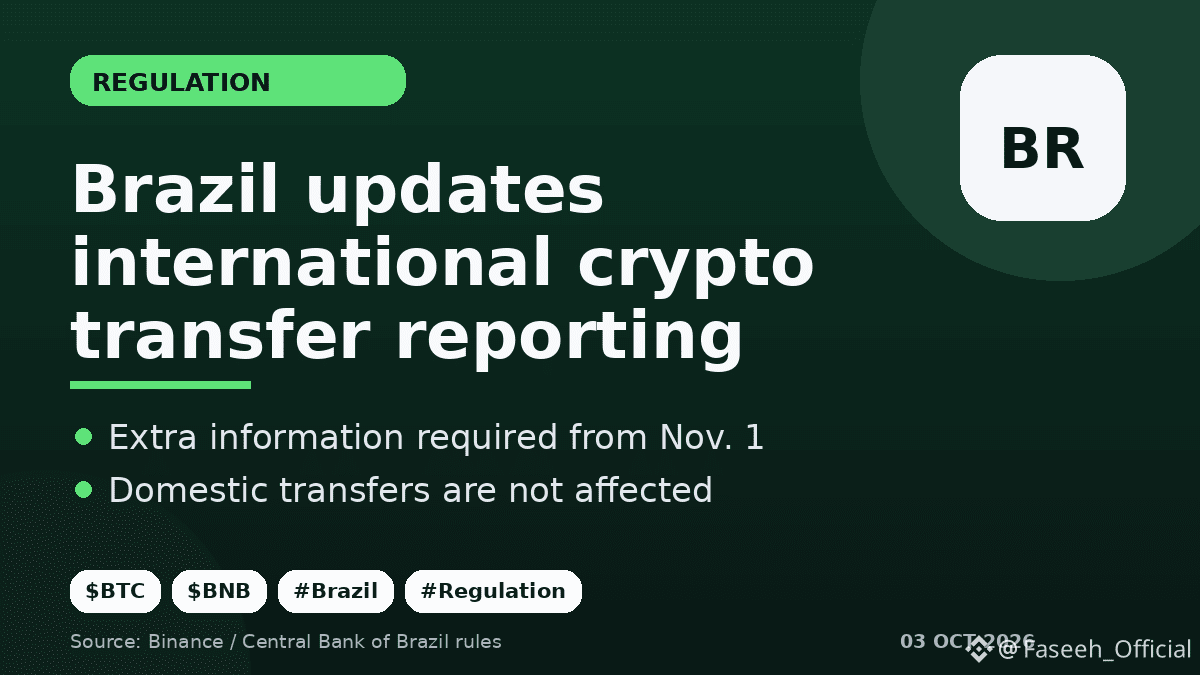
🇧🇷 CRYPTO REGULATION UPDATE: Binance says users in Brazil will need to provide extra information for certain international crypto transfers starting Nov. 1, 2026. Domestic transfers are unaffected. Cross-border crypto reporting is becoming more structured globally. $BTC $BNB #Binance #CryptoRegulation #Brazil #Blockchain
🇧🇷 CRYPTO REGULATION UPDATE: Binance says users in Brazil will need to provide extra information for certain international crypto transfers starting Nov. 1, 2026. Domestic transfers are unaffected. Cross-border crypto reporting is becoming more structured globally. $BTC $BNB #Binance #CryptoRegulation #Brazil #Blockchain
278

·
--
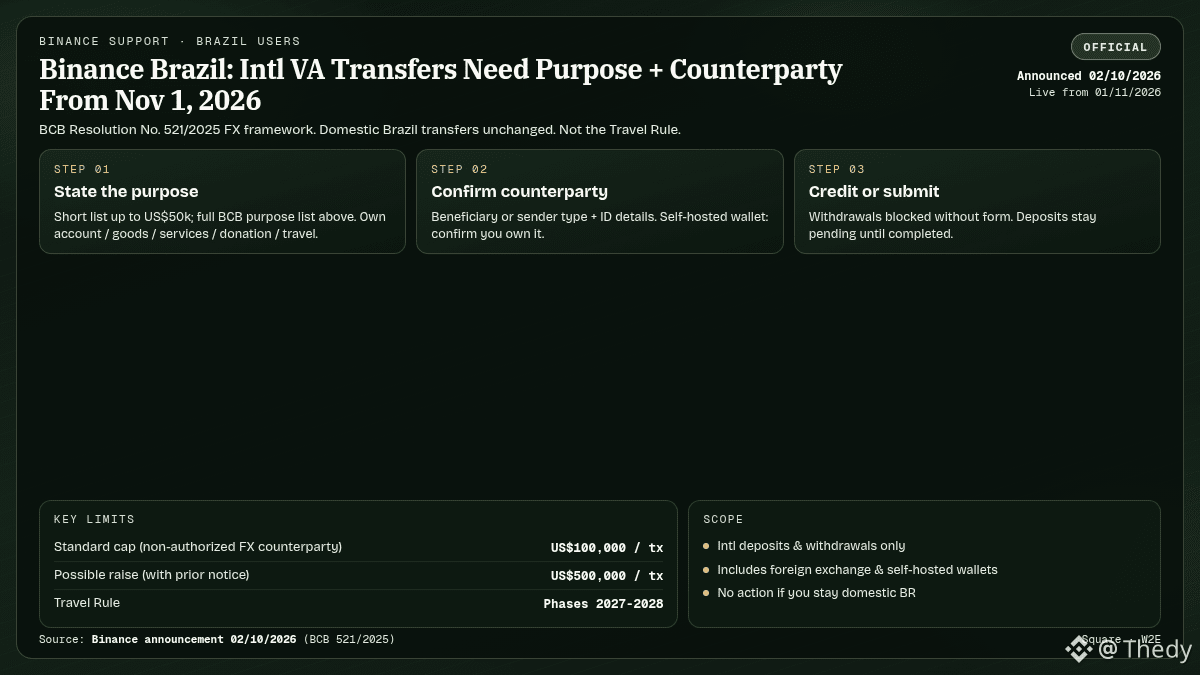
Binance updated the procedures for international transfers of virtual assets for users in Brazil.
Official announcement dated 02/10/2026: starting 01/11/2026, international deposits and withdrawals will require a questionnaire (transfer purpose + identity of the counterparty), in accordance with BCB Resolution No. 521/2025. Domestic transfers within Brazil do not change.
FACTS (source: Binance Support, 02/10/2026):
• Effective date: 01/11/2026
• Framework: Resolution BCB No. 521/2025 (foreign exchange market), not the Travel Rule (scheduled in phases for 2027-2028)
• Standard limit: USD 100,000 per transaction if the counterparty is not an authorized institution on the Brazilian FX market (may be raised to USD 500,000 with prior notice)
• Without information: withdrawal is not subject; deposit remains pending (sometimes returned to the sender)
INTERPRETATION:
This is not a “retail crypto ban.” It’s FX compliance on Binance’s side, separate from BCB resolutions 561/588 (eFX channel / self-custody reporting) that were already in effect as of 01/10.
SCENARIOS:
• Baseline: smooth adoption of the pop-up, domestic flows unchanged
• Extension: the cap increased to 500k after notification
• Risk: friction for large international transfers and self-hosted wallets
BR users who only do domestic activity: no action required. For those who handle international flows: will the questionnaire be a real blocker, or just a UX step?
#Binance #Brazil #Regulation
Binance updated the procedures for international transfers of virtual assets for users in Brazil.
Official announcement dated 02/10/2026: starting 01/11/2026, international deposits and withdrawals will require a questionnaire (transfer purpose + identity of the counterparty), in accordance with BCB Resolution No. 521/2025. Domestic transfers within Brazil do not change.
FACTS (source: Binance Support, 02/10/2026):
• Effective date: 01/11/2026
• Framework: Resolution BCB No. 521/2025 (foreign exchange market), not the Travel Rule (scheduled in phases for 2027-2028)
• Standard limit: USD 100,000 per transaction if the counterparty is not an authorized institution on the Brazilian FX market (may be raised to USD 500,000 with prior notice)
• Without information: withdrawal is not subject; deposit remains pending (sometimes returned to the sender)
INTERPRETATION:
This is not a “retail crypto ban.” It’s FX compliance on Binance’s side, separate from BCB resolutions 561/588 (eFX channel / self-custody reporting) that were already in effect as of 01/10.
SCENARIOS:
• Baseline: smooth adoption of the pop-up, domestic flows unchanged
• Extension: the cap increased to 500k after notification
• Risk: friction for large international transfers and self-hosted wallets
BR users who only do domestic activity: no action required. For those who handle international flows: will the questionnaire be a real blocker, or just a UX step?
#Binance #Brazil #Regulation
Official announcement dated 02/10/2026: starting 01/11/2026, international deposits and withdrawals will require a questionnaire (transfer purpose + identity of the counterparty), in accordance with BCB Resolution No. 521/2025. Domestic transfers within Brazil do not change.
FACTS (source: Binance Support, 02/10/2026):
• Effective date: 01/11/2026
• Framework: Resolution BCB No. 521/2025 (foreign exchange market), not the Travel Rule (scheduled in phases for 2027-2028)
• Standard limit: USD 100,000 per transaction if the counterparty is not an authorized institution on the Brazilian FX market (may be raised to USD 500,000 with prior notice)
• Without information: withdrawal is not subject; deposit remains pending (sometimes returned to the sender)
INTERPRETATION:
This is not a “retail crypto ban.” It’s FX compliance on Binance’s side, separate from BCB resolutions 561/588 (eFX channel / self-custody reporting) that were already in effect as of 01/10.
SCENARIOS:
• Baseline: smooth adoption of the pop-up, domestic flows unchanged
• Extension: the cap increased to 500k after notification
• Risk: friction for large international transfers and self-hosted wallets
BR users who only do domestic activity: no action required. For those who handle international flows: will the questionnaire be a real blocker, or just a UX step?
#Binance #Brazil #Regulation
6
·
--
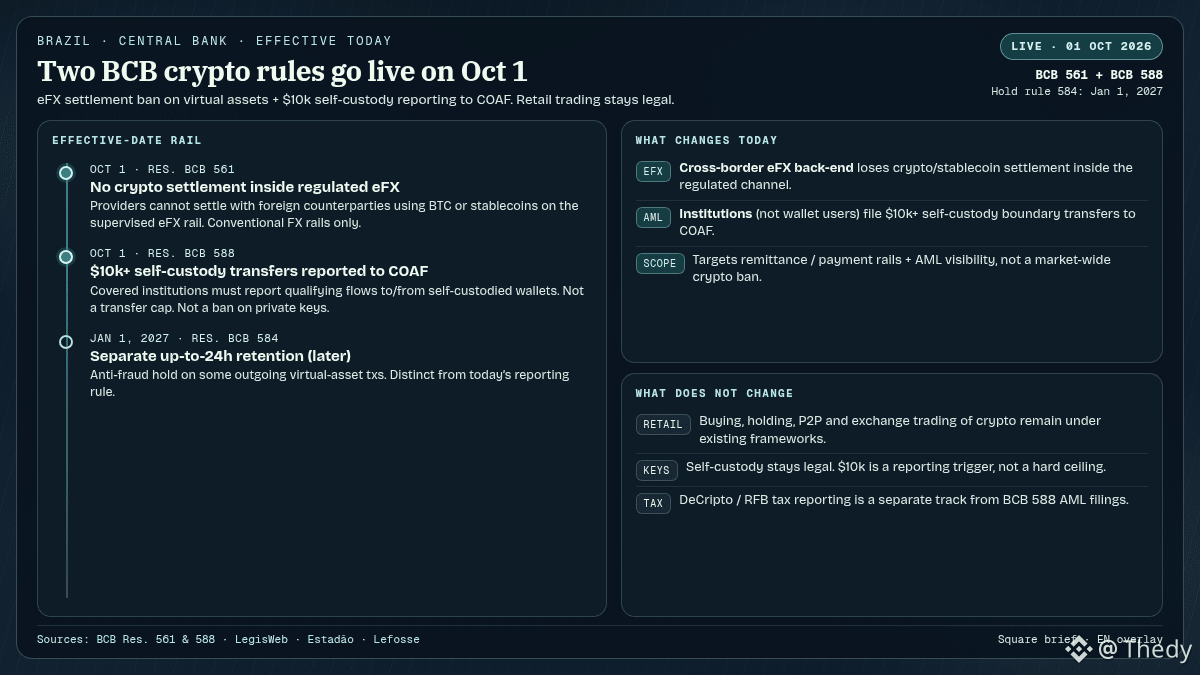
Today 01/10, two rules from the Banco Central do Brasil (BCB) come into force. This is not a “crypto ban” for retail. This is a targeted tightening on regulated rails and AML.
FACTS (sources: BCB resolutions, LegisWeb, Estadão, Lefosse):
• BCB Resolution 561: in the eFX channel (regulated payments / international transfers), no more settlement in virtual assets (bitcoin, stablecoins) between a Brazilian provider and its foreign counterparty. Return to traditional FX rails.
• BCB Resolution 588: covered institutions must report to COAF transfers of virtual assets to or from a self-custody wallet from ~10,000$ (equivalent). This is an institutional obligation, not a user threshold.
• Separately: BCB Resolution 584 (preventive withholding up to 24 hours on certain withdrawals) scheduled for 01/01/2027, distinct from today’s reporting.
INTERPRETATION:
Brazil closes a back-end use case (stablecoin/BTC settlement in supervised eFX) and increases AML visibility at the custody ↔ self-custody boundary. Retail: buying, holding, trading, and private keys remain within existing frameworks. DeCripto / RFB tax treatment = another angle.
SCENARIOS:
• Base case: impact mainly on remittances / fintechs using eFX; retail volume like Square is little affected day to day
• Stress case: stronger friction on institutional outflows → wallet ≥10k $ (delays / KYC), with no formal prohibition
• Invalidating the “ban” narrative: if the BCB expanded to trading/custody outside eFX (not today’s text)
Spot (Kraken ~14:53 UTC): $BTC ~83.8k · $ETH ~2.68k · Fear & Greed 74.
Question: for you, the real issue is the remittances/stablecoins slowdown, or the COAF reporting at $10k?
#Brazil #Regulation $USDT
Today 01/10, two rules from the Banco Central do Brasil (BCB) come into force. This is not a “crypto ban” for retail. This is a targeted tightening on regulated rails and AML.
FACTS (sources: BCB resolutions, LegisWeb, Estadão, Lefosse):
• BCB Resolution 561: in the eFX channel (regulated payments / international transfers), no more settlement in virtual assets (bitcoin, stablecoins) between a Brazilian provider and its foreign counterparty. Return to traditional FX rails.
• BCB Resolution 588: covered institutions must report to COAF transfers of virtual assets to or from a self-custody wallet from ~10,000$ (equivalent). This is an institutional obligation, not a user threshold.
• Separately: BCB Resolution 584 (preventive withholding up to 24 hours on certain withdrawals) scheduled for 01/01/2027, distinct from today’s reporting.
INTERPRETATION:
Brazil closes a back-end use case (stablecoin/BTC settlement in supervised eFX) and increases AML visibility at the custody ↔ self-custody boundary. Retail: buying, holding, trading, and private keys remain within existing frameworks. DeCripto / RFB tax treatment = another angle.
SCENARIOS:
• Base case: impact mainly on remittances / fintechs using eFX; retail volume like Square is little affected day to day
• Stress case: stronger friction on institutional outflows → wallet ≥10k $ (delays / KYC), with no formal prohibition
• Invalidating the “ban” narrative: if the BCB expanded to trading/custody outside eFX (not today’s text)
Spot (Kraken ~14:53 UTC): $BTC ~83.8k · $ETH ~2.68k · Fear & Greed 74.
Question: for you, the real issue is the remittances/stablecoins slowdown, or the COAF reporting at $10k?
#Brazil #Regulation $USDT
FACTS (sources: BCB resolutions, LegisWeb, Estadão, Lefosse):
• BCB Resolution 561: in the eFX channel (regulated payments / international transfers), no more settlement in virtual assets (bitcoin, stablecoins) between a Brazilian provider and its foreign counterparty. Return to traditional FX rails.
• BCB Resolution 588: covered institutions must report to COAF transfers of virtual assets to or from a self-custody wallet from ~10,000$ (equivalent). This is an institutional obligation, not a user threshold.
• Separately: BCB Resolution 584 (preventive withholding up to 24 hours on certain withdrawals) scheduled for 01/01/2027, distinct from today’s reporting.
INTERPRETATION:
Brazil closes a back-end use case (stablecoin/BTC settlement in supervised eFX) and increases AML visibility at the custody ↔ self-custody boundary. Retail: buying, holding, trading, and private keys remain within existing frameworks. DeCripto / RFB tax treatment = another angle.
SCENARIOS:
• Base case: impact mainly on remittances / fintechs using eFX; retail volume like Square is little affected day to day
• Stress case: stronger friction on institutional outflows → wallet ≥10k $ (delays / KYC), with no formal prohibition
• Invalidating the “ban” narrative: if the BCB expanded to trading/custody outside eFX (not today’s text)
Spot (Kraken ~14:53 UTC): $BTC ~83.8k · $ETH ~2.68k · Fear & Greed 74.
Question: for you, the real issue is the remittances/stablecoins slowdown, or the COAF reporting at $10k?
#Brazil #Regulation $USDT
189

🚨 Brazil: only four crypto exchanges left awaiting central bank approval 🧠
📊 | $BTC | $ETH | $BNB |
- Please follow, like, and share your thoughts 📈
- The Brazilian central bank’s new crypto regulatory deadline has about one month remaining
- Only five VASPs have submitted operating license applications, and one has already been rejected
- The remaining exchanges are still waiting for approval, and the industry faces downward pressure 🔥
- In the short term, approval delays may intensify selling pressure in the market
- If approvals are further obstructed, it may trigger whale asset distributions, leading to a price drop
- However, if regulation becomes clear, investor confidence is expected to recover, which could stabilize prices in the short term
- Near-term volatility is expected to remain high, and the short-term bias is still bearish
- How do you think Brazil’s regulatory progress will impact the global crypto market?
- Please keep following our in-depth analysis and leave your insights
#Crypto #Brazil #Whales #Regulation #Trading
🚨 Brazil: only four crypto exchanges left awaiting central bank approval 🧠
📊 | $BTC | $ETH | $BNB |
- Please follow, like, and share your thoughts 📈
- The Brazilian central bank’s new crypto regulatory deadline has about one month remaining
- Only five VASPs have submitted operating license applications, and one has already been rejected
- The remaining exchanges are still waiting for approval, and the industry faces downward pressure 🔥
- In the short term, approval delays may intensify selling pressure in the market
- If approvals are further obstructed, it may trigger whale asset distributions, leading to a price drop
- However, if regulation becomes clear, investor confidence is expected to recover, which could stabilize prices in the short term
- Near-term volatility is expected to remain high, and the short-term bias is still bearish
- How do you think Brazil’s regulatory progress will impact the global crypto market?
- Please keep following our in-depth analysis and leave your insights
#Crypto #Brazil #Whales #Regulation #Trading
📊 | $BTC | $ETH | $BNB |
- Please follow, like, and share your thoughts 📈
- The Brazilian central bank’s new crypto regulatory deadline has about one month remaining
- Only five VASPs have submitted operating license applications, and one has already been rejected
- The remaining exchanges are still waiting for approval, and the industry faces downward pressure 🔥
- In the short term, approval delays may intensify selling pressure in the market
- If approvals are further obstructed, it may trigger whale asset distributions, leading to a price drop
- However, if regulation becomes clear, investor confidence is expected to recover, which could stabilize prices in the short term
- Near-term volatility is expected to remain high, and the short-term bias is still bearish
- How do you think Brazil’s regulatory progress will impact the global crypto market?
- Please keep following our in-depth analysis and leave your insights
#Crypto #Brazil #Whales #Regulation #Trading
264

Brazil is tightening its grip on crypto. Starting October 1, the central bank’s Resolution 561 bans stablecoins from settling a major category of institutional cross-border FX payments. While retail transfers remain untouched, this move strikes at the core of institutional crypto utility in Latin America's largest economy. Regulators want tighter control over foreign exchange flows, signaling that the trillion-dollar stablecoin sector must navigate stricter compliance hurdles moving forward. $USDT $USDC #Regulation #Stablecoins #Brazil
Brazil is tightening its grip on crypto. Starting October 1, the central bank’s Resolution 561 bans stablecoins from settling a major category of institutional cross-border FX payments. While retail transfers remain untouched, this move strikes at the core of institutional crypto utility in Latin America's largest economy. Regulators want tighter control over foreign exchange flows, signaling that the trillion-dollar stablecoin sector must navigate stricter compliance hurdles moving forward. $USDT $USDC #Regulation #Stablecoins #Brazil
12
·
--
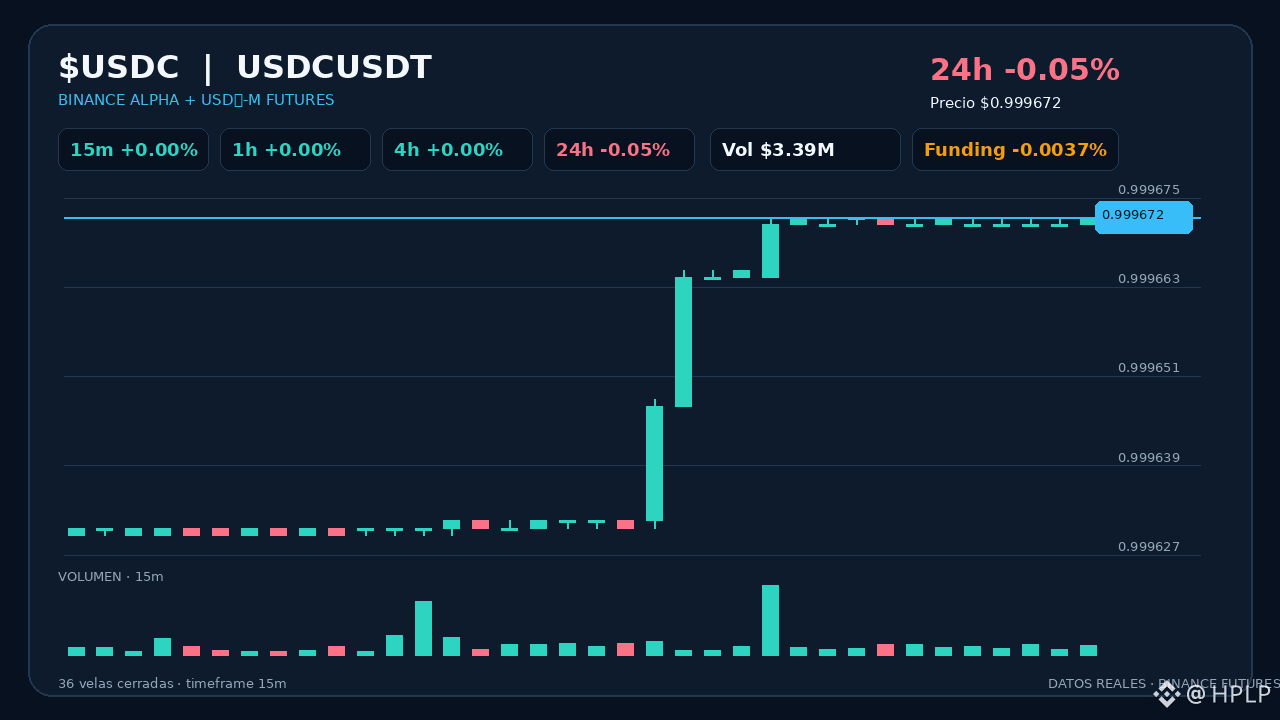
The Central Bank of Brazil has decided to remove virtual assets and stablecoins from a specific lane for international payments starting October 1 through Resolution 561. This measure directly impacts settlement between foreign currency providers and counterparties, requiring regulated traditional channels. Why it matters: Brazil is one of the markets with the highest adoption of stablecoins for trade and remittances, and these restrictions could fragment liquidity or slow the pace of institutional adoption in the region. What to watch: the response from stablecoin issuers, cross-border transaction volume, and whether other central banks in emerging economies replicate this strict regulatory stance. #CryptoRegulation #Stablecoins #Macro #Brazil $USDT $USDC
The Central Bank of Brazil has decided to remove virtual assets and stablecoins from a specific lane for international payments starting October 1 through Resolution 561. This measure directly impacts settlement between foreign currency providers and counterparties, requiring regulated traditional channels. Why it matters: Brazil is one of the markets with the highest adoption of stablecoins for trade and remittances, and these restrictions could fragment liquidity or slow the pace of institutional adoption in the region. What to watch: the response from stablecoin issuers, cross-border transaction volume, and whether other central banks in emerging economies replicate this strict regulatory stance. #CryptoRegulation #Stablecoins #Macro #Brazil $USDT $USDC
157
🚨 10 Billion-Dollar Bank Collapse Shocks Brazil’s Elections 🧠
📊 | $BTC | $ETH | $BNB |
- Please follow, like, and comment to share your immediate thoughts. 📈
- In November 2025, Brazil’s Bank Master collapsed, involving losses of about $1 billion in deposits.
- The bank lured hundreds of thousands of depositors with unusually high returns, leading to severe losses for depositors and insurance companies.
- Ten months later, the owner, Daniel Volcaro, was charged, prompting the Supreme Court to step in.
- This incident has already spilled over into the upcoming Brazilian presidential election, becoming a political focus. 🔥
- Market sentiment has turned bearish, and it is expected that in the short term digital assets such as Bitcoin will face downward pressure.
- If uncertainty in Brazilian politics intensifies, funds may flow into safe-haven assets, leading to further sell-offs in the crypto market.
- Whale funds show signs of redistribution; in the short term, there may be selling or a wait-and-see posture, and volatility may rise.
- If regulatory intervention helps ease the banking crisis, the market may see a brief rebound, but overall it remains bearish.
- What do you think about how Brazil’s political risk will affect global crypto market trends?
- Feel free to keep following our in-depth analysis—we look forward to your comments.
#Crypto #Markets #Whales #Brazil #Election
🚨 10 Billion-Dollar Bank Collapse Shocks Brazil’s Elections 🧠
📊 | $BTC | $ETH | $BNB |
- Please follow, like, and comment to share your immediate thoughts. 📈
- In November 2025, Brazil’s Bank Master collapsed, involving losses of about $1 billion in deposits.
- The bank lured hundreds of thousands of depositors with unusually high returns, leading to severe losses for depositors and insurance companies.
- Ten months later, the owner, Daniel Volcaro, was charged, prompting the Supreme Court to step in.
- This incident has already spilled over into the upcoming Brazilian presidential election, becoming a political focus. 🔥
- Market sentiment has turned bearish, and it is expected that in the short term digital assets such as Bitcoin will face downward pressure.
- If uncertainty in Brazilian politics intensifies, funds may flow into safe-haven assets, leading to further sell-offs in the crypto market.
- Whale funds show signs of redistribution; in the short term, there may be selling or a wait-and-see posture, and volatility may rise.
- If regulatory intervention helps ease the banking crisis, the market may see a brief rebound, but overall it remains bearish.
- What do you think about how Brazil’s political risk will affect global crypto market trends?
- Feel free to keep following our in-depth analysis—we look forward to your comments.
#Crypto #Markets #Whales #Brazil #Election
📊 | $BTC | $ETH | $BNB |
- Please follow, like, and comment to share your immediate thoughts. 📈
- In November 2025, Brazil’s Bank Master collapsed, involving losses of about $1 billion in deposits.
- The bank lured hundreds of thousands of depositors with unusually high returns, leading to severe losses for depositors and insurance companies.
- Ten months later, the owner, Daniel Volcaro, was charged, prompting the Supreme Court to step in.
- This incident has already spilled over into the upcoming Brazilian presidential election, becoming a political focus. 🔥
- Market sentiment has turned bearish, and it is expected that in the short term digital assets such as Bitcoin will face downward pressure.
- If uncertainty in Brazilian politics intensifies, funds may flow into safe-haven assets, leading to further sell-offs in the crypto market.
- Whale funds show signs of redistribution; in the short term, there may be selling or a wait-and-see posture, and volatility may rise.
- If regulatory intervention helps ease the banking crisis, the market may see a brief rebound, but overall it remains bearish.
- What do you think about how Brazil’s political risk will affect global crypto market trends?
- Feel free to keep following our in-depth analysis—we look forward to your comments.
#Crypto #Markets #Whales #Brazil #Election
347

·
--
🇧🇷 BRAZIL TIGHTENS CRYPTO RULES 🚨
Brazil’s Central Bank is raising capital and regulatory requirements for Virtual Asset Service Providers (VASPs).
🔐 Stronger financial safeguards
📋 Tougher compliance standards
🏦 Better protection for crypto users
📈 More regulatory clarity for institutions
This could push the Brazilian crypto market toward greater stability and institutional adoption.
🔥 Bullish for Brazil’s crypto industry or too restrictive?
#Brazil #Crypto #bitcoin #VASP #CryptoRegulation
🇧🇷 BRAZIL TIGHTENS CRYPTO RULES 🚨
Brazil’s Central Bank is raising capital and regulatory requirements for Virtual Asset Service Providers (VASPs).
🔐 Stronger financial safeguards
📋 Tougher compliance standards
🏦 Better protection for crypto users
📈 More regulatory clarity for institutions
This could push the Brazilian crypto market toward greater stability and institutional adoption.
🔥 Bullish for Brazil’s crypto industry or too restrictive?
#Brazil #Crypto #bitcoin #VASP #CryptoRegulation
Brazil’s Central Bank is raising capital and regulatory requirements for Virtual Asset Service Providers (VASPs).
🔐 Stronger financial safeguards
📋 Tougher compliance standards
🏦 Better protection for crypto users
📈 More regulatory clarity for institutions
This could push the Brazilian crypto market toward greater stability and institutional adoption.
🔥 Bullish for Brazil’s crypto industry or too restrictive?
#Brazil #Crypto #bitcoin #VASP #CryptoRegulation
63

#brazilcentralbankraisesvaspcapitalrequirements
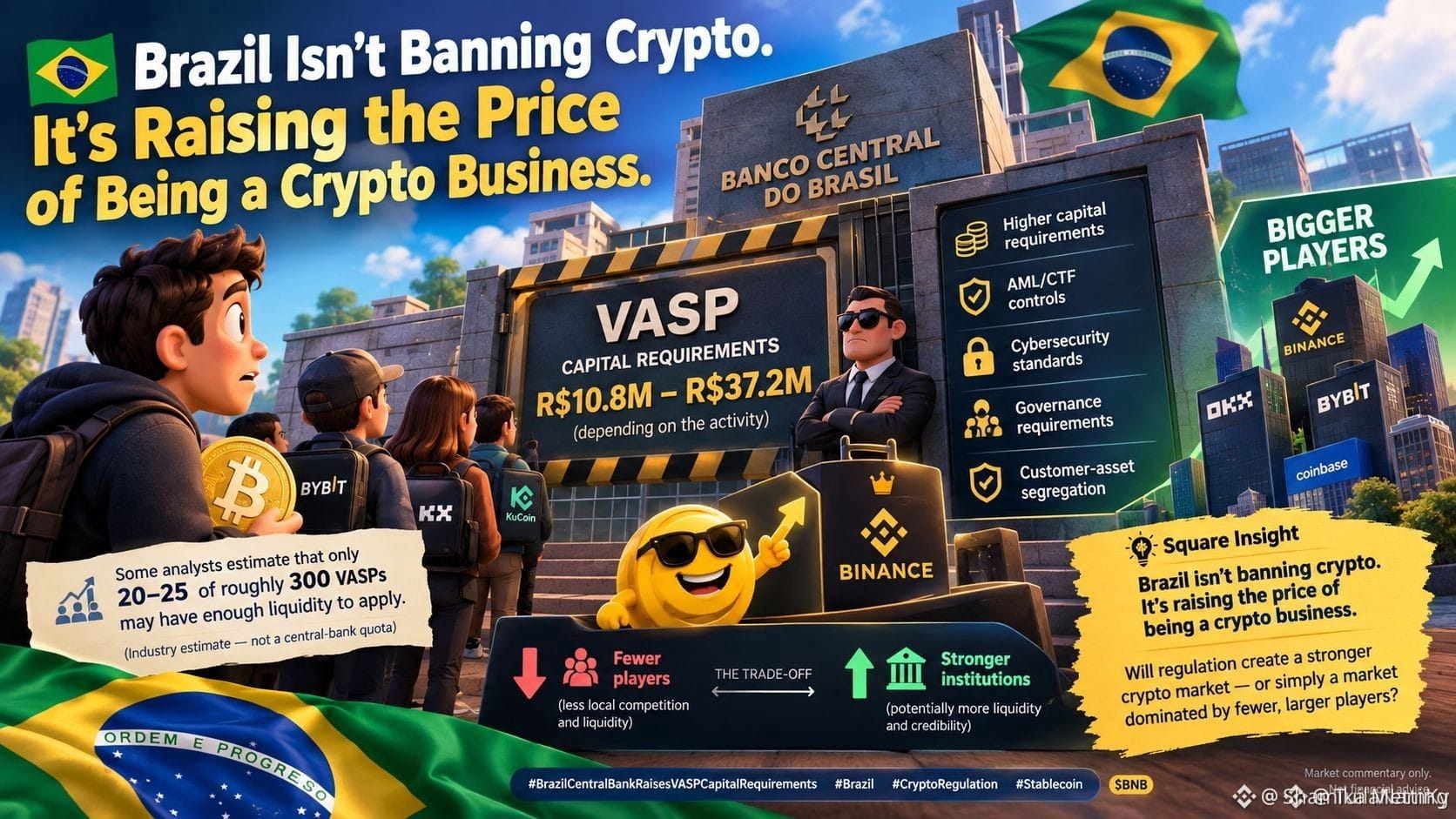
🇧🇷 Brazil does not ban cryptocurrencies. It increases the cost of operating a company in this space.
The Central Bank of Brazil has drawn up a much higher compliance bar for crypto firms.
Under the new VASP framework, companies face minimum capital requirements of approximately R$10.8M–R$37.2M, depending on what they do.
This changes the game.
Small trading platforms and crypto businesses now have to bear:
→ higher capital requirements
→ AML/CFT controls
→ cybersecurity standards
→ governance requirements
→ segregation of customer assets
And here’s the interesting part. 👀
Some analysts estimate that only 20–25 out of about 300 VASPs may have enough liquidity to apply.
But this is an industry estimate — not a specific share from the Central Bank.
🧩 The biggest shift
Regulation doesn’t necessarily mean killing crypto.
It consolidates it.
If smaller players withdraw or merge, larger platforms can gain market share, liquidity, and institutional credibility.
That’s where the indirect connection to $BNB becomes even more interesting.
$BNB
{future}(BNBUSDT)
#Brazil #CryptoRegulation #Stablecoin
Market commentary only. Not financial advice.
Please follow up
#brazilcentralbankraisesvaspcapitalrequirements
🇧🇷 Brazil does not ban cryptocurrencies. It increases the cost of operating a company in this space.
The Central Bank of Brazil has drawn up a much higher compliance bar for crypto firms.
Under the new VASP framework, companies face minimum capital requirements of approximately R$10.8M–R$37.2M, depending on what they do.
This changes the game.
Small trading platforms and crypto businesses now have to bear:
→ higher capital requirements
→ AML/CFT controls
→ cybersecurity standards
→ governance requirements
→ segregation of customer assets
And here’s the interesting part. 👀
Some analysts estimate that only 20–25 out of about 300 VASPs may have enough liquidity to apply.
But this is an industry estimate — not a specific share from the Central Bank.
🧩 The biggest shift
Regulation doesn’t necessarily mean killing crypto.
It consolidates it.
If smaller players withdraw or merge, larger platforms can gain market share, liquidity, and institutional credibility.
That’s where the indirect connection to $BNB becomes even more interesting.
$BNB
#Brazil #CryptoRegulation #Stablecoin
Market commentary only. Not financial advice.
Please follow up
🇧🇷 Brazil does not ban cryptocurrencies. It increases the cost of operating a company in this space.
The Central Bank of Brazil has drawn up a much higher compliance bar for crypto firms.
Under the new VASP framework, companies face minimum capital requirements of approximately R$10.8M–R$37.2M, depending on what they do.
This changes the game.
Small trading platforms and crypto businesses now have to bear:
→ higher capital requirements
→ AML/CFT controls
→ cybersecurity standards
→ governance requirements
→ segregation of customer assets
And here’s the interesting part. 👀
Some analysts estimate that only 20–25 out of about 300 VASPs may have enough liquidity to apply.
But this is an industry estimate — not a specific share from the Central Bank.
🧩 The biggest shift
Regulation doesn’t necessarily mean killing crypto.
It consolidates it.
If smaller players withdraw or merge, larger platforms can gain market share, liquidity, and institutional credibility.
That’s where the indirect connection to $BNB becomes even more interesting.
$BNB
#Brazil #CryptoRegulation #Stablecoin
Market commentary only. Not financial advice.
Please follow up
1
3
969

·
--
Bearish
#brazilcentralbankraisesvaspcapitalrequirements
🚨 Brazil Tightens Crypto Rules
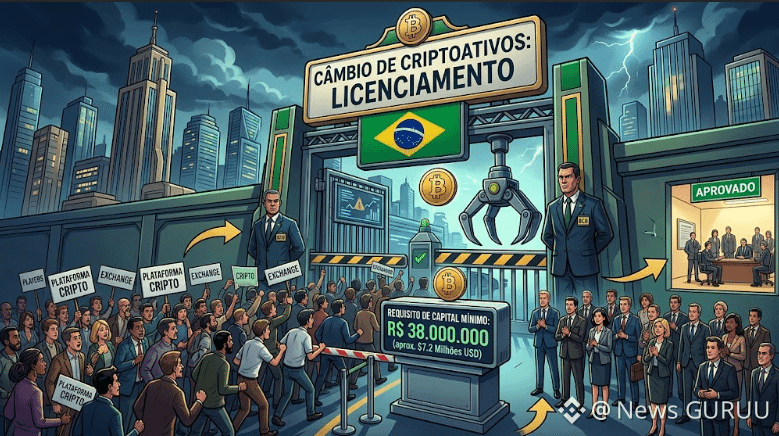
Brazil’s new crypto rules could require platforms to hold up to $7.2M in capital, creating a major barrier for smaller firms. Reports suggest only a fraction of the roughly 300 players may qualify for authorization.
⚠️ The tighter framework could accelerate consolidation across Brazil’s crypto market.
Trading View: SELL 🔴
Question: Could stricter regulation pressure Brazil’s crypto market? "CLICK ON THE BELOW YELLOW COIN TAG TO GO TO DESIRED TRADING PAGE TO GET BENEFIT TRADE"$MINA $LSK $TREE
{spot}(TREEUSDT)
{spot}(LSKUSDT)
{spot}(MINAUSDT)
#LSK #Brazil #centralbank
#brazilcentralbankraisesvaspcapitalrequirements
🚨 Brazil Tightens Crypto Rules
Brazil’s new crypto rules could require platforms to hold up to $7.2M in capital, creating a major barrier for smaller firms. Reports suggest only a fraction of the roughly 300 players may qualify for authorization.
⚠️ The tighter framework could accelerate consolidation across Brazil’s crypto market.
Trading View: SELL 🔴
Question: Could stricter regulation pressure Brazil’s crypto market? "CLICK ON THE BELOW YELLOW COIN TAG TO GO TO DESIRED TRADING PAGE TO GET BENEFIT TRADE"$MINA $LSK $TREE
#LSK #Brazil #centralbank
🚨 Brazil Tightens Crypto Rules
Brazil’s new crypto rules could require platforms to hold up to $7.2M in capital, creating a major barrier for smaller firms. Reports suggest only a fraction of the roughly 300 players may qualify for authorization.
⚠️ The tighter framework could accelerate consolidation across Brazil’s crypto market.
Trading View: SELL 🔴
Question: Could stricter regulation pressure Brazil’s crypto market? "CLICK ON THE BELOW YELLOW COIN TAG TO GO TO DESIRED TRADING PAGE TO GET BENEFIT TRADE"$MINA $LSK $TREE
#LSK #Brazil #centralbank
3
30
·
--
#brazilcentralbankraisesvaspcapitalrequirements
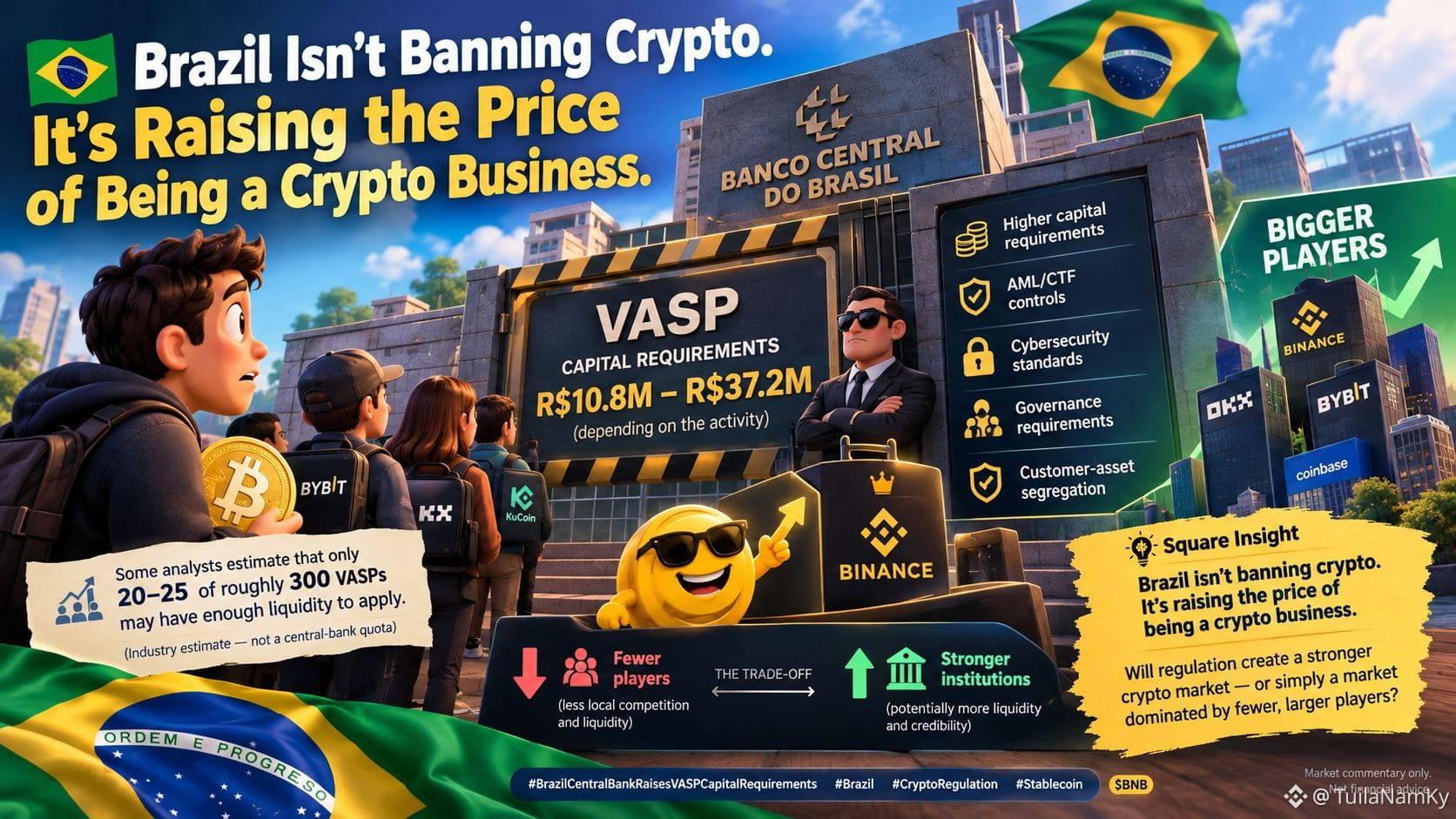
🇧🇷 Brazil Isn’t Banning Crypto. It’s Raising the Price of Being a Crypto Business.
Brazil’s central bank has drawn a much higher compliance line for crypto firms.
Under its new VASP framework, companies face minimum capital requirements of roughly R$10.8M–R$37.2M, depending on what they do.
That changes the game.
Smaller exchanges and crypto businesses now have to absorb:
→ Higher capital requirements
→ AML/CTF controls
→ Cybersecurity standards
→ Governance requirements
→ Customer-asset segregation
And here’s the interesting part. 👀
Some analysts estimate that only 20–25 of roughly 300 VASPs may have enough liquidity to apply.
But that is an industry estimate — not a central-bank quota.
🧩 THE BIGGER TWIST
Regulation doesn't necessarily kill crypto.
It can consolidate it.
If smaller players exit or merge, larger exchanges may gain market share, liquidity and institutional credibility.
That’s where the indirect connection to $BNB becomes interesting.
The beneficiaries may not be the tokens themselves.
They may be the large exchange ecosystems capable of absorbing the regulatory cost.
But there’s another risk:
Brazil is also tightening oversight around crypto-related FX and stablecoin activity.
So this isn't simply “more regulation = bullish.”
It’s a trade-off:
More compliance → fewer players → potentially stronger institutions → but potentially less local competition and liquidity.
🧠 Square Insight
Brazil isn't banning crypto. It's raising the price of being a crypto business.
The real question is: Will regulation create a stronger crypto market — or simply a market dominated by fewer, larger players?
$BNB
{future}(BNBUSDT)
#Brazil #CryptoRegulation #Stablecoin
Market commentary only. Not financial advice.
#brazilcentralbankraisesvaspcapitalrequirements
🇧🇷 Brazil Isn’t Banning Crypto. It’s Raising the Price of Being a Crypto Business.
Brazil’s central bank has drawn a much higher compliance line for crypto firms.
Under its new VASP framework, companies face minimum capital requirements of roughly R$10.8M–R$37.2M, depending on what they do.
That changes the game.
Smaller exchanges and crypto businesses now have to absorb:
→ Higher capital requirements
→ AML/CTF controls
→ Cybersecurity standards
→ Governance requirements
→ Customer-asset segregation
And here’s the interesting part. 👀
Some analysts estimate that only 20–25 of roughly 300 VASPs may have enough liquidity to apply.
But that is an industry estimate — not a central-bank quota.
🧩 THE BIGGER TWIST
Regulation doesn't necessarily kill crypto.
It can consolidate it.
If smaller players exit or merge, larger exchanges may gain market share, liquidity and institutional credibility.
That’s where the indirect connection to $BNB becomes interesting.
The beneficiaries may not be the tokens themselves.
They may be the large exchange ecosystems capable of absorbing the regulatory cost.
But there’s another risk:
Brazil is also tightening oversight around crypto-related FX and stablecoin activity.
So this isn't simply “more regulation = bullish.”
It’s a trade-off:
More compliance → fewer players → potentially stronger institutions → but potentially less local competition and liquidity.
🧠 Square Insight
Brazil isn't banning crypto. It's raising the price of being a crypto business.
The real question is: Will regulation create a stronger crypto market — or simply a market dominated by fewer, larger players?
$BNB
#Brazil #CryptoRegulation #Stablecoin
Market commentary only. Not financial advice.
🇧🇷 Brazil Isn’t Banning Crypto. It’s Raising the Price of Being a Crypto Business.
Brazil’s central bank has drawn a much higher compliance line for crypto firms.
Under its new VASP framework, companies face minimum capital requirements of roughly R$10.8M–R$37.2M, depending on what they do.
That changes the game.
Smaller exchanges and crypto businesses now have to absorb:
→ Higher capital requirements
→ AML/CTF controls
→ Cybersecurity standards
→ Governance requirements
→ Customer-asset segregation
And here’s the interesting part. 👀
Some analysts estimate that only 20–25 of roughly 300 VASPs may have enough liquidity to apply.
But that is an industry estimate — not a central-bank quota.
🧩 THE BIGGER TWIST
Regulation doesn't necessarily kill crypto.
It can consolidate it.
If smaller players exit or merge, larger exchanges may gain market share, liquidity and institutional credibility.
That’s where the indirect connection to $BNB becomes interesting.
The beneficiaries may not be the tokens themselves.
They may be the large exchange ecosystems capable of absorbing the regulatory cost.
But there’s another risk:
Brazil is also tightening oversight around crypto-related FX and stablecoin activity.
So this isn't simply “more regulation = bullish.”
It’s a trade-off:
More compliance → fewer players → potentially stronger institutions → but potentially less local competition and liquidity.
🧠 Square Insight
Brazil isn't banning crypto. It's raising the price of being a crypto business.
The real question is: Will regulation create a stronger crypto market — or simply a market dominated by fewer, larger players?
$BNB
#Brazil #CryptoRegulation #Stablecoin
Market commentary only. Not financial advice.
2
1.1k


·
--
Bullish
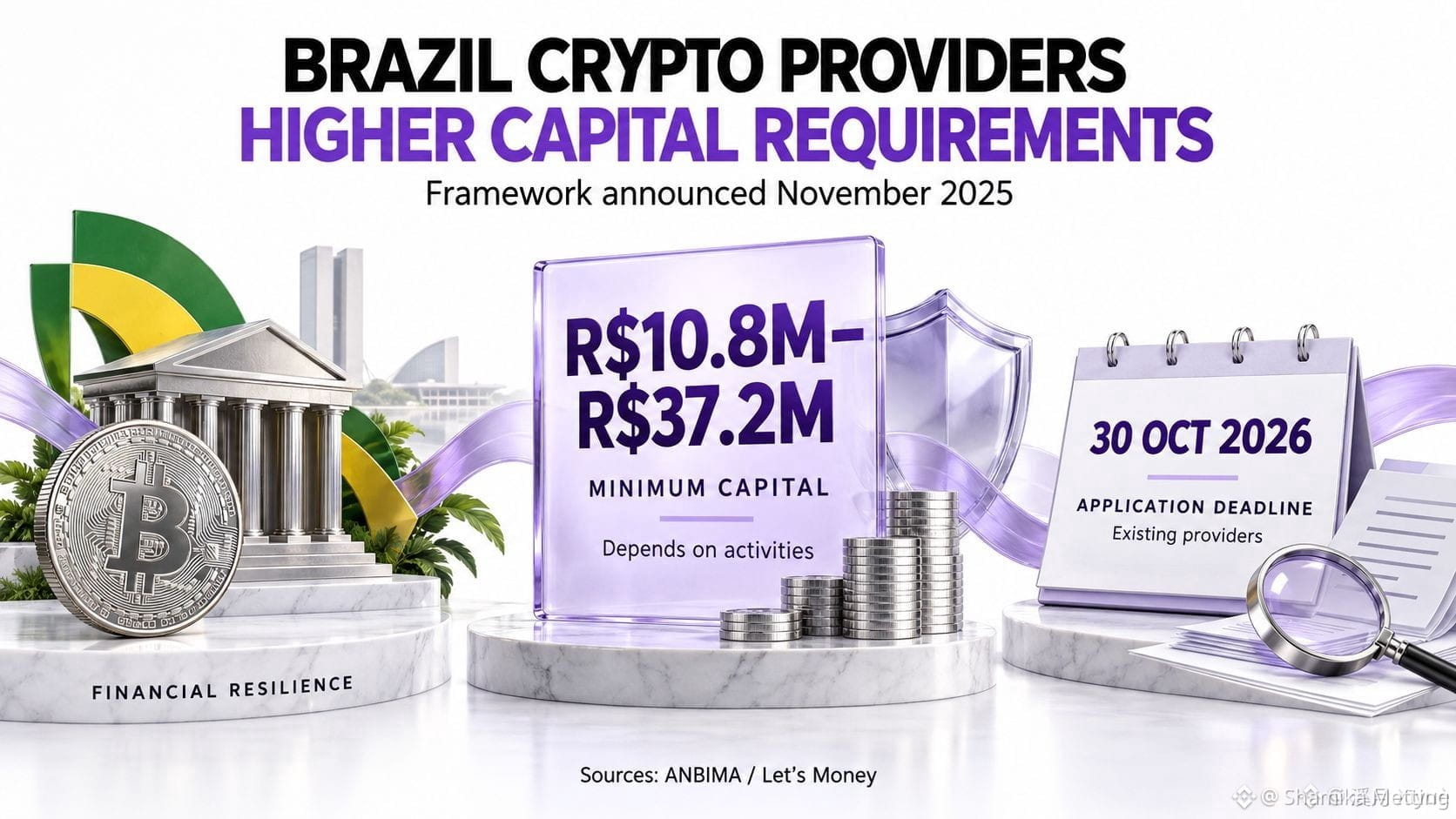
#brazilcentralbankraisesvaspcapitalrequirements
Brazil’s Crypto Capital Requirements Could Reshape Competition
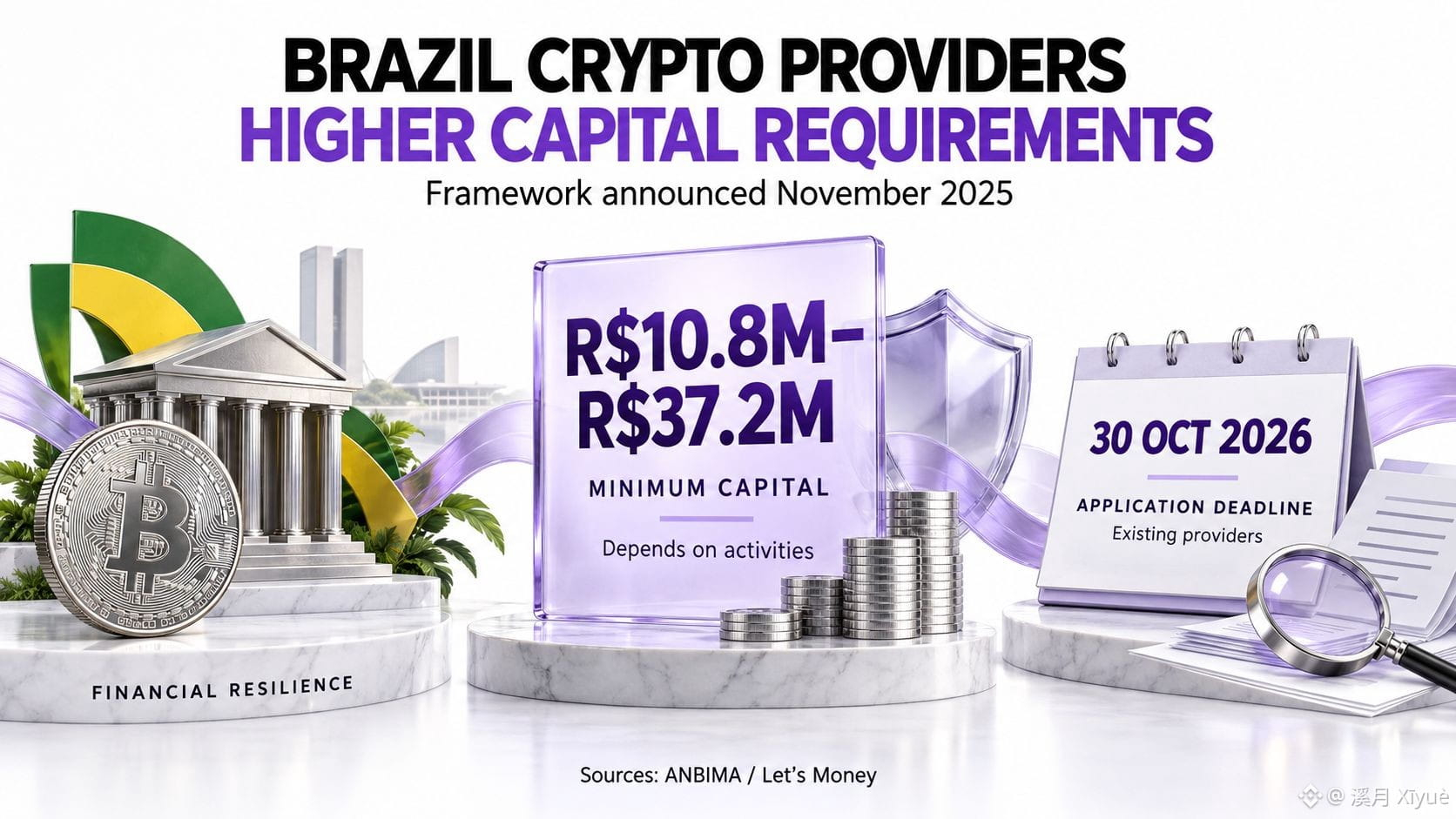
Brazil’s crypto licensing framework sets minimum capital requirements ranging from R$10.8 million to R$37.2 million, depending on the activities a provider offers.
According to ANBIMA, the final requirements are significantly higher than the amounts originally proposed during public consultation. Providers also face obligations covering governance, cybersecurity, operational risk and segregation of client assets.
The timing matters: these capital levels come from the November 2025 framework, with the main rules taking effect in February 2026. Existing providers face an October 30, 2026 deadline to submit authorization applications.
My take: Stronger capital buffers can help firms absorb losses and maintain operations during difficult periods. Their effectiveness also depends on custody controls, transparent accounting and how client assets are protected.
The competitive impact deserves attention. Larger firms may spread compliance costs across more customers. Smaller providers could need additional funding, partnerships or a narrower range of services to make their businesses viable.
For users, the outcome will show up in practical ways: platform reliability, withdrawal handling, fees and the number of credible providers available.
I would watch authorization progress and changes to services as the application deadline approaches.
Can Brazil strengthen crypto businesses financially while preserving enough competition to benefit users?
#BrazilCentralBankRaisesVASPCapitalRequirements #CryptoRegulation #Brazil
$CVC $REZ $KOMA
{future}(KOMAUSDT)
{future}(REZUSDT)
{future}(CVCUSDT)
#brazilcentralbankraisesvaspcapitalrequirements
Brazil’s Crypto Capital Requirements Could Reshape Competition
Brazil’s crypto licensing framework sets minimum capital requirements ranging from R$10.8 million to R$37.2 million, depending on the activities a provider offers.
According to ANBIMA, the final requirements are significantly higher than the amounts originally proposed during public consultation. Providers also face obligations covering governance, cybersecurity, operational risk and segregation of client assets.
The timing matters: these capital levels come from the November 2025 framework, with the main rules taking effect in February 2026. Existing providers face an October 30, 2026 deadline to submit authorization applications.
My take: Stronger capital buffers can help firms absorb losses and maintain operations during difficult periods. Their effectiveness also depends on custody controls, transparent accounting and how client assets are protected.
The competitive impact deserves attention. Larger firms may spread compliance costs across more customers. Smaller providers could need additional funding, partnerships or a narrower range of services to make their businesses viable.
For users, the outcome will show up in practical ways: platform reliability, withdrawal handling, fees and the number of credible providers available.
I would watch authorization progress and changes to services as the application deadline approaches.
Can Brazil strengthen crypto businesses financially while preserving enough competition to benefit users?
#BrazilCentralBankRaisesVASPCapitalRequirements #CryptoRegulation #Brazil
$CVC $REZ $KOMA
Brazil’s Crypto Capital Requirements Could Reshape Competition
Brazil’s crypto licensing framework sets minimum capital requirements ranging from R$10.8 million to R$37.2 million, depending on the activities a provider offers.
According to ANBIMA, the final requirements are significantly higher than the amounts originally proposed during public consultation. Providers also face obligations covering governance, cybersecurity, operational risk and segregation of client assets.
The timing matters: these capital levels come from the November 2025 framework, with the main rules taking effect in February 2026. Existing providers face an October 30, 2026 deadline to submit authorization applications.
My take: Stronger capital buffers can help firms absorb losses and maintain operations during difficult periods. Their effectiveness also depends on custody controls, transparent accounting and how client assets are protected.
The competitive impact deserves attention. Larger firms may spread compliance costs across more customers. Smaller providers could need additional funding, partnerships or a narrower range of services to make their businesses viable.
For users, the outcome will show up in practical ways: platform reliability, withdrawal handling, fees and the number of credible providers available.
I would watch authorization progress and changes to services as the application deadline approaches.
Can Brazil strengthen crypto businesses financially while preserving enough competition to benefit users?
#BrazilCentralBankRaisesVASPCapitalRequirements #CryptoRegulation #Brazil
$CVC $REZ $KOMA
215

·
--
Bullish
🚨 BRAZIL JUST CHANGED THE CRYPTO GAME! 🇧🇷
Brazil’s Central Bank is raising capital requirements for VASPs — and traders should NOT ignore this. ⚠️
📉 Weak/small platforms could face pressure or consolidation
🏦 Stronger exchanges may capture more liquidity
💰 Higher compliance could attract bigger institutional money
🔥 Less risky platforms = potentially more confidence in the market
For traders, the real question is:
WHO BENEFITS FROM THIS MOVE — AND WHICH CRYPTO PLATFORMS GET HIT? 👀
This could trigger capital rotation, liquidity shifts and volatility across the crypto sector.
🎯 Watch exchange-related tokens + BTC/ETH market reaction closely.
Bullish regulation or bearish pressure? DROP YOUR CALL 👇
$BTC $ETH
#Brazil #cryptotrading #ETH #CryptoNews
#brazilcentralbankraisesvaspcapitalrequirements
🚨 BRAZIL JUST CHANGED THE CRYPTO GAME! 🇧🇷
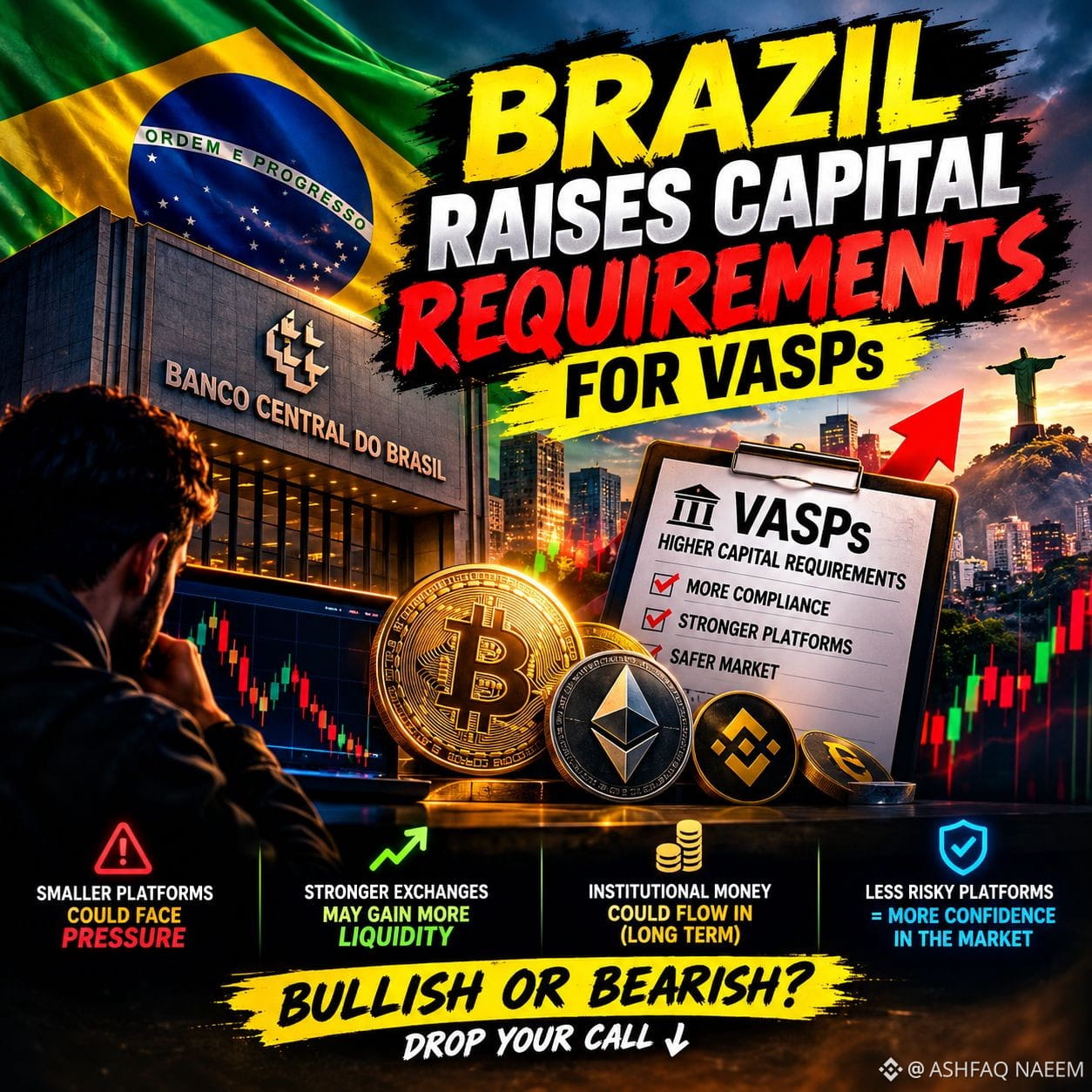
Brazil’s Central Bank is raising capital requirements for VASPs — and traders should NOT ignore this. ⚠️
📉 Weak/small platforms could face pressure or consolidation
🏦 Stronger exchanges may capture more liquidity
💰 Higher compliance could attract bigger institutional money
🔥 Less risky platforms = potentially more confidence in the market
For traders, the real question is:
WHO BENEFITS FROM THIS MOVE — AND WHICH CRYPTO PLATFORMS GET HIT? 👀
This could trigger capital rotation, liquidity shifts and volatility across the crypto sector.
🎯 Watch exchange-related tokens + BTC/ETH market reaction closely.
Bullish regulation or bearish pressure? DROP YOUR CALL 👇
$BTC $ETH
#Brazil #cryptotrading #ETH #CryptoNews
#brazilcentralbankraisesvaspcapitalrequirements
Brazil’s Central Bank is raising capital requirements for VASPs — and traders should NOT ignore this. ⚠️
📉 Weak/small platforms could face pressure or consolidation
🏦 Stronger exchanges may capture more liquidity
💰 Higher compliance could attract bigger institutional money
🔥 Less risky platforms = potentially more confidence in the market
For traders, the real question is:
WHO BENEFITS FROM THIS MOVE — AND WHICH CRYPTO PLATFORMS GET HIT? 👀
This could trigger capital rotation, liquidity shifts and volatility across the crypto sector.
🎯 Watch exchange-related tokens + BTC/ETH market reaction closely.
Bullish regulation or bearish pressure? DROP YOUR CALL 👇
$BTC $ETH
#Brazil #cryptotrading #ETH #CryptoNews
#brazilcentralbankraisesvaspcapitalrequirements
69
#BrazilCentralBankRaisesVASPCapitalRequirements
Capital requirements in Brazil for the crypto sector are reshaping competition
Brazil’s digital asset licensing framework sets minimum capital requirements ranging from 10.8 million reais to 37.2 million reais, depending on the activities offered by the provider.
According to the ANBIMA Association, the final requirements are far higher than the amounts originally proposed during public consultations. Providers also face obligations including governance, cybersecurity, operational risk, and the segregation/segregation of client assets.
Timing matters: these capital levels come from the November 2025 framework, while the main rules begin in February 2026. Service providers have a deadline of 30 October 2026 to submit licensing applications.
My view: stronger capital buffers can help companies absorb losses and keep operations running during difficult periods. Their effectiveness also depends on custody controls, transparent accounting, and how client assets are protected.
Competitive impacts deserve attention. Larger firms may be able to spread compliance costs across a greater number of customers. Smaller providers may need additional funding, partnerships, or a narrower scope of services to keep their businesses viable.
Please follow up
#BrazilCentralBankRaisesVASPCapitalRequirements #CryptoRegulation #Brazil
$CVC $REZ $KOMA
#BrazilCentralBankRaisesVASPCapitalRequirements
Capital requirements in Brazil for the crypto sector are reshaping competition
Brazil’s digital asset licensing framework sets minimum capital requirements ranging from 10.8 million reais to 37.2 million reais, depending on the activities offered by the provider.
According to the ANBIMA Association, the final requirements are far higher than the amounts originally proposed during public consultations. Providers also face obligations including governance, cybersecurity, operational risk, and the segregation/segregation of client assets.
Timing matters: these capital levels come from the November 2025 framework, while the main rules begin in February 2026. Service providers have a deadline of 30 October 2026 to submit licensing applications.
My view: stronger capital buffers can help companies absorb losses and keep operations running during difficult periods. Their effectiveness also depends on custody controls, transparent accounting, and how client assets are protected.
Competitive impacts deserve attention. Larger firms may be able to spread compliance costs across a greater number of customers. Smaller providers may need additional funding, partnerships, or a narrower scope of services to keep their businesses viable.
Please follow up
#BrazilCentralBankRaisesVASPCapitalRequirements #CryptoRegulation #Brazil
$CVC $REZ $KOMA
Capital requirements in Brazil for the crypto sector are reshaping competition
Brazil’s digital asset licensing framework sets minimum capital requirements ranging from 10.8 million reais to 37.2 million reais, depending on the activities offered by the provider.
According to the ANBIMA Association, the final requirements are far higher than the amounts originally proposed during public consultations. Providers also face obligations including governance, cybersecurity, operational risk, and the segregation/segregation of client assets.
Timing matters: these capital levels come from the November 2025 framework, while the main rules begin in February 2026. Service providers have a deadline of 30 October 2026 to submit licensing applications.
My view: stronger capital buffers can help companies absorb losses and keep operations running during difficult periods. Their effectiveness also depends on custody controls, transparent accounting, and how client assets are protected.
Competitive impacts deserve attention. Larger firms may be able to spread compliance costs across a greater number of customers. Smaller providers may need additional funding, partnerships, or a narrower scope of services to keep their businesses viable.
Please follow up
#BrazilCentralBankRaisesVASPCapitalRequirements #CryptoRegulation #Brazil
$CVC $REZ $KOMA
1
1
58

·
--
#brazilcentralbankraisesvaspcapitalrequirements
Regulatory Watch & Market Impact
Regulatory Watch: Brazil Central Bank Increases Capital Demands for VASPs
The Central Bank of Brazil (BCB) has finalized its updated regulatory guidelines for Virtual Asset Service Providers (VASPs), raising capital requirements to a range between 10.8 million and 37.2 million BRL (~$2.1M to $7.2M USD) based on operating activities and risk profiles.
This regulatory adjustment introduces stricter capital adequacy metrics, mandatory third-party auditing, robust proof-of-reserves frameworks, asset segregation mandates, and expanded anti-money laundering (AML) controls.
Core Drivers & Market Implications:
Major Market Consolidation: Out of approximately 300 active crypto exchanges in Brazil, analysts estimate that only 20 to 25 platforms have the liquidity to apply for licensing, with as few as 10 ultimately securing full authorization. Unlicensed entities face a mandatory wind-down period starting after the October 30, 2026 application cutoff.
Institutional Capital Safeguards: Requiring local corporate entities and strict client-asset segregation eliminates pooled-liquidity risks, restoring confidence among institutional funds and banking partners.
Liquidity Compression: Smaller domestic platforms are scaling back or discontinuing retail trading operations, which may compress local fiat-to-crypto liquidity in the short term while benefiting major global exchanges.
Discussion:
Will stricter VASP requirements in Brazil boost long-term market security and institutional adoption, or will elevated entry barriers stifle startup innovation across Latin America? 📈
Share your market perspectives below! 👇
#Brazil #CryptoRegulation #BinanceSquare
#brazilcentralbankraisesvaspcapitalrequirements
Regulatory Watch & Market Impact
Regulatory Watch: Brazil Central Bank Increases Capital Demands for VASPs
The Central Bank of Brazil (BCB) has finalized its updated regulatory guidelines for Virtual Asset Service Providers (VASPs), raising capital requirements to a range between 10.8 million and 37.2 million BRL (~$2.1M to $7.2M USD) based on operating activities and risk profiles.
This regulatory adjustment introduces stricter capital adequacy metrics, mandatory third-party auditing, robust proof-of-reserves frameworks, asset segregation mandates, and expanded anti-money laundering (AML) controls.
Core Drivers & Market Implications:
Major Market Consolidation: Out of approximately 300 active crypto exchanges in Brazil, analysts estimate that only 20 to 25 platforms have the liquidity to apply for licensing, with as few as 10 ultimately securing full authorization. Unlicensed entities face a mandatory wind-down period starting after the October 30, 2026 application cutoff.
Institutional Capital Safeguards: Requiring local corporate entities and strict client-asset segregation eliminates pooled-liquidity risks, restoring confidence among institutional funds and banking partners.
Liquidity Compression: Smaller domestic platforms are scaling back or discontinuing retail trading operations, which may compress local fiat-to-crypto liquidity in the short term while benefiting major global exchanges.
Discussion:
Will stricter VASP requirements in Brazil boost long-term market security and institutional adoption, or will elevated entry barriers stifle startup innovation across Latin America? 📈
Share your market perspectives below! 👇
#Brazil #CryptoRegulation #BinanceSquare
Regulatory Watch & Market Impact
Regulatory Watch: Brazil Central Bank Increases Capital Demands for VASPs
The Central Bank of Brazil (BCB) has finalized its updated regulatory guidelines for Virtual Asset Service Providers (VASPs), raising capital requirements to a range between 10.8 million and 37.2 million BRL (~$2.1M to $7.2M USD) based on operating activities and risk profiles.
This regulatory adjustment introduces stricter capital adequacy metrics, mandatory third-party auditing, robust proof-of-reserves frameworks, asset segregation mandates, and expanded anti-money laundering (AML) controls.
Core Drivers & Market Implications:
Major Market Consolidation: Out of approximately 300 active crypto exchanges in Brazil, analysts estimate that only 20 to 25 platforms have the liquidity to apply for licensing, with as few as 10 ultimately securing full authorization. Unlicensed entities face a mandatory wind-down period starting after the October 30, 2026 application cutoff.
Institutional Capital Safeguards: Requiring local corporate entities and strict client-asset segregation eliminates pooled-liquidity risks, restoring confidence among institutional funds and banking partners.
Liquidity Compression: Smaller domestic platforms are scaling back or discontinuing retail trading operations, which may compress local fiat-to-crypto liquidity in the short term while benefiting major global exchanges.
Discussion:
Will stricter VASP requirements in Brazil boost long-term market security and institutional adoption, or will elevated entry barriers stifle startup innovation across Latin America? 📈
Share your market perspectives below! 👇
#Brazil #CryptoRegulation #BinanceSquare

3
2
178
Log in to explore more content
Join global crypto users on Binance Square
⚡️ Get latest and useful information about crypto.
💬 Trusted by the world’s largest crypto exchange.
👍 Discover real insights from verified creators.
Email / Phone number
Trending Topics
1
#ADAGains10%Above$0.27
10,426 views
153 Discussing
2
#ETHUp70%InQ3ButLiquidityFalls
117,270 views
924 Discussing
3
#EthStakingExitQueueHits2026High
42,459 views
674 Discussing
4
#FedOctoberHoldOdds82.3%
41,055 views
633 Discussing
5
#Nikkei225Jumps2.5%ToThreeMonthHigh
71,465 views
1,007 Discussing
6
#CircleMints$2.75BUSDCOnSolanaIn7Days
1,438 views
38 Discussing
7
#DriftHackVictimsBeginClaims
161,056 views
1,667 Discussing
8
#SolanaTokenizedStockVolumeTops$4.4BInSeptember
12,556 views
130 Discussing
9
#BitcoinSpotETFsDraw$6.34BInflowsInQ3
51,437 views
261 Discussing
10
#EthereumValidatorExitQueueJumps392%
292,309 views
2,530 Discussing