

Shamika Metting
11.9k Posts

Shamika Metting
Report
Block User
Binance square.
256 Following
3.8K+ Followers
28.8K+ Liked
Posts
Portfolio
All
Quotes
Videos
#HKDollarStablecoinHKDAPToLaunchOnSolana
🇭🇰🚀 A historic milestone: HKDAP, the first Hong Kong dollar stablecoin, is making its way to Solana!
Anchorpoint has announced a strategic agreement that will enable HKDAP (a stablecoin pegged to the Hong Kong dollar) to be available on the Solana network. This marks HKDAP’s first collaboration with a public blockchain, where tokens can be issued and redeemed directly and easily on the faster network.
🛠️ The goal: 1 HKDAP is worth approximately one Hong Kong dollar. The aim is to make your Hong Kong dollar payments seamless, fast, and less expensive, while also simplifying the purchase and sale of digital assets (RWA). 💳📲
🚧 Important note: HKDAP on Solana does not mean it is immediately available to everyone! According to reports, the project is still currently in the testing phase, and transfers to unapproved wallets are strictly prohibited. No date has been set yet for the service’s public launch on Solana.
🤔 What do you think of this move by Solana in Asia? Share your analysis in the comments! 👇
Please follow
$BEAMX
$IRYS
$SOXSB
#SOL空投 #solana #HKDAP #HKDollarStablecoinHKDAPToLaunchOnSolana

3
49
$SOL down 6.3% to $94.3 over 24 hours, and 9.1% over the week. Focus: expanding HKDAP to Solana.
Anchorpoint, backed by Standard Chartered, will launch native HKDAP on Solana for retail payments and tokenized assets.
24-hour trading volume: $5.8 billion, or 10% of market capitalization. Ranked seventh by market capitalization; bearish momentum remains dominant#Write2Earrn
Please follow
#HKDollarStablecoinHKDAPToLaunchOnSolana
4
137
🚨 The HKD stablecoin is about to launch on Solana!
A new development in the stablecoin space is bringing the Hong Kong dollar to the Solana ecosystem.
The highly anticipated Hong Kong dollar-pegged stablecoin could expand access to digital dollar payments, improve on-chain liquidity, and strengthen Solana’s position in the global stablecoin market.
Why it matters:
More stablecoins on Solana could mean more payment options, deeper liquidity, and wider adoption of blockchain-based financial services.
The key question is whether this launch can attract real users and meaningful transaction volume.
Could Hong Kong dollar-pegged stablecoins become the next big growth story on Solana?
Please follow
#hkdollarstablecoinhkdaptolaunchonsolana $SOL
{future}(SOLUSDT)
🚨 The HKD stablecoin is about to launch on Solana!
A new development in the stablecoin space is bringing the Hong Kong dollar to the Solana ecosystem.
The highly anticipated Hong Kong dollar-pegged stablecoin could expand access to digital dollar payments, improve on-chain liquidity, and strengthen Solana’s position in the global stablecoin market.
Why it matters:
More stablecoins on Solana could mean more payment options, deeper liquidity, and wider adoption of blockchain-based financial services.
The key question is whether this launch can attract real users and meaningful transaction volume.
Could Hong Kong dollar-pegged stablecoins become the next big growth story on Solana?
Please follow
#hkdollarstablecoinhkdaptolaunchonsolana $SOL

1
28
The debate over cryptocurrency taxation is heating up, as Uniswap and Andreessen Horowitz (a16z) push to exempt decentralized finance from Illinois’ proposed cryptocurrency tax rules. They are concerned that DeFi protocols and non-custodial platforms could face unfair tax burdens, potentially slowing innovation and making cryptocurrency development more difficult. DeFi platforms allow users to trade and manage digital assets without traditional intermediaries, so applying conventional financial tax rules could pose significant challenges. This could be an important moment for the cryptocurrency industry in the United States, as regulators must balance fair taxation with protecting investors and innovation. 🚀
The main concern is that the proposed 0.2% tax would be calculated on the transaction value, not just trading profits. Uniswap, a16z, and the DeFi Education Fund want withdrawals from wallets and transfers between blockchains to be exempt, and they oppose requirements to keep records of private keys. Illinois has agreed to delay implementation of the rules until July 1, 2027, pending court approval. The outcome could affect how other U.S. states approach taxing decentralized finance. The Defiant +2
What do you think 🤔?
Please follow
#UniswapA16zSeekDeFiExemptionFromIllinoisCryptoTax

1
183
Verified
🚨 South Korea’s KOSPI market is under severe pressure! 🇰🇷
📉 South Korea’s KOSPI index saw a sharp sell-off, falling around 3.5% and dropping below the psychologically important 6,000 level.
🔥 What’s behind the decline?
🔹 Heavy selling by foreign investors
🔹 Weakness in major semiconductor stocks
🔹 Concerns about the profitability of AI investments
🔹 Growing uncertainty in global technology markets
📊 Samsung Electronics and SK Hynix were among the major stocks facing significant selling pressure.
⚠️ Why does this matter?
South Korea is a key player in the global semiconductor industry. Weakness in its stock market could also affect investor sentiment in Asian and global markets.
💬 Your turn:
Is this a temporary market correction or the start of a bigger decline?
Will Bitcoin and cryptocurrency markets be affected?
👇 Share your thoughts!
Please follow
#KOSPI #كوريا_الجنوبية #Stock_Market #أخبار_العملات_المشفرة #Bitcoin #الأسواق_العالمية #Semiconductors #التداول #kospifalls3.53%backbelow6000
1
1
1.6k
#KOSPIFalls3.53%BackBelow6000
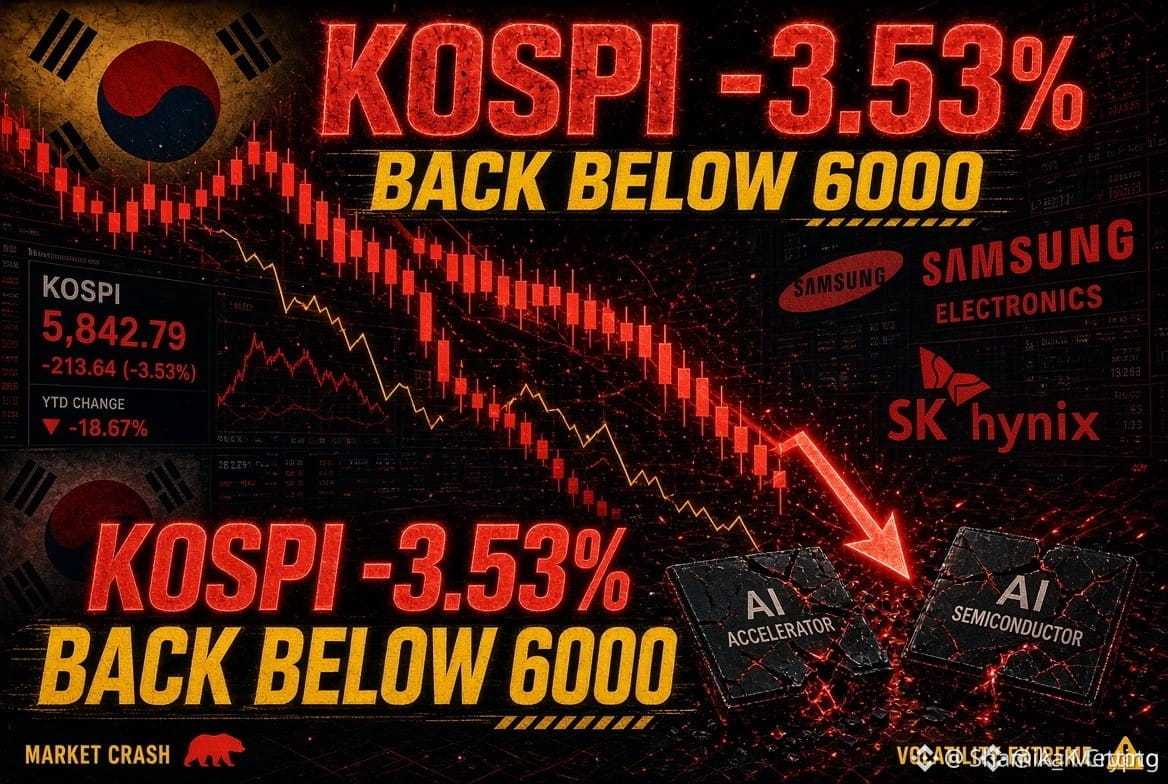
📉 South Korea’s benchmark index closed at around 5,731 after a sharp sell-off. The «$GOOGL shock» and concerns about AI profitability weighed heavily, sending Samsung and SK Hynix shares lower. The sell-side «sidecar» mechanism had been activated earlier. Foreign investors also dumped their shares.
This is a classic example of risk aversion spreading from the U.S. tech sector. The heavy weighting of semiconductors in Korea makes the KOSPI highly sensitive to AI hype cycles. The short-term pain is real, but high-quality chipmakers often rebound once the panic subsides. Watch for a reversal in foreign investor flows and any signals from the Federal Reserve. Stay disciplined — volatility creates opportunities for patient capital. 🛡️
Please follow
#KOSPI #Samsung #SKhynix #AI #Stocks #BinanceSquare
1
106
#binancewilllistpredictpredict
⏸️ PREDICT listing on hold: what we know so far
Binance announced the launch of spot trading for Predict (PREDICT) with a Seed Tag, scheduled to begin on October 30 at 10:00 UTC. The launch was then postponed until further notice, and Binance Wallet also indicated that PREDICT Alpha trading had been delayed.
Context, verified across multiple sources:
• Binance also reported a security incident: its impact is estimated at around $6.3 billion, of which about $3 billion has been frozen, with deposits and withdrawals temporarily suspended (Binance, CNBC, and AP).
• Binance says user funds are safe and that losses will be covered by the SAFU fund and company funds.
• Binance has not linked the postponement to the incident, so any assumed connection between them remains speculation.
Predict is a prediction market on BNB Chain, backed by YZi Labs.
What I’m watching:
1️⃣ A new launch date, announced only through Binance’s official channels
2️⃣ The promised post-incident analysis and an update to the proof of reserves
3️⃣ Seed Tag volatility at launch: shallow order books and wide spreads
⚠️ Posts saying “trading starts today” are no longer up to date. This is not financial advice.
Will you trade as soon as trading begins, or wait until things become clearer? 👇
Please follow
$BEAMX
{future}(BEAMXUSDT)
#binancewilllistpredictpredict
⏸️ PREDICT listing on hold: what we know so far
Binance announced the launch of spot trading for Predict (PREDICT) with a Seed Tag, scheduled to begin on October 30 at 10:00 UTC. The launch was then postponed until further notice, and Binance Wallet also indicated that PREDICT Alpha trading had been delayed.
Context, verified across multiple sources:
• Binance also reported a security incident: its impact is estimated at around $6.3 billion, of which about $3 billion has been frozen, with deposits and withdrawals temporarily suspended (Binance, CNBC, and AP).
• Binance says user funds are safe and that losses will be covered by the SAFU fund and company funds.
• Binance has not linked the postponement to the incident, so any assumed connection between them remains speculation.
Predict is a prediction market on BNB Chain, backed by YZi Labs.
What I’m watching:
1️⃣ A new launch date, announced only through Binance’s official channels
2️⃣ The promised post-incident analysis and an update to the proof of reserves
3️⃣ Seed Tag volatility at launch: shallow order books and wide spreads
⚠️ Posts saying “trading starts today” are no longer up to date. This is not financial advice.
Will you trade as soon as trading begins, or wait until things become clearer? 👇
Please follow
$BEAMX

1
39
Verified
🚨 $AMZN Drops 7% Before Market Open — Even AWS Growth Can't Save Amazon! 📉🔥
Amazon just reported its third-quarter earnings, and Wall Street isn't happy. 👀
The problem? AI is growing fast, but it costs a fortune.
📊 Here's what happened:
🔴 $AMZN: Down 7% before the market opened
💰 Revenue: $201.9 billion, slightly below expectations
☁️ AWS revenue: $46 billion (+39%)
💸 Free cash flow: -$42.4 billion over the past twelve months
🔥 2026 capital expenditure forecast: $220 billion
Amazon says AI spending could rise even further in 2027.
So, what's the real question?…
If AWS is growing this fast, why are investors selling their shares?
Because Wall Street is no longer willing to pay for AI growth alone.
It wants to see returns.
🐂 Bullish: Buyers absorb the post-earnings sell-off → stabilizes at $AMZN → a comfortable rebound could follow.
🐻 Bearish: Cash-flow concerns persist → tech selling accelerates → another wave of declines.
⚠️ The biggest trap?
Buying the stock after a 7% drop just because Amazon is a tech giant.
A strong company doesn't always mean a strong stock.
This is not financial advice. Do your own research.
Please follow
#amazonsharesfallabout7%inpremarkettrading #$1.5BInLeveragedCryptoBetsLiquidated #KOSPIFalls3.53%BackBelow6000 #USMidtermElections #StrategySTRCReaches$99.95ForFirstTimeIn165Days
🚨 $AMZN Drops 7% Before Market Open — Even AWS Growth Can't Save Amazon! 📉🔥
Amazon just reported its third-quarter earnings, and Wall Street isn't happy. 👀
The problem? AI is growing fast, but it costs a fortune.
📊 Here's what happened:
🔴 $AMZN : Down 7% before the market opened
💰 Revenue: $201.9 billion, slightly below expectations
☁️ AWS revenue: $46 billion (+39%)
💸 Free cash flow: -$42.4 billion over the past twelve months
🔥 2026 capital expenditure forecast: $220 billion
Amazon says AI spending could rise even further in 2027.
So, what's the real question?…
If AWS is growing this fast, why are investors selling their shares?
Because Wall Street is no longer willing to pay for AI growth alone.
It wants to see returns.
🐂 Bullish: Buyers absorb the post-earnings sell-off → stabilizes at $AMZN → a comfortable rebound could follow.
🐻 Bearish: Cash-flow concerns persist → tech selling accelerates → another wave of declines.
⚠️ The biggest trap?
Buying the stock after a 7% drop just because Amazon is a tech giant.
A strong company doesn't always mean a strong stock.
This is not financial advice. Do your own research.
Please follow
#amazonsharesfallabout7%inpremarkettrading #$1.5BInLeveragedCryptoBetsLiquidated #KOSPIFalls3.53%BackBelow6000 #USMidtermElections #StrategySTRCReaches$99.95ForFirstTimeIn165Days
1
1k
Wall Street punishes excessive spending on AI:
Amazon ($AMZNB ) falls -7.30% in after-hours trading, while Apple ($AAPL) establishes itself as a safe haven.
The S&P 500 ($SPX) slides toward 7,650 points (-0.91%) at the October monthly close, after consecutive blows hit Alphabet and Amazon.
Among Big Tech companies:
- Amazon ($AMZN ): Severe punishment: after falling -4.25% during the regular trading session to $243.79, it plunged to $225.99 in after-hours trading (low of $220.17), amid concerns over its $220,000M infrastructure spending.
- Strength in Apple ($AAPLB ): The stock rose +1.48% to $348.91, and climbed to $352.05 (+0.90%) after its results, attracting institutional flows fleeing excessive capital expenditure.
- Month-end pressure on $SPX: In addition to Alphabet's ($GOOGLB ) sharp -12% drop, the index is testing the key support level at 7,650 points on the last business day of October.
Will funds take advantage of $AMZN falling below $225, or will the defensive shift toward $AAPLB continue? 📉
Please follow
#AmazonSharesFallAbout7%InPremarketTrading
1
54
#AmazonSharesFallAbout7%InPremarketTrading ding
🚨 Amazon shares fall 7%: Has AI spending become too expensive?
Amazon ($AMZN) is facing strong selling pressure after its third-quarter 2026 results disappointed Wall Street. Shares fell about 7% in premarket trading on Friday.
Here’s what caught investors’ attention:
- Revenue was $201.94 billion, slightly below expectations of around $202.2 billion.
- Earnings per share were $1.89, compared with expectations of $1.97.
- AWS revenue jumped 39.3% to $46 billion, marking its fastest growth in nearly five years.
- Trailing twelve-month free cash flow turned negative, coming in at $42.4 billion, largely due to massive investments in AI infrastructure.
My take: Amazon’s cloud business is growing impressively, but investors are becoming increasingly concerned about how much Big Tech companies are spending to build AI infrastructure. Growth alone is no longer enough; the market wants to see tangible returns on this investment.
I’ll be watching AWS growth, cash flow, and management’s future spending plans before judging the next move.
Is this an opportunity to buy $AMZN, or could further declines be on the horizon? What do you think? 👇
Please follow
#AMZN #EarningsSeas
1
43
#AmazonSharesFallAbout7%InPremarketTrading
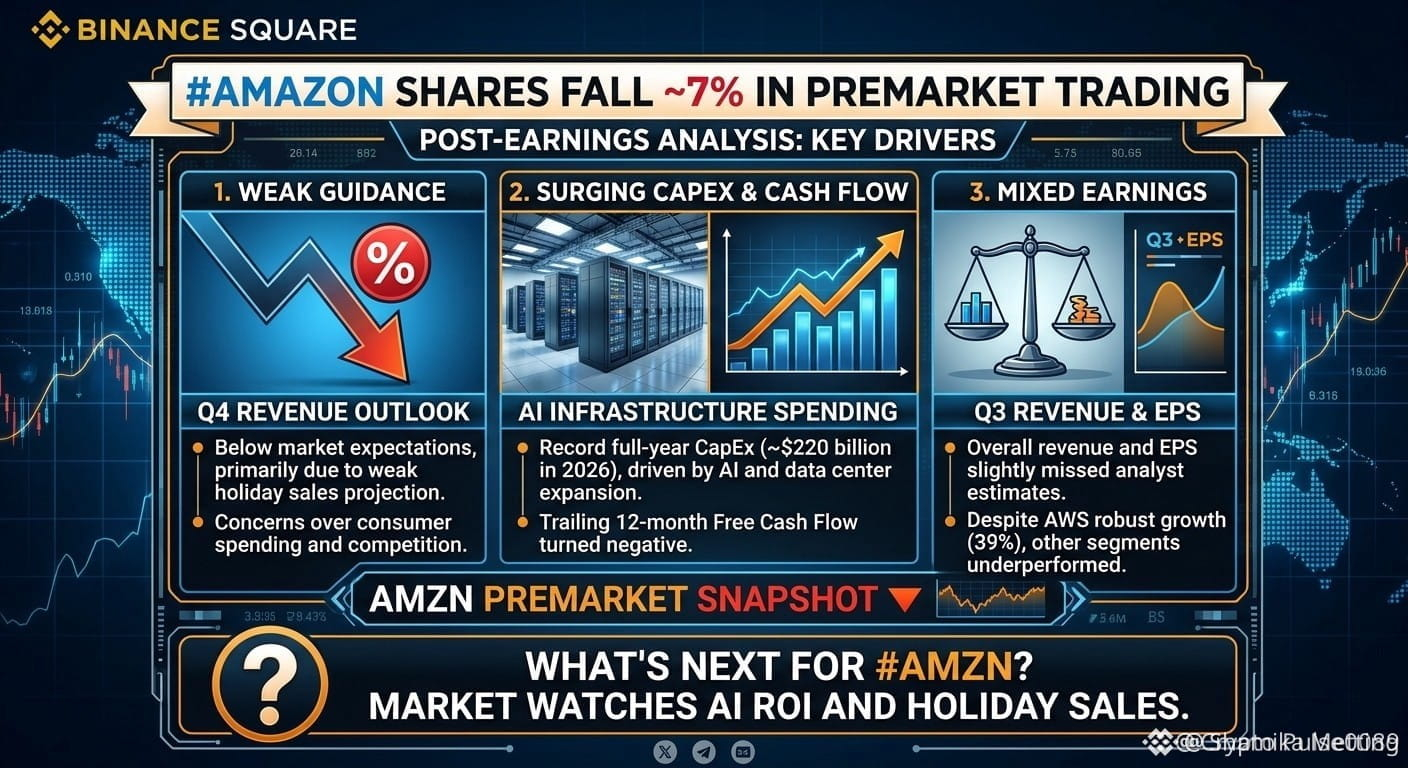
📉 Shares of #Amazon fell by around 7% in pre-market trading: Post-earnings analysis
Despite impressive growth in AWS, Amazon ($AMZN) shares took a notable hit in pre-market trading following the release of its latest earnings report. Here’s a quick summary of the factors behind the market’s reaction:
🔍 Key reasons for the decline:
1️⃣ Weak fourth-quarter guidance
Revenue guidance for the holiday quarter came in slightly below market expectations, raising concerns about weak consumer spending and intensifying competition in the retail sector.
2️⃣ Higher capital expenditures and negative free cash flow
Heavy investments in AI infrastructure and data center expansion pushed projected capital expenditures for all of 2026 to around $220 billion.
As a result, free cash flow over the past twelve months turned negative (around -$42.4 billion), fueling debate about near-term capital depletion.
3️⃣ Mixed third-quarter results
Total third-quarter revenue ($201.9 billion) and earnings per share ($1.89) came in slightly below analysts’ average estimates.
#Amazon #AMZN #StockMarket #BinanceSquare #EarningsReport #CloudComputing #Aİ
$PEPE $ALPINE $CRMB
1
66
📉 Amazon shares fell about 7% before the market opened👇
Amazon shares fell about 7% in premarket trading after third-quarter results came in below expectations for revenue and earnings. Although AWS growth reached 39%, its strongest in nearly five years, massive AI-related capital spending increased cash burn and lowered fourth-quarter guidance.
The market is weighing the trade-off between rapid expansion in cloud services and near-term pressure on free cash flow. Long-term investors often view these infrastructure investments as the foundation for future leadership in AI and cloud services.
Please follow
$AMZNB $AMZNB $AMZN.US #CoinVahini #AmazonSharesFallAbout7 %InPremarketTrading #AMZN #TechEarnings
AMZNUS-1.50%
AMZNB+0.97%
1
57
$AMZN is crashing in premarket trading - down 7.1% to $226.48
Why the market is punishing Amazon today:
Q3 earnings miss:
Revenue: $201.94B vs. $202.22B expected ❌
EPS: $1.89 vs. $1.97 expected ❌
Even a record operating margin of 13.9% couldn’t save the day.
Weak Q4 guidance:
Midpoint of the guidance range: $243.5B, below Wall Street’s higher expectations. The holiday quarter is shaping up to be weak.
The real knockout blow - AI capital expenditures:
This is why Nasdaq futures are down -2.19% and tech stocks are falling:
Full-year capital expenditures: $220 billion in 2026 - all for AI data centers
Free cash flow: -$42.4 billion over the past twelve months, versus +$14.8B last year
The CEO says spending in 2027 will be “much higher”
The market’s question: When will all this AI spending actually start generating profits?
Amazon and Intel alone are expected to erase $300B in market value today. This, combined with Alphabet’s -12% drop yesterday, means the AI trade is in trouble.
Is this a buying opportunity or the beginning of the AI bubble bursting?
Please follow
#amazon #stockmarket #EarningsSeaso #EarningsSeason
#AmazonSharesFallAbout7%InPremarketTrading
1
46
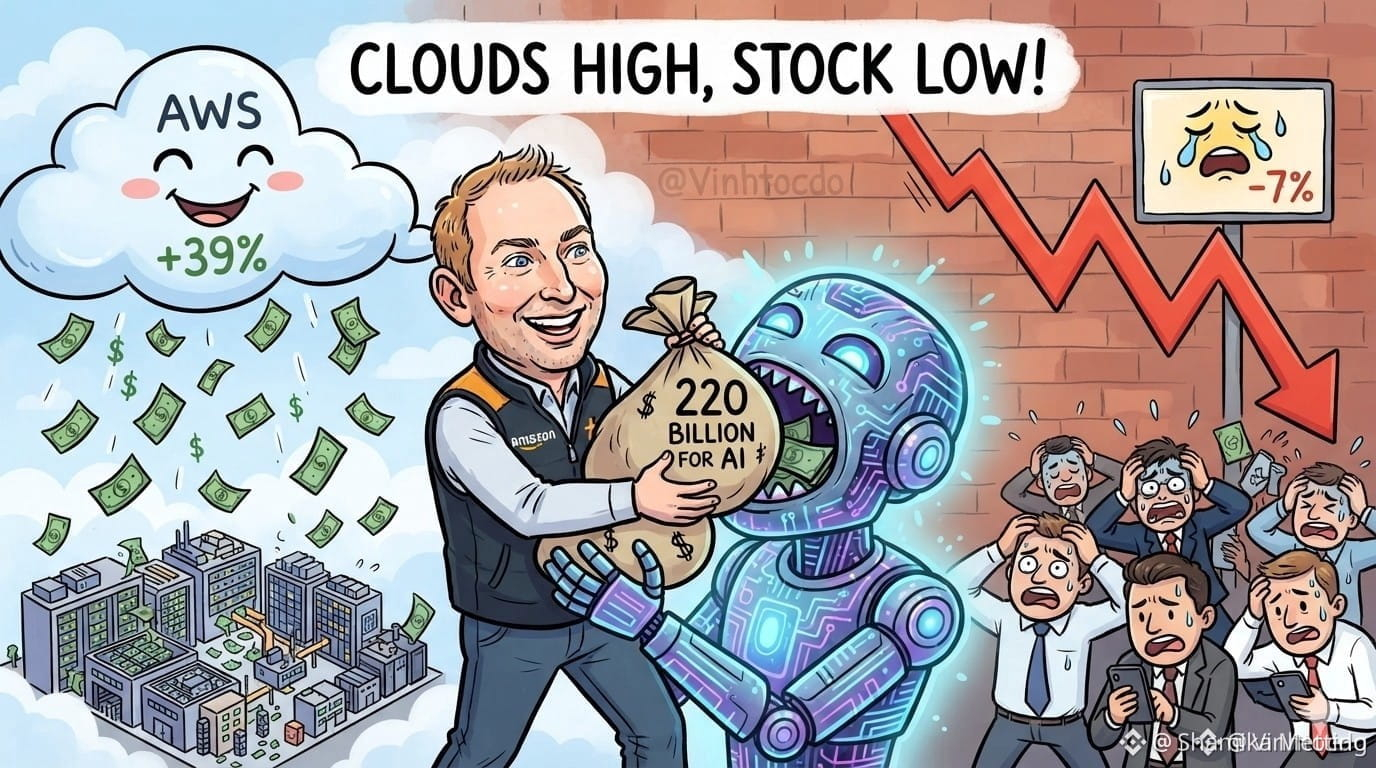
#amazonsharesfallabout7%inpremarkettrading Amazon is making a fortune thanks to 39% growth in its cloud business, AWS, but its stock still lost 7% of its market value!
Why? Because CEO Andy Jassy is «spending without restraint» and plans to invest up to $220 billion in AI, pushing free cash flow into negative territory at -$42.4 billion. Wall Street is shocked and worried: when will AI finally start generating real money, while the retail business is growing only modestly?
What should traders do? Don’t panic! This is an opportunity to buy at lower prices while taking a long-term view, as AWS approaches becoming a trillion-dollar business.
⚠️ This is not financial advice.
Please follow
$PARTI
{future}(PARTIUSDT)
#amazonsharesfallabout7%inpremarkettrading Amazon is making a fortune thanks to 39% growth in its cloud business, AWS, but its stock still lost 7% of its market value!
Why? Because CEO Andy Jassy is «spending without restraint» and plans to invest up to $220 billion in AI, pushing free cash flow into negative territory at -$42.4 billion. Wall Street is shocked and worried: when will AI finally start generating real money, while the retail business is growing only modestly?
What should traders do? Don’t panic! This is an opportunity to buy at lower prices while taking a long-term view, as AWS approaches becoming a trillion-dollar business.
⚠️ This is not financial advice.
Please follow
$PARTI
1
54
#AmazonSharesFallAbout7%InPremarketTrading
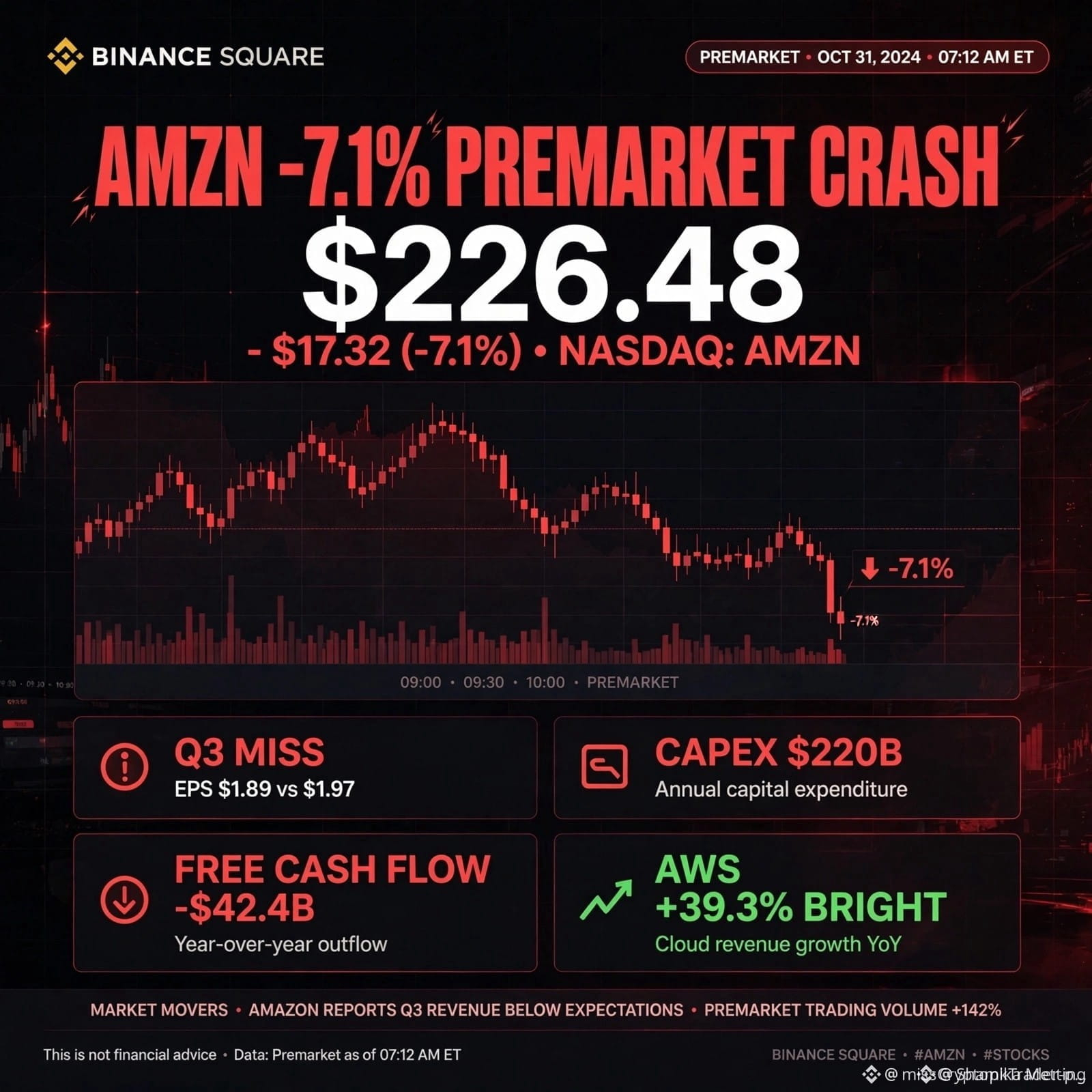
$AMZN -7.1% sharp drop in pre-market trading! What’s next? 📉
AMZN fell to $226.48 after its third-quarter results!
❌ EPS $1.89 vs. $1.97 expected
❌ Revenue $201.94B vs. $202.22B expected
❌ Q4 guidance of $243.5B vs. lower expectations
❌ $220B in AI capital expenditures — free cash flow of -$42.4B!
✅ The only bright spot: AWS grew +39.3% year over year to $46B — its fastest growth in 5 years! The CEO says growth will exceed 40% in 2027 and 2028
Nasdaq futures -2.29% | Market fears return
Is this a buying opportunity on the dip, or is more downside ahead?
My view: Holding above $226 could lead to a rebound toward $232-$240, while a break below $222 would put $215 in sight
Are you buying this dip or waiting?
Please follow
$AMZN $QQQ
#AmazonSharesFallAbout7%InPremarketTrading #AMZN #NASDAQ #StockMarket
1
72
🚨 Amazon stock falls 7% — AI spending raises investor concerns!
Amazon shares ($AMZNB ) fell about 7% in premarket trading on October 30, as investors reacted to disappointing earnings and rising AI infrastructure costs.
📉 What’s behind the sell-off?
• Third-quarter revenue came in at $201.94 billion, slightly below expectations
• Earnings per share fell short of analysts’ forecasts
• AI spending is putting significant pressure on cash flow
• Fourth-quarter revenue guidance disappointed investors
🔥 The bright side: AWS revenue surged 39.3%, reflecting strong demand for cloud and AI infrastructure.
⚠️ The downside: Heavy investment in AI and weak cash flow could continue to weigh on the stock.
The key question is whether Amazon’s AI investments will generate enough returns to justify this massive spending.
Is this a buying opportunity or the start of a deeper correction?
Please follow
#amazonsharesfallabout7%inpremarkettrading $AMZNB

1
94
Partly True
#kospifalls3.53%backbelow6000
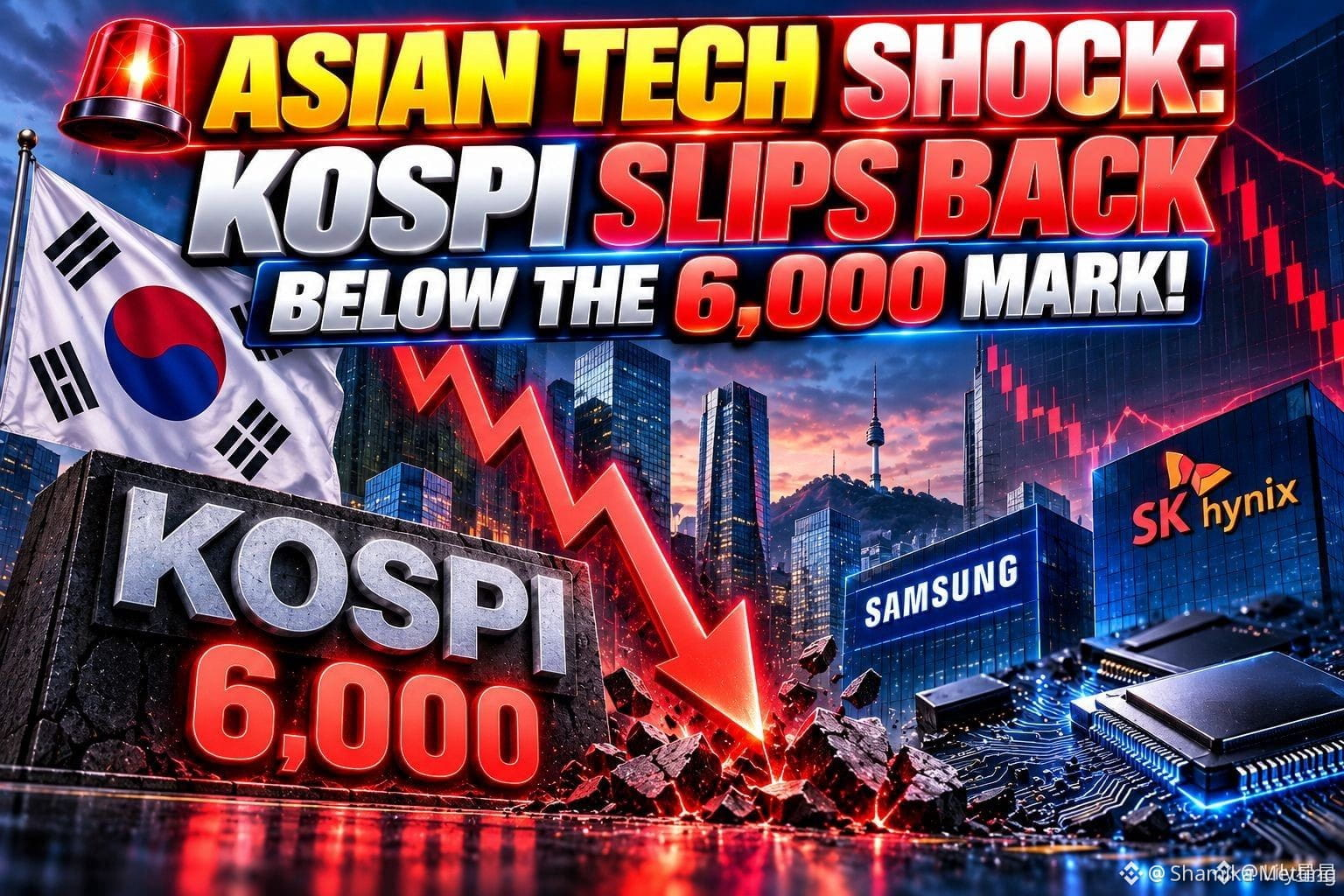
🚨 Asian Tech Shock: KOSPI Falls Below 6,000 Again! 📉🇰🇷
Sudden drop: South Korea’s benchmark KOSPI came under heavy downward pressure, falling about 3.5% and slipping below the key psychological level of 6,000 once again, amid a wave of profit-taking and a shift in regional market momentum.
$ZEC
{future}(ZECUSDT)
Semiconductor giants stumble: Major companies such as Samsung Electronics and SK Hynix faced intense selling pressure as global investors reassessed short-term valuations following the recent sharp rally in tech stocks.
$BTC
{future}(BTCUSDT)
AI and macroeconomic concerns: Growing caution over the timelines for returns on AI capital expenditure, coupled with shifting foreign capital flows, left Asian equities vulnerable to a broader wave of risk aversion.
Global implications: Since South Korea is a key indicator of global technology and semiconductor supply chains, weakness in its market often shakes international investor sentiment and broader high-risk asset markets.
$INIT
Please follow
#StrategySTRCReaches$99.95ForFirstTimeIn165Days #TwoAddressesHoldingAbout1.28BUSDTFrozen #SouthKorea
#kospifalls3.53%backbelow6000
🚨 Asian Tech Shock: KOSPI Falls Below 6,000 Again! 📉🇰🇷
Sudden drop: South Korea’s benchmark KOSPI came under heavy downward pressure, falling about 3.5% and slipping below the key psychological level of 6,000 once again, amid a wave of profit-taking and a shift in regional market momentum.
$ZEC
Semiconductor giants stumble: Major companies such as Samsung Electronics and SK Hynix faced intense selling pressure as global investors reassessed short-term valuations following the recent sharp rally in tech stocks.
$BTC
AI and macroeconomic concerns: Growing caution over the timelines for returns on AI capital expenditure, coupled with shifting foreign capital flows, left Asian equities vulnerable to a broader wave of risk aversion.
Global implications: Since South Korea is a key indicator of global technology and semiconductor supply chains, weakness in its market often shakes international investor sentiment and broader high-risk asset markets.
$INIT
Please follow
#StrategySTRCReaches$99.95ForFirstTimeIn165Days #TwoAddressesHoldingAbout1.28BUSDTFrozen #SouthKorea
1
1.1k
#KOSPIFalls3.53%BackBelow6000
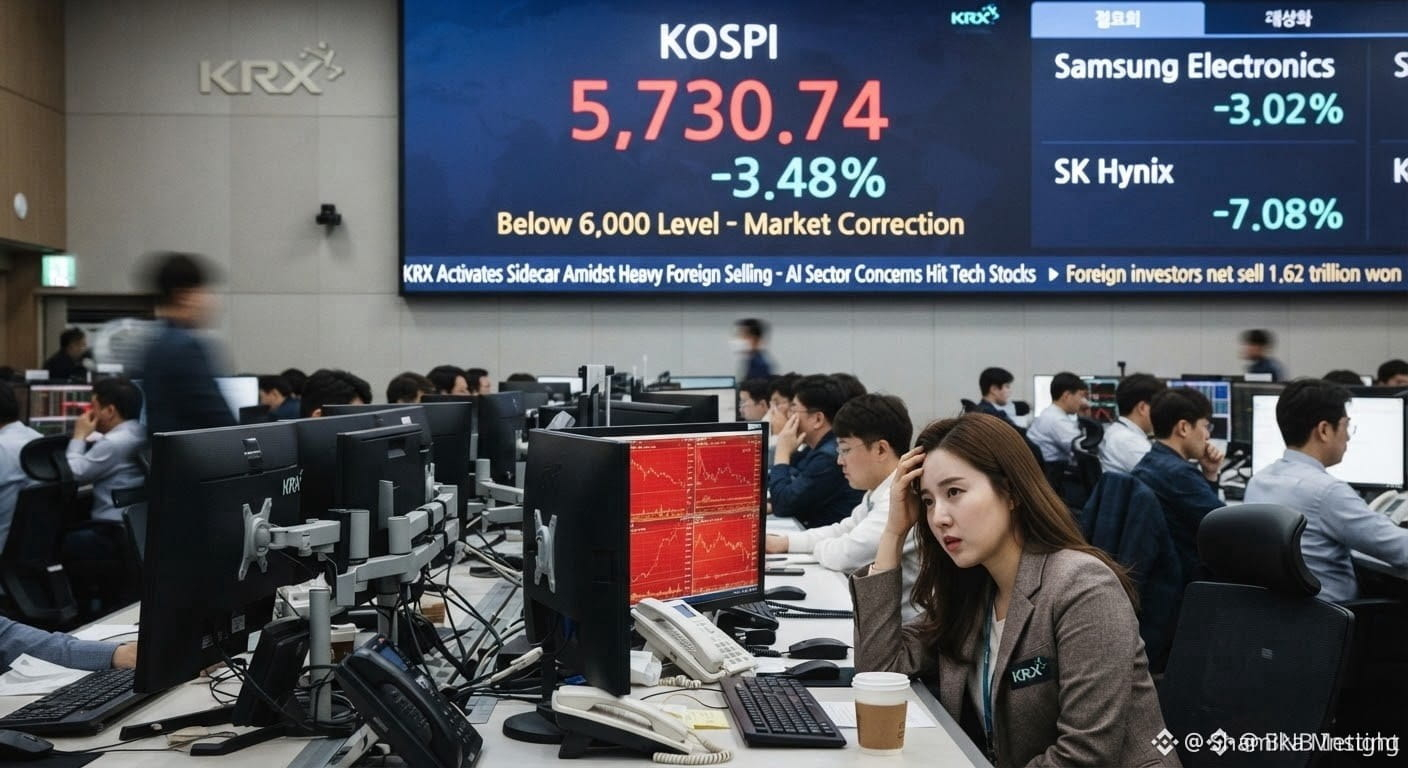
The sell-off in the KOSPI goes beyond a routine market correction. South Korea’s benchmark index fell 3.48% on October 30, closing at 5,730.74 and dropping further below the psychologically significant 6,000 mark. Yonhap News Agency +1
The pressure came mainly from semiconductor stocks, as investors reassessed the sustainability of massive investments in AI. Concerns grew after major U.S. tech companies, particularly Alphabet, reported weaker-than-expected earnings. Samsung Electronics fell 3.02%, while SK Hynix dropped 7.08%. Korea JoongAng Daily +1
One detail worth noting: foreign investors were net sellers of about 1.62 trillion won, and institutions also reduced their exposure. The Korea Exchange even activated a temporary suspension mechanism for sell orders during the session, highlighting the intensity of the selling pressure. Yonhap News Agency +1
To me, the key question is whether this correction reflects temporary concerns about AI valuations or a deeper reassessment of growth expectations for the semiconductor sector.
The 6,000 level has now become an important psychological benchmark, but regaining it alone would not confirm a recovery. Buyers will need to show stronger participation and an improvement in foreign capital flows.
Please follow up
2
68
#KOSPIFalls3.53%BackBelow6000
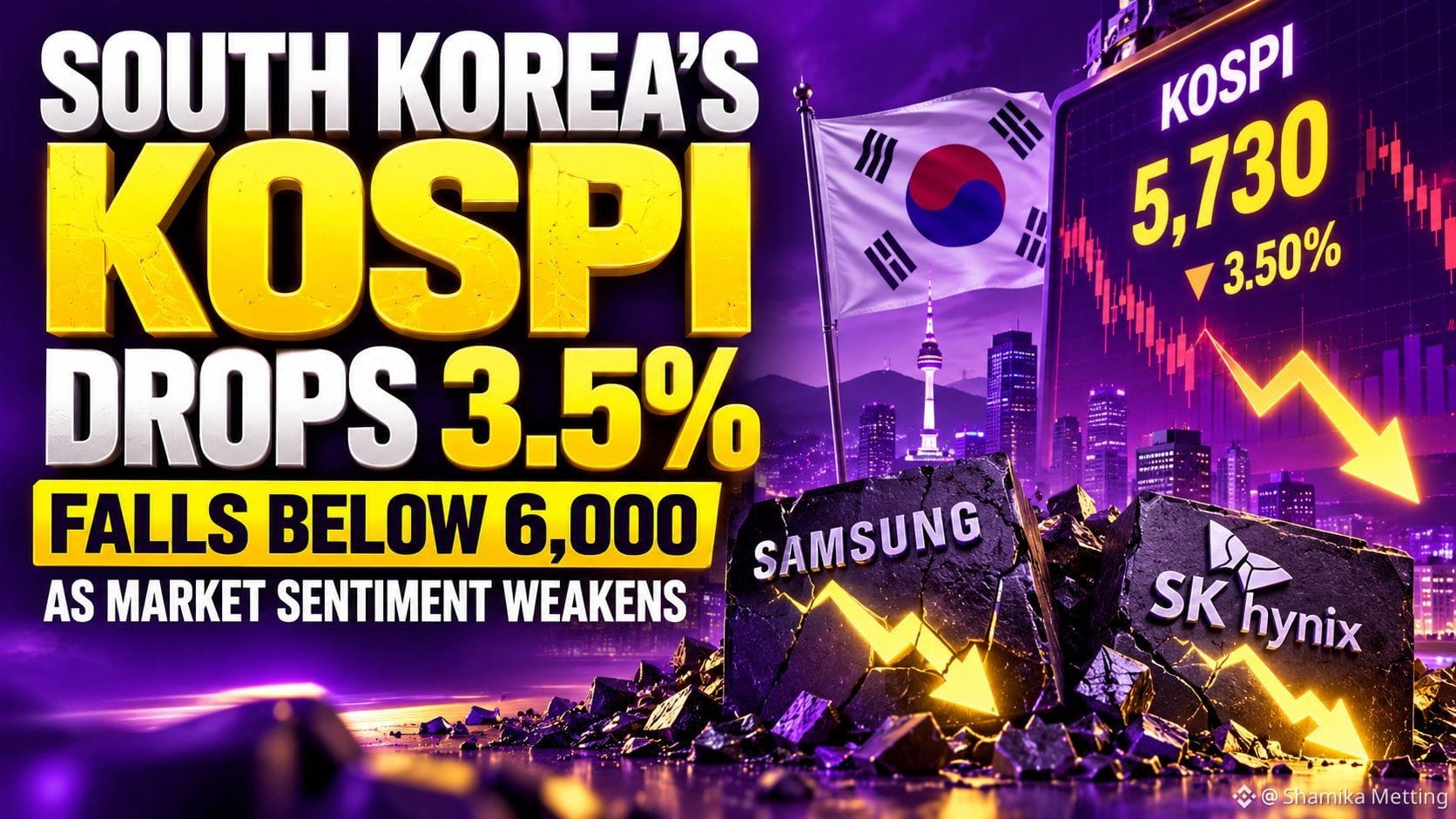
🚨 South Korea’s KOSPI index fell 3.5% — dropping below 6,000 as market sentiment weakened
📉 The KOSPI, South Korea’s benchmark index, plunged on October 30, falling about 3.5% to close at around 5,730—well below the psychologically significant 6,000 mark.
🔍 What triggered the sell-off?
The decline was largely driven by renewed concerns over massive AI investment spending and the sustainability of returns in the technology sector.
Key developments included:
SK Hynix: Shares fell about 7.08%.
Samsung Electronics: Shares dropped about 3.02%.
Foreign investors: Heavy net selling added to pressure on the market.
Global technology-sector sentiment: Weakness in U.S. tech stocks amplified selling pressure across Asian markets.
The Korea Exchange also activated its sell-side circuit breaker (sidecar) as selling intensified.
₿ What does this mean for cryptocurrencies?
A drop in the KOSPI does not automatically mean weakness in Bitcoin or the broader cryptocurrency market. But it highlights growing caution toward high-risk global assets.
Key indicators to watch next include Bitcoin price movements, U.S. tech stocks, institutional flows, and broader global risk sentiment.
Please follow
#StockMarket
$BMT $MARSCOIN $RED
1
33
#kospifalls3.53%backbelow6000
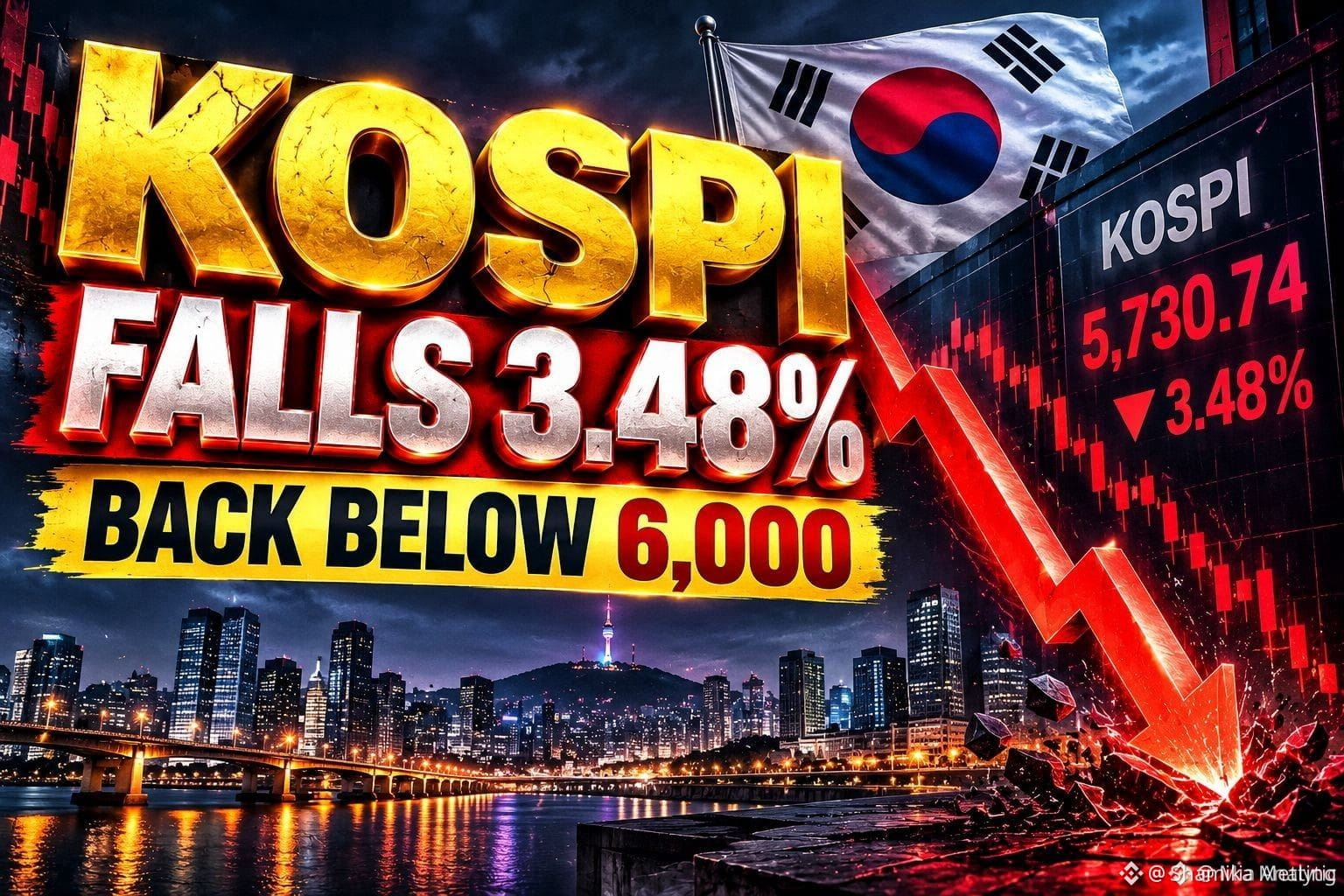
📉 KOSPI falls 3.48%, dropping below 6,000 as AI concerns trigger global sell-off in tech stocks
South Korea’s benchmark KOSPI index plunged on October 30, falling 3.48% to close at 5,730.74, well below the psychologically important 6,000 mark.
The sell-off was largely driven by renewed concerns about the profitability of massive investments in artificial intelligence. Weak earnings forecasts from major U.S. tech companies, including Alphabet, added pressure on global tech stocks and semiconductor makers.
South Korea’s major chipmakers were hit hard:
SK Hynix: down 7.08%
Samsung Electronics: down 3.02%
Foreign investors also sold approximately 1.62 trillion won worth of KOSPI shares, adding to the pressure on the market.
What does this mean for cryptocurrencies?
The decline highlights growing caution toward investments related to technology and AI. If risk aversion spreads to global financial markets, cryptocurrencies could also face selling pressure as investors reduce their exposure to volatile assets.
However, a stock market correction does not automatically mean that Bitcoin or the broader cryptocurrency market will follow the same direction.
Please follow us
#KOSPI #MarketAnalysis
$PYTH $SPORTFUN
1
47
Log in to explore more content
Join global crypto users on Binance Square
⚡️ Get latest and useful information about crypto.
💬 Trusted by the world’s largest crypto exchange.
👍 Discover real insights from verified creators.
Email / Phone number
Trending Topics
BinanceReports80%Recoveryof$6.3BillioninLossesfromHackIncident
19,088 views
178 Discussing
Security Incident Update #2 (2026-10-30)
Binance Announcement
·1.2k Likes
·1.4M views
HeYiSaysWithdrawalsExpectedtoResumeWithin42Hours
34,087 views
692 Discussing
CZSaysCompensationIsinPlaceUsersAreProtected
40,316 views
558 Discussing