
Hammad_Traders
114 Beiträge

Hammad_Traders
Melden
Nutzer blockieren
Crypto Trader, Web3 Explorer, Charts Over Emotions ,Daily Market Updates, No Hype Only Levels, Follow For Smart Trading
63 Following
2.3K+ Follower
189 Like gegeben
Beiträge
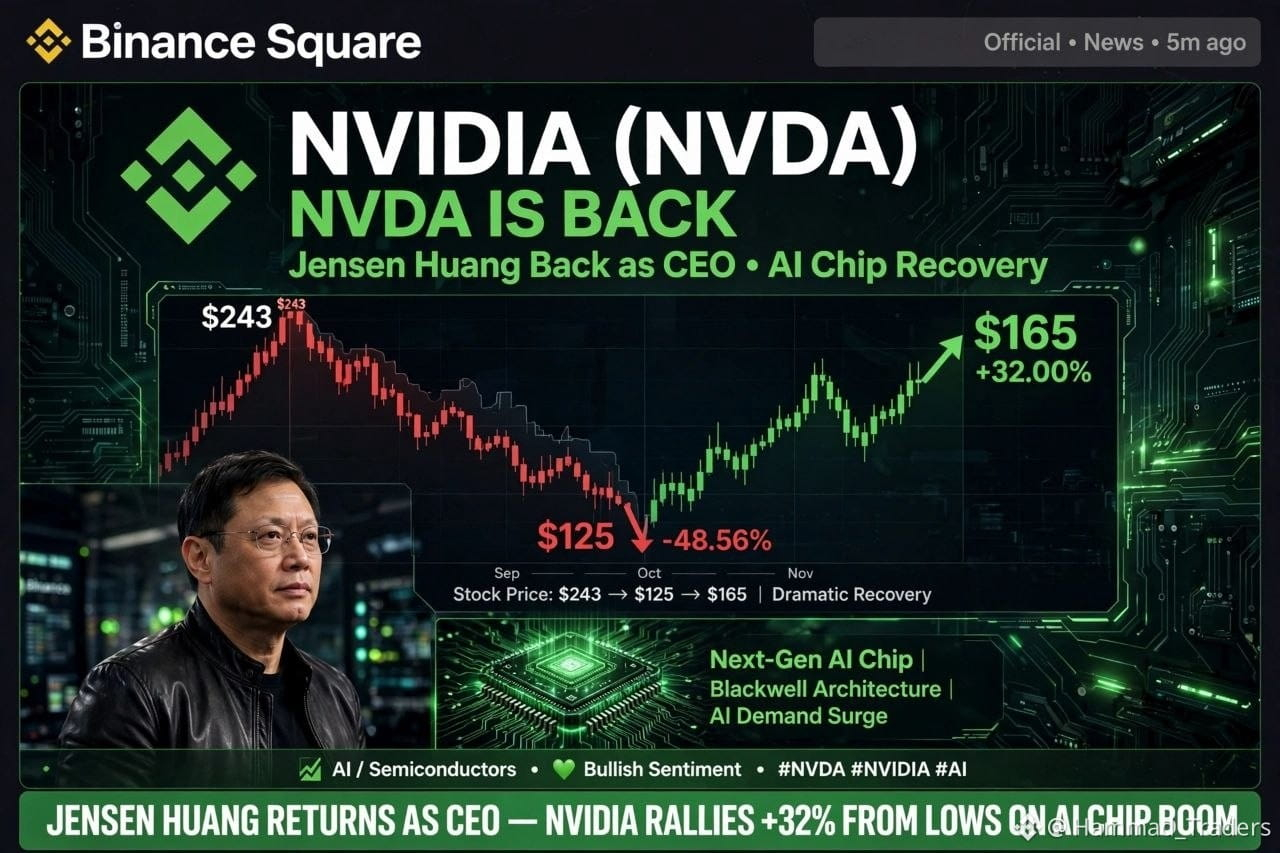
Ich kann immer noch nicht glauben, was mit $NVDA passiert ist.
Vor ein paar Wochen nannten alle die Aktie noch den König der KI. Allzeithoch bei 243 $.
Dann ging alles ganz schnell: Jensen Huang trat zurück, es kamen Nachrichten über eine SEC-Untersuchung auf und die Angst vor einer KI-Blase machte sich breit. Die Aktie stürzte direkt auf 125 $. In wenigen Wochen fast 48 % Verlust. Die Leute sagten, KI sei am Ende.
Aber das Verrückte daran? Die Geschäftszahlen waren tatsächlich rekordverdächtig: 115,8 Mrd. $ Umsatz, ein Plus von 103 %. Das Geschäft lief ungebremst weiter – nur die Angst übernahm das Ruder.
Und heute ist Jensen als CEO zurück und NVDA legte an einem Tag um 32 % auf über 165 $ zu.
Deshalb verkaufe ich bei solchen Nachrichten nie in Panik. Der Markt reagiert auf Emotionen, nicht auf das Geschäft.
Hast du in Panik verkauft oder $NVDA gehalten?
#NVDA #NVIDIA #Aİ #stocks
1
280
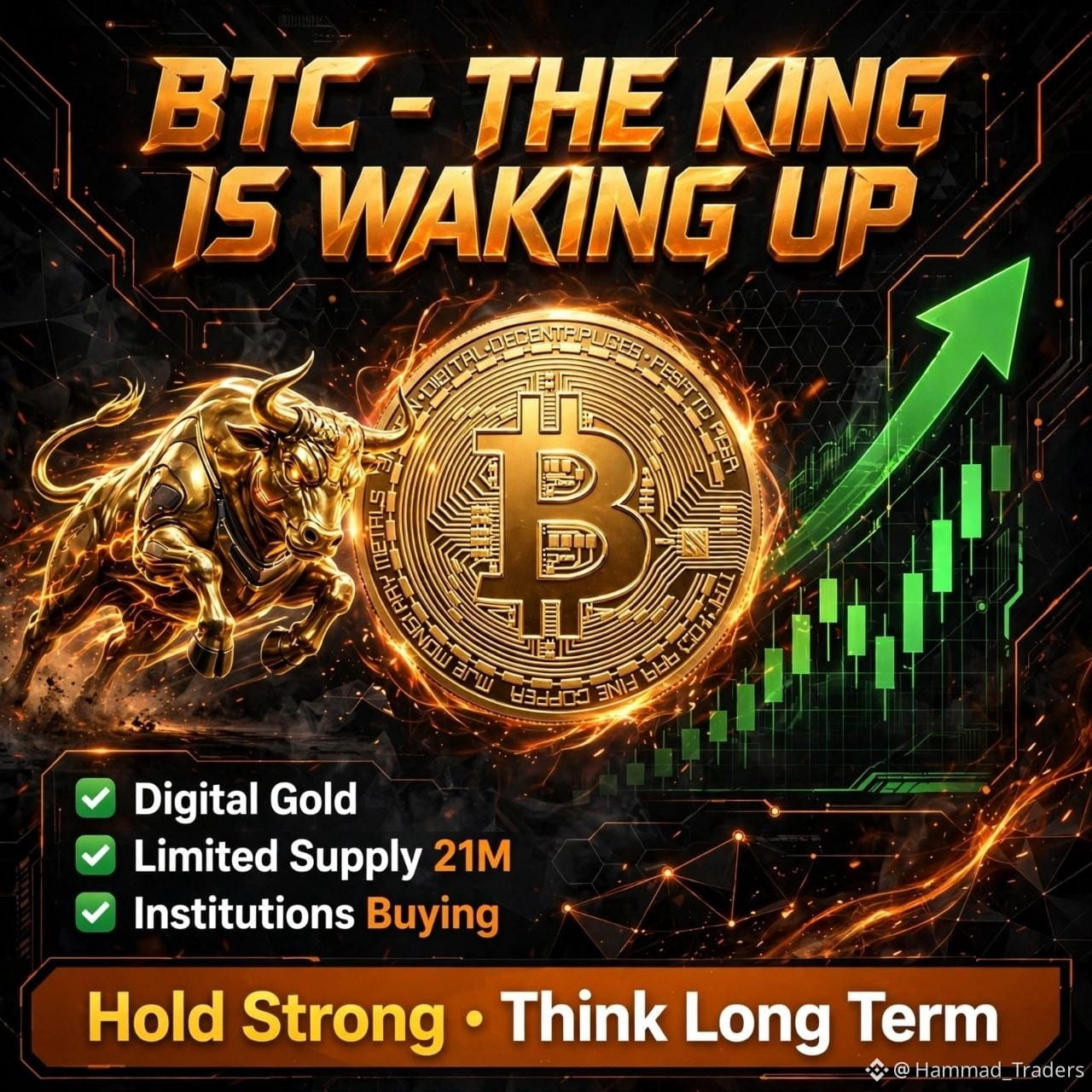
👑 BTC – DER KÖNIG WACHT AUF! 🚀
In jedem Zyklus zweifeln die Menschen an Bitcoin …
Und in jedem Zyklus beweist Bitcoin ihnen das Gegenteil.
$BTC ist nicht einfach nur eine Coin, sondern DIGITALES GOLD.
Es wird niemals mehr als 21 Millionen geben, und große Institutionen kaufen still und leise.
Schlaues Geld kauft in Zeiten der Angst.
Schwache Hände verkaufen in Zeiten der Angst.
Zu welcher Gruppe gehörst du?
Geduld zahlt sich bei BTC immer aus. Bleib standhaft und denke langfristig!
Glaubst du, dass BTC in diesem Zyklus ein neues Allzeithoch erreicht? Kommentiere 👇
#BTC #bitcoin #crypto #BinanceSquare #Bullrun #HODL
2
155
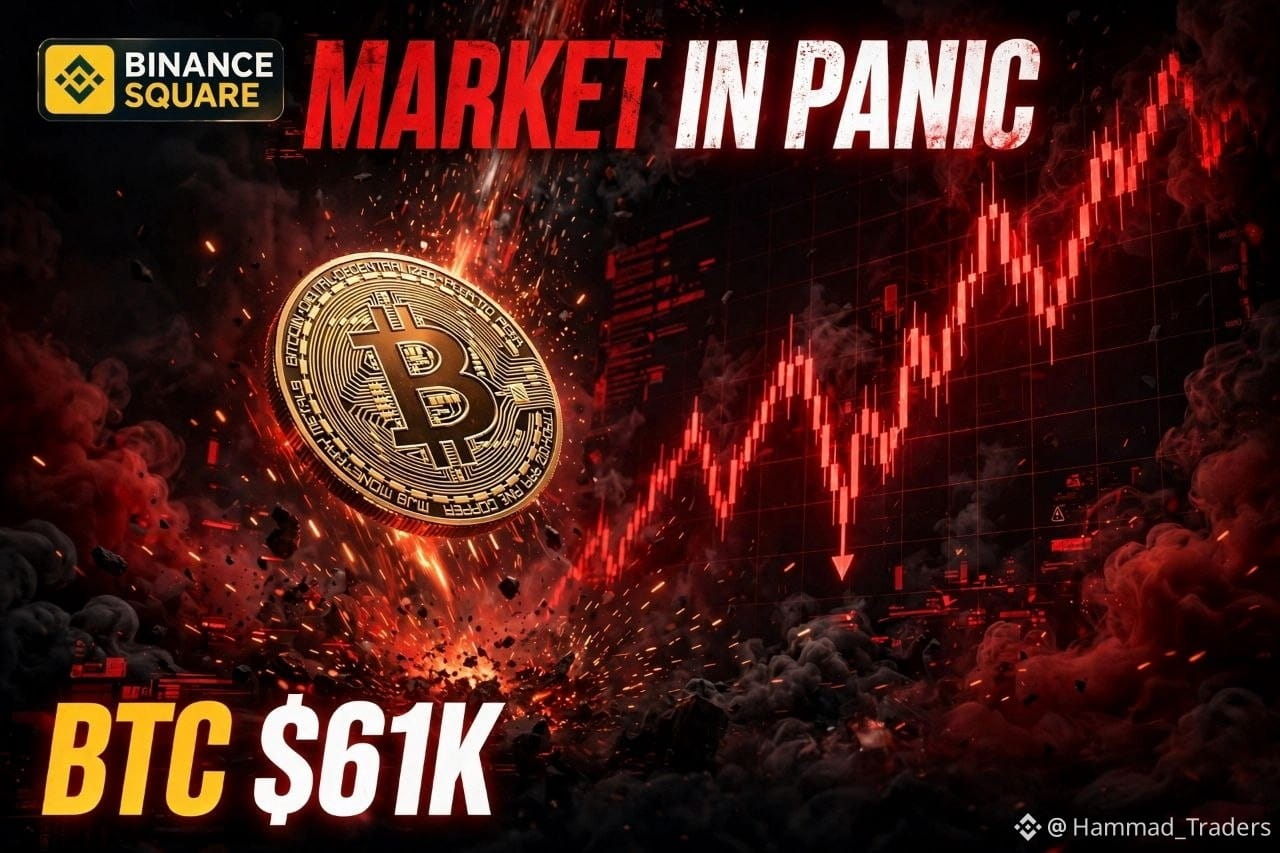
DER MARKT IST IN VOLLER PANIK!
Trumps schockierende Aussage hat den Kryptomarkt erneut erschüttert.
Bitcoin ist auf 62.600 $ abgestürzt und hat innerhalb einer Woche 15 % verloren. Und $TRUMP memecoin wird jetzt unter 1 $ gehandelt.
Die eigentliche Sorge? Trumps Medienunternehmen hält 15.649 BTC und muss seine Anleihen bis zum 30. November zurückzahlen. Der Markt fürchtet, dass das Unternehmen gezwungen sein könnte, BTC zu verkaufen, um die Schulden zu begleichen.
Außerdem fordern Abgeordnete Trump und seine Familie auf, nach dem Sieg der Demokraten bei den Zwischenwahlen alle Unterlagen zu ihren Kryptoprojekten aufzubewahren.
Und Trump? Er sagte gerade:
„Ich überprüfe mein Vermögen kaum. Es ist mir egal … Ich habe viel mehr Geld, als ich je gedacht hätte.“
Panik am Markt, Gelassenheit in Washington.
Was denkt ihr: Ist das der Tiefpunkt oder kommt noch ein weiterer Abverkauf?
#TRUMP #Bitcoin #crypto
2.5k
4
138
2.5k
Übersetzung ansehen
#dusk $DUSK @Dusk_Foundation
FTX didn’t expose a “crypto problem.”
It exposed a custody problem.
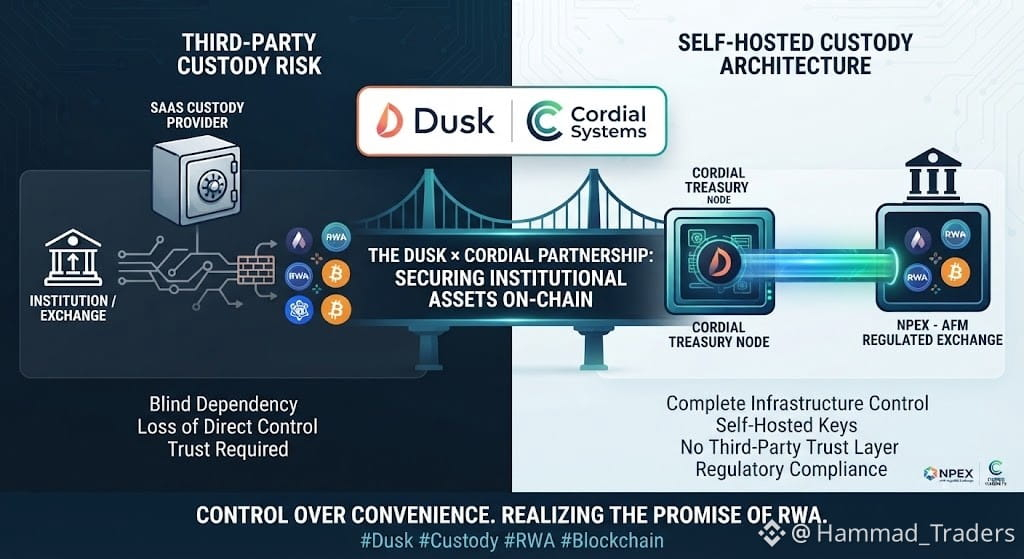
That’s why the Dusk × Cordial Systems partnership caught my attention.
The interesting part isn’t simply adding another wallet solution. It’s the architecture behind it.
NPEX, an AFM-regulated exchange, wants custody infrastructure it can actually control—not a third-party SaaS layer sitting between the institution and its assets.
That’s where Cordial Treasury comes in.
With a self-hosted setup, NPEX can operate its custody stack on its own infrastructure and maintain control of its keys.
No external platform taking custody.
No blind dependency on a vendor.
No “trust us” layer between the institution and its assets.
And this matters for Dusk because institutional adoption isn’t only about tokenization or throughput.
It starts with infrastructure institutions are willing to trust.
The fact that NPEX is already using Dusk Vault makes this more interesting than a typical partnership announcement. Cordial’s experience working with institutional players such as Figure Markets also adds credibility to the model.
Self-hosted custody may require more infrastructure work upfront, but it gives regulated institutions something SaaS custody often can’t:
control.
As RWAs move deeper into regulated markets, I think custody architecture will become just as important as the blockchain underneath it.
The real question is:
Will institutions eventually demand self-controlled custody as the default, or will convenience keep winning over control?
$DUSK @Dusk_Foundation
#dusk $DUSK @Dusk
FTX didn’t expose a “crypto problem.”
It exposed a custody problem.
That’s why the Dusk × Cordial Systems partnership caught my attention.
The interesting part isn’t simply adding another wallet solution. It’s the architecture behind it.
NPEX, an AFM-regulated exchange, wants custody infrastructure it can actually control—not a third-party SaaS layer sitting between the institution and its assets.
That’s where Cordial Treasury comes in.
With a self-hosted setup, NPEX can operate its custody stack on its own infrastructure and maintain control of its keys.
No external platform taking custody.
No blind dependency on a vendor.
No “trust us” layer between the institution and its assets.
And this matters for Dusk because institutional adoption isn’t only about tokenization or throughput.
It starts with infrastructure institutions are willing to trust.
The fact that NPEX is already using Dusk Vault makes this more interesting than a typical partnership announcement. Cordial’s experience working with institutional players such as Figure Markets also adds credibility to the model.
Self-hosted custody may require more infrastructure work upfront, but it gives regulated institutions something SaaS custody often can’t:
control.
As RWAs move deeper into regulated markets, I think custody architecture will become just as important as the blockchain underneath it.
The real question is:
Will institutions eventually demand self-controlled custody as the default, or will convenience keep winning over control?
$DUSK @Dusk
74
Übersetzung ansehen
#dusk $DUSK @Dusk_Foundation
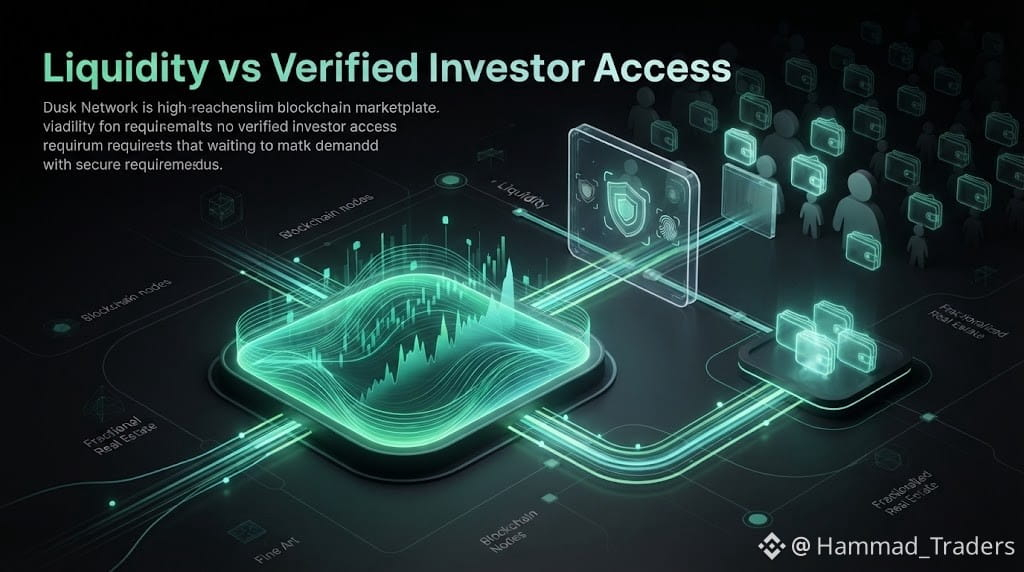
One thing I find interesting about regulated assets on @Dusk is that liquidity may not tell the whole story.
In a normal token market, thin depth can be read as weak demand. But with regulated assets, the market is naturally filtered by onboarding and investor eligibility first.
So the number of wallets actually able to participate may be much smaller than the number of people interested in the asset.
That creates an interesting dynamic: slow liquidity growth could be a demand issue, but it could also be an onboarding issue.
And that makes the next phase especially interesting.
If the pool of verified participants suddenly expands, does liquidity simply deepen—or does price discovery accelerate as previously sidelined demand finally gets access?
For me, that’s one of the more underrated things to watch on @Dusk_Foundation
#dusk $DUSK @Dusk
One thing I find interesting about regulated assets on @Dusk is that liquidity may not tell the whole story.
In a normal token market, thin depth can be read as weak demand. But with regulated assets, the market is naturally filtered by onboarding and investor eligibility first.
So the number of wallets actually able to participate may be much smaller than the number of people interested in the asset.
That creates an interesting dynamic: slow liquidity growth could be a demand issue, but it could also be an onboarding issue.
And that makes the next phase especially interesting.
If the pool of verified participants suddenly expands, does liquidity simply deepen—or does price discovery accelerate as previously sidelined demand finally gets access?
For me, that’s one of the more underrated things to watch on @Dusk
1
2
76
Übersetzung ansehen
#termmax @termmax
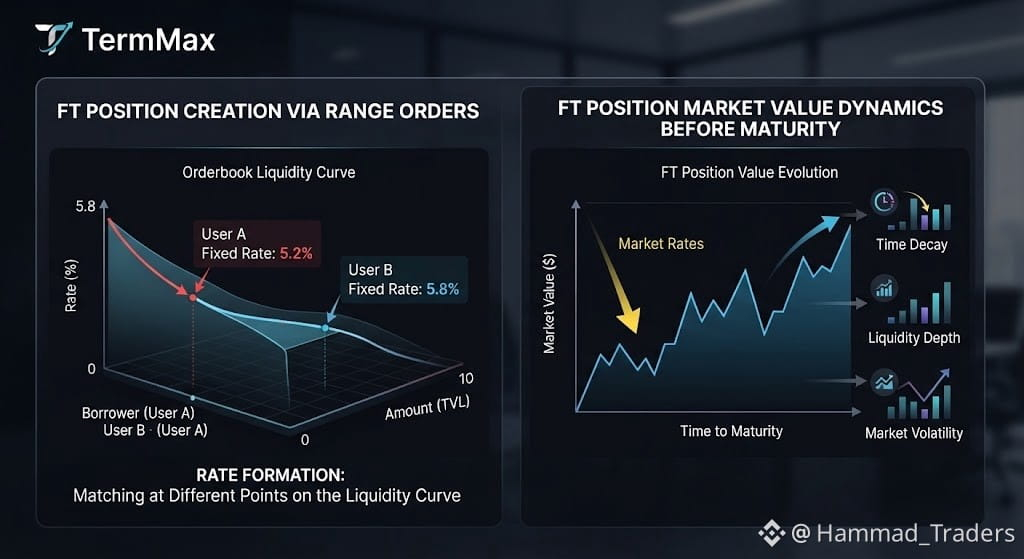
One TermMax detail I almost overlooked was how its range-order pricing curves actually shape the way fixed-rate orders get matched.
At first, I saw it as an execution detail. But the more I looked at it, the more important it seemed.
A range order doesn't necessarily mean every unit is matched at one identical rate. Different parts of the range can carry different pricing, which means the curve itself helps determine how liquidity is consumed across the order.
That changes how I think about fixed-rate markets.
The interesting question isn't only what rate you get, but how the pricing mechanism decides where liquidity gets used.
Then there's a second layer: FT can be traded before maturity.
So you have two different mechanisms interacting. The pricing curve determines how the original position is matched, while secondary trading can influence how that position is valued before maturity.
Under normal conditions, that could make fixed-term positions more flexible.
But the more interesting test comes when conditions get ugly.
If volatility rises and liquidity gets thin, do the pricing curves and pre-maturity trading complement each other—or start competing for the same liquidity?
That, to me, is a more interesting question than the fixed rate itself.
Because the real test of a fixed-term market isn't how it works when liquidity is abundant.
It's what happens when liquidity starts disappearing.
@termmax #TermMax
#termmax @TermMax
One TermMax detail I almost overlooked was how its range-order pricing curves actually shape the way fixed-rate orders get matched.
At first, I saw it as an execution detail. But the more I looked at it, the more important it seemed.
A range order doesn't necessarily mean every unit is matched at one identical rate. Different parts of the range can carry different pricing, which means the curve itself helps determine how liquidity is consumed across the order.
That changes how I think about fixed-rate markets.
The interesting question isn't only what rate you get, but how the pricing mechanism decides where liquidity gets used.
Then there's a second layer: FT can be traded before maturity.
So you have two different mechanisms interacting. The pricing curve determines how the original position is matched, while secondary trading can influence how that position is valued before maturity.
Under normal conditions, that could make fixed-term positions more flexible.
But the more interesting test comes when conditions get ugly.
If volatility rises and liquidity gets thin, do the pricing curves and pre-maturity trading complement each other—or start competing for the same liquidity?
That, to me, is a more interesting question than the fixed rate itself.
Because the real test of a fixed-term market isn't how it works when liquidity is abundant.
It's what happens when liquidity starts disappearing.
@TermMax #TermMax
21
7
79
Übersetzung ansehen
#termmax @termmax
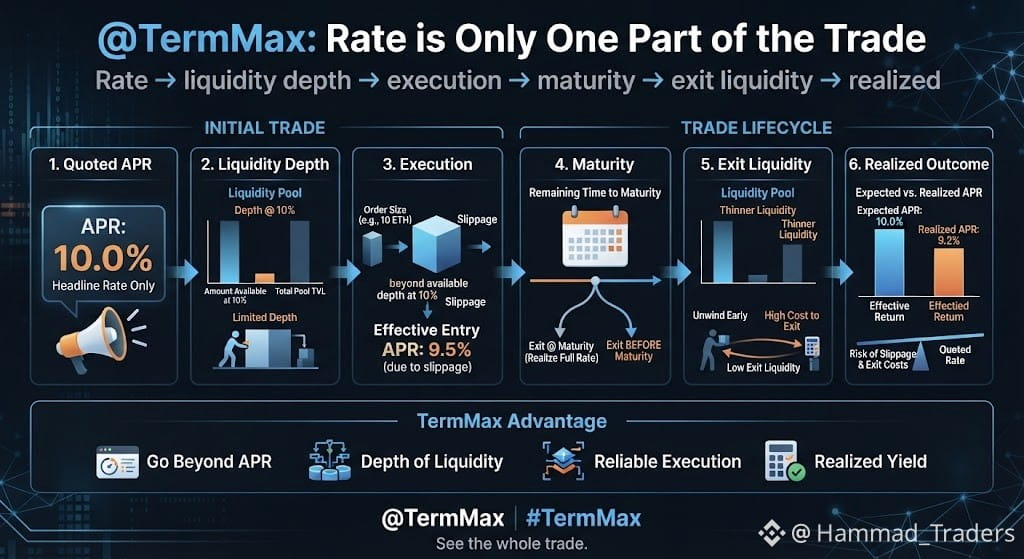
Most people looking at a fixed-rate market start with one question:
What’s the APR?
But I think there’s a more important question:
How much liquidity actually exists around that rate?
A quoted APR tells you the price being offered. It doesn’t necessarily tell you how much capital you can actually deploy at that price—or what it will cost to exit before maturity.
That distinction matters.
In fixed-rate markets, the headline rate is only one part of the trade. You also need to consider:
Rate → liquidity depth → execution → maturity → exit liquidity → realized outcome
A 10% rate may look attractive on paper. But if there’s limited depth around that rate, a larger position can face worse execution, and the effective return can be very different from the quoted APR.
The same applies on the way out.
If liquidity is thin when you need to unwind, the cost of exiting can eat into the return you expected when entering the position.
That’s why I wouldn’t evaluate a fixed-rate market by APR or TVL alone.
I’d look at how much capital is actually available at the quoted rate, how efficiently larger positions can be executed, and what happens when that capital needs to move before maturity.
The real question isn’t just what rate TermMax can quote.
It’s how much capital can actually trade at that rate—and how reliably that yield can be realized.
@termmax
#TermMax
#termmax @TermMax
Most people looking at a fixed-rate market start with one question:
What’s the APR?
But I think there’s a more important question:
How much liquidity actually exists around that rate?
A quoted APR tells you the price being offered. It doesn’t necessarily tell you how much capital you can actually deploy at that price—or what it will cost to exit before maturity.
That distinction matters.
In fixed-rate markets, the headline rate is only one part of the trade. You also need to consider:
Rate → liquidity depth → execution → maturity → exit liquidity → realized outcome
A 10% rate may look attractive on paper. But if there’s limited depth around that rate, a larger position can face worse execution, and the effective return can be very different from the quoted APR.
The same applies on the way out.
If liquidity is thin when you need to unwind, the cost of exiting can eat into the return you expected when entering the position.
That’s why I wouldn’t evaluate a fixed-rate market by APR or TVL alone.
I’d look at how much capital is actually available at the quoted rate, how efficiently larger positions can be executed, and what happens when that capital needs to move before maturity.
The real question isn’t just what rate TermMax can quote.
It’s how much capital can actually trade at that rate—and how reliably that yield can be realized.
@TermMax
#TermMax
12
7
156
Übersetzung ansehen
#termmax @termmax
I think I was looking at @termmax 's “fixed rate” too narrowly.
The interesting part isn’t just that the rate is fixed.
It’s how that rate is formed — and what happens to that position after the loan is created.
TermMax’s Range Orders are pricing curves rather than simple flat-rate orders. For borrowers, different portions of an order can be matched at different points on the curve, while lenders face the opposite structure.
So two users interacting with the same order can end up with different fixed rates.
That makes the execution point important.
If part of an order has already been filled, the remaining liquidity may sit at a different point on the curve. The rate itself isn’t unpredictable; the curve defines the pricing. But the rate you receive depends partly on where your execution occurs.
That is where I think the more interesting question begins.
Once an FT is created, the fixed rate is no longer the entire story because the FT can be traded before maturity.
Now you have a fixed-rate position with its own market value.
That value can change as time to maturity falls, liquidity changes, and market rates move.
In other words, locking in the borrowing or lending rate removes one kind of uncertainty — but it doesn’t eliminate the need to price the position afterward.
This makes me think TermMax may be building something broader than just fixed-rate lending.
The primitive is closer to a market for creating, pricing and trading fixed-rate positions.
And that leaves me with the question I find most interesting:
When market rates move sharply, how efficiently does an FT reprice before maturity?
Because creating a predictable fixed-rate position is one problem.
Making that position liquid when the market has moved somewhere else is the harder one.
#TermMax @termmax
#termmax @TermMax
I think I was looking at @TermMax 's “fixed rate” too narrowly.
The interesting part isn’t just that the rate is fixed.
It’s how that rate is formed — and what happens to that position after the loan is created.
TermMax’s Range Orders are pricing curves rather than simple flat-rate orders. For borrowers, different portions of an order can be matched at different points on the curve, while lenders face the opposite structure.
So two users interacting with the same order can end up with different fixed rates.
That makes the execution point important.
If part of an order has already been filled, the remaining liquidity may sit at a different point on the curve. The rate itself isn’t unpredictable; the curve defines the pricing. But the rate you receive depends partly on where your execution occurs.
That is where I think the more interesting question begins.
Once an FT is created, the fixed rate is no longer the entire story because the FT can be traded before maturity.
Now you have a fixed-rate position with its own market value.
That value can change as time to maturity falls, liquidity changes, and market rates move.
In other words, locking in the borrowing or lending rate removes one kind of uncertainty — but it doesn’t eliminate the need to price the position afterward.
This makes me think TermMax may be building something broader than just fixed-rate lending.
The primitive is closer to a market for creating, pricing and trading fixed-rate positions.
And that leaves me with the question I find most interesting:
When market rates move sharply, how efficiently does an FT reprice before maturity?
Because creating a predictable fixed-rate position is one problem.
Making that position liquid when the market has moved somewhere else is the harder one.
#TermMax @TermMax
13
4
77
Übersetzung ansehen
#termmax @termmax
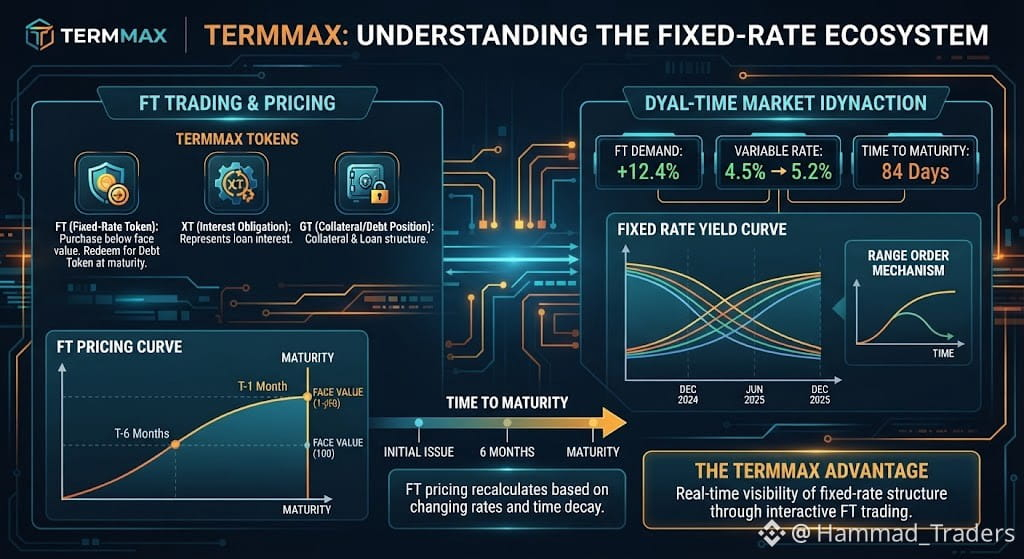
One thing I wanted to understand about @TermMax was why its fixed-rate market uses three different tokens.
The docs describe FT as a fixed-rate token that can be purchased below face value and redeemed for the debt token at maturity. XT represents the interest obligation associated with the loan, while GT represents the collateral and debt position.
That made me look at TermMax differently. The fixed rate is not just a number displayed on a lending screen; it is reflected through the structure of the position itself.
Another detail matters here: FT can be traded before maturity, and its pricing changes as the remaining time to maturity changes. TermMax’s range-order mechanism also recalculates its pricing curve as that time changes.
What I’m genuinely curious about is how these mechanics behave when real market activity, changing rates, and different maturity dates interact at the same time.
I want to watch this in practice.
#termmax @TermMax
One thing I wanted to understand about @TermMax was why its fixed-rate market uses three different tokens.
The docs describe FT as a fixed-rate token that can be purchased below face value and redeemed for the debt token at maturity. XT represents the interest obligation associated with the loan, while GT represents the collateral and debt position.
That made me look at TermMax differently. The fixed rate is not just a number displayed on a lending screen; it is reflected through the structure of the position itself.
Another detail matters here: FT can be traded before maturity, and its pricing changes as the remaining time to maturity changes. TermMax’s range-order mechanism also recalculates its pricing curve as that time changes.
What I’m genuinely curious about is how these mechanics behave when real market activity, changing rates, and different maturity dates interact at the same time.
I want to watch this in practice.
2
2
72
Übersetzung ansehen
#termmax @termmax I initially thought @TermMax was mainly about fixed-rate lending. Looking closer, the mechanism is more interesting.
TermMax uses FT, XT, and GT to structure fixed-term positions, while Range Orders help define borrowing and lending prices. FTs can also be traded before maturity, which makes time-to-maturity an important part of how these positions are valued.
What I find most interesting is how maturity becomes part of the market structure itself, rather than just being a date in the background.
The real question for me is how this mechanism performs as liquidity and market conditions change. That’s what I’ll be watching next.
#TermMax @termmax
#termmax @TermMax I initially thought @TermMax was mainly about fixed-rate lending. Looking closer, the mechanism is more interesting.
TermMax uses FT, XT, and GT to structure fixed-term positions, while Range Orders help define borrowing and lending prices. FTs can also be traded before maturity, which makes time-to-maturity an important part of how these positions are valued.
What I find most interesting is how maturity becomes part of the market structure itself, rather than just being a date in the background.
The real question for me is how this mechanism performs as liquidity and market conditions change. That’s what I’ll be watching next.
#TermMax @TermMax
1
80
Übersetzung ansehen
Celebrating 9 years of Binance innovation! All 9 landmarks unlocked. Ready to conquer the next chapters of this amazing crypto revolution. #BinanceTurns9
Celebrating 9 years of Binance innovation! All 9 landmarks unlocked. Ready to conquer the next chapters of this amazing crypto revolution. #BinanceTurns9
62
#robo $ROBO
Aufregende Zeiten für dezentrale Infrastruktur @FabricFND $ROBO token steht an der Spitze der Innovation mit der Fabric Foundation, die nahtlose, sichere und skalierbare Lösungen ermöglicht. Mit einem Fokus auf gemeinschaftsgetriebenes Wachstum und realen Anwendungen ist $ROBO bereit, den Raum zu transformieren. Tauche ein und sei Teil der Revolution #ROBO Es wird zum Mond gehen.
Aufregende Zeiten für dezentrale Infrastruktur @FabricFND $ROBO token steht an der Spitze der Innovation mit der Fabric Foundation, die nahtlose, sichere und skalierbare Lösungen ermöglicht. Mit einem Fokus auf gemeinschaftsgetriebenes Wachstum und realen Anwendungen ist $ROBO bereit, den Raum zu transformieren. Tauche ein und sei Teil der Revolution #ROBO Es wird zum Mond gehen.
21
Übersetzung ansehen
#fogo $FOGO
Here's a post for Binance Square:
"Exciting times for $FOGO holders! 🚀 @fogo is revolutionizing the way we think about . With their innovative approach and strong community backing, it's no wonder $FOGO is gaining traction! 💰 What's your favorite thing about the Fogo project? Share with us!
Here's a post for Binance Square:
"Exciting times for $FOGO holders! 🚀 @fogo is revolutionizing the way we think about . With their innovative approach and strong community backing, it's no wonder $FOGO is gaining traction! 💰 What's your favorite thing about the Fogo project? Share with us!
2
23
Übersetzung ansehen
"Binance Trader League Season 2 is live! Compete globally, climb ranks & win rewards! Top traders get featured & earn exclusive prizes. Join now & show off trading skills! 📈💰🔥"
#TradersLeague
"Binance Trader League Season 2 is live! Compete globally, climb ranks & win rewards! Top traders get featured & earn exclusive prizes. Join now & show off trading skills! 📈💰🔥"
#TradersLeague
#TradersLeague
10
10
Anmelden und weiter Inhalte entdecken
Krypto-Nutzer weltweit auf Binance Square kennenlernen
⚡️ Bleib in Sachen Krypto stets am Puls.
💬 Die weltgrößte Kryptobörse vertraut darauf.
👍 Erhalte verlässliche Einblicke von verifizierten Creators.
E-Mail-Adresse/Telefonnummer
Trendthemen
BitcoinAndStocksSlipAgainAmidTrump’sTariffPlans
10,606 Aufrufe
214 Kommentare
USA planen neue Zölle auf China, die EU und weitere Länder; Bitcoin fällt unter 60.000 $, Nasdaq gibt 1,5 % nach
Binance News
·6 Likes
·3.1k Aufrufe
JensenHuangSaysNvidiaDoesn’tNeedASuccessionPlan
9,849 Aufrufe
152 Kommentare
AnthropicBreaksBelowIPOPriceAmidAISlump
101,565 Aufrufe
918 Kommentare