#termmax @TermMax
Most people looking at a fixed-rate market start with one question:
What’s the APR?
But I think there’s a more important question:
How much liquidity actually exists around that rate?
A quoted APR tells you the price being offered. It doesn’t necessarily tell you how much capital you can actually deploy at that price—or what it will cost to exit before maturity.
That distinction matters.
In fixed-rate markets, the headline rate is only one part of the trade. You also need to consider:
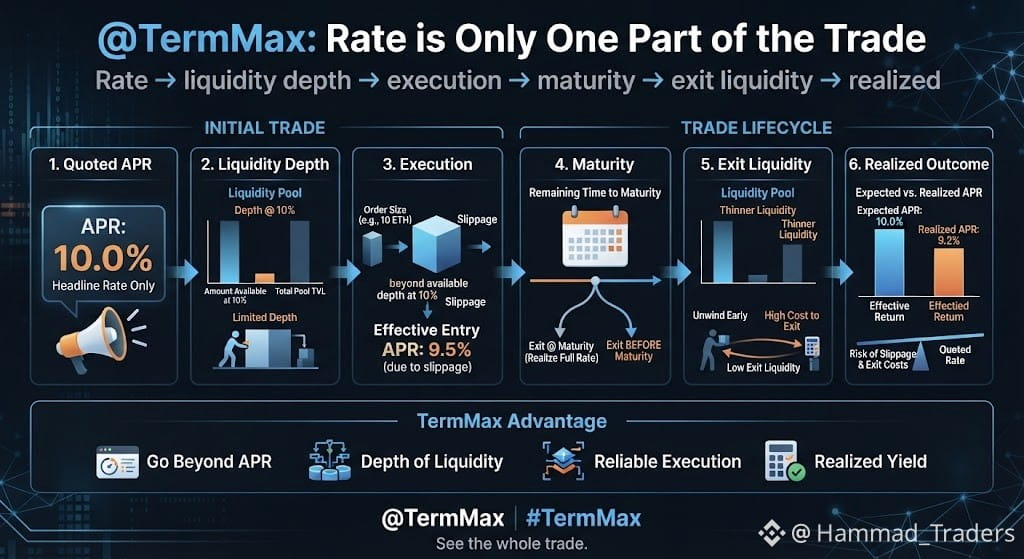
Rate → liquidity depth → execution → maturity → exit liquidity → realized outcome
A 10% rate may look attractive on paper. But if there’s limited depth around that rate, a larger position can face worse execution, and the effective return can be very different from the quoted APR.
The same applies on the way out.
If liquidity is thin when you need to unwind, the cost of exiting can eat into the return you expected when entering the position.
That’s why I wouldn’t evaluate a fixed-rate market by APR or TVL alone.
I’d look at how much capital is actually available at the quoted rate, how efficiently larger positions can be executed, and what happens when that capital needs to move before maturity.
The real question isn’t just what rate TermMax can quote.
It’s how much capital can actually trade at that rate—and how reliably that yield can be realized.
@TermMax
#TermMax