#dusk $DUSK @Dusk
FTX didn’t expose a “crypto problem.”
It exposed a custody problem.
That’s why the Dusk × Cordial Systems partnership caught my attention.
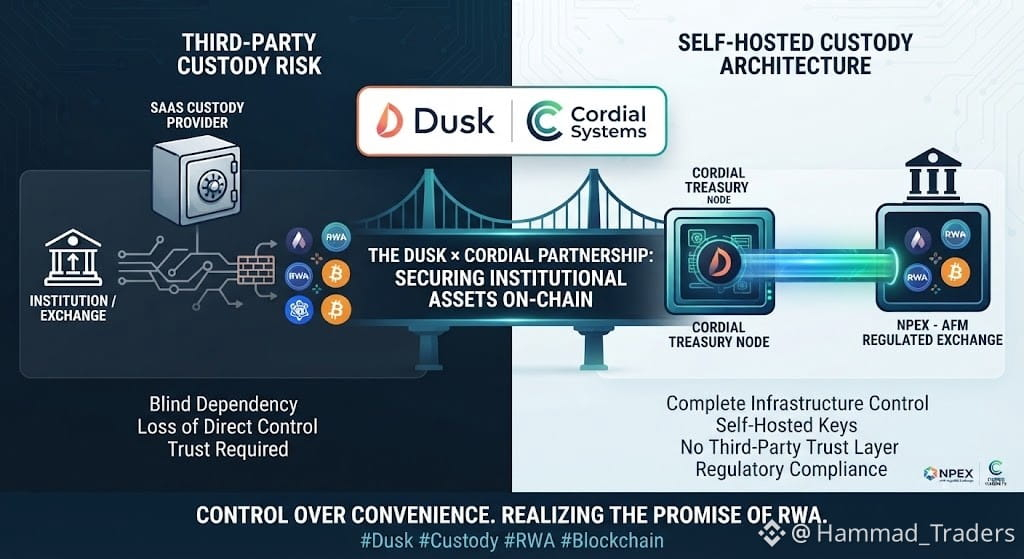
The interesting part isn’t simply adding another wallet solution. It’s the architecture behind it.
NPEX, an AFM-regulated exchange, wants custody infrastructure it can actually control—not a third-party SaaS layer sitting between the institution and its assets.
That’s where Cordial Treasury comes in.
With a self-hosted setup, NPEX can operate its custody stack on its own infrastructure and maintain control of its keys.
No external platform taking custody.
No blind dependency on a vendor.
No “trust us” layer between the institution and its assets.
And this matters for Dusk because institutional adoption isn’t only about tokenization or throughput.
It starts with infrastructure institutions are willing to trust.
The fact that NPEX is already using Dusk Vault makes this more interesting than a typical partnership announcement. Cordial’s experience working with institutional players such as Figure Markets also adds credibility to the model.
Self-hosted custody may require more infrastructure work upfront, but it gives regulated institutions something SaaS custody often can’t:
control.
As RWAs move deeper into regulated markets, I think custody architecture will become just as important as the blockchain underneath it.
The real question is:
Will institutions eventually demand self-controlled custody as the default, or will convenience keep winning over control?
$DUSK @Dusk