#termmax @TermMax
I think I was looking at @TermMax 's “fixed rate” too narrowly.
The interesting part isn’t just that the rate is fixed.
It’s how that rate is formed — and what happens to that position after the loan is created.
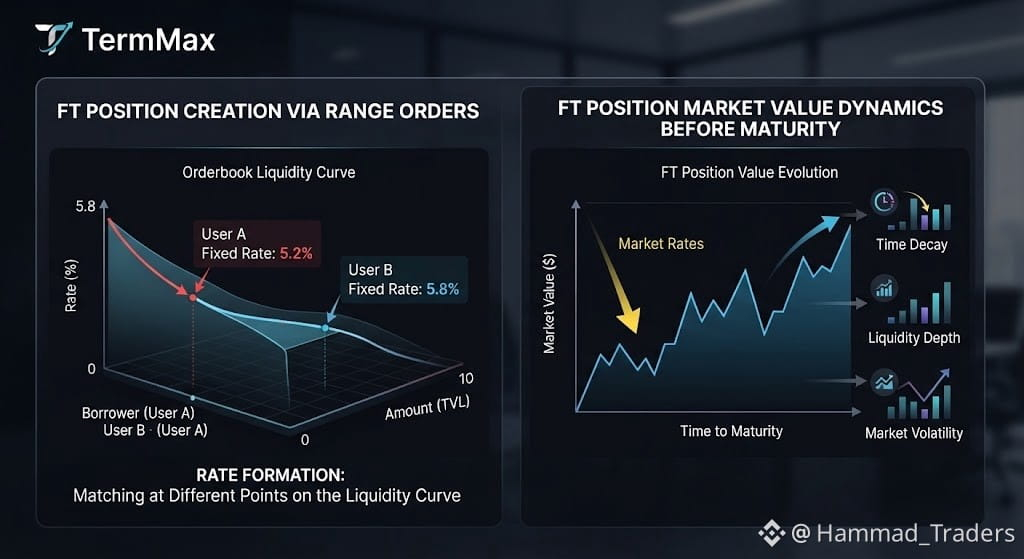
TermMax’s Range Orders are pricing curves rather than simple flat-rate orders. For borrowers, different portions of an order can be matched at different points on the curve, while lenders face the opposite structure.
So two users interacting with the same order can end up with different fixed rates.
That makes the execution point important.
If part of an order has already been filled, the remaining liquidity may sit at a different point on the curve. The rate itself isn’t unpredictable; the curve defines the pricing. But the rate you receive depends partly on where your execution occurs.
That is where I think the more interesting question begins.
Once an FT is created, the fixed rate is no longer the entire story because the FT can be traded before maturity.
Now you have a fixed-rate position with its own market value.
That value can change as time to maturity falls, liquidity changes, and market rates move.
In other words, locking in the borrowing or lending rate removes one kind of uncertainty — but it doesn’t eliminate the need to price the position afterward.
This makes me think TermMax may be building something broader than just fixed-rate lending.
The primitive is closer to a market for creating, pricing and trading fixed-rate positions.
And that leaves me with the question I find most interesting:
When market rates move sharply, how efficiently does an FT reprice before maturity?
Because creating a predictable fixed-rate position is one problem.
Making that position liquid when the market has moved somewhere else is the harder one.
#TermMax @TermMax