

O R B I T
120 Beiträge

O R B I T
Melden
Nutzer blockieren
14 Following
19 Follower
142 Like gegeben
Beiträge
·
--
Übersetzung ansehen
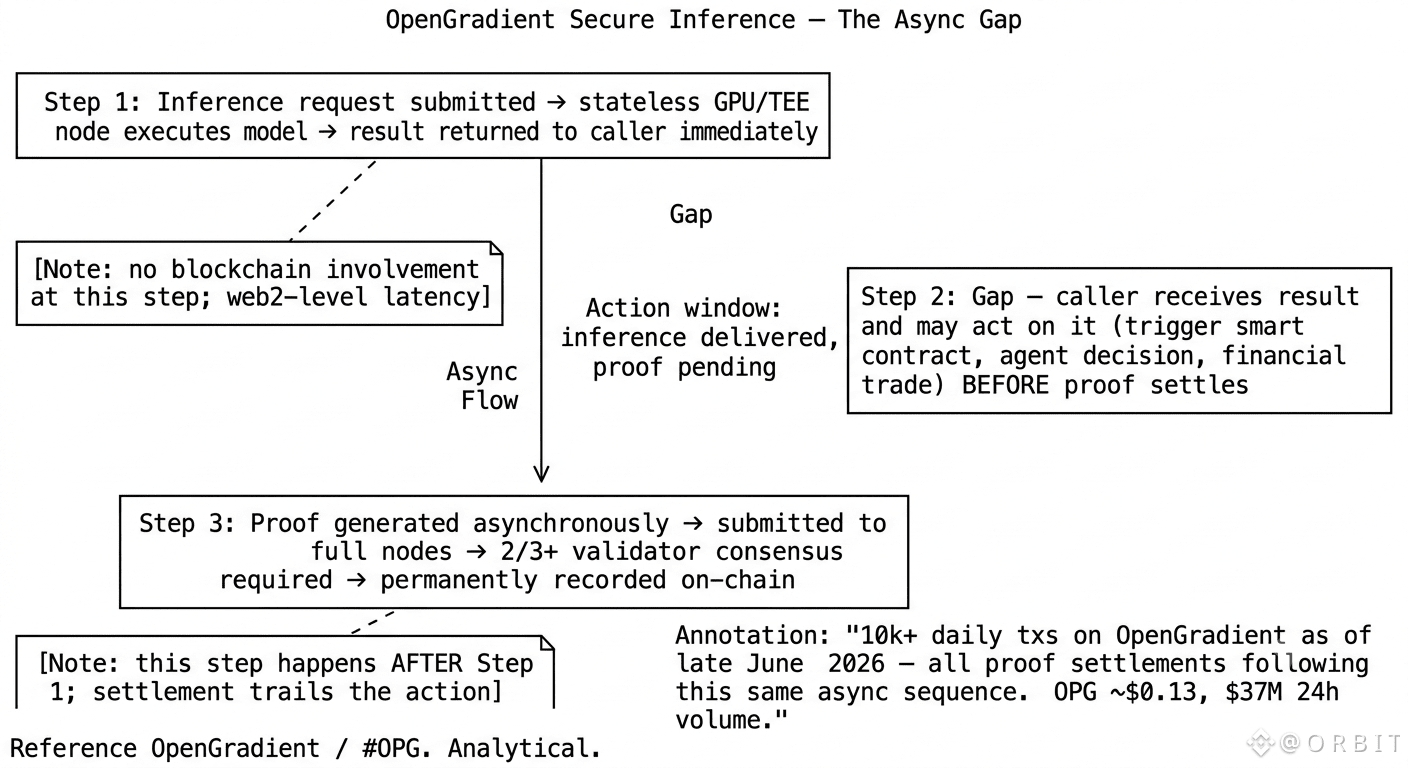
What caught me during this task wasn't the marketing — it was a line buried in the architecture docs. OpenGradient's inference nodes are explicitly stateless. They don't hold state between requests. The actual result gets returned to the caller immediately, while verification and settlement happen asynchronously in the background. @OpenGradient calls this "secure inference." In practice, it means you get the answer before the proof commits. $OPG #OPG
That's the real behavior: a user or agent receives the output first, then the network's 2/3+ validator consensus catches up and permanently records the proof. The network is right now doing 10k+ daily transactions against 4.2M+ blocks produced since TGE — all of those proof settlements trailing their inferences by at least one consensus round. With $OPG trading around $0.13 this week with $37M in 24h volume, the market is certainly not pricing in that subtle ordering.
I kept thinking — for most use cases, fine. Agentic workflows probably don't care. But for a DeFi contract or an autonomous agent making an irreversible on-chain decision based on an inference result… the action can execute before the proof that justified it actually lands. That's a window. Maybe small, maybe inconsequential, but real.
Does asynchronous verification actually work as a security guarantee when the downstream action doesn't wait for it?
What caught me during this task wasn't the marketing — it was a line buried in the architecture docs. OpenGradient's inference nodes are explicitly stateless. They don't hold state between requests. The actual result gets returned to the caller immediately, while verification and settlement happen asynchronously in the background. @OpenGradient calls this "secure inference." In practice, it means you get the answer before the proof commits. $OPG #OPG
That's the real behavior: a user or agent receives the output first, then the network's 2/3+ validator consensus catches up and permanently records the proof. The network is right now doing 10k+ daily transactions against 4.2M+ blocks produced since TGE — all of those proof settlements trailing their inferences by at least one consensus round. With $OPG trading around $0.13 this week with $37M in 24h volume, the market is certainly not pricing in that subtle ordering.
I kept thinking — for most use cases, fine. Agentic workflows probably don't care. But for a DeFi contract or an autonomous agent making an irreversible on-chain decision based on an inference result… the action can execute before the proof that justified it actually lands. That's a window. Maybe small, maybe inconsequential, but real.
Does asynchronous verification actually work as a security guarantee when the downstream action doesn't wait for it?
That's the real behavior: a user or agent receives the output first, then the network's 2/3+ validator consensus catches up and permanently records the proof. The network is right now doing 10k+ daily transactions against 4.2M+ blocks produced since TGE — all of those proof settlements trailing their inferences by at least one consensus round. With $OPG trading around $0.13 this week with $37M in 24h volume, the market is certainly not pricing in that subtle ordering.
I kept thinking — for most use cases, fine. Agentic workflows probably don't care. But for a DeFi contract or an autonomous agent making an irreversible on-chain decision based on an inference result… the action can execute before the proof that justified it actually lands. That's a window. Maybe small, maybe inconsequential, but real.
Does asynchronous verification actually work as a security guarantee when the downstream action doesn't wait for it?
5
2
51
·
--
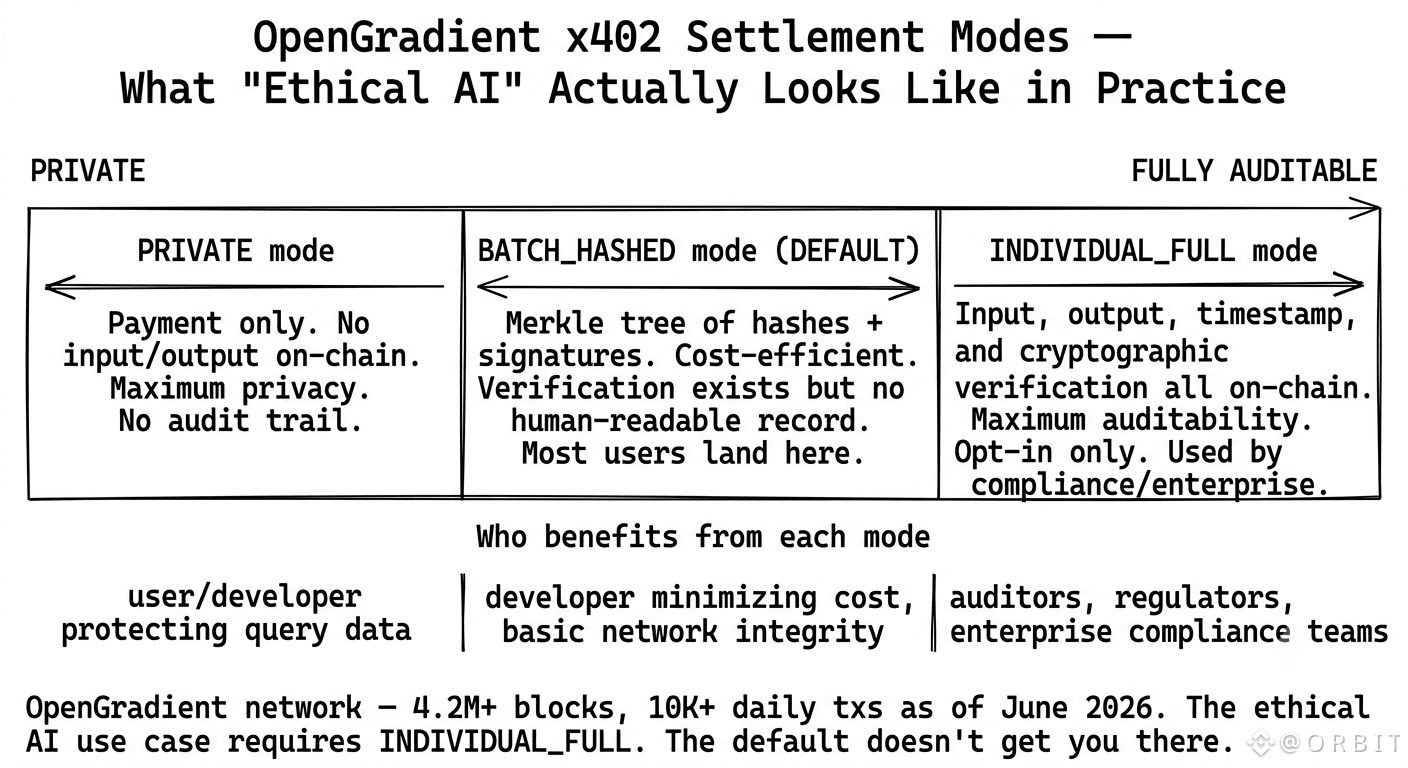
Dieses Detail aus den SDK-Dokumenten hat sich in meinem Kopf festgesetzt. @OpenGradient hat drei Abwicklungsmodi in ihr x402-Zahlungsprotokoll eingebaut: PRIVATE, BATCH_HASHED und INDIVIDUAL_FULL. Dieser letzte Modus — erfasst Eingaben, Ausgaben, Zeitstempel und die Verifikation on-chain, maximale Nachvollziehbarkeit — ist das, was ethische KI-Infrastruktur wirklich braucht, um irgendjemandem überhaupt etwas nachweisen zu können. Und das ist nicht die Standardeinstellung. $OPG #OPG
Die Standardeinstellung ist BATCH_HASHED. Am kosteneffizientesten. Bündelt Inferenzdaten in einen Merkle-Baum mit Hashes und Signaturen. Eine echte Verifikation existiert, aber der vollständige Prüfpfad ist Opt-in. In der Zwischenzeit hält das Netzwerk über 4,2 Millionen produzierte Blöcke vor, 10.000+ tägliche Transaktionen, und das Upbit-Listing vom 15. Juni hat das 24-Stunden-Volumen auf 357 Mio. $ geschoben, ohne dass irgendjemand die Abwicklungsmodi genauer unter die Lupe genommen hätte.
Ich habe INDIVIDUAL_FULL im SDK während der Aufgabe ausprobiert. Es funktioniert. Du bekommst einen Transaktionshash zurück zusammen mit der KI-Antwort. On-chain. Mit Zeitstempel. Das ist wirklich ein anderes Artefakt als jede Ausgabe von GPT-5 oder Gemini — die liefern dir überhaupt keine Herkunft. OpenGradient gibt dir eine Quittung.
Aber hier ist das, was mich innehalten ließ… Diejenigen, die am ehesten INDIVIDUAL_FULL nutzen, sind Compliance-Teams, Auditoren, Unternehmen — nicht normale Alltagsnutzer. Die gesellschaftliche Wirkung von ethischer KI trifft zuerst Institutionen. Normale Nutzer bekommen den Standard, und der Standard ist für sie größtenteils immer noch undurchsichtig.
Wenn wir also von verifizierbarer KI sprechen: Wer genau macht die Verifikation?
Dieses Detail aus den SDK-Dokumenten hat sich in meinem Kopf festgesetzt. @OpenGradient hat drei Abwicklungsmodi in ihr x402-Zahlungsprotokoll eingebaut: PRIVATE, BATCH_HASHED und INDIVIDUAL_FULL. Dieser letzte Modus — erfasst Eingaben, Ausgaben, Zeitstempel und die Verifikation on-chain, maximale Nachvollziehbarkeit — ist das, was ethische KI-Infrastruktur wirklich braucht, um irgendjemandem überhaupt etwas nachweisen zu können. Und das ist nicht die Standardeinstellung. $OPG #OPG
Die Standardeinstellung ist BATCH_HASHED. Am kosteneffizientesten. Bündelt Inferenzdaten in einen Merkle-Baum mit Hashes und Signaturen. Eine echte Verifikation existiert, aber der vollständige Prüfpfad ist Opt-in. In der Zwischenzeit hält das Netzwerk über 4,2 Millionen produzierte Blöcke vor, 10.000+ tägliche Transaktionen, und das Upbit-Listing vom 15. Juni hat das 24-Stunden-Volumen auf 357 Mio. $ geschoben, ohne dass irgendjemand die Abwicklungsmodi genauer unter die Lupe genommen hätte.
Ich habe INDIVIDUAL_FULL im SDK während der Aufgabe ausprobiert. Es funktioniert. Du bekommst einen Transaktionshash zurück zusammen mit der KI-Antwort. On-chain. Mit Zeitstempel. Das ist wirklich ein anderes Artefakt als jede Ausgabe von GPT-5 oder Gemini — die liefern dir überhaupt keine Herkunft. OpenGradient gibt dir eine Quittung.
Aber hier ist das, was mich innehalten ließ… Diejenigen, die am ehesten INDIVIDUAL_FULL nutzen, sind Compliance-Teams, Auditoren, Unternehmen — nicht normale Alltagsnutzer. Die gesellschaftliche Wirkung von ethischer KI trifft zuerst Institutionen. Normale Nutzer bekommen den Standard, und der Standard ist für sie größtenteils immer noch undurchsichtig.
Wenn wir also von verifizierbarer KI sprechen: Wer genau macht die Verifikation?
Die Standardeinstellung ist BATCH_HASHED. Am kosteneffizientesten. Bündelt Inferenzdaten in einen Merkle-Baum mit Hashes und Signaturen. Eine echte Verifikation existiert, aber der vollständige Prüfpfad ist Opt-in. In der Zwischenzeit hält das Netzwerk über 4,2 Millionen produzierte Blöcke vor, 10.000+ tägliche Transaktionen, und das Upbit-Listing vom 15. Juni hat das 24-Stunden-Volumen auf 357 Mio. $ geschoben, ohne dass irgendjemand die Abwicklungsmodi genauer unter die Lupe genommen hätte.
Ich habe INDIVIDUAL_FULL im SDK während der Aufgabe ausprobiert. Es funktioniert. Du bekommst einen Transaktionshash zurück zusammen mit der KI-Antwort. On-chain. Mit Zeitstempel. Das ist wirklich ein anderes Artefakt als jede Ausgabe von GPT-5 oder Gemini — die liefern dir überhaupt keine Herkunft. OpenGradient gibt dir eine Quittung.
Aber hier ist das, was mich innehalten ließ… Diejenigen, die am ehesten INDIVIDUAL_FULL nutzen, sind Compliance-Teams, Auditoren, Unternehmen — nicht normale Alltagsnutzer. Die gesellschaftliche Wirkung von ethischer KI trifft zuerst Institutionen. Normale Nutzer bekommen den Standard, und der Standard ist für sie größtenteils immer noch undurchsichtig.
Wenn wir also von verifizierbarer KI sprechen: Wer genau macht die Verifikation?
22
21
106
·
--
Etwas rutschte während der Aufgabe in den Fokus, womit ich nicht gerechnet hatte — und das ordnet den gesamten Compliance-Gedanken neu.
OpenGradient $OPG @OpenGradient #OPG positioniert sich als compliance-freundliche KI durch kryptografischen Nachweis jeder Inferenz: welches Modell lief, welche Daten es berührten, unveränderlicher Trace On-Chain. Für regulierte Branchen — Finanzdienstleistungen, Gesundheitswesen, überall dort, wo eine KI-Entscheidung eine Prüfspur braucht — ist das ein wirklich überzeugendes Konzept.
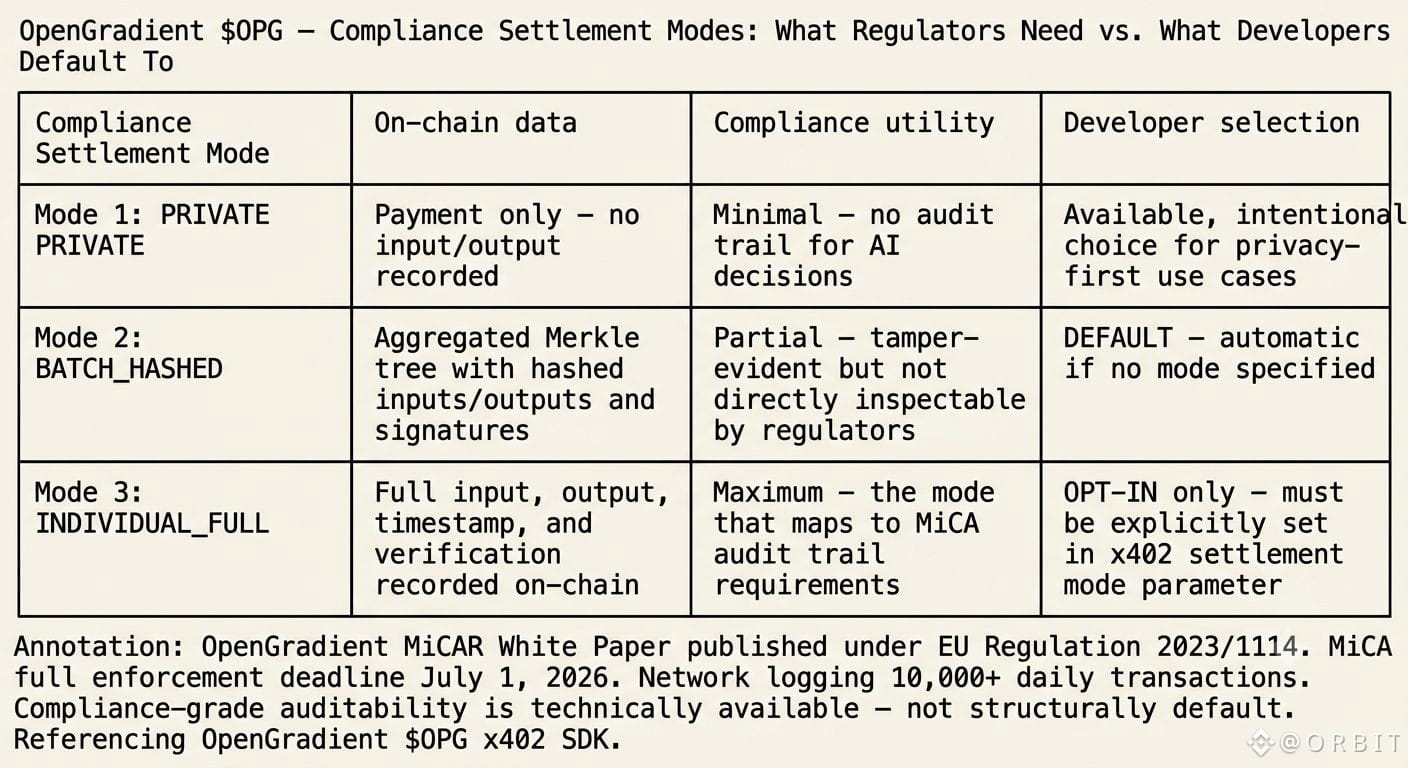
Wenn man jedoch in das tatsächliche x402-Settlement-SDK eintaucht, gibt es drei Modi. PRIVATE: nur Zahlungen, keine Daten On-Chain. BATCH_HASHED: gehashte Summen in einem Merkle-Baum, kosteneffizient — und der Standard. INDIVIDUAL_FULL: vollständige Eingaben, Ausgaben, Zeitstempel und Verifikationen werden On-Chain aufgezeichnet. Genau dieser Modus wäre die Compliance-Spur, die Aufsichtsbehörden tatsächlich wollen. Er ist aber nicht der Standard. Ein Entwickler, der eine konforme App baut, muss ihn bewusst aktivieren.
Ich habe darüber nachgedacht. Das MiCA-Whitepaper von OpenGradient existiert — vollständige regulatorische Kennzeichnung unter der EU-Verordnung 2023/1114 — was zeigt, dass sie den Compliance-Markt ernsthaft im Blick haben, genau dann, wenn die MiCA-Übergangsphase endet (1. Juli 2026) und die Durchsetzung in den EU-Mitgliedstaaten deutlich strenger wird. In diesem Kontext hat die Chain diese Woche 10.000+ tägliche Transaktionen protokolliert. Aber die Compliance-Erzählung auf Netzwerkebene und das Default-Verhalten für Entwickler ziehen weiterhin in unterschiedliche Richtungen.
Erfordert Compliance tatsächlich eine Infrastruktur, die Auditierbarkeit als Standard setzt — statt als auswählbaren Modus?
Etwas rutschte während der Aufgabe in den Fokus, womit ich nicht gerechnet hatte — und das ordnet den gesamten Compliance-Gedanken neu.
OpenGradient $OPG @OpenGradient #OPG positioniert sich als compliance-freundliche KI durch kryptografischen Nachweis jeder Inferenz: welches Modell lief, welche Daten es berührten, unveränderlicher Trace On-Chain. Für regulierte Branchen — Finanzdienstleistungen, Gesundheitswesen, überall dort, wo eine KI-Entscheidung eine Prüfspur braucht — ist das ein wirklich überzeugendes Konzept.
Wenn man jedoch in das tatsächliche x402-Settlement-SDK eintaucht, gibt es drei Modi. PRIVATE: nur Zahlungen, keine Daten On-Chain. BATCH_HASHED: gehashte Summen in einem Merkle-Baum, kosteneffizient — und der Standard. INDIVIDUAL_FULL: vollständige Eingaben, Ausgaben, Zeitstempel und Verifikationen werden On-Chain aufgezeichnet. Genau dieser Modus wäre die Compliance-Spur, die Aufsichtsbehörden tatsächlich wollen. Er ist aber nicht der Standard. Ein Entwickler, der eine konforme App baut, muss ihn bewusst aktivieren.
Ich habe darüber nachgedacht. Das MiCA-Whitepaper von OpenGradient existiert — vollständige regulatorische Kennzeichnung unter der EU-Verordnung 2023/1114 — was zeigt, dass sie den Compliance-Markt ernsthaft im Blick haben, genau dann, wenn die MiCA-Übergangsphase endet (1. Juli 2026) und die Durchsetzung in den EU-Mitgliedstaaten deutlich strenger wird. In diesem Kontext hat die Chain diese Woche 10.000+ tägliche Transaktionen protokolliert. Aber die Compliance-Erzählung auf Netzwerkebene und das Default-Verhalten für Entwickler ziehen weiterhin in unterschiedliche Richtungen.
Erfordert Compliance tatsächlich eine Infrastruktur, die Auditierbarkeit als Standard setzt — statt als auswählbaren Modus?
OpenGradient $OPG @OpenGradient #OPG positioniert sich als compliance-freundliche KI durch kryptografischen Nachweis jeder Inferenz: welches Modell lief, welche Daten es berührten, unveränderlicher Trace On-Chain. Für regulierte Branchen — Finanzdienstleistungen, Gesundheitswesen, überall dort, wo eine KI-Entscheidung eine Prüfspur braucht — ist das ein wirklich überzeugendes Konzept.
Wenn man jedoch in das tatsächliche x402-Settlement-SDK eintaucht, gibt es drei Modi. PRIVATE: nur Zahlungen, keine Daten On-Chain. BATCH_HASHED: gehashte Summen in einem Merkle-Baum, kosteneffizient — und der Standard. INDIVIDUAL_FULL: vollständige Eingaben, Ausgaben, Zeitstempel und Verifikationen werden On-Chain aufgezeichnet. Genau dieser Modus wäre die Compliance-Spur, die Aufsichtsbehörden tatsächlich wollen. Er ist aber nicht der Standard. Ein Entwickler, der eine konforme App baut, muss ihn bewusst aktivieren.
Ich habe darüber nachgedacht. Das MiCA-Whitepaper von OpenGradient existiert — vollständige regulatorische Kennzeichnung unter der EU-Verordnung 2023/1114 — was zeigt, dass sie den Compliance-Markt ernsthaft im Blick haben, genau dann, wenn die MiCA-Übergangsphase endet (1. Juli 2026) und die Durchsetzung in den EU-Mitgliedstaaten deutlich strenger wird. In diesem Kontext hat die Chain diese Woche 10.000+ tägliche Transaktionen protokolliert. Aber die Compliance-Erzählung auf Netzwerkebene und das Default-Verhalten für Entwickler ziehen weiterhin in unterschiedliche Richtungen.
Erfordert Compliance tatsächlich eine Infrastruktur, die Auditierbarkeit als Standard setzt — statt als auswählbaren Modus?
26
21
97
·
--
Übersetzung ansehen
What stopped me mid-task wasn't the automation pitch itself. It was one sentence buried in @OpenGradient x402 blog: "AI agents that autonomously spin up compute, pay per inference, verify their own outputs, and interact with each other — all without human-in-the-loop payment flows — aren't science fiction." Written in February 2026. By June, AWS had built exactly that with Bedrock AgentCore Payments. $OPG #OPG
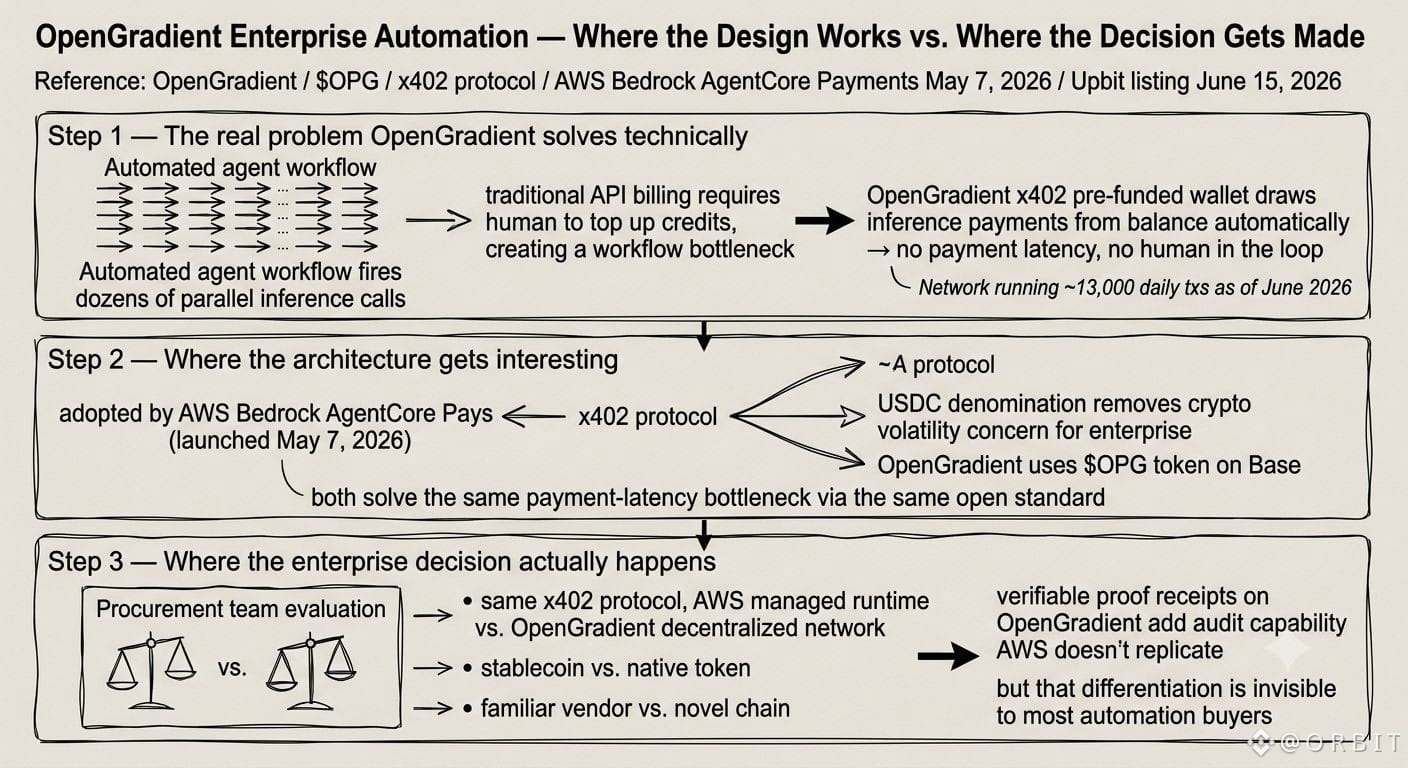
Here's the thing. OpenGradient's x402 implementation pre-funds a wallet so an agent can fire dozens of parallel inference calls without any payment latency blocking compute. That's a real operational design choice — not a whitepaper promise. And the problem it solves for enterprise automation is legitimate: most automated workflows still bottleneck at billing. An agent that needs to pay for inference mid-workflow currently stalls unless a human topped up the API credits. The pre-funded draw mechanism removes that stall. The network's running ~13,000 daily transactions with 197M $OPG now circulating post-Upbit listing on June 15, and the baseline activity underneath all that listing noise is genuinely steady.
I spent time cross-referencing this against how AWS is positioning AgentCore Payments, which launched May 7 and does the same x402 pattern with USDC, not OPG. Same protocol, different token. Enterprise teams will gravitate to whichever rail causes less friction in procurement.
…which raises the uncomfortable question for OpenGradient: if x402 is the standard and AWS implements it first with a stablecoin, what exactly does the $OPG payment rail add that tips the enterprise decision?
What stopped me mid-task wasn't the automation pitch itself. It was one sentence buried in @OpenGradient x402 blog: "AI agents that autonomously spin up compute, pay per inference, verify their own outputs, and interact with each other — all without human-in-the-loop payment flows — aren't science fiction." Written in February 2026. By June, AWS had built exactly that with Bedrock AgentCore Payments. $OPG #OPG
Here's the thing. OpenGradient's x402 implementation pre-funds a wallet so an agent can fire dozens of parallel inference calls without any payment latency blocking compute. That's a real operational design choice — not a whitepaper promise. And the problem it solves for enterprise automation is legitimate: most automated workflows still bottleneck at billing. An agent that needs to pay for inference mid-workflow currently stalls unless a human topped up the API credits. The pre-funded draw mechanism removes that stall. The network's running ~13,000 daily transactions with 197M $OPG now circulating post-Upbit listing on June 15, and the baseline activity underneath all that listing noise is genuinely steady.
I spent time cross-referencing this against how AWS is positioning AgentCore Payments, which launched May 7 and does the same x402 pattern with USDC, not OPG. Same protocol, different token. Enterprise teams will gravitate to whichever rail causes less friction in procurement.
…which raises the uncomfortable question for OpenGradient: if x402 is the standard and AWS implements it first with a stablecoin, what exactly does the $OPG payment rail add that tips the enterprise decision?
Here's the thing. OpenGradient's x402 implementation pre-funds a wallet so an agent can fire dozens of parallel inference calls without any payment latency blocking compute. That's a real operational design choice — not a whitepaper promise. And the problem it solves for enterprise automation is legitimate: most automated workflows still bottleneck at billing. An agent that needs to pay for inference mid-workflow currently stalls unless a human topped up the API credits. The pre-funded draw mechanism removes that stall. The network's running ~13,000 daily transactions with 197M $OPG now circulating post-Upbit listing on June 15, and the baseline activity underneath all that listing noise is genuinely steady.
I spent time cross-referencing this against how AWS is positioning AgentCore Payments, which launched May 7 and does the same x402 pattern with USDC, not OPG. Same protocol, different token. Enterprise teams will gravitate to whichever rail causes less friction in procurement.
…which raises the uncomfortable question for OpenGradient: if x402 is the standard and AWS implements it first with a stablecoin, what exactly does the $OPG payment rail add that tips the enterprise decision?
1
103
·
--
Übersetzung ansehen
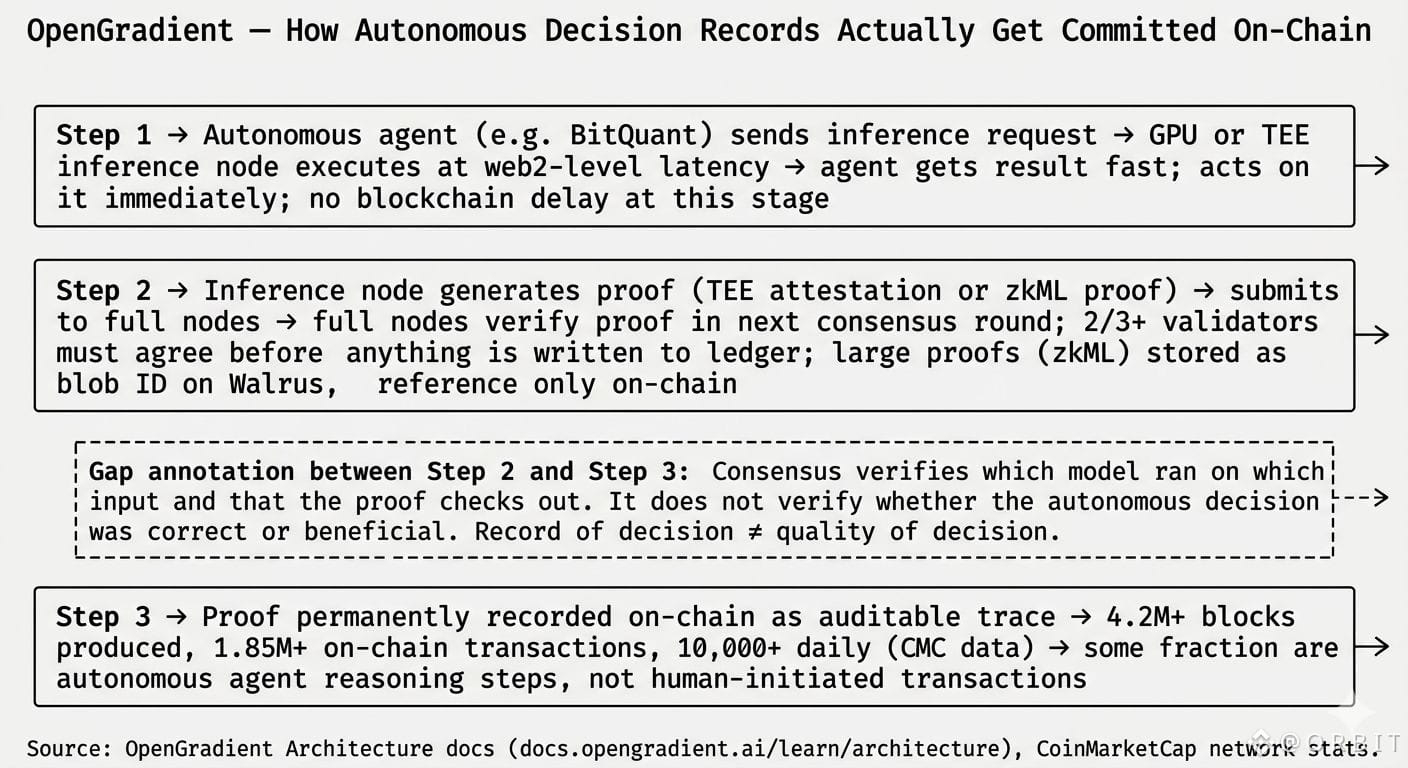
Something in the @OpenGradient architecture docs stopped me mid-task. Not the agent angle — the sequencing. An autonomous agent makes a decision call, inference runs on a GPU/TEE node at web2 speed, but the decision only gets committed to the ledger after 2/3+ validators pass the proof at the next consensus round. The agent acts fast. The record catches up. That separation is what actually makes autonomous decisions auditable rather than just fast. $OPG #OPG
Hold up — that design means every autonomous reasoning step BitQuant takes on a DeFi position isn't just an API call that disappears. It's a permanent, auditable trace on-chain once consensus confirms the proof. The network has produced 4.2 million blocks carrying 1.85 million on-chain transactions, running at 10,000+ daily. Some meaningful fraction of those are autonomous agent decisions, not humans clicking anything.
I spent a while just sitting with that. The narrative around AI agents usually focuses on what they decide. This is the infrastructure layer that makes the record of deciding tamper-evident. Completely different thing. Came at it from the autonomy angle but landed on the accountability angle instead.
Though… the honest gap is still the same one. Verification that a decision was recorded isn't the same as verification that it was a good decision. The proof tells you which model ran and on what input. It says nothing about whether the output was actually right.
Hmm. Does on-chain auditability of bad autonomous decisions help anyone, or just create a cleaner record of the damage?
Something in the @OpenGradient architecture docs stopped me mid-task. Not the agent angle — the sequencing. An autonomous agent makes a decision call, inference runs on a GPU/TEE node at web2 speed, but the decision only gets committed to the ledger after 2/3+ validators pass the proof at the next consensus round. The agent acts fast. The record catches up. That separation is what actually makes autonomous decisions auditable rather than just fast. $OPG #OPG
Hold up — that design means every autonomous reasoning step BitQuant takes on a DeFi position isn't just an API call that disappears. It's a permanent, auditable trace on-chain once consensus confirms the proof. The network has produced 4.2 million blocks carrying 1.85 million on-chain transactions, running at 10,000+ daily. Some meaningful fraction of those are autonomous agent decisions, not humans clicking anything.
I spent a while just sitting with that. The narrative around AI agents usually focuses on what they decide. This is the infrastructure layer that makes the record of deciding tamper-evident. Completely different thing. Came at it from the autonomy angle but landed on the accountability angle instead.
Though… the honest gap is still the same one. Verification that a decision was recorded isn't the same as verification that it was a good decision. The proof tells you which model ran and on what input. It says nothing about whether the output was actually right.
Hmm. Does on-chain auditability of bad autonomous decisions help anyone, or just create a cleaner record of the damage?
Hold up — that design means every autonomous reasoning step BitQuant takes on a DeFi position isn't just an API call that disappears. It's a permanent, auditable trace on-chain once consensus confirms the proof. The network has produced 4.2 million blocks carrying 1.85 million on-chain transactions, running at 10,000+ daily. Some meaningful fraction of those are autonomous agent decisions, not humans clicking anything.
I spent a while just sitting with that. The narrative around AI agents usually focuses on what they decide. This is the infrastructure layer that makes the record of deciding tamper-evident. Completely different thing. Came at it from the autonomy angle but landed on the accountability angle instead.
Though… the honest gap is still the same one. Verification that a decision was recorded isn't the same as verification that it was a good decision. The proof tells you which model ran and on what input. It says nothing about whether the output was actually right.
Hmm. Does on-chain auditability of bad autonomous decisions help anyone, or just create a cleaner record of the damage?
1
84
·
--
Übersetzung ansehen
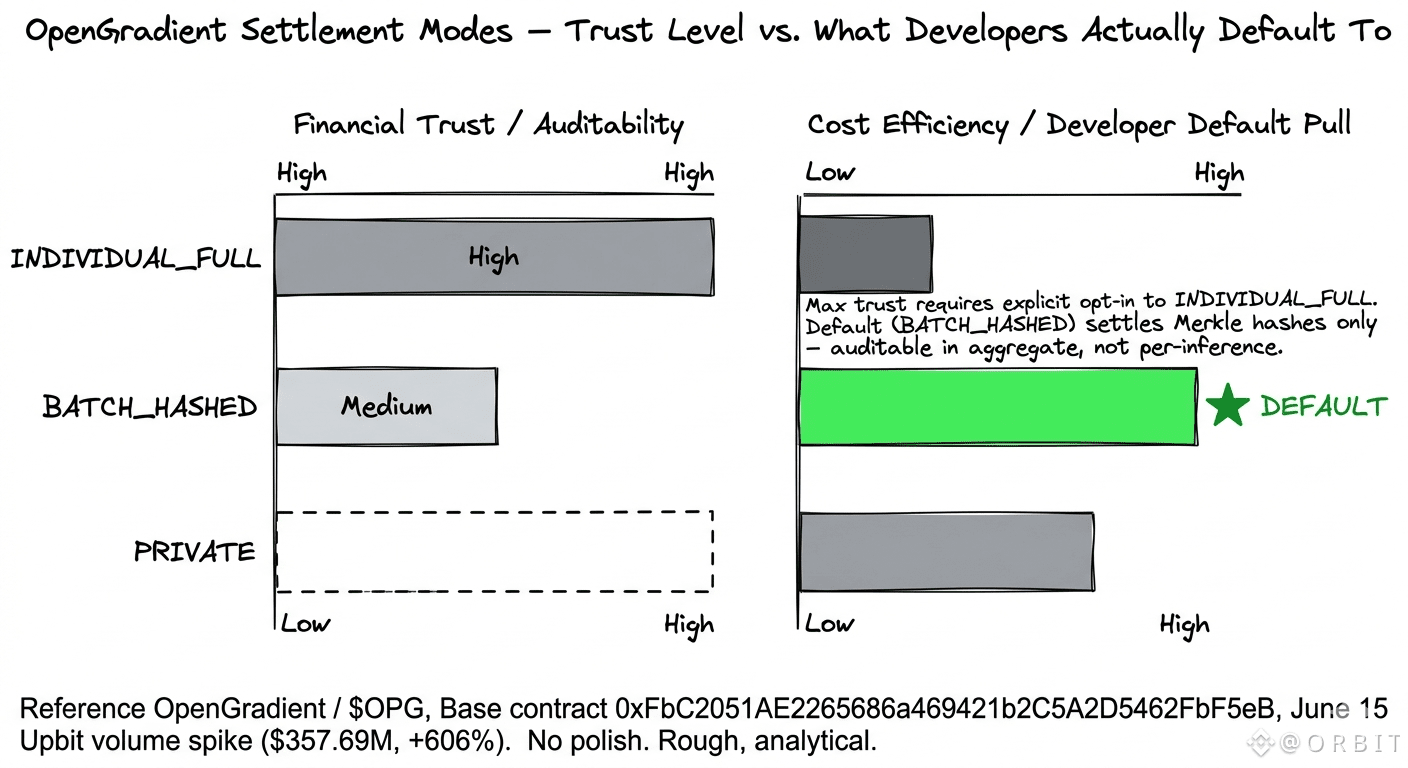
The thing that caught me off guard during this task wasn't the verifiable inference pitch — it was the settlement mode architecture sitting quietly in OpenGradient's SDK docs. Three modes: PRIVATE (payment only, nothing on-chain), BATCH_HASHED (Merkle-aggregated hashes, default), and INDIVIDUAL_FULL (every input, output, timestamp fully recorded). $OPG , @OpenGradient , #OPG . The default — BATCH_HASHED — is cost-efficient but not fully transparent. Maximum financial trust requires INDIVIDUAL_FULL. Nobody ships that by default.
That contrast landed harder when I looked back at the Upbit listing on June 15. OPG on Base (0xFbC2051AE2265686a469421b2C5A2D5462FbF5eB), volume exploding 606% to $357.69M, price swinging $0.3064 to $0.1815 intraday. The network was processing thousands of daily transactions through all of this. But what settlement mode were they using? Most likely batch. Cheaper, faster, less exposed. Not the version that reshapes financial trust at its core.
I sat with that for a while. The infrastructure to rebuild financial trust genuinely exists here — every model call auditable, every input and output immutably recorded, no black box. But the default behavior optimizes for cost, not transparency. Which means trust is an opt-in, not the baseline.
…and if trust requires an active choice to unlock, who actually makes that choice in practice — and who never thinks to ask?
The thing that caught me off guard during this task wasn't the verifiable inference pitch — it was the settlement mode architecture sitting quietly in OpenGradient's SDK docs. Three modes: PRIVATE (payment only, nothing on-chain), BATCH_HASHED (Merkle-aggregated hashes, default), and INDIVIDUAL_FULL (every input, output, timestamp fully recorded). $OPG , @OpenGradient , #OPG . The default — BATCH_HASHED — is cost-efficient but not fully transparent. Maximum financial trust requires INDIVIDUAL_FULL. Nobody ships that by default.
That contrast landed harder when I looked back at the Upbit listing on June 15. OPG on Base (0xFbC2051AE2265686a469421b2C5A2D5462FbF5eB), volume exploding 606% to $357.69M, price swinging $0.3064 to $0.1815 intraday. The network was processing thousands of daily transactions through all of this. But what settlement mode were they using? Most likely batch. Cheaper, faster, less exposed. Not the version that reshapes financial trust at its core.
I sat with that for a while. The infrastructure to rebuild financial trust genuinely exists here — every model call auditable, every input and output immutably recorded, no black box. But the default behavior optimizes for cost, not transparency. Which means trust is an opt-in, not the baseline.
…and if trust requires an active choice to unlock, who actually makes that choice in practice — and who never thinks to ask?
That contrast landed harder when I looked back at the Upbit listing on June 15. OPG on Base (0xFbC2051AE2265686a469421b2C5A2D5462FbF5eB), volume exploding 606% to $357.69M, price swinging $0.3064 to $0.1815 intraday. The network was processing thousands of daily transactions through all of this. But what settlement mode were they using? Most likely batch. Cheaper, faster, less exposed. Not the version that reshapes financial trust at its core.
I sat with that for a while. The infrastructure to rebuild financial trust genuinely exists here — every model call auditable, every input and output immutably recorded, no black box. But the default behavior optimizes for cost, not transparency. Which means trust is an opt-in, not the baseline.
…and if trust requires an active choice to unlock, who actually makes that choice in practice — and who never thinks to ask?
2
1
126
·
--
Übersetzung ansehen
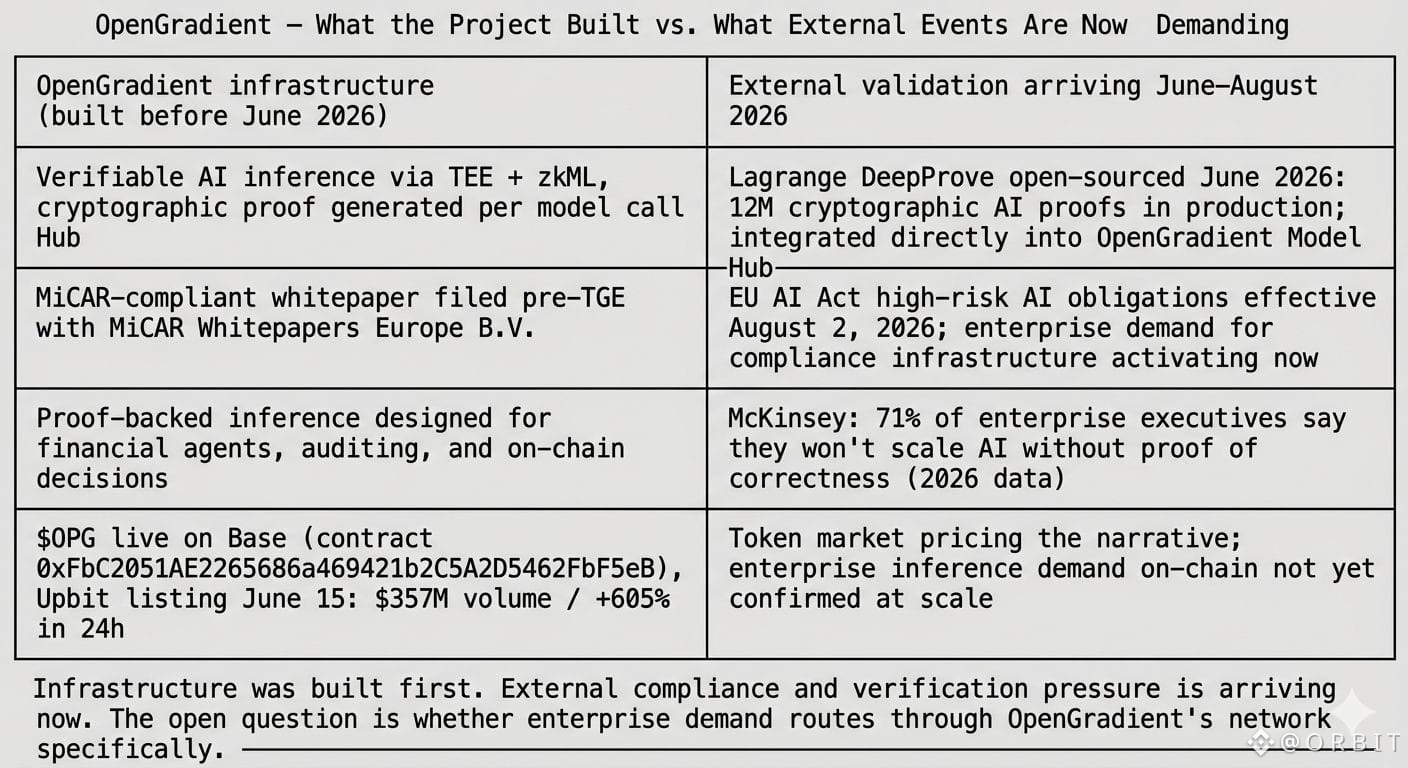
Something clicked during this task that reframed the whole project for me. OpenGradient #OPG @OpenGradient talks a lot about verifiable inference, but what actually set it apart in my mind was how external forces are now validating the same bet — independently. Lagrange Labs just open-sourced DeepProve this month, a production-grade zkML system that generated 12 million cryptographic AI proofs. They integrated it directly into OpenGradient's Model Hub. Then there's McKinsey data citing 71% of enterprise executives won't scale AI without proof of correctness. And the EU AI Act's high-risk obligations hit August 2, 2026 — six weeks away.
Hold up — OpenGradient built this infrastructure before those external pressures arrived. That's a different thing from a project that reacts to a narrative. The MiCAR-compliant whitepaper was filed pre-TGE. The DeepProve integration was in place before enterprises started publicly demanding cryptographic receipts for AI outputs. The timing is backward in the good way.
The Upbit listing June 15 moved $357M in volume, +605%, with $OPG touching $0.30 on the Base contract 0xFbC2051AE2265686a469421b2C5A2D5462FbF5eB. Markets are pricing in the narrative. But the external validation I keep coming back to is quieter — enterprise compliance requirements and open-source proof systems converging on the exact architecture OpenGradient already built.
The question I can't answer: does convergence from outside translate into measurable inference volume growth inside the network before token attention moves on?
Something clicked during this task that reframed the whole project for me. OpenGradient #OPG @OpenGradient talks a lot about verifiable inference, but what actually set it apart in my mind was how external forces are now validating the same bet — independently. Lagrange Labs just open-sourced DeepProve this month, a production-grade zkML system that generated 12 million cryptographic AI proofs. They integrated it directly into OpenGradient's Model Hub. Then there's McKinsey data citing 71% of enterprise executives won't scale AI without proof of correctness. And the EU AI Act's high-risk obligations hit August 2, 2026 — six weeks away.
Hold up — OpenGradient built this infrastructure before those external pressures arrived. That's a different thing from a project that reacts to a narrative. The MiCAR-compliant whitepaper was filed pre-TGE. The DeepProve integration was in place before enterprises started publicly demanding cryptographic receipts for AI outputs. The timing is backward in the good way.
The Upbit listing June 15 moved $357M in volume, +605%, with $OPG touching $0.30 on the Base contract 0xFbC2051AE2265686a469421b2C5A2D5462FbF5eB. Markets are pricing in the narrative. But the external validation I keep coming back to is quieter — enterprise compliance requirements and open-source proof systems converging on the exact architecture OpenGradient already built.
The question I can't answer: does convergence from outside translate into measurable inference volume growth inside the network before token attention moves on?
Hold up — OpenGradient built this infrastructure before those external pressures arrived. That's a different thing from a project that reacts to a narrative. The MiCAR-compliant whitepaper was filed pre-TGE. The DeepProve integration was in place before enterprises started publicly demanding cryptographic receipts for AI outputs. The timing is backward in the good way.
The Upbit listing June 15 moved $357M in volume, +605%, with $OPG touching $0.30 on the Base contract 0xFbC2051AE2265686a469421b2C5A2D5462FbF5eB. Markets are pricing in the narrative. But the external validation I keep coming back to is quieter — enterprise compliance requirements and open-source proof systems converging on the exact architecture OpenGradient already built.
The question I can't answer: does convergence from outside translate into measurable inference volume growth inside the network before token attention moves on?
2
2
126
·
--
Übersetzung ansehen
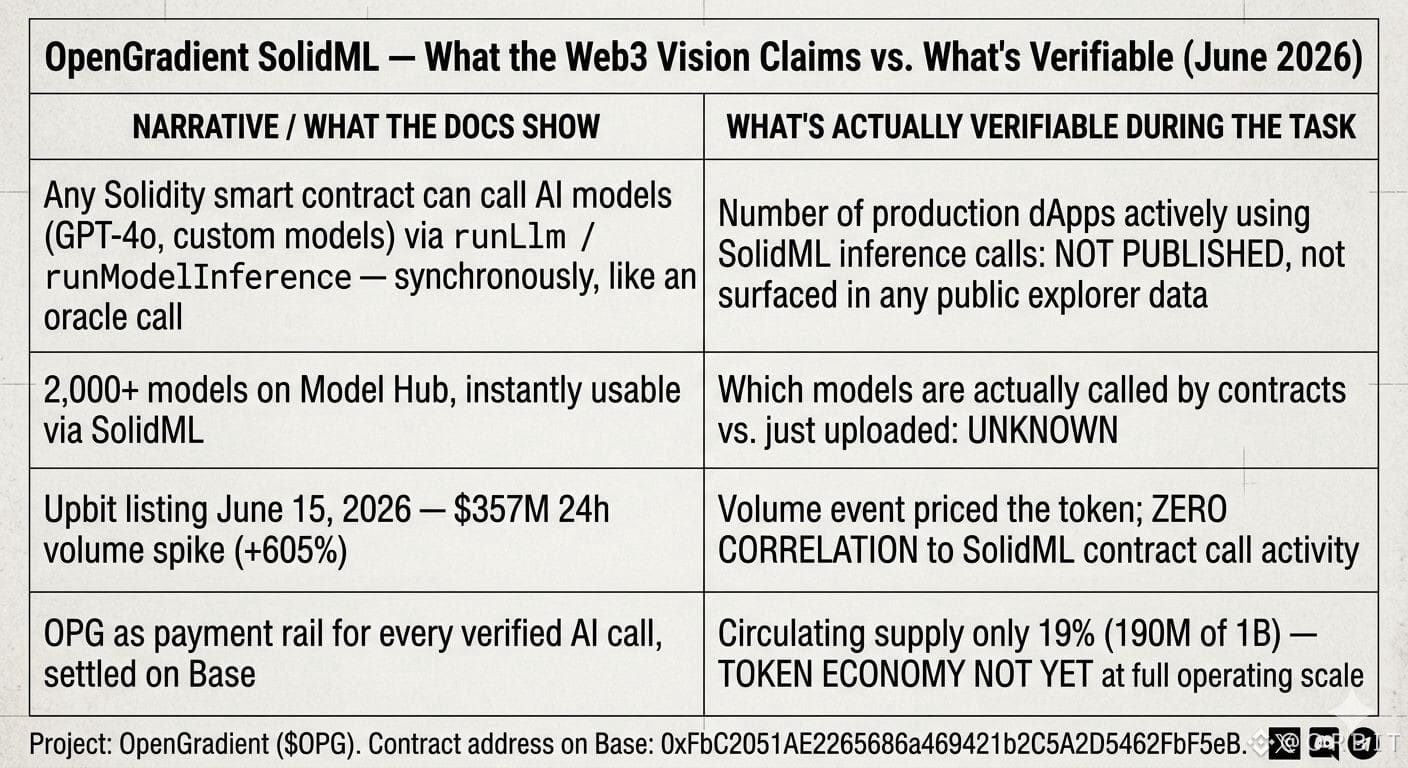
Was reading through the SolidML docs during the CreatorPad task when something stopped me cold. There's a function in there — runLlm — that lets a Solidity smart contract call GPT-4o directly. From inside the contract. Synchronously. Like calling any other function. @OpenGradient $OPG #OPG
hold up — that's actually the Web3 vision in one line of code. Not "AI with blockchain exposure." Not a token stapled to a chatbot. A smart contract making an AI inference call the same way it calls a price oracle. That's compositional. That's what permissionless is supposed to mean when you apply it to intelligence rather than just value.
And then I look at where OPG is right now post-Upbit listing June 15 — volume spiked $357M, price opened at $0.3064, dumped to $0.1815, token sitting at $0.21 range today. 190M circulating out of 1B. The market is pricing the token. It's not pricing the SolidML usage yet.
I spent a while trying to find how many smart contracts on OpenGradient are actually calling runModelInference in production versus just existing in testnet state. That number isn't published anywhere I could find.
The gap between "you can call GPT-4o from a Solidity function" and "someone's dApp depends on it" — that's probably where the real test of the Web3 vision lives.
Was reading through the SolidML docs during the CreatorPad task when something stopped me cold. There's a function in there — runLlm — that lets a Solidity smart contract call GPT-4o directly. From inside the contract. Synchronously. Like calling any other function. @OpenGradient $OPG #OPG
hold up — that's actually the Web3 vision in one line of code. Not "AI with blockchain exposure." Not a token stapled to a chatbot. A smart contract making an AI inference call the same way it calls a price oracle. That's compositional. That's what permissionless is supposed to mean when you apply it to intelligence rather than just value.
And then I look at where OPG is right now post-Upbit listing June 15 — volume spiked $357M, price opened at $0.3064, dumped to $0.1815, token sitting at $0.21 range today. 190M circulating out of 1B. The market is pricing the token. It's not pricing the SolidML usage yet.
I spent a while trying to find how many smart contracts on OpenGradient are actually calling runModelInference in production versus just existing in testnet state. That number isn't published anywhere I could find.
The gap between "you can call GPT-4o from a Solidity function" and "someone's dApp depends on it" — that's probably where the real test of the Web3 vision lives.
hold up — that's actually the Web3 vision in one line of code. Not "AI with blockchain exposure." Not a token stapled to a chatbot. A smart contract making an AI inference call the same way it calls a price oracle. That's compositional. That's what permissionless is supposed to mean when you apply it to intelligence rather than just value.
And then I look at where OPG is right now post-Upbit listing June 15 — volume spiked $357M, price opened at $0.3064, dumped to $0.1815, token sitting at $0.21 range today. 190M circulating out of 1B. The market is pricing the token. It's not pricing the SolidML usage yet.
I spent a while trying to find how many smart contracts on OpenGradient are actually calling runModelInference in production versus just existing in testnet state. That number isn't published anywhere I could find.
The gap between "you can call GPT-4o from a Solidity function" and "someone's dApp depends on it" — that's probably where the real test of the Web3 vision lives.
82
·
--
Übersetzung ansehen
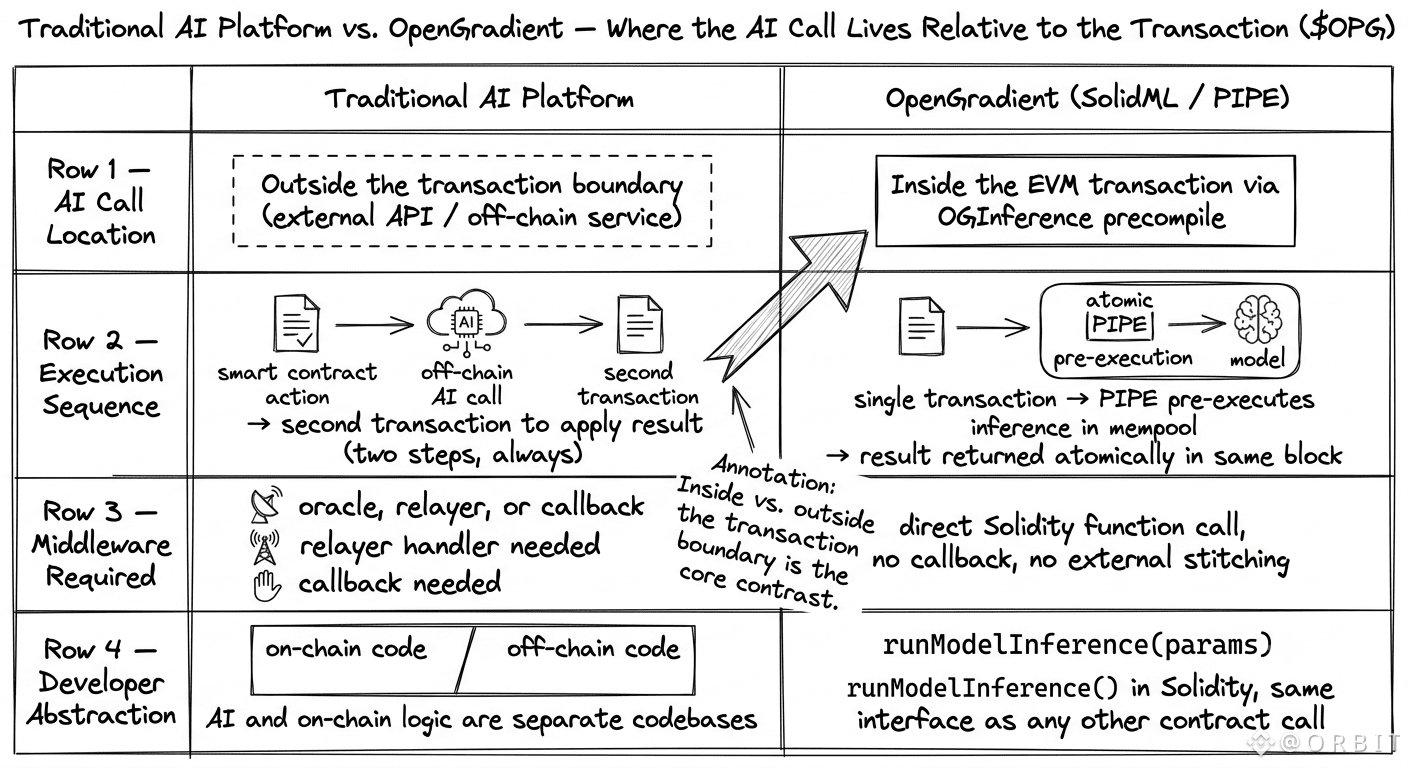
The thing that separated OpenGradient from every traditional AI platform I've poked at isn't the verification story — it's the execution primitive. @OpenGradient $OPG #OPG built a Solidity precompile called OGInference that lets a smart contract call an AI model the same way it calls any other function. runModelInference(). One line. The result comes back atomically, inside the same EVM transaction. No oracle callback. No external API roundtrip. No waiting for a second transaction to close the loop.
That's a genuinely different architectural choice. OpenAI, Anthropic, every cloud provider — their inference lives outside the transaction boundary. The AI call and the on-chain action are always two separate steps, always stitched together by middleware or an off-chain relayer. PIPE — the Parallelized Inference Pre-Execution Engine — runs the inferences in the mempool before block building, so by the time the block lands, the result is already in. No congestion, no EVM overhead.
The Upbit listing on June 15 pushed OPG to $357.69M in 24-hour volume, a 606% spike. Fine. But none of that volume was from DeFi protocols calling runModelInference() in their Solidity logic. That developer surface is barely being used yet.
And that's the part I keep sitting with. The most meaningfully different thing about this network — AI as a native transaction primitive — is also the thing that requires on-chain developers to actually rebuild their stack around it.
So is atomic AI inference a new primitive that changes on-chain development, or does it stay niche until the existing tooling ecosystems decide to adopt it?
The thing that separated OpenGradient from every traditional AI platform I've poked at isn't the verification story — it's the execution primitive. @OpenGradient $OPG #OPG built a Solidity precompile called OGInference that lets a smart contract call an AI model the same way it calls any other function. runModelInference(). One line. The result comes back atomically, inside the same EVM transaction. No oracle callback. No external API roundtrip. No waiting for a second transaction to close the loop.
That's a genuinely different architectural choice. OpenAI, Anthropic, every cloud provider — their inference lives outside the transaction boundary. The AI call and the on-chain action are always two separate steps, always stitched together by middleware or an off-chain relayer. PIPE — the Parallelized Inference Pre-Execution Engine — runs the inferences in the mempool before block building, so by the time the block lands, the result is already in. No congestion, no EVM overhead.
The Upbit listing on June 15 pushed OPG to $357.69M in 24-hour volume, a 606% spike. Fine. But none of that volume was from DeFi protocols calling runModelInference() in their Solidity logic. That developer surface is barely being used yet.
And that's the part I keep sitting with. The most meaningfully different thing about this network — AI as a native transaction primitive — is also the thing that requires on-chain developers to actually rebuild their stack around it.
So is atomic AI inference a new primitive that changes on-chain development, or does it stay niche until the existing tooling ecosystems decide to adopt it?
That's a genuinely different architectural choice. OpenAI, Anthropic, every cloud provider — their inference lives outside the transaction boundary. The AI call and the on-chain action are always two separate steps, always stitched together by middleware or an off-chain relayer. PIPE — the Parallelized Inference Pre-Execution Engine — runs the inferences in the mempool before block building, so by the time the block lands, the result is already in. No congestion, no EVM overhead.
The Upbit listing on June 15 pushed OPG to $357.69M in 24-hour volume, a 606% spike. Fine. But none of that volume was from DeFi protocols calling runModelInference() in their Solidity logic. That developer surface is barely being used yet.
And that's the part I keep sitting with. The most meaningfully different thing about this network — AI as a native transaction primitive — is also the thing that requires on-chain developers to actually rebuild their stack around it.
So is atomic AI inference a new primitive that changes on-chain development, or does it stay niche until the existing tooling ecosystems decide to adopt it?
3
2
133
·
--
Etwas hat mich heute Morgen während der @OpenGradient #OPG Aufgabe gestoppt. Der Verantwortungsansatz von OpenGradient klingt total — jede KI-Inferenz erhält eine kryptografische Spur on-chain. Der $OPG Vertrag auf Base (0xFbC2051AE2265686a469421b2C5A2D5462FbF5eB — dieselbe Adresse, die Upbit für Einzahlungen beim Listing am 15. Juni verwendet hat) regelt die Inferenzzahlungen über Permit2. Die Infrastruktur-Schicht scheint vollständig zu sein.
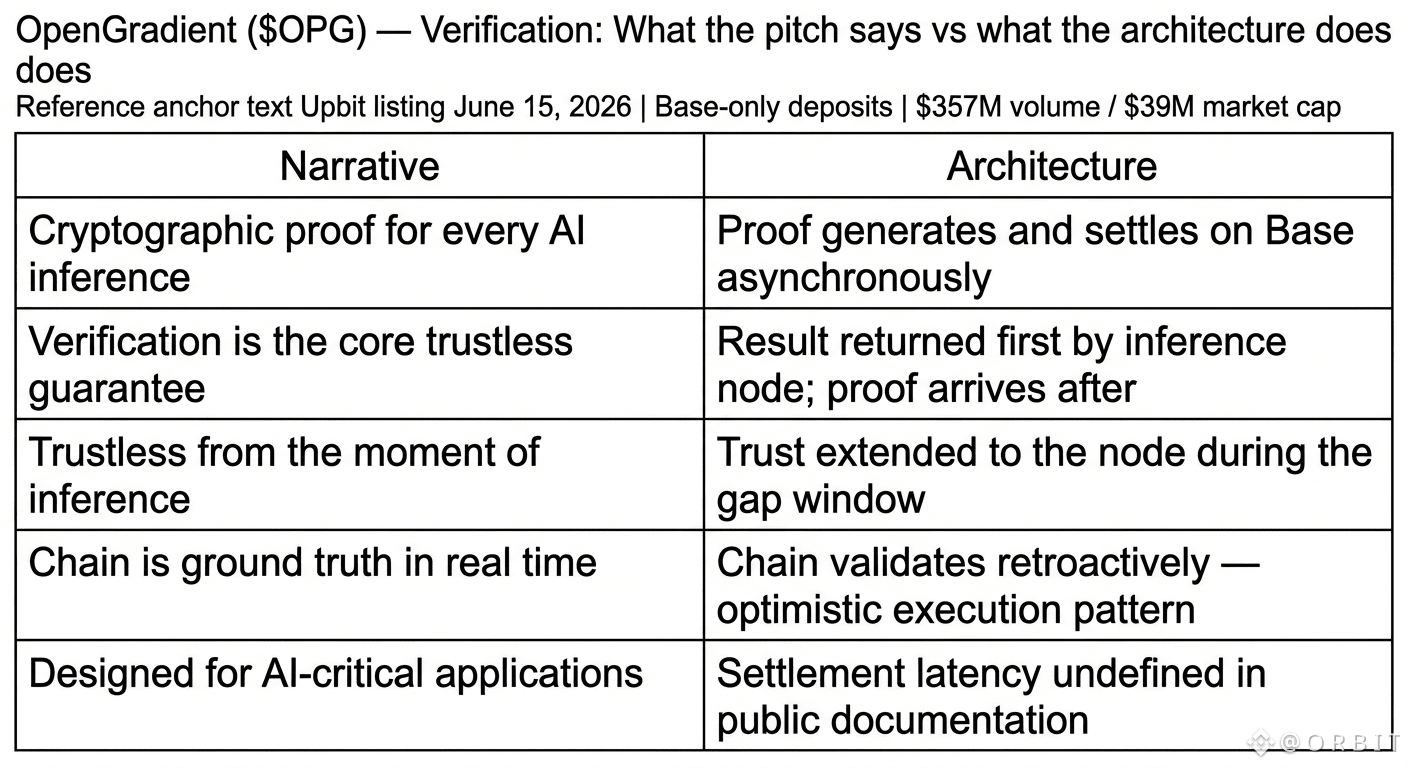
Aber sie teilt sich an einem wichtigen Punkt. Für Open-Source-Modelle, die auf den eigenen Inferenzknoten von OpenGradient laufen, können ZKML oder TEE-Bestätigungen tatsächlich die Berechnung verifizieren — welches Modell lief, genaue Eingaben, genaue Ausgaben. Das ist echte Verantwortlichkeit.
Für LLM-Proxy-Calls, die zu Anthropic oder OpenAI weitergeleitet werden, ist das, was das TEE beweist, jedoch enger gefasst: Der Prompt erreichte den Anbieter unberührt und das Ergebnis wurde unberührt zurückgegeben. Was nicht verifiziert werden kann, ist, was das Closed-Source-Modell intern gemacht hat — das Denken, die Gewichte, die genaue Version, die lief. Die Black Box bewegt sich stromaufwärts. OpenGradient sichert die Pipeline darum herum, stoppt aber an der Modellgrenze.
Habe eine Weile darüber nachgedacht. Ein Agent kann beweisen, dass er einen bestimmten Anbieter mit einem bestimmten Prompt angerufen hat und ein bestimmtes Ergebnis erhalten hat. Das ist mehr als die meisten Systeme anbieten. Aber zu beweisen, dass der Call korrekt stattgefunden hat, ist nicht dasselbe wie zu beweisen, was das Modell berechnet hat. Ob diese Lücke wichtig ist, hängt vollständig davon ab, was darauf aufgebaut wird. #OPG
Etwas hat mich heute Morgen während der @OpenGradient #OPG Aufgabe gestoppt. Der Verantwortungsansatz von OpenGradient klingt total — jede KI-Inferenz erhält eine kryptografische Spur on-chain. Der $OPG Vertrag auf Base (0xFbC2051AE2265686a469421b2C5A2D5462FbF5eB — dieselbe Adresse, die Upbit für Einzahlungen beim Listing am 15. Juni verwendet hat) regelt die Inferenzzahlungen über Permit2. Die Infrastruktur-Schicht scheint vollständig zu sein.
Aber sie teilt sich an einem wichtigen Punkt. Für Open-Source-Modelle, die auf den eigenen Inferenzknoten von OpenGradient laufen, können ZKML oder TEE-Bestätigungen tatsächlich die Berechnung verifizieren — welches Modell lief, genaue Eingaben, genaue Ausgaben. Das ist echte Verantwortlichkeit.
Für LLM-Proxy-Calls, die zu Anthropic oder OpenAI weitergeleitet werden, ist das, was das TEE beweist, jedoch enger gefasst: Der Prompt erreichte den Anbieter unberührt und das Ergebnis wurde unberührt zurückgegeben. Was nicht verifiziert werden kann, ist, was das Closed-Source-Modell intern gemacht hat — das Denken, die Gewichte, die genaue Version, die lief. Die Black Box bewegt sich stromaufwärts. OpenGradient sichert die Pipeline darum herum, stoppt aber an der Modellgrenze.
Habe eine Weile darüber nachgedacht. Ein Agent kann beweisen, dass er einen bestimmten Anbieter mit einem bestimmten Prompt angerufen hat und ein bestimmtes Ergebnis erhalten hat. Das ist mehr als die meisten Systeme anbieten. Aber zu beweisen, dass der Call korrekt stattgefunden hat, ist nicht dasselbe wie zu beweisen, was das Modell berechnet hat. Ob diese Lücke wichtig ist, hängt vollständig davon ab, was darauf aufgebaut wird. #OPG
Aber sie teilt sich an einem wichtigen Punkt. Für Open-Source-Modelle, die auf den eigenen Inferenzknoten von OpenGradient laufen, können ZKML oder TEE-Bestätigungen tatsächlich die Berechnung verifizieren — welches Modell lief, genaue Eingaben, genaue Ausgaben. Das ist echte Verantwortlichkeit.
Für LLM-Proxy-Calls, die zu Anthropic oder OpenAI weitergeleitet werden, ist das, was das TEE beweist, jedoch enger gefasst: Der Prompt erreichte den Anbieter unberührt und das Ergebnis wurde unberührt zurückgegeben. Was nicht verifiziert werden kann, ist, was das Closed-Source-Modell intern gemacht hat — das Denken, die Gewichte, die genaue Version, die lief. Die Black Box bewegt sich stromaufwärts. OpenGradient sichert die Pipeline darum herum, stoppt aber an der Modellgrenze.
Habe eine Weile darüber nachgedacht. Ein Agent kann beweisen, dass er einen bestimmten Anbieter mit einem bestimmten Prompt angerufen hat und ein bestimmtes Ergebnis erhalten hat. Das ist mehr als die meisten Systeme anbieten. Aber zu beweisen, dass der Call korrekt stattgefunden hat, ist nicht dasselbe wie zu beweisen, was das Modell berechnet hat. Ob diese Lücke wichtig ist, hängt vollständig davon ab, was darauf aufgebaut wird. #OPG
3
1
150
·
--
Ich habe einen Teil der Aufgabe damit verbracht, die tatsächlichen Bereitstellungsdaten zu überprüfen. Bedrock behauptet, uniBTC sei auf 19 Chains unterwegs — das ist der "Bitcoin-Anwendungsfälle erweitern" Pitch von @Bedrock in einem Satz. $BR , #Bedrock . Klingt nach Skalierung.
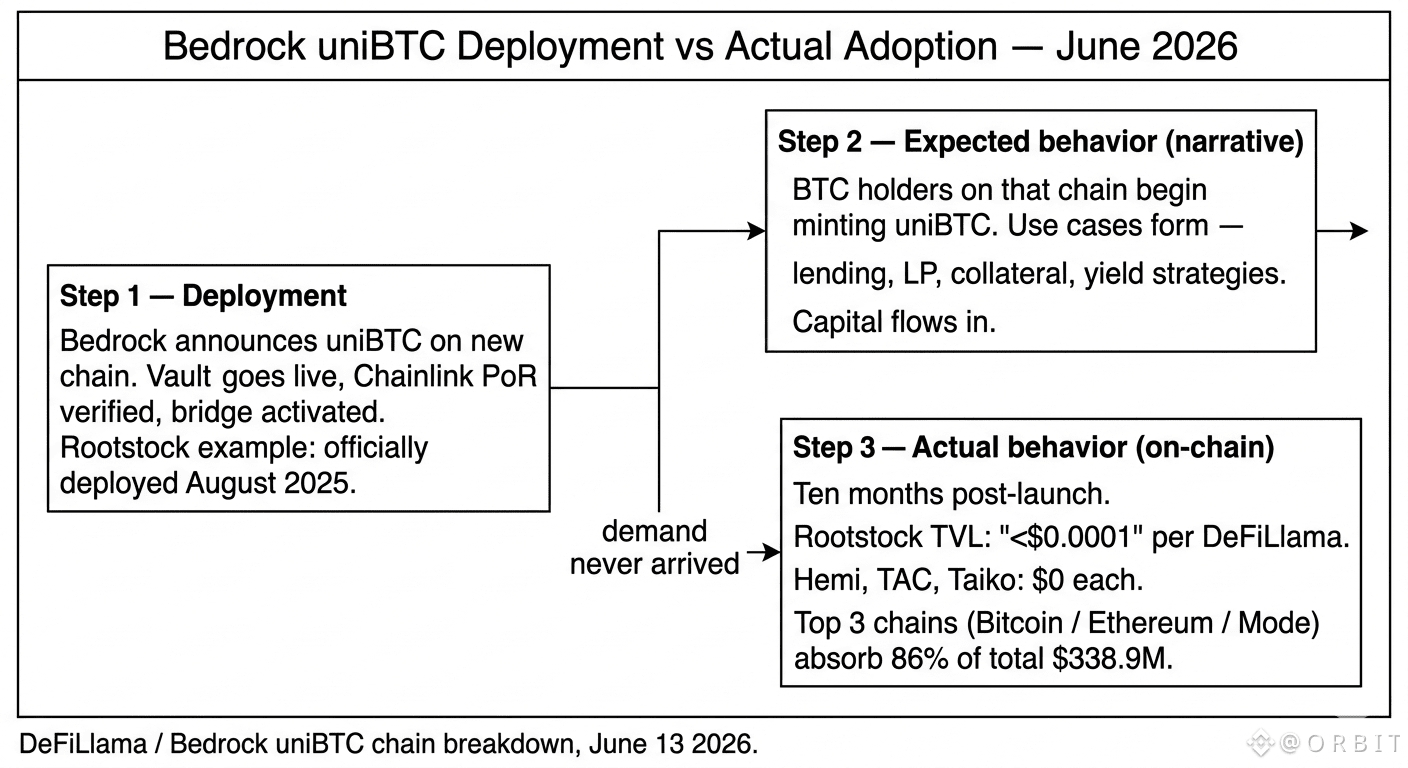
Dann habe ich die DeFiLlama Chain-Aufschlüsselung geöffnet. Rootstock wird als aktive Chain aufgeführt. Bedrock hat uniBTC dort im August 2025 mit einer offiziellen Ankündigung gelauncht. TVL gerade jetzt: weniger als einen Dollar. Der genaue Einstieg ist "<$0.0001." Hemi, TAC und Taiko sind ebenfalls aufgeführt — alle bei null.
Drei Chains halten 86% des gesamten $338,9M: Bitcoin-Chain mit $134M (hauptsächlich Babylon Restaking), Ethereum mit $90,67M, Mode mit $67,12M. Die verbleibenden 16 Chains teilen sich etwa $48M insgesamt, und der Großteil davon sitzt in BOB und BSC. Also 19 Chains bereitgestellt. Drei Chains machen tatsächlich etwas Reales.
Das Infrastruktur-Argument hält — uniBTC Minting mit Chainlink PoR-Verifizierung, brBTC, das dynamisch über sechs Restaking-Protokolle geroutet wird. Das ist echt. Aber Rootstock, das nach zehn Monaten Live-Betrieb unter einem Dollar bleibt, ist ein leises Signal dafür, wo die organische Nachfrage tatsächlich entsteht. Ob das Ende dieser Chain-Liste jemals aufholt oder einfach leer bleibt, während die Top drei alles abziehen — das ist der Teil, den ich beobachte.
Ich habe einen Teil der Aufgabe damit verbracht, die tatsächlichen Bereitstellungsdaten zu überprüfen. Bedrock behauptet, uniBTC sei auf 19 Chains unterwegs — das ist der "Bitcoin-Anwendungsfälle erweitern" Pitch von @Bedrock in einem Satz. $BR , #Bedrock . Klingt nach Skalierung.
Dann habe ich die DeFiLlama Chain-Aufschlüsselung geöffnet. Rootstock wird als aktive Chain aufgeführt. Bedrock hat uniBTC dort im August 2025 mit einer offiziellen Ankündigung gelauncht. TVL gerade jetzt: weniger als einen Dollar. Der genaue Einstieg ist "<$0.0001." Hemi, TAC und Taiko sind ebenfalls aufgeführt — alle bei null.
Drei Chains halten 86% des gesamten $338,9M: Bitcoin-Chain mit $134M (hauptsächlich Babylon Restaking), Ethereum mit $90,67M, Mode mit $67,12M. Die verbleibenden 16 Chains teilen sich etwa $48M insgesamt, und der Großteil davon sitzt in BOB und BSC. Also 19 Chains bereitgestellt. Drei Chains machen tatsächlich etwas Reales.
Das Infrastruktur-Argument hält — uniBTC Minting mit Chainlink PoR-Verifizierung, brBTC, das dynamisch über sechs Restaking-Protokolle geroutet wird. Das ist echt. Aber Rootstock, das nach zehn Monaten Live-Betrieb unter einem Dollar bleibt, ist ein leises Signal dafür, wo die organische Nachfrage tatsächlich entsteht. Ob das Ende dieser Chain-Liste jemals aufholt oder einfach leer bleibt, während die Top drei alles abziehen — das ist der Teil, den ich beobachte.
Dann habe ich die DeFiLlama Chain-Aufschlüsselung geöffnet. Rootstock wird als aktive Chain aufgeführt. Bedrock hat uniBTC dort im August 2025 mit einer offiziellen Ankündigung gelauncht. TVL gerade jetzt: weniger als einen Dollar. Der genaue Einstieg ist "<$0.0001." Hemi, TAC und Taiko sind ebenfalls aufgeführt — alle bei null.
Drei Chains halten 86% des gesamten $338,9M: Bitcoin-Chain mit $134M (hauptsächlich Babylon Restaking), Ethereum mit $90,67M, Mode mit $67,12M. Die verbleibenden 16 Chains teilen sich etwa $48M insgesamt, und der Großteil davon sitzt in BOB und BSC. Also 19 Chains bereitgestellt. Drei Chains machen tatsächlich etwas Reales.
Das Infrastruktur-Argument hält — uniBTC Minting mit Chainlink PoR-Verifizierung, brBTC, das dynamisch über sechs Restaking-Protokolle geroutet wird. Das ist echt. Aber Rootstock, das nach zehn Monaten Live-Betrieb unter einem Dollar bleibt, ist ein leises Signal dafür, wo die organische Nachfrage tatsächlich entsteht. Ob das Ende dieser Chain-Liste jemals aufholt oder einfach leer bleibt, während die Top drei alles abziehen — das ist der Teil, den ich beobachte.
1
199
·
--
Übersetzung ansehen
Was going through a CreatorPad task on Bedrock's approach to long-term value creation, and one number just kept pulling me back.
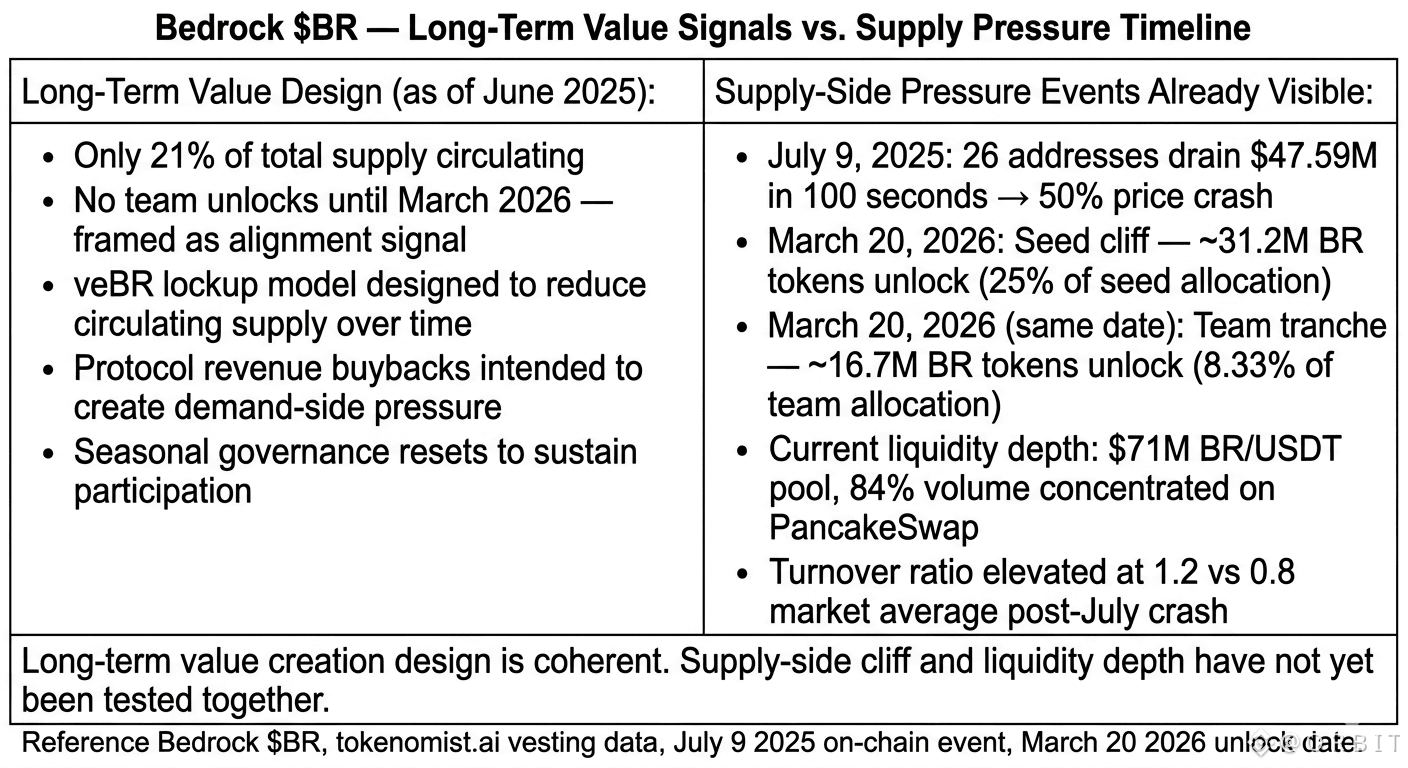
@Bedrock $BR #Bedrock builds its long-term value story around veBR lockups reducing circulating supply, protocol buybacks, and a founding team with no unlocks until 2026 — presented as alignment signal. And fair enough, the vesting structure is publicly traceable. Only 21% of total supply circulating right now. Sounds disciplined. But then I looked at what's actually sitting on the horizon: the seed round cliff triggers March 20, 2026, releasing 25% of seed allocation — roughly 31.2 million BR tokens — followed by the team's 8.33% tranche dropping the same day, another ~16.7 million. Two cohorts, same date, both cliff-unlocking into a token that already showed it can drop 50% in 100 seconds when concentrated holders exit together.
I'd been running a parallel tab on the July 9 liquidity drain the whole time — 26 addresses, $47.59M out in under two minutes. So when I hit the March 2026 cliff details, it landed differently than it probably would have otherwise.
Hmm. The vesting schedule is structured. The veBR lockup design is thoughtful. I don't doubt the intent. But there's a real question about whether the long-term value creation architecture can hold its shape when the supply-side clock and the liquidity depth don't yet match.
What does it actually mean for a protocol's long-term value thesis when the most credible test of it is still nine months out on the vesting calendar?
Was going through a CreatorPad task on Bedrock's approach to long-term value creation, and one number just kept pulling me back.
@Bedrock $BR #Bedrock builds its long-term value story around veBR lockups reducing circulating supply, protocol buybacks, and a founding team with no unlocks until 2026 — presented as alignment signal. And fair enough, the vesting structure is publicly traceable. Only 21% of total supply circulating right now. Sounds disciplined. But then I looked at what's actually sitting on the horizon: the seed round cliff triggers March 20, 2026, releasing 25% of seed allocation — roughly 31.2 million BR tokens — followed by the team's 8.33% tranche dropping the same day, another ~16.7 million. Two cohorts, same date, both cliff-unlocking into a token that already showed it can drop 50% in 100 seconds when concentrated holders exit together.
I'd been running a parallel tab on the July 9 liquidity drain the whole time — 26 addresses, $47.59M out in under two minutes. So when I hit the March 2026 cliff details, it landed differently than it probably would have otherwise.
Hmm. The vesting schedule is structured. The veBR lockup design is thoughtful. I don't doubt the intent. But there's a real question about whether the long-term value creation architecture can hold its shape when the supply-side clock and the liquidity depth don't yet match.
What does it actually mean for a protocol's long-term value thesis when the most credible test of it is still nine months out on the vesting calendar?
@Bedrock $BR #Bedrock builds its long-term value story around veBR lockups reducing circulating supply, protocol buybacks, and a founding team with no unlocks until 2026 — presented as alignment signal. And fair enough, the vesting structure is publicly traceable. Only 21% of total supply circulating right now. Sounds disciplined. But then I looked at what's actually sitting on the horizon: the seed round cliff triggers March 20, 2026, releasing 25% of seed allocation — roughly 31.2 million BR tokens — followed by the team's 8.33% tranche dropping the same day, another ~16.7 million. Two cohorts, same date, both cliff-unlocking into a token that already showed it can drop 50% in 100 seconds when concentrated holders exit together.
I'd been running a parallel tab on the July 9 liquidity drain the whole time — 26 addresses, $47.59M out in under two minutes. So when I hit the March 2026 cliff details, it landed differently than it probably would have otherwise.
Hmm. The vesting schedule is structured. The veBR lockup design is thoughtful. I don't doubt the intent. But there's a real question about whether the long-term value creation architecture can hold its shape when the supply-side clock and the liquidity depth don't yet match.
What does it actually mean for a protocol's long-term value thesis when the most credible test of it is still nine months out on the vesting calendar?
1
61
·
--
Ich habe die Aufgabe @Bedrock durchgegangen, und der Teil, der mich zum Innehalten brachte, waren die Unstaking-Dokumente.
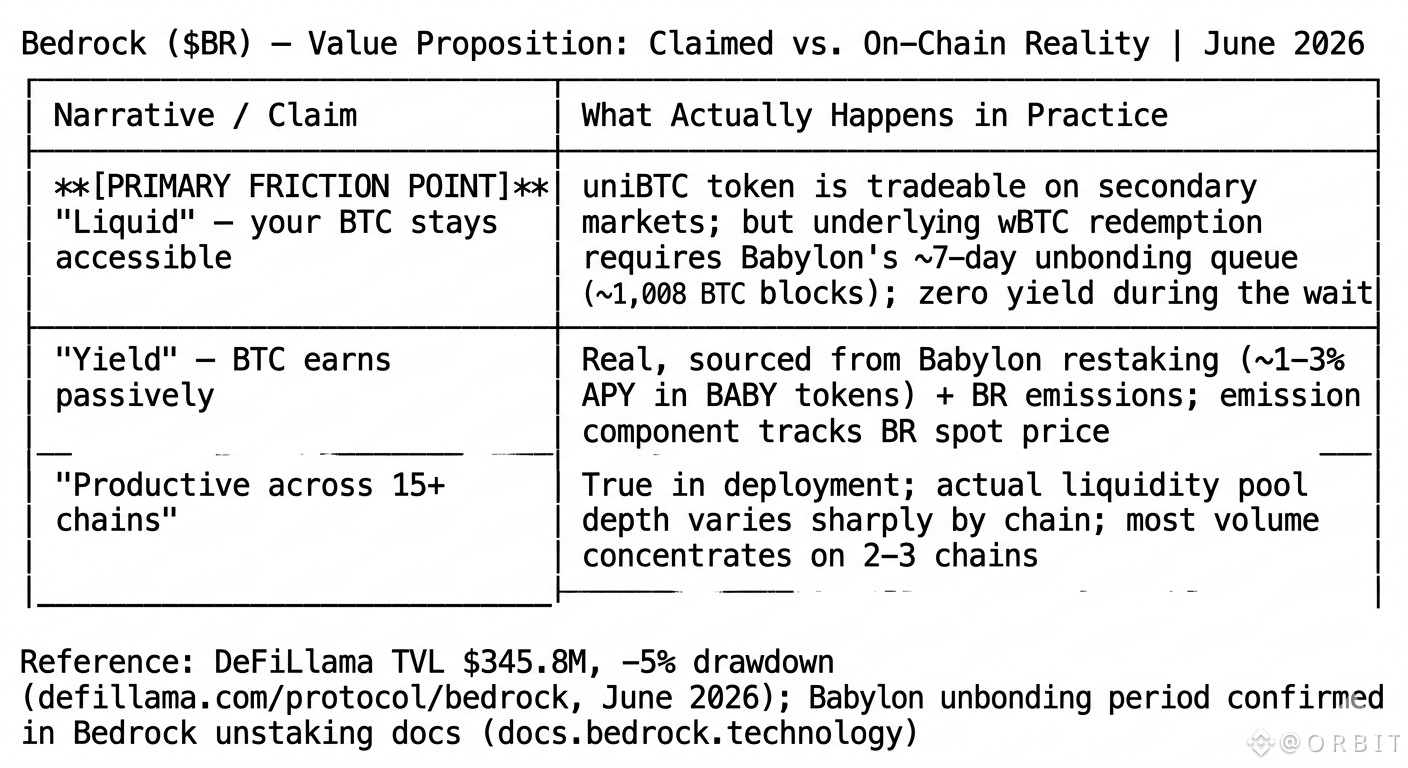
Der gesamte Pitch von Bedrock — #Bedrock , $BR , das BTCFi 2.0-Framework — lässt sich auf drei Wörter reduzieren: Ertrag, liquide, produktiv. Zwei davon halten einer Prüfung stand. Das dritte wird interessant.
DeFiLlama zeigt derzeit Bedrock TVL bei 345,8 Millionen Dollar, ein Rückgang von -5% in den letzten Tagen (defillama.com/protocol/bedrock). Die Leute ziehen sich zurück. Und die Mechanik ist genau dann wichtig. Das Einlösen von uniBTC zurück zu wBTC ist nicht sofort — Babylons Unbonding-Phase dauert ungefähr 7 Tage, etwa 1.008 Bitcoin-Blöcke, und während dieses Zeitraums verdienst du nichts. Dein uniBTC-Token bleibt in der Zwischenzeit auf sekundären Märkten handelbar, sicher. Aber zu welcher Pool-Tiefe auch immer an diesem Tag.
Also bedeutet "liquide" in der Praxis: liquide, wenn jemand deinen Token zu einem fairen Preis kauft, oder für eine Woche gesperrt, wenn du das zugrunde liegende Asset willst. Das ist nicht genau ein Mangel — so funktioniert das Staking bei Babylon, und Bedrock übernimmt das ehrlich. Die Dokumente sagen das sogar. Aber die Landing-Page hält es als ein sauberes Wort.
Der Hauptwert ist real. Routing, Chainlink-Reserveverifizierung, Multi-Chain-Abdeckung. Nur dieses eine Wort — liquide — trägt mehr Last in der Präsentation, als es tatsächlich in einer geschäftigen Ausstiegswoche unterstützen kann.
Ich habe die Aufgabe @Bedrock durchgegangen, und der Teil, der mich zum Innehalten brachte, waren die Unstaking-Dokumente.
Der gesamte Pitch von Bedrock — #Bedrock , $BR , das BTCFi 2.0-Framework — lässt sich auf drei Wörter reduzieren: Ertrag, liquide, produktiv. Zwei davon halten einer Prüfung stand. Das dritte wird interessant.
DeFiLlama zeigt derzeit Bedrock TVL bei 345,8 Millionen Dollar, ein Rückgang von -5% in den letzten Tagen (defillama.com/protocol/bedrock). Die Leute ziehen sich zurück. Und die Mechanik ist genau dann wichtig. Das Einlösen von uniBTC zurück zu wBTC ist nicht sofort — Babylons Unbonding-Phase dauert ungefähr 7 Tage, etwa 1.008 Bitcoin-Blöcke, und während dieses Zeitraums verdienst du nichts. Dein uniBTC-Token bleibt in der Zwischenzeit auf sekundären Märkten handelbar, sicher. Aber zu welcher Pool-Tiefe auch immer an diesem Tag.
Also bedeutet "liquide" in der Praxis: liquide, wenn jemand deinen Token zu einem fairen Preis kauft, oder für eine Woche gesperrt, wenn du das zugrunde liegende Asset willst. Das ist nicht genau ein Mangel — so funktioniert das Staking bei Babylon, und Bedrock übernimmt das ehrlich. Die Dokumente sagen das sogar. Aber die Landing-Page hält es als ein sauberes Wort.
Der Hauptwert ist real. Routing, Chainlink-Reserveverifizierung, Multi-Chain-Abdeckung. Nur dieses eine Wort — liquide — trägt mehr Last in der Präsentation, als es tatsächlich in einer geschäftigen Ausstiegswoche unterstützen kann.
Der gesamte Pitch von Bedrock — #Bedrock , $BR , das BTCFi 2.0-Framework — lässt sich auf drei Wörter reduzieren: Ertrag, liquide, produktiv. Zwei davon halten einer Prüfung stand. Das dritte wird interessant.
DeFiLlama zeigt derzeit Bedrock TVL bei 345,8 Millionen Dollar, ein Rückgang von -5% in den letzten Tagen (defillama.com/protocol/bedrock). Die Leute ziehen sich zurück. Und die Mechanik ist genau dann wichtig. Das Einlösen von uniBTC zurück zu wBTC ist nicht sofort — Babylons Unbonding-Phase dauert ungefähr 7 Tage, etwa 1.008 Bitcoin-Blöcke, und während dieses Zeitraums verdienst du nichts. Dein uniBTC-Token bleibt in der Zwischenzeit auf sekundären Märkten handelbar, sicher. Aber zu welcher Pool-Tiefe auch immer an diesem Tag.
Also bedeutet "liquide" in der Praxis: liquide, wenn jemand deinen Token zu einem fairen Preis kauft, oder für eine Woche gesperrt, wenn du das zugrunde liegende Asset willst. Das ist nicht genau ein Mangel — so funktioniert das Staking bei Babylon, und Bedrock übernimmt das ehrlich. Die Dokumente sagen das sogar. Aber die Landing-Page hält es als ein sauberes Wort.
Der Hauptwert ist real. Routing, Chainlink-Reserveverifizierung, Multi-Chain-Abdeckung. Nur dieses eine Wort — liquide — trägt mehr Last in der Präsentation, als es tatsächlich in einer geschäftigen Ausstiegswoche unterstützen kann.
4
236
·
--
Ich habe mich mit der @GeniusOfficial Stapel-Positionierung für diese CreatorPad-Aufgabe beschäftigt – wie $GENIUS tatsächlich innerhalb der Web3-Infrastruktur sitzt, nicht wie die Dokus es darstellen – als mir etwas ins Auge fiel, das ich vorher nicht ganz registriert hatte.
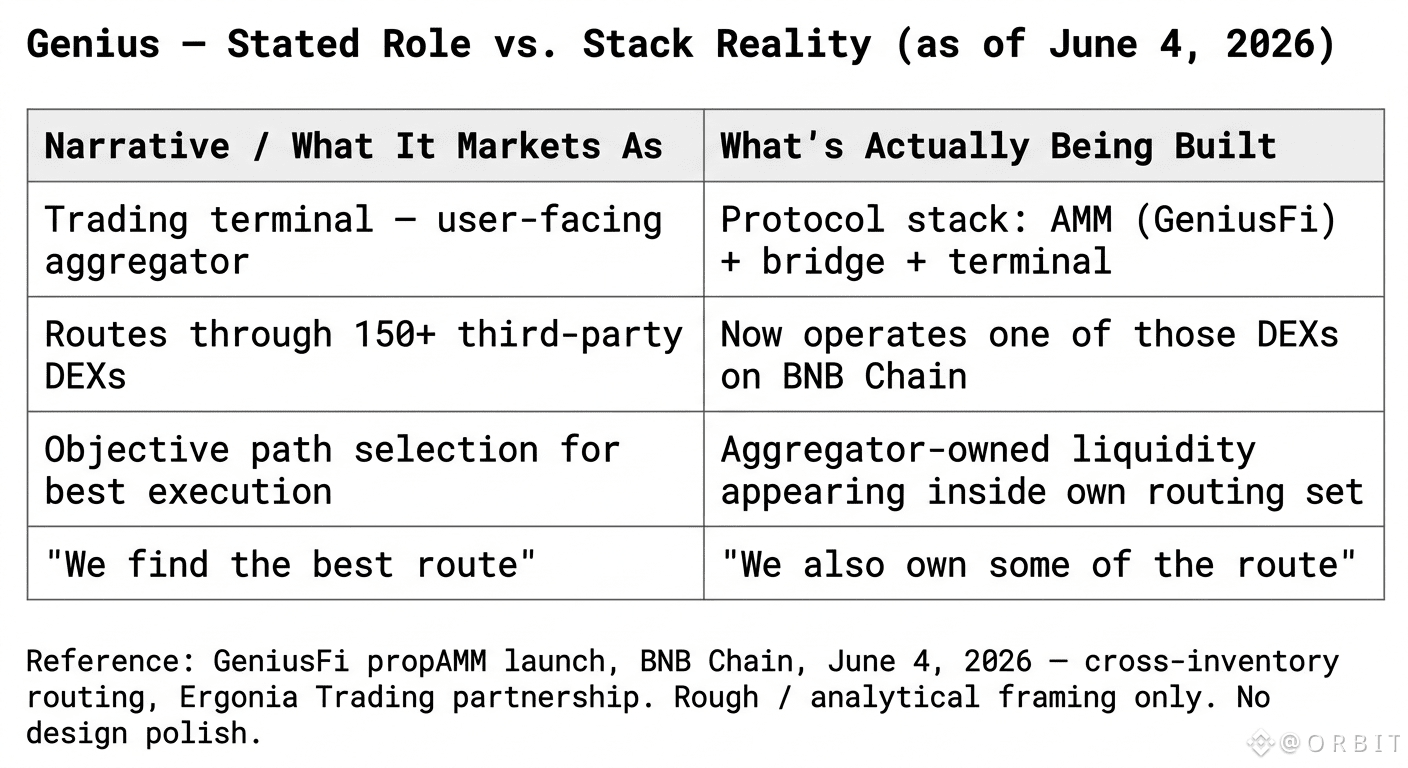
Die Plattform vermarktet sich als Aggregator. Sie routet durch über 150 DEXs, findet den besten Weg, und schichtet Ghost Orders für Privatsphäre darauf. Das ist die terminale Schicht. Aber GeniusFi ist am 4. Juni gelandet – ein propAMM auf der BNB Chain, gebaut mit Ergonia Trading, das Cross-Inventory-Routing verwendet, um Liquidität aktiv zu managen, anstatt sie passiv zu bündeln. #genius baut jetzt einen Liquiditätsort, der innerhalb des Stapels sitzt, durch den es routet.
Das ist der Teil, der mich zum Stoppen gebracht hat. Sie wählen nicht nur den besten Weg durch die Infrastruktur anderer. Sie legen leise Teile der Infrastruktur selbst nieder. Das Genius Bridge Protocol wird bereits als die zugrunde liegende Schicht beschrieben – das Terminal ist sein primärer Front-End-Client, was impliziert, dass andere möglicherweise auch darauf aufbauen könnten. GeniusFi fügt jetzt ein live AMM zum Bild hinzu. Aggregator, Brücke, AMM. Drei Stapelschichten. Alle ihnen.
hmm… die offensichtliche Frage, die keiner wirklich laut auspricht: Wenn der Aggregator einen Teil dessen besitzt, was er aggregiert, wer entscheidet dann tatsächlich, welche Liquiditätsquelle gewinnt?
Ich habe mich mit der @GeniusOfficial Stapel-Positionierung für diese CreatorPad-Aufgabe beschäftigt – wie $GENIUS tatsächlich innerhalb der Web3-Infrastruktur sitzt, nicht wie die Dokus es darstellen – als mir etwas ins Auge fiel, das ich vorher nicht ganz registriert hatte.
Die Plattform vermarktet sich als Aggregator. Sie routet durch über 150 DEXs, findet den besten Weg, und schichtet Ghost Orders für Privatsphäre darauf. Das ist die terminale Schicht. Aber GeniusFi ist am 4. Juni gelandet – ein propAMM auf der BNB Chain, gebaut mit Ergonia Trading, das Cross-Inventory-Routing verwendet, um Liquidität aktiv zu managen, anstatt sie passiv zu bündeln. #genius baut jetzt einen Liquiditätsort, der innerhalb des Stapels sitzt, durch den es routet.
Das ist der Teil, der mich zum Stoppen gebracht hat. Sie wählen nicht nur den besten Weg durch die Infrastruktur anderer. Sie legen leise Teile der Infrastruktur selbst nieder. Das Genius Bridge Protocol wird bereits als die zugrunde liegende Schicht beschrieben – das Terminal ist sein primärer Front-End-Client, was impliziert, dass andere möglicherweise auch darauf aufbauen könnten. GeniusFi fügt jetzt ein live AMM zum Bild hinzu. Aggregator, Brücke, AMM. Drei Stapelschichten. Alle ihnen.
hmm… die offensichtliche Frage, die keiner wirklich laut auspricht: Wenn der Aggregator einen Teil dessen besitzt, was er aggregiert, wer entscheidet dann tatsächlich, welche Liquiditätsquelle gewinnt?
Die Plattform vermarktet sich als Aggregator. Sie routet durch über 150 DEXs, findet den besten Weg, und schichtet Ghost Orders für Privatsphäre darauf. Das ist die terminale Schicht. Aber GeniusFi ist am 4. Juni gelandet – ein propAMM auf der BNB Chain, gebaut mit Ergonia Trading, das Cross-Inventory-Routing verwendet, um Liquidität aktiv zu managen, anstatt sie passiv zu bündeln. #genius baut jetzt einen Liquiditätsort, der innerhalb des Stapels sitzt, durch den es routet.
Das ist der Teil, der mich zum Stoppen gebracht hat. Sie wählen nicht nur den besten Weg durch die Infrastruktur anderer. Sie legen leise Teile der Infrastruktur selbst nieder. Das Genius Bridge Protocol wird bereits als die zugrunde liegende Schicht beschrieben – das Terminal ist sein primärer Front-End-Client, was impliziert, dass andere möglicherweise auch darauf aufbauen könnten. GeniusFi fügt jetzt ein live AMM zum Bild hinzu. Aggregator, Brücke, AMM. Drei Stapelschichten. Alle ihnen.
hmm… die offensichtliche Frage, die keiner wirklich laut auspricht: Wenn der Aggregator einen Teil dessen besitzt, was er aggregiert, wer entscheidet dann tatsächlich, welche Liquiditätsquelle gewinnt?
1
173
·
--
Ich habe länger als erwartet mit der Genius Terminal CreatorPad Aufgabe gesessen. Das Problem war nicht das Routing oder die Privatschicht. Es war die spezifische Form dessen, was GeniusFi tatsächlich auf der BNB Chain macht.
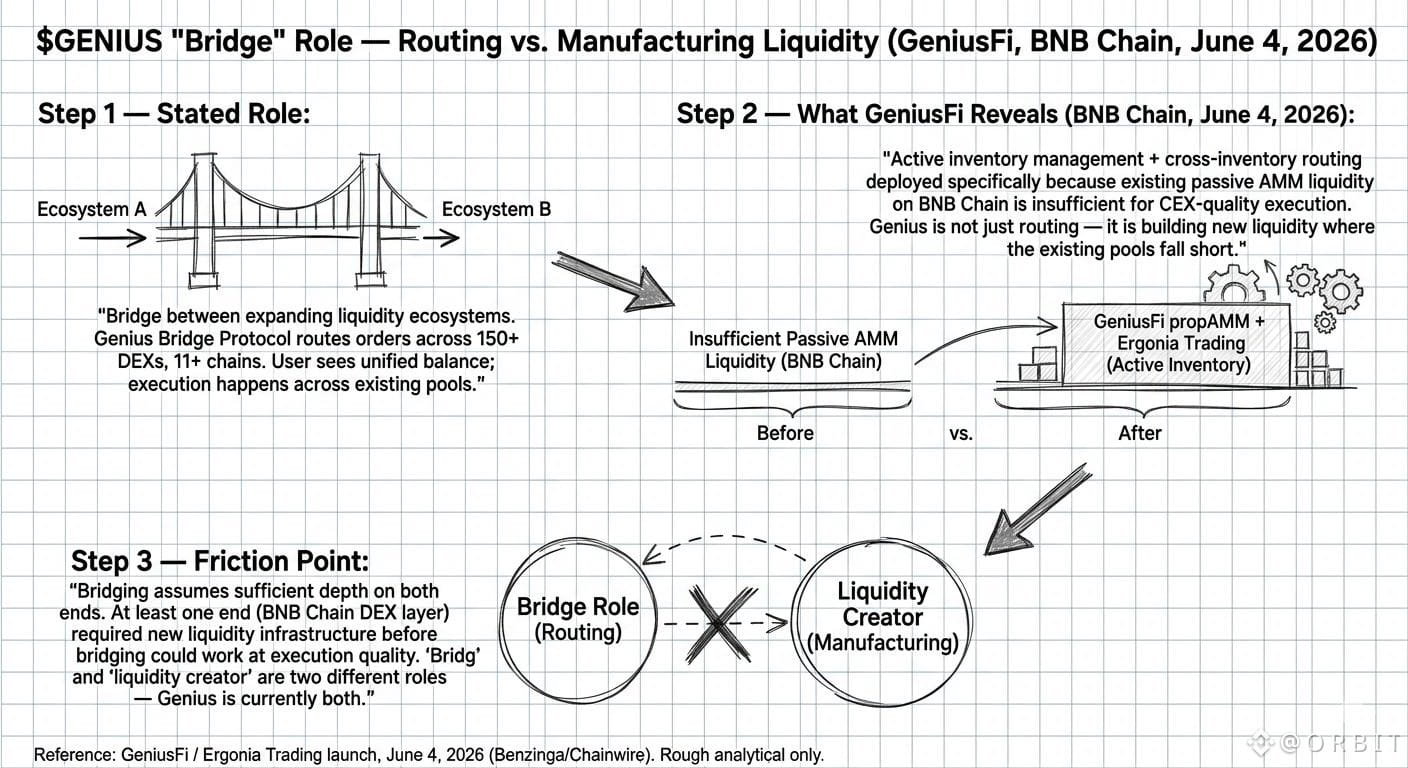
Angekündigt am 4. Juni — @GeniusOfficial und Ergonia Trading starten ein propAMM mit Cross-Inventar-Routing. Der Rahmen ist "Brücke zwischen Ökosystemen," und auf dem Papier sieht das so aus: $GENIUS #genius sitzt über 150+ DEXs auf 11 Chains und verbindet Liquiditätsquellen, die nicht nativ miteinander kommunizieren. Aber GeniusFi ist anders. Es geht nicht um das Routing zwischen Ökosystemen — es geht darum, neue Liquidität innerhalb eines davon herzustellen. BNB Chain. Aktives Bestandsmanagement. Engere Spreads. Market Maker setzen die Kurse, nicht passive Pools, die darauf warten, gefüllt zu werden.
Die Unterscheidung ist wichtiger, als es aussieht. Eine Brücke zwischen Ökosystemen impliziert, dass die Ökosysteme bereits tief genug sind, um sich zu verbinden. GeniusFi ist ein Eingeständnis, dass zumindest eines von ihnen — die DEX-Schicht der BNB Chain — noch nicht tief genug ist, damit Genius sauber durchrouten kann. Man baut kein propAMM von Grund auf auf einer Chain, die bereits über ausreichende Liquidität verfügt.
Ich hatte angenommen, dass Genius hauptsächlich ein Koordinationsproblem war: die Pools verbinden, die Aufträge routen. GeniusFi hat offenbart, dass es auch teilweise ein Schaffensproblem ist. Ein Teil der Liquidität, die das Terminal benötigt, um durchzurouten, existiert einfach noch nicht in der richtigen Form.
Das wirft eine Frage auf, über die ich noch nachdenke: Wenn Genius Liquidität auf jeder Chain herstellen muss, die es überbrücken möchte, wie tief skaliert das tatsächlich, bevor das Modell anfängt sich zu biegen?
Ich habe länger als erwartet mit der Genius Terminal CreatorPad Aufgabe gesessen. Das Problem war nicht das Routing oder die Privatschicht. Es war die spezifische Form dessen, was GeniusFi tatsächlich auf der BNB Chain macht.
Angekündigt am 4. Juni — @GeniusOfficial und Ergonia Trading starten ein propAMM mit Cross-Inventar-Routing. Der Rahmen ist "Brücke zwischen Ökosystemen," und auf dem Papier sieht das so aus: $GENIUS #genius sitzt über 150+ DEXs auf 11 Chains und verbindet Liquiditätsquellen, die nicht nativ miteinander kommunizieren. Aber GeniusFi ist anders. Es geht nicht um das Routing zwischen Ökosystemen — es geht darum, neue Liquidität innerhalb eines davon herzustellen. BNB Chain. Aktives Bestandsmanagement. Engere Spreads. Market Maker setzen die Kurse, nicht passive Pools, die darauf warten, gefüllt zu werden.
Die Unterscheidung ist wichtiger, als es aussieht. Eine Brücke zwischen Ökosystemen impliziert, dass die Ökosysteme bereits tief genug sind, um sich zu verbinden. GeniusFi ist ein Eingeständnis, dass zumindest eines von ihnen — die DEX-Schicht der BNB Chain — noch nicht tief genug ist, damit Genius sauber durchrouten kann. Man baut kein propAMM von Grund auf auf einer Chain, die bereits über ausreichende Liquidität verfügt.
Ich hatte angenommen, dass Genius hauptsächlich ein Koordinationsproblem war: die Pools verbinden, die Aufträge routen. GeniusFi hat offenbart, dass es auch teilweise ein Schaffensproblem ist. Ein Teil der Liquidität, die das Terminal benötigt, um durchzurouten, existiert einfach noch nicht in der richtigen Form.
Das wirft eine Frage auf, über die ich noch nachdenke: Wenn Genius Liquidität auf jeder Chain herstellen muss, die es überbrücken möchte, wie tief skaliert das tatsächlich, bevor das Modell anfängt sich zu biegen?
Angekündigt am 4. Juni — @GeniusOfficial und Ergonia Trading starten ein propAMM mit Cross-Inventar-Routing. Der Rahmen ist "Brücke zwischen Ökosystemen," und auf dem Papier sieht das so aus: $GENIUS #genius sitzt über 150+ DEXs auf 11 Chains und verbindet Liquiditätsquellen, die nicht nativ miteinander kommunizieren. Aber GeniusFi ist anders. Es geht nicht um das Routing zwischen Ökosystemen — es geht darum, neue Liquidität innerhalb eines davon herzustellen. BNB Chain. Aktives Bestandsmanagement. Engere Spreads. Market Maker setzen die Kurse, nicht passive Pools, die darauf warten, gefüllt zu werden.
Die Unterscheidung ist wichtiger, als es aussieht. Eine Brücke zwischen Ökosystemen impliziert, dass die Ökosysteme bereits tief genug sind, um sich zu verbinden. GeniusFi ist ein Eingeständnis, dass zumindest eines von ihnen — die DEX-Schicht der BNB Chain — noch nicht tief genug ist, damit Genius sauber durchrouten kann. Man baut kein propAMM von Grund auf auf einer Chain, die bereits über ausreichende Liquidität verfügt.
Ich hatte angenommen, dass Genius hauptsächlich ein Koordinationsproblem war: die Pools verbinden, die Aufträge routen. GeniusFi hat offenbart, dass es auch teilweise ein Schaffensproblem ist. Ein Teil der Liquidität, die das Terminal benötigt, um durchzurouten, existiert einfach noch nicht in der richtigen Form.
Das wirft eine Frage auf, über die ich noch nachdenke: Wenn Genius Liquidität auf jeder Chain herstellen muss, die es überbrücken möchte, wie tief skaliert das tatsächlich, bevor das Modell anfängt sich zu biegen?
1
204
·
--
Übersetzung ansehen
Sat down to check @Bedrock market efficiency story mid-task. Then I pulled the actual numbers and hit a small pause.
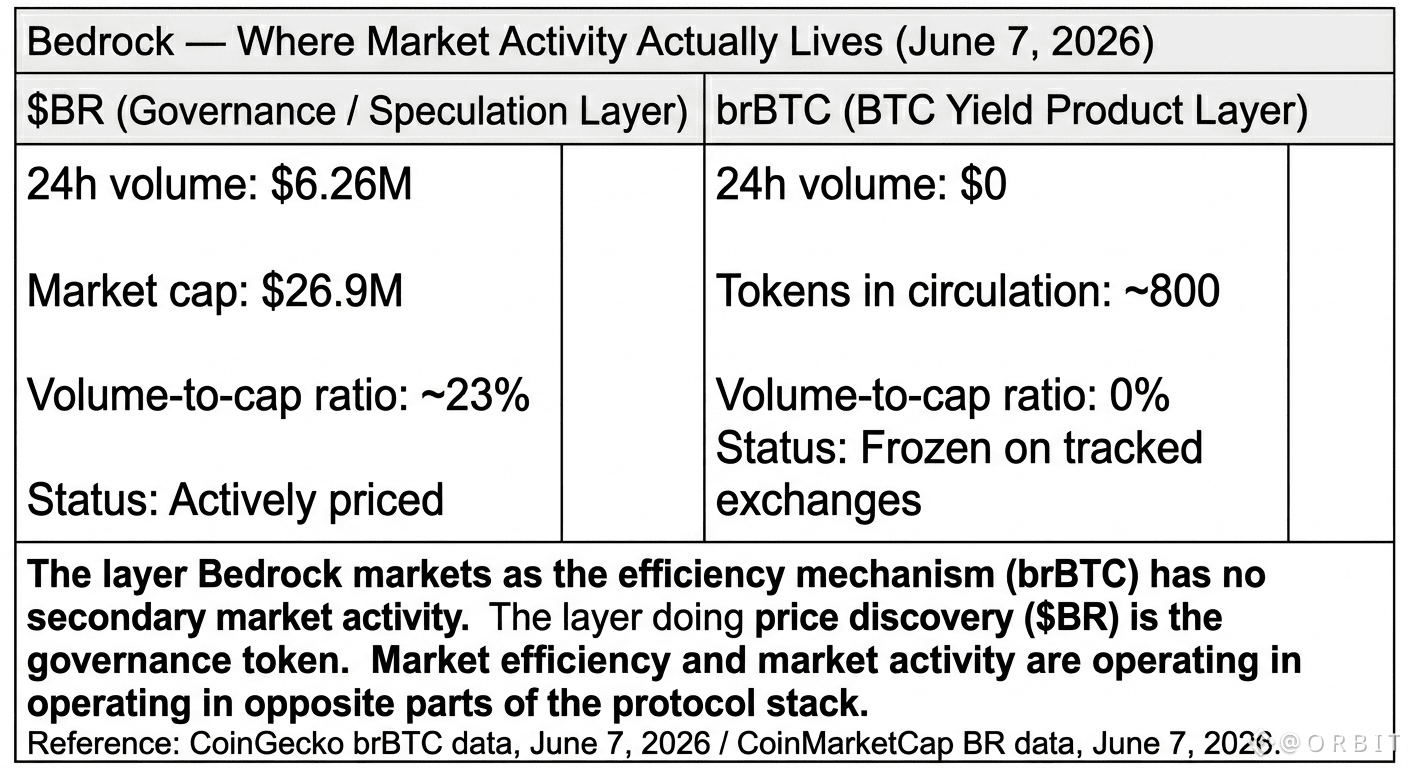
$BR 24-hour volume is running around $6.26M against a $26.9M market cap — roughly 23% of the float moving in a single day. Busy. In the same window, brBTC — Bedrock's actual BTC yield product, the thing that's supposed to consolidate fragmented liquidity and make Bitcoin work harder — registered zero volume on tracked exchanges. Flat. #Bedrock
That contrast is the thing that stayed. The efficiency case for Bedrock runs through brBTC and uniBTC: idle BTC earns yield, wrapped sources pool into one token, rewards route across chains. The architecture is real. But secondary market liquidity for the yield product isn't there right now. The active market is the governance and speculative layer — $BR — not the product.
Maturity issue or something structural? Probably too early to tell. But the efficiency the market is actually pricing right now lives in $BR, not in the BTC restaking product it exists to support. That gap might close over time. Or it just… might not.
Sat down to check @Bedrock market efficiency story mid-task. Then I pulled the actual numbers and hit a small pause.
$BR 24-hour volume is running around $6.26M against a $26.9M market cap — roughly 23% of the float moving in a single day. Busy. In the same window, brBTC — Bedrock's actual BTC yield product, the thing that's supposed to consolidate fragmented liquidity and make Bitcoin work harder — registered zero volume on tracked exchanges. Flat. #Bedrock
That contrast is the thing that stayed. The efficiency case for Bedrock runs through brBTC and uniBTC: idle BTC earns yield, wrapped sources pool into one token, rewards route across chains. The architecture is real. But secondary market liquidity for the yield product isn't there right now. The active market is the governance and speculative layer — $BR — not the product.
Maturity issue or something structural? Probably too early to tell. But the efficiency the market is actually pricing right now lives in $BR , not in the BTC restaking product it exists to support. That gap might close over time. Or it just… might not.
$BR 24-hour volume is running around $6.26M against a $26.9M market cap — roughly 23% of the float moving in a single day. Busy. In the same window, brBTC — Bedrock's actual BTC yield product, the thing that's supposed to consolidate fragmented liquidity and make Bitcoin work harder — registered zero volume on tracked exchanges. Flat. #Bedrock
That contrast is the thing that stayed. The efficiency case for Bedrock runs through brBTC and uniBTC: idle BTC earns yield, wrapped sources pool into one token, rewards route across chains. The architecture is real. But secondary market liquidity for the yield product isn't there right now. The active market is the governance and speculative layer — $BR — not the product.
Maturity issue or something structural? Probably too early to tell. But the efficiency the market is actually pricing right now lives in $BR , not in the BTC restaking product it exists to support. That gap might close over time. Or it just… might not.
6
3
179
·
--
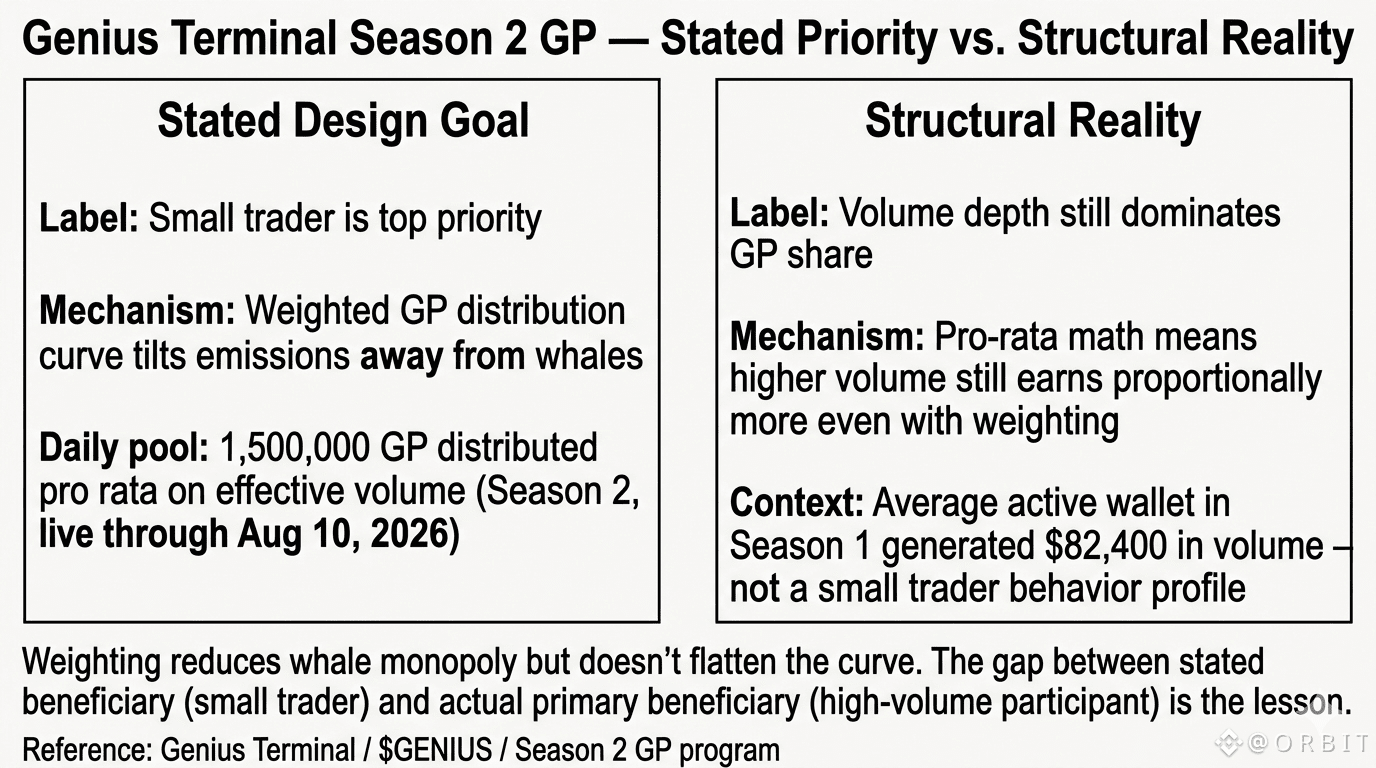
Etwas hat mich während dieser CreatorPad-Aufgabe wirklich überrascht, woran ich beim Einstieg nicht gedacht hatte. Genius Terminal präsentiert sich als für Profis gemacht — die Sprache überall ist institutionell, fokusiert auf Wale, und hochdynamisch. Aber dann schaust du dir die tatsächlichen Season 2 GP-Mechaniken an, die bis zum 10. August 2026 laufen, und das aufschlussreichste Signal für einen neuen Trader ist im Verteilungsdesign verborgen. @GeniusOfficial hat ein gewichtetes Modell entwickelt, damit Wale die wöchentlichen GP-Emissionen nicht monopolisiert. 1.500.000 GP werden täglich zugewiesen, pro rata basierend auf dem effektiven Volumen — aber mit einer Kurve, die sich zugunsten kleinerer Teilnehmer neigt. #Genius $GENIUS
Warte mal. Das ist tatsächlich eine der besseren realen Demos, wie Anreizstrukturen gestaltet werden können, um deklarierte Ziele zu bedienen, ohne sie vollständig zu erfüllen. Denn die Kurve hilft, ja — aber bei einer durchschnittlichen aktiven Wallet mit einem Volumen von 82.400 $ während Season 1 konkurriert der realistische Kleinhändler immer noch gegen Profis, die das in einer Sitzung generieren können. Die Gewichtung verringert die Lücke; sie schließt sie nicht.
Was neue Trader tatsächlich aus dem Studium dessen lernen können: Die Struktur eines Anreizprogramms zeigt dir, für wen die Plattform optimiert ist im Vergleich zu dem, für wen sie dir vorgaukeln möchte, dass sie es ist. Diese beiden Dinge können nebeneinander existieren. Genius möchte auf dem Papier Einzelhandelsengagement. Die Mechaniken belohnen in der Praxis die Volumentiefe. Zu wissen, dass diese Lücke existiert, ist an sich schon nützlich.
Ich bin mit mehr Respekt für die Struktur gegangen als für die Behauptung, dass sie retail-first ist. Designabsicht und Designresultat sind unterschiedliche Dinge.
Produziert diese gewichtete Kurve jemals wirklich gleichberechtigten Zugang — oder schafft sie hauptsächlich den Anschein davon?
Etwas hat mich während dieser CreatorPad-Aufgabe wirklich überrascht, woran ich beim Einstieg nicht gedacht hatte. Genius Terminal präsentiert sich als für Profis gemacht — die Sprache überall ist institutionell, fokusiert auf Wale, und hochdynamisch. Aber dann schaust du dir die tatsächlichen Season 2 GP-Mechaniken an, die bis zum 10. August 2026 laufen, und das aufschlussreichste Signal für einen neuen Trader ist im Verteilungsdesign verborgen. @GeniusOfficial hat ein gewichtetes Modell entwickelt, damit Wale die wöchentlichen GP-Emissionen nicht monopolisiert. 1.500.000 GP werden täglich zugewiesen, pro rata basierend auf dem effektiven Volumen — aber mit einer Kurve, die sich zugunsten kleinerer Teilnehmer neigt. #Genius $GENIUS
Warte mal. Das ist tatsächlich eine der besseren realen Demos, wie Anreizstrukturen gestaltet werden können, um deklarierte Ziele zu bedienen, ohne sie vollständig zu erfüllen. Denn die Kurve hilft, ja — aber bei einer durchschnittlichen aktiven Wallet mit einem Volumen von 82.400 $ während Season 1 konkurriert der realistische Kleinhändler immer noch gegen Profis, die das in einer Sitzung generieren können. Die Gewichtung verringert die Lücke; sie schließt sie nicht.
Was neue Trader tatsächlich aus dem Studium dessen lernen können: Die Struktur eines Anreizprogramms zeigt dir, für wen die Plattform optimiert ist im Vergleich zu dem, für wen sie dir vorgaukeln möchte, dass sie es ist. Diese beiden Dinge können nebeneinander existieren. Genius möchte auf dem Papier Einzelhandelsengagement. Die Mechaniken belohnen in der Praxis die Volumentiefe. Zu wissen, dass diese Lücke existiert, ist an sich schon nützlich.
Ich bin mit mehr Respekt für die Struktur gegangen als für die Behauptung, dass sie retail-first ist. Designabsicht und Designresultat sind unterschiedliche Dinge.
Produziert diese gewichtete Kurve jemals wirklich gleichberechtigten Zugang — oder schafft sie hauptsächlich den Anschein davon?
Warte mal. Das ist tatsächlich eine der besseren realen Demos, wie Anreizstrukturen gestaltet werden können, um deklarierte Ziele zu bedienen, ohne sie vollständig zu erfüllen. Denn die Kurve hilft, ja — aber bei einer durchschnittlichen aktiven Wallet mit einem Volumen von 82.400 $ während Season 1 konkurriert der realistische Kleinhändler immer noch gegen Profis, die das in einer Sitzung generieren können. Die Gewichtung verringert die Lücke; sie schließt sie nicht.
Was neue Trader tatsächlich aus dem Studium dessen lernen können: Die Struktur eines Anreizprogramms zeigt dir, für wen die Plattform optimiert ist im Vergleich zu dem, für wen sie dir vorgaukeln möchte, dass sie es ist. Diese beiden Dinge können nebeneinander existieren. Genius möchte auf dem Papier Einzelhandelsengagement. Die Mechaniken belohnen in der Praxis die Volumentiefe. Zu wissen, dass diese Lücke existiert, ist an sich schon nützlich.
Ich bin mit mehr Respekt für die Struktur gegangen als für die Behauptung, dass sie retail-first ist. Designabsicht und Designresultat sind unterschiedliche Dinge.
Produziert diese gewichtete Kurve jemals wirklich gleichberechtigten Zugang — oder schafft sie hauptsächlich den Anschein davon?
2
226
·
--
Übersetzung ansehen
Spent time mapping how Bedrock actually builds protocol-level stickiness — not the "network effects" slide from the pitch deck but the real on-chain mechanics around $BR . And there's something worth sitting with.
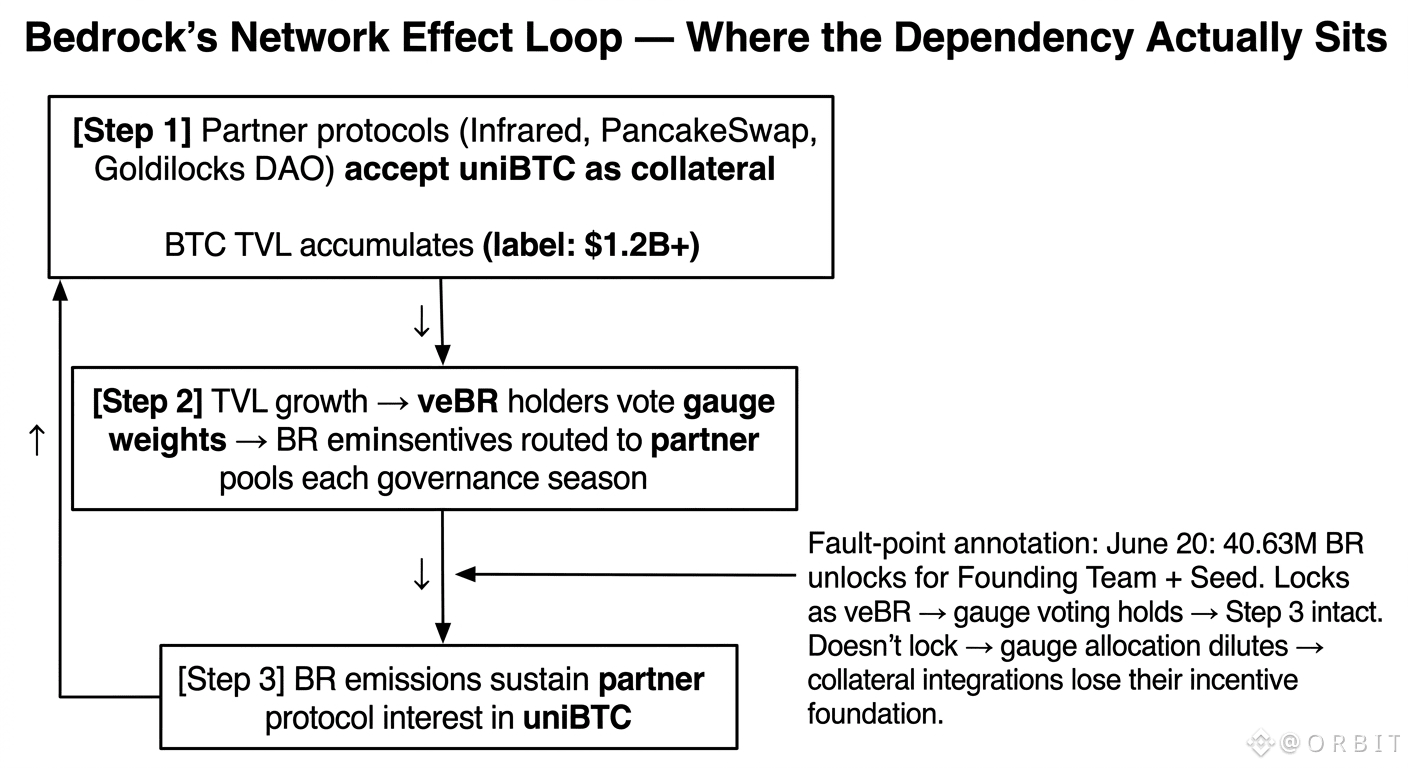
The pitch is elegant. Each new chain or lending protocol that accepts uniBTC as collateral draws more BTC in. More BTC locked → deeper liquidity → more DeFi protocols accept it → repeat. @Bedrock now spans 19+ chains, 60+ integrations, $1.2B TVL — that's the #Bedrock flywheel. Real. But it's sustained by something most people aren't tracking.
The gauge system is what actually holds it together. veBR holders vote each season on where emission incentives flow — Infrared, PancakeSwap, Goldilocks DAO. Those emissions keep partner protocols allocating to uniBTC pools. Pull them and the collateral acceptance doesn't automatically stay. That backdrop is what makes this week's behavior interesting: $BR dropped 12.3% over 7 days while TVL held — and a 40.63M BR unlock hits June 20 for Founding Team and Seed, 4.1% of total supply (~$4.21M at current prices). Markets seem to be pricing that in already.
Network effects built on sustained emission routing... I'm not saying it breaks when the insiders get liquid. Just wondering if the behavior holds once the subsidy math changes.
Spent time mapping how Bedrock actually builds protocol-level stickiness — not the "network effects" slide from the pitch deck but the real on-chain mechanics around $BR . And there's something worth sitting with.
The pitch is elegant. Each new chain or lending protocol that accepts uniBTC as collateral draws more BTC in. More BTC locked → deeper liquidity → more DeFi protocols accept it → repeat. @Bedrock now spans 19+ chains, 60+ integrations, $1.2B TVL — that's the #Bedrock flywheel. Real. But it's sustained by something most people aren't tracking.
The gauge system is what actually holds it together. veBR holders vote each season on where emission incentives flow — Infrared, PancakeSwap, Goldilocks DAO. Those emissions keep partner protocols allocating to uniBTC pools. Pull them and the collateral acceptance doesn't automatically stay. That backdrop is what makes this week's behavior interesting: $BR dropped 12.3% over 7 days while TVL held — and a 40.63M BR unlock hits June 20 for Founding Team and Seed, 4.1% of total supply (~$4.21M at current prices). Markets seem to be pricing that in already.
Network effects built on sustained emission routing... I'm not saying it breaks when the insiders get liquid. Just wondering if the behavior holds once the subsidy math changes.
The pitch is elegant. Each new chain or lending protocol that accepts uniBTC as collateral draws more BTC in. More BTC locked → deeper liquidity → more DeFi protocols accept it → repeat. @Bedrock now spans 19+ chains, 60+ integrations, $1.2B TVL — that's the #Bedrock flywheel. Real. But it's sustained by something most people aren't tracking.
The gauge system is what actually holds it together. veBR holders vote each season on where emission incentives flow — Infrared, PancakeSwap, Goldilocks DAO. Those emissions keep partner protocols allocating to uniBTC pools. Pull them and the collateral acceptance doesn't automatically stay. That backdrop is what makes this week's behavior interesting: $BR dropped 12.3% over 7 days while TVL held — and a 40.63M BR unlock hits June 20 for Founding Team and Seed, 4.1% of total supply (~$4.21M at current prices). Markets seem to be pricing that in already.
Network effects built on sustained emission routing... I'm not saying it breaks when the insiders get liquid. Just wondering if the behavior holds once the subsidy math changes.
2
2
145
·
--
Übersetzung ansehen
The line that stopped me during this task was buried in the Genius Terminal docs, almost offhand: "Bridges become pipes. Vaults become config options."
Genius Terminal, $GENIUS , @GeniusOfficial teaches something specific about where modern DeFi infrastructure is actually heading — not through what it builds from scratch, but through what it refuses to expose to the user. The platform doesn't own the liquidity on Jupiter or Odos. It doesn't custody assets. It doesn't run the DEXs it routes through. It just sits on top, treats every underlying protocol as a silent API, and presents one interface.
That's the infrastructure lesson. The gUSD stablecoin earns yield directly from the Genius Bridge Protocol's cross-chain swap fees — no lending, no rehypothecation, just fee capture piped back to holders passively. That design is quiet. With $GENIUS down ~37% over the past 7 days per CoinGecko, and Season 2 GP still running through August 10, the volume that generates those swap fees is real even when the token price isn't cooperating.
I kept thinking about how different that is from the composability stacks most people point to as DeFi infrastructure. Those are protocol-to-protocol. This is terminal-to-protocol. The user never sees the seams.
Hmm… whether that abstraction becomes a moat or a fragility — what happens when one of those silent APIs breaks mid-execution — that's the question I didn't find an answer to.
#genius
The line that stopped me during this task was buried in the Genius Terminal docs, almost offhand: "Bridges become pipes. Vaults become config options."
Genius Terminal, $GENIUS , @GeniusOfficial teaches something specific about where modern DeFi infrastructure is actually heading — not through what it builds from scratch, but through what it refuses to expose to the user. The platform doesn't own the liquidity on Jupiter or Odos. It doesn't custody assets. It doesn't run the DEXs it routes through. It just sits on top, treats every underlying protocol as a silent API, and presents one interface.
That's the infrastructure lesson. The gUSD stablecoin earns yield directly from the Genius Bridge Protocol's cross-chain swap fees — no lending, no rehypothecation, just fee capture piped back to holders passively. That design is quiet. With $GENIUS down ~37% over the past 7 days per CoinGecko, and Season 2 GP still running through August 10, the volume that generates those swap fees is real even when the token price isn't cooperating.
I kept thinking about how different that is from the composability stacks most people point to as DeFi infrastructure. Those are protocol-to-protocol. This is terminal-to-protocol. The user never sees the seams.
Hmm… whether that abstraction becomes a moat or a fragility — what happens when one of those silent APIs breaks mid-execution — that's the question I didn't find an answer to.
#genius
Genius Terminal, $GENIUS , @GeniusOfficial teaches something specific about where modern DeFi infrastructure is actually heading — not through what it builds from scratch, but through what it refuses to expose to the user. The platform doesn't own the liquidity on Jupiter or Odos. It doesn't custody assets. It doesn't run the DEXs it routes through. It just sits on top, treats every underlying protocol as a silent API, and presents one interface.
That's the infrastructure lesson. The gUSD stablecoin earns yield directly from the Genius Bridge Protocol's cross-chain swap fees — no lending, no rehypothecation, just fee capture piped back to holders passively. That design is quiet. With $GENIUS down ~37% over the past 7 days per CoinGecko, and Season 2 GP still running through August 10, the volume that generates those swap fees is real even when the token price isn't cooperating.
I kept thinking about how different that is from the composability stacks most people point to as DeFi infrastructure. Those are protocol-to-protocol. This is terminal-to-protocol. The user never sees the seams.
Hmm… whether that abstraction becomes a moat or a fragility — what happens when one of those silent APIs breaks mid-execution — that's the question I didn't find an answer to.
#genius
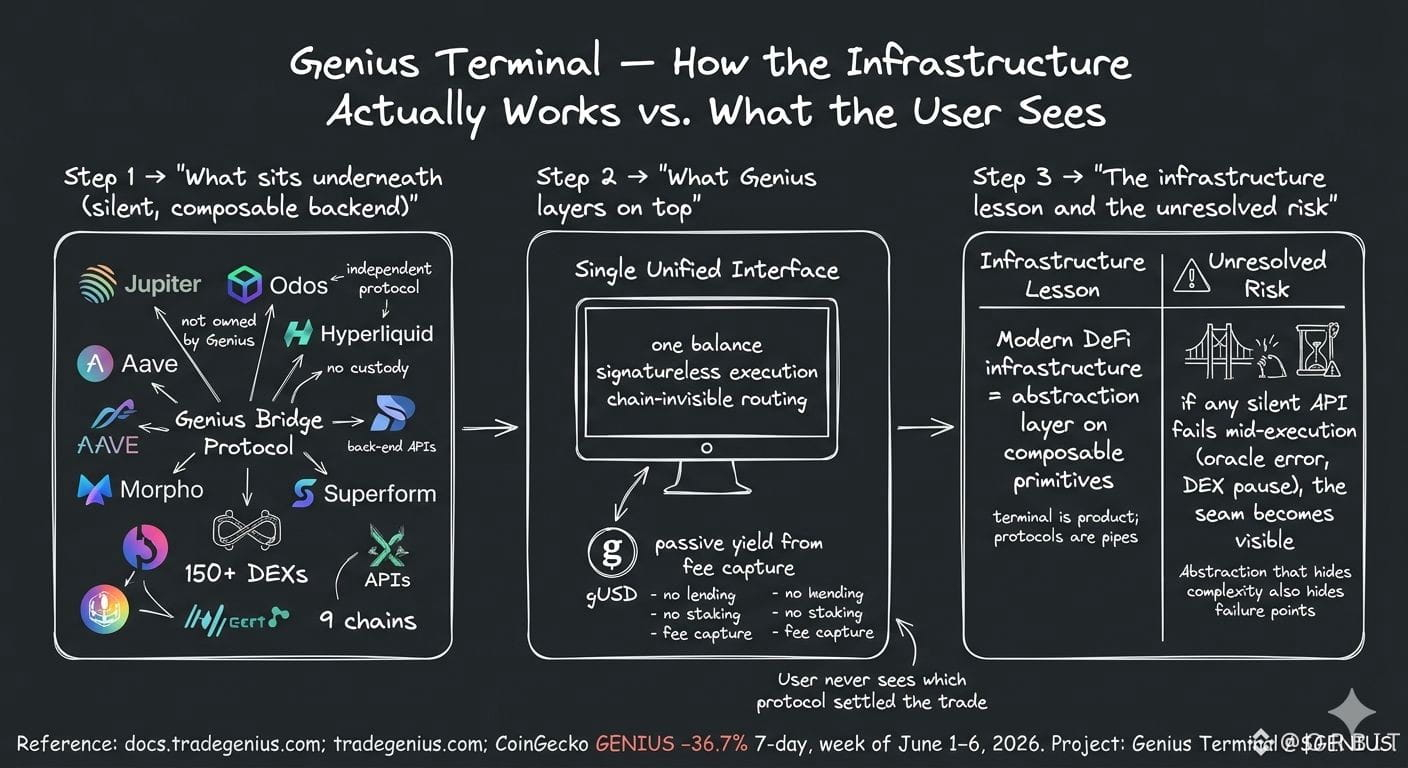
2
1
99
·
--
Übersetzung ansehen
Just finished the CreatorPad task on Genius Terminal and one thing stood out mid-session. I tried switching between Fast Swap and Aggregator Swap modes in the terminal. That toggle exists. You can choose speed or price depth — and unlike every other terminal I've used, you can also see and select which aggregators are active. @GeniusOfficial calls it "explicit routing control." Most platforms just route your order through a black box and let it settle. #genius
That's a small UI choice with a real implication for how scattered liquidity gets addressed. The usual response to fragmented DEX liquidity is to aggregate it opaquely — hide the complexity, pick a route, present a quote. Genius goes one layer further: it's described as an aggregator of aggregators, pulling quote paths from multiple routing services simultaneously, and it's the only terminal in this class that actually surfaces the routing layer to the user.
It matters here because the GeniusFi propAMM launched on BNB Chain just two days ago, June 4th. That's a new liquidity source being added to the mix in real time. The Genius Bridge Protocol now has one more endpoint to route through — and with cross-inventory routing, it theoretically improves quote depth on BNB Chain trades without the user needing to know it happened.
Hmm… but the Genius Points program still rewards only spot volume, not routing quality or depth of liquidity used. So the trader who uses the most sophisticated routing path earns identical GP to one who picks the fastest, shallowest swap. I keep wondering whether the routing transparency is actually valued by the users showing up right now… or whether it's infrastructure waiting for a more demanding cohort.
$GENIUS
Just finished the CreatorPad task on Genius Terminal and one thing stood out mid-session. I tried switching between Fast Swap and Aggregator Swap modes in the terminal. That toggle exists. You can choose speed or price depth — and unlike every other terminal I've used, you can also see and select which aggregators are active. @GeniusOfficial calls it "explicit routing control." Most platforms just route your order through a black box and let it settle. #genius
That's a small UI choice with a real implication for how scattered liquidity gets addressed. The usual response to fragmented DEX liquidity is to aggregate it opaquely — hide the complexity, pick a route, present a quote. Genius goes one layer further: it's described as an aggregator of aggregators, pulling quote paths from multiple routing services simultaneously, and it's the only terminal in this class that actually surfaces the routing layer to the user.
It matters here because the GeniusFi propAMM launched on BNB Chain just two days ago, June 4th. That's a new liquidity source being added to the mix in real time. The Genius Bridge Protocol now has one more endpoint to route through — and with cross-inventory routing, it theoretically improves quote depth on BNB Chain trades without the user needing to know it happened.
Hmm… but the Genius Points program still rewards only spot volume, not routing quality or depth of liquidity used. So the trader who uses the most sophisticated routing path earns identical GP to one who picks the fastest, shallowest swap. I keep wondering whether the routing transparency is actually valued by the users showing up right now… or whether it's infrastructure waiting for a more demanding cohort.
$GENIUS
That's a small UI choice with a real implication for how scattered liquidity gets addressed. The usual response to fragmented DEX liquidity is to aggregate it opaquely — hide the complexity, pick a route, present a quote. Genius goes one layer further: it's described as an aggregator of aggregators, pulling quote paths from multiple routing services simultaneously, and it's the only terminal in this class that actually surfaces the routing layer to the user.
It matters here because the GeniusFi propAMM launched on BNB Chain just two days ago, June 4th. That's a new liquidity source being added to the mix in real time. The Genius Bridge Protocol now has one more endpoint to route through — and with cross-inventory routing, it theoretically improves quote depth on BNB Chain trades without the user needing to know it happened.
Hmm… but the Genius Points program still rewards only spot volume, not routing quality or depth of liquidity used. So the trader who uses the most sophisticated routing path earns identical GP to one who picks the fastest, shallowest swap. I keep wondering whether the routing transparency is actually valued by the users showing up right now… or whether it's infrastructure waiting for a more demanding cohort.
$GENIUS
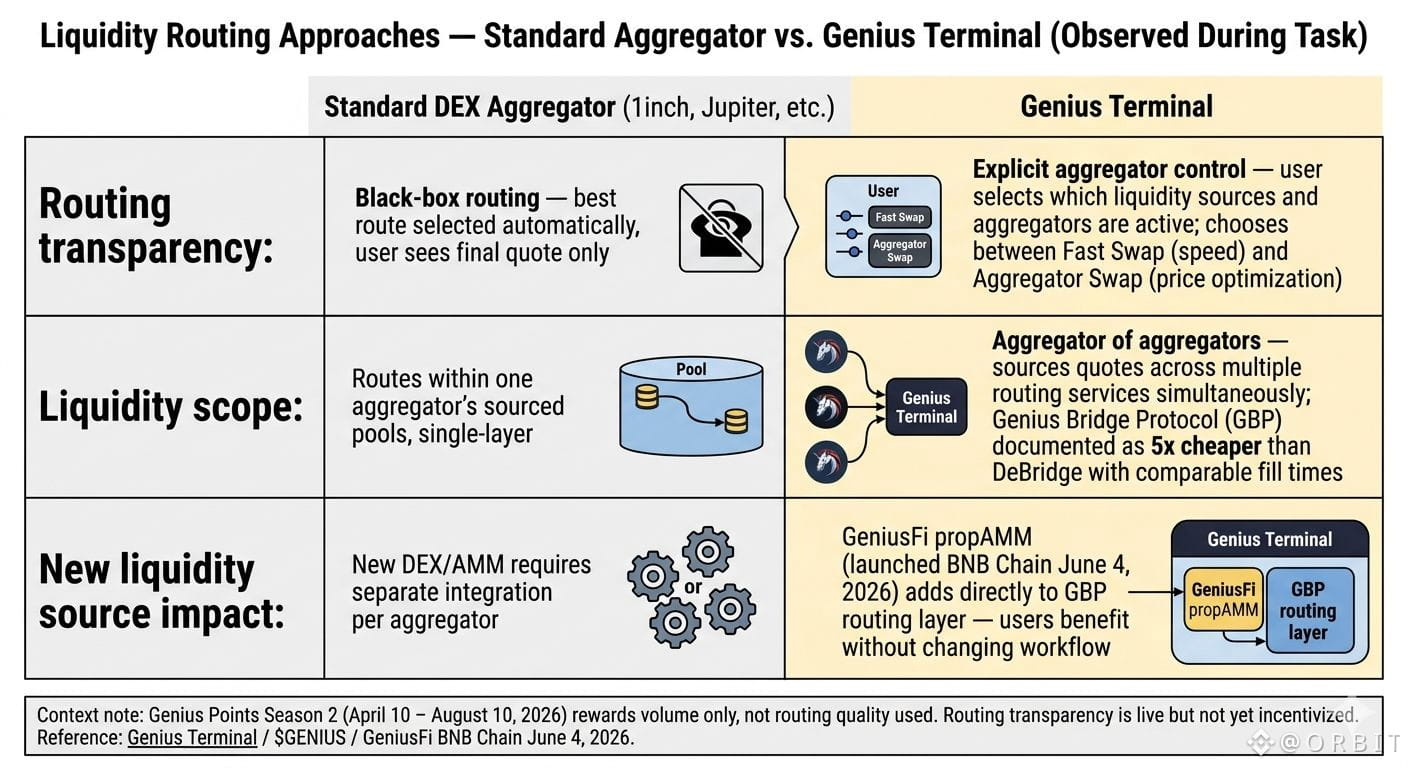
179
Anmelden und weiter Inhalte entdecken
Krypto-Nutzer weltweit auf Binance Square kennenlernen
⚡️ Bleib in Sachen Krypto stets am Puls.
💬 Die weltgrößte Kryptobörse vertraut darauf.
👍 Erhalte verlässliche Einblicke von verifizierten Creators.
E-Mail-Adresse/Telefonnummer
Trendthemen
BinanceLaunchesBinanceIntelligence
487,606 Aufrufe
3,335 Kommentare
nce
🔥 Der Kryptohandel könnte in das Zeitalter der „KI-Assistenten“ eintreten.
Binance Intelligence integriert künstliche Intelligenz direkt in den Handelsablauf.
Statt manuell zwischen folgenden Bereichen zu wechseln:
📊 Marktforschung
🔔 Benachrichtigungen
💼 Portfolio-Tracking
🧠 Strategieideen
⚙️ Handelsaktionen
kann die KI all das in einem System zusammenführen.
Das ist wichtig, denn der größte Vorteil für Trader besteht nicht immer darin, mehr Informationen zu finden,
sondern darin, Informationen schneller zu verarbeiten.
Wenn KI den Markt zusammenfassen, Risiken hervorheben, Portfolios verfolgen und bei der Entwicklung von Strategien helfen kann …
könnte der Abstand zwischen den Tools von Profis und denen von Privatanlegern allmählich kleiner werden.
Doch ein wichtiger Punkt bleibt:
KI kann die Entscheidungsfindung verbessern, aber Risiken nicht beseitigen.
Trader, die sie sinnvoll einsetzen, können sich einen Wettbewerbsvorteil verschaffen.
Wer ihr jedoch blind folgt, verliert womöglich einfach nur schneller.
Vertraust du der KI als Teil deines Handelsprozesses? 👀
$BTC
$XRP
$ETH
#BinanceAI #crypto #AI #trading $NVDAB #BinanceLaunchesBinanceIntelligence
MARFl
·1 Likes
·293 Aufrufe
BitcoinTargets2026OpenAt$87570
3,429 Aufrufe
90 Kommentare
BitcoinRejectedAt$87KThirdTime
3,117 Aufrufe
74 Kommentare