Was going through a CreatorPad task on Bedrock's approach to long-term value creation, and one number just kept pulling me back.
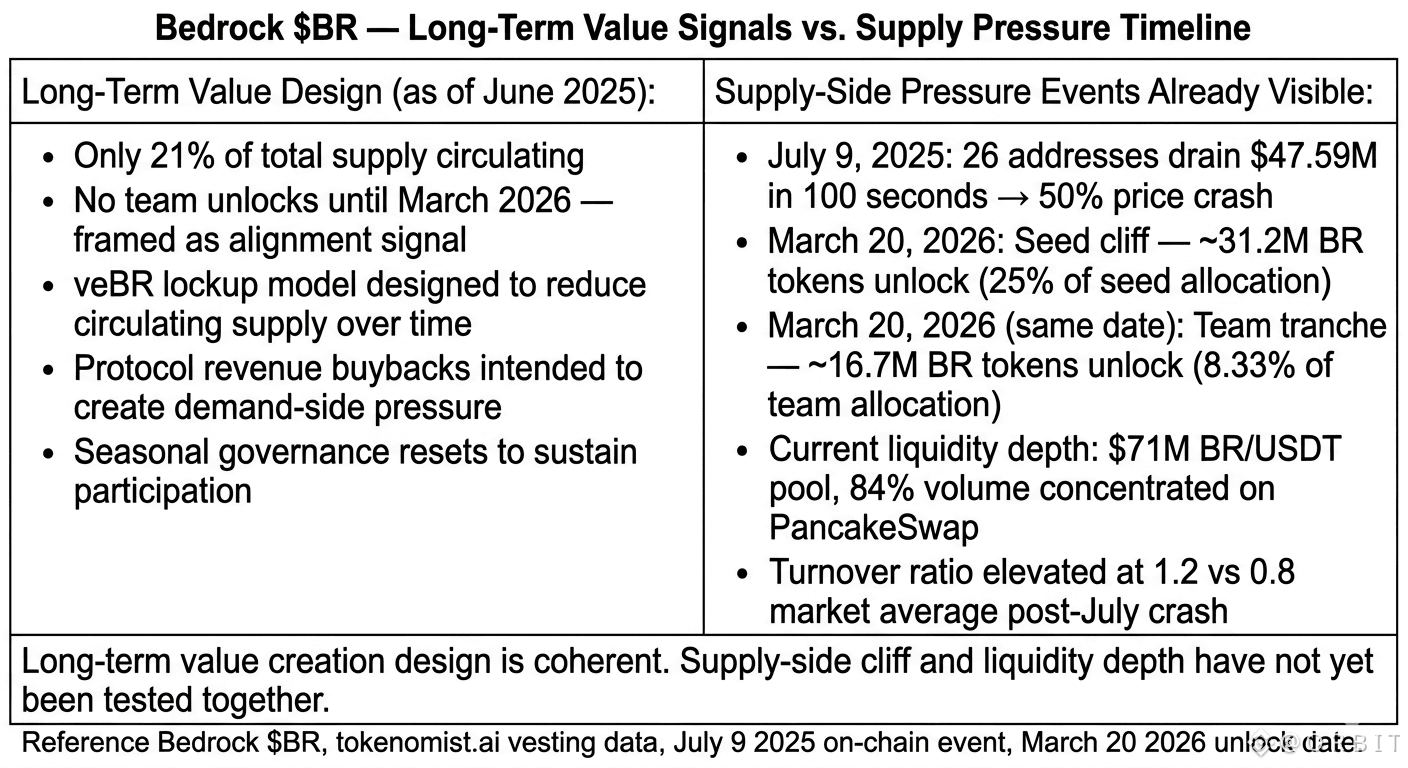
@Bedrock $BR #Bedrock builds its long-term value story around veBR lockups reducing circulating supply, protocol buybacks, and a founding team with no unlocks until 2026 — presented as alignment signal. And fair enough, the vesting structure is publicly traceable. Only 21% of total supply circulating right now. Sounds disciplined. But then I looked at what's actually sitting on the horizon: the seed round cliff triggers March 20, 2026, releasing 25% of seed allocation — roughly 31.2 million BR tokens — followed by the team's 8.33% tranche dropping the same day, another ~16.7 million. Two cohorts, same date, both cliff-unlocking into a token that already showed it can drop 50% in 100 seconds when concentrated holders exit together.
I'd been running a parallel tab on the July 9 liquidity drain the whole time — 26 addresses, $47.59M out in under two minutes. So when I hit the March 2026 cliff details, it landed differently than it probably would have otherwise.
Hmm. The vesting schedule is structured. The veBR lockup design is thoughtful. I don't doubt the intent. But there's a real question about whether the long-term value creation architecture can hold its shape when the supply-side clock and the liquidity depth don't yet match.
What does it actually mean for a protocol's long-term value thesis when the most credible test of it is still nine months out on the vesting calendar?
@Bedrock $BR #Bedrock builds its long-term value story around veBR lockups reducing circulating supply, protocol buybacks, and a founding team with no unlocks until 2026 — presented as alignment signal. And fair enough, the vesting structure is publicly traceable. Only 21% of total supply circulating right now. Sounds disciplined. But then I looked at what's actually sitting on the horizon: the seed round cliff triggers March 20, 2026, releasing 25% of seed allocation — roughly 31.2 million BR tokens — followed by the team's 8.33% tranche dropping the same day, another ~16.7 million. Two cohorts, same date, both cliff-unlocking into a token that already showed it can drop 50% in 100 seconds when concentrated holders exit together.
I'd been running a parallel tab on the July 9 liquidity drain the whole time — 26 addresses, $47.59M out in under two minutes. So when I hit the March 2026 cliff details, it landed differently than it probably would have otherwise.
Hmm. The vesting schedule is structured. The veBR lockup design is thoughtful. I don't doubt the intent. But there's a real question about whether the long-term value creation architecture can hold its shape when the supply-side clock and the liquidity depth don't yet match.
What does it actually mean for a protocol's long-term value thesis when the most credible test of it is still nine months out on the vesting calendar?