
SAIIFY
2.5k Beiträge

SAIIFY
Nothing To Show
Regelmäßiger Trader
1.4 Jahre
737 Following
23.2K+ Follower
5.0K+ Like gegeben
Beiträge
Alle
Zitierungen
Live
Übersetzung ansehen
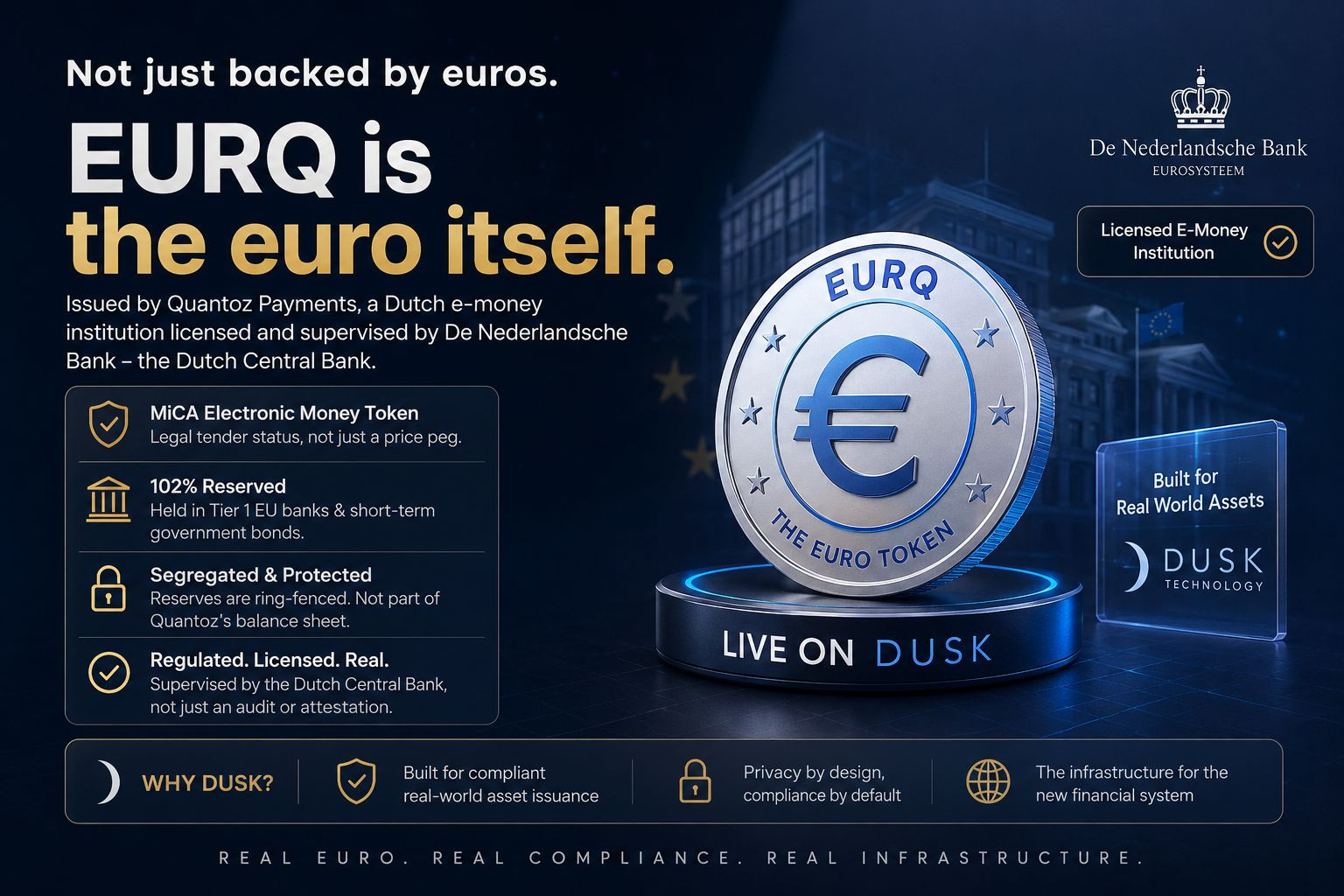
Most stablecoins are a companys promise. EURQ is legally the euro itself. Thats a bigger difference than it sounds.
I have read a lot of stablecoin pitches. Almost all of them use the same language, backed 1:1, fully reserved, audited regularly. EURQ, the euro token now live on @Dusk , makes a different and much stronger claim, and I wanted to check whether it actually holds up.
EURQ is issued by Quantoz Payments, a Dutch electronic money institution licensed and supervised directly by De Nederlandsche Bank, the actual Dutch central bank. Thats not a self-attested audit or a third party attestation firm signing off after the fact. Thats a banking regulator granting an E-Money license the same category used for real digital cash, not a crypto side project wearing compliance language.
Heres the part that actually separates it from something like USDT or even USDC. Under MiCA, EURQ is classified as an Electronic Money Token, legal tender status, not just a price-pegged crypto asset. Reserves sit in Tier 1 European banks and short term government bonds, segregated from Quantozs own balance sheet, held at 102 percent to cover redemption even under stress. If Quantoz ran into trouble tomorrow, those reserves are not Quantozs money to touch.
Now the #dusk specific part. Dusk is not just one more chain EURQ happens to support. Out of the handful of blockchains carrying it, $DUSK is the one actually built for native real world asset issuance with compliance baked into the protocol itself, not bolted on after. Thats why NPEX picked it too, a real Euro token is the missing piece for an actual on-chain stock exchange to settle trades in something regulators recognize as genuine currency, not a synthetic stand-in for one.
I still think people should read the fine print on any stablecoin before trusting it. But EURQs fine print is a banking license, not a whitepaper. Thats a meaningfully different foundation than most of what circulates in this space.
I have read a lot of stablecoin pitches. Almost all of them use the same language, backed 1:1, fully reserved, audited regularly. EURQ, the euro token now live on @Dusk , makes a different and much stronger claim, and I wanted to check whether it actually holds up.
EURQ is issued by Quantoz Payments, a Dutch electronic money institution licensed and supervised directly by De Nederlandsche Bank, the actual Dutch central bank. Thats not a self-attested audit or a third party attestation firm signing off after the fact. Thats a banking regulator granting an E-Money license the same category used for real digital cash, not a crypto side project wearing compliance language.
Heres the part that actually separates it from something like USDT or even USDC. Under MiCA, EURQ is classified as an Electronic Money Token, legal tender status, not just a price-pegged crypto asset. Reserves sit in Tier 1 European banks and short term government bonds, segregated from Quantozs own balance sheet, held at 102 percent to cover redemption even under stress. If Quantoz ran into trouble tomorrow, those reserves are not Quantozs money to touch.
Now the #dusk specific part. Dusk is not just one more chain EURQ happens to support. Out of the handful of blockchains carrying it, $DUSK is the one actually built for native real world asset issuance with compliance baked into the protocol itself, not bolted on after. Thats why NPEX picked it too, a real Euro token is the missing piece for an actual on-chain stock exchange to settle trades in something regulators recognize as genuine currency, not a synthetic stand-in for one.
I still think people should read the fine print on any stablecoin before trusting it. But EURQs fine print is a banking license, not a whitepaper. Thats a meaningfully different foundation than most of what circulates in this space.
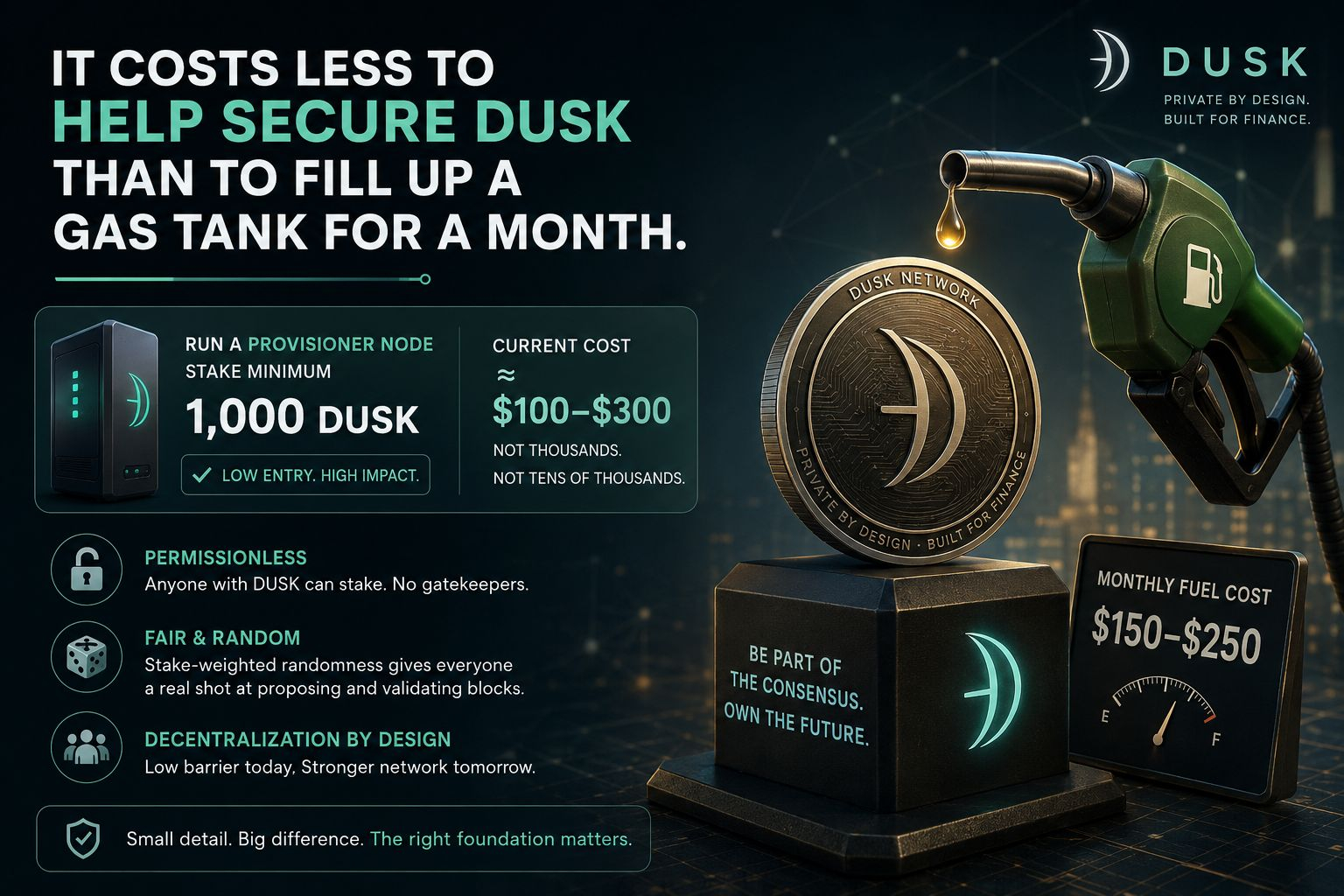
Es kostet weniger, um dabei zu helfen, @Dusk abzusichern, als es kostet, einen Gastank für einen Monat zu füllen. Diese Zahl hat mich gestoppt.
Ich habe in diesen Beiträgen viele grobe Kanten auseinander genommen. Also lass mich das einmal umdrehen und über etwas sprechen, das #dusk wirklich richtig gemacht hat, denn ich glaube, das gerät unter allem anderen.
Um auf Dusk einen Validator-Node zu betreiben, als Provisioner, beträgt die minimale Stake 1.000 $DUSK . Zu aktuellen Preisen sind das irgendwo im niedrigen zweistelligen oder niedrigen dreistelligen Dollarbereich – nicht Tausende, nicht Zehntausende. Vergleiche das damit, was nötig ist, um einen echten Validator in vielen großen Proof-of-Stake-Ketten zu betreiben: Dort liegt der Einstiegspreis oft weit in die 5- oder 6-stelligen Bereiche, sobald man die Anforderung an die Mindest-Stake berücksichtigt. Dusk hat diese Tür bewusst niedrig gehalten.
Und es ist nicht nur günstig, es ist auch wirklich permissionless. Jeder, der DUSK hält, kann staken und Teil des Konsens-Set werden – ohne Antrag, ohne Freigabe, ohne Gatekeeper, der entscheidet, wer überhaupt mithelfen darf, das Netzwerk abzusichern. Die Auswahl erfolgt über zufällige Auswahl gewichtet nach Einsatz, sodass kleinere Staker weiterhin echte, wiederkehrende Chancen bekommen, Blöcke vorzuschlagen und zu validieren – und nicht nur von der Seitenlinie aus zuzusehen, während ein paar Wale alles übernehmen.
Ich möchte dabei vorsichtig sein, nicht zu viel zu versprechen. Niedrige Einstiegskosten bedeuten nicht automatisch, dass das Validator-Set langfristig breit gestreut bleibt. Konzentration kann trotzdem langsam zunehmen, wenn größere Inhaber mehr Einfluss anhäufen – dieses Risiko besteht bei jeder Proof-of-Stake-Kette, unabhängig von der anfänglichen Mindest-Stake. Aber ein niedriger Einstieg ist immer noch die richtige Grundlage, um Dezentralisierung darauf aufzubauen. Man kann keine breite Beteiligung erreichen, wenn der Einstiegspreis die meisten Menschen aussperrt, bevor sie überhaupt es versuchen, und Dusk hat ganz klar nicht so entschieden.
Kleine Einzelheit, leicht zu übersehen. Wahrscheinlich sollte man sie nicht.
Ich habe in diesen Beiträgen viele grobe Kanten auseinander genommen. Also lass mich das einmal umdrehen und über etwas sprechen, das #dusk wirklich richtig gemacht hat, denn ich glaube, das gerät unter allem anderen.
Um auf Dusk einen Validator-Node zu betreiben, als Provisioner, beträgt die minimale Stake 1.000 $DUSK . Zu aktuellen Preisen sind das irgendwo im niedrigen zweistelligen oder niedrigen dreistelligen Dollarbereich – nicht Tausende, nicht Zehntausende. Vergleiche das damit, was nötig ist, um einen echten Validator in vielen großen Proof-of-Stake-Ketten zu betreiben: Dort liegt der Einstiegspreis oft weit in die 5- oder 6-stelligen Bereiche, sobald man die Anforderung an die Mindest-Stake berücksichtigt. Dusk hat diese Tür bewusst niedrig gehalten.
Und es ist nicht nur günstig, es ist auch wirklich permissionless. Jeder, der DUSK hält, kann staken und Teil des Konsens-Set werden – ohne Antrag, ohne Freigabe, ohne Gatekeeper, der entscheidet, wer überhaupt mithelfen darf, das Netzwerk abzusichern. Die Auswahl erfolgt über zufällige Auswahl gewichtet nach Einsatz, sodass kleinere Staker weiterhin echte, wiederkehrende Chancen bekommen, Blöcke vorzuschlagen und zu validieren – und nicht nur von der Seitenlinie aus zuzusehen, während ein paar Wale alles übernehmen.
Ich möchte dabei vorsichtig sein, nicht zu viel zu versprechen. Niedrige Einstiegskosten bedeuten nicht automatisch, dass das Validator-Set langfristig breit gestreut bleibt. Konzentration kann trotzdem langsam zunehmen, wenn größere Inhaber mehr Einfluss anhäufen – dieses Risiko besteht bei jeder Proof-of-Stake-Kette, unabhängig von der anfänglichen Mindest-Stake. Aber ein niedriger Einstieg ist immer noch die richtige Grundlage, um Dezentralisierung darauf aufzubauen. Man kann keine breite Beteiligung erreichen, wenn der Einstiegspreis die meisten Menschen aussperrt, bevor sie überhaupt es versuchen, und Dusk hat ganz klar nicht so entschieden.
Kleine Einzelheit, leicht zu übersehen. Wahrscheinlich sollte man sie nicht.
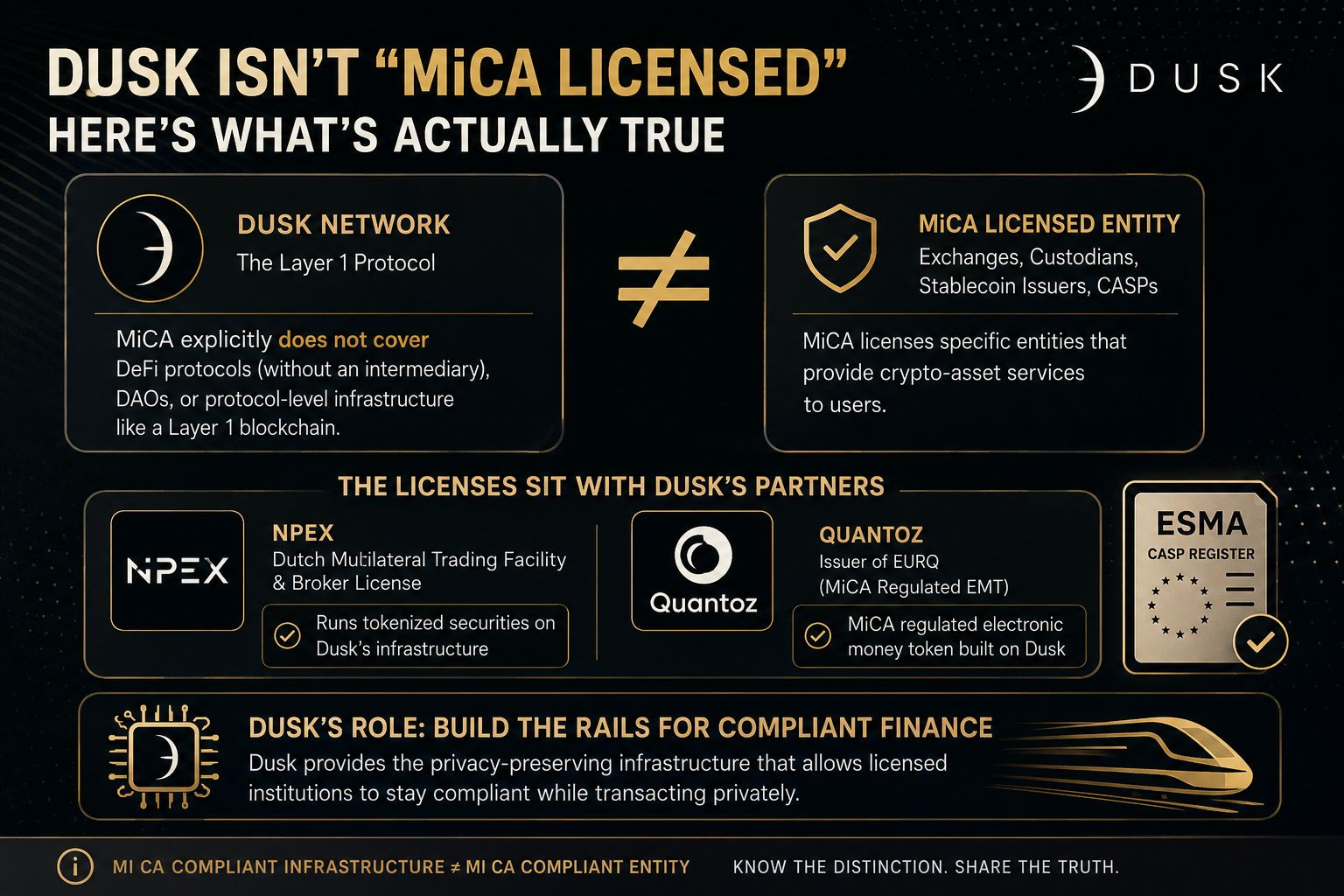
„MiCA-konform“ wird ständig über @Dusk gesagt. Dusk selbst besitzt tatsächlich keine MiCA-Lizenz. Ich musste das zweimal lesen.
Ich habe nach einer Bestätigung gesucht, dass #dusk selbst MiCA-autorisiert ist, und ich erwartete ein klares Ja. Was ich fand, war differenzierter – und ehrlich gesagt interessanter – als ein simples Ja.
MiCA, der europäische Krypto-Regulierungsrahmen, lizenziert bestimmte Dinge. Börsen, Verwahrer, Emittenten von Stablecoins, also Unternehmen, die Crypto-Asset-Service-Provider sind. Nach den eigenen Worten von Dusk in deren eigener Ausarbeitung deckt MiCA ausdrücklich keine DeFi-Protokolle ohne eine vermittelnde Stelle ab, keine DAOs und auch keine reine Protokollinfrastruktur wie etwa eine Layer-1-Blockchain selbst. Also ist Dusk als Netzwerk nicht das, was lizenziert wird. Es sind die „Schienen“ darunter, auf denen lizenzierte Einrichtungen laufen.
Die eigentlichen Lizenzen liegen bei Dusks Partnern. NPEX hält eine niederländische Multilaterale Handelsfazilität und eine Brokerlizenz und betreibt seine tokenisierten Wertpapiere auf $DUSK Infrastruktur. Quantoz emittiert EURQ, ein MiCA-reguliertes E-Geld-Token, das ebenfalls auf Dusk basiert. Beide sind real, nachweisbar und im ESMA-CASP-Register verzeichnet. Dusk hat die Technologie gebaut, die lizenzierten Institutionen ermöglicht, beim privaten Handeln compliant zu bleiben. Das ist wirklich wertvoll. Es ist nur eine andere Behauptung als „Dusk ist MiCA-konform“ als pauschale Aussage.
Ich glaube nicht, dass Dusk unehrlich ist. In ihrem eigenen Blogbeitrag wird die Unterscheidung ziemlich klar ausgeführt, wenn man die Schlagzeile hinter sich lässt. Ich denke, es ist eher so, dass „MiCA-konforme Infrastruktur“ in lockeren Gesprächen und Social Posts auf „MiCA-konform“ verkürzt wird, und dass diese Verkürzung stillschweigend verändert, was genau behauptet wird. Die eine Version sagt: Wir ermöglichen Compliance. Die andere impliziert: Wir sind compliant. Das sind nicht dieselben Sätze.
Es ist hilfreich zu wissen, welche Version tatsächlich stimmt, bevor man sie als Verkaufsargument wiederholt.
Ich habe nach einer Bestätigung gesucht, dass #dusk selbst MiCA-autorisiert ist, und ich erwartete ein klares Ja. Was ich fand, war differenzierter – und ehrlich gesagt interessanter – als ein simples Ja.
MiCA, der europäische Krypto-Regulierungsrahmen, lizenziert bestimmte Dinge. Börsen, Verwahrer, Emittenten von Stablecoins, also Unternehmen, die Crypto-Asset-Service-Provider sind. Nach den eigenen Worten von Dusk in deren eigener Ausarbeitung deckt MiCA ausdrücklich keine DeFi-Protokolle ohne eine vermittelnde Stelle ab, keine DAOs und auch keine reine Protokollinfrastruktur wie etwa eine Layer-1-Blockchain selbst. Also ist Dusk als Netzwerk nicht das, was lizenziert wird. Es sind die „Schienen“ darunter, auf denen lizenzierte Einrichtungen laufen.
Die eigentlichen Lizenzen liegen bei Dusks Partnern. NPEX hält eine niederländische Multilaterale Handelsfazilität und eine Brokerlizenz und betreibt seine tokenisierten Wertpapiere auf $DUSK Infrastruktur. Quantoz emittiert EURQ, ein MiCA-reguliertes E-Geld-Token, das ebenfalls auf Dusk basiert. Beide sind real, nachweisbar und im ESMA-CASP-Register verzeichnet. Dusk hat die Technologie gebaut, die lizenzierten Institutionen ermöglicht, beim privaten Handeln compliant zu bleiben. Das ist wirklich wertvoll. Es ist nur eine andere Behauptung als „Dusk ist MiCA-konform“ als pauschale Aussage.
Ich glaube nicht, dass Dusk unehrlich ist. In ihrem eigenen Blogbeitrag wird die Unterscheidung ziemlich klar ausgeführt, wenn man die Schlagzeile hinter sich lässt. Ich denke, es ist eher so, dass „MiCA-konforme Infrastruktur“ in lockeren Gesprächen und Social Posts auf „MiCA-konform“ verkürzt wird, und dass diese Verkürzung stillschweigend verändert, was genau behauptet wird. Die eine Version sagt: Wir ermöglichen Compliance. Die andere impliziert: Wir sind compliant. Das sind nicht dieselben Sätze.
Es ist hilfreich zu wissen, welche Version tatsächlich stimmt, bevor man sie als Verkaufsargument wiederholt.
Übersetzung ansehen
🚀 Crypto Market Blast: Bitcoin Just Shook the Market! 🚀
Bitcoin is on an incredible run this week. It closed with a 22% weekly gain, ending near $77,000, up from about $62,800 at the start of the week. That's its strongest weekly run since 2024, and Bitcoin even broke past the $78,000 level!
What's driving the rally?
📈 Treasury Secretary Bessent's bond market intervention pushed yields down
📈 Trump has been pushing Congress to pass the Clarity Act, which would bring clarity to crypto regulation
📈 This triggered a massive short squeeze, with roughly $2.7 billion in crypto short positions liquidated
It's not just Bitcoin. Ethereum jumped 8.12% to $2,515, and XRP surged 14.61% to $1.4538, showing the rally is broad rather than a single-token move. Bitcoin Cash gained 31% in 24 hours, and Ethena rose 27%. Altcoins are joining the party too! 🎉
⚠️ Reminder: crypto is highly volatile. Do your own research and only invest what you can afford to lose.
#Bitcoin #CryptoMarket #BTC #CryptoNews #Ethereum
Bitcoin is on an incredible run this week. It closed with a 22% weekly gain, ending near $77,000, up from about $62,800 at the start of the week. That's its strongest weekly run since 2024, and Bitcoin even broke past the $78,000 level!
What's driving the rally?
📈 Treasury Secretary Bessent's bond market intervention pushed yields down
📈 Trump has been pushing Congress to pass the Clarity Act, which would bring clarity to crypto regulation
📈 This triggered a massive short squeeze, with roughly $2.7 billion in crypto short positions liquidated
It's not just Bitcoin. Ethereum jumped 8.12% to $2,515, and XRP surged 14.61% to $1.4538, showing the rally is broad rather than a single-token move. Bitcoin Cash gained 31% in 24 hours, and Ethena rose 27%. Altcoins are joining the party too! 🎉
⚠️ Reminder: crypto is highly volatile. Do your own research and only invest what you can afford to lose.
#Bitcoin #CryptoMarket #BTC #CryptoNews #Ethereum
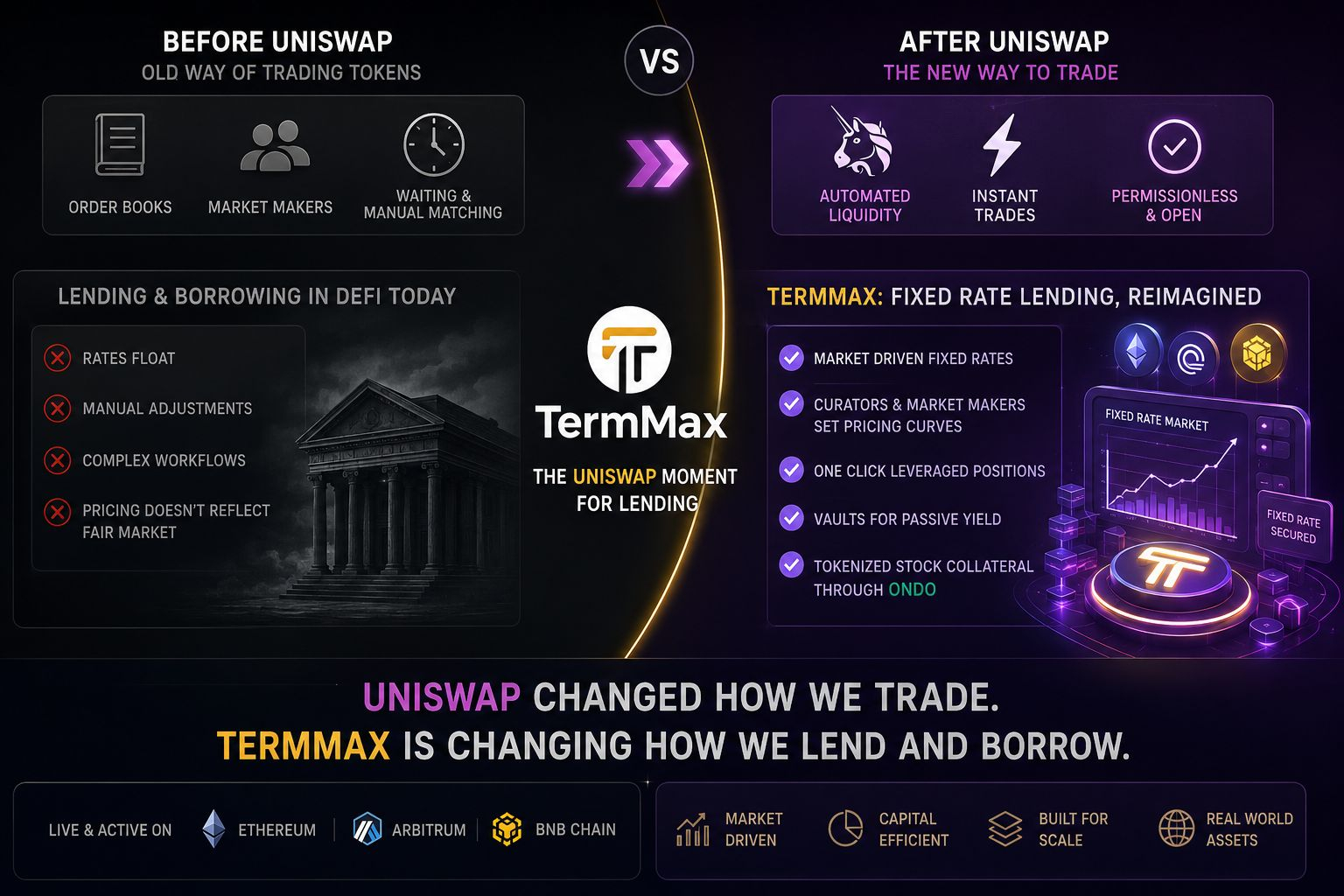
Uniswap hat verändert, wie Menschen Token handeln. @TermMax ist dabei, dasselbe für das Leihen und Verleihen zu tun.
Vor Uniswap bedeutete Handel Orderbücher, Market Maker und das Warten darauf, dass jemand deinen Preis trifft. Uniswap machte ihn sofort und automatisiert. Das Leihen und Verleihen in DeFi fühlt sich allerdings immer noch sehr ähnlich wie das alte System an. Die Zinssätze schwanken, Positionen brauchen ständige Aufmerksamkeit, und die Preisbildung spiegelt selten wirklich wider, was für beide Seiten fair ist.
#TermMax bringt diesen gleichen automatisierten, marktbasierten Ansatz zum Kreditgeschäft mit festen Zinssätzen. Kreditnehmer und Kreditgeber einigen sich auf Zinssätze über reale Marktmechanismen – nicht über einen einzelnen Algorithmus, der versucht, die richtige Zahl für alle zu erraten. Kuratoren und Market Maker legen ihre eigenen Preiskurven über Range-Orders fest, sodass sich der Markt selbst anpasst, statt dass du dich an ihn anpassen musst.
Ein paar Gründe, warum das einen genaueren Blick wert ist.
Live und aktiv auf Ethereum, Arbitrum und BNB Chain – nicht nur eine Ankündigung.
One-Click-Leverage-Positionen, sodass du nicht fünf Transaktionen über verschiedene Plattformen zusammensetzen musst.
Vaults für Menschen, die Rendite möchten, ohne täglich aktiv eine Strategie verwalten zu müssen.
Ein tokenisiertes Aktienbesicherungs-Marktmodell über Ondo, das fest verzinstes Borrowing für Real-World-Assets eröffnet.
Der Vergleich geht nicht um Hype. Es geht um den Wandel von manuellen, unvorhersehbaren Systemen zu solchen, die einfach so funktionieren, wie Märkte funktionieren sollten. Dort entsteht normalerweise auch das echte Wachstum.
Welcher Teil von DeFi braucht deiner Meinung nach immer noch seinen „Uniswap Moment“?
Vor Uniswap bedeutete Handel Orderbücher, Market Maker und das Warten darauf, dass jemand deinen Preis trifft. Uniswap machte ihn sofort und automatisiert. Das Leihen und Verleihen in DeFi fühlt sich allerdings immer noch sehr ähnlich wie das alte System an. Die Zinssätze schwanken, Positionen brauchen ständige Aufmerksamkeit, und die Preisbildung spiegelt selten wirklich wider, was für beide Seiten fair ist.
#TermMax bringt diesen gleichen automatisierten, marktbasierten Ansatz zum Kreditgeschäft mit festen Zinssätzen. Kreditnehmer und Kreditgeber einigen sich auf Zinssätze über reale Marktmechanismen – nicht über einen einzelnen Algorithmus, der versucht, die richtige Zahl für alle zu erraten. Kuratoren und Market Maker legen ihre eigenen Preiskurven über Range-Orders fest, sodass sich der Markt selbst anpasst, statt dass du dich an ihn anpassen musst.
Ein paar Gründe, warum das einen genaueren Blick wert ist.
Live und aktiv auf Ethereum, Arbitrum und BNB Chain – nicht nur eine Ankündigung.
One-Click-Leverage-Positionen, sodass du nicht fünf Transaktionen über verschiedene Plattformen zusammensetzen musst.
Vaults für Menschen, die Rendite möchten, ohne täglich aktiv eine Strategie verwalten zu müssen.
Ein tokenisiertes Aktienbesicherungs-Marktmodell über Ondo, das fest verzinstes Borrowing für Real-World-Assets eröffnet.
Der Vergleich geht nicht um Hype. Es geht um den Wandel von manuellen, unvorhersehbaren Systemen zu solchen, die einfach so funktionieren, wie Märkte funktionieren sollten. Dort entsteht normalerweise auch das echte Wachstum.
Welcher Teil von DeFi braucht deiner Meinung nach immer noch seinen „Uniswap Moment“?
Übersetzung ansehen
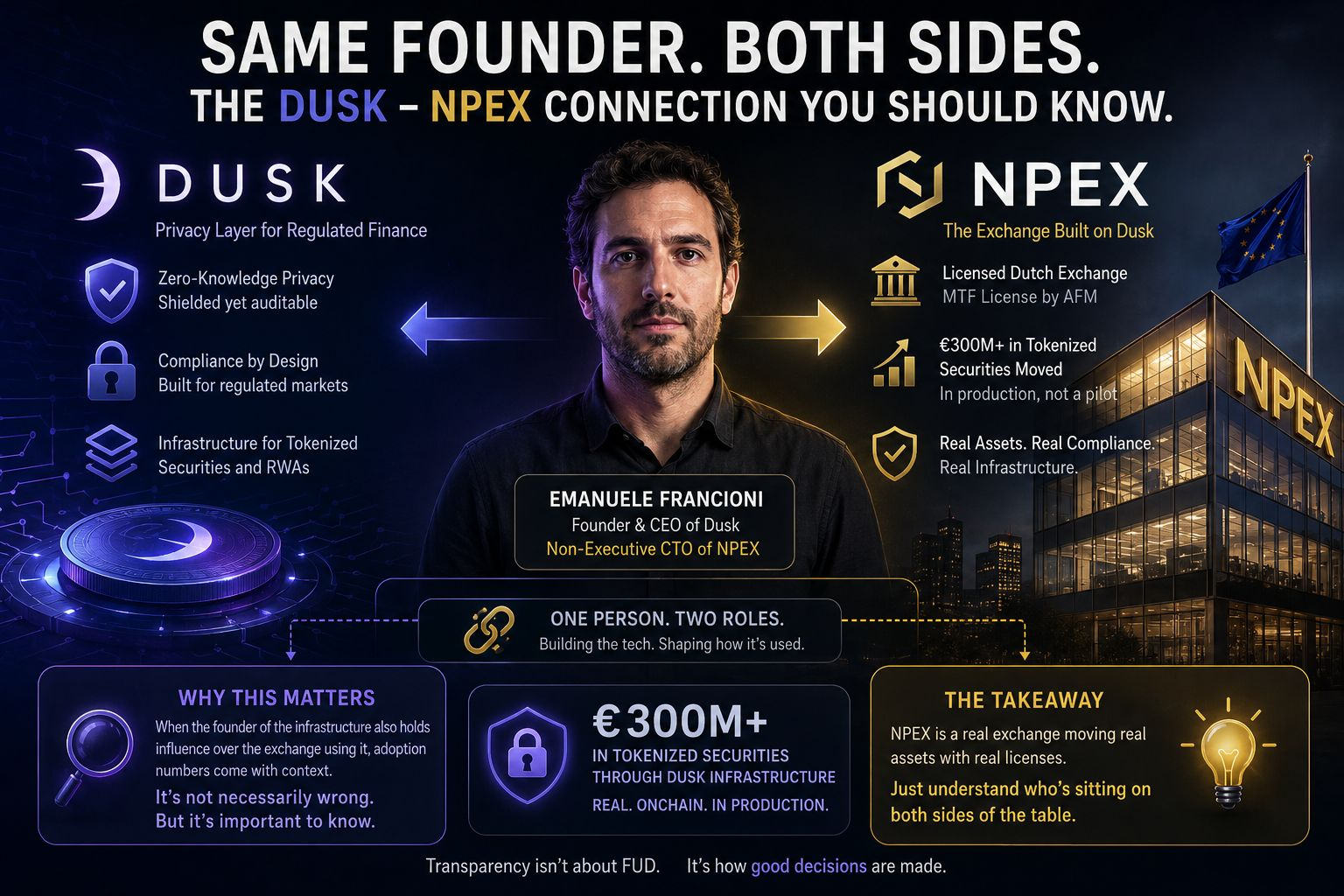
Dusks founder is also the CTO of the exchange that runs on Dusks own technology. Nobody flagged this to me until I checked myself.
I was reading through #dusk partnership news and noticed a line that made me stop. Emanuele Francioni, founder and CEO of @Dusk , was appointed as Non-Executive CTO of NPEX, the licensed Dutch exchange that's tokenizing hundreds of millions in securities using Dusks infrastructure. Same person, sitting on both sides of whats supposed to be a partnership between two separate entities.
I want to be fair about this before jumping to conclusions. Non-Executive roles are common in this industry, Advisors sit on boards all the time, and having the actual architect of the underlying tech helping the exchange implement it correctly is not inherently sketchy. If anything, you could argue its the opposite, who better understands how to securely deploy $DUSK privacy and compliance layer than the person who built it.
But step back for a second. NPEX using Dusk is not just two companies doing business together anymore. Its a licensed exchange whose technical direction is partly steered by the same person whose company benefits directly from that Exchanges continued use of Dusk. Every reference to NPEX as proof of institutional adoption, the 300 million plus in tokenized assets, all of it carries this detail sitting quietly underneath, not hidden exactly, just rarely mentioned next to the headline number.
I dont think this makes the NPEX partnership fake or the numbers inflated. Real securities are genuinely moving through real infrastructure. I just think when a founder holds influence on both sides of a flagship adoption story, thats worth knowing before you treat it as fully independent validation, not after.
I was reading through #dusk partnership news and noticed a line that made me stop. Emanuele Francioni, founder and CEO of @Dusk , was appointed as Non-Executive CTO of NPEX, the licensed Dutch exchange that's tokenizing hundreds of millions in securities using Dusks infrastructure. Same person, sitting on both sides of whats supposed to be a partnership between two separate entities.
I want to be fair about this before jumping to conclusions. Non-Executive roles are common in this industry, Advisors sit on boards all the time, and having the actual architect of the underlying tech helping the exchange implement it correctly is not inherently sketchy. If anything, you could argue its the opposite, who better understands how to securely deploy $DUSK privacy and compliance layer than the person who built it.
But step back for a second. NPEX using Dusk is not just two companies doing business together anymore. Its a licensed exchange whose technical direction is partly steered by the same person whose company benefits directly from that Exchanges continued use of Dusk. Every reference to NPEX as proof of institutional adoption, the 300 million plus in tokenized assets, all of it carries this detail sitting quietly underneath, not hidden exactly, just rarely mentioned next to the headline number.
I dont think this makes the NPEX partnership fake or the numbers inflated. Real securities are genuinely moving through real infrastructure. I just think when a founder holds influence on both sides of a flagship adoption story, thats worth knowing before you treat it as fully independent validation, not after.
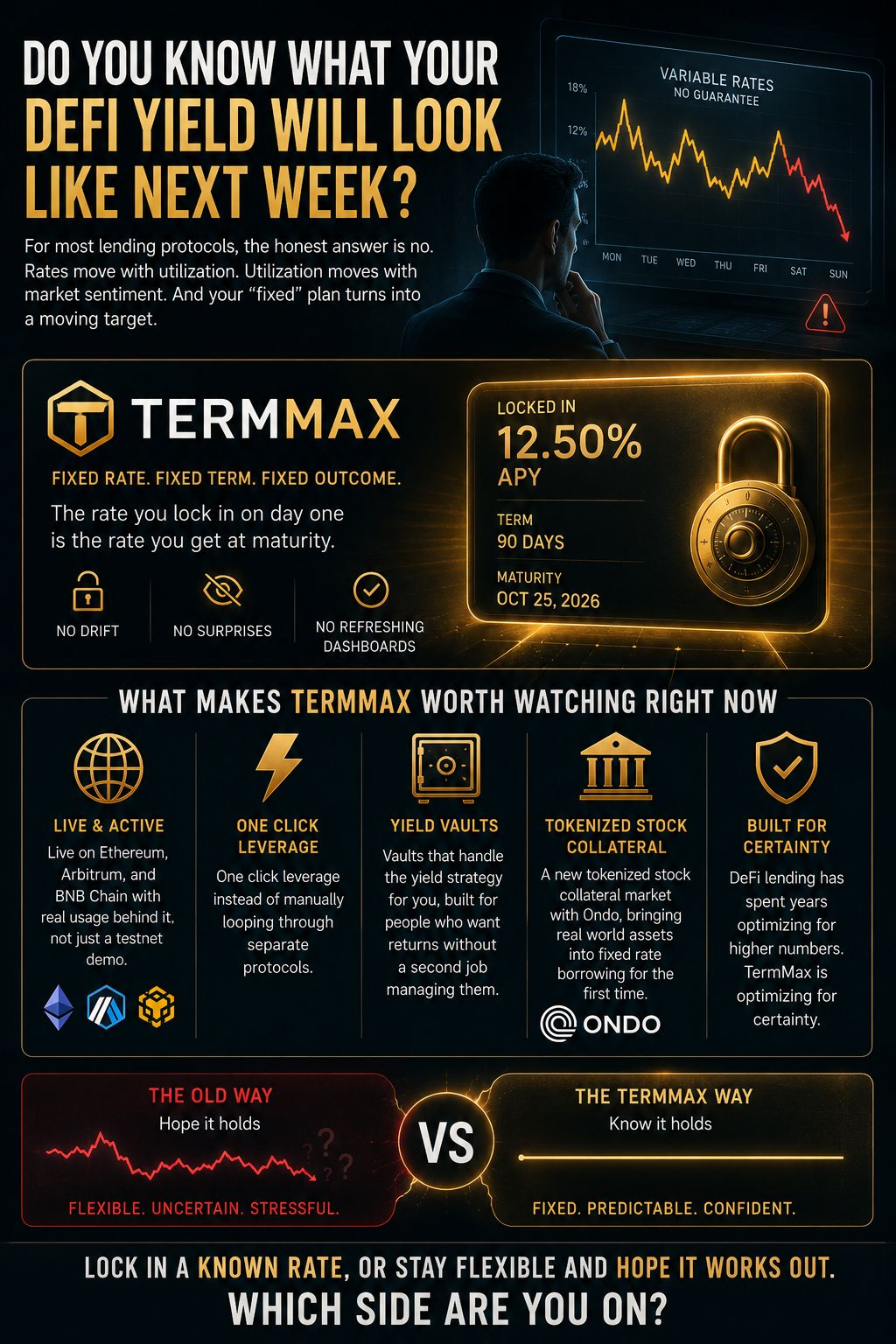
Kurze Frage: Wissen Sie wirklich, wie sich Ihre DeFi-Rendite nächste Woche entwickeln wird?
Für die meisten Lending-Protokolle lautet die ehrliche Antwort: Nein. Die Zinssätze bewegen sich mit der Auslastung, die Auslastung wiederum mit der Marktlage/der Stimmung, und Ihr „Fix“-Plan wird zu einem beweglichen Ziel.
@TermMax umgeht dieses Problem komplett. Es ist ein Festzins-, Festlaufzeit-Protokoll: Der Zinssatz, den Sie am ersten Tag festlegen, ist der Zinssatz, den Sie bei Fälligkeit erhalten. Kein Drift, keine Überraschungen, kein ständiges Aktualisieren Ihres Dashboards, um zu sehen, was sich über Nacht geändert hat.
Warum es sich gerade jetzt lohnt, darauf zu achten.
Live auf Ethereum, Arbitrum und BNB Chain – mit echter Nutzung im Hintergrund, nicht nur einer Testnet-Demo.
Ein-Klick-Leverage statt manuellem Looping durch einzelne, separate Protokolle.
Vaults, die die Yield-Strategie für Sie übernehmen – entwickelt für Menschen, die Renditen wollen, ohne noch einen zweiten Job managen zu müssen.
Ein neues tokenisiertes Aktienkollateral-Marktmodell mit Ondo: Das bringt erstmals Real-World-Assets in das Fixed-Rate-Borrowing.
DeFi-Lending hat jahrelang darauf optimiert, höhere Zahlen zu erzielen. #TermMax optimiert stattdessen für Sicherheit – und das könnte wichtiger werden, sobald ernsthaftes Kapital nach einem Grund sucht, um überhaupt an die Kette zu kommen.
Eine bekannte Verzinsung fest einpreisen oder flexibel bleiben und hoffen, dass es aufgeht. Auf welcher Seite stehen Sie?
Für die meisten Lending-Protokolle lautet die ehrliche Antwort: Nein. Die Zinssätze bewegen sich mit der Auslastung, die Auslastung wiederum mit der Marktlage/der Stimmung, und Ihr „Fix“-Plan wird zu einem beweglichen Ziel.
@TermMax umgeht dieses Problem komplett. Es ist ein Festzins-, Festlaufzeit-Protokoll: Der Zinssatz, den Sie am ersten Tag festlegen, ist der Zinssatz, den Sie bei Fälligkeit erhalten. Kein Drift, keine Überraschungen, kein ständiges Aktualisieren Ihres Dashboards, um zu sehen, was sich über Nacht geändert hat.
Warum es sich gerade jetzt lohnt, darauf zu achten.
Live auf Ethereum, Arbitrum und BNB Chain – mit echter Nutzung im Hintergrund, nicht nur einer Testnet-Demo.
Ein-Klick-Leverage statt manuellem Looping durch einzelne, separate Protokolle.
Vaults, die die Yield-Strategie für Sie übernehmen – entwickelt für Menschen, die Renditen wollen, ohne noch einen zweiten Job managen zu müssen.
Ein neues tokenisiertes Aktienkollateral-Marktmodell mit Ondo: Das bringt erstmals Real-World-Assets in das Fixed-Rate-Borrowing.
DeFi-Lending hat jahrelang darauf optimiert, höhere Zahlen zu erzielen. #TermMax optimiert stattdessen für Sicherheit – und das könnte wichtiger werden, sobald ernsthaftes Kapital nach einem Grund sucht, um überhaupt an die Kette zu kommen.
Eine bekannte Verzinsung fest einpreisen oder flexibel bleiben und hoffen, dass es aufgeht. Auf welcher Seite stehen Sie?
Verifiziert
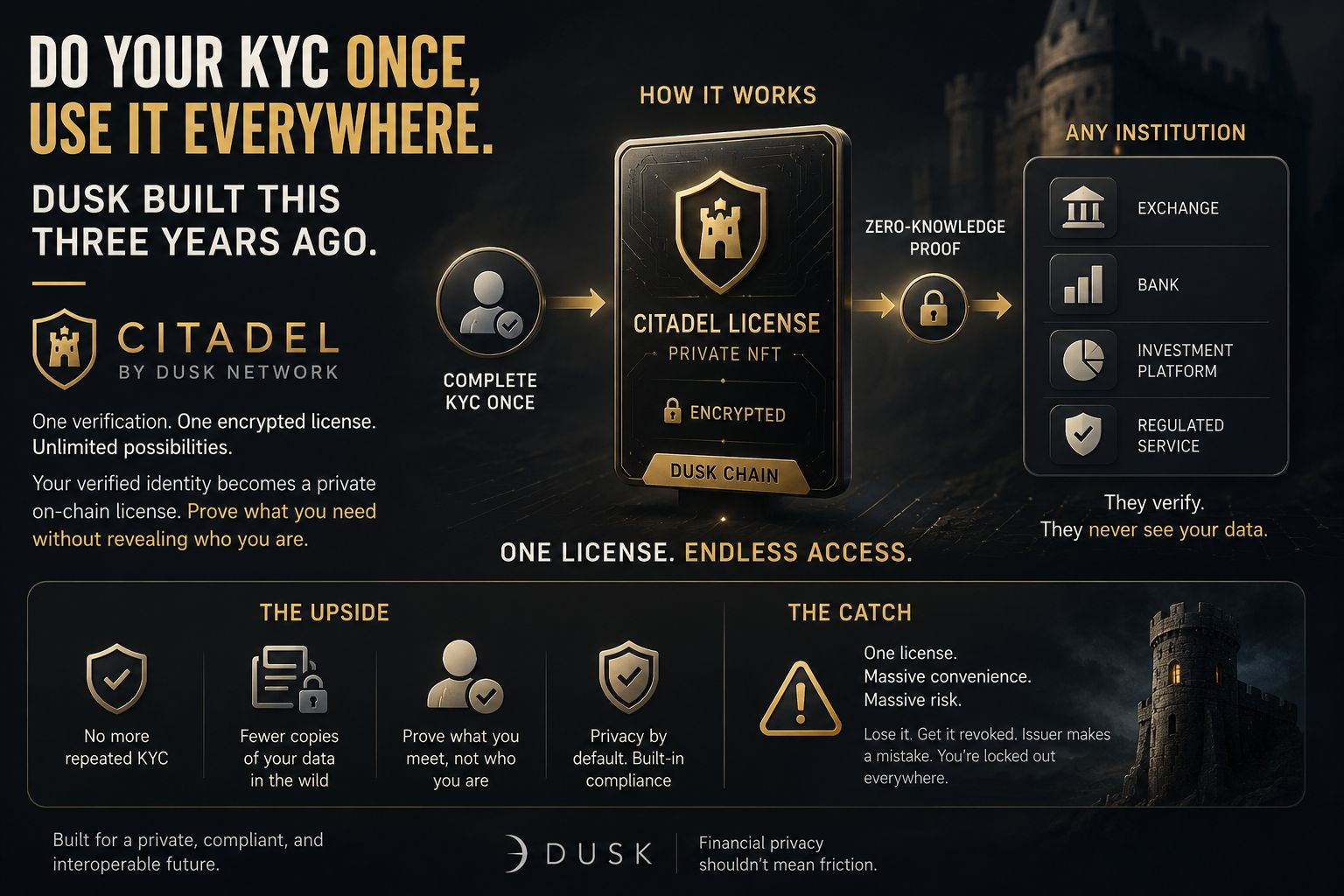
Mache dein KYC einmal, nutze es überall. @Dusk baute das vor drei Jahren und fast niemand spricht mehr darüber.
Alle sind begeistert von DuskEVM und der Kursentwicklung der letzten Zeit, fair genug. Aber wenn ich in der #dusk Historie zurückscrolle, finde ich etwas, das viel älter ist und das meiner Meinung nach mehr bedeutet als alles, was gerade ausgeliefert wird. Es heißt Citadel. Du machst den KYC einmal fertig, und jede Institution, die dich später verifizieren muss, prüft dann nur noch eine Lizenz, statt dich noch einmal durch den kompletten Prozess zu schicken.
So funktioniert es. Deine verifizierte Identität wird zu etwas wie einem privaten NFT, einer Lizenz, die auf der Dusk-Kette liegt, verschlüsselt. Wenn eine Plattform bestätigt, dass du ihre Anforderungen erfüllst – akkreditierter Investorstatus, Mindestguthaben, was auch immer – gibst du ihnen keine Dokumente mehr erneut. Du erzeugst einen Zero-Knowledge-Beweis, dass du eine gültige Lizenz besitzt, die exakt deren Anforderung erfüllt. Das ist alles, was sie sehen. Nicht dein Name, nicht dein Bankauszug – nur ein verifiziertes Ja.
Ich mag das aus einem offensichtlichen Grund. KYC ist heute wirklich miserabel: dieselben Dokumente, dasselbe Selfie mit deinem Ausweis, immer wieder, für jede Börse und jede Plattform, die du anfasst – jede speichert irgendwo eine frische Kopie deiner Daten. Citadel bündelt all das zu einer einzigen Verifikation, die wiederverwendet wird. Das bedeutet: ein Haufen weniger deiner persönlichen Dokumente, der irgendwo in einer Datenbank liegt und darauf wartet, dass etwas leakt.
Was mich jedoch innehalten lässt: Wenn deine gesamte Compliance-Identität auf genau eine On-Chain-Lizenz heruntergebrochen ist, dann wird diese Lizenz zu einem extrem wertvollen Ziel. Wenn du die Kontrolle verlierst oder die ausstellende Stelle einen Fehler macht, bist du nicht nur von einer Plattform ausgesperrt – potenziell von allen. Bequemlichkeit zu zentralisieren und Risiko zu zentralisieren ist meistens dieselbe Entscheidung, nur in anderer Kleidung.
Drei Jahre alt, und ich sehe immer noch nicht, dass es viel Aufmerksamkeit bekommt. Vielleicht ist es der am stärksten unterschätzte Teil dessen, was Dusk tatsächlich gebaut hat. $DUSK
Alle sind begeistert von DuskEVM und der Kursentwicklung der letzten Zeit, fair genug. Aber wenn ich in der #dusk Historie zurückscrolle, finde ich etwas, das viel älter ist und das meiner Meinung nach mehr bedeutet als alles, was gerade ausgeliefert wird. Es heißt Citadel. Du machst den KYC einmal fertig, und jede Institution, die dich später verifizieren muss, prüft dann nur noch eine Lizenz, statt dich noch einmal durch den kompletten Prozess zu schicken.
So funktioniert es. Deine verifizierte Identität wird zu etwas wie einem privaten NFT, einer Lizenz, die auf der Dusk-Kette liegt, verschlüsselt. Wenn eine Plattform bestätigt, dass du ihre Anforderungen erfüllst – akkreditierter Investorstatus, Mindestguthaben, was auch immer – gibst du ihnen keine Dokumente mehr erneut. Du erzeugst einen Zero-Knowledge-Beweis, dass du eine gültige Lizenz besitzt, die exakt deren Anforderung erfüllt. Das ist alles, was sie sehen. Nicht dein Name, nicht dein Bankauszug – nur ein verifiziertes Ja.
Ich mag das aus einem offensichtlichen Grund. KYC ist heute wirklich miserabel: dieselben Dokumente, dasselbe Selfie mit deinem Ausweis, immer wieder, für jede Börse und jede Plattform, die du anfasst – jede speichert irgendwo eine frische Kopie deiner Daten. Citadel bündelt all das zu einer einzigen Verifikation, die wiederverwendet wird. Das bedeutet: ein Haufen weniger deiner persönlichen Dokumente, der irgendwo in einer Datenbank liegt und darauf wartet, dass etwas leakt.
Was mich jedoch innehalten lässt: Wenn deine gesamte Compliance-Identität auf genau eine On-Chain-Lizenz heruntergebrochen ist, dann wird diese Lizenz zu einem extrem wertvollen Ziel. Wenn du die Kontrolle verlierst oder die ausstellende Stelle einen Fehler macht, bist du nicht nur von einer Plattform ausgesperrt – potenziell von allen. Bequemlichkeit zu zentralisieren und Risiko zu zentralisieren ist meistens dieselbe Entscheidung, nur in anderer Kleidung.
Drei Jahre alt, und ich sehe immer noch nicht, dass es viel Aufmerksamkeit bekommt. Vielleicht ist es der am stärksten unterschätzte Teil dessen, was Dusk tatsächlich gebaut hat. $DUSK
Übersetzung ansehen
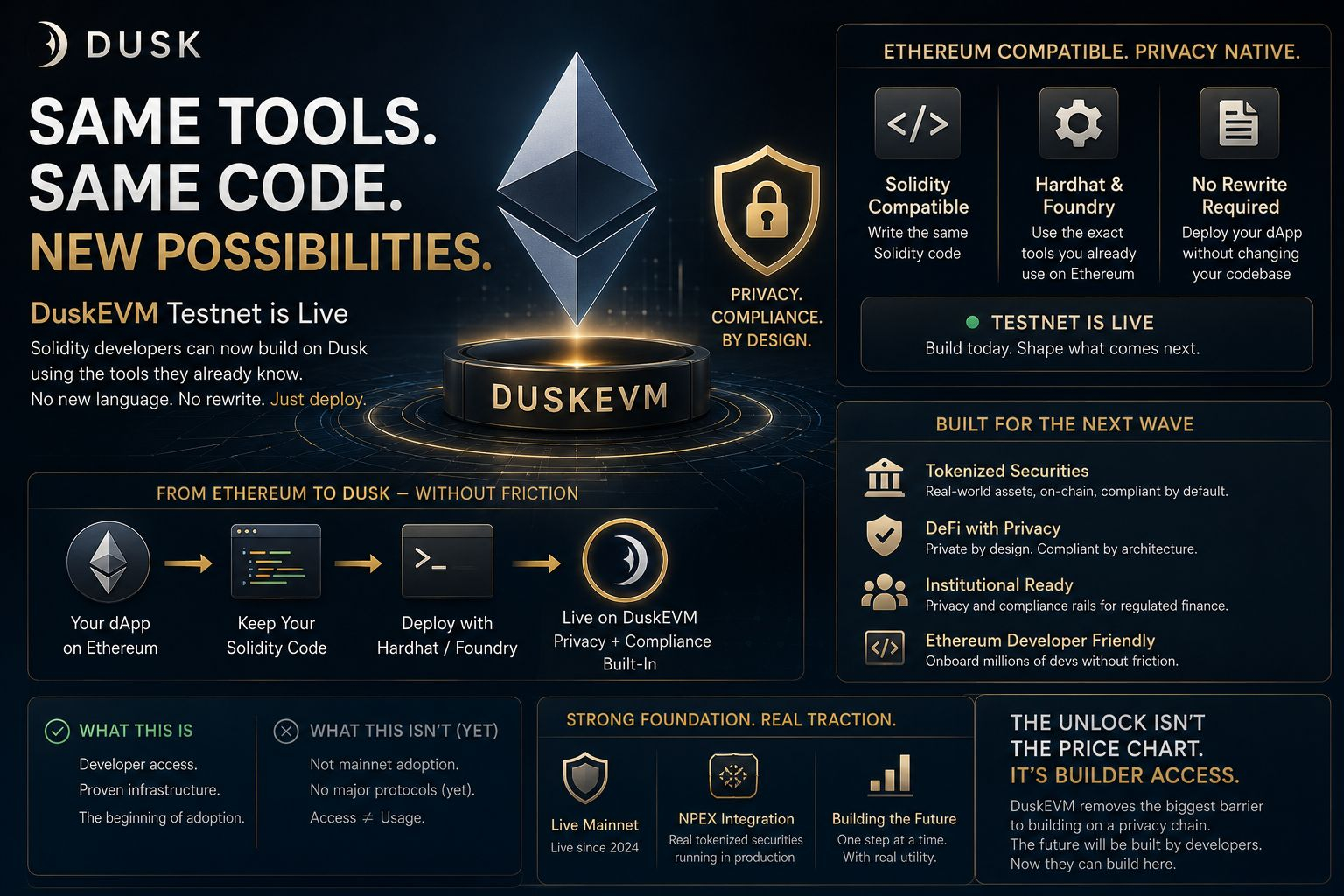
$DUSK just made it possible for any Ethereum Developer to build here without Learning anything new. I think this is the actual Unlock, not the price Chart.
Small headline, big implication. DuskEVM testnet went live earlier this month. What that actually means: Developers can now deploy Solidity contracts on @Dusk using Hardhat and Foundry, the exact tools they already use on Ethereum. No new language, no rewriting a codebase from scratch, no learning #dusk Native Rust Environment just to try it out.
Why that matters more than it sounds. Privacy chains have historically had a chicken and egg problem. The tech is genuinely impressive, but almost nobody builds on it because it demands developers abandon everything familiar and start over. Dusk just removed that excuse. An existing Ethereum DeFi app can now target DuskEVM directly, keep its Solidity code, and inherit Dusks privacy and compliance layer underneath without a rewrite.
I want to be honest about what this is and is not, because the hype cycle tends to skip this part. This is a testnet. It establishes developer access, it does not prove adoption yet. Nobodys shipped a major protocol on it, no TVL has moved because of it. Access is not the same as usage, and I have watched enough testnets get treated like finished products to know the difference matters.
Still, paired with everything else stacking up, real tokenized securities running through NPEX, a live Mainnet a year old now, this is the piece that turns "Interesting Privacy Chain" into "A Chain Ethereum Builders can actually enter without Friction". Thats a bigger deal long term than another green candle.
Watching this closely, not calling it proven yet. The testnet is real. The adoption is still an open question.
Small headline, big implication. DuskEVM testnet went live earlier this month. What that actually means: Developers can now deploy Solidity contracts on @Dusk using Hardhat and Foundry, the exact tools they already use on Ethereum. No new language, no rewriting a codebase from scratch, no learning #dusk Native Rust Environment just to try it out.
Why that matters more than it sounds. Privacy chains have historically had a chicken and egg problem. The tech is genuinely impressive, but almost nobody builds on it because it demands developers abandon everything familiar and start over. Dusk just removed that excuse. An existing Ethereum DeFi app can now target DuskEVM directly, keep its Solidity code, and inherit Dusks privacy and compliance layer underneath without a rewrite.
I want to be honest about what this is and is not, because the hype cycle tends to skip this part. This is a testnet. It establishes developer access, it does not prove adoption yet. Nobodys shipped a major protocol on it, no TVL has moved because of it. Access is not the same as usage, and I have watched enough testnets get treated like finished products to know the difference matters.
Still, paired with everything else stacking up, real tokenized securities running through NPEX, a live Mainnet a year old now, this is the piece that turns "Interesting Privacy Chain" into "A Chain Ethereum Builders can actually enter without Friction". Thats a bigger deal long term than another green candle.
Watching this closely, not calling it proven yet. The testnet is real. The adoption is still an open question.
Übersetzung ansehen
I used to think Fixed rates in DeFi were a nice idea that would never actually work.
Too much Liquidity Fragmentation, too many edge cases, too hard to price. Turns out I was wrong, or at least early in writing it off.
@TermMax has been running fixed rate, fixed term Lending and Borrowing since April 2025, and its now sitting on close to $50M in TVL across Ethereum, Arbitrum, and BNB Chain, with over 17K daily active users and more than 100 markets live. Thats not hype numbers. Thats actual usage from people who got tired of watching their yield drift around.
Here is what changed my mind.
Instead of forcing everyone into one floating Rate curve, #TermMax lets Lenders and Borrowers agree on rates through an actual market mechanism. Curators and market makers set their own pricing and manage risk with range orders. You get real price discovery instead of a single formula trying to fit everyone.
Then they added one click leverage, so you are not chaining five transactions across different apps just to loop a position. And now they have pushed into tokenized stock collateral through Ondo, which means fixed rate borrowing against real world assets is no longer a theory, its live.
The bigger picture is simple. Fixed income is the largest asset class in traditional finance for a reason. People want to know what they are getting before they commit capital. DeFi is finally catching up to that expectation instead of asking everyone to tolerate constant rate volatility.
Still early days for the sector, but this is what Infrastructure actually being built looks like...
Too much Liquidity Fragmentation, too many edge cases, too hard to price. Turns out I was wrong, or at least early in writing it off.
@TermMax has been running fixed rate, fixed term Lending and Borrowing since April 2025, and its now sitting on close to $50M in TVL across Ethereum, Arbitrum, and BNB Chain, with over 17K daily active users and more than 100 markets live. Thats not hype numbers. Thats actual usage from people who got tired of watching their yield drift around.
Here is what changed my mind.
Instead of forcing everyone into one floating Rate curve, #TermMax lets Lenders and Borrowers agree on rates through an actual market mechanism. Curators and market makers set their own pricing and manage risk with range orders. You get real price discovery instead of a single formula trying to fit everyone.
Then they added one click leverage, so you are not chaining five transactions across different apps just to loop a position. And now they have pushed into tokenized stock collateral through Ondo, which means fixed rate borrowing against real world assets is no longer a theory, its live.
The bigger picture is simple. Fixed income is the largest asset class in traditional finance for a reason. People want to know what they are getting before they commit capital. DeFi is finally catching up to that expectation instead of asking everyone to tolerate constant rate volatility.
Still early days for the sector, but this is what Infrastructure actually being built looks like...
Übersetzung ansehen
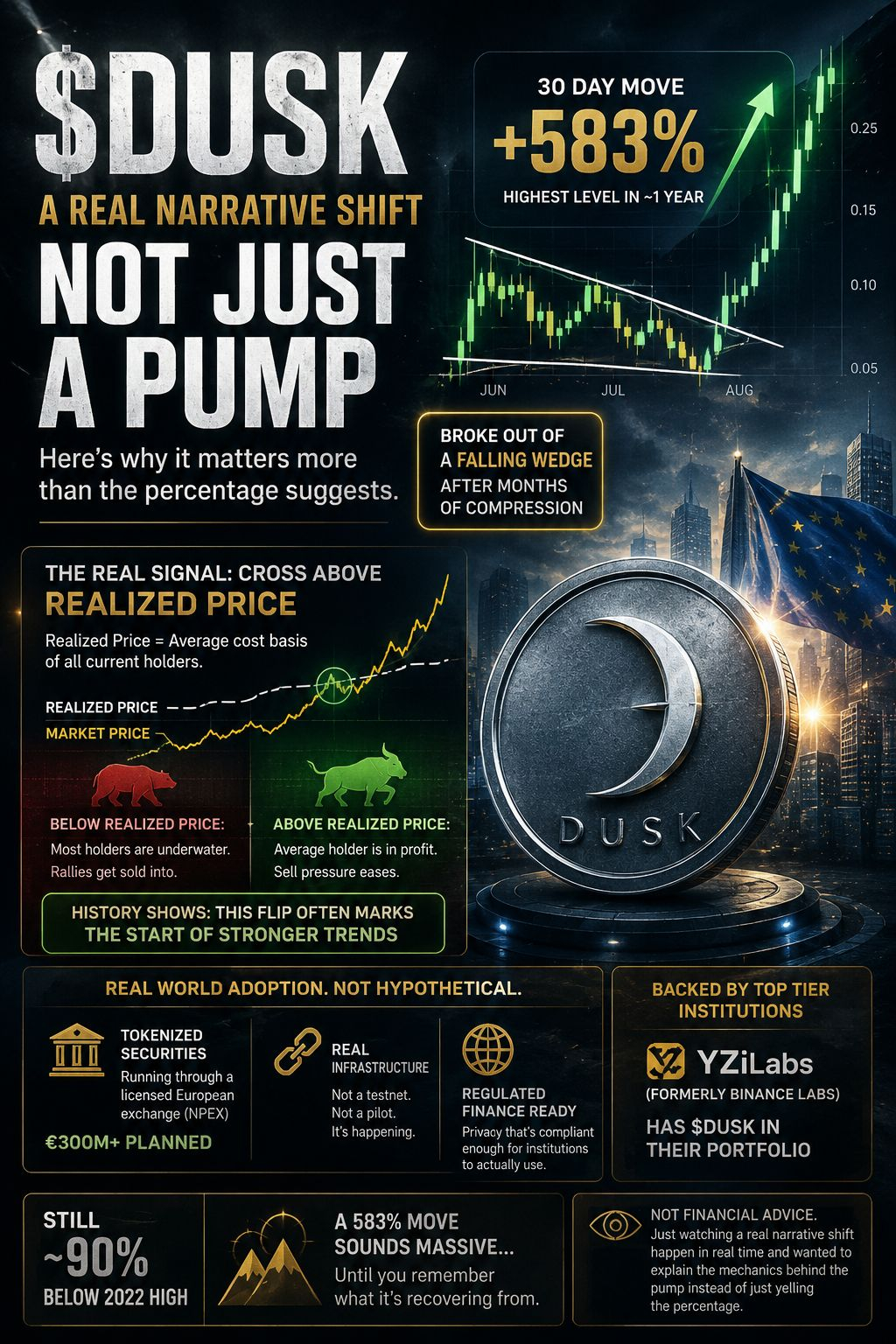
$DUSK just did something most Privacy Coins have not managed in Years. I want to explain why it matters more than the Percentage suggests.
Everyone chases the number first. Fine, lets start there. @Dusk ran nearly 583% in 30 days, Breaking out of a falling wedge it had been stuck in for months, hitting its Highest level in about a Year. Loud number. But loud numbers happen every week in this market and most of them mean nothing six weeks later.
Here is the part that actually made me Pay attention. On-chain data shows #dusk Crossed above its realized price, basically the average cost basis of everyone currently holding it. That flip matters more than people give it Credit for. Below that line, most holders are underwater and rallies get sold into as people rush to break even. Above it, the average holder is finally in profit, and historically that's when sell pressure eases instead of capping every bounce. It's the difference between a pump getting sold, and a trend that has room to actually continue.
And this is not happening in a vacuum. DUSK is one of the few privacy tokens actually shipping Real-World Asset (RWA) integration, Tokenized securities running through a licensed European exchange, north of 300 million Euros planned, not hypothetical.
Y Zi Labs, the fund formerly known as BINANCE Labs, has DUSK in its own portfolio. Thats not retail hype carrying this, thats a narrative Institutions are actually positioning around, privacy thats compliant enough for regulated finance to touch.
I will say the boring part too because it matters. This token is still sitting something like 90 percent below its 2022 high. A 583% move sounds massive until you remember what it's recovering from. Respect the move, dont romanticize it into something it is not yet.
Not financial Advice. Just watching a real narrative shift happen in real time and wanted to explain the mechanics behind the pump instead of just yelling the Percentage.
Everyone chases the number first. Fine, lets start there. @Dusk ran nearly 583% in 30 days, Breaking out of a falling wedge it had been stuck in for months, hitting its Highest level in about a Year. Loud number. But loud numbers happen every week in this market and most of them mean nothing six weeks later.
Here is the part that actually made me Pay attention. On-chain data shows #dusk Crossed above its realized price, basically the average cost basis of everyone currently holding it. That flip matters more than people give it Credit for. Below that line, most holders are underwater and rallies get sold into as people rush to break even. Above it, the average holder is finally in profit, and historically that's when sell pressure eases instead of capping every bounce. It's the difference between a pump getting sold, and a trend that has room to actually continue.
And this is not happening in a vacuum. DUSK is one of the few privacy tokens actually shipping Real-World Asset (RWA) integration, Tokenized securities running through a licensed European exchange, north of 300 million Euros planned, not hypothetical.
Y Zi Labs, the fund formerly known as BINANCE Labs, has DUSK in its own portfolio. Thats not retail hype carrying this, thats a narrative Institutions are actually positioning around, privacy thats compliant enough for regulated finance to touch.
I will say the boring part too because it matters. This token is still sitting something like 90 percent below its 2022 high. A 583% move sounds massive until you remember what it's recovering from. Respect the move, dont romanticize it into something it is not yet.
Not financial Advice. Just watching a real narrative shift happen in real time and wanted to explain the mechanics behind the pump instead of just yelling the Percentage.
Die meisten Menschen realisieren nicht, wie viel sie für die Unsicherheit in DeFi überbezahlen.
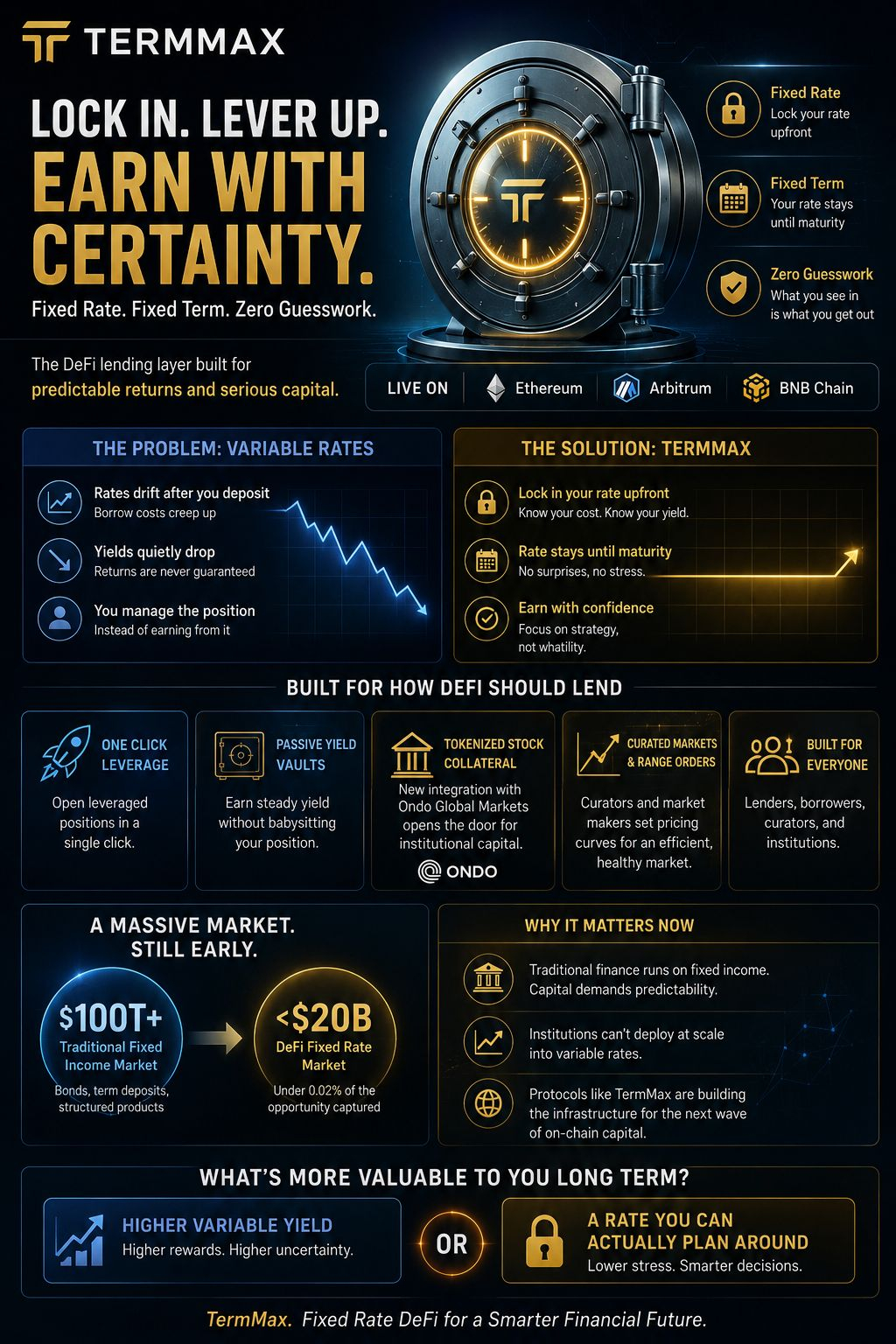
Du legst Geld in einen Lending-Pool ein, der Zinssatz sieht am ersten Tag großartig aus – und dann driftet er. Die Kreditkosten steigen langsam. Die Rendite sinkt still und leise. Am Ende verwaltest du eine Position, statt wirklich daraus zu verdienen.
@TermMax verfolgt einen anderen Ansatz. Es ist ein Protokoll für Fixed-Rate-, Fixed-Term-Lending und -Borrowing, live auf Ethereum, Arbitrum und BNB Chain. Du sicherst deinen Zinssatz upfront ab, und er bleibt bis zur Fälligkeit unverändert. Was du eingibst, bekommst du später auch wieder heraus.
Ein paar Gründe, warum das gerade jetzt besonders hervorsticht.
Es unterstützt One-Click-gehebelte Positionen, ohne dass man über mehrere Protokolle routen muss.
Mit Vaults kannst du passive Rendite verdienen, ohne deine Position jeden Tag im Blick zu behalten.
Kürzlich wurde tokenisiertes Aktienkollateral über Ondo Global Markets hinzugefügt – ein echter Schritt in Richtung, institutionelles Kapital on-chain zu bringen.
Curatoren und Market Maker können ihre eigenen Preis-Kurven über Range Orders festlegen, sodass der Markt effizient bleibt, statt sich auf eine einzige Formel zu verlassen.
Traditionelles Finance funktioniert mit Fixed Income. Bonds, Term Deposits, strukturierte Produkte. Das ist ein Markt, der weit über 100 Tsd. $ groß ist. Der Fixed-Rate-Teil bei DeFi liegt noch unter 20 Mrd. $. Das ist keine Schwäche des Sektors. Es sind erst die frühen Phasen.
Wenn DeFi Kapital anziehen will, das unvorhersehbare Renditen nicht tolerieren kann, dann sind Protokolle wie dieses diejenigen, die die tatsächliche Infrastruktur dafür aufbauen.
Was ist langfristig für dich wertvoller: höhere variable Rendite oder ein Zinssatz, den du wirklich planen kannst? #termmax
Du legst Geld in einen Lending-Pool ein, der Zinssatz sieht am ersten Tag großartig aus – und dann driftet er. Die Kreditkosten steigen langsam. Die Rendite sinkt still und leise. Am Ende verwaltest du eine Position, statt wirklich daraus zu verdienen.
@TermMax verfolgt einen anderen Ansatz. Es ist ein Protokoll für Fixed-Rate-, Fixed-Term-Lending und -Borrowing, live auf Ethereum, Arbitrum und BNB Chain. Du sicherst deinen Zinssatz upfront ab, und er bleibt bis zur Fälligkeit unverändert. Was du eingibst, bekommst du später auch wieder heraus.
Ein paar Gründe, warum das gerade jetzt besonders hervorsticht.
Es unterstützt One-Click-gehebelte Positionen, ohne dass man über mehrere Protokolle routen muss.
Mit Vaults kannst du passive Rendite verdienen, ohne deine Position jeden Tag im Blick zu behalten.
Kürzlich wurde tokenisiertes Aktienkollateral über Ondo Global Markets hinzugefügt – ein echter Schritt in Richtung, institutionelles Kapital on-chain zu bringen.
Curatoren und Market Maker können ihre eigenen Preis-Kurven über Range Orders festlegen, sodass der Markt effizient bleibt, statt sich auf eine einzige Formel zu verlassen.
Traditionelles Finance funktioniert mit Fixed Income. Bonds, Term Deposits, strukturierte Produkte. Das ist ein Markt, der weit über 100 Tsd. $ groß ist. Der Fixed-Rate-Teil bei DeFi liegt noch unter 20 Mrd. $. Das ist keine Schwäche des Sektors. Es sind erst die frühen Phasen.
Wenn DeFi Kapital anziehen will, das unvorhersehbare Renditen nicht tolerieren kann, dann sind Protokolle wie dieses diejenigen, die die tatsächliche Infrastruktur dafür aufbauen.
Was ist langfristig für dich wertvoller: höhere variable Rendite oder ein Zinssatz, den du wirklich planen kannst? #termmax
Übersetzung ansehen
Fixed rates are quietly becoming DeFi's next big unlock...
Everyones chasing APY screenshots, but the real problem in DeFi lending has never been the yield. Its the uncertainty. Rates swing overnight, borrowing costs spike out of nowhere, and "Passive income" often means checking your dashboard five times a day...
Thats the gap @TermMax is quietly closing.
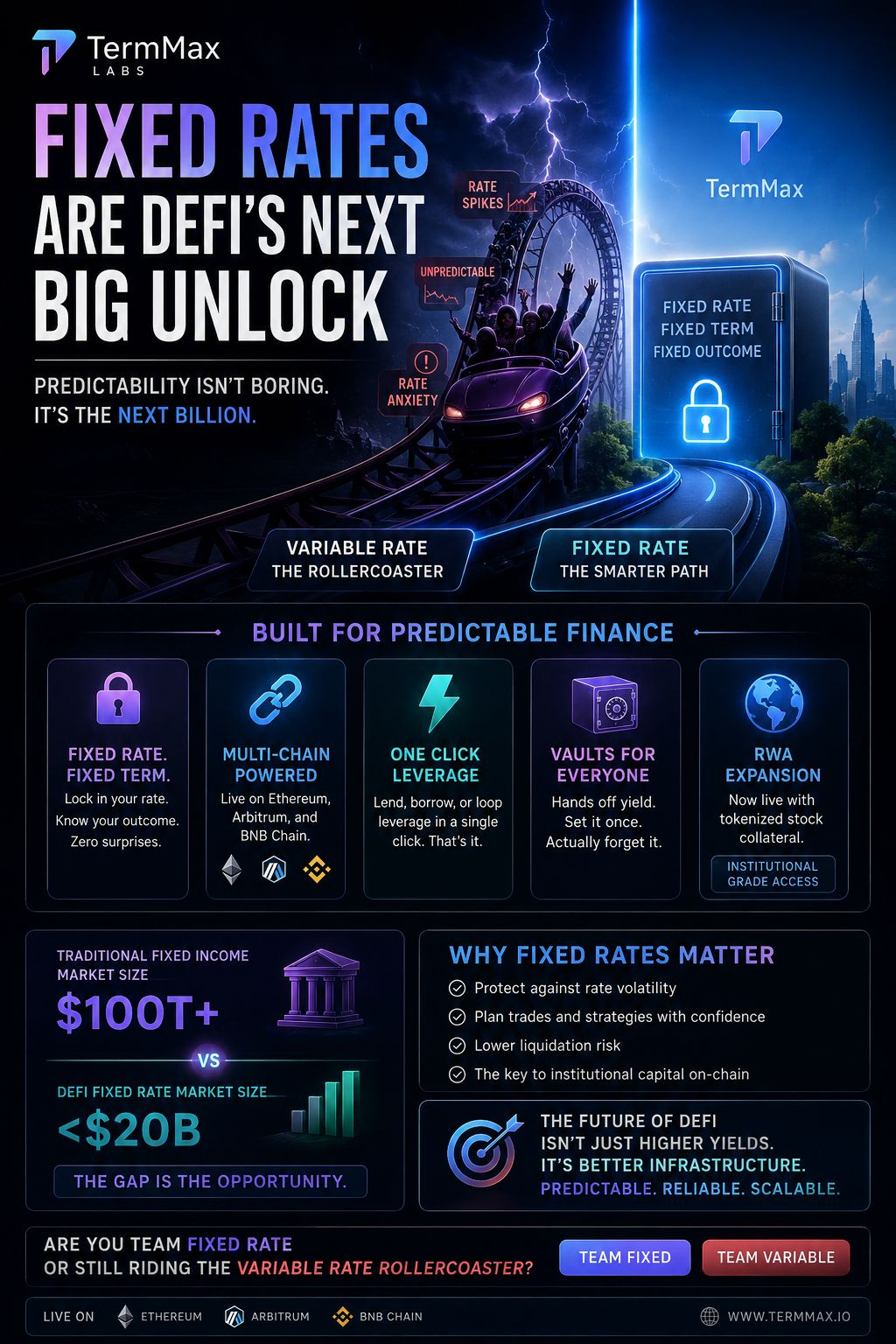
Instead of the usual floating rate roulette, #TermMax lets you lock in a fixed rate for a fixed term. Lend, borrow, or loop leverage with a single click, and actually know your numbers going in. No guessing games. No rate anxiety.
A few things worth paying attention to:
Fixed rate and fixed maturity lending/borrowing, live on Ethereum, Arbitrum, and BNB Chain.
One click leverage without hopping across five different protocols.
Vaults for hands off yield. Set it and actually forget it.
Recently expanded into tokenized stock collateral, opening the door for RWAs and institutional grade capital.
Zoom out for a second. Traditional fixed income markets are worth over $100T. DeFi's version of that market is still under $20B. That gap isn't a flaw. Its the opportunity.
Predictability is not the exciting part of crypto, but it might be the part that finally brings serious capital on chain.
Are you team fixed rate or still riding the variable rate rollercoaster?
Everyones chasing APY screenshots, but the real problem in DeFi lending has never been the yield. Its the uncertainty. Rates swing overnight, borrowing costs spike out of nowhere, and "Passive income" often means checking your dashboard five times a day...
Thats the gap @TermMax is quietly closing.
Instead of the usual floating rate roulette, #TermMax lets you lock in a fixed rate for a fixed term. Lend, borrow, or loop leverage with a single click, and actually know your numbers going in. No guessing games. No rate anxiety.
A few things worth paying attention to:
Fixed rate and fixed maturity lending/borrowing, live on Ethereum, Arbitrum, and BNB Chain.
One click leverage without hopping across five different protocols.
Vaults for hands off yield. Set it and actually forget it.
Recently expanded into tokenized stock collateral, opening the door for RWAs and institutional grade capital.
Zoom out for a second. Traditional fixed income markets are worth over $100T. DeFi's version of that market is still under $20B. That gap isn't a flaw. Its the opportunity.
Predictability is not the exciting part of crypto, but it might be the part that finally brings serious capital on chain.
Are you team fixed rate or still riding the variable rate rollercoaster?
Verifiziert
@Dusk wird immer wieder als „einzigartig“ bezeichnet, wenn es darum geht, Datenschutz und Compliance zu verbinden. Es ist das nicht, nicht wirklich.
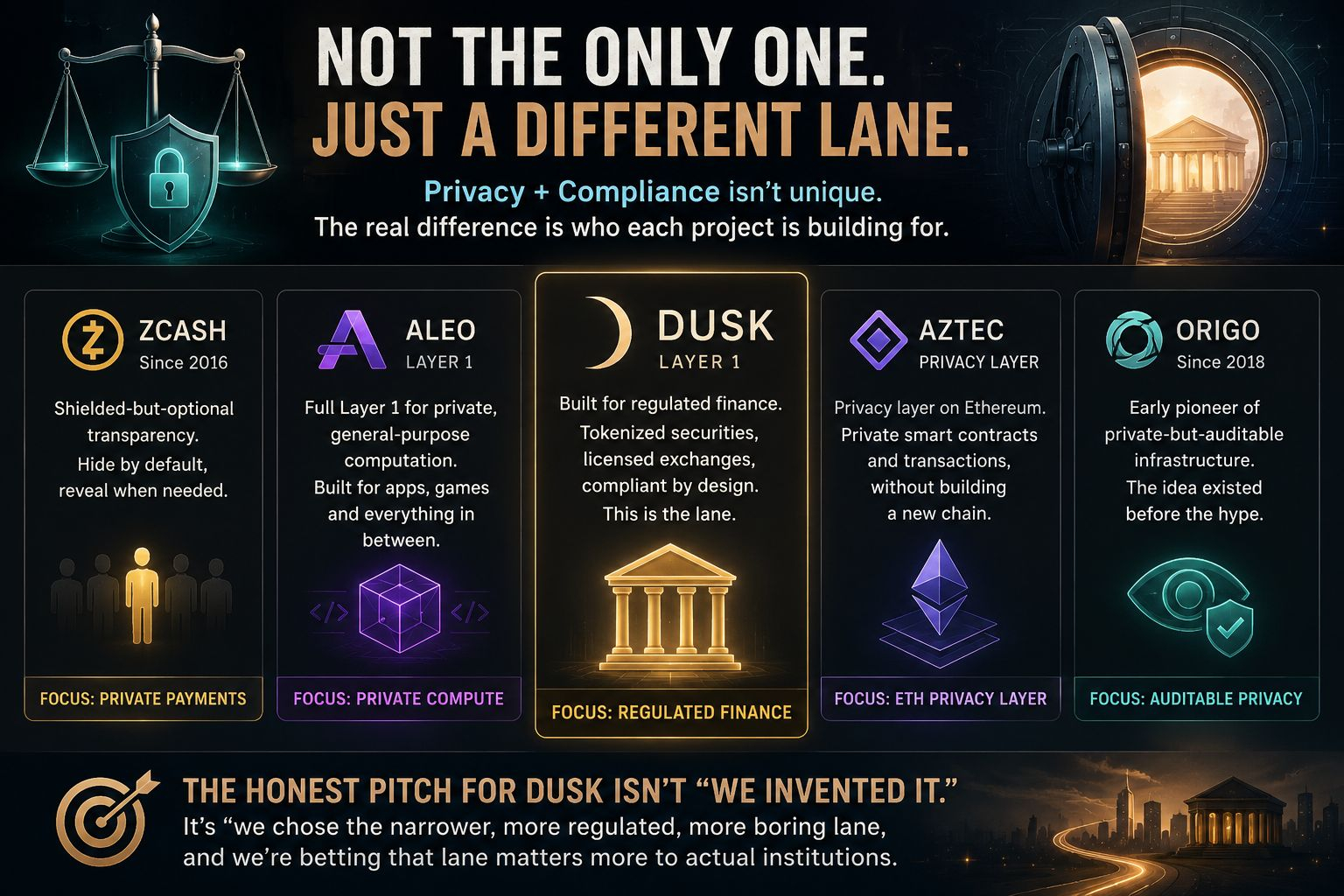
Ich habe immer wieder dieselbe Zeile in #dusk -Berichten gesehen. Datenschutz und regulatorische Compliance, gemeinsam, zum ersten Mal. Also habe ich nachgesehen, wer tatsächlich an genau diesem Problem arbeitet, und es ist ein weitaus belebterer Raum, als das Marketing glauben machen will.
Zcash macht seit 2016 „verdeckte“, aber optionale Transparenz – das ist im Grunde dieselbe Spannung: standardmäßig verbergen, bei Bedarf offenlegen. Aleo baut eine komplette Layer-1-Umgebung für private, allgemeine Rechenoperationen, nicht nur für Zahlungen. Aztec macht etwas Ähnliches, aber als Datenschicht obendrauf auf Ethereum statt als eigener Chain. Sogar Origo, ein deutlich kleineres, weniger bekanntes Projekt, hat bereits 2018 auf private, aber prüfbare Infrastruktur gepitcht – Jahre bevor Dusk ein funktionierendes Mainnet hatte.
Was tatsächlich anders ist – und ich will fair sein – ist, für wen jeweils aufgebaut wird. Aleo und Aztec gehen beide in Richtung allgemeiner privater Berechnung: Anwendungen, Spiele, beliebige Logik, die eben auch privat ist. $DUSK konzentriert sich dagegen speziell auf reguliertes Finanzwesen: tokenisierte Wertpapiere, lizenzierte Börsen, Geschäfte in der Art des NPEX. Das ist eine echte Unterscheidung, nicht einfach „nichts“. Es ist auch keine einzigartige Idee, sondern ein anderer Zielmarkt für eine gemeinsame Idee, der seit Jahren eine Handvoll Teams hinterherläuft.
Ich glaube, die ehrliche Version von Dusk ist nicht „Wir haben privates, konformes Finanzwesen erfunden“. Sondern: „Wir haben uns für eine engere, langweiligere, stärker regulierte Spur entschieden als Aleo oder Aztec, und wir setzen darauf, dass diese Spur für echte Institutionen wichtiger ist.“ Das ist eine kleinere Behauptung. Und es ist auch die, die ich für glaubwürdiger halte.
Ich habe immer wieder dieselbe Zeile in #dusk -Berichten gesehen. Datenschutz und regulatorische Compliance, gemeinsam, zum ersten Mal. Also habe ich nachgesehen, wer tatsächlich an genau diesem Problem arbeitet, und es ist ein weitaus belebterer Raum, als das Marketing glauben machen will.
Zcash macht seit 2016 „verdeckte“, aber optionale Transparenz – das ist im Grunde dieselbe Spannung: standardmäßig verbergen, bei Bedarf offenlegen. Aleo baut eine komplette Layer-1-Umgebung für private, allgemeine Rechenoperationen, nicht nur für Zahlungen. Aztec macht etwas Ähnliches, aber als Datenschicht obendrauf auf Ethereum statt als eigener Chain. Sogar Origo, ein deutlich kleineres, weniger bekanntes Projekt, hat bereits 2018 auf private, aber prüfbare Infrastruktur gepitcht – Jahre bevor Dusk ein funktionierendes Mainnet hatte.
Was tatsächlich anders ist – und ich will fair sein – ist, für wen jeweils aufgebaut wird. Aleo und Aztec gehen beide in Richtung allgemeiner privater Berechnung: Anwendungen, Spiele, beliebige Logik, die eben auch privat ist. $DUSK konzentriert sich dagegen speziell auf reguliertes Finanzwesen: tokenisierte Wertpapiere, lizenzierte Börsen, Geschäfte in der Art des NPEX. Das ist eine echte Unterscheidung, nicht einfach „nichts“. Es ist auch keine einzigartige Idee, sondern ein anderer Zielmarkt für eine gemeinsame Idee, der seit Jahren eine Handvoll Teams hinterherläuft.
Ich glaube, die ehrliche Version von Dusk ist nicht „Wir haben privates, konformes Finanzwesen erfunden“. Sondern: „Wir haben uns für eine engere, langweiligere, stärker regulierte Spur entschieden als Aleo oder Aztec, und wir setzen darauf, dass diese Spur für echte Institutionen wichtiger ist.“ Das ist eine kleinere Behauptung. Und es ist auch die, die ich für glaubwürdiger halte.
Übersetzung ansehen
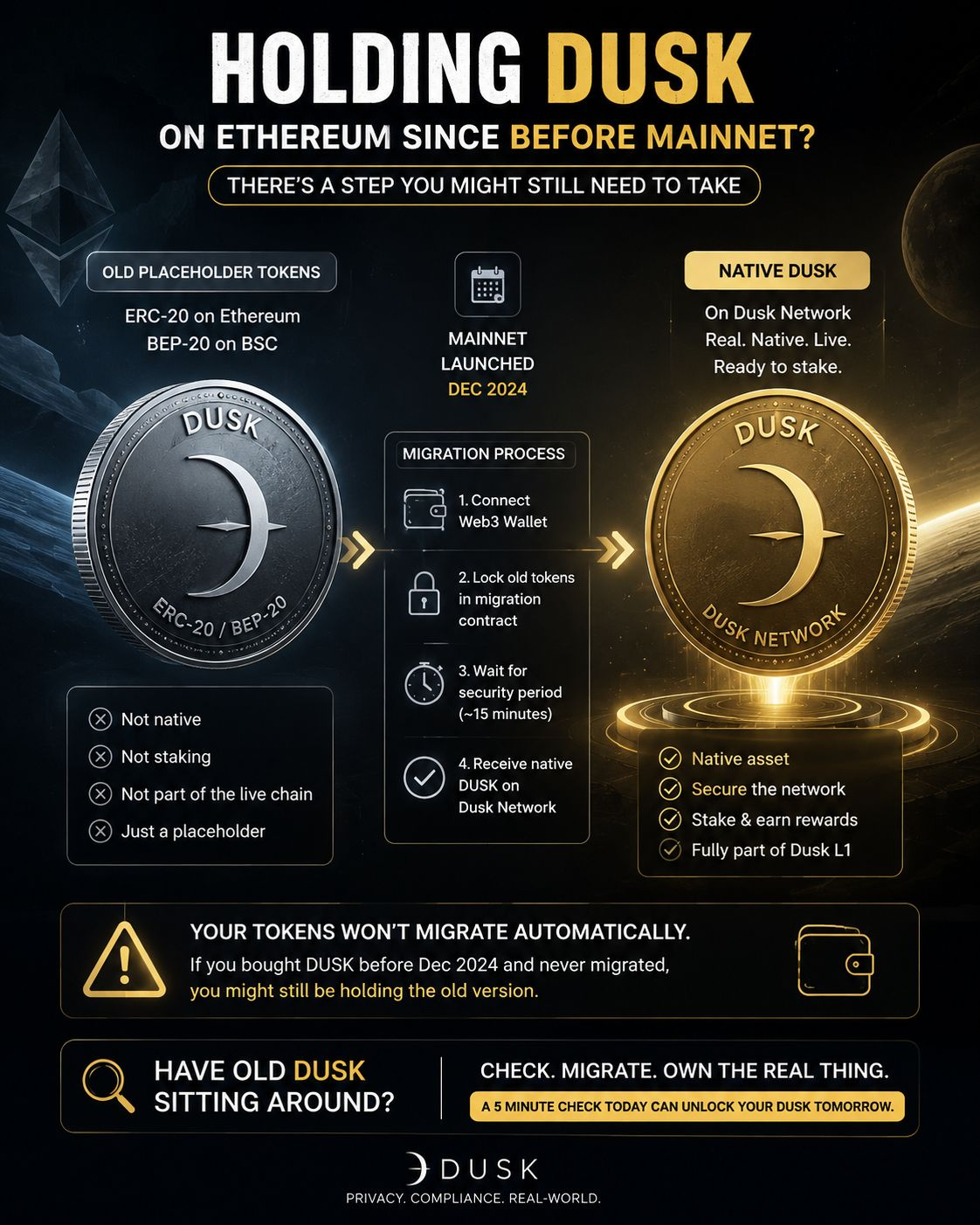
If you have been holding $DUSK on Ethereum since before mainnet, theres a step you might not know you still need to take...
I was reading through #dusk migration docs and realized something that seems easy to miss if you bought in early and just... never checked back.
@Dusk originally launched as a placeholder token, ERC-20 on Ethereum, BEP-20 on BSC, because the actual mainnet was not ready yet. Thats normal, plenty of projects do this. Whats less normal is what happens after mainnet actually launches. Those placeholder tokens dont automatically become the real thing. You have to manually migrate them, connect a Web3 wallet, lock the old tokens in a migration contract, and wait for native DUSK to get issued on the other end. Its not instant either, the contract itself imposes a wait, roughly fifteen minutes, built in for security.
Mainnet went live back in December 2024. That means anyone who bought ERC-20 or BEP-20 DUSK before then and just left it sitting in an exchange wallet or a Web3 wallet they forgot about is holding a placeholder token, not the actual native asset securing the network today. It still has value, its still swappable, but its not staking, not earning anything, not actually part of the live chain until someone manually moves it over.
I dont think this is some kind of trap, the process is documented, its not hidden. But migrations like this quietly strand tokens all the time, not through malice, just through people buying something years ago and forgetting to check back when the underlying project actually shipped.
If you have got old DUSK sitting somewhere and have not touched it since 2023 or 2024, thats worth a five minute check before you assume its already the current version.
I was reading through #dusk migration docs and realized something that seems easy to miss if you bought in early and just... never checked back.
@Dusk originally launched as a placeholder token, ERC-20 on Ethereum, BEP-20 on BSC, because the actual mainnet was not ready yet. Thats normal, plenty of projects do this. Whats less normal is what happens after mainnet actually launches. Those placeholder tokens dont automatically become the real thing. You have to manually migrate them, connect a Web3 wallet, lock the old tokens in a migration contract, and wait for native DUSK to get issued on the other end. Its not instant either, the contract itself imposes a wait, roughly fifteen minutes, built in for security.
Mainnet went live back in December 2024. That means anyone who bought ERC-20 or BEP-20 DUSK before then and just left it sitting in an exchange wallet or a Web3 wallet they forgot about is holding a placeholder token, not the actual native asset securing the network today. It still has value, its still swappable, but its not staking, not earning anything, not actually part of the live chain until someone manually moves it over.
I dont think this is some kind of trap, the process is documented, its not hidden. But migrations like this quietly strand tokens all the time, not through malice, just through people buying something years ago and forgetting to check back when the underlying project actually shipped.
If you have got old DUSK sitting somewhere and have not touched it since 2023 or 2024, thats worth a five minute check before you assume its already the current version.
Verifiziert
"Schließt BlackRock ein" begann als ein Tweet von einem Account mit 2.000 Followern. Mittlerweile ist es Teil des gesamten Bull-Case.
Ich habe mir die aktuellen #dusk News-Roundups durchgelesen, und eine Zeile wurde immer wieder in mehreren Quellen wiederholt: Hinweise auf BlackRock-Integration, die institutionelle Zuversicht befeuern. Allein dieser Satz hat mich dazu gebracht, der Spur bis zur Quelle zu folgen, statt ihn einfach nur weiterzuverbreiten.
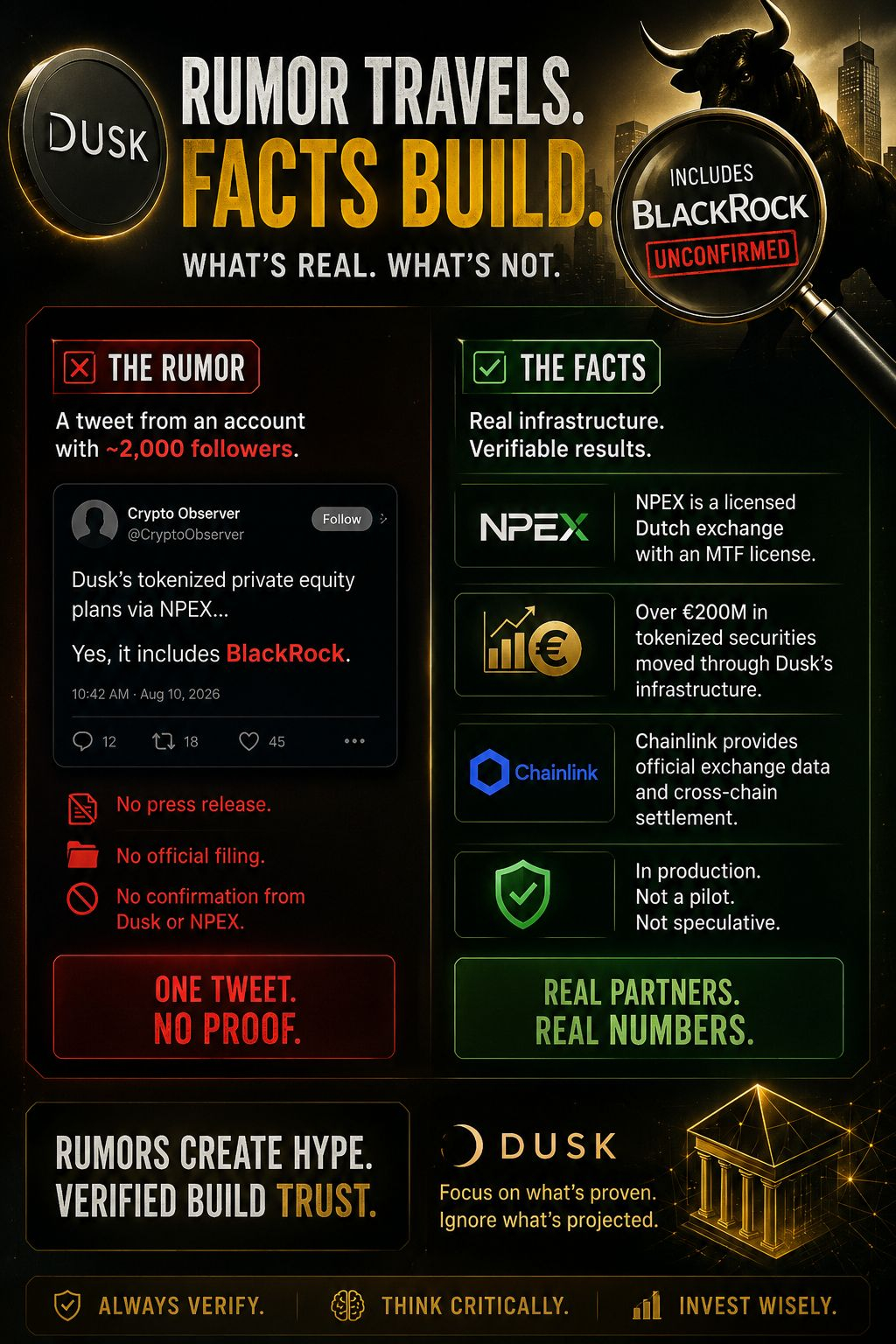
Ich habe es bis zur Quelle zurückverfolgt. Es ist ein Tweet. Von einem Account mit ungefähr 2.000 Followern, der über @Dusk tokenisierte Private-Equity-Pläne über ihre NPEX-Partnerschaft kommentiert, mit dem Zusatz „Ja, es schließt BlackRock ein.“ Das war’s. Das ist der Ursprung. Keine Pressemitteilung, keine offizielle Einreichung, nichts von Dusk oder NPEX selbst, das es bestätigt. Ein Seitenkommentar einer Person, jetzt kursierend in Markt-Roundups als angeblicher echter Katalysator.
Was tatsächlich bestätigt ist, ist viel weniger spektakulär, aber ehrlich gesagt solider. NPEX ist eine echte, lizenzierte niederländische Börse mit einer MTF-Lizenz, und sie haben über 200 Millionen Euro in tokenisierten Wertpapieren über Dusk-Infrastruktur bewegt – im Betrieb, nicht in einem Pilotprojekt. Chainlinks ist inzwischen auch mit dabei: Sie kümmern sich um offizielle Austauschdaten und Cross-Chain-Abwicklung für die tokenisierten Assets. Das ist echtes institutionelles „Plumbing“, überprüfbar, nicht spekulativ.
Ich verstehe, warum sich die BlackRock-Formulierung schneller verbreitet als die NPEX-Zahlen. Das eine ist ein global bekanntes Unternehmen, das an ein Gerücht geknüpft ist. Das andere ist eine reale, aber un vertraute niederländische Börse, verbunden mit einer bestätigten Zahl. Gerüchte reisen leichter als Fakten – sie tun das immer.
Ich sage nicht, dass BlackRock irgendwo entlang der Kette definitiv nicht doch beteiligt ist. Ich sage nur: Bisher hat das niemand tatsächlich gezeigt, und es wird bereits in Kreisen als „ausgemachte Tatsache“ behandelt, die es besser wissen sollten. $DUSK
Ich habe mir die aktuellen #dusk News-Roundups durchgelesen, und eine Zeile wurde immer wieder in mehreren Quellen wiederholt: Hinweise auf BlackRock-Integration, die institutionelle Zuversicht befeuern. Allein dieser Satz hat mich dazu gebracht, der Spur bis zur Quelle zu folgen, statt ihn einfach nur weiterzuverbreiten.
Ich habe es bis zur Quelle zurückverfolgt. Es ist ein Tweet. Von einem Account mit ungefähr 2.000 Followern, der über @Dusk tokenisierte Private-Equity-Pläne über ihre NPEX-Partnerschaft kommentiert, mit dem Zusatz „Ja, es schließt BlackRock ein.“ Das war’s. Das ist der Ursprung. Keine Pressemitteilung, keine offizielle Einreichung, nichts von Dusk oder NPEX selbst, das es bestätigt. Ein Seitenkommentar einer Person, jetzt kursierend in Markt-Roundups als angeblicher echter Katalysator.
Was tatsächlich bestätigt ist, ist viel weniger spektakulär, aber ehrlich gesagt solider. NPEX ist eine echte, lizenzierte niederländische Börse mit einer MTF-Lizenz, und sie haben über 200 Millionen Euro in tokenisierten Wertpapieren über Dusk-Infrastruktur bewegt – im Betrieb, nicht in einem Pilotprojekt. Chainlinks ist inzwischen auch mit dabei: Sie kümmern sich um offizielle Austauschdaten und Cross-Chain-Abwicklung für die tokenisierten Assets. Das ist echtes institutionelles „Plumbing“, überprüfbar, nicht spekulativ.
Ich verstehe, warum sich die BlackRock-Formulierung schneller verbreitet als die NPEX-Zahlen. Das eine ist ein global bekanntes Unternehmen, das an ein Gerücht geknüpft ist. Das andere ist eine reale, aber un vertraute niederländische Börse, verbunden mit einer bestätigten Zahl. Gerüchte reisen leichter als Fakten – sie tun das immer.
Ich sage nicht, dass BlackRock irgendwo entlang der Kette definitiv nicht doch beteiligt ist. Ich sage nur: Bisher hat das niemand tatsächlich gezeigt, und es wird bereits in Kreisen als „ausgemachte Tatsache“ behandelt, die es besser wissen sollten. $DUSK
Übersetzung ansehen
@Dusk is advertising 27% staking APR. The math behind it made me want to slow down.
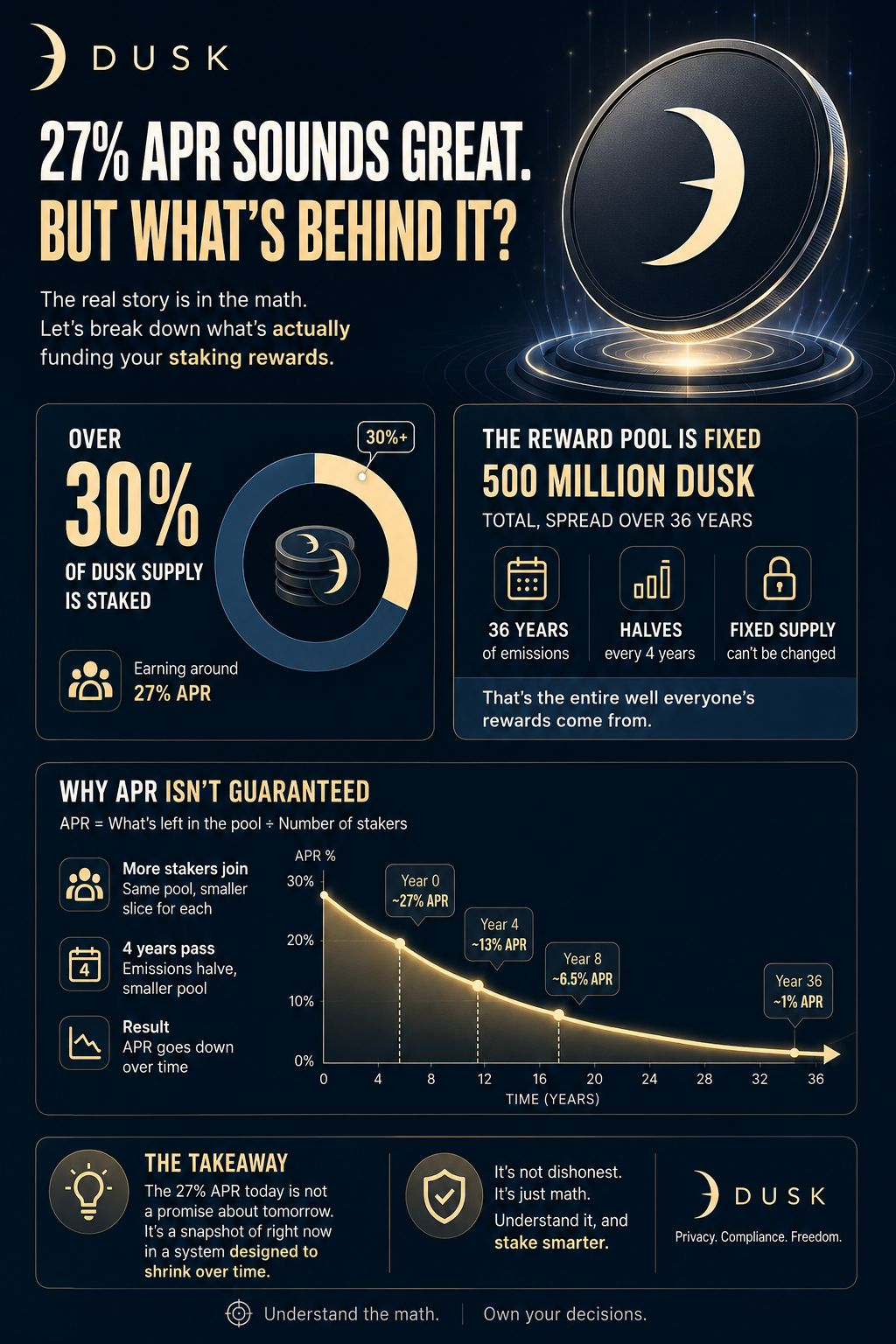
Saw the number on their own account: over 30% of $DUSK supply staked, earning around 27% APR. Sounds great on its own. Then I checked what's actually funding that reward.
The whole staking reward pool is fixed. 500 million DUSK, total, spread out over 36 years, cut in half every four years by design. Thats it. Thats the entire well everyones rewards come from, forever shrinking on a schedule that was set in advance.
So here is the thing nobody says out loud next to that 27% figure. Its not a fixed rate. Its whatever is left in a shrinking pool, split across however many people happen to be staking at that moment. More stakers join, same pool, smaller slice each. Four years pass, the emission halves, smaller pool too. The 27% today is not a promise about tomorrow, its a snapshot of right now.
I dont think thats dishonest exactly, this is how most staking systems work once you look under the hood. I just think leading with a big APR number, without the decay curve sitting right next to it, sets people up to expect something thats mathematically built to shrink. #dusk
Saw the number on their own account: over 30% of $DUSK supply staked, earning around 27% APR. Sounds great on its own. Then I checked what's actually funding that reward.
The whole staking reward pool is fixed. 500 million DUSK, total, spread out over 36 years, cut in half every four years by design. Thats it. Thats the entire well everyones rewards come from, forever shrinking on a schedule that was set in advance.
So here is the thing nobody says out loud next to that 27% figure. Its not a fixed rate. Its whatever is left in a shrinking pool, split across however many people happen to be staking at that moment. More stakers join, same pool, smaller slice each. Four years pass, the emission halves, smaller pool too. The 27% today is not a promise about tomorrow, its a snapshot of right now.
I dont think thats dishonest exactly, this is how most staking systems work once you look under the hood. I just think leading with a big APR number, without the decay curve sitting right next to it, sets people up to expect something thats mathematically built to shrink. #dusk
Übersetzung ansehen
A blockchain trying to be private and fully auditable at once. Did not think that was possible until I looked closer.
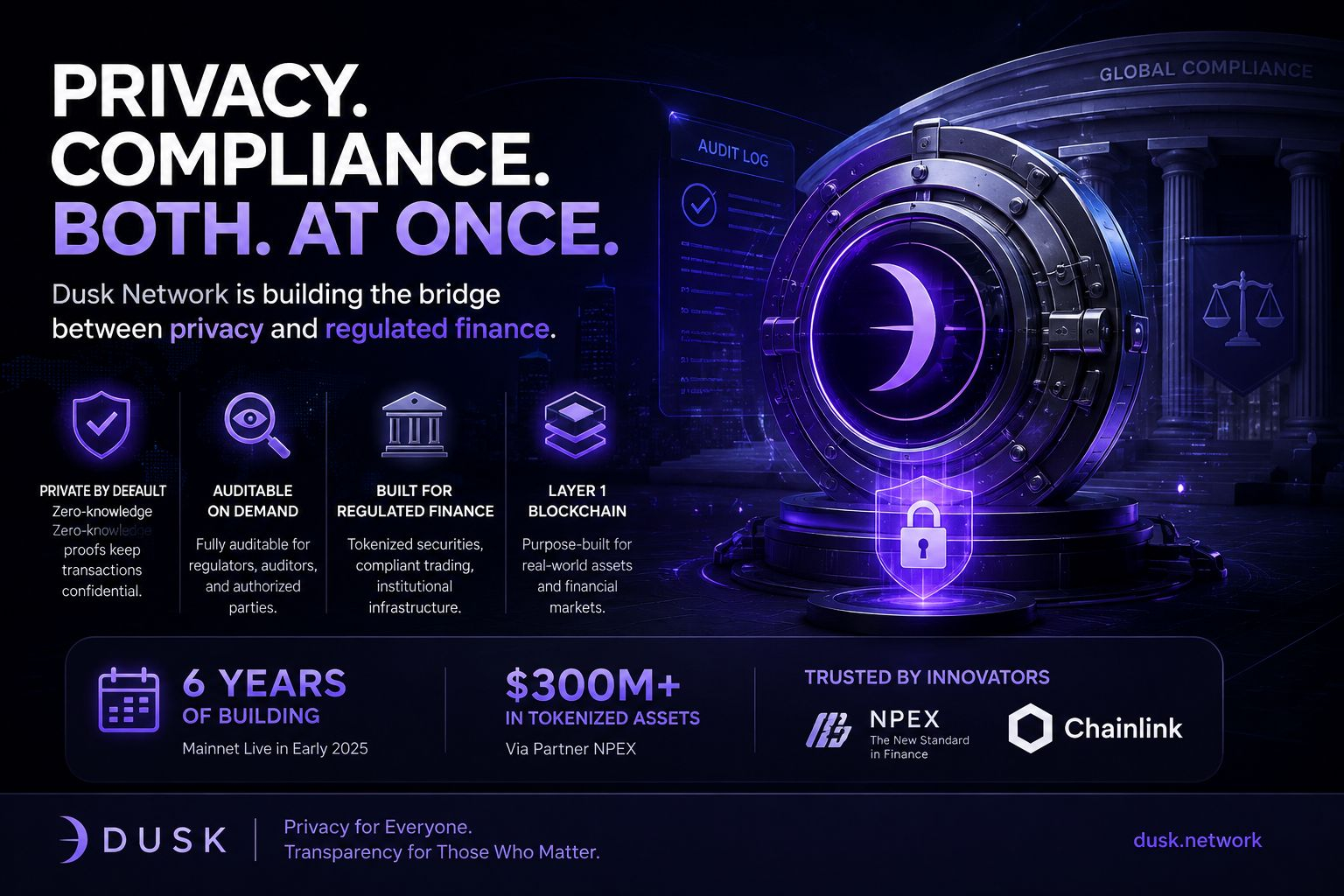
Privacy and compliance usually dont mix in crypto. Either transactions are hidden and regulators hate it, or everythings public and you have rebuilt a transparent ledger nobody with real money wants. @Dusk is building the thing in between.
It's a Layer 1 for regulated finance, tokenized securities, compliant trading, not degen DeFi. It uses zero-knowledge proofs so transactions stay shielded from public view while still being fully auditable to whoevers legally allowed to check them. Confidential to everyone else, transparent to the one party who is supposed to see it. Thats a genuinely hard problem, not a slogan.
What caught my attention is the timeline. Mainnet went live in early 2025, six years after the project started. Six years is unusual patience in an industry that ships a whitepaper and a token in six months. Paired with real partners like NPEX tokenizing over 300 million dollars in assets, it reads less like stalling and more like someone waiting for the hard part to actually work.
The price chart tells a rougher story. DUSK still sits around 80 percent below its 2021 high, even after real rallies tied to actual news. That gap between "The Tech is Advancing" and "The Token has not Recovered" is common with infrastructure plays. The market does not wait for six year roadmaps to prove themselves.
I dont know yet if regulated finance actually wants this, or if institutions stay comfortable running real securities through a token this volatile. But privacy that does not have to fight compliance feels like one of the few genuinely new ideas I have run into lately. #dusk $DUSK
Privacy and compliance usually dont mix in crypto. Either transactions are hidden and regulators hate it, or everythings public and you have rebuilt a transparent ledger nobody with real money wants. @Dusk is building the thing in between.
It's a Layer 1 for regulated finance, tokenized securities, compliant trading, not degen DeFi. It uses zero-knowledge proofs so transactions stay shielded from public view while still being fully auditable to whoevers legally allowed to check them. Confidential to everyone else, transparent to the one party who is supposed to see it. Thats a genuinely hard problem, not a slogan.
What caught my attention is the timeline. Mainnet went live in early 2025, six years after the project started. Six years is unusual patience in an industry that ships a whitepaper and a token in six months. Paired with real partners like NPEX tokenizing over 300 million dollars in assets, it reads less like stalling and more like someone waiting for the hard part to actually work.
The price chart tells a rougher story. DUSK still sits around 80 percent below its 2021 high, even after real rallies tied to actual news. That gap between "The Tech is Advancing" and "The Token has not Recovered" is common with infrastructure plays. The market does not wait for six year roadmaps to prove themselves.
I dont know yet if regulated finance actually wants this, or if institutions stay comfortable running real securities through a token this volatile. But privacy that does not have to fight compliance feels like one of the few genuinely new ideas I have run into lately. #dusk $DUSK
Der Krypto-Markt fühlt sich an, als würde er in eine Phase übergehen, in der Geduld wichtiger ist als der Hype.
Wir sehen, wie Geld rotiert, sich Narrative schnell verändern und sich starke Projekte klar vom Rauschen absetzen. BTC bleibt der Anker des Marktes, während die Liquidität allmählich nach den nächsten Wachstumsbereichen sucht – über DeFi, KI, RWA und Infrastruktur hinweg.
Die große Frage ist nicht nur „Geht Krypto höher?“
Sondern: „Welche Sektoren und Projekte werden auch dann noch relevant sein, wenn die nächste Welle an Liquidität ankommt?“
Märkte bewegen sich selten in einer geraden Linie. Es wird Rücksetzer geben, Fehlausbrüche und plötzliche Rotationen.
Für mich ist das die Phase, in der man die Grundlagen im Blick behält, der Liquidität folgt und vorbereitet bleibt – statt jeder grünen Kerze hinterherzujagen.
Der nächste große Move könnte sich bereits leise anbahnen. 👀
$NBISB $PROM
#crypto #BTC #Altcoins #DeFi #CryptoMarket
Wir sehen, wie Geld rotiert, sich Narrative schnell verändern und sich starke Projekte klar vom Rauschen absetzen. BTC bleibt der Anker des Marktes, während die Liquidität allmählich nach den nächsten Wachstumsbereichen sucht – über DeFi, KI, RWA und Infrastruktur hinweg.
Die große Frage ist nicht nur „Geht Krypto höher?“
Sondern: „Welche Sektoren und Projekte werden auch dann noch relevant sein, wenn die nächste Welle an Liquidität ankommt?“
Märkte bewegen sich selten in einer geraden Linie. Es wird Rücksetzer geben, Fehlausbrüche und plötzliche Rotationen.
Für mich ist das die Phase, in der man die Grundlagen im Blick behält, der Liquidität folgt und vorbereitet bleibt – statt jeder grünen Kerze hinterherzujagen.
Der nächste große Move könnte sich bereits leise anbahnen. 👀
$NBISB $PROM
#crypto #BTC #Altcoins #DeFi #CryptoMarket
Übersetzung ansehen
@BabylonLabs_io own paperwork says #baby is not an investment. Their staking page disagrees with that.
I was reading through Babylon's tokenomics docs, mostly checking numbers, and ran into a disclaimer I was not expecting. Buried in the legal boilerplate, it says plainly that BABY's primary purpose is paying fees, securing consensus and enabling governance, and that it is not intended to serve as an investment. Fine, standard lawyer language, every project has some version of this.
Except I do just come from the staking page, where the whole pitch is APY numbers, reward projections and language about earning yield on your Bitcoin. Those two things are sitting on the same website contradicting each other, and I dont think thats an accident, I think its the exact tension every token project is currently navigating.
The SEC actually weighed in on this general question earlier this year and their framing stuck with me. What matters is not the label a project puts on its own token. What matters is economic reality, how the thing actually behaves in practice, regardless of what the disclaimer calls it. If something functions like an investment, generates yield, gets marketed around returns, the paperwork saying otherwise does not necessarily settle anything.
Im not a lawyer and Im not accusing Babylon of doing anything uniquely wrong here, honestly almost every token project has this same gap between its legal disclaimers and its actual marketing copy. But reading both pages back to back made the gap feel bigger than usual. One page says this is not an investment. The other page is entirely built around convincing you its worth investing in.
I dont know how that gets resolved, and I dont think Babylon does either yet, nobody in crypto fully does. I just think its worth noticing when a projects legal language and its marketing language are quietly telling you two different stories.
$BABY $ON
I was reading through Babylon's tokenomics docs, mostly checking numbers, and ran into a disclaimer I was not expecting. Buried in the legal boilerplate, it says plainly that BABY's primary purpose is paying fees, securing consensus and enabling governance, and that it is not intended to serve as an investment. Fine, standard lawyer language, every project has some version of this.
Except I do just come from the staking page, where the whole pitch is APY numbers, reward projections and language about earning yield on your Bitcoin. Those two things are sitting on the same website contradicting each other, and I dont think thats an accident, I think its the exact tension every token project is currently navigating.
The SEC actually weighed in on this general question earlier this year and their framing stuck with me. What matters is not the label a project puts on its own token. What matters is economic reality, how the thing actually behaves in practice, regardless of what the disclaimer calls it. If something functions like an investment, generates yield, gets marketed around returns, the paperwork saying otherwise does not necessarily settle anything.
Im not a lawyer and Im not accusing Babylon of doing anything uniquely wrong here, honestly almost every token project has this same gap between its legal disclaimers and its actual marketing copy. But reading both pages back to back made the gap feel bigger than usual. One page says this is not an investment. The other page is entirely built around convincing you its worth investing in.
I dont know how that gets resolved, and I dont think Babylon does either yet, nobody in crypto fully does. I just think its worth noticing when a projects legal language and its marketing language are quietly telling you two different stories.
$BABY $ON
Anmelden und weiter Inhalte entdecken