
Crypto knowledge P
164 Beiträge

Crypto knowledge P
15 Following
1.4K+ Follower
515 Like gegeben
Beiträge
Übersetzung ansehen
🎁🎁Red packet claim fast 🎁🎁
Übersetzung ansehen
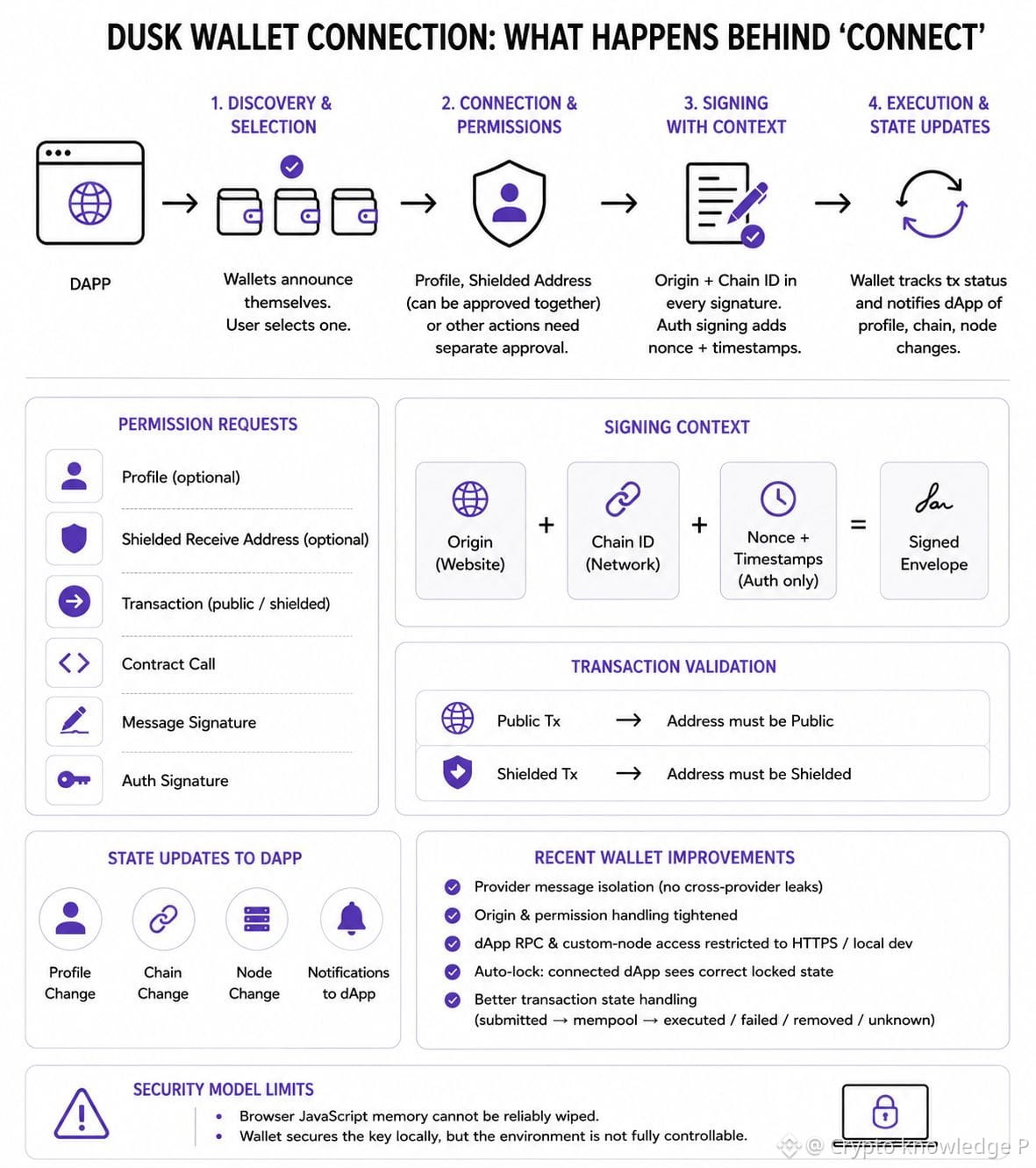
A Dusk wallet connection looks like one simple click. But when I started looking at what sits behind it, I realised there’s quite a bit going on.
I went through the wallet discovery flow first. A dApp doesn’t just grab whichever Dusk wallet is sitting on the page. Wallets announce themselves, the dApp discovers them, and if there’s more than one installed, a provider has to be selected. Each one also carries its own identity. It’s a small detail, but it matters because the site needs to know which wallet it is actually talking to.
Then I looked at the permission side. A profile request, shielded receive address, transaction, contract call or signature are not all the same thing. They go through different wallet requests, and the wallet can also report profile, chain and selected-node changes while the connection is active. So “connected” doesn’t really mean the dApp has unlimited access.
The signing part was the one I found most interesting. Dusk puts the origin and chain ID into the signed message context. Auth signing also carries a nonce and timestamps. So the signature isn’t just “this account signed something” — there’s context around the request as well.
I also checked the recent wallet changes around this. Provider messages were restricted so another installed Dusk provider can’t receive the same dApp request. Origin and permission handling were tightened, and dApp RPC and custom-node connections were restricted to HTTPS or local development endpoints. Dusk’s own security notes also mention limits like JavaScript memory not being reliably wipeable.
For me, that changes how the little Connect Wallet button looks. It’s not really one permission. There’s a whole layer between the website and the key deciding which wallet is being used, what the dApp can ask for, and what the user actually signs.
$DUSK @Dusk #dusk
I went through the wallet discovery flow first. A dApp doesn’t just grab whichever Dusk wallet is sitting on the page. Wallets announce themselves, the dApp discovers them, and if there’s more than one installed, a provider has to be selected. Each one also carries its own identity. It’s a small detail, but it matters because the site needs to know which wallet it is actually talking to.
Then I looked at the permission side. A profile request, shielded receive address, transaction, contract call or signature are not all the same thing. They go through different wallet requests, and the wallet can also report profile, chain and selected-node changes while the connection is active. So “connected” doesn’t really mean the dApp has unlimited access.
The signing part was the one I found most interesting. Dusk puts the origin and chain ID into the signed message context. Auth signing also carries a nonce and timestamps. So the signature isn’t just “this account signed something” — there’s context around the request as well.
I also checked the recent wallet changes around this. Provider messages were restricted so another installed Dusk provider can’t receive the same dApp request. Origin and permission handling were tightened, and dApp RPC and custom-node connections were restricted to HTTPS or local development endpoints. Dusk’s own security notes also mention limits like JavaScript memory not being reliably wipeable.
For me, that changes how the little Connect Wallet button looks. It’s not really one permission. There’s a whole layer between the website and the key deciding which wallet is being used, what the dApp can ask for, and what the user actually signs.
$DUSK @Dusk #dusk
Verifiziert
Übersetzung ansehen
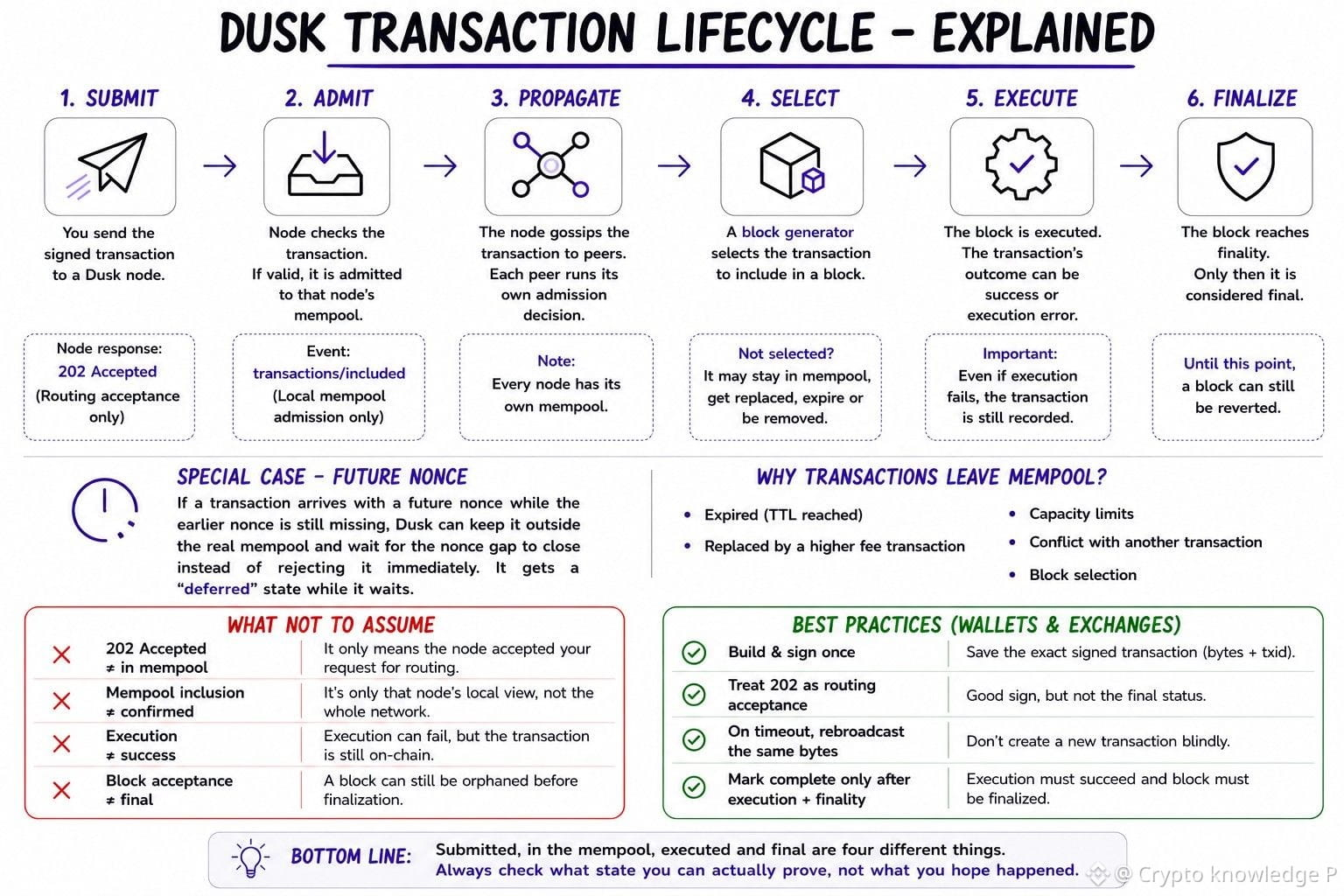
I think we usually ask the wrong question when a Dusk transaction “fails”.
A 202 Accepted only means the node accepted the request for routing. It does not mean the transaction is already in the mempool or in a block. One example I found interesting is a future nonce. If a Moonlight transaction arrives with a future nonce while an earlier nonce is still missing, Dusk can keep it outside the real mempool and wait for the nonce gap to close instead of rejecting it immediately. It gets a deferred state while that happens.
That is only one part of the story. Once a transaction passes admission, it enters that node’s local mempool. Other nodes keep their own mempools and run their own admission checks too. Later, a transaction can be selected for a block, executed, and eventually finalized. It can also leave the local mempool without that automatically meaning it failed. Expiry, replacement, capacity limits and conflicts can all lead to removal.
This is where I think the difference matters for wallets and exchanges. Dusk’s own integration guidance says to keep the exact signed transaction, treat 202 Accepted only as successful routing, and rebroadcast the same signed bytes after a transport timeout instead of creating a new transaction blindly. A withdrawal should only be marked complete after execution is checked and the block is finalized.
The more I looked at it, the less “transaction submitted” sounded like a useful status on its own. A transaction can be waiting for a nonce, sitting in one node’s mempool, executed with an error, or sitting in a block that is not final yet. Those are very different situations, even though they can all look like “it’s still pending” from the outside.
For me, that is the useful takeaway from Dusk’s transaction flow: submitted is only the beginning. What matters is the state you can actually prove the transaction reached.
$DUSK @Dusk #dusk
A 202 Accepted only means the node accepted the request for routing. It does not mean the transaction is already in the mempool or in a block. One example I found interesting is a future nonce. If a Moonlight transaction arrives with a future nonce while an earlier nonce is still missing, Dusk can keep it outside the real mempool and wait for the nonce gap to close instead of rejecting it immediately. It gets a deferred state while that happens.
That is only one part of the story. Once a transaction passes admission, it enters that node’s local mempool. Other nodes keep their own mempools and run their own admission checks too. Later, a transaction can be selected for a block, executed, and eventually finalized. It can also leave the local mempool without that automatically meaning it failed. Expiry, replacement, capacity limits and conflicts can all lead to removal.
This is where I think the difference matters for wallets and exchanges. Dusk’s own integration guidance says to keep the exact signed transaction, treat 202 Accepted only as successful routing, and rebroadcast the same signed bytes after a transport timeout instead of creating a new transaction blindly. A withdrawal should only be marked complete after execution is checked and the block is finalized.
The more I looked at it, the less “transaction submitted” sounded like a useful status on its own. A transaction can be waiting for a nonce, sitting in one node’s mempool, executed with an error, or sitting in a block that is not final yet. Those are very different situations, even though they can all look like “it’s still pending” from the outside.
For me, that is the useful takeaway from Dusk’s transaction flow: submitted is only the beginning. What matters is the state you can actually prove the transaction reached.
$DUSK @Dusk #dusk
Verifiziert
Übersetzung ansehen
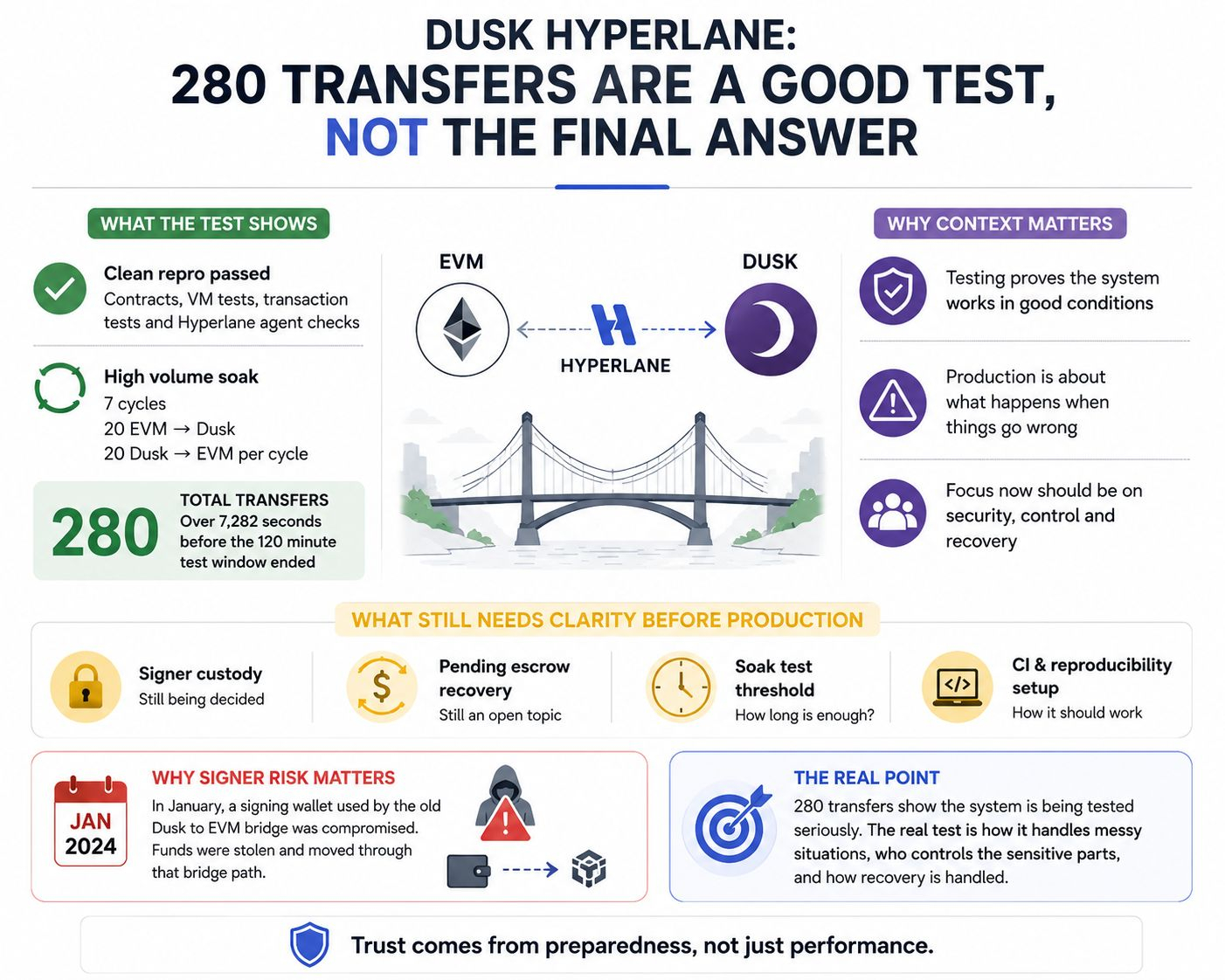
The 280 transfers caught my eye, but I ended up paying more attention to everything around them.
I went through the latest Dusk Hyperlane sign off work and the testing so far looks solid. The latest clean repro passed the contract builds, VM tests, transaction tests and Hyperlane agent checks. Then the high volume soak ran 7 cycles, with 20 EVM to Dusk and 20 Dusk to EVM transfers in each cycle. That came to 280 total transfers over 7,282 seconds before the 120 minute test window ended.
What I found more important was the production checklist sitting beside those results. Production signer custody is still being decided. There is also an open decision around pending escrow recovery, how long the soak should run, and how the CI and reproducibility setup should work. Those are easy to overlook when the headline number is a successful test, but they are the things I would want to understand before real liquidity is involved.
The signer question is especially hard to ignore after what happened with the old Dusk to EVM bridge in January. An attacker gained access to the bridge signing wallet, stole DUSK from it, and moved part of the stolen funds through the bridge to BNB Smart Chain. Dusk was clear that the incident was a bridge wallet compromise, not a Dusk consensus or protocol exploit. The bridge was later redesigned with stronger separation between signing, event handling and fund release, along with tighter balance and recovery controls.
So I’m not looking at the 280 transfers as either a green light or a red flag. They show that the system is being tested seriously. What matters to me now is how the system is supposed to behave when something goes wrong, who controls the sensitive parts, and how recovery is handled.
That’s what I’d want settled before treating Dusk Hyperlane as infrastructure for meaningful liquidity.
$DUSK @Dusk #dusk
I went through the latest Dusk Hyperlane sign off work and the testing so far looks solid. The latest clean repro passed the contract builds, VM tests, transaction tests and Hyperlane agent checks. Then the high volume soak ran 7 cycles, with 20 EVM to Dusk and 20 Dusk to EVM transfers in each cycle. That came to 280 total transfers over 7,282 seconds before the 120 minute test window ended.
What I found more important was the production checklist sitting beside those results. Production signer custody is still being decided. There is also an open decision around pending escrow recovery, how long the soak should run, and how the CI and reproducibility setup should work. Those are easy to overlook when the headline number is a successful test, but they are the things I would want to understand before real liquidity is involved.
The signer question is especially hard to ignore after what happened with the old Dusk to EVM bridge in January. An attacker gained access to the bridge signing wallet, stole DUSK from it, and moved part of the stolen funds through the bridge to BNB Smart Chain. Dusk was clear that the incident was a bridge wallet compromise, not a Dusk consensus or protocol exploit. The bridge was later redesigned with stronger separation between signing, event handling and fund release, along with tighter balance and recovery controls.
So I’m not looking at the 280 transfers as either a green light or a red flag. They show that the system is being tested seriously. What matters to me now is how the system is supposed to behave when something goes wrong, who controls the sensitive parts, and how recovery is handled.
That’s what I’d want settled before treating Dusk Hyperlane as infrastructure for meaningful liquidity.
$DUSK @Dusk #dusk
Teilweise korrekt
Übersetzung ansehen
One small thing about Dusk transactions kept bothering me.
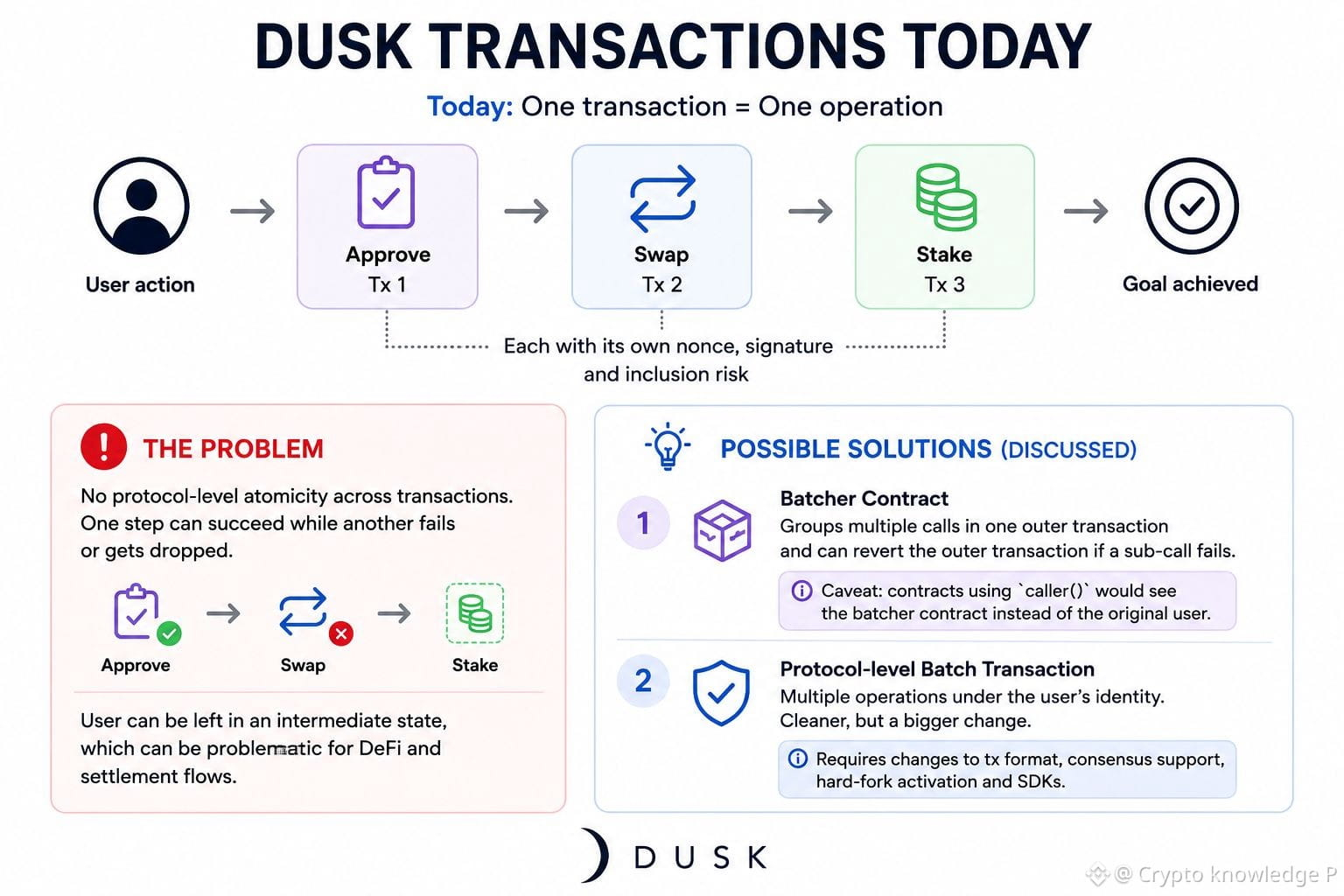
I was reading through Dusk’s transaction flow and found out that one transaction currently carries one operation. For something basic, that’s actually pretty sensible. It keeps things easier to validate and understand. But then I thought about a more complex DeFi flow, like preparing funds, doing a swap, and then staking. To the user, that feels like one action. On Dusk, it becomes several separate transactions, each with its own nonce, signature and chance of being included.
That’s where I started wondering what happens if only part of the sequence goes through. There’s no protocol level rollback across those transactions, so you can end up halfway through a larger flow. For a normal trade, probably not a big deal. But for DeFi, settlement or treasury operations, I can see this becoming a real headache.
What I found interesting is that Dusk already has an open GitHub issue, #4058, discussing batch transactions. One idea is a batcher contract that puts several calls into one transaction, but contracts using caller() could see the batcher instead of the original user. The other option is a protocol level batch where multiple operations stay under the user’s identity, but that would mean changes to the transaction format, consensus support, hard fork activation and SDKs.
So I wouldn’t replace the current single operation model. I think it makes sense as the simple default. I’d rather see an optional atomic batch for complex workflows, where the operations run in order, the whole batch can revert if one fails, and the original user remains visible to each call.
Would that be the right balance for Dusk, or is the extra protocol complexity not worth it?
$DUSK @Dusk #dusk
I was reading through Dusk’s transaction flow and found out that one transaction currently carries one operation. For something basic, that’s actually pretty sensible. It keeps things easier to validate and understand. But then I thought about a more complex DeFi flow, like preparing funds, doing a swap, and then staking. To the user, that feels like one action. On Dusk, it becomes several separate transactions, each with its own nonce, signature and chance of being included.
That’s where I started wondering what happens if only part of the sequence goes through. There’s no protocol level rollback across those transactions, so you can end up halfway through a larger flow. For a normal trade, probably not a big deal. But for DeFi, settlement or treasury operations, I can see this becoming a real headache.
What I found interesting is that Dusk already has an open GitHub issue, #4058, discussing batch transactions. One idea is a batcher contract that puts several calls into one transaction, but contracts using caller() could see the batcher instead of the original user. The other option is a protocol level batch where multiple operations stay under the user’s identity, but that would mean changes to the transaction format, consensus support, hard fork activation and SDKs.
So I wouldn’t replace the current single operation model. I think it makes sense as the simple default. I’d rather see an optional atomic batch for complex workflows, where the operations run in order, the whole batch can revert if one fails, and the original user remains visible to each call.
Would that be the right balance for Dusk, or is the extra protocol complexity not worth it?
$DUSK @Dusk #dusk
Übersetzung ansehen
#dusk $DUSK @Dusk
I’ve been looking at the SME side of Dusk recently and one thing kept coming back to me.
Tokenizing an SME sounds simple when you say it in one line.
Put the asset onchain.
Let investors access it.
Done.
But it really isn’t that simple.
Someone still has to decide who can invest, how ownership is handled, how transfers work, what information needs to be disclosed, and how the actual money gets settled.
And this is where I think people sometimes underestimate the RWA problem.
The token itself is only one part of the process. The market around it still has to work.
That’s where the Dusk approach gets interesting to me.
Their recent focus on private markets and SMEs isn’t really about putting another asset on a blockchain just for the sake of it.
It’s more about connecting the different parts of the process.
Because the difficult part isn’t creating the token.
The difficult part is making the token usable.
An SME can have a tokenized security, but if investors can’t access it properly, transfers are complicated, or there’s no real market around it, then not much has changed.
That’s also why I’m curious to see how the Dusk Trade side develops.
If it can make the process simpler for both companies and investors, then this becomes more interesting than just another RWA narrative.
Still early though.
For me, the real test is simple:
Can Dusk make private markets actually easier to use, or are we just putting an old process onchain and calling it new?
That’s the part I’ll be watching closely as Dusk Trade starts to take shape.
I’ve been looking at the SME side of Dusk recently and one thing kept coming back to me.
Tokenizing an SME sounds simple when you say it in one line.
Put the asset onchain.
Let investors access it.
Done.
But it really isn’t that simple.
Someone still has to decide who can invest, how ownership is handled, how transfers work, what information needs to be disclosed, and how the actual money gets settled.
And this is where I think people sometimes underestimate the RWA problem.
The token itself is only one part of the process. The market around it still has to work.
That’s where the Dusk approach gets interesting to me.
Their recent focus on private markets and SMEs isn’t really about putting another asset on a blockchain just for the sake of it.
It’s more about connecting the different parts of the process.
Because the difficult part isn’t creating the token.
The difficult part is making the token usable.
An SME can have a tokenized security, but if investors can’t access it properly, transfers are complicated, or there’s no real market around it, then not much has changed.
That’s also why I’m curious to see how the Dusk Trade side develops.
If it can make the process simpler for both companies and investors, then this becomes more interesting than just another RWA narrative.
Still early though.
For me, the real test is simple:
Can Dusk make private markets actually easier to use, or are we just putting an old process onchain and calling it new?
That’s the part I’ll be watching closely as Dusk Trade starts to take shape.
Übersetzung ansehen
Been looking deeper into how Dusk handles transactions, and I noticed something I hadn’t really thought about before.
Moonlight and Phoenix aren’t just two versions of the same thing.
Moonlight is account-based. You have an account, balance, nonce and keys, and the network checks the transaction against that state.
Phoenix takes a different approach.
It uses notes stored in a Merkle tree. When a note is spent, a nullifier is created so the same note can’t be spent again.
What caught my attention is that the network doesn’t need to reveal which specific note was spent.
That’s where the ZK proofs come in — the transaction can be verified without exposing the underlying private details. The one-time note keys also help reduce transaction linkability.
There’s also a delegation mechanism for things like scanning and proof generation, without giving the delegated party access to spend the funds.
So I wouldn’t describe it simply as “Moonlight is transparent and Phoenix is private.”
They’re different transaction models designed around different requirements, while operating on the same Dusk network.
And honestly, I think that’s a pretty interesting design choice.
Which would you prefer on Dusk?
@Dusk $DUSK #dusk
Moonlight and Phoenix aren’t just two versions of the same thing.
Moonlight is account-based. You have an account, balance, nonce and keys, and the network checks the transaction against that state.
Phoenix takes a different approach.
It uses notes stored in a Merkle tree. When a note is spent, a nullifier is created so the same note can’t be spent again.
What caught my attention is that the network doesn’t need to reveal which specific note was spent.
That’s where the ZK proofs come in — the transaction can be verified without exposing the underlying private details. The one-time note keys also help reduce transaction linkability.
There’s also a delegation mechanism for things like scanning and proof generation, without giving the delegated party access to spend the funds.
So I wouldn’t describe it simply as “Moonlight is transparent and Phoenix is private.”
They’re different transaction models designed around different requirements, while operating on the same Dusk network.
And honestly, I think that’s a pretty interesting design choice.
Which would you prefer on Dusk?
@Dusk $DUSK #dusk
🔥 Phoenix
50%
🌙 Moonlight
10%
⚡ Both
20%
🤔 Depends on the use case
20%
10 Stimmen • Abstimmung beendet
Übersetzung ansehen
A token being on-chain is only the beginning.
The real question is: can the rules around that asset move on-chain too?
Take a regulated bond.
Turning it into a token might be the easy part. But a real financial market needs more:
• Only eligible investors should be able to hold it
• Transfers may need built-in restrictions
• Sensitive positions shouldn’t be public by default
• The right parties need access to the right information
• Cash and asset delivery need to settle together
That is where tokenization becomes more than a digital wrapper.
It becomes market infrastructure.
This is why @Dusk stands out to me. Its focus isn’t simply putting assets on-chain, but enabling regulated workflows around them—controlled transfers, selective disclosure, privacy, eligibility, and settlement as connected parts of one system.
The bigger opportunity isn’t just tokenized assets.
It is programmable markets:
Rules that follow the asset.
Privacy that can coexist with accountability.
Settlement that happens as part of the transaction.
Ownership changes that don’t break compliance requirements.
If that model works at scale, on-chain finance could look less like traditional markets with a new database—and more like a redesigned financial system.
What do you think is the hardest hurdle for real-world finance moving on-chain: identity, privacy, trading, settlement, or asset servicing?
$DUSK #dusk @Dusk
The real question is: can the rules around that asset move on-chain too?
Take a regulated bond.
Turning it into a token might be the easy part. But a real financial market needs more:
• Only eligible investors should be able to hold it
• Transfers may need built-in restrictions
• Sensitive positions shouldn’t be public by default
• The right parties need access to the right information
• Cash and asset delivery need to settle together
That is where tokenization becomes more than a digital wrapper.
It becomes market infrastructure.
This is why @Dusk stands out to me. Its focus isn’t simply putting assets on-chain, but enabling regulated workflows around them—controlled transfers, selective disclosure, privacy, eligibility, and settlement as connected parts of one system.
The bigger opportunity isn’t just tokenized assets.
It is programmable markets:
Rules that follow the asset.
Privacy that can coexist with accountability.
Settlement that happens as part of the transaction.
Ownership changes that don’t break compliance requirements.
If that model works at scale, on-chain finance could look less like traditional markets with a new database—and more like a redesigned financial system.
What do you think is the hardest hurdle for real-world finance moving on-chain: identity, privacy, trading, settlement, or asset servicing?
$DUSK #dusk @Dusk
Teilweise korrekt
Übersetzung ansehen
Everyone talks about blockchain scalability.
Almost nobody talks about the cost of remembering.
A network can process huge amounts of activity, but every block, event and state transition also creates historical data that eventually has to be stored and maintained.
That’s why I found Dusk’s recent infrastructure update more interesting than another TPS headline.
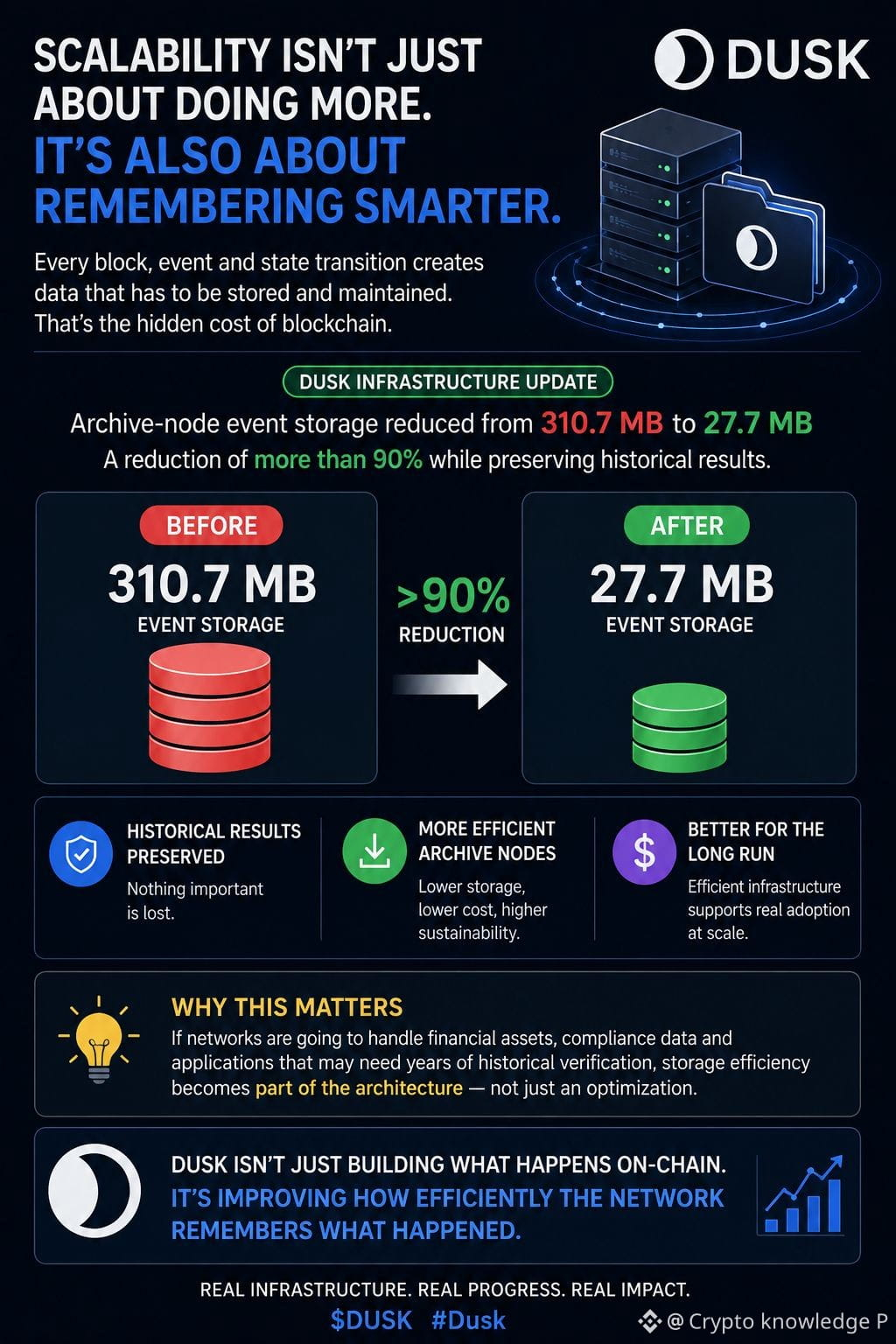
Dusk reduced archive-node event storage from 310.7 MB to 27.7 MB — more than a 90% reduction — while preserving historical results.
The interesting part isn’t simply the number.
It’s what this says about blockchain infrastructure.
If networks are eventually going to support financial assets and applications that may need years of historical verification, storage efficiency becomes part of the architecture itself.
Scalability isn’t only about processing more. It’s also about carrying less data without losing the history that makes the network verifiable.
These improvements probably won’t create the loudest headlines.
But the boring infrastructure work is often what makes large-scale adoption possible.
Dusk isn’t only working on what happens on-chain.
It’s also improving how efficiently the network can remember what happened.
@Dusk $DUSK #dusk
Almost nobody talks about the cost of remembering.
A network can process huge amounts of activity, but every block, event and state transition also creates historical data that eventually has to be stored and maintained.
That’s why I found Dusk’s recent infrastructure update more interesting than another TPS headline.
Dusk reduced archive-node event storage from 310.7 MB to 27.7 MB — more than a 90% reduction — while preserving historical results.
The interesting part isn’t simply the number.
It’s what this says about blockchain infrastructure.
If networks are eventually going to support financial assets and applications that may need years of historical verification, storage efficiency becomes part of the architecture itself.
Scalability isn’t only about processing more. It’s also about carrying less data without losing the history that makes the network verifiable.
These improvements probably won’t create the loudest headlines.
But the boring infrastructure work is often what makes large-scale adoption possible.
Dusk isn’t only working on what happens on-chain.
It’s also improving how efficiently the network can remember what happened.
@Dusk $DUSK #dusk
Verifiziert
Übersetzung ansehen
One Dusk update I think deserves more attention is the DuskEVM testnet going live.
At first glance, “another EVM environment” doesn’t sound particularly interesting. But the architecture tells a different story.
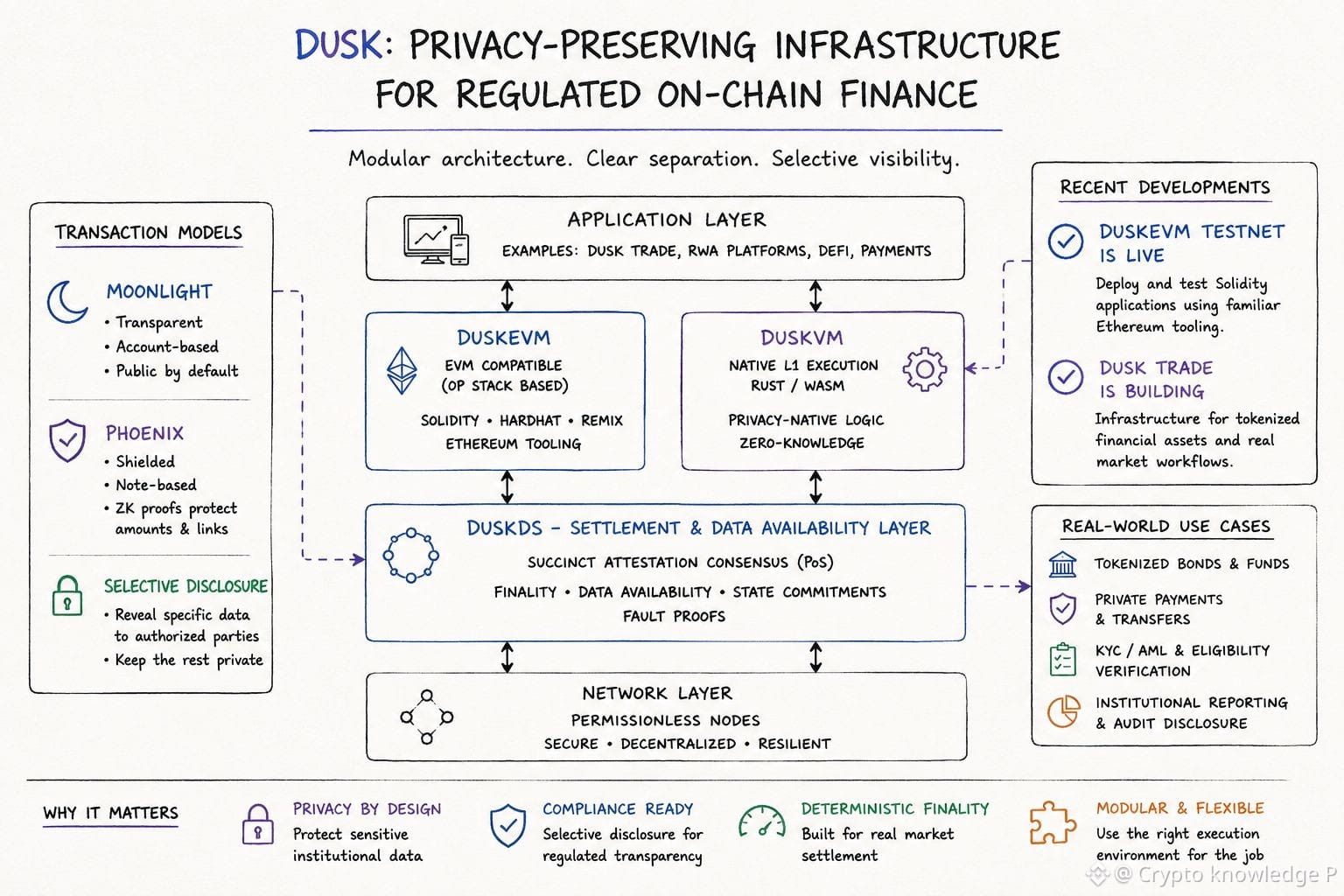
DuskEVM brings Solidity, Hardhat and standard Ethereum tooling to Dusk, while execution settles through DuskDS. That separation matters because developers can use a familiar application stack without giving up Dusk’s native settlement and data-availability layer.
The more interesting part is what sits around it.
Dusk is also building Dusk Trade as an application layer for tokenized financial assets, with workflows around investor onboarding, wallet binding, controlled transfers, payment coordination and compliant settlement.
So the recent development is not just about adding EVM compatibility.
It looks more like Dusk is moving toward a full stack where different pieces handle different problems:
→ DuskDS: consensus, settlement and data availability
→ DuskEVM: familiar EVM execution
→ DuskVM: native Rust/WASM execution with direct access to Dusk’s privacy capabilities
→ Dusk Trade: application-level infrastructure for tokenized markets
And this is where the RWA thesis becomes more interesting.
Tokenizing an asset is relatively easy to describe. Building the actual infrastructure for issuance, eligibility, transfers, privacy, disclosure and settlement is the harder problem.
With DuskEVM now available for testing and Dusk Trade being built around real market workflows, the next thing I’ll be watching is not another announcement.
It’s what developers and financial applications actually build on top of this stack.
@Dusk $DUSK #dusk
At first glance, “another EVM environment” doesn’t sound particularly interesting. But the architecture tells a different story.
DuskEVM brings Solidity, Hardhat and standard Ethereum tooling to Dusk, while execution settles through DuskDS. That separation matters because developers can use a familiar application stack without giving up Dusk’s native settlement and data-availability layer.
The more interesting part is what sits around it.
Dusk is also building Dusk Trade as an application layer for tokenized financial assets, with workflows around investor onboarding, wallet binding, controlled transfers, payment coordination and compliant settlement.
So the recent development is not just about adding EVM compatibility.
It looks more like Dusk is moving toward a full stack where different pieces handle different problems:
→ DuskDS: consensus, settlement and data availability
→ DuskEVM: familiar EVM execution
→ DuskVM: native Rust/WASM execution with direct access to Dusk’s privacy capabilities
→ Dusk Trade: application-level infrastructure for tokenized markets
And this is where the RWA thesis becomes more interesting.
Tokenizing an asset is relatively easy to describe. Building the actual infrastructure for issuance, eligibility, transfers, privacy, disclosure and settlement is the harder problem.
With DuskEVM now available for testing and Dusk Trade being built around real market workflows, the next thing I’ll be watching is not another announcement.
It’s what developers and financial applications actually build on top of this stack.
@Dusk $DUSK #dusk
Je mehr ich mir die Tokenisierung anschaue, desto mehr denke ich, dass wir die falsche Frage stellen.
Jeder fragt: „Kann dieses Asset auf die Blockchain gebracht werden?“
Aber stell dir vor, das Asset ist bereits dort.
Jetzt möchte ein Investor es kaufen. Ein anderer möchte es verkaufen. Der Emittent muss durchsetzen, wer es halten darf. Ein Regulator braucht später möglicherweise einen Nachweis. Und irgendwo dazwischen darf sensible Information nicht zu öffentlichen Daten werden.
Das ist für mich der spannende Teil von @Dusk . Seine Marktinfrastruktur wird so konzipiert, dass sie den gesamten Arbeitsablauf unterstützt – Eignung, kontrollierte Übertragungen, Datenschutz, Offenlegung und Abwicklung – statt einen Token als fertiges Produkt zu behandeln.
Vielleicht liegt der eigentliche Durchbruch bei RWA nicht darin, mehr Tokens zu erstellen.
Vielleicht liegt er darin, dass diese Tokens tatsächlich wie Finanzanlagen funktionieren.
Welcher Teil dieses Arbeitsablaufs ist deiner Meinung nach am schwersten zu lösen?
$DUSK #dusk @Dusk
Jeder fragt: „Kann dieses Asset auf die Blockchain gebracht werden?“
Aber stell dir vor, das Asset ist bereits dort.
Jetzt möchte ein Investor es kaufen. Ein anderer möchte es verkaufen. Der Emittent muss durchsetzen, wer es halten darf. Ein Regulator braucht später möglicherweise einen Nachweis. Und irgendwo dazwischen darf sensible Information nicht zu öffentlichen Daten werden.
Das ist für mich der spannende Teil von @Dusk . Seine Marktinfrastruktur wird so konzipiert, dass sie den gesamten Arbeitsablauf unterstützt – Eignung, kontrollierte Übertragungen, Datenschutz, Offenlegung und Abwicklung – statt einen Token als fertiges Produkt zu behandeln.
Vielleicht liegt der eigentliche Durchbruch bei RWA nicht darin, mehr Tokens zu erstellen.
Vielleicht liegt er darin, dass diese Tokens tatsächlich wie Finanzanlagen funktionieren.
Welcher Teil dieses Arbeitsablaufs ist deiner Meinung nach am schwersten zu lösen?
$DUSK #dusk @Dusk
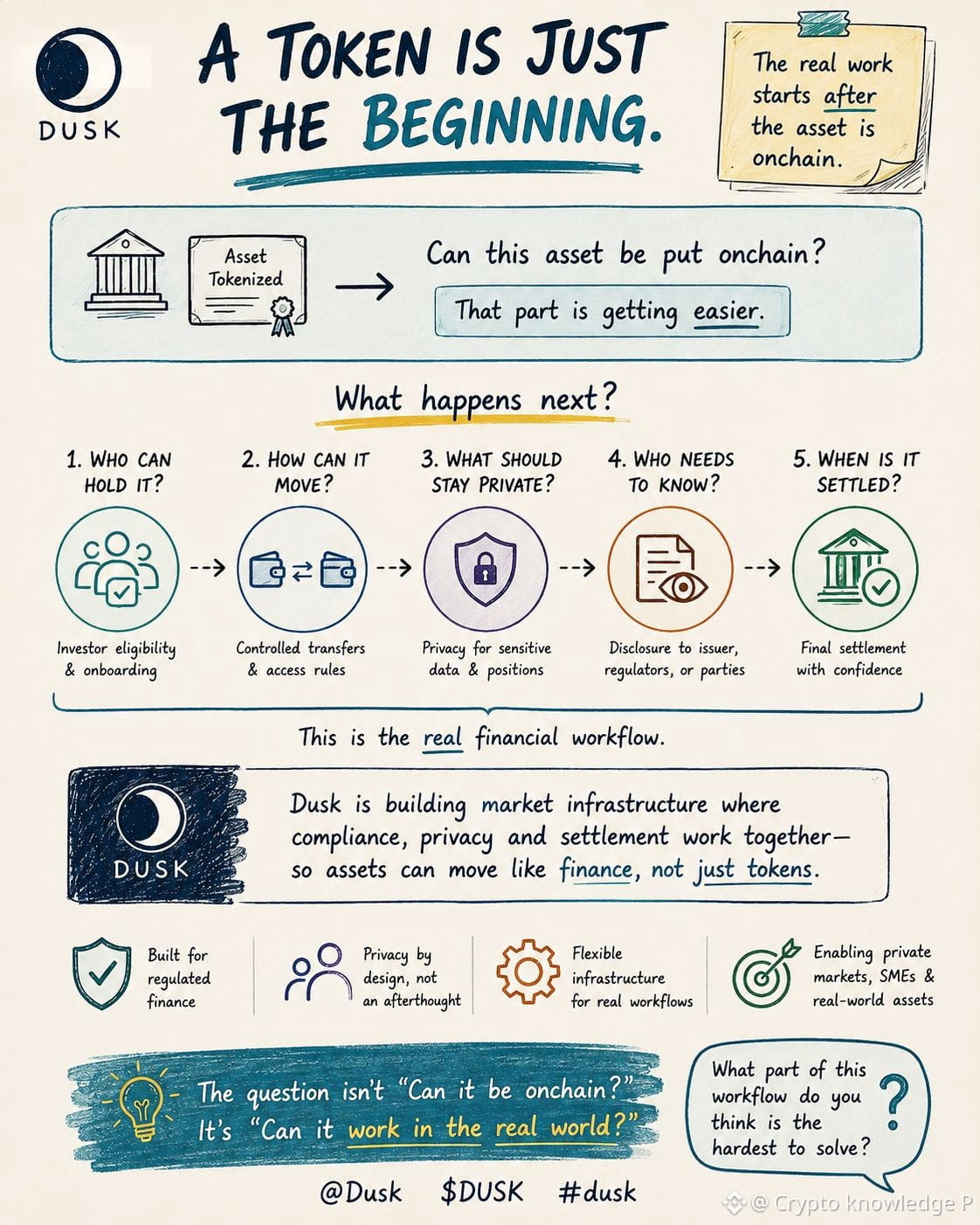
Vor ein paar Tagen habe ich darüber nachgedacht, was „Tokenisierung eines Assets“ eigentlich bedeutet. Auf den ersten Blick klingt es simpel: Man nimmt eine Aktie, eine Anleihe oder ein anderes Finanz-Asset und bringt es auf die Blockchain. Aber das Erstellen des Tokens dürfte wahrscheinlich der leichtere Teil sein.
Die schwierigeren Fragen beginnen danach. Wer kann es tatsächlich halten? Was passiert, wenn jemand versucht, es an eine falsche Wallet zu übertragen? Welche Informationen müssen für Compliance sichtbar sein, und was sollte privat bleiben?
Genau dort wird $DUSK für mich spannend. Echte finanzielle Assets brauchen mehr als nur schnelle Übertragungen – sie brauchen Regeln, Privatsphäre, Verifizierung und Abwicklung, die zusammenarbeiten, ohne alles in eine öffentliche Tabellenkalkulation zu verwandeln.
Vielleicht besteht die eigentliche Herausforderung von RWA nicht darin, Assets auf die Blockchain zu bringen. Vielleicht geht es vielmehr darum, ein System zu bauen, in dem Finanzmärkte dort tatsächlich funktionieren können, ohne auf die Privatsphäre und Kontrollen zu verzichten, von denen sie bereits abhängen. Was denkst du, ist das größte fehlende Element? 👀
@Dusk $DUSK #Dusk
Die schwierigeren Fragen beginnen danach. Wer kann es tatsächlich halten? Was passiert, wenn jemand versucht, es an eine falsche Wallet zu übertragen? Welche Informationen müssen für Compliance sichtbar sein, und was sollte privat bleiben?
Genau dort wird $DUSK für mich spannend. Echte finanzielle Assets brauchen mehr als nur schnelle Übertragungen – sie brauchen Regeln, Privatsphäre, Verifizierung und Abwicklung, die zusammenarbeiten, ohne alles in eine öffentliche Tabellenkalkulation zu verwandeln.
Vielleicht besteht die eigentliche Herausforderung von RWA nicht darin, Assets auf die Blockchain zu bringen. Vielleicht geht es vielmehr darum, ein System zu bauen, in dem Finanzmärkte dort tatsächlich funktionieren können, ohne auf die Privatsphäre und Kontrollen zu verzichten, von denen sie bereits abhängen. Was denkst du, ist das größte fehlende Element? 👀
@Dusk $DUSK #Dusk
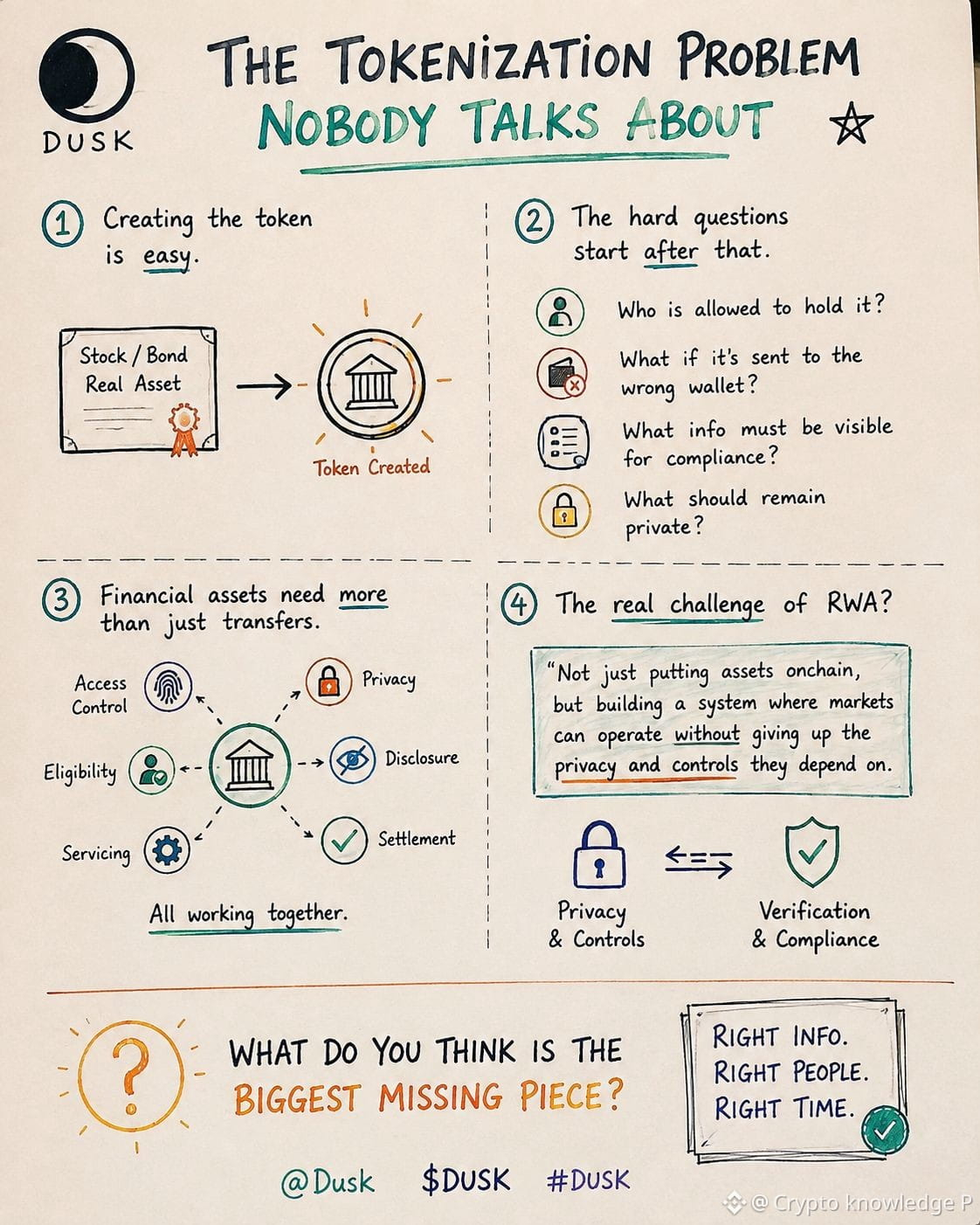
#dusk $DUSK
Die Sicherheitsgeschichte einer Blockchain lautet nicht „Wir haben nie einen Bug gefunden“.
Sondern: Was passiert, nachdem ein ernsthafter Audit einen gefunden hat.
Deshalb bin ich dem AEGIS-„Kaninchenbau“ bei @Dusk gefolgt.
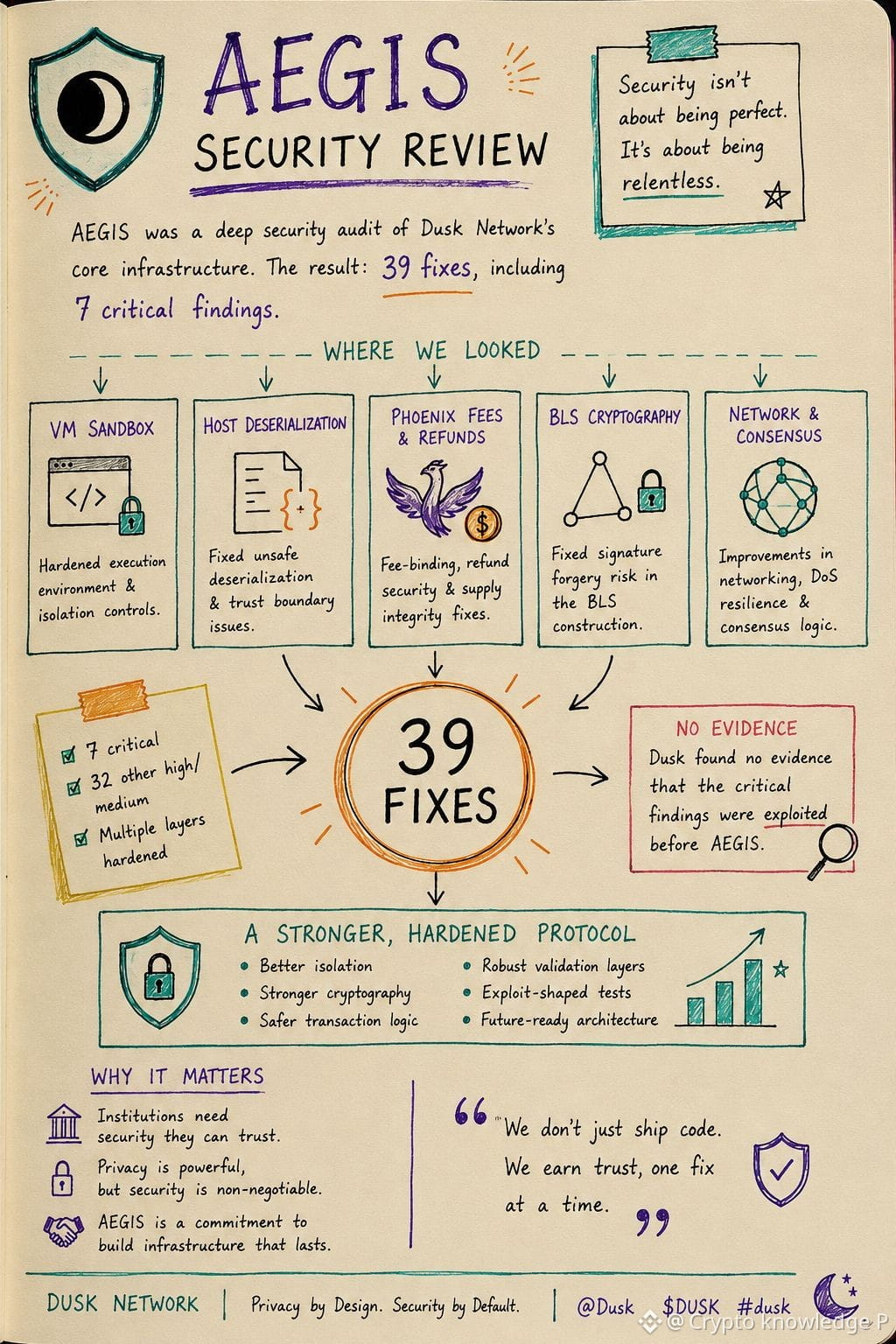
Dusk veröffentlichte 2026 die AEGIS-Remediation mit 39 Sicherheitsfixes, darunter 7 kritische Befunde.
Der interessante Teil? Das waren nicht nur oberflächliche Probleme.
Das Audit ging tief in den Stack:
→ VM-Sandbox-Ausführung
→ Deserialisierung auf Host-Seite
→ Phoenix-Fees- und Refund-Logik
→ BLS-Signatur-Sicherheit
→ Konsens, Networking & kryptografische Komponenten
Ein Problem mit der Phoenix-Fees-Logik kann die Integrität des Angebots, die Verfügbarkeit der Chain und die Sicherheit der Rückerstattung beeinträchtigen. Das BLS-Problem betraf den kryptografischen Aufbau, der für die Signaturverifikation verwendet wird.
AEGIS hat nicht einfach nur eine Zeile gepatcht und weitergemacht. Dusk sagt, sie hätten das betroffene Ownership-Modell überarbeitet, Vertrauensgrenzen gehärtet, an mehreren Ebenen Checks zur Konsistenz der Fees ergänzt, den BLS-Pfad gestärkt und regressionstests hinzugefügt, die wie Exploits geformt sind.
Und laut Dusk fanden sie keine Hinweise darauf, dass die kritischen Befunde zuvor vor AEGIS ausgenutzt wurden.
Für mich ist das der eigentliche Takeaway.
Im regulierten Finanzwesen ist Privatsphäre wichtig.
Aber Privatsphäre ohne Sicherheit ist nutzlos.
Die Infrastruktur muss adversatives Denken überstehen, bevor Institutionen ihr vertrauen können.
Das ist die Seite von @Dusk , die ich es wert finde, im Blick zu behalten:
nicht nur das, was das Protokoll verspricht,
sondern wie ernsthaft es reagiert, wenn jemand versucht, es zu brechen.
$DUSK #dusk @Dusk
Die Sicherheitsgeschichte einer Blockchain lautet nicht „Wir haben nie einen Bug gefunden“.
Sondern: Was passiert, nachdem ein ernsthafter Audit einen gefunden hat.
Deshalb bin ich dem AEGIS-„Kaninchenbau“ bei @Dusk gefolgt.
Dusk veröffentlichte 2026 die AEGIS-Remediation mit 39 Sicherheitsfixes, darunter 7 kritische Befunde.
Der interessante Teil? Das waren nicht nur oberflächliche Probleme.
Das Audit ging tief in den Stack:
→ VM-Sandbox-Ausführung
→ Deserialisierung auf Host-Seite
→ Phoenix-Fees- und Refund-Logik
→ BLS-Signatur-Sicherheit
→ Konsens, Networking & kryptografische Komponenten
Ein Problem mit der Phoenix-Fees-Logik kann die Integrität des Angebots, die Verfügbarkeit der Chain und die Sicherheit der Rückerstattung beeinträchtigen. Das BLS-Problem betraf den kryptografischen Aufbau, der für die Signaturverifikation verwendet wird.
AEGIS hat nicht einfach nur eine Zeile gepatcht und weitergemacht. Dusk sagt, sie hätten das betroffene Ownership-Modell überarbeitet, Vertrauensgrenzen gehärtet, an mehreren Ebenen Checks zur Konsistenz der Fees ergänzt, den BLS-Pfad gestärkt und regressionstests hinzugefügt, die wie Exploits geformt sind.
Und laut Dusk fanden sie keine Hinweise darauf, dass die kritischen Befunde zuvor vor AEGIS ausgenutzt wurden.
Für mich ist das der eigentliche Takeaway.
Im regulierten Finanzwesen ist Privatsphäre wichtig.
Aber Privatsphäre ohne Sicherheit ist nutzlos.
Die Infrastruktur muss adversatives Denken überstehen, bevor Institutionen ihr vertrauen können.
Das ist die Seite von @Dusk , die ich es wert finde, im Blick zu behalten:
nicht nur das, was das Protokoll verspricht,
sondern wie ernsthaft es reagiert, wenn jemand versucht, es zu brechen.
$DUSK #dusk @Dusk
Verifiziert
#dusk $DUSK
Die meisten Blockchains wurden rund um eine Idee entworfen:
Transparenz.
Aber echte Finanzmärkte brauchen etwas mehr Differenzierung.
Man kann nicht erwarten, dass Institutionen jede Kontostand-, Positions- und Transaktionsdetails auf ein öffentliches Ledger stellen, damit es für alle sichtbar ist.
Genau da wird @Dusk interessant.
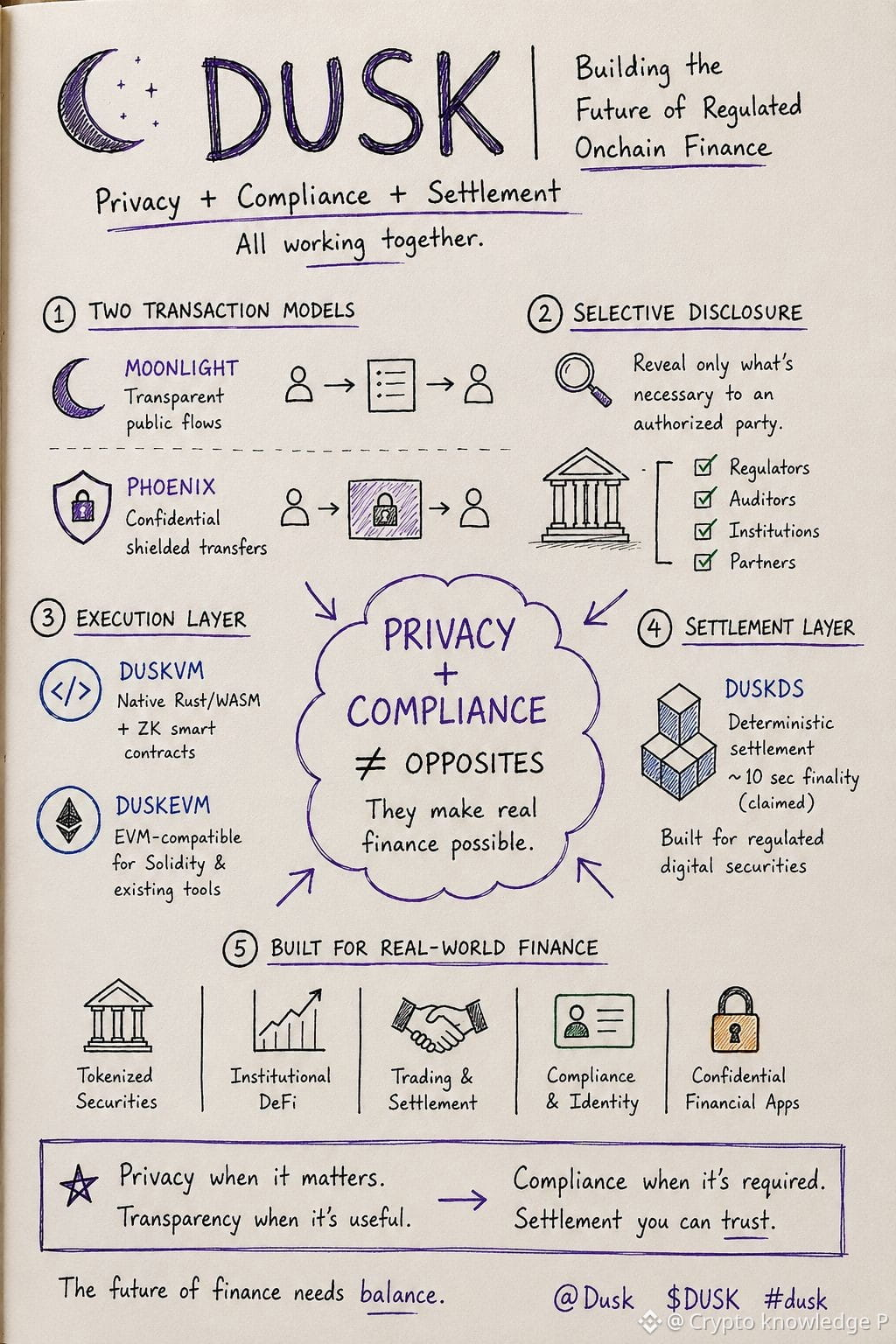
Dusk baut Infrastruktur für reguliertes Onchain-Finanzwesen, bei dem Privatsphäre, Compliance und deterministische Abwicklung gemeinsam funktionieren können.
→ Moonlight für transparente öffentliche Flows
→ Phoenix für vertrauliche, abgeschirmte Überweisungen
→ Selektive Offenlegung, wenn eine autorisierte Partei spezifische Informationen benötigt
→ DuskVM für native Rust/WASM + ZK-Smart-Contracts
→ DuskEVM für einen EVM-kompatiblen Entwicklungspfad
Und die größere Idee geht über das bloße „Tokenisieren eines Assets“ hinaus.
Bei regulierten Wertpapieren müssen Anlegerberechtigung, kontrollierte Transfers, Privatsphäre, Offenlegung, Reporting und Abwicklung zusammenarbeiten.
Das ist der Teil, den ich an Dusk am spannendsten finde.
Tokenisierung ist leicht zu beschreiben.
Die finanzielle Infrastruktur darum herum aufzubauen ist der schwierige Teil.
Dusk setzt darauf, dass die Zukunft des Onchain-Finanzwesens beides braucht:
Privatsphäre, wenn es darauf ankommt.
Transparenz, wenn sie nützlich ist.
Compliance, wenn sie erforderlich ist.
Abwicklung, der man vertrauen kann.
Das ist eine These, der man Aufmerksamkeit schenken sollte. 👀
@Dusk $DUSK #dusk
Die meisten Blockchains wurden rund um eine Idee entworfen:
Transparenz.
Aber echte Finanzmärkte brauchen etwas mehr Differenzierung.
Man kann nicht erwarten, dass Institutionen jede Kontostand-, Positions- und Transaktionsdetails auf ein öffentliches Ledger stellen, damit es für alle sichtbar ist.
Genau da wird @Dusk interessant.
Dusk baut Infrastruktur für reguliertes Onchain-Finanzwesen, bei dem Privatsphäre, Compliance und deterministische Abwicklung gemeinsam funktionieren können.
→ Moonlight für transparente öffentliche Flows
→ Phoenix für vertrauliche, abgeschirmte Überweisungen
→ Selektive Offenlegung, wenn eine autorisierte Partei spezifische Informationen benötigt
→ DuskVM für native Rust/WASM + ZK-Smart-Contracts
→ DuskEVM für einen EVM-kompatiblen Entwicklungspfad
Und die größere Idee geht über das bloße „Tokenisieren eines Assets“ hinaus.
Bei regulierten Wertpapieren müssen Anlegerberechtigung, kontrollierte Transfers, Privatsphäre, Offenlegung, Reporting und Abwicklung zusammenarbeiten.
Das ist der Teil, den ich an Dusk am spannendsten finde.
Tokenisierung ist leicht zu beschreiben.
Die finanzielle Infrastruktur darum herum aufzubauen ist der schwierige Teil.
Dusk setzt darauf, dass die Zukunft des Onchain-Finanzwesens beides braucht:
Privatsphäre, wenn es darauf ankommt.
Transparenz, wenn sie nützlich ist.
Compliance, wenn sie erforderlich ist.
Abwicklung, der man vertrauen kann.
Das ist eine These, der man Aufmerksamkeit schenken sollte. 👀
@Dusk $DUSK #dusk
⚡ ZUKUNFTSHÄNDLER UMFRAGE ⚡
RSI über 78 = überkaufter Bereich 📊
Diese Top-Gewinner steigen… was ist dein Plan für die Futures? 👇
Hohes Risiko, hohe Belohnung — lass dich nicht liquidieren!
💬 Kommentiere deinen Einstieg & Hebel#CryptoPoll #SKLUSDT #CryptoPatience #FutureTradingSignals #MOVR/USDT $ZBT $KERNEL $SKL
RSI über 78 = überkaufter Bereich 📊
Diese Top-Gewinner steigen… was ist dein Plan für die Futures? 👇
Hohes Risiko, hohe Belohnung — lass dich nicht liquidieren!
💬 Kommentiere deinen Einstieg & Hebel#CryptoPoll #SKLUSDT #CryptoPatience #FutureTradingSignals #MOVR/USDT $ZBT $KERNEL $SKL
Short KERNEL
57%
Short SKL
13%
Short MOVR
27%
Short ZBT
3%
104 Stimmen • Abstimmung beendet
Auf welche Art von Krypto setzen Sie für den nächsten Bullenlauf? 👇
💬 Kommentieren Sie Ihre Wahl + warum
#BTC #solana #MEME #CryptoPoll #Dogecoin $NOM $ON $KAT
💬 Kommentieren Sie Ihre Wahl + warum
#BTC #solana #MEME #CryptoPoll #Dogecoin $NOM $ON $KAT
Store of Value — Bitcoin (BTC)
22%
Oracle Power— Chainlink (LINK)
14%
High-Speed Chains— Solana(SOL)
33%
Memecoins — Dogecoin (DOGE)
31%
36 Stimmen • Abstimmung beendet
Trending Verborgene Juwelen Umfrage (Binance) 💎
Jeder schaut auf BTC & ETH…
Aber echte Gewinne kommen von verborgenen Juwelen 👀
Welcher trendige Altcoin hat das größte 10-fache Potenzial?$FET $RNDR $TIA
📊 Jetzt abstimmen & kommentiere deinen verborgenen Juwel
Die beste Alpha ist immer in den Kommentaren 👇
#crypto #CryptoPoll #BTC #BinanceSquareTalks #CryptoPoll
Jeder schaut auf BTC & ETH…
Aber echte Gewinne kommen von verborgenen Juwelen 👀
Welcher trendige Altcoin hat das größte 10-fache Potenzial?$FET $RNDR $TIA
📊 Jetzt abstimmen & kommentiere deinen verborgenen Juwel
Die beste Alpha ist immer in den Kommentaren 👇
#crypto #CryptoPoll #BTC #BinanceSquareTalks #CryptoPoll
FET (AI narrative)
63%
RNDR (GPU / AI infrastructure)
10%
TIA (Modular blockchain)
24%
SEI (High-speed DeFi chain)
3%
71 Stimmen • Abstimmung beendet
Welche Memecoin sammelst du gerade?
💬 Kommentiere die Memecoin, bei der du optimistisch bist
Lass uns sehen, welche Community am stärksten ist 👀
#MemecoinArmy #CryptoPoll #BinanceSquare #PEPE #memecoin🚀🚀🚀
$PEPE $DOGE $FLOKI
💬 Kommentiere die Memecoin, bei der du optimistisch bist
Lass uns sehen, welche Community am stärksten ist 👀
#MemecoinArmy #CryptoPoll #BinanceSquare #PEPE #memecoin🚀🚀🚀
$PEPE $DOGE $FLOKI
DOGE
43%
SHIB
7%
PEPE
39%
OTHER (COMMENT IT)
11%
87 Stimmen • Abstimmung beendet
🚨 Sei ehrlich… die meisten Menschen werden das falsch machen.
Welches Asset führt tatsächlich den NÄCHSTEN Bullenzyklus? 📈
#CryptoPoll #Binance #BTC #Web3 #Ethereum
$KITE $DENT $SENT
Welches Asset führt tatsächlich den NÄCHSTEN Bullenzyklus? 📈
#CryptoPoll #Binance #BTC #Web3 #Ethereum
$KITE $DENT $SENT
₿ Bitcoin – The king
23%
Ξ Ethereum – Smart contracts
19%
🟡BNB – Exchange+ real utility
13%
🚀 Altcoins
45%
31 Stimmen • Abstimmung beendet
Anmelden und weiter Inhalte entdecken