
Lavette Stamison
32 Bài đăng

Lavette Stamison
Báo cáo
Chặn người dùng
3 Đang theo dõi
27 Người theo dõi
54 Đã thích
Bài đăng
·
--
Tăng giá
Xem bản dịch
#termmax
Nobody opens the fee page, so I did it. @termmax publishes exact formulas and they're worth sixty seconds.
💰 Lending — fee rate = APR × 2% × (days to maturity ÷ 365). Lend 1,000 USDC at 10% APR for a full year → 0.2%, about 2 FT. Notice what that means: the fee scales with your yield and your term, not with size alone. Short maturity, tiny fee.
💰 Borrowing — [GT minting reference rate × 10% + matched borrow rate × 3%] × (days ÷ 365). Stablecoin reference sits at 6%, non-stables at 3%. Borrow 1,000 USDC at 5% for 90 days → 0.185%, roughly 1.85 FT.
💰 Leverage — same rate, applied only to the borrowed portion. Input 1,000 USDC at 4.8x, so you borrow 3,800 → about 7.31 FT to open the position. Under 0.2% for a near-5x in a single transaction.
I ran these before opening anything, because building a 4.8x loop by hand on a money market costs more in gas alone, never mind the rate drift between legs while you're clicking.
One caveat worth knowing: fees are denominated in FT, so what you actually pay depends on where FT is priced when you execute. Cheap on paper isn't always cheap at 3am. $TMX
Do you check protocol fees before entering, or find out afterwards?
#termmax
Nobody opens the fee page, so I did it. @TermMax publishes exact formulas and they're worth sixty seconds.
💰 Lending — fee rate = APR × 2% × (days to maturity ÷ 365). Lend 1,000 USDC at 10% APR for a full year → 0.2%, about 2 FT. Notice what that means: the fee scales with your yield and your term, not with size alone. Short maturity, tiny fee.
💰 Borrowing — [GT minting reference rate × 10% + matched borrow rate × 3%] × (days ÷ 365). Stablecoin reference sits at 6%, non-stables at 3%. Borrow 1,000 USDC at 5% for 90 days → 0.185%, roughly 1.85 FT.
💰 Leverage — same rate, applied only to the borrowed portion. Input 1,000 USDC at 4.8x, so you borrow 3,800 → about 7.31 FT to open the position. Under 0.2% for a near-5x in a single transaction.
I ran these before opening anything, because building a 4.8x loop by hand on a money market costs more in gas alone, never mind the rate drift between legs while you're clicking.
One caveat worth knowing: fees are denominated in FT, so what you actually pay depends on where FT is priced when you execute. Cheap on paper isn't always cheap at 3am. $TMX
Do you check protocol fees before entering, or find out afterwards?
Nobody opens the fee page, so I did it. @TermMax publishes exact formulas and they're worth sixty seconds.
💰 Lending — fee rate = APR × 2% × (days to maturity ÷ 365). Lend 1,000 USDC at 10% APR for a full year → 0.2%, about 2 FT. Notice what that means: the fee scales with your yield and your term, not with size alone. Short maturity, tiny fee.
💰 Borrowing — [GT minting reference rate × 10% + matched borrow rate × 3%] × (days ÷ 365). Stablecoin reference sits at 6%, non-stables at 3%. Borrow 1,000 USDC at 5% for 90 days → 0.185%, roughly 1.85 FT.
💰 Leverage — same rate, applied only to the borrowed portion. Input 1,000 USDC at 4.8x, so you borrow 3,800 → about 7.31 FT to open the position. Under 0.2% for a near-5x in a single transaction.
I ran these before opening anything, because building a 4.8x loop by hand on a money market costs more in gas alone, never mind the rate drift between legs while you're clicking.
One caveat worth knowing: fees are denominated in FT, so what you actually pay depends on where FT is priced when you execute. Cheap on paper isn't always cheap at 3am. $TMX
Do you check protocol fees before entering, or find out afterwards?
📖 Always read the fee page
100%
😬 Found out the hard way once
0%
⛽ Only care about gas
0%
🔍 Bookmarking this
0%
1 phiếu bầu • Cuộc bỏ phiếu đã kết thúc
1
81
Xem bản dịch
#termmax Here's the @termmax detail I think is most underrated, and it has nothing to do with rates.
In most fixed-term protocols, capital that's been offered but not yet borrowed sits there earning zero. Dead weight. TermMax attacks that from three angles:
⚙️ Idle fund deployment — unborrowed capital is routed into floating-rate protocols like Aave, Morpho and Venus, so it earns while waiting for a taker.
⚙️ Atomic orders — before funds are borrowed, virtual liquidity can sit across several orders simultaneously instead of being locked into one. No fragmentation.
⚙️ Named curators — markets are run by actual liquidity managers: Keyrock, Hardcoded Lab, Edge Capital, AlphaPing, Origami Crypto. They set target APR ranges rather than accepting whatever a generic curve produces.
I pay attention to this because it's the gap between a protocol that looks good in a screenshot and one where capital efficiency was designed in from the start. The vaults are ERC-4626, with a guardian role and an asymmetric timelock: risk-reducing changes apply instantly, risk-increasing ones wait out the full period. Boring plumbing, and it's exactly what decides whether something survives a bad week.
Before depositing, read the vault: curators set their own performance fee, typically 10-20% of profits, and their own capacity limits. $TMX
Do you check who curates a vault, or just look at the headline APY?
#termmax Here's the @TermMax detail I think is most underrated, and it has nothing to do with rates.
In most fixed-term protocols, capital that's been offered but not yet borrowed sits there earning zero. Dead weight. TermMax attacks that from three angles:
⚙️ Idle fund deployment — unborrowed capital is routed into floating-rate protocols like Aave, Morpho and Venus, so it earns while waiting for a taker.
⚙️ Atomic orders — before funds are borrowed, virtual liquidity can sit across several orders simultaneously instead of being locked into one. No fragmentation.
⚙️ Named curators — markets are run by actual liquidity managers: Keyrock, Hardcoded Lab, Edge Capital, AlphaPing, Origami Crypto. They set target APR ranges rather than accepting whatever a generic curve produces.
I pay attention to this because it's the gap between a protocol that looks good in a screenshot and one where capital efficiency was designed in from the start. The vaults are ERC-4626, with a guardian role and an asymmetric timelock: risk-reducing changes apply instantly, risk-increasing ones wait out the full period. Boring plumbing, and it's exactly what decides whether something survives a bad week.
Before depositing, read the vault: curators set their own performance fee, typically 10-20% of profits, and their own capacity limits. $TMX
Do you check who curates a vault, or just look at the headline APY?
In most fixed-term protocols, capital that's been offered but not yet borrowed sits there earning zero. Dead weight. TermMax attacks that from three angles:
⚙️ Idle fund deployment — unborrowed capital is routed into floating-rate protocols like Aave, Morpho and Venus, so it earns while waiting for a taker.
⚙️ Atomic orders — before funds are borrowed, virtual liquidity can sit across several orders simultaneously instead of being locked into one. No fragmentation.
⚙️ Named curators — markets are run by actual liquidity managers: Keyrock, Hardcoded Lab, Edge Capital, AlphaPing, Origami Crypto. They set target APR ranges rather than accepting whatever a generic curve produces.
I pay attention to this because it's the gap between a protocol that looks good in a screenshot and one where capital efficiency was designed in from the start. The vaults are ERC-4626, with a guardian role and an asymmetric timelock: risk-reducing changes apply instantly, risk-increasing ones wait out the full period. Boring plumbing, and it's exactly what decides whether something survives a bad week.
Before depositing, read the vault: curators set their own performance fee, typically 10-20% of profits, and their own capacity limits. $TMX
Do you check who curates a vault, or just look at the headline APY?
🔍 I read the curator first
0%
📈 APY, then maybe
0%
⏱️ Timelock design is key
0%
🤷 Vault curators?
0%
0 phiếu bầu • Cuộc bỏ phiếu đã kết thúc
1
208
·
--
Tăng giá
Tôi đã đi tìm xem các hồ sơ công bố của tổ chức thực sự nói gì về tài sản cơ sở đứng sau $SPCXB. Bản tin thì giật tít: các quỹ lớn nắm giữ hàng chục tỷ, vậy thì chắc chắn là vững. Nhưng trong hồ sơ thì nói một chuyện khác.
Cơ chế. Các công bố định kỳ hằng quý của nhà đầu tư tổ chức tại Mỹ là một “bức ảnh” của ngày cuối cùng của quý đó, được đăng tải muộn tới 45 ngày. Một quỹ quốc gia báo cáo 154.146.835 cổ phiếu trị giá 26,34 tỷ đô la. Một bên nộp hồ sơ khác báo cáo 551,2 triệu cổ phiếu trị giá 94,2 tỷ. Chia cả hai ra: 170,88 và 170,90. Cùng một mức giá suy ra, từ hai bên nộp hồ sơ không liên quan. Giá đó rơi vào ngày 30 tháng 6.
Sau đó, phần “coverage” theo khu vực định giá vị thế cổ phiếu 154,1 triệu đó ở mức 21,5 tỷ, sử dụng 139,50 đô la/cổ phiếu. Hồ sơ tương tự, cùng số lượng cổ phiếu, chênh 4,8 tỷ.
Bạn nhận được gì. Hai bên nộp hồ sơ vô tình đăng cùng một “mốc”, nên giờ bạn có thể “đóng dấu ngày” cho hầu như bất kỳ con số nào bạn đọc.
Bạn phải trả gì. Ba thứ.
1 Bạn trả giá theo một mức giá “tại thời điểm hiện tại” dựa trên các dữ kiện đã cũ 49 ngày. Token của bạn được định giá lại mỗi giây. Còn hồ sơ thì không hề được định giá lại.
2 Không ai gắn nhãn một “mốc” là “mốc”. Cả hai con số đều đúng và chênh nhau 18%. Một tiêu đề sẽ không cho bạn biết bạn đang nhận cái nào.
3 Tín hiệu giảm giá (bearish) rẻ đã trở nên đắt. Lãi suất vay ngắn hạn tính theo phần trăm giảm một phần vì mẫu số mà nó được đo so với đã tăng, chứ không chỉ vì bên gấu rời đi. Phí vay là một mức giá thật: 0,51% vào cuối tháng 6, hiện tại là 2 đến 3%.
Giới hạn trung thực. Tôi không đo bất cứ thứ gì trên màn hình của mình cho trường hợp này. Tôi đọc các công bố công khai đúng như đã được báo cáo và thực hiện phép chia hai lần. Toàn bộ phát hiện nằm ở phép toán, và bạn có thể làm lại trong mười giây.
Trước khi mua theo một tiêu đề từ hồ sơ, hãy tìm ngày ứng với con số.
@BinanceCIS liệu một trang bStock có thể hiển thị dấu thời gian của giá tham chiếu mà nó trích dẫn không?
$SPCXB
#bstockscis
Tôi đã đi tìm xem các hồ sơ công bố của tổ chức thực sự nói gì về tài sản cơ sở đứng sau $SPCXB. Bản tin thì giật tít: các quỹ lớn nắm giữ hàng chục tỷ, vậy thì chắc chắn là vững. Nhưng trong hồ sơ thì nói một chuyện khác.
Cơ chế. Các công bố định kỳ hằng quý của nhà đầu tư tổ chức tại Mỹ là một “bức ảnh” của ngày cuối cùng của quý đó, được đăng tải muộn tới 45 ngày. Một quỹ quốc gia báo cáo 154.146.835 cổ phiếu trị giá 26,34 tỷ đô la. Một bên nộp hồ sơ khác báo cáo 551,2 triệu cổ phiếu trị giá 94,2 tỷ. Chia cả hai ra: 170,88 và 170,90. Cùng một mức giá suy ra, từ hai bên nộp hồ sơ không liên quan. Giá đó rơi vào ngày 30 tháng 6.
Sau đó, phần “coverage” theo khu vực định giá vị thế cổ phiếu 154,1 triệu đó ở mức 21,5 tỷ, sử dụng 139,50 đô la/cổ phiếu. Hồ sơ tương tự, cùng số lượng cổ phiếu, chênh 4,8 tỷ.
Bạn nhận được gì. Hai bên nộp hồ sơ vô tình đăng cùng một “mốc”, nên giờ bạn có thể “đóng dấu ngày” cho hầu như bất kỳ con số nào bạn đọc.
Bạn phải trả gì. Ba thứ.
1 Bạn trả giá theo một mức giá “tại thời điểm hiện tại” dựa trên các dữ kiện đã cũ 49 ngày. Token của bạn được định giá lại mỗi giây. Còn hồ sơ thì không hề được định giá lại.
2 Không ai gắn nhãn một “mốc” là “mốc”. Cả hai con số đều đúng và chênh nhau 18%. Một tiêu đề sẽ không cho bạn biết bạn đang nhận cái nào.
3 Tín hiệu giảm giá (bearish) rẻ đã trở nên đắt. Lãi suất vay ngắn hạn tính theo phần trăm giảm một phần vì mẫu số mà nó được đo so với đã tăng, chứ không chỉ vì bên gấu rời đi. Phí vay là một mức giá thật: 0,51% vào cuối tháng 6, hiện tại là 2 đến 3%.
Giới hạn trung thực. Tôi không đo bất cứ thứ gì trên màn hình của mình cho trường hợp này. Tôi đọc các công bố công khai đúng như đã được báo cáo và thực hiện phép chia hai lần. Toàn bộ phát hiện nằm ở phép toán, và bạn có thể làm lại trong mười giây.
Trước khi mua theo một tiêu đề từ hồ sơ, hãy tìm ngày ứng với con số.
@BinanceCIS liệu một trang bStock có thể hiển thị dấu thời gian của giá tham chiếu mà nó trích dẫn không?
$SPCXB
#bstockscis
Cơ chế. Các công bố định kỳ hằng quý của nhà đầu tư tổ chức tại Mỹ là một “bức ảnh” của ngày cuối cùng của quý đó, được đăng tải muộn tới 45 ngày. Một quỹ quốc gia báo cáo 154.146.835 cổ phiếu trị giá 26,34 tỷ đô la. Một bên nộp hồ sơ khác báo cáo 551,2 triệu cổ phiếu trị giá 94,2 tỷ. Chia cả hai ra: 170,88 và 170,90. Cùng một mức giá suy ra, từ hai bên nộp hồ sơ không liên quan. Giá đó rơi vào ngày 30 tháng 6.
Sau đó, phần “coverage” theo khu vực định giá vị thế cổ phiếu 154,1 triệu đó ở mức 21,5 tỷ, sử dụng 139,50 đô la/cổ phiếu. Hồ sơ tương tự, cùng số lượng cổ phiếu, chênh 4,8 tỷ.
Bạn nhận được gì. Hai bên nộp hồ sơ vô tình đăng cùng một “mốc”, nên giờ bạn có thể “đóng dấu ngày” cho hầu như bất kỳ con số nào bạn đọc.
Bạn phải trả gì. Ba thứ.
1 Bạn trả giá theo một mức giá “tại thời điểm hiện tại” dựa trên các dữ kiện đã cũ 49 ngày. Token của bạn được định giá lại mỗi giây. Còn hồ sơ thì không hề được định giá lại.
2 Không ai gắn nhãn một “mốc” là “mốc”. Cả hai con số đều đúng và chênh nhau 18%. Một tiêu đề sẽ không cho bạn biết bạn đang nhận cái nào.
3 Tín hiệu giảm giá (bearish) rẻ đã trở nên đắt. Lãi suất vay ngắn hạn tính theo phần trăm giảm một phần vì mẫu số mà nó được đo so với đã tăng, chứ không chỉ vì bên gấu rời đi. Phí vay là một mức giá thật: 0,51% vào cuối tháng 6, hiện tại là 2 đến 3%.
Giới hạn trung thực. Tôi không đo bất cứ thứ gì trên màn hình của mình cho trường hợp này. Tôi đọc các công bố công khai đúng như đã được báo cáo và thực hiện phép chia hai lần. Toàn bộ phát hiện nằm ở phép toán, và bạn có thể làm lại trong mười giây.
Trước khi mua theo một tiêu đề từ hồ sơ, hãy tìm ngày ứng với con số.
@BinanceCIS liệu một trang bStock có thể hiển thị dấu thời gian của giá tham chiếu mà nó trích dẫn không?
$SPCXB
#bstockscis
Read 13F numbers as current
0%
Knew it was a June 30 mark
100%
Never checked the filing date
0%
I only trade my own screen
0%
2 phiếu bầu • Cuộc bỏ phiếu đã kết thúc
1
2
105
·
--
Tăng giá
Xem bản dịch
#termmax
Fixed-rate DeFi stays abstract until someone runs the numbers, so here's the worked example straight out of the @termmax docs.
Market: USDC debt, ETH collateral, 1-year maturity, max LTV 0.8.
🧮 Borrower side — Alice locks 1 ETH at $1,000 into a GT. At 0.8 MLTV she mints 800 FT, meaning 800 USDC of debt. She sells that FT at a 20% discount, $0.80 each, and walks away with $640 today. Her cost is set. No reprice, no drift.
🧮 Lender side — deposit 640 USDC, receive 640 FT + 640 XT, and the contract swaps the XT into 160 more FT. Total 800 FT, each redeemable for 1 USDC at maturity → $800 back. Roughly 25% on the entry, decided on day one.
🧮 The part most people skip — Alice can repay in FT instead of USDC. If FT still trades near $0.80, buying 800 back costs about $640 to clear an 800 USDC debt. The discount cuts both ways.
That third point is what changed how I read these markets. A borrower isn't only paying a rate, they're holding a position against their own debt token.
To be clear, the 20% discount above is the docs' illustration, not a live rate — real discounts are whatever the curve and curators offer at that moment. And a fixed term means your capital has a date attached: exiting early means selling FT at market. $TMX
Fixed and locked for the term, or floating and free to leave whenever?
#termmax
Fixed-rate DeFi stays abstract until someone runs the numbers, so here's the worked example straight out of the @TermMax docs.
Market: USDC debt, ETH collateral, 1-year maturity, max LTV 0.8.
🧮 Borrower side — Alice locks 1 ETH at $1,000 into a GT. At 0.8 MLTV she mints 800 FT, meaning 800 USDC of debt. She sells that FT at a 20% discount, $0.80 each, and walks away with $640 today. Her cost is set. No reprice, no drift.
🧮 Lender side — deposit 640 USDC, receive 640 FT + 640 XT, and the contract swaps the XT into 160 more FT. Total 800 FT, each redeemable for 1 USDC at maturity → $800 back. Roughly 25% on the entry, decided on day one.
🧮 The part most people skip — Alice can repay in FT instead of USDC. If FT still trades near $0.80, buying 800 back costs about $640 to clear an 800 USDC debt. The discount cuts both ways.
That third point is what changed how I read these markets. A borrower isn't only paying a rate, they're holding a position against their own debt token.
To be clear, the 20% discount above is the docs' illustration, not a live rate — real discounts are whatever the curve and curators offer at that moment. And a fixed term means your capital has a date attached: exiting early means selling FT at market. $TMX
Fixed and locked for the term, or floating and free to leave whenever?
Fixed-rate DeFi stays abstract until someone runs the numbers, so here's the worked example straight out of the @TermMax docs.
Market: USDC debt, ETH collateral, 1-year maturity, max LTV 0.8.
🧮 Borrower side — Alice locks 1 ETH at $1,000 into a GT. At 0.8 MLTV she mints 800 FT, meaning 800 USDC of debt. She sells that FT at a 20% discount, $0.80 each, and walks away with $640 today. Her cost is set. No reprice, no drift.
🧮 Lender side — deposit 640 USDC, receive 640 FT + 640 XT, and the contract swaps the XT into 160 more FT. Total 800 FT, each redeemable for 1 USDC at maturity → $800 back. Roughly 25% on the entry, decided on day one.
🧮 The part most people skip — Alice can repay in FT instead of USDC. If FT still trades near $0.80, buying 800 back costs about $640 to clear an 800 USDC debt. The discount cuts both ways.
That third point is what changed how I read these markets. A borrower isn't only paying a rate, they're holding a position against their own debt token.
To be clear, the 20% discount above is the docs' illustration, not a live rate — real discounts are whatever the curve and curators offer at that moment. And a fixed term means your capital has a date attached: exiting early means selling FT at market. $TMX
Fixed and locked for the term, or floating and free to leave whenever?
🔒 Lock the rate take the date
0%
🚪 I need to exit anytime
0%
🧮 Depends on the discount
0%
🔍 Still learning FT/XT
100%
1 phiếu bầu • Cuộc bỏ phiếu đã kết thúc
2
81
·
--
Tăng giá
Xem bản dịch
#termmax @termmax
#TermMax Most DeFi lending is a variable-rate mortgage nobody signed for. You deposit at 12% APY, come back three days later, it's 4%. Nothing broke — that's just how floating pools work.
@termmax goes the other way: every market has a fixed rate and a fixed maturity. Known rate, known term, known risk. Three tokens carry the whole design:
1️⃣ FT — a zero-coupon bond. Buy it below par, redeem it 1:1 for the debt token at maturity. Your yield is locked the second you enter.
2️⃣ XT — the other half. 1 FT + 1 XT = 1 debt token, always. Borrowers receive XT, sell it immediately, and their cost is fixed at entry.
3️⃣ GT — an NFT holding your entire leveraged position, collateral and debt in one object. One transaction instead of manually looping across three protocols.
What convinced me wasn't the yield, it was being able to write the number down before entering. I put a slice of stables into a fixed-term market and I know the figure I get back on the maturity date. Nothing to monitor, nothing to reprice.
It's live on Ethereum, BNB Chain, Base, Berachain, HyperEVM and more, so the same logic follows you across chains.
Do you actually track your lending APY, or just hope it's still good?
#termmax @TermMax
#TermMax Most DeFi lending is a variable-rate mortgage nobody signed for. You deposit at 12% APY, come back three days later, it's 4%. Nothing broke — that's just how floating pools work.
@TermMax goes the other way: every market has a fixed rate and a fixed maturity. Known rate, known term, known risk. Three tokens carry the whole design:
1️⃣ FT — a zero-coupon bond. Buy it below par, redeem it 1:1 for the debt token at maturity. Your yield is locked the second you enter.
2️⃣ XT — the other half. 1 FT + 1 XT = 1 debt token, always. Borrowers receive XT, sell it immediately, and their cost is fixed at entry.
3️⃣ GT — an NFT holding your entire leveraged position, collateral and debt in one object. One transaction instead of manually looping across three protocols.
What convinced me wasn't the yield, it was being able to write the number down before entering. I put a slice of stables into a fixed-term market and I know the figure I get back on the maturity date. Nothing to monitor, nothing to reprice.
It's live on Ethereum, BNB Chain, Base, Berachain, HyperEVM and more, so the same logic follows you across chains.
Do you actually track your lending APY, or just hope it's still good?
#TermMax Most DeFi lending is a variable-rate mortgage nobody signed for. You deposit at 12% APY, come back three days later, it's 4%. Nothing broke — that's just how floating pools work.
@TermMax goes the other way: every market has a fixed rate and a fixed maturity. Known rate, known term, known risk. Three tokens carry the whole design:
1️⃣ FT — a zero-coupon bond. Buy it below par, redeem it 1:1 for the debt token at maturity. Your yield is locked the second you enter.
2️⃣ XT — the other half. 1 FT + 1 XT = 1 debt token, always. Borrowers receive XT, sell it immediately, and their cost is fixed at entry.
3️⃣ GT — an NFT holding your entire leveraged position, collateral and debt in one object. One transaction instead of manually looping across three protocols.
What convinced me wasn't the yield, it was being able to write the number down before entering. I put a slice of stables into a fixed-term market and I know the figure I get back on the maturity date. Nothing to monitor, nothing to reprice.
It's live on Ethereum, BNB Chain, Base, Berachain, HyperEVM and more, so the same logic follows you across chains.
Do you actually track your lending APY, or just hope it's still good?
📌 I want a fixed number
0%
🎲 Floating works for me
0%
🤔 Never checked, honestly
0%
🔍 Just researching
100%
1 phiếu bầu • Cuộc bỏ phiếu đã kết thúc
2
59
·
--
Tăng giá
Xem bản dịch
#bstockscis @BinanceCIS
The rule for these names is that the marker letter goes on the end
of the ordinary stock ticker. It sounds like the least interesting
fact about the product. After a week of reading this hashtag I think
it is the part that can cost a reader money.
Mechanism. The letter sits at the end, never at the front. Square
also auto links plain text that looks like a ticker, so a name
becomes a clickable instrument even when you did not mark it. For
one underlying company there can be three instruments with almost
the same letters: a perpetual futures contract, a bStock certificate
under the ADGM prospectus, and third party tokenized versions from
other issuers with their own suffix.
What you pay for. Three things.
1. The position of the letter. Front loaded forms do not exist here.
Put the letter first and you get nothing, or a match to something
else. I have read posts in this hashtag whose text was about a
backed certificate while the widget underneath pointed to a
perpetual futures contract. Same three letters, different product,
and one of them carries leverage.
2. The suffix is the issuer, not decoration. It tells you whose
prospectus you are under and how redemption works. Two tokens can
track the same company and hand you different rights.
3. The letters do not describe the underlying. $SPCXB follows one
single company that listed this June, not a broad index of five
hundred names, although a popular post here has said otherwise for
two days.
I did not learn this from documentation. In one of my own posts a
plain three letter word became a cashtag on its own, and the widget
below pointed away from the campaign asset. In a later post I
avoided those letters and described the asset in words. The same
widget appeared anyway.
Before your next order, check where the letter sits, then open the
instrument page and confirm the issuer rather than the company name.
@BinanceCIS is there one page mapping every bStock ticker to its
underlying and its issuer?
#bstockscis @BinanceCIS
The rule for these names is that the marker letter goes on the end
of the ordinary stock ticker. It sounds like the least interesting
fact about the product. After a week of reading this hashtag I think
it is the part that can cost a reader money.
Mechanism. The letter sits at the end, never at the front. Square
also auto links plain text that looks like a ticker, so a name
becomes a clickable instrument even when you did not mark it. For
one underlying company there can be three instruments with almost
the same letters: a perpetual futures contract, a bStock certificate
under the ADGM prospectus, and third party tokenized versions from
other issuers with their own suffix.
What you pay for. Three things.
1. The position of the letter. Front loaded forms do not exist here.
Put the letter first and you get nothing, or a match to something
else. I have read posts in this hashtag whose text was about a
backed certificate while the widget underneath pointed to a
perpetual futures contract. Same three letters, different product,
and one of them carries leverage.
2. The suffix is the issuer, not decoration. It tells you whose
prospectus you are under and how redemption works. Two tokens can
track the same company and hand you different rights.
3. The letters do not describe the underlying. $SPCXB follows one
single company that listed this June, not a broad index of five
hundred names, although a popular post here has said otherwise for
two days.
I did not learn this from documentation. In one of my own posts a
plain three letter word became a cashtag on its own, and the widget
below pointed away from the campaign asset. In a later post I
avoided those letters and described the asset in words. The same
widget appeared anyway.
Before your next order, check where the letter sits, then open the
instrument page and confirm the issuer rather than the company name.
@BinanceCIS is there one page mapping every bStock ticker to its
underlying and its issuer?
The rule for these names is that the marker letter goes on the end
of the ordinary stock ticker. It sounds like the least interesting
fact about the product. After a week of reading this hashtag I think
it is the part that can cost a reader money.
Mechanism. The letter sits at the end, never at the front. Square
also auto links plain text that looks like a ticker, so a name
becomes a clickable instrument even when you did not mark it. For
one underlying company there can be three instruments with almost
the same letters: a perpetual futures contract, a bStock certificate
under the ADGM prospectus, and third party tokenized versions from
other issuers with their own suffix.
What you pay for. Three things.
1. The position of the letter. Front loaded forms do not exist here.
Put the letter first and you get nothing, or a match to something
else. I have read posts in this hashtag whose text was about a
backed certificate while the widget underneath pointed to a
perpetual futures contract. Same three letters, different product,
and one of them carries leverage.
2. The suffix is the issuer, not decoration. It tells you whose
prospectus you are under and how redemption works. Two tokens can
track the same company and hand you different rights.
3. The letters do not describe the underlying. $SPCXB follows one
single company that listed this June, not a broad index of five
hundred names, although a popular post here has said otherwise for
two days.
I did not learn this from documentation. In one of my own posts a
plain three letter word became a cashtag on its own, and the widget
below pointed away from the campaign asset. In a later post I
avoided those letters and described the asset in words. The same
widget appeared anyway.
Before your next order, check where the letter sits, then open the
instrument page and confirm the issuer rather than the company name.
@BinanceCIS is there one page mapping every bStock ticker to its
underlying and its issuer?
I check the issuer first
0%
I go by the ticker name
33%
I clicked a widget by mistake
67%
I had not thought about it
0%
3 phiếu bầu • Cuộc bỏ phiếu đã kết thúc
1
2
459
Mười một ngày mua bán ticker chiến dịch này và tôi chưa bao giờ kiểm tra xem phía sau nó, cổ phiếu sẽ ra sao. Hôm nay tôi nhìn. Con số quan trọng không nằm trên bất kỳ màn hình nào trong ứng dụng này.
Thiết lập. 16 tháng 8, 19:40 Kyiv, Chủ nhật. Thị trường Mỹ đã đóng từ thứ Sáu. Tôi mở cuốn <a>$SPCXB book</a> và trang tài sản thế chấp trong cùng một phút.
Sổ lệnh: hỏi 139.87 trên 6,489 token, mua 139.86 trên 5,721. Chênh nhau đúng một tick. Biên độ trong ngày 139.30 đến 140.55, biên dao động 0.89 phần trăm trên 65 giờ, không có thị trường tham chiếu. Đóng cửa thứ Sáu là 140.00, nên token nằm thấp hơn nó một phần mười phần trăm. Phần này hoạt động.
Trang tài sản thế chấp, 00:45 UTC hôm nay: 67 bStocks được phát hành, mỗi dòng 100 phần trăm. Tôi có bản chụp riêng của nó từ ngày 11 tháng 8. Một mã ticker trong cơ chế lưu ký đã giảm từ 11,182 cổ phiếu xuống 8,670, giảm 22 phần trăm. Mã khác từ 5,474 lên 6,125, tăng 12 phần trăm. Cả hai đều đọc 100 ở cả hai ngày.
Trang này chứng minh một tỷ lệ, và một tỷ lệ thì tồn tại qua mọi thứ.
Bạn trả tiền cho cái gì. Ba thứ.
Hệ số nhân (Multiplier) không phải là tấm khiên. Nó xử lý việc tách cổ phiếu và điều chỉnh cổ tức, nên nó làm thay đổi số lượng token của bạn. Phân bổ pha loãng (dilution) làm thay đổi giá trị trên mỗi cổ phiếu và giữ nguyên số lượng của bạn. Cơ chế mà nguồn cấp dữ liệu này gọi là bảo vệ tự động lại im lặng về đúng rủi ro đã được ghi ngày.
Được bảo đảm 100 phần trăm và giảm 39 phần trăm là tương thích. Biểu đồ này cùng in ra mức 229.94 ở đỉnh và 105.00 ở đáy. Mức bao phủ là 100 ở cả hai.
Lịch của bạn không phải lịch của chiến dịch. Cổ phiếu niêm yết ngày 12 tháng 6 với dưới 5 phần trăm công ty đang được giao dịch. Khoảng 911 triệu cổ phiếu nữa được mở khóa vào ngày 6 tháng 8. Bài viết truyền thông cho rằng đợt tiếp theo ở khoảng 21 tháng 8 và phần còn lại trước 8 tháng 12. Không có phí maker kết thúc vào 31 tháng 8.
Giới hạn thẳng thắn. Một tài khoản, một Chủ nhật, một ticker. Ngày mở khóa đến từ bài báo/coverage, không phải từ chính hồ sơ nộp, và các ngày có thể thay đổi. Đóng cửa thứ Sáu là thông tin công khai, không phải phép đo của tôi.
Tự làm đi. Trước thứ Hai, hãy tra cứu float và lịch mở khóa của cổ phiếu nằm sau ticker của bạn. Sau đó thử tìm một trong hai ngay trong ứng dụng này. Đừng lấy lời tôi cho bất cứ điều gì.
@BinanceCIS ở trang bStock, người nắm giữ có thể thấy float của tài sản gốc ở đâu?
$SPCXB
#bstockscis
Mười một ngày mua bán ticker chiến dịch này và tôi chưa bao giờ kiểm tra xem phía sau nó, cổ phiếu sẽ ra sao. Hôm nay tôi nhìn. Con số quan trọng không nằm trên bất kỳ màn hình nào trong ứng dụng này.
Thiết lập. 16 tháng 8, 19:40 Kyiv, Chủ nhật. Thị trường Mỹ đã đóng từ thứ Sáu. Tôi mở cuốn <a>$SPCXB book</a> và trang tài sản thế chấp trong cùng một phút.
Sổ lệnh: hỏi 139.87 trên 6,489 token, mua 139.86 trên 5,721. Chênh nhau đúng một tick. Biên độ trong ngày 139.30 đến 140.55, biên dao động 0.89 phần trăm trên 65 giờ, không có thị trường tham chiếu. Đóng cửa thứ Sáu là 140.00, nên token nằm thấp hơn nó một phần mười phần trăm. Phần này hoạt động.
Trang tài sản thế chấp, 00:45 UTC hôm nay: 67 bStocks được phát hành, mỗi dòng 100 phần trăm. Tôi có bản chụp riêng của nó từ ngày 11 tháng 8. Một mã ticker trong cơ chế lưu ký đã giảm từ 11,182 cổ phiếu xuống 8,670, giảm 22 phần trăm. Mã khác từ 5,474 lên 6,125, tăng 12 phần trăm. Cả hai đều đọc 100 ở cả hai ngày.
Trang này chứng minh một tỷ lệ, và một tỷ lệ thì tồn tại qua mọi thứ.
Bạn trả tiền cho cái gì. Ba thứ.
Hệ số nhân (Multiplier) không phải là tấm khiên. Nó xử lý việc tách cổ phiếu và điều chỉnh cổ tức, nên nó làm thay đổi số lượng token của bạn. Phân bổ pha loãng (dilution) làm thay đổi giá trị trên mỗi cổ phiếu và giữ nguyên số lượng của bạn. Cơ chế mà nguồn cấp dữ liệu này gọi là bảo vệ tự động lại im lặng về đúng rủi ro đã được ghi ngày.
Được bảo đảm 100 phần trăm và giảm 39 phần trăm là tương thích. Biểu đồ này cùng in ra mức 229.94 ở đỉnh và 105.00 ở đáy. Mức bao phủ là 100 ở cả hai.
Lịch của bạn không phải lịch của chiến dịch. Cổ phiếu niêm yết ngày 12 tháng 6 với dưới 5 phần trăm công ty đang được giao dịch. Khoảng 911 triệu cổ phiếu nữa được mở khóa vào ngày 6 tháng 8. Bài viết truyền thông cho rằng đợt tiếp theo ở khoảng 21 tháng 8 và phần còn lại trước 8 tháng 12. Không có phí maker kết thúc vào 31 tháng 8.
Giới hạn thẳng thắn. Một tài khoản, một Chủ nhật, một ticker. Ngày mở khóa đến từ bài báo/coverage, không phải từ chính hồ sơ nộp, và các ngày có thể thay đổi. Đóng cửa thứ Sáu là thông tin công khai, không phải phép đo của tôi.
Tự làm đi. Trước thứ Hai, hãy tra cứu float và lịch mở khóa của cổ phiếu nằm sau ticker của bạn. Sau đó thử tìm một trong hai ngay trong ứng dụng này. Đừng lấy lời tôi cho bất cứ điều gì.
@BinanceCIS ở trang bStock, người nắm giữ có thể thấy float của tài sản gốc ở đâu?
$SPCXB
#bstockscis
Thiết lập. 16 tháng 8, 19:40 Kyiv, Chủ nhật. Thị trường Mỹ đã đóng từ thứ Sáu. Tôi mở cuốn <a>$SPCXB book</a> và trang tài sản thế chấp trong cùng một phút.
Sổ lệnh: hỏi 139.87 trên 6,489 token, mua 139.86 trên 5,721. Chênh nhau đúng một tick. Biên độ trong ngày 139.30 đến 140.55, biên dao động 0.89 phần trăm trên 65 giờ, không có thị trường tham chiếu. Đóng cửa thứ Sáu là 140.00, nên token nằm thấp hơn nó một phần mười phần trăm. Phần này hoạt động.
Trang tài sản thế chấp, 00:45 UTC hôm nay: 67 bStocks được phát hành, mỗi dòng 100 phần trăm. Tôi có bản chụp riêng của nó từ ngày 11 tháng 8. Một mã ticker trong cơ chế lưu ký đã giảm từ 11,182 cổ phiếu xuống 8,670, giảm 22 phần trăm. Mã khác từ 5,474 lên 6,125, tăng 12 phần trăm. Cả hai đều đọc 100 ở cả hai ngày.
Trang này chứng minh một tỷ lệ, và một tỷ lệ thì tồn tại qua mọi thứ.
Bạn trả tiền cho cái gì. Ba thứ.
Hệ số nhân (Multiplier) không phải là tấm khiên. Nó xử lý việc tách cổ phiếu và điều chỉnh cổ tức, nên nó làm thay đổi số lượng token của bạn. Phân bổ pha loãng (dilution) làm thay đổi giá trị trên mỗi cổ phiếu và giữ nguyên số lượng của bạn. Cơ chế mà nguồn cấp dữ liệu này gọi là bảo vệ tự động lại im lặng về đúng rủi ro đã được ghi ngày.
Được bảo đảm 100 phần trăm và giảm 39 phần trăm là tương thích. Biểu đồ này cùng in ra mức 229.94 ở đỉnh và 105.00 ở đáy. Mức bao phủ là 100 ở cả hai.
Lịch của bạn không phải lịch của chiến dịch. Cổ phiếu niêm yết ngày 12 tháng 6 với dưới 5 phần trăm công ty đang được giao dịch. Khoảng 911 triệu cổ phiếu nữa được mở khóa vào ngày 6 tháng 8. Bài viết truyền thông cho rằng đợt tiếp theo ở khoảng 21 tháng 8 và phần còn lại trước 8 tháng 12. Không có phí maker kết thúc vào 31 tháng 8.
Giới hạn thẳng thắn. Một tài khoản, một Chủ nhật, một ticker. Ngày mở khóa đến từ bài báo/coverage, không phải từ chính hồ sơ nộp, và các ngày có thể thay đổi. Đóng cửa thứ Sáu là thông tin công khai, không phải phép đo của tôi.
Tự làm đi. Trước thứ Hai, hãy tra cứu float và lịch mở khóa của cổ phiếu nằm sau ticker của bạn. Sau đó thử tìm một trong hai ngay trong ứng dụng này. Đừng lấy lời tôi cho bất cứ điều gì.
@BinanceCIS ở trang bStock, người nắm giữ có thể thấy float của tài sản gốc ở đâu?
$SPCXB
#bstockscis
Didn't know about unlocks
0%
Knew it, I track the dates
100%
Thought Multiplier covers it
0%
I never check the underlying
0%
1 phiếu bầu • Cuộc bỏ phiếu đã kết thúc
1
200
·
--
Tăng giá
Xem bản dịch
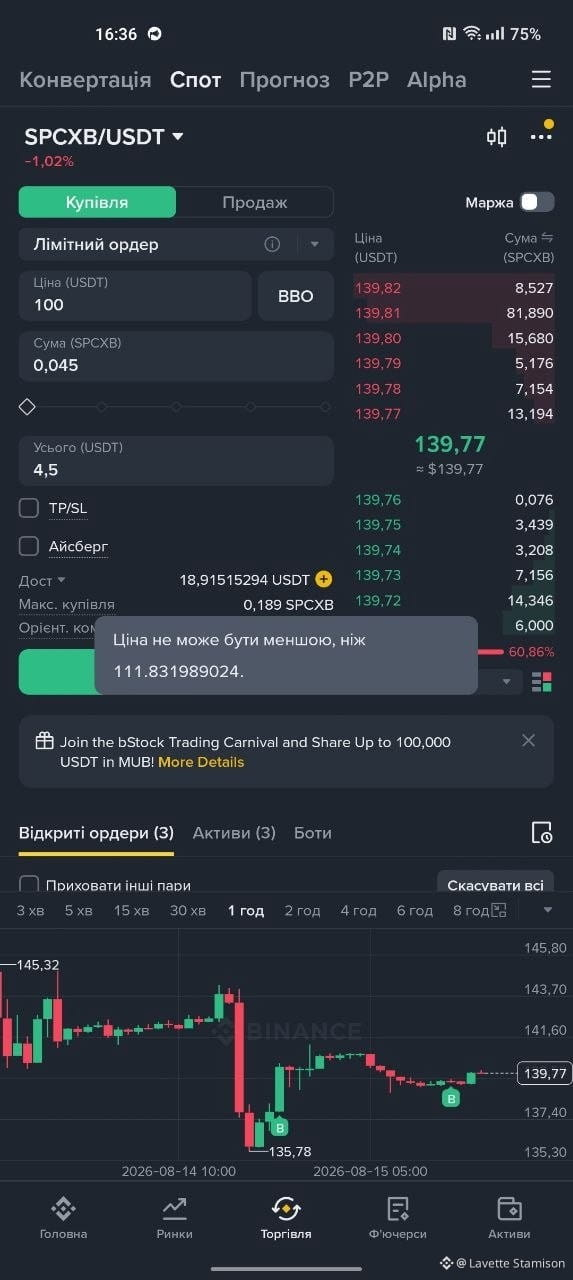
Eleven days I have placed the same five dollar buy in this campaign. Today I tried to place it at 4.50 and the exchange refused twice, for two different reasons. I had never checked the floor I was standing on.
Setup. 15 August, 16:36 Kyiv time, phone app, $SPCXB order book, limit buy, my own account.
Attempt one. Price 100, size 0.045, total 4.50. Refused on price: "Price cannot be lower than 111.831989024." The reference at that second was 139.79. Divide that refusal number by 0.8 and you get 139.78998628. A twenty percent floor under the limit price I am allowed to name.
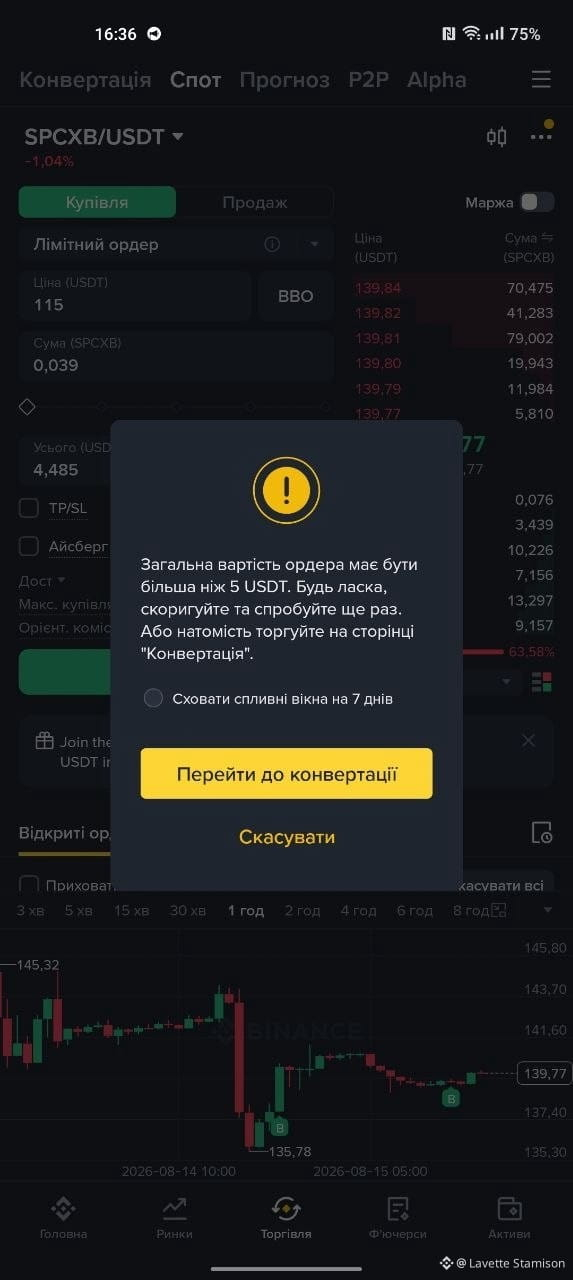
Attempt two. Price 115, size 0.039, total 4.485. Refused on size: total order value must be greater than 5 USDT. The only button on that window was Go to Convert.
Attempt three. Price 115, size 0.045, total 5.175. Accepted at 16:36:46.
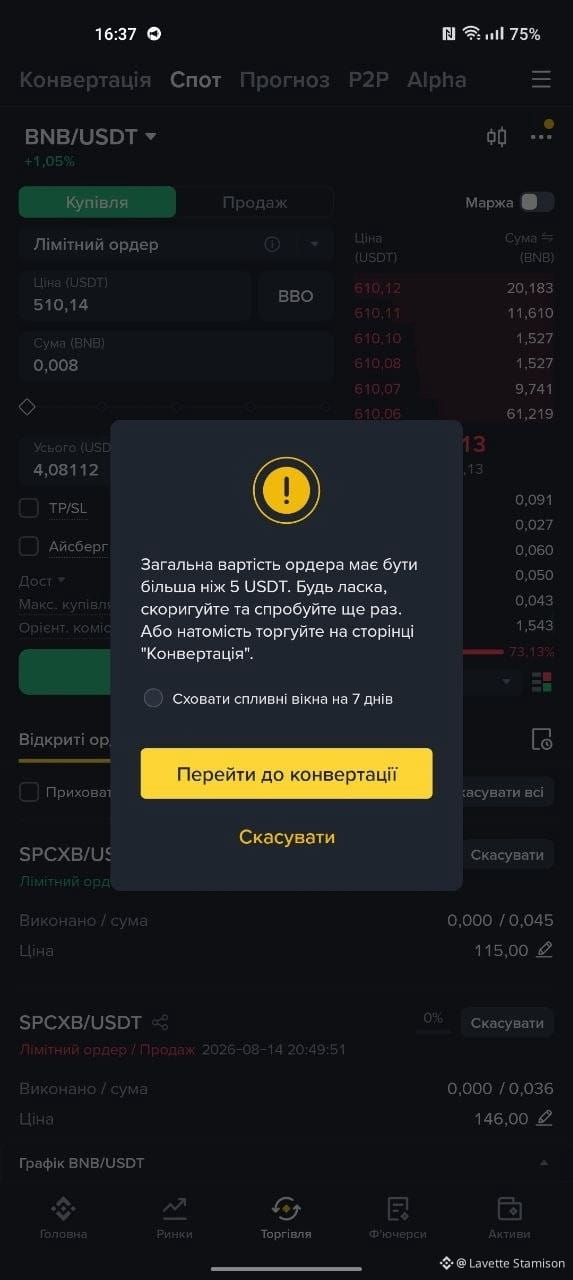
Control, 16:37, on the largest non stablecoin pair here, total 4.08. Identical window, identical wording.
So the floor is not five dollars. It sits above five dollars.
What you pay for. Three things.
The feed keeps saying fractions from 5 dollars. The wording on my screen says greater than 5, not at least 5. The campaign's own daily task is a 5 dollar trade. The threshold is set above the number everyone is told to trade.
Below the threshold you are not refused, you are redirected. Convert has no book and no limit price. You get a quote instead of a market.
The two limits stack on a small position. Your price is fenced into a band, your size is fenced from below. If the same floor applies on the way out, a five dollar position cannot be sold in halves at all.
Honest limits. One account, one minute, buy side only. I stopped at 4.485 and did not test exactly 5.00. I did not test the sell side, so the last point above is an inference, not a measurement. The band I measured on one pair at one price.
Do it yourself. Open the ticket, type 4.50, read what comes back. Do not take my word for any of this.
@BinanceCIS have you placed a bStock order at exactly the campaign amount?
$SPCXB
#bstockscis
Eleven days I have placed the same five dollar buy in this campaign. Today I tried to place it at 4.50 and the exchange refused twice, for two different reasons. I had never checked the floor I was standing on.
Setup. 15 August, 16:36 Kyiv time, phone app, $SPCXB order book, limit buy, my own account.
Attempt one. Price 100, size 0.045, total 4.50. Refused on price: "Price cannot be lower than 111.831989024." The reference at that second was 139.79. Divide that refusal number by 0.8 and you get 139.78998628. A twenty percent floor under the limit price I am allowed to name.
Attempt two. Price 115, size 0.039, total 4.485. Refused on size: total order value must be greater than 5 USDT. The only button on that window was Go to Convert.
Attempt three. Price 115, size 0.045, total 5.175. Accepted at 16:36:46.
Control, 16:37, on the largest non stablecoin pair here, total 4.08. Identical window, identical wording.
So the floor is not five dollars. It sits above five dollars.
What you pay for. Three things.
The feed keeps saying fractions from 5 dollars. The wording on my screen says greater than 5, not at least 5. The campaign's own daily task is a 5 dollar trade. The threshold is set above the number everyone is told to trade.
Below the threshold you are not refused, you are redirected. Convert has no book and no limit price. You get a quote instead of a market.
The two limits stack on a small position. Your price is fenced into a band, your size is fenced from below. If the same floor applies on the way out, a five dollar position cannot be sold in halves at all.
Honest limits. One account, one minute, buy side only. I stopped at 4.485 and did not test exactly 5.00. I did not test the sell side, so the last point above is an inference, not a measurement. The band I measured on one pair at one price.
Do it yourself. Open the ticket, type 4.50, read what comes back. Do not take my word for any of this.
@BinanceCIS have you placed a bStock order at exactly the campaign amount?
$SPCXB
#bstockscis
Setup. 15 August, 16:36 Kyiv time, phone app, $SPCXB order book, limit buy, my own account.
Attempt one. Price 100, size 0.045, total 4.50. Refused on price: "Price cannot be lower than 111.831989024." The reference at that second was 139.79. Divide that refusal number by 0.8 and you get 139.78998628. A twenty percent floor under the limit price I am allowed to name.
Attempt two. Price 115, size 0.039, total 4.485. Refused on size: total order value must be greater than 5 USDT. The only button on that window was Go to Convert.
Attempt three. Price 115, size 0.045, total 5.175. Accepted at 16:36:46.
Control, 16:37, on the largest non stablecoin pair here, total 4.08. Identical window, identical wording.
So the floor is not five dollars. It sits above five dollars.
What you pay for. Three things.
The feed keeps saying fractions from 5 dollars. The wording on my screen says greater than 5, not at least 5. The campaign's own daily task is a 5 dollar trade. The threshold is set above the number everyone is told to trade.
Below the threshold you are not refused, you are redirected. Convert has no book and no limit price. You get a quote instead of a market.
The two limits stack on a small position. Your price is fenced into a band, your size is fenced from below. If the same floor applies on the way out, a five dollar position cannot be sold in halves at all.
Honest limits. One account, one minute, buy side only. I stopped at 4.485 and did not test exactly 5.00. I did not test the sell side, so the last point above is an inference, not a measurement. The band I measured on one pair at one price.
Do it yourself. Open the ticket, type 4.50, read what comes back. Do not take my word for any of this.
@BinanceCIS have you placed a bStock order at exactly the campaign amount?
$SPCXB
#bstockscis
4
3
15
Xem bản dịch
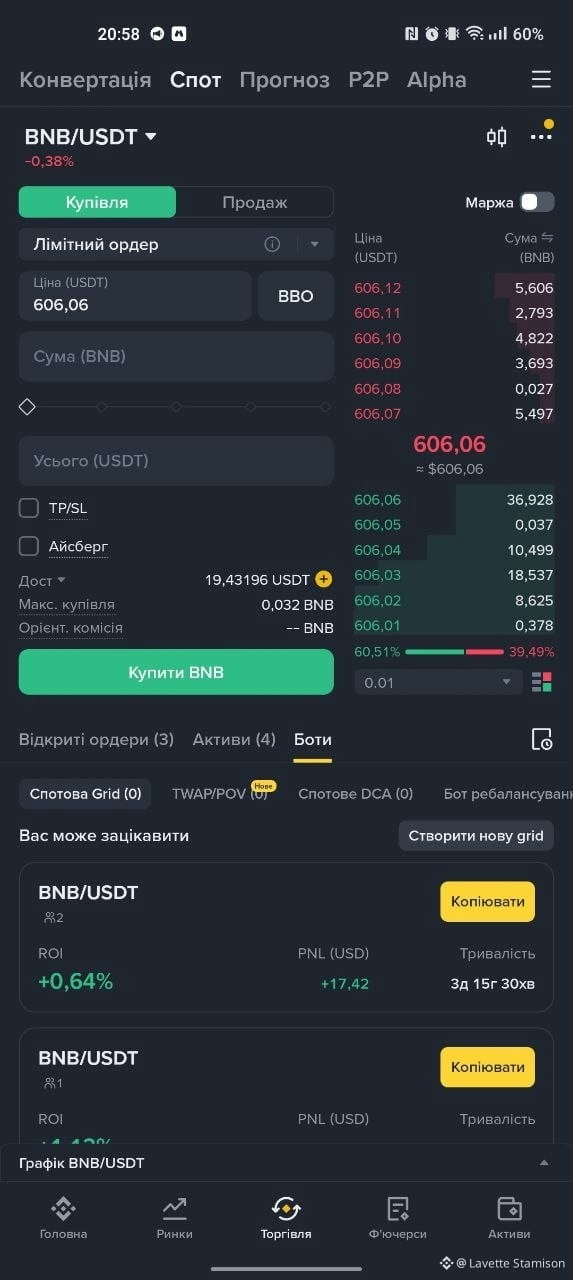
I have twice told you that liquidity on these tokens is thin. Tonight I measured it and I was wrong.
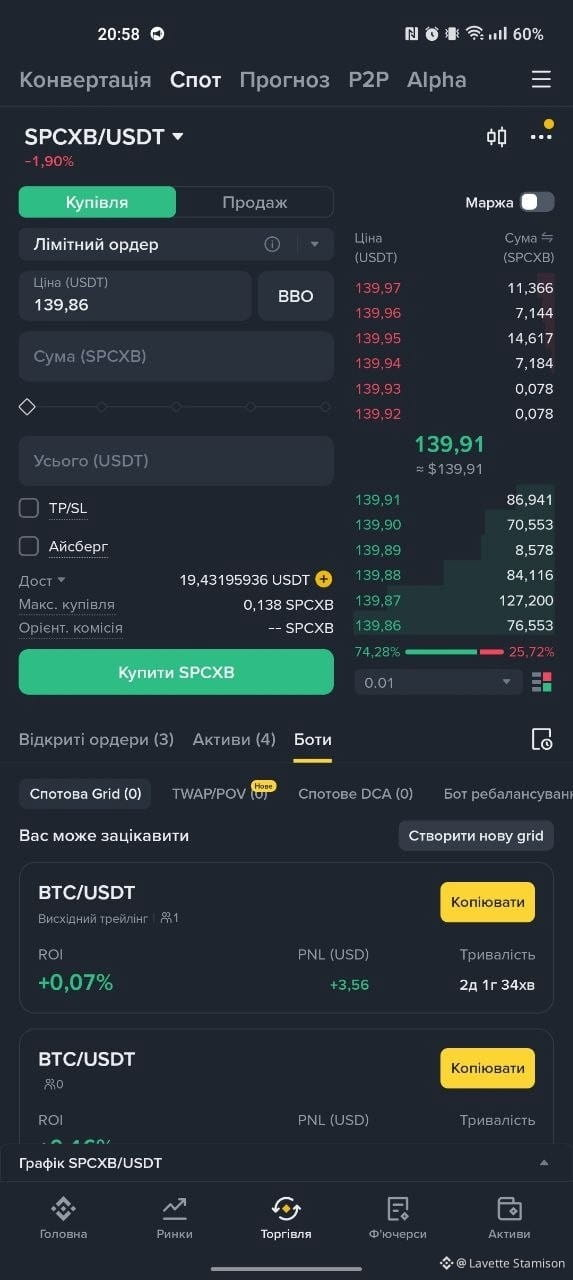
The setup. At 20:58 Kyiv, 13:58 New York, US session open, I opened SPCXB/USDT and BNB/USDT side by side and counted six price levels on each side of both books.
Bids, six levels deep. SPCXB: 453.9 tokens, about $63,500. BNB: 75.0 coins, about $45,500.
Asks, six levels deep. SPCXB: 40.5 tokens, about $5,660. BNB: 22.4 coins, about $13,600.
Spread: one tick on both, $0.01.
Order type menu: identical. Eight types each, TWAP and Scaled Order included.
The bid on a tokenized stock was deeper than the bid on BNB. I had been repeating a claim I never checked on this venue.
What you pay. Three things.
1️⃣ The book is lopsided. SPCXB sat near 11 to 1, bid over ask. BNB near 3 to 1. Buying slips more than selling, on the same screen, in the same second. That is the opposite of the story I had been telling.
2️⃣ A tick is not a tick. One cent on a $139.91 token is 0.007%. One cent on BNB at $606.06 is 0.0017%. Crossing the spread costs four times as much in relative terms, and no chart shows you that.
3️⃣ Scale. The whole visible ask side was $5,660. My campaign trade is $5. At that size none of this reaches me. Most of what gets written about depth here, mine included, is about a problem the writer does not have.
Honest limits: one snapshot, one minute, six levels, one ticker, mid session. Books move in seconds and I did not watch this one move. A deep bid at 21:00 says nothing about 03:00, when the underlying is shut.
Two posts of mine need this correction, so here it is. Before you believe anyone about liquidity on bStocks, open the two books in the same second and count. That includes not believing me.
@BinanceCIS is that bid depth market making, or is it flow?
$SPCXB
#bstockscis
I have twice told you that liquidity on these tokens is thin. Tonight I measured it and I was wrong.
The setup. At 20:58 Kyiv, 13:58 New York, US session open, I opened SPCXB/USDT and BNB/USDT side by side and counted six price levels on each side of both books.
Bids, six levels deep. SPCXB: 453.9 tokens, about $63,500. BNB: 75.0 coins, about $45,500.
Asks, six levels deep. SPCXB: 40.5 tokens, about $5,660. BNB: 22.4 coins, about $13,600.
Spread: one tick on both, $0.01.
Order type menu: identical. Eight types each, TWAP and Scaled Order included.
The bid on a tokenized stock was deeper than the bid on BNB. I had been repeating a claim I never checked on this venue.
What you pay. Three things.
1️⃣ The book is lopsided. SPCXB sat near 11 to 1, bid over ask. BNB near 3 to 1. Buying slips more than selling, on the same screen, in the same second. That is the opposite of the story I had been telling.
2️⃣ A tick is not a tick. One cent on a $139.91 token is 0.007%. One cent on BNB at $606.06 is 0.0017%. Crossing the spread costs four times as much in relative terms, and no chart shows you that.
3️⃣ Scale. The whole visible ask side was $5,660. My campaign trade is $5. At that size none of this reaches me. Most of what gets written about depth here, mine included, is about a problem the writer does not have.
Honest limits: one snapshot, one minute, six levels, one ticker, mid session. Books move in seconds and I did not watch this one move. A deep bid at 21:00 says nothing about 03:00, when the underlying is shut.
Two posts of mine need this correction, so here it is. Before you believe anyone about liquidity on bStocks, open the two books in the same second and count. That includes not believing me.
@BinanceCIS is that bid depth market making, or is it flow?
$SPCXB
#bstockscis
The setup. At 20:58 Kyiv, 13:58 New York, US session open, I opened SPCXB/USDT and BNB/USDT side by side and counted six price levels on each side of both books.
Bids, six levels deep. SPCXB: 453.9 tokens, about $63,500. BNB: 75.0 coins, about $45,500.
Asks, six levels deep. SPCXB: 40.5 tokens, about $5,660. BNB: 22.4 coins, about $13,600.
Spread: one tick on both, $0.01.
Order type menu: identical. Eight types each, TWAP and Scaled Order included.
The bid on a tokenized stock was deeper than the bid on BNB. I had been repeating a claim I never checked on this venue.
What you pay. Three things.
1️⃣ The book is lopsided. SPCXB sat near 11 to 1, bid over ask. BNB near 3 to 1. Buying slips more than selling, on the same screen, in the same second. That is the opposite of the story I had been telling.
2️⃣ A tick is not a tick. One cent on a $139.91 token is 0.007%. One cent on BNB at $606.06 is 0.0017%. Crossing the spread costs four times as much in relative terms, and no chart shows you that.
3️⃣ Scale. The whole visible ask side was $5,660. My campaign trade is $5. At that size none of this reaches me. Most of what gets written about depth here, mine included, is about a problem the writer does not have.
Honest limits: one snapshot, one minute, six levels, one ticker, mid session. Books move in seconds and I did not watch this one move. A deep bid at 21:00 says nothing about 03:00, when the underlying is shut.
Two posts of mine need this correction, so here it is. Before you believe anyone about liquidity on bStocks, open the two books in the same second and count. That includes not believing me.
@BinanceCIS is that bid depth market making, or is it flow?
$SPCXB
#bstockscis
2
1
107
·
--
Tăng giá
Xem bản dịch
Every article about bStocks today quotes one number. I opened the page they all cite and it shows a different one.
The mechanism. Token Terminal's Market cap for tokenized stocks is value tokenized onchain, price times supply, grouped by issuer. Today's story: bStocks passed xStocks into second place behind Ondo.
What you get. An outside scoreboard on the product. Public, no login.
What you pay. Three things.
1️⃣ The rank is thin. At 15:16 Kyiv the page showed bStocks $622.6M and xStocks $605.5M. A $17.1M gap on $622.6M is 2.8%. It was $45M on 3 August, $9.4M on Tuesday.
2️⃣ The comparison is not like-for-like. On that page every bStock lists one chain. Each xStocks asset lists six. bStocks are BEP-20 on BNB Smart Chain, the only rail in and out.
3️⃣ The issuer is not your ticker. Four tokens hold about half of that $622.6M, and two of them are down over 30 days while the issuer total is up.
Honest limits: one snapshot, one afternoon. Market cap mixes price with supply, so a fall can be the stock, not redemptions.
Read the row for your ticker, not the rank of its issuer.
@BinanceCIS which chain besides BSC will bStocks settle on?
$SPCXB
#bstockscis
Every article about bStocks today quotes one number. I opened the page they all cite and it shows a different one.
The mechanism. Token Terminal's Market cap for tokenized stocks is value tokenized onchain, price times supply, grouped by issuer. Today's story: bStocks passed xStocks into second place behind Ondo.
What you get. An outside scoreboard on the product. Public, no login.
What you pay. Three things.
1️⃣ The rank is thin. At 15:16 Kyiv the page showed bStocks $622.6M and xStocks $605.5M. A $17.1M gap on $622.6M is 2.8%. It was $45M on 3 August, $9.4M on Tuesday.
2️⃣ The comparison is not like-for-like. On that page every bStock lists one chain. Each xStocks asset lists six. bStocks are BEP-20 on BNB Smart Chain, the only rail in and out.
3️⃣ The issuer is not your ticker. Four tokens hold about half of that $622.6M, and two of them are down over 30 days while the issuer total is up.
Honest limits: one snapshot, one afternoon. Market cap mixes price with supply, so a fall can be the stock, not redemptions.
Read the row for your ticker, not the rank of its issuer.
@BinanceCIS which chain besides BSC will bStocks settle on?
$SPCXB
#bstockscis
The mechanism. Token Terminal's Market cap for tokenized stocks is value tokenized onchain, price times supply, grouped by issuer. Today's story: bStocks passed xStocks into second place behind Ondo.
What you get. An outside scoreboard on the product. Public, no login.
What you pay. Three things.
1️⃣ The rank is thin. At 15:16 Kyiv the page showed bStocks $622.6M and xStocks $605.5M. A $17.1M gap on $622.6M is 2.8%. It was $45M on 3 August, $9.4M on Tuesday.
2️⃣ The comparison is not like-for-like. On that page every bStock lists one chain. Each xStocks asset lists six. bStocks are BEP-20 on BNB Smart Chain, the only rail in and out.
3️⃣ The issuer is not your ticker. Four tokens hold about half of that $622.6M, and two of them are down over 30 days while the issuer total is up.
Honest limits: one snapshot, one afternoon. Market cap mixes price with supply, so a fall can be the stock, not redemptions.
Read the row for your ticker, not the rank of its issuer.
@BinanceCIS which chain besides BSC will bStocks settle on?
$SPCXB
#bstockscis
I go by rankings
34%
I check my ticker's own row
33%
Didn't know it's one chain
0%
I track neither
33%
3 phiếu bầu • Cuộc bỏ phiếu đã kết thúc
2
3
552
·
--
Tăng giá
Xem bản dịch
Today I went looking for what a bStock dividend actually pays and found two Binance pages that disagree.
The bStocks site promises the same economic entitlement as a shareholder. The Bahrain launch disclaimer says holders are not entitled to any dividends at all.
The mechanism. A dividend never reaches you as cash. The issuer collects it, withholding is applied, and the rest is rebased into your balance by the Multiplier.
What you get. Compounding with no action and no fee, on a fraction of a share.
What you pay. Three things.
1️⃣ Withholding. The standard US rate on dividends to a non-resident is 30% unless a treaty applies. Binance CIS published IBMB near 2.2% on 4 August. Net, closer to 1.5%.
2️⃣ The exit shuts. For Apple and IBM the snapshot was 10 August, 00:00 UTC, and conversion into the share was suspended from 8 August. The dividend lands while the door is shut.
3️⃣ No choice. You cannot take the cash instead. The issuer says the adjustment may not reflect the dividend's full value.
I read documents, not my own screen, and have never held a bStock through a dividend. Check the announcement for your ticker.
@BinanceCIS which rate applies to a CIS holder?
$IBMB
#bstockscis
Today I went looking for what a bStock dividend actually pays and found two Binance pages that disagree.
The bStocks site promises the same economic entitlement as a shareholder. The Bahrain launch disclaimer says holders are not entitled to any dividends at all.
The mechanism. A dividend never reaches you as cash. The issuer collects it, withholding is applied, and the rest is rebased into your balance by the Multiplier.
What you get. Compounding with no action and no fee, on a fraction of a share.
What you pay. Three things.
1️⃣ Withholding. The standard US rate on dividends to a non-resident is 30% unless a treaty applies. Binance CIS published IBMB near 2.2% on 4 August. Net, closer to 1.5%.
2️⃣ The exit shuts. For Apple and IBM the snapshot was 10 August, 00:00 UTC, and conversion into the share was suspended from 8 August. The dividend lands while the door is shut.
3️⃣ No choice. You cannot take the cash instead. The issuer says the adjustment may not reflect the dividend's full value.
I read documents, not my own screen, and have never held a bStock through a dividend. Check the announcement for your ticker.
@BinanceCIS which rate applies to a CIS holder?
$IBMB
#bstockscis
The bStocks site promises the same economic entitlement as a shareholder. The Bahrain launch disclaimer says holders are not entitled to any dividends at all.
The mechanism. A dividend never reaches you as cash. The issuer collects it, withholding is applied, and the rest is rebased into your balance by the Multiplier.
What you get. Compounding with no action and no fee, on a fraction of a share.
What you pay. Three things.
1️⃣ Withholding. The standard US rate on dividends to a non-resident is 30% unless a treaty applies. Binance CIS published IBMB near 2.2% on 4 August. Net, closer to 1.5%.
2️⃣ The exit shuts. For Apple and IBM the snapshot was 10 August, 00:00 UTC, and conversion into the share was suspended from 8 August. The dividend lands while the door is shut.
3️⃣ No choice. You cannot take the cash instead. The issuer says the adjustment may not reflect the dividend's full value.
I read documents, not my own screen, and have never held a bStock through a dividend. Check the announcement for your ticker.
@BinanceCIS which rate applies to a CIS holder?
$IBMB
#bstockscis
Didn't know about withholding
0%
Knew it, fine with it
0%
I avoid dividend tickers
0%
I exit before the snapshot
0%
0 phiếu bầu • Cuộc bỏ phiếu đã kết thúc
5
3
586
Xem bản dịch
I went looking for the DeFi yield everyone promises on bStocks and found a pool paying 74,110% APR.
It holds $7.25.
Every thread this week ends the same way. Withdraw to your wallet, put it into DeFi, earn yield. None names a venue or a number.
Binance Research did. Its 8 July figures for PancakeSwap LP yields on bStocks top out at 228%.
I searched NVDAB on PancakeSwap myself, 15:00 Kyiv time. The first six results are all the same token on the same chain. The deepest quotes 324.70% APR on $1,002,026 of liquidity and did $5.38M in 24h. The 0.01% tier quotes 74,110% APR on $7.25 and traded nothing at all. A V2 pool shows 155.57% on $5.91.
Here is what I take from this. APR is a fraction, and on a dead pool the denominator writes the headline. The 228% from a month ago is not today's ceiling, but the loudest number on my screen was also the emptiest.
Read TVL first, APR second. A rate quoted on seven dollars tells you nothing about the rate you get on five hundred.
Honest limits: one ticker, one afternoon, one screen. These pools reprice constantly, so check before you size.
@BinanceCIS what APR were you shown when someone said bStocks earn yield?
#bstockscis $NVDAB
I went looking for the DeFi yield everyone promises on bStocks and found a pool paying 74,110% APR.
It holds $7.25.
Every thread this week ends the same way. Withdraw to your wallet, put it into DeFi, earn yield. None names a venue or a number.
Binance Research did. Its 8 July figures for PancakeSwap LP yields on bStocks top out at 228%.
I searched NVDAB on PancakeSwap myself, 15:00 Kyiv time. The first six results are all the same token on the same chain. The deepest quotes 324.70% APR on $1,002,026 of liquidity and did $5.38M in 24h. The 0.01% tier quotes 74,110% APR on $7.25 and traded nothing at all. A V2 pool shows 155.57% on $5.91.
Here is what I take from this. APR is a fraction, and on a dead pool the denominator writes the headline. The 228% from a month ago is not today's ceiling, but the loudest number on my screen was also the emptiest.
Read TVL first, APR second. A rate quoted on seven dollars tells you nothing about the rate you get on five hundred.
Honest limits: one ticker, one afternoon, one screen. These pools reprice constantly, so check before you size.
@BinanceCIS what APR were you shown when someone said bStocks earn yield?
#bstockscis $NVDAB
It holds $7.25.
Every thread this week ends the same way. Withdraw to your wallet, put it into DeFi, earn yield. None names a venue or a number.
Binance Research did. Its 8 July figures for PancakeSwap LP yields on bStocks top out at 228%.
I searched NVDAB on PancakeSwap myself, 15:00 Kyiv time. The first six results are all the same token on the same chain. The deepest quotes 324.70% APR on $1,002,026 of liquidity and did $5.38M in 24h. The 0.01% tier quotes 74,110% APR on $7.25 and traded nothing at all. A V2 pool shows 155.57% on $5.91.
Here is what I take from this. APR is a fraction, and on a dead pool the denominator writes the headline. The 228% from a month ago is not today's ceiling, but the loudest number on my screen was also the emptiest.
Read TVL first, APR second. A rate quoted on seven dollars tells you nothing about the rate you get on five hundred.
Honest limits: one ticker, one afternoon, one screen. These pools reprice constantly, so check before you size.
@BinanceCIS what APR were you shown when someone said bStocks earn yield?
#bstockscis $NVDAB
Never saw a number
100%
Under 20%
0%
Over 100%
0%
I check TVL first
0%
1 phiếu bầu • Cuộc bỏ phiếu đã kết thúc
1
1
92
·
--
Tăng giá
Đã xác minh
Miễn phí phí maker trên bStocks chạy đến ngày 31 tháng Tám. Điều đó nghe có vẻ như giao dịch rẻ hơn. Nhưng còn một cách hiểu ít rõ ràng hơn.
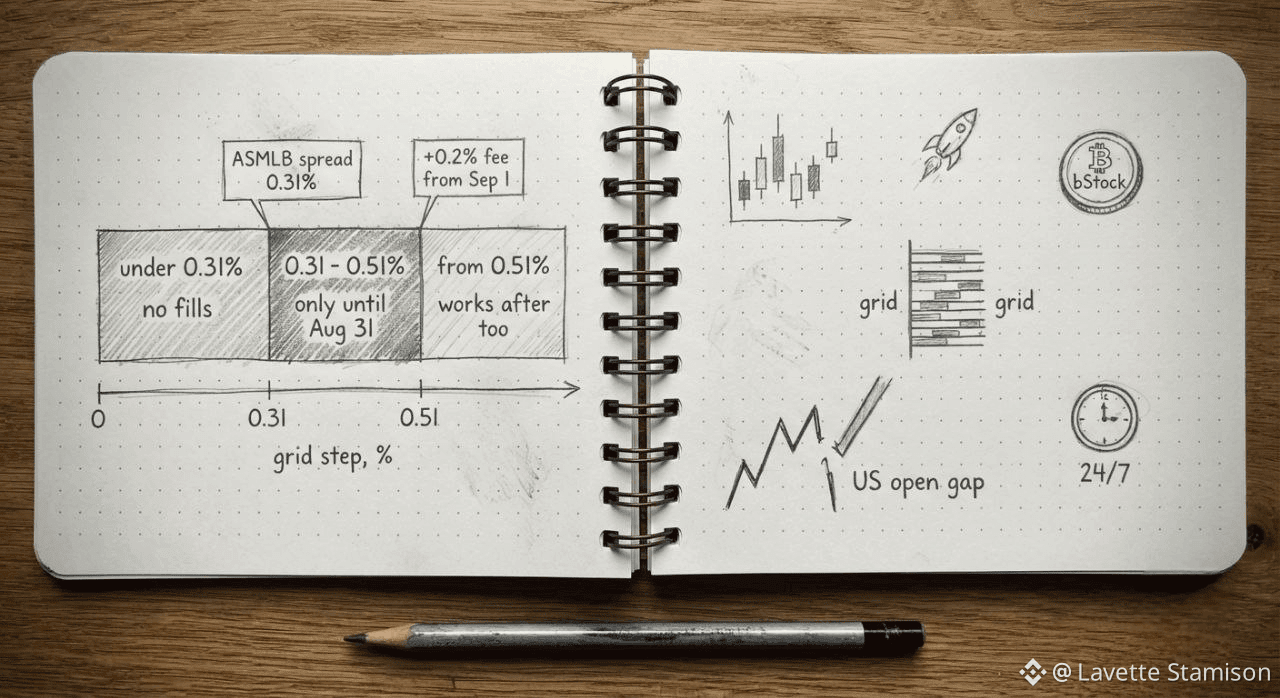
Cơ chế. Vào ngày 5 tháng 8, với mười cặp mới, Binance đã bật Spot Algo Trading Bot. Bot dạng lưới hoạt động thông qua lệnh giới hạn, vì vậy nó nằm ở phía maker gần như liên tục. Trong suốt thời gian khuyến mãi, các lệnh đó được điền miễn phí.
Điều đó mang lại cho bạn. Cổ phiếu cơ sở giao dịch khoảng sáu tiếng rưỡi mỗi ngày. bStock thì không bao giờ dừng. Phần lớn thời gian, giá biến động trong một thị trường thanh khoản mỏng, không có “reference print” từ Nasdaq. Đây là điều kiện làm việc phù hợp cho một chiến lược lưới: nó không đoán hướng, mà khai thác biên dao động.
Bạn phải trả gì cho nó. Ba thứ.
Tính thanh khoản mỏng ngoài phiên Mỹ làm giãn spread. Thứ bạn tiết kiệm được ở phí có thể chuyển thành chi phí trượt giá (slippage).
Khoảng trống tại thời điểm mở cửa phiên Mỹ đẩy lưới ra khỏi biên của nó. Bot không có góc nhìn về kết quả kinh doanh hay vĩ mô.
Từ ngày 1 tháng 9, mức phí tiêu chuẩn sẽ trở lại. Những phép tính từng hiệu quả trong tháng 8 có thể không còn đúng trong tháng 9.
Tôi chưa từng chạy một lưới trên một cặp bStocks, chỉ theo dõi sổ lệnh ASMLB: trong phiên châu Âu, spread giữ quanh khoảng một phần ba phần trăm. Trước khi bắt đầu, tôi sẽ kiểm tra xem bước của lưới có đủ bao phủ spread đó hay không.
$ASMLB
#bstockscis @BinanceCIS
Miễn phí phí maker trên bStocks chạy đến ngày 31 tháng Tám. Điều đó nghe có vẻ như giao dịch rẻ hơn. Nhưng còn một cách hiểu ít rõ ràng hơn.
Cơ chế. Vào ngày 5 tháng 8, với mười cặp mới, Binance đã bật Spot Algo Trading Bot. Bot dạng lưới hoạt động thông qua lệnh giới hạn, vì vậy nó nằm ở phía maker gần như liên tục. Trong suốt thời gian khuyến mãi, các lệnh đó được điền miễn phí.
Điều đó mang lại cho bạn. Cổ phiếu cơ sở giao dịch khoảng sáu tiếng rưỡi mỗi ngày. bStock thì không bao giờ dừng. Phần lớn thời gian, giá biến động trong một thị trường thanh khoản mỏng, không có “reference print” từ Nasdaq. Đây là điều kiện làm việc phù hợp cho một chiến lược lưới: nó không đoán hướng, mà khai thác biên dao động.
Bạn phải trả gì cho nó. Ba thứ.
Tính thanh khoản mỏng ngoài phiên Mỹ làm giãn spread. Thứ bạn tiết kiệm được ở phí có thể chuyển thành chi phí trượt giá (slippage).
Khoảng trống tại thời điểm mở cửa phiên Mỹ đẩy lưới ra khỏi biên của nó. Bot không có góc nhìn về kết quả kinh doanh hay vĩ mô.
Từ ngày 1 tháng 9, mức phí tiêu chuẩn sẽ trở lại. Những phép tính từng hiệu quả trong tháng 8 có thể không còn đúng trong tháng 9.
Tôi chưa từng chạy một lưới trên một cặp bStocks, chỉ theo dõi sổ lệnh ASMLB: trong phiên châu Âu, spread giữ quanh khoảng một phần ba phần trăm. Trước khi bắt đầu, tôi sẽ kiểm tra xem bước của lưới có đủ bao phủ spread đó hay không.
$ASMLB
#bstockscis @BinanceCIS
Cơ chế. Vào ngày 5 tháng 8, với mười cặp mới, Binance đã bật Spot Algo Trading Bot. Bot dạng lưới hoạt động thông qua lệnh giới hạn, vì vậy nó nằm ở phía maker gần như liên tục. Trong suốt thời gian khuyến mãi, các lệnh đó được điền miễn phí.
Điều đó mang lại cho bạn. Cổ phiếu cơ sở giao dịch khoảng sáu tiếng rưỡi mỗi ngày. bStock thì không bao giờ dừng. Phần lớn thời gian, giá biến động trong một thị trường thanh khoản mỏng, không có “reference print” từ Nasdaq. Đây là điều kiện làm việc phù hợp cho một chiến lược lưới: nó không đoán hướng, mà khai thác biên dao động.
Bạn phải trả gì cho nó. Ba thứ.
Tính thanh khoản mỏng ngoài phiên Mỹ làm giãn spread. Thứ bạn tiết kiệm được ở phí có thể chuyển thành chi phí trượt giá (slippage).
Khoảng trống tại thời điểm mở cửa phiên Mỹ đẩy lưới ra khỏi biên của nó. Bot không có góc nhìn về kết quả kinh doanh hay vĩ mô.
Từ ngày 1 tháng 9, mức phí tiêu chuẩn sẽ trở lại. Những phép tính từng hiệu quả trong tháng 8 có thể không còn đúng trong tháng 9.
Tôi chưa từng chạy một lưới trên một cặp bStocks, chỉ theo dõi sổ lệnh ASMLB: trong phiên châu Âu, spread giữ quanh khoảng một phần ba phần trăm. Trước khi bắt đầu, tôi sẽ kiểm tra xem bước của lưới có đủ bao phủ spread đó hay không.
$ASMLB
#bstockscis @BinanceCIS
2
101
Đã xác minh
Xem bản dịch
Що станеться з обсягом bStocks 1 вересня, коли вимкнеться нульова комісія мейкера?
Звіт CoinDesk Data за липень, опублікований 1 серпня: обсяг торгів токенізованими акціями і ETF - $11,3 млрд, +288% за місяць. На bStocks припало $9,41 млрд, 83,3% ринку.
З них один токен, $QQQB (Invesco QQQ Trust, лістинг 30 червня о 13:30 UTC), зробив $9,27 млрд - близько 82% ринку. Я відняв: на всю решту лінійки bStocks лишається близько $140 млн за липень. Точність груба, це різниця округлених чисел, але порядок такий - приблизно $4,5 млн на добу на все інше.
Дві дати пояснюють це краще за попит. QQQB торгується з нульовою комісією мейкера до 31 серпня. З 23 липня Binance рахує обсяг по акціях і bStocks з множником 3x для просування по VIP-рівнях.
Базовий актив: QQQ у липні впав на 6,6% і в моменті був на 10,2% нижче закриття 30 червня, тоді як Nasdaq Composite -3,2%, S&P 500 -0,1%. Обсяг ріс не за ціною.
Для мене з цього випливає умова. Інший ETF лінійки, $EWYB (iShares MSCI South Korea), сидить уже в тій решті. Поки комісія нульова, я працюю лімітками, а після 31 серпня перевірятиму спред до заявки, не після.
{spot}(QQQBUSDT)
Що буде з обсягом bStocks після 31 серпня?
#bstockscis @BinanceCIS
Що станеться з обсягом bStocks 1 вересня, коли вимкнеться нульова комісія мейкера?
Звіт CoinDesk Data за липень, опублікований 1 серпня: обсяг торгів токенізованими акціями і ETF - $11,3 млрд, +288% за місяць. На bStocks припало $9,41 млрд, 83,3% ринку.
З них один токен, $QQQB (Invesco QQQ Trust, лістинг 30 червня о 13:30 UTC), зробив $9,27 млрд - близько 82% ринку. Я відняв: на всю решту лінійки bStocks лишається близько $140 млн за липень. Точність груба, це різниця округлених чисел, але порядок такий - приблизно $4,5 млн на добу на все інше.
Дві дати пояснюють це краще за попит. QQQB торгується з нульовою комісією мейкера до 31 серпня. З 23 липня Binance рахує обсяг по акціях і bStocks з множником 3x для просування по VIP-рівнях.
Базовий актив: QQQ у липні впав на 6,6% і в моменті був на 10,2% нижче закриття 30 червня, тоді як Nasdaq Composite -3,2%, S&P 500 -0,1%. Обсяг ріс не за ціною.
Для мене з цього випливає умова. Інший ETF лінійки, $EWYB (iShares MSCI South Korea), сидить уже в тій решті. Поки комісія нульова, я працюю лімітками, а після 31 серпня перевірятиму спред до заявки, не після.
Що буде з обсягом bStocks після 31 серпня?
#bstockscis @BinanceCIS
Звіт CoinDesk Data за липень, опублікований 1 серпня: обсяг торгів токенізованими акціями і ETF - $11,3 млрд, +288% за місяць. На bStocks припало $9,41 млрд, 83,3% ринку.
З них один токен, $QQQB (Invesco QQQ Trust, лістинг 30 червня о 13:30 UTC), зробив $9,27 млрд - близько 82% ринку. Я відняв: на всю решту лінійки bStocks лишається близько $140 млн за липень. Точність груба, це різниця округлених чисел, але порядок такий - приблизно $4,5 млн на добу на все інше.
Дві дати пояснюють це краще за попит. QQQB торгується з нульовою комісією мейкера до 31 серпня. З 23 липня Binance рахує обсяг по акціях і bStocks з множником 3x для просування по VIP-рівнях.
Базовий актив: QQQ у липні впав на 6,6% і в моменті був на 10,2% нижче закриття 30 червня, тоді як Nasdaq Composite -3,2%, S&P 500 -0,1%. Обсяг ріс не за ціною.
Для мене з цього випливає умова. Інший ETF лінійки, $EWYB (iShares MSCI South Korea), сидить уже в тій решті. Поки комісія нульова, я працюю лімітками, а після 31 серпня перевірятиму спред до заявки, не після.
Що буде з обсягом bStocks після 31 серпня?
#bstockscis @BinanceCIS
Впаде помітно 📉
0%
Утримається ⚖️
100%
Виросте, річ не в комісії 📈
0%
1 phiếu bầu • Cuộc bỏ phiếu đã kết thúc
2
88
·
--
Tăng giá
Đúng một phần
Xem bản dịch
I opened [Proof of Collateral](https://www.binance.com/en/proof-of-collateral/bstocks) to check one number. It is not the number everyone repeats.
It says 66 bStocks are currently issued. Not 25, not 40.
It also settles a claim that still circulates: $METAB exists. The page shows 3,270 Meta shares in custody and exactly 3,270 METAB as BEP-20. Backing 100%, updated today at 00:46:22.
Then I opened the $ASMLB order book on Spot, 15:30 Kyiv time. Lowest ask 1,739.85, highest bid 1,734.48. Spread 5.37 USDT, or 0.31%.
24h volume - 14.09 tokens, about 24,569 USDT. Fourteen ASML shares in a full day.
Here is what I take from this. 1:1 backing and liquidity are different things. The first guarantees a share sits behind the token. The second decides the price you exit at. On a book this thin a market order costs more than the fee, which is zero until August 31 anyway. So limit orders, not market.
On PancakeSwap I checked a different ticker, $NFLXB : 100 USDT gives 1.366819 tokens. Next to the name sits a Scale 1.00x badge - looks like the same Multiplier.
Do you check the spread before entering, or just hit market?
#bstockscis @BinanceCIS
I opened Proof of Collateral to check one number. It is not the number everyone repeats.
It says 66 bStocks are currently issued. Not 25, not 40.
It also settles a claim that still circulates: $METAB exists. The page shows 3,270 Meta shares in custody and exactly 3,270 METAB as BEP-20. Backing 100%, updated today at 00:46:22.
Then I opened the $ASMLB order book on Spot, 15:30 Kyiv time. Lowest ask 1,739.85, highest bid 1,734.48. Spread 5.37 USDT, or 0.31%.
24h volume - 14.09 tokens, about 24,569 USDT. Fourteen ASML shares in a full day.
Here is what I take from this. 1:1 backing and liquidity are different things. The first guarantees a share sits behind the token. The second decides the price you exit at. On a book this thin a market order costs more than the fee, which is zero until August 31 anyway. So limit orders, not market.
On PancakeSwap I checked a different ticker, $NFLXB : 100 USDT gives 1.366819 tokens. Next to the name sits a Scale 1.00x badge - looks like the same Multiplier.
Do you check the spread before entering, or just hit market?
#bstockscis @BinanceCIS
It says 66 bStocks are currently issued. Not 25, not 40.
It also settles a claim that still circulates: $METAB exists. The page shows 3,270 Meta shares in custody and exactly 3,270 METAB as BEP-20. Backing 100%, updated today at 00:46:22.
Then I opened the $ASMLB order book on Spot, 15:30 Kyiv time. Lowest ask 1,739.85, highest bid 1,734.48. Spread 5.37 USDT, or 0.31%.
24h volume - 14.09 tokens, about 24,569 USDT. Fourteen ASML shares in a full day.
Here is what I take from this. 1:1 backing and liquidity are different things. The first guarantees a share sits behind the token. The second decides the price you exit at. On a book this thin a market order costs more than the fee, which is zero until August 31 anyway. So limit orders, not market.
On PancakeSwap I checked a different ticker, $NFLXB : 100 USDT gives 1.366819 tokens. Next to the name sits a Scale 1.00x badge - looks like the same Multiplier.
Do you check the spread before entering, or just hit market?
#bstockscis @BinanceCIS
I always check the spread
0%
Limit orders only
100%
I just hit market
0%
Haven't traded bStocks yet
0%
1 phiếu bầu • Cuộc bỏ phiếu đã kết thúc
2
149
·
--
Tăng giá
Đã xác minh
Xem bản dịch
Забезпечення 1:1 звучить переконливо рівно доти, доки не спитаєш: а зворотний шлях працює?
Саме він відрізняє реальне покриття від запису в таблиці.
bStock - це сертифікат, який випускає BTech Holdings, афілійована з Binance, і за кожним стоїть реальна акція у співвідношенні 1:1. Але головне інше: конвертація працює в обидва боки. Пряму акцію можна перевести в bStock, а bStock назад у пряму акцію - безкоштовно і в будь-яку годину, не чекаючи відкриття біржі.
Я щодня беру $SPCXB на $5. При ціні близько $113 це приблизно 0,044 токена. Дробова позиція, за якою стоять ті самі двері назад.
Жодного разу нічого не конвертував. Але сам факт, що вихід існує, змінює те, як дивишся на позицію. Одна річ тримати токен, який можна лише продати за USDT. Інша - тримати той, у якого є прохід у базовий актив.
Чесно про обмеження: це не пряме володіння акцією, права голосу немає, регуляторно це сертифікат за правилами ADGM/FSRA. Доступність конвертації залежить від регіону та статусу акаунта.
А ви перевіряли, чи доступна конвертація саме вам?
@BinanceCIS #bstockscis $SPCXB
Забезпечення 1:1 звучить переконливо рівно доти, доки не спитаєш: а зворотний шлях працює?
Саме він відрізняє реальне покриття від запису в таблиці.
bStock - це сертифікат, який випускає BTech Holdings, афілійована з Binance, і за кожним стоїть реальна акція у співвідношенні 1:1. Але головне інше: конвертація працює в обидва боки. Пряму акцію можна перевести в bStock, а bStock назад у пряму акцію - безкоштовно і в будь-яку годину, не чекаючи відкриття біржі.
Я щодня беру $SPCXB на $5. При ціні близько $113 це приблизно 0,044 токена. Дробова позиція, за якою стоять ті самі двері назад.
Жодного разу нічого не конвертував. Але сам факт, що вихід існує, змінює те, як дивишся на позицію. Одна річ тримати токен, який можна лише продати за USDT. Інша - тримати той, у якого є прохід у базовий актив.
Чесно про обмеження: це не пряме володіння акцією, права голосу немає, регуляторно це сертифікат за правилами ADGM/FSRA. Доступність конвертації залежить від регіону та статусу акаунта.
А ви перевіряли, чи доступна конвертація саме вам?
@BinanceCIS #bstockscis $SPCXB
Саме він відрізняє реальне покриття від запису в таблиці.
bStock - це сертифікат, який випускає BTech Holdings, афілійована з Binance, і за кожним стоїть реальна акція у співвідношенні 1:1. Але головне інше: конвертація працює в обидва боки. Пряму акцію можна перевести в bStock, а bStock назад у пряму акцію - безкоштовно і в будь-яку годину, не чекаючи відкриття біржі.
Я щодня беру $SPCXB на $5. При ціні близько $113 це приблизно 0,044 токена. Дробова позиція, за якою стоять ті самі двері назад.
Жодного разу нічого не конвертував. Але сам факт, що вихід існує, змінює те, як дивишся на позицію. Одна річ тримати токен, який можна лише продати за USDT. Інша - тримати той, у якого є прохід у базовий актив.
Чесно про обмеження: це не пряме володіння акцією, права голосу немає, регуляторно це сертифікат за правилами ADGM/FSRA. Доступність конвертації залежить від регіону та статусу акаунта.
А ви перевіряли, чи доступна конвертація саме вам?
@BinanceCIS #bstockscis $SPCXB
Так, доступна
67%
Ні, не перевіряв
33%
Ні, не знав про неї
0%
Ще не купував bStocks
0%
3 phiếu bầu • Cuộc bỏ phiếu đã kết thúc
2
218
Đảm bảo 1:1 không có nghĩa là giá cũng sẽ theo tỷ lệ 1:1.
Bạn có biết rằng khoảng 58% khối lượng giao dịch liên quan đến cổ phiếu trên Binance diễn ra khi Nasdaq và NYSE đã đóng cửa? Hóa ra, phần lớn giao dịch lại diễn ra trong sổ lệnh mỏng nhất. Theo tôi, đây là rủi ro thực tế nhất trong bStocks mà lạ là ít người đề cập.
Dưới đây là ba điều bạn nên hiểu về giá bStock:
1. Phí bảo hiểm và chiết khấu. Đảm bảo cam kết rằng đằng sau mỗi token là một cổ phiếu thực, nhưng giá thì mỗi giây được quyết định bởi sổ lệnh. Cao hơn giá tham chiếu của tài sản cơ sở là phí bảo hiểm, thấp hơn là chiết khấu. Giá tham chiếu ở đây chỉ mang tính định hướng, không phải là sự ràng buộc.
2. Chênh lệch (spread). Trong khi phiên chính đang mở, khoảng chênh hẹp và được khép lại nhanh chóng. Ngoài phiên, không thể đối chiếu theo thời gian thực với bất kỳ thứ gì: ít lệnh hơn, spread rộng hơn, và lệnh thị trường có thể được khớp với mức tệ hơn đáng kể so với những gì biểu đồ thể hiện.
3. Market-maker. Họ giữ báo giá ở cả hai phía và “ép” cho spread thu hẹp, nhưng không hủy bỏ spread đó.
Vì vậy, trong chế độ truy cập 24/7 vẫn có mặt “phần còn lại”. Bạn phải tự kiểm tra giá, vì lúc 3 giờ sáng thì không ai làm điều đó thay bạn.
Không phải là lời khuyên đầu tư. DYOR.
$SPCXB @BinanceCIS #bstockscis
{spot}(SPCXBUSDT)
Vậy trước khi thực hiện giao dịch ngoài phiên chính, bạn đang nhìn vào điều gì?
Đảm bảo 1:1 không có nghĩa là giá cũng sẽ theo tỷ lệ 1:1.
Bạn có biết rằng khoảng 58% khối lượng giao dịch liên quan đến cổ phiếu trên Binance diễn ra khi Nasdaq và NYSE đã đóng cửa? Hóa ra, phần lớn giao dịch lại diễn ra trong sổ lệnh mỏng nhất. Theo tôi, đây là rủi ro thực tế nhất trong bStocks mà lạ là ít người đề cập.
Dưới đây là ba điều bạn nên hiểu về giá bStock:
1. Phí bảo hiểm và chiết khấu. Đảm bảo cam kết rằng đằng sau mỗi token là một cổ phiếu thực, nhưng giá thì mỗi giây được quyết định bởi sổ lệnh. Cao hơn giá tham chiếu của tài sản cơ sở là phí bảo hiểm, thấp hơn là chiết khấu. Giá tham chiếu ở đây chỉ mang tính định hướng, không phải là sự ràng buộc.
2. Chênh lệch (spread). Trong khi phiên chính đang mở, khoảng chênh hẹp và được khép lại nhanh chóng. Ngoài phiên, không thể đối chiếu theo thời gian thực với bất kỳ thứ gì: ít lệnh hơn, spread rộng hơn, và lệnh thị trường có thể được khớp với mức tệ hơn đáng kể so với những gì biểu đồ thể hiện.
3. Market-maker. Họ giữ báo giá ở cả hai phía và “ép” cho spread thu hẹp, nhưng không hủy bỏ spread đó.
Vì vậy, trong chế độ truy cập 24/7 vẫn có mặt “phần còn lại”. Bạn phải tự kiểm tra giá, vì lúc 3 giờ sáng thì không ai làm điều đó thay bạn.
Không phải là lời khuyên đầu tư. DYOR.
$SPCXB @BinanceCIS #bstockscis
Vậy trước khi thực hiện giao dịch ngoài phiên chính, bạn đang nhìn vào điều gì?
Bạn có biết rằng khoảng 58% khối lượng giao dịch liên quan đến cổ phiếu trên Binance diễn ra khi Nasdaq và NYSE đã đóng cửa? Hóa ra, phần lớn giao dịch lại diễn ra trong sổ lệnh mỏng nhất. Theo tôi, đây là rủi ro thực tế nhất trong bStocks mà lạ là ít người đề cập.
Dưới đây là ba điều bạn nên hiểu về giá bStock:
1. Phí bảo hiểm và chiết khấu. Đảm bảo cam kết rằng đằng sau mỗi token là một cổ phiếu thực, nhưng giá thì mỗi giây được quyết định bởi sổ lệnh. Cao hơn giá tham chiếu của tài sản cơ sở là phí bảo hiểm, thấp hơn là chiết khấu. Giá tham chiếu ở đây chỉ mang tính định hướng, không phải là sự ràng buộc.
2. Chênh lệch (spread). Trong khi phiên chính đang mở, khoảng chênh hẹp và được khép lại nhanh chóng. Ngoài phiên, không thể đối chiếu theo thời gian thực với bất kỳ thứ gì: ít lệnh hơn, spread rộng hơn, và lệnh thị trường có thể được khớp với mức tệ hơn đáng kể so với những gì biểu đồ thể hiện.
3. Market-maker. Họ giữ báo giá ở cả hai phía và “ép” cho spread thu hẹp, nhưng không hủy bỏ spread đó.
Vì vậy, trong chế độ truy cập 24/7 vẫn có mặt “phần còn lại”. Bạn phải tự kiểm tra giá, vì lúc 3 giờ sáng thì không ai làm điều đó thay bạn.
Không phải là lời khuyên đầu tư. DYOR.
$SPCXB @BinanceCIS #bstockscis
Vậy trước khi thực hiện giao dịch ngoài phiên chính, bạn đang nhìn vào điều gì?
Спред
0%
Премію або дисконт
0%
Тільки графік
100%
1 phiếu bầu • Cuộc bỏ phiếu đã kết thúc
259
#bstockscis @BinanceCIS
Gần đây tôi có nói chuyện với bạn của mình và đây là điều tôi phát hiện ra.
Fr - Tôi đang tìm hiểu bStocks ở đây và thấy một điểm khá thú vị. Có lẽ bạn cũng nghĩ rằng các khoản cổ tức cho những token này chỉ nên được nạp thẳng vào USDT, đúng không?
Me - Ừ thì tất nhiên rồi, còn cách nào khác trên một sàn crypto chứ?
Fr - Đó chính là điểm mấu chốt, nghe này. Với bStocks mọi thứ khác đi. Nếu một công ty chi trả cổ tức, thì số tiền ròng sau khi trừ thuế sẽ tự động được bên phát hành tái đầu tư trở lại vào tài sản cơ sở.
Me - Nghĩa là sẽ không có "tiền thật" trong ví spot cho bStocks?
Fr - Không. Hệ thống tính toán mọi thứ thông qua một bộ nhân (multiplier): số lượng token bStocks có thể không đổi, nhưng số dư hiển thị trên màn hình sẽ tăng lên. Việc tách (split) cũng hoạt động theo cách tương tự. Vì vậy nếu bạn thấy các con số trên bStocks của mình bị chênh lệch—thì đó chỉ là "phép thuật" kỹ thuật của blockchain và các sự kiện doanh nghiệp, chứ không phải là thiếu quỹ.
Me - Wow, hay thật. Chắc chắn là điều đáng suy nghĩ, cảm ơn nhé!
Có ai đã đang nắm giữ bStocks và gặp phải điều này trong thực tế chưa? Hãy chia sẻ trải nghiệm của bạn trong phần bình luận.
#bstockscis @BinanceCIS
Gần đây tôi có nói chuyện với bạn của mình và đây là điều tôi phát hiện ra.
Fr - Tôi đang tìm hiểu bStocks ở đây và thấy một điểm khá thú vị. Có lẽ bạn cũng nghĩ rằng các khoản cổ tức cho những token này chỉ nên được nạp thẳng vào USDT, đúng không?
Me - Ừ thì tất nhiên rồi, còn cách nào khác trên một sàn crypto chứ?
Fr - Đó chính là điểm mấu chốt, nghe này. Với bStocks mọi thứ khác đi. Nếu một công ty chi trả cổ tức, thì số tiền ròng sau khi trừ thuế sẽ tự động được bên phát hành tái đầu tư trở lại vào tài sản cơ sở.
Me - Nghĩa là sẽ không có "tiền thật" trong ví spot cho bStocks?
Fr - Không. Hệ thống tính toán mọi thứ thông qua một bộ nhân (multiplier): số lượng token bStocks có thể không đổi, nhưng số dư hiển thị trên màn hình sẽ tăng lên. Việc tách (split) cũng hoạt động theo cách tương tự. Vì vậy nếu bạn thấy các con số trên bStocks của mình bị chênh lệch—thì đó chỉ là "phép thuật" kỹ thuật của blockchain và các sự kiện doanh nghiệp, chứ không phải là thiếu quỹ.
Me - Wow, hay thật. Chắc chắn là điều đáng suy nghĩ, cảm ơn nhé!
Có ai đã đang nắm giữ bStocks và gặp phải điều này trong thực tế chưa? Hãy chia sẻ trải nghiệm của bạn trong phần bình luận.
Gần đây tôi có nói chuyện với bạn của mình và đây là điều tôi phát hiện ra.
Fr - Tôi đang tìm hiểu bStocks ở đây và thấy một điểm khá thú vị. Có lẽ bạn cũng nghĩ rằng các khoản cổ tức cho những token này chỉ nên được nạp thẳng vào USDT, đúng không?
Me - Ừ thì tất nhiên rồi, còn cách nào khác trên một sàn crypto chứ?
Fr - Đó chính là điểm mấu chốt, nghe này. Với bStocks mọi thứ khác đi. Nếu một công ty chi trả cổ tức, thì số tiền ròng sau khi trừ thuế sẽ tự động được bên phát hành tái đầu tư trở lại vào tài sản cơ sở.
Me - Nghĩa là sẽ không có "tiền thật" trong ví spot cho bStocks?
Fr - Không. Hệ thống tính toán mọi thứ thông qua một bộ nhân (multiplier): số lượng token bStocks có thể không đổi, nhưng số dư hiển thị trên màn hình sẽ tăng lên. Việc tách (split) cũng hoạt động theo cách tương tự. Vì vậy nếu bạn thấy các con số trên bStocks của mình bị chênh lệch—thì đó chỉ là "phép thuật" kỹ thuật của blockchain và các sự kiện doanh nghiệp, chứ không phải là thiếu quỹ.
Me - Wow, hay thật. Chắc chắn là điều đáng suy nghĩ, cảm ơn nhé!
Có ai đã đang nắm giữ bStocks và gặp phải điều này trong thực tế chưa? Hãy chia sẻ trải nghiệm của bạn trong phần bình luận.
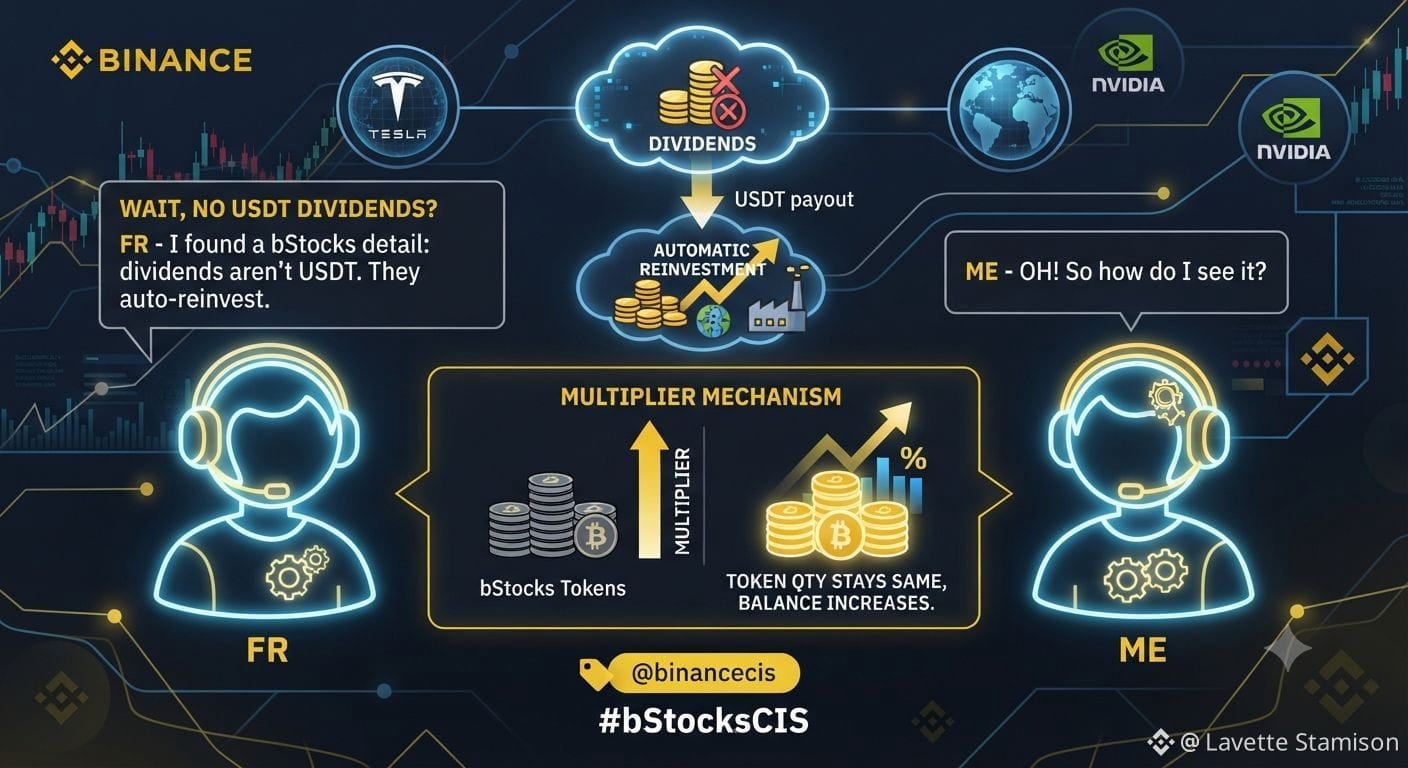
1
142
Thế giới đang số hóa và thậm chí một ông già như tôi cũng nhận ra điều đó.
Và thực ra điều này rất tốt: mọi thứ trở nên dễ tiếp cận hơn và người dùng cuối có nhiều quyền kiểm soát hơn. Gần đây tôi đã khám phá bStocks.
Nếu nói đơn giản nhất thì đó giống như các token, về bản chất được bảo chứng bằng các cổ phiếu thật của nhiều công ty lớn trên thế giới (Tesla, NVIDIA và vân vân). Tức là, nếu bạn mua một token như vậy thì hãy hiểu rằng bạn đang có trong tay một cổ phiếu. Điều thú vị là chúng ta không cần thị trường mở hay bất kỳ thứ gì tương tự—mọi thứ hoạt động 24/7 ngay trên blockchain ($BNB Chain). Vì vậy:
- Chúng ta không phải chờ thị trường hay bất cứ điều gì khác, có thể làm mọi thứ 24/7.
- Chúng ta có thể mua một phần cổ phiếu, kể cả chỉ với 5 USDT. Hãy tưởng tượng sở hữu Tesla ($TSLAB ) trị giá 5 đô la—dù chỉ là những khoản nhỏ nhặt, nhưng bạn đã là nhà đầu tư rồi, và điều đó thật tuyệt.
Tìm ở đâu và mua thế nào trên Binance?
1. Vào mục Binance Spot Market (hoặc vào một mục đặc biệt dành cho bStocks).
2. Gõ vào ô tìm kiếm mã ticker cần thiết, ví dụ $TSLAB (cho cổ phiếu Tesla) hoặc các mã khác—danh sách đã khá lớn.
3. Mua tài sản bằng USDT cũng dễ như mua bất kỳ cặp crypto nào.
Bạn đã thử nghiệm cổ phiếu được token hóa trong thực tế chưa? Hãy chia sẻ cảm nhận và khuyến nghị của bạn trong phần bình luận—chúng ta sẽ học cùng nhau.
@BinanceCIS #bstockscis
Thế giới đang số hóa và thậm chí một ông già như tôi cũng nhận ra điều đó.
Và thực ra điều này rất tốt: mọi thứ trở nên dễ tiếp cận hơn và người dùng cuối có nhiều quyền kiểm soát hơn. Gần đây tôi đã khám phá bStocks.
Nếu nói đơn giản nhất thì đó giống như các token, về bản chất được bảo chứng bằng các cổ phiếu thật của nhiều công ty lớn trên thế giới (Tesla, NVIDIA và vân vân). Tức là, nếu bạn mua một token như vậy thì hãy hiểu rằng bạn đang có trong tay một cổ phiếu. Điều thú vị là chúng ta không cần thị trường mở hay bất kỳ thứ gì tương tự—mọi thứ hoạt động 24/7 ngay trên blockchain ($BNB Chain). Vì vậy:
- Chúng ta không phải chờ thị trường hay bất cứ điều gì khác, có thể làm mọi thứ 24/7.
- Chúng ta có thể mua một phần cổ phiếu, kể cả chỉ với 5 USDT. Hãy tưởng tượng sở hữu Tesla ($TSLAB ) trị giá 5 đô la—dù chỉ là những khoản nhỏ nhặt, nhưng bạn đã là nhà đầu tư rồi, và điều đó thật tuyệt.
Tìm ở đâu và mua thế nào trên Binance?
1. Vào mục Binance Spot Market (hoặc vào một mục đặc biệt dành cho bStocks).
2. Gõ vào ô tìm kiếm mã ticker cần thiết, ví dụ $TSLAB (cho cổ phiếu Tesla) hoặc các mã khác—danh sách đã khá lớn.
3. Mua tài sản bằng USDT cũng dễ như mua bất kỳ cặp crypto nào.
Bạn đã thử nghiệm cổ phiếu được token hóa trong thực tế chưa? Hãy chia sẻ cảm nhận và khuyến nghị của bạn trong phần bình luận—chúng ta sẽ học cùng nhau.
@BinanceCIS #bstockscis
Và thực ra điều này rất tốt: mọi thứ trở nên dễ tiếp cận hơn và người dùng cuối có nhiều quyền kiểm soát hơn. Gần đây tôi đã khám phá bStocks.
Nếu nói đơn giản nhất thì đó giống như các token, về bản chất được bảo chứng bằng các cổ phiếu thật của nhiều công ty lớn trên thế giới (Tesla, NVIDIA và vân vân). Tức là, nếu bạn mua một token như vậy thì hãy hiểu rằng bạn đang có trong tay một cổ phiếu. Điều thú vị là chúng ta không cần thị trường mở hay bất kỳ thứ gì tương tự—mọi thứ hoạt động 24/7 ngay trên blockchain ($BNB Chain). Vì vậy:
- Chúng ta không phải chờ thị trường hay bất cứ điều gì khác, có thể làm mọi thứ 24/7.
- Chúng ta có thể mua một phần cổ phiếu, kể cả chỉ với 5 USDT. Hãy tưởng tượng sở hữu Tesla ($TSLAB ) trị giá 5 đô la—dù chỉ là những khoản nhỏ nhặt, nhưng bạn đã là nhà đầu tư rồi, và điều đó thật tuyệt.
Tìm ở đâu và mua thế nào trên Binance?
1. Vào mục Binance Spot Market (hoặc vào một mục đặc biệt dành cho bStocks).
2. Gõ vào ô tìm kiếm mã ticker cần thiết, ví dụ $TSLAB (cho cổ phiếu Tesla) hoặc các mã khác—danh sách đã khá lớn.
3. Mua tài sản bằng USDT cũng dễ như mua bất kỳ cặp crypto nào.
Bạn đã thử nghiệm cổ phiếu được token hóa trong thực tế chưa? Hãy chia sẻ cảm nhận và khuyến nghị của bạn trong phần bình luận—chúng ta sẽ học cùng nhau.
@BinanceCIS #bstockscis
1
93
Đăng nhập để khám phá thêm nội dung
Tham gia cùng người dùng tiền mã hóa toàn cầu trên Binance Square
⚡️ Nhận thông tin mới nhất và hữu ích về tiền mã hóa.
💬 Được tin cậy bởi sàn giao dịch tiền mã hóa lớn nhất thế giới.
👍 Khám phá những thông tin chuyên sâu thực tế từ những nhà sáng tạo đã xác minh.
Email / Số điện thoại
Chủ đề thịnh hành
TinFed
81,820 lượt xem
387 đang thảo luận
👋 TỔNG HỢP DỰ BÁO KINH TẾ & LÃI SUẤT CỦA FED (17/9/2026)
1️⃣ Quyết định lãi suất
Fed TĂNG lãi suất 0,25 điểm %, đưa lãi suất lên 3,75% - 4,0%. Đây là lần tăng đầu tiên kể từ tháng 7/2023.
Quyết định được thông qua với tỷ lệ 12-0, tức toàn bộ thành viên có quyền bỏ phiếu đều đồng thuận.
Fed cho biết đợt tăng lãi lần này sẽ giúp lạm phát quay về mục tiêu 2% nhanh hơn. Fed vẫn đánh giá kinh tế tăng trưởng vững, trong khi lạm phát còn cao.
2️⃣ Dự báo kinh tế
• Lạm phát PCE 2026: 3,6% -> 3,7%
• Lạm phát PCE lõi 2026: 3,3% -> 3,4%
=> Fed tiếp tục nâng dự báo lạm phát, dù đã tăng lãi suất trong cuộc họp lần này.
3️⃣ Dự báo lãi suất - Dot Plot
• Cuối năm 2026: 4,1%, tăng từ 3,8% hồi tháng 6
• Cuối năm 2027: 4,1%, tăng mạnh từ 3,6%
• Cuối năm 2028: 3,9%, tăng từ 3,4%
• Lãi suất dài hạn: 3,2%, tăng từ 3,1%
=> 16/18 quan chức Fed hiện thấy cần ít nhất 1 lần tăng lãi suất nữa trong năm 2026.
Đáng chú ý hơn, lãi suất trung vị dự báo sẽ vẫn nằm ở 4,1% tới tận cuối năm 2027, rồi mới giảm về 3,9% năm 2028. Giữ lãi suất cao lâu hơn đang quay trở lại khá rõ trong Dot Plot lần này.
#TinFed #btc
David Nguyen crypto
·0 lượt thích
·72 lượt xem
45NgayTuDoTaiChinh
933,126 lượt xem
3,216 đang thảo luận
TheoDõiFOMC
92,296 lượt xem
582 đang thảo luận