

TamaraSolovei
34 Bài đăng

TamaraSolovei
Báo cáo
Chặn người dùng
7 Đang theo dõi
2 Người theo dõi
5 Đã thích
Bài đăng
Xem bản dịch
#dusk $DUSK @Dusk_Foundation
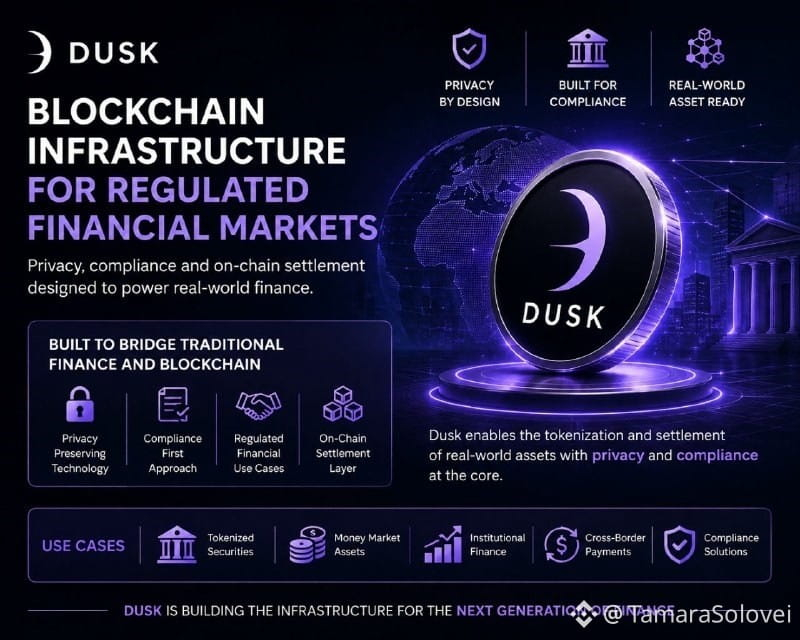
One of the most important things for institutional finance is knowing exactly what happens when a transaction is completed.
That's why Dusk's approach to settlement caught my attention.
In traditional financial markets, settlement can involve multiple systems and intermediaries. On-chain infrastructure offers the possibility of making the process more direct and programmable.
@Dusk_Foundation is building around deterministic settlement, while combining it with privacy and compliance features needed for regulated assets.
This matters because a tokenized security isn't useful simply because it exists on a blockchain.
The infrastructure also needs to answer:
🔹 Who is allowed to hold it?
🔹 Can it be transferred?
🔹 What information must be verified?
🔹 When is the transaction final?
Dusk is trying to make those rules part of the network itself.
For me, that's the more interesting RWA thesis: not just tokenizing assets, but making the entire financial transaction lifecycle programmable and verifiable.
#dusk $DUSK @Dusk
One of the most important things for institutional finance is knowing exactly what happens when a transaction is completed.
That's why Dusk's approach to settlement caught my attention.
In traditional financial markets, settlement can involve multiple systems and intermediaries. On-chain infrastructure offers the possibility of making the process more direct and programmable.
@Dusk is building around deterministic settlement, while combining it with privacy and compliance features needed for regulated assets.
This matters because a tokenized security isn't useful simply because it exists on a blockchain.
The infrastructure also needs to answer:
🔹 Who is allowed to hold it?
🔹 Can it be transferred?
🔹 What information must be verified?
🔹 When is the transaction final?
Dusk is trying to make those rules part of the network itself.
For me, that's the more interesting RWA thesis: not just tokenizing assets, but making the entire financial transaction lifecycle programmable and verifiable.
One of the most important things for institutional finance is knowing exactly what happens when a transaction is completed.
That's why Dusk's approach to settlement caught my attention.
In traditional financial markets, settlement can involve multiple systems and intermediaries. On-chain infrastructure offers the possibility of making the process more direct and programmable.
@Dusk is building around deterministic settlement, while combining it with privacy and compliance features needed for regulated assets.
This matters because a tokenized security isn't useful simply because it exists on a blockchain.
The infrastructure also needs to answer:
🔹 Who is allowed to hold it?
🔹 Can it be transferred?
🔹 What information must be verified?
🔹 When is the transaction final?
Dusk is trying to make those rules part of the network itself.
For me, that's the more interesting RWA thesis: not just tokenizing assets, but making the entire financial transaction lifecycle programmable and verifiable.
103
Xem bản dịch
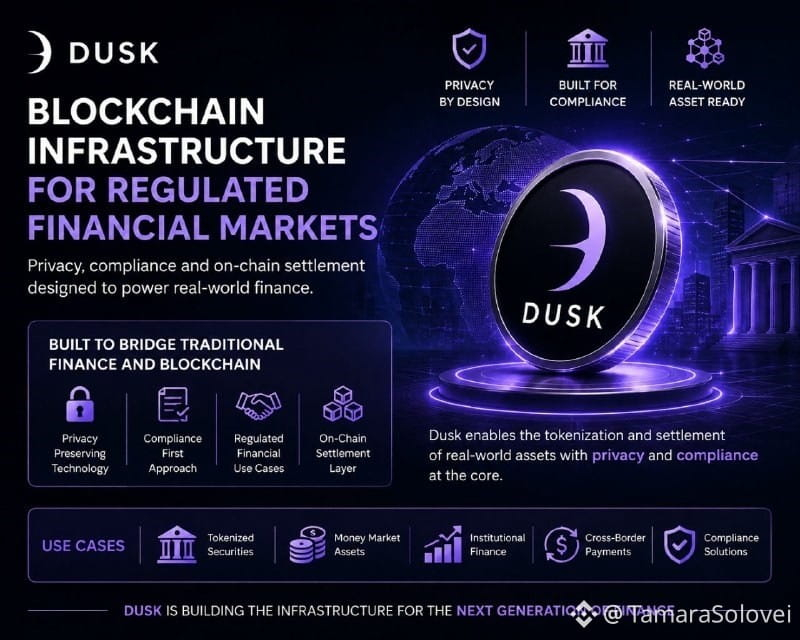
#dusk $DUSK @Dusk_Foundation After following Dusk for a while, the part that stands out to me is how specifically the network is built around financial markets.
Dusk isn't trying to solve every possible blockchain use case.
Its infrastructure is focused on a much narrower — but potentially very important — problem: making regulated financial assets work on-chain.
That means dealing with the things that make traditional finance complicated in the first place:
🔹 Investor eligibility
🔹 Asset transfers
🔹 Privacy and selective disclosure
🔹 Compliance requirements
🔹 Deterministic settlement
🔹 Different execution environments for developers
And I think that's the right way to approach the RWA market.
Tokenizing an asset is only the starting point. The real challenge is building infrastructure where that asset can actually be issued, transferred, traded and settled while the rules surrounding it remain enforceable.
That's the thesis behind Dusk that I find most compelling.
Not “blockchain for everything.”
Blockchain infrastructure specifically designed for financial markets.
Whether Dusk can turn this architecture into significant real-world adoption remains the big question.
But as the RWA sector continues to develop, I think projects solving the infrastructure problem deserve attention.
For now, $DUSK stays on my watchlist.
#dusk $DUSK @Dusk After following Dusk for a while, the part that stands out to me is how specifically the network is built around financial markets.
Dusk isn't trying to solve every possible blockchain use case.
Its infrastructure is focused on a much narrower — but potentially very important — problem: making regulated financial assets work on-chain.
That means dealing with the things that make traditional finance complicated in the first place:
🔹 Investor eligibility
🔹 Asset transfers
🔹 Privacy and selective disclosure
🔹 Compliance requirements
🔹 Deterministic settlement
🔹 Different execution environments for developers
And I think that's the right way to approach the RWA market.
Tokenizing an asset is only the starting point. The real challenge is building infrastructure where that asset can actually be issued, transferred, traded and settled while the rules surrounding it remain enforceable.
That's the thesis behind Dusk that I find most compelling.
Not “blockchain for everything.”
Blockchain infrastructure specifically designed for financial markets.
Whether Dusk can turn this architecture into significant real-world adoption remains the big question.
But as the RWA sector continues to develop, I think projects solving the infrastructure problem deserve attention.
For now, $DUSK stays on my watchlist.
Dusk isn't trying to solve every possible blockchain use case.
Its infrastructure is focused on a much narrower — but potentially very important — problem: making regulated financial assets work on-chain.
That means dealing with the things that make traditional finance complicated in the first place:
🔹 Investor eligibility
🔹 Asset transfers
🔹 Privacy and selective disclosure
🔹 Compliance requirements
🔹 Deterministic settlement
🔹 Different execution environments for developers
And I think that's the right way to approach the RWA market.
Tokenizing an asset is only the starting point. The real challenge is building infrastructure where that asset can actually be issued, transferred, traded and settled while the rules surrounding it remain enforceable.
That's the thesis behind Dusk that I find most compelling.
Not “blockchain for everything.”
Blockchain infrastructure specifically designed for financial markets.
Whether Dusk can turn this architecture into significant real-world adoption remains the big question.
But as the RWA sector continues to develop, I think projects solving the infrastructure problem deserve attention.
For now, $DUSK stays on my watchlist.
83
Xem bản dịch
#dusk $DUSK @Dusk_Foundation
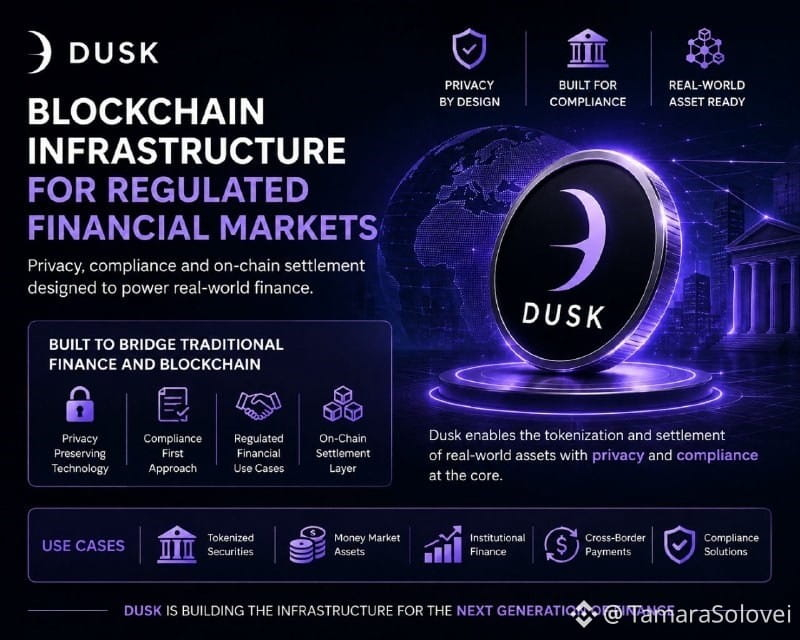
The most interesting part of Dusk might be what happens between the moment an asset is issued and the moment it reaches an investor.
Regulated finance has a lot of conditions that need to be enforced before an asset can actually move: investor eligibility, transfer restrictions, compliance checks and settlement.
@Dusk_Foundation is building these requirements into the blockchain infrastructure itself.
That means the network isn't treating compliance as a separate layer that has to be bolted onto every application. Instead, regulated asset workflows can be built around native access controls, privacy-preserving transactions and deterministic settlement.
I think this approach makes sense for institutional markets.
A public blockchain can provide transparency, but financial institutions also need controlled access and predictable execution.
Dusk is trying to combine both:
Transparent infrastructure where it helps.
Privacy where it's necessary.
Verification where regulation requires it.
If tokenized securities eventually become a major market, these details could matter far more than simply having another blockchain capable of issuing tokens.
The real test is whether financial institutions can actually operate on the network.
That's what I'll be watching with $DUSK .
#dusk $DUSK @Dusk
The most interesting part of Dusk might be what happens between the moment an asset is issued and the moment it reaches an investor.
Regulated finance has a lot of conditions that need to be enforced before an asset can actually move: investor eligibility, transfer restrictions, compliance checks and settlement.
@Dusk is building these requirements into the blockchain infrastructure itself.
That means the network isn't treating compliance as a separate layer that has to be bolted onto every application. Instead, regulated asset workflows can be built around native access controls, privacy-preserving transactions and deterministic settlement.
I think this approach makes sense for institutional markets.
A public blockchain can provide transparency, but financial institutions also need controlled access and predictable execution.
Dusk is trying to combine both:
Transparent infrastructure where it helps.
Privacy where it's necessary.
Verification where regulation requires it.
If tokenized securities eventually become a major market, these details could matter far more than simply having another blockchain capable of issuing tokens.
The real test is whether financial institutions can actually operate on the network.
That's what I'll be watching with $DUSK .
The most interesting part of Dusk might be what happens between the moment an asset is issued and the moment it reaches an investor.
Regulated finance has a lot of conditions that need to be enforced before an asset can actually move: investor eligibility, transfer restrictions, compliance checks and settlement.
@Dusk is building these requirements into the blockchain infrastructure itself.
That means the network isn't treating compliance as a separate layer that has to be bolted onto every application. Instead, regulated asset workflows can be built around native access controls, privacy-preserving transactions and deterministic settlement.
I think this approach makes sense for institutional markets.
A public blockchain can provide transparency, but financial institutions also need controlled access and predictable execution.
Dusk is trying to combine both:
Transparent infrastructure where it helps.
Privacy where it's necessary.
Verification where regulation requires it.
If tokenized securities eventually become a major market, these details could matter far more than simply having another blockchain capable of issuing tokens.
The real test is whether financial institutions can actually operate on the network.
That's what I'll be watching with $DUSK .
80
Xem bản dịch
#dusk $DUSK @Dusk_Foundation
Most people hear “RWA” and immediately think about tokenizing government bonds or putting real estate onchain.
But I think the more interesting opportunity is much broader.
Private markets.
A huge amount of economic activity happens outside public markets.
Private companies need financing.
Investors need access to opportunities.
Ownership needs to be recorded.
Transfers need to be controlled.
Payments and settlement need to happen.
And every participant needs to know who is actually allowed to do what.
Today, a lot of this infrastructure is fragmented across issuers, banks, custodians, administrators, brokers and other intermediaries.
Tokenization doesn't automatically solve that.
Putting an asset on a blockchain doesn't magically create liquidity, demand or legal certainty.
The interesting part is what happens when the entire lifecycle of an asset can be represented digitally.
Issuance.
Investor eligibility.
Ownership.
Transfers.
Dividends.
Voting.
Settlement.
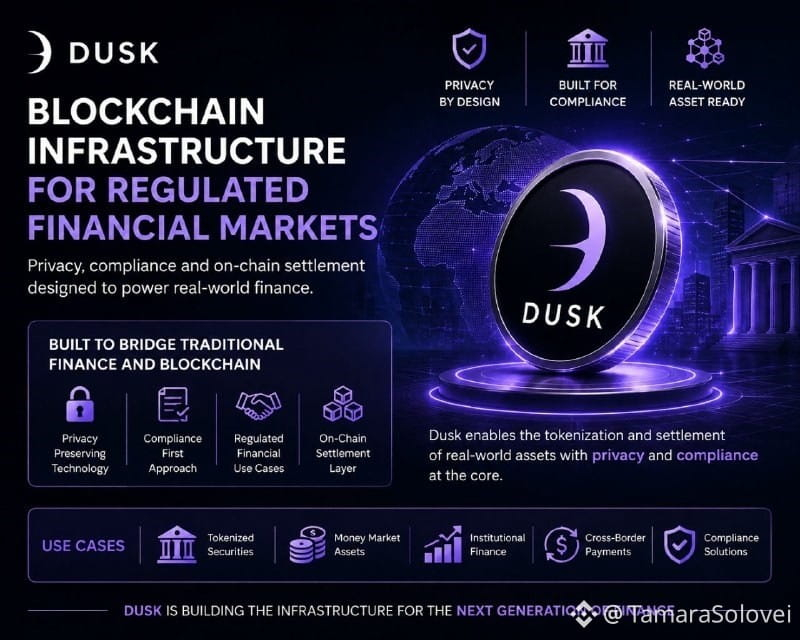
That's where @Dusk_Foundation _Foundation is taking an interesting approach.
Dusk isn't simply saying “let's put more assets onchain.”
It's trying to build infrastructure where regulated assets can exist onchain while still dealing with the requirements that financial markets can't ignore.
Privacy.
Selective disclosure.
Access controls.
Compliance.
Deterministic settlement.
And that's particularly important for private markets.
A public blockchain gives you transparency by default.
Financial markets often need the opposite: controlled visibility.
An investor may need to prove they're eligible without exposing every piece of personal information.
A company may need to keep sensitive positions private.
A regulated venue may need to know exactly who can hold or transfer an asset.
That doesn't mean blockchain has to choose between transparency and privacy.
It means the infrastructure needs to be designed for both.
This is why I'm paying attention to Dusk.
The interesting question isn't whether we can tokenize another asset.
#dusk $DUSK @Dusk
Most people hear “RWA” and immediately think about tokenizing government bonds or putting real estate onchain.
But I think the more interesting opportunity is much broader.
Private markets.
A huge amount of economic activity happens outside public markets.
Private companies need financing.
Investors need access to opportunities.
Ownership needs to be recorded.
Transfers need to be controlled.
Payments and settlement need to happen.
And every participant needs to know who is actually allowed to do what.
Today, a lot of this infrastructure is fragmented across issuers, banks, custodians, administrators, brokers and other intermediaries.
Tokenization doesn't automatically solve that.
Putting an asset on a blockchain doesn't magically create liquidity, demand or legal certainty.
The interesting part is what happens when the entire lifecycle of an asset can be represented digitally.
Issuance.
Investor eligibility.
Ownership.
Transfers.
Dividends.
Voting.
Settlement.
That's where @Dusk _Foundation is taking an interesting approach.
Dusk isn't simply saying “let's put more assets onchain.”
It's trying to build infrastructure where regulated assets can exist onchain while still dealing with the requirements that financial markets can't ignore.
Privacy.
Selective disclosure.
Access controls.
Compliance.
Deterministic settlement.
And that's particularly important for private markets.
A public blockchain gives you transparency by default.
Financial markets often need the opposite: controlled visibility.
An investor may need to prove they're eligible without exposing every piece of personal information.
A company may need to keep sensitive positions private.
A regulated venue may need to know exactly who can hold or transfer an asset.
That doesn't mean blockchain has to choose between transparency and privacy.
It means the infrastructure needs to be designed for both.
This is why I'm paying attention to Dusk.
The interesting question isn't whether we can tokenize another asset.
Most people hear “RWA” and immediately think about tokenizing government bonds or putting real estate onchain.
But I think the more interesting opportunity is much broader.
Private markets.
A huge amount of economic activity happens outside public markets.
Private companies need financing.
Investors need access to opportunities.
Ownership needs to be recorded.
Transfers need to be controlled.
Payments and settlement need to happen.
And every participant needs to know who is actually allowed to do what.
Today, a lot of this infrastructure is fragmented across issuers, banks, custodians, administrators, brokers and other intermediaries.
Tokenization doesn't automatically solve that.
Putting an asset on a blockchain doesn't magically create liquidity, demand or legal certainty.
The interesting part is what happens when the entire lifecycle of an asset can be represented digitally.
Issuance.
Investor eligibility.
Ownership.
Transfers.
Dividends.
Voting.
Settlement.
That's where @Dusk _Foundation is taking an interesting approach.
Dusk isn't simply saying “let's put more assets onchain.”
It's trying to build infrastructure where regulated assets can exist onchain while still dealing with the requirements that financial markets can't ignore.
Privacy.
Selective disclosure.
Access controls.
Compliance.
Deterministic settlement.
And that's particularly important for private markets.
A public blockchain gives you transparency by default.
Financial markets often need the opposite: controlled visibility.
An investor may need to prove they're eligible without exposing every piece of personal information.
A company may need to keep sensitive positions private.
A regulated venue may need to know exactly who can hold or transfer an asset.
That doesn't mean blockchain has to choose between transparency and privacy.
It means the infrastructure needs to be designed for both.
This is why I'm paying attention to Dusk.
The interesting question isn't whether we can tokenize another asset.
71
Xem bản dịch
#dusk $DUSK @Dusk_Foundation
Most people hear “RWA” and immediately think about tokenizing government bonds or putting real estate onchain.
But I think the more interesting opportunity is much broader.
Private markets.
A huge amount of economic activity happens outside public markets.
Private companies need financing.
Investors need access to opportunities.
Ownership needs to be recorded.
Transfers need to be controlled.
Payments and settlement need to happen.
And every participant needs to know who is actually allowed to do what.
Today, a lot of this infrastructure is fragmented across issuers, banks, custodians, administrators, brokers and other intermediaries.
Tokenization doesn't automatically solve that.
Putting an asset on a blockchain doesn't magically create liquidity, demand or legal certainty.
The interesting part is what happens when the entire lifecycle of an asset can be represented digitally.
Issuance.
Investor eligibility.
Ownership.
Transfers.
Dividends.
Voting.
Settlement.
That's where @Dusk_Foundation _Foundation is taking an interesting approach.
Dusk isn't simply saying “let's put more assets onchain.”
It's trying to build infrastructure where regulated assets can exist onchain while still dealing with the requirements that financial markets can't ignore.
Privacy.
Selective disclosure.
Access controls.
Compliance.
Deterministic settlement.
And that's particularly important for private markets.
A public blockchain gives you transparency by default.
Financial markets often need the opposite: controlled visibility.
An investor may need to prove they're eligible without exposing every piece of personal information.
A company may need to keep sensitive positions private.
A regulated venue may need to know exactly who can hold or transfer an asset.
That doesn't mean blockchain has to choose between transparency and privacy.
It means the infrastructure needs to be designed for both.
This is why I'm paying attention to Dusk.
The interesting question isn't whether we can tokenize another asset.
#dusk $DUSK @Dusk
Most people hear “RWA” and immediately think about tokenizing government bonds or putting real estate onchain.
But I think the more interesting opportunity is much broader.
Private markets.
A huge amount of economic activity happens outside public markets.
Private companies need financing.
Investors need access to opportunities.
Ownership needs to be recorded.
Transfers need to be controlled.
Payments and settlement need to happen.
And every participant needs to know who is actually allowed to do what.
Today, a lot of this infrastructure is fragmented across issuers, banks, custodians, administrators, brokers and other intermediaries.
Tokenization doesn't automatically solve that.
Putting an asset on a blockchain doesn't magically create liquidity, demand or legal certainty.
The interesting part is what happens when the entire lifecycle of an asset can be represented digitally.
Issuance.
Investor eligibility.
Ownership.
Transfers.
Dividends.
Voting.
Settlement.
That's where @Dusk _Foundation is taking an interesting approach.
Dusk isn't simply saying “let's put more assets onchain.”
It's trying to build infrastructure where regulated assets can exist onchain while still dealing with the requirements that financial markets can't ignore.
Privacy.
Selective disclosure.
Access controls.
Compliance.
Deterministic settlement.
And that's particularly important for private markets.
A public blockchain gives you transparency by default.
Financial markets often need the opposite: controlled visibility.
An investor may need to prove they're eligible without exposing every piece of personal information.
A company may need to keep sensitive positions private.
A regulated venue may need to know exactly who can hold or transfer an asset.
That doesn't mean blockchain has to choose between transparency and privacy.
It means the infrastructure needs to be designed for both.
This is why I'm paying attention to Dusk.
The interesting question isn't whether we can tokenize another asset.
Most people hear “RWA” and immediately think about tokenizing government bonds or putting real estate onchain.
But I think the more interesting opportunity is much broader.
Private markets.
A huge amount of economic activity happens outside public markets.
Private companies need financing.
Investors need access to opportunities.
Ownership needs to be recorded.
Transfers need to be controlled.
Payments and settlement need to happen.
And every participant needs to know who is actually allowed to do what.
Today, a lot of this infrastructure is fragmented across issuers, banks, custodians, administrators, brokers and other intermediaries.
Tokenization doesn't automatically solve that.
Putting an asset on a blockchain doesn't magically create liquidity, demand or legal certainty.
The interesting part is what happens when the entire lifecycle of an asset can be represented digitally.
Issuance.
Investor eligibility.
Ownership.
Transfers.
Dividends.
Voting.
Settlement.
That's where @Dusk _Foundation is taking an interesting approach.
Dusk isn't simply saying “let's put more assets onchain.”
It's trying to build infrastructure where regulated assets can exist onchain while still dealing with the requirements that financial markets can't ignore.
Privacy.
Selective disclosure.
Access controls.
Compliance.
Deterministic settlement.
And that's particularly important for private markets.
A public blockchain gives you transparency by default.
Financial markets often need the opposite: controlled visibility.
An investor may need to prove they're eligible without exposing every piece of personal information.
A company may need to keep sensitive positions private.
A regulated venue may need to know exactly who can hold or transfer an asset.
That doesn't mean blockchain has to choose between transparency and privacy.
It means the infrastructure needs to be designed for both.
This is why I'm paying attention to Dusk.
The interesting question isn't whether we can tokenize another asset.
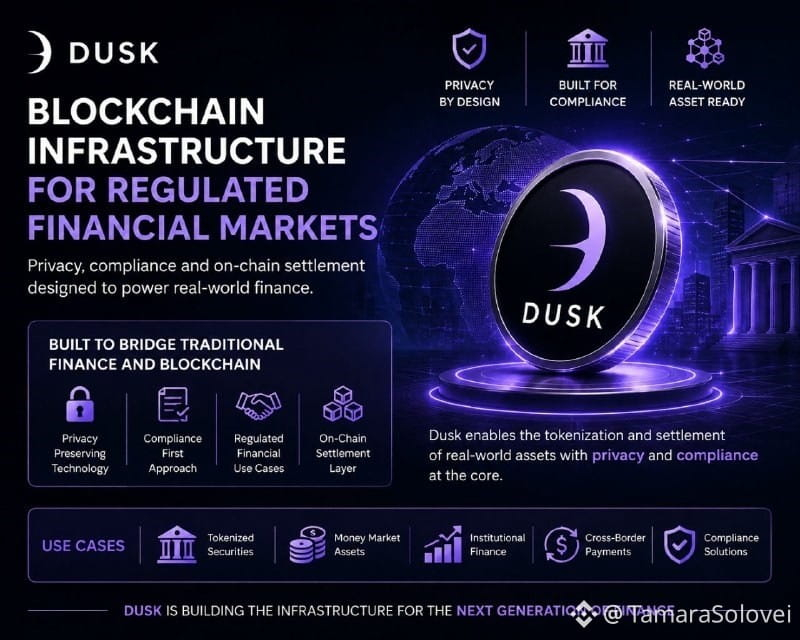
64
Xem bản dịch
#termmax @termmax DeFi becomes much more interesting when financial positions can be built like Lego blocks.
That’s one reason I’m watching TermMax.
The protocol is focused on fixed-rate lending and borrowing with defined maturities, but the bigger idea is what these predictable positions can enable on top of them.
A fixed-rate position can become a building block for:
🔹 Hedging interest-rate exposure
🔹 More predictable leverage
🔹 Fixed-income strategies
🔹 Vaults and structured products
🔹 More precise capital management
Instead of every strategy depending on whatever the floating market rate happens to be at a particular moment, users can build around a known rate and a defined time horizon.
That's important because sophisticated financial strategies usually need more than liquidity. They need predictability.
TermMax is essentially bringing another primitive from traditional fixed-income markets into DeFi and making it composable with on-chain infrastructure.
The interesting question is how far fixed-rate markets can go once they become programmable.
$TMX is one token I'll be watching as this sector develops.
#termmax @TermMax DeFi becomes much more interesting when financial positions can be built like Lego blocks.
That’s one reason I’m watching TermMax.
The protocol is focused on fixed-rate lending and borrowing with defined maturities, but the bigger idea is what these predictable positions can enable on top of them.
A fixed-rate position can become a building block for:
🔹 Hedging interest-rate exposure
🔹 More predictable leverage
🔹 Fixed-income strategies
🔹 Vaults and structured products
🔹 More precise capital management
Instead of every strategy depending on whatever the floating market rate happens to be at a particular moment, users can build around a known rate and a defined time horizon.
That's important because sophisticated financial strategies usually need more than liquidity. They need predictability.
TermMax is essentially bringing another primitive from traditional fixed-income markets into DeFi and making it composable with on-chain infrastructure.
The interesting question is how far fixed-rate markets can go once they become programmable.
$TMX is one token I'll be watching as this sector develops.
That’s one reason I’m watching TermMax.
The protocol is focused on fixed-rate lending and borrowing with defined maturities, but the bigger idea is what these predictable positions can enable on top of them.
A fixed-rate position can become a building block for:
🔹 Hedging interest-rate exposure
🔹 More predictable leverage
🔹 Fixed-income strategies
🔹 Vaults and structured products
🔹 More precise capital management
Instead of every strategy depending on whatever the floating market rate happens to be at a particular moment, users can build around a known rate and a defined time horizon.
That's important because sophisticated financial strategies usually need more than liquidity. They need predictability.
TermMax is essentially bringing another primitive from traditional fixed-income markets into DeFi and making it composable with on-chain infrastructure.
The interesting question is how far fixed-rate markets can go once they become programmable.
$TMX is one token I'll be watching as this sector develops.
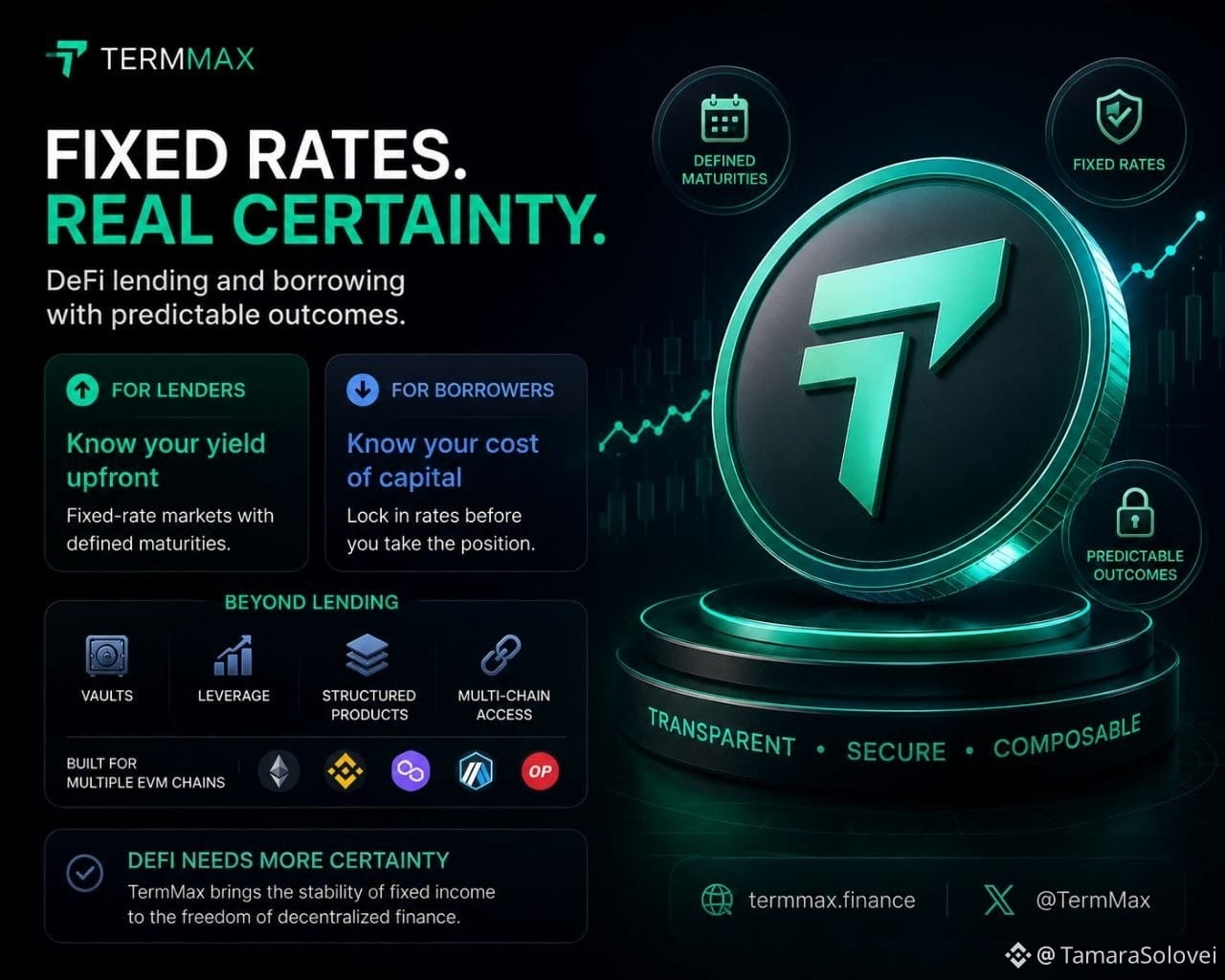
57
Xem bản dịch
#dusk $DUSK @Dusk_Foundation
One thing I find interesting about Dusk is that it isn't trying to force every financial application into the same execution model.
The network provides DuskVM for native Rust/WASM applications and DuskEVM for developers who want an Ethereum-compatible environment.
That creates an interesting balance.
Developers can use familiar EVM tooling and smart-contract languages, while applications that need deeper access to Dusk's native capabilities can build directly on DuskVM.
Underneath both environments is DuskDS, providing the settlement and data-availability layer.
This architecture makes sense for a network focused on financial applications. Different products can have different technical requirements without necessarily needing completely separate chains.
And the native $DUSK token ties the ecosystem together through transaction fees and network staking.
For me, the interesting question isn't whether Dusk can attract developers — it's whether this architecture can turn into real financial activity on-chain.
If it does, $DUSK becomes more than just a token attached to an RWA narrative. It becomes part of the infrastructure powering the applications built on Dusk.
#dusk $DUSK @Dusk
One thing I find interesting about Dusk is that it isn't trying to force every financial application into the same execution model.
The network provides DuskVM for native Rust/WASM applications and DuskEVM for developers who want an Ethereum-compatible environment.
That creates an interesting balance.
Developers can use familiar EVM tooling and smart-contract languages, while applications that need deeper access to Dusk's native capabilities can build directly on DuskVM.
Underneath both environments is DuskDS, providing the settlement and data-availability layer.
This architecture makes sense for a network focused on financial applications. Different products can have different technical requirements without necessarily needing completely separate chains.
And the native $DUSK token ties the ecosystem together through transaction fees and network staking.
For me, the interesting question isn't whether Dusk can attract developers — it's whether this architecture can turn into real financial activity on-chain.
If it does, $DUSK becomes more than just a token attached to an RWA narrative. It becomes part of the infrastructure powering the applications built on Dusk.
One thing I find interesting about Dusk is that it isn't trying to force every financial application into the same execution model.
The network provides DuskVM for native Rust/WASM applications and DuskEVM for developers who want an Ethereum-compatible environment.
That creates an interesting balance.
Developers can use familiar EVM tooling and smart-contract languages, while applications that need deeper access to Dusk's native capabilities can build directly on DuskVM.
Underneath both environments is DuskDS, providing the settlement and data-availability layer.
This architecture makes sense for a network focused on financial applications. Different products can have different technical requirements without necessarily needing completely separate chains.
And the native $DUSK token ties the ecosystem together through transaction fees and network staking.
For me, the interesting question isn't whether Dusk can attract developers — it's whether this architecture can turn into real financial activity on-chain.
If it does, $DUSK becomes more than just a token attached to an RWA narrative. It becomes part of the infrastructure powering the applications built on Dusk.
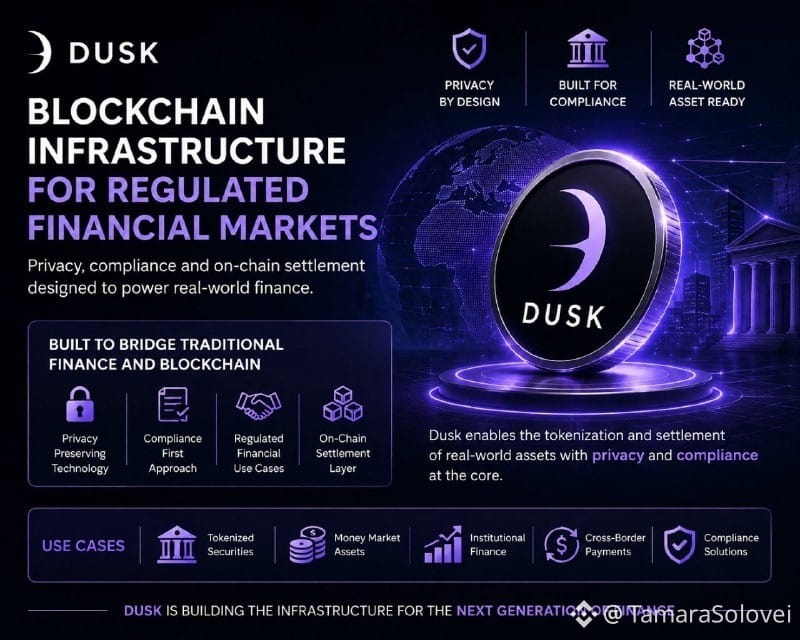
79
Xem bản dịch
#dusk $DUSK @Dusk_Foundation
Dusk is taking an interesting approach to one of the biggest problems in on-chain finance: making different parts of the market work together.
A tokenized security needs more than a blockchain address. It needs rules around who can hold it, how it can move, what information can be disclosed and how settlement is finalized.
Dusk is building these requirements into its network rather than treating them as separate infrastructure.
What stands out to me is the combination of:
🔹 Permissioned access where required
🔹 Privacy-preserving transactions
🔹 Selective disclosure
🔹 Deterministic settlement
🔹 EVM compatibility for developers
That combination could make Dusk useful for financial applications where completely public transactions aren't practical, but completely private systems aren't acceptable either.
The interesting part of the Dusk thesis isn't putting finance on a blockchain. It's making blockchain infrastructure fit the way regulated finance actually works.
If RWAs continue moving toward institutional adoption, that's a niche worth watching.
#dusk $DUSK @Dusk
Dusk is taking an interesting approach to one of the biggest problems in on-chain finance: making different parts of the market work together.
A tokenized security needs more than a blockchain address. It needs rules around who can hold it, how it can move, what information can be disclosed and how settlement is finalized.
Dusk is building these requirements into its network rather than treating them as separate infrastructure.
What stands out to me is the combination of:
🔹 Permissioned access where required
🔹 Privacy-preserving transactions
🔹 Selective disclosure
🔹 Deterministic settlement
🔹 EVM compatibility for developers
That combination could make Dusk useful for financial applications where completely public transactions aren't practical, but completely private systems aren't acceptable either.
The interesting part of the Dusk thesis isn't putting finance on a blockchain. It's making blockchain infrastructure fit the way regulated finance actually works.
If RWAs continue moving toward institutional adoption, that's a niche worth watching.
Dusk is taking an interesting approach to one of the biggest problems in on-chain finance: making different parts of the market work together.
A tokenized security needs more than a blockchain address. It needs rules around who can hold it, how it can move, what information can be disclosed and how settlement is finalized.
Dusk is building these requirements into its network rather than treating them as separate infrastructure.
What stands out to me is the combination of:
🔹 Permissioned access where required
🔹 Privacy-preserving transactions
🔹 Selective disclosure
🔹 Deterministic settlement
🔹 EVM compatibility for developers
That combination could make Dusk useful for financial applications where completely public transactions aren't practical, but completely private systems aren't acceptable either.
The interesting part of the Dusk thesis isn't putting finance on a blockchain. It's making blockchain infrastructure fit the way regulated finance actually works.
If RWAs continue moving toward institutional adoption, that's a niche worth watching.
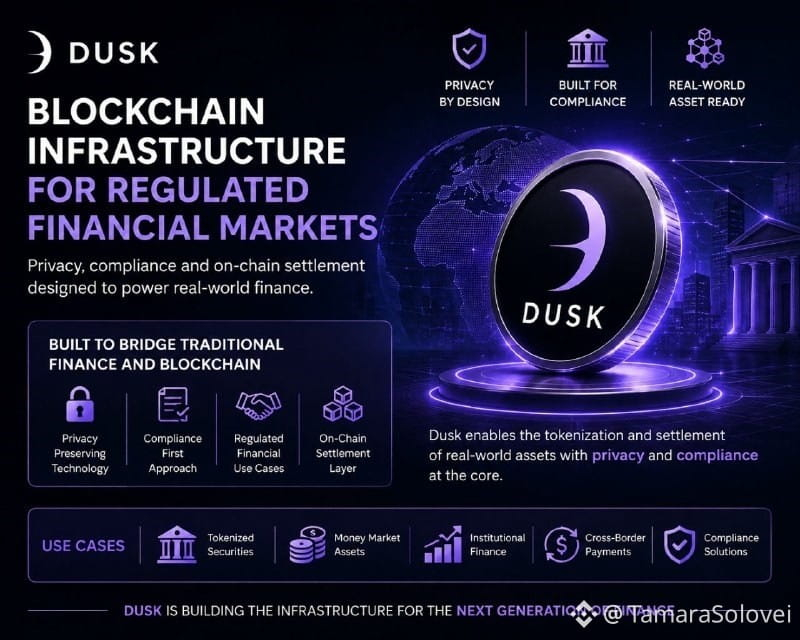
62
Xem bản dịch
#termmax @termmax
Predictability can be just as valuable as yield in DeFi.
When borrowing rates constantly change, managing a position becomes a moving target. A strategy that looks attractive today can become expensive tomorrow simply because market conditions changed.
TermMax approaches this with fixed-rate markets and defined maturities.
That gives users something DeFi often lacks: a clearer framework for planning capital.
Borrowers can know their financing cost in advance, while lenders can evaluate an expected return over a specific period instead of relying entirely on a floating rate.
This also creates interesting possibilities for more sophisticated strategies:
🔹 Hedging interest-rate risk
🔹 Planning leverage more precisely
🔹 Building fixed-income strategies
🔹 Combining lending with structured products
🔹 Creating more predictable vault strategies
I think this is an important step if DeFi wants to move beyond short-term speculation and become a more complete financial ecosystem.
The ability to know your rate and maturity in advance may sound simple — but in a volatile market, predictability itself has value.
That’s what makes the TermMax approach worth watching.
#termmax @TermMax
Predictability can be just as valuable as yield in DeFi.
When borrowing rates constantly change, managing a position becomes a moving target. A strategy that looks attractive today can become expensive tomorrow simply because market conditions changed.
TermMax approaches this with fixed-rate markets and defined maturities.
That gives users something DeFi often lacks: a clearer framework for planning capital.
Borrowers can know their financing cost in advance, while lenders can evaluate an expected return over a specific period instead of relying entirely on a floating rate.
This also creates interesting possibilities for more sophisticated strategies:
🔹 Hedging interest-rate risk
🔹 Planning leverage more precisely
🔹 Building fixed-income strategies
🔹 Combining lending with structured products
🔹 Creating more predictable vault strategies
I think this is an important step if DeFi wants to move beyond short-term speculation and become a more complete financial ecosystem.
The ability to know your rate and maturity in advance may sound simple — but in a volatile market, predictability itself has value.
That’s what makes the TermMax approach worth watching.
Predictability can be just as valuable as yield in DeFi.
When borrowing rates constantly change, managing a position becomes a moving target. A strategy that looks attractive today can become expensive tomorrow simply because market conditions changed.
TermMax approaches this with fixed-rate markets and defined maturities.
That gives users something DeFi often lacks: a clearer framework for planning capital.
Borrowers can know their financing cost in advance, while lenders can evaluate an expected return over a specific period instead of relying entirely on a floating rate.
This also creates interesting possibilities for more sophisticated strategies:
🔹 Hedging interest-rate risk
🔹 Planning leverage more precisely
🔹 Building fixed-income strategies
🔹 Combining lending with structured products
🔹 Creating more predictable vault strategies
I think this is an important step if DeFi wants to move beyond short-term speculation and become a more complete financial ecosystem.
The ability to know your rate and maturity in advance may sound simple — but in a volatile market, predictability itself has value.
That’s what makes the TermMax approach worth watching.
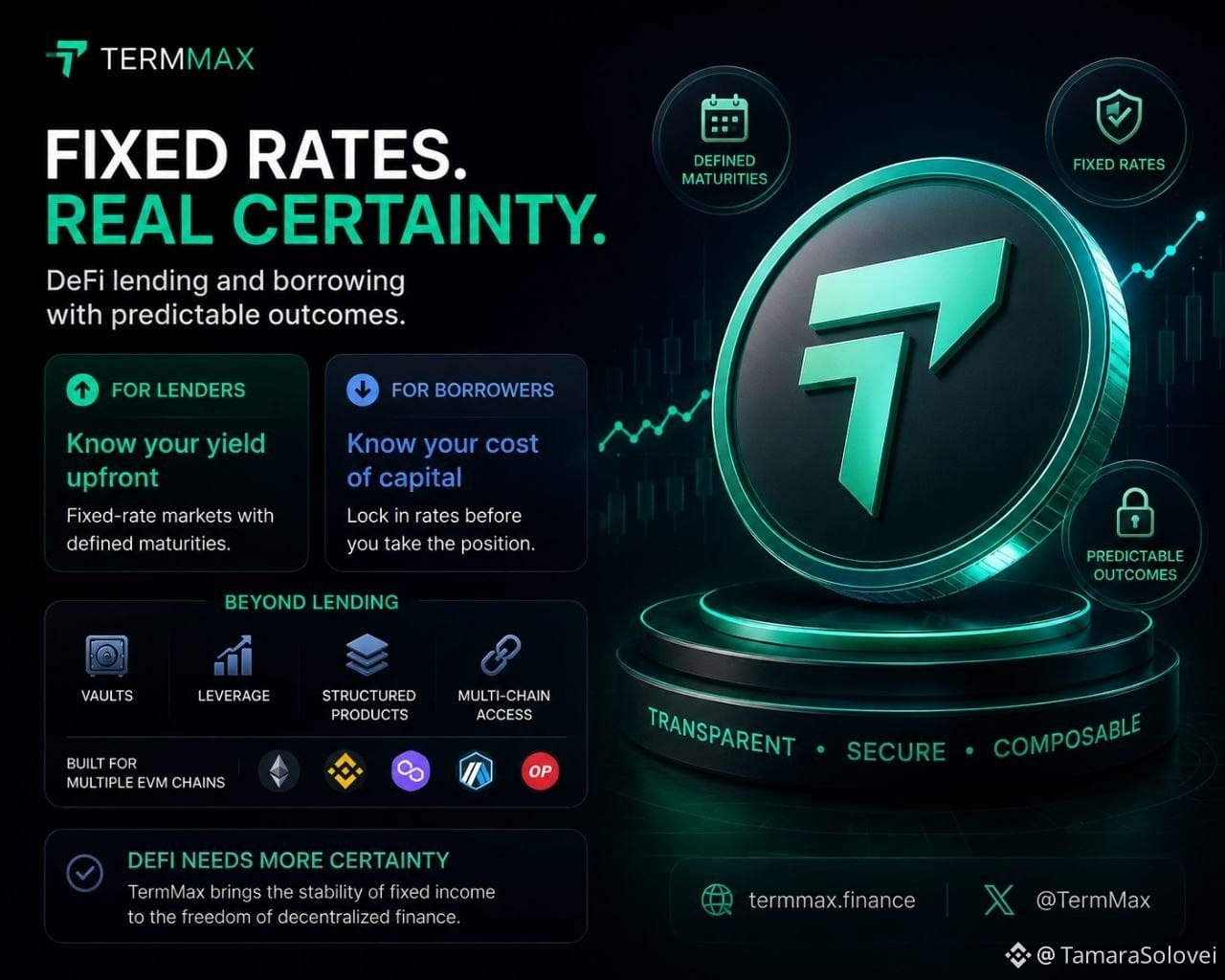
77
Xem bản dịch
#termmax @termmax
What makes TermMax interesting isn't only fixed-rate lending. It's the idea of turning predictable debt into a building block for DeFi.
Fixed-rate markets can give users something that is often missing from on-chain finance: a clear timeline for a position.
Instead of constantly reacting to changing borrowing costs, users can structure positions around a known rate and maturity.
This creates interesting possibilities for more advanced strategies:
🔹 Fixed-rate borrowing
🔹 Predictable lending returns
🔹 Leveraged strategies
🔹 Vault-based products
🔹 Structured positions
The goal isn't simply to copy traditional fixed-income products on-chain. It's to make these financial primitives composable with the rest of DeFi.
That's where I think $TMX becomes interesting as part of the bigger TermMax ecosystem.
If DeFi wants to attract more sophisticated capital, predictable rates and defined maturities could become just as important as liquidity.
The next evolution of DeFi might not be about more leverage. It might be about better control over risk.
#termmax @TermMax
What makes TermMax interesting isn't only fixed-rate lending. It's the idea of turning predictable debt into a building block for DeFi.
Fixed-rate markets can give users something that is often missing from on-chain finance: a clear timeline for a position.
Instead of constantly reacting to changing borrowing costs, users can structure positions around a known rate and maturity.
This creates interesting possibilities for more advanced strategies:
🔹 Fixed-rate borrowing
🔹 Predictable lending returns
🔹 Leveraged strategies
🔹 Vault-based products
🔹 Structured positions
The goal isn't simply to copy traditional fixed-income products on-chain. It's to make these financial primitives composable with the rest of DeFi.
That's where I think $TMX becomes interesting as part of the bigger TermMax ecosystem.
If DeFi wants to attract more sophisticated capital, predictable rates and defined maturities could become just as important as liquidity.
The next evolution of DeFi might not be about more leverage. It might be about better control over risk.
What makes TermMax interesting isn't only fixed-rate lending. It's the idea of turning predictable debt into a building block for DeFi.
Fixed-rate markets can give users something that is often missing from on-chain finance: a clear timeline for a position.
Instead of constantly reacting to changing borrowing costs, users can structure positions around a known rate and maturity.
This creates interesting possibilities for more advanced strategies:
🔹 Fixed-rate borrowing
🔹 Predictable lending returns
🔹 Leveraged strategies
🔹 Vault-based products
🔹 Structured positions
The goal isn't simply to copy traditional fixed-income products on-chain. It's to make these financial primitives composable with the rest of DeFi.
That's where I think $TMX becomes interesting as part of the bigger TermMax ecosystem.
If DeFi wants to attract more sophisticated capital, predictable rates and defined maturities could become just as important as liquidity.
The next evolution of DeFi might not be about more leverage. It might be about better control over risk.
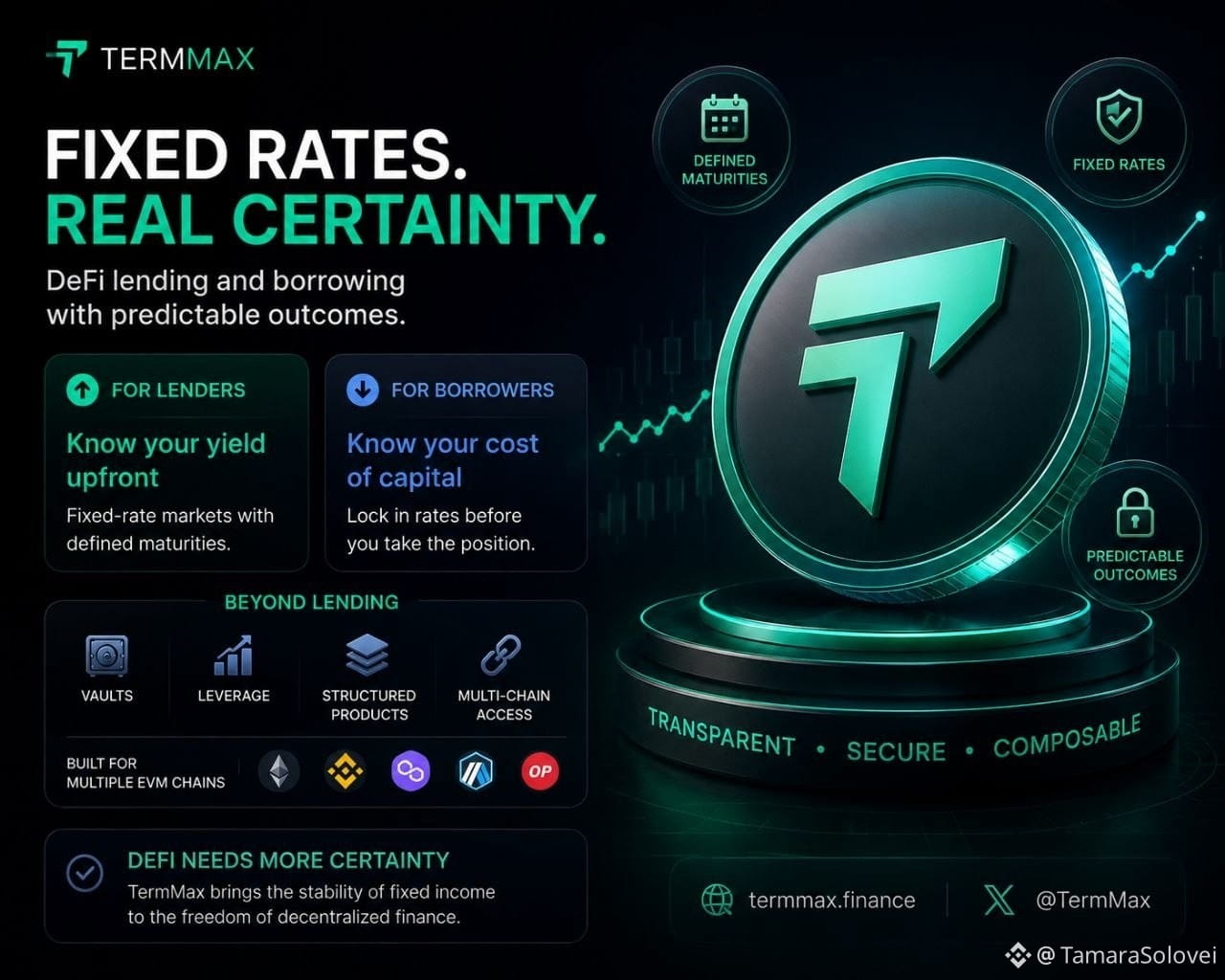
56
Xem bản dịch
#dusk $DUSK @Dusk_Foundation
Why does regulated finance need its own blockchain infrastructure instead of simply using a public chain?
That question is becoming increasingly important as tokenized securities and real-world assets move on-chain.
@Dusk_Foundation is built around the idea that financial markets have different requirements from ordinary crypto applications. Issuers, investors, custodians and regulators all need to interact with the same infrastructure while sensitive financial information remains protected.
One of the most interesting concepts is selective disclosure.
Instead of choosing between complete transparency or complete privacy, Dusk is designed to let authorized parties verify the information they need without exposing every transaction or portfolio detail publicly. Combined with deterministic settlement and access controls, this creates infrastructure tailored for regulated digital assets.
I think that distinction is what makes Dusk worth watching. The future of RWAs may depend less on creating tokens and more on creating networks capable of handling the real-world rules behind them.
#dusk $DUSK @Dusk
Why does regulated finance need its own blockchain infrastructure instead of simply using a public chain?
That question is becoming increasingly important as tokenized securities and real-world assets move on-chain.
@Dusk is built around the idea that financial markets have different requirements from ordinary crypto applications. Issuers, investors, custodians and regulators all need to interact with the same infrastructure while sensitive financial information remains protected.
One of the most interesting concepts is selective disclosure.
Instead of choosing between complete transparency or complete privacy, Dusk is designed to let authorized parties verify the information they need without exposing every transaction or portfolio detail publicly. Combined with deterministic settlement and access controls, this creates infrastructure tailored for regulated digital assets.
I think that distinction is what makes Dusk worth watching. The future of RWAs may depend less on creating tokens and more on creating networks capable of handling the real-world rules behind them.
Why does regulated finance need its own blockchain infrastructure instead of simply using a public chain?
That question is becoming increasingly important as tokenized securities and real-world assets move on-chain.
@Dusk is built around the idea that financial markets have different requirements from ordinary crypto applications. Issuers, investors, custodians and regulators all need to interact with the same infrastructure while sensitive financial information remains protected.
One of the most interesting concepts is selective disclosure.
Instead of choosing between complete transparency or complete privacy, Dusk is designed to let authorized parties verify the information they need without exposing every transaction or portfolio detail publicly. Combined with deterministic settlement and access controls, this creates infrastructure tailored for regulated digital assets.
I think that distinction is what makes Dusk worth watching. The future of RWAs may depend less on creating tokens and more on creating networks capable of handling the real-world rules behind them.
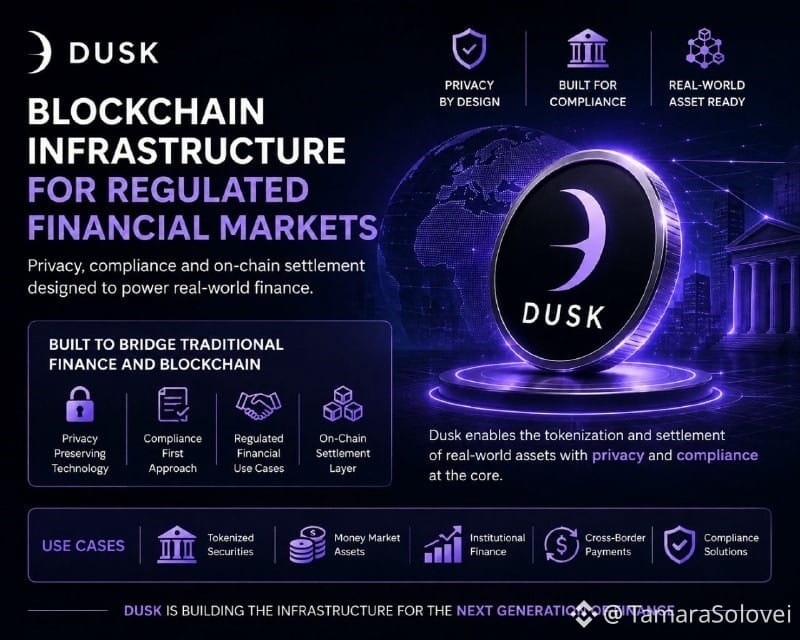
78
Xem bản dịch
#termmax @termmax
DeFi is great at giving users flexibility, but flexibility often comes with uncertainty.
Interest rates can change quickly, making it difficult to plan the cost of borrowing or the return on lending.
@termmax approaches this problem with fixed-rate markets and defined maturities.
Instead of constantly watching the lending rate, users can know the key parameters of a position in advance.
For lenders, that can mean clearer expectations around yield. For borrowers, it can make the cost of capital easier to plan.
I think this is an important direction for DeFi because predictable financial products could make on-chain markets more useful beyond short-term speculation.
More certainty doesn't have to mean less flexibility. It can simply mean better tools for managing risk.
#termmax @TermMax
DeFi is great at giving users flexibility, but flexibility often comes with uncertainty.
Interest rates can change quickly, making it difficult to plan the cost of borrowing or the return on lending.
@TermMax approaches this problem with fixed-rate markets and defined maturities.
Instead of constantly watching the lending rate, users can know the key parameters of a position in advance.
For lenders, that can mean clearer expectations around yield. For borrowers, it can make the cost of capital easier to plan.
I think this is an important direction for DeFi because predictable financial products could make on-chain markets more useful beyond short-term speculation.
More certainty doesn't have to mean less flexibility. It can simply mean better tools for managing risk.
DeFi is great at giving users flexibility, but flexibility often comes with uncertainty.
Interest rates can change quickly, making it difficult to plan the cost of borrowing or the return on lending.
@TermMax approaches this problem with fixed-rate markets and defined maturities.
Instead of constantly watching the lending rate, users can know the key parameters of a position in advance.
For lenders, that can mean clearer expectations around yield. For borrowers, it can make the cost of capital easier to plan.
I think this is an important direction for DeFi because predictable financial products could make on-chain markets more useful beyond short-term speculation.
More certainty doesn't have to mean less flexibility. It can simply mean better tools for managing risk.
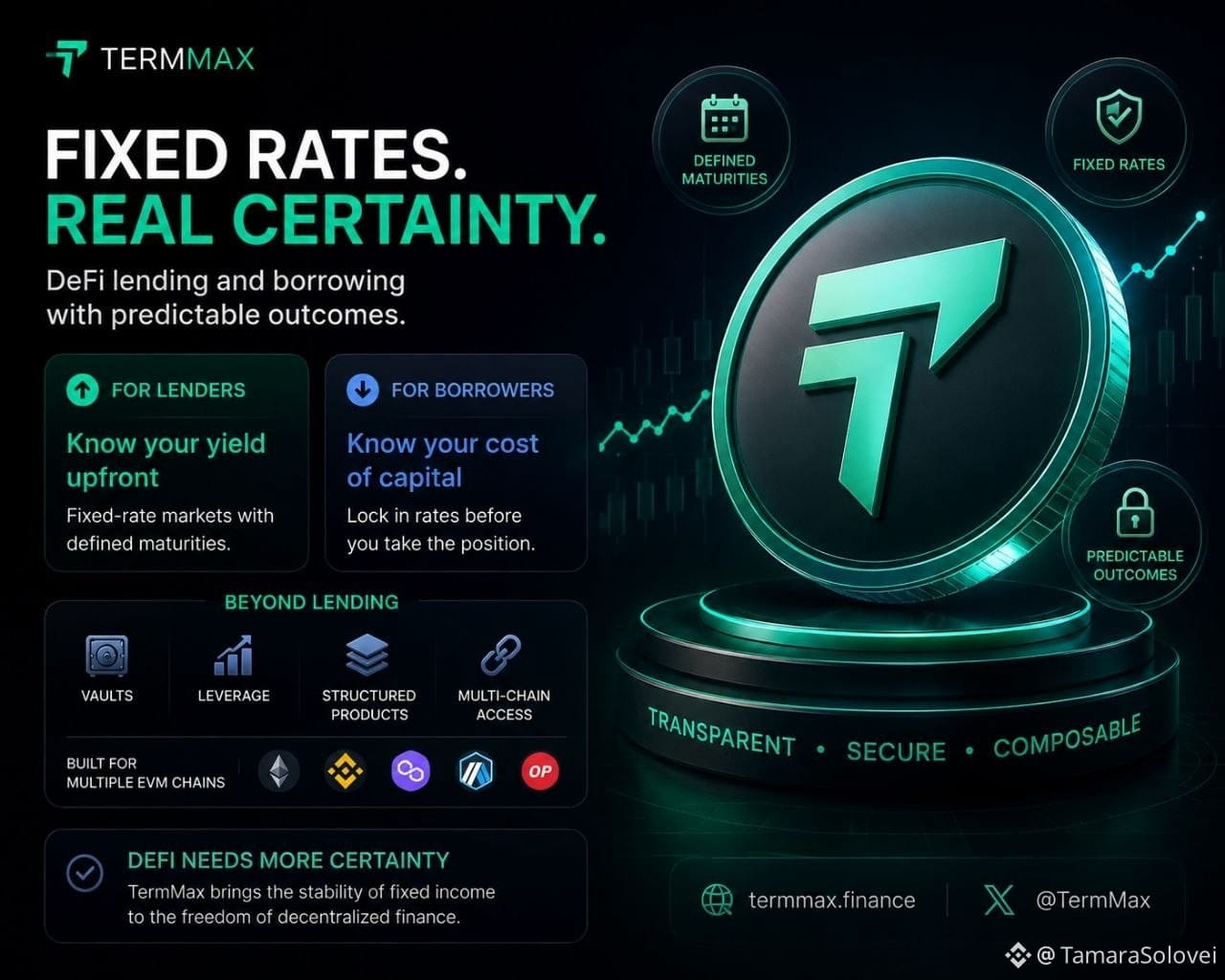
40
Xem bản dịch
#dusk $DUSK @Dusk_Foundation
A financial asset doesn't end its journey when the trade is completed.
That’s why I think the infrastructure behind tokenized assets is more important than the token itself.
In traditional markets, an asset can go through issuance, trading, settlement, dividends, reporting, transfers and other corporate actions. Each stage can involve different systems and intermediaries.
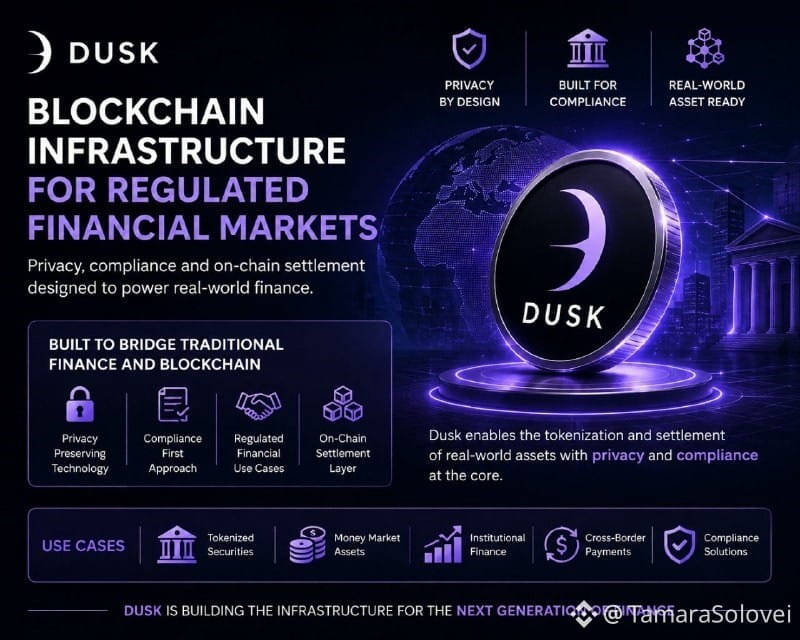
@Dusk_Foundation is approaching this as a complete on-chain workflow.
Its infrastructure is designed to handle things like eligibility checks, transfer restrictions, privacy, settlement, reporting and corporate actions as part of the asset lifecycle.
There is also an interesting distinction between public transparency and private financial information.
Dusk supports transparent transactions through Moonlight, while Phoenix enables shielded transfers using zero-knowledge proofs. Information can also be selectively disclosed when an authorized party needs it.
This is important because regulated finance doesn't necessarily need everything to be public.
It needs the right information to be visible to the right participants at the right time.
And that's a very different design philosophy from simply putting an existing financial asset on a public blockchain.
If tokenized securities become a major part of the next phase of Web3, I think infrastructure like this will be just as important as the assets themselves.
Dusk isn't only trying to put finance on-chain. It's trying to make the entire financial workflow work there.
#dusk $DUSK @Dusk
A financial asset doesn't end its journey when the trade is completed.
That’s why I think the infrastructure behind tokenized assets is more important than the token itself.
In traditional markets, an asset can go through issuance, trading, settlement, dividends, reporting, transfers and other corporate actions. Each stage can involve different systems and intermediaries.
@Dusk is approaching this as a complete on-chain workflow.
Its infrastructure is designed to handle things like eligibility checks, transfer restrictions, privacy, settlement, reporting and corporate actions as part of the asset lifecycle.
There is also an interesting distinction between public transparency and private financial information.
Dusk supports transparent transactions through Moonlight, while Phoenix enables shielded transfers using zero-knowledge proofs. Information can also be selectively disclosed when an authorized party needs it.
This is important because regulated finance doesn't necessarily need everything to be public.
It needs the right information to be visible to the right participants at the right time.
And that's a very different design philosophy from simply putting an existing financial asset on a public blockchain.
If tokenized securities become a major part of the next phase of Web3, I think infrastructure like this will be just as important as the assets themselves.
Dusk isn't only trying to put finance on-chain. It's trying to make the entire financial workflow work there.
A financial asset doesn't end its journey when the trade is completed.
That’s why I think the infrastructure behind tokenized assets is more important than the token itself.
In traditional markets, an asset can go through issuance, trading, settlement, dividends, reporting, transfers and other corporate actions. Each stage can involve different systems and intermediaries.
@Dusk is approaching this as a complete on-chain workflow.
Its infrastructure is designed to handle things like eligibility checks, transfer restrictions, privacy, settlement, reporting and corporate actions as part of the asset lifecycle.
There is also an interesting distinction between public transparency and private financial information.
Dusk supports transparent transactions through Moonlight, while Phoenix enables shielded transfers using zero-knowledge proofs. Information can also be selectively disclosed when an authorized party needs it.
This is important because regulated finance doesn't necessarily need everything to be public.
It needs the right information to be visible to the right participants at the right time.
And that's a very different design philosophy from simply putting an existing financial asset on a public blockchain.
If tokenized securities become a major part of the next phase of Web3, I think infrastructure like this will be just as important as the assets themselves.
Dusk isn't only trying to put finance on-chain. It's trying to make the entire financial workflow work there.
60
Xem bản dịch
#bstockscis @BinanceCIS
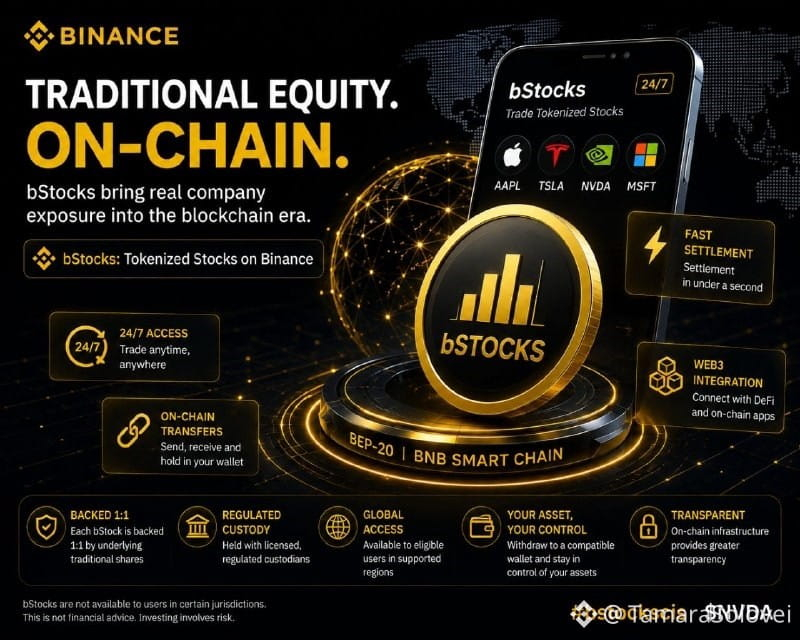
What makes tokenized stocks interesting isn't just the ability to buy them on-chain. It's what happens after you own them.
bStocks bring traditional equity exposure into a blockchain environment, opening the door to features that don't exist in the same way with conventional brokerage accounts.
With bStocks operating as BEP-20 tokens on BNB Smart Chain, the asset can become part of a broader on-chain ecosystem rather than remaining locked inside a traditional financial platform.
That creates some interesting possibilities:
🔹
On-chain transfers
🔹
24/7 access
🔹
Blockchain-based settlement
🔹
Potential integration with Web3 infrastructure
🔹
The ability to hold tokenized equity in a compatible wallet
But the most important part for me is the bridge between two financial worlds.
Traditional stocks provide exposure to established companies and real businesses. Blockchain infrastructure adds programmability, portability and continuous settlement.
Put those two things together, and tokenized equities start looking less like a simple crypto product and more like a new financial primitive.
The RWA market is still developing, but this is exactly the kind of infrastructure I think is worth watching.
Which traditional asset would you most like to see become fully integrated with on-chain finance?
#bstockscis @BinanceCIS
What makes tokenized stocks interesting isn't just the ability to buy them on-chain. It's what happens after you own them.
bStocks bring traditional equity exposure into a blockchain environment, opening the door to features that don't exist in the same way with conventional brokerage accounts.
With bStocks operating as BEP-20 tokens on BNB Smart Chain, the asset can become part of a broader on-chain ecosystem rather than remaining locked inside a traditional financial platform.
That creates some interesting possibilities:
🔹
On-chain transfers
🔹
24/7 access
🔹
Blockchain-based settlement
🔹
Potential integration with Web3 infrastructure
🔹
The ability to hold tokenized equity in a compatible wallet
But the most important part for me is the bridge between two financial worlds.
Traditional stocks provide exposure to established companies and real businesses. Blockchain infrastructure adds programmability, portability and continuous settlement.
Put those two things together, and tokenized equities start looking less like a simple crypto product and more like a new financial primitive.
The RWA market is still developing, but this is exactly the kind of infrastructure I think is worth watching.
Which traditional asset would you most like to see become fully integrated with on-chain finance?
What makes tokenized stocks interesting isn't just the ability to buy them on-chain. It's what happens after you own them.
bStocks bring traditional equity exposure into a blockchain environment, opening the door to features that don't exist in the same way with conventional brokerage accounts.
With bStocks operating as BEP-20 tokens on BNB Smart Chain, the asset can become part of a broader on-chain ecosystem rather than remaining locked inside a traditional financial platform.
That creates some interesting possibilities:
🔹
On-chain transfers
🔹
24/7 access
🔹
Blockchain-based settlement
🔹
Potential integration with Web3 infrastructure
🔹
The ability to hold tokenized equity in a compatible wallet
But the most important part for me is the bridge between two financial worlds.
Traditional stocks provide exposure to established companies and real businesses. Blockchain infrastructure adds programmability, portability and continuous settlement.
Put those two things together, and tokenized equities start looking less like a simple crypto product and more like a new financial primitive.
The RWA market is still developing, but this is exactly the kind of infrastructure I think is worth watching.
Which traditional asset would you most like to see become fully integrated with on-chain finance?
147
Xem bản dịch
#termmax @termmax
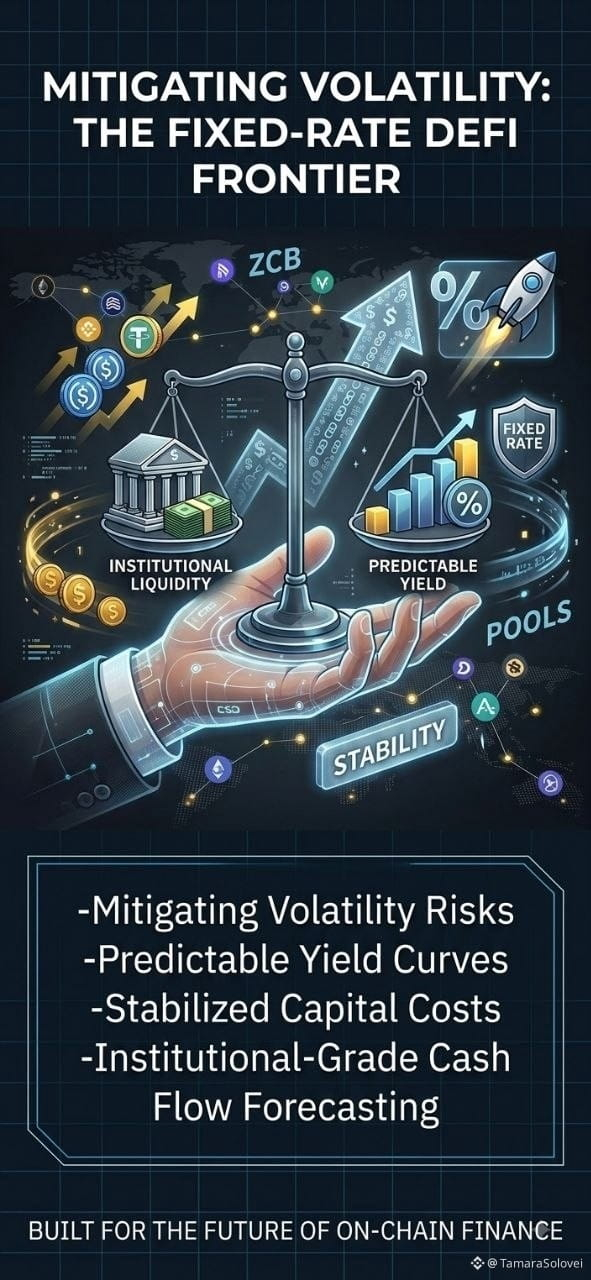
The maturity of the DeFi ecosystem is directly correlated with the introduction of primitive financial instruments capable of mitigating volatility risks. A significant gap in current credit markets is the lack of robust fixed-rate lending solutions. This is where @termmax introduces a crucial innovation.
By utilizing Zero-Coupon Bonds and Liquidity Pools, TermMax provides predictable yield curves for lenders and guaranteed capital costs for borrowers. This model dramatically reduces slippage and the uncertainty associated with variable interest rates. From my perspective, this approach is essential for attracting large-scale institutional liquidity, which requires accurate cash flow forecasting. Moving beyond variable-rate dependence is a critical step toward the long-term stabilization of capital markets on the blockchain.
#termmax @TermMax
The maturity of the DeFi ecosystem is directly correlated with the introduction of primitive financial instruments capable of mitigating volatility risks. A significant gap in current credit markets is the lack of robust fixed-rate lending solutions. This is where @TermMax introduces a crucial innovation.
By utilizing Zero-Coupon Bonds and Liquidity Pools, TermMax provides predictable yield curves for lenders and guaranteed capital costs for borrowers. This model dramatically reduces slippage and the uncertainty associated with variable interest rates. From my perspective, this approach is essential for attracting large-scale institutional liquidity, which requires accurate cash flow forecasting. Moving beyond variable-rate dependence is a critical step toward the long-term stabilization of capital markets on the blockchain.
The maturity of the DeFi ecosystem is directly correlated with the introduction of primitive financial instruments capable of mitigating volatility risks. A significant gap in current credit markets is the lack of robust fixed-rate lending solutions. This is where @TermMax introduces a crucial innovation.
By utilizing Zero-Coupon Bonds and Liquidity Pools, TermMax provides predictable yield curves for lenders and guaranteed capital costs for borrowers. This model dramatically reduces slippage and the uncertainty associated with variable interest rates. From my perspective, this approach is essential for attracting large-scale institutional liquidity, which requires accurate cash flow forecasting. Moving beyond variable-rate dependence is a critical step toward the long-term stabilization of capital markets on the blockchain.
47
Xem bản dịch
#dusk $DUSK @Dusk_Foundation
Tokenizing an asset is only the first step. The real challenge is building the market around it.
This is why I’m interested in what @Dusk_Foundation is building.
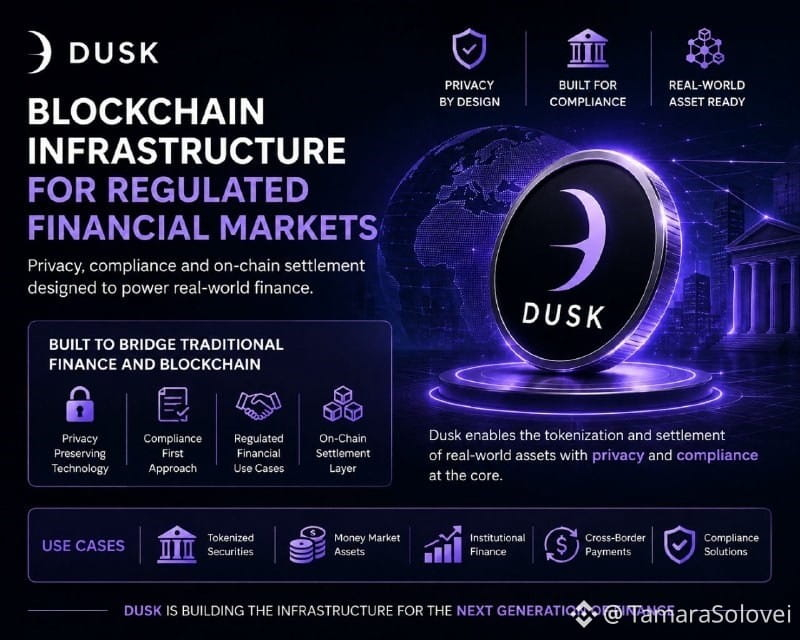
Dusk Trade is designed as an application layer for tokenized financial assets, covering more than simply buying and selling. The workflow can include investor onboarding, eligibility checks, wallet connection, payment coordination and settlement.
Underneath it, Dusk provides the infrastructure for regulated workflows: access controls, privacy, selective disclosure and deterministic settlement.
That approach makes sense to me because real financial markets aren't just token contracts. They involve issuers, investors, venues, custodians, compliance and settlement — all of which need to work together.
If RWAs are going to scale, the infrastructure has to support the entire market workflow, not just put another asset on-chain.
That's the direction I'm watching with Dusk.
#dusk $DUSK @Dusk
Tokenizing an asset is only the first step. The real challenge is building the market around it.
This is why I’m interested in what @Dusk is building.
Dusk Trade is designed as an application layer for tokenized financial assets, covering more than simply buying and selling. The workflow can include investor onboarding, eligibility checks, wallet connection, payment coordination and settlement.
Underneath it, Dusk provides the infrastructure for regulated workflows: access controls, privacy, selective disclosure and deterministic settlement.
That approach makes sense to me because real financial markets aren't just token contracts. They involve issuers, investors, venues, custodians, compliance and settlement — all of which need to work together.
If RWAs are going to scale, the infrastructure has to support the entire market workflow, not just put another asset on-chain.
That's the direction I'm watching with Dusk.
Tokenizing an asset is only the first step. The real challenge is building the market around it.
This is why I’m interested in what @Dusk is building.
Dusk Trade is designed as an application layer for tokenized financial assets, covering more than simply buying and selling. The workflow can include investor onboarding, eligibility checks, wallet connection, payment coordination and settlement.
Underneath it, Dusk provides the infrastructure for regulated workflows: access controls, privacy, selective disclosure and deterministic settlement.
That approach makes sense to me because real financial markets aren't just token contracts. They involve issuers, investors, venues, custodians, compliance and settlement — all of which need to work together.
If RWAs are going to scale, the infrastructure has to support the entire market workflow, not just put another asset on-chain.
That's the direction I'm watching with Dusk.
61
#bstockscis @BinanceCIS
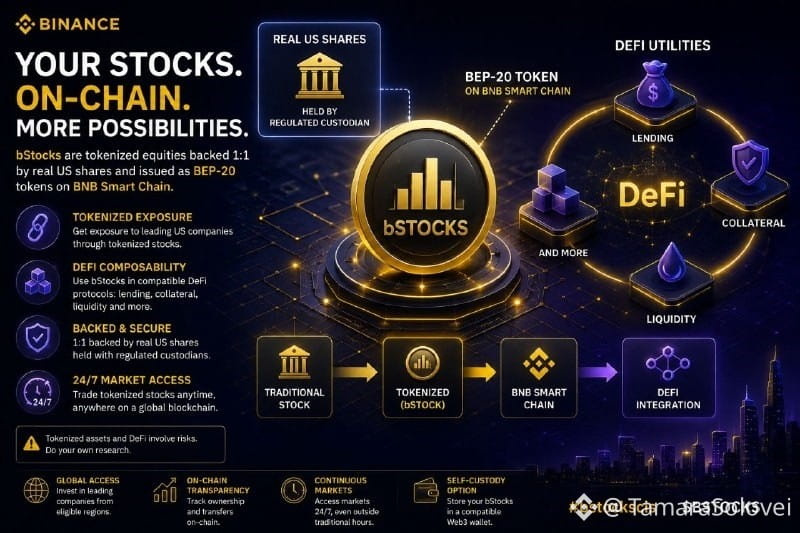
Điều gì sẽ xảy ra nếu danh mục chứng khoán của bạn có thể trở thành một phần trong chiến lược tài chính trên chuỗi của bạn?
Đây là nơi các cổ phiếu được token hóa bắt đầu trở nên thú vị hơn nhiều.
Cổ phiếu không chỉ đơn thuần là bản sao kỹ thuật số của cổ phiếu truyền thống. Vì chúng tồn tại dưới dạng token BEP-20 trên BNB Smart Chain, chúng có thể tương tác với cùng hạ tầng blockchain hỗ trợ các tài sản số khác.
Điều đó mở ra một không gian thiết kế hoàn toàn khác.
Hãy tưởng tượng bạn nắm giữ quyền tiếp xúc với một công ty và có thể sử dụng token đó trong các ứng dụng DeFi tương thích thay vì giữ tài sản bị “cô lập” trong một tài khoản môi giới truyền thống.
Từ quan trọng ở đây là khả năng tương thích (composability).
Các cổ phần truyền thống thường tồn tại trong hạ tầng của nhà môi giới. Tài sản được token hóa có thể trở thành các khối xây dựng cho những ứng dụng tài chính khác — cho vay, tài sản thế chấp, thanh khoản và các chiến lược on-chain khác, tùy thuộc vào các giao thức cụ thể và điều kiện đủ tư cách.
Khung bStocks hiện tại của Binance được xây dựng dựa trên sự đảm bảo 1:1 bằng các cổ phiếu tương ứng do một bên giám hộ được quản lý nắm giữ, trong khi chính token đó hoạt động trên BNB Smart Chain.
Điều này tạo ra một sự kết hợp thú vị:
Tài sản truyền thống → đại diện được token hóa → hạ tầng blockchain → tiện ích DeFi tiềm năng.
Và đó là lý do tôi nghĩ câu chuyện RWA lớn hơn việc chỉ đơn giản là mở thị trường 24/7.
Sự đổi mới thực sự có thể là việc biến các tài sản tài chính vốn trước đây bị tách biệt trở nên có thể kết hợp với một “ngăn xếp” tài chính hoàn toàn mới.
Tất nhiên, việc tích hợp DeFi cũng mang đến thêm các rủi ro về hợp đồng thông minh, thanh khoản và thị trường, vì vậy “on-chain” không tự động đồng nghĩa với “tốt hơn.”
Nhưng bản thân khả năng đó là vô cùng hấp dẫn.
Bạn có thực sự sử dụng cổ phiếu được token hóa làm tài sản thế chấp hoặc bên trong DeFi không, hay bạn sẽ chỉ giữ nó thuần túy như một khoản đầu tư?
#bstockscis @BinanceCIS
Điều gì sẽ xảy ra nếu danh mục chứng khoán của bạn có thể trở thành một phần trong chiến lược tài chính trên chuỗi của bạn?
Đây là nơi các cổ phiếu được token hóa bắt đầu trở nên thú vị hơn nhiều.
Cổ phiếu không chỉ đơn thuần là bản sao kỹ thuật số của cổ phiếu truyền thống. Vì chúng tồn tại dưới dạng token BEP-20 trên BNB Smart Chain, chúng có thể tương tác với cùng hạ tầng blockchain hỗ trợ các tài sản số khác.
Điều đó mở ra một không gian thiết kế hoàn toàn khác.
Hãy tưởng tượng bạn nắm giữ quyền tiếp xúc với một công ty và có thể sử dụng token đó trong các ứng dụng DeFi tương thích thay vì giữ tài sản bị “cô lập” trong một tài khoản môi giới truyền thống.
Từ quan trọng ở đây là khả năng tương thích (composability).
Các cổ phần truyền thống thường tồn tại trong hạ tầng của nhà môi giới. Tài sản được token hóa có thể trở thành các khối xây dựng cho những ứng dụng tài chính khác — cho vay, tài sản thế chấp, thanh khoản và các chiến lược on-chain khác, tùy thuộc vào các giao thức cụ thể và điều kiện đủ tư cách.
Khung bStocks hiện tại của Binance được xây dựng dựa trên sự đảm bảo 1:1 bằng các cổ phiếu tương ứng do một bên giám hộ được quản lý nắm giữ, trong khi chính token đó hoạt động trên BNB Smart Chain.
Điều này tạo ra một sự kết hợp thú vị:
Tài sản truyền thống → đại diện được token hóa → hạ tầng blockchain → tiện ích DeFi tiềm năng.
Và đó là lý do tôi nghĩ câu chuyện RWA lớn hơn việc chỉ đơn giản là mở thị trường 24/7.
Sự đổi mới thực sự có thể là việc biến các tài sản tài chính vốn trước đây bị tách biệt trở nên có thể kết hợp với một “ngăn xếp” tài chính hoàn toàn mới.
Tất nhiên, việc tích hợp DeFi cũng mang đến thêm các rủi ro về hợp đồng thông minh, thanh khoản và thị trường, vì vậy “on-chain” không tự động đồng nghĩa với “tốt hơn.”
Nhưng bản thân khả năng đó là vô cùng hấp dẫn.
Bạn có thực sự sử dụng cổ phiếu được token hóa làm tài sản thế chấp hoặc bên trong DeFi không, hay bạn sẽ chỉ giữ nó thuần túy như một khoản đầu tư?
Điều gì sẽ xảy ra nếu danh mục chứng khoán của bạn có thể trở thành một phần trong chiến lược tài chính trên chuỗi của bạn?
Đây là nơi các cổ phiếu được token hóa bắt đầu trở nên thú vị hơn nhiều.
Cổ phiếu không chỉ đơn thuần là bản sao kỹ thuật số của cổ phiếu truyền thống. Vì chúng tồn tại dưới dạng token BEP-20 trên BNB Smart Chain, chúng có thể tương tác với cùng hạ tầng blockchain hỗ trợ các tài sản số khác.
Điều đó mở ra một không gian thiết kế hoàn toàn khác.
Hãy tưởng tượng bạn nắm giữ quyền tiếp xúc với một công ty và có thể sử dụng token đó trong các ứng dụng DeFi tương thích thay vì giữ tài sản bị “cô lập” trong một tài khoản môi giới truyền thống.
Từ quan trọng ở đây là khả năng tương thích (composability).
Các cổ phần truyền thống thường tồn tại trong hạ tầng của nhà môi giới. Tài sản được token hóa có thể trở thành các khối xây dựng cho những ứng dụng tài chính khác — cho vay, tài sản thế chấp, thanh khoản và các chiến lược on-chain khác, tùy thuộc vào các giao thức cụ thể và điều kiện đủ tư cách.
Khung bStocks hiện tại của Binance được xây dựng dựa trên sự đảm bảo 1:1 bằng các cổ phiếu tương ứng do một bên giám hộ được quản lý nắm giữ, trong khi chính token đó hoạt động trên BNB Smart Chain.
Điều này tạo ra một sự kết hợp thú vị:
Tài sản truyền thống → đại diện được token hóa → hạ tầng blockchain → tiện ích DeFi tiềm năng.
Và đó là lý do tôi nghĩ câu chuyện RWA lớn hơn việc chỉ đơn giản là mở thị trường 24/7.
Sự đổi mới thực sự có thể là việc biến các tài sản tài chính vốn trước đây bị tách biệt trở nên có thể kết hợp với một “ngăn xếp” tài chính hoàn toàn mới.
Tất nhiên, việc tích hợp DeFi cũng mang đến thêm các rủi ro về hợp đồng thông minh, thanh khoản và thị trường, vì vậy “on-chain” không tự động đồng nghĩa với “tốt hơn.”
Nhưng bản thân khả năng đó là vô cùng hấp dẫn.
Bạn có thực sự sử dụng cổ phiếu được token hóa làm tài sản thế chấp hoặc bên trong DeFi không, hay bạn sẽ chỉ giữ nó thuần túy như một khoản đầu tư?
69
Xem bản dịch
#dusk $DUSK @Dusk_Foundation
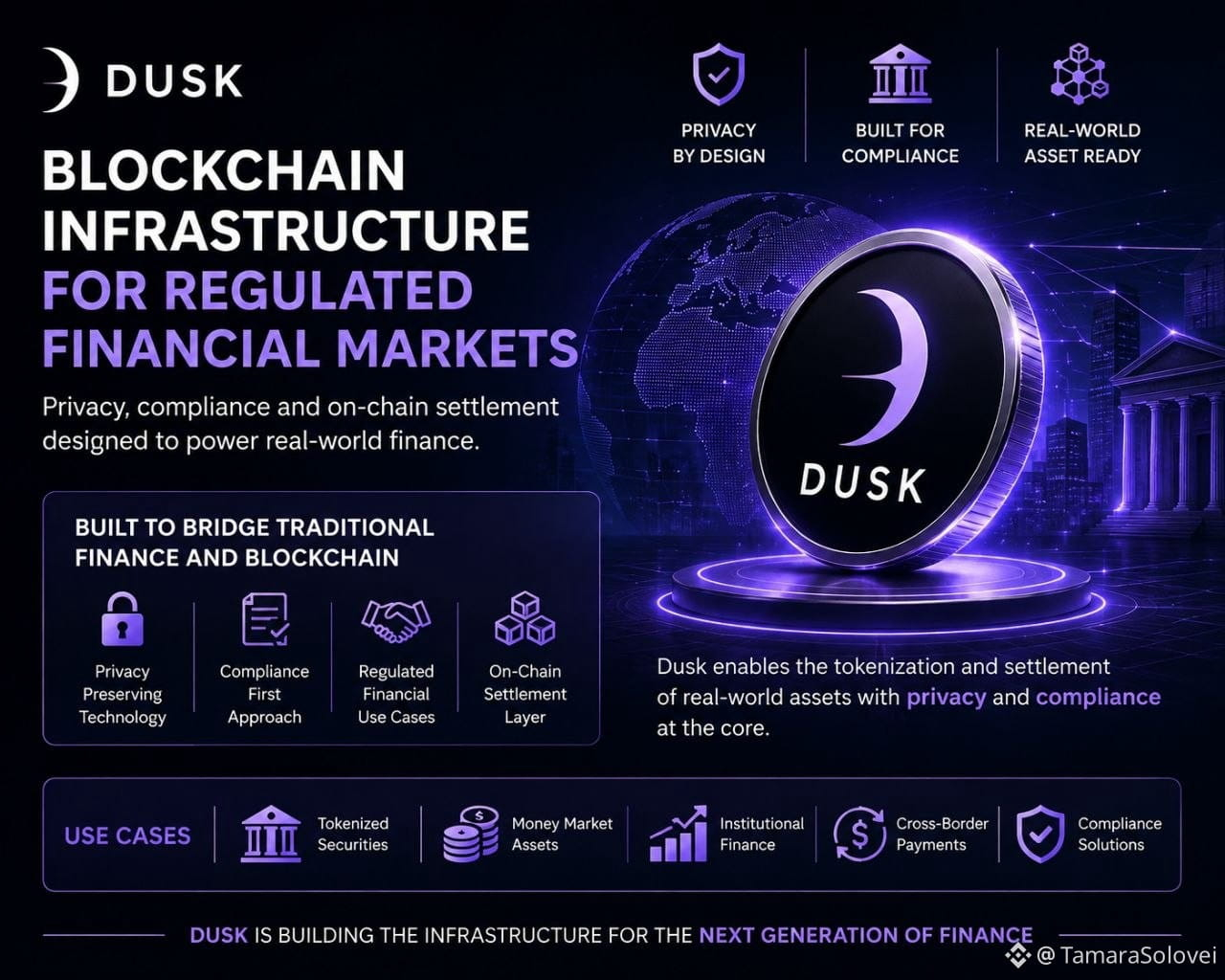
RWAs need more than tokenization. They need infrastructure built for real financial markets.
That’s what makes @Dusk_Foundation interesting to me.
Dusk is designed around regulated assets, combining privacy, compliance and on-chain settlement. Instead of making every transaction completely public, its architecture supports selective disclosure — allowing relevant information to be verified without exposing everything to everyone.
This could be especially useful for securities, bonds and other regulated assets where investor privacy and regulatory requirements have to coexist.
Another interesting part is Dusk’s EVM compatibility, which makes it easier for developers familiar with Ethereum tooling to build applications on the network.
If RWAs are going to become a major part of Web3, the infrastructure behind them needs to handle much more than simple token transfers.
That’s the niche Dusk is trying to build.
#dusk $DUSK @Dusk
RWAs need more than tokenization. They need infrastructure built for real financial markets.
That’s what makes @Dusk interesting to me.
Dusk is designed around regulated assets, combining privacy, compliance and on-chain settlement. Instead of making every transaction completely public, its architecture supports selective disclosure — allowing relevant information to be verified without exposing everything to everyone.
This could be especially useful for securities, bonds and other regulated assets where investor privacy and regulatory requirements have to coexist.
Another interesting part is Dusk’s EVM compatibility, which makes it easier for developers familiar with Ethereum tooling to build applications on the network.
If RWAs are going to become a major part of Web3, the infrastructure behind them needs to handle much more than simple token transfers.
That’s the niche Dusk is trying to build.
RWAs need more than tokenization. They need infrastructure built for real financial markets.
That’s what makes @Dusk interesting to me.
Dusk is designed around regulated assets, combining privacy, compliance and on-chain settlement. Instead of making every transaction completely public, its architecture supports selective disclosure — allowing relevant information to be verified without exposing everything to everyone.
This could be especially useful for securities, bonds and other regulated assets where investor privacy and regulatory requirements have to coexist.
Another interesting part is Dusk’s EVM compatibility, which makes it easier for developers familiar with Ethereum tooling to build applications on the network.
If RWAs are going to become a major part of Web3, the infrastructure behind them needs to handle much more than simple token transfers.
That’s the niche Dusk is trying to build.
1
79
Xem bản dịch
#bstockscis @BinanceCIS
What happens when a stock stops being locked inside a brokerage account?
That’s one of the more interesting ideas behind bStocks.
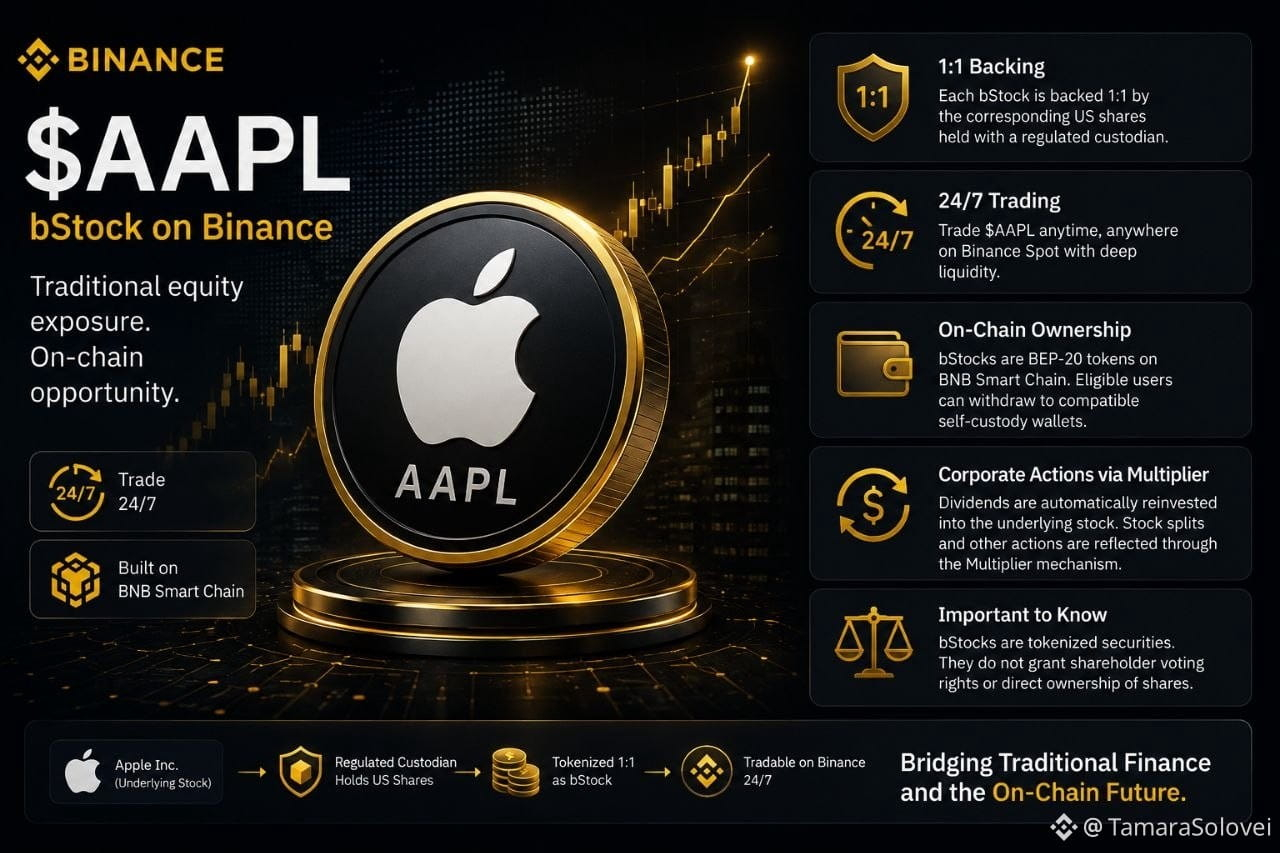
A tokenized stock such as $AAPL isn't simply a ticker displayed on an exchange. bStocks are backed 1:1 by corresponding US shares held with a regulated custodian, while the token itself exists as a BEP-20 asset on BNB Smart Chain.
The interesting part is what this enables.
Instead of keeping your exposure exclusively inside a traditional brokerage environment, eligible users can withdraw the tokenized asset to a compatible Web3 wallet.
That opens the door to something traditional shares can't easily provide:
🔗 Blockchain-native transfers
🌐 On-chain composability
🔐 Self-custody through a compatible wallet
🕐 24/7 trading infrastructure
And this is where tokenization becomes more than just changing the format of an asset.
The underlying economic exposure remains connected to the traditional security, while the representation of that exposure can interact with blockchain infrastructure.
That's the part of tokenized equities I find most interesting: bringing real-world financial assets into an environment where ownership and blockchain applications can finally start to interact.
Would you keep a tokenized stock on Binance or move it to your own compatible wallet?
#bstockscis @BinanceCIS
What happens when a stock stops being locked inside a brokerage account?
That’s one of the more interesting ideas behind bStocks.
A tokenized stock such as $AAPL isn't simply a ticker displayed on an exchange. bStocks are backed 1:1 by corresponding US shares held with a regulated custodian, while the token itself exists as a BEP-20 asset on BNB Smart Chain.
The interesting part is what this enables.
Instead of keeping your exposure exclusively inside a traditional brokerage environment, eligible users can withdraw the tokenized asset to a compatible Web3 wallet.
That opens the door to something traditional shares can't easily provide:
🔗 Blockchain-native transfers
🌐 On-chain composability
🔐 Self-custody through a compatible wallet
🕐 24/7 trading infrastructure
And this is where tokenization becomes more than just changing the format of an asset.
The underlying economic exposure remains connected to the traditional security, while the representation of that exposure can interact with blockchain infrastructure.
That's the part of tokenized equities I find most interesting: bringing real-world financial assets into an environment where ownership and blockchain applications can finally start to interact.
Would you keep a tokenized stock on Binance or move it to your own compatible wallet?
What happens when a stock stops being locked inside a brokerage account?
That’s one of the more interesting ideas behind bStocks.
A tokenized stock such as $AAPL isn't simply a ticker displayed on an exchange. bStocks are backed 1:1 by corresponding US shares held with a regulated custodian, while the token itself exists as a BEP-20 asset on BNB Smart Chain.
The interesting part is what this enables.
Instead of keeping your exposure exclusively inside a traditional brokerage environment, eligible users can withdraw the tokenized asset to a compatible Web3 wallet.
That opens the door to something traditional shares can't easily provide:
🔗 Blockchain-native transfers
🌐 On-chain composability
🔐 Self-custody through a compatible wallet
🕐 24/7 trading infrastructure
And this is where tokenization becomes more than just changing the format of an asset.
The underlying economic exposure remains connected to the traditional security, while the representation of that exposure can interact with blockchain infrastructure.
That's the part of tokenized equities I find most interesting: bringing real-world financial assets into an environment where ownership and blockchain applications can finally start to interact.
Would you keep a tokenized stock on Binance or move it to your own compatible wallet?
1
2
116
Xem bản dịch
#dusk $DUSK @Dusk_Foundation
One thing that makes Dusk interesting is that it doesn't force every application to use blockchain infrastructure in exactly the same way.
Dusk separates settlement from execution through its modular architecture.
At the foundation is DuskDS, responsible for consensus, finality and data availability. On top of that, developers can use DuskVM for native Rust/WASM smart contracts or DuskEVM when they want an EVM-compatible environment and familiar Solidity tooling.
Why is that important for regulated finance?
Different financial applications have different requirements. A native asset workflow may need direct access to Dusk's privacy and transaction models, while another application may benefit from existing Ethereum tooling and developer infrastructure.
Dusk is essentially trying to provide both paths without giving up its underlying settlement layer.
And this is where the architecture becomes more interesting than the usual “RWA blockchain” narrative.
The network is designed around requirements such as:
🔹 eligibility and access controls
🔹 selective disclosure of sensitive information
🔹 confidential transactions
🔹 deterministic settlement
🔹 regulated asset issuance and servicing
Its documentation specifically describes use cases ranging from tokenized equity and debt to institutional DeFi and delivery-versus-payment settlement.
For me, the key question isn't whether institutions will eventually use blockchain. It's whether the underlying infrastructure is flexible enough to meet the requirements of real financial markets.
That's the part of the Dusk thesis I'm watching.
#dusk $DUSK @Dusk
One thing that makes Dusk interesting is that it doesn't force every application to use blockchain infrastructure in exactly the same way.
Dusk separates settlement from execution through its modular architecture.
At the foundation is DuskDS, responsible for consensus, finality and data availability. On top of that, developers can use DuskVM for native Rust/WASM smart contracts or DuskEVM when they want an EVM-compatible environment and familiar Solidity tooling.
Why is that important for regulated finance?
Different financial applications have different requirements. A native asset workflow may need direct access to Dusk's privacy and transaction models, while another application may benefit from existing Ethereum tooling and developer infrastructure.
Dusk is essentially trying to provide both paths without giving up its underlying settlement layer.
And this is where the architecture becomes more interesting than the usual “RWA blockchain” narrative.
The network is designed around requirements such as:
🔹 eligibility and access controls
🔹 selective disclosure of sensitive information
🔹 confidential transactions
🔹 deterministic settlement
🔹 regulated asset issuance and servicing
Its documentation specifically describes use cases ranging from tokenized equity and debt to institutional DeFi and delivery-versus-payment settlement.
For me, the key question isn't whether institutions will eventually use blockchain. It's whether the underlying infrastructure is flexible enough to meet the requirements of real financial markets.
That's the part of the Dusk thesis I'm watching.
One thing that makes Dusk interesting is that it doesn't force every application to use blockchain infrastructure in exactly the same way.
Dusk separates settlement from execution through its modular architecture.
At the foundation is DuskDS, responsible for consensus, finality and data availability. On top of that, developers can use DuskVM for native Rust/WASM smart contracts or DuskEVM when they want an EVM-compatible environment and familiar Solidity tooling.
Why is that important for regulated finance?
Different financial applications have different requirements. A native asset workflow may need direct access to Dusk's privacy and transaction models, while another application may benefit from existing Ethereum tooling and developer infrastructure.
Dusk is essentially trying to provide both paths without giving up its underlying settlement layer.
And this is where the architecture becomes more interesting than the usual “RWA blockchain” narrative.
The network is designed around requirements such as:
🔹 eligibility and access controls
🔹 selective disclosure of sensitive information
🔹 confidential transactions
🔹 deterministic settlement
🔹 regulated asset issuance and servicing
Its documentation specifically describes use cases ranging from tokenized equity and debt to institutional DeFi and delivery-versus-payment settlement.
For me, the key question isn't whether institutions will eventually use blockchain. It's whether the underlying infrastructure is flexible enough to meet the requirements of real financial markets.
That's the part of the Dusk thesis I'm watching.
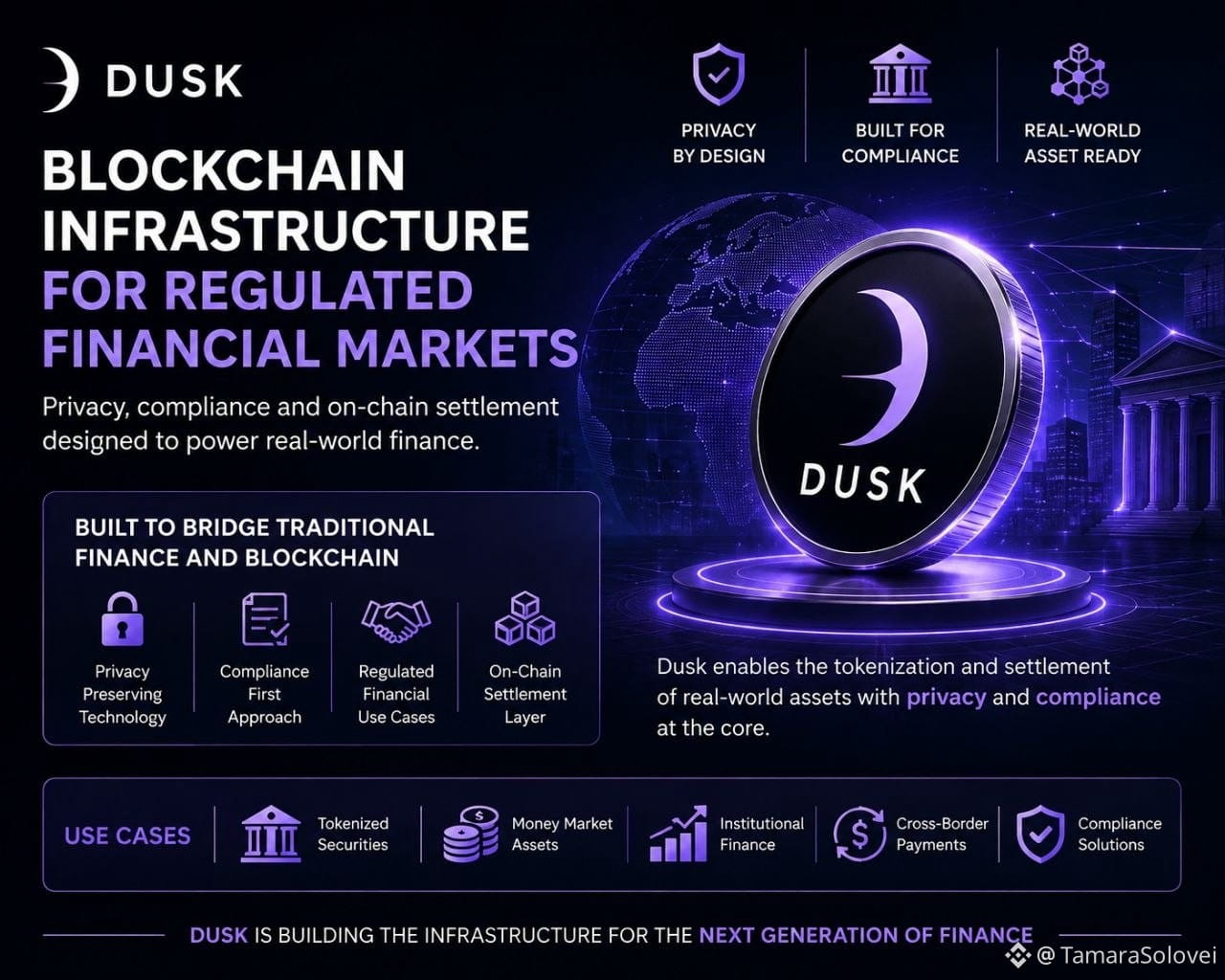
2
1
57
Đăng nhập để khám phá thêm nội dung
Tham gia cùng người dùng tiền mã hóa toàn cầu trên Binance Square
⚡️ Nhận thông tin mới nhất và hữu ích về tiền mã hóa.
💬 Được tin cậy bởi sàn giao dịch tiền mã hóa lớn nhất thế giới.
👍 Khám phá những thông tin chuyên sâu thực tế từ những nhà sáng tạo đã xác minh.
Email / Số điện thoại