#bstockscis @BinanceCIS
What if your stock portfolio could become part of your on-chain financial strategy?
This is where tokenized equities start getting much more interesting.
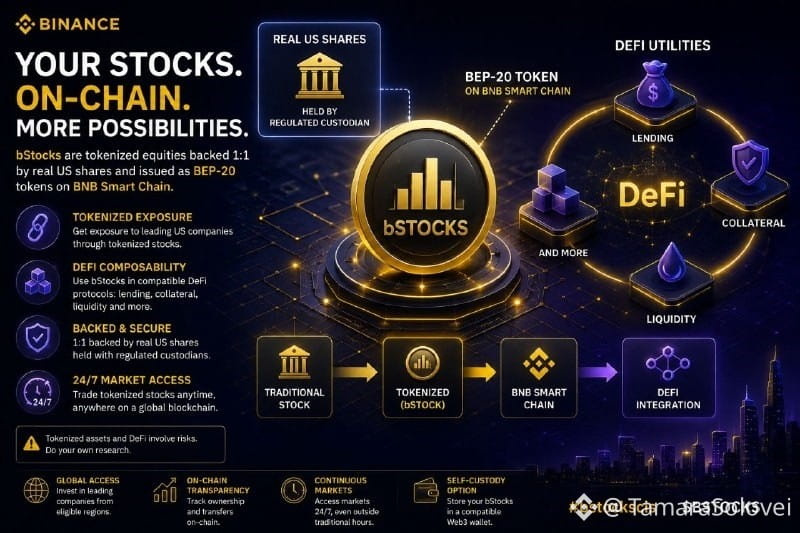
bStocks aren't simply digital representations of traditional stocks. Because they exist as BEP-20 tokens on BNB Smart Chain, they can potentially interact with the same blockchain infrastructure that supports other digital assets.
That creates a completely different design space.
Imagine holding exposure to a company and being able to use that token within compatible DeFi applications instead of keeping the asset isolated inside a traditional brokerage account.
The important word here is composability.
Traditional shares generally live inside a brokerage infrastructure. Tokenized assets can potentially become building blocks for other financial applications — lending, collateral, liquidity and other on-chain strategies, depending on the specific protocols and eligibility requirements.
Binance's current bStocks framework is built around 1:1 backing by corresponding US shares held with a regulated custodian, while the token itself operates on BNB Smart Chain.
This creates an interesting combination:
Traditional asset → tokenized representation → blockchain infrastructure → potential DeFi utility.
And that's why I think the RWA story is bigger than simply making markets available 24/7.
The real innovation could be making previously isolated financial assets composable with an entirely new financial stack.
Of course, DeFi integration also introduces additional smart-contract, liquidity and market risks, so “on-chain” doesn't automatically mean “better.”
But the possibility itself is fascinating.
Would you actually use a tokenized stock as collateral or inside DeFi, or would you keep it purely as an investment?
What if your stock portfolio could become part of your on-chain financial strategy?
This is where tokenized equities start getting much more interesting.
bStocks aren't simply digital representations of traditional stocks. Because they exist as BEP-20 tokens on BNB Smart Chain, they can potentially interact with the same blockchain infrastructure that supports other digital assets.
That creates a completely different design space.
Imagine holding exposure to a company and being able to use that token within compatible DeFi applications instead of keeping the asset isolated inside a traditional brokerage account.
The important word here is composability.
Traditional shares generally live inside a brokerage infrastructure. Tokenized assets can potentially become building blocks for other financial applications — lending, collateral, liquidity and other on-chain strategies, depending on the specific protocols and eligibility requirements.
Binance's current bStocks framework is built around 1:1 backing by corresponding US shares held with a regulated custodian, while the token itself operates on BNB Smart Chain.
This creates an interesting combination:
Traditional asset → tokenized representation → blockchain infrastructure → potential DeFi utility.
And that's why I think the RWA story is bigger than simply making markets available 24/7.
The real innovation could be making previously isolated financial assets composable with an entirely new financial stack.
Of course, DeFi integration also introduces additional smart-contract, liquidity and market risks, so “on-chain” doesn't automatically mean “better.”
But the possibility itself is fascinating.
Would you actually use a tokenized stock as collateral or inside DeFi, or would you keep it purely as an investment?