
Aaira_3596
180 Bài đăng

Aaira_3596
11 Đang theo dõi
1.1K+ Người theo dõi
402 Đã thích
Bài đăng
Xem bản dịch
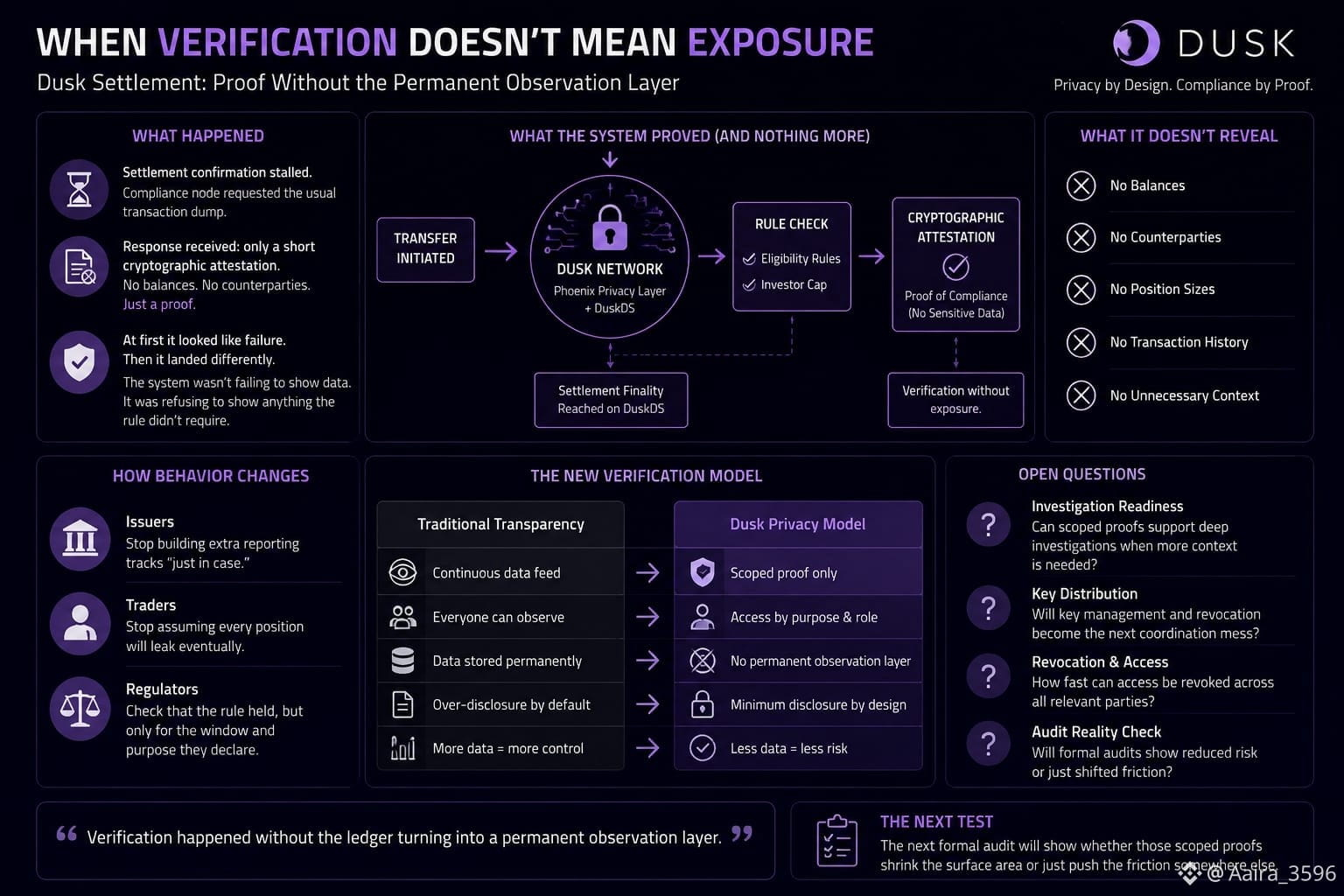
#dusk $DUSK @Dusk I watched a settlement confirmation stall on Dusk the other day. The compliance node kept asking for the usual transaction dump and kept getting nothing back except a short cryptographic attestation. No balances. No counterparties. Just a proof that the transfer stayed inside the eligibility rules and the investor cap.
At first it looked like the pipeline was broken. Then it landed differently. The system wasn’t failing to show data. It was simply refusing to show anything the rule itself didn’t require. Verification happened without the ledger turning into a permanent observation layer.
That shifts how people actually behave. Issuers stop building extra reporting tracks “just in case.” Traders stop assuming every position will leak eventually. Regulators still check that the rule held, but only for the window and purpose they declare. The continuous feed is gone.
I’m not convinced it holds up when a real investigation needs more context. Key distribution and revocation could become the next coordination mess. The next formal audit will show whether those scoped proofs shrink the surface area or just push the friction somewhere else.
At first it looked like the pipeline was broken. Then it landed differently. The system wasn’t failing to show data. It was simply refusing to show anything the rule itself didn’t require. Verification happened without the ledger turning into a permanent observation layer.
That shifts how people actually behave. Issuers stop building extra reporting tracks “just in case.” Traders stop assuming every position will leak eventually. Regulators still check that the rule held, but only for the window and purpose they declare. The continuous feed is gone.
I’m not convinced it holds up when a real investigation needs more context. Key distribution and revocation could become the next coordination mess. The next formal audit will show whether those scoped proofs shrink the surface area or just push the friction somewhere else.
Xem bản dịch
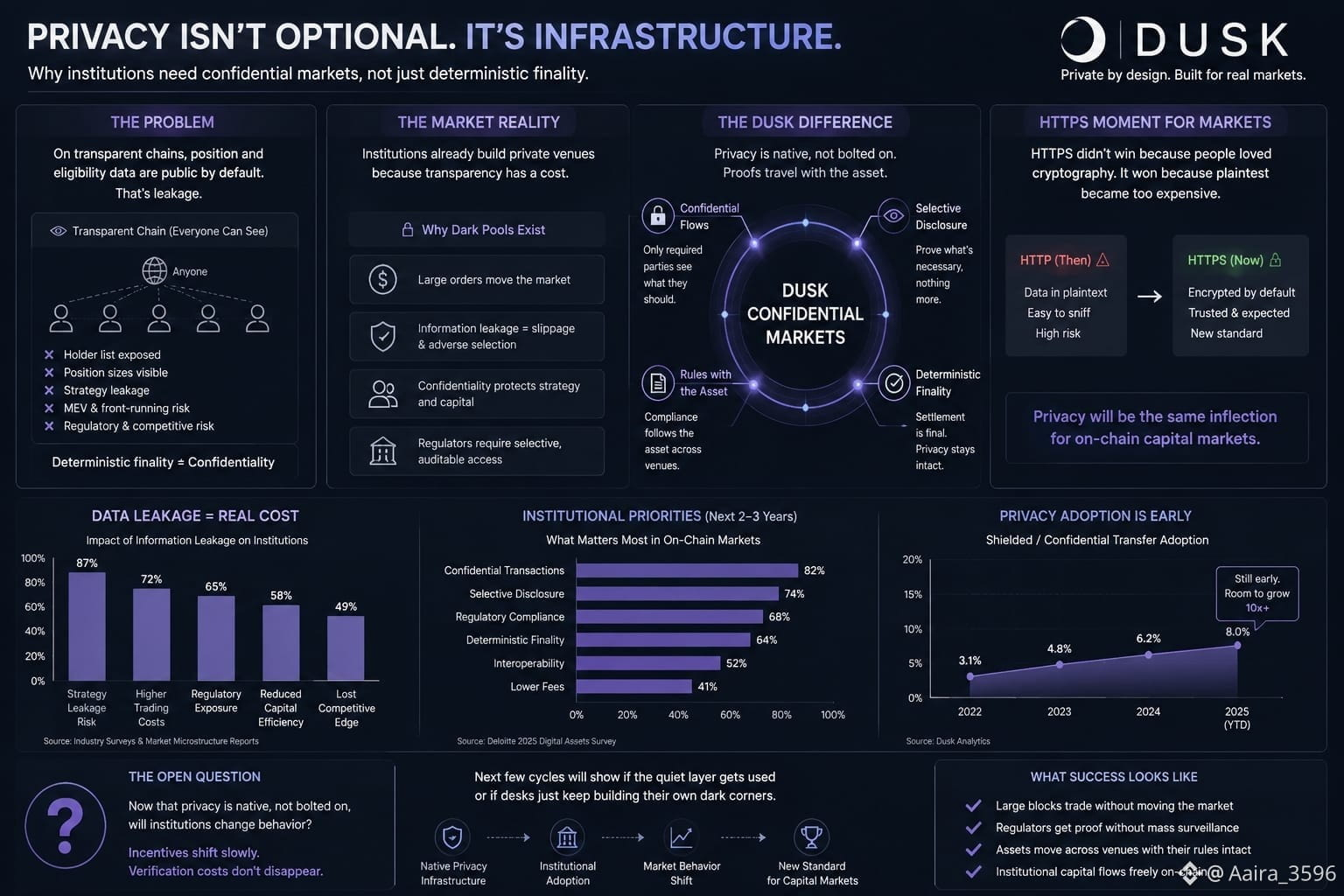
#dusk $DUSK @Dusk I watched a test issuance stall last week. Not on settlement that cleared fine. The hold-up was quieter. Someone on the compliance side asked who could see the holder list and the size of the book. Silence. On a transparent chain the answer is basically everyone. That’s the part that keeps showing up.
You can have deterministic finality and still lose the room the moment positions or eligibility data sit in the open. Institutions don’t treat that as a feature. They treat it as leakage. Dark pools exist for a reason. HTTPS didn’t become default because people loved cryptography; it became default because plaintext started costing real money and real risk.
Dusk has been building the quieter version for years—confidential flows where they matter, selective disclosure when a regulator or auditor actually needs proof, rules that travel with the asset. The stack tries to keep the market from having to choose between public rails and private walls. Whether participants actually change behavior once the privacy is native, not bolted on, is still the open question. Incentives shift slowly. Verification costs don’t disappear just because the math is elegant.
Next few cycles will show if the quiet layer gets used or if desks just keep building their own dark corners.
You can have deterministic finality and still lose the room the moment positions or eligibility data sit in the open. Institutions don’t treat that as a feature. They treat it as leakage. Dark pools exist for a reason. HTTPS didn’t become default because people loved cryptography; it became default because plaintext started costing real money and real risk.
Dusk has been building the quieter version for years—confidential flows where they matter, selective disclosure when a regulator or auditor actually needs proof, rules that travel with the asset. The stack tries to keep the market from having to choose between public rails and private walls. Whether participants actually change behavior once the privacy is native, not bolted on, is still the open question. Incentives shift slowly. Verification costs don’t disappear just because the math is elegant.
Next few cycles will show if the quiet layer gets used or if desks just keep building their own dark corners.
Xem bản dịch
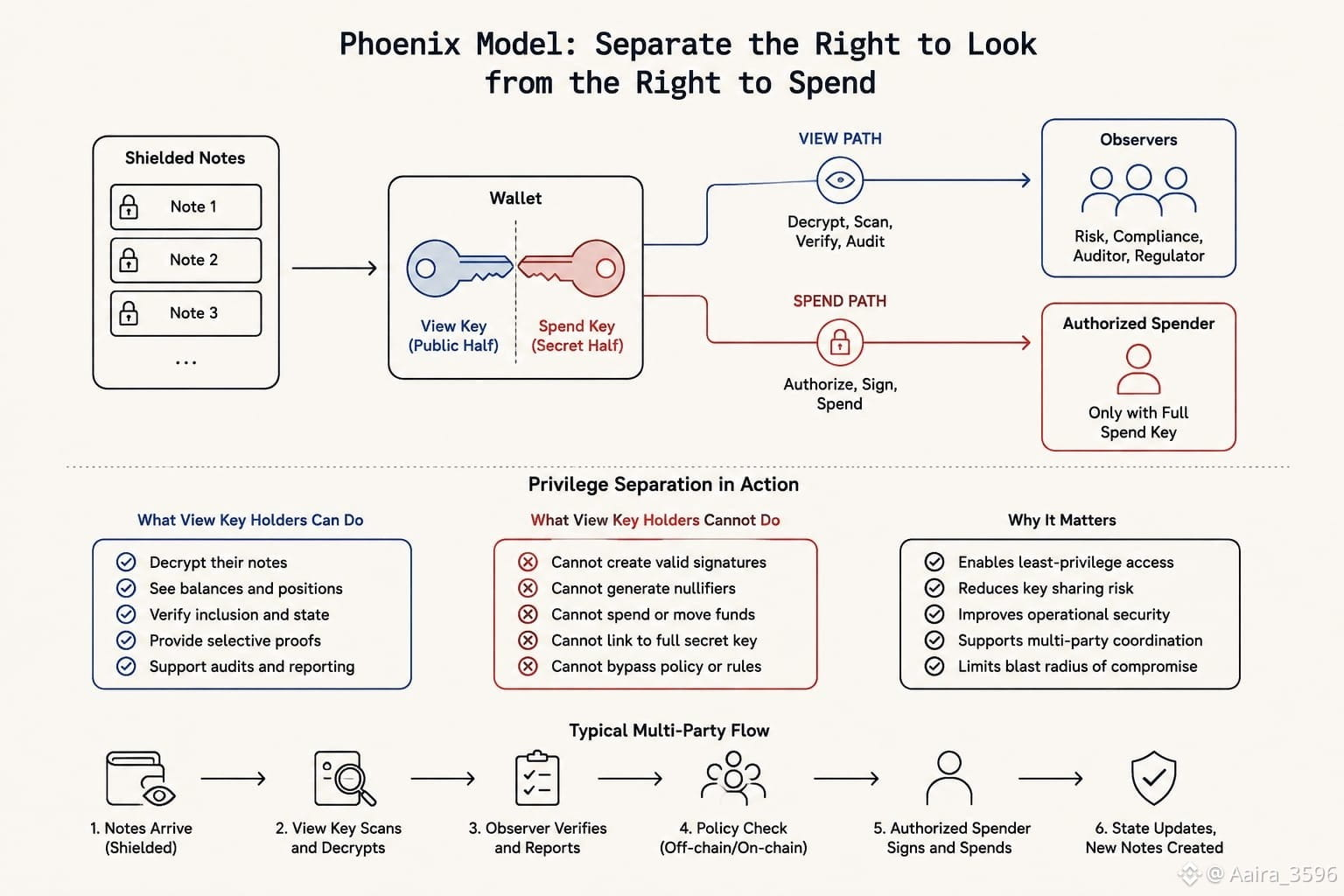
#dusk $DUSK @Dusk I was watching a node sync last week when a note scan stalled. The wallet had the view key, so it could decrypt the incoming shielded notes and tally the balance just fine. But the spend path kept failing on the nullifier. Turns out the operator had shared only the view half with the monitoring script. The full secret stayed offline.
That little gap is what the Phoenix design leans on. You can hand someone the ability to see every note that belongs to an address—values, positions, the whole local state—without ever giving them the scalar that finishes the note secret key. They can verify, they can audit, they can even prove ownership to a regulator. They just cannot move anything. The system treats “looking” and “authorizing” as two different privileges instead of one fused secret.
It changes how people coordinate. Risk teams can watch balances in real time. Compliance can pull selective history. The actual keys that sign stays with whoever is supposed to control the funds. You start seeing fewer “just share the seed for a second” requests, which is useful when the money is real.
Still not sure how cleanly this holds once you have dozens of parties needing different slices of visibility at the same time. The crypto boundary is sharp. The operational ones usually aren’t. Next time a multi-party settlement hits a view-key handoff under time pressure, I’ll be watching whether anyone reaches for the full secret out of habit.
That little gap is what the Phoenix design leans on. You can hand someone the ability to see every note that belongs to an address—values, positions, the whole local state—without ever giving them the scalar that finishes the note secret key. They can verify, they can audit, they can even prove ownership to a regulator. They just cannot move anything. The system treats “looking” and “authorizing” as two different privileges instead of one fused secret.
It changes how people coordinate. Risk teams can watch balances in real time. Compliance can pull selective history. The actual keys that sign stays with whoever is supposed to control the funds. You start seeing fewer “just share the seed for a second” requests, which is useful when the money is real.
Still not sure how cleanly this holds once you have dozens of parties needing different slices of visibility at the same time. The crypto boundary is sharp. The operational ones usually aren’t. Next time a multi-party settlement hits a view-key handoff under time pressure, I’ll be watching whether anyone reaches for the full secret out of habit.
Xem bản dịch
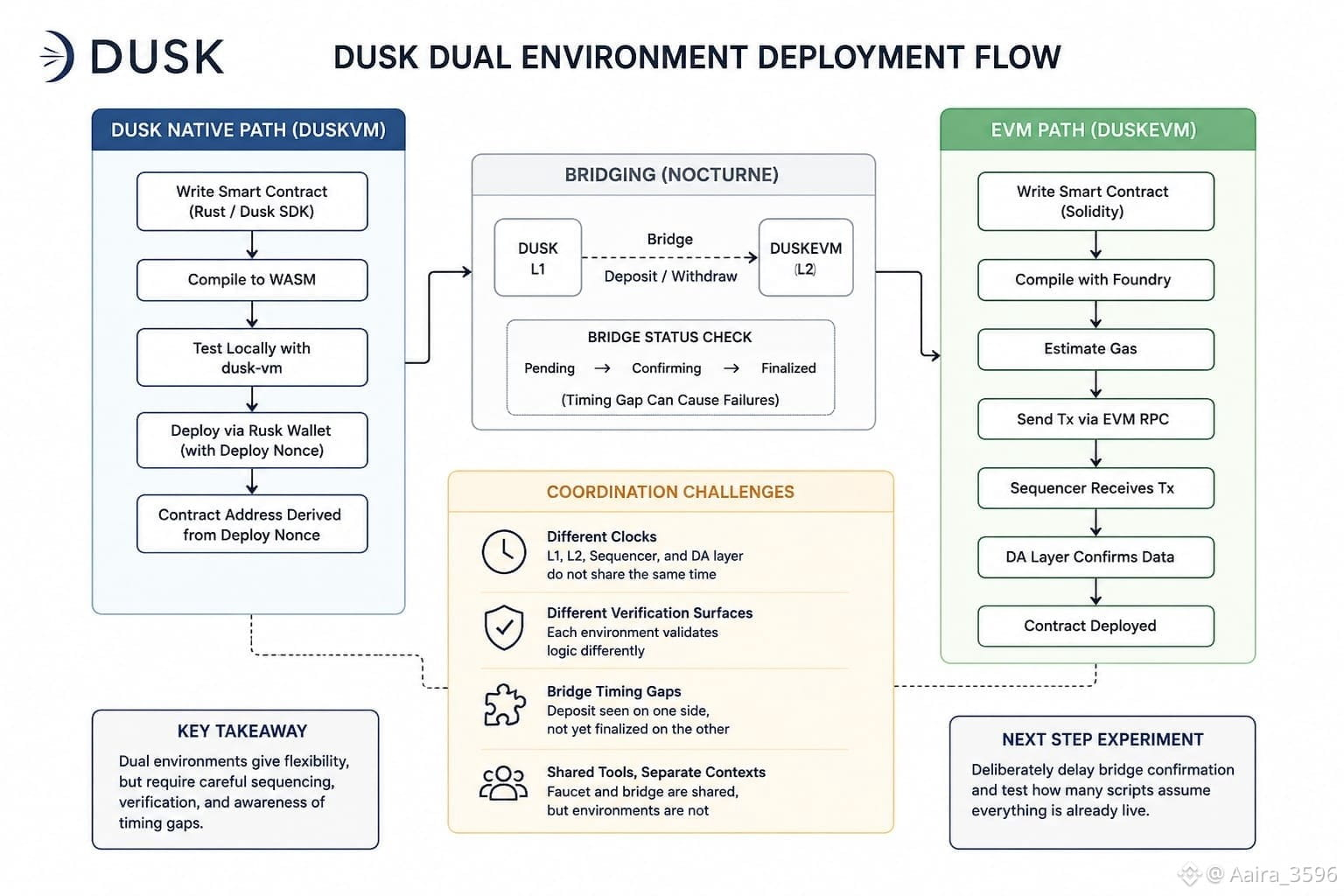
#dusk $DUSK @Dusk I watched a deploy retry fail this morning on the DuskEVM side. Same Foundry command, same encrypted keystore, gas estimate looked clean enough. Transaction just hung. The bridged testnet DUSK from Nocturne hadn’t fully settled explorer still showed the L1 hop pending while the EVM RPC already took the signed payload. Small timing gap, but it made me sit there watching the bridge status instead of assuming the tooling would just coordinate itself.
That stall said more than most of the docs. You’re bouncing between two environments that don’t share a clock or the same verification surface. Native path: compile the WASM, run it through dusk-vm locally, then hand it to the Rusk wallet with a deploy nonce that becomes part of the address. Miss the nonce and the contract lands somewhere unexpected. EVM side feels familiar until the sequencer and the data-availability layer disagree about when a deposit is actually real. People start treating the Discord faucet and the bridge like shared infrastructure rather than free tokens, which changes how carefully they sequence their own tests.
I’m still not convinced the dual setup scales cleanly once more teams hit the same coordination points at once. The incentives push toward careful verification, but only if you notice the gaps. Next time I’ll deliberately delay the bridge confirmation and watch how many of the usual scripts still assume everything is already live.
That stall said more than most of the docs. You’re bouncing between two environments that don’t share a clock or the same verification surface. Native path: compile the WASM, run it through dusk-vm locally, then hand it to the Rusk wallet with a deploy nonce that becomes part of the address. Miss the nonce and the contract lands somewhere unexpected. EVM side feels familiar until the sequencer and the data-availability layer disagree about when a deposit is actually real. People start treating the Discord faucet and the bridge like shared infrastructure rather than free tokens, which changes how carefully they sequence their own tests.
I’m still not convinced the dual setup scales cleanly once more teams hit the same coordination points at once. The incentives push toward careful verification, but only if you notice the gaps. Next time I’ll deliberately delay the bridge confirmation and watch how many of the usual scripts still assume everything is already live.
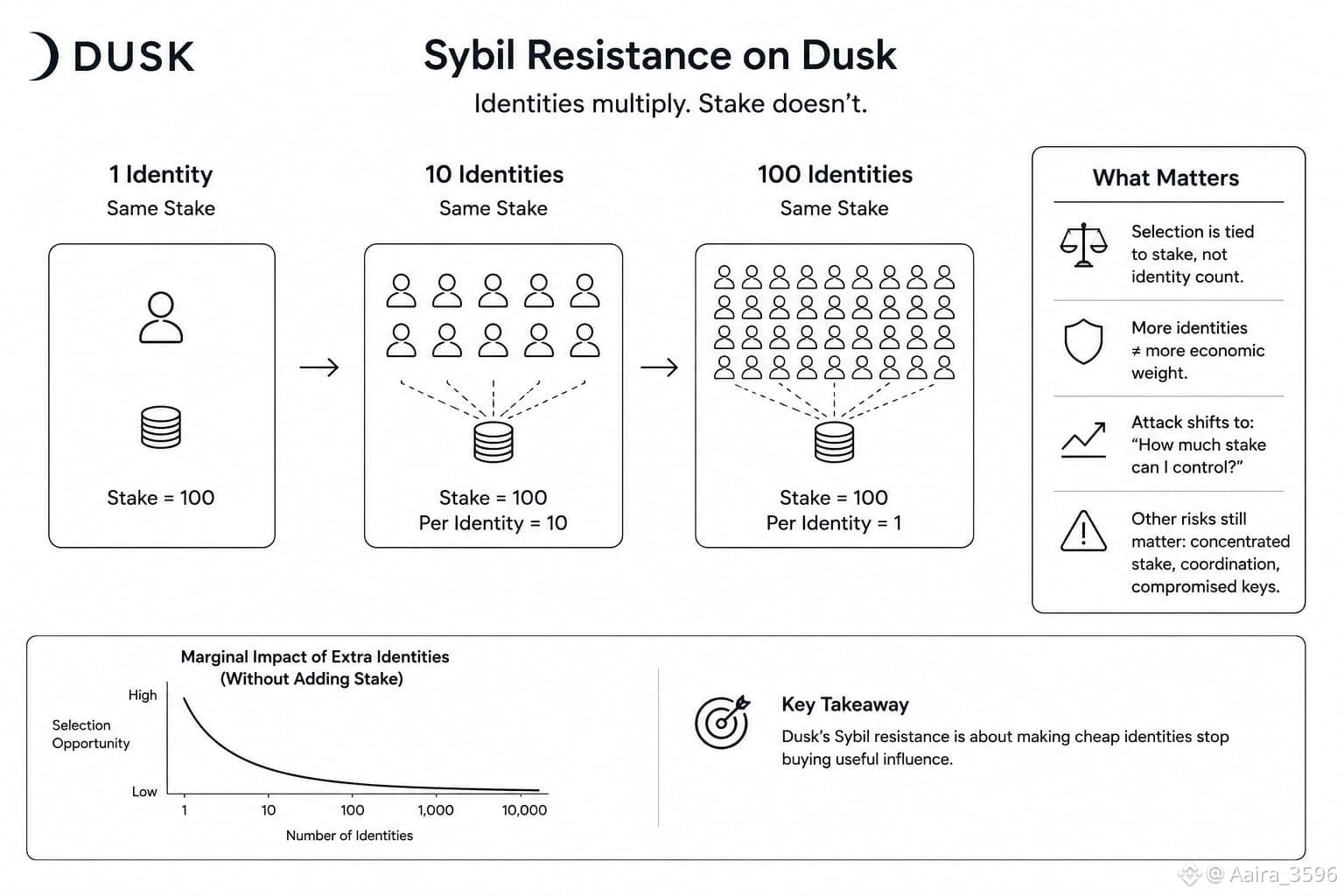
#dusk $DUSK @Dusk Tôi nhận thấy điều gì đó khi suy nghĩ về một kịch bản Sybil trên Dusk: kẻ tấn công có thể tạo ra các danh tính nhanh hơn nhiều so với mạng có thể quan tâm đến chúng.
Đó là phần quan trọng. Nếu tôi có thể tạo ra 100 địa chỉ gần như miễn phí, việc đếm địa chỉ chỉ là một biện pháp phòng thủ yếu. Câu hỏi thú vị là những địa chỉ đó thực sự có thể gây ảnh hưởng gì.
Dusk gắn việc lựa chọn với stake, từ đó thay đổi bài toán kinh tế. Giả sử tôi lấy cùng một lượng stake và phân tán nó qua 10 hay 100 danh tính. Tôi tạo ra nhiều danh tính hơn, nhưng tôi không tạo ra thêm trọng lượng kinh tế. Các khóa được nhân lên. Cam kết nền tảng của tôi thì không.
Vì vậy, cuộc tấn công chuyển từ “Tôi có thể tạo ra bao nhiêu danh tính?” sang “Tôi thực sự có thể kiểm soát bao nhiêu stake?” Đây là một bài toán khó hơn nhiều để giải quyết chỉ bằng việc tạo tài khoản rẻ.
Nó cũng không phải một “lá chắn” thần kỳ. Stake tập trung, các tác nhân phối hợp, khóa bị xâm phạm và các rủi ro đồng thuận khác vẫn quan trọng. Tôi sẽ nghi ngờ bất kỳ thiết kế nào tuyên bố điều ngược lại.
Điều tôi thấy đáng theo dõi là hành vi ở “biên”: nếu một kẻ tấn công cứ tiếp tục thêm danh tính mà không thêm stake, thì danh tính bổ sung đó ngừng chuyển thành các cơ hội lựa chọn có ý nghĩa nhanh đến mức nào?
Đó là lúc khả năng kháng Sybil của Dusk trở nên thú vị với tôi: không phải khi danh tính biến mất, mà khi các danh tính rẻ không còn mua được ảnh hưởng hữu ích nữa.
Đó là phần quan trọng. Nếu tôi có thể tạo ra 100 địa chỉ gần như miễn phí, việc đếm địa chỉ chỉ là một biện pháp phòng thủ yếu. Câu hỏi thú vị là những địa chỉ đó thực sự có thể gây ảnh hưởng gì.
Dusk gắn việc lựa chọn với stake, từ đó thay đổi bài toán kinh tế. Giả sử tôi lấy cùng một lượng stake và phân tán nó qua 10 hay 100 danh tính. Tôi tạo ra nhiều danh tính hơn, nhưng tôi không tạo ra thêm trọng lượng kinh tế. Các khóa được nhân lên. Cam kết nền tảng của tôi thì không.
Vì vậy, cuộc tấn công chuyển từ “Tôi có thể tạo ra bao nhiêu danh tính?” sang “Tôi thực sự có thể kiểm soát bao nhiêu stake?” Đây là một bài toán khó hơn nhiều để giải quyết chỉ bằng việc tạo tài khoản rẻ.
Nó cũng không phải một “lá chắn” thần kỳ. Stake tập trung, các tác nhân phối hợp, khóa bị xâm phạm và các rủi ro đồng thuận khác vẫn quan trọng. Tôi sẽ nghi ngờ bất kỳ thiết kế nào tuyên bố điều ngược lại.
Điều tôi thấy đáng theo dõi là hành vi ở “biên”: nếu một kẻ tấn công cứ tiếp tục thêm danh tính mà không thêm stake, thì danh tính bổ sung đó ngừng chuyển thành các cơ hội lựa chọn có ý nghĩa nhanh đến mức nào?
Đó là lúc khả năng kháng Sybil của Dusk trở nên thú vị với tôi: không phải khi danh tính biến mất, mà khi các danh tính rẻ không còn mua được ảnh hưởng hữu ích nữa.
Xem bản dịch
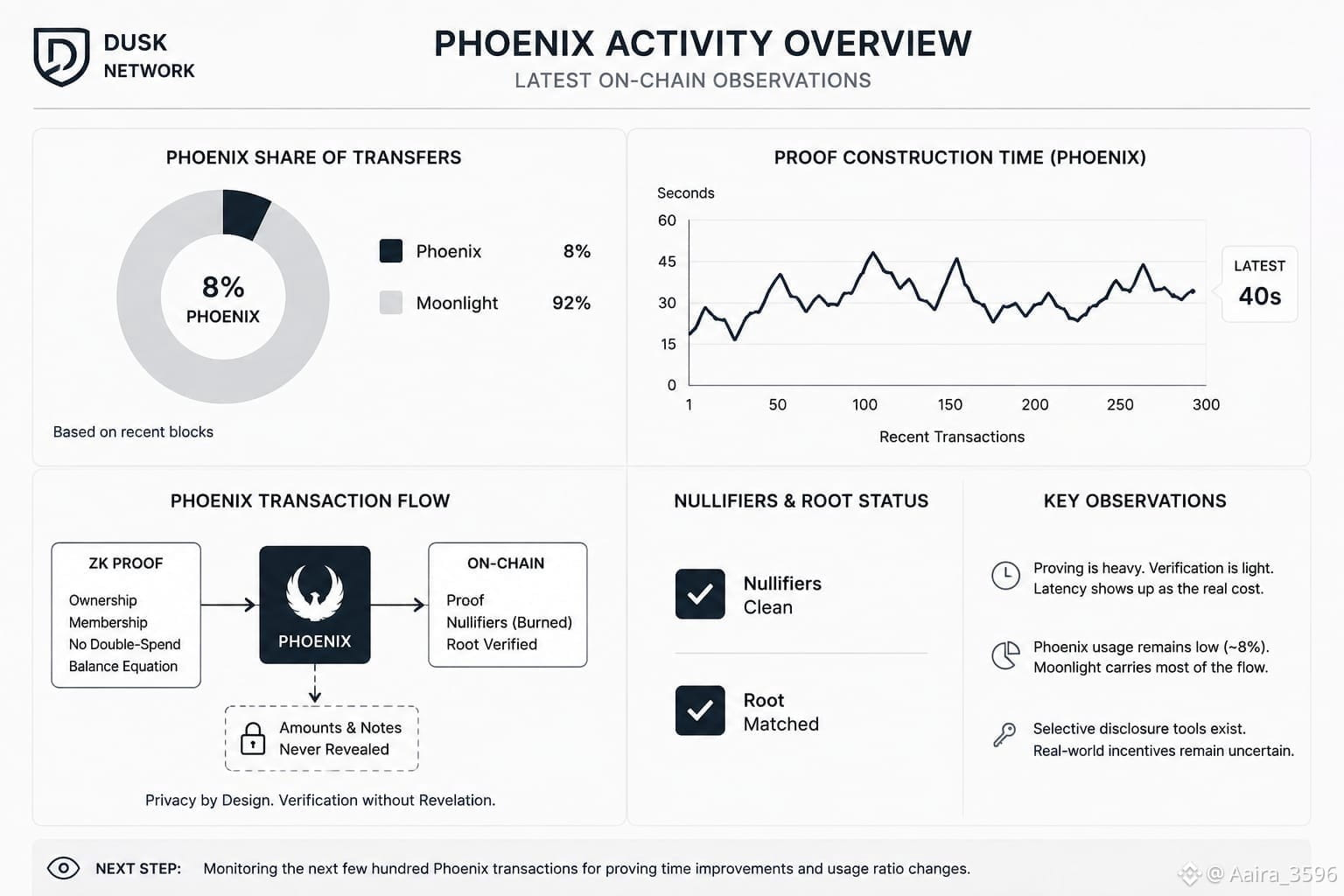
#dusk $DUSK @Dusk I watched another Phoenix spend hang on Dusk last night. Forty seconds of the wallet just chewing on the proof before the node finally accepted it. Nullifiers showed up clean. Root matched. Balance equation held. Nothing on-chain ever revealed the amounts or which notes got spent. Just the proof and a couple of burned markers sitting there.
That quiet is deliberate. The circuit makes the sender do all the hard arithmetic so the validators never touch the actual values. Ownership, membership, no double-spend — all forced into the proof without the data itself ever appearing. Verification stays light. Construction does not.
Still seeing the same split in recent blocks on Dusk. Most value keeps moving on Moonlight. Phoenix appears, but sparsely — lately around eight percent of transfers. Hard to blame anyone running a busy wallet or exchange flow. Proving keys are heavy, remote provers get more of the witness than feels comfortable, and the cost shows up as latency more than anything else. Dual path exists. People keep choosing the public one.
Not sure yet how the selective disclosure side will hold up when real pressure arrives. Viewing keys are there. Sender encryption is there. Whether anyone actually hands them over under audit is a different problem. Math works either way. Incentives might not.
Going to watch the next few hundred Phoenix transactions on Dusk and see if proving times drop or if the ratio just stays stuck.
That quiet is deliberate. The circuit makes the sender do all the hard arithmetic so the validators never touch the actual values. Ownership, membership, no double-spend — all forced into the proof without the data itself ever appearing. Verification stays light. Construction does not.
Still seeing the same split in recent blocks on Dusk. Most value keeps moving on Moonlight. Phoenix appears, but sparsely — lately around eight percent of transfers. Hard to blame anyone running a busy wallet or exchange flow. Proving keys are heavy, remote provers get more of the witness than feels comfortable, and the cost shows up as latency more than anything else. Dual path exists. People keep choosing the public one.
Not sure yet how the selective disclosure side will hold up when real pressure arrives. Viewing keys are there. Sender encryption is there. Whether anyone actually hands them over under audit is a different problem. Math works either way. Incentives might not.
Going to watch the next few hundred Phoenix transactions on Dusk and see if proving times drop or if the ratio just stays stuck.
Đã xác minh
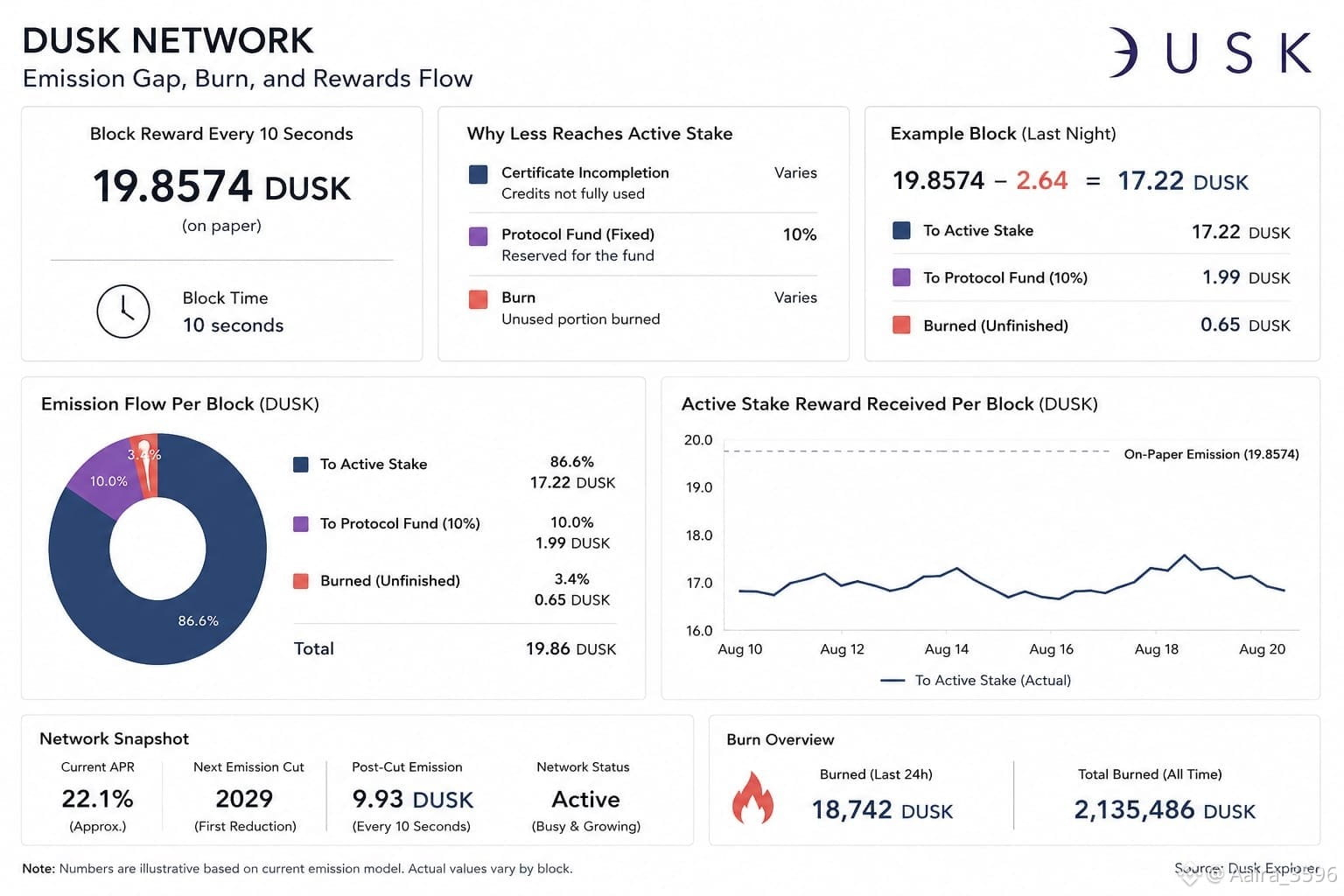
#dusk $DUSK @Dusk Tối qua tôi cứ nhìn chằm chằm vào trình khám phá Dusk thì có một khối được đưa vào lúc 17.22 thay vì mức 19.86 mà tôi vẫn còn nửa tin là sẽ đến. Bộ tạo đã điền hầu hết vào số tín chỉ trên chứng chỉ… khoan, không phải tất cả, nên phần lát thừa của thêm 10% đó đã biến mất vào việc đốt. Không kịch tính, không cảnh báo—chỉ là nguồn cung yên lặng hơn so với những gì lịch hẹn hứa hẹn.
Khoảng trống nhỏ đó cứ tiếp diễn. Giao thức ghi ra 19.8574 trên giấy sau mỗi mười giây, nhưng phần thực sự đến được active stake thì đã bị cắt bớt vì các chứng chỉ chưa hoàn tất và khoản cố định 10% chuyển vào quỹ. Những người cung cấp dịch vụ (provisioners) nhận ra điều đó. Hoặc ít nhất là những người vẫn còn kiểm tra con số. Bạn bắt đầu theo dõi tỷ lệ được đưa vào của chính mình cẩn thận hơn vì chênh lệch giữa bonus đầy đủ và bonus một phần là tiền thật sau một vài nghìn khối. Đợt phát hành sớm cao được thiết kế để kéo các node hoạt động nhanh khi phí còn mỏng. Giao thức chỉ tiếp tục làm như vậy.
Liệu việc đẩy lên sớm có mua đủ sự tham gia đáng tin cậy trước lần cắt đầu tiên vào năm 2029 hay không vẫn còn bỏ ngỏ. Hiện tại APR đang ở mức thấp hai chục và mạng cảm giác khá bận rộn, nhưng đợt giảm đầu tiên sẽ thử xem mức sử dụng có thể gánh nổi ngân sách bảo mật hay không khi vòi phun hạ xuống còn 9.93.
Tôi vẫn kiểm tra tốc độ đốt trên Dusk. Chưa chắc con số nào sẽ thực sự làm tôi lo lúc này.
Khoảng trống nhỏ đó cứ tiếp diễn. Giao thức ghi ra 19.8574 trên giấy sau mỗi mười giây, nhưng phần thực sự đến được active stake thì đã bị cắt bớt vì các chứng chỉ chưa hoàn tất và khoản cố định 10% chuyển vào quỹ. Những người cung cấp dịch vụ (provisioners) nhận ra điều đó. Hoặc ít nhất là những người vẫn còn kiểm tra con số. Bạn bắt đầu theo dõi tỷ lệ được đưa vào của chính mình cẩn thận hơn vì chênh lệch giữa bonus đầy đủ và bonus một phần là tiền thật sau một vài nghìn khối. Đợt phát hành sớm cao được thiết kế để kéo các node hoạt động nhanh khi phí còn mỏng. Giao thức chỉ tiếp tục làm như vậy.
Liệu việc đẩy lên sớm có mua đủ sự tham gia đáng tin cậy trước lần cắt đầu tiên vào năm 2029 hay không vẫn còn bỏ ngỏ. Hiện tại APR đang ở mức thấp hai chục và mạng cảm giác khá bận rộn, nhưng đợt giảm đầu tiên sẽ thử xem mức sử dụng có thể gánh nổi ngân sách bảo mật hay không khi vòi phun hạ xuống còn 9.93.
Tôi vẫn kiểm tra tốc độ đốt trên Dusk. Chưa chắc con số nào sẽ thực sự làm tôi lo lúc này.
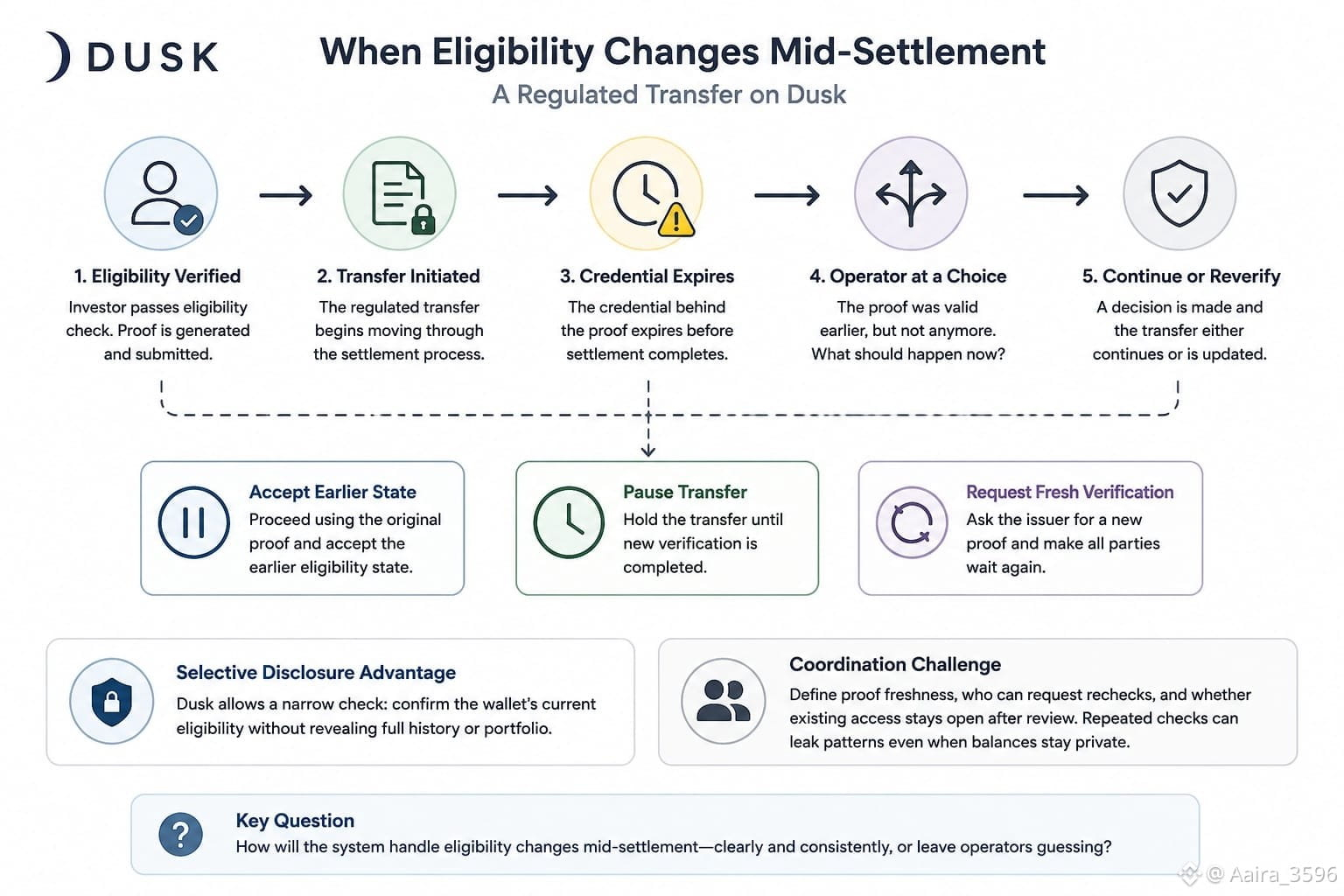
#dusk $DUSK @Dusk Tôi nhận ra vấn đề khi một lệnh chuyển có điều tiết trên Dusk bị dừng ngay trước giai đoạn thanh toán. Nhà đầu tư đã vượt qua bài kiểm tra đủ điều kiện trước đó, nhưng thông tin xác thực đứng sau bằng chứng đó đã hết hạn trong khi giao dịch vẫn đang chạy qua quy trình. Không có gì trông có vẻ rõ ràng là bị hỏng. Bằng chứng đã có hiệu lực—hoặc đúng hơn là đã có hiệu lực khi được gửi đi. Điều đó đặt người vận hành vào một lựa chọn khó xử: chấp nhận trạng thái trước, tạm dừng việc chuyển, hay yêu cầu xác minh mới và khiến mọi người phải chờ lại lần nữa. Điều thu hút sự chú ý của tôi là thực tế không cần thêm nhiều thông tin. Tổ chức phát hành không cần toàn bộ lịch sử hay danh mục hiện tại của nhà đầu tư; họ chỉ cần xác nhận rằng ví nhận vẫn còn đủ điều kiện tại đúng thời điểm đó. Mô hình tiết lộ có chọn lọc của Dusk hẳn sẽ giúp thực hiện kiểm tra hẹp này mà không biến một trễ hẹn thường lệ thành một yêu cầu dữ liệu rộng. Nhưng cơ chế đó không loại bỏ vấn đề phối hợp. Vẫn có người phải xác định thời điểm một bằng chứng trở nên “cũ”, ai được quyền yêu cầu bằng chứng khác, và liệu quyền truy cập hiện có có nên được giữ mở sau khi rà soát hay không. Việc kiểm tra lặp lại cũng có thể rò rỉ các mẫu hành vi ngay cả khi số dư không bị lộ. Tôi không chắc điều này được duy trì “sạch” đến mức nào khi các bên giữ hộ (custodians), tổ chức phát hành và các bên rà soát bên ngoài đều làm việc theo những lịch trình khác nhau. Tôi sẽ theo dõi giao dịch tiếp theo khi điều kiện đủ tư cách thay đổi giữa giai đoạn thanh toán, và xem hệ thống có thất bại rõ ràng hay chỉ khiến người vận hành phải đoán.
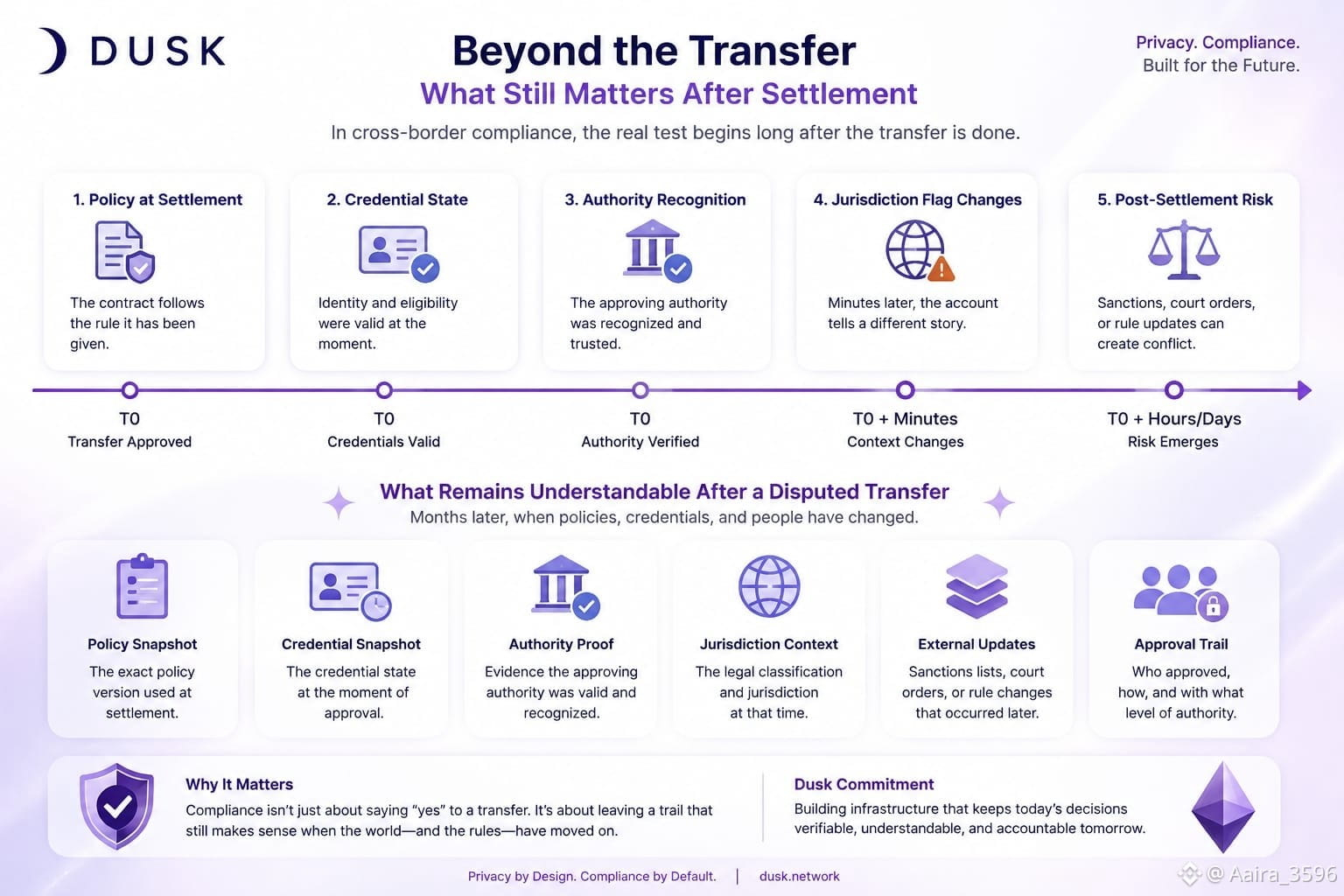
#dusk $DUSK @Dusk Tôi nhận thấy cờ thẩm quyền sau khi việc chuyển nhượng đã hoàn tất. Nó chỉ thay đổi vài phút sau đó, vì vậy về mặt kỹ thuật thì phần phê duyệt vẫn đúng, nhưng tài khoản giờ đây lại kể một câu chuyện khác. Bất kỳ ai xem lại vào tháng tới cũng có thể dễ dàng thắc mắc vì sao tài sản lại được cho phép đi qua. Nghĩ đầu tiên của tôi là Dusk chỉ cần giữ nguyên chính sách được dùng tại thời điểm kết toán. Nhưng rồi tôi nhận ra điều đó là chưa đủ. Người xem xét cũng sẽ cần trạng thái thông tin xác thực tại đúng thời điểm đó, cùng với một số bằng chứng rằng cơ quan phê duyệt vẫn được công nhận. Có lẽ còn nhiều hơn nữa. Đây là lúc việc tuân thủ xuyên biên giới bắt đầu trượt khỏi một mô hình hợp đồng gọn gàng. Một quốc gia có thể coi tài sản đó là một chứng khoán, trong khi quốc gia khác lại coi đó là một yêu cầu theo hợp đồng, và các cách phân loại ấy có thể thay đổi ngay cả khi token không hề di chuyển. Hợp đồng tuân theo quy tắc mà nó được cung cấp. Nó không biết liệu quy tắc đó còn phù hợp về mặt pháp lý hay không. Một bản cập nhật về trừng phạt đến sau khi kết toán khiến khoảng trống đó khó có thể bỏ qua hơn. Một tòa án có thể yêu cầu phong tỏa trong khi tổ chức phát hành đã đang xử lý việc chuộc lại ở nơi khác. Cho phép một nhà vận hành ghi đè tài sản sẽ nhanh, nhưng tôi sẽ không thấy thoải mái khi quyền lực đó âm thầm nằm yên ở chế độ nền. Yêu cầu nhiều lần phê duyệt có vẻ an toàn hơn cho đến khi phản hồi trở nên khẩn cấp. Tôi không còn quá hứng thú với việc thấy một lần chuyển nhượng khác diễn ra sạch sẽ ngay bây giờ. Tôi muốn xem điều gì vẫn có thể hiểu được sau một lần bị tranh chấp—vài tháng sau, khi các chính sách, thông tin xác thực và những người chịu trách nhiệm đã thay đổi.
Xem bản dịch
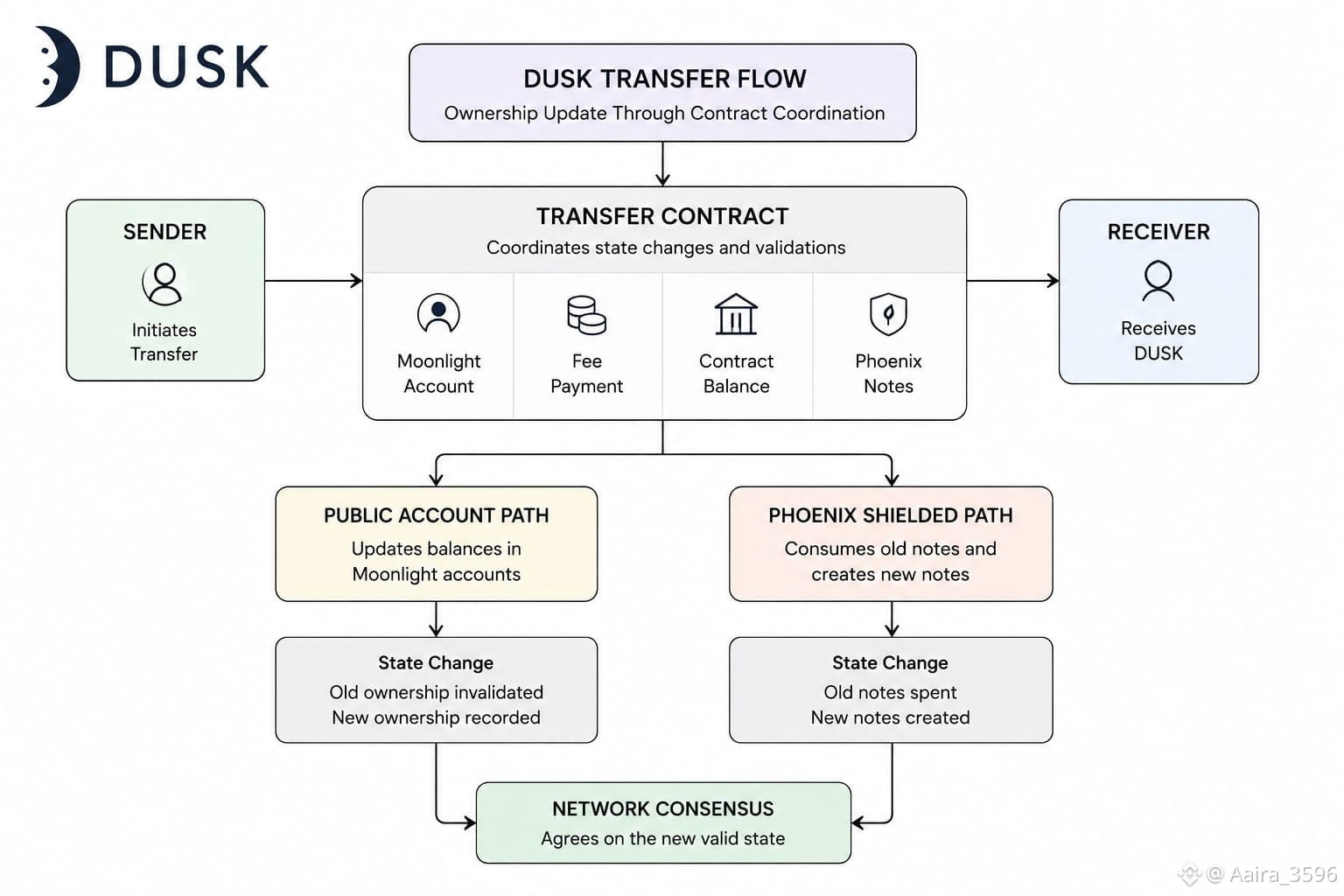
#dusk $DUSK I noticed the mismatch while tracing a DUSK transfer that looked finished in the wallet but still felt incomplete from the system side. The number had changed, sure, but that was only the visible part. Underneath it, the Transfer contract was still the place where several different kinds of state had to agree: the Moonlight account, the fee being paid, the contract balance, or, in another path, the Phoenix notes being consumed and recreated. That made me stop thinking about DUSK as something that simply moves from A to B. It is closer to the network deciding that one version of ownership is no longer valid and another one is. Small distinction, but operationally it matters. A contract can change its own application state without becoming the authority on what native DUSK means, and that separation probably prevents a lot of accounting logic from leaking into every application. Still, I would not call the model simple. Once public accounts, shielded notes, gas, and contract-held funds start touching the same execution path, the coordination burden just moves lower in the stack. Maybe that is the point. What I would want to watch is a busy period with several contract calls and mixed transaction types landing together, because that is where clean accounting assumptions usually start getting uncomfortable.@Dusk
Xem bản dịch
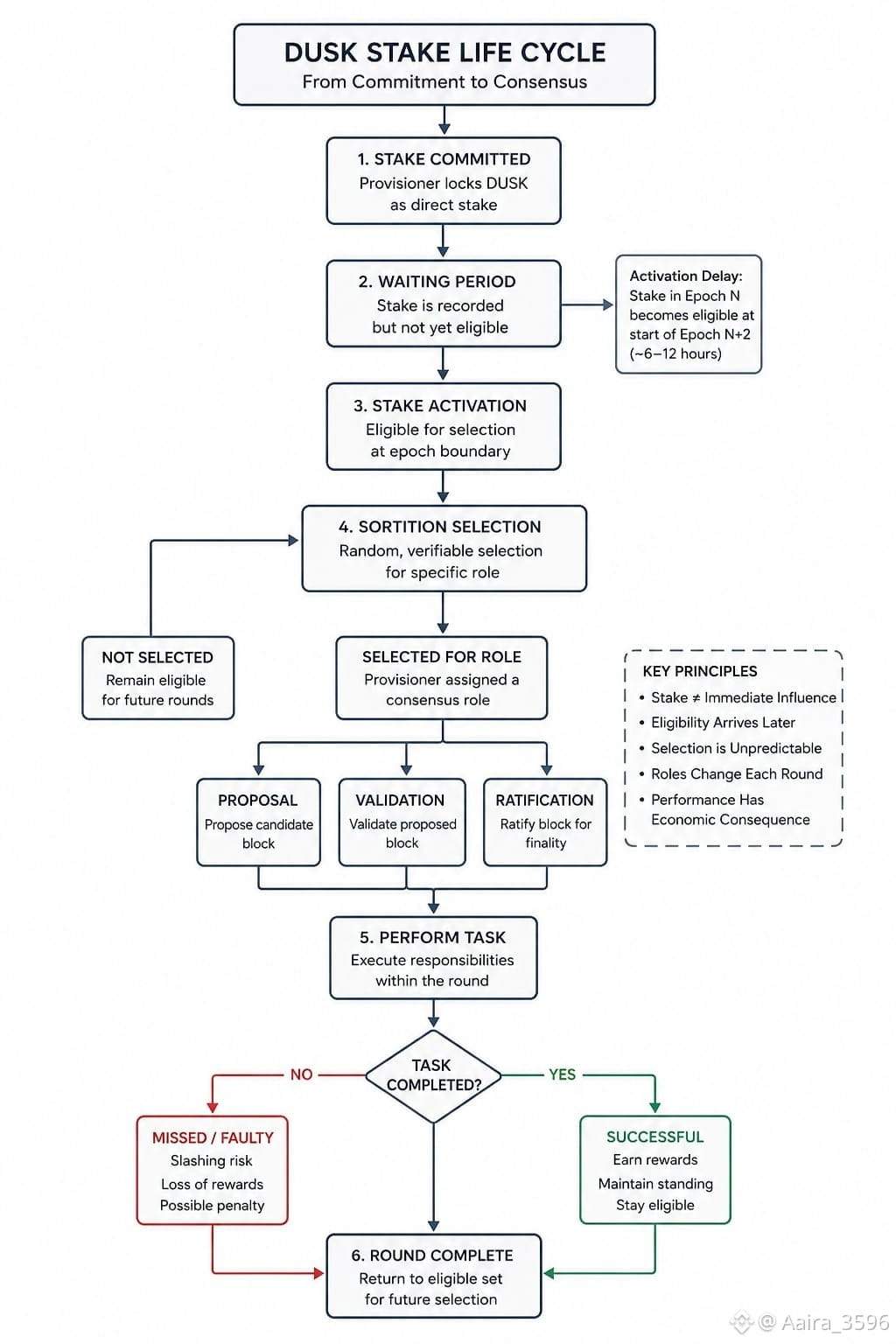
#dusk $DUSK $ACE $AKE @Dusk I noticed the awkward part when a new DUSK stake was already committed but still could not participate in consensus. The capital had moved, yet from the network’s point of view the provisioner was still waiting. My first reaction was to treat that as unnecessary delay, but watching the epoch boundary made the design look different. Dusk does not let fresh stake become immediate influence. Eligibility arrives later, which means someone cannot simply move capital in and expect instant access to consensus selection. That changes how a provisioner has to think about timing. And even after activation, the stake is only eligibility, not a permanent seat. A provisioner can sit there doing very little for a while, then suddenly be selected for a role where missing the job has an economic consequence. Generator rewards pull behavior in another direction: being selected is valuable, but only if the participant actually performs when the network asks. I’m still unsure how smooth this feels when operators are topping up stake, entering around epoch boundaries, or recovering from penalties. The mechanism looks orderly on paper; operations rarely stay that tidy. What I would watch next is a period where many provisioners change stake at roughly the same time and see whether the delayed maturity and reward structure still produce predictable behavior under that pressure.
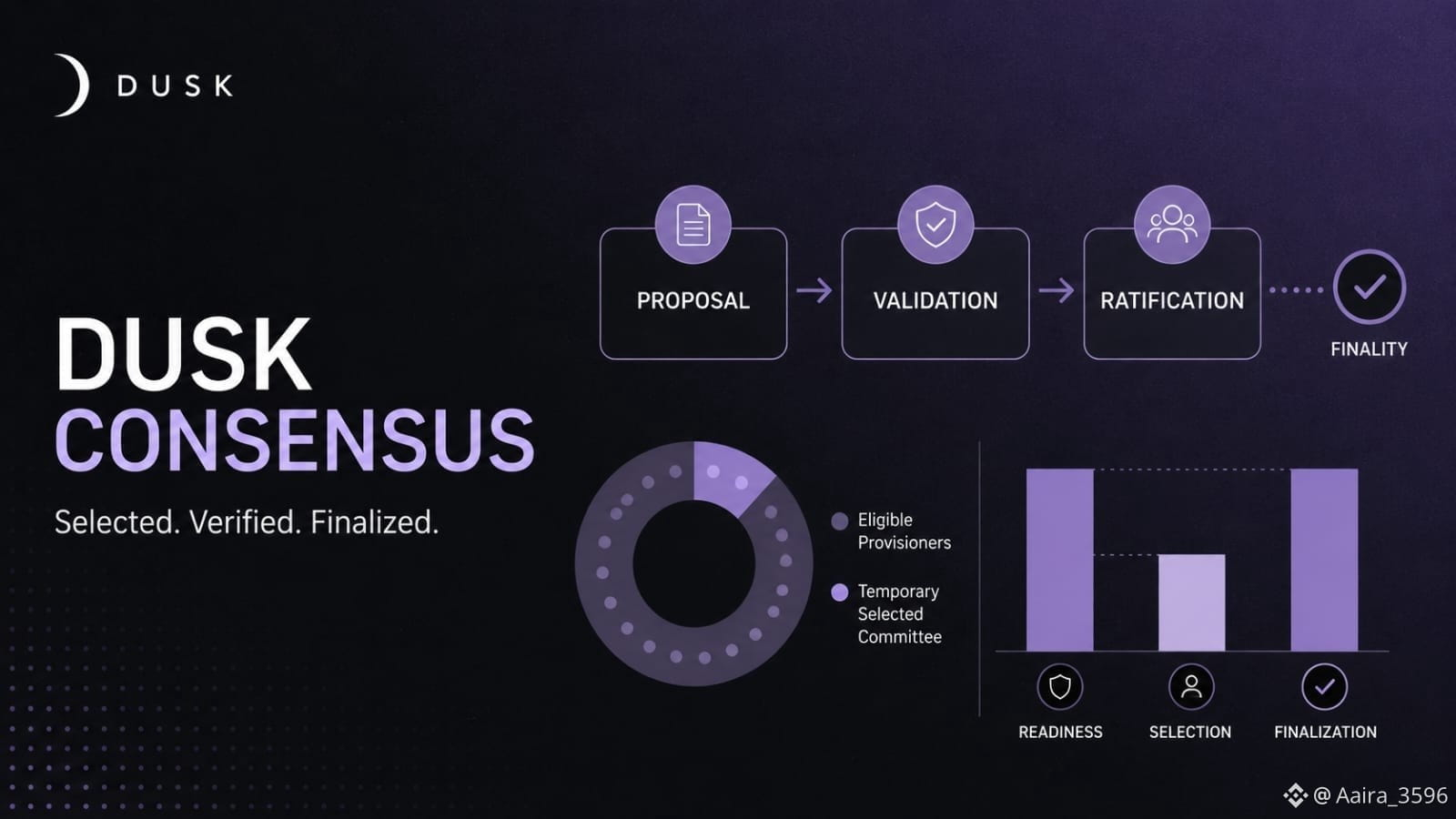
Tôi từng cho rằng staking có nghĩa là phải luôn tham gia vào mọi khối. Xem xét kỹ @Dusk đã thay đổi quan điểm đó: các provisioner luôn sẵn sàng, nhưng trách nhiệm đồng thuận chỉ đến khi giao thức chọn họ.
Attestation Tinh Gọn (Succinct Attestation) của Dusk là một giao thức proof-of-stake không được cấp phép, dựa trên ủy ban, được xây dựng quanh sortition xác định. Một provisioner trước tiên cần một khoản stake trực tiếp tối thiểu là 1,000 $DUSK . Stake mới không trở nên đủ điều kiện ngay; việc kích hoạt diễn ra tại ranh giới epoch sau epoch kế tiếp. Mỗi epoch chứa 2,160 khối, nên thời gian kích hoạt thông thường nằm trong khoảng khoảng sáu đến mười hai giờ.
Khi đã hoạt động, stake thiết lập tính đủ điều kiện thay vì quyền biểu quyết vĩnh viễn. Sortition sẽ chọn các provisioner cho các vai trò cụ thể trong từng vòng đồng thuận, nhờ đó giới hạn việc phải phối hợp đồng thời của số lượng người tham gia. Việc lựa chọn là không thể dự đoán trước trước khi vòng diễn ra, nhưng được suy ra từ các quy tắc của giao thức mà các nút khác có thể tự xác minh. Sự khác biệt này rất quan trọng: một kẻ tấn công không thể đơn giản tự bổ nhiệm, trong khi các nút trung thực không cần một bộ điều phối trung tâm để xác nhận ai đã được chọn.
Sau đó, công việc được chia thành ba giai đoạn. Một provisioner được chọn sẽ đề xuất và phát bản ứng viên (candidate block). Một ủy ban xác thực sẽ kiểm tra nó, trong khi một ủy ban phê chuẩn (ratification) riêng biệt sẽ xác nhận kết quả xác thực và hoàn tất khối. Phê chuẩn thành công sẽ tạo ra finality xác định.
Đối với hoạt động tài chính được quản lý, cấu trúc này không chỉ là lựa chọn về hiệu quả. Các ủy ban tạm thời giúp giảm phối hợp không cần thiết, tách biệt nhiệm vụ ngăn một người tham gia kiểm soát toàn bộ đường ra quyết định, và finality xác định cung cấp một mốc thanh toán rõ ràng cho giao dịch.
Bạn nghĩ cơ chế bảo vệ mạnh nhất của Dusk đến từ việc lựa chọn không thể dự đoán hay từ việc tách bạch giữa đề xuất, xác thực và phê chuẩn? #dusk $AKE $ACE
Attestation Tinh Gọn (Succinct Attestation) của Dusk là một giao thức proof-of-stake không được cấp phép, dựa trên ủy ban, được xây dựng quanh sortition xác định. Một provisioner trước tiên cần một khoản stake trực tiếp tối thiểu là 1,000 $DUSK . Stake mới không trở nên đủ điều kiện ngay; việc kích hoạt diễn ra tại ranh giới epoch sau epoch kế tiếp. Mỗi epoch chứa 2,160 khối, nên thời gian kích hoạt thông thường nằm trong khoảng khoảng sáu đến mười hai giờ.
Khi đã hoạt động, stake thiết lập tính đủ điều kiện thay vì quyền biểu quyết vĩnh viễn. Sortition sẽ chọn các provisioner cho các vai trò cụ thể trong từng vòng đồng thuận, nhờ đó giới hạn việc phải phối hợp đồng thời của số lượng người tham gia. Việc lựa chọn là không thể dự đoán trước trước khi vòng diễn ra, nhưng được suy ra từ các quy tắc của giao thức mà các nút khác có thể tự xác minh. Sự khác biệt này rất quan trọng: một kẻ tấn công không thể đơn giản tự bổ nhiệm, trong khi các nút trung thực không cần một bộ điều phối trung tâm để xác nhận ai đã được chọn.
Sau đó, công việc được chia thành ba giai đoạn. Một provisioner được chọn sẽ đề xuất và phát bản ứng viên (candidate block). Một ủy ban xác thực sẽ kiểm tra nó, trong khi một ủy ban phê chuẩn (ratification) riêng biệt sẽ xác nhận kết quả xác thực và hoàn tất khối. Phê chuẩn thành công sẽ tạo ra finality xác định.
Đối với hoạt động tài chính được quản lý, cấu trúc này không chỉ là lựa chọn về hiệu quả. Các ủy ban tạm thời giúp giảm phối hợp không cần thiết, tách biệt nhiệm vụ ngăn một người tham gia kiểm soát toàn bộ đường ra quyết định, và finality xác định cung cấp một mốc thanh toán rõ ràng cho giao dịch.
Bạn nghĩ cơ chế bảo vệ mạnh nhất của Dusk đến từ việc lựa chọn không thể dự đoán hay từ việc tách bạch giữa đề xuất, xác thực và phê chuẩn? #dusk $AKE $ACE
Xem bản dịch
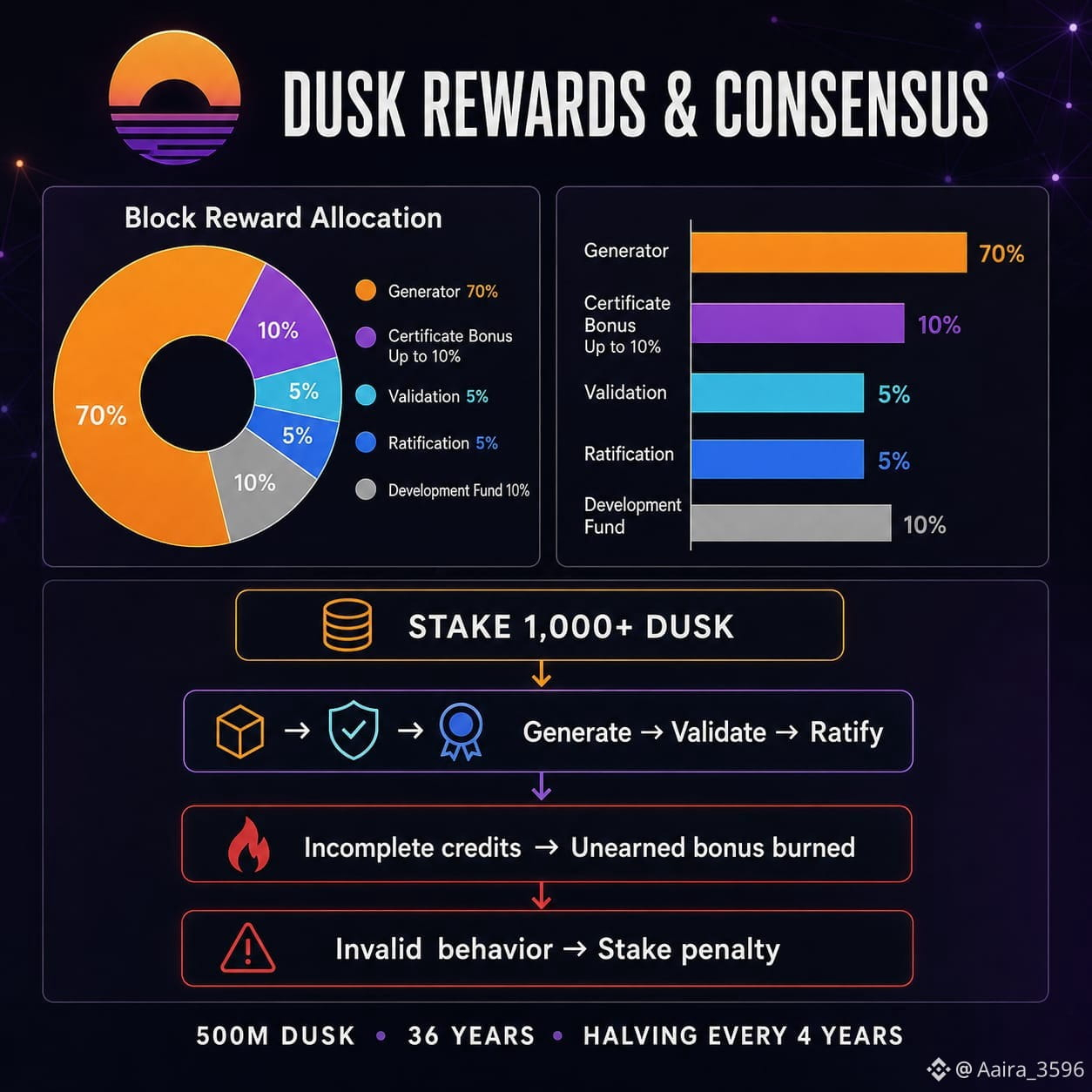
I was checking Dusk’s reward percentages over coffee and realized the most important number might be the portion a generator can lose. It reveals that security is built around completed work, not entitlement.
On @Dusk , provisioners secure consensus by staking at least 1,000 $DUSK . Their capital gives them access to participation, but rewards depend on the role performed when a block moves through generation, validation, and ratification.
A block reward combines fresh emissions with all transaction fees paid in that block. The generator receives 70% directly and may collect another 10% based on the credits included in the final certificate. When the required consensus evidence is incomplete, the unearned part of that 10% is burned. The protocol therefore makes certificate quality financially relevant to the participant assembling the block.
Independent checks are also compensated. The validation committee receives 5% for evaluating the proposal, while the ratification committee receives 5% for confirming it. Another 10% supports the development fund. This distribution avoids placing the entire economic reward around block creation alone.
Provisioners carry downside risk too. Failed participation can lead to suspension and move active DUSK into locked stake, where it remains owned but cannot participate. Invalid votes or signatures on conflicting proposals can trigger hard penalties and burn part of the stake.
The emission plan supplies 500 million DUSK across 36 years, halving the rate every four years. That makes growing transaction fees increasingly important to #dusk security over time. $DUSK $AKE $EDEN
Does tying part of the generator reward directly to certificate credits create enough pressure for consistently strong consensus participation?
On @Dusk , provisioners secure consensus by staking at least 1,000 $DUSK . Their capital gives them access to participation, but rewards depend on the role performed when a block moves through generation, validation, and ratification.
A block reward combines fresh emissions with all transaction fees paid in that block. The generator receives 70% directly and may collect another 10% based on the credits included in the final certificate. When the required consensus evidence is incomplete, the unearned part of that 10% is burned. The protocol therefore makes certificate quality financially relevant to the participant assembling the block.
Independent checks are also compensated. The validation committee receives 5% for evaluating the proposal, while the ratification committee receives 5% for confirming it. Another 10% supports the development fund. This distribution avoids placing the entire economic reward around block creation alone.
Provisioners carry downside risk too. Failed participation can lead to suspension and move active DUSK into locked stake, where it remains owned but cannot participate. Invalid votes or signatures on conflicting proposals can trigger hard penalties and burn part of the stake.
The emission plan supplies 500 million DUSK across 36 years, halving the rate every four years. That makes growing transaction fees increasingly important to #dusk security over time. $DUSK $AKE $EDEN
Does tying part of the generator reward directly to certificate credits create enough pressure for consistently strong consensus participation?
Xem bản dịch
Why is everyone talking about $BABY while so few people are actually testing the vault that gives the story real substance?
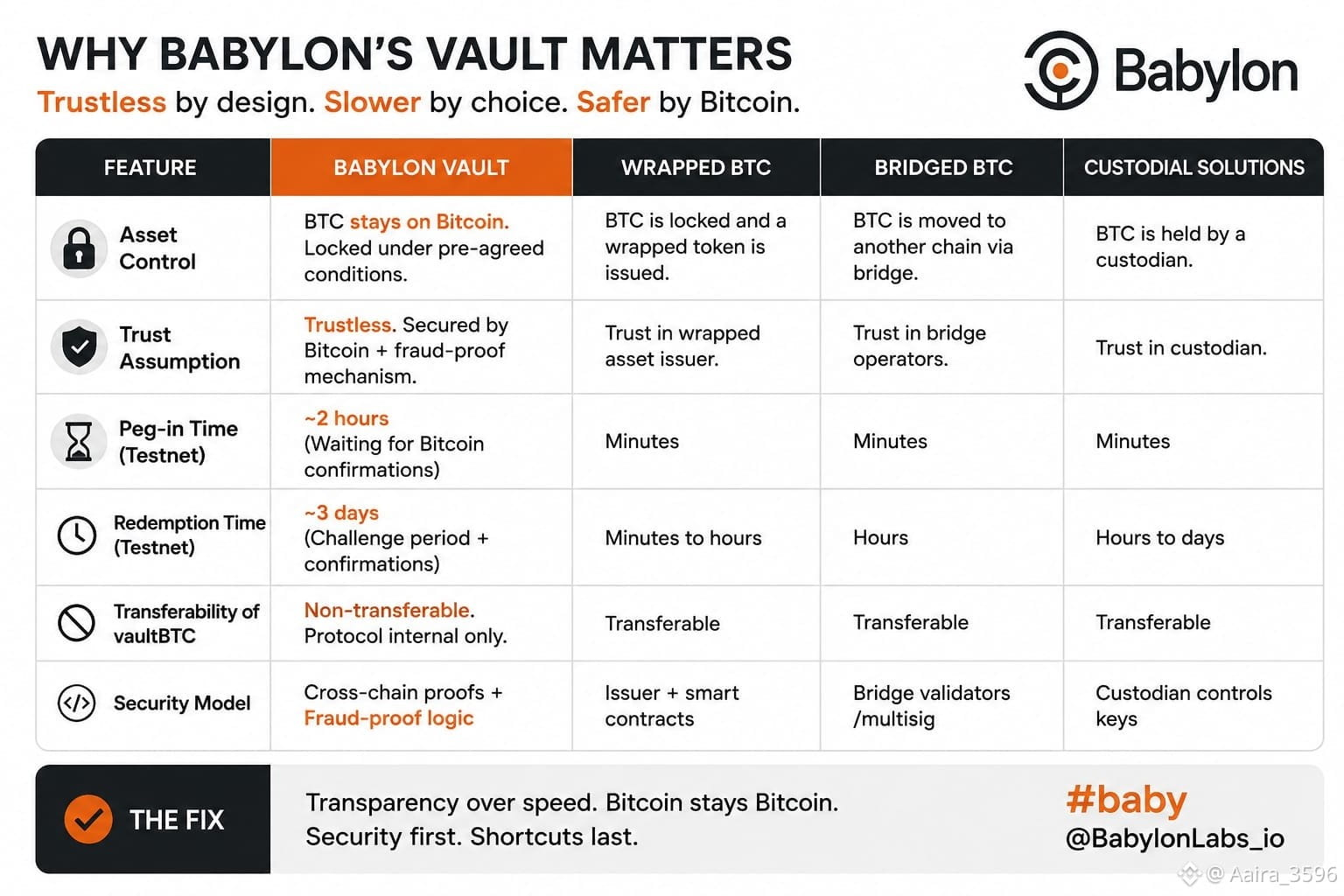
The problem is simple: most attention goes to price, staking rewards, and token narratives, while the Trustless Bitcoin Vault is where Babylon’s design becomes tangible. Instead of wrapping BTC, bridging it or handing it to a custodian, the vault keeps Bitcoin locked on its own chain under pre agreed spending conditions. That sounds smooth until you use it and realize trustless does not mean instant.
On the public testnet, the peg-in can take around two hours because the system waits for Bitcoin confirmations. Redemption is even slower, with a challenge period of roughly three days before funds complete the journey. At first, that delay feels frustrating. You lock BTC, expect to borrow quickly, and start wondering whether something has failed. In reality, the waiting is part of the security model, not a broken feature.
The fix is not to hide the delay or pretend native Bitcoin can move like a fast bridge. The fix is to make the process transparent: BTC stays on Bitcoin, vaultBTC remains internal and non-transferable, and the protocol uses cross-chain proofs plus fraud-proof logic rather than trusting a wrapped asset issuer.
Testing it changed my view. The vault feels less like tapping a payment app and more like placing something valuable inside a security box with strict withdrawal rules. Slower, yes—but deliberately slower.
So are people chasing $BABY because they understand the infrastructure, or because they have not tested the part that actually matters?
#baby @BabylonLabs_io
The problem is simple: most attention goes to price, staking rewards, and token narratives, while the Trustless Bitcoin Vault is where Babylon’s design becomes tangible. Instead of wrapping BTC, bridging it or handing it to a custodian, the vault keeps Bitcoin locked on its own chain under pre agreed spending conditions. That sounds smooth until you use it and realize trustless does not mean instant.
On the public testnet, the peg-in can take around two hours because the system waits for Bitcoin confirmations. Redemption is even slower, with a challenge period of roughly three days before funds complete the journey. At first, that delay feels frustrating. You lock BTC, expect to borrow quickly, and start wondering whether something has failed. In reality, the waiting is part of the security model, not a broken feature.
The fix is not to hide the delay or pretend native Bitcoin can move like a fast bridge. The fix is to make the process transparent: BTC stays on Bitcoin, vaultBTC remains internal and non-transferable, and the protocol uses cross-chain proofs plus fraud-proof logic rather than trusting a wrapped asset issuer.
Testing it changed my view. The vault feels less like tapping a payment app and more like placing something valuable inside a security box with strict withdrawal rules. Slower, yes—but deliberately slower.
So are people chasing $BABY because they understand the infrastructure, or because they have not tested the part that actually matters?
#baby @BabylonLabs_io
Xem bản dịch
i once left my house key with someone because it seemed easier than carrying it myself. Nothing went wrong, but I knew access to my own home depended on another person. That is how most Bitcoin-backed DeFi still feels.
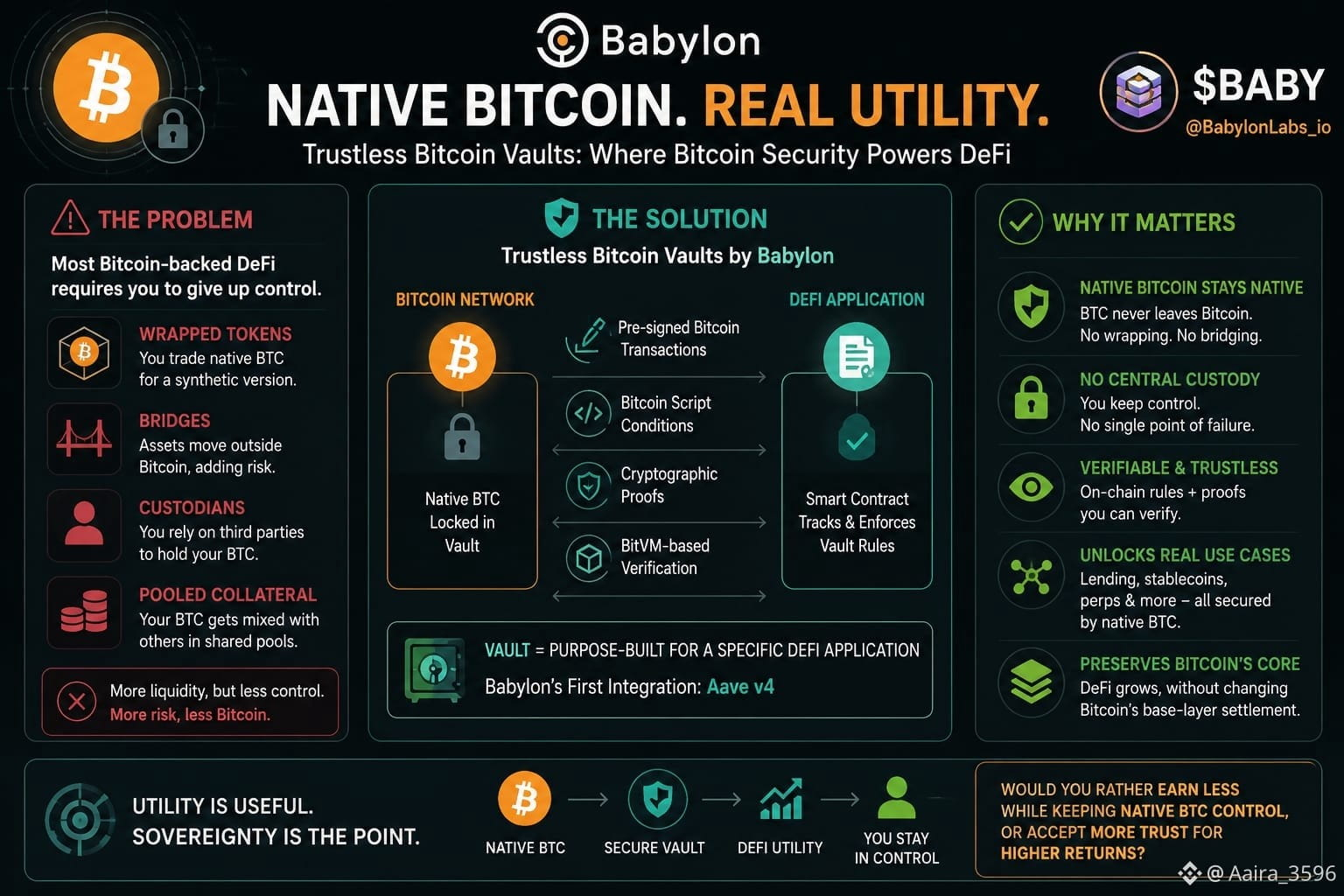
The real problem is not whether BTC can support borrowing. It is whether Bitcoin must stop behaving like Bitcoin before it becomes useful. Wrapped tokens, bridges, custodians, and pooled collateral introduce extra trust assumptions. You may gain liquidity, but you also give up direct control of the native asset and inherit risks outside Bitcoin.
Babylon’s Trustless Bitcoin Vaults take a different route. Native BTC remains locked on the Bitcoin network rather than being wrapped or bridged. Pre-signed Bitcoin transactions, Bitcoin Script conditions, cryptographic proofs, and BitVM-based verification allow a smart contract on another chain to coordinate what can happen to that collateral. The vault is created for a specific DeFi application, and Babylon’s first integration is designed around Aave v4.
Borrowing stablecoins is the first visible feature, but the deeper value is the collateral architecture. It gives DeFi a way to recognize and enforce claims against native BTC without placing the coins in a centralized custodian or moving them into a synthetic representation. That could support lending, stablecoin issuance, perpetuals, and other Bitcoin-backed markets while preserving Bitcoin’s base-layer settlement.
For me, that is why native Bitcoin matters more than the loan itself: utility is useful, but sovereignty is the point. $BABY may benefit if Babylon becomes core infrastructure for this model, though adoption and execution still matter.
Would you rather earn less while keeping native BTC control, or accept more trust for higher returns?
#baby @BabylonLabs_io
The real problem is not whether BTC can support borrowing. It is whether Bitcoin must stop behaving like Bitcoin before it becomes useful. Wrapped tokens, bridges, custodians, and pooled collateral introduce extra trust assumptions. You may gain liquidity, but you also give up direct control of the native asset and inherit risks outside Bitcoin.
Babylon’s Trustless Bitcoin Vaults take a different route. Native BTC remains locked on the Bitcoin network rather than being wrapped or bridged. Pre-signed Bitcoin transactions, Bitcoin Script conditions, cryptographic proofs, and BitVM-based verification allow a smart contract on another chain to coordinate what can happen to that collateral. The vault is created for a specific DeFi application, and Babylon’s first integration is designed around Aave v4.
Borrowing stablecoins is the first visible feature, but the deeper value is the collateral architecture. It gives DeFi a way to recognize and enforce claims against native BTC without placing the coins in a centralized custodian or moving them into a synthetic representation. That could support lending, stablecoin issuance, perpetuals, and other Bitcoin-backed markets while preserving Bitcoin’s base-layer settlement.
For me, that is why native Bitcoin matters more than the loan itself: utility is useful, but sovereignty is the point. $BABY may benefit if Babylon becomes core infrastructure for this model, though adoption and execution still matter.
Would you rather earn less while keeping native BTC control, or accept more trust for higher returns?
#baby @BabylonLabs_io
Tôi đã từng chuyển tiền giữa hai ngân hàng để tiết kiệm một khoản phí, rồi phát hiện ra rằng lệnh chuyển sẽ bị khóa trong nhiều ngày. Lúc đầu, sự chậm trễ đó giống như một thiết kế tệ. Sau đó, tôi hiểu rằng thời gian chờ được đặt ra để ngăn sai sót và giảm gian lận.
Đó cũng là cách mà tính năng an toàn lớn nhất của Babylon có thể trông giống như một sự hạn chế.
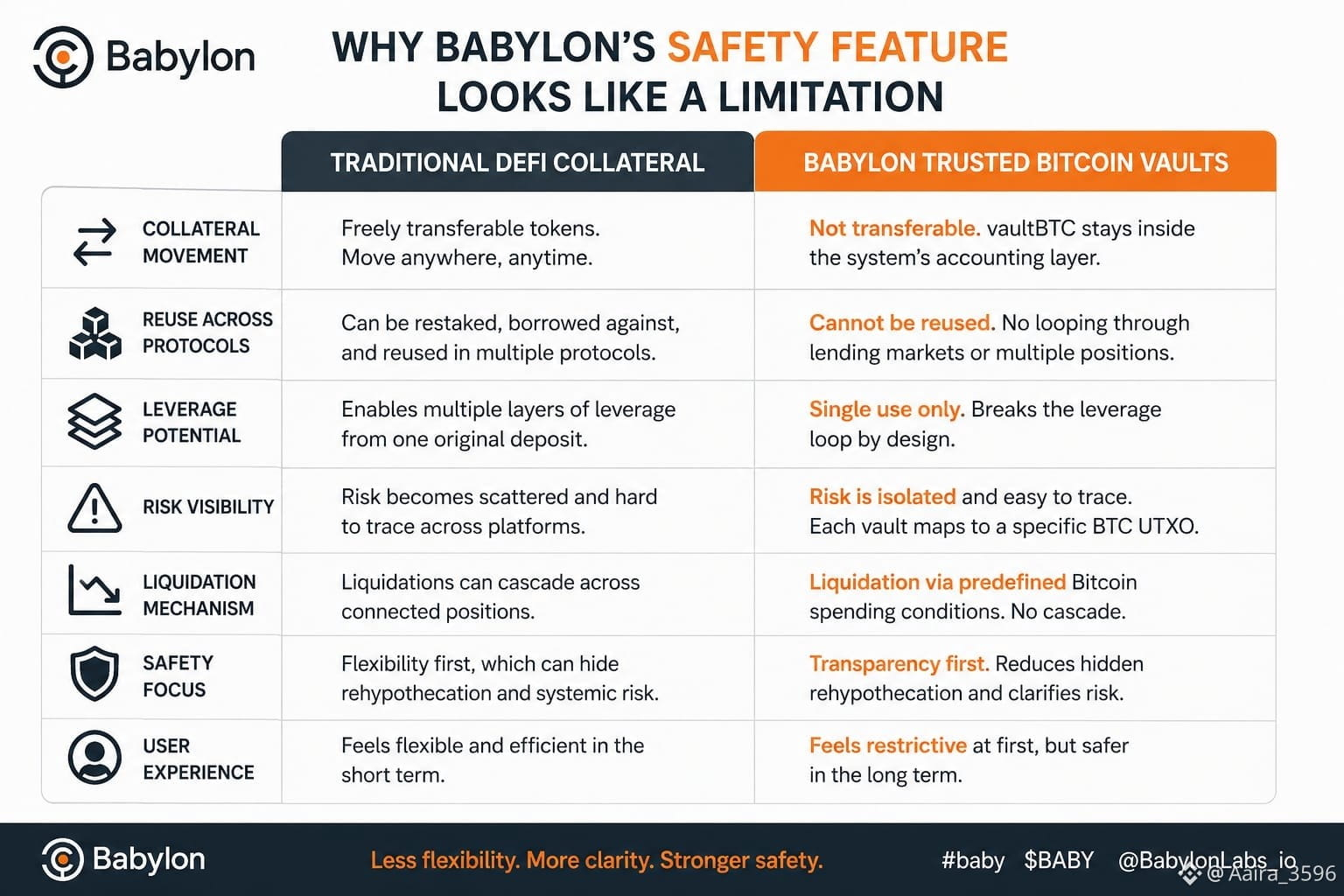
Khi BTC được khóa trong một Babylon Trusted Bitcoin Vault, vaultBTC tạo ra sẽ không được gửi tới ví của bạn dưới dạng một token có thể chuyển nhượng tự do. Bạn không thể chuyển nó sang một giao thức khác, đem nó qua các thị trường cho vay (lending) theo kiểu vòng lặp, hoặc tái sử dụng cùng một tài sản thế chấp cho nhiều vị thế khác nhau. Tài sản được vay có thể di chuyển, nhưng biên nhận tài sản thế chấp sẽ được giữ nguyên trong lớp kế toán của hệ thống.
Với những người săn lợi suất (yield hunters), điều này có thể gây cảm giác bị gò bó. Trên nhiều nền tảng DeFi, biên nhận tài sản thế chấp được thiết kế để có thể “đi khắp nơi”. Người dùng có thể restake chúng, vay dựa trên chúng một lần nữa, và xây nhiều lớp đòn bẩy từ một khoản tiền gửi ban đầu.
Vấn đề là sự linh hoạt đó có thể che giấu nơi mà rủi ro đang nằm. Khi thị trường suy giảm, một số vị thế được kết nối có thể bị giải vị (unwind) cùng lúc, và một lần thanh lý (liquidation) có thể kích hoạt một lần khác.
Babylon chủ ý cắt đứt chuỗi đó. Mỗi vault được ánh xạ tới một Bitcoin UTXO cụ thể, quyền sở hữu dễ được theo dõi hơn, và việc thanh lý diễn ra thông qua các điều kiện chi tiêu (spending conditions) được xác định sẵn thay vì một token biên nhận di chuyển “lung tung”.
Nó không loại bỏ rủi ro phần mềm, quản trị, thanh khoản hay rủi ro của người vận hành. Nhưng nó giảm tình trạng tái thế chấp (rehypothecation) ẩn và làm cho đường đi của tài sản thế chấp trở nên rõ ràng hơn rất nhiều.
Bạn có chấp nhận ít linh hoạt hơn, nếu đổi lại bạn biết chính xác BTC của mình ở đâu và điều gì có thể xảy ra với nó không?
#baby $BABY @BabylonLabs_io
Đó cũng là cách mà tính năng an toàn lớn nhất của Babylon có thể trông giống như một sự hạn chế.
Khi BTC được khóa trong một Babylon Trusted Bitcoin Vault, vaultBTC tạo ra sẽ không được gửi tới ví của bạn dưới dạng một token có thể chuyển nhượng tự do. Bạn không thể chuyển nó sang một giao thức khác, đem nó qua các thị trường cho vay (lending) theo kiểu vòng lặp, hoặc tái sử dụng cùng một tài sản thế chấp cho nhiều vị thế khác nhau. Tài sản được vay có thể di chuyển, nhưng biên nhận tài sản thế chấp sẽ được giữ nguyên trong lớp kế toán của hệ thống.
Với những người săn lợi suất (yield hunters), điều này có thể gây cảm giác bị gò bó. Trên nhiều nền tảng DeFi, biên nhận tài sản thế chấp được thiết kế để có thể “đi khắp nơi”. Người dùng có thể restake chúng, vay dựa trên chúng một lần nữa, và xây nhiều lớp đòn bẩy từ một khoản tiền gửi ban đầu.
Vấn đề là sự linh hoạt đó có thể che giấu nơi mà rủi ro đang nằm. Khi thị trường suy giảm, một số vị thế được kết nối có thể bị giải vị (unwind) cùng lúc, và một lần thanh lý (liquidation) có thể kích hoạt một lần khác.
Babylon chủ ý cắt đứt chuỗi đó. Mỗi vault được ánh xạ tới một Bitcoin UTXO cụ thể, quyền sở hữu dễ được theo dõi hơn, và việc thanh lý diễn ra thông qua các điều kiện chi tiêu (spending conditions) được xác định sẵn thay vì một token biên nhận di chuyển “lung tung”.
Nó không loại bỏ rủi ro phần mềm, quản trị, thanh khoản hay rủi ro của người vận hành. Nhưng nó giảm tình trạng tái thế chấp (rehypothecation) ẩn và làm cho đường đi của tài sản thế chấp trở nên rõ ràng hơn rất nhiều.
Bạn có chấp nhận ít linh hoạt hơn, nếu đổi lại bạn biết chính xác BTC của mình ở đâu và điều gì có thể xảy ra với nó không?
#baby $BABY @BabylonLabs_io
Xem bản dịch
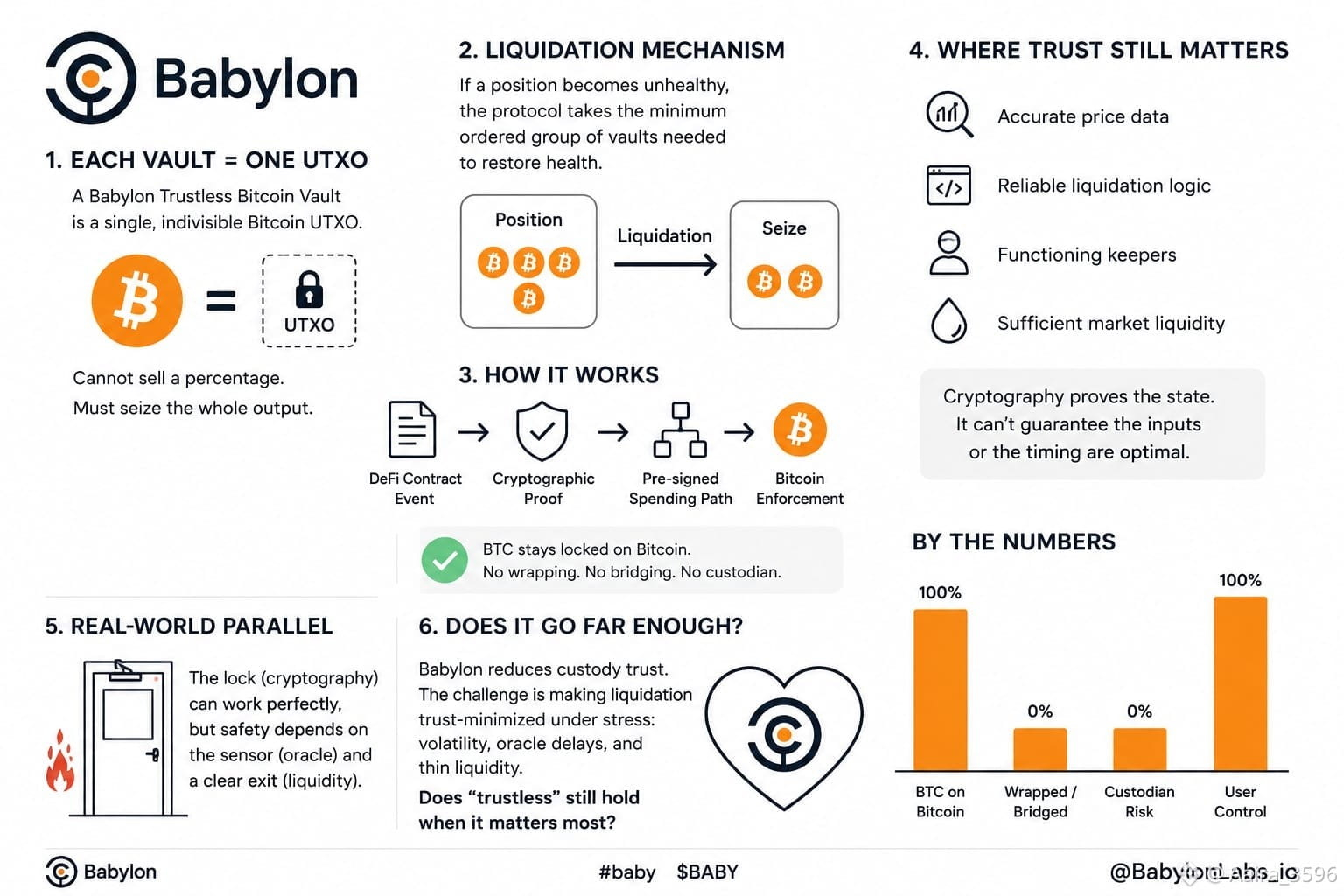
I keep coming back to one technical fact: each Babylon Trustless Bitcoin Vault is a single, indivisible Bitcoin UTXO. When liquidation begins, the protocol cannot sell a percentage of that vault. It must seize the whole output, or, when several vaults back one position, take the minimum ordered group needed to restore the loan’s health.
That mechanism still solves a serious problem. The BTC remains locked on Bitcoin rather than being wrapped, bridged, or handed to a custodian. Pre-signed spending paths define the possible outcomes, while cryptographic proofs translate the external DeFi contract’s state into conditions Bitcoin can enforce. In that sense, liquidation changes ownership according to rules agreed when the vault was created, instead of depending on a company promising to return the coins.
But this is where the word “trustless” becomes more complicated for me. The vault may remove custody risk, yet the lending application still depends on accurate price data, reliable liquidation logic, functioning keepers, and enough market liquidity to close unhealthy positions without creating a larger loss. Cryptography can prove that a contract reached a particular state; it cannot guarantee that the oracle price was economically fair or that liquidation happened at the best moment.
It reminds me of an automatic fire door. The locking mechanism can work exactly as designed, but safety still depends on the sensor detecting smoke correctly and the exit route remaining clear.
I think Babylon has meaningfully reduced the trust required to use native BTC in DeFi. The harder question is whether @BabylonLabs_io can make liquidation equally trust-minimized when volatility, oracle delays, and thin liquidity arrive together. Does “trustless” still hold at the moment users need it most?
#baby $BABY
That mechanism still solves a serious problem. The BTC remains locked on Bitcoin rather than being wrapped, bridged, or handed to a custodian. Pre-signed spending paths define the possible outcomes, while cryptographic proofs translate the external DeFi contract’s state into conditions Bitcoin can enforce. In that sense, liquidation changes ownership according to rules agreed when the vault was created, instead of depending on a company promising to return the coins.
But this is where the word “trustless” becomes more complicated for me. The vault may remove custody risk, yet the lending application still depends on accurate price data, reliable liquidation logic, functioning keepers, and enough market liquidity to close unhealthy positions without creating a larger loss. Cryptography can prove that a contract reached a particular state; it cannot guarantee that the oracle price was economically fair or that liquidation happened at the best moment.
It reminds me of an automatic fire door. The locking mechanism can work exactly as designed, but safety still depends on the sensor detecting smoke correctly and the exit route remaining clear.
I think Babylon has meaningfully reduced the trust required to use native BTC in DeFi. The harder question is whether @BabylonLabs_io can make liquidation equally trust-minimized when volatility, oracle delays, and thin liquidity arrive together. Does “trustless” still hold at the moment users need it most?
#baby $BABY
Xem bản dịch
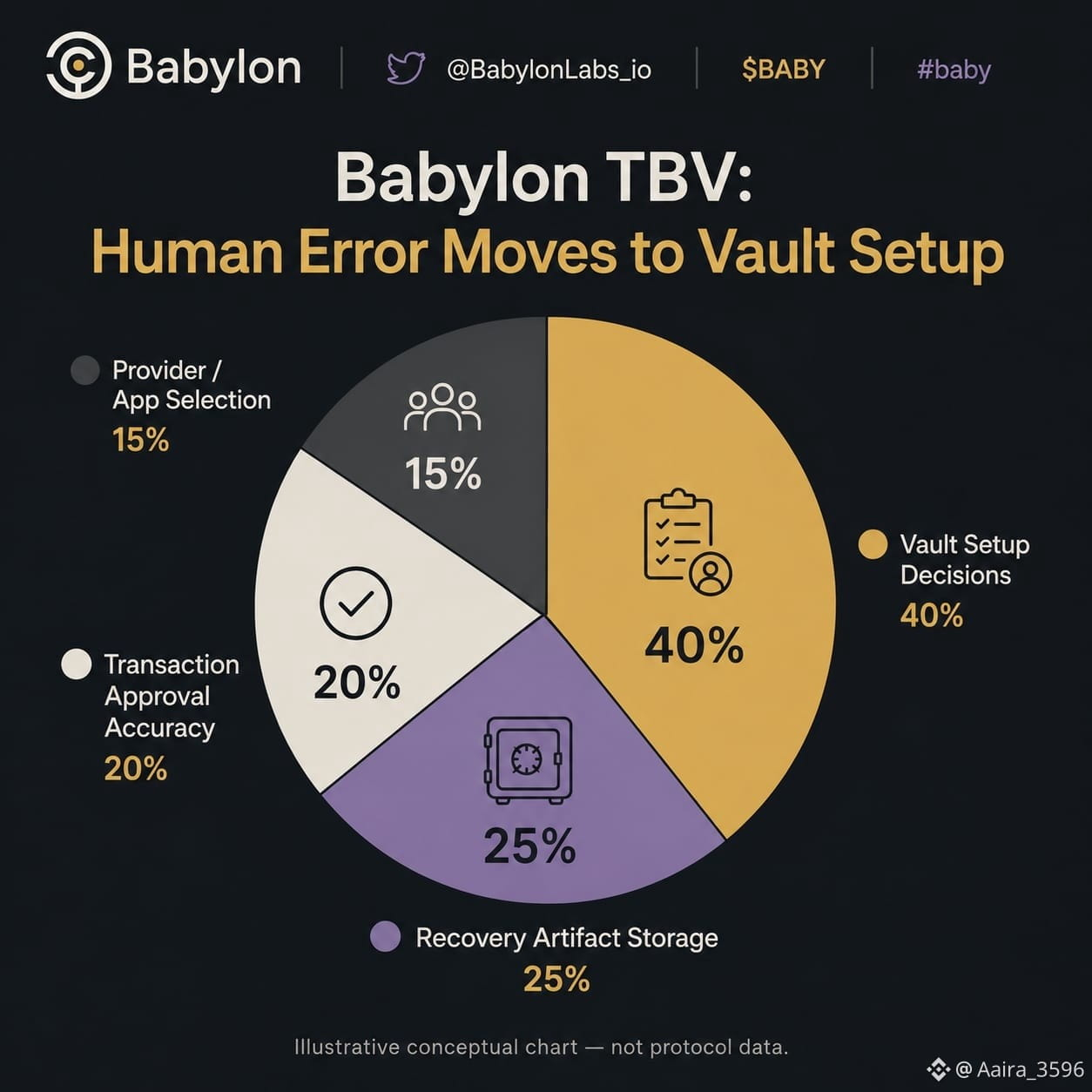
I keep coming back to one technical detail: every legitimate Bitcoin spending path in a Babylon Trustless Bitcoin Vault is constructed and signed before the vault becomes active.
That is what makes the design powerful. BTC stays inside a depositor-owned Taproot output on Bitcoin, while the pre-signed transaction graph limits future movement to the redemption, liquidation, challenge, and refund paths agreed during setup. After activation, nobody can simply invent a new route for the coins. BABE-based proofs and a challenge window then help enforce the matching Ethereum-side outcome without relying on a bridge or custodian.
But cryptography can only enforce what was approved.
The depositor still chooses the amount, application, Vault Provider, and transaction approvals. They also need to preserve the vault-specific recovery artifacts required for the self-claim fallback. A mistaken choice, a rushed signature, or a missing backup may not look dramatic when the vault is created, yet it can matter much later when the BTC needs to move.
It reminds me of setting a permanent bank instruction: automation removes repeated manual risk, but the original instruction still has to be correct. The safer the system becomes after setup, the more important that first setup moment becomes.
That does not make TBV insecure. It means the human-risk surface has shifted from ongoing custody and bridge trust toward configuration, signing, and long-term evidence storage.
For me, the next real test is usability: can @BabylonLabs_io make those setup decisions understandable enough that ordinary holders notice mistakes before Bitcoin makes them permanent?
Or does #baby still need a stronger verification layer around vault creation before the wider $BABY ecosystem is truly ready for mainstream users?
That is what makes the design powerful. BTC stays inside a depositor-owned Taproot output on Bitcoin, while the pre-signed transaction graph limits future movement to the redemption, liquidation, challenge, and refund paths agreed during setup. After activation, nobody can simply invent a new route for the coins. BABE-based proofs and a challenge window then help enforce the matching Ethereum-side outcome without relying on a bridge or custodian.
But cryptography can only enforce what was approved.
The depositor still chooses the amount, application, Vault Provider, and transaction approvals. They also need to preserve the vault-specific recovery artifacts required for the self-claim fallback. A mistaken choice, a rushed signature, or a missing backup may not look dramatic when the vault is created, yet it can matter much later when the BTC needs to move.
It reminds me of setting a permanent bank instruction: automation removes repeated manual risk, but the original instruction still has to be correct. The safer the system becomes after setup, the more important that first setup moment becomes.
That does not make TBV insecure. It means the human-risk surface has shifted from ongoing custody and bridge trust toward configuration, signing, and long-term evidence storage.
For me, the next real test is usability: can @BabylonLabs_io make those setup decisions understandable enough that ordinary holders notice mistakes before Bitcoin makes them permanent?
Or does #baby still need a stronger verification layer around vault creation before the wider $BABY ecosystem is truly ready for mainstream users?
Xem bản dịch
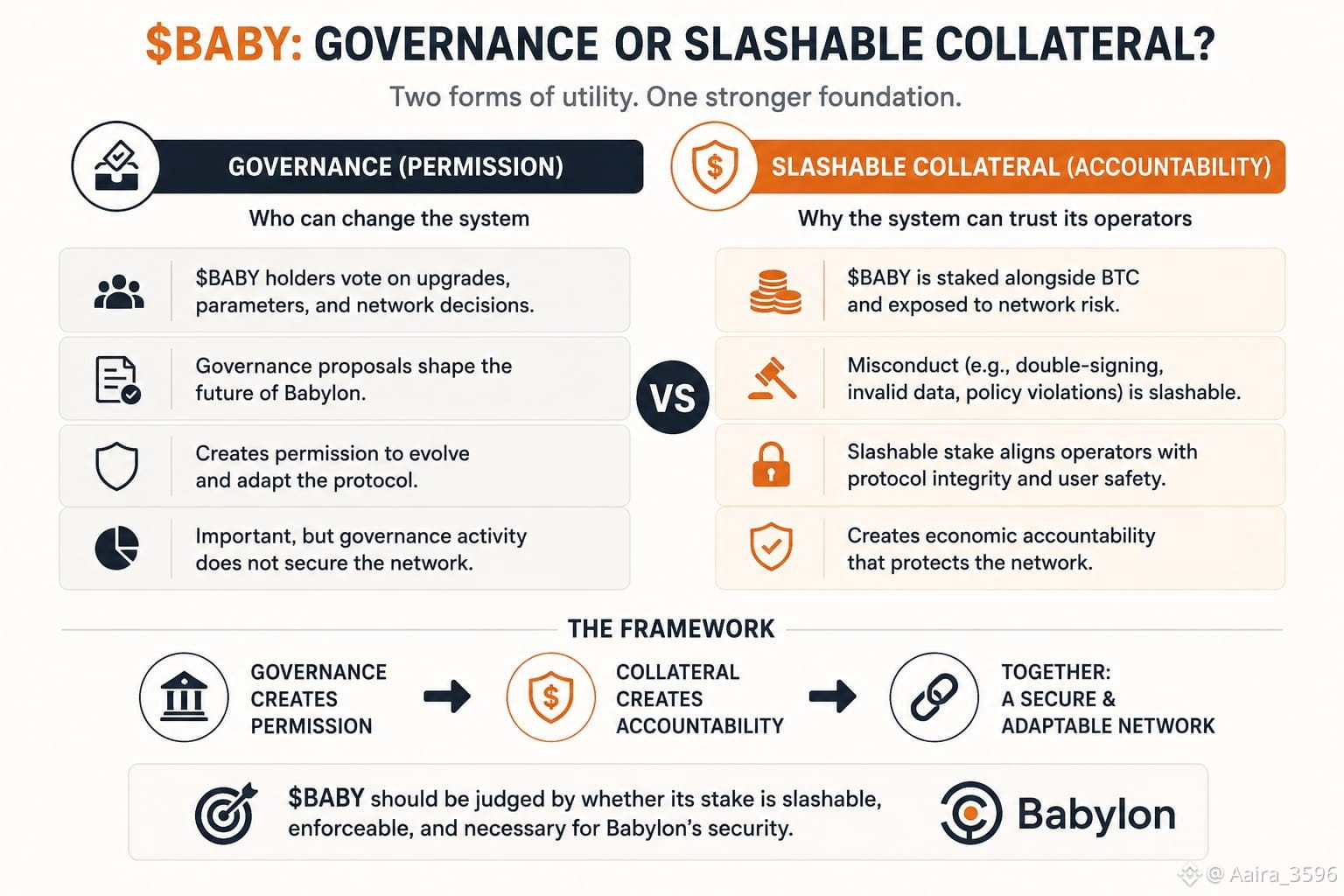
I keep returning to one question: is $BABY valuable because holders can vote, or because Babylon needs capital that can be punished when participants break the rules?
Governance is real. $BABY holders can vote on upgrades and parameters, while the token also pays gas and is staked alongside BTC. But governance explains who can change the system; slashing collateral explains why the system can trust its operators. Those are different forms of utility.
This matters in DeFi and onchain automation. A lending agent, liquidation bot, or cross-chain strategy can act immediately after detecting a state change. If the data is incomplete, an operator double-signs, or collateral conditions were never verified, automation can turn a small policy failure into irreversible settlement.
The stronger idea behind @BabylonLabs_io is verification before settlement. Pre-settlement policy checks can confirm staking conditions, validator status, exposure limits, and transaction rules before capital is released or finality is accepted. Onchain attestations and cryptographic proofs then create a verifiable record, while slashable stake gives misconduct an economic consequence.
My framework is simple: governance creates permission; collateral creates accountability. In my view, $BABY should not be judged mainly by proposal activity. Its deeper value depends on whether BABY stake is genuinely exposed to network risk, whether slashing is enforceable, and whether the token remains necessary as Babylon expands Bitcoin-backed security.
That is where my skepticism sits. A token can be called “governance” long before governance becomes economically meaningful. The harder test is whether BABY is indispensable to security rather than merely attached to it.
So, is $BABY ’s strongest utility the right to govern Babylon, or the obligation to stand behind its decisions with slashable capital? #baby
Governance is real. $BABY holders can vote on upgrades and parameters, while the token also pays gas and is staked alongside BTC. But governance explains who can change the system; slashing collateral explains why the system can trust its operators. Those are different forms of utility.
This matters in DeFi and onchain automation. A lending agent, liquidation bot, or cross-chain strategy can act immediately after detecting a state change. If the data is incomplete, an operator double-signs, or collateral conditions were never verified, automation can turn a small policy failure into irreversible settlement.
The stronger idea behind @BabylonLabs_io is verification before settlement. Pre-settlement policy checks can confirm staking conditions, validator status, exposure limits, and transaction rules before capital is released or finality is accepted. Onchain attestations and cryptographic proofs then create a verifiable record, while slashable stake gives misconduct an economic consequence.
My framework is simple: governance creates permission; collateral creates accountability. In my view, $BABY should not be judged mainly by proposal activity. Its deeper value depends on whether BABY stake is genuinely exposed to network risk, whether slashing is enforceable, and whether the token remains necessary as Babylon expands Bitcoin-backed security.
That is where my skepticism sits. A token can be called “governance” long before governance becomes economically meaningful. The harder test is whether BABY is indispensable to security rather than merely attached to it.
So, is $BABY ’s strongest utility the right to govern Babylon, or the obligation to stand behind its decisions with slashable capital? #baby
Xem bản dịch
I think the most important security question in DeFi is not whether a transaction can execute, but whether the system has enough independent economic weight to make dishonest settlement genuinely expensive.
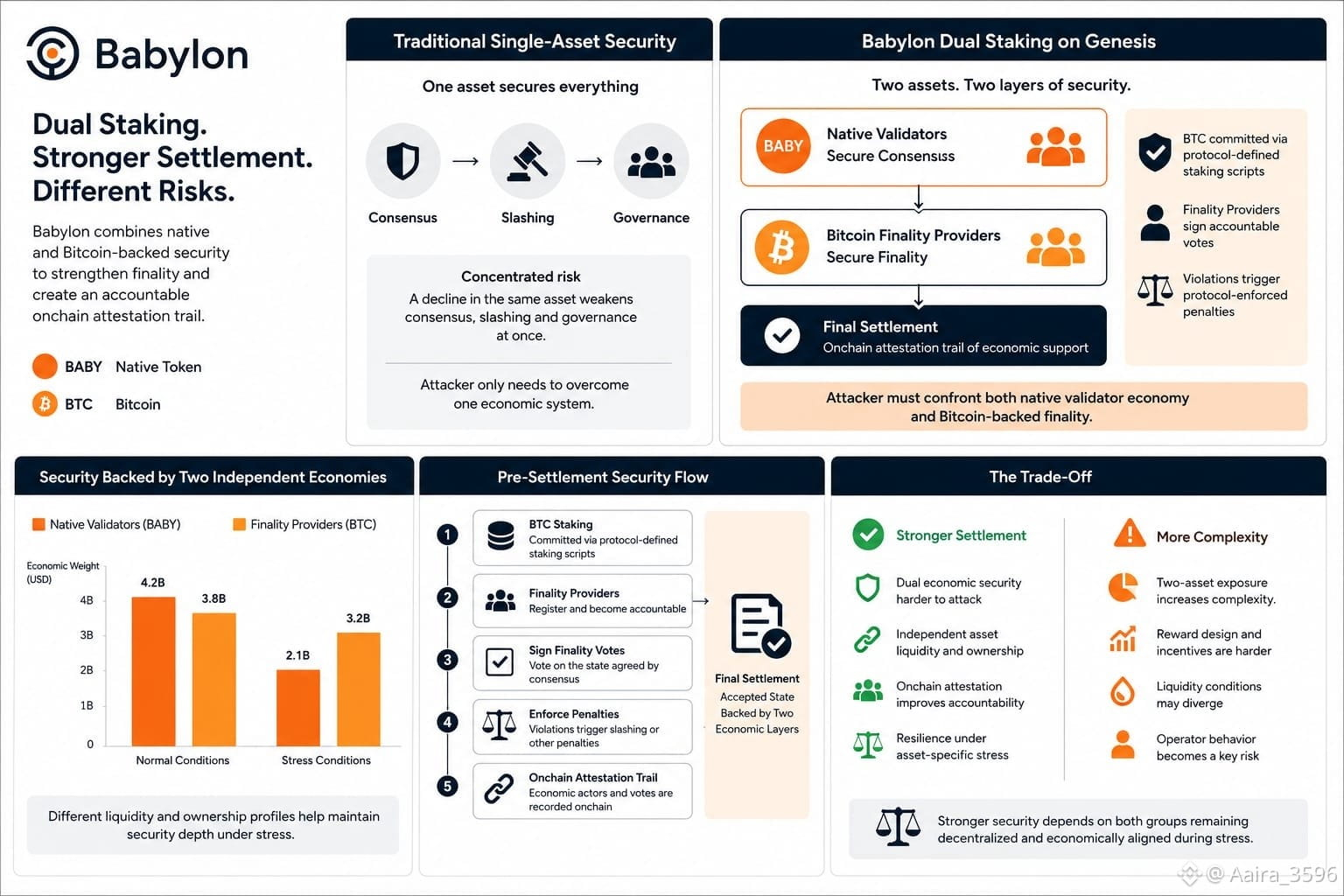
Many onchain applications still depend on a single validator set one native token or an offchain operator to confirm that predefined conditions were met. That creates concentrated risk. When the same asset secures consensus absorbs slashing and determines governance power a sharp decline in that asset can weaken several protections at once.
@BabylonLabs_io approaches this differently through dual staking on Babylon Genesis. Native $BABY validators support chain consensus while Bitcoin backed Finality Providers add finality votes above the underlying consensus layer. The result is not simply more stake. It is security drawn from two assets with different liquidity ownership and risk profiles.
Babylon’s version of pre-settlement control should be understood carefully. It is not a generic policy engine checking every DeFi action before execution. Instead, security conditions are established before participants can influence final settlement: BTC is committed through protocol-defined staking scripts, accountable Finality Providers sign votes and violations can trigger protocol-enforced penalties. Those votes and staking states create an onchain attestation trail showing which economic actors supported the accepted state.
In my view, this improves resilience because an attacker must confront both the native validator economy and Bitcoin-backed finality. But it also adds two-asset exposure. Security can become stronger while incentives reward expectations, liquidity conditions and operator behaviour become more complex.
That trade off matters. Dual staking should be judged not only by total value committed, but by whether both security groups remain sufficiently decentralised and economically aligned during stress.
Does Babylon’s two-asset model create meaningfully stronger settlement or does it simply move security risk into a more complicated structure?#baby
Many onchain applications still depend on a single validator set one native token or an offchain operator to confirm that predefined conditions were met. That creates concentrated risk. When the same asset secures consensus absorbs slashing and determines governance power a sharp decline in that asset can weaken several protections at once.
@BabylonLabs_io approaches this differently through dual staking on Babylon Genesis. Native $BABY validators support chain consensus while Bitcoin backed Finality Providers add finality votes above the underlying consensus layer. The result is not simply more stake. It is security drawn from two assets with different liquidity ownership and risk profiles.
Babylon’s version of pre-settlement control should be understood carefully. It is not a generic policy engine checking every DeFi action before execution. Instead, security conditions are established before participants can influence final settlement: BTC is committed through protocol-defined staking scripts, accountable Finality Providers sign votes and violations can trigger protocol-enforced penalties. Those votes and staking states create an onchain attestation trail showing which economic actors supported the accepted state.
In my view, this improves resilience because an attacker must confront both the native validator economy and Bitcoin-backed finality. But it also adds two-asset exposure. Security can become stronger while incentives reward expectations, liquidity conditions and operator behaviour become more complex.
That trade off matters. Dual staking should be judged not only by total value committed, but by whether both security groups remain sufficiently decentralised and economically aligned during stress.
Does Babylon’s two-asset model create meaningfully stronger settlement or does it simply move security risk into a more complicated structure?#baby
Đăng nhập để khám phá thêm nội dung