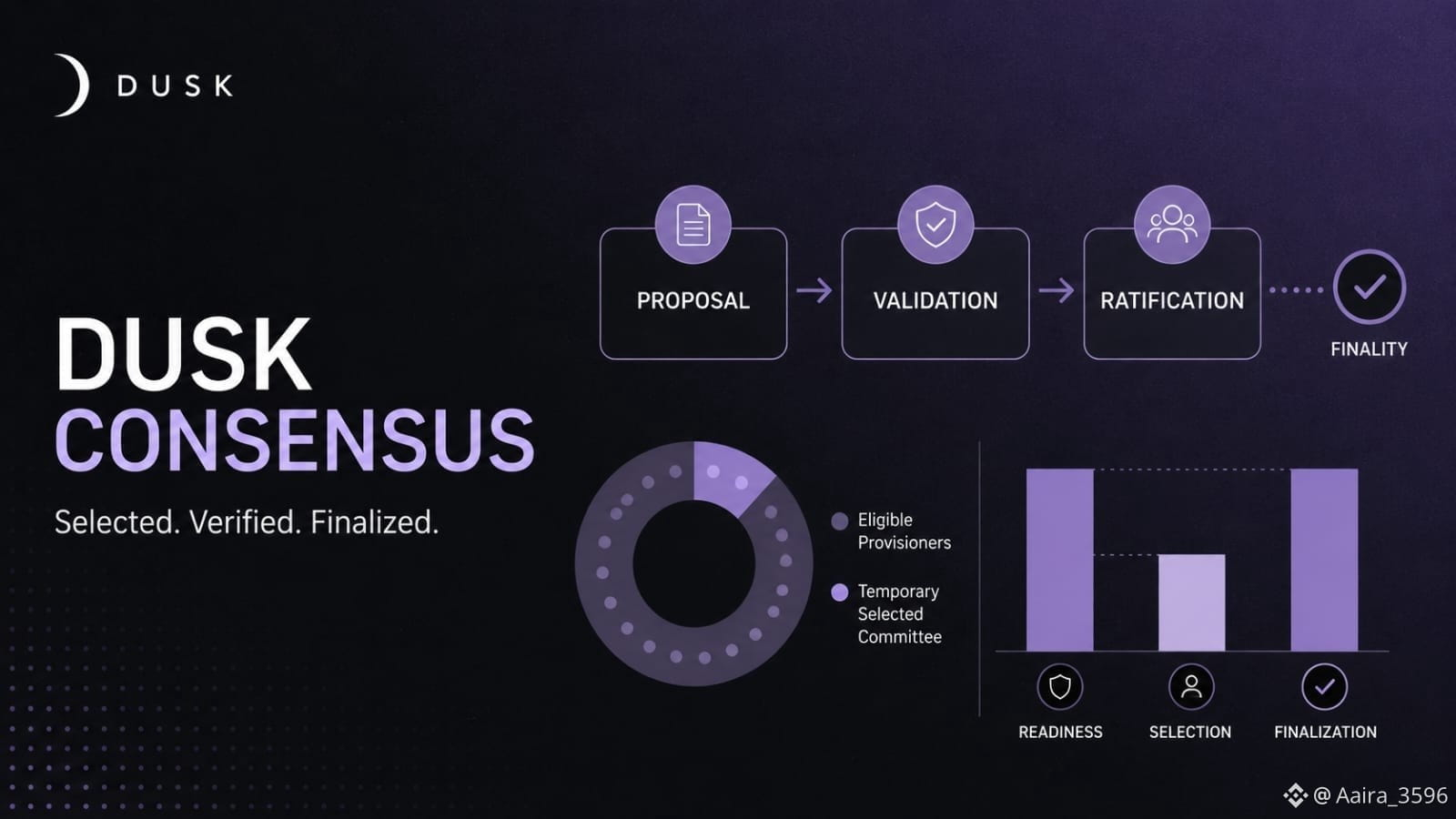
I used to assume that staking meant staying involved in every block. Looking closely at @Dusk changed that view: provisioners remain ready, but consensus responsibility arrives only when the protocol selects them.
Dusk’s Succinct Attestation is a permissionless, committee-based proof-of-stake protocol built around deterministic sortition. A provisioner first needs a direct stake of at least 1,000 $DUSK . New stake does not become eligible immediately; activation occurs at the epoch boundary after the next one. Each epoch contains 2,160 blocks, placing normal activation time between roughly six and twelve hours.
Once active, stake establishes eligibility rather than permanent voting authority. Sortition chooses provisioners for specific roles during each consensus round, limiting how many participants must coordinate at once. Selection is unpredictable before the round but derived from protocol rules that other nodes can verify independently. That distinction matters: an attacker cannot simply appoint itself, while honest nodes do not need a central coordinator to confirm who was selected.
The work is then separated into three stages. One selected provisioner proposes and broadcasts a candidate block. A validation committee checks it, while a separate ratification committee confirms the validation result and finalizes the block. Successful ratification produces deterministic finality.
For regulated financial activity, this structure is more than an efficiency choice. Temporary committees reduce unnecessary coordination, separated duties prevent one participant from controlling the complete decision path, and deterministic finality gives transactions a definite settlement point.
Do you think Dusk’s strongest protection comes from unpredictable selection or from separating proposal, validation, and ratification? #dusk $AKE $ACE
Dusk’s Succinct Attestation is a permissionless, committee-based proof-of-stake protocol built around deterministic sortition. A provisioner first needs a direct stake of at least 1,000 $DUSK . New stake does not become eligible immediately; activation occurs at the epoch boundary after the next one. Each epoch contains 2,160 blocks, placing normal activation time between roughly six and twelve hours.
Once active, stake establishes eligibility rather than permanent voting authority. Sortition chooses provisioners for specific roles during each consensus round, limiting how many participants must coordinate at once. Selection is unpredictable before the round but derived from protocol rules that other nodes can verify independently. That distinction matters: an attacker cannot simply appoint itself, while honest nodes do not need a central coordinator to confirm who was selected.
The work is then separated into three stages. One selected provisioner proposes and broadcasts a candidate block. A validation committee checks it, while a separate ratification committee confirms the validation result and finalizes the block. Successful ratification produces deterministic finality.
For regulated financial activity, this structure is more than an efficiency choice. Temporary committees reduce unnecessary coordination, separated duties prevent one participant from controlling the complete decision path, and deterministic finality gives transactions a definite settlement point.
Do you think Dusk’s strongest protection comes from unpredictable selection or from separating proposal, validation, and ratification? #dusk $AKE $ACE