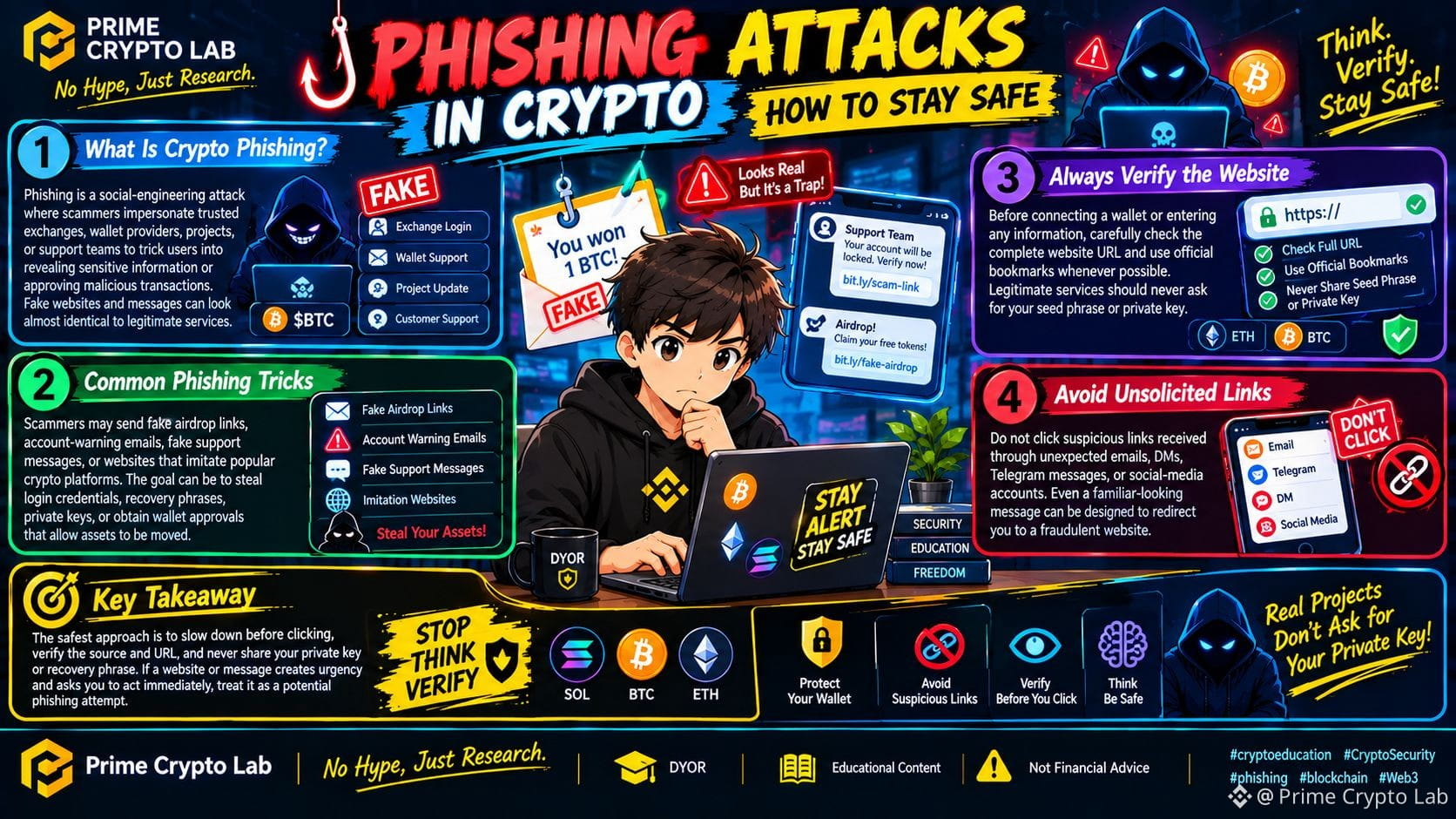
🎣 Phishing Attacks in Crypto — How to Stay Safe
🚨 1. What Is Crypto Phishing?
Bitcoin $BTC — Phishing is a social-engineering attack where scammers impersonate trusted exchanges, wallet providers, projects, or support teams to trick users into revealing sensitive information or approving malicious transactions. Fake websites and messages can look almost identical to legitimate services.
🔗 2. Common Phishing Tricks
Scammers may send fake airdrop links, account-warning emails, fake support messages, or websites that imitate popular crypto platforms. The goal can be to steal login credentials, recovery phrases, private keys, or obtain wallet approvals that allow assets to be moved.
🔍 3. Always Verify the Website
Ethereum $ETH — Before connecting a wallet or entering any information, carefully check the complete website URL and use official bookmarks whenever possible. Legitimate services should never ask for your seed phrase or private key.
🛡️ 4. Avoid Unsolicited Links
Do not click suspicious links received through unexpected emails, DMs, Telegram messages, or social-media accounts. Even a familiar-looking message can be designed to redirect you to a fraudulent website.
🎯 Key Takeaway
Solana $SOL — The safest approach is to slow down before clicking, verify the source and URL, and never share your private key or recovery phrase. If a website or message creates urgency and asks you to act immediately, treat it as a potential phishing attempt.
Prime Crypto Lab — No Hype, Just Research.
DYOR | Educational Content | Not Financial Advice
#cryptoeducation #CryptoSecurity #phishing #blockchain #Web3
🚨 1. What Is Crypto Phishing?
Bitcoin $BTC — Phishing is a social-engineering attack where scammers impersonate trusted exchanges, wallet providers, projects, or support teams to trick users into revealing sensitive information or approving malicious transactions. Fake websites and messages can look almost identical to legitimate services.
🔗 2. Common Phishing Tricks
Scammers may send fake airdrop links, account-warning emails, fake support messages, or websites that imitate popular crypto platforms. The goal can be to steal login credentials, recovery phrases, private keys, or obtain wallet approvals that allow assets to be moved.
🔍 3. Always Verify the Website
Ethereum $ETH — Before connecting a wallet or entering any information, carefully check the complete website URL and use official bookmarks whenever possible. Legitimate services should never ask for your seed phrase or private key.
🛡️ 4. Avoid Unsolicited Links
Do not click suspicious links received through unexpected emails, DMs, Telegram messages, or social-media accounts. Even a familiar-looking message can be designed to redirect you to a fraudulent website.
🎯 Key Takeaway
Solana $SOL — The safest approach is to slow down before clicking, verify the source and URL, and never share your private key or recovery phrase. If a website or message creates urgency and asks you to act immediately, treat it as a potential phishing attempt.
Prime Crypto Lab — No Hype, Just Research.
DYOR | Educational Content | Not Financial Advice
#cryptoeducation #CryptoSecurity #phishing #blockchain #Web3