
#usstocks
usstocks
202,288 lượt xem
850 đang thảo luận
Phổ biến
Mới nhất
·
--
Đúng một phần
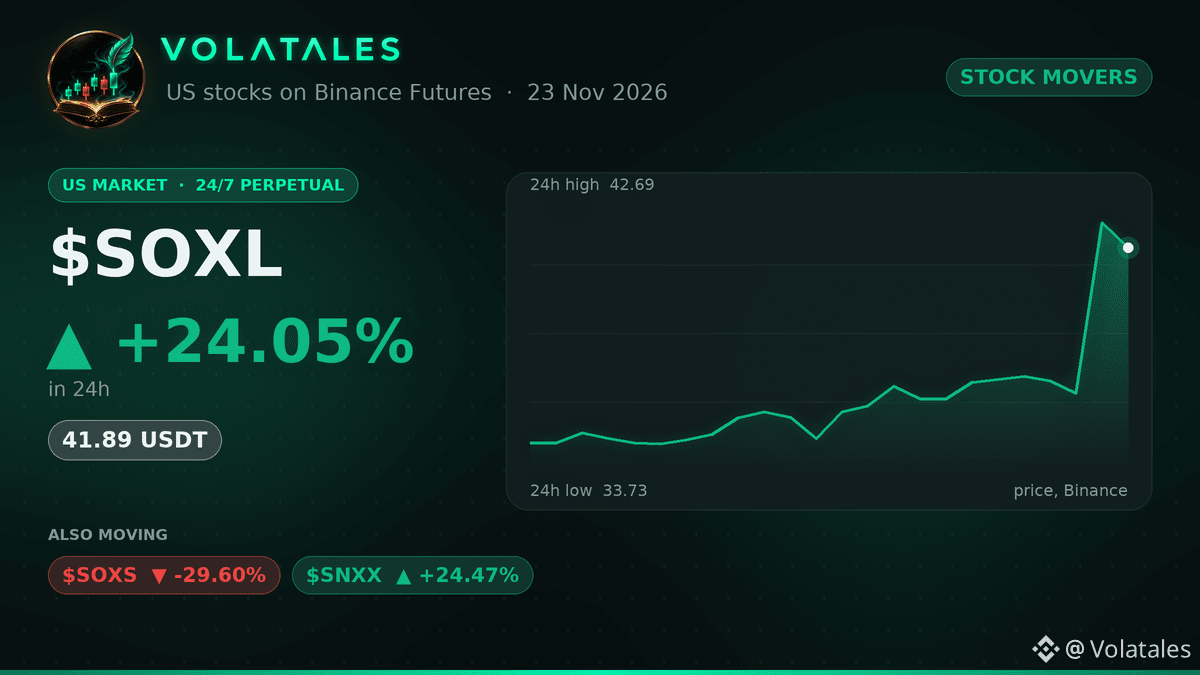
🚀 $SOXL tăng +24.05% trong 24 giờ lên 41.89 USDT
Không có tin tức nổi bật cụ thể nào đứng sau đợt tăng này. SOXL là ETF đòn bẩy 3x về ngành bán dẫn, nên biến động mạnh gấp vài lần so với chỉ số. Một số nhà giao dịch đang cân nhắc mức hao hụt của ETF và một cổ phiếu dẫn đầu ngành chip đang tụt lại phía sau; có người cho biết đã giảm tỷ trọng để chuyển sang các mã khác.
SOXL được giao dịch 24/7 trên Binance Futures dưới dạng hợp đồng vĩnh cửu USDT 📈
Bạn đang giao dịch nhịp biến động này hay đứng ngoài quan sát? 👀
📊 Các mã khác cũng biến động: $SOXS -29.60%, $SNXX +24.47%
Theo dõi tôi để cập nhật các cổ phiếu Mỹ biến động mạnh mỗi ngày 🔔
#USStocks #TradFi #StockMarket
2
1
877

·
--
Bài viết
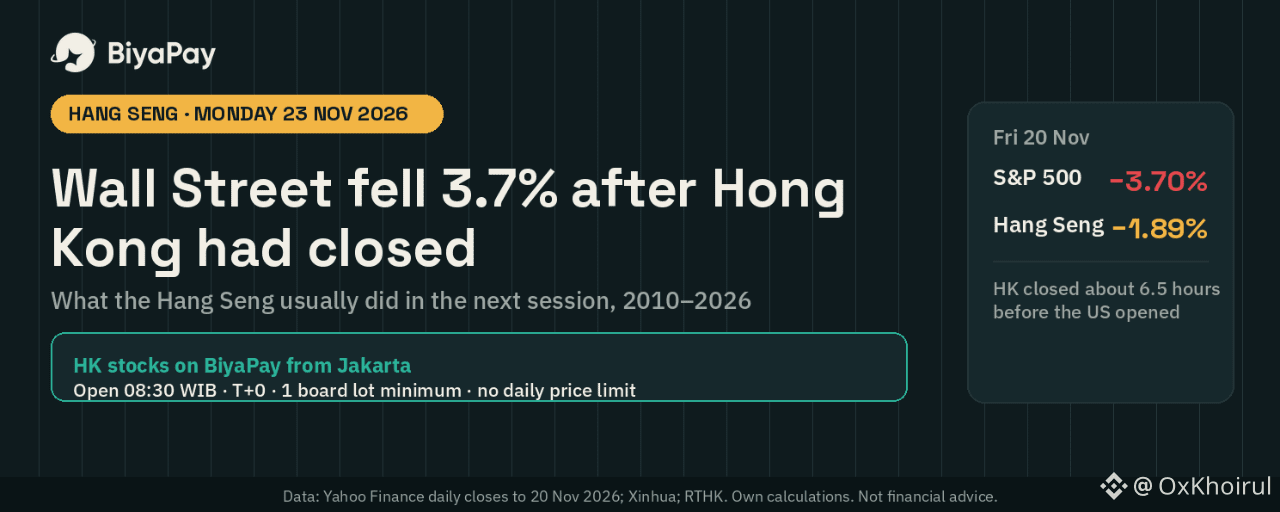
Phố Wall giảm 3,7% sau khi Hong Kong đóng cửa: Hang Seng thường diễn biến thế nào trong phiên tiếp theo?Tuyên bố miễn trừ trách nhiệm: Đây không phải là lời khuyên tài chính
Thị trường lao dốc vào thứ Sáu sau khi Hong Kong đã đóng cửa
Theo bản tin tổng kết phiên của Tân Hoa Xã, vào thứ Sáu, ngày 20 tháng 11 năm 2026, S&P 500 giảm 3,70% xuống còn 6.910,39 và Nasdaq Composite giảm 5,28% xuống còn 22.617,73. Công nghệ là lĩnh vực giảm mạnh nhất, mất 7,11%.
Đến lúc đó, Hong Kong đã kết thúc tuần giao dịch. Chỉ số Hang Seng đóng cửa giảm 1,89% xuống còn 22.410,80 vào chiều thứ Sáu, còn Chỉ số Hang Seng Tech giảm 3,8% xuống 3.511, theo RTHK.
Hang Seng đóng cửa lúc 16:00 theo giờ Hong Kong, tức 03:00 ở New York, sớm hơn sáu tiếng rưỡi so với giờ mở cửa thị trường Mỹ. Vì vậy, mức giảm 1,89% của Hong Kong hôm thứ Sáu là phản ứng trước phiên giao dịch Mỹ hôm thứ Năm, khi S&P 500 mất 2,02%. Mức giảm 3,70% hôm thứ Sáu vẫn chưa được phản ánh trong giao dịch tại Hong Kong. Cơ hội đầu tiên sẽ là vào thứ Hai, ngày 23 tháng 11, lúc 09:30 theo giờ Hong Kong.
Phố Wall giảm 3,7% sau khi Hong Kong đóng cửa: Hang Seng thường diễn biến thế nào trong phiên tiếp theo?
Tuyên bố miễn trừ trách nhiệm: Đây không phải là lời khuyên tài chính
Thị trường lao dốc vào thứ Sáu sau khi Hong Kong đã đóng cửa
Theo bản tin tổng kết phiên của Tân Hoa Xã, vào thứ Sáu, ngày 20 tháng 11 năm 2026, S&P 500 giảm 3,70% xuống còn 6.910,39 và Nasdaq Composite giảm 5,28% xuống còn 22.617,73. Công nghệ là lĩnh vực giảm mạnh nhất, mất 7,11%.
Đến lúc đó, Hong Kong đã kết thúc tuần giao dịch. Chỉ số Hang Seng đóng cửa giảm 1,89% xuống còn 22.410,80 vào chiều thứ Sáu, còn Chỉ số Hang Seng Tech giảm 3,8% xuống 3.511, theo RTHK.
Hang Seng đóng cửa lúc 16:00 theo giờ Hong Kong, tức 03:00 ở New York, sớm hơn sáu tiếng rưỡi so với giờ mở cửa thị trường Mỹ. Vì vậy, mức giảm 1,89% của Hong Kong hôm thứ Sáu là phản ứng trước phiên giao dịch Mỹ hôm thứ Năm, khi S&P 500 mất 2,02%. Mức giảm 3,70% hôm thứ Sáu vẫn chưa được phản ánh trong giao dịch tại Hong Kong. Cơ hội đầu tiên sẽ là vào thứ Hai, ngày 23 tháng 11, lúc 09:30 theo giờ Hong Kong.
SPY+3,17%
EWHETF+1,06%
301


·
--
Đúng một phần
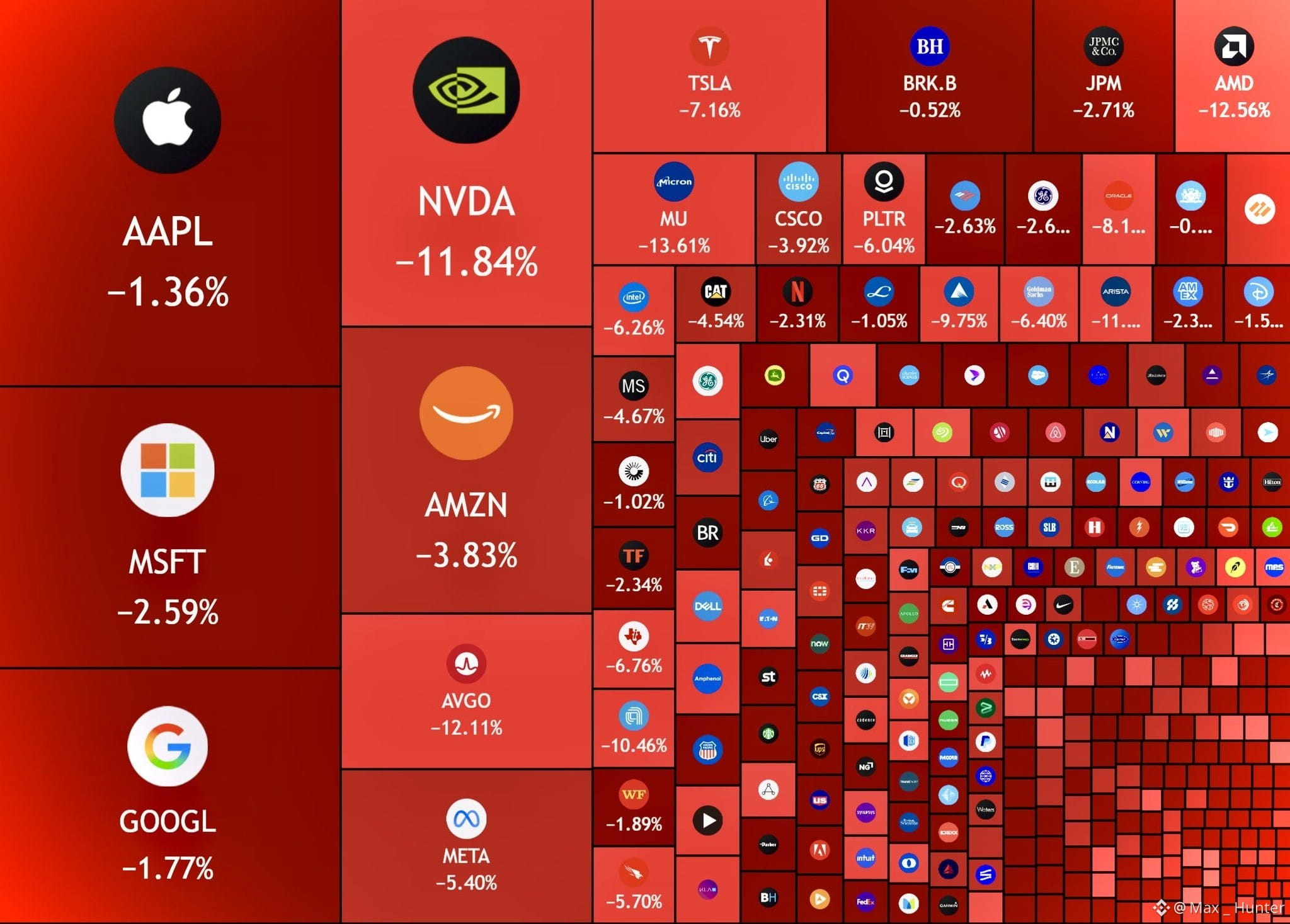
🚨 THỊ TRƯỜNG CHỨNG KHOÁN MỸ BỐC HƠI KHỐI TÀI SẢN KHỔNG LỒ! 🇺🇸
Những con số ngày càng khó bị phớt lờ.
Theo các số liệu đang được lan truyền, khoảng 8,9 nghìn tỷ USD đã bốc hơi khỏi thị trường chứng khoán Mỹ trong 45 ngày qua, và được cho là riêng hôm nay đã mất thêm 2,5 nghìn tỷ USD.
Đó là một lượng giá trị thị trường khổng lồ biến mất chỉ trong một khoảng thời gian rất ngắn.
Điều này đặt ra một câu hỏi lớn hơn: Đây chỉ là một đợt điều chỉnh tạm thời, hay các nhà đầu tư đang bắt đầu suy nghĩ lại về mức độ đầu tư của mình vào các thị trường tài chính truyền thống?
Khi bất ổn gia tăng, niềm tin cũng quan trọng không kém vốn. Vài tuần tới có thể cho thấy áp lực này chỉ tồn tại trong thời gian ngắn hay là một phần của sự thay đổi sâu sắc hơn trong tâm lý thị trường.
Có một điều rõ ràng: Thị trường tài chính lúc này đáng được theo dõi sát sao. 👀
Đây là một đợt điều chỉnh bình thường hay là điều gì đó lớn hơn nhiều?
#StockMarket #USStocks #breakingnews s#Crypto #MarketUpdate
1.1k
·
--
Đúng một phần
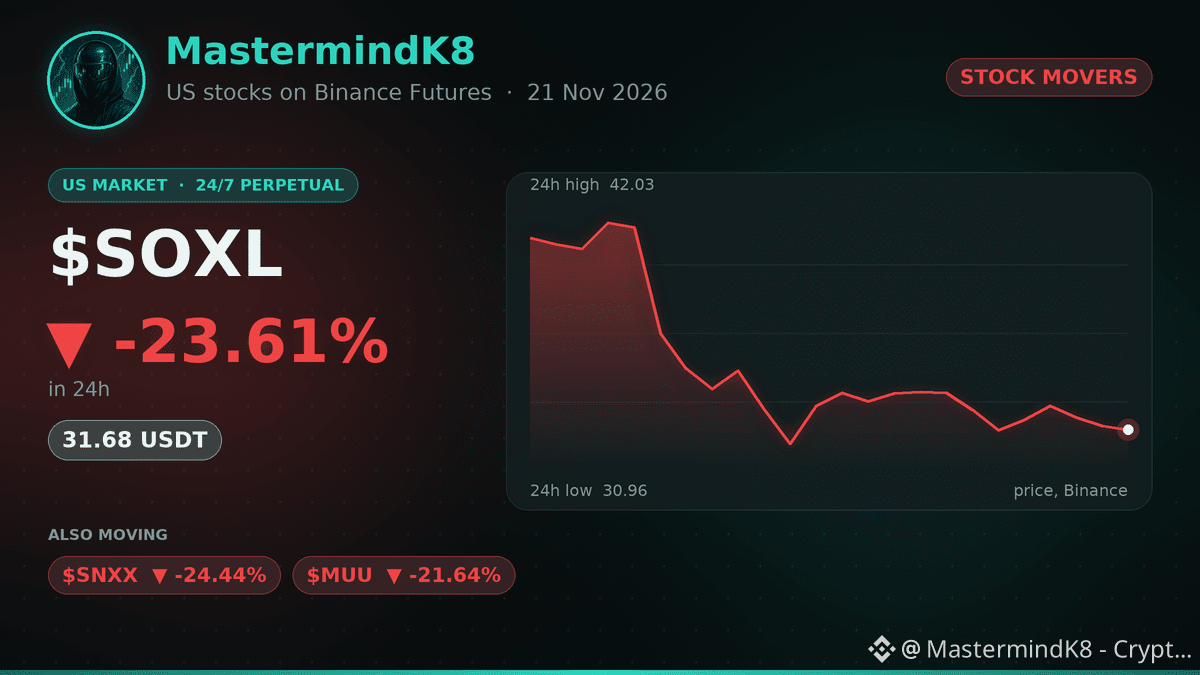
📉 $SOXL giảm -23.61% trong 24 giờ 😬
Một nhà giao dịch đã giảm mức độ tiếp xúc với SOXL, viện dẫn việc cổ phiếu đầu ngành chip tụt lại phía sau và sự hao mòn của ETF, rồi chuyển sang các mã cổ phiếu bán dẫn khác. ⚡
SOXL là ETF bán dẫn đòn bẩy 3x, nên biến động gấp nhiều lần chỉ số cơ sở.
SOXL được giao dịch 24/7 trên Binance Futures dưới dạng hợp đồng vĩnh cửu USDT. 🕒
Diễn biến này có làm thay đổi cách bạn nhìn nhận các ETF chip sử dụng đòn bẩy không? 🤔
📊 Cũng đang biến động: $SNXX -24.44%, $MUU -21.64%
Theo dõi tôi để cập nhật các cổ phiếu Mỹ biến động mạnh hằng ngày 🔔
#USStocks #TradFi #StockMarket
1
1.1k

Bảng giá mạnh nhất kết hợp hiệu suất, độ rộng tham gia và đà tiếp diễn.
Cổ phiếu — Hiệu suất & xu hướng hàng đầu:
$WMT | $CVX | $XOM | AAPL | LLY | DIS | MSFT | GOOGL | NFLX | BA
Đánh giá WPO:
Walmart dẫn đầu nhóm cổ phiếu có thanh khoản cao, tăng +1.51% trong phiên gần nhất được theo dõi và giảm -0.74% trong mẫu năm phiên. 3 trong số 5 mã hàng đầu tăng giá, cho thấy độ rộng thị trường chỉ tập trung ở một số mã. Vị thế dẫn đầu được chia sẻ giữa các mã hàng đầu; khối lượng giao dịch cao gấp 2.2 lần nhịp độ gần đây.
Đà tăng có thể đảo chiều nhanh chóng, vì vậy sự xác nhận quan trọng hơn sự hưng phấn.
#wpo_report #USStocks #NghiênCứuThịTrường
274

·
--
Đúng một phần
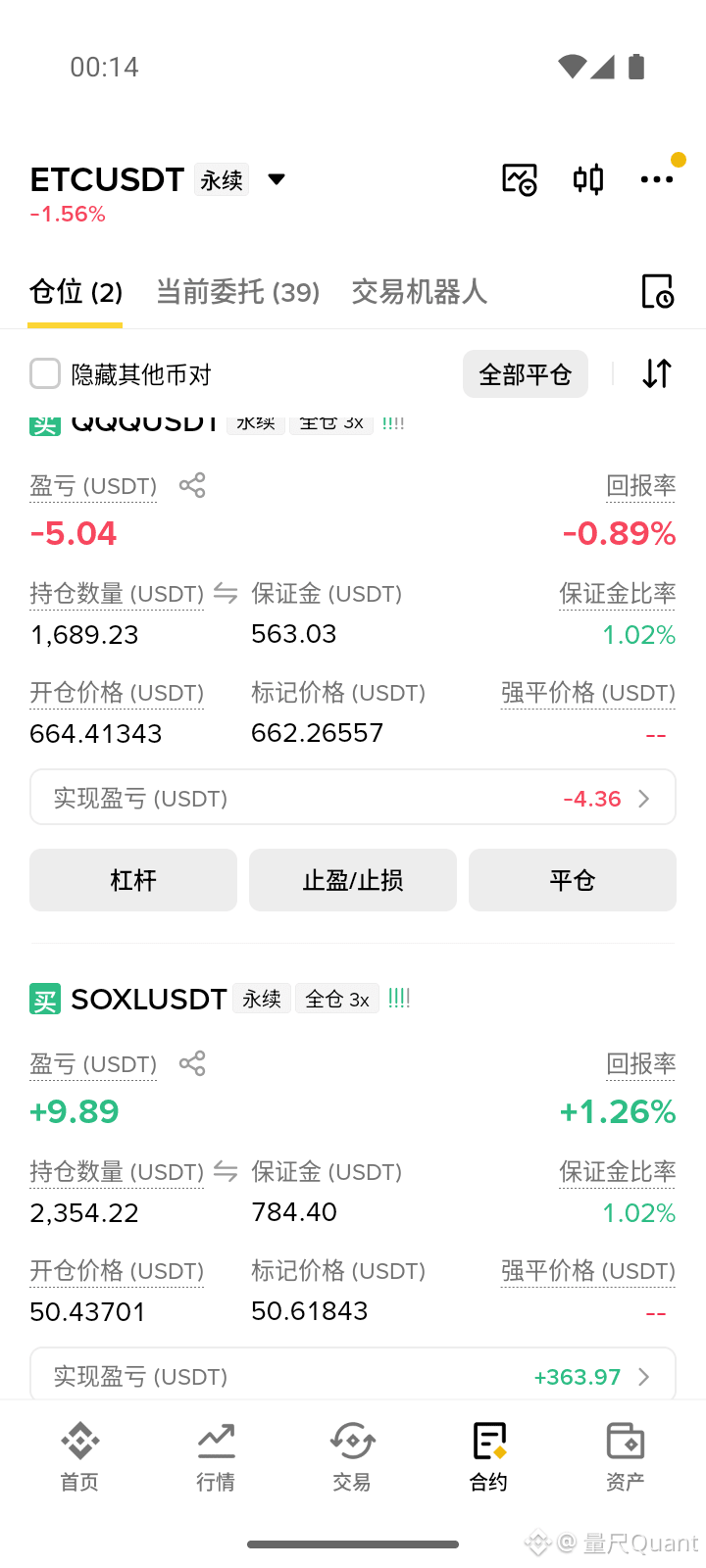
Đợt này cổ phiếu bán dẫn cứ tăng mãi, chiến lược lưới giúp tôi vừa tăng vừa bán, nên bản thân tôi cũng chẳng phải động tay nhiều. Vừa xem tài khoản, vị thế SOXL này đã chốt lời +363.97, còn giá hiện tại thực ra chỉ đang lình xình quanh giá vốn. Nói thật, giá càng tăng thẳng một mạch thì tôi càng không dám mua thêm. Trước mắt cứ giữ phần vị thế cơ sở còn lại, đợi giá quay về vùng giá vốn rồi mới cân nhắc có mua thêm không; nếu thủng đáy trước đó thì bán bớt một nửa. Mọi người đầu tư sản phẩm đòn bẩy 3x thì thích chốt lời cho chắc hay giữ lại để hưởng xu hướng? Nhật ký giao dịch thực tế · Ngày thứ 10 #Semiconductors #USStocks
Đợt này cổ phiếu bán dẫn cứ tăng mãi, chiến lược lưới giúp tôi vừa tăng vừa bán, nên bản thân tôi cũng chẳng phải động tay nhiều. Vừa xem tài khoản, vị thế SOXL này đã chốt lời +363.97, còn giá hiện tại thực ra chỉ đang lình xình quanh giá vốn. Nói thật, giá càng tăng thẳng một mạch thì tôi càng không dám mua thêm. Trước mắt cứ giữ phần vị thế cơ sở còn lại, đợi giá quay về vùng giá vốn rồi mới cân nhắc có mua thêm không; nếu thủng đáy trước đó thì bán bớt một nửa. Mọi người đầu tư sản phẩm đòn bẩy 3x thì thích chốt lời cho chắc hay giữ lại để hưởng xu hướng? Nhật ký giao dịch thực tế · Ngày thứ 10 #Semiconductors #USStocks
1.1k

·
--
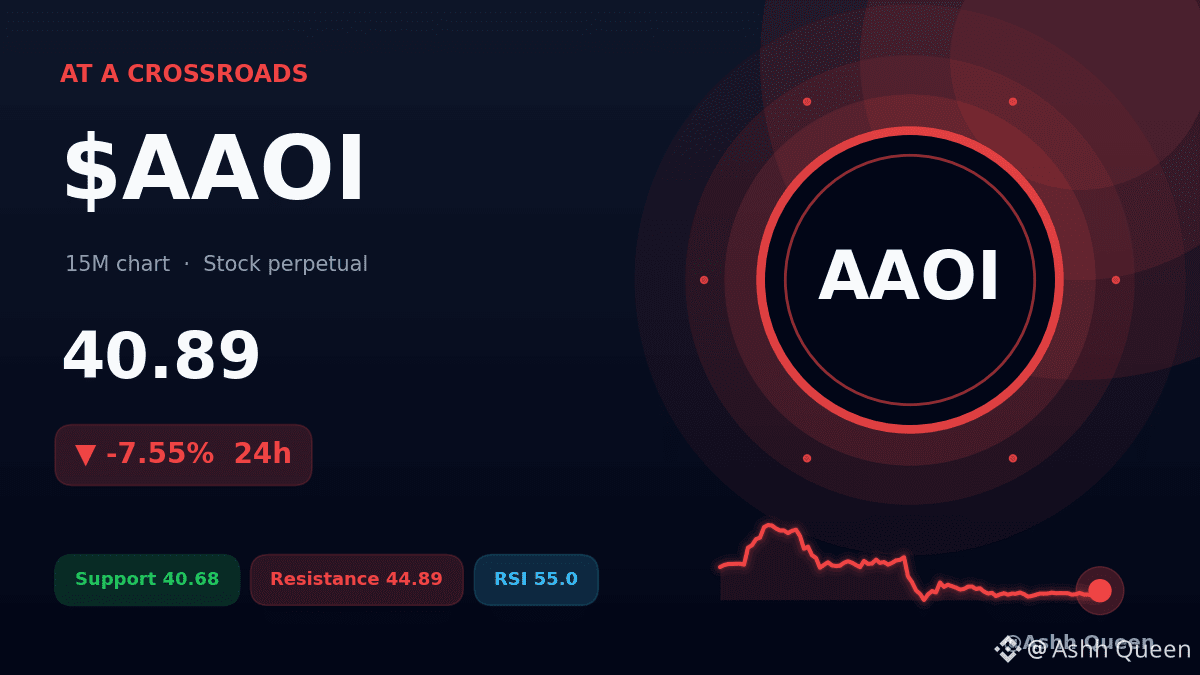
Một mức giá mà các nhà giao dịch $AAOI không nên bỏ qua hôm nay. ⚠️
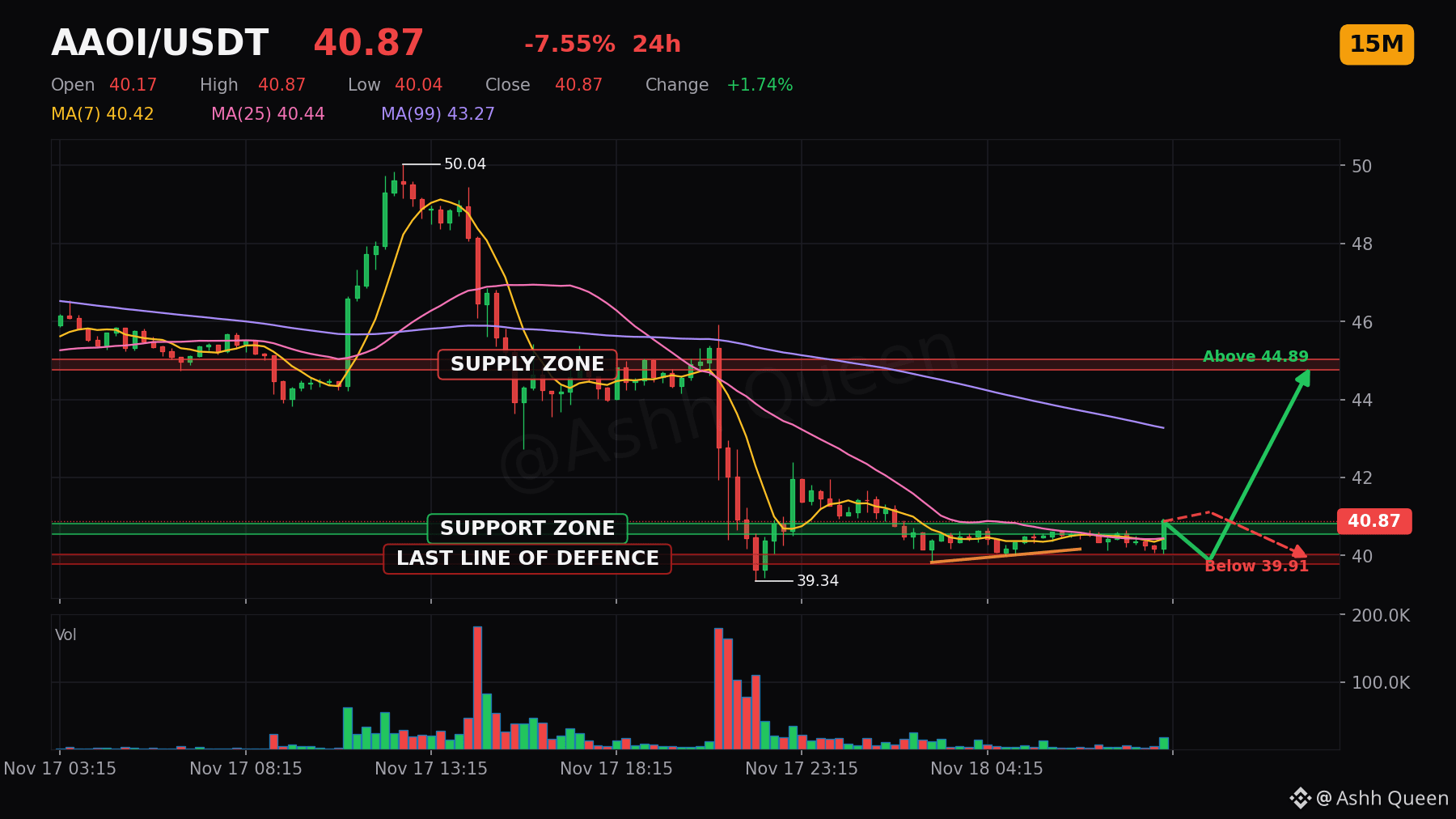
Hợp đồng perp này đã biến động +1.74% trong giờ qua, đẩy giá lên 40.89 trên biểu đồ 15 phút. 🧐
Hiện giá đang giữ trên VWAP ở mức 40.67 và EMA20 ở mức 40.51, nhưng tài sản vẫn thấp hơn nhiều so với EMA50 ở mức 41.26. Nếu vùng hỗ trợ tại 40.68 trụ vững, chúng ta có thể hướng đến ngưỡng kháng cự 44.89. Nếu thủng, nhiều khả năng giá sẽ kiểm tra lại vùng hỗ trợ 39.91. 🛡️
Bạn nhận định thế nào về biến động này, và những chỉ báo nào đang định hình quan điểm của bạn?
#AAOI #USStocks #StockMarket #BinanceSquare
⚠️ Hợp đồng vĩnh cửu là sản phẩm phái sinh có đòn bẩy, không phải bản thân cổ phiếu hay hàng hóa.
Lưu ý về rủi ro: đòn bẩy làm gia tăng thua lỗ. Hãy lên kế hoạch thoát lệnh trước khi vào lệnh.
4
·
--
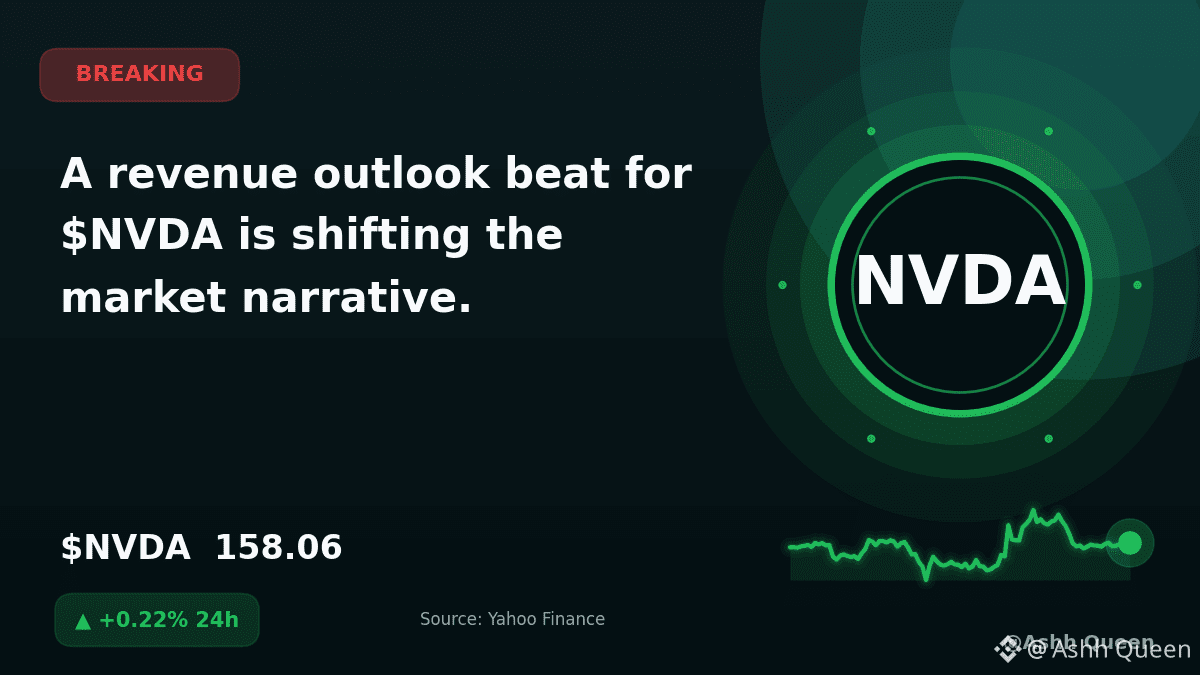
Triển vọng doanh thu vượt kỳ vọng của $NVDA đang làm thay đổi câu chuyện trên thị trường.
Theo Yahoo Finance, hợp đồng tương lai chứng khoán Mỹ đang phục hồi sau khi công ty công bố kết quả doanh thu cao hơn dự kiến. Diễn biến này diễn ra trong bối cảnh thị trường nói chung vừa trải qua đợt thoái lui, với S&P 500 và Nasdaq ghi nhận phiên giảm điểm thứ tư liên tiếp.
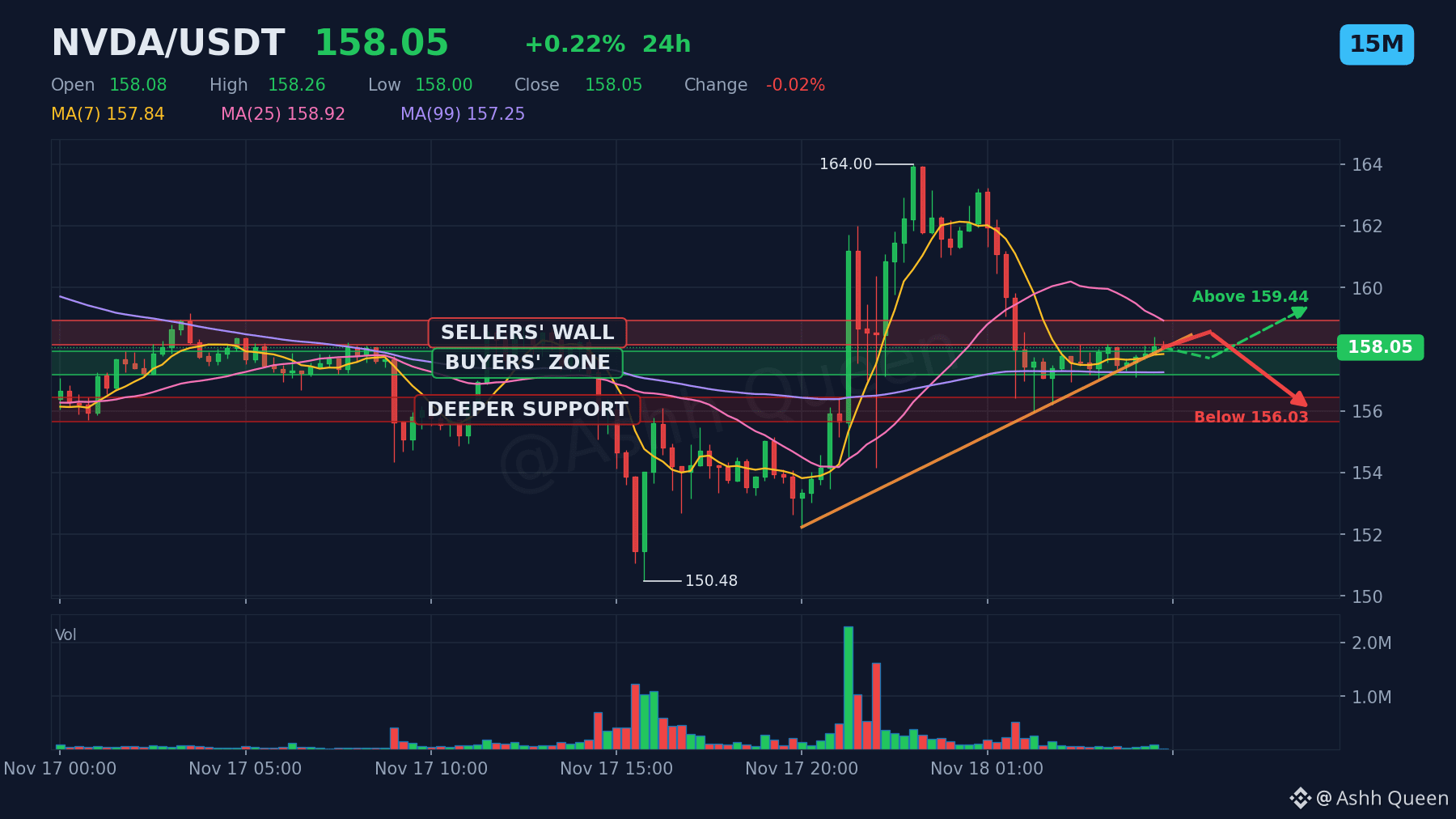
Hợp đồng vĩnh cửu $NVDA hiện có giá 158.06, với mức thay đổi trong 24 giờ là +0.22%. Tài sản này đang dao động gần ngưỡng hỗ trợ 157.54 và ngưỡng kháng cự 158.53.
Bạn nghĩ báo cáo thu nhập này sẽ tác động thế nào đến tâm lý chung của lĩnh vực công nghệ trong những phiên tới? 🔥⚡🚀
#NVDA #USStocks #TinTucThiTruong
⚠️ Hợp đồng vĩnh cửu là các sản phẩm phái sinh có đòn bẩy, không phải bản thân cổ phiếu hay hàng hóa.
Tự nghiên cứu kỹ trước khi đầu tư. Hãy cân nhắc quy mô vị thế cẩn thận và đừng bao giờ giao dịch bằng số tiền mà bạn không thể để mất.
6

·
--
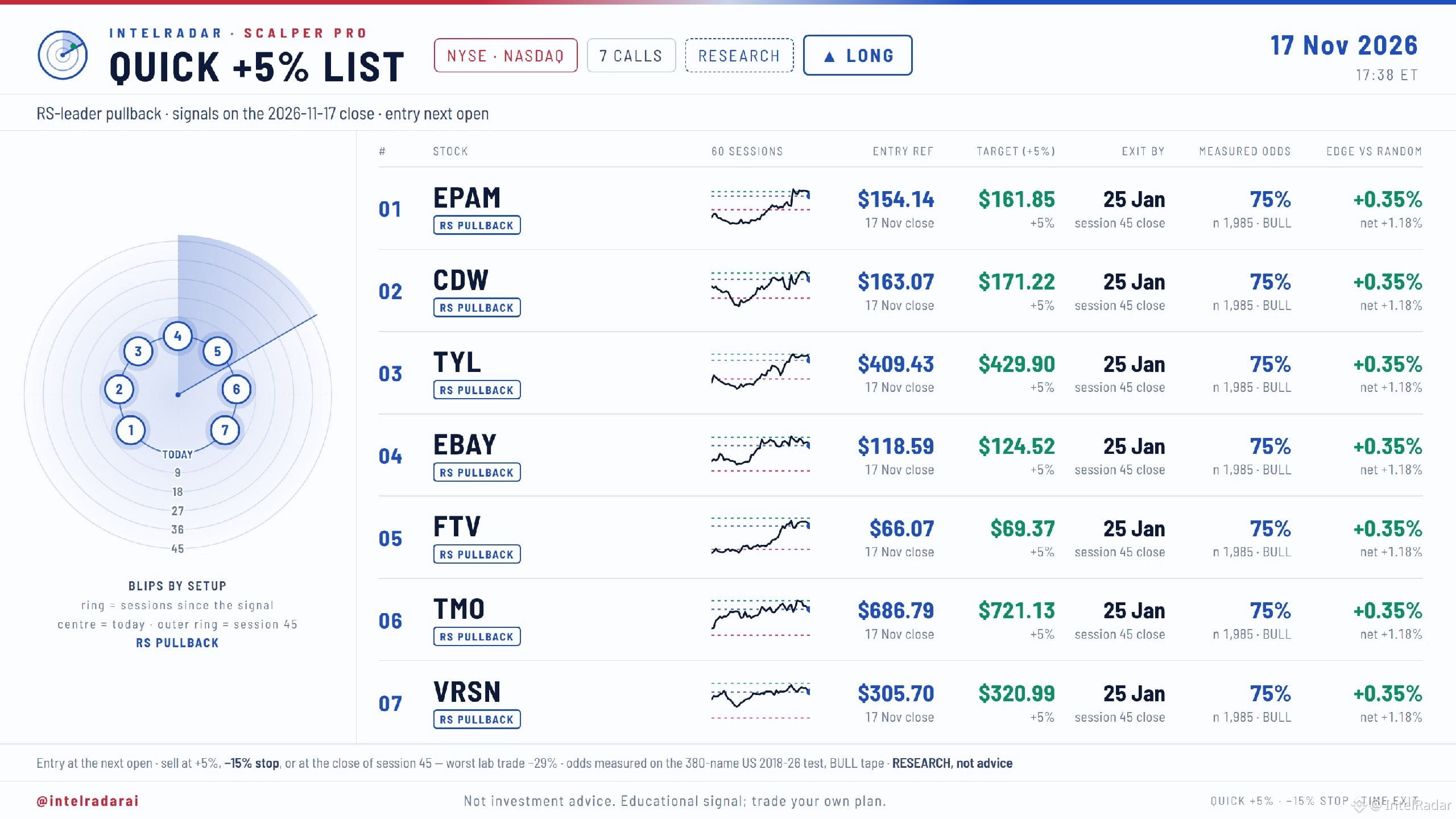
Danh sách tăng nhanh +5% | Đóng cửa ngày 17/11
Các mã dẫn đầu RS điều chỉnh giảm, 7 mã của Mỹ
Quy tắc:
Vào lệnh ở giá mở cửa phiên tiếp theo
Mục tiêu +5%
Cắt lỗ -15%
Thoát theo thời gian ở giá đóng cửa phiên thứ 45 (25/1)
Giá tham chiếu vào lệnh → mục tiêu:
$EPAM.US 154.14 → 161.85
$CDW.US 163.07 → 171.22
$TYL.US 409.43 → 429.90
$EBAY 118.59 → 124.52
$FTV 66.07 → 69.37
$TMO 686.79 → 721.13
$VRSN 305.70 → 320.99
Xác suất của thiết lập (kiểm định quá khứ, giống nhau cho cả 7 mã):
75% đạt +5%
380 mã, 2018–26, thị trường tăng giá
Giao dịch tệ nhất trong kiểm định: -29%
Nghiên cứu, không phải lời khuyên. Kết quả kiểm định quá khứ, không phải kết quả giao dịch thực tế.
Bạn sẽ bỏ qua mã nào, và tại sao?
#Stocks #USStocks
CDWUS+4,74%
EPAMUS+0,93%
TYLUS-0,21%
83
·
--
Đã xác minh
Bài viết
Ba mã “tăng giá” hàng đầu trên Nasdaq ngày 17 tháng 11 đều gộp cổ phiếu: Giá đã điều chỉnh cho thấy điều gìTuyên bố miễn trừ trách nhiệm: Đây không phải là lời khuyên tài chính
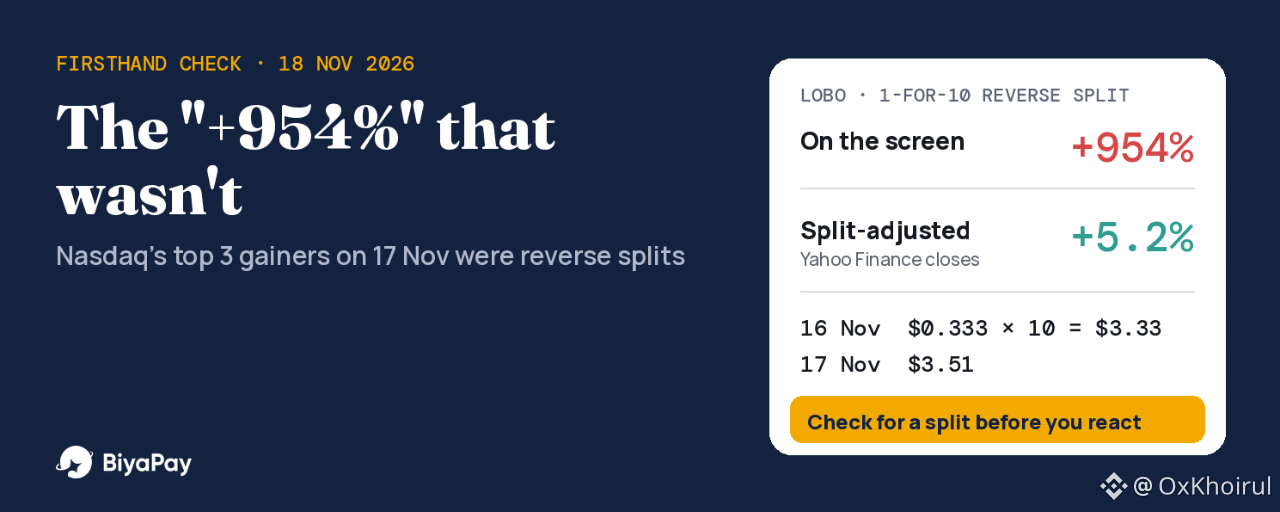
Vào thứ Ba, ngày 17 tháng 11, bản tin thị trường cuối ngày của Investing.com liệt kê những mã có diễn biến tốt nhất trên Nasdaq Composite: Lobo Technologies (LOBO) tăng 954,08% lên 3,51 USD, Edible Garden (EDBL) tăng 384,31% lên 2,47 USD và Forcendra (FCDH) tăng 366,39% lên 2,56 USD. Nếu chỉ lướt nhanh qua danh sách đó, bạn có thể nghĩ rằng ba cổ phiếu vừa tăng gấp ba lần hoặc hơn chỉ trong một ngày.
Tôi đã đối chiếu từng mã với các thông báo của công ty và lịch sử giá đã điều chỉnh theo các đợt gộp cổ phiếu. Cả ba đều đã thực hiện gộp cổ phiếu trong cùng tuần đó. Trên thực tế, không mã nào tăng hơn 6%. Hai mã còn giảm.
Ba mã “tăng giá” hàng đầu trên Nasdaq ngày 17 tháng 11 đều gộp cổ phiếu: Giá đã điều chỉnh cho thấy điều gì
Tuyên bố miễn trừ trách nhiệm: Đây không phải là lời khuyên tài chính
Vào thứ Ba, ngày 17 tháng 11, bản tin thị trường cuối ngày của Investing.com liệt kê những mã có diễn biến tốt nhất trên Nasdaq Composite: Lobo Technologies (LOBO) tăng 954,08% lên 3,51 USD, Edible Garden (EDBL) tăng 384,31% lên 2,47 USD và Forcendra (FCDH) tăng 366,39% lên 2,56 USD. Nếu chỉ lướt nhanh qua danh sách đó, bạn có thể nghĩ rằng ba cổ phiếu vừa tăng gấp ba lần hoặc hơn chỉ trong một ngày.
Tôi đã đối chiếu từng mã với các thông báo của công ty và lịch sử giá đã điều chỉnh theo các đợt gộp cổ phiếu. Cả ba đều đã thực hiện gộp cổ phiếu trong cùng tuần đó. Trên thực tế, không mã nào tăng hơn 6%. Hai mã còn giảm.
SNDK+12,34%
FCDHUS-0,84%
2
2.1k
Động lượng đáng chú ý khi nhiều khung thời gian cùng chỉ về một hướng.
Cổ phiếu — Hiệu suất hàng đầu & xu hướng:
$ARM | $AVGO | $CVX | XOM | WMT | RDDT | AAPL | AMZN | DIS | TSLA
Nhận định WPO:
Arm dẫn đầu nhóm cổ phiếu có thanh khoản cao trong phiên gần nhất được theo dõi, tăng +4.76%, nhưng giảm -7.30% trong mẫu gồm năm phiên. Có 3 trong số 5 mã hàng đầu tăng giá, cho thấy đà tăng chỉ tập trung ở một số mã. Vị thế dẫn đầu được chia sẻ trong nhóm đứng đầu; khối lượng giao dịch đạt 1.3 lần mức gần đây.
Trước khi hành động, hãy so sánh biến động này với tin tức doanh nghiệp và diễn biến chung của thị trường.
#wpo_report #USStocks #NghienCuuThiTruong
217
·
--
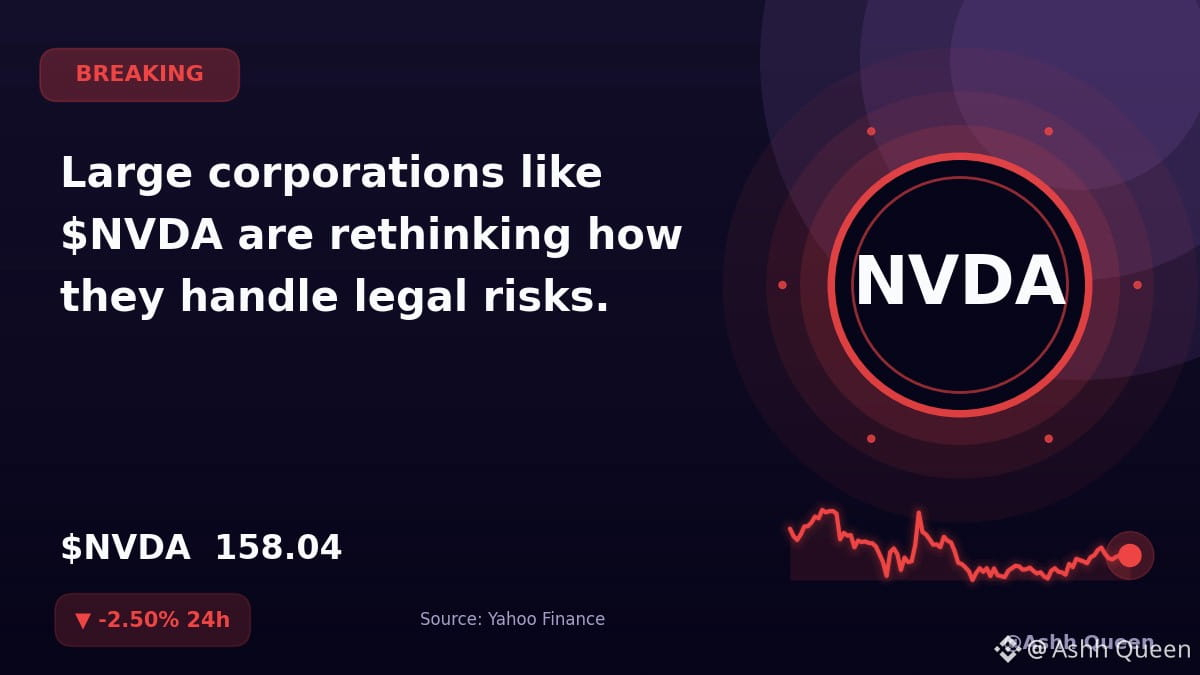
Các tập đoàn lớn như $NVDA đang suy nghĩ lại về cách xử lý rủi ro pháp lý.
Yahoo Finance đưa tin công ty duy trì bảo hiểm trách nhiệm cho giám đốc và cán bộ điều hành trị giá 900 triệu đô la, nhưng dùng tiền mặt dự trữ của chính mình để chi trả cho các vụ kiện của cổ đông doanh nghiệp.
Các nhà phân tích cho rằng đây là một chiến lược thận trọng đối với một công ty có cơ cấu vốn như vậy.
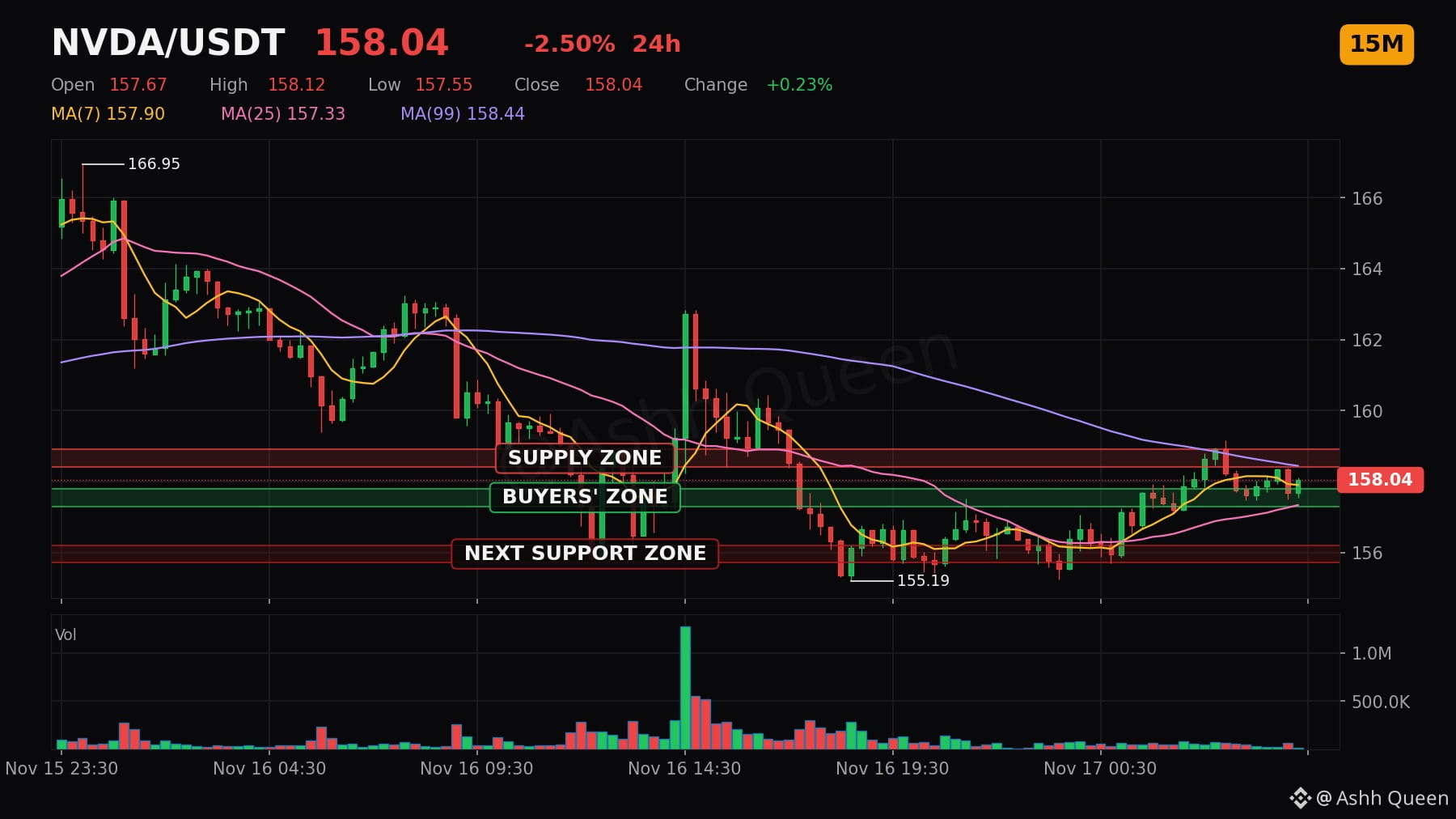
Hợp đồng vĩnh cửu $NVDA hiện đang giao dịch ở mức 158.04, giảm 2.50% trong 24 giờ qua. Giá đang giữ gần ngưỡng hỗ trợ 157.54.
Bạn đã điều chỉnh chiến lược quản lý rủi ro như thế nào khi giao dịch những tài sản có nguy cơ đối mặt với các trở ngại kiện tụng đặc thù của doanh nghiệp? ⚔️🐂
#NVDA #NVDAStock #USStocks
⚠️ Hợp đồng vĩnh cửu là các công cụ phái sinh có đòn bẩy, không phải bản thân cổ phiếu hay hàng hóa.
Đây không phải lời khuyên tài chính. Hãy ưu tiên bảo vệ vốn, cơ hội tiếp theo sẽ luôn đến.
7
·
--
Đã xác minh
Bài viết
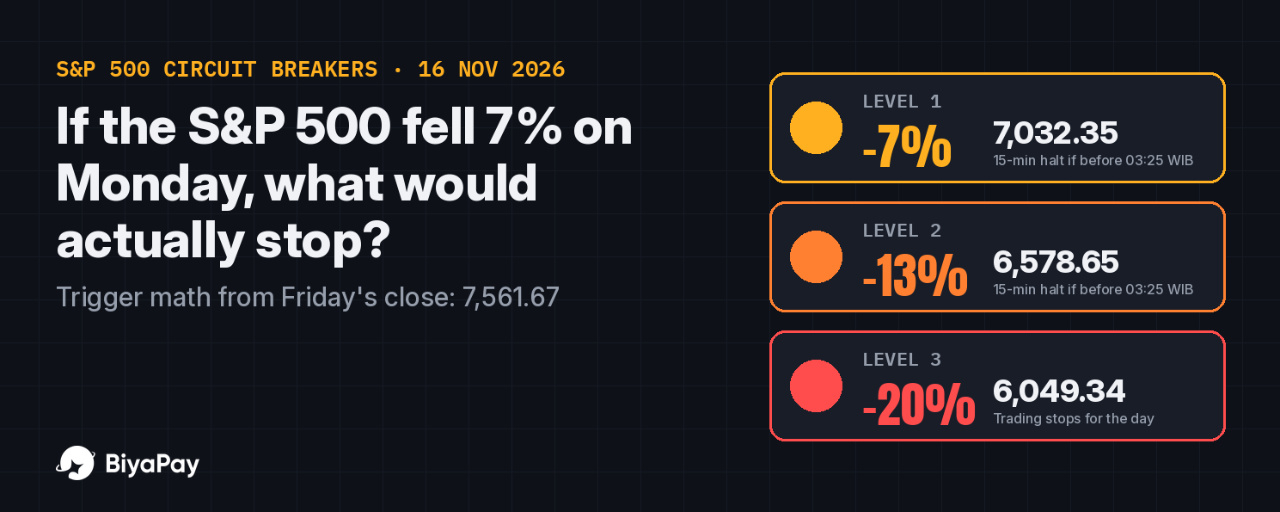
Nếu S&P 500 giảm 7% vào thứ Hai, điều gì sẽ thực sự bị dừng lại? Cách tính ngưỡng ngắt mạch ở mức 7.561Tuyên bố miễn trừ trách nhiệm: Đây không phải là lời khuyên tài chính.
Thứ Sáu là lời nhắc rằng “thị trường tăng trong cả tuần” và “màn hình của tôi vẫn yên ả” là hai chuyện khác nhau. Vào thứ Sáu, ngày 13 tháng 11 năm 2026, S&P 500 giảm 0,40%, chốt phiên ở mức 7.561,67; Nasdaq Composite giảm 0,91% và Chỉ số Bán dẫn Philadelphia giảm 3,4%. Theo Reuters, AMD giảm 8,8% và Broadcom giảm 4,8% chỉ trong một phiên giao dịch. VIX tăng lên 19,35 (Thông tấn xã Anadolu), lợi suất trái phiếu Kho bạc Mỹ kỳ hạn 10 năm ở mức trên 5,1%, và các nhà giao dịch dự đoán khả năng Fed tăng lãi suất vào tháng 12 gần như chắc chắn.
Nếu S&P 500 giảm 7% vào thứ Hai, điều gì sẽ thực sự bị dừng lại? Cách tính ngưỡng ngắt mạch ở mức 7.561
Tuyên bố miễn trừ trách nhiệm: Đây không phải là lời khuyên tài chính.
Thứ Sáu là lời nhắc rằng “thị trường tăng trong cả tuần” và “màn hình của tôi vẫn yên ả” là hai chuyện khác nhau. Vào thứ Sáu, ngày 13 tháng 11 năm 2026, S&P 500 giảm 0,40%, chốt phiên ở mức 7.561,67; Nasdaq Composite giảm 0,91% và Chỉ số Bán dẫn Philadelphia giảm 3,4%. Theo Reuters, AMD giảm 8,8% và Broadcom giảm 4,8% chỉ trong một phiên giao dịch. VIX tăng lên 19,35 (Thông tấn xã Anadolu), lợi suất trái phiếu Kho bạc Mỹ kỳ hạn 10 năm ở mức trên 5,1%, và các nhà giao dịch dự đoán khả năng Fed tăng lãi suất vào tháng 12 gần như chắc chắn.
Thứ Sáu là lời nhắc rằng “thị trường tăng trong cả tuần” và “màn hình của tôi vẫn yên ả” là hai chuyện khác nhau. Vào thứ Sáu, ngày 13 tháng 11 năm 2026, S&P 500 giảm 0,40%, chốt phiên ở mức 7.561,67; Nasdaq Composite giảm 0,91% và Chỉ số Bán dẫn Philadelphia giảm 3,4%. Theo Reuters, AMD giảm 8,8% và Broadcom giảm 4,8% chỉ trong một phiên giao dịch. VIX tăng lên 19,35 (Thông tấn xã Anadolu), lợi suất trái phiếu Kho bạc Mỹ kỳ hạn 10 năm ở mức trên 5,1%, và các nhà giao dịch dự đoán khả năng Fed tăng lãi suất vào tháng 12 gần như chắc chắn.
598
Diễn biến thị trường mạnh nhất là sự kết hợp giữa hiệu suất, độ lan tỏa và đà tiếp diễn.
Cổ phiếu — Hiệu suất và xu hướng hàng đầu:
$META | $CVX | $WMT | LLY | UBER | JPM | XOM | BAC | DIS | AAPL
Nhận định WPO:
Meta Platforms dẫn đầu nhóm cổ phiếu có thanh khoản cao trong phiên gần nhất được theo dõi, tăng +2.90%, và tăng +0.58% trong mẫu gồm năm phiên. Cả 5 trong số 5 mã hàng đầu đều tăng, cho thấy đà tăng lan tỏa rộng. Vị thế dẫn đầu được chia sẻ giữa các mã trong nhóm hàng đầu; khối lượng giao dịch đạt 1.3 lần mức gần đây.
Đà tăng có thể đảo chiều nhanh chóng, vì vậy tín hiệu xác nhận quan trọng hơn sự hưng phấn.
#wpo_report #USStocks #NghiênCứuThịTrường
225
·
--
Đã xác minh
Bài viết
Xem bản dịch
Five Stocks or One Index ETF? What Friday's Chip Sell-Off Means for a $1,000 AccountDisclosure: It is not financial advice
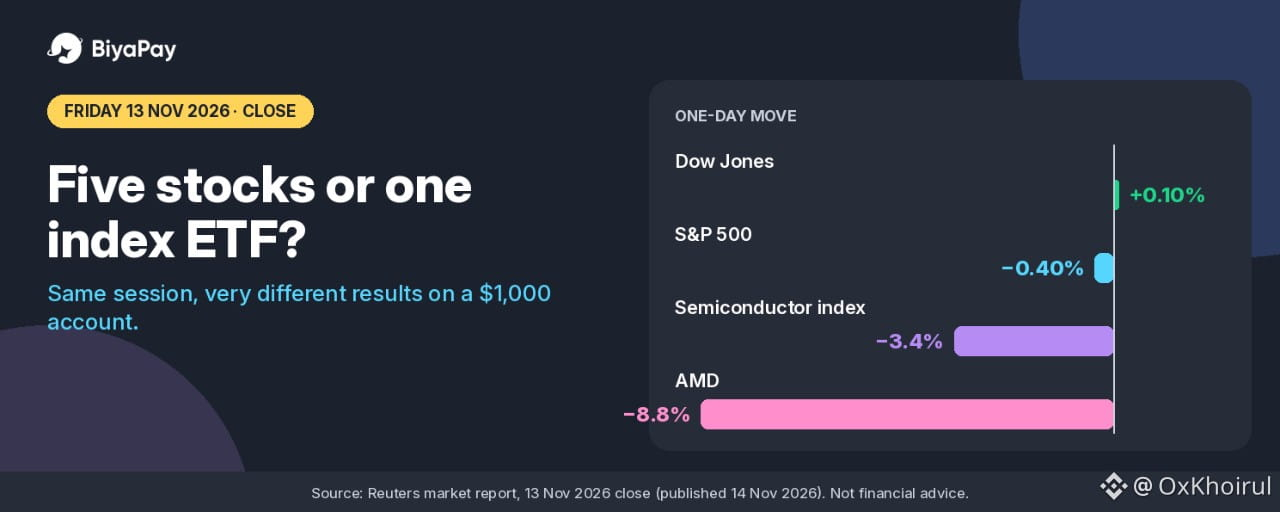
On Friday, 13 November 2026, the S&P 500 closed down 0.40 percent. On the same day, Advanced Micro Devices fell 8.8 percent, Broadcom fell 4.8 percent, and the Philadelphia Semiconductor Index fell 3.4 percent, according to Reuters. The Dow Jones Industrial Average actually closed 0.10 percent higher.
Same market, same session, very different results. The gap between those numbers is the whole argument of this article.
A common piece of advice for small accounts is "just split your money across five stocks and you are diversified." A second one is "buy one index ETF, it is always the cheaper choice." Friday's numbers, and the fee arithmetic on a 1,000 dollar account, suggest both claims are only half true.
This is a worked comparison using official and reputable figures, with a 1,000 dollar example that is an illustration, not a suggested order size.
What one session did to 1,000 dollars
Take 1,000 dollars and put it to work three different ways, using Friday's actual closing moves.
All of it in one chip stock that fell 8.8 percent: the position loses 88 dollars in one session.
Split into five equal 200 dollar positions, where one of them is that same stock and the other four are unchanged: the account loses 17.60 dollars, or 1.76 percent. The one bad position still hurts, but it is one fifth of the damage.
All of it tracking the S&P 500, which fell 0.40 percent: the account loses about 4 dollars, before any tracking difference or fund costs.
That middle case comes with a catch that is easy to miss. "Five stocks" only spreads risk if the five stocks do not all react to the same news. Five chip names are closer to one bet with five tickers. On Friday the semiconductor index as a whole fell 3.4 percent, which on 1,000 dollars is 34 dollars, more than eight times the S&P 500's move.
The index does not avoid chip stocks either
The opposite mistake is to think an index fund simply sidesteps a sector sell-off. It does not. It holds the sector at whatever weight the index gives it.
State Street's official page for the SPDR S&P 500 ETF Trust (SPY), with holdings as of 12 November 2026, lists the index weight of Nvidia at 6.15 percent and Broadcom at 2.65 percent. Information Technology is 36.15 percent of the index.
A rough contribution estimate: Nvidia fell 2 percent on Friday and Broadcom fell 4.8 percent, according to Reuters. At those weights, Nvidia's move takes about 0.12 percentage points off the index, and Broadcom's takes about 0.13 points. Together that is roughly 0.25 points of the index's 0.40 percent decline, from just two companies. Weights shift during the day, so treat this as an approximation, not an official attribution.
So the index ETF did not dodge Friday. It diluted it. That is a real difference, but it is not immunity. In a broad market decline the index falls too, and with 36 percent in technology, a tech-led sell-off reaches an index holder more than the word "diversified" suggests.
What order fees add to a $1,000 account
Here is where the "five stocks" approach has a cost that a 1,000 dollar account feels more than a large one.
On BiyaPay, US stock commission is 0 dollars, while the platform fee is 0.005 dollars per share, with a minimum of 0.99 dollars per order and a maximum of 1 percent of the transaction value. External institution fees, trading activity fees, and sell-related items are added on top of the platform fee. Some US stocks on BiyaPay support fractional trading: an order below one share is charged a 1 percent platform fee capped at 1 dollar, with no commission and no external institution fees.
On small orders the per-share calculation is usually below the minimum, so the 0.99 dollar minimum is what applies. On a 200 dollar order, 1 percent is 2 dollars, so the cap does not bring it lower. Using only that platform-fee minimum:
One order of 1,000 dollars: 0.99 dollars to buy, 1.98 dollars to buy and later sell. That is about 0.2 percent of the account for the round trip.
Five orders of 200 dollars: 4.95 dollars to buy, 9.90 dollars to buy and later sell. That is about 0.99 percent of the account, five times as much, before any external fees.
Now scale the same split to 10,000 dollars. If each order is still under 198 shares, so the per-share calculation stays below the minimum, five orders of 2,000 dollars still cost 9.90 dollars for a round trip, which is about 0.1 percent of the account. The fee did not change. The account size did.
The index ETF has its own cost, and it is a different kind. State Street lists SPY's gross expense ratio at 0.0945 percent a year, as of 14 November 2026. On 1,000 dollars that is about 0.95 dollars a year, taken inside the fund rather than charged per order. It is small, but it repeats every year you hold, while an order fee is paid once per trade.
There is one more practical detail. SPY closed at 757.12 dollars on 12 November 2026, according to State Street. A 1,000 dollar account can buy one whole share and has about 243 dollars left over, which is below one share and would be a fractional order.
So the choice is not only about risk. It is also about how many orders a 1,000 dollar account has to pay for.
When five single stocks make sense, and when they do not
Five single stocks can make sense when:
The account is large enough that the minimum fee is a small slice of each position. At 0.99 dollars per order, a 495 dollar position keeps the minimum at about 0.2 percent per side.
The five companies are genuinely different businesses that do not move on the same headline. A bank, a retailer, a drug maker, an energy company, and a software company spread risk. Five chip makers do not.
You actually want to avoid what the index is heavy in. With 36 percent of the S&P 500 in technology, someone who wants less tech exposure cannot get that from the index alone.
They make less sense when:
The account is small and every position is under a few hundred dollars. The minimum fee then becomes a meaningful percentage before the stock has moved at all.
The five picks are really one theme. That is concentration with extra fees.
You plan to rebalance or trade often. Each trade on each name pays the minimum again.
And the index ETF is not automatically right either. It cannot outperform the market it tracks, it charges an annual expense ratio, and it fell on Friday along with everything it holds.
My view
In my view, the first 1,000 dollars of a US stock account is not the place to build a five-stock portfolio. The numbers say the five-order version costs about five times as much in platform-fee minimums, and the protection it buys depends entirely on whether the five stocks are truly different. Friday showed what happens when they are not.
I would rather start with one broad position, accept that it holds tech at the index weight, and add single names only when each new position is large enough that the 0.99 dollar minimum stays near 0.2 percent per side. That works out to roughly 500 dollars per position or more. That is a rule I would set for myself.
A short checklist I would use before splitting money across stocks:
Divide 0.99 by the planned position size. If the result is above about 0.2 percent per side, the position is small relative to the minimum fee.Ask whether the stocks would all fall on the same headline. If yes, count them as one bet.If using an index ETF, read its official holdings and sector weights, so you know what it already contains.
Sources: Reuters market report on 13 November 2026 trading, published 14 November 2026; State Street Investment Management, SPDR S&P 500 ETF Trust (SPY) page: top holdings and sector weights as of 12 November 2026, closing price as of 12 November 2026, gross expense ratio as of 14 November 2026. All checked on 15 November 2026 (Asia/Jakarta, UTC+7).
#BiyaPay #USStocks #ETF
Five Stocks or One Index ETF? What Friday's Chip Sell-Off Means for a $1,000 Account
Disclosure: It is not financial advice
On Friday, 13 November 2026, the S&P 500 closed down 0.40 percent. On the same day, Advanced Micro Devices fell 8.8 percent, Broadcom fell 4.8 percent, and the Philadelphia Semiconductor Index fell 3.4 percent, according to Reuters. The Dow Jones Industrial Average actually closed 0.10 percent higher.
Same market, same session, very different results. The gap between those numbers is the whole argument of this article.
A common piece of advice for small accounts is "just split your money across five stocks and you are diversified." A second one is "buy one index ETF, it is always the cheaper choice." Friday's numbers, and the fee arithmetic on a 1,000 dollar account, suggest both claims are only half true.
This is a worked comparison using official and reputable figures, with a 1,000 dollar example that is an illustration, not a suggested order size.
What one session did to 1,000 dollars
Take 1,000 dollars and put it to work three different ways, using Friday's actual closing moves.
All of it in one chip stock that fell 8.8 percent: the position loses 88 dollars in one session.
Split into five equal 200 dollar positions, where one of them is that same stock and the other four are unchanged: the account loses 17.60 dollars, or 1.76 percent. The one bad position still hurts, but it is one fifth of the damage.
All of it tracking the S&P 500, which fell 0.40 percent: the account loses about 4 dollars, before any tracking difference or fund costs.
That middle case comes with a catch that is easy to miss. "Five stocks" only spreads risk if the five stocks do not all react to the same news. Five chip names are closer to one bet with five tickers. On Friday the semiconductor index as a whole fell 3.4 percent, which on 1,000 dollars is 34 dollars, more than eight times the S&P 500's move.
The index does not avoid chip stocks either
The opposite mistake is to think an index fund simply sidesteps a sector sell-off. It does not. It holds the sector at whatever weight the index gives it.
State Street's official page for the SPDR S&P 500 ETF Trust (SPY), with holdings as of 12 November 2026, lists the index weight of Nvidia at 6.15 percent and Broadcom at 2.65 percent. Information Technology is 36.15 percent of the index.
A rough contribution estimate: Nvidia fell 2 percent on Friday and Broadcom fell 4.8 percent, according to Reuters. At those weights, Nvidia's move takes about 0.12 percentage points off the index, and Broadcom's takes about 0.13 points. Together that is roughly 0.25 points of the index's 0.40 percent decline, from just two companies. Weights shift during the day, so treat this as an approximation, not an official attribution.
So the index ETF did not dodge Friday. It diluted it. That is a real difference, but it is not immunity. In a broad market decline the index falls too, and with 36 percent in technology, a tech-led sell-off reaches an index holder more than the word "diversified" suggests.
What order fees add to a $1,000 account
Here is where the "five stocks" approach has a cost that a 1,000 dollar account feels more than a large one.
On BiyaPay, US stock commission is 0 dollars, while the platform fee is 0.005 dollars per share, with a minimum of 0.99 dollars per order and a maximum of 1 percent of the transaction value. External institution fees, trading activity fees, and sell-related items are added on top of the platform fee. Some US stocks on BiyaPay support fractional trading: an order below one share is charged a 1 percent platform fee capped at 1 dollar, with no commission and no external institution fees.
On small orders the per-share calculation is usually below the minimum, so the 0.99 dollar minimum is what applies. On a 200 dollar order, 1 percent is 2 dollars, so the cap does not bring it lower. Using only that platform-fee minimum:
One order of 1,000 dollars: 0.99 dollars to buy, 1.98 dollars to buy and later sell. That is about 0.2 percent of the account for the round trip.
Five orders of 200 dollars: 4.95 dollars to buy, 9.90 dollars to buy and later sell. That is about 0.99 percent of the account, five times as much, before any external fees.
Now scale the same split to 10,000 dollars. If each order is still under 198 shares, so the per-share calculation stays below the minimum, five orders of 2,000 dollars still cost 9.90 dollars for a round trip, which is about 0.1 percent of the account. The fee did not change. The account size did.
The index ETF has its own cost, and it is a different kind. State Street lists SPY's gross expense ratio at 0.0945 percent a year, as of 14 November 2026. On 1,000 dollars that is about 0.95 dollars a year, taken inside the fund rather than charged per order. It is small, but it repeats every year you hold, while an order fee is paid once per trade.
There is one more practical detail. SPY closed at 757.12 dollars on 12 November 2026, according to State Street. A 1,000 dollar account can buy one whole share and has about 243 dollars left over, which is below one share and would be a fractional order.
So the choice is not only about risk. It is also about how many orders a 1,000 dollar account has to pay for.
When five single stocks make sense, and when they do not
Five single stocks can make sense when:
The account is large enough that the minimum fee is a small slice of each position. At 0.99 dollars per order, a 495 dollar position keeps the minimum at about 0.2 percent per side.
The five companies are genuinely different businesses that do not move on the same headline. A bank, a retailer, a drug maker, an energy company, and a software company spread risk. Five chip makers do not.
You actually want to avoid what the index is heavy in. With 36 percent of the S&P 500 in technology, someone who wants less tech exposure cannot get that from the index alone.
They make less sense when:
The account is small and every position is under a few hundred dollars. The minimum fee then becomes a meaningful percentage before the stock has moved at all.
The five picks are really one theme. That is concentration with extra fees.
You plan to rebalance or trade often. Each trade on each name pays the minimum again.
And the index ETF is not automatically right either. It cannot outperform the market it tracks, it charges an annual expense ratio, and it fell on Friday along with everything it holds.
My view
In my view, the first 1,000 dollars of a US stock account is not the place to build a five-stock portfolio. The numbers say the five-order version costs about five times as much in platform-fee minimums, and the protection it buys depends entirely on whether the five stocks are truly different. Friday showed what happens when they are not.
I would rather start with one broad position, accept that it holds tech at the index weight, and add single names only when each new position is large enough that the 0.99 dollar minimum stays near 0.2 percent per side. That works out to roughly 500 dollars per position or more. That is a rule I would set for myself.
A short checklist I would use before splitting money across stocks:
Divide 0.99 by the planned position size. If the result is above about 0.2 percent per side, the position is small relative to the minimum fee.Ask whether the stocks would all fall on the same headline. If yes, count them as one bet.If using an index ETF, read its official holdings and sector weights, so you know what it already contains.
Sources: Reuters market report on 13 November 2026 trading, published 14 November 2026; State Street Investment Management, SPDR S&P 500 ETF Trust (SPY) page: top holdings and sector weights as of 12 November 2026, closing price as of 12 November 2026, gross expense ratio as of 14 November 2026. All checked on 15 November 2026 (Asia/Jakarta, UTC+7).
#BiyaPay #USStocks #ETF
476
·
--
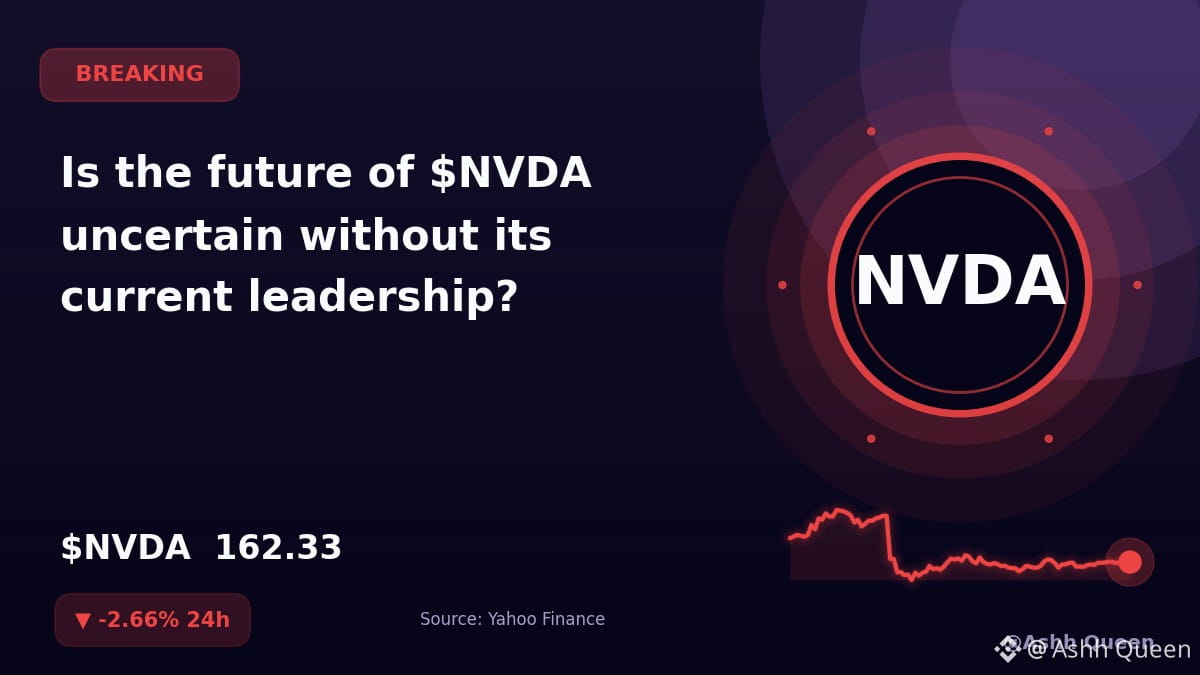
Tương lai của $NVDA có bất định nếu thiếu ban lãnh đạo hiện tại?
Yahoo Finance đưa tin giá cổ phiếu của công ty đã giảm gần 13% trong tuần này. Trong khi đó, Decrypt lưu ý rằng hội đồng quản trị được cho là đã tiếp cận CEO của Arm để cân nhắc người kế nhiệm Jensen Huang.
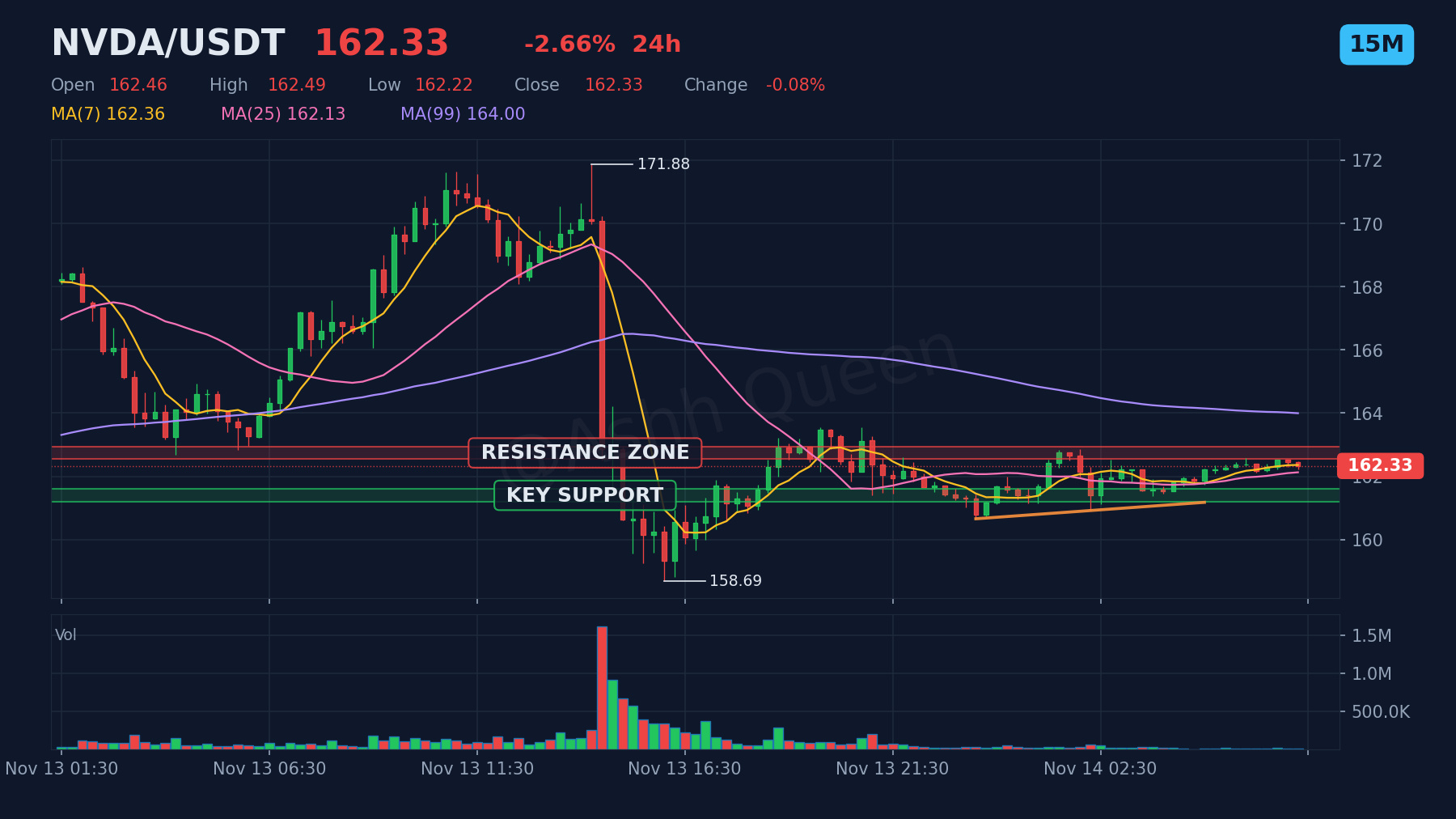
Bạn có thể theo dõi hợp đồng vĩnh cửu này ở mức giá 162.33, với mức biến động 24 giờ là -2.66%. Mức hỗ trợ hiện tại là 161.40.
⚠️ 🧐
Bạn thích giao dịch hợp đồng vĩnh cửu này trong khung thời gian ngắn hay dài hơn?
#NVDA #USStocks #CổPhiếu
⚠️ Hợp đồng vĩnh cửu là sản phẩm phái sinh có đòn bẩy, không phải bản thân cổ phiếu hay hàng hóa.
Đây là phân tích, không phải khuyến nghị. Hãy ưu tiên quản lý rủi ro trước, lợi nhuận sau.
53
·
--
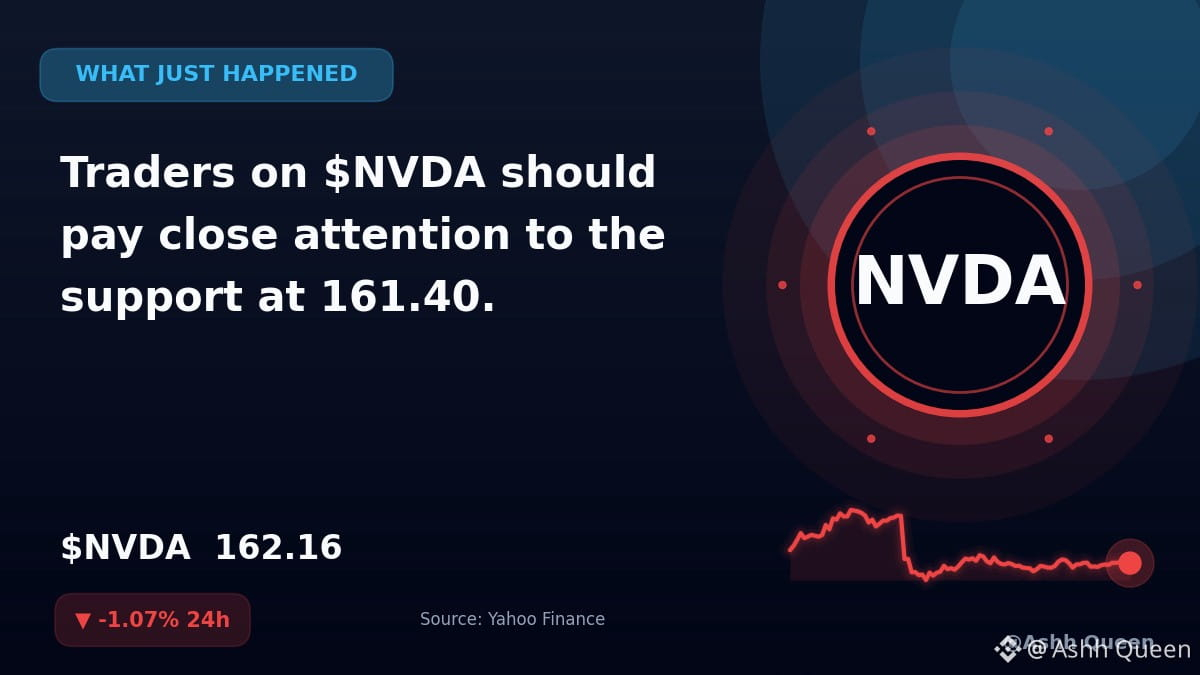
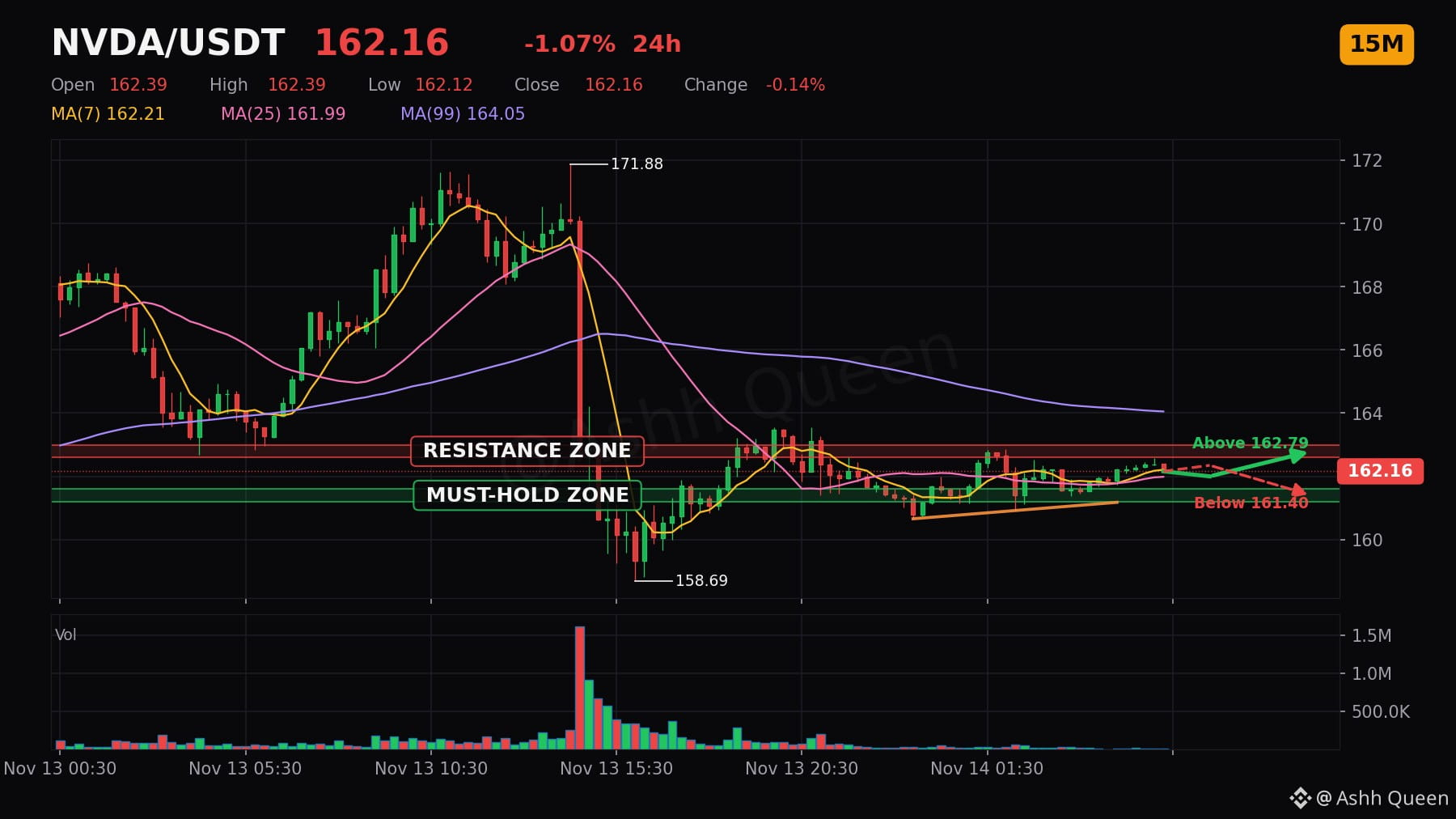
Các nhà giao dịch trên $NVDA nên chú ý kỹ đến vùng hỗ trợ tại 161.40.
Theo Yahoo Finance, công ty của Jim Simons đã thoát khỏi vị thế của mình trong nhà sản xuất chip này. Các báo cáo từ cùng nguồn cho thấy công ty đã tiết lộ các khoản nắm giữ trị giá hàng tỷ đô la trong các cổ phiếu công nghệ khác.
Hợp đồng vĩnh viễn $NVDA hiện đang giao dịch ở mức 162.16 với mức thay đổi 24h là -1.07%.
📈 📉 📊
Tín hiệu thị trường cụ thể nào hoặc sự thay đổi cơ bản nào sẽ thay đổi quan điểm hiện tại của bạn về tài sản này?
#NVDA #NVDAStock #StockMarketNews #USStocks
⚠️ Hợp đồng vĩnh viễn là các công cụ phái sinh có đòn bẩy, không phải chính cổ phiếu hay hàng hóa đó.
Không phải lời khuyên tài chính. Thị trường biến động mạnh, vì vậy hãy dùng lệnh dừng lỗ và chỉ chấp nhận rủi ro trong phạm vi bạn có thể mất.
47
·
--
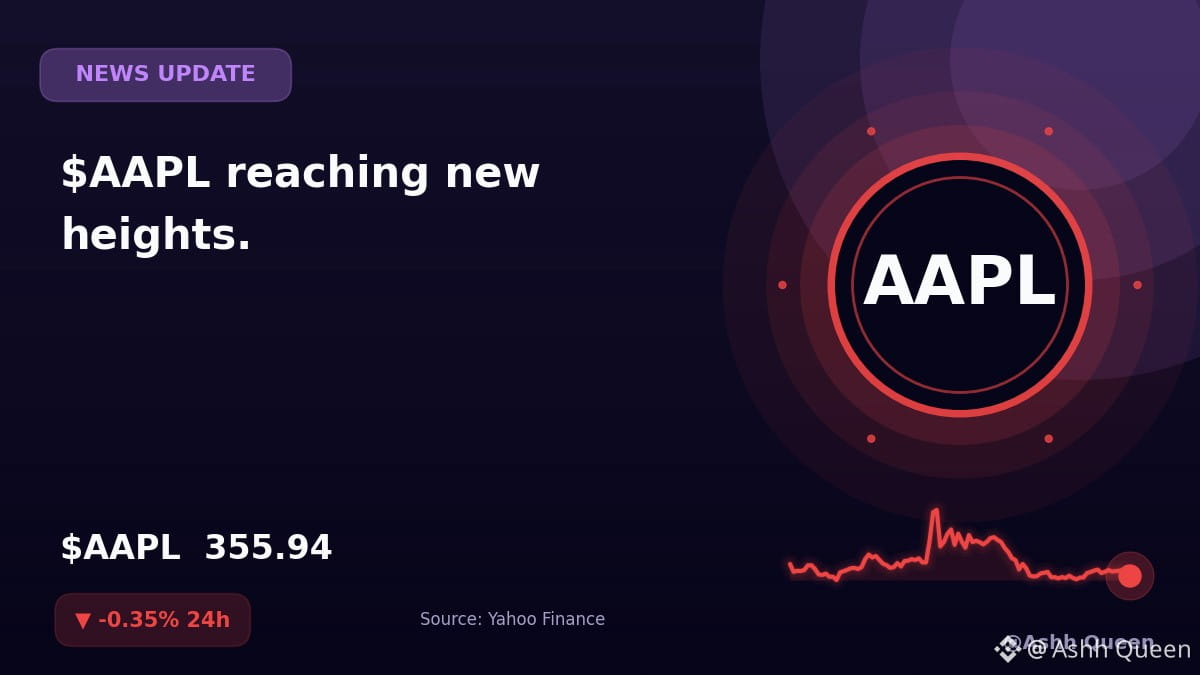
$AAPL đang đạt những đỉnh cao mới.
Yahoo Finance đưa tin tài sản này đang lập các mức đỉnh mới, dù triển vọng cho thấy vẫn có thể còn dư địa tăng giá.
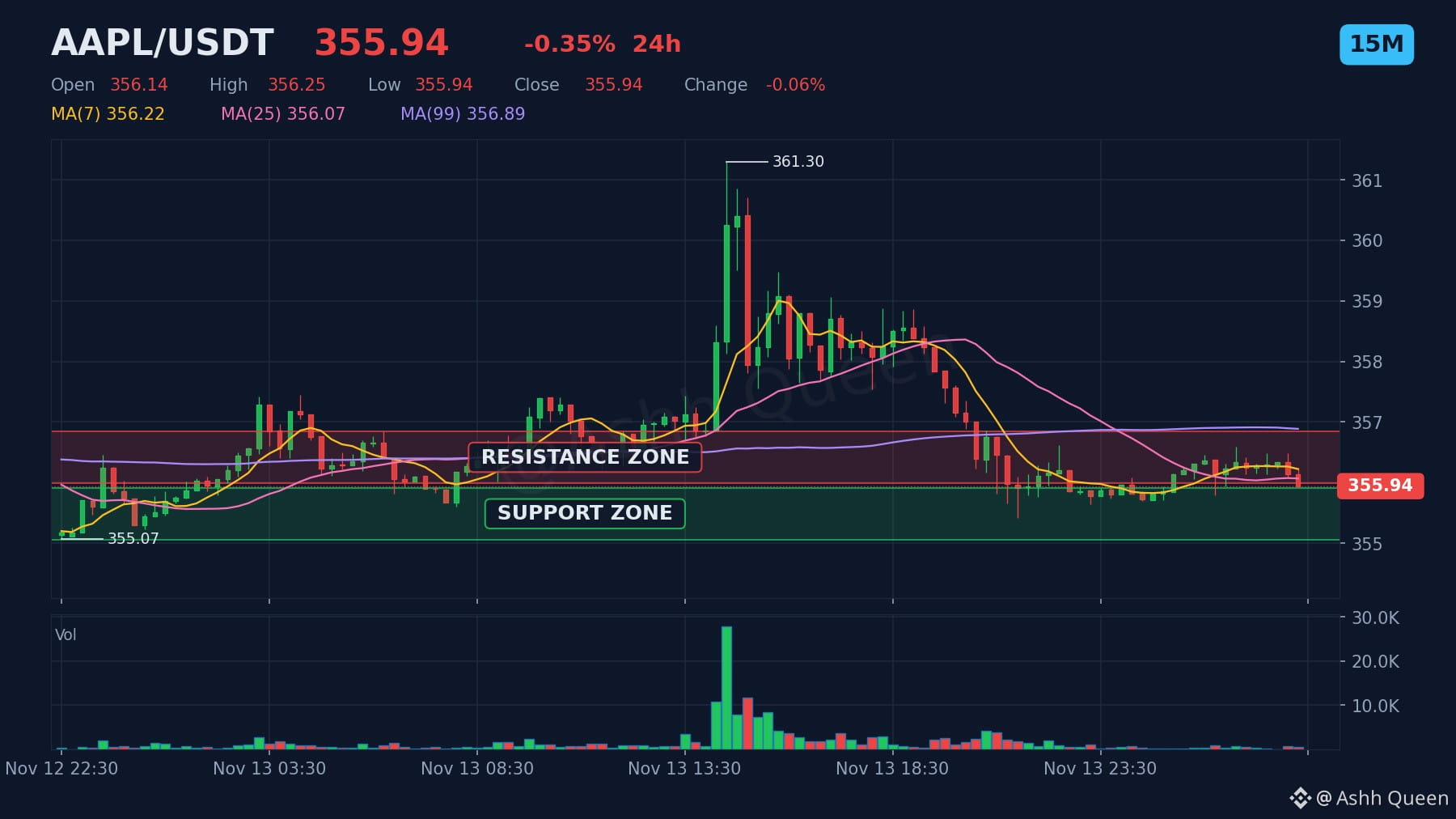
Hợp đồng vĩnh cửu AAPLUSDT này hiện có giá 355.94, với mức biến động trong 24 giờ là -0.35%. Mức kháng cự hiện tại ở 356.42. 🎯 👀 🧭
Bạn đang theo dõi mức nào trên biểu đồ và vì sao?
#AAPL #AAPLStock #USStocks
⚠️ Hợp đồng vĩnh cửu là các công cụ phái sinh có đòn bẩy, không phải bản thân cổ phiếu hay hàng hóa.
Đây không phải lời khuyên tài chính. Thị trường biến động mạnh, vì vậy hãy sử dụng lệnh cắt lỗ và chỉ chấp nhận rủi ro với số tiền bạn có thể mất.
71
·
--
Đã xác minh
Bài viết
Xem bản dịch
The Fed Meets in December. The 10-Year Yield Is Already Above 5%Disclosure: It is not financial advice
The next Federal Reserve policy meeting is still weeks away. The 10-year US Treasury yield did not wait.
On Tuesday, 10 November 2026, the US Bureau of Labor Statistics reported that the consumer price index rose a seasonally adjusted 0.4 percent in October, above the 0.3 percent increase economists had expected, according to Reuters and CNBC. Core CPI, which excludes food and energy, rose 0.3 percent, also above the forecast. The BLS did not publish a year-over-year inflation rate, because a government shutdown in 2025 left no October comparison base.
The Federal Reserve's policy rate is still in a 3.75 percent to 4.00 percent range, after officials held that range at the October meeting. The next scheduled Federal Open Market Committee meeting is on 8 and 9 December 2026, according to the Federal Reserve's official calendar, last updated on 12 November 2026. It is a meeting associated with a Summary of Economic Projections.
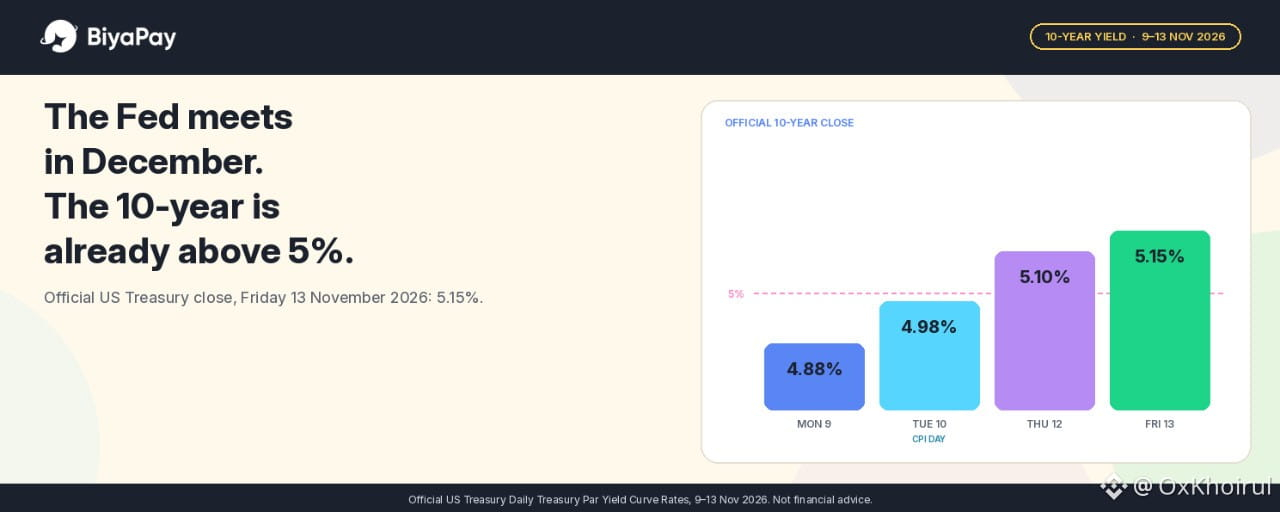
By Friday, 13 November, the official Daily Treasury Par Yield Curve Rate for the 10-year note had closed at 5.15 percent. On Monday, 9 November, that same official series closed at 4.88 percent. That is a rise of 27 basis points in four trading sessions. One basis point is 0.01 percent. From the previous Friday, 6 November, when the 10-year closed at 4.86 percent, the week's move was 29 basis points.
The 10-year crossed 5 percent between the Tuesday close of 4.98 percent, the day of the CPI report, and the Thursday close of 5.10 percent. There is no official daily close on that Treasury series for Wednesday, 11 November. I am using the official daily par yield curve, not an intra-day screen, so these are closing figures.
This piece is a reading of a rate that is already on an official Treasury page, and of what I would put next to a US stock after a week like this.
The policy rate and the 10-year are not the same number
It is easy to treat "the Fed will hike" as the whole story. The policy rate is the overnight federal funds range. A widely discussed 25 basis point increase in December would take that range to 4.00 percent to 4.25 percent, if the Fed chooses that size. That decision has not been made.
The 10-year yield is a longer market rate. It already closed at 5.15 percent on Friday, which is above both the current policy range and the 4.00 to 4.25 percent range that a quarter-point hike would create. The two-year yield, which usually moves more closely with near-term policy expectations, closed at 4.88 percent on Friday, up 32 basis points from Monday's 4.56 percent, on the same official Treasury series.
In my view, that is why the useful number this week is not a December headline that has not arrived yet. The useful number is the 10-year yield that already moved.
Markets can still be surprised. Officials have discussed a larger 50 basis point option, and I would not treat Friday's close as a prediction of where the 10-year will be on 9 December. I would treat 5.15 percent as the market rate that is on the page today.
What 5.15 percent means on a 1,000 dollar example
Take 1,000 dollars as a worked example, not as a suggested order size.
At Friday's official 10-year close of 5.15 percent, 1,000 dollars would correspond to 51.50 dollars over a year if that yield were earned for a full year. At Monday's close of 4.88 percent, the same example would have been 48.80 dollars. The week's 27 basis point rise lifted that annual figure by 2.70 dollars on 1,000 dollars, or by 27 dollars on 10,000 dollars.
That 51.50 dollar figure is a benchmark, not a return I can claim, and it is not a product on BiyaPay. To earn a Treasury yield, an investor would have to buy an actual Treasury security, elsewhere, at the then-prevailing price, and hold it through the relevant period. The 5.15 percent close is the market's own longer-term rate. I would use it as a hurdle: a US stock I am considering would have to offer a combination of dividends and price change that I believe can clear that bar, after costs, and after the risk that comes with equities.
Dividends are part of that comparison only when they are actually paid. US and Hong Kong stocks purchased on BiyaPay may receive dividends. Whether a dividend is paid depends on whether the company pays one and whether you meet that company's conditions. I would not plug in a made-up dividend and call it income.
The cost of placing a US stock order on BiyaPay sits in a different category. US stock trading has 0 commission. The US stock platform fee is 0.005 US dollars per share, with a minimum of 0.99 US dollars per order and a maximum of 1 percent of the transaction value. External institution fees, trading activity fees, and other items can also apply.
On a 1,000 dollar example, that 0.99 dollar minimum is about 0.1 percent of the position, and it is a one-time order cost. Friday's 5.15 percent yield is an annual benchmark. Those two numbers are not the same kind of cost, and I would not pretend they are. The comparison I would still make is one of scale. If I hold for a year, the hurdle I am measuring against is 51.50 dollars on 1,000 dollars, which is many times the minimum platform fee on a single order. This week, the market rate moved by 2.70 dollars on that same 1,000 dollar example, which is already larger than the 0.99 dollar minimum.
When this hurdle matters, and when it does not
This comparison is useful if I am considering a US stock as a longer holding, and I want a clear market rate to put next to whatever return I expect. In a week when the 10-year has just moved through 5 percent, that rate is easier to ignore than it should be, because the conversation is about the December meeting rather than about the yield that already changed.
It is less useful if I am trading around the announcement itself. A short holding is dominated by the next price move, which can be several percent in either direction, not by a 5.15 percent annual benchmark. A 1 percent move on a 1,000 dollar position is 10 dollars, which is already larger than the week's 2.70 dollar change in the annual hurdle.
It also does not apply as a guaranteed alternative. BiyaPay's US stock product is a way to buy actual shares. It is not a Treasury auction, and I would not write as if a 5.15 percent yield is sitting in a wallet and can be clicked. Cash, USDT, and a 10-year Treasury are different assets. This article is about the hurdle, not about a substitute trade.
A December decision that surprises the path already priced into the market could move the 10-year again, up or down. Friday's close is a starting point I would update, not a number I would freeze until December.
What I would actually do
In my view, the question worth asking after this CPI week is not "will the Fed hike in December?" That outcome is widely expected, and the 10-year has already moved. The question I would ask is whether a US stock I am looking at can reasonably be expected to earn more than the 5.15 percent the 10-year already offers, after the costs I would actually pay, and after the risk of holding equities instead of a government note.
I would rather start with that hurdle than start with the commission line. The commission is zero, and the remaining order fees are real, but they are not what changed this week.
A short list I would use:
Read the latest official 10-year close, not only the Fed-meeting headline.Write down what return I actually expect from the stock, including only dividends the company itself has declared or paid, not a round number I assumed.Look at the fee on that ticket in the BiyaPay order preview, including the 0.99 dollar platform-fee minimum where it applies.If I cannot explain why the stock should clear a 5.15 percent hurdle after those costs, I would wait, rather than treat a December headline as a reason to click.
Source: US Bureau of Labor Statistics CPI report for October 2026, as reported by Reuters and CNBC on 10 November 2026; US Treasury Daily Treasury Par Yield Curve Rates for 6 to 13 November 2026, captured on 14 November 2026 at 06:12 Asia/Jakarta (UTC+7); Federal Reserve FOMC calendar, last updated 12 November 2026.
#BiyaPay #TreasuryYield #USStocks
The Fed Meets in December. The 10-Year Yield Is Already Above 5%
Disclosure: It is not financial advice
The next Federal Reserve policy meeting is still weeks away. The 10-year US Treasury yield did not wait.
On Tuesday, 10 November 2026, the US Bureau of Labor Statistics reported that the consumer price index rose a seasonally adjusted 0.4 percent in October, above the 0.3 percent increase economists had expected, according to Reuters and CNBC. Core CPI, which excludes food and energy, rose 0.3 percent, also above the forecast. The BLS did not publish a year-over-year inflation rate, because a government shutdown in 2025 left no October comparison base.
The Federal Reserve's policy rate is still in a 3.75 percent to 4.00 percent range, after officials held that range at the October meeting. The next scheduled Federal Open Market Committee meeting is on 8 and 9 December 2026, according to the Federal Reserve's official calendar, last updated on 12 November 2026. It is a meeting associated with a Summary of Economic Projections.
By Friday, 13 November, the official Daily Treasury Par Yield Curve Rate for the 10-year note had closed at 5.15 percent. On Monday, 9 November, that same official series closed at 4.88 percent. That is a rise of 27 basis points in four trading sessions. One basis point is 0.01 percent. From the previous Friday, 6 November, when the 10-year closed at 4.86 percent, the week's move was 29 basis points.
The 10-year crossed 5 percent between the Tuesday close of 4.98 percent, the day of the CPI report, and the Thursday close of 5.10 percent. There is no official daily close on that Treasury series for Wednesday, 11 November. I am using the official daily par yield curve, not an intra-day screen, so these are closing figures.
This piece is a reading of a rate that is already on an official Treasury page, and of what I would put next to a US stock after a week like this.
The policy rate and the 10-year are not the same number
It is easy to treat "the Fed will hike" as the whole story. The policy rate is the overnight federal funds range. A widely discussed 25 basis point increase in December would take that range to 4.00 percent to 4.25 percent, if the Fed chooses that size. That decision has not been made.
The 10-year yield is a longer market rate. It already closed at 5.15 percent on Friday, which is above both the current policy range and the 4.00 to 4.25 percent range that a quarter-point hike would create. The two-year yield, which usually moves more closely with near-term policy expectations, closed at 4.88 percent on Friday, up 32 basis points from Monday's 4.56 percent, on the same official Treasury series.
In my view, that is why the useful number this week is not a December headline that has not arrived yet. The useful number is the 10-year yield that already moved.
Markets can still be surprised. Officials have discussed a larger 50 basis point option, and I would not treat Friday's close as a prediction of where the 10-year will be on 9 December. I would treat 5.15 percent as the market rate that is on the page today.
What 5.15 percent means on a 1,000 dollar example
Take 1,000 dollars as a worked example, not as a suggested order size.
At Friday's official 10-year close of 5.15 percent, 1,000 dollars would correspond to 51.50 dollars over a year if that yield were earned for a full year. At Monday's close of 4.88 percent, the same example would have been 48.80 dollars. The week's 27 basis point rise lifted that annual figure by 2.70 dollars on 1,000 dollars, or by 27 dollars on 10,000 dollars.
That 51.50 dollar figure is a benchmark, not a return I can claim, and it is not a product on BiyaPay. To earn a Treasury yield, an investor would have to buy an actual Treasury security, elsewhere, at the then-prevailing price, and hold it through the relevant period. The 5.15 percent close is the market's own longer-term rate. I would use it as a hurdle: a US stock I am considering would have to offer a combination of dividends and price change that I believe can clear that bar, after costs, and after the risk that comes with equities.
Dividends are part of that comparison only when they are actually paid. US and Hong Kong stocks purchased on BiyaPay may receive dividends. Whether a dividend is paid depends on whether the company pays one and whether you meet that company's conditions. I would not plug in a made-up dividend and call it income.
The cost of placing a US stock order on BiyaPay sits in a different category. US stock trading has 0 commission. The US stock platform fee is 0.005 US dollars per share, with a minimum of 0.99 US dollars per order and a maximum of 1 percent of the transaction value. External institution fees, trading activity fees, and other items can also apply.
On a 1,000 dollar example, that 0.99 dollar minimum is about 0.1 percent of the position, and it is a one-time order cost. Friday's 5.15 percent yield is an annual benchmark. Those two numbers are not the same kind of cost, and I would not pretend they are. The comparison I would still make is one of scale. If I hold for a year, the hurdle I am measuring against is 51.50 dollars on 1,000 dollars, which is many times the minimum platform fee on a single order. This week, the market rate moved by 2.70 dollars on that same 1,000 dollar example, which is already larger than the 0.99 dollar minimum.
When this hurdle matters, and when it does not
This comparison is useful if I am considering a US stock as a longer holding, and I want a clear market rate to put next to whatever return I expect. In a week when the 10-year has just moved through 5 percent, that rate is easier to ignore than it should be, because the conversation is about the December meeting rather than about the yield that already changed.
It is less useful if I am trading around the announcement itself. A short holding is dominated by the next price move, which can be several percent in either direction, not by a 5.15 percent annual benchmark. A 1 percent move on a 1,000 dollar position is 10 dollars, which is already larger than the week's 2.70 dollar change in the annual hurdle.
It also does not apply as a guaranteed alternative. BiyaPay's US stock product is a way to buy actual shares. It is not a Treasury auction, and I would not write as if a 5.15 percent yield is sitting in a wallet and can be clicked. Cash, USDT, and a 10-year Treasury are different assets. This article is about the hurdle, not about a substitute trade.
A December decision that surprises the path already priced into the market could move the 10-year again, up or down. Friday's close is a starting point I would update, not a number I would freeze until December.
What I would actually do
In my view, the question worth asking after this CPI week is not "will the Fed hike in December?" That outcome is widely expected, and the 10-year has already moved. The question I would ask is whether a US stock I am looking at can reasonably be expected to earn more than the 5.15 percent the 10-year already offers, after the costs I would actually pay, and after the risk of holding equities instead of a government note.
I would rather start with that hurdle than start with the commission line. The commission is zero, and the remaining order fees are real, but they are not what changed this week.
A short list I would use:
Read the latest official 10-year close, not only the Fed-meeting headline.Write down what return I actually expect from the stock, including only dividends the company itself has declared or paid, not a round number I assumed.Look at the fee on that ticket in the BiyaPay order preview, including the 0.99 dollar platform-fee minimum where it applies.If I cannot explain why the stock should clear a 5.15 percent hurdle after those costs, I would wait, rather than treat a December headline as a reason to click.
Source: US Bureau of Labor Statistics CPI report for October 2026, as reported by Reuters and CNBC on 10 November 2026; US Treasury Daily Treasury Par Yield Curve Rates for 6 to 13 November 2026, captured on 14 November 2026 at 06:12 Asia/Jakarta (UTC+7); Federal Reserve FOMC calendar, last updated 12 November 2026.
#BiyaPay #TreasuryYield #USStocks
2
2
1.1k

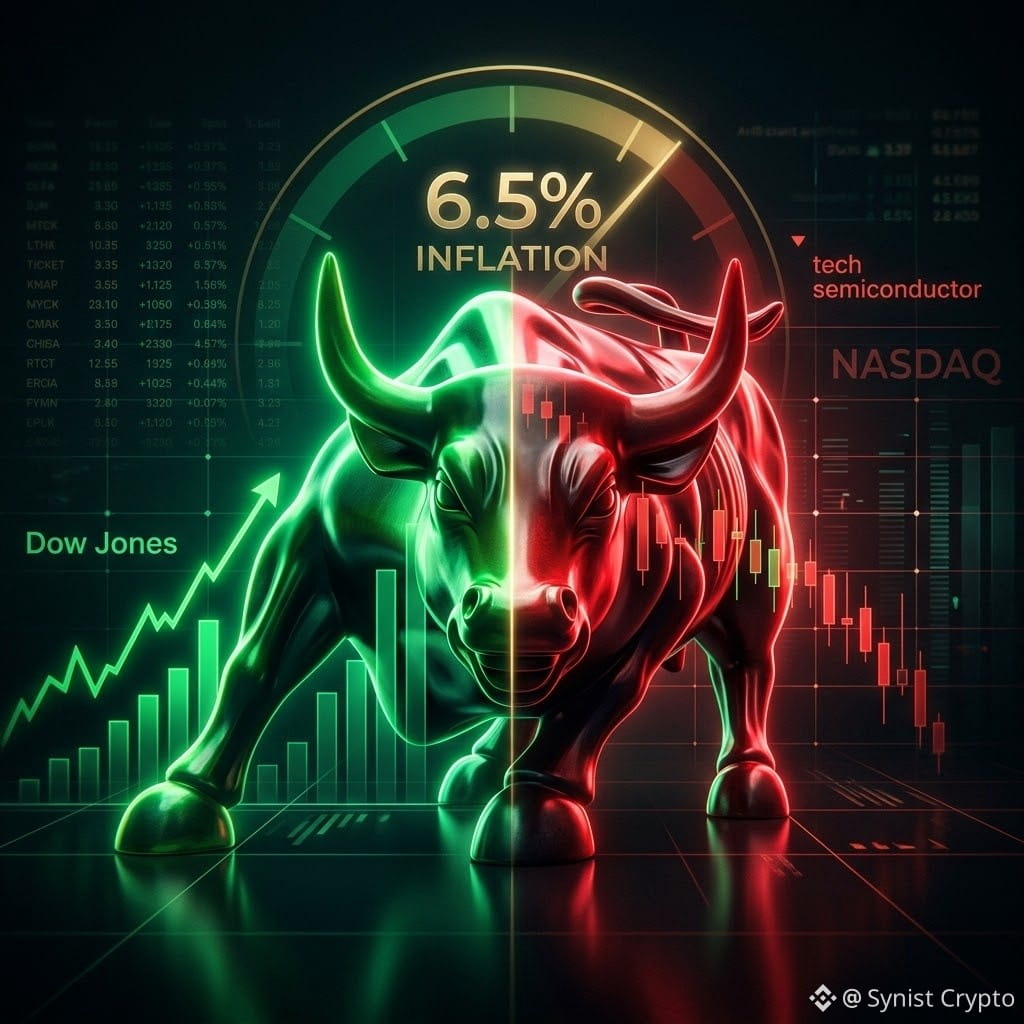
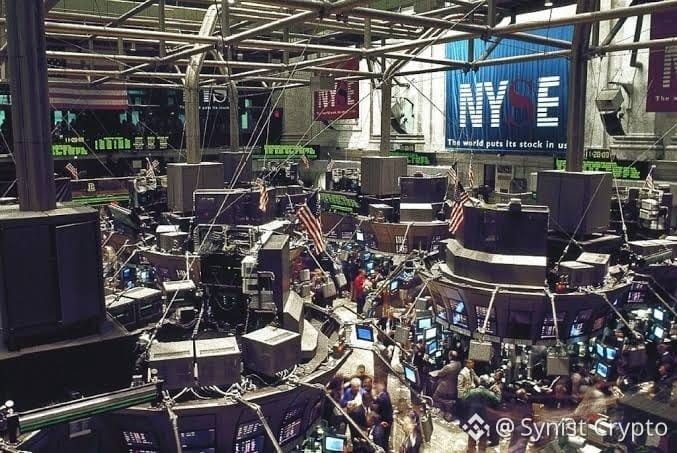
Một ngày thứ Sáu khác thường trên Phố Wall.
Chỉ số Dow gần như không đổi (+0,1%), nhưng Nasdaq và cổ phiếu ngành chip chịu ảnh hưởng nặng nề khi lạm phát giá bán buôn tháng 10 (PPI) tăng lên 6,5% so với cùng kỳ năm trước, mức tăng lớn nhất kể từ năm 2022. Dù vậy, cả ba chỉ số chính đều kết thúc tuần trong sắc xanh, cho thấy lĩnh vực công nghệ đang chịu tác động nặng nề nhất.
Mỗi khi Nasdaq hắt hơi, $BTC thường bị cảm lạnh. Bạn có dùng cổ phiếu để xác định xu hướng của tiền mã hóa không, hay sẽ tạm ngừng theo dõi Phố Wall cho đến tháng 12? 👇
$BTC #USStocks #Nasdaq #Inflation #Macro
58
Đăng nhập để khám phá thêm nội dung
Tham gia cùng người dùng tiền mã hóa toàn cầu trên Binance Square
⚡️ Nhận thông tin mới nhất và hữu ích về tiền mã hóa.
💬 Được tin cậy bởi sàn giao dịch tiền mã hóa lớn nhất thế giới.
👍 Khám phá những thông tin chuyên sâu thực tế từ những nhà sáng tạo đã xác minh.
Email / Số điện thoại
Chủ đề thịnh hành
1
#TheoDõiFOMC
371,480 lượt xem
1,601 đang thảo luận
2
#TinFed
439,729 lượt xem
1,398 đang thảo luận
3
#NVIDIAReinstatesJensenHuangasCEO
3,277 lượt xem
264 đang thảo luận
4
#WillMarketsStageAThanksgivingReliefRally?
101,051 lượt xem
1,477 đang thảo luận
5
#WillOctCorePCEShiftFedHikeExpectations?
36,212 lượt xem
576 đang thảo luận
6
#BitcoinEndsRecord17DayStreakOfLowerHighs
185 lượt xem
74 đang thảo luận
7
#TradersPriceOut50bpDecemberFedHike
837 lượt xem
68 đang thảo luận
8
#EvolveAtBinanceBlockchainWeek
87,572 lượt xem
857 đang thảo luận
9
#BlackRockETHNetOutflowsReach$1.75BSinceOct1
311 lượt xem
10 đang thảo luận
10
#TrumpBackedAmericanBitcoinRaisesHoldingsToOver8500BTC
567 lượt xem
25 đang thảo luận