
#us10yearyieldnears5.3%
us10yearyieldnears5.3%
Hot
Latest
·
--
#US10YearYieldNears5.3%
The US 10-Year Treasury Yield has broken past the 5.3% threshold, surging to a 24-year high of 5.342% on October 1, 2026. This milestone marks the highest level the global benchmark note has reached since early 2002, surpassing its 2007 pre-financial crisis peak as a brutal global bond sell-off accelerates. [1]
What Is Driving the Spike?
Resilient Economic Growth: Upgraded U.S. GDP estimates (revised up to 2.2% for Q2) indicate the economy is expanding faster than initially anticipated. [1]
Energy-Driven Inflation Concerns: Elevated oil prices and persistent, sticky inflation are continuing to exert upward pressure on long-term rates. [1, 2]
$NEAR , $AAPLB ,$SOL
#US10YearYieldNears5.3%
The US 10-Year Treasury Yield has broken past the 5.3% threshold, surging to a 24-year high of 5.342% on October 1, 2026. This milestone marks the highest level the global benchmark note has reached since early 2002, surpassing its 2007 pre-financial crisis peak as a brutal global bond sell-off accelerates. [1]
What Is Driving the Spike?
Resilient Economic Growth: Upgraded U.S. GDP estimates (revised up to 2.2% for Q2) indicate the economy is expanding faster than initially anticipated. [1]
Energy-Driven Inflation Concerns: Elevated oil prices and persistent, sticky inflation are continuing to exert upward pressure on long-term rates. [1, 2]
$NEAR , $AAPLB ,$SOL
The US 10-Year Treasury Yield has broken past the 5.3% threshold, surging to a 24-year high of 5.342% on October 1, 2026. This milestone marks the highest level the global benchmark note has reached since early 2002, surpassing its 2007 pre-financial crisis peak as a brutal global bond sell-off accelerates. [1]
What Is Driving the Spike?
Resilient Economic Growth: Upgraded U.S. GDP estimates (revised up to 2.2% for Q2) indicate the economy is expanding faster than initially anticipated. [1]
Energy-Driven Inflation Concerns: Elevated oil prices and persistent, sticky inflation are continuing to exert upward pressure on long-term rates. [1, 2]
$NEAR , $AAPLB ,$SOL
178

·
--
Bullish
🚨 THE U.S. 10-YEAR JUST PUNCHED ABOVE 5.3% — THE BOND MARKET IS THE REAL PROBLEM NOW.
The 10-year Treasury yield briefly hit 5.34%, its highest level since 2002, before easing back near 5.27%.
And here’s the weird part:
PCE inflation came in softer than expected… but yields still exploded higher.
Why?
Because markets are still fighting:
Heavy government borrowing.
Sticky inflation risks.
Huge AI/data-center capital demand.
Weak appetite for long-duration bonds.
That creates a brutal setup:
10Y yield ↑ → mortgage rates ↑ → valuations compress → financing gets more expensive → risk assets feel the squeeze.
This is why everyone watching $BTC, $QQQ, $SPX and even $XAU should care.
The Fed can pause.
Inflation can cool.
But if the bond market keeps demanding 5%+ yields, financial conditions stay tight anyway.
The biggest macro risk may no longer be the next Fed hike.
It may be the bond market refusing to calm down. 👀
$BTC $QQQ $SPX $XAU
{future}(BTCUSDT)
{future}(QQQUSDT)
{future}(XAUUSDT)
#us10yearyieldnears5.3% #USWeeklyJoblessClaimsFallTo197000 #BitcoinETFsTake$6.34BillionInQ3 #MicronBeatsEarningsLiftsGuidance #MetaMaskExitsLidoValidatorsAfterSecurityIncident
🚨 THE U.S. 10-YEAR JUST PUNCHED ABOVE 5.3% — THE BOND MARKET IS THE REAL PROBLEM NOW.
The 10-year Treasury yield briefly hit 5.34%, its highest level since 2002, before easing back near 5.27%.
And here’s the weird part:
PCE inflation came in softer than expected… but yields still exploded higher.
Why?
Because markets are still fighting:
Heavy government borrowing.
Sticky inflation risks.
Huge AI/data-center capital demand.
Weak appetite for long-duration bonds.
That creates a brutal setup:
10Y yield ↑ → mortgage rates ↑ → valuations compress → financing gets more expensive → risk assets feel the squeeze.
This is why everyone watching $BTC, $QQQ, $SPX and even $XAU should care.
The Fed can pause.
Inflation can cool.
But if the bond market keeps demanding 5%+ yields, financial conditions stay tight anyway.
The biggest macro risk may no longer be the next Fed hike.
It may be the bond market refusing to calm down. 👀
$BTC $QQQ $SPX $XAU
#us10yearyieldnears5.3% #USWeeklyJoblessClaimsFallTo197000 #BitcoinETFsTake$6.34BillionInQ3 #MicronBeatsEarningsLiftsGuidance #MetaMaskExitsLidoValidatorsAfterSecurityIncident
The 10-year Treasury yield briefly hit 5.34%, its highest level since 2002, before easing back near 5.27%.
And here’s the weird part:
PCE inflation came in softer than expected… but yields still exploded higher.
Why?
Because markets are still fighting:
Heavy government borrowing.
Sticky inflation risks.
Huge AI/data-center capital demand.
Weak appetite for long-duration bonds.
That creates a brutal setup:
10Y yield ↑ → mortgage rates ↑ → valuations compress → financing gets more expensive → risk assets feel the squeeze.
This is why everyone watching $BTC, $QQQ, $SPX and even $XAU should care.
The Fed can pause.
Inflation can cool.
But if the bond market keeps demanding 5%+ yields, financial conditions stay tight anyway.
The biggest macro risk may no longer be the next Fed hike.
It may be the bond market refusing to calm down. 👀
$BTC $QQQ $SPX $XAU
#us10yearyieldnears5.3% #USWeeklyJoblessClaimsFallTo197000 #BitcoinETFsTake$6.34BillionInQ3 #MicronBeatsEarningsLiftsGuidance #MetaMaskExitsLidoValidatorsAfterSecurityIncident

455

·
--
Bearish
🚨 #US10YearYieldNears5.3% — RISK ASSETS ON ALERT!
The U.S. 10-Year Treasury yield is hovering near 5.3%, around its highest level since 2002.
🔥 Higher yields can mean: • Stronger pressure on stocks & crypto
• Higher borrowing costs
• Stronger demand for yield-bearing assets
• More volatility across global markets
$BTC has already struggled to hold its post-PCE rally while Treasury yields remain elevated.
📉 Trader question:
Can Bitcoin stay bullish if US10Y keeps climbing?
#BTC #Crypto #Bitcoin #US10YTreasuryYieldHits19YearHigh推上热榜 #TreasuryYields #MarketUpdate #
Add a sharper trader setup
{spot}(BTCUSDT)
🚨 #US10YearYieldNears5.3% — RISK ASSETS ON ALERT!
The U.S. 10-Year Treasury yield is hovering near 5.3%, around its highest level since 2002.
🔥 Higher yields can mean: • Stronger pressure on stocks & crypto
• Higher borrowing costs
• Stronger demand for yield-bearing assets
• More volatility across global markets
$BTC has already struggled to hold its post-PCE rally while Treasury yields remain elevated.
📉 Trader question:
Can Bitcoin stay bullish if US10Y keeps climbing?
#BTC #Crypto #Bitcoin #US10YTreasuryYieldHits19YearHigh推上热榜 #TreasuryYields #MarketUpdate #
Add a sharper trader setup
The U.S. 10-Year Treasury yield is hovering near 5.3%, around its highest level since 2002.
🔥 Higher yields can mean: • Stronger pressure on stocks & crypto
• Higher borrowing costs
• Stronger demand for yield-bearing assets
• More volatility across global markets
$BTC has already struggled to hold its post-PCE rally while Treasury yields remain elevated.
📉 Trader question:
Can Bitcoin stay bullish if US10Y keeps climbing?
#BTC #Crypto #Bitcoin #US10YTreasuryYieldHits19YearHigh推上热榜 #TreasuryYields #MarketUpdate #
Add a sharper trader setup
5

·
--
#US10YearYieldNears5.3%
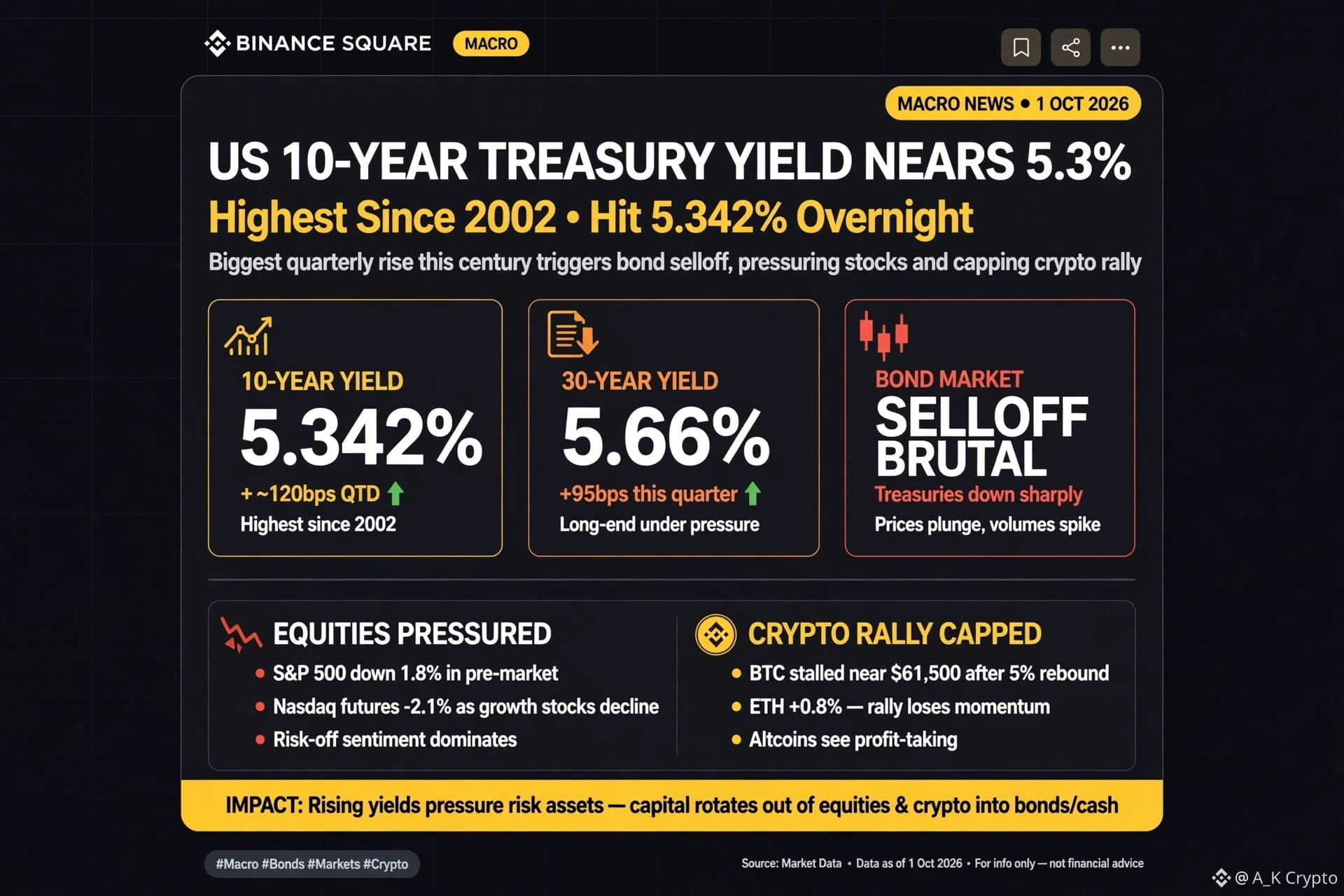
🚨 US 10-YEAR YIELD NEARS 5.3% — HIGHEST SINCE 2002!
The 10Y Treasury hit 5.342% overnight, 30Y tapped 5.66%. Biggest quarterly surge this century.
Why it matters:
S&P futures -1.8%, Nasdaq -2.1%
$BTC popped to $85.5K on soft PCE (3.4% vs 3.7% exp) then faded to $83.7K
10Y yield up ∼120bps QTD, biggest jump since 2009
Bonds brutal, risk pressured.
Yields at 24-year highs change the game. Soft inflation wasn’t enough — deficits, Treasury supply and AI capex demand are driving term premium higher. This is why stocks and crypto stalled. Until 10Y breaks back below 5%, rallies will be sold. I’m watching 5.3% as the line for risk rotation.
#US10YearYieldNears5.3% #crypto #Binanace
#KoreaProposesTokenizingStocksAndBonds
#US10YearYieldNears5.3%
🚨 US 10-YEAR YIELD NEARS 5.3% — HIGHEST SINCE 2002!
The 10Y Treasury hit 5.342% overnight, 30Y tapped 5.66%. Biggest quarterly surge this century.
Why it matters:
S&P futures -1.8%, Nasdaq -2.1%
$BTC popped to $85.5K on soft PCE (3.4% vs 3.7% exp) then faded to $83.7K
10Y yield up ∼120bps QTD, biggest jump since 2009
Bonds brutal, risk pressured.
Yields at 24-year highs change the game. Soft inflation wasn’t enough — deficits, Treasury supply and AI capex demand are driving term premium higher. This is why stocks and crypto stalled. Until 10Y breaks back below 5%, rallies will be sold. I’m watching 5.3% as the line for risk rotation.
#US10YearYieldNears5.3% #crypto #Binanace
#KoreaProposesTokenizingStocksAndBonds
🚨 US 10-YEAR YIELD NEARS 5.3% — HIGHEST SINCE 2002!
The 10Y Treasury hit 5.342% overnight, 30Y tapped 5.66%. Biggest quarterly surge this century.
Why it matters:
S&P futures -1.8%, Nasdaq -2.1%
$BTC popped to $85.5K on soft PCE (3.4% vs 3.7% exp) then faded to $83.7K
10Y yield up ∼120bps QTD, biggest jump since 2009
Bonds brutal, risk pressured.
Yields at 24-year highs change the game. Soft inflation wasn’t enough — deficits, Treasury supply and AI capex demand are driving term premium higher. This is why stocks and crypto stalled. Until 10Y breaks back below 5%, rallies will be sold. I’m watching 5.3% as the line for risk rotation.
#US10YearYieldNears5.3% #crypto #Binanace
#KoreaProposesTokenizingStocksAndBonds
8

#US10YearYieldNears5.3%
10-Year Treasury Yield Hits 5.34% — Highest Since 2002. Rising yields are increasing borrowing costs and putting pressure on stocks and other risk assets.
#US10YearYieldNears5.3%
10-Year Treasury Yield Hits 5.34% — Highest Since 2002. Rising yields are increasing borrowing costs and putting pressure on stocks and other risk assets.
10-Year Treasury Yield Hits 5.34% — Highest Since 2002. Rising yields are increasing borrowing costs and putting pressure on stocks and other risk assets.


TLTETF-0.83%
IEFETF-0.55%
1
1

·
--
Article
🚨 The U.S. 10-Year Yield Just Broke 5.3% — And This Could Reshape the Next Move inThe global macro market just delivered another major warning signal.
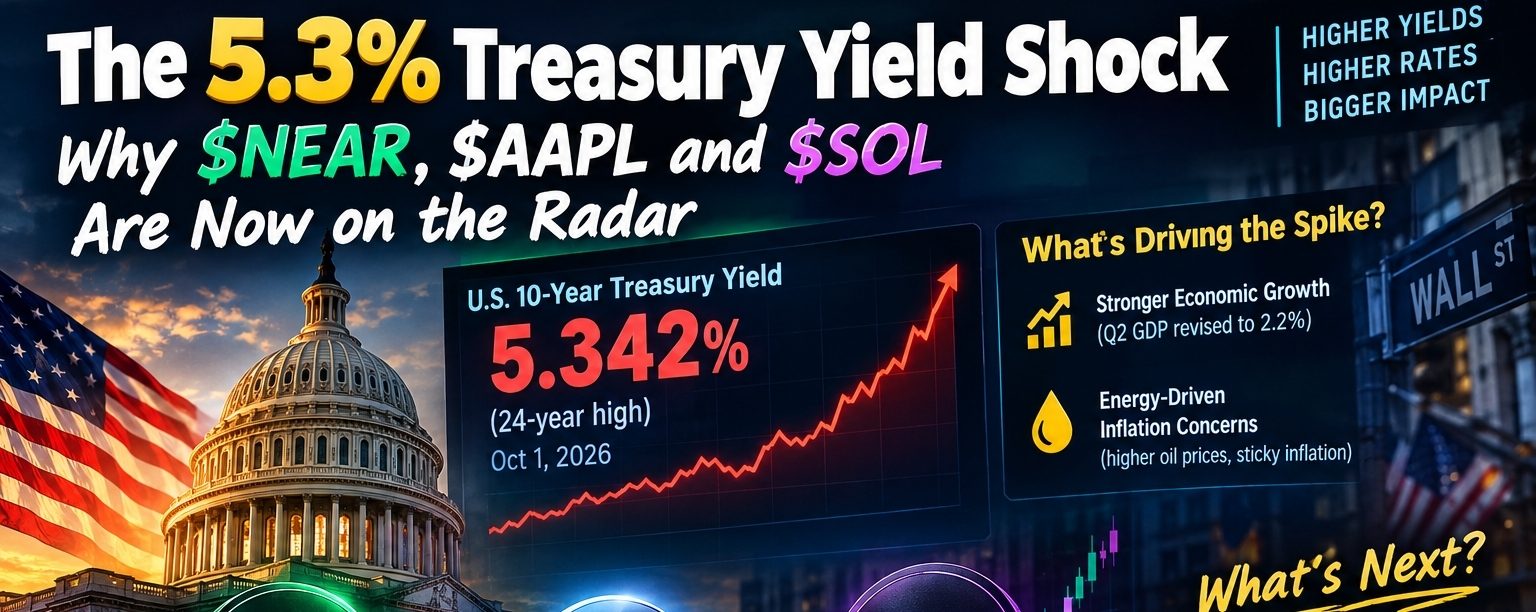
On October 1, 2026, the U.S. 10-Year Treasury yield surged to 5.342%, breaking above the 5.3% threshold and reaching its highest level since early 2002. The move also pushed the benchmark yield above its previous 2007 peak, as the global bond sell-off accelerated.
This is not simply another Treasury-market headline.
The 10-Year yield is one of the most important reference rates in global finance. When it rises aggressively, the impact can travel from government bonds into equities, corporate borrowing, mortgages, technology valuations, crypto liquidity and ultimately investor risk appetite.
And that is why I’m watching this move closely.
NEAR, AAPL and SOL are three very different assets, but all can be affected by the same macro force:
The price of money.
When the risk-free yield rises sharply, investors have to rethink how much risk they are willing to take for potential returns.
🔥 Why Is the 10-Year Yield Exploding Higher?
There isn't one single reason behind the move.
The current bond sell-off reflects a combination of stronger economic growth, inflation concerns, energy prices, fiscal pressures and a higher term premium.
1️⃣ The U.S. Economy Is Stronger Than Expected
The latest Q2 GDP revision showed that the U.S. economy expanded at a 2.2% annualized rate, significantly above the previous 1.5% estimate. The revision reflected stronger investment, consumer spending and government spending.
That matters for the bond market.
A stronger economy can mean that investors don't need to expect aggressive monetary easing. If growth remains resilient, long-term Treasury yields can remain elevated even when expectations for an immediate Fed rate hike decline.
In other words:
Strong growth → less urgency for monetary easing → higher long-term yields.
That is one of the biggest macro forces currently pressuring duration-sensitive assets.
🛢️ 2️⃣ Energy Prices Are Reintroducing Inflation Risk
Another important factor is energy.
Higher oil prices can increase transportation, production and operating costs throughout the economy. That creates concern that inflation could remain sticky even if some underlying price pressures are cooling.
Recent market commentary has highlighted the combination of elevated energy prices and Treasury yields as a major factor affecting risk assets.
This creates an uncomfortable environment for policymakers:
Growth is still solid.
Inflation isn't completely defeated.
Energy prices remain a risk.
Long-term yields keep rising.
That combination can make the market much more sensitive to incoming economic data.
📉 Why Does 5.3% Matter for Stocks?
The 10-Year Treasury yield represents more than a bond-market statistic.
It becomes a benchmark against which investors compare other assets.
Imagine an investor can obtain a substantially higher yield from a relatively low-risk Treasury.
That can change the calculation behind owning a high-growth stock.
Growth companies are particularly sensitive because much of their valuation depends on profits and cash flows expected years into the future.
Higher discount rates generally make those future cash flows worth less today.
That means:
Higher yields → higher discount rates → greater valuation pressure on long-duration assets.
But this doesn't mean every technology stock must fall.
The market can continue rewarding companies with strong earnings, cash flow and structural growth.
That distinction is extremely important.
🍎 AAPL — Quality Meets a Higher-Rate Environment
AAPL sits in a very different position from speculative growth assets.
Apple has a massive global ecosystem, recurring services revenue, strong brand positioning and a large installed device base.
That gives the stock a fundamentally different profile from an early-stage technology company.
However, a 5%+ 10-Year yield can still matter.
Why?
Because investors compare the expected return from owning equities with the return available from Treasury securities.
If Treasury yields continue climbing, the equity risk premium can become less attractive unless earnings expectations rise alongside valuations.
Apple therefore becomes an interesting macro watch:
Strong business fundamentals vs. higher discount rates.
If earnings and cash generation continue supporting the valuation, the stock can potentially absorb higher yields better than many speculative growth names.
But if yields continue climbing without a corresponding improvement in earnings expectations, valuation multiples could become more difficult to sustain.
That is the key equation I would watch.
⚡ NEAR — Higher Yields Mean Liquidity Matters More
The situation becomes very different for NEAR.
Crypto assets generally have greater sensitivity to global liquidity and investor risk appetite than established mega-cap equities.
When financial conditions tighten, speculative capital can become more selective.
That doesn't automatically mean NEAR has to decline.
Instead, the market starts asking a different question:
Is the project attracting enough capital, users and activity to justify taking risk while the macro environment becomes tougher?
That is where structure becomes important.
If NEAR maintains strong market structure while Bitcoin and broader crypto liquidity remain stable, a high-yield environment does not necessarily destroy the bullish thesis.
But if Treasury yields continue pushing higher while crypto liquidity deteriorates, altcoins can experience significantly greater volatility.
For me, that makes volume, support structure, BTC trend and liquidity more important than simply chasing a green candle.
☀️ $SOL — The Liquidity Test Gets More Interesting
SOL is another asset worth watching closely.
Solana has developed into one of the most actively traded large-cap crypto ecosystems, meaning its price can respond strongly when liquidity rotates into or out of higher-beta crypto assets.
That creates both opportunity and risk.
When liquidity expands:
BTC → ETH → large-cap altcoins → higher-beta assets
can become a familiar rotation pattern.
But when financial conditions tighten, that flow can reverse.
And a 5.3%+ 10-Year yield is exactly the type of macro signal that can make traders more cautious about aggressive risk exposure.
Therefore, I would not look at SOL in isolation.
Instead, watch the combination:
10Y Yield + DXY + BTC structure + stablecoin liquidity + SOL volume.
If Treasury yields stabilize while crypto liquidity remains strong, the pressure from rates could become less important.
If yields continue accelerating higher at the same time BTC loses important support, the risk to high-beta assets becomes considerably more significant.
🧠 The Bigger Picture: This Is a Liquidity Story
The most important takeaway isn't simply:
“Treasury yields are high.”
The bigger story is:
The cost of capital is changing.
For years, investors became comfortable paying high valuations for future growth.
But when the risk-free rate rises substantially, the opportunity cost of holding speculative assets increases.
That affects:
Growth stocks
Technology companies
Crypto
Venture investments
Real estate
High-duration assets
And that's why this Treasury move deserves attention far beyond the bond market.
📊 What I Would Watch Next
Rather than predicting the next move blindly, I would track five indicators.
1. U.S. 10-Year Yield
A sustained move above 5.3% would indicate that the pressure from long-term rates is not disappearing quickly.
2. Inflation
If inflation continues cooling, the market may eventually become more comfortable with lower future policy rates.
But if energy prices reignite inflation expectations, long-term yields could remain elevated.
3. U.S. Growth
The latest Q2 GDP revision to 2.2% demonstrates that the economy is still showing resilience.
The next question is whether that strength continues into Q3.
4. Bitcoin
For crypto investors, BTC remains the liquidity barometer.
If Bitcoin holds its structure despite higher yields, that would tell us that crypto demand remains relatively resilient.
If BTC starts breaking major support while yields accelerate, altcoin risk could increase.
5. Dollar Liquidity
Crypto ultimately needs liquidity.
Stablecoin supply, exchange flows, ETF flows and broader financial conditions can help determine whether capital is actually moving toward risk assets.
🚨 The Bullish Scenario
There is another side to this story.
A high 10-Year yield doesn't automatically mean a market crash.
If the U.S. economy remains strong, corporate earnings continue growing and inflation gradually moves lower, markets could eventually absorb higher yields.
In that environment, investors may continue allocating capital toward companies and protocols with genuine growth.
That would create a very different market from a liquidity-driven speculative rally.
Instead of:
“Everything is pumping.”
the market becomes:
“Show me the fundamentals.”
That environment could favor assets with real adoption, strong revenue, growing ecosystems and sustainable demand.
⚠️ The Risk Scenario
The bigger danger would be a combination of:
Higher yields + persistent inflation + weaker economic growth + falling liquidity.
That would create a much more difficult backdrop.
In that scenario, investors could reduce exposure to higher-risk assets while demanding greater compensation for holding speculative positions.
Crypto would likely remain especially sensitive to this environment.
And this is exactly why I wouldn't chase breakouts blindly.
A strong narrative can attract buyers.
But macro liquidity determines how much capital is available to sustain that narrative.
🎯 My Market Watchlist
For the current environment, I'm keeping three names on the radar for three different reasons:
🍎 $AAPL
A mega-cap quality asset where earnings, cash flow and valuation must be weighed against rising discount rates.
⚡ NEAR
A higher-beta crypto asset where liquidity, adoption, volume and market structure become increasingly important.
☀️ SOL
A major crypto ecosystem that can provide a useful read on whether investors are still willing to allocate capital toward higher-beta digital assets.
These aren't identical trades.
And that's precisely why they are interesting.
💡 Final Thought
The 5.342% 10-Year Treasury yield is more than a new number on a chart.
It is a reminder that the global market is repricing the cost of capital.
The U.S. economy is still showing resilience, with Q2 growth revised to 2.2%, while inflation and energy-price risks remain part of the market equation.
Now the real question is not:
“Will markets go up or down?”
The better question is:
Which assets can continue attracting capital when the risk-free return becomes increasingly competitive?
That is the environment I want to trade.
Watch the 10Y yield. Watch liquidity. Watch BTC. Watch volume.
And for $NEAR , AAPL and SOL — don't just watch the price.
Watch the money behind the price.
This is market analysis, not financial advice. Crypto and equities carry significant risk. Always do your own research, manage position size carefully, and never risk capital you cannot afford to lose.
{spot}(SOLUSDT)
{spot}(NEARUSDT)
{spot}(AAPLBUSDT)
#US10YearYieldNears5.3% #Near #AAPL #solana #Binance
🚨 The U.S. 10-Year Yield Just Broke 5.3% — And This Could Reshape the Next Move in
The global macro market just delivered another major warning signal.
On October 1, 2026, the U.S. 10-Year Treasury yield surged to 5.342%, breaking above the 5.3% threshold and reaching its highest level since early 2002. The move also pushed the benchmark yield above its previous 2007 peak, as the global bond sell-off accelerated.
This is not simply another Treasury-market headline.
The 10-Year yield is one of the most important reference rates in global finance. When it rises aggressively, the impact can travel from government bonds into equities, corporate borrowing, mortgages, technology valuations, crypto liquidity and ultimately investor risk appetite.
And that is why I’m watching this move closely.
NEAR, AAPL and SOL are three very different assets, but all can be affected by the same macro force:
The price of money.
When the risk-free yield rises sharply, investors have to rethink how much risk they are willing to take for potential returns.
🔥 Why Is the 10-Year Yield Exploding Higher?
There isn't one single reason behind the move.
The current bond sell-off reflects a combination of stronger economic growth, inflation concerns, energy prices, fiscal pressures and a higher term premium.
1️⃣ The U.S. Economy Is Stronger Than Expected
The latest Q2 GDP revision showed that the U.S. economy expanded at a 2.2% annualized rate, significantly above the previous 1.5% estimate. The revision reflected stronger investment, consumer spending and government spending.
That matters for the bond market.
A stronger economy can mean that investors don't need to expect aggressive monetary easing. If growth remains resilient, long-term Treasury yields can remain elevated even when expectations for an immediate Fed rate hike decline.
In other words:
Strong growth → less urgency for monetary easing → higher long-term yields.
That is one of the biggest macro forces currently pressuring duration-sensitive assets.
🛢️ 2️⃣ Energy Prices Are Reintroducing Inflation Risk
Another important factor is energy.
Higher oil prices can increase transportation, production and operating costs throughout the economy. That creates concern that inflation could remain sticky even if some underlying price pressures are cooling.
Recent market commentary has highlighted the combination of elevated energy prices and Treasury yields as a major factor affecting risk assets.
This creates an uncomfortable environment for policymakers:
Growth is still solid.
Inflation isn't completely defeated.
Energy prices remain a risk.
Long-term yields keep rising.
That combination can make the market much more sensitive to incoming economic data.
📉 Why Does 5.3% Matter for Stocks?
The 10-Year Treasury yield represents more than a bond-market statistic.
It becomes a benchmark against which investors compare other assets.
Imagine an investor can obtain a substantially higher yield from a relatively low-risk Treasury.
That can change the calculation behind owning a high-growth stock.
Growth companies are particularly sensitive because much of their valuation depends on profits and cash flows expected years into the future.
Higher discount rates generally make those future cash flows worth less today.
That means:
Higher yields → higher discount rates → greater valuation pressure on long-duration assets.
But this doesn't mean every technology stock must fall.
The market can continue rewarding companies with strong earnings, cash flow and structural growth.
That distinction is extremely important.
🍎 AAPL — Quality Meets a Higher-Rate Environment
AAPL sits in a very different position from speculative growth assets.
Apple has a massive global ecosystem, recurring services revenue, strong brand positioning and a large installed device base.
That gives the stock a fundamentally different profile from an early-stage technology company.
However, a 5%+ 10-Year yield can still matter.
Why?
Because investors compare the expected return from owning equities with the return available from Treasury securities.
If Treasury yields continue climbing, the equity risk premium can become less attractive unless earnings expectations rise alongside valuations.
Apple therefore becomes an interesting macro watch:
Strong business fundamentals vs. higher discount rates.
If earnings and cash generation continue supporting the valuation, the stock can potentially absorb higher yields better than many speculative growth names.
But if yields continue climbing without a corresponding improvement in earnings expectations, valuation multiples could become more difficult to sustain.
That is the key equation I would watch.
⚡ NEAR — Higher Yields Mean Liquidity Matters More
The situation becomes very different for NEAR.
Crypto assets generally have greater sensitivity to global liquidity and investor risk appetite than established mega-cap equities.
When financial conditions tighten, speculative capital can become more selective.
That doesn't automatically mean NEAR has to decline.
Instead, the market starts asking a different question:
Is the project attracting enough capital, users and activity to justify taking risk while the macro environment becomes tougher?
That is where structure becomes important.
If NEAR maintains strong market structure while Bitcoin and broader crypto liquidity remain stable, a high-yield environment does not necessarily destroy the bullish thesis.
But if Treasury yields continue pushing higher while crypto liquidity deteriorates, altcoins can experience significantly greater volatility.
For me, that makes volume, support structure, BTC trend and liquidity more important than simply chasing a green candle.
☀️ $SOL — The Liquidity Test Gets More Interesting
SOL is another asset worth watching closely.
Solana has developed into one of the most actively traded large-cap crypto ecosystems, meaning its price can respond strongly when liquidity rotates into or out of higher-beta crypto assets.
That creates both opportunity and risk.
When liquidity expands:
BTC → ETH → large-cap altcoins → higher-beta assets
can become a familiar rotation pattern.
But when financial conditions tighten, that flow can reverse.
And a 5.3%+ 10-Year yield is exactly the type of macro signal that can make traders more cautious about aggressive risk exposure.
Therefore, I would not look at SOL in isolation.
Instead, watch the combination:
10Y Yield + DXY + BTC structure + stablecoin liquidity + SOL volume.
If Treasury yields stabilize while crypto liquidity remains strong, the pressure from rates could become less important.
If yields continue accelerating higher at the same time BTC loses important support, the risk to high-beta assets becomes considerably more significant.
🧠 The Bigger Picture: This Is a Liquidity Story
The most important takeaway isn't simply:
“Treasury yields are high.”
The bigger story is:
The cost of capital is changing.
For years, investors became comfortable paying high valuations for future growth.
But when the risk-free rate rises substantially, the opportunity cost of holding speculative assets increases.
That affects:
Growth stocks
Technology companies
Crypto
Venture investments
Real estate
High-duration assets
And that's why this Treasury move deserves attention far beyond the bond market.
📊 What I Would Watch Next
Rather than predicting the next move blindly, I would track five indicators.
1. U.S. 10-Year Yield
A sustained move above 5.3% would indicate that the pressure from long-term rates is not disappearing quickly.
2. Inflation
If inflation continues cooling, the market may eventually become more comfortable with lower future policy rates.
But if energy prices reignite inflation expectations, long-term yields could remain elevated.
3. U.S. Growth
The latest Q2 GDP revision to 2.2% demonstrates that the economy is still showing resilience.
The next question is whether that strength continues into Q3.
4. Bitcoin
For crypto investors, BTC remains the liquidity barometer.
If Bitcoin holds its structure despite higher yields, that would tell us that crypto demand remains relatively resilient.
If BTC starts breaking major support while yields accelerate, altcoin risk could increase.
5. Dollar Liquidity
Crypto ultimately needs liquidity.
Stablecoin supply, exchange flows, ETF flows and broader financial conditions can help determine whether capital is actually moving toward risk assets.
🚨 The Bullish Scenario
There is another side to this story.
A high 10-Year yield doesn't automatically mean a market crash.
If the U.S. economy remains strong, corporate earnings continue growing and inflation gradually moves lower, markets could eventually absorb higher yields.
In that environment, investors may continue allocating capital toward companies and protocols with genuine growth.
That would create a very different market from a liquidity-driven speculative rally.
Instead of:
“Everything is pumping.”
the market becomes:
“Show me the fundamentals.”
That environment could favor assets with real adoption, strong revenue, growing ecosystems and sustainable demand.
⚠️ The Risk Scenario
The bigger danger would be a combination of:
Higher yields + persistent inflation + weaker economic growth + falling liquidity.
That would create a much more difficult backdrop.
In that scenario, investors could reduce exposure to higher-risk assets while demanding greater compensation for holding speculative positions.
Crypto would likely remain especially sensitive to this environment.
And this is exactly why I wouldn't chase breakouts blindly.
A strong narrative can attract buyers.
But macro liquidity determines how much capital is available to sustain that narrative.
🎯 My Market Watchlist
For the current environment, I'm keeping three names on the radar for three different reasons:
🍎 $AAPL
A mega-cap quality asset where earnings, cash flow and valuation must be weighed against rising discount rates.
⚡ NEAR
A higher-beta crypto asset where liquidity, adoption, volume and market structure become increasingly important.
☀️ SOL
A major crypto ecosystem that can provide a useful read on whether investors are still willing to allocate capital toward higher-beta digital assets.
These aren't identical trades.
And that's precisely why they are interesting.
💡 Final Thought
The 5.342% 10-Year Treasury yield is more than a new number on a chart.
It is a reminder that the global market is repricing the cost of capital.
The U.S. economy is still showing resilience, with Q2 growth revised to 2.2%, while inflation and energy-price risks remain part of the market equation.
Now the real question is not:
“Will markets go up or down?”
The better question is:
Which assets can continue attracting capital when the risk-free return becomes increasingly competitive?
That is the environment I want to trade.
Watch the 10Y yield. Watch liquidity. Watch BTC. Watch volume.
And for $NEAR , AAPL and SOL — don't just watch the price.
Watch the money behind the price.
This is market analysis, not financial advice. Crypto and equities carry significant risk. Always do your own research, manage position size carefully, and never risk capital you cannot afford to lose.
#US10YearYieldNears5.3% #Near #AAPL #solana #Binance
On October 1, 2026, the U.S. 10-Year Treasury yield surged to 5.342%, breaking above the 5.3% threshold and reaching its highest level since early 2002. The move also pushed the benchmark yield above its previous 2007 peak, as the global bond sell-off accelerated.
This is not simply another Treasury-market headline.
The 10-Year yield is one of the most important reference rates in global finance. When it rises aggressively, the impact can travel from government bonds into equities, corporate borrowing, mortgages, technology valuations, crypto liquidity and ultimately investor risk appetite.
And that is why I’m watching this move closely.
NEAR, AAPL and SOL are three very different assets, but all can be affected by the same macro force:
The price of money.
When the risk-free yield rises sharply, investors have to rethink how much risk they are willing to take for potential returns.
🔥 Why Is the 10-Year Yield Exploding Higher?
There isn't one single reason behind the move.
The current bond sell-off reflects a combination of stronger economic growth, inflation concerns, energy prices, fiscal pressures and a higher term premium.
1️⃣ The U.S. Economy Is Stronger Than Expected
The latest Q2 GDP revision showed that the U.S. economy expanded at a 2.2% annualized rate, significantly above the previous 1.5% estimate. The revision reflected stronger investment, consumer spending and government spending.
That matters for the bond market.
A stronger economy can mean that investors don't need to expect aggressive monetary easing. If growth remains resilient, long-term Treasury yields can remain elevated even when expectations for an immediate Fed rate hike decline.
In other words:
Strong growth → less urgency for monetary easing → higher long-term yields.
That is one of the biggest macro forces currently pressuring duration-sensitive assets.
🛢️ 2️⃣ Energy Prices Are Reintroducing Inflation Risk
Another important factor is energy.
Higher oil prices can increase transportation, production and operating costs throughout the economy. That creates concern that inflation could remain sticky even if some underlying price pressures are cooling.
Recent market commentary has highlighted the combination of elevated energy prices and Treasury yields as a major factor affecting risk assets.
This creates an uncomfortable environment for policymakers:
Growth is still solid.
Inflation isn't completely defeated.
Energy prices remain a risk.
Long-term yields keep rising.
That combination can make the market much more sensitive to incoming economic data.
📉 Why Does 5.3% Matter for Stocks?
The 10-Year Treasury yield represents more than a bond-market statistic.
It becomes a benchmark against which investors compare other assets.
Imagine an investor can obtain a substantially higher yield from a relatively low-risk Treasury.
That can change the calculation behind owning a high-growth stock.
Growth companies are particularly sensitive because much of their valuation depends on profits and cash flows expected years into the future.
Higher discount rates generally make those future cash flows worth less today.
That means:
Higher yields → higher discount rates → greater valuation pressure on long-duration assets.
But this doesn't mean every technology stock must fall.
The market can continue rewarding companies with strong earnings, cash flow and structural growth.
That distinction is extremely important.
🍎 AAPL — Quality Meets a Higher-Rate Environment
AAPL sits in a very different position from speculative growth assets.
Apple has a massive global ecosystem, recurring services revenue, strong brand positioning and a large installed device base.
That gives the stock a fundamentally different profile from an early-stage technology company.
However, a 5%+ 10-Year yield can still matter.
Why?
Because investors compare the expected return from owning equities with the return available from Treasury securities.
If Treasury yields continue climbing, the equity risk premium can become less attractive unless earnings expectations rise alongside valuations.
Apple therefore becomes an interesting macro watch:
Strong business fundamentals vs. higher discount rates.
If earnings and cash generation continue supporting the valuation, the stock can potentially absorb higher yields better than many speculative growth names.
But if yields continue climbing without a corresponding improvement in earnings expectations, valuation multiples could become more difficult to sustain.
That is the key equation I would watch.
⚡ NEAR — Higher Yields Mean Liquidity Matters More
The situation becomes very different for NEAR.
Crypto assets generally have greater sensitivity to global liquidity and investor risk appetite than established mega-cap equities.
When financial conditions tighten, speculative capital can become more selective.
That doesn't automatically mean NEAR has to decline.
Instead, the market starts asking a different question:
Is the project attracting enough capital, users and activity to justify taking risk while the macro environment becomes tougher?
That is where structure becomes important.
If NEAR maintains strong market structure while Bitcoin and broader crypto liquidity remain stable, a high-yield environment does not necessarily destroy the bullish thesis.
But if Treasury yields continue pushing higher while crypto liquidity deteriorates, altcoins can experience significantly greater volatility.
For me, that makes volume, support structure, BTC trend and liquidity more important than simply chasing a green candle.
☀️ $SOL — The Liquidity Test Gets More Interesting
SOL is another asset worth watching closely.
Solana has developed into one of the most actively traded large-cap crypto ecosystems, meaning its price can respond strongly when liquidity rotates into or out of higher-beta crypto assets.
That creates both opportunity and risk.
When liquidity expands:
BTC → ETH → large-cap altcoins → higher-beta assets
can become a familiar rotation pattern.
But when financial conditions tighten, that flow can reverse.
And a 5.3%+ 10-Year yield is exactly the type of macro signal that can make traders more cautious about aggressive risk exposure.
Therefore, I would not look at SOL in isolation.
Instead, watch the combination:
10Y Yield + DXY + BTC structure + stablecoin liquidity + SOL volume.
If Treasury yields stabilize while crypto liquidity remains strong, the pressure from rates could become less important.
If yields continue accelerating higher at the same time BTC loses important support, the risk to high-beta assets becomes considerably more significant.
🧠 The Bigger Picture: This Is a Liquidity Story
The most important takeaway isn't simply:
“Treasury yields are high.”
The bigger story is:
The cost of capital is changing.
For years, investors became comfortable paying high valuations for future growth.
But when the risk-free rate rises substantially, the opportunity cost of holding speculative assets increases.
That affects:
Growth stocks
Technology companies
Crypto
Venture investments
Real estate
High-duration assets
And that's why this Treasury move deserves attention far beyond the bond market.
📊 What I Would Watch Next
Rather than predicting the next move blindly, I would track five indicators.
1. U.S. 10-Year Yield
A sustained move above 5.3% would indicate that the pressure from long-term rates is not disappearing quickly.
2. Inflation
If inflation continues cooling, the market may eventually become more comfortable with lower future policy rates.
But if energy prices reignite inflation expectations, long-term yields could remain elevated.
3. U.S. Growth
The latest Q2 GDP revision to 2.2% demonstrates that the economy is still showing resilience.
The next question is whether that strength continues into Q3.
4. Bitcoin
For crypto investors, BTC remains the liquidity barometer.
If Bitcoin holds its structure despite higher yields, that would tell us that crypto demand remains relatively resilient.
If BTC starts breaking major support while yields accelerate, altcoin risk could increase.
5. Dollar Liquidity
Crypto ultimately needs liquidity.
Stablecoin supply, exchange flows, ETF flows and broader financial conditions can help determine whether capital is actually moving toward risk assets.
🚨 The Bullish Scenario
There is another side to this story.
A high 10-Year yield doesn't automatically mean a market crash.
If the U.S. economy remains strong, corporate earnings continue growing and inflation gradually moves lower, markets could eventually absorb higher yields.
In that environment, investors may continue allocating capital toward companies and protocols with genuine growth.
That would create a very different market from a liquidity-driven speculative rally.
Instead of:
“Everything is pumping.”
the market becomes:
“Show me the fundamentals.”
That environment could favor assets with real adoption, strong revenue, growing ecosystems and sustainable demand.
⚠️ The Risk Scenario
The bigger danger would be a combination of:
Higher yields + persistent inflation + weaker economic growth + falling liquidity.
That would create a much more difficult backdrop.
In that scenario, investors could reduce exposure to higher-risk assets while demanding greater compensation for holding speculative positions.
Crypto would likely remain especially sensitive to this environment.
And this is exactly why I wouldn't chase breakouts blindly.
A strong narrative can attract buyers.
But macro liquidity determines how much capital is available to sustain that narrative.
🎯 My Market Watchlist
For the current environment, I'm keeping three names on the radar for three different reasons:
🍎 $AAPL
A mega-cap quality asset where earnings, cash flow and valuation must be weighed against rising discount rates.
⚡ NEAR
A higher-beta crypto asset where liquidity, adoption, volume and market structure become increasingly important.
☀️ SOL
A major crypto ecosystem that can provide a useful read on whether investors are still willing to allocate capital toward higher-beta digital assets.
These aren't identical trades.
And that's precisely why they are interesting.
💡 Final Thought
The 5.342% 10-Year Treasury yield is more than a new number on a chart.
It is a reminder that the global market is repricing the cost of capital.
The U.S. economy is still showing resilience, with Q2 growth revised to 2.2%, while inflation and energy-price risks remain part of the market equation.
Now the real question is not:
“Will markets go up or down?”
The better question is:
Which assets can continue attracting capital when the risk-free return becomes increasingly competitive?
That is the environment I want to trade.
Watch the 10Y yield. Watch liquidity. Watch BTC. Watch volume.
And for $NEAR , AAPL and SOL — don't just watch the price.
Watch the money behind the price.
This is market analysis, not financial advice. Crypto and equities carry significant risk. Always do your own research, manage position size carefully, and never risk capital you cannot afford to lose.
#US10YearYieldNears5.3% #Near #AAPL #solana #Binance
1
49

·
--
Bullish
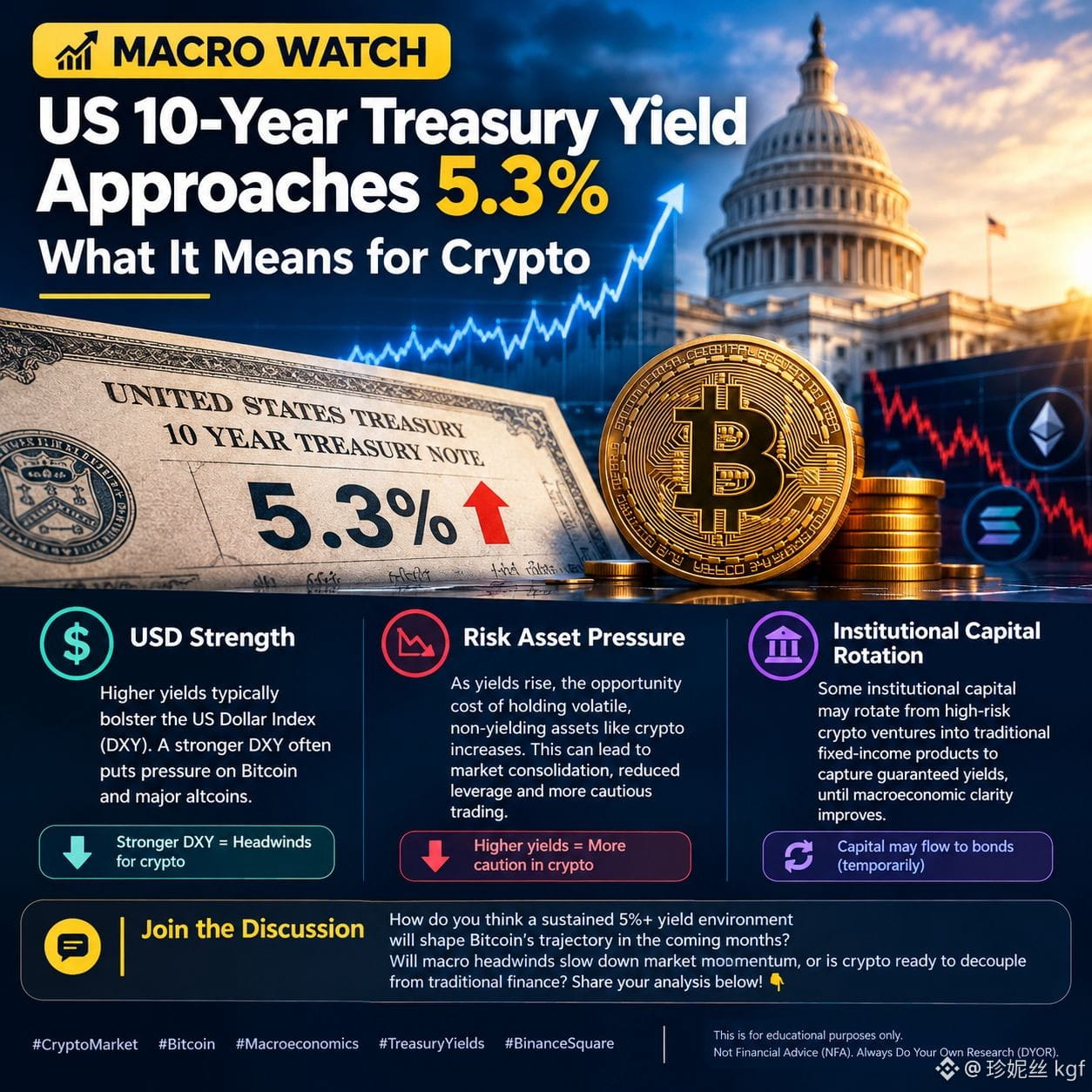
#us10yearyieldnears5.3% 📈 Macro Watch US 10-Year Treasury Yield Approaches 5.3% – What It Means for Crypto
The traditional finance landscape is shifting again. As the US 10-Year Treasury yield edges closer to the 5.3% mark, crypto investors are paying close attention to the potential ripple effects on global risk assets.
📰 Core News
The US 10-Year Treasury yield is a primary benchmark for global borrowing costs and economic sentiment. A rise toward 5.3% generally signals market expectations of sustained higher interest rates or resilient economic data. This makes traditional "risk-free" government bonds more attractive to institutional capital, altering the flow of liquidity in financial markets.
🌍 Market Impact
• 💵 USD Strength Higher yields typically bolster the US Dollar Index (DXY). Historically, a stronger DXY shares an inverse relationship with Bitcoin and major altcoins, creating headwinds for price appreciation.
• 📉 Risk Asset Pressure As yields rise, the opportunity cost of holding volatile, non-yielding assets like crypto increases. This can lead to short-term market consolidation, reduced leverage, and more cautious trading behavior.
• 🏛️ Institutional Capital Rotation Some institutional capital may temporarily rotate from high-risk crypto ventures into traditional fixed-income products to capture guaranteed yields, until macroeconomic clarity improves.
💬 Join the Discussion
How do you think a sustained 5%+ yield environment will shape Bitcoin’s trajectory in the coming months? Will macro headwinds slow down market momentum, or is crypto ready to decouple from traditional finance? Share your analysis below! 👇
#CryptoMarket #Bitcoin #Macroeconomics #TreasuryYields #BinanceSquare
This is for educational purposes only. Not Financial Advice (NFA). Always Do Your Own Research (DYOR).
$MOVR $NOM $NIGHT
{future}(NIGHTUSDT)
{future}(NOMUSDT)
{future}(MOVRUSDT)
#us10yearyieldnears5.3% 📈 Macro Watch US 10-Year Treasury Yield Approaches 5.3% – What It Means for Crypto
The traditional finance landscape is shifting again. As the US 10-Year Treasury yield edges closer to the 5.3% mark, crypto investors are paying close attention to the potential ripple effects on global risk assets.
📰 Core News
The US 10-Year Treasury yield is a primary benchmark for global borrowing costs and economic sentiment. A rise toward 5.3% generally signals market expectations of sustained higher interest rates or resilient economic data. This makes traditional "risk-free" government bonds more attractive to institutional capital, altering the flow of liquidity in financial markets.
🌍 Market Impact
• 💵 USD Strength Higher yields typically bolster the US Dollar Index (DXY). Historically, a stronger DXY shares an inverse relationship with Bitcoin and major altcoins, creating headwinds for price appreciation.
• 📉 Risk Asset Pressure As yields rise, the opportunity cost of holding volatile, non-yielding assets like crypto increases. This can lead to short-term market consolidation, reduced leverage, and more cautious trading behavior.
• 🏛️ Institutional Capital Rotation Some institutional capital may temporarily rotate from high-risk crypto ventures into traditional fixed-income products to capture guaranteed yields, until macroeconomic clarity improves.
💬 Join the Discussion
How do you think a sustained 5%+ yield environment will shape Bitcoin’s trajectory in the coming months? Will macro headwinds slow down market momentum, or is crypto ready to decouple from traditional finance? Share your analysis below! 👇
#CryptoMarket #Bitcoin #Macroeconomics #TreasuryYields #BinanceSquare
This is for educational purposes only. Not Financial Advice (NFA). Always Do Your Own Research (DYOR).
$MOVR $NOM $NIGHT
The traditional finance landscape is shifting again. As the US 10-Year Treasury yield edges closer to the 5.3% mark, crypto investors are paying close attention to the potential ripple effects on global risk assets.
📰 Core News
The US 10-Year Treasury yield is a primary benchmark for global borrowing costs and economic sentiment. A rise toward 5.3% generally signals market expectations of sustained higher interest rates or resilient economic data. This makes traditional "risk-free" government bonds more attractive to institutional capital, altering the flow of liquidity in financial markets.
🌍 Market Impact
• 💵 USD Strength Higher yields typically bolster the US Dollar Index (DXY). Historically, a stronger DXY shares an inverse relationship with Bitcoin and major altcoins, creating headwinds for price appreciation.
• 📉 Risk Asset Pressure As yields rise, the opportunity cost of holding volatile, non-yielding assets like crypto increases. This can lead to short-term market consolidation, reduced leverage, and more cautious trading behavior.
• 🏛️ Institutional Capital Rotation Some institutional capital may temporarily rotate from high-risk crypto ventures into traditional fixed-income products to capture guaranteed yields, until macroeconomic clarity improves.
💬 Join the Discussion
How do you think a sustained 5%+ yield environment will shape Bitcoin’s trajectory in the coming months? Will macro headwinds slow down market momentum, or is crypto ready to decouple from traditional finance? Share your analysis below! 👇
#CryptoMarket #Bitcoin #Macroeconomics #TreasuryYields #BinanceSquare
This is for educational purposes only. Not Financial Advice (NFA). Always Do Your Own Research (DYOR).
$MOVR $NOM $NIGHT
124

·
--
Bearish
#US10YearYieldNears5.3%
🚨 The bond market is sending a warning to risk assets. 🇺🇸📉
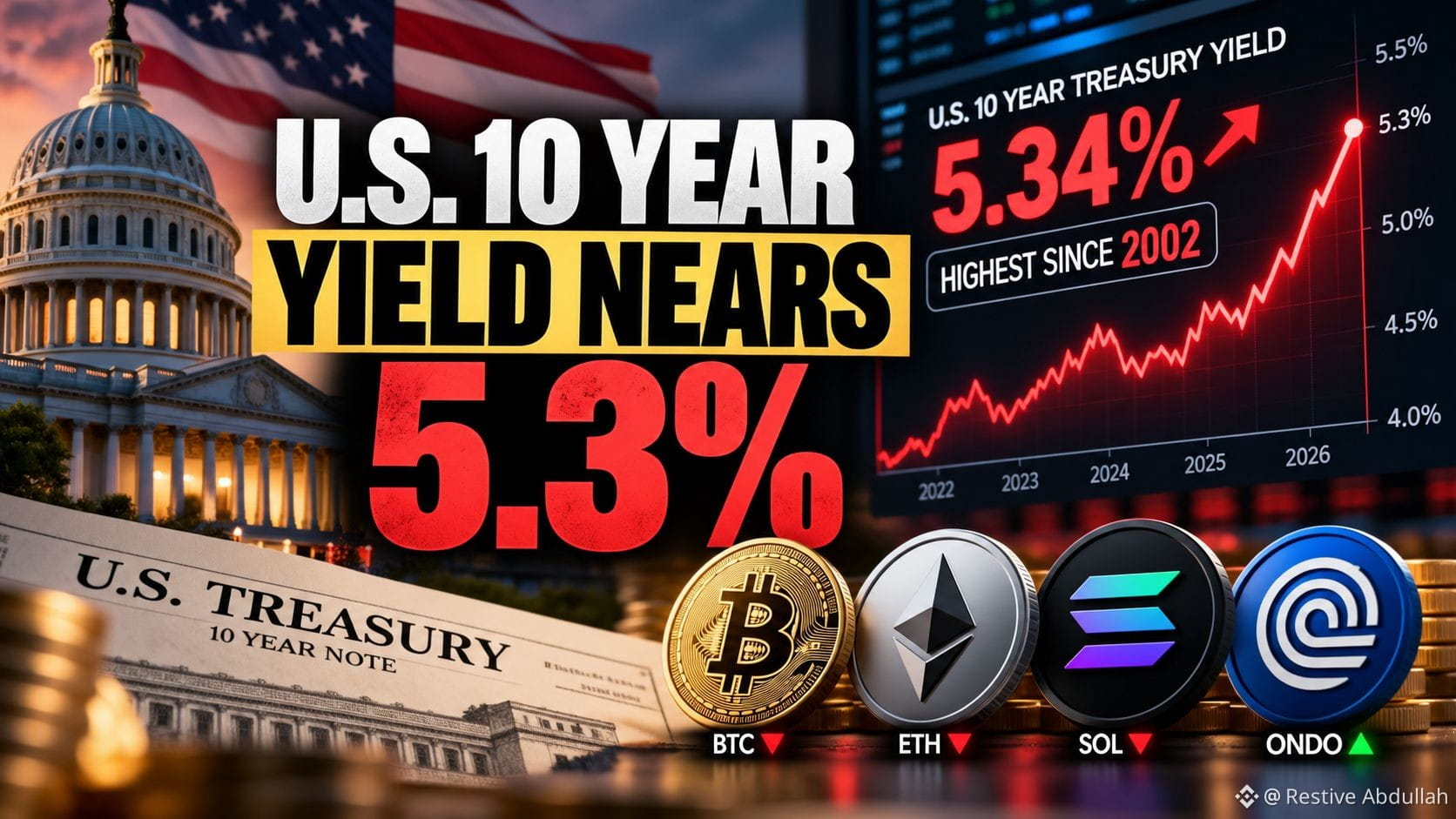
The U.S. 10-year Treasury yield has surged to around 5.34%, reaching its highest level since 2002.
And this is not just another bond-market headline.
The 10-year yield is one of the biggest drivers of global asset pricing.
When yields rise this fast, investors can demand more return from risky assets.
That puts pressure on:
• Bitcoin
• Tech stocks
• Growth assets
• High-beta altcoins
• Speculative crypto trades
Here's the part I'm watching.
Bitcoin briefly pushed above $85,000 after softer U.S. inflation data.
But the move faded as Treasury yields stayed near 5.3%.
That tells me the bond market is currently overpowering the softer inflation signal.
📉 My Market Read
{future}(BTCUSDT)
SHORT-TERM SIGNAL: 🔴 BEARISH
A 5.3%+ 10-year yield creates a tougher liquidity setup for crypto.
If yields keep pushing higher, I would expect more pressure on high-risk assets.
The next key question is simple:
Does the 10-year yield break higher, or finally cool down?
👀 Tokens I'm Watching
$BTC — the main liquidity indicator for crypto.
$ETH — higher-beta exposure if risk appetite weakens.
$SOL — usually more sensitive to changes in risk appetite.
$ONDO — an interesting exception to watch because higher Treasury yields can support demand for tokenized Treasury products, even while higher rates pressure broader crypto.
So I wouldn't treat every crypto token the same here.
My Take
Rising yields = pressure.
Falling yields = breathing room.
Until the 10-year yield starts cooling, I'm watching BTC strength, stablecoin liquidity and altcoin volume very closely.
The bond market is giving crypto traders a macro signal.
Don't ignore it. 👀
#US10YearYieldNears5.3%
🚨 The bond market is sending a warning to risk assets. 🇺🇸📉
The U.S. 10-year Treasury yield has surged to around 5.34%, reaching its highest level since 2002.
And this is not just another bond-market headline.
The 10-year yield is one of the biggest drivers of global asset pricing.
When yields rise this fast, investors can demand more return from risky assets.
That puts pressure on:
• Bitcoin
• Tech stocks
• Growth assets
• High-beta altcoins
• Speculative crypto trades
Here's the part I'm watching.
Bitcoin briefly pushed above $85,000 after softer U.S. inflation data.
But the move faded as Treasury yields stayed near 5.3%.
That tells me the bond market is currently overpowering the softer inflation signal.
📉 My Market Read
SHORT-TERM SIGNAL: 🔴 BEARISH
A 5.3%+ 10-year yield creates a tougher liquidity setup for crypto.
If yields keep pushing higher, I would expect more pressure on high-risk assets.
The next key question is simple:
Does the 10-year yield break higher, or finally cool down?
👀 Tokens I'm Watching
$BTC — the main liquidity indicator for crypto.
$ETH — higher-beta exposure if risk appetite weakens.
$SOL — usually more sensitive to changes in risk appetite.
$ONDO — an interesting exception to watch because higher Treasury yields can support demand for tokenized Treasury products, even while higher rates pressure broader crypto.
So I wouldn't treat every crypto token the same here.
My Take
Rising yields = pressure.
Falling yields = breathing room.
Until the 10-year yield starts cooling, I'm watching BTC strength, stablecoin liquidity and altcoin volume very closely.
The bond market is giving crypto traders a macro signal.
Don't ignore it. 👀
🚨 The bond market is sending a warning to risk assets. 🇺🇸📉
The U.S. 10-year Treasury yield has surged to around 5.34%, reaching its highest level since 2002.
And this is not just another bond-market headline.
The 10-year yield is one of the biggest drivers of global asset pricing.
When yields rise this fast, investors can demand more return from risky assets.
That puts pressure on:
• Bitcoin
• Tech stocks
• Growth assets
• High-beta altcoins
• Speculative crypto trades
Here's the part I'm watching.
Bitcoin briefly pushed above $85,000 after softer U.S. inflation data.
But the move faded as Treasury yields stayed near 5.3%.
That tells me the bond market is currently overpowering the softer inflation signal.
📉 My Market Read
SHORT-TERM SIGNAL: 🔴 BEARISH
A 5.3%+ 10-year yield creates a tougher liquidity setup for crypto.
If yields keep pushing higher, I would expect more pressure on high-risk assets.
The next key question is simple:
Does the 10-year yield break higher, or finally cool down?
👀 Tokens I'm Watching
$BTC — the main liquidity indicator for crypto.
$ETH — higher-beta exposure if risk appetite weakens.
$SOL — usually more sensitive to changes in risk appetite.
$ONDO — an interesting exception to watch because higher Treasury yields can support demand for tokenized Treasury products, even while higher rates pressure broader crypto.
So I wouldn't treat every crypto token the same here.
My Take
Rising yields = pressure.
Falling yields = breathing room.
Until the 10-year yield starts cooling, I'm watching BTC strength, stablecoin liquidity and altcoin volume very closely.
The bond market is giving crypto traders a macro signal.
Don't ignore it. 👀
43

·
--
US 10Y Yield Nears 5.3% — Is Bitcoin Paying Attention? 📈
US Treasury bonds are under pressure, with the 10-year yield holding near 5.3%—its highest level since 2002.
Even a softer PCE inflation reading hasn’t been enough to bring yields down. The concern appears to be broader than Fed policy: rising fiscal debt, bond supply, and elevated term premiums are keeping markets on edge.
Bitcoin briefly reached $85.5K before pulling back toward $83.7K. According to 10x Research, the impact on BTC may depend on why yields are rising. If markets view the move as a financial-stability concern rather than simply tighter monetary policy, Bitcoin could react differently from traditional risk assets.
Key data to watch: the US 10-year yield and Friday’s Non-Farm Payrolls report. A decline in yields may improve broader risk sentiment, while another push higher could increase volatility across crypto markets.
⚠️ Not financial advice. Always DYOR.
$BTC $DOGE $ZEC
#US10YearYieldNears5.3% #KoreaProposesTokenizingStocksAndBonds #MetaMaskExitsLidoValidatorsAfterSecurityIncident
US 10Y Yield Nears 5.3% — Is Bitcoin Paying Attention? 📈
US Treasury bonds are under pressure, with the 10-year yield holding near 5.3%—its highest level since 2002.
Even a softer PCE inflation reading hasn’t been enough to bring yields down. The concern appears to be broader than Fed policy: rising fiscal debt, bond supply, and elevated term premiums are keeping markets on edge.
Bitcoin briefly reached $85.5K before pulling back toward $83.7K. According to 10x Research, the impact on BTC may depend on why yields are rising. If markets view the move as a financial-stability concern rather than simply tighter monetary policy, Bitcoin could react differently from traditional risk assets.
Key data to watch: the US 10-year yield and Friday’s Non-Farm Payrolls report. A decline in yields may improve broader risk sentiment, while another push higher could increase volatility across crypto markets.
⚠️ Not financial advice. Always DYOR.
$BTC $DOGE $ZEC
#US10YearYieldNears5.3% #KoreaProposesTokenizingStocksAndBonds #MetaMaskExitsLidoValidatorsAfterSecurityIncident
US Treasury bonds are under pressure, with the 10-year yield holding near 5.3%—its highest level since 2002.
Even a softer PCE inflation reading hasn’t been enough to bring yields down. The concern appears to be broader than Fed policy: rising fiscal debt, bond supply, and elevated term premiums are keeping markets on edge.
Bitcoin briefly reached $85.5K before pulling back toward $83.7K. According to 10x Research, the impact on BTC may depend on why yields are rising. If markets view the move as a financial-stability concern rather than simply tighter monetary policy, Bitcoin could react differently from traditional risk assets.
Key data to watch: the US 10-year yield and Friday’s Non-Farm Payrolls report. A decline in yields may improve broader risk sentiment, while another push higher could increase volatility across crypto markets.
⚠️ Not financial advice. Always DYOR.
$BTC $DOGE $ZEC
#US10YearYieldNears5.3% #KoreaProposesTokenizingStocksAndBonds #MetaMaskExitsLidoValidatorsAfterSecurityIncident
70

$BITCOIN
{alpha}(10x72e4f9f808c49a2a61de9c5896298920dc4eeea9)
#US10YearYieldNears5.3% #USWeeklyJoblessClaimsFallTo197000 Gives Back Its PCE Pop as the 10-Year Holds Near 5.3%
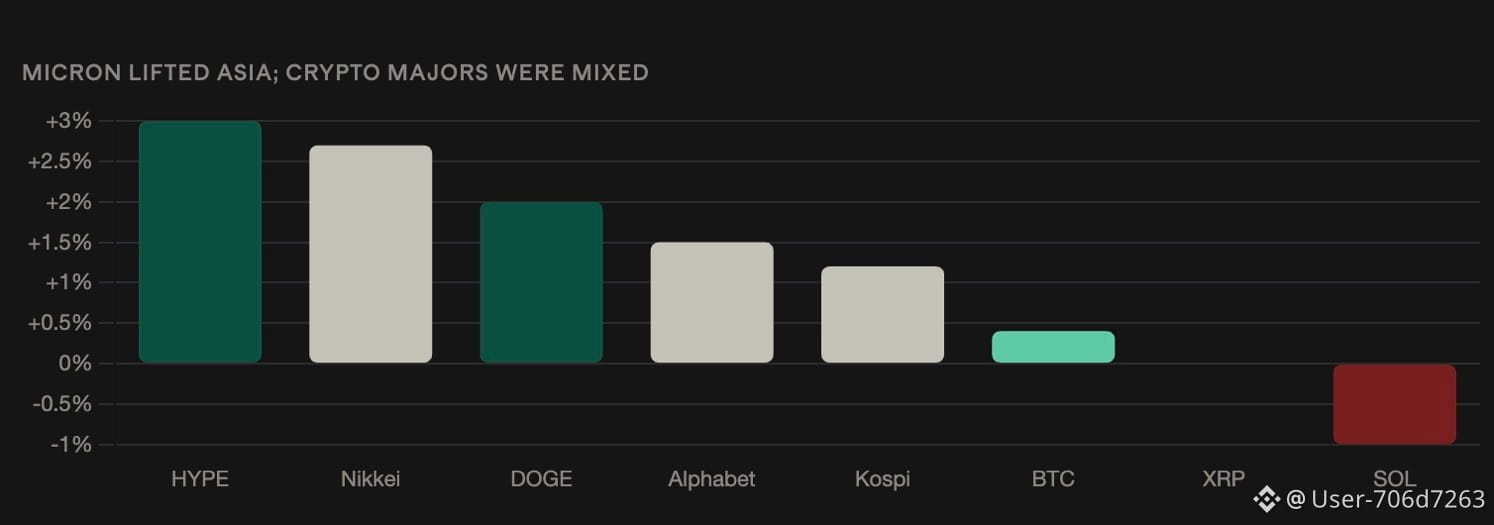
Bitcoin surged above $85,500 on Wednesday's softer PCE print before returning to $83,700 as Treasury yields reversed — the 10-year closed 1.6bps higher at 5.276% after touching 5.30%, its highest since 2002, and the 30-year settled at 5.63%. The pattern is the direct test of Thielen's framework: softer PCE reduced October hike odds from 70% to 47.1%, but long yields didn't follow — confirming the fiscal and term-premium driver that a softer inflation reading cannot address. Oil is what reversed the brief relief: WTI +2% with gasoline and diesel each up 4%. The 10-year real yield climbed to 2.83% from 2.68% in the week to September 25. Friday's NFP is the next test with Kalshi pricing 60% odds above 90,000 against Goldman's 80,000 and BofA's 60,000.
$BITCOIN
#US10YearYieldNears5.3% #USWeeklyJoblessClaimsFallTo197000 Gives Back Its PCE Pop as the 10-Year Holds Near 5.3%
Bitcoin surged above $85,500 on Wednesday's softer PCE print before returning to $83,700 as Treasury yields reversed — the 10-year closed 1.6bps higher at 5.276% after touching 5.30%, its highest since 2002, and the 30-year settled at 5.63%. The pattern is the direct test of Thielen's framework: softer PCE reduced October hike odds from 70% to 47.1%, but long yields didn't follow — confirming the fiscal and term-premium driver that a softer inflation reading cannot address. Oil is what reversed the brief relief: WTI +2% with gasoline and diesel each up 4%. The 10-year real yield climbed to 2.83% from 2.68% in the week to September 25. Friday's NFP is the next test with Kalshi pricing 60% odds above 90,000 against Goldman's 80,000 and BofA's 60,000.
#US10YearYieldNears5.3% #USWeeklyJoblessClaimsFallTo197000 Gives Back Its PCE Pop as the 10-Year Holds Near 5.3%
Bitcoin surged above $85,500 on Wednesday's softer PCE print before returning to $83,700 as Treasury yields reversed — the 10-year closed 1.6bps higher at 5.276% after touching 5.30%, its highest since 2002, and the 30-year settled at 5.63%. The pattern is the direct test of Thielen's framework: softer PCE reduced October hike odds from 70% to 47.1%, but long yields didn't follow — confirming the fiscal and term-premium driver that a softer inflation reading cannot address. Oil is what reversed the brief relief: WTI +2% with gasoline and diesel each up 4%. The 10-year real yield climbed to 2.83% from 2.68% in the week to September 25. Friday's NFP is the next test with Kalshi pricing 60% odds above 90,000 against Goldman's 80,000 and BofA's 60,000.
25

·
--
Bearish
#US10YearYieldNears5.3% means the yield on the U.S. 10-year Treasury bond is approaching 5.3%.
For crypto markets, this can be important because:
📉 Higher yields can put pressure on Bitcoin and altcoins.
💵 Investors may prefer safer U.S. Treasury assets when yields are attractive.
⚠️ Higher yields can increase market volatility.
📊 Traders will closely watch U.S. interest-rate and inflation expectations.$GOOGL.US $BTC #USWeeklyJoblessClaimsFallTo197000
#US10YearYieldNears5.3% means the yield on the U.S. 10-year Treasury bond is approaching 5.3%.
For crypto markets, this can be important because:
📉 Higher yields can put pressure on Bitcoin and altcoins.
💵 Investors may prefer safer U.S. Treasury assets when yields are attractive.
⚠️ Higher yields can increase market volatility.
📊 Traders will closely watch U.S. interest-rate and inflation expectations.$GOOGL.US $BTC #USWeeklyJoblessClaimsFallTo197000
For crypto markets, this can be important because:
📉 Higher yields can put pressure on Bitcoin and altcoins.
💵 Investors may prefer safer U.S. Treasury assets when yields are attractive.
⚠️ Higher yields can increase market volatility.
📊 Traders will closely watch U.S. interest-rate and inflation expectations.$GOOGL.US $BTC #USWeeklyJoblessClaimsFallTo197000
BTC-0.34%
GOOGLUS-0.49%
276

·
--
#US10YearYieldNears5.3% — WHY DOES IT MATTER?
The U.S. 10-year Treasury yield has moved above 5.3%, reaching levels not seen since 2002. That is a big move for global markets.
What makes this interesting is that the rise is happening even as recent U.S. inflation data came in softer than expected. At the same time, stronger economic growth and higher energy prices are keeping investors cautious about future inflation and interest rates.
Higher Treasury yields can increase borrowing costs across the economy. They can also change how investors look at stocks, bonds and other risk assets because U.S. government debt is offering a higher return.
For markets, the key question is whether yields can stay around these levels or continue moving higher.
This is not just a bond-market story anymore. It can influence equities, currencies, credit and even crypto sentiment.
The big question now:
Will the 10-year yield stabilize near 5.3%, or is the bond market signaling another move higher?
#US10YearYield #Treasury #Finance #USWeeklyJoblessClaimsFallTo197000
#US10YearYieldNears5.3% — WHY DOES IT MATTER?
The U.S. 10-year Treasury yield has moved above 5.3%, reaching levels not seen since 2002. That is a big move for global markets.
What makes this interesting is that the rise is happening even as recent U.S. inflation data came in softer than expected. At the same time, stronger economic growth and higher energy prices are keeping investors cautious about future inflation and interest rates.
Higher Treasury yields can increase borrowing costs across the economy. They can also change how investors look at stocks, bonds and other risk assets because U.S. government debt is offering a higher return.
For markets, the key question is whether yields can stay around these levels or continue moving higher.
This is not just a bond-market story anymore. It can influence equities, currencies, credit and even crypto sentiment.
The big question now:
Will the 10-year yield stabilize near 5.3%, or is the bond market signaling another move higher?
#US10YearYield #Treasury #Finance #USWeeklyJoblessClaimsFallTo197000
The U.S. 10-year Treasury yield has moved above 5.3%, reaching levels not seen since 2002. That is a big move for global markets.
What makes this interesting is that the rise is happening even as recent U.S. inflation data came in softer than expected. At the same time, stronger economic growth and higher energy prices are keeping investors cautious about future inflation and interest rates.
Higher Treasury yields can increase borrowing costs across the economy. They can also change how investors look at stocks, bonds and other risk assets because U.S. government debt is offering a higher return.
For markets, the key question is whether yields can stay around these levels or continue moving higher.
This is not just a bond-market story anymore. It can influence equities, currencies, credit and even crypto sentiment.
The big question now:
Will the 10-year yield stabilize near 5.3%, or is the bond market signaling another move higher?
#US10YearYield #Treasury #Finance #USWeeklyJoblessClaimsFallTo197000
IEFETF-0.55%
53


Article
U.S. 10-Year Yield Nears 5.3%U.S. 10-Year Yield Nears 5.3%: The Global Bond Sell-Off Enters a New Phase
The U.S. 10-year Treasury yield climbed as high as 5.34% on 2026-10-01, surpassing its 2007 peak and reaching its highest intraday level since 2002. The move came amid a wider sovereign-bond sell-off, with the U.K. 30-year gilt moving above 6% and long-dated borrowing costs rising across major developed economies. The key message for global markets is clear: investors are demanding substantially more compensation to own long-term government debt.
The latest official U.S. Treasury curve data available before the move showed the 10-year at 5.26%, the 2-year at 4.89%, and the 30-year at 5.59% on 2026-09-30. This steepening structure matters: it suggests the pressure is concentrated not only in expectations for central-bank policy, but also in long-term inflation, fiscal supply, and duration-risk premiums.
Why yields are rising
Energy shock is reviving inflation concerns
Elevated oil prices, linked to disruptions and geopolitical risk in the Middle East, are raising concerns that inflation may remain uncomfortable for longer. Higher energy costs can filter through transport, manufacturing, consumer prices, and inflation expectations.
For bond investors, this matters because a fixed coupon becomes less valuable when future inflation is less predictable. The result is usually a demand for a higher nominal yield—especially on longer-dated debt.
U.S. growth has remained resilient
The Bureau of Economic Analysis reported that U.S. real GDP expanded at an annualized 2.2% in Q2 2026, following a revised 2.5% pace in Q1. Consumer spending, investment, and exports contributed to the expansion. Stronger growth is constructive for economic activity, but it can also make a rapid decline in interest rates less likely.
The market implication is not simply “the Fed may stay restrictive.” More importantly, investors may conclude that the economy can absorb higher yields for longer—until financing costs begin to affect households, companies, and public finances more visibly.
Fiscal supply is becoming a central market variable
A rising public-debt burden and persistent fiscal deficits increase the quantity of Treasury securities that the market must absorb. When issuance remains large while investor demand becomes less certain, yields may need to rise to attract buyers.
This dynamic is often described as a higher term premium: investors seek additional return for accepting the uncertainty of holding long-duration bonds through inflation shocks, policy shifts, and growing supply. The 10-year yield is therefore increasingly reflecting fiscal and structural concerns, not only expectations for the next Federal Reserve meeting.
Technical selling can intensify the bond rout
Bond-market moves can become self-reinforcing. Rising yields lower bond prices; falling prices can trigger hedging activity in mortgage-backed securities and rebalancing by leveraged futures participants; those flows can create additional Treasury selling.
This does not mean every move is mechanically driven, but technical positioning can magnify an already fragile macro backdrop. In such periods, yields may overshoot in either direction before a more stable equilibrium emerges.
Global spillover: this is not only a U.S. problem
The bond sell-off is broad. Reports on 2026-10-01 showed the U.K. 30-year gilt breaking above 6% for the first time since 1998, while global long-end yields were pressured by inflation concerns and investor caution around government borrowing.
The significance is systemic: Treasury yields act as a global benchmark for discount rates, credit conditions, mortgage pricing, and the relative appeal of risk assets. When the U.S. long end reprices higher alongside other sovereign markets, global financial conditions can tighten even without a fresh policy-rate increase.
Cross-asset impact
Fixed income: higher income, but still meaningful duration risk
Higher yields improve the income available on newly issued bonds. However, that does not eliminate risk for existing long-duration holdings. If inflation expectations, fiscal concerns, or technical selling continue to push yields higher, long-dated bond prices can remain under pressure.
A future yield decline could support bond prices, but the scale of any return depends on maturity, duration, coupon, and the path of yields. Historical sensitivity is not a promise of future performance.
Equities: higher discount rates challenge valuations
Yields above 5% change portfolio mathematics. A higher risk-free rate raises the hurdle rate used to value future corporate cash flows, which can pressure long-duration growth sectors in particular. It also raises corporate refinancing costs and can narrow the equity risk premium.
Businesses with durable cash generation, manageable debt burdens, and pricing power may be more resilient than highly leveraged companies whose valuations rely heavily on distant future earnings. Still, the macro environment remains uncertain.
Real estate and credit: direct pressure channels
The 10-year Treasury yield is a key reference point for mortgage and commercial borrowing costs. Sustained elevated yields can pressure housing affordability, slow refinancing activity, and force higher capitalization rates in commercial real estate.
For credit markets, refinancing becomes more expensive as older low-cost debt matures. The impact tends to emerge gradually, but it can become significant if elevated yields persist.
Crypto: liquidity sensitivity becomes the key variable
Crypto markets often react to broad liquidity conditions rather than Treasury yields alone. Higher real and nominal yields can strengthen the appeal of cash-like instruments, raise leverage costs, and reduce risk appetite across speculative assets.
The first-order effect is therefore a potentially tighter liquidity backdrop. A more constructive medium-term environment would depend on factors such as easing inflation pressure, reduced energy risk, stabilizing Treasury demand, or a less aggressive rise in real yields. These are conditional developments, not assured outcomes.
Visionary prospect: from “higher for longer” to a higher term-premium era
The more important market question is whether this is a temporary rate shock or the beginning of a structurally different regime.
If inflation moderates, energy prices retreat, growth cools gradually, and Treasury auctions find durable demand, long-end yields could stabilize. That would ease pressure on global risk assets and allow markets to focus again on growth, earnings, and innovation.
But if fiscal issuance remains heavy while inflation uncertainty stays elevated, the world may be entering a higher term-premium era—one in which long-term capital is persistently more expensive than markets became accustomed to during the low-rate decade.
In that scenario, capital discipline becomes more important across asset classes. Firms, protocols, and projects with genuine cash-flow visibility, strong balance sheets, sustainable token economics, and lower dependence on cheap leverage may receive greater market attention than narratives reliant mainly on abundant liquidity.
The next catalysts to watch are U.S. employment and inflation data, oil-market developments, Treasury auction demand, and whether the 10-year yield remains elevated after the immediate technical selling pressure fades.
{spot}(MOVRUSDT)
{spot}(NEARUSDT)
{spot}(QNTUSDT)
$MOVR $QNT $NEAR
#US10YearYieldNears5.3% #USCorePCEEasesTo3%InAugust #USADPAdds90000JobsInSeptember #BTC #Binance
[Click here for Article "South koreas financial commission(FSC)"](https://app.binance.com/uni-qr/cart/372584982980885?r=bubuyvnj&l=en&uco=cuthsvmhrnhukta6pswucq&uc=app_square_share_link&us=copylink)
U.S. 10-Year Yield Nears 5.3%
U.S. 10-Year Yield Nears 5.3%: The Global Bond Sell-Off Enters a New Phase
The U.S. 10-year Treasury yield climbed as high as 5.34% on 2026-10-01, surpassing its 2007 peak and reaching its highest intraday level since 2002. The move came amid a wider sovereign-bond sell-off, with the U.K. 30-year gilt moving above 6% and long-dated borrowing costs rising across major developed economies. The key message for global markets is clear: investors are demanding substantially more compensation to own long-term government debt.
The latest official U.S. Treasury curve data available before the move showed the 10-year at 5.26%, the 2-year at 4.89%, and the 30-year at 5.59% on 2026-09-30. This steepening structure matters: it suggests the pressure is concentrated not only in expectations for central-bank policy, but also in long-term inflation, fiscal supply, and duration-risk premiums.
Why yields are rising
Energy shock is reviving inflation concerns
Elevated oil prices, linked to disruptions and geopolitical risk in the Middle East, are raising concerns that inflation may remain uncomfortable for longer. Higher energy costs can filter through transport, manufacturing, consumer prices, and inflation expectations.
For bond investors, this matters because a fixed coupon becomes less valuable when future inflation is less predictable. The result is usually a demand for a higher nominal yield—especially on longer-dated debt.
U.S. growth has remained resilient
The Bureau of Economic Analysis reported that U.S. real GDP expanded at an annualized 2.2% in Q2 2026, following a revised 2.5% pace in Q1. Consumer spending, investment, and exports contributed to the expansion. Stronger growth is constructive for economic activity, but it can also make a rapid decline in interest rates less likely.
The market implication is not simply “the Fed may stay restrictive.” More importantly, investors may conclude that the economy can absorb higher yields for longer—until financing costs begin to affect households, companies, and public finances more visibly.
Fiscal supply is becoming a central market variable
A rising public-debt burden and persistent fiscal deficits increase the quantity of Treasury securities that the market must absorb. When issuance remains large while investor demand becomes less certain, yields may need to rise to attract buyers.
This dynamic is often described as a higher term premium: investors seek additional return for accepting the uncertainty of holding long-duration bonds through inflation shocks, policy shifts, and growing supply. The 10-year yield is therefore increasingly reflecting fiscal and structural concerns, not only expectations for the next Federal Reserve meeting.
Technical selling can intensify the bond rout
Bond-market moves can become self-reinforcing. Rising yields lower bond prices; falling prices can trigger hedging activity in mortgage-backed securities and rebalancing by leveraged futures participants; those flows can create additional Treasury selling.
This does not mean every move is mechanically driven, but technical positioning can magnify an already fragile macro backdrop. In such periods, yields may overshoot in either direction before a more stable equilibrium emerges.
Global spillover: this is not only a U.S. problem
The bond sell-off is broad. Reports on 2026-10-01 showed the U.K. 30-year gilt breaking above 6% for the first time since 1998, while global long-end yields were pressured by inflation concerns and investor caution around government borrowing.
The significance is systemic: Treasury yields act as a global benchmark for discount rates, credit conditions, mortgage pricing, and the relative appeal of risk assets. When the U.S. long end reprices higher alongside other sovereign markets, global financial conditions can tighten even without a fresh policy-rate increase.
Cross-asset impact
Fixed income: higher income, but still meaningful duration risk
Higher yields improve the income available on newly issued bonds. However, that does not eliminate risk for existing long-duration holdings. If inflation expectations, fiscal concerns, or technical selling continue to push yields higher, long-dated bond prices can remain under pressure.
A future yield decline could support bond prices, but the scale of any return depends on maturity, duration, coupon, and the path of yields. Historical sensitivity is not a promise of future performance.
Equities: higher discount rates challenge valuations
Yields above 5% change portfolio mathematics. A higher risk-free rate raises the hurdle rate used to value future corporate cash flows, which can pressure long-duration growth sectors in particular. It also raises corporate refinancing costs and can narrow the equity risk premium.
Businesses with durable cash generation, manageable debt burdens, and pricing power may be more resilient than highly leveraged companies whose valuations rely heavily on distant future earnings. Still, the macro environment remains uncertain.
Real estate and credit: direct pressure channels
The 10-year Treasury yield is a key reference point for mortgage and commercial borrowing costs. Sustained elevated yields can pressure housing affordability, slow refinancing activity, and force higher capitalization rates in commercial real estate.
For credit markets, refinancing becomes more expensive as older low-cost debt matures. The impact tends to emerge gradually, but it can become significant if elevated yields persist.
Crypto: liquidity sensitivity becomes the key variable
Crypto markets often react to broad liquidity conditions rather than Treasury yields alone. Higher real and nominal yields can strengthen the appeal of cash-like instruments, raise leverage costs, and reduce risk appetite across speculative assets.
The first-order effect is therefore a potentially tighter liquidity backdrop. A more constructive medium-term environment would depend on factors such as easing inflation pressure, reduced energy risk, stabilizing Treasury demand, or a less aggressive rise in real yields. These are conditional developments, not assured outcomes.
Visionary prospect: from “higher for longer” to a higher term-premium era
The more important market question is whether this is a temporary rate shock or the beginning of a structurally different regime.
If inflation moderates, energy prices retreat, growth cools gradually, and Treasury auctions find durable demand, long-end yields could stabilize. That would ease pressure on global risk assets and allow markets to focus again on growth, earnings, and innovation.
But if fiscal issuance remains heavy while inflation uncertainty stays elevated, the world may be entering a higher term-premium era—one in which long-term capital is persistently more expensive than markets became accustomed to during the low-rate decade.
In that scenario, capital discipline becomes more important across asset classes. Firms, protocols, and projects with genuine cash-flow visibility, strong balance sheets, sustainable token economics, and lower dependence on cheap leverage may receive greater market attention than narratives reliant mainly on abundant liquidity.
The next catalysts to watch are U.S. employment and inflation data, oil-market developments, Treasury auction demand, and whether the 10-year yield remains elevated after the immediate technical selling pressure fades.
$MOVR $QNT $NEAR
#US10YearYieldNears5.3% #USCorePCEEasesTo3%InAugust #USADPAdds90000JobsInSeptember #BTC #Binance
Click here for Article "South koreas financial commission(FSC)"
The U.S. 10-year Treasury yield climbed as high as 5.34% on 2026-10-01, surpassing its 2007 peak and reaching its highest intraday level since 2002. The move came amid a wider sovereign-bond sell-off, with the U.K. 30-year gilt moving above 6% and long-dated borrowing costs rising across major developed economies. The key message for global markets is clear: investors are demanding substantially more compensation to own long-term government debt.
The latest official U.S. Treasury curve data available before the move showed the 10-year at 5.26%, the 2-year at 4.89%, and the 30-year at 5.59% on 2026-09-30. This steepening structure matters: it suggests the pressure is concentrated not only in expectations for central-bank policy, but also in long-term inflation, fiscal supply, and duration-risk premiums.
Why yields are rising
Energy shock is reviving inflation concerns
Elevated oil prices, linked to disruptions and geopolitical risk in the Middle East, are raising concerns that inflation may remain uncomfortable for longer. Higher energy costs can filter through transport, manufacturing, consumer prices, and inflation expectations.
For bond investors, this matters because a fixed coupon becomes less valuable when future inflation is less predictable. The result is usually a demand for a higher nominal yield—especially on longer-dated debt.
U.S. growth has remained resilient
The Bureau of Economic Analysis reported that U.S. real GDP expanded at an annualized 2.2% in Q2 2026, following a revised 2.5% pace in Q1. Consumer spending, investment, and exports contributed to the expansion. Stronger growth is constructive for economic activity, but it can also make a rapid decline in interest rates less likely.
The market implication is not simply “the Fed may stay restrictive.” More importantly, investors may conclude that the economy can absorb higher yields for longer—until financing costs begin to affect households, companies, and public finances more visibly.
Fiscal supply is becoming a central market variable
A rising public-debt burden and persistent fiscal deficits increase the quantity of Treasury securities that the market must absorb. When issuance remains large while investor demand becomes less certain, yields may need to rise to attract buyers.
This dynamic is often described as a higher term premium: investors seek additional return for accepting the uncertainty of holding long-duration bonds through inflation shocks, policy shifts, and growing supply. The 10-year yield is therefore increasingly reflecting fiscal and structural concerns, not only expectations for the next Federal Reserve meeting.
Technical selling can intensify the bond rout
Bond-market moves can become self-reinforcing. Rising yields lower bond prices; falling prices can trigger hedging activity in mortgage-backed securities and rebalancing by leveraged futures participants; those flows can create additional Treasury selling.
This does not mean every move is mechanically driven, but technical positioning can magnify an already fragile macro backdrop. In such periods, yields may overshoot in either direction before a more stable equilibrium emerges.
Global spillover: this is not only a U.S. problem
The bond sell-off is broad. Reports on 2026-10-01 showed the U.K. 30-year gilt breaking above 6% for the first time since 1998, while global long-end yields were pressured by inflation concerns and investor caution around government borrowing.
The significance is systemic: Treasury yields act as a global benchmark for discount rates, credit conditions, mortgage pricing, and the relative appeal of risk assets. When the U.S. long end reprices higher alongside other sovereign markets, global financial conditions can tighten even without a fresh policy-rate increase.
Cross-asset impact
Fixed income: higher income, but still meaningful duration risk
Higher yields improve the income available on newly issued bonds. However, that does not eliminate risk for existing long-duration holdings. If inflation expectations, fiscal concerns, or technical selling continue to push yields higher, long-dated bond prices can remain under pressure.
A future yield decline could support bond prices, but the scale of any return depends on maturity, duration, coupon, and the path of yields. Historical sensitivity is not a promise of future performance.
Equities: higher discount rates challenge valuations
Yields above 5% change portfolio mathematics. A higher risk-free rate raises the hurdle rate used to value future corporate cash flows, which can pressure long-duration growth sectors in particular. It also raises corporate refinancing costs and can narrow the equity risk premium.
Businesses with durable cash generation, manageable debt burdens, and pricing power may be more resilient than highly leveraged companies whose valuations rely heavily on distant future earnings. Still, the macro environment remains uncertain.
Real estate and credit: direct pressure channels
The 10-year Treasury yield is a key reference point for mortgage and commercial borrowing costs. Sustained elevated yields can pressure housing affordability, slow refinancing activity, and force higher capitalization rates in commercial real estate.
For credit markets, refinancing becomes more expensive as older low-cost debt matures. The impact tends to emerge gradually, but it can become significant if elevated yields persist.
Crypto: liquidity sensitivity becomes the key variable
Crypto markets often react to broad liquidity conditions rather than Treasury yields alone. Higher real and nominal yields can strengthen the appeal of cash-like instruments, raise leverage costs, and reduce risk appetite across speculative assets.
The first-order effect is therefore a potentially tighter liquidity backdrop. A more constructive medium-term environment would depend on factors such as easing inflation pressure, reduced energy risk, stabilizing Treasury demand, or a less aggressive rise in real yields. These are conditional developments, not assured outcomes.
Visionary prospect: from “higher for longer” to a higher term-premium era
The more important market question is whether this is a temporary rate shock or the beginning of a structurally different regime.
If inflation moderates, energy prices retreat, growth cools gradually, and Treasury auctions find durable demand, long-end yields could stabilize. That would ease pressure on global risk assets and allow markets to focus again on growth, earnings, and innovation.
But if fiscal issuance remains heavy while inflation uncertainty stays elevated, the world may be entering a higher term-premium era—one in which long-term capital is persistently more expensive than markets became accustomed to during the low-rate decade.
In that scenario, capital discipline becomes more important across asset classes. Firms, protocols, and projects with genuine cash-flow visibility, strong balance sheets, sustainable token economics, and lower dependence on cheap leverage may receive greater market attention than narratives reliant mainly on abundant liquidity.
The next catalysts to watch are U.S. employment and inflation data, oil-market developments, Treasury auction demand, and whether the 10-year yield remains elevated after the immediate technical selling pressure fades.
$MOVR $QNT $NEAR
#US10YearYieldNears5.3% #USCorePCEEasesTo3%InAugust #USADPAdds90000JobsInSeptember #BTC #Binance
Click here for Article "South koreas financial commission(FSC)"
1
510

#US10YearYieldNears5.3%
The U.S. 10-Year Treasury yield is approaching 5.3%, putting markets on alert. Higher yields can increase pressure on risk assets and may lead to greater market volatility. 📊⚠️$GIGGLE $BNB $XRP
#Crypto #Bitcoin #BTC #MarketUpdate #US10Y
#US10YearYieldNears5.3%
The U.S. 10-Year Treasury yield is approaching 5.3%, putting markets on alert. Higher yields can increase pressure on risk assets and may lead to greater market volatility. 📊⚠️$GIGGLE $BNB $XRP
#Crypto #Bitcoin #BTC #MarketUpdate #US10Y
The U.S. 10-Year Treasury yield is approaching 5.3%, putting markets on alert. Higher yields can increase pressure on risk assets and may lead to greater market volatility. 📊⚠️$GIGGLE $BNB $XRP
#Crypto #Bitcoin #BTC #MarketUpdate #US10Y
Mkmamun40:
🥰🥰🥰
3
3
2
161

·
--
#US10YearYieldNears5.3% 🚨 US 10-Year Treasury Yield Nears 5.3% — Markets on Alert!The US 10-Year Treasury Yield approaching the 5.3% level is drawing attention across global financial markets. 📊Higher Treasury yields can impact:
🔹 Investor sentiment
🔹 US Dollar strength
🔹 Stock market performance
🔹 Bitcoin and cryptocurrency markets
Crypto traders should keep a close eye on bond yields, Federal Reserve expectations, and upcoming economic data.⚠️ Rising yields may create volatility across risk assets, including Bitcoin.Stay informed. Manage your risk. Trade wisely! 🚀
in #BTC☀️ #CryptoNews #BBinanceSquar $GOOGL.US #US10YearYield #TreasuryYields #CryptoMarketSentiment
#US10YearYieldNears5.3% 🚨 US 10-Year Treasury Yield Nears 5.3% — Markets on Alert!The US 10-Year Treasury Yield approaching the 5.3% level is drawing attention across global financial markets. 📊Higher Treasury yields can impact:
🔹 Investor sentiment
🔹 US Dollar strength
🔹 Stock market performance
🔹 Bitcoin and cryptocurrency markets
Crypto traders should keep a close eye on bond yields, Federal Reserve expectations, and upcoming economic data.⚠️ Rising yields may create volatility across risk assets, including Bitcoin.Stay informed. Manage your risk. Trade wisely! 🚀
in #BTC☀️ #CryptoNews #BBinanceSquar $GOOGL.US #US10YearYield #TreasuryYields #CryptoMarketSentiment
🔹 Investor sentiment
🔹 US Dollar strength
🔹 Stock market performance
🔹 Bitcoin and cryptocurrency markets
Crypto traders should keep a close eye on bond yields, Federal Reserve expectations, and upcoming economic data.⚠️ Rising yields may create volatility across risk assets, including Bitcoin.Stay informed. Manage your risk. Trade wisely! 🚀
in #BTC☀️ #CryptoNews #BBinanceSquar $GOOGL.US #US10YearYield #TreasuryYields #CryptoMarketSentiment
96

#US10YearYieldNears5.3%
⚠️ MARKET WATCH: #US10YearYieldNears5.3%
Something important is happening in the macro market. 👀
The U.S. 10-Year Yield is nearing 5.3% — a level that could bring increased volatility to global risk assets.
💵 Higher yields
📉 Tighter financial conditions
🌎 Potential impact on crypto
Keep your eyes on the macro data. The next move could be interesting.
#Binance #Crypto #Bitcoin #BTC #MarketUpdate #US10Y
#US10YearYieldNears5.3%
⚠️ MARKET WATCH: #US10YearYieldNears5.3%
Something important is happening in the macro market. 👀
The U.S. 10-Year Yield is nearing 5.3% — a level that could bring increased volatility to global risk assets.
💵 Higher yields
📉 Tighter financial conditions
🌎 Potential impact on crypto
Keep your eyes on the macro data. The next move could be interesting.
#Binance #Crypto #Bitcoin #BTC #MarketUpdate #US10Y
⚠️ MARKET WATCH: #US10YearYieldNears5.3%
Something important is happening in the macro market. 👀
The U.S. 10-Year Yield is nearing 5.3% — a level that could bring increased volatility to global risk assets.
💵 Higher yields
📉 Tighter financial conditions
🌎 Potential impact on crypto
Keep your eyes on the macro data. The next move could be interesting.
#Binance #Crypto #Bitcoin #BTC #MarketUpdate #US10Y

BTC-0.34%
IEFETF-0.55%
1
292

·
--
Verified
#US10YearYieldNears5.3%
🚨 10-YEAR TREASURY YIELD HITS 24-YEAR HIGH🔥
U.S. 10-year Treasury yield surged to 5.34%, reaching its highest level since 2002, as the global bond sell-off intensifies.
📉 Global bond market under pressure as yields keep climbing.
$BTC
#US10YearYieldNears5.3%
🚨 10-YEAR TREASURY YIELD HITS 24-YEAR HIGH🔥
U.S. 10-year Treasury yield surged to 5.34%, reaching its highest level since 2002, as the global bond sell-off intensifies.
📉 Global bond market under pressure as yields keep climbing.
$BTC
🚨 10-YEAR TREASURY YIELD HITS 24-YEAR HIGH🔥
U.S. 10-year Treasury yield surged to 5.34%, reaching its highest level since 2002, as the global bond sell-off intensifies.
📉 Global bond market under pressure as yields keep climbing.
$BTC
IEFETF-0.55%
1
42

·
--
Bullish
#us10yearyieldnears5.3%
🚨 JUST IN: 🇺🇸 US 10-YEAR TREASURY YIELD NEARS 5.3%! 📈
A move this large can have major implications across global markets.
🔴 Bond yields climbing
🔴 Liquidity conditions under pressure
🔴 Risk assets face a tougher macro backdrop
👀 Traders watching BTC, stocks & crypto closely
If yields keep pushing higher, volatility could be coming. ⚠️
#bitcoin #crypto #Macro
#us10yearyieldnears5.3%
🚨 JUST IN: 🇺🇸 US 10-YEAR TREASURY YIELD NEARS 5.3%! 📈
A move this large can have major implications across global markets.
🔴 Bond yields climbing
🔴 Liquidity conditions under pressure
🔴 Risk assets face a tougher macro backdrop
👀 Traders watching BTC, stocks & crypto closely
If yields keep pushing higher, volatility could be coming. ⚠️
#bitcoin #crypto #Macro
🚨 JUST IN: 🇺🇸 US 10-YEAR TREASURY YIELD NEARS 5.3%! 📈
A move this large can have major implications across global markets.
🔴 Bond yields climbing
🔴 Liquidity conditions under pressure
🔴 Risk assets face a tougher macro backdrop
👀 Traders watching BTC, stocks & crypto closely
If yields keep pushing higher, volatility could be coming. ⚠️
#bitcoin #crypto #Macro
AngelOfCrypto_-:
nice
1
1
6
16.6k

·
--
Bullish
#US10YearYieldNears5.3%
📊 BOND YIELDS AT MULTI-YEAR HIGHS!
The US 10-year Treasury yield approaching 5.3% is creating a major talking point across global financial markets. Rising yields reflect changing expectations around inflation, economic growth, and government borrowing.
🌍 What makes this situation particularly interesting is the impact on crypto sentiment. Higher bond yields may reduce demand for riskier assets, while persistent institutional interest could provide some support to crypto markets.
₿ The real question is: Can Bitcoin maintain its strength while traditional financial markets face rising borrowing costs?
💡 Sometimes, the biggest market signals come from outside the crypto market.
#Bitcoin #CryptoMarket #US10YearYield #TreasuryYields #BTC $BTC
{future}(BTCUSDT)
#US10YearYieldNears5.3%
📊 BOND YIELDS AT MULTI-YEAR HIGHS!
The US 10-year Treasury yield approaching 5.3% is creating a major talking point across global financial markets. Rising yields reflect changing expectations around inflation, economic growth, and government borrowing.
🌍 What makes this situation particularly interesting is the impact on crypto sentiment. Higher bond yields may reduce demand for riskier assets, while persistent institutional interest could provide some support to crypto markets.
₿ The real question is: Can Bitcoin maintain its strength while traditional financial markets face rising borrowing costs?
💡 Sometimes, the biggest market signals come from outside the crypto market.
#Bitcoin #CryptoMarket #US10YearYield #TreasuryYields #BTC $BTC
📊 BOND YIELDS AT MULTI-YEAR HIGHS!
The US 10-year Treasury yield approaching 5.3% is creating a major talking point across global financial markets. Rising yields reflect changing expectations around inflation, economic growth, and government borrowing.
🌍 What makes this situation particularly interesting is the impact on crypto sentiment. Higher bond yields may reduce demand for riskier assets, while persistent institutional interest could provide some support to crypto markets.
₿ The real question is: Can Bitcoin maintain its strength while traditional financial markets face rising borrowing costs?
💡 Sometimes, the biggest market signals come from outside the crypto market.
#Bitcoin #CryptoMarket #US10YearYield #TreasuryYields #BTC $BTC
BTC-0.34%
IEFETF-0.55%
AngelOfCrypto_-:
nice
1
4.4k

·
--
#us10yearyieldnears5.3%
🚨 Fixed Income Alert: US 10-Year Treasury Yield Nears 5.3%!
The Market Update: Bond market pressures are escalating across global fixed income desks as the benchmark US 10-Year Treasury yield climbs close to the critical 5.3% threshold. As tracked by our macro bond trading dashboard, persistent inflation concerns and shifting fiscal expectations are pushing yields higher, creating intense cross-asset volatility between traditional debt instruments and risk-on equities. 📊
What This Means for Traders: Rising treasury yields increase the cost of capital and typically apply downward pressure on high-beta growth assets and tech sectors, while drawing institutional cash into fixed income. Market participants are monitoring capital flows, currency strength, and risk appetite as yields test multi-year resistance levels.
Highlighted Tradeable Coins to Watch (Macro-Sensitive & Layer-1 Sectors):
$BTC (Bitcoin): The primary digital liquidity anchor; tracking how elevated treasury yields and macro tightening impact institutional store-of-value demand.
$ETH (Ethereum): Leading smart-contract settlement layer; observing decentralized yield dynamics and capital rotation across staking protocols during fixed income shifts.
$SOL (Solana): High-throughput layer-1 network; monitoring network volume and high-beta asset behavior amidst shifting macroeconomic liquidity conditions.
How do you view the impact of surging US 10-year yields on risk-on capital and digital asset market momentum this quarter? Let's discuss your strategy in the comments below! 👇
{spot}(BTCUSDT)
{spot}(ETHUSDT)
{spot}(SOLUSDT)
#TreasuryYields #MacroEconomics #cryptotrading
#us10yearyieldnears5.3%
🚨 Fixed Income Alert: US 10-Year Treasury Yield Nears 5.3%!
The Market Update: Bond market pressures are escalating across global fixed income desks as the benchmark US 10-Year Treasury yield climbs close to the critical 5.3% threshold. As tracked by our macro bond trading dashboard, persistent inflation concerns and shifting fiscal expectations are pushing yields higher, creating intense cross-asset volatility between traditional debt instruments and risk-on equities. 📊
What This Means for Traders: Rising treasury yields increase the cost of capital and typically apply downward pressure on high-beta growth assets and tech sectors, while drawing institutional cash into fixed income. Market participants are monitoring capital flows, currency strength, and risk appetite as yields test multi-year resistance levels.
Highlighted Tradeable Coins to Watch (Macro-Sensitive & Layer-1 Sectors):
$BTC (Bitcoin): The primary digital liquidity anchor; tracking how elevated treasury yields and macro tightening impact institutional store-of-value demand.
$ETH (Ethereum): Leading smart-contract settlement layer; observing decentralized yield dynamics and capital rotation across staking protocols during fixed income shifts.
$SOL (Solana): High-throughput layer-1 network; monitoring network volume and high-beta asset behavior amidst shifting macroeconomic liquidity conditions.
How do you view the impact of surging US 10-year yields on risk-on capital and digital asset market momentum this quarter? Let's discuss your strategy in the comments below! 👇
#TreasuryYields #MacroEconomics #cryptotrading
🚨 Fixed Income Alert: US 10-Year Treasury Yield Nears 5.3%!
The Market Update: Bond market pressures are escalating across global fixed income desks as the benchmark US 10-Year Treasury yield climbs close to the critical 5.3% threshold. As tracked by our macro bond trading dashboard, persistent inflation concerns and shifting fiscal expectations are pushing yields higher, creating intense cross-asset volatility between traditional debt instruments and risk-on equities. 📊
What This Means for Traders: Rising treasury yields increase the cost of capital and typically apply downward pressure on high-beta growth assets and tech sectors, while drawing institutional cash into fixed income. Market participants are monitoring capital flows, currency strength, and risk appetite as yields test multi-year resistance levels.
Highlighted Tradeable Coins to Watch (Macro-Sensitive & Layer-1 Sectors):
$BTC (Bitcoin): The primary digital liquidity anchor; tracking how elevated treasury yields and macro tightening impact institutional store-of-value demand.
$ETH (Ethereum): Leading smart-contract settlement layer; observing decentralized yield dynamics and capital rotation across staking protocols during fixed income shifts.
$SOL (Solana): High-throughput layer-1 network; monitoring network volume and high-beta asset behavior amidst shifting macroeconomic liquidity conditions.
How do you view the impact of surging US 10-year yields on risk-on capital and digital asset market momentum this quarter? Let's discuss your strategy in the comments below! 👇
#TreasuryYields #MacroEconomics #cryptotrading

4
5k
Log in to explore more content
Join global crypto users on Binance Square
⚡️ Get latest and useful information about crypto.
💬 Trusted by the world’s largest crypto exchange.
👍 Discover real insights from verified creators.
Email / Phone number
Trending Topics
1
#EtherGains70.9%InQ3
1,135 views
93 Discussing
2
#US10YearYieldNears5.3%
26,282 views
324 Discussing
3
#DollarIndexHitsHighestSinceMay2025
588 views
61 Discussing
4
#USWeeklyJoblessClaimsFallTo197000
2,486 views
122 Discussing
5
#BitcoinETFsTake$6.34BillionInQ3
1,311 views
41 Discussing
6
#KoreaProposesTokenizingStocksAndBonds
29,699 views
485 Discussing
7
#MetaMaskExitsLidoValidatorsAfterSecurityIncident
105,340 views
1,210 Discussing
8
#MicronBeatsEarningsLiftsGuidance
59,334 views
908 Discussing
9
#CFTCSubmitsTwoEventContractRulesToWhiteHouse
41,074 views
714 Discussing
10
#BitcoinClears$85200
42,920 views
374 Discussing