
#usoctobernfp
usoctobernfp
326 views
15 Discussing
Hot
Latest

·
--
#USOctoberNFP-AreRateCutsStillPossible
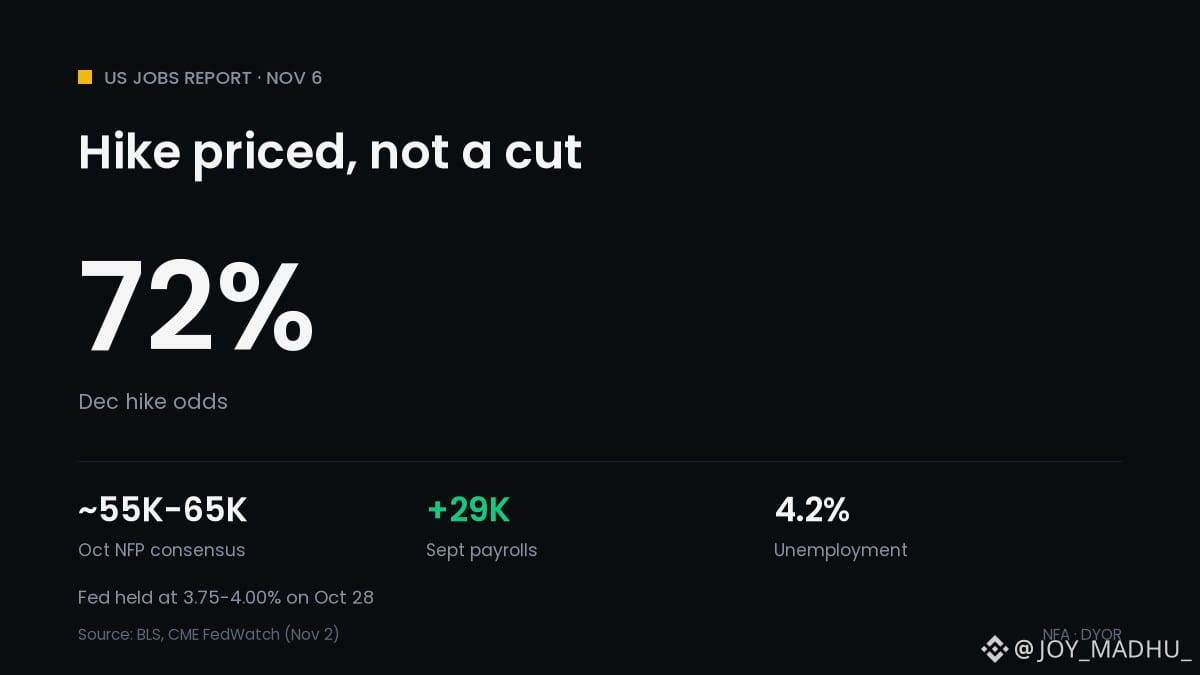
🇺🇸 October Jobs Report: Markets Price a Hike, Not a Cut
📅 The October jobs report lands Friday, Nov 6, at 8:30 AM ET
📊 Consensus is roughly 55K-65K new jobs, with unemployment holding at 4.2%
📉 September added only 29K jobs vs 84K expected, and July-August were revised down by 60K combined
💵 Wage growth was just 0.1% in September; forecasters expect about 0.3% for October
🏦 The Fed held at 3.75-4.00% on Oct 28, with two officials voting for a hike
⚠️ CME FedWatch shows about 72% odds of a December hike and 28% for a hold, with no cut priced
What it means for crypto: a strong print could lift yields and the dollar, a headwind for $BTC. A weak one could cool hike bets, but with inflation still elevated, a cut looks unlikely for now.
Hot or cold jobs number on Friday? 👇
$BTC $ETH
#CryptoNews #Fed #NFP #USOctoberNFP-AreRateCutsStillPossible
#USOctoberNFP-AreRateCutsStillPossible
🇺🇸 October Jobs Report: Markets Price a Hike, Not a Cut
📅 The October jobs report lands Friday, Nov 6, at 8:30 AM ET
📊 Consensus is roughly 55K-65K new jobs, with unemployment holding at 4.2%
📉 September added only 29K jobs vs 84K expected, and July-August were revised down by 60K combined
💵 Wage growth was just 0.1% in September; forecasters expect about 0.3% for October
🏦 The Fed held at 3.75-4.00% on Oct 28, with two officials voting for a hike
⚠️ CME FedWatch shows about 72% odds of a December hike and 28% for a hold, with no cut priced
What it means for crypto: a strong print could lift yields and the dollar, a headwind for $BTC . A weak one could cool hike bets, but with inflation still elevated, a cut looks unlikely for now.
Hot or cold jobs number on Friday? 👇
$BTC $ETH
#CryptoNews #Fed #NFP #USOctoberNFP-AreRateCutsStillPossible


The latest US October Non-Farm Payrolls (NFP) data has been released, and the market is closely watching to see if this influences the possibility of future interest rate cuts. Stronger-than-expected job growth could signal continued economic resilience, potentially leading central banks to maintain a tighter monetary policy for longer. Conversely, a weaker report might increase the likelihood of rate adjustments sooner rather than later. This data point is crucial for understanding the near-term direction of monetary policy and its subsequent effects on crypto markets, including assets like $BTC and $ETH.
Traders and investors are scrutinizing these figures to gauge the Federal Reserve's next move. The interplay between labor market strength and inflation expectations remains a key determinant in the rate cut narrative. A sustained period of robust job creation could dampen hopes for immediate easing, while any signs of cooling in the labor market might reignite discussions around rate cuts.
This economic indicator plays a significant role in shaping market sentiment and investment strategies across all asset classes, including digital assets.
#USOctoberNFP-AreRateCutsStillPossible $BTC $ETH
The latest US October Non-Farm Payrolls (NFP) data has been released, and the market is closely watching to see if this influences the possibility of future interest rate cuts. Stronger-than-expected job growth could signal continued economic resilience, potentially leading central banks to maintain a tighter monetary policy for longer. Conversely, a weaker report might increase the likelihood of rate adjustments sooner rather than later. This data point is crucial for understanding the near-term direction of monetary policy and its subsequent effects on crypto markets, including assets like $BTC and $ETH .
Traders and investors are scrutinizing these figures to gauge the Federal Reserve's next move. The interplay between labor market strength and inflation expectations remains a key determinant in the rate cut narrative. A sustained period of robust job creation could dampen hopes for immediate easing, while any signs of cooling in the labor market might reignite discussions around rate cuts.
This economic indicator plays a significant role in shaping market sentiment and investment strategies across all asset classes, including digital assets.
#USOctoberNFP-AreRateCutsStillPossible $BTC $ETH
80

·
--
📰 Why Has U.S. Jobs Data Become a “Cash Machine” for Crypto?
The U.S. Department of Labor will release its October employment reports on November 3 and 6. The data drawing the most market attention are the nonfarm payrolls and wage growth figures, due on the 6th. These figures not only influence the Federal Reserve’s interest rate decisions, but have also unexpectedly become a “barometer” for the crypto market. Strong data could boost expectations of Fed rate hikes and weigh on risk assets, while weaker-than-expected data could lift market sentiment and temporarily benefit cryptocurrencies. For BTC and ETH, how the market digests the report’s “details” matters more than any single headline figure.
Why does this news matter?
This jobs report matters because it reveals the true health of the U.S. economy, a key factor in the Federal Reserve’s monetary policy decisions. The pace of Fed rate hikes directly affects the strength of the U.S. dollar and, in turn, global capital flows. As risk-sensitive assets, cryptocurrencies are highly responsive to the Fed’s policy direction. Historical data show that when employment figures exceed expectations, rate hike expectations tend to rise, potentially strengthening the dollar and putting pressure on global equities and other risk assets. Conversely, weaker-than-expected employment data may lead markets to expect the Fed to slow the pace of tightening, potentially benefiting risk assets in the short term. For crypto, this means the report’s “details” are crucial. For example, strong job growth alongside weak wage growth could signal an overheated economy but insufficient purchasing power, which may not necessarily sustain expectations for more aggressive Fed rate hikes. Conversely, if both employment and wage figures improve, that could reinforce expectations of continued Fed tightening. This means the market needs to pay attention both to the data itself and to how it interprets the figures.
Market impact
U.S. employment data affect the crypto market primarily through the following channels:
1. **Fed expectations**: Employment data directly shape market expectations for the scale of Fed rate hikes. If the figures are strong, markets may expect another rate hike in December or a longer hiking cycle. The dollar could strengthen, and capital could flow out of risk assets, including cryptocurrencies.
2. **Shifts in risk appetite**: Employment figures directly affect market risk appetite. Strong data could make investors more concerned about asset bubbles and less willing to allocate funds to highly volatile assets such as cryptocurrencies.
3. **Capital flow indicators**: Weaker-than-expected employment data could spark concerns about an economic slowdown. Some capital may flow out of traditional assets such as stocks in search of safe havens or in anticipation of looser policy, potentially benefiting cryptocurrencies temporarily. Historically, however, these inflows have often been short-lived because cryptocurrencies lack fundamental support.
For BTC and ETH specifically, if the market has already fully priced in expectations of Fed rate hikes, the employment data may affect short-term sentiment more than alter the medium- to long-term trend. But if the data differ sharply from market expectations, they could trigger significant short-term volatility. For example, if employment figures far exceed expectations and strengthen expectations of a 75-basis-point Fed rate hike in December, BTC could come under pressure and fall toward $74,000. Conversely, if the data fall short of expectations and markets anticipate a slower pace of tightening, BTC could briefly rebound to $77,500. Historically, though, cryptocurrencies’ reactions to macroeconomic events like these have often been short-lived, as their prices are driven more by fundamentals and technical factors.
Trading approach
The report is likely to affect cryptocurrencies mainly through sentiment and could increase volatility in the short term. BTC may choose a direction within the $74,000–$77,000 range, but this outlook would be invalidated if the Fed holds its December hike at 50 basis points or if the employment data are merely average. Simply put: if stronger-than-expected employment data lead the Fed to continue raising rates, BTC could fall toward $74,000; if the data fall short of expectations and the market anticipates slower tightening, BTC could briefly rebound to $77,500.
This article is not sponsored by any project, and the author does not hold any of the assets mentioned.
$BTC $ETH #BTC #ETH
⚠️ This is not investment advice. Forecasts are for reference only.
#USOctoberNFP-AreRateCutsStillPossible
$BNB



242

🚨 CRYPTO NEWS: BINANCE, UNISWAP & SOLANA IN FOCUS
🔶 1. BINANCE RESTORES 28 FIAT WITHDRAWAL OPTIONS
Binance has expanded fiat withdrawals to 28 currencies following the reported $6.3B cyberattack linked to North Korea’s TraderTraitor group. Reported outflows have reached $3.64B as services gradually resume. Users are watching reserve transparency and withdrawal access closely.
⚖️ 2. UNISWAP & a16z CHALLENGE ILLINOIS CRYPTO TAX RULES
Uniswap Labs, a16z, and the DeFi Education Fund oppose proposed rules involving a 0.2% tax on digital-asset transactions. They warn that applying broker obligations to decentralized protocols could threaten DeFi innovation.
🌐 3. HKDAP STABLECOIN HEADS TO SOLANA
Anchorpoint Financial Technology is partnering with the Solana Foundation to bring HKDAP, a Hong Kong dollar-pegged stablecoin, to Solana, potentially supporting faster, lower-cost digital payments and tokenized asset applications.
📊 4. MACRO WATCH: US MIDTERMS & NFP
US labor-market data, Federal Reserve rate expectations, and the upcoming midterm elections could influence crypto liquidity, investor sentiment, and regulatory policy. The direction of future rate decisions remains uncertain.
🔍 KEY TAKEAWAY: Exchange transparency, DeFi regulation, stablecoin adoption, and US macroeconomic policy remain major factors for crypto markets.
⚠️ Risk Disclaimer: For educational purposes only. Not financial advice. Verify official announcements, withdrawal availability, and reserve disclosures before making financial decisions.
#BinanceRestores28FiatWithdrawals #Verify1to1BinanceReserves #USMidtermElections #USOctoberNFP #Solana #HKDAP #Web3 #BinanceSquare #CryptoTax #Uniswap #a16z #DeFi

1
80
·
--
The latest data show that U.S. nonfarm payrolls rose by 263,000 in September, exceeding market expectations of 225,000, while the unemployment rate remained at a historic low of 3.7%. These strong jobs data have intensified market doubts about the Federal Reserve cutting interest rates. Although inflation has fallen from 9% at the beginning of the year to 7.7% currently, the Fed still needs to weigh the risks of an overheating economy and easing inflation. Economists predict that if the October nonfarm payrolls report remains strong, the likelihood of a Fed rate cut in December will fall below 25%. In addition, Wall Street analysts point out that if November ADP employment data also remain elevated, market bets on rate cuts will decline further. At present, only 30% of the 170 economists surveyed by Bloomberg believe the Fed will cut rates this year. #USOctoberNFP-AreRateCutsStillPossible
$BTC
$BTC
152

·
--
Seven fifty-nine. I only dragged myself out of bed after the alarm went off for the second time. My phone probably lit up first.
Still holding the same position as yesterday. ETH is still weighing on me, and I haven’t made a move.
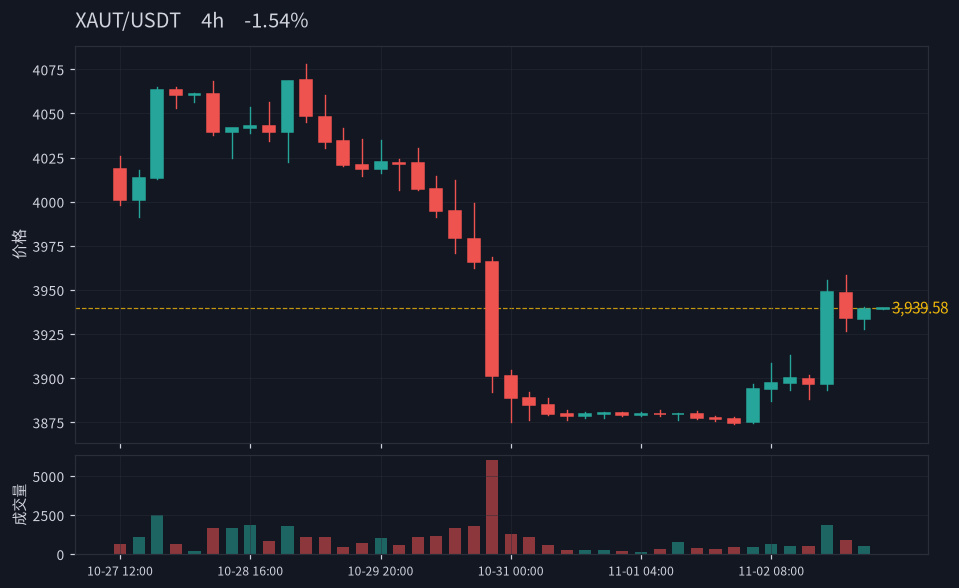
The system’s 4-hour signal is still leaning bearish. Last night, the price got pushed down from 2318 all the way to 2237; it’s at 2253 now, down 1% in 24 hours. I raised my hand to add to my position, then put it back down. Honestly, I chickened out.
I saw a discussion this morning about whether rate cuts are still possible after the nonfarm payrolls report, and that told me all I needed to know. Honestly, when rate-cut expectations cool, risk assets get hit first—and ETH, being so closely tied to macro conditions, is no exception. The long I opened near 2310 the day before yesterday is still sitting on an unrealized loss. I didn’t cut it. That’s my bad habit, and I own it.
SOL has also been drifting down over the past couple of days. There are noticeably fewer people in the group calling for a dip-buying opportunity. Once the buzz dies down, it actually feels more like we haven’t hit the bottom yet.
At this level, would you cut half and wait for the news to land, or keep your core position and tough it out?
#USOctoberNFP-AreRateCutsStillPossible #₿ BTC $XAUT $BTC
231

·
--
Macro noise on $NFP means nothing right now 📉
People chase headlines while price sits at 0.001810 after dropping hard
Volume sits near 3.8M and that heavy red move changes the game for short term entries
Staying flat here and watching how the range holds near 0.001680
A massive bounce past 0.005700 would prove this read completely wrong
Do not take my word for it, tap $NFP and look at the candles
Agree?
#USOctoberNFP-AreRateCutsStillPossible #NFP
2
·
--
Macro noise barely touches $NFP after that drop
Everyone blames jobs data for rate cuts while ignoring the chart
Price sits at 0.001810 after hitting a low of 0.001680 today
Traders should wait for a real base instead of guessing macro turns
Watching from the sidelines until volume stabilizes above recent ranges
A daily close back near 0.005700 would prove this read completely wrong
Tap $NFP and check the hourly chart yourself
Agree or disagree
#USOctoberNFP-AreRateCutsStillPossible #NFP
Log in to explore more content
Join global crypto users on Binance Square
⚡️ Get latest and useful information about crypto.
💬 Trusted by the world’s largest crypto exchange.
👍 Discover real insights from verified creators.
Email / Phone number
Trending Topics
1
#BinanceReopensWithdrawalsForMoreAssets
20,964 views
594 Discussing
2
#AppleReportsMixedResults
14,352 views
447 Discussing
3
#BinanceHourlyDepositsExceedWithdrawals
2,557 views
130 Discussing
4
#PalantirSlides3PercentOn$2BRevenue
150 views
8 Discussing
5
#USMidtermElections
711,579 views
3,864 Discussing
6
#USOctoberNFP-AreRateCutsStillPossible
107,890 views
907 Discussing
7
#Verify1to1BinanceReserves
97,358 views
674 Discussing
8
#SBIFirstHalfCryptoRevenueFalls30.1%
464 views
16 Discussing
9
#NEARVoteApprovesCutInMaxAnnualIssuanceTo1.6%
3,537 views
30 Discussing
10
#BinanceRestores28FiatWithdrawals
248,516 views
1,342 Discussing