

#us30yearyieldhighestsince2004
us30yearyieldhighestsince2004
Hot
Latest

·
--
Bearish
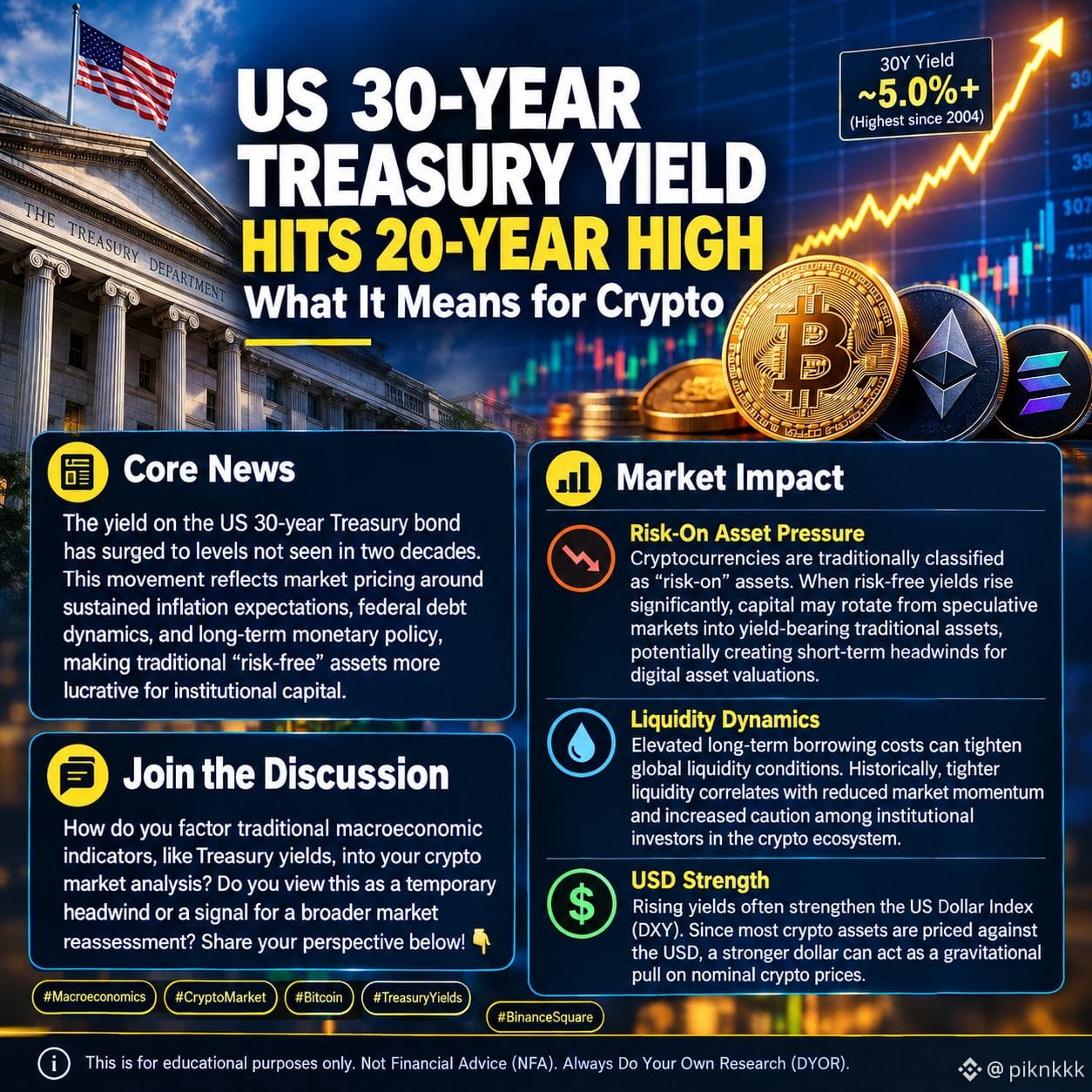
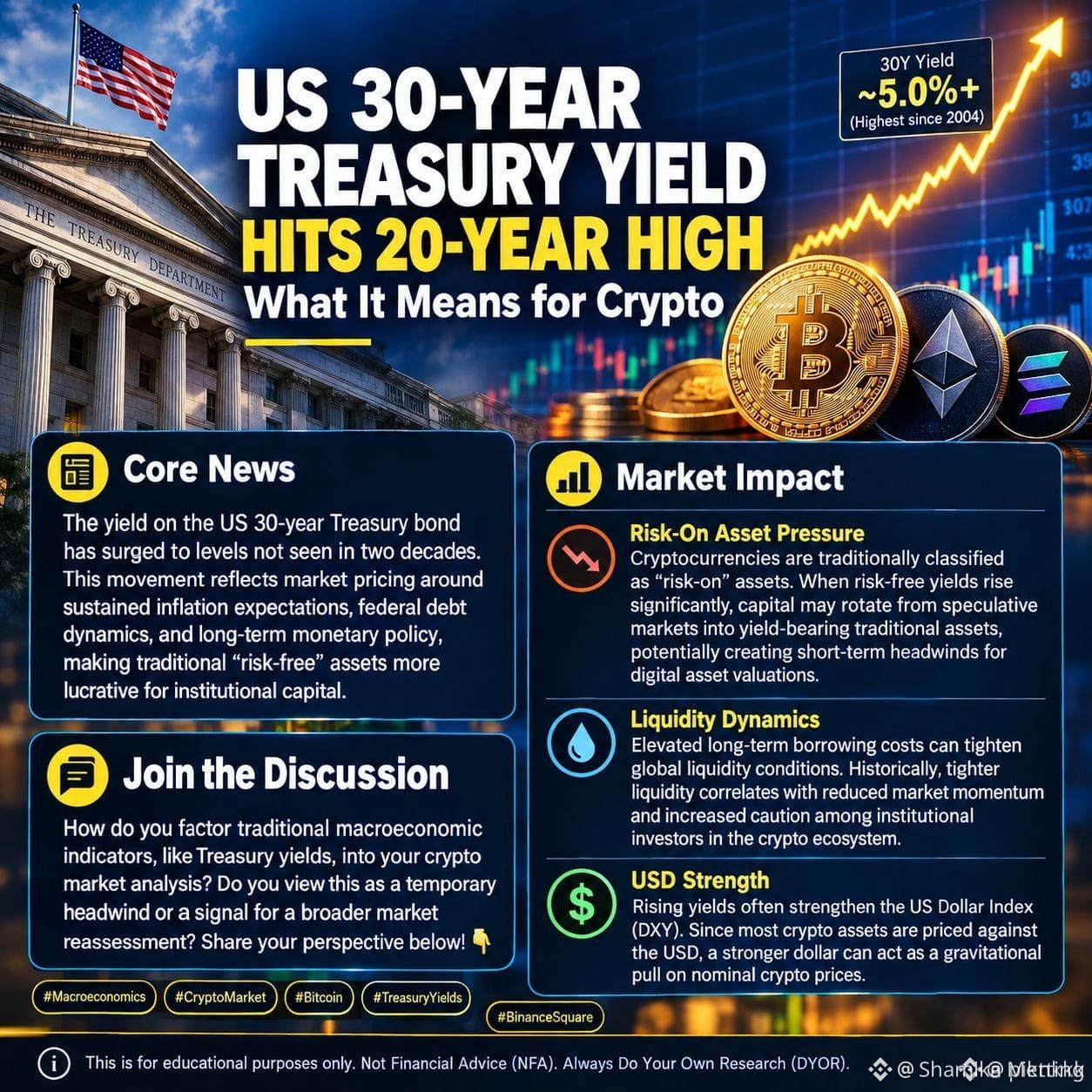
#us30yearyieldhighestsince2004 📉 US 30-Year Treasury Yield Hits 20-Year High: What It Means for Crypto
The US 30-year Treasury yield has climbed to its highest level since 2004. Here is an objective breakdown of how this major macroeconomic shift could influence the digital asset landscape.
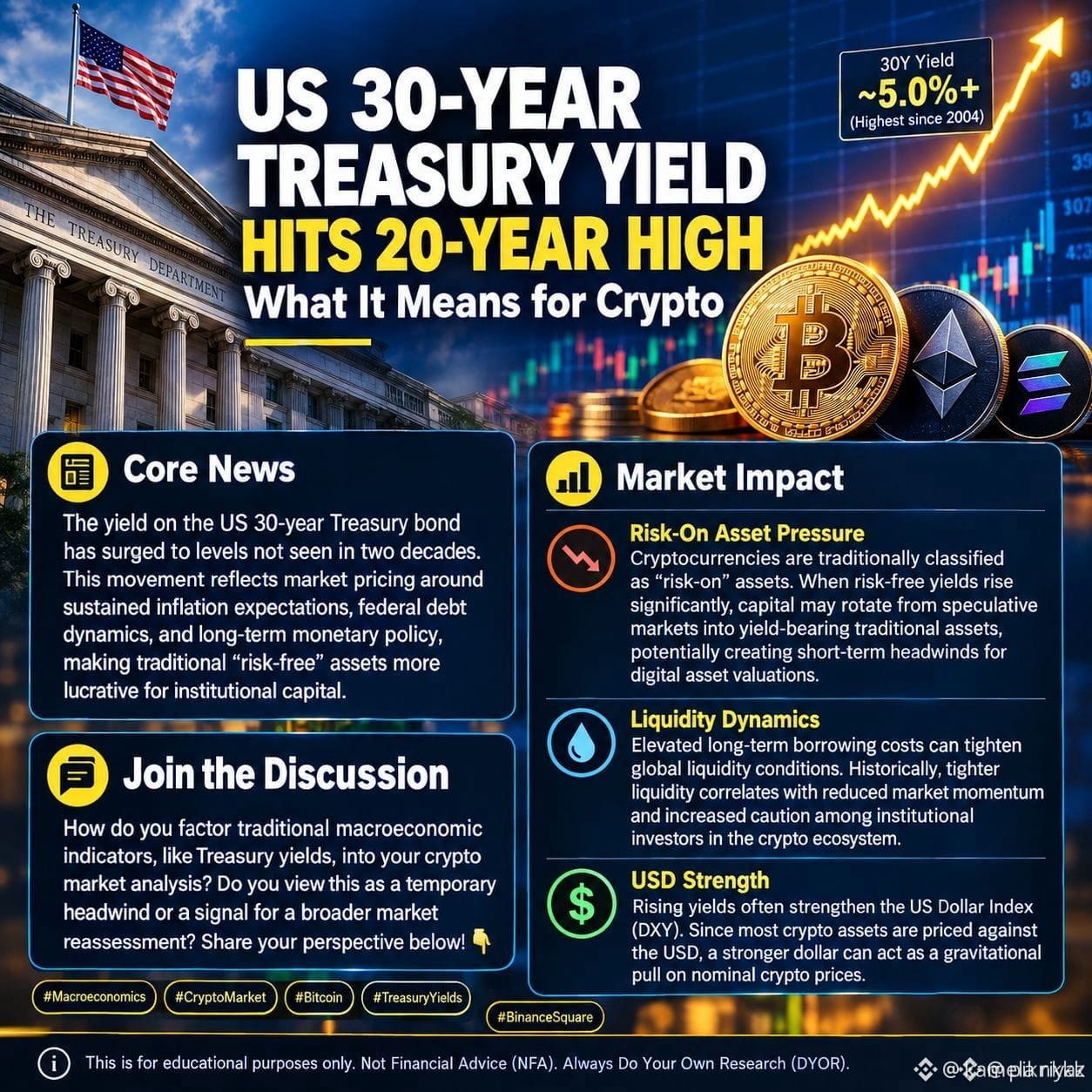
📰 Core News
The yield on the US 30-year Treasury bond has surged to levels not seen in two decades. This movement reflects market pricing around sustained inflation expectations, federal debt dynamics, and long-term monetary policy, making traditional "risk-free" assets more lucrative for institutional capital.
📊 Market Impact
🔹Risk-On Asset Pressure Cryptocurrencies are traditionally classified as "risk-on" assets. When risk-free yields rise significantly, capital may rotate from speculative markets into yield-bearing traditional assets, potentially creating short-term headwinds for digital asset valuations.
🔹 Liquidity Dynamics Elevated long-term borrowing costs can tighten global liquidity conditions. Historically, tighter liquidity correlates with reduced market momentum and increased caution among institutional investors in the crypto ecosystem.
🔹 USD Strength Rising yields often strengthen the US Dollar Index (DXY). Since most crypto assets are priced against the USD, a stronger dollar can act as a gravitational pull on nominal crypto prices.
💬 Join the Discussion
How do you factor traditional macroeconomic indicators, like Treasury yields, into your crypto market analysis? Do you view this as a temporary headwind or a signal for a broader market reassessment? Share your perspective below! 👇
#Macroeconomics #CryptoMarket #Bitcoin #TreasuryYields #BinanceSquare
This is for educational purposes only. Not Financial Advice (NFA). Always Do Your Own Research (DYOR).
$MET $EPIC $RONIN
{future}(RONINUSDT)
{future}(EPICUSDT)
{future}(METUSDT)
#us30yearyieldhighestsince2004 📉 US 30-Year Treasury Yield Hits 20-Year High: What It Means for Crypto
The US 30-year Treasury yield has climbed to its highest level since 2004. Here is an objective breakdown of how this major macroeconomic shift could influence the digital asset landscape.
📰 Core News
The yield on the US 30-year Treasury bond has surged to levels not seen in two decades. This movement reflects market pricing around sustained inflation expectations, federal debt dynamics, and long-term monetary policy, making traditional "risk-free" assets more lucrative for institutional capital.
📊 Market Impact
🔹Risk-On Asset Pressure Cryptocurrencies are traditionally classified as "risk-on" assets. When risk-free yields rise significantly, capital may rotate from speculative markets into yield-bearing traditional assets, potentially creating short-term headwinds for digital asset valuations.
🔹 Liquidity Dynamics Elevated long-term borrowing costs can tighten global liquidity conditions. Historically, tighter liquidity correlates with reduced market momentum and increased caution among institutional investors in the crypto ecosystem.
🔹 USD Strength Rising yields often strengthen the US Dollar Index (DXY). Since most crypto assets are priced against the USD, a stronger dollar can act as a gravitational pull on nominal crypto prices.
💬 Join the Discussion
How do you factor traditional macroeconomic indicators, like Treasury yields, into your crypto market analysis? Do you view this as a temporary headwind or a signal for a broader market reassessment? Share your perspective below! 👇
#Macroeconomics #CryptoMarket #Bitcoin #TreasuryYields #BinanceSquare
This is for educational purposes only. Not Financial Advice (NFA). Always Do Your Own Research (DYOR).
$MET $EPIC $RONIN
The US 30-year Treasury yield has climbed to its highest level since 2004. Here is an objective breakdown of how this major macroeconomic shift could influence the digital asset landscape.
📰 Core News
The yield on the US 30-year Treasury bond has surged to levels not seen in two decades. This movement reflects market pricing around sustained inflation expectations, federal debt dynamics, and long-term monetary policy, making traditional "risk-free" assets more lucrative for institutional capital.
📊 Market Impact
🔹Risk-On Asset Pressure Cryptocurrencies are traditionally classified as "risk-on" assets. When risk-free yields rise significantly, capital may rotate from speculative markets into yield-bearing traditional assets, potentially creating short-term headwinds for digital asset valuations.
🔹 Liquidity Dynamics Elevated long-term borrowing costs can tighten global liquidity conditions. Historically, tighter liquidity correlates with reduced market momentum and increased caution among institutional investors in the crypto ecosystem.
🔹 USD Strength Rising yields often strengthen the US Dollar Index (DXY). Since most crypto assets are priced against the USD, a stronger dollar can act as a gravitational pull on nominal crypto prices.
💬 Join the Discussion
How do you factor traditional macroeconomic indicators, like Treasury yields, into your crypto market analysis? Do you view this as a temporary headwind or a signal for a broader market reassessment? Share your perspective below! 👇
#Macroeconomics #CryptoMarket #Bitcoin #TreasuryYields #BinanceSquare
This is for educational purposes only. Not Financial Advice (NFA). Always Do Your Own Research (DYOR).
$MET $EPIC $RONIN
1
5.6k

·
--
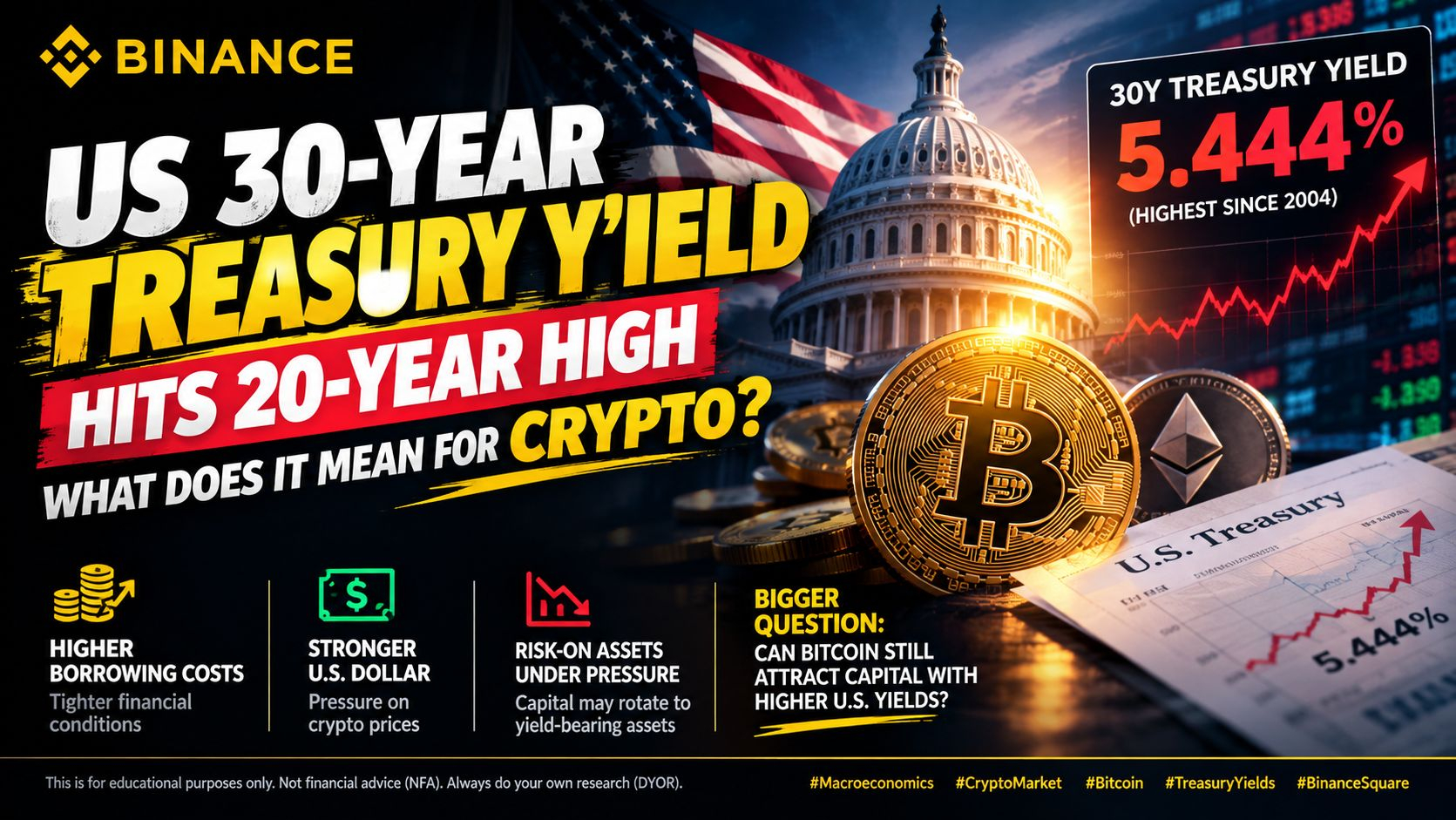
#us30yearyieldhighestsince2004 US 30-Year Treasury Yield Hits 20-Year High — What Does It Mean for Crypto?
The U.S. bond market is sending a major macro signal.
The 30-year U.S. Treasury yield climbed to 5.444%, reaching its highest level since 2004, as the long-end bond selloff intensified.
For crypto investors, this matters because Treasury yields influence borrowing costs, financial conditions, the U.S. dollar and the relative attractiveness of traditional assets.
📊 Why Are Treasury Yields Rising?
Recent market pressure has been linked to several factors, including:
🔹 Strong U.S. economic growth
Resilient economic data has reduced expectations for a rapid decline in borrowing costs.
🔹 Inflation pressures
Higher energy prices and renewed inflation concerns are contributing to expectations that interest rates could remain elevated for longer.
🔹 Government debt and borrowing needs
Investors are demanding more compensation to hold longer-duration U.S. debt, adding pressure to long-term yields.
₿ What Could This Mean for Bitcoin & Crypto?
1️⃣ Higher opportunity cost
When Treasury yields rise, investors can earn higher returns from traditional dollar-denominated assets. That can make speculative assets such as cryptocurrencies relatively less attractive to some institutional investors.
2️⃣ Tighter financial conditions
Higher long-term yields increase borrowing costs across the economy. Reuters notes that rising Treasury yields can tighten financial conditions globally.
For crypto, tighter liquidity conditions can become a headwind for speculative positioning — although the relationship is not automatic and can vary across market cycles.
That will be an important macro factor to watch in the weeks ahead.
⚠️ Educational content only. Not financial advice (NFA). Always do your own research (DYOR).
#Bitcoin #BTC #Crypto #Macroeconomics #TreasuryYields #US30YearYield #CryptoMarket #FederalReserve #BinanceSquare
$METAB $EPIC $RONIN
#us30yearyieldhighestsince2004 US 30-Year Treasury Yield Hits 20-Year High — What Does It Mean for Crypto?
The U.S. bond market is sending a major macro signal.
The 30-year U.S. Treasury yield climbed to 5.444%, reaching its highest level since 2004, as the long-end bond selloff intensified.
For crypto investors, this matters because Treasury yields influence borrowing costs, financial conditions, the U.S. dollar and the relative attractiveness of traditional assets.
📊 Why Are Treasury Yields Rising?
Recent market pressure has been linked to several factors, including:
🔹 Strong U.S. economic growth
Resilient economic data has reduced expectations for a rapid decline in borrowing costs.
🔹 Inflation pressures
Higher energy prices and renewed inflation concerns are contributing to expectations that interest rates could remain elevated for longer.
🔹 Government debt and borrowing needs
Investors are demanding more compensation to hold longer-duration U.S. debt, adding pressure to long-term yields.
₿ What Could This Mean for Bitcoin & Crypto?
1️⃣ Higher opportunity cost
When Treasury yields rise, investors can earn higher returns from traditional dollar-denominated assets. That can make speculative assets such as cryptocurrencies relatively less attractive to some institutional investors.
2️⃣ Tighter financial conditions
Higher long-term yields increase borrowing costs across the economy. Reuters notes that rising Treasury yields can tighten financial conditions globally.
For crypto, tighter liquidity conditions can become a headwind for speculative positioning — although the relationship is not automatic and can vary across market cycles.
That will be an important macro factor to watch in the weeks ahead.
⚠️ Educational content only. Not financial advice (NFA). Always do your own research (DYOR).
#Bitcoin #BTC #Crypto #Macroeconomics #TreasuryYields #US30YearYield #CryptoMarket #FederalReserve #BinanceSquare
$METAB $EPIC $RONIN
The U.S. bond market is sending a major macro signal.
The 30-year U.S. Treasury yield climbed to 5.444%, reaching its highest level since 2004, as the long-end bond selloff intensified.
For crypto investors, this matters because Treasury yields influence borrowing costs, financial conditions, the U.S. dollar and the relative attractiveness of traditional assets.
📊 Why Are Treasury Yields Rising?
Recent market pressure has been linked to several factors, including:
🔹 Strong U.S. economic growth
Resilient economic data has reduced expectations for a rapid decline in borrowing costs.
🔹 Inflation pressures
Higher energy prices and renewed inflation concerns are contributing to expectations that interest rates could remain elevated for longer.
🔹 Government debt and borrowing needs
Investors are demanding more compensation to hold longer-duration U.S. debt, adding pressure to long-term yields.
₿ What Could This Mean for Bitcoin & Crypto?
1️⃣ Higher opportunity cost
When Treasury yields rise, investors can earn higher returns from traditional dollar-denominated assets. That can make speculative assets such as cryptocurrencies relatively less attractive to some institutional investors.
2️⃣ Tighter financial conditions
Higher long-term yields increase borrowing costs across the economy. Reuters notes that rising Treasury yields can tighten financial conditions globally.
For crypto, tighter liquidity conditions can become a headwind for speculative positioning — although the relationship is not automatic and can vary across market cycles.
That will be an important macro factor to watch in the weeks ahead.
⚠️ Educational content only. Not financial advice (NFA). Always do your own research (DYOR).
#Bitcoin #BTC #Crypto #Macroeconomics #TreasuryYields #US30YearYield #CryptoMarket #FederalReserve #BinanceSquare
$METAB $EPIC $RONIN
3
7.7k

#us30yearyieldhighestsince2004
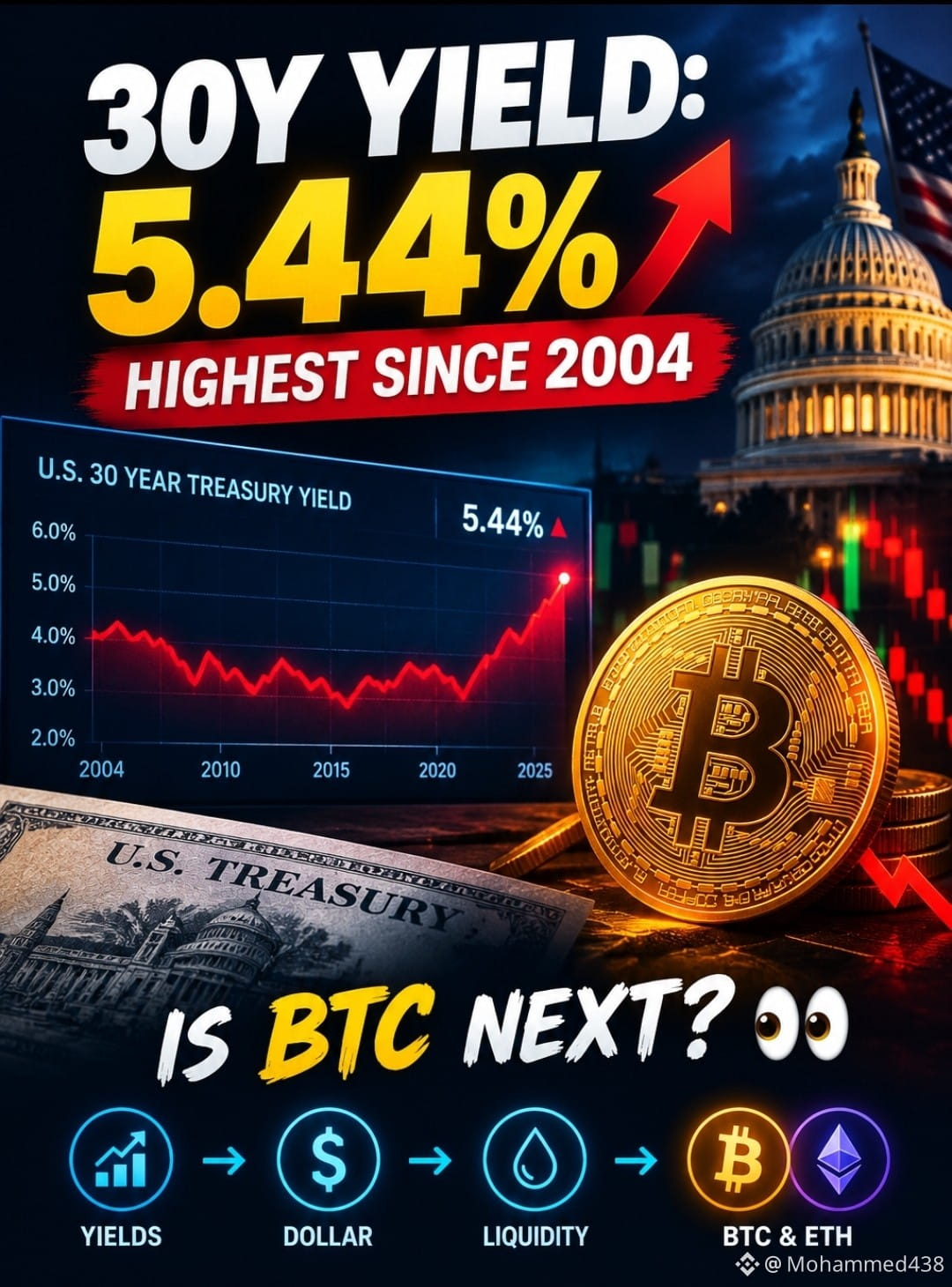
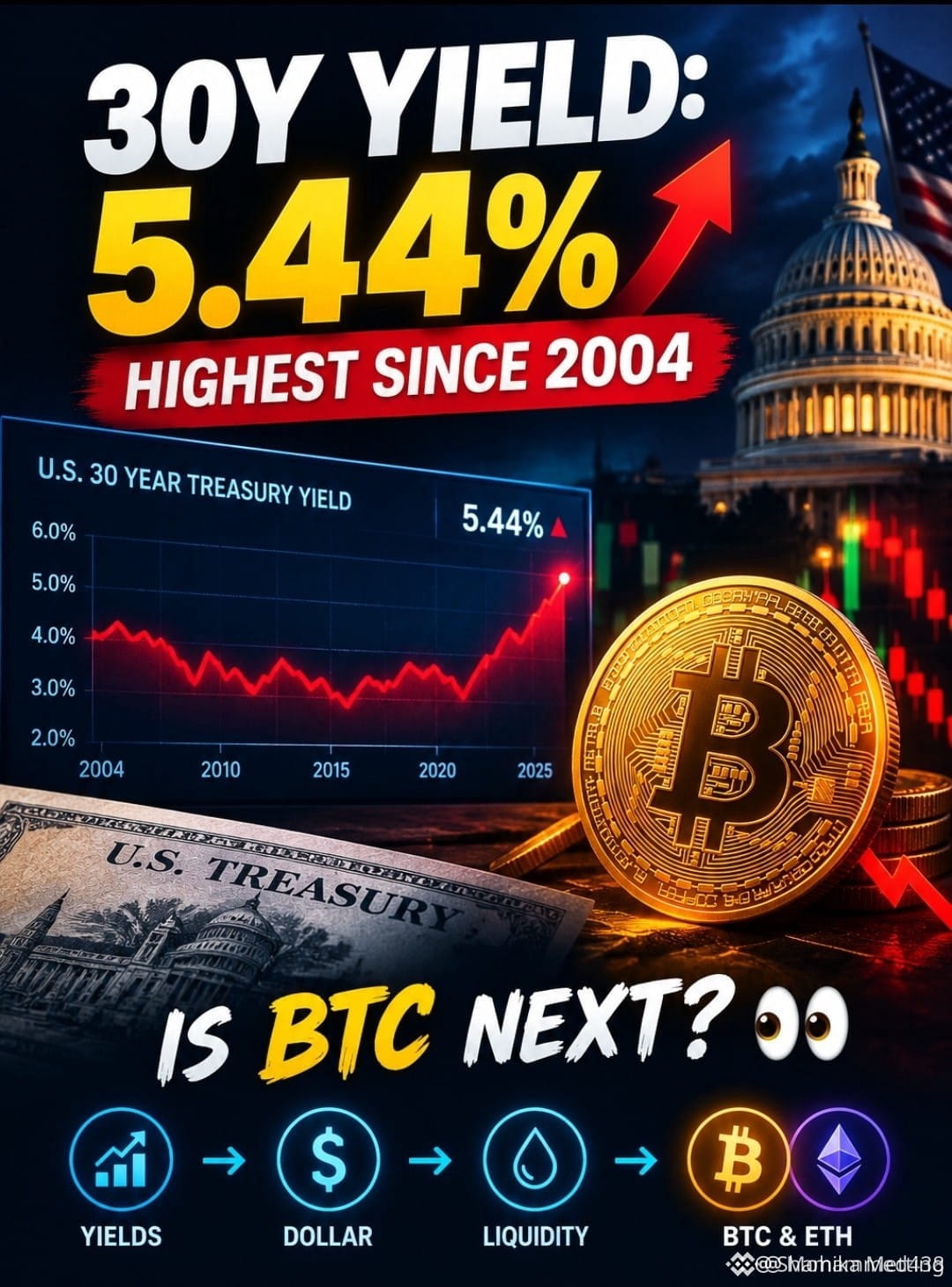
🚨 30-Year Yield Hits Highest Level Since 2004… Is BTC Next? 👀
The U.S. 30-year Treasury yield has climbed to around 5.44%, reaching its highest level since 2004.
But here’s the real question: Higher long-term yields can tighten financial conditions, reduce risk appetite, and put pressure on high-risk assets like crypto.
So I’m watching the chain closely: Yields - Dollar - Liquidity - BTC & ETH
If yields keep rising, Bitcoin could become even more sensitive to changes in liquidity and risk sentiment.
The signal started in the bond market… but could it spread to crypto?
#TreasuryYields #BTC #ETH #Crypto
$BTC
{future}(BTCUSDT)
$ETH
{future}(ETHUSDT)
#us30yearyieldhighestsince2004
🚨 30-Year Yield Hits Highest Level Since 2004… Is BTC Next? 👀
The U.S. 30-year Treasury yield has climbed to around 5.44%, reaching its highest level since 2004.
But here’s the real question: Higher long-term yields can tighten financial conditions, reduce risk appetite, and put pressure on high-risk assets like crypto.
So I’m watching the chain closely: Yields - Dollar - Liquidity - BTC & ETH
If yields keep rising, Bitcoin could become even more sensitive to changes in liquidity and risk sentiment.
The signal started in the bond market… but could it spread to crypto?
#TreasuryYields #BTC #ETH #Crypto
$BTC
$ETH
🚨 30-Year Yield Hits Highest Level Since 2004… Is BTC Next? 👀
The U.S. 30-year Treasury yield has climbed to around 5.44%, reaching its highest level since 2004.
But here’s the real question: Higher long-term yields can tighten financial conditions, reduce risk appetite, and put pressure on high-risk assets like crypto.
So I’m watching the chain closely: Yields - Dollar - Liquidity - BTC & ETH
If yields keep rising, Bitcoin could become even more sensitive to changes in liquidity and risk sentiment.
The signal started in the bond market… but could it spread to crypto?
#TreasuryYields #BTC #ETH #Crypto
$BTC
$ETH
1
1.6k

·
--
#us30yearyieldhighestsince2004
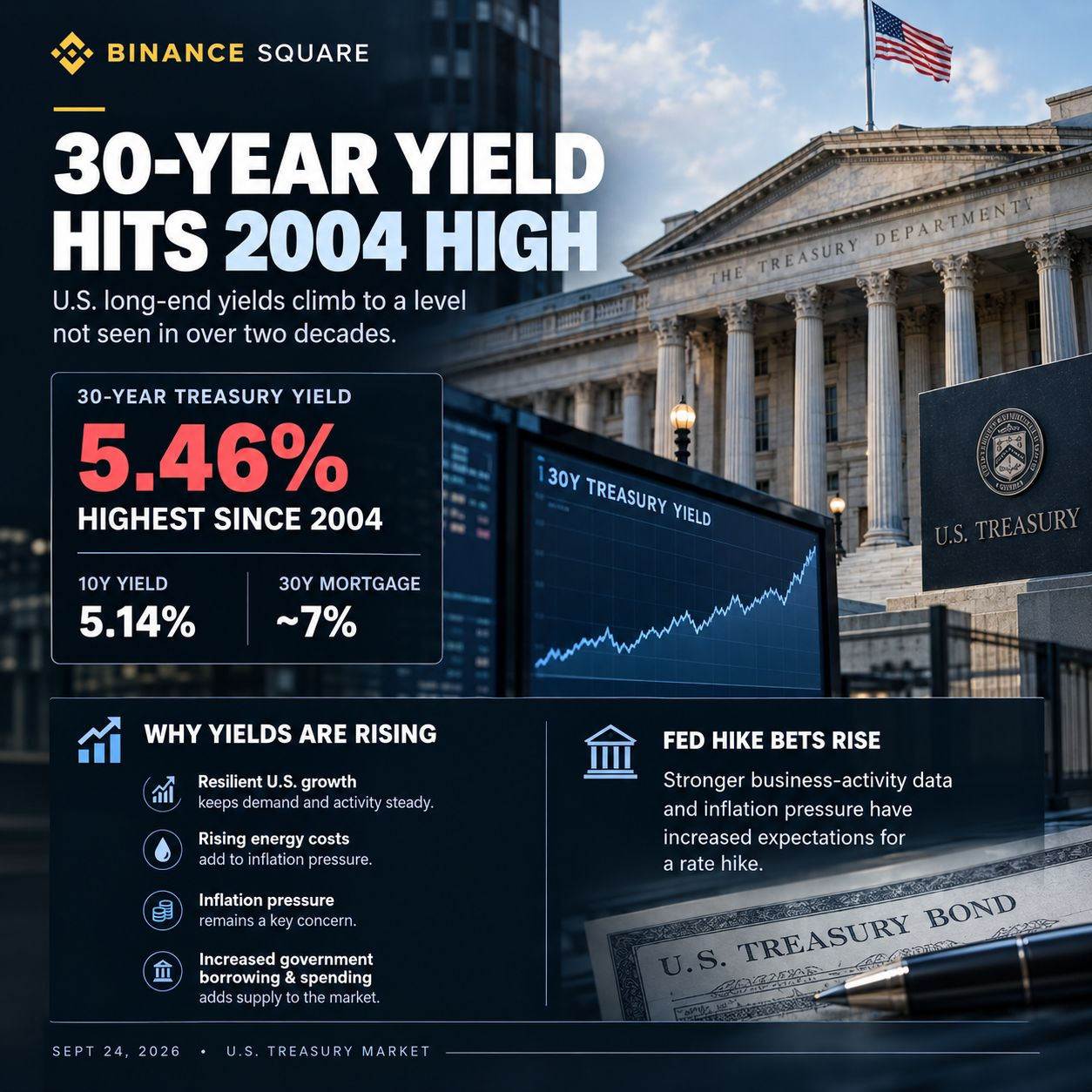
The U.S. 30-year Treasury yield just hit a level markets haven't seen since 2004.
It briefly climbed above 5.46%, extending the bond selloff and reaching its highest level in more than two decades.
But here's the part I think matters for crypto:
This isn't only about what the Fed does at its next meeting.
The 30-year yield reflects the market's longer-term cost of money — including expectations around inflation, economic growth and the amount of government borrowing investors need to absorb.
And when long-term yields rise this far, the hurdle for risk assets gets higher.
That's why I'd watch Treasury yields alongside $BTC, rather than treating Bitcoin's move in isolation.
The key question now is whether these elevated yields stabilize — or continue repricing financial conditions.
$BTC
{spot}(BTCUSDT)
#bitcoin #TreasuryYields #Macro
#us30yearyieldhighestsince2004
The U.S. 30-year Treasury yield just hit a level markets haven't seen since 2004.
It briefly climbed above 5.46%, extending the bond selloff and reaching its highest level in more than two decades.
But here's the part I think matters for crypto:
This isn't only about what the Fed does at its next meeting.
The 30-year yield reflects the market's longer-term cost of money — including expectations around inflation, economic growth and the amount of government borrowing investors need to absorb.
And when long-term yields rise this far, the hurdle for risk assets gets higher.
That's why I'd watch Treasury yields alongside $BTC , rather than treating Bitcoin's move in isolation.
The key question now is whether these elevated yields stabilize — or continue repricing financial conditions.
$BTC
#bitcoin #TreasuryYields #Macro
The U.S. 30-year Treasury yield just hit a level markets haven't seen since 2004.
It briefly climbed above 5.46%, extending the bond selloff and reaching its highest level in more than two decades.
But here's the part I think matters for crypto:
This isn't only about what the Fed does at its next meeting.
The 30-year yield reflects the market's longer-term cost of money — including expectations around inflation, economic growth and the amount of government borrowing investors need to absorb.
And when long-term yields rise this far, the hurdle for risk assets gets higher.
That's why I'd watch Treasury yields alongside $BTC , rather than treating Bitcoin's move in isolation.
The key question now is whether these elevated yields stabilize — or continue repricing financial conditions.
$BTC
#bitcoin #TreasuryYields #Macro
BTC-0.07%
TLTETF+0.04%
76


The US 30-year Treasury yield has reached its highest level since 2004, a significant development that could ripple through financial markets. This surge in long-term borrowing costs for the US government reflects growing inflation expectations and potential future interest rate hikes. For the crypto market, this presents a mixed bag. On one hand, higher yields on safe-haven assets like Treasuries can draw capital away from riskier investments, including cryptocurrencies. On the other hand, persistent inflation fears that drive yields higher might also encourage a continued search for inflation hedges, a role that digital assets like Bitcoin are sometimes seen to play. Traders will be closely watching how this trend impacts liquidity and investor sentiment across all asset classes.
Disclaimer: This is not investment advice.
#US30YearYieldHighestSince2004 $BTC $XRP
The US 30-year Treasury yield has reached its highest level since 2004, a significant development that could ripple through financial markets. This surge in long-term borrowing costs for the US government reflects growing inflation expectations and potential future interest rate hikes. For the crypto market, this presents a mixed bag. On one hand, higher yields on safe-haven assets like Treasuries can draw capital away from riskier investments, including cryptocurrencies. On the other hand, persistent inflation fears that drive yields higher might also encourage a continued search for inflation hedges, a role that digital assets like Bitcoin are sometimes seen to play. Traders will be closely watching how this trend impacts liquidity and investor sentiment across all asset classes.
Disclaimer: This is not investment advice.
#US30YearYieldHighestSince2004 $BTC $XRP
Disclaimer: This is not investment advice.
#US30YearYieldHighestSince2004 $BTC $XRP
TLTETF+0.04%
394

·
--
Bearish
#US30YearYieldHighestSince2004
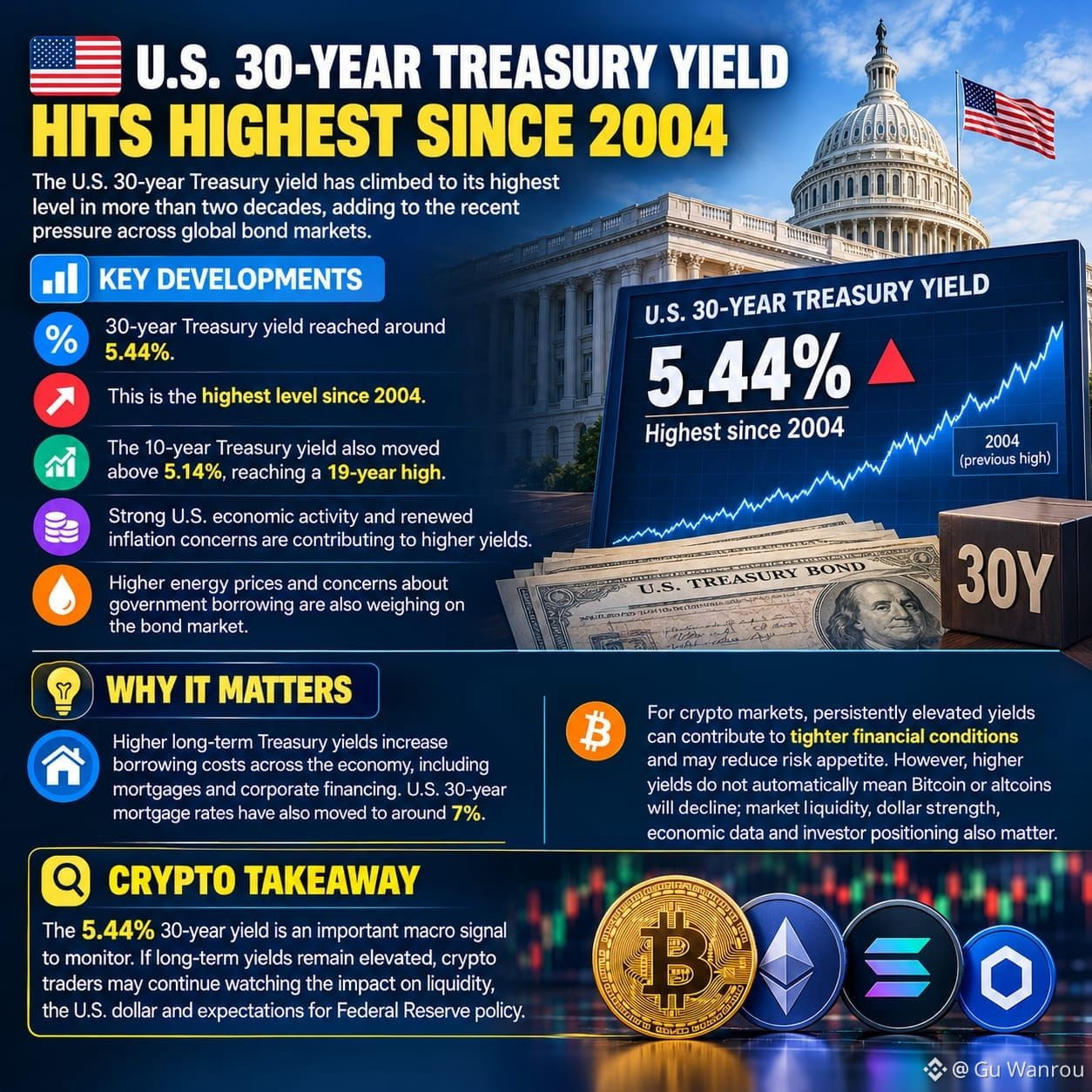
🇺🇸📈 U.S. 30-YEAR TREASURY YIELD HITS HIGHEST SINCE 2004
The U.S. 30-year Treasury yield has climbed to its highest level in more than two decades, adding to the recent pressure across global bond markets.
📊 KEY DEVELOPMENTS:
• 30-year Treasury yield reached around 5.44%
• This is the highest level since 2004
• The 10-year Treasury yield also moved above 5.14%, reaching a 19-year high
• Strong U.S. economic activity and renewed inflation concerns are contributing to higher yields
• Higher energy prices and concerns about government borrowing are also weighing on the bond market
💡 WHY IT MATTERS:
Higher long-term Treasury yields increase borrowing costs across the economy, including mortgages and corporate financing. U.S. 30-year mortgage rates have also moved to around 7%.
For crypto markets, persistently elevated yields can contribute to tighter financial conditions and may reduce risk appetite. However, higher yields do not automatically mean Bitcoin or altcoins will decline; market liquidity, dollar strength, economic data and investor positioning also matter.
🔎 CRYPTO TAKEAWAY:
The 5.44% 30-year yield is an important macro signal to monitor. If long-term yields remain elevated, crypto traders may continue watching the impact on liquidity, the U.S. dollar and expectations for Federal Reserve policy.
⚠️ Disclaimer: This post is for informational purposes only and is not financial advice. Crypto markets are highly volatile. Do your own research before making investment decisions.
$MET
{future}(METUSDT)
$ZRO
{future}(ZROUSDT)
$BCH
{future}(BCHUSDT)
#US30YearYieldHighestSince2004
🇺🇸📈 U.S. 30-YEAR TREASURY YIELD HITS HIGHEST SINCE 2004
The U.S. 30-year Treasury yield has climbed to its highest level in more than two decades, adding to the recent pressure across global bond markets.
📊 KEY DEVELOPMENTS:
• 30-year Treasury yield reached around 5.44%
• This is the highest level since 2004
• The 10-year Treasury yield also moved above 5.14%, reaching a 19-year high
• Strong U.S. economic activity and renewed inflation concerns are contributing to higher yields
• Higher energy prices and concerns about government borrowing are also weighing on the bond market
💡 WHY IT MATTERS:
Higher long-term Treasury yields increase borrowing costs across the economy, including mortgages and corporate financing. U.S. 30-year mortgage rates have also moved to around 7%.
For crypto markets, persistently elevated yields can contribute to tighter financial conditions and may reduce risk appetite. However, higher yields do not automatically mean Bitcoin or altcoins will decline; market liquidity, dollar strength, economic data and investor positioning also matter.
🔎 CRYPTO TAKEAWAY:
The 5.44% 30-year yield is an important macro signal to monitor. If long-term yields remain elevated, crypto traders may continue watching the impact on liquidity, the U.S. dollar and expectations for Federal Reserve policy.
⚠️ Disclaimer: This post is for informational purposes only and is not financial advice. Crypto markets are highly volatile. Do your own research before making investment decisions.
$MET
$ZRO
$BCH
🇺🇸📈 U.S. 30-YEAR TREASURY YIELD HITS HIGHEST SINCE 2004
The U.S. 30-year Treasury yield has climbed to its highest level in more than two decades, adding to the recent pressure across global bond markets.
📊 KEY DEVELOPMENTS:
• 30-year Treasury yield reached around 5.44%
• This is the highest level since 2004
• The 10-year Treasury yield also moved above 5.14%, reaching a 19-year high
• Strong U.S. economic activity and renewed inflation concerns are contributing to higher yields
• Higher energy prices and concerns about government borrowing are also weighing on the bond market
💡 WHY IT MATTERS:
Higher long-term Treasury yields increase borrowing costs across the economy, including mortgages and corporate financing. U.S. 30-year mortgage rates have also moved to around 7%.
For crypto markets, persistently elevated yields can contribute to tighter financial conditions and may reduce risk appetite. However, higher yields do not automatically mean Bitcoin or altcoins will decline; market liquidity, dollar strength, economic data and investor positioning also matter.
🔎 CRYPTO TAKEAWAY:
The 5.44% 30-year yield is an important macro signal to monitor. If long-term yields remain elevated, crypto traders may continue watching the impact on liquidity, the U.S. dollar and expectations for Federal Reserve policy.
⚠️ Disclaimer: This post is for informational purposes only and is not financial advice. Crypto markets are highly volatile. Do your own research before making investment decisions.
$MET
$ZRO
$BCH
TLTETF+0.04%
IEFETF+0.00%
31
·
--
#US30YearYieldHighestSince2004
On September 24, 2026, the U.S. 30-year Treasury yield skyrocketed to 5.46%, its highest intradaylevel since 2004. Driven by a combination of surging crude oil prices over $100 per barrel, hot inflationary pressures from the Middle East war, and resilient domestic economic data, investors are pricing in a 69% probability of another Federal Reserve interest rate hike at the October meeting. This dramatic multi-decade surge in long-term borrowing costs is introducing fresh volatility across stock markets, real estate, and crypto risk assets. [1, 2, 3, 4, 5]
The massive sell-off in long-dated government debt (which pushes yields up) stems from a perfect storm of macroeconomic pressures:
Geopolitical Energy Shocks: The ongoing U.S.-Israel war with Iran has severely disrupted shipping in the Strait of Hormuz, driving Brent crude oil toward $100/barrel. These spiraling energy costs have fanned aggressive global inflation fears. [1, 2, 3]
Booming Economic Data: S&P Global data revealed exceptionally robust U.S. business activity and lower-than-expected jobless claims. This strong backdrop gives the Federal Reserve more leeway to push interest rates even higher.
$AAPLB
{spot}(AAPLBUSDT)
$AT
{future}(ATUSDT)
$SOL
{future}(SOLUSDT)
#US30YearYieldHighestSince2004
On September 24, 2026, the U.S. 30-year Treasury yield skyrocketed to 5.46%, its highest intradaylevel since 2004. Driven by a combination of surging crude oil prices over $100 per barrel, hot inflationary pressures from the Middle East war, and resilient domestic economic data, investors are pricing in a 69% probability of another Federal Reserve interest rate hike at the October meeting. This dramatic multi-decade surge in long-term borrowing costs is introducing fresh volatility across stock markets, real estate, and crypto risk assets. [1, 2, 3, 4, 5]
The massive sell-off in long-dated government debt (which pushes yields up) stems from a perfect storm of macroeconomic pressures:
Geopolitical Energy Shocks: The ongoing U.S.-Israel war with Iran has severely disrupted shipping in the Strait of Hormuz, driving Brent crude oil toward $100/barrel. These spiraling energy costs have fanned aggressive global inflation fears. [1, 2, 3]
Booming Economic Data: S&P Global data revealed exceptionally robust U.S. business activity and lower-than-expected jobless claims. This strong backdrop gives the Federal Reserve more leeway to push interest rates even higher.
$AAPLB
$AT
$SOL
On September 24, 2026, the U.S. 30-year Treasury yield skyrocketed to 5.46%, its highest intradaylevel since 2004. Driven by a combination of surging crude oil prices over $100 per barrel, hot inflationary pressures from the Middle East war, and resilient domestic economic data, investors are pricing in a 69% probability of another Federal Reserve interest rate hike at the October meeting. This dramatic multi-decade surge in long-term borrowing costs is introducing fresh volatility across stock markets, real estate, and crypto risk assets. [1, 2, 3, 4, 5]
The massive sell-off in long-dated government debt (which pushes yields up) stems from a perfect storm of macroeconomic pressures:
Geopolitical Energy Shocks: The ongoing U.S.-Israel war with Iran has severely disrupted shipping in the Strait of Hormuz, driving Brent crude oil toward $100/barrel. These spiraling energy costs have fanned aggressive global inflation fears. [1, 2, 3]
Booming Economic Data: S&P Global data revealed exceptionally robust U.S. business activity and lower-than-expected jobless claims. This strong backdrop gives the Federal Reserve more leeway to push interest rates even higher.
$AAPLB
$AT
$SOL

50
·
--
Article
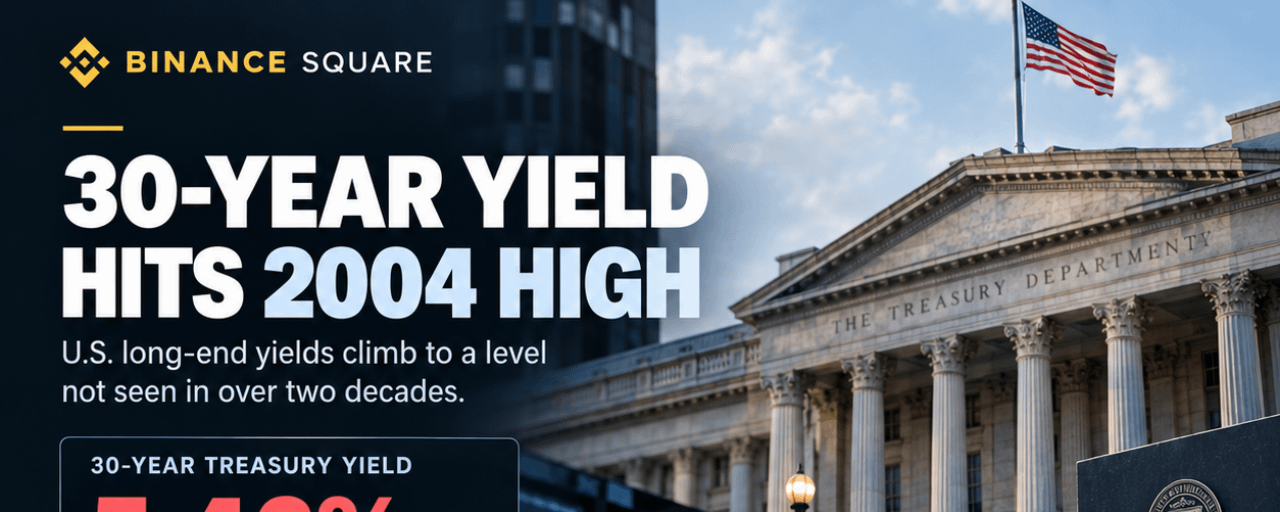
US 30-Year Treasury Yield Hits Highest Since 2004#us30yearyieldhighestsince2004
The 30-Year Treasury Yield Just Hit a 2004 High
The U.S. 30-year Treasury yield just moved above 5.46%, reaching its highest level since 2004 as the global bond selloff accelerated.
But for crypto, the important part isn't simply the number.
It's what the move says about the longer-term cost of money.
This Goes Beyond the Next Fed Meeting
Shorter-dated Treasury yields are heavily influenced by expectations for the Federal Reserve's policy rate.
The 30-year yield is different.
It reflects what investors demand to lend to the U.S. government over a much longer period, incorporating views around inflation, economic growth, fiscal borrowing and the compensation investors require for holding long-duration debt.
That's why the latest move deserves attention.
The 30-year yield didn't simply rise above 5%.
It reached a level markets haven't seen in more than two decades.
Why Risk Assets Care
Treasuries sit at the center of global financial markets.
When long-term U.S. yields rise, borrowing costs across mortgages, corporate debt and other financial markets can also move higher. Higher Treasury yields can additionally make dollar-denominated fixed-income assets more attractive relative to riskier investments.
That doesn't automatically mean Bitcoin has to fall.
But it can raise the hurdle that risk assets need to overcome.
And we're already seeing that relationship become relevant.
Bitcoin recently pushed toward $87K before retreating below $83K as Treasury yields surged. The 10-year yield also climbed above 5.1%, reaching its highest level since 2007.
The More Important Question for BTC
The question isn't simply:
“Are higher yields bearish for Bitcoin?”
It's more specific:
Can BTC remain resilient while long-term borrowing costs stay elevated?
That's a much more useful market test.
If Treasury yields stabilize, the pressure on risk assets could become less intense.
If long-term yields continue repricing higher, traders may have to reassess the broader financial-conditions backdrop.
The reason for the yield increase also matters. Recent reporting points to a combination of resilient economic growth, inflation concerns, higher energy costs and worries around government borrowing and deficits.
So this isn't purely a Fed story.
What I'd Watch Next
For crypto traders, I'd keep three charts side by side:
$BTC — Does Bitcoin stabilize after the sharp rejection from $87K?
30-year Treasury yield — Does the move above 5.46% reverse or continue?
10-year Treasury yield — Does it remain above 5%?
The interaction between these markets may tell us more than any single headline.
Bitcoin doesn't trade in isolation from global liquidity and interest rates.
And when the world's largest bond market starts repricing long-term borrowing costs to levels last seen in 2004, that's something crypto traders can't really ignore.
The key question now isn't whether 5.46% sounds high.
It's whether these elevated yields stabilize — or whether financial conditions are still in the process of repricing.
US 30-Year Treasury Yield Hits Highest Since 2004
#us30yearyieldhighestsince2004
The 30-Year Treasury Yield Just Hit a 2004 High
The U.S. 30-year Treasury yield just moved above 5.46%, reaching its highest level since 2004 as the global bond selloff accelerated.
But for crypto, the important part isn't simply the number.
It's what the move says about the longer-term cost of money.
This Goes Beyond the Next Fed Meeting
Shorter-dated Treasury yields are heavily influenced by expectations for the Federal Reserve's policy rate.
The 30-year yield is different.
It reflects what investors demand to lend to the U.S. government over a much longer period, incorporating views around inflation, economic growth, fiscal borrowing and the compensation investors require for holding long-duration debt.
That's why the latest move deserves attention.
The 30-year yield didn't simply rise above 5%.
It reached a level markets haven't seen in more than two decades.
Why Risk Assets Care
Treasuries sit at the center of global financial markets.
When long-term U.S. yields rise, borrowing costs across mortgages, corporate debt and other financial markets can also move higher. Higher Treasury yields can additionally make dollar-denominated fixed-income assets more attractive relative to riskier investments.
That doesn't automatically mean Bitcoin has to fall.
But it can raise the hurdle that risk assets need to overcome.
And we're already seeing that relationship become relevant.
Bitcoin recently pushed toward $87K before retreating below $83K as Treasury yields surged. The 10-year yield also climbed above 5.1%, reaching its highest level since 2007.
The More Important Question for BTC
The question isn't simply:
“Are higher yields bearish for Bitcoin?”
It's more specific:
Can BTC remain resilient while long-term borrowing costs stay elevated?
That's a much more useful market test.
If Treasury yields stabilize, the pressure on risk assets could become less intense.
If long-term yields continue repricing higher, traders may have to reassess the broader financial-conditions backdrop.
The reason for the yield increase also matters. Recent reporting points to a combination of resilient economic growth, inflation concerns, higher energy costs and worries around government borrowing and deficits.
So this isn't purely a Fed story.
What I'd Watch Next
For crypto traders, I'd keep three charts side by side:
$BTC — Does Bitcoin stabilize after the sharp rejection from $87K?
30-year Treasury yield — Does the move above 5.46% reverse or continue?
10-year Treasury yield — Does it remain above 5%?
The interaction between these markets may tell us more than any single headline.
Bitcoin doesn't trade in isolation from global liquidity and interest rates.
And when the world's largest bond market starts repricing long-term borrowing costs to levels last seen in 2004, that's something crypto traders can't really ignore.
The key question now isn't whether 5.46% sounds high.
It's whether these elevated yields stabilize — or whether financial conditions are still in the process of repricing.
The 30-Year Treasury Yield Just Hit a 2004 High
The U.S. 30-year Treasury yield just moved above 5.46%, reaching its highest level since 2004 as the global bond selloff accelerated.
But for crypto, the important part isn't simply the number.
It's what the move says about the longer-term cost of money.
This Goes Beyond the Next Fed Meeting
Shorter-dated Treasury yields are heavily influenced by expectations for the Federal Reserve's policy rate.
The 30-year yield is different.
It reflects what investors demand to lend to the U.S. government over a much longer period, incorporating views around inflation, economic growth, fiscal borrowing and the compensation investors require for holding long-duration debt.
That's why the latest move deserves attention.
The 30-year yield didn't simply rise above 5%.
It reached a level markets haven't seen in more than two decades.
Why Risk Assets Care
Treasuries sit at the center of global financial markets.
When long-term U.S. yields rise, borrowing costs across mortgages, corporate debt and other financial markets can also move higher. Higher Treasury yields can additionally make dollar-denominated fixed-income assets more attractive relative to riskier investments.
That doesn't automatically mean Bitcoin has to fall.
But it can raise the hurdle that risk assets need to overcome.
And we're already seeing that relationship become relevant.
Bitcoin recently pushed toward $87K before retreating below $83K as Treasury yields surged. The 10-year yield also climbed above 5.1%, reaching its highest level since 2007.
The More Important Question for BTC
The question isn't simply:
“Are higher yields bearish for Bitcoin?”
It's more specific:
Can BTC remain resilient while long-term borrowing costs stay elevated?
That's a much more useful market test.
If Treasury yields stabilize, the pressure on risk assets could become less intense.
If long-term yields continue repricing higher, traders may have to reassess the broader financial-conditions backdrop.
The reason for the yield increase also matters. Recent reporting points to a combination of resilient economic growth, inflation concerns, higher energy costs and worries around government borrowing and deficits.
So this isn't purely a Fed story.
What I'd Watch Next
For crypto traders, I'd keep three charts side by side:
$BTC — Does Bitcoin stabilize after the sharp rejection from $87K?
30-year Treasury yield — Does the move above 5.46% reverse or continue?
10-year Treasury yield — Does it remain above 5%?
The interaction between these markets may tell us more than any single headline.
Bitcoin doesn't trade in isolation from global liquidity and interest rates.
And when the world's largest bond market starts repricing long-term borrowing costs to levels last seen in 2004, that's something crypto traders can't really ignore.
The key question now isn't whether 5.46% sounds high.
It's whether these elevated yields stabilize — or whether financial conditions are still in the process of repricing.
23

·
--
#US30YearYieldHighestSince2004
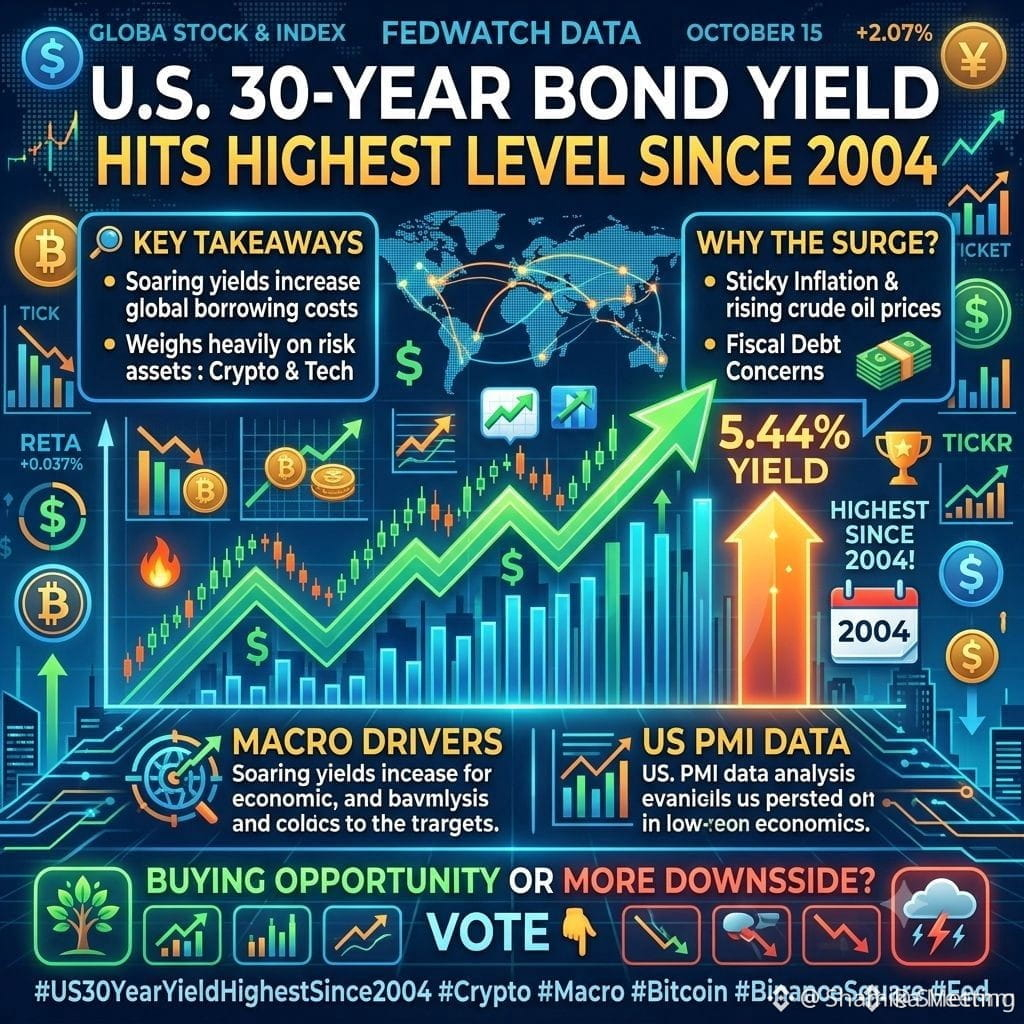
🚨 U.S. 30-Year Bond Yield Hits Highest Level Since 2004
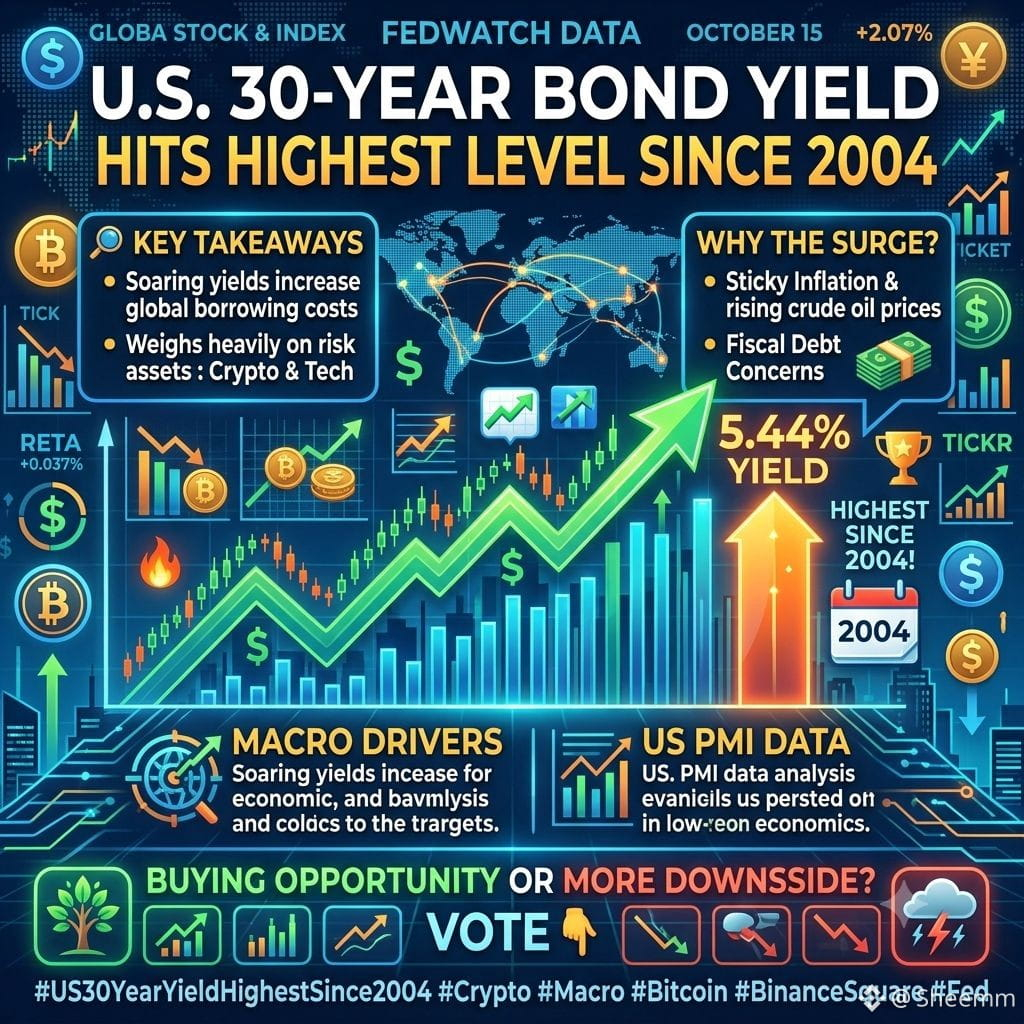
The yield on long-dated U.S. Treasuries surged to 5.44%, marking a 22-year high amid a massive global bond selloff driven by sticky inflation, rising crude oil prices, and fiscal debt concerns.
Key Takeaways:
* Tightening Liquidity: Soaring yields increase global borrowing costs and weigh heavily on risk assets, including Crypto & Tech.
* Macro Drivers: Robust U.S. PMI data and persistent cost pressures are pushing rate-hike expectations higher.
Is this macro tightening creating a buying opportunity, or is more downside ahead? 👇
#BinanceSquare
$ETC
{future}(ETCUSDT)
$LTC
{future}(LTCUSDT)
$PLUME
{future}(PLUMEUSDT)
#write2earn🌐💹
#DYORAlways
#US30YearYieldHighestSince2004
🚨 U.S. 30-Year Bond Yield Hits Highest Level Since 2004
The yield on long-dated U.S. Treasuries surged to 5.44%, marking a 22-year high amid a massive global bond selloff driven by sticky inflation, rising crude oil prices, and fiscal debt concerns.
Key Takeaways:
* Tightening Liquidity: Soaring yields increase global borrowing costs and weigh heavily on risk assets, including Crypto & Tech.
* Macro Drivers: Robust U.S. PMI data and persistent cost pressures are pushing rate-hike expectations higher.
Is this macro tightening creating a buying opportunity, or is more downside ahead? 👇
#BinanceSquare
$ETC
$LTC
$PLUME
#write2earn🌐💹
#DYORAlways
🚨 U.S. 30-Year Bond Yield Hits Highest Level Since 2004
The yield on long-dated U.S. Treasuries surged to 5.44%, marking a 22-year high amid a massive global bond selloff driven by sticky inflation, rising crude oil prices, and fiscal debt concerns.
Key Takeaways:
* Tightening Liquidity: Soaring yields increase global borrowing costs and weigh heavily on risk assets, including Crypto & Tech.
* Macro Drivers: Robust U.S. PMI data and persistent cost pressures are pushing rate-hike expectations higher.
Is this macro tightening creating a buying opportunity, or is more downside ahead? 👇
#BinanceSquare
$ETC
$LTC
$PLUME
#write2earn🌐💹
#DYORAlways
1
245
·
--
#US30YearYieldHighestSince2004
🚨 BREAKING: US 30-YEAR TREASURY YIELD HITS HIGHEST LEVEL SINCE 2004! 🇺🇸📈
#US30YearYieldHighestSince2004
The 30-year U.S. Treasury yield climbed above 5.44%, reaching its highest level in more than two decades.
🔥 What this could mean for crypto:
🔴 Higher borrowing costs
🔴 More pressure on risk assets
🔴 Stronger demand for yield
⚠️ Potential volatility for $BTC & $altcoins
The bond market is sending a serious warning: macro conditions are getting tougher. 👀
Will Bitcoin hold up if Treasury yields keep rising? 🤔
#Bitcoin #BTC #Binance #US30YearYieldHighestSince2004
{spot}(BTCUSDT)
#US30YearYieldHighestSince2004
🚨 BREAKING: US 30-YEAR TREASURY YIELD HITS HIGHEST LEVEL SINCE 2004! 🇺🇸📈
#US30YearYieldHighestSince2004
The 30-year U.S. Treasury yield climbed above 5.44%, reaching its highest level in more than two decades.
🔥 What this could mean for crypto:
🔴 Higher borrowing costs
🔴 More pressure on risk assets
🔴 Stronger demand for yield
⚠️ Potential volatility for $BTC & $altcoins
The bond market is sending a serious warning: macro conditions are getting tougher. 👀
Will Bitcoin hold up if Treasury yields keep rising? 🤔
#Bitcoin #BTC #Binance #US30YearYieldHighestSince2004
🚨 BREAKING: US 30-YEAR TREASURY YIELD HITS HIGHEST LEVEL SINCE 2004! 🇺🇸📈
#US30YearYieldHighestSince2004
The 30-year U.S. Treasury yield climbed above 5.44%, reaching its highest level in more than two decades.
🔥 What this could mean for crypto:
🔴 Higher borrowing costs
🔴 More pressure on risk assets
🔴 Stronger demand for yield
⚠️ Potential volatility for $BTC & $altcoins
The bond market is sending a serious warning: macro conditions are getting tougher. 👀
Will Bitcoin hold up if Treasury yields keep rising? 🤔
#Bitcoin #BTC #Binance #US30YearYieldHighestSince2004
1
122

·
--
Bullish
Verified
#us30yearyieldhighestsince2004
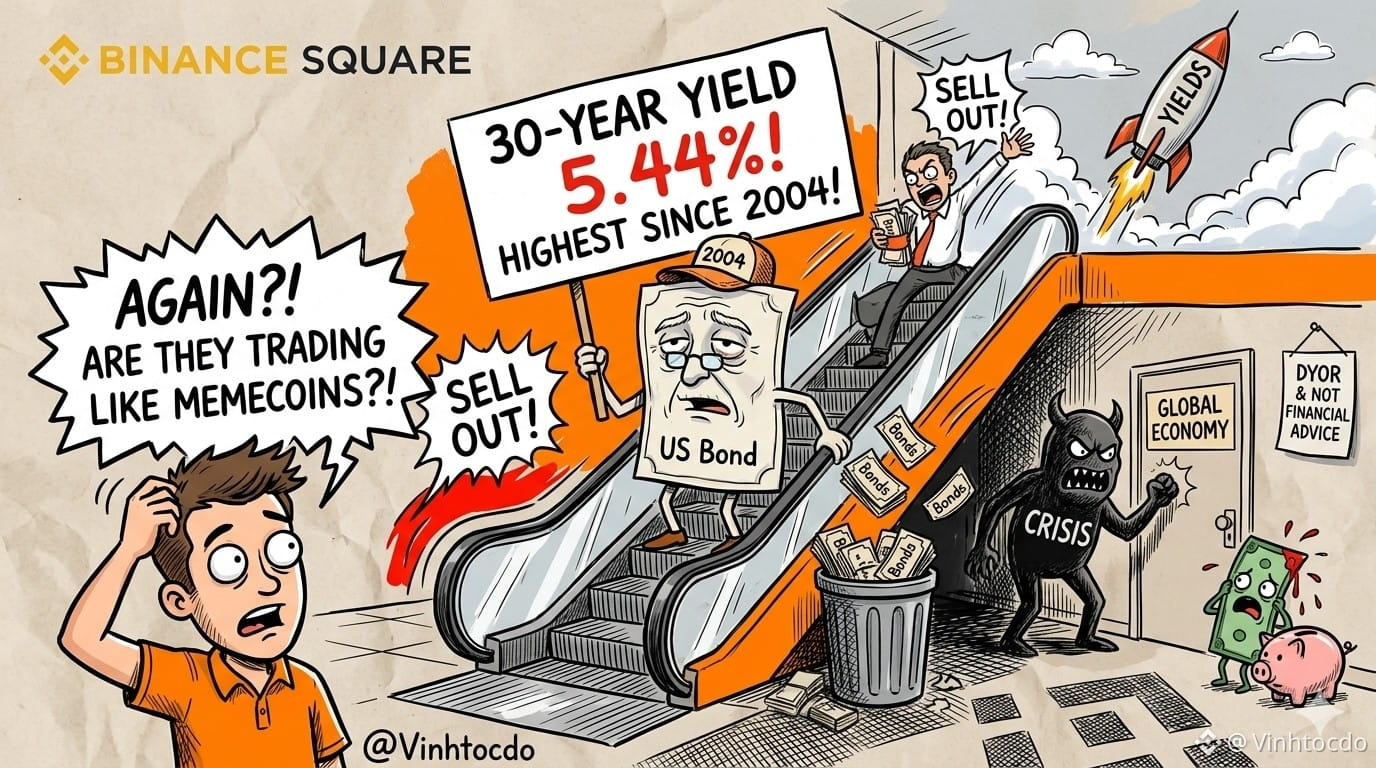
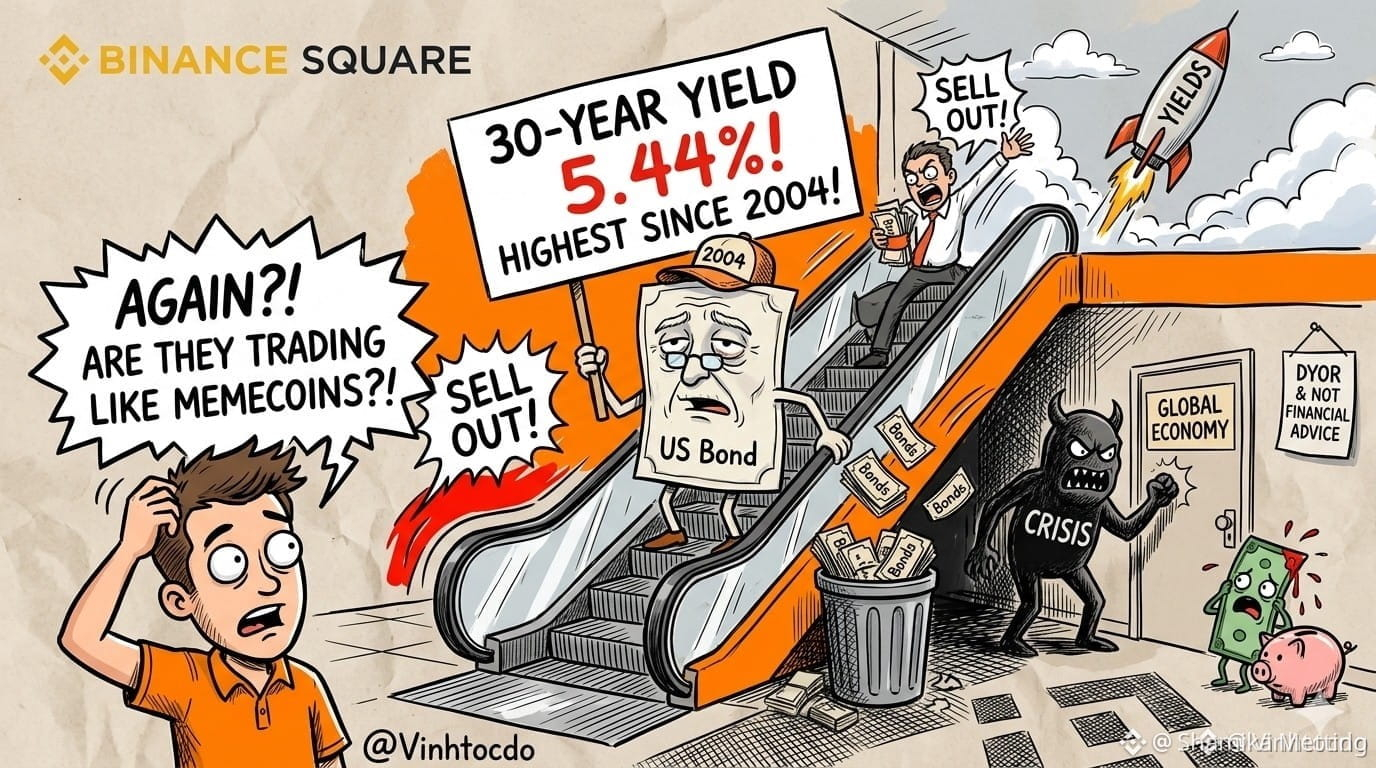
📈 Wait, what?! #us30yearyieldhighestsince2004 is trending at a crazy 5.44%! 🤯
Again?! US 30-year bond yields just hit a 22-year high! Is a financial crisis knocking on our doors? 🚨 And wait... "bond sell-off"? People actually trade bonds like memecoins now? 😂
Turns out, high inflation and skyrocketing oil prices are making investors panic and dump long-term bonds, driving yields to the moon! 🚀
What should crypto traders do?
1️⃣ Don't panic! Cash is bleeding, but crypto is built for this. 🧠
2️⃣ Watch out for market volatility. 📉📈
3️⃣ DYOR! This is NOT financial advice! 👀
Ready to trade the chaos? Sign up with code VINHTOCDO:
👉 https://www.binance.com/register?ref=VINHTOCDO
Click and trade below to support me:
$BTC
{future}(BTCUSDT)
$BNB
{future}(BNBUSDT)
$ETH
{future}(ETHUSDT)
#YieldsRising #BondSellOff #MacroCrypto #CryptoNews #FinancialCrisis #VINHTOCDO
#us30yearyieldhighestsince2004
📈 Wait, what?! #us30yearyieldhighestsince2004 is trending at a crazy 5.44%! 🤯
Again?! US 30-year bond yields just hit a 22-year high! Is a financial crisis knocking on our doors? 🚨 And wait... "bond sell-off"? People actually trade bonds like memecoins now? 😂
Turns out, high inflation and skyrocketing oil prices are making investors panic and dump long-term bonds, driving yields to the moon! 🚀
What should crypto traders do?
1️⃣ Don't panic! Cash is bleeding, but crypto is built for this. 🧠
2️⃣ Watch out for market volatility. 📉📈
3️⃣ DYOR! This is NOT financial advice! 👀
Ready to trade the chaos? Sign up with code VINHTOCDO:
👉 https://www.binance.com/register?ref=VINHTOCDO
Click and trade below to support me:
$BTC
$BNB
$ETH
#YieldsRising #BondSellOff #MacroCrypto #CryptoNews #FinancialCrisis #VINHTOCDO
📈 Wait, what?! #us30yearyieldhighestsince2004 is trending at a crazy 5.44%! 🤯
Again?! US 30-year bond yields just hit a 22-year high! Is a financial crisis knocking on our doors? 🚨 And wait... "bond sell-off"? People actually trade bonds like memecoins now? 😂
Turns out, high inflation and skyrocketing oil prices are making investors panic and dump long-term bonds, driving yields to the moon! 🚀
What should crypto traders do?
1️⃣ Don't panic! Cash is bleeding, but crypto is built for this. 🧠
2️⃣ Watch out for market volatility. 📉📈
3️⃣ DYOR! This is NOT financial advice! 👀
Ready to trade the chaos? Sign up with code VINHTOCDO:
👉 https://www.binance.com/register?ref=VINHTOCDO
Click and trade below to support me:
$BTC
$BNB
$ETH
#YieldsRising #BondSellOff #MacroCrypto #CryptoNews #FinancialCrisis #VINHTOCDO
2
160

#us30yearyieldhighestsince2004 📉 U.S. Treasury bond yield for 30 years hits highest level in 20 years: What does it mean for cryptocurrencies
The yield on U.S. Treasury bonds for 30 years has risen to its highest level since 2004. Below is an objective analysis of how this major economic shift could affect the digital asset landscape.
📰 Key news
The 30-year U.S. Treasury yield jumped to levels not seen in two decades. This move reflects market pricing for expectations of persistent inflation, Federal debt dynamics, and long-term monetary policies—making traditional “risk-free” assets more attractive to institutional capital.
📊 Market impact
🔹 Pressure on “risk” assets Cryptocurrencies are traditionally classified as “risk” assets. When risk-free yields rise sharply, capital may rotate from speculative markets to traditional yield-bearing assets, which could create a short-term headwind for the valuation of digital assets.
#الاقتصاد_الكلّي #سوق_العملات_المشفرة #بيتكوين #Treasury_yields #BinanceSquare
This content is for educational purposes only. Not financial advice (NFA). Always do your own research (DYOR).
Please follow up
$MET $EPIC $RONIN
#us30yearyieldhighestsince2004 📉 U.S. Treasury bond yield for 30 years hits highest level in 20 years: What does it mean for cryptocurrencies
The yield on U.S. Treasury bonds for 30 years has risen to its highest level since 2004. Below is an objective analysis of how this major economic shift could affect the digital asset landscape.
📰 Key news
The 30-year U.S. Treasury yield jumped to levels not seen in two decades. This move reflects market pricing for expectations of persistent inflation, Federal debt dynamics, and long-term monetary policies—making traditional “risk-free” assets more attractive to institutional capital.
📊 Market impact
🔹 Pressure on “risk” assets Cryptocurrencies are traditionally classified as “risk” assets. When risk-free yields rise sharply, capital may rotate from speculative markets to traditional yield-bearing assets, which could create a short-term headwind for the valuation of digital assets.
#الاقتصاد_الكلّي #سوق_العملات_المشفرة #بيتكوين #Treasury_yields #BinanceSquare
This content is for educational purposes only. Not financial advice (NFA). Always do your own research (DYOR).
Please follow up
$MET $EPIC $RONIN
The yield on U.S. Treasury bonds for 30 years has risen to its highest level since 2004. Below is an objective analysis of how this major economic shift could affect the digital asset landscape.
📰 Key news
The 30-year U.S. Treasury yield jumped to levels not seen in two decades. This move reflects market pricing for expectations of persistent inflation, Federal debt dynamics, and long-term monetary policies—making traditional “risk-free” assets more attractive to institutional capital.
📊 Market impact
🔹 Pressure on “risk” assets Cryptocurrencies are traditionally classified as “risk” assets. When risk-free yields rise sharply, capital may rotate from speculative markets to traditional yield-bearing assets, which could create a short-term headwind for the valuation of digital assets.
#الاقتصاد_الكلّي #سوق_العملات_المشفرة #بيتكوين #Treasury_yields #BinanceSquare
This content is for educational purposes only. Not financial advice (NFA). Always do your own research (DYOR).
Please follow up
$MET $EPIC $RONIN
TLTETF+0.04%
2
5.6k
#us30yearyieldhighestsince2004
📈 Wait, what?! #us30yearyieldhighestsince2004 is heading up crazily—up to 5.44%! 🤯
Once again?! U.S. Treasury bond yields for 30 years just hit their highest level in 22 years! Is a financial crisis knocking at our door? 🚨 And wait... "sell the bonds"? Are people trading bonds now the same way they trade meme coins? 😂
It turns out that high inflation and a rocket-like rise in oil prices have investors in panic—selling long-term bonds, pushing yields to the moon! 🚀
What should crypto traders do?
1️⃣ Don’t panic! Cash is bleeding, but crypto is built for this. 🧠
2️⃣ Watch the market volatility. 📉📈
3️⃣ Do your own research (DYOR)! This is not financial advice! 👀
Please follow along
$BTC
$BNB
$ETH
#YieldsRising #BondSellOff #MacroCrypto #CryptoNews #FinancialCrisis
#us30yearyieldhighestsince2004
📈 Wait, what?! #us30yearyieldhighestsince2004 is heading up crazily—up to 5.44%! 🤯
Once again?! U.S. Treasury bond yields for 30 years just hit their highest level in 22 years! Is a financial crisis knocking at our door? 🚨 And wait... "sell the bonds"? Are people trading bonds now the same way they trade meme coins? 😂
It turns out that high inflation and a rocket-like rise in oil prices have investors in panic—selling long-term bonds, pushing yields to the moon! 🚀
What should crypto traders do?
1️⃣ Don’t panic! Cash is bleeding, but crypto is built for this. 🧠
2️⃣ Watch the market volatility. 📉📈
3️⃣ Do your own research (DYOR)! This is not financial advice! 👀
Please follow along
$BTC
$BNB
$ETH
#YieldsRising #BondSellOff #MacroCrypto #CryptoNews #FinancialCrisis
📈 Wait, what?! #us30yearyieldhighestsince2004 is heading up crazily—up to 5.44%! 🤯
Once again?! U.S. Treasury bond yields for 30 years just hit their highest level in 22 years! Is a financial crisis knocking at our door? 🚨 And wait... "sell the bonds"? Are people trading bonds now the same way they trade meme coins? 😂
It turns out that high inflation and a rocket-like rise in oil prices have investors in panic—selling long-term bonds, pushing yields to the moon! 🚀
What should crypto traders do?
1️⃣ Don’t panic! Cash is bleeding, but crypto is built for this. 🧠
2️⃣ Watch the market volatility. 📉📈
3️⃣ Do your own research (DYOR)! This is not financial advice! 👀
Please follow along
$BTC
$BNB
$ETH
#YieldsRising #BondSellOff #MacroCrypto #CryptoNews #FinancialCrisis
2
4.8k
#us30yearyieldhighestsince2004
🚨 30-year bond yield hits highest level since 2004… Is Bitcoin on the way? 👀
The U.S. 30-year Treasury bond yield has reached around 5.44%, recording the highest level since 2004.
But the real question is: rising long-term yields can tighten financial conditions, reduce risk appetite, and weigh on high-risk assets like cryptocurrencies.
So I’m following the thread closely: yields - the dollar - liquidity - BTC and ETH
If yields keep climbing, Bitcoin could become more sensitive to changes in liquidity and risk sentiment.
An indication has started in the bond market… but can it spill over into the world of cryptocurrencies?
Please follow up
#TreasuryYields #BTC #ETH #Crypto
$BTC
{future}(BTCUSDT)
#us30yearyieldhighestsince2004
🚨 30-year bond yield hits highest level since 2004… Is Bitcoin on the way? 👀
The U.S. 30-year Treasury bond yield has reached around 5.44%, recording the highest level since 2004.
But the real question is: rising long-term yields can tighten financial conditions, reduce risk appetite, and weigh on high-risk assets like cryptocurrencies.
So I’m following the thread closely: yields - the dollar - liquidity - BTC and ETH
If yields keep climbing, Bitcoin could become more sensitive to changes in liquidity and risk sentiment.
An indication has started in the bond market… but can it spill over into the world of cryptocurrencies?
Please follow up
#TreasuryYields #BTC #ETH #Crypto
$BTC
🚨 30-year bond yield hits highest level since 2004… Is Bitcoin on the way? 👀
The U.S. 30-year Treasury bond yield has reached around 5.44%, recording the highest level since 2004.
But the real question is: rising long-term yields can tighten financial conditions, reduce risk appetite, and weigh on high-risk assets like cryptocurrencies.
So I’m following the thread closely: yields - the dollar - liquidity - BTC and ETH
If yields keep climbing, Bitcoin could become more sensitive to changes in liquidity and risk sentiment.
An indication has started in the bond market… but can it spill over into the world of cryptocurrencies?
Please follow up
#TreasuryYields #BTC #ETH #Crypto
$BTC
humkash:
Please Follow me. I Followed you back. Please like my post.
1
2
1.2k

·
--
Bullish
$TRUMP
$XAU
#U.S. bond yields for 30 years hit their highest level since 2004 as the selling wave intensifies
The historical sell-off in U.S. Treasury bonds eased slightly on Thursday, as benchmark yields touched levels not seen since before the global financial crisis in 2008, amid a convergence of several factors: a faster pace of business activity, higher energy prices, and hawkish signals from the Federal Reserve—sparking renewed inflation fears.
The yield on the benchmark 10-year U.S. Treasury note fell to 5.10% after reaching its highest level since July 2007. The move follows the sharp sell-off seen on Wednesday, which marked the biggest one-day rise in yields since April of last year, and the largest since the "Liberation Day" in 2025.#BinanceWillListHyperliquid(HYPE) #BitcoinFallsBelow$83,000 #US30YearYieldHighestSince2004 #US30YearYieldHighestSince2004 #ETHBreaksAbove$2,700
$TRUMP
$XAU
#U.S. bond yields for 30 years hit their highest level since 2004 as the selling wave intensifies
The historical sell-off in U.S. Treasury bonds eased slightly on Thursday, as benchmark yields touched levels not seen since before the global financial crisis in 2008, amid a convergence of several factors: a faster pace of business activity, higher energy prices, and hawkish signals from the Federal Reserve—sparking renewed inflation fears.
The yield on the benchmark 10-year U.S. Treasury note fell to 5.10% after reaching its highest level since July 2007. The move follows the sharp sell-off seen on Wednesday, which marked the biggest one-day rise in yields since April of last year, and the largest since the "Liberation Day" in 2025.#BinanceWillListHyperliquid(HYPE) #BitcoinFallsBelow$83,000 #US30YearYieldHighestSince2004 #US30YearYieldHighestSince2004 #ETHBreaksAbove$2,700
$XAU
#U.S. bond yields for 30 years hit their highest level since 2004 as the selling wave intensifies
The historical sell-off in U.S. Treasury bonds eased slightly on Thursday, as benchmark yields touched levels not seen since before the global financial crisis in 2008, amid a convergence of several factors: a faster pace of business activity, higher energy prices, and hawkish signals from the Federal Reserve—sparking renewed inflation fears.
The yield on the benchmark 10-year U.S. Treasury note fell to 5.10% after reaching its highest level since July 2007. The move follows the sharp sell-off seen on Wednesday, which marked the biggest one-day rise in yields since April of last year, and the largest since the "Liberation Day" in 2025.#BinanceWillListHyperliquid(HYPE) #BitcoinFallsBelow$83,000 #US30YearYieldHighestSince2004 #US30YearYieldHighestSince2004 #ETHBreaksAbove$2,700
33
#US30YearYieldHighestSince2004
🚨 The U.S. Treasury bond yield for 30 years hits the highest level since 2004
Long-term U.S. bond yields jumped to 5.44%, the highest level in 22 years, as a massive global sell-off in bonds is driven by “sticky” inflation, higher crude oil prices, and concerns about financial debt.
Key points:
* Liquidity tightening: higher yields increase borrowing costs worldwide and weigh heavily on risk assets, including cryptocurrencies and tech.
* Economic drivers: strong U.S. PMI data, along with ongoing pressure on costs, are pushing interest-rate hike expectations higher.
Will this economic tightening create a buying opportunity, or is there more downside ahead? 👇
Please follow up
#BinanceSquare
$ETC
$LTC
$PLUME
#write2earn🌐 🌐💹
#DYORAlways
#US30YearYieldHighestSince2004
🚨 The U.S. Treasury bond yield for 30 years hits the highest level since 2004
Long-term U.S. bond yields jumped to 5.44%, the highest level in 22 years, as a massive global sell-off in bonds is driven by “sticky” inflation, higher crude oil prices, and concerns about financial debt.
Key points:
* Liquidity tightening: higher yields increase borrowing costs worldwide and weigh heavily on risk assets, including cryptocurrencies and tech.
* Economic drivers: strong U.S. PMI data, along with ongoing pressure on costs, are pushing interest-rate hike expectations higher.
Will this economic tightening create a buying opportunity, or is there more downside ahead? 👇
Please follow up
#BinanceSquare
$ETC
$LTC
$PLUME
#write2earn🌐 🌐💹
#DYORAlways
🚨 The U.S. Treasury bond yield for 30 years hits the highest level since 2004
Long-term U.S. bond yields jumped to 5.44%, the highest level in 22 years, as a massive global sell-off in bonds is driven by “sticky” inflation, higher crude oil prices, and concerns about financial debt.
Key points:
* Liquidity tightening: higher yields increase borrowing costs worldwide and weigh heavily on risk assets, including cryptocurrencies and tech.
* Economic drivers: strong U.S. PMI data, along with ongoing pressure on costs, are pushing interest-rate hike expectations higher.
Will this economic tightening create a buying opportunity, or is there more downside ahead? 👇
Please follow up
#BinanceSquare
$ETC
$LTC
$PLUME
#write2earn🌐 🌐💹
#DYORAlways
1
29

·
--
According to the latest search results, the U.S. 30-year Treasury yield has climbed to its highest level since 2004, currently around 4.8%. This increase is mainly driven by the Federal Reserve’s ongoing rate hikes aimed at curbing inflation. Since the beginning of 2023, the Fed has raised rates five times, for a cumulative increase of 500 basis points, leading market expectations to suggest further hikes may be coming. In addition, inflation data remains stubborn: in July, the Consumer Price Index (CPI) rose 3.2% year over year, higher than the market expectation of 3.1%. The high interest-rate environment has pushed long-term bond yields higher. The 30-year Treasury yield has broken through the psychological barrier of 4.8%, reflecting investors’ concerns about the economic outlook. Market analysts believe that if the Fed continues its tightening policy, yields may rise further. #US30YearYieldHighestSince2004
According to the latest search results, the U.S. 30-year Treasury yield has climbed to its highest level since 2004, currently around 4.8%. This increase is mainly driven by the Federal Reserve’s ongoing rate hikes aimed at curbing inflation. Since the beginning of 2023, the Fed has raised rates five times, for a cumulative increase of 500 basis points, leading market expectations to suggest further hikes may be coming. In addition, inflation data remains stubborn: in July, the Consumer Price Index (CPI) rose 3.2% year over year, higher than the market expectation of 3.1%. The high interest-rate environment has pushed long-term bond yields higher. The 30-year Treasury yield has broken through the psychological barrier of 4.8%, reflecting investors’ concerns about the economic outlook. Market analysts believe that if the Fed continues its tightening policy, yields may rise further. #US30YearYieldHighestSince2004
TLTETF+0.04%
19

·
--
Bearish
🚨🔥 BOND MARKET ALERT: 22-YEAR HIGH SHAKES CRYPTO! 🔥🚨
📚 EDUCATION When US Treasury yields rise, financial conditions tighten. That can pressure risk assets as investors reassess liquidity, borrowing costs and returns.
📰 FRESH NEWS 🇺🇸 The US 30-Year Treasury yield jumped to 5.444%, its highest since 2004, as the bond selloff deepened. The 10-Year yield moved above 5.1%.
🌍 GLOBAL MARKET WATCH Higher yields and a firmer dollar are pressuring global risk assets.
🪙 ALTCOIN WATCH ₿ $BTC slipped below $84K. ♦️ $ETH is near $2.6K. 🟡 $BNB is around $770. 🟣 $SOL is near $113. 💧 $XRP is below $1.50. 🐕 $DOGE faces heavier selling. ⚡ $LTC shows relative strength.
📊 MARKET REACTIO $Crypto market capitalization dropped as leverage unwound. $BTC, $ETH, $SOL and $XRP remain under pressure, while $DOGE and smaller altcoins are moving sharply.
🔎 OUR ANALYSIS The key battle is rising yields versus $crypto demand. Elevated yields can keep rallies under pressure, while cooling bond stress can support recovery.
🎯 OUR PREDICTION $BTC will test $82.5K–$83K. A strong hold can push $BTC toward $85K–$87K; a clean break below support will increase downside pressure across major altcoins.
⚠️ WATCHPOINTS Watch US 30Y, US 10Y, DXY, oil, $BTC volume and liquidations.
📈 CHART + MARKET PREDICTION Use the US 30Y Yield chart and select Bearish for this setup.
👀 VISITS + CASH TAGS Add Visits to $BTC $ETH $BNB $SOL $XRP $DOGE $LTC.
❤️ Follow for fresh news, education, analysis and direct predictions!
#Bitcoin #Ethereum #BNB #Solana #XRP #Dogecoin #Litecoin #Crypto #CryptoMarket #BitcoinNews #Altcoins #TreasuryYields #BondMarket #MarketUpdate #TradingCommunity #US30YearYieldHighestSince2004
{future}(BTCUSDT)
$
🚨🔥 BOND MARKET ALERT: 22-YEAR HIGH SHAKES CRYPTO! 🔥🚨
📚 EDUCATION When US Treasury yields rise, financial conditions tighten. That can pressure risk assets as investors reassess liquidity, borrowing costs and returns.
📰 FRESH NEWS 🇺🇸 The US 30-Year Treasury yield jumped to 5.444%, its highest since 2004, as the bond selloff deepened. The 10-Year yield moved above 5.1%.
🌍 GLOBAL MARKET WATCH Higher yields and a firmer dollar are pressuring global risk assets.
🪙 ALTCOIN WATCH ₿ $BTC slipped below $84K. ♦️ $ETH is near $2.6K. 🟡 $BNB is around $770. 🟣 $SOL is near $113. 💧 $XRP is below $1.50. 🐕 $DOGE faces heavier selling. ⚡ $LTC shows relative strength.
📊 MARKET REACTIO $Crypto market capitalization dropped as leverage unwound. $BTC, $ETH, $SOL and $XRP remain under pressure, while $DOGE and smaller altcoins are moving sharply.
🔎 OUR ANALYSIS The key battle is rising yields versus $crypto demand. Elevated yields can keep rallies under pressure, while cooling bond stress can support recovery.
🎯 OUR PREDICTION $BTC will test $82.5K–$83K. A strong hold can push $BTC toward $85K–$87K; a clean break below support will increase downside pressure across major altcoins.
⚠️ WATCHPOINTS Watch US 30Y, US 10Y, DXY, oil, $BTC volume and liquidations.
📈 CHART + MARKET PREDICTION Use the US 30Y Yield chart and select Bearish for this setup.
👀 VISITS + CASH TAGS Add Visits to $BTC $ETH $BNB $SOL $XRP $DOGE $LTC.
❤️ Follow for fresh news, education, analysis and direct predictions!
#Bitcoin #Ethereum #BNB #Solana #XRP #Dogecoin #Litecoin #Crypto #CryptoMarket #BitcoinNews #Altcoins #TreasuryYields #BondMarket #MarketUpdate #TradingCommunity #US30YearYieldHighestSince2004
$
📚 EDUCATION When US Treasury yields rise, financial conditions tighten. That can pressure risk assets as investors reassess liquidity, borrowing costs and returns.
📰 FRESH NEWS 🇺🇸 The US 30-Year Treasury yield jumped to 5.444%, its highest since 2004, as the bond selloff deepened. The 10-Year yield moved above 5.1%.
🌍 GLOBAL MARKET WATCH Higher yields and a firmer dollar are pressuring global risk assets.
🪙 ALTCOIN WATCH ₿ $BTC slipped below $84K. ♦️ $ETH is near $2.6K. 🟡 $BNB is around $770. 🟣 $SOL is near $113. 💧 $XRP is below $1.50. 🐕 $DOGE faces heavier selling. ⚡ $LTC shows relative strength.
📊 MARKET REACTIO $Crypto market capitalization dropped as leverage unwound. $BTC, $ETH, $SOL and $XRP remain under pressure, while $DOGE and smaller altcoins are moving sharply.
🔎 OUR ANALYSIS The key battle is rising yields versus $crypto demand. Elevated yields can keep rallies under pressure, while cooling bond stress can support recovery.
🎯 OUR PREDICTION $BTC will test $82.5K–$83K. A strong hold can push $BTC toward $85K–$87K; a clean break below support will increase downside pressure across major altcoins.
⚠️ WATCHPOINTS Watch US 30Y, US 10Y, DXY, oil, $BTC volume and liquidations.
📈 CHART + MARKET PREDICTION Use the US 30Y Yield chart and select Bearish for this setup.
👀 VISITS + CASH TAGS Add Visits to $BTC $ETH $BNB $SOL $XRP $DOGE $LTC.
❤️ Follow for fresh news, education, analysis and direct predictions!
#Bitcoin #Ethereum #BNB #Solana #XRP #Dogecoin #Litecoin #Crypto #CryptoMarket #BitcoinNews #Altcoins #TreasuryYields #BondMarket #MarketUpdate #TradingCommunity #US30YearYieldHighestSince2004
$
6

·
--
U.S. 30-Year Treasury Yield Rises to 5.47%|ETH Still Near 2686|I’ll First Manage Volatility, Not Chase Shorts
My stance is cautious and more defensive, but I won’t mechanically translate rising yields into “ETH must fall.” The Binance Square hot list is currently discussing #US30YearYieldHighestSince2004. The U.S. Treasury Department reported on September 24 that the fixed-term yield on 30-year Treasuries is 5.47%, higher than 5.40% on the 23rd; the 10-year yield rose from 5.11% to 5.18%. This is the official end-of-day data. It’s not the same sampling time as the intraday 5.44% mentioned in the press release, so you can’t mix them into the same market move. Binance News is also watching the selloff in long bonds, indicating this isn’t simply a sentiment topic from the crypto圈.
When long-end rates rise, the transmission to ETH has two layers: first, the risk-free yield is higher, increasing the opportunity cost of holding volatile assets; second, when financing and discount rates rise, overvalued risk assets tend to shrink positions together. But that’s only a pressure channel, not proof of immediate selling. ETH is influenced both by macro risk appetite and by on-chain activity, net subscriptions/redemptions of spot ETFs, and leverage in derivatives. If ETF demand continues absorbing supply and on-chain funds stay active, the headwind from rates could be partially offset. So I won’t short ETH nakedly based on a single yield figure, nor will I treat “highest since 2004” as a specific downside-magnitude forecast for ETH.
The market has reacted, but it’s not a one-way collapse. At the time of writing, KuCoin spot ETH/USDT is around $2686.59, with a 24-hour high of $2705.79 and a low of $2628.58—about a 0.47% gain versus roughly $2700 this time yesterday. In other words, after long-bond yields rose, ETH remained below the previous 2700-level and fluctuated repeatedly; what we can currently confirm is that it hasn’t reclaimed the highs yet—not that macro news has already caused sustained downside. Next, I’m watching two conditions: whether there can be consecutive daily closes above 2706 and then a successful retest that doesn’t break; and if it loses 2670 again, whether it rapidly slides toward around 2628. If yields fall while ETH is still breaking down, the issue may be more than just macro. If yields keep rising and ETH holds above 2706, then my defensive judgment would be weakened.
If this were my own trade: I’m not participating now. On direction, I’ll only keep conditional small-position spot longs and no leveraged shorts. Only if two complete 15-minute candles close above $2706, and then the subsequent pullback holds within the 2695—2706 range, will I try a long position with 0.3% of total funds; then cut it in half at 2725, and liquidate the remaining near 2745. After entry, if a 15-minute close drops back below 2685, I’ll cut the position in half first; if it touches 2670, I’ll stop out the entire position and close. If before that trigger the price breaks below 2628 first, this plan is immediately invalidated—I won’t catch a falling knife during the downswing. My position size is so light because macro yields and ETH’s short-term price don’t correspond one-to-one; any data release or rate fluctuation could cause a breakout to fail. I’ll verify the Treasury yield data and the complete ETF data again tomorrow morning. Until there’s evidence of improvement occurring in sync, discipline matters more than guessing direction.
#US30YearYieldHighestSince2004 #ETH
The above is only my personal market observations and does not constitute investment advice.
U.S. 30-Year Treasury Yield Rises to 5.47%|ETH Still Near 2686|I’ll First Manage Volatility, Not Chase Shorts
My stance is cautious and more defensive, but I won’t mechanically translate rising yields into “ETH must fall.” The Binance Square hot list is currently discussing #US30YearYieldHighestSince2004. The U.S. Treasury Department reported on September 24 that the fixed-term yield on 30-year Treasuries is 5.47%, higher than 5.40% on the 23rd; the 10-year yield rose from 5.11% to 5.18%. This is the official end-of-day data. It’s not the same sampling time as the intraday 5.44% mentioned in the press release, so you can’t mix them into the same market move. Binance News is also watching the selloff in long bonds, indicating this isn’t simply a sentiment topic from the crypto圈.
When long-end rates rise, the transmission to ETH has two layers: first, the risk-free yield is higher, increasing the opportunity cost of holding volatile assets; second, when financing and discount rates rise, overvalued risk assets tend to shrink positions together. But that’s only a pressure channel, not proof of immediate selling. ETH is influenced both by macro risk appetite and by on-chain activity, net subscriptions/redemptions of spot ETFs, and leverage in derivatives. If ETF demand continues absorbing supply and on-chain funds stay active, the headwind from rates could be partially offset. So I won’t short ETH nakedly based on a single yield figure, nor will I treat “highest since 2004” as a specific downside-magnitude forecast for ETH.
The market has reacted, but it’s not a one-way collapse. At the time of writing, KuCoin spot ETH/USDT is around $2686.59, with a 24-hour high of $2705.79 and a low of $2628.58—about a 0.47% gain versus roughly $2700 this time yesterday. In other words, after long-bond yields rose, ETH remained below the previous 2700-level and fluctuated repeatedly; what we can currently confirm is that it hasn’t reclaimed the highs yet—not that macro news has already caused sustained downside. Next, I’m watching two conditions: whether there can be consecutive daily closes above 2706 and then a successful retest that doesn’t break; and if it loses 2670 again, whether it rapidly slides toward around 2628. If yields fall while ETH is still breaking down, the issue may be more than just macro. If yields keep rising and ETH holds above 2706, then my defensive judgment would be weakened.
If this were my own trade: I’m not participating now. On direction, I’ll only keep conditional small-position spot longs and no leveraged shorts. Only if two complete 15-minute candles close above $2706, and then the subsequent pullback holds within the 2695—2706 range, will I try a long position with 0.3% of total funds; then cut it in half at 2725, and liquidate the remaining near 2745. After entry, if a 15-minute close drops back below 2685, I’ll cut the position in half first; if it touches 2670, I’ll stop out the entire position and close. If before that trigger the price breaks below 2628 first, this plan is immediately invalidated—I won’t catch a falling knife during the downswing. My position size is so light because macro yields and ETH’s short-term price don’t correspond one-to-one; any data release or rate fluctuation could cause a breakout to fail. I’ll verify the Treasury yield data and the complete ETF data again tomorrow morning. Until there’s evidence of improvement occurring in sync, discipline matters more than guessing direction.
#US30YearYieldHighestSince2004 #ETH
The above is only my personal market observations and does not constitute investment advice.
My stance is cautious and more defensive, but I won’t mechanically translate rising yields into “ETH must fall.” The Binance Square hot list is currently discussing #US30YearYieldHighestSince2004. The U.S. Treasury Department reported on September 24 that the fixed-term yield on 30-year Treasuries is 5.47%, higher than 5.40% on the 23rd; the 10-year yield rose from 5.11% to 5.18%. This is the official end-of-day data. It’s not the same sampling time as the intraday 5.44% mentioned in the press release, so you can’t mix them into the same market move. Binance News is also watching the selloff in long bonds, indicating this isn’t simply a sentiment topic from the crypto圈.
When long-end rates rise, the transmission to ETH has two layers: first, the risk-free yield is higher, increasing the opportunity cost of holding volatile assets; second, when financing and discount rates rise, overvalued risk assets tend to shrink positions together. But that’s only a pressure channel, not proof of immediate selling. ETH is influenced both by macro risk appetite and by on-chain activity, net subscriptions/redemptions of spot ETFs, and leverage in derivatives. If ETF demand continues absorbing supply and on-chain funds stay active, the headwind from rates could be partially offset. So I won’t short ETH nakedly based on a single yield figure, nor will I treat “highest since 2004” as a specific downside-magnitude forecast for ETH.
The market has reacted, but it’s not a one-way collapse. At the time of writing, KuCoin spot ETH/USDT is around $2686.59, with a 24-hour high of $2705.79 and a low of $2628.58—about a 0.47% gain versus roughly $2700 this time yesterday. In other words, after long-bond yields rose, ETH remained below the previous 2700-level and fluctuated repeatedly; what we can currently confirm is that it hasn’t reclaimed the highs yet—not that macro news has already caused sustained downside. Next, I’m watching two conditions: whether there can be consecutive daily closes above 2706 and then a successful retest that doesn’t break; and if it loses 2670 again, whether it rapidly slides toward around 2628. If yields fall while ETH is still breaking down, the issue may be more than just macro. If yields keep rising and ETH holds above 2706, then my defensive judgment would be weakened.
If this were my own trade: I’m not participating now. On direction, I’ll only keep conditional small-position spot longs and no leveraged shorts. Only if two complete 15-minute candles close above $2706, and then the subsequent pullback holds within the 2695—2706 range, will I try a long position with 0.3% of total funds; then cut it in half at 2725, and liquidate the remaining near 2745. After entry, if a 15-minute close drops back below 2685, I’ll cut the position in half first; if it touches 2670, I’ll stop out the entire position and close. If before that trigger the price breaks below 2628 first, this plan is immediately invalidated—I won’t catch a falling knife during the downswing. My position size is so light because macro yields and ETH’s short-term price don’t correspond one-to-one; any data release or rate fluctuation could cause a breakout to fail. I’ll verify the Treasury yield data and the complete ETF data again tomorrow morning. Until there’s evidence of improvement occurring in sync, discipline matters more than guessing direction.
#US30YearYieldHighestSince2004 #ETH
The above is only my personal market observations and does not constitute investment advice.

2
·
--
XMR meets rising long-end rates|Price is about $548|I’ll wait to confirm risk appetite
My stance is cautious: privacy needs are a long-term narrative, but in the short term, price still has to answer to the opportunity cost of USD capital. The U.S. Treasury’s September 23 yield curve shows the 30-year U.S. Treasury yield at 5.40%, up 11 basis points from 5.29% on the 22nd; the 10-year also rose from 4.96% to 5.11%. These are already published official closing figures, not a prediction of the rate direction for the next trading day. Street talk about long-end rates is heating up, but historical records like “a new high in some year” need to be verified against a consistent standard—I care more about whether the rise in yields itself can sustain.
Why watch XMR and still keep an eye on U.S. Treasuries? Holding costs for non-yielding assets become more noticeable as the risk-free rate rises. When the market reduces exposure to volatile assets, currencies with relatively limited liquidity may have amplified volatility. Privacy characteristics don’t automatically make this capital chain immune, and you also can’t use that to assert that XMR will definitely fall. If macro pressure eases and spot buying can independently absorb demand, XMR may even be more resilient than the broader market. These two forces should be observed separately; you can’t explain an entire K-line by interest rates alone.
When I check the XMR/USDT market on KuCoin, the quote is around $548.03, with a 24-hour change of about -2.24%. The intraday high is 567 and the low is 542.01. It does pull back, but that’s just parallel observation within the same time window and is not enough to prove that U.S. Treasury yields are the only reason. Around 548 is an immediate reference, not confirmed support; around 542 is this round’s low-level defense line; around 567 is the recent upper boundary. If price reclaims 567 and the buy-side absorption remains stable, while long-end Treasuries stop continuing to rise, then my cautious view would be invalidated. If it breaks below 542 and the rebound lacks strength, short-term defense comes first.
If I were trading it myself, I wouldn’t chase longs now or open high-leverage short positions. I’d stay in cash and observe. Only if spot re-establishes itself above $567, then the subsequent pullback doesn’t break, and the broader market’s risk appetite improves in sync, would I consider going long in line with the trend, with the first entry not exceeding 2% of total capital. The initial target is $580; near the target I’d cut half the position, and then watch for $590 with the remaining position, though I won’t assume it must hit. After entry, if it falls back below $558, I follow the plan and stop out. If long-end yields clearly rise again or XMR falls out of 542, even if the long plan hasn’t triggered yet, I cancel the long setup. If after triggering it still can’t continue and trading weakens, I would close the position early—I won’t turn waiting into an involuntary holding of risk.
All of the above are conditional-entry ideas. If conditions aren’t met, there’s no execution, and therefore no profit.
Source: U.S. Treasury’s daily Treasury yield curve (Sep 22 and Sep 23); KuCoin XMR/USDT 24-hour market snapshot (queried at the time of writing). #US30YearYieldHighestSince2004 #XMR
The above is only my personal market observation and does not constitute investment advice.
XMR meets rising long-end rates|Price is about $548|I’ll wait to confirm risk appetite
My stance is cautious: privacy needs are a long-term narrative, but in the short term, price still has to answer to the opportunity cost of USD capital. The U.S. Treasury’s September 23 yield curve shows the 30-year U.S. Treasury yield at 5.40%, up 11 basis points from 5.29% on the 22nd; the 10-year also rose from 4.96% to 5.11%. These are already published official closing figures, not a prediction of the rate direction for the next trading day. Street talk about long-end rates is heating up, but historical records like “a new high in some year” need to be verified against a consistent standard—I care more about whether the rise in yields itself can sustain.
Why watch XMR and still keep an eye on U.S. Treasuries? Holding costs for non-yielding assets become more noticeable as the risk-free rate rises. When the market reduces exposure to volatile assets, currencies with relatively limited liquidity may have amplified volatility. Privacy characteristics don’t automatically make this capital chain immune, and you also can’t use that to assert that XMR will definitely fall. If macro pressure eases and spot buying can independently absorb demand, XMR may even be more resilient than the broader market. These two forces should be observed separately; you can’t explain an entire K-line by interest rates alone.
When I check the XMR/USDT market on KuCoin, the quote is around $548.03, with a 24-hour change of about -2.24%. The intraday high is 567 and the low is 542.01. It does pull back, but that’s just parallel observation within the same time window and is not enough to prove that U.S. Treasury yields are the only reason. Around 548 is an immediate reference, not confirmed support; around 542 is this round’s low-level defense line; around 567 is the recent upper boundary. If price reclaims 567 and the buy-side absorption remains stable, while long-end Treasuries stop continuing to rise, then my cautious view would be invalidated. If it breaks below 542 and the rebound lacks strength, short-term defense comes first.
If I were trading it myself, I wouldn’t chase longs now or open high-leverage short positions. I’d stay in cash and observe. Only if spot re-establishes itself above $567, then the subsequent pullback doesn’t break, and the broader market’s risk appetite improves in sync, would I consider going long in line with the trend, with the first entry not exceeding 2% of total capital. The initial target is $580; near the target I’d cut half the position, and then watch for $590 with the remaining position, though I won’t assume it must hit. After entry, if it falls back below $558, I follow the plan and stop out. If long-end yields clearly rise again or XMR falls out of 542, even if the long plan hasn’t triggered yet, I cancel the long setup. If after triggering it still can’t continue and trading weakens, I would close the position early—I won’t turn waiting into an involuntary holding of risk.
All of the above are conditional-entry ideas. If conditions aren’t met, there’s no execution, and therefore no profit.
Source: U.S. Treasury’s daily Treasury yield curve (Sep 22 and Sep 23); KuCoin XMR/USDT 24-hour market snapshot (queried at the time of writing). #US30YearYieldHighestSince2004 #XMR
The above is only my personal market observation and does not constitute investment advice.
My stance is cautious: privacy needs are a long-term narrative, but in the short term, price still has to answer to the opportunity cost of USD capital. The U.S. Treasury’s September 23 yield curve shows the 30-year U.S. Treasury yield at 5.40%, up 11 basis points from 5.29% on the 22nd; the 10-year also rose from 4.96% to 5.11%. These are already published official closing figures, not a prediction of the rate direction for the next trading day. Street talk about long-end rates is heating up, but historical records like “a new high in some year” need to be verified against a consistent standard—I care more about whether the rise in yields itself can sustain.
Why watch XMR and still keep an eye on U.S. Treasuries? Holding costs for non-yielding assets become more noticeable as the risk-free rate rises. When the market reduces exposure to volatile assets, currencies with relatively limited liquidity may have amplified volatility. Privacy characteristics don’t automatically make this capital chain immune, and you also can’t use that to assert that XMR will definitely fall. If macro pressure eases and spot buying can independently absorb demand, XMR may even be more resilient than the broader market. These two forces should be observed separately; you can’t explain an entire K-line by interest rates alone.
When I check the XMR/USDT market on KuCoin, the quote is around $548.03, with a 24-hour change of about -2.24%. The intraday high is 567 and the low is 542.01. It does pull back, but that’s just parallel observation within the same time window and is not enough to prove that U.S. Treasury yields are the only reason. Around 548 is an immediate reference, not confirmed support; around 542 is this round’s low-level defense line; around 567 is the recent upper boundary. If price reclaims 567 and the buy-side absorption remains stable, while long-end Treasuries stop continuing to rise, then my cautious view would be invalidated. If it breaks below 542 and the rebound lacks strength, short-term defense comes first.
If I were trading it myself, I wouldn’t chase longs now or open high-leverage short positions. I’d stay in cash and observe. Only if spot re-establishes itself above $567, then the subsequent pullback doesn’t break, and the broader market’s risk appetite improves in sync, would I consider going long in line with the trend, with the first entry not exceeding 2% of total capital. The initial target is $580; near the target I’d cut half the position, and then watch for $590 with the remaining position, though I won’t assume it must hit. After entry, if it falls back below $558, I follow the plan and stop out. If long-end yields clearly rise again or XMR falls out of 542, even if the long plan hasn’t triggered yet, I cancel the long setup. If after triggering it still can’t continue and trading weakens, I would close the position early—I won’t turn waiting into an involuntary holding of risk.
All of the above are conditional-entry ideas. If conditions aren’t met, there’s no execution, and therefore no profit.
Source: U.S. Treasury’s daily Treasury yield curve (Sep 22 and Sep 23); KuCoin XMR/USDT 24-hour market snapshot (queried at the time of writing). #US30YearYieldHighestSince2004 #XMR
The above is only my personal market observation and does not constitute investment advice.

39
Log in to explore more content
Join global crypto users on Binance Square
⚡️ Get latest and useful information about crypto.
💬 Trusted by the world’s largest crypto exchange.
👍 Discover real insights from verified creators.
Email / Phone number
Trending Topics
1
#BinanceWillListHyperliquid(HYPE)
104,331 views
2,205 Discussing
2
#FedOctoberRateHikeOddsRiseTo69.7%
28,318 views
865 Discussing
3
#BitcoinFallsBelow$83,000
3,189 views
20 Discussing
4
#BitcoinFallsToAround$84,600ThisWeek
0 views
0 Discussing
5
#US30YearYieldHighestSince2004
26,075 views
696 Discussing
6
#ETHBreaksAbove$2,700
1,435 views
19 Discussing
7
#USWeighsPromotingDollarStablecoinsAbroad
58,986 views
1,584 Discussing
8
#US10YTreasuryYieldHits19YearHigh
60,541 views
1,282 Discussing
9
#SpotBitcoinETFsInflow$2.31BInFourDays
6,907 views
75 Discussing
10
#BitcoinRejectedAt$87,300Twice
0 views
0 Discussing