Binance Square
#tradfi

tradfi

2M views
17,403 Discussing
R A O_加密 143
·
--
@Binance_Announcement Share Your Feedback & Win 1,000 USDC! Binance is looking for user feedback on its latest TradFi Product Suite! Your insights go directly to the team shaping the future trading interface. Key Details: • Eligible Products: TradFi Perpetuals, Stock Options, and bStocks • Prize Pool: 1,000 USDC • Activity Period: Sept 15, 2026 (12:00 UTC) – Sept 21, 2026 (23:59 UTC) Drop your thoughts in the comments or join the official campaign page to claim your share! 🚀 #Binance #TradFi #USDC
@Binance Announcement Share Your Feedback & Win 1,000 USDC!
Binance is looking for user feedback on its latest TradFi Product Suite! Your insights go directly to the team shaping the future trading interface.
Key Details:
• Eligible Products: TradFi Perpetuals, Stock Options, and bStocks
• Prize Pool: 1,000 USDC
• Activity Period: Sept 15, 2026 (12:00 UTC) – Sept 21, 2026 (23:59 UTC)
Drop your thoughts in the comments or join the official campaign page to claim your share! 🚀
#Binance #TradFi #USDC
While $BTC sits in a $77K standoff ahead of the Fed, idle cash does not have to stare at the chart with you. Today Binance Earn opened ETF Wealth Management — 11 US-listed Treasury and investment-grade bond ETFs. Real ETF shares, executed via licensed brokers, from the same app where you already hold $USDC. Not a fixed savings promise. Self-directed. You own the shares and any cash distributions. Why now: the 10-year yield is near 5%, FOMC lands tomorrow, and crypto capital parked on-exchange finally has a TradFi income path without opening a separate brokerage. Would you rather leave $USDC flat through rate week — or park a slice in Treasuries inside Earn? #BinanceEarn #TradFi #US10YearTreasuryYieldNears5%
While $BTC sits in a $77K standoff ahead of the Fed, idle cash does not have to stare at the chart with you.

Today Binance Earn opened ETF Wealth Management — 11 US-listed Treasury and investment-grade bond ETFs. Real ETF shares, executed via licensed brokers, from the same app where you already hold $USDC . Not a fixed savings promise. Self-directed. You own the shares and any cash distributions.

Why now: the 10-year yield is near 5%, FOMC lands tomorrow, and crypto capital parked on-exchange finally has a TradFi income path without opening a separate brokerage.

Would you rather leave $USDC flat through rate week — or park a slice in Treasuries inside Earn?
#BinanceEarn #TradFi #US10YearTreasuryYieldNears5%
·
--
Verified
Article
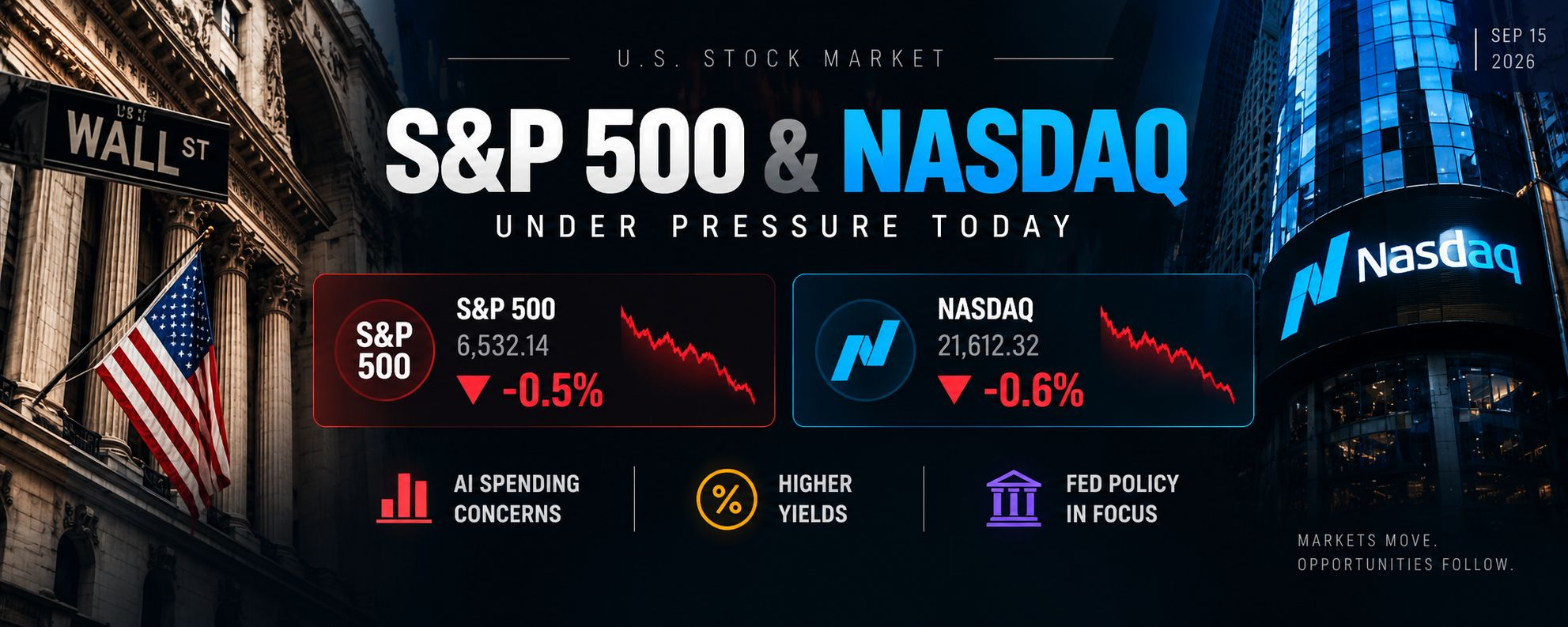
📊 S&P 500 & NASDAQ: WHY ARE U.S. STOCKS UNDER PRESSURE?The S&P 500 and Nasdaq are facing renewed pressure as investors reassess two major risks: higher interest rates and the sustainability of the AI-driven rally. On Monday, the S&P 500 fell around 0.5%, while the Nasdaq Composite declined around 0.6%. Two developments are getting the most attention: 📉 AI concerns Investors are becoming more cautious about the massive spending on AI infrastructure after industry leaders called for a slower pace of AI development. 💵 Higher yields The U.S. 10-year Treasury yield briefly moved above 5%, increasing pressure on equity valuations, particularly growth and technology stocks. The Federal Reserve is also beginning its September policy meeting, with markets expecting a potential rate hike as inflation remains a concern. For investors, the key question isn't simply whether stocks will rise or fall. It's whether earnings growth can continue to justify high valuations while borrowing costs and Treasury yields remain elevated. 💬 Which market do you think is more vulnerable to higher interest rates: S&P 500 or Nasdaq? #SP500 #NASDAQ #stockmarket #TradFi

📊 S&P 500 & NASDAQ: WHY ARE U.S. STOCKS UNDER PRESSURE?

The S&P 500 and Nasdaq are facing renewed pressure as investors reassess two major risks: higher interest rates and the sustainability of the AI-driven rally.
On Monday, the S&P 500 fell around 0.5%, while the Nasdaq Composite declined around 0.6%.
Two developments are getting the most attention:
📉 AI concerns Investors are becoming more cautious about the massive spending on AI infrastructure after industry leaders called for a slower pace of AI development.
💵 Higher yields The U.S. 10-year Treasury yield briefly moved above 5%, increasing pressure on equity valuations, particularly growth and technology stocks.
The Federal Reserve is also beginning its September policy meeting, with markets expecting a potential rate hike as inflation remains a concern.
For investors, the key question isn't simply whether stocks will rise or fall.
It's whether earnings growth can continue to justify high valuations while borrowing costs and Treasury yields remain elevated.
💬 Which market do you think is more vulnerable to higher interest rates: S&P 500 or Nasdaq?
#SP500 #NASDAQ #stockmarket #TradFi
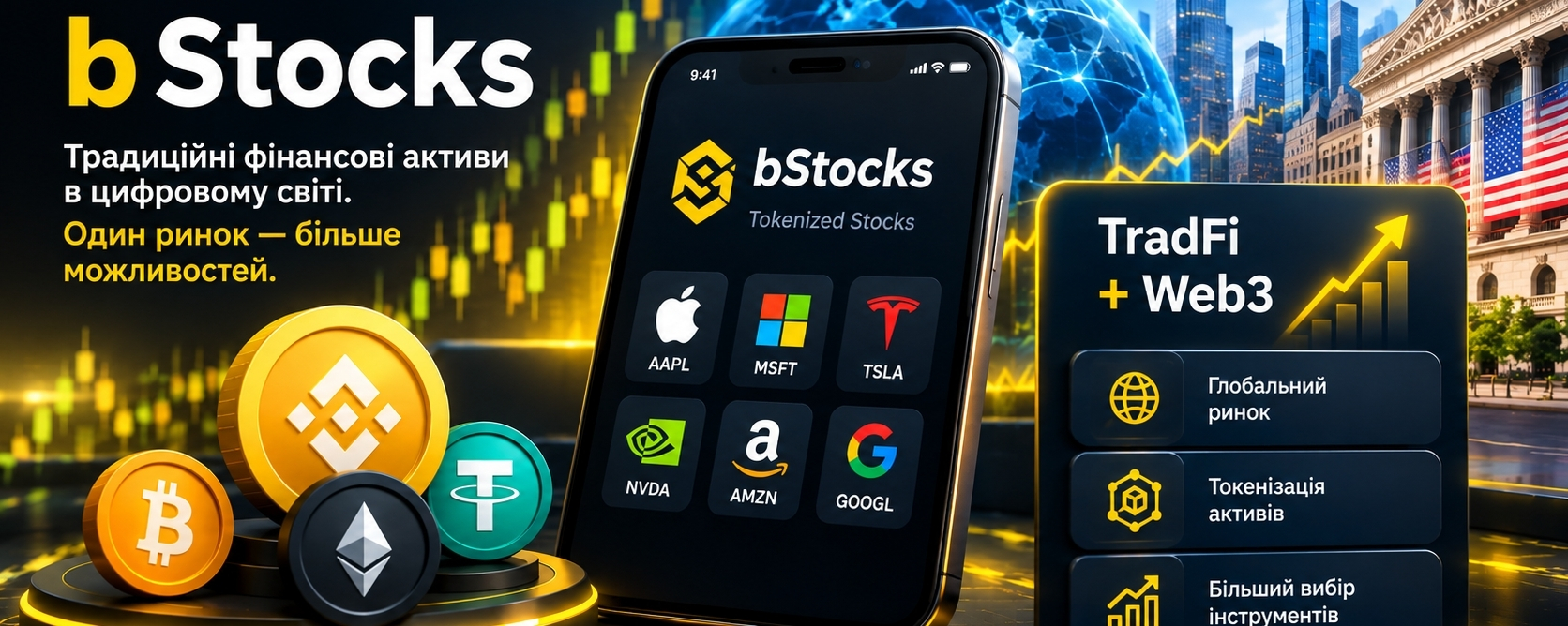
Beginner's guide: what Binance bStocks actually are If you have ever wanted Tesla or NVIDIA exposure but hated waiting for Wall Street hours or opening a separate brokerage — this is for you. What it is bStocks are crypto tokens that track traditional stocks. Each token is backed 1:1 by the underlying stock held at a regulated custodian. You trade them from your Binance wallet — same app, same balance flow as crypto. How it differs from a classic brokerage • Markets: 24/7 instead of waiting for the NYSE/Nasdaq open • Size: fractional ownership — start small, no need to buy a full share • Friction: no separate brokerage account; Spot search inside Binance 3 concrete steps in the app 1. Open Spot and search bStocks (or a ticker like $TSLAB, $NVDAB, $AAPLB) 2. Check the pair, size a small test order you can afford to lose 3. Confirm — the token sits in your Binance wallet like any other Spot asset Who it fits Curious crypto users who want TradFi names without leaving Binance. Not for anyone who needs a guarantee — prices move and you can lose money. DYOR. Not financial advice. Which name would you try first — Tesla, NVIDIA, or Apple? #bStocks #TradFi
Beginner's guide: what Binance bStocks actually are

If you have ever wanted Tesla or NVIDIA exposure but hated waiting for Wall Street hours or opening a separate brokerage — this is for you.

What it is
bStocks are crypto tokens that track traditional stocks. Each token is backed 1:1 by the underlying stock held at a regulated custodian. You trade them from your Binance wallet — same app, same balance flow as crypto.

How it differs from a classic brokerage
• Markets: 24/7 instead of waiting for the NYSE/Nasdaq open
• Size: fractional ownership — start small, no need to buy a full share
• Friction: no separate brokerage account; Spot search inside Binance

3 concrete steps in the app
1. Open Spot and search bStocks (or a ticker like $TSLAB , $NVDAB , $AAPLB )
2. Check the pair, size a small test order you can afford to lose
3. Confirm — the token sits in your Binance wallet like any other Spot asset

Who it fits
Curious crypto users who want TradFi names without leaving Binance. Not for anyone who needs a guarantee — prices move and you can lose money. DYOR. Not financial advice.

Which name would you try first — Tesla, NVIDIA, or Apple?
#bStocks #TradFi
BINANCE IS BRINGING TRADFI YIELD DIRECTLY INTO EARN Binance is expanding beyond crypto-native yield. Its new ETF Wealth Management platform gives users access to a curated lineup of 11 U.S.-listed ETFs, focused on short-term U.S. Treasuries and investment-grade bonds. The products span cash management, steady income and longer-term yield strategies. Users hold the actual ETF shares and receive the economic benefits, while execution, clearing and custody are handled by licensed third-party brokers through Binance Stock Trading. This suggests Binance is positioning itself as more than a crypto exchange. It is becoming a gateway between crypto capital and traditional financial assets. The bigger question: how much idle stablecoin capital could eventually flow into TradFi yield through Binance? #Binance #TradFi
BINANCE IS BRINGING TRADFI YIELD DIRECTLY INTO EARN

Binance is expanding beyond crypto-native yield.

Its new ETF Wealth Management platform gives users access to a curated lineup of 11 U.S.-listed ETFs, focused on short-term U.S. Treasuries and investment-grade bonds. The products span cash management, steady income and longer-term yield strategies.

Users hold the actual ETF shares and receive the economic benefits, while execution, clearing and custody are handled by licensed third-party brokers through Binance Stock Trading.

This suggests Binance is positioning itself as more than a crypto exchange. It is becoming a gateway between crypto capital and traditional financial assets.

The bigger question: how much idle stablecoin capital could eventually flow into TradFi yield through Binance?

#Binance #TradFi
Stock markets used to feel like they belonged to someone else — brokers, bankers, people who "knew the system." That quiet barrier just cracked. With Binance bStocks you can get Tesla- and NVIDIA-like exposure as $TSLAB and $NVDAB — 1:1-backed tokens — from the same app you already trade crypto in. 24/7. No waiting for Wall Street to open. Why now: TradFi and crypto finally share one wallet. Open Spot, search bStocks, pick the name you already watch. DYOR. Would you rather wait for the next market open — or buy when the idea hits? #bStocks #TradFi
Stock markets used to feel like they belonged to someone else — brokers, bankers, people who "knew the system."

That quiet barrier just cracked. With Binance bStocks you can get Tesla- and NVIDIA-like exposure as $TSLAB and $NVDAB — 1:1-backed tokens — from the same app you already trade crypto in. 24/7. No waiting for Wall Street to open.

Why now: TradFi and crypto finally share one wallet. Open Spot, search bStocks, pick the name you already watch. DYOR.

Would you rather wait for the next market open — or buy when the idea hits?
#bStocks #TradFi
Article
Inside Cover Re's Broker Relationships: Where Deal Flow Comes FromCover Re is the licensed reinsurer in the Re ecosystem. A portion of the capital deposited with Re is deployed offchain as collateral for reinsurance contracts written by Cover Re, helping generate yield for reUSD and reUSDe depositors. But who connects Cover Re with the insurers on the other side? Reinsurance is a relationship-driven market in which hundreds of billions of dollars of risk are transferred through private transactions rather than a public exchange. Brokers sit at the center of this, acting as a primary channel through which insurers bring treaty business to reinsurers, helping them identify appropriate markets, negotiate terms, and manage transactions after they are bound. A broker's role continues after the deal is signed. The matchmaking is the visible part. A broker knows the insurers in its market; it knows their books, their renewal calendars, and when a client needs capacity; and it recommends the counterparties it trusts. But deal origination is only the start. The broker facilitates the deal from end to end, shaping the structure of the treaty, negotiating terms between the parties, and carrying the transaction through to binding. Once the treaty is bound, the broker services the contract for its entire duration. That means managing the technical accounting between the parties, reconciling the collateral and trust accounts that stand behind the contract, remitting premium to the reinsurer as it comes in, and moving claims between the parties when losses occur. A reinsurance contract can remain active for years, and the broker's role continues well after the contract is signed. For Re depositors, that means the contracts their capital backs are supported by established processes for moving premiums, documents, and claims between the insurer and Cover Re. Access across global insurance markets. The major brokers Cover Re works with have offices across global insurance hubs, from London to Bermuda to Singapore. Their local teams can help Cover Re access business in markets where it does not maintain its own presence. As a result, Cover Re doesn't need its own office in a foreign market to do business there. A broker with a local team can reach those insurers on its behalf. And if Cover Re does want to move into a new region, that broker relationship provides a way in. Brokers also bring local market knowledge. Every market has its own regulatory regime, conventions, and commercial culture. Working with a team that already understands those conditions can reduce the friction involved in entering a new market. And every corner of the U.S. economy. Within the United States, brokers connect Cover Re to insurers of many kinds, from large national carriers to regional and specialty companies. Take regional mutual insurers as an example. They're the policyholder-owned companies that cover much of small-town and rural America. These often cover small risks: a farm insuring its heavy equipment, a retail establishment with a storefront policy, and so on. The premiums might come to only a few thousand dollars a year each, but there are a lot of them. Insurers like these write thousands of these small policies and pool them into a single book of business. Through a broker, they then pass a portion of that book's risk to Cover Re. The businesses themselves may never know that Re's capital stands behind their coverage. Reinsurance [1] operates in the background, and the broker network is how it reaches them. Brokers work in the other direction too. So far we've described brokers bringing business to Cover Re. The same relationships can run the other way. A reinsurer takes on risk from insurers. It can then buy reinsurance of its own on that risk, passing a portion of it to another reinsurer. That's called retrocession: reinsurance for reinsurers. Reinsurers do this to protect themselves against concentration. If a reinsurer keeps writing similar contracts, it can end up holding too much of one kind of risk. That might mean heavy exposure to a single region, or to one type of event. A single bad year could then cause a serious financial loss. Passing part of that risk to another reinsurer can reduce the amount of exposure the original reinsurer retains, much as an insurer uses reinsurance in the first place. If Cover Re chooses to buy retrocession, those same broker relationships can connect it with other reinsurers. Why this matters for Re. Re's mission is to make reinsurance transparent and accessible onchain. Depositors provide capital in stablecoins. Re publishes the information needed to verify how capital is held and deployed, rather than asking depositors to take it on trust. Onchain reserves are visible in real time. Data on capital held offchain as collateral against live treaties is independently attested and published onchain as well. And treaty-level data on Cover Re's portfolio is disclosed rather than kept opaque, as it would be in traditional reinsurance. The reinsurance market itself remains private and relationship-driven. These contracts aren't bought on an open market; each is negotiated between an insurer and reinsurer, usually with a broker arranging the transaction. That's how Cover Re reaches this business, and those broker relationships matter to depositors in three ways. Choice - Because Cover Re works with many of the major brokers, it can evaluate more potential business than it ultimately writes. A broader opportunity set gives the underwriting team more room to be selective about pricing and risk.Operational reliability - Brokers remain involved after contracts are signed, helping coordinate premiums, accounting, collateral records, documentation, and claims between insurers and Cover Re. That established servicing infrastructure reduces the amount the two sides need to manage directly over the life of a contract.Durability - Established broker relationships are far harder to reproduce than software. Brokers need confidence in a reinsurer's underwriting appetite, capacity, and ability to meet its obligations. That confidence develops through experience working together; it can't be replicated simply by launching similar technology. For Re, the broker network is core infrastructure: it's how Cover Re reaches the market where depositor capital is actually put to work. Learn more. For more information on the protocol (https://re.xyz), visit our official docs (https://docs.re.xyz) and read more of our blogs (https://re.xyz/insights). Explore Re: https://re.xyz #reinsurance #RWA #TradFi Sources https://docs.re.xyz/getting-started-with-re/what-reinsurance-is Disclosures: This blog post is for informational and educational purposes only and does not constitute investment, legal, tax, or financial advice. Nothing in this article should be construed as an offer or solicitation to buy or sell any security, token, or financial product.Affiliate disclosure. The "re" brand, the re protocol, and re.xyz are operated by Resilience Foundation Cayman LLC ("Resilience Foundation"), an Exempted Limited Guarantee Foundation Company incorporated in the Cayman Islands with Limited Liability with registered number IC-414560, together with its affiliate Resilience (BVI) Ltd and Resilience Inv SPC. Resilience Foundation, Resilience BVI, and Resilience Inv do not provide insurance or reinsurance services, do not act as insurance broker or agent, and do not hold an insurance license. All regulated reinsurance activities are conducted exclusively by Cover Reinsurance SPC Ltd. ("Cover Re SPC"), a Class B(iii) licensed exempted segregated portfolio company in the Cayman Islands, operating under the "Cover Re" brand at coverre.com.Access and eligibility. reUSDe is available exclusively to non-U.S. persons, as defined under Regulation S of the U.S. Securities Act of 1933, in specific permitted jurisdictions. Use by U.S. persons or residents is strictly prohibited. reUSDe may be classified as a security in certain jurisdictions, and participation is subject to eligibility requirements, KYC/AML verification, and jurisdiction-specific restrictions. reUSDe is not a bank deposit, is not FDIC insured, and is not government backed.Yield. reUSD/reUSDe yield is variable, is not guaranteed, and may change at any time. Any references to yield, APR, APY, returns, or performance are informational only, and past performance is not a reliable indicator of future results. The value and stability of reUSD/reUSDe are subject to market volatility, smart contract vulnerabilities, regulatory uncertainty, and the performance of underlying collateral and protocol activity.Risk disclosure. Digital assets and blockchain-based products involve significant risk, including the potential loss of principal, smart contract vulnerabilities, liquidity constraints, and regulatory uncertainty. Any references to APR, returns, or performance are not guaranteed, and past performance is not a reliable indicator of future results.Regulatory environment. The regulatory environment for digital assets, stablecoins, tokenized real-world assets, and onchain financial products is dynamic and continues to evolve across jurisdictions. The information in this post reflects the understanding as of the date of publication and may not reflect subsequent legal or regulatory developments. Readers should consult qualified legal, tax, and financial professionals before making any decisions.Terms apply. For full terms, disclosures, and risk disclaimers, please see the Re website at https://re.xyz, Terms of Service (https://re.xyz/terms), and Disclaimers (https://docs.re.xyz/disclaimers).

Inside Cover Re's Broker Relationships: Where Deal Flow Comes From

Cover Re is the licensed reinsurer in the Re ecosystem. A portion of the capital deposited with Re is deployed offchain as collateral for reinsurance contracts written by Cover Re, helping generate yield for reUSD and reUSDe depositors. But who connects Cover Re with the insurers on the other side?
Reinsurance is a relationship-driven market in which hundreds of billions of dollars of risk are transferred through private transactions rather than a public exchange. Brokers sit at the center of this, acting as a primary channel through which insurers bring treaty business to reinsurers, helping them identify appropriate markets, negotiate terms, and manage transactions after they are bound.
A broker's role continues after the deal is signed.
The matchmaking is the visible part. A broker knows the insurers in its market; it knows their books, their renewal calendars, and when a client needs capacity; and it recommends the counterparties it trusts.
But deal origination is only the start. The broker facilitates the deal from end to end, shaping the structure of the treaty, negotiating terms between the parties, and carrying the transaction through to binding. Once the treaty is bound, the broker services the contract for its entire duration. That means managing the technical accounting between the parties, reconciling the collateral and trust accounts that stand behind the contract, remitting premium to the reinsurer as it comes in, and moving claims between the parties when losses occur. A reinsurance contract can remain active for years, and the broker's role continues well after the contract is signed. For Re depositors, that means the contracts their capital backs are supported by established processes for moving premiums, documents, and claims between the insurer and Cover Re.
Access across global insurance markets.
The major brokers Cover Re works with have offices across global insurance hubs, from London to Bermuda to Singapore. Their local teams can help Cover Re access business in markets where it does not maintain its own presence.
As a result, Cover Re doesn't need its own office in a foreign market to do business there. A broker with a local team can reach those insurers on its behalf. And if Cover Re does want to move into a new region, that broker relationship provides a way in.
Brokers also bring local market knowledge. Every market has its own regulatory regime, conventions, and commercial culture. Working with a team that already understands those conditions can reduce the friction involved in entering a new market.
And every corner of the U.S. economy.
Within the United States, brokers connect Cover Re to insurers of many kinds, from large national carriers to regional and specialty companies.
Take regional mutual insurers as an example. They're the policyholder-owned companies that cover much of small-town and rural America. These often cover small risks: a farm insuring its heavy equipment, a retail establishment with a storefront policy, and so on. The premiums might come to only a few thousand dollars a year each, but there are a lot of them. Insurers like these write thousands of these small policies and pool them into a single book of business. Through a broker, they then pass a portion of that book's risk to Cover Re.
The businesses themselves may never know that Re's capital stands behind their coverage. Reinsurance [1] operates in the background, and the broker network is how it reaches them.
Brokers work in the other direction too.
So far we've described brokers bringing business to Cover Re. The same relationships can run the other way.
A reinsurer takes on risk from insurers. It can then buy reinsurance of its own on that risk, passing a portion of it to another reinsurer. That's called retrocession: reinsurance for reinsurers.
Reinsurers do this to protect themselves against concentration. If a reinsurer keeps writing similar contracts, it can end up holding too much of one kind of risk. That might mean heavy exposure to a single region, or to one type of event. A single bad year could then cause a serious financial loss. Passing part of that risk to another reinsurer can reduce the amount of exposure the original reinsurer retains, much as an insurer uses reinsurance in the first place.
If Cover Re chooses to buy retrocession, those same broker relationships can connect it with other reinsurers.
Why this matters for Re.
Re's mission is to make reinsurance transparent and accessible onchain. Depositors provide capital in stablecoins. Re publishes the information needed to verify how capital is held and deployed, rather than asking depositors to take it on trust. Onchain reserves are visible in real time. Data on capital held offchain as collateral against live treaties is independently attested and published onchain as well. And treaty-level data on Cover Re's portfolio is disclosed rather than kept opaque, as it would be in traditional reinsurance.
The reinsurance market itself remains private and relationship-driven. These contracts aren't bought on an open market; each is negotiated between an insurer and reinsurer, usually with a broker arranging the transaction. That's how Cover Re reaches this business, and those broker relationships matter to depositors in three ways.
Choice - Because Cover Re works with many of the major brokers, it can evaluate more potential business than it ultimately writes. A broader opportunity set gives the underwriting team more room to be selective about pricing and risk.Operational reliability - Brokers remain involved after contracts are signed, helping coordinate premiums, accounting, collateral records, documentation, and claims between insurers and Cover Re. That established servicing infrastructure reduces the amount the two sides need to manage directly over the life of a contract.Durability - Established broker relationships are far harder to reproduce than software. Brokers need confidence in a reinsurer's underwriting appetite, capacity, and ability to meet its obligations. That confidence develops through experience working together; it can't be replicated simply by launching similar technology.
For Re, the broker network is core infrastructure: it's how Cover Re reaches the market where depositor capital is actually put to work.
Learn more.
For more information on the protocol (https://re.xyz), visit our official docs (https://docs.re.xyz) and read more of our blogs (https://re.xyz/insights).
Explore Re: https://re.xyz
#reinsurance #RWA #TradFi
Sources
https://docs.re.xyz/getting-started-with-re/what-reinsurance-is
Disclosures: This blog post is for informational and educational purposes only and does not constitute investment, legal, tax, or financial advice. Nothing in this article should be construed as an offer or solicitation to buy or sell any security, token, or financial product.Affiliate disclosure. The "re" brand, the re protocol, and re.xyz are operated by Resilience Foundation Cayman LLC ("Resilience Foundation"), an Exempted Limited Guarantee Foundation Company incorporated in the Cayman Islands with Limited Liability with registered number IC-414560, together with its affiliate Resilience (BVI) Ltd and Resilience Inv SPC. Resilience Foundation, Resilience BVI, and Resilience Inv do not provide insurance or reinsurance services, do not act as insurance broker or agent, and do not hold an insurance license. All regulated reinsurance activities are conducted exclusively by Cover Reinsurance SPC Ltd. ("Cover Re SPC"), a Class B(iii) licensed exempted segregated portfolio company in the Cayman Islands, operating under the "Cover Re" brand at coverre.com.Access and eligibility. reUSDe is available exclusively to non-U.S. persons, as defined under Regulation S of the U.S. Securities Act of 1933, in specific permitted jurisdictions. Use by U.S. persons or residents is strictly prohibited. reUSDe may be classified as a security in certain jurisdictions, and participation is subject to eligibility requirements, KYC/AML verification, and jurisdiction-specific restrictions. reUSDe is not a bank deposit, is not FDIC insured, and is not government backed.Yield. reUSD/reUSDe yield is variable, is not guaranteed, and may change at any time. Any references to yield, APR, APY, returns, or performance are informational only, and past performance is not a reliable indicator of future results. The value and stability of reUSD/reUSDe are subject to market volatility, smart contract vulnerabilities, regulatory uncertainty, and the performance of underlying collateral and protocol activity.Risk disclosure. Digital assets and blockchain-based products involve significant risk, including the potential loss of principal, smart contract vulnerabilities, liquidity constraints, and regulatory uncertainty. Any references to APR, returns, or performance are not guaranteed, and past performance is not a reliable indicator of future results.Regulatory environment. The regulatory environment for digital assets, stablecoins, tokenized real-world assets, and onchain financial products is dynamic and continues to evolve across jurisdictions. The information in this post reflects the understanding as of the date of publication and may not reflect subsequent legal or regulatory developments. Readers should consult qualified legal, tax, and financial professionals before making any decisions.Terms apply. For full terms, disclosures, and risk disclaimers, please see the Re website at https://re.xyz, Terms of Service (https://re.xyz/terms), and Disclaimers (https://docs.re.xyz/disclaimers).

Verified
Article
$433 Billion in Monthly Volume. That's Real.TradFi perpetual futures on Binance hit $445 billion in August 2026. That's 15x growth since January. 📈 One stock alone — SanDisk — generated $7 BILLION in 24-hour volume on Binance. That's 22% of the entire Nasdaq volume for the same stock. 🔥 Binance controls 76% of all tracked equity perpetual volume. Not just crypto. STOCKS. 📊 September 1, 2026: Binance launched Stock Options. Physically settled options on 1,000+ U.S. stocks and ETFs. Hedging strategies. Leverage plays. All the tools Wall Street has. On Binance. 🏛️ One account. Crypto. Tokenized stocks. Real stocks. Commodity options. Stock options. This is not alternative anymore. This is the main market now. 💪 #BinanceUkraine #TradFi #StockMarketOnChain

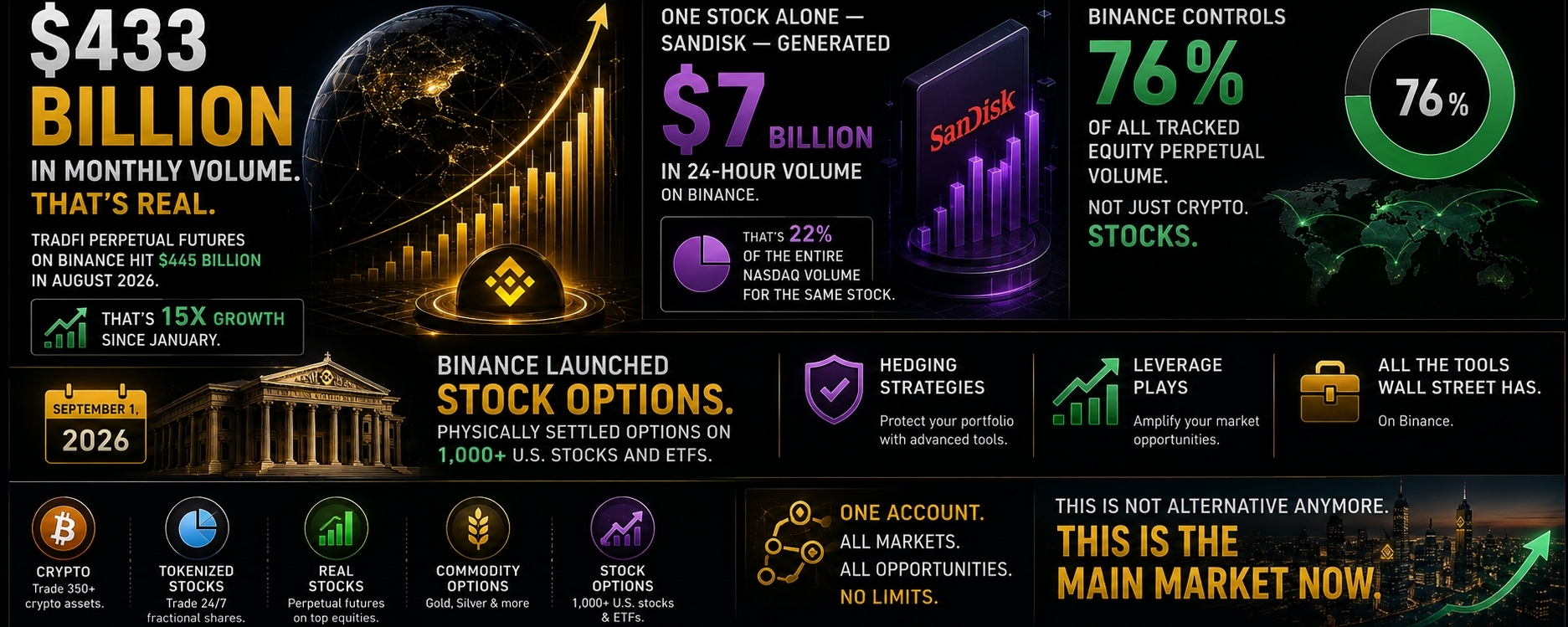
$433 Billion in Monthly Volume. That's Real.

TradFi perpetual futures on Binance hit $445 billion in August 2026. That's 15x growth since January. 📈
One stock alone — SanDisk — generated $7 BILLION in 24-hour volume on Binance. That's 22% of the entire Nasdaq volume for the same stock. 🔥
Binance controls 76% of all tracked equity perpetual volume. Not just crypto. STOCKS. 📊
September 1, 2026: Binance launched Stock Options. Physically settled options on 1,000+ U.S. stocks and ETFs. Hedging strategies. Leverage plays. All the tools Wall Street has. On Binance. 🏛️
One account. Crypto. Tokenized stocks. Real stocks. Commodity options. Stock options.
This is not alternative anymore. This is the main market now. 💪
#BinanceUkraine #TradFi #StockMarketOnChain
🚨 SOUTH KOREA EXTENDS TRADING HOURS BRIDGING TRADFI TO 24/7 GLOBAL LIQUIDITY! $BTC ⚡ Traditional finance is officially taking notes from crypto's playbook as South Korea extends stock trading to 8 PM, marking a major step toward a full 24/7 market. 🌊 Institutional desks and high-turnover hedge funds are gaining unprecedented flexibility to rebalance positions across overlapping global sessions. While domestic equity volume has slowed, stretching trading hours opens a direct conduit for international capital to capture price discovery in real time. 📊 As traditional exchanges slowly dismantle the closing bell, round-the-clock liquidity continues to prove itself as the ultimate standard for global asset pricing. 💬 Will 24/7 TradFi markets accelerate institutional crypto adoption, or will it create fierce competition for overnight order flow? 👇 ⚠️ Not financial advice. Always manage your risk. 🛡️ 🏷️ #BTC #TradFi #Liquidity #Macro #Crypto 🔥 💎
🚨 SOUTH KOREA EXTENDS TRADING HOURS BRIDGING TRADFI TO 24/7 GLOBAL LIQUIDITY! $BTC

Traditional finance is officially taking notes from crypto's playbook as South Korea extends stock trading to 8 PM, marking a major step toward a full 24/7 market. 🌊 Institutional desks and high-turnover hedge funds are gaining unprecedented flexibility to rebalance positions across overlapping global sessions.

While domestic equity volume has slowed, stretching trading hours opens a direct conduit for international capital to capture price discovery in real time. 📊 As traditional exchanges slowly dismantle the closing bell, round-the-clock liquidity continues to prove itself as the ultimate standard for global asset pricing.

💬 Will 24/7 TradFi markets accelerate institutional crypto adoption, or will it create fierce competition for overnight order flow? 👇

⚠️ Not financial advice. Always manage your risk. 🛡️

🏷️ #BTC #TradFi #Liquidity #Macro #Crypto

🔥 💎
·
--
Bullish
TradFi stocks mein aaj kaafi mixed movement dekhne ko mil rahi hai! 📉 Ek taraf jahan $SPCXB (SpaceX) +1.30% ke sath positive momentum maintain kiye hue hai, wahin doosri taraf $MSTRB -3.40% tak drop ho kar sabse barri correction face kar raha hai. ⚠️⌛ Kya aapka focus abhi green stocks par hai ya aap is dip ko buying opportunity samajh rahe hain? Comments mein zaroor batayein! 👇 #trading #TradFi #US2YearYieldRisesTo4.61%
TradFi stocks mein aaj kaafi mixed movement dekhne ko mil rahi hai! 📉 Ek taraf jahan $SPCXB (SpaceX) +1.30% ke sath positive momentum maintain kiye hue hai, wahin doosri taraf $MSTRB -3.40% tak drop ho kar sabse barri correction face kar raha hai. ⚠️⌛

Kya aapka focus abhi green stocks par hai ya aap is dip ko buying opportunity samajh rahe hain? Comments mein zaroor batayein! 👇

#trading #TradFi #US2YearYieldRisesTo4.61%
What will SpaceX (SPCX) hit in September 2026?

What will SpaceX (SPCX) hit in September 2026?

↑ $14097%↓ $13561%↓ $13050%
Volume $110.0
·
--
Article
Commodity TradFi Perpetuals shift to a 24/5 modeStarting from September 15 at 21:00 UTC, i.e., at 00:00 on September 16 Kyiv time, Binance will move Commodity TradFi Perpetuals to a 24/5 mode without a daily one-hour maintenance break. The update will be applied to gold, silver, platinum, palladium, copper, oil, and natural gas contracts, as well as to the relevant commodity futures contracts.

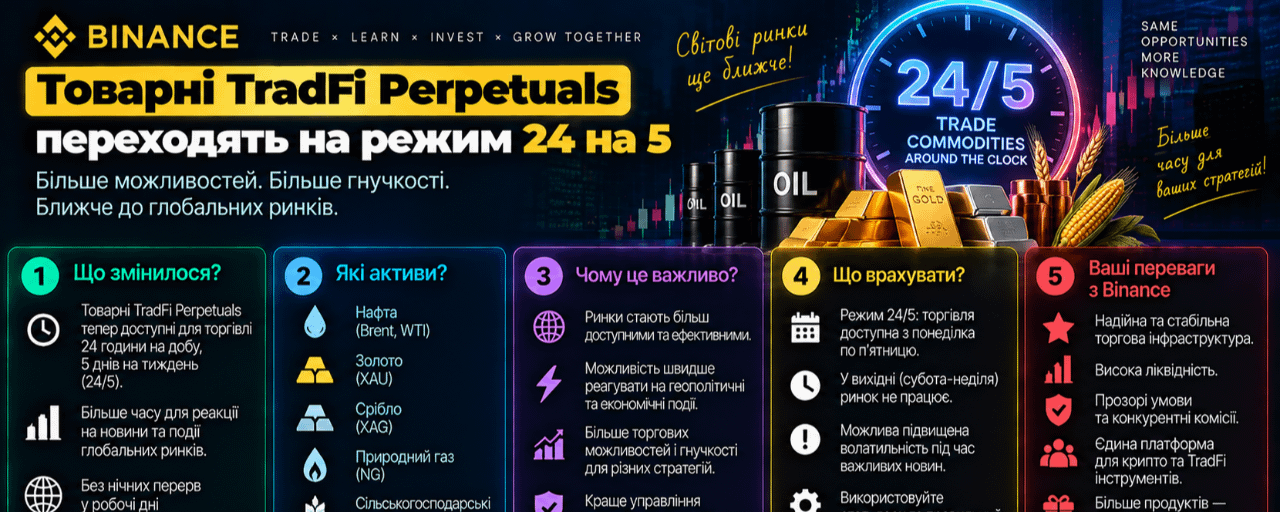
Commodity TradFi Perpetuals shift to a 24/5 mode

Starting from September 15 at 21:00 UTC, i.e., at 00:00 on September 16 Kyiv time, Binance will move Commodity TradFi Perpetuals to a 24/5 mode without a daily one-hour maintenance break. The update will be applied to gold, silver, platinum, palladium, copper, oil, and natural gas contracts, as well as to the relevant commodity futures contracts.
Easy comparison)) "TradFi vs Crypto: a date that didn’t go as planned" 😀 TradFi: I love stocks, gold, and everything that’s stable. Crypto: And I love volatility. Sometimes even too much ❤️‍🔥 TradFi: I’m serious. Exchanges, brokers, documents. Crypto: I’m serious too. It’s just that sometimes BTC decides that today I’m starting a new life 😁 And then they met in one place — Binance 👀 Here you can find tools that bring together traditional finance and the crypto market. 📈 bStocks for those who want to get exposure to traditional assets through the crypto ecosystem. 💰 Binance Earn for those who want their assets not just to sit idle, but potentially generate income. But remember: even the best date doesn’t guarantee a happy ending. Risks are still a thing nobody canceled 😅 ❤️ TradFi — love the classics 🚀 Crypto — love the momentum 🔥 Binance — want both 💪 #TradFi #bStocks #BinanceEarn
Easy comparison))
"TradFi vs Crypto: a date that didn’t go as planned" 😀

TradFi: I love stocks, gold, and everything that’s stable.
Crypto: And I love volatility. Sometimes even too much ❤️‍🔥
TradFi: I’m serious. Exchanges, brokers, documents.
Crypto: I’m serious too. It’s just that sometimes BTC decides that today I’m starting a new life 😁

And then they met in one place — Binance 👀

Here you can find tools that bring together traditional finance and the crypto market.

📈 bStocks for those who want to get exposure to traditional assets through the crypto ecosystem.

💰 Binance Earn for those who want their assets not just to sit idle, but potentially generate income.

But remember: even the best date doesn’t guarantee a happy ending. Risks are still a thing nobody canceled 😅

❤️ TradFi — love the classics
🚀 Crypto — love the momentum
🔥 Binance — want both 💪
#TradFi #bStocks #BinanceEarn
KiSerVik:
цікава інформація. підписуюсь на тебе. подивись, у мене також є цікаві публікації
Article
📈 Market overview: how bStocks fits into modern financial trendsThe financial market is gradually changing: traditional investment instruments are becoming more accessible, while digital assets are increasingly intersecting with familiar finance. One of the interesting directions of this trend is bStocks — a solution that allows you to gain exposure to traditional stock market assets through a crypto ecosystem.

📈 Market overview: how bStocks fits into modern financial trends

The financial market is gradually changing: traditional investment instruments are becoming more accessible, while digital assets are increasingly intersecting with familiar finance.
One of the interesting directions of this trend is bStocks — a solution that allows you to gain exposure to traditional stock market assets through a crypto ecosystem.
SHAKIBUR888:
right
·
--
Bullish
#TradFi -perp trading on Binance is no longer tied to crypto. In August, they made up 37% of the entire volume of perpetual contracts on the exchange. In the daily breakdown, ten out of the fifteen largest contracts by volume were TradFi perps, accounting for 59% of the volume of the top 15. The number one spot was not Bitcoin, but $SNDKB . Cisco and Coherent released their filings at 16:05 New York time, five minutes after the U.S. market closed. The underlying stocks were no longer trading, while TradFi perps on Binance were being repriced as the market digested the numbers. This gap a traditional trader would have seen only at the open the next day. Weekends also stopped being empty. The monthly trading volume on weekends for these perps across crypto exchanges grew from about $4.5 billion to $28 billion by mid-August. Nearly half of that is attributable to Binance. Now, about the risks. A perp does not provide ownership of the underlying asset—it’s a margin contract. It requires collateral; with a sudden price move, your position can be liquidated, and a negative balance remains your debt. Volatility outside market hours is usually higher, and it works both ways. Access to hours when everyone is asleep is not a free advantage. {spot}(SNDKBUSDT)
#TradFi -perp trading on Binance is no longer tied to crypto. In August, they made up 37% of the entire volume of perpetual contracts on the exchange.

In the daily breakdown, ten out of the fifteen largest contracts by volume were TradFi perps, accounting for 59% of the volume of the top 15. The number one spot was not Bitcoin, but $SNDKB .

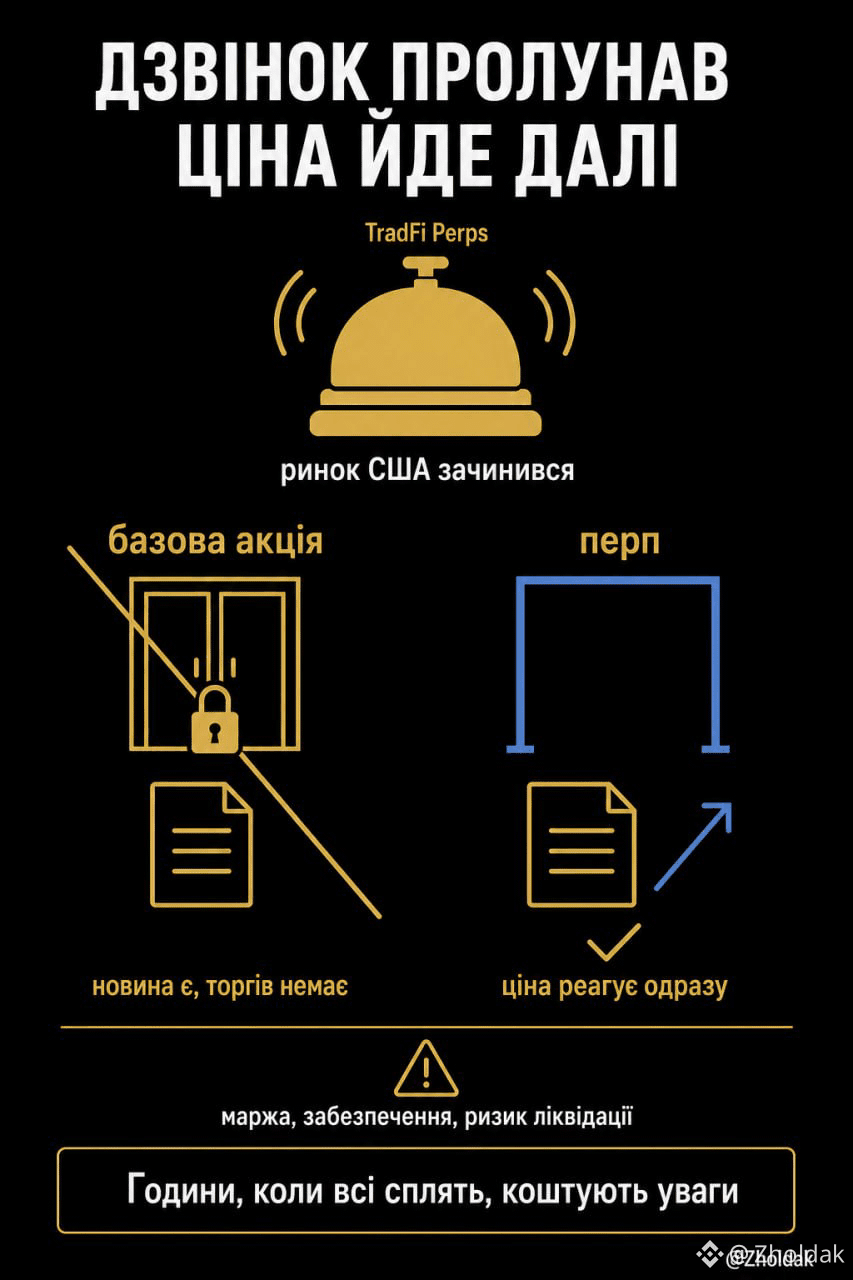
Cisco and Coherent released their filings at 16:05 New York time, five minutes after the U.S. market closed. The underlying stocks were no longer trading, while TradFi perps on Binance were being repriced as the market digested the numbers.

This gap a traditional trader would have seen only at the open the next day.

Weekends also stopped being empty. The monthly trading volume on weekends for these perps across crypto exchanges grew from about $4.5 billion to $28 billion by mid-August. Nearly half of that is attributable to Binance.

Now, about the risks. A perp does not provide ownership of the underlying asset—it’s a margin contract. It requires collateral; with a sudden price move, your position can be liquidated, and a negative balance remains your debt. Volatility outside market hours is usually higher, and it works both ways.

Access to hours when everyone is asleep is not a free advantage.
TradFi Sector Daily Report | 2026-09-16 Monitoring 15 assets | 0 positions to open | Action: remain in cash RWA Sector TVL: $27.48B (7D -0.84%) Overall Score Top: · XRPUSDT Score 66.0 Price 1.3849 · QNTUSDT Score 52.0 Price 62.4 · HBARUSDT Score 50.0 Price 0.07765 · PENDLEUSDT Score 47.0 Price 2.28 · LINKUSDT Score 45.0 Price 11.221 Market news: · The European Central Bank calls for merchants · Standard Chartered predicts Arbitrum's ARB · Standard Chartered sees Arbitrum at $10 by —— Personal trading records, not investment advice. DYOR, strict risk control. #TradFi #RWA #BinanceSquare
TradFi Sector Daily Report | 2026-09-16
Monitoring 15 assets | 0 positions to open | Action: remain in cash
RWA Sector TVL: $27.48B (7D -0.84%)
Overall Score Top:
· XRPUSDT Score 66.0 Price 1.3849
· QNTUSDT Score 52.0 Price 62.4
· HBARUSDT Score 50.0 Price 0.07765
· PENDLEUSDT Score 47.0 Price 2.28
· LINKUSDT Score 45.0 Price 11.221
Market news:
· The European Central Bank calls for merchants
· Standard Chartered predicts Arbitrum's ARB
· Standard Chartered sees Arbitrum at $10 by
——
Personal trading records, not investment advice. DYOR, strict risk control.

#TradFi #RWA #BinanceSquare
I tried TradFi to understand in practice how traditional financial instruments can work in a modern crypto environment. What I liked most is that everything looks quite clear even for a beginner: you can review the available assets, check their terms, and assess potential opportunities. For me, the main advantage is the combination of a familiar financial approach with blockchain technologies. After testing, it became clearer why TradFi is needed in the market and why such solutions are gradually attracting more attention. #TradFi #Crypto #Blockchain #DeFi
·
--
Institutional adoption takes a new step toward convergence with traditional finance. Binance has integrated 11 exchange-traded ETFs in the U.S., focused on Treasury bonds and high-quality corporate debt, within its wealth management offering. This move brings key macro fixed-income instruments closer to the cryptoasset ecosystem, making it easier to access traditional market assets without leaving the platform. What does this mean for the market? Issuers and investors are seeking efficient alternatives to capture returns, linking digital liquidity with U.S. sovereign debt. Keep a close eye on how this integration affects capital flows into regulated products and the institutional custody strategy in the medium term. Do you see this as a positive trend for sector stability? Comment below. 📈🏛️ #Binance #ETFs #Crypto #TradFi $BNB $BTC
[M1_mag7] The old dog checked the on-chain contracts. Over the past 24 hours, $MRVL saw a 3.5% gain. The close was pinned at 227.62. The price moved, but funding was only about 0.0008% (in other words, a very mild positive). This combination is a bit interesting: price is moving up, but the long side hasn’t become wildly overcrowded yet. The angle is Mag7/market-cap benchmark tracking, but the input doesn’t provide the specific SPY and QQQ data, so correlation can only be inferred from sector beta. For the semiconductor sector that $MRVL belongs to, beta is usually high—when the broader market swings, it shakes a lot. Now its gain and slightly positive funding suggest that, in this upswing, the main driver is more like the on-chain TradFi perp longs entering in a relatively calm/gradual way, not the whole sector becoming collectively euphoric based purely on beta. There’s no data in the meme list to compare with other coins in the same sector, which implies there aren’t any direct peers for comparison right now; its liquidity is currently best treated as an isolated observation. So the old dog’s view is: the 3.5% rise in $MRVL is being nudged a bit by the long funds in TradFi perpetual contracts, but positioning sentiment hasn’t reached the critical point where it could get explosively crowded. This is a single-signal conclusion based on (1) price change and (2) funding direction. I’m against chasing the move. If the market only looks at the price’s rise and FOMOs in while ignoring that funding is still positive (an early signal of overcrowding), it’s easy to get shaken out during a minor pullback. On positioning, I’m choosing to watch—no entry. The strongest counterargument is this: if the broader market (say, QQQ) suddenly prints a big bullish candle, causing semiconductor beta to run wild, then $MRVL could be pulled higher by sector sentiment. In that case, the weak positive funding wouldn’t be a real resistance. A second-order effect: if that happens, those who went short early in TradFi perps might be forced to cover due to a beta-driven squeeze, which would further push the price up. The invalidation is very clear: if the fundingRate jumps to above 0.01%, or flips negative, then my view of a mild rally with low overcrowding must be overturned. The trigger action is: if price continues up but funding stays below 0.001%, I’ll consider testing a long with a small position; otherwise, if price doesn’t move but funding spikes first, I’ll pull back. Trading tag: #BinanceFutures #TradFi #USDⓈM #MRVL #MRVLUSDT $MRVL
[M1_mag7]
The old dog checked the on-chain contracts. Over the past 24 hours, $MRVL saw a 3.5% gain. The close was pinned at 227.62. The price moved, but funding was only about 0.0008% (in other words, a very mild positive). This combination is a bit interesting: price is moving up, but the long side hasn’t become wildly overcrowded yet.

The angle is Mag7/market-cap benchmark tracking, but the input doesn’t provide the specific SPY and QQQ data, so correlation can only be inferred from sector beta. For the semiconductor sector that $MRVL belongs to, beta is usually high—when the broader market swings, it shakes a lot. Now its gain and slightly positive funding suggest that, in this upswing, the main driver is more like the on-chain TradFi perp longs entering in a relatively calm/gradual way, not the whole sector becoming collectively euphoric based purely on beta. There’s no data in the meme list to compare with other coins in the same sector, which implies there aren’t any direct peers for comparison right now; its liquidity is currently best treated as an isolated observation.

So the old dog’s view is: the 3.5% rise in $MRVL is being nudged a bit by the long funds in TradFi perpetual contracts, but positioning sentiment hasn’t reached the critical point where it could get explosively crowded. This is a single-signal conclusion based on (1) price change and (2) funding direction. I’m against chasing the move. If the market only looks at the price’s rise and FOMOs in while ignoring that funding is still positive (an early signal of overcrowding), it’s easy to get shaken out during a minor pullback. On positioning, I’m choosing to watch—no entry.

The strongest counterargument is this: if the broader market (say, QQQ) suddenly prints a big bullish candle, causing semiconductor beta to run wild, then $MRVL could be pulled higher by sector sentiment. In that case, the weak positive funding wouldn’t be a real resistance. A second-order effect: if that happens, those who went short early in TradFi perps might be forced to cover due to a beta-driven squeeze, which would further push the price up. The invalidation is very clear: if the fundingRate jumps to above 0.01%, or flips negative, then my view of a mild rally with low overcrowding must be overturned. The trigger action is: if price continues up but funding stays below 0.001%, I’ll consider testing a long with a small position; otherwise, if price doesn’t move but funding spikes first, I’ll pull back.

Trading tag: #BinanceFutures #TradFi #USDⓈM #MRVL #MRVLUSDT $MRVL
Log in to explore more content
Join global crypto users on Binance Square
⚡️ Get latest and useful information about crypto.
💬 Trusted by the world’s largest crypto exchange.
👍 Discover real insights from verified creators.
Email / Phone number