

#stylus
stylus
1,740 views
15 Discussing
Hot
Latest
Arbitrum is moving forward with Stylus again, which was a technical development worth watching: contracts written in Rust and C/C++ can interoperate on the same chain with EVM applications, while also opening up the possibility of lower costs for compute-intensive use cases. But the controversy in the community is not about Stylus itself; it is about the accompanying “new contract approval authority.”
The key questions are: Who has the authority to approve or reject contracts going live? Are the approval criteria transparent? Can developers appeal a rejection? Is this authority time-limited? If control over the gateway rests with a small number of multisig signers or the team, “permissionless deployment” could become “deployment by permission,” creating unfair barriers for major projects and anonymous teams.
Security reviews and risk isolation are understandable, but temporary powers must have clear boundaries, on-chain disclosure, timelocks, and an exit mechanism. Otherwise, a single technical upgrade could also rewrite Arbitrum’s commitment to openness. $ARB #Arbitrum #Stylus #Layer2

·
--
Arbitrum is planning to push Stylus forward again. It should be a positive development, attracting Rust and C/C++ developers and lowering the barrier to building high-performance contracts. But the proposal has sparked controversy over new contract approval permissions. Supporters say this is a security gate before launch that can filter out high-risk implementations; critics worry that opaque approval boundaries could reintroduce permission hurdles into the ecosystem, effectively creating a deployment whitelist.
The key issue is not just whether the technology works, but who has the authority to approve contracts, what standards they use, and who is responsible when something goes wrong. Without transparent governance rules, even a performance upgrade could come at the cost of trust.
Are you more optimistic about the ecosystem growth Stylus could bring, or wary of tighter controls on contract deployment?
$ARB #Arbitrum #Stylus #Layer2
Arbitrum’s renewed push to launch Stylus should have been good news for the ecosystem: languages such as Rust, C, and C++ can be used in the EVM+ development environment, supporting high-performance applications and bringing in new developers. But the real controversy isn’t about the technology—it’s about the accompanying “new contract approval authority.”
The key questions are: Who has the authority to approve contracts? Is the approval process transparent? Can that authority be limited or revoked? How will audit standards, lines of responsibility, and emergency pause mechanisms be designed? If the authority is too broad, deployment may become more efficient, but DAOs and users will also take on additional trust assumptions. If the governance terms, timelocks, and oversight mechanisms are sufficiently clear, Stylus will look more like a long-term upgrade in capabilities.
The benefits shouldn’t be judged by the narrative alone; we also need to look at how authority is allocated. $ARB holders and developers should pay closer attention to the proposal’s details, not just the launch timeline.
#Arbitrum #Stylus #Layer2

·
--
Arbitrum plans to relaunch Stylus. This should be good news for the Layer 2 developer ecosystem, but the addition of contract approval powers has sparked controversy.
Stylus lets developers write contracts in languages such as Rust, C, and C++, lowering the barrier to deploying high-performance applications. But what the community really cares about is this: Will new contracts need additional approval before going live? Could this turn on-chain deployment, which was originally meant to be permissionless, into a mechanism with access controls?
Supporters believe that introducing reviews early can reduce risks and prevent serious vulnerabilities. Critics worry that if approval powers remain in place long term, they could undermine Arbitrum’s decentralization and affect developers’ expectations. A technical upgrade is never just a technical issue; ultimately, it comes down to governance and the boundaries of authority.
The key now is how the official team explains who will approve contracts, how long the process will take, and how the approval mechanism can be removed. If it is only a temporary safeguard, the community may accept it; if the scope of these powers remains unclear, holders of $ARB will likely keep asking questions.
#Arbitrum #Stylus #Layer2

·
--
Arbitrum plans to resume pushing Stylus forward, originally to bring languages like Rust and C/C++ into smart contract development and lower the barrier to deploying high-performance applications. But what has really sparked controversy is the accompanying “new contract approval authority.”
The key questions are: Who gets to decide which Stylus contracts can go live? Are the approval standards transparent? Could this authority become a gateway to censorship, or be overused in an emergency? If deployment control is too centralized, developers may worry about the ecosystem’s freedom; if there is no review mechanism at all, security risks could grow.
The technical upgrade is worth looking forward to, but the design of this authority must first be clearly explained: its boundaries, time limits, review process, and community veto mechanism should all be openly discussed and put to a vote. Layer 2 competition is not just about performance and ecosystem metrics—it is also about the credibility of governance. Holders of $ARB need to consider not only whether Stylus can bring new applications, but also whether Arbitrum is still following a decentralized path.
#Arbitrum #Stylus #Layer2
3

·
--
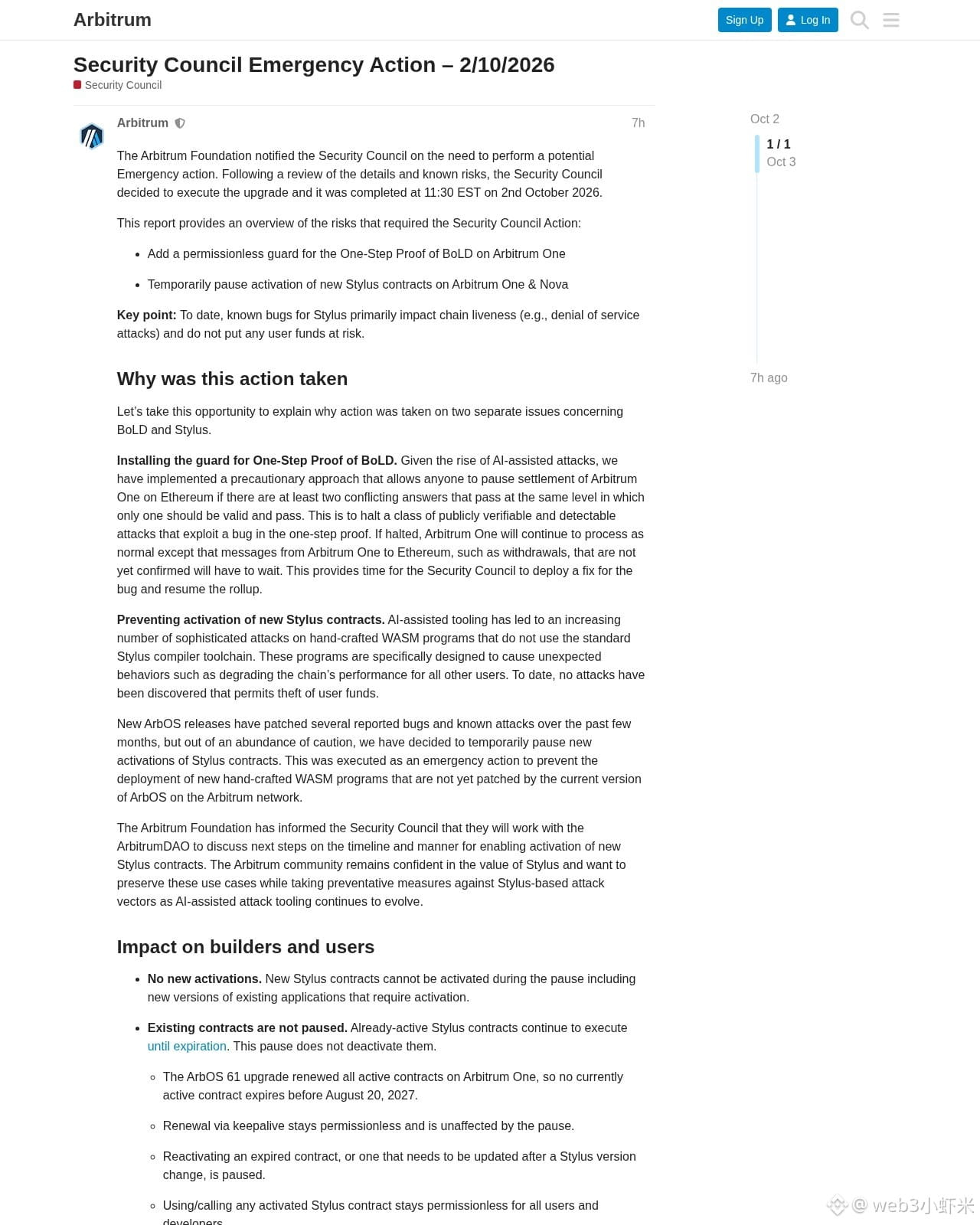
Hitting the Arbitrum forum: Security Committee 10/2 emergency upgrade pauses activation of new Stylus contracts for One/Nova; already deployed ones can still run and be renewed, and Solidity/EVM are unaffected.
At the same time, a permissionless hardening was added to One’s BoLD single-step proof—if, for the same disputed step, two conflicting answers both pass verification, anyone can pause settlement to Ethereum; unconfirmed withdrawals may have to wait for the fix. The official says the known issue mainly impacts activity (DoS), not user funds; when it will be restored will be decided by ArbitrumDAO.
AI-assisted attackers are building WASM attacks more aggressively—L2 locks the door first.
$ARB #Arbitrum #Stylus #Security
259

·
--
Arbitrum Stylus Upgrades & Liquidity Inflows🔴 RED (SELL/SHORT - Or Wait for Dip Absorption)
Arbitrum (ARB) is experiencing a minor -2.17% pullback over the last 6 hours, establishing a classic "buy the dip" scenario for patient spot and derivative traders. Despite the temporary red candle, ARB remains one of the most heavily searched tokens due to the sweeping excitement over Arbitrum Stylus. Stylus is an engineering leap forward that allows developers to write smart contracts in mainstream, hyper-efficient languages like Rust, C, and C++, alongside traditional Solidity.
This has effectively unlocked a massive global pool of non-crypto native developers, triggering a wave of migration from Web2 infrastructure into the Arbitrum ecosystem. Furthermore, Arbitrum still commands the highest Total Value Locked (TVL) across all Ethereum Layer-2 networks. This deep liquidity creates a sticky environment for capital; traders and yield farmers are reluctant to leave a network where liquidity is deep, fees are negligible, and slippage is minimal. The current price decline is widely interpreted by analysts as short-term profit-taking rather than a structural flaw.
The 2.17% pullback has driven ARB straight into a high-confluence demand zone between 0.1100 and 0.1130. This area lines up perfectly with a historical order block and the 50-period Exponential Moving Average (EMA) on the 4-hour chart. The daily RSI has cooled down from near-overbought territories to a comfortable 46, wiping out excessive leverage and resetting the chart for a healthier upward trajectory.
$ARB
{future}(ARBUSDT)
[ Resistance / Target: 0.1250 ]
▲
│
📉 CURRENT PRICE: 0.1127 ─── (50 EMA / Oversold Reset)
▲
│
[ High-Confluence Support: 0.1100 ]
Notice how the selling volume is visibly tapering off as the price approaches 0.1100, signaling that sellers are exhausting their capital and buyers are beginning to absorb the remaining liquidity. An ideal trade configuration involves bidding this exact pocket, looking for a swift reversal back up toward the 0.1250 resistance tier. A daily close below 0.1080 invalidates this setup.
Do not let minor red candles mask structural strength. ARB is offering a discounted entry into the dominant Layer-2 network by TVL. Position entries near 0.1100, targeting a recovery back to recent highs.
#Arbitrum #Stylus #Web3 Dev #layer 2Crypto
Arbitrum Stylus Upgrades & Liquidity Inflows
🔴 RED (SELL/SHORT - Or Wait for Dip Absorption)
Arbitrum (ARB) is experiencing a minor -2.17% pullback over the last 6 hours, establishing a classic "buy the dip" scenario for patient spot and derivative traders. Despite the temporary red candle, ARB remains one of the most heavily searched tokens due to the sweeping excitement over Arbitrum Stylus. Stylus is an engineering leap forward that allows developers to write smart contracts in mainstream, hyper-efficient languages like Rust, C, and C++, alongside traditional Solidity.
This has effectively unlocked a massive global pool of non-crypto native developers, triggering a wave of migration from Web2 infrastructure into the Arbitrum ecosystem. Furthermore, Arbitrum still commands the highest Total Value Locked (TVL) across all Ethereum Layer-2 networks. This deep liquidity creates a sticky environment for capital; traders and yield farmers are reluctant to leave a network where liquidity is deep, fees are negligible, and slippage is minimal. The current price decline is widely interpreted by analysts as short-term profit-taking rather than a structural flaw.
The 2.17% pullback has driven ARB straight into a high-confluence demand zone between 0.1100 and 0.1130. This area lines up perfectly with a historical order block and the 50-period Exponential Moving Average (EMA) on the 4-hour chart. The daily RSI has cooled down from near-overbought territories to a comfortable 46, wiping out excessive leverage and resetting the chart for a healthier upward trajectory.
$ARB
[ Resistance / Target: 0.1250 ]
▲
│
📉 CURRENT PRICE: 0.1127 ─── (50 EMA / Oversold Reset)
▲
│
[ High-Confluence Support: 0.1100 ]
Notice how the selling volume is visibly tapering off as the price approaches 0.1100, signaling that sellers are exhausting their capital and buyers are beginning to absorb the remaining liquidity. An ideal trade configuration involves bidding this exact pocket, looking for a swift reversal back up toward the 0.1250 resistance tier. A daily close below 0.1080 invalidates this setup.
Do not let minor red candles mask structural strength. ARB is offering a discounted entry into the dominant Layer-2 network by TVL. Position entries near 0.1100, targeting a recovery back to recent highs.
#Arbitrum #Stylus #Web3 Dev #layer 2Crypto
1
208

🚨 Arbitrum pauses the activation of new Stylus in an emergency security measure
The Arbitrum network announced a temporary pause on activating its new Stylus feature. This precautionary security measure follows the discovery of a potential issue that requires review. The move aims to ensure network stability and user safety.
━━━━━━━━━━━━━━
📊 Impact: 📈 High
🏷️ ALTCOIN
#Arbitrum #Stylus #BlockchainSecurity #Layer2 #CryptoNews
📰 Source: cryptobriefing.com
1
51
·
--
$XAI Recent upgrades like Stylus and gaming ecosystem expansion give it a stronger “growth story” narrative for speculators.
Stylus is basically a big upgrade on Arbitrum that lets developers build smart contracts using languages like Rust, C, and C++ instead of only Solidity.
Normally on Ethereum-style chains, devs mostly use Solidity. Stylus changes that by adding WebAssembly (WASM) support alongside the normal Ethereum Virtual Machine (EVM).
Simple version:
* Old way = mostly Solidity only
* Stylus = Solidity + Rust + C++ + more languages
Why people are bullish on it:
* Faster execution
* Lower gas fees
* Better for heavy apps like games and AI
* Easier for normal software developers to enter crypto
For gaming specifically, this matters because game logic can become much more complex and efficient. Some people think this can help gaming ecosystems connected to Arbitrum, including projects like Xai, build smoother on-chain games.
A big part of the XAI thesis is:
* “Gaming on Arbitrum infrastructure”
* “Better tech for game developers”
* “Cheaper/faster gameplay”
Stylus feeds into that narrative because it improves the underlying tech stack. It does NOT automatically pump XAI price, but it strengthens the long-term ecosystem story.
#arb #stylus #gaming #Altseason #web3
242
Log in to explore more content
Join global crypto users on Binance Square
⚡️ Get latest and useful information about crypto.
💬 Trusted by the world’s largest crypto exchange.
👍 Discover real insights from verified creators.
Email / Phone number
Trending Topics
1
#BinancePick
3.1M views
153,018 Discussing
2
#EarningsSeason
5.3M views
26,027 Discussing
3
#AnthropicTTMRevenueGrewAbout1200%
32,027 views
436 Discussing
4
#AnthropicS1ExpectedToday
27,347 views
353 Discussing
5
#SouthKoreaReportedlyWeighsFourthCryptoTaxDelay
31,540 views
481 Discussing
6
#FranklinTempletonFilesForTwoDividendToBitcoinETFs
41,633 views
549 Discussing
7
#StrategyMSTRSurpassesNasdaqInMarketCap
31,786 views
391 Discussing
8
#CanadaProposesStablecoinRedemptionWithin3BusinessDays
1,363 views
36 Discussing
9
#ElectrumWalletBugLetRogueServersStealFunds
31,897 views
471 Discussing
10
#ArgentineCourtDismissesLIBRACaseAgainstMilei
47,629 views
590 Discussing