
#skypsmusdcliquidityreboundsto
skypsmusdcliquidityreboundsto
292 views
12 Discussing
Hot
Latest

·
--
Article
Sky’s PSM liquidity returns to $1.77 billion: The stress test passed, but confidence has yet to recoverSky’s PSM liquidity returns to $1.77 billion: The stress test passed, but confidence has yet to recover
At around 14:58 Beijing time, `#SkyPSMUSDCLiquidityReboundsTo$1.77B` appeared on Binance Square’s trending list, with 15 people visible in the discussion. What makes this topic worth watching isn’t how big “$1.77 billion” sounds, but a more specific question: After a wave of large redemptions, has Sky’s stablecoin conversion channel recovered—and have users regained confidence in holding USDS?
1. What happened?
On November 20, the Sky Frontier Foundation published “Sky Protocol Shows Resilience Through Record $2 Billion Day as Review Finds CoinDesk Report Misleading,” saying that on November 19, users converted more than $2 billion in USDS to USDC through the Peg Stability Module (PSM), with conversions maintained at a 1:1 rate and no suspension of the PSM, USDS, or sUSDS. Sky later updated its statement on November 23, saying that USDC liquidity in the PSM had returned to about $1.77 billion, exceeding 28.4% of the combined circulating supply of USDS and DAI.
Sky’s PSM liquidity returns to $1.77 billion: The stress test passed, but confidence has yet to recover
Sky’s PSM liquidity returns to $1.77 billion: The stress test passed, but confidence has yet to recover
At around 14:58 Beijing time, `#SkyPSMUSDCLiquidityReboundsTo$1.77B` appeared on Binance Square’s trending list, with 15 people visible in the discussion. What makes this topic worth watching isn’t how big “$1.77 billion” sounds, but a more specific question: After a wave of large redemptions, has Sky’s stablecoin conversion channel recovered—and have users regained confidence in holding USDS?
1. What happened?
On November 20, the Sky Frontier Foundation published “Sky Protocol Shows Resilience Through Record $2 Billion Day as Review Finds CoinDesk Report Misleading,” saying that on November 19, users converted more than $2 billion in USDS to USDC through the Peg Stability Module (PSM), with conversions maintained at a 1:1 rate and no suspension of the PSM, USDS, or sUSDS. Sky later updated its statement on November 23, saying that USDC liquidity in the PSM had returned to about $1.77 billion, exceeding 28.4% of the combined circulating supply of USDS and DAI.
215

·
--
everyone thinks sky psm usdc liquidity bouncing is a bullish demand signal but actually it's often just scared money parking during extreme fear.
ngl traders keep falling for this. you see $usdc flooding the psm, you think $sky is about to cook or that sitting in usds yield is the play, then you watch your capital go dead while $btc keeps bleeding and you miss every bounce.
this is a clean case study of the current tape. fear and greed is sitting at 9. people are converting into $usdc through the peg stability module, minting usds, and locking it for the savings rate. that's your liquidity rebound. it is not new conviction flowing into the protocol. it is risk-off rotation, same pattern we saw when everyone hid in stables last cycle and sat through weeks of nothing.
the psm filling up is a fear thermometer, not a green light on $sky. idle capital waiting for a catalyst. if you're treating this rebound like confirmation that things are healing you are probably about to get chopped.
anyone else watching this and treating it as a warning instead of a buy signal?
#SkyPSMUSDCLiquidityReboundsTo #WillMarketsStageAThanksgivingReliefRally #TradersPriceOut50bpDecemberFedHike
4

Why is nobody talking about Sky's PSM USDC liquidity rebounding right in the middle of extreme fear?
Traders keep losing money chasing every dip or panic dumping $BTC because they ignore where the actual stables are moving. That FOMO and fear cycle is exactly why most people miss the real setups.
The rebound in $USDC through the Sky Peg Stability Module is not coincidence. Bigger players use that 1:1 facility when they want to enter or stabilize without slippage, and seeing it pick up now with the Fear and Greed Index at 9 tells you capital is not running away. It is rotating. $SKY and the surrounding DeFi often stabilize first when this happens.
Use it as a practical filter. Monitor those PSM USDC numbers instead of charts alone. When liquidity comes back in fear, start scaling into quality assets rather than waiting for confirmation.
Anyone else reading this as early positioning, or do you think it leads nowhere?
#SkyPSMUSDCLiquidityReboundsTo #WillMarketsStageAThanksgivingReliefRally #BitcoinEndsRecord17DayStreakOfLowerHighs
2

·
--
#SkyPSMUSDCLiquidityReboundsTo$1.77B
🔁 $2B Out in a Day, $1.77B Back: Sky's Reserve Refills
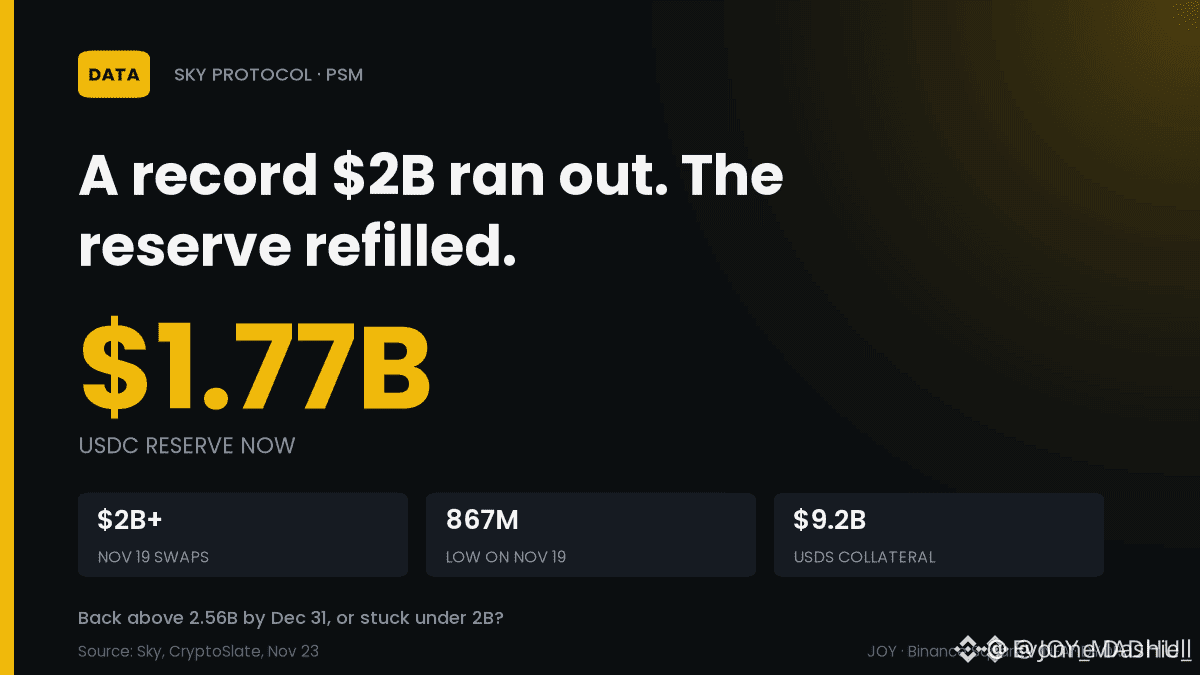
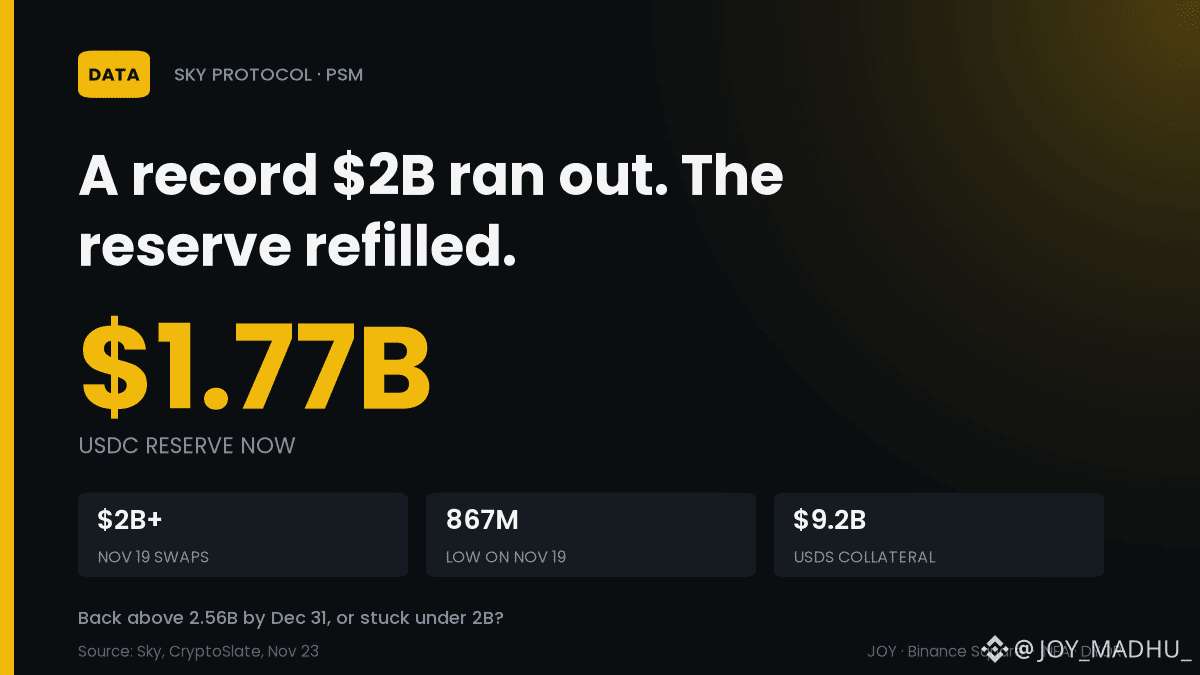
Sky's USDC swap reserve has rebuilt to $1.77B after a record outflow on Nov 19.
📊 Over $2B of USDS swapped to USDC 1:1 on Nov 19, a PSM record
📉 Reserve fell from 2.56B to 867M USDC within hours
📈 Now 1.77B USDC, over 28.4% of USDS + DAI supply
🏦 USDS backed by $9.2B collateral; swaps never paused, per Sky
Why it matters: the peg held, but a two-thirds drain in hours shows how fast a run tests a reserve.
Back above 2.56B by Dec 31, or stuck under 2B? 👇
$SKY $USDC
#SkyPSMUSDCLiquidityReboundsTo$1.77B #Stablecoins #DeFi
67

·
--
$SKY: Sky reported a record "more than $2 billion" reserve outflow on November 19, but its on-chain balance had fallen about $1.69 billion. Which number should a holder trust?
Short answer: both, for different jobs: $2 billion is gross one-way redemption volume, $1.69 billion is the net change. The refill to $1.77 billion is real, but part came from a loan repayment, not fresh deposits.
What happened:
- Sky's November 23 update put PSM USDC liquidity at $1.77 billion, above 28.4% of combined USDS and DAI supply, with USDS backed by about $9.2 billion of collateral.
- It called November 19 the PSM's largest single-day outflow since launch: over $2 billion of 1:1 USDS-to-USDC swaps.
- CryptoSlate's November 23 on-chain check read $2.559 billion early on November 19 and $867 million just before 17:56 UTC - a net decline of about $1.69 billion, some $300 million below the gross figure.
Why it matters:
- Gross volume counts holders who moved; a balance shows the backing left at the low.
- The first refill was mechanical: at 17:55:47 UTC on November 19 an Obex allocator repaid about 100 million USDC for an equal amount of DAI, and a holder swapped 12 million back (CryptoSlate). Sky blamed market stress and a "severely misleading" report - its account, not verified.
What I am watching:
- Its PSM dashboard against the $1.77 billion headline; CryptoSlate read 1.76 billion at 12:38 UTC.
- Whether the reserve holds near 28% coverage if another redemption day arrives.
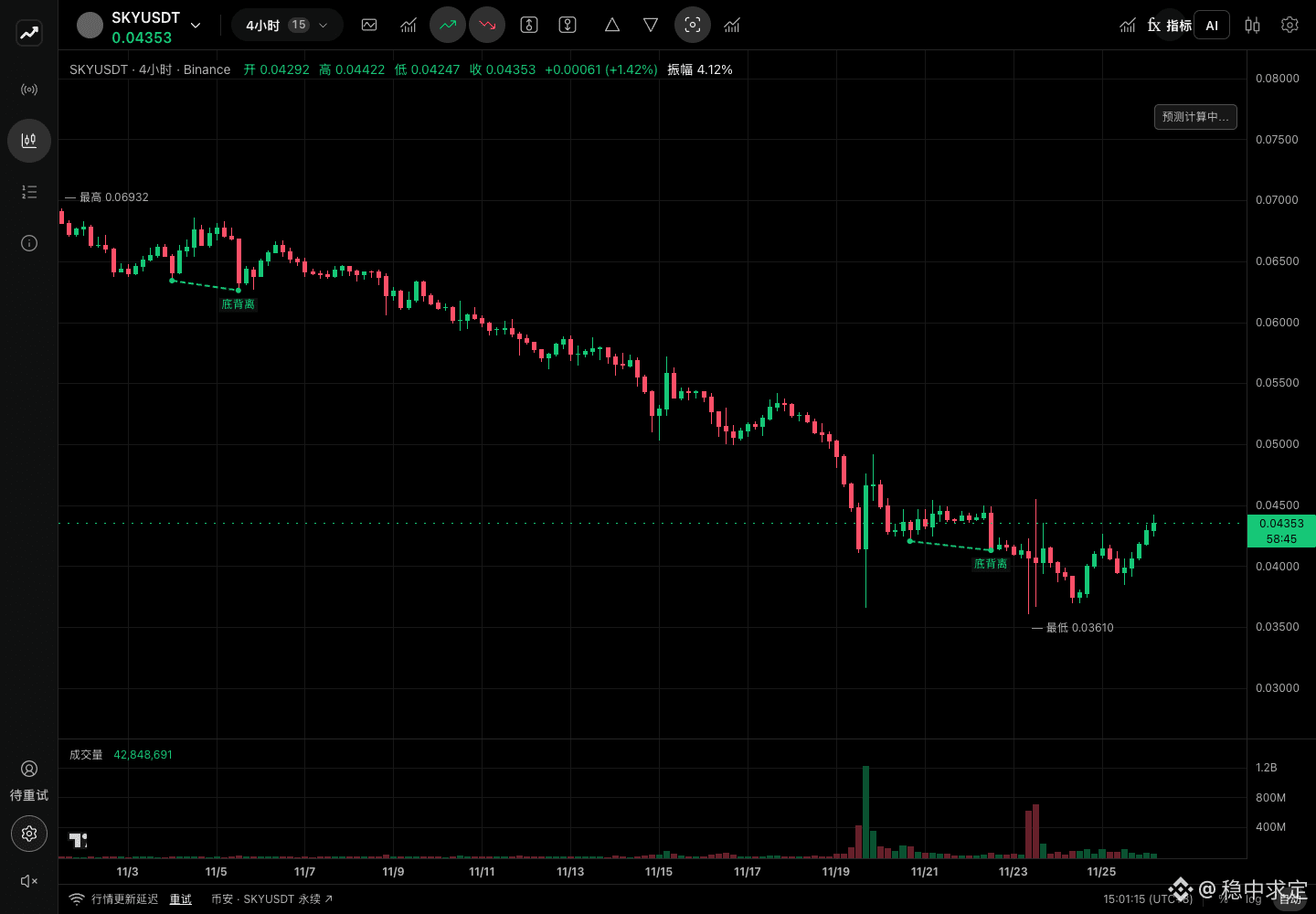
- SKYUSDT at $0.04096, -2.43% over rolling 24h, range $0.0362-$0.0455 (Binance, 19:32 Kyiv): the token did not recover with the balance.
My rule: read the balance, not the flow headline. Gross redemptions flatter a run and a recovery.
#SkyPSMUSDCLiquidityReboundsTo$1.77B #Write2Earn
When a stablecoin reserve refills, what do you check first - the dashboard balance or the redemption volume, and why?
$SKY : Sky reported a record "more than $2 billion" reserve outflow on November 19, but its on-chain balance had fallen about $1.69 billion. Which number should a holder trust?
Short answer: both, for different jobs: $2 billion is gross one-way redemption volume, $1.69 billion is the net change. The refill to $1.77 billion is real, but part came from a loan repayment, not fresh deposits.
What happened:
- Sky's November 23 update put PSM USDC liquidity at $1.77 billion, above 28.4% of combined USDS and DAI supply, with USDS backed by about $9.2 billion of collateral.
- It called November 19 the PSM's largest single-day outflow since launch: over $2 billion of 1:1 USDS-to-USDC swaps.
- CryptoSlate's November 23 on-chain check read $2.559 billion early on November 19 and $867 million just before 17:56 UTC - a net decline of about $1.69 billion, some $300 million below the gross figure.
Why it matters:
- Gross volume counts holders who moved; a balance shows the backing left at the low.
- The first refill was mechanical: at 17:55:47 UTC on November 19 an Obex allocator repaid about 100 million USDC for an equal amount of DAI, and a holder swapped 12 million back (CryptoSlate). Sky blamed market stress and a "severely misleading" report - its account, not verified.
What I am watching:
- Its PSM dashboard against the $1.77 billion headline; CryptoSlate read 1.76 billion at 12:38 UTC.
- Whether the reserve holds near 28% coverage if another redemption day arrives.
- SKYUSDT at $0.04096, -2.43% over rolling 24h, range $0.0362-$0.0455 (Binance, 19:32 Kyiv): the token did not recover with the balance.
My rule: read the balance, not the flow headline. Gross redemptions flatter a run and a recovery.
#SkyPSMUSDCLiquidityReboundsTo$1.77B #Write2Earn
When a stablecoin reserve refills, what do you check first - the dashboard balance or the redemption volume, and why?
68

·
--
ETH retreats to around $1,740 | Liquidity in Sky stablecoin swap pool recovers | I’m waiting for confirmation at $1,765
I welcome the recovery in on-chain liquidity, but I wouldn’t use it as a reason to chase ETH. A topic appeared on Binance Square: #SkyPSMUSDCLiquidityReboundsTo$1.77B. I checked Sky’s public ecosystem dashboard: the snapshot at 04:03 UTC on November 23 showed about $1.758 billion in USDC held by LitePSM, roughly 28.3% of the combined USDS and DAI supply. That is below the dashboard’s indicated target of about $1.87 billion, a difference of roughly $108.4 million. Another Sky collateral page showed about $1.753 billion on the same day, but with a different snapshot time and measurement methodology. The $1.77 billion figure in the topic can be understood as an approximation; the small differences between pages shouldn’t be interpreted as a sudden influx of funds, and it would be wrong to say that this USDC represents the entire Sky system’s reserves.
The PSM’s mechanics matter more than the numbers. Sky explains that LitePSM provides a 1:1 conversion route between USDC and USDS or DAI, and that its liquidity buffer can support arbitrage and large conversions when stablecoins deviate from their peg. This matters for settlement confidence among Ethereum DeFi users: if the conversion route remains smooth, stablecoin risks for related lending and trading applications may ease. But this USDC is a reserve in a stablecoin conversion pool, not a direct purchase of ETH, and it doesn’t prove that spot ETH ETFs have shifted from outflows to inflows. Anyone who sees the word “recovery” and concludes that ETH must rise is skipping over three links: stablecoin demand, on-chain activity, and ETH value capture. I’ll keep watching whether the PSM balance remains stable, whether the USDS price deviates from its peg, and what happens to on-chain fees, rather than focusing on a single snapshot.
The market also hasn’t confirmed a sustained move higher. The latest Kraken ETH/USD quote is around $1,739.79, with a 24-hour open of $1,721.61, a low of $1,693.91, and a high of $1,843.93. The price briefly surged to around $1,844 intraday, then fell back by about $100; this move can’t be directly attributed to the Sky data. $1,765 is the short-term level I’m watching to see whether the rebound can regain its footing, while $1,844 is further overhead resistance. A drop below $1,690 would invalidate my short-term recovery thesis; a break above $1,765 followed by a quick drop back to $1,740 would also indicate insufficient buying support. ETF flows and Wednesday’s U.S. PCE data remain independent risks that can’t be offset by a single piece of positive DeFi news.
If I were trading this myself, I wouldn’t enter now. I’d only consider a small, unleveraged spot long. I’d wait for a four-hour close above $1,765, a retest that holds near $1,760, and no further significant decline in the Sky dashboard balance before entering with at most 1.5% of my total capital. My first target would be $1,800, where I’d sell half; my second target would be $1,840, where I’d sell half of the remainder. I’d place a stop below $1,725 and close the position immediately if it’s triggered. If there’s another large net outflow from the stablecoin conversion pool or ETH falls back below $1,760, I’d exit proactively even if the stop hasn’t been reached. If these conditions aren’t met, I’d stay out of the market. #SkyPSMUSDCLiquidityReboundsTo$1.77B #ETH
The above is only my personal market observation and does not constitute investment advice.

5

Zoom announces a dividend—but what is it signaling?
Zoom Communications beat earnings expectations and initiated a quarterly dividend, showing that its strategy of targeting large customers is paying off—a positive sign for tech stocks and investors holding related ETFs.
Zoom Communications has just released its earnings report, with revenue and profits both exceeding market expectations. The company unexpectedly announced an annual dividend of $0.25 per share, something it had never done before. The signal is clear: Zoom is preparing to distribute more of its profits to investors. At the same time, it has recently been aggressively pursuing large enterprise customers, suggesting that making money has become easier. For tech-focused funds like ARK 40 ETF, a show of confidence from a leading company like Zoom is a shot in the arm for the entire sector.
Market impact
- Short term: News like this could lift tech ETFs and indirectly support ETH and BTC, since many people view ETH as “digital gold” and see it as closely linked to tech stocks. Funds may flow out of riskier altcoins and back into these more established companies.
- Medium term: If large enterprise customers become the norm, valuations across the software industry could be reassessed. In the long run, this could benefit crypto projects that serve large customers. Regulators may pay more attention to companies with stable earnings rather than purely speculative projects.
My take
This is positive for both ETH and BTC, but the impact won’t be especially strong. ETH has recently been consolidating around $1,700. If sentiment around tech stocks continues to build, ETH could test the psychological $1,800 level. But at the end of the day, the crypto market still hinges on the Fed and the dollar’s trajectory. Good news like this from Zoom is just a catalyst. Don’t be too hard on me if I’m wrong—I’m only trying it out with a small position myself.
$BTC $ETH #BTC #ETH
⚠️ This is not investment advice
#SkyPSMUSDCLiquidityReboundsTo$1.77B



38

·
--
Miners just said they’d ramp up buying—so how did Bitcoin surge to $10 million?
We discussed this just a couple of days ago, and now there’s a new development. At the ITC conference, Michael Saylor said that the Bitcoin Strategy bought this year has covered this year’s mining output—possibly equaling the total mined over the past four years—and added, “We’re just getting started.” He stressed that miners can only sell once, while Strategy is a long-term holder. Combined with declining new-coin supply and more companies buying in, this suggests Bitcoin’s price could surge to $10 million.
Why does this news matter? Saylor’s comments essentially give another boost to the theory that Bitcoin’s value comes from its scarcity. BTC is currently at $60,004.46, down 2.81% in 24 hours, as the market continues to digest the effects of Fed rate hikes and tech-stock sell-offs. By directly linking the purchase of mining farms with accumulating Bitcoin, Saylor has turned the “Bitcoin is digital gold” narrative from a concept into a plan of action. In the short term, this means Bitcoin’s buyers could continue to receive support from heavyweight players like Saylor.
As for the market impact, Saylor’s comments could trigger two kinds of reactions: first, directly boost bullish sentiment toward BTC; second, prompt critics to question whether this “buy mining rigs + accumulate Bitcoin” strategy is sustainable. Historically, after a big investor talks up a rally, profit-taking often follows the next day. But Saylor’s particular emphasis this time on “just getting started” gives the story more room to gain momentum. From a capital-flow perspective, the overall market is under pressure. If Saylor’s thesis holds, capital could flow back into BTC from other cryptocurrencies, creating a “huddle around scarce assets” effect.
💡 BTC’s price could benefit from Saylor’s continued buying, but the $1 million target would require a further depletion of new-coin supply to support it. If large-scale mining-farm shutdowns occur or institutions suddenly change course, this thesis could unravel in an instant.
This article is not sponsored by any project, and the author does not hold any of the assets mentioned.
⚠️ This is not investment advice. Predictions are for reference only.
#SkyPSMUSDCLiquidityReboundsTo$1.77B
$BTC #PersonalOpinion



231
Log in to explore more content
Join global crypto users on Binance Square
⚡️ Get latest and useful information about crypto.
💬 Trusted by the world’s largest crypto exchange.
👍 Discover real insights from verified creators.
Email / Phone number
Trending Topics
1
#EvolveAtBinanceBlockchainWeek
2.9M views
22,515 Discussing
2
#SunReportedlyOffered4BToRescueFTX
22,170 views
284 Discussing
3
#IBSGovAccountMints1BTokensDrains5.71M
60,004 views
609 Discussing
4
#XRPLAmendmentsEnterActivationWindow
24,996 views
264 Discussing
5
#OPECReportedlyKeepsOilQuotasUnchangedForQ1
14,221 views
276 Discussing
6
#WorldLibertyActsToCutLiquidationRisk
100,941 views
811 Discussing
7
#LiquidHackerMoves598BTC
75,959 views
488 Discussing
8
#TrumpMediaCouldFace883.5MRepaymentDemand
40,649 views
204 Discussing
9
#BitcoinETFsExtendOutflowStreakToEightDays
147,964 views
1,066 Discussing
10
#SouthKorea’sStockStabilizationFundCouldDoubleTo$15B
17 views
6 Discussing