

#sberbank
sberbank
16,932 views
66 Discussing
Hot
Latest

·
--
Sberbank Predicts $46B Crypto Trading Boom
Russia's biggest bank is betting BIG on crypto! 💰 Sberbank expects regulated crypto exchange trading in Russia could reach roughly 4 trillion rubles ($46.4 billion) during the first year under the new framework. The bank also plans potential $BTC , $ETH and $USDT -backed loans after regulatory approval.
#Sberbank #BTC #ETH #USDT #CryptoAdoption
Sberbank Predicts $46B Crypto Trading Boom
Russia's biggest bank is betting BIG on crypto! 💰 Sberbank expects regulated crypto exchange trading in Russia could reach roughly 4 trillion rubles ($46.4 billion) during the first year under the new framework. The bank also plans potential $BTC , $ETH and $USDT -backed loans after regulatory approval.
#Sberbank #BTC #ETH #USDT #CryptoAdoption
Russia's biggest bank is betting BIG on crypto! 💰 Sberbank expects regulated crypto exchange trading in Russia could reach roughly 4 trillion rubles ($46.4 billion) during the first year under the new framework. The bank also plans potential $BTC , $ETH and $USDT -backed loans after regulatory approval.
#Sberbank #BTC #ETH #USDT #CryptoAdoption
2
36

·
--
Partly True
Sberbank is moving gigantic figures in the crypto world.
The Russian bank reached $46 billion in trading volume.
Now they plan to launch loans backed by $ETH y $USDT.
All that’s left is the green light from the regulators to get started.
It’s a strong move for a bank of this size.
Are you surprised that a traditional bank is betting on crypto like this?
#Crypto #Sberbank #Banking
Sberbank is moving gigantic figures in the crypto world.
The Russian bank reached $46 billion in trading volume.
Now they plan to launch loans backed by $ETH y $USDT.
All that’s left is the green light from the regulators to get started.
It’s a strong move for a bank of this size.
Are you surprised that a traditional bank is betting on crypto like this?
#Crypto #Sberbank #Banking
The Russian bank reached $46 billion in trading volume.
Now they plan to launch loans backed by $ETH y $USDT.
All that’s left is the green light from the regulators to get started.
It’s a strong move for a bank of this size.
Are you surprised that a traditional bank is betting on crypto like this?
#Crypto #Sberbank #Banking

746

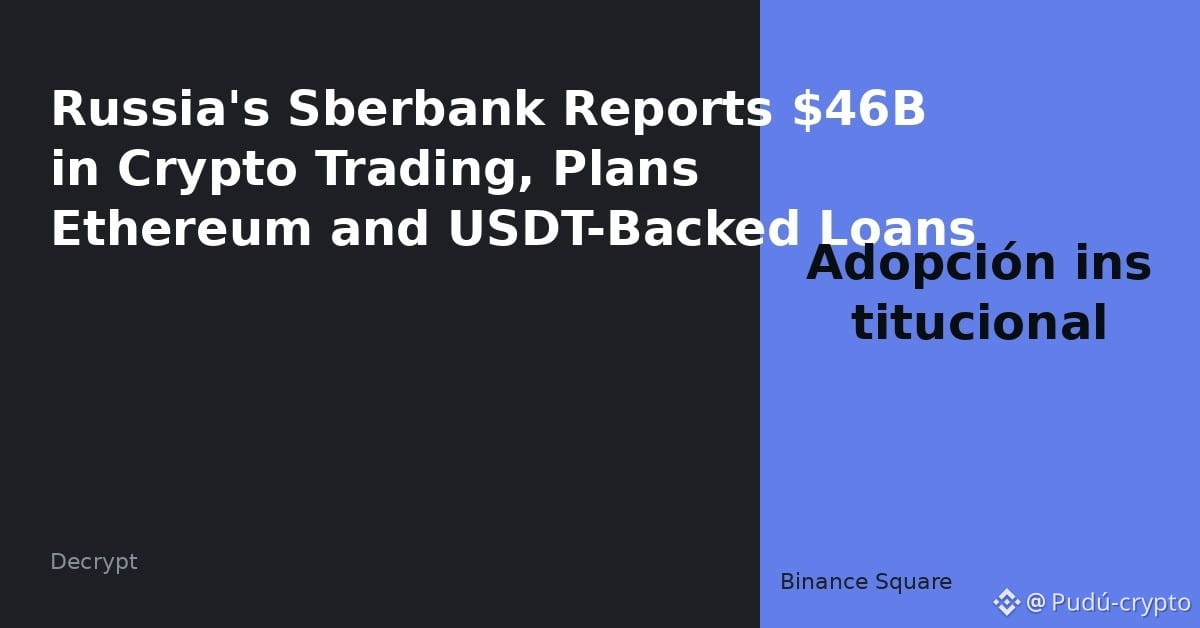
Sberbank expects 46 billion dollars in crypto exchange trading volume within the first year of new Russian regulations effective in 2026.
#Sberbank #RussianRegulation
Sberbank expects 46 billion dollars in crypto exchange trading volume within the first year of new Russian regulations effective in 2026.
#Sberbank #RussianRegulation
#Sberbank #RussianRegulation
7


To avoid pressure from EU and US sanctions, Russia’s largest bank plans to launch a compliant crypto trading system in December
According to Cointelegraph, Russia’s Sberbank announced plans to build crypto-asset trading infrastructure and launch a digital custody vault by December 1, to comply with Russia’s new crypto regulatory regime. The system will cover compliant trading, asset custody, and settlement services.
Alexander Vedyakhin, Sberbank’s first deputy chairman, said the digital custody vault will record users’ ownership of crypto assets. Most transaction processes can be completed outside the main blockchain, while the bank will simultaneously operate an active wallet to handle customers’ needs for storing, retrieving, and transferring crypto assets.
Russia’s first crypto bill completed review this month and will take effect on September 1. The bill also divides market participants into five categories—exchanges, brokers, asset managers, custodians, and exchange service providers—and specifies participation standards for the compliant market.
The bill also grants the Bank of Russia broad supervisory authority and sets crypto asset entry thresholds: an average market capitalization exceeding 5 trillion rubles over two years, and daily trading value exceeding 1 trillion rubles.
Notably, this move comes as the EU and the US continue to step up sanctions targeting Russia-related crypto activities. Against this backdrop, the Bank of Russia has to accelerate the development of a comprehensive legislative framework for the crypto market.
In addition, the EU’s latest round of sanctions also includes HTX (formerly Huobi) among 18 Russia-related crypto service entity listings, aiming to prohibit EU market participants from trading with it;
Moreover, back in May of this year, the UK had already imposed similar sanctions on HTX, deeming it to provide a financial conduit for Russia to evade sanctions.
Overall, with Russia rolling out a compliant crypto framework and major banks entering the crypto business, on the one hand it provides new channels for domestic companies’ cross-border trade settlement. On the other hand, it can help offset restrictions on capital flows brought by EU and US financial sanctions.
#Sberbank #加密货币托管
To avoid pressure from EU and US sanctions, Russia’s largest bank plans to launch a compliant crypto trading system in December
According to Cointelegraph, Russia’s Sberbank announced plans to build crypto-asset trading infrastructure and launch a digital custody vault by December 1, to comply with Russia’s new crypto regulatory regime. The system will cover compliant trading, asset custody, and settlement services.
Alexander Vedyakhin, Sberbank’s first deputy chairman, said the digital custody vault will record users’ ownership of crypto assets. Most transaction processes can be completed outside the main blockchain, while the bank will simultaneously operate an active wallet to handle customers’ needs for storing, retrieving, and transferring crypto assets.
Russia’s first crypto bill completed review this month and will take effect on September 1. The bill also divides market participants into five categories—exchanges, brokers, asset managers, custodians, and exchange service providers—and specifies participation standards for the compliant market.
The bill also grants the Bank of Russia broad supervisory authority and sets crypto asset entry thresholds: an average market capitalization exceeding 5 trillion rubles over two years, and daily trading value exceeding 1 trillion rubles.
Notably, this move comes as the EU and the US continue to step up sanctions targeting Russia-related crypto activities. Against this backdrop, the Bank of Russia has to accelerate the development of a comprehensive legislative framework for the crypto market.
In addition, the EU’s latest round of sanctions also includes HTX (formerly Huobi) among 18 Russia-related crypto service entity listings, aiming to prohibit EU market participants from trading with it;
Moreover, back in May of this year, the UK had already imposed similar sanctions on HTX, deeming it to provide a financial conduit for Russia to evade sanctions.
Overall, with Russia rolling out a compliant crypto framework and major banks entering the crypto business, on the one hand it provides new channels for domestic companies’ cross-border trade settlement. On the other hand, it can help offset restrictions on capital flows brought by EU and US financial sanctions.
#Sberbank #加密货币托管
According to Cointelegraph, Russia’s Sberbank announced plans to build crypto-asset trading infrastructure and launch a digital custody vault by December 1, to comply with Russia’s new crypto regulatory regime. The system will cover compliant trading, asset custody, and settlement services.
Alexander Vedyakhin, Sberbank’s first deputy chairman, said the digital custody vault will record users’ ownership of crypto assets. Most transaction processes can be completed outside the main blockchain, while the bank will simultaneously operate an active wallet to handle customers’ needs for storing, retrieving, and transferring crypto assets.
Russia’s first crypto bill completed review this month and will take effect on September 1. The bill also divides market participants into five categories—exchanges, brokers, asset managers, custodians, and exchange service providers—and specifies participation standards for the compliant market.
The bill also grants the Bank of Russia broad supervisory authority and sets crypto asset entry thresholds: an average market capitalization exceeding 5 trillion rubles over two years, and daily trading value exceeding 1 trillion rubles.
Notably, this move comes as the EU and the US continue to step up sanctions targeting Russia-related crypto activities. Against this backdrop, the Bank of Russia has to accelerate the development of a comprehensive legislative framework for the crypto market.
In addition, the EU’s latest round of sanctions also includes HTX (formerly Huobi) among 18 Russia-related crypto service entity listings, aiming to prohibit EU market participants from trading with it;
Moreover, back in May of this year, the UK had already imposed similar sanctions on HTX, deeming it to provide a financial conduit for Russia to evade sanctions.
Overall, with Russia rolling out a compliant crypto framework and major banks entering the crypto business, on the one hand it provides new channels for domestic companies’ cross-border trade settlement. On the other hand, it can help offset restrictions on capital flows brought by EU and US financial sanctions.
#Sberbank #加密货币托管
502

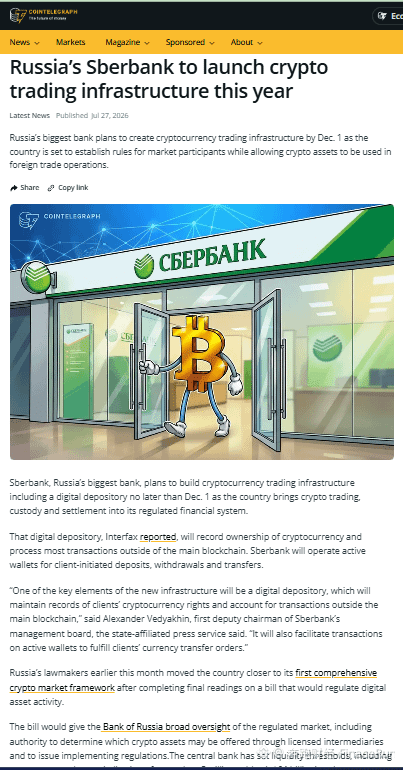
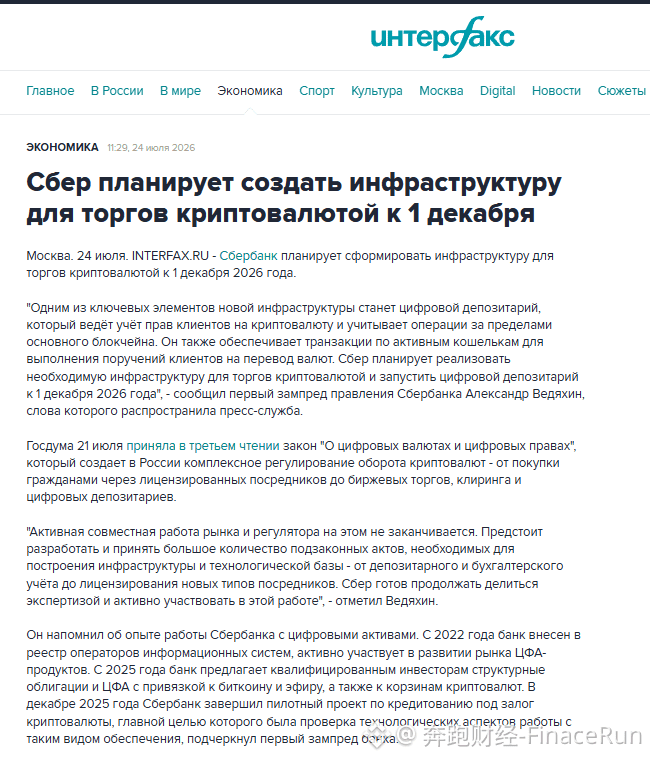
Sberbank Russia is preparing to build crypto trading infrastructure by the end of the year
• Sberbank, Russia’s largest bank, plans to roll out crypto trading infrastructure on December 1.
• Russia is drafting regulations for market participants, while also allowing crypto assets to be used in international trade transactions.
• This infrastructure will support trading, settlement, and storage of digital assets, expanding access to the crypto market for businesses and individuals.
• This event marks an important step toward legalizing and developing the crypto market in Russia.
#BinanceSquare #CryptoNews #Sberbank #Russia #CryptoInfrastructure
$btc $eth
vlikevn Titanbot
Source: CoinTelegraph
Sberbank Russia is preparing to build crypto trading infrastructure by the end of the year
• Sberbank, Russia’s largest bank, plans to roll out crypto trading infrastructure on December 1.
• Russia is drafting regulations for market participants, while also allowing crypto assets to be used in international trade transactions.
• This infrastructure will support trading, settlement, and storage of digital assets, expanding access to the crypto market for businesses and individuals.
• This event marks an important step toward legalizing and developing the crypto market in Russia.
#BinanceSquare #CryptoNews #Sberbank #Russia #CryptoInfrastructure
$btc $eth
vlikevn Titanbot
Source: CoinTelegraph
• Sberbank, Russia’s largest bank, plans to roll out crypto trading infrastructure on December 1.
• Russia is drafting regulations for market participants, while also allowing crypto assets to be used in international trade transactions.
• This infrastructure will support trading, settlement, and storage of digital assets, expanding access to the crypto market for businesses and individuals.
• This event marks an important step toward legalizing and developing the crypto market in Russia.
#BinanceSquare #CryptoNews #Sberbank #Russia #CryptoInfrastructure
$btc $eth
vlikevn Titanbot
Source: CoinTelegraph
9

📰 Sberbank to Launch Crypto Trading: Russia's largest bank enters digital asset infrastructure
On July 27, 2026, Russia's Sberbank has announced plans to launch crypto trading infrastructure this year, as reported by Cointelegraph. The country's largest financial institution is moving into digital asset services.
The move signals growing institutional acceptance of crypto in Russia, despite the complex regulatory environment. Sberbank's entry could bring significant new capital to the market.
Bitcoin $BTC trading at $65,250 and total market cap of $2.32T demonstrate the scale of the market Sberbank is entering.
📌 Key Takeaway:
Sberbank entering crypto trading is a major institutional endorsement. When the largest bank in Russia builds crypto infrastructure, mainstream adoption is accelerating regardless of regulatory challenges.
#Sberbank #InstitutionalAdoption #CryptoNews
#BinanceAlphaAlert
📰 Sberbank to Launch Crypto Trading: Russia's largest bank enters digital asset infrastructure
On July 27, 2026, Russia's Sberbank has announced plans to launch crypto trading infrastructure this year, as reported by Cointelegraph. The country's largest financial institution is moving into digital asset services.
The move signals growing institutional acceptance of crypto in Russia, despite the complex regulatory environment. Sberbank's entry could bring significant new capital to the market.
Bitcoin $BTC trading at $65,250 and total market cap of $2.32T demonstrate the scale of the market Sberbank is entering.
📌 Key Takeaway:
Sberbank entering crypto trading is a major institutional endorsement. When the largest bank in Russia builds crypto infrastructure, mainstream adoption is accelerating regardless of regulatory challenges.
#Sberbank #InstitutionalAdoption #CryptoNews
#BinanceAlphaAlert
On July 27, 2026, Russia's Sberbank has announced plans to launch crypto trading infrastructure this year, as reported by Cointelegraph. The country's largest financial institution is moving into digital asset services.
The move signals growing institutional acceptance of crypto in Russia, despite the complex regulatory environment. Sberbank's entry could bring significant new capital to the market.
Bitcoin $BTC trading at $65,250 and total market cap of $2.32T demonstrate the scale of the market Sberbank is entering.
📌 Key Takeaway:
Sberbank entering crypto trading is a major institutional endorsement. When the largest bank in Russia builds crypto infrastructure, mainstream adoption is accelerating regardless of regulatory challenges.
#Sberbank #InstitutionalAdoption #CryptoNews
#BinanceAlphaAlert
7

·
--
🎯 Russia’s largest bank directly accepts Bitcoin as collateral
📰 Sberbank officially announced that it accepts BTC, ETH, and USDT as loan collateral. One of Russia’s largest business families personally steps in to endorse and put its stamp on crypto assets
💬 To be honest, traditional banks may condemn it loudly in public, but their actions are surprisingly honest. Institutional channels are opening one after another—crypto is no longer just a niche in-joke; it’s mainstream demand
🏷️ #Sberbank #BTC #ETH #传统金融 #CryptoCompliance
🎯 Russia’s largest bank directly accepts Bitcoin as collateral
📰 Sberbank officially announced that it accepts BTC, ETH, and USDT as loan collateral. One of Russia’s largest business families personally steps in to endorse and put its stamp on crypto assets
💬 To be honest, traditional banks may condemn it loudly in public, but their actions are surprisingly honest. Institutional channels are opening one after another—crypto is no longer just a niche in-joke; it’s mainstream demand
🏷️ #Sberbank #BTC #ETH #传统金融 #CryptoCompliance
📰 Sberbank officially announced that it accepts BTC, ETH, and USDT as loan collateral. One of Russia’s largest business families personally steps in to endorse and put its stamp on crypto assets
💬 To be honest, traditional banks may condemn it loudly in public, but their actions are surprisingly honest. Institutional channels are opening one after another—crypto is no longer just a niche in-joke; it’s mainstream demand
🏷️ #Sberbank #BTC #ETH #传统金融 #CryptoCompliance
166
·
--
🎯 Russia’s central bank gives the green light — Sberbank to launch crypto trading by year-end
📰 Russia’s largest bank plans to roll out a crypto exchange and digital custody before December, with the new rules taking effect in September
💬 Here’s something interesting—sanctions pressure has, in fact, forced the emergence of the mainstream players. With the September regulations taking effect + state-owned banks entering the arena, this script used to be something no one had ever written
🏷️ #俄罗斯 #Sberbank #加密监管 #机构入场
🎯 Russia’s central bank gives the green light — Sberbank to launch crypto trading by year-end
📰 Russia’s largest bank plans to roll out a crypto exchange and digital custody before December, with the new rules taking effect in September
💬 Here’s something interesting—sanctions pressure has, in fact, forced the emergence of the mainstream players. With the September regulations taking effect + state-owned banks entering the arena, this script used to be something no one had ever written
🏷️ #俄罗斯 #Sberbank #加密监管 #机构入场
📰 Russia’s largest bank plans to roll out a crypto exchange and digital custody before December, with the new rules taking effect in September
💬 Here’s something interesting—sanctions pressure has, in fact, forced the emergence of the mainstream players. With the September regulations taking effect + state-owned banks entering the arena, this script used to be something no one had ever written
🏷️ #俄罗斯 #Sberbank #加密监管 #机构入场
53

·
--
EXPLODE. Russia's largest bank Sberbank is gearing up to unveil a game-changing crypto trading infrastructure by December, in a seismic shift for the Russian market.
The proof is clear: Russia's new crypto regulations kicking in next month (Sept. 1) will open the floodgates for licensed intermediaries, while Sberbank's move sets the stage for a monumental shift in trading, custody, and settlement #RussiaCrypto #Sberbank #cryptoinfraestructure
The stakes are high: this bold move is poised to rewrite the market playbook, potentially disrupting the status quo and drawing in a wave of new investors #cryptomarkets
Are you ready to capitalize on the Russian crypto boom? Secure your spot now on Binance Square!
EXPLODE. Russia's largest bank Sberbank is gearing up to unveil a game-changing crypto trading infrastructure by December, in a seismic shift for the Russian market.
The proof is clear: Russia's new crypto regulations kicking in next month (Sept. 1) will open the floodgates for licensed intermediaries, while Sberbank's move sets the stage for a monumental shift in trading, custody, and settlement #RussiaCrypto #Sberbank #cryptoinfraestructure
The stakes are high: this bold move is poised to rewrite the market playbook, potentially disrupting the status quo and drawing in a wave of new investors #cryptomarkets
Are you ready to capitalize on the Russian crypto boom? Secure your spot now on Binance Square!
The proof is clear: Russia's new crypto regulations kicking in next month (Sept. 1) will open the floodgates for licensed intermediaries, while Sberbank's move sets the stage for a monumental shift in trading, custody, and settlement #RussiaCrypto #Sberbank #cryptoinfraestructure
The stakes are high: this bold move is poised to rewrite the market playbook, potentially disrupting the status quo and drawing in a wave of new investors #cryptomarkets
Are you ready to capitalize on the Russian crypto boom? Secure your spot now on Binance Square!
18

·
--
Today, the crypto market has three major signals. Russia’s largest bank, Sberbank, plans to accept BTC, ETH, and USDT as loan collateral, with an AI score of 95, indicating a bullish signal—showing that traditional financial institutions are accelerating their move into the crypto space. Arthur Hayes, co-founder of BitMEX, said that U.S. Treasury bond buybacks are driving Bitcoin higher; once the market truly starts worrying about yield-curve control, BTC could quickly surge to several hundred thousand dollars, also with a score of 95 and a bullish outlook.
In terms of liquidity, a “whale” address that had been dormant for 8 months has become active again, buying about 76,856 SOL for roughly $8 million on Hyperliquid—indicating continued strong capital interest in the Solana ecosystem. In addition, Bitcoin spot ETFs saw inflows of $1.92 billion last week, reflecting strong institutional demand.
NFA | DYOR
#Bitcoin #Sberbank #ETF流入 #Solana #Cryptocurrency
Today, the crypto market has three major signals. Russia’s largest bank, Sberbank, plans to accept BTC, ETH, and USDT as loan collateral, with an AI score of 95, indicating a bullish signal—showing that traditional financial institutions are accelerating their move into the crypto space. Arthur Hayes, co-founder of BitMEX, said that U.S. Treasury bond buybacks are driving Bitcoin higher; once the market truly starts worrying about yield-curve control, BTC could quickly surge to several hundred thousand dollars, also with a score of 95 and a bullish outlook.
In terms of liquidity, a “whale” address that had been dormant for 8 months has become active again, buying about 76,856 SOL for roughly $8 million on Hyperliquid—indicating continued strong capital interest in the Solana ecosystem. In addition, Bitcoin spot ETFs saw inflows of $1.92 billion last week, reflecting strong institutional demand.
NFA | DYOR
#Bitcoin #Sberbank #ETF流入 #Solana #Cryptocurrency
In terms of liquidity, a “whale” address that had been dormant for 8 months has become active again, buying about 76,856 SOL for roughly $8 million on Hyperliquid—indicating continued strong capital interest in the Solana ecosystem. In addition, Bitcoin spot ETFs saw inflows of $1.92 billion last week, reflecting strong institutional demand.
NFA | DYOR
#Bitcoin #Sberbank #ETF流入 #Solana #Cryptocurrency
26

·
--
🚨 Russia entering crypto 🇷🇺
#Sberbank — Russia's biggest bank with 110 million customers — is launching a crypto trading platform by December 2026 👀
And Russia's new crypto regulations go live September 1.
This isn't a small regional bank experimenting with blockchain. This is the Russian equivalent of JPMorgan deciding crypto is real.
110 million potential new crypto users. A full digital custody system. A regulated framework launching in 60 days.
Meanwhile in the West — the Clarity Act is still fighting through Congress. Europe just finished sorting out #MiCA . And Russia is quietly about to onboard a population the size of every crypto user in Southeast Asia combined.
The next wave of crypto adoption might not come from where everyone is looking
Does Russia entering crypto change how you think about the market? 👇
DYOR
$BTC #bitcoin #BinanceSquareFamily #BinanceSquareTalks
{future}(BTCUSDT)
🚨 Russia entering crypto 🇷🇺
#Sberbank — Russia's biggest bank with 110 million customers — is launching a crypto trading platform by December 2026 👀
And Russia's new crypto regulations go live September 1.
This isn't a small regional bank experimenting with blockchain. This is the Russian equivalent of JPMorgan deciding crypto is real.
110 million potential new crypto users. A full digital custody system. A regulated framework launching in 60 days.
Meanwhile in the West — the Clarity Act is still fighting through Congress. Europe just finished sorting out #MiCA . And Russia is quietly about to onboard a population the size of every crypto user in Southeast Asia combined.
The next wave of crypto adoption might not come from where everyone is looking
Does Russia entering crypto change how you think about the market? 👇
DYOR
$BTC #bitcoin #BinanceSquareFamily #BinanceSquareTalks
#Sberbank — Russia's biggest bank with 110 million customers — is launching a crypto trading platform by December 2026 👀
And Russia's new crypto regulations go live September 1.
This isn't a small regional bank experimenting with blockchain. This is the Russian equivalent of JPMorgan deciding crypto is real.
110 million potential new crypto users. A full digital custody system. A regulated framework launching in 60 days.
Meanwhile in the West — the Clarity Act is still fighting through Congress. Europe just finished sorting out #MiCA . And Russia is quietly about to onboard a population the size of every crypto user in Southeast Asia combined.
The next wave of crypto adoption might not come from where everyone is looking
Does Russia entering crypto change how you think about the market? 👇
DYOR
$BTC #bitcoin #BinanceSquareFamily #BinanceSquareTalks

8
1.2k

🇷🇺 Russia’s Sberbank plans to expand its crypto services
The deputy chairman of the board of Russia’s Sberbank, Anatoly Popov, told government media outlets that the volume of digital asset trading could reach 4 trillion rubles in the first year. The bank is preparing to offer loans backed by digital currencies, such as Ethereum and USDT, pending approval from the regulators.
━━━━━━━━━━━━━━
📊 Impact: 📈 High
🏷️ REGULATION
#Russia #Sberbank #CryptoAdoption #Regulation #DigitalAssets
📰 Source: decrypt.co
🇷🇺 Russia’s Sberbank plans to expand its crypto services
The deputy chairman of the board of Russia’s Sberbank, Anatoly Popov, told government media outlets that the volume of digital asset trading could reach 4 trillion rubles in the first year. The bank is preparing to offer loans backed by digital currencies, such as Ethereum and USDT, pending approval from the regulators.
━━━━━━━━━━━━━━
📊 Impact: 📈 High
🏷️ REGULATION
#Russia #Sberbank #CryptoAdoption #Regulation #DigitalAssets
📰 Source: decrypt.co
The deputy chairman of the board of Russia’s Sberbank, Anatoly Popov, told government media outlets that the volume of digital asset trading could reach 4 trillion rubles in the first year. The bank is preparing to offer loans backed by digital currencies, such as Ethereum and USDT, pending approval from the regulators.
━━━━━━━━━━━━━━
📊 Impact: 📈 High
🏷️ REGULATION
#Russia #Sberbank #CryptoAdoption #Regulation #DigitalAssets
📰 Source: decrypt.co
17
🇷🇺 Sberbank expects $46 billion in trading in Russia’s regulated crypto market
Russian Sberbank expects the trading volume in the country’s regulated digital currency market to reach $46 billion within its first year of launch. The forecast comes amid initiatives to regulate Russia’s digital sector, noting that restrictions imposed on individual investors may affect the extent of broad participation.
━━━━━━━━━━━━━━
📊 Impact: 📈 High
🏷️ REGULATION
#Russia #CryptoRegulation #Sberbank #DigitalAssets #MarketVolume
📰 Source: cryptobriefing.com
🇷🇺 Sberbank expects $46 billion in trading in Russia’s regulated crypto market
Russian Sberbank expects the trading volume in the country’s regulated digital currency market to reach $46 billion within its first year of launch. The forecast comes amid initiatives to regulate Russia’s digital sector, noting that restrictions imposed on individual investors may affect the extent of broad participation.
━━━━━━━━━━━━━━
📊 Impact: 📈 High
🏷️ REGULATION
#Russia #CryptoRegulation #Sberbank #DigitalAssets #MarketVolume
📰 Source: cryptobriefing.com
Russian Sberbank expects the trading volume in the country’s regulated digital currency market to reach $46 billion within its first year of launch. The forecast comes amid initiatives to regulate Russia’s digital sector, noting that restrictions imposed on individual investors may affect the extent of broad participation.
━━━━━━━━━━━━━━
📊 Impact: 📈 High
🏷️ REGULATION
#Russia #CryptoRegulation #Sberbank #DigitalAssets #MarketVolume
📰 Source: cryptobriefing.com
57
Sberbank considers accepting ETH and USDT as collateral for crypto loans
- Russia’s bank (Bank of Russia) has added ETH and USDT to a draft list of cryptocurrencies permitted for public trading in Russia.
- Sberbank plans to allow the use of ETH and USDT as collateral for loans secured by crypto.
- This move indicates a growing trend of cryptocurrency acceptance within Russia’s banking system.
#BinanceSquare #CryptoNews #ETH #USDT #Sberbank Russia
$eth $usdt
vlikevn Titanbot
Source: CoinDesk
Sberbank considers accepting ETH and USDT as collateral for crypto loans
- Russia’s bank (Bank of Russia) has added ETH and USDT to a draft list of cryptocurrencies permitted for public trading in Russia.
- Sberbank plans to allow the use of ETH and USDT as collateral for loans secured by crypto.
- This move indicates a growing trend of cryptocurrency acceptance within Russia’s banking system.
#BinanceSquare #CryptoNews #ETH #USDT #Sberbank Russia
$eth $usdt
vlikevn Titanbot
Source: CoinDesk
- Russia’s bank (Bank of Russia) has added ETH and USDT to a draft list of cryptocurrencies permitted for public trading in Russia.
- Sberbank plans to allow the use of ETH and USDT as collateral for loans secured by crypto.
- This move indicates a growing trend of cryptocurrency acceptance within Russia’s banking system.
#BinanceSquare #CryptoNews #ETH #USDT #Sberbank Russia
$eth $usdt
vlikevn Titanbot
Source: CoinDesk
8
Russia’s Sberbank plans to build crypto trading infrastructure
• Russia’s largest bank, Sberbank, is expected to roll out digital asset trading infrastructure in December.
• New rules on crypto trading, custody, and settlement in Russia will take effect from 01/09.
• Licensed intermediaries will begin submitting registration applications starting July 2027.
#CryptoNews #Russia #Sberbank #Blockchain #Web3
$btc $eth
vlikevn Titanbot
Source: CoinDesk
Russia’s Sberbank plans to build crypto trading infrastructure
• Russia’s largest bank, Sberbank, is expected to roll out digital asset trading infrastructure in December.
• New rules on crypto trading, custody, and settlement in Russia will take effect from 01/09.
• Licensed intermediaries will begin submitting registration applications starting July 2027.
#CryptoNews #Russia #Sberbank #Blockchain #Web3
$btc $eth
vlikevn Titanbot
Source: CoinDesk
• Russia’s largest bank, Sberbank, is expected to roll out digital asset trading infrastructure in December.
• New rules on crypto trading, custody, and settlement in Russia will take effect from 01/09.
• Licensed intermediaries will begin submitting registration applications starting July 2027.
#CryptoNews #Russia #Sberbank #Blockchain #Web3
$btc $eth
vlikevn Titanbot
Source: CoinDesk
52

·
--
Verified
🚨 Latest News: Russia’s largest bank is moving into the “crypto-asset collateral” era! 🇷🇺⚡
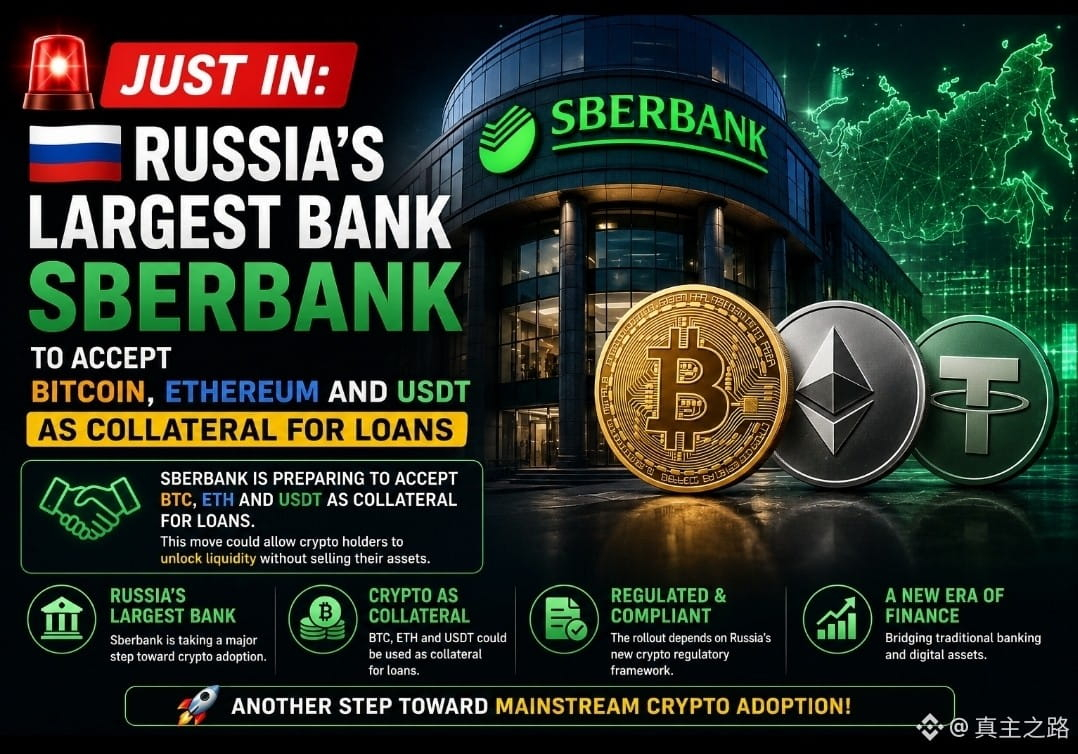
Russia’s largest bank, Sberbank (Savings Bank of Russia), is preparing to accept digital assets as loan collateral.🏦🟠
The bank plans not only to support Bitcoin, and may further accept the following assets as collateral:
₿ Bitcoin (BTC)
🔷 Ethereum (ETH)
💵 Tether (USDT)
for loan collateral.
⚠️ Please note: The official rollout of this plan still depends on Russia’s new crypto-asset regulatory framework, and whether some digital assets can receive the relevant approvals.
This means that in the future, crypto holders may be able to obtain liquidity without selling $BTC
{future}(BTCUSDT)
, $ETH
{future}(ETHUSDT)
, or $USDT
{future}(XRPUSDT)
.👀
Large traditional banks moving further into crypto-asset-backed finance also once again shows that:
The boundary between the crypto market and the traditional financial system is steadily shrinking.
🔥 Institutional adoption is still in full swing!
#Bitcoin #Ethereum #Sberbank #Russia #CryptoAdoption
🚨 Latest News: Russia’s largest bank is moving into the “crypto-asset collateral” era! 🇷🇺⚡
Russia’s largest bank, Sberbank (Savings Bank of Russia), is preparing to accept digital assets as loan collateral.🏦🟠
The bank plans not only to support Bitcoin, and may further accept the following assets as collateral:
₿ Bitcoin (BTC)
🔷 Ethereum (ETH)
💵 Tether (USDT)
for loan collateral.
⚠️ Please note: The official rollout of this plan still depends on Russia’s new crypto-asset regulatory framework, and whether some digital assets can receive the relevant approvals.
This means that in the future, crypto holders may be able to obtain liquidity without selling $BTC
, $ETH
, or $USDT
.👀
Large traditional banks moving further into crypto-asset-backed finance also once again shows that:
The boundary between the crypto market and the traditional financial system is steadily shrinking.
🔥 Institutional adoption is still in full swing!
#Bitcoin #Ethereum #Sberbank #Russia #CryptoAdoption
Russia’s largest bank, Sberbank (Savings Bank of Russia), is preparing to accept digital assets as loan collateral.🏦🟠
The bank plans not only to support Bitcoin, and may further accept the following assets as collateral:
₿ Bitcoin (BTC)
🔷 Ethereum (ETH)
💵 Tether (USDT)
for loan collateral.
⚠️ Please note: The official rollout of this plan still depends on Russia’s new crypto-asset regulatory framework, and whether some digital assets can receive the relevant approvals.
This means that in the future, crypto holders may be able to obtain liquidity without selling $BTC
, $ETH
, or $USDT
.👀
Large traditional banks moving further into crypto-asset-backed finance also once again shows that:
The boundary between the crypto market and the traditional financial system is steadily shrinking.
🔥 Institutional adoption is still in full swing!
#Bitcoin #Ethereum #Sberbank #Russia #CryptoAdoption
288
Sberbank (Vietnam) prepares to launch an integrated cryptocurrency wallet
- Sberbank, Russia’s largest bank, is planning to launch a cryptocurrency wallet.
- The wallet service will be integrated directly into the bank’s existing apps, "Sberbank Online" and "SberInvestments".
- The launch is expected to take place after the bill "On Digital Currency and Digital Rights" takes effect in September.
- This move suggests that Russia is gradually making way for the development of the domestic cryptocurrency market.
#BinanceSquare #CryptoNews #Nga #Sberbank #Regulation Adoption
$btc $eth
vlikevn Titanbot
Source: CoinDesk
Sberbank (Vietnam) prepares to launch an integrated cryptocurrency wallet
- Sberbank, Russia’s largest bank, is planning to launch a cryptocurrency wallet.
- The wallet service will be integrated directly into the bank’s existing apps, "Sberbank Online" and "SberInvestments".
- The launch is expected to take place after the bill "On Digital Currency and Digital Rights" takes effect in September.
- This move suggests that Russia is gradually making way for the development of the domestic cryptocurrency market.
#BinanceSquare #CryptoNews #Nga #Sberbank #Regulation Adoption
$btc $eth
vlikevn Titanbot
Source: CoinDesk
- Sberbank, Russia’s largest bank, is planning to launch a cryptocurrency wallet.
- The wallet service will be integrated directly into the bank’s existing apps, "Sberbank Online" and "SberInvestments".
- The launch is expected to take place after the bill "On Digital Currency and Digital Rights" takes effect in September.
- This move suggests that Russia is gradually making way for the development of the domestic cryptocurrency market.
#BinanceSquare #CryptoNews #Nga #Sberbank #Regulation Adoption
$btc $eth
vlikevn Titanbot
Source: CoinDesk
82
Log in to explore more content
Join global crypto users on Binance Square
⚡️ Get latest and useful information about crypto.
💬 Trusted by the world’s largest crypto exchange.
👍 Discover real insights from verified creators.
Email / Phone number
Trending Topics
1
#EtherGains70.9%InQ3
120,249 views
1,025 Discussing
2
#TreasuryLetsStatesFileStablecoinCertificationsEarly
6,520 views
73 Discussing
3
#US10YearYieldNears5.3%
132,471 views
1,058 Discussing
4
#DollarIndexHitsHighestSinceMay2025
29,880 views
553 Discussing
5
#USWeeklyJoblessClaimsFallTo197000
28,832 views
462 Discussing
6
#BitcoinETFsTake$6.34BillionInQ3
8,647 views
70 Discussing
7
#KoreaProposesTokenizingStocksAndBonds
65,527 views
801 Discussing
8
#MetaMaskExitsLidoValidatorsAfterSecurityIncident
163,249 views
1,522 Discussing
9
#MicronBeatsEarningsLiftsGuidance
82,173 views
1,103 Discussing
10
#CFTCSubmitsTwoEventContractRulesToWhiteHouse
56,216 views
823 Discussing