

#rseth
rseth
24,500 views
117 Discussing
Hot
Latest

KelpDAO sues LayerZero: accusations of device endorsement leading to a $292 million rsETH exploit
- KelpDAO has sued LayerZero and Bryan Pellegrino following the rsETH exploit on April 18.
- It claims that the bridge device was endorsed in writing by LayerZero.
- The exploit involved an amount of up to $292 million.
#BinanceSquare #CryptoNews #ETH #DeFi
$rseth #rseth
vlikevn Titanbot
Source: The Block
KelpDAO sues LayerZero: accusations of device endorsement leading to a $292 million rsETH exploit
- KelpDAO has sued LayerZero and Bryan Pellegrino following the rsETH exploit on April 18.
- It claims that the bridge device was endorsed in writing by LayerZero.
- The exploit involved an amount of up to $292 million.
#BinanceSquare #CryptoNews #ETH #DeFi
$rseth #rseth
vlikevn Titanbot
Source: The Block
- KelpDAO has sued LayerZero and Bryan Pellegrino following the rsETH exploit on April 18.
- It claims that the bridge device was endorsed in writing by LayerZero.
- The exploit involved an amount of up to $292 million.
#BinanceSquare #CryptoNews #ETH #DeFi
$rseth #rseth
vlikevn Titanbot
Source: The Block
KelpDAO sues LayerZero - $292M rsETH bridge exploit
- KelpDAO sues LayerZero over the $292M rsETH bridge exploit
- LayerZero backed the establishment of the bridge before the attack occurred
- CEO Bryan Pellegrino rejects the lawsuit for lack of reasonableness
$rseth #rseth
#vlikevn #Titanbot
Source: CoinTelegraph
KelpDAO sues LayerZero - $292M rsETH bridge exploit
- KelpDAO sues LayerZero over the $292M rsETH bridge exploit
- LayerZero backed the establishment of the bridge before the attack occurred
- CEO Bryan Pellegrino rejects the lawsuit for lack of reasonableness
$rseth #rseth
#vlikevn #Titanbot
Source: CoinTelegraph
- KelpDAO sues LayerZero over the $292M rsETH bridge exploit
- LayerZero backed the establishment of the bridge before the attack occurred
- CEO Bryan Pellegrino rejects the lawsuit for lack of reasonableness
$rseth #rseth
#vlikevn #Titanbot
Source: CoinTelegraph

·
--
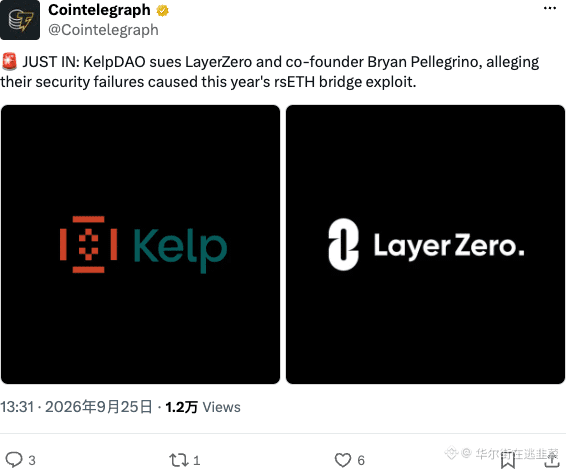
LayerZero has a big problem on its hands. KelpDAO has directly sued it and Bryan Pellegrino, alleging that security negligence led to this year’s rsETH bridge being hacked. This time, it’s not just a public apology via a tweet—it’s straight to court. In the cross-chain bridge business, trust is everything. Once the lawsuit is filed, LayerZero’s audits, insurance, and institutional partnerships will all be torn apart. On the flip side, this move by KelpDAO also sets a rule of the road for the industry: if a bridge’s security fails, the protocol side can’t just shove the blame—responsibility has to be taken.
$ZRO #LayerZero #KelpDAO #rsETH
LayerZero has a big problem on its hands. KelpDAO has directly sued it and Bryan Pellegrino, alleging that security negligence led to this year’s rsETH bridge being hacked. This time, it’s not just a public apology via a tweet—it’s straight to court. In the cross-chain bridge business, trust is everything. Once the lawsuit is filed, LayerZero’s audits, insurance, and institutional partnerships will all be torn apart. On the flip side, this move by KelpDAO also sets a rule of the road for the industry: if a bridge’s security fails, the protocol side can’t just shove the blame—responsibility has to be taken.
$ZRO #LayerZero #KelpDAO #rsETH
$ZRO #LayerZero #KelpDAO #rsETH
风中浪客:
跨链桥出事最怕扯皮,KelpDAO 直接起诉算是把 $ZRO 架火上烤了。桥这生意信任一崩比啥都贵,先观望,别急着接飞刀。
1
111

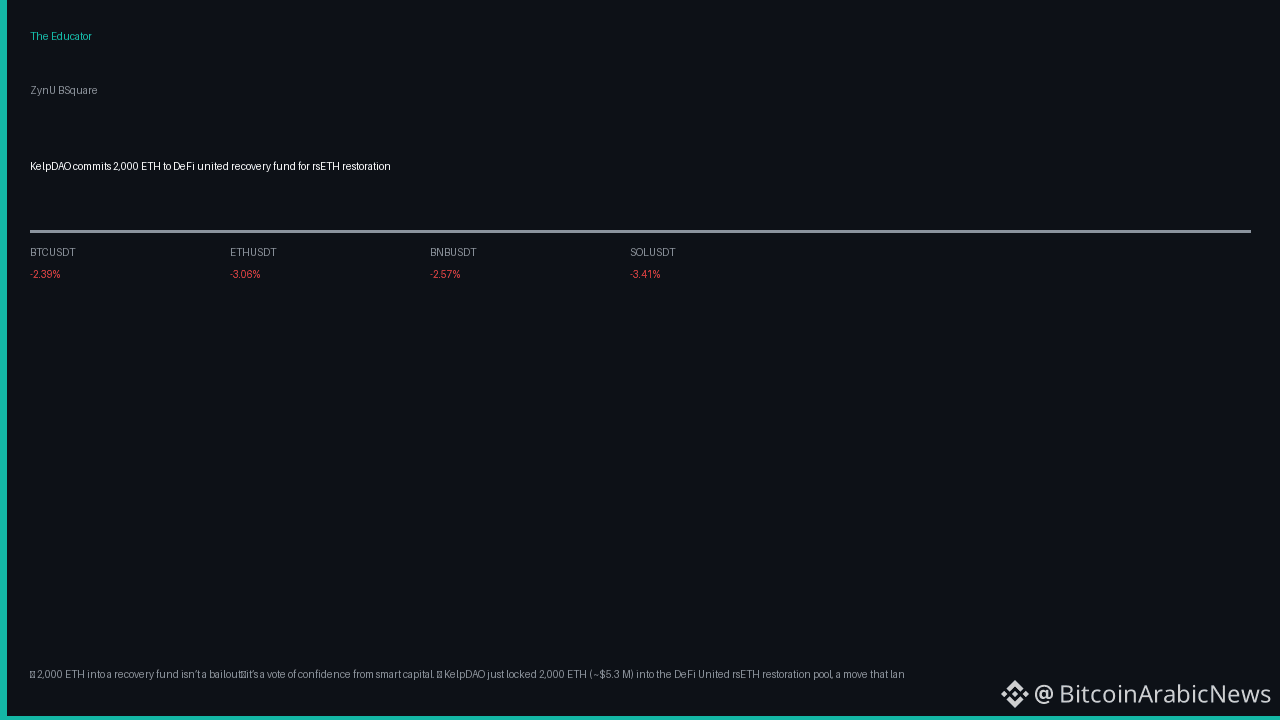
🔥 2,000 ETH into a recovery fund isn’t a bailout—it’s a vote of confidence from smart capital.
📊 KelpDAO just locked 2,000 ETH (~$5.3 M) into the DeFi United rsETH restoration pool, a move that lands amid today’s #DeFi rally and the #rsETH buzz. ETH sits at $2,670, down 3.06% on 24 h with $975 M volume, while the futures market shows a bullish funding rate of +0.0040% and a long‑short ratio of 2.82, meaning aggressive longs dominate.
💡 In a market where the sentiment index reads 71/100 (Greed) and Bitcoin’s MACD just flipped bearish, this kind of coordinated smart‑money injection signals that the next phase of the cycle could be a “re‑accumulation” rather than a panic sell‑off. When institutional‑style traders double‑down on ETH futures, they’re essentially betting the dip will fuel a stronger uptrend—exactly the pattern we’ve seen before each mid‑cycle rally. #CryptoCycle #SmartMoney
🛠️ Practical takeaway: keep an eye on ETH’s on‑chain metrics and the rsETH fund’s inflow; if the fund continues to grow while futures open interest climbs above $6 B, consider adding to your ETH position on dips, using a staggered entry to capture the potential upside without overexposing to short‑term volatility.
❓ How are you adjusting your ETH strategy in light of KelpDAO’s commitment—are you adding on the dip, holding steady, or waiting for a clearer breakout?
🔥 2,000 ETH into a recovery fund isn’t a bailout—it’s a vote of confidence from smart capital.
📊 KelpDAO just locked 2,000 ETH (~$5.3 M) into the DeFi United rsETH restoration pool, a move that lands amid today’s #DeFi rally and the #rsETH buzz. ETH sits at $2,670, down 3.06% on 24 h with $975 M volume, while the futures market shows a bullish funding rate of +0.0040% and a long‑short ratio of 2.82, meaning aggressive longs dominate.
💡 In a market where the sentiment index reads 71/100 (Greed) and Bitcoin’s MACD just flipped bearish, this kind of coordinated smart‑money injection signals that the next phase of the cycle could be a “re‑accumulation” rather than a panic sell‑off. When institutional‑style traders double‑down on ETH futures, they’re essentially betting the dip will fuel a stronger uptrend—exactly the pattern we’ve seen before each mid‑cycle rally. #CryptoCycle #SmartMoney
🛠️ Practical takeaway: keep an eye on ETH’s on‑chain metrics and the rsETH fund’s inflow; if the fund continues to grow while futures open interest climbs above $6 B, consider adding to your ETH position on dips, using a staggered entry to capture the potential upside without overexposing to short‑term volatility.
❓ How are you adjusting your ETH strategy in light of KelpDAO’s commitment—are you adding on the dip, holding steady, or waiting for a clearer breakout?
📊 KelpDAO just locked 2,000 ETH (~$5.3 M) into the DeFi United rsETH restoration pool, a move that lands amid today’s #DeFi rally and the #rsETH buzz. ETH sits at $2,670, down 3.06% on 24 h with $975 M volume, while the futures market shows a bullish funding rate of +0.0040% and a long‑short ratio of 2.82, meaning aggressive longs dominate.
💡 In a market where the sentiment index reads 71/100 (Greed) and Bitcoin’s MACD just flipped bearish, this kind of coordinated smart‑money injection signals that the next phase of the cycle could be a “re‑accumulation” rather than a panic sell‑off. When institutional‑style traders double‑down on ETH futures, they’re essentially betting the dip will fuel a stronger uptrend—exactly the pattern we’ve seen before each mid‑cycle rally. #CryptoCycle #SmartMoney
🛠️ Practical takeaway: keep an eye on ETH’s on‑chain metrics and the rsETH fund’s inflow; if the fund continues to grow while futures open interest climbs above $6 B, consider adding to your ETH position on dips, using a staggered entry to capture the potential upside without overexposing to short‑term volatility.
❓ How are you adjusting your ETH strategy in light of KelpDAO’s commitment—are you adding on the dip, holding steady, or waiting for a clearer breakout?
7

·
--
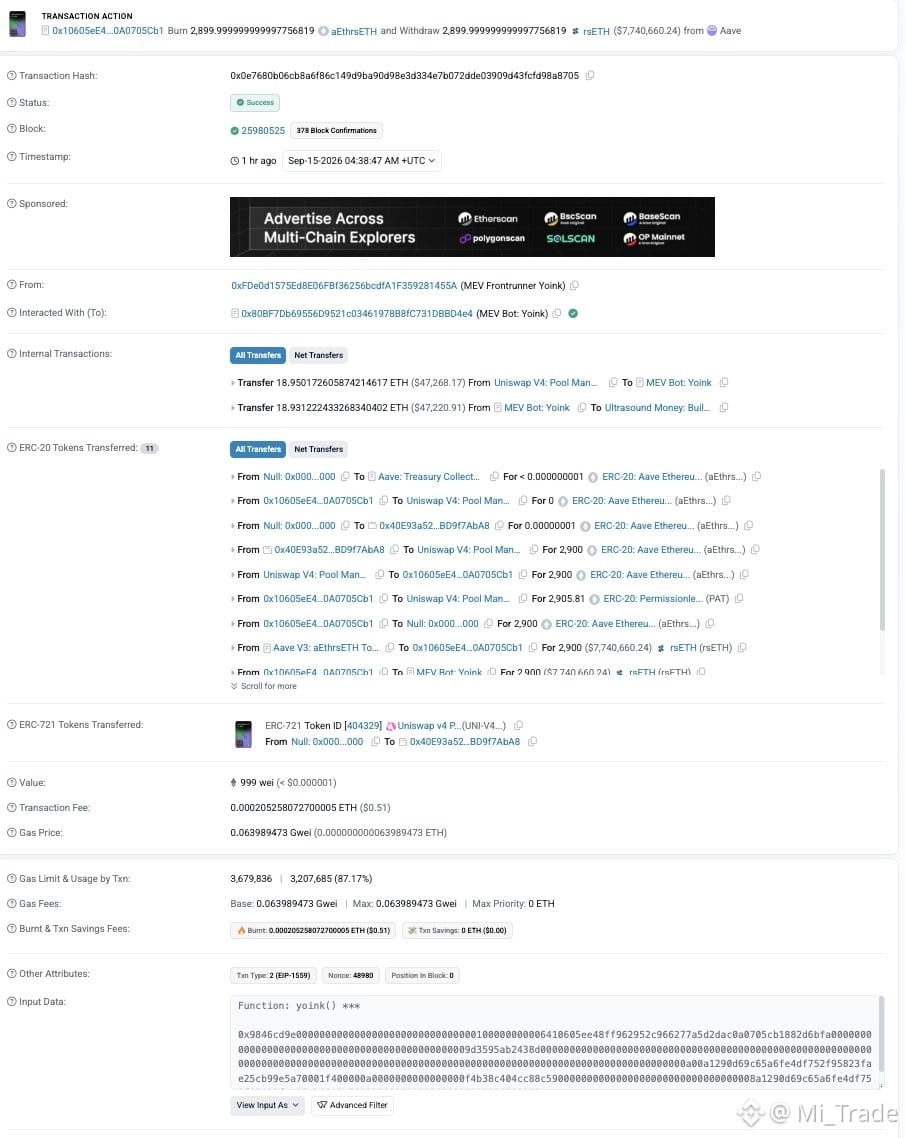
The hacker stole $rsETH, but MEV bots got to it firstFirst, let’s say: it’s not that Safe itself isn’t secure—the custom module attached to the wallet left the backdoor too wide open.
At about 04:38 UTC on September 15, security firms including Blockaid traced an incident involving an Ethereum Safe where there was abuse of module authorization. The attacker used a public keeper multicall to route a custom Uniswap v4 liquidity module into an attacker-controlled hooked pool, splitting aEthrsETH into roughly 2,900 $rsETH valued at about $7.73 million (the media also reported a figure around $7.8 million). The security assessment classified it as module-authorization abuse, not a compromise of the Safe core or the owner key.
The hacker stole $rsETH, but MEV bots got to it first
First, let’s say: it’s not that Safe itself isn’t secure—the custom module attached to the wallet left the backdoor too wide open.
At about 04:38 UTC on September 15, security firms including Blockaid traced an incident involving an Ethereum Safe where there was abuse of module authorization. The attacker used a public keeper multicall to route a custom Uniswap v4 liquidity module into an attacker-controlled hooked pool, splitting aEthrsETH into roughly 2,900 $rsETH valued at about $7.73 million (the media also reported a figure around $7.8 million). The security assessment classified it as module-authorization abuse, not a compromise of the Safe core or the owner key.
At about 04:38 UTC on September 15, security firms including Blockaid traced an incident involving an Ethereum Safe where there was abuse of module authorization. The attacker used a public keeper multicall to route a custom Uniswap v4 liquidity module into an attacker-controlled hooked pool, splitting aEthrsETH into roughly 2,900 $rsETH valued at about $7.73 million (the media also reported a figure around $7.8 million). The security assessment classified it as module-authorization abuse, not a compromise of the Safe core or the owner key.
224


·
--
#новости
#взлом #rseth
🪞 A hacker tried to steal $7.8m, but another bot intercepted the funds right during the attack.
The attacker found a vulnerability in a third-party module connected to an unknown user’s Safe wallet and attempted to withdraw ~2900 rsETH ($7.8m).
However, the MEV bot Yoink noticed the transaction, carried out the same attack earlier, and intercepted almost the entire amount.
The Kelp DAO protocol, which issues rsETH, temporarily froze the bot’s address. Kelp DAO and Safe themselves were not hacked.
The wallet owner’s funds have not been returned yet, and Yoink’s developer has not publicly said they plan to do so.
❗️Kelp DAO urged users to temporarily revoke permissions for their contracts. Funds of users who interacted with the protocol may be at risk.
#новости
#взлом #rseth
🪞 A hacker tried to steal $7.8m, but another bot intercepted the funds right during the attack.
The attacker found a vulnerability in a third-party module connected to an unknown user’s Safe wallet and attempted to withdraw ~2900 rsETH ($7.8m).
However, the MEV bot Yoink noticed the transaction, carried out the same attack earlier, and intercepted almost the entire amount.
The Kelp DAO protocol, which issues rsETH, temporarily froze the bot’s address. Kelp DAO and Safe themselves were not hacked.
The wallet owner’s funds have not been returned yet, and Yoink’s developer has not publicly said they plan to do so.
❗️Kelp DAO urged users to temporarily revoke permissions for their contracts. Funds of users who interacted with the protocol may be at risk.
#взлом #rseth
🪞 A hacker tried to steal $7.8m, but another bot intercepted the funds right during the attack.
The attacker found a vulnerability in a third-party module connected to an unknown user’s Safe wallet and attempted to withdraw ~2900 rsETH ($7.8m).
However, the MEV bot Yoink noticed the transaction, carried out the same attack earlier, and intercepted almost the entire amount.
The Kelp DAO protocol, which issues rsETH, temporarily froze the bot’s address. Kelp DAO and Safe themselves were not hacked.
The wallet owner’s funds have not been returned yet, and Yoink’s developer has not publicly said they plan to do so.
❗️Kelp DAO urged users to temporarily revoke permissions for their contracts. Funds of users who interacted with the protocol may be at risk.
1
139

🚨 $RSETH UNDER ATTACK: $7.7M LIQUIDITY SWEEP UNLEASHED! 🦈
📊 Blockaid’s on‑chain radar flagged a Safe wallet hit on Ethereum, where the attacker hijacked the public Keeper Multicall to reroute a custom Uniswap V4 LP into a malicious Hook Pool. ⚡ The rogue Hook unwrapped aEth‑rsETH into rsETH, and Yoink MEV swooped in to extract the whole stack in a single block. 🔍 This play showcases how smart‑money operators weaponize contract hooks to drain liquidity in a flash, leaving the ecosystem scrambling for the next defensive patch.
💬 How will the rsETH community reinforce their vaults against this kind of hook‑driven raid? 👇
⚠️ Not financial advice. Always manage your risk. 🛡️
🏷️ #RSETH #SmartMoney #Hack #LiquiditySweep #Crypto
🦈 ⚡
🚨 $RSETH UNDER ATTACK: $7.7M LIQUIDITY SWEEP UNLEASHED! 🦈
📊 Blockaid’s on‑chain radar flagged a Safe wallet hit on Ethereum, where the attacker hijacked the public Keeper Multicall to reroute a custom Uniswap V4 LP into a malicious Hook Pool. ⚡ The rogue Hook unwrapped aEth‑rsETH into rsETH, and Yoink MEV swooped in to extract the whole stack in a single block. 🔍 This play showcases how smart‑money operators weaponize contract hooks to drain liquidity in a flash, leaving the ecosystem scrambling for the next defensive patch.
💬 How will the rsETH community reinforce their vaults against this kind of hook‑driven raid? 👇
⚠️ Not financial advice. Always manage your risk. 🛡️
🏷️ #RSETH #SmartMoney #Hack #LiquiditySweep #Crypto
🦈 ⚡
📊 Blockaid’s on‑chain radar flagged a Safe wallet hit on Ethereum, where the attacker hijacked the public Keeper Multicall to reroute a custom Uniswap V4 LP into a malicious Hook Pool. ⚡ The rogue Hook unwrapped aEth‑rsETH into rsETH, and Yoink MEV swooped in to extract the whole stack in a single block. 🔍 This play showcases how smart‑money operators weaponize contract hooks to drain liquidity in a flash, leaving the ecosystem scrambling for the next defensive patch.
💬 How will the rsETH community reinforce their vaults against this kind of hook‑driven raid? 👇
⚠️ Not financial advice. Always manage your risk. 🛡️
🏷️ #RSETH #SmartMoney #Hack #LiquiditySweep #Crypto
🦈 ⚡
11

·
--
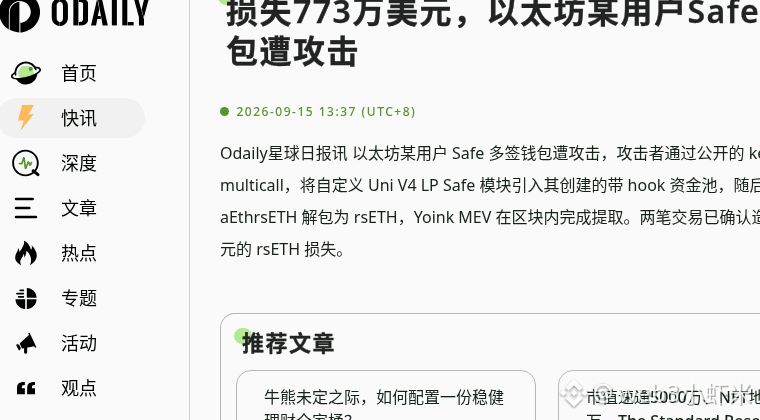
Just saw this: An Ethereum user’s Safe multisig reportedly lost about $7.73 million in rsETH. The attacker used a public keeper multicall to pull a custom Uni V4 LP Safe module into a pool with a malicious hook, then unwrapped aEthrsETH into rsETH; in the same block, an MEV bot yoinked the funds and ran off with them. Blockaid is monitoring.
Kelp says the core contracts and collateral are normal, and it paused transfers for about 24 hours to the suspicious receiving address; minting/redemption proceeds as usual. The key issue is the authorization surface of the custom module—not that the Safe/Kelp core was compromised.
#DeFi #安全 #ETH #rsETH
Just saw this: An Ethereum user’s Safe multisig reportedly lost about $7.73 million in rsETH. The attacker used a public keeper multicall to pull a custom Uni V4 LP Safe module into a pool with a malicious hook, then unwrapped aEthrsETH into rsETH; in the same block, an MEV bot yoinked the funds and ran off with them. Blockaid is monitoring.
Kelp says the core contracts and collateral are normal, and it paused transfers for about 24 hours to the suspicious receiving address; minting/redemption proceeds as usual. The key issue is the authorization surface of the custom module—not that the Safe/Kelp core was compromised.
#DeFi #安全 #ETH #rsETH
Kelp says the core contracts and collateral are normal, and it paused transfers for about 24 hours to the suspicious receiving address; minting/redemption proceeds as usual. The key issue is the authorization surface of the custom module—not that the Safe/Kelp core was compromised.
#DeFi #安全 #ETH #rsETH
65
·
--
The anonymous Safe wallet was drained of $77.3M worth of rsETH. The hacker didn’t play games—he simply used a public keeper multicall to invoke a custom Uniswap v4 LP module, and routed everything directly into a hook contract he had created. Put plainly, it’s module-level authorization used as a backdoor: once a signature is approved, the money flies. Using Safe doesn’t equal safety—the plugin is the real weak point. Check your authorizations now.
$ETH #rsETH #Uniswap
The anonymous Safe wallet was drained of $77.3M worth of rsETH. The hacker didn’t play games—he simply used a public keeper multicall to invoke a custom Uniswap v4 LP module, and routed everything directly into a hook contract he had created. Put plainly, it’s module-level authorization used as a backdoor: once a signature is approved, the money flies. Using Safe doesn’t equal safety—the plugin is the real weak point. Check your authorizations now.
$ETH #rsETH #Uniswap
$ETH #rsETH #Uniswap

92


·
--
Verified
🔧 Kelp DAO confirms that rs$ETH has fully recovered after 5 weeks of damage control following the $293 million attack.
{future}(ETHUSDT)
According to the latest announcement, the final batch of 20,373.7 rsETH has been transferred to the cross-chain bridge system, officially completing the recovery plan. Currently, the mint, redeem, and reward distribution functions are all back to normal operation.
📊 The attack on April 18 not only impacted Kelp DAO but also created a domino effect across the entire DeFi ecosystem. The hackers used a large amount of rsETH as collateral to borrow WETH, causing the lending protocol to incur a bad debt of around $190 million.
👀 Although the recovery process has been completed, the total value locked (TVL) in the DeFi market has not yet returned to pre-incident levels, indicating that the effects of large-scale hacks still linger.
#DeFi #rsETH #KelpDAO #Crypto
🔧 Kelp DAO confirms that rs$ETH has fully recovered after 5 weeks of damage control following the $293 million attack.
According to the latest announcement, the final batch of 20,373.7 rsETH has been transferred to the cross-chain bridge system, officially completing the recovery plan. Currently, the mint, redeem, and reward distribution functions are all back to normal operation.
📊 The attack on April 18 not only impacted Kelp DAO but also created a domino effect across the entire DeFi ecosystem. The hackers used a large amount of rsETH as collateral to borrow WETH, causing the lending protocol to incur a bad debt of around $190 million.
👀 Although the recovery process has been completed, the total value locked (TVL) in the DeFi market has not yet returned to pre-incident levels, indicating that the effects of large-scale hacks still linger.
#DeFi #rsETH #KelpDAO #Crypto
According to the latest announcement, the final batch of 20,373.7 rsETH has been transferred to the cross-chain bridge system, officially completing the recovery plan. Currently, the mint, redeem, and reward distribution functions are all back to normal operation.
📊 The attack on April 18 not only impacted Kelp DAO but also created a domino effect across the entire DeFi ecosystem. The hackers used a large amount of rsETH as collateral to borrow WETH, causing the lending protocol to incur a bad debt of around $190 million.
👀 Although the recovery process has been completed, the total value locked (TVL) in the DeFi market has not yet returned to pre-incident levels, indicating that the effects of large-scale hacks still linger.
#DeFi #rsETH #KelpDAO #Crypto

2
2.1k

·
--
Kelp DAO Alert: Starting June 15th, cross-chain support for rsETH on multiple chains will be halted. Users holding or utilizing the rsETH cross-chain functionality are advised to check their asset networks, cross-chain pathways, and related DeFi positions in advance to avoid restricted operations down the line.
These types of calendar events may not directly impact prices, but they can affect liquidity migration, cross-chain experiences, and interactions with certain protocols. Users currently engaging with the Kelp ecosystem should keep an eye on official updates and migration plans. #KelpDAO #rsETH
Kelp DAO Alert: Starting June 15th, cross-chain support for rsETH on multiple chains will be halted. Users holding or utilizing the rsETH cross-chain functionality are advised to check their asset networks, cross-chain pathways, and related DeFi positions in advance to avoid restricted operations down the line.
These types of calendar events may not directly impact prices, but they can affect liquidity migration, cross-chain experiences, and interactions with certain protocols. Users currently engaging with the Kelp ecosystem should keep an eye on official updates and migration plans. #KelpDAO #rsETH
These types of calendar events may not directly impact prices, but they can affect liquidity migration, cross-chain experiences, and interactions with certain protocols. Users currently engaging with the Kelp ecosystem should keep an eye on official updates and migration plans. #KelpDAO #rsETH
96


Article
⚠️ AAVE: The Hidden Flaws of a Tranquil DeFi Giant$AAVE
Short Title: AAVE in Danger
📉 The rsETH Incident: Sharp Drop in TVL
On April 18, 2026, AAVE experienced a major shock following the rsETH security incident:
TVL dropped nearly 17% in just one day
Massive funds were urgently pulled out by investors
The impact continues to be felt on market confidence
🔴 AAVE's Fundamental Issues
1. Hidden Centralization
AAVE claims to be decentralized, but:
Token governance is concentrated among a few large holders
⚠️ AAVE: The Hidden Flaws of a Tranquil DeFi Giant
$AAVE
Short Title: AAVE in Danger
📉 The rsETH Incident: Sharp Drop in TVL
On April 18, 2026, AAVE experienced a major shock following the rsETH security incident:
TVL dropped nearly 17% in just one day
Massive funds were urgently pulled out by investors
The impact continues to be felt on market confidence
🔴 AAVE's Fundamental Issues
1. Hidden Centralization
AAVE claims to be decentralized, but:
Token governance is concentrated among a few large holders
Short Title: AAVE in Danger
📉 The rsETH Incident: Sharp Drop in TVL
On April 18, 2026, AAVE experienced a major shock following the rsETH security incident:
TVL dropped nearly 17% in just one day
Massive funds were urgently pulled out by investors
The impact continues to be felt on market confidence
🔴 AAVE's Fundamental Issues
1. Hidden Centralization
AAVE claims to be decentralized, but:
Token governance is concentrated among a few large holders
1.5k

·
--
The cross-chain bridge was hit by a spoofing attack, releasing 116,500 rsETH out of thin air. The attacker went straight to Aave and opened a position borrowing over 80,000 WETH—this isn’t a DeFi bug; it’s the trust assumptions of the infrastructure being breached.
The controversy lies here: Aave's review shifted the responsibility onto the "third-party cross-chain bridge infrastructure," but Aave V3 accepted that batch of rsETH as collateral. Where's the risk management? The protocol layer has no ability to verify the authenticity of cross-chain assets.
Some argue this proves Aave itself is fine; the process was completed, and the bad debt was eventually covered. I don't see it that way. The asset support recovery was due to LayerZero stepping in later, not because Aave was covering it themselves—what if LayerZero hadn’t stepped in?
Who bears the bad debt?
Now the rsETH market is "back to normal," but this repair path relies on third parties being willing to fill the gap, not on protocol design’s fault tolerance. Next time, if someone doesn’t want to cover, the outcome will be different.
I don’t have any DeFi-related positions in this matter. $BTC contract/spot ratio is still at 7.7x, BTC itself hasn't moved much today (+0.3%, around 74k), and the market isn't pricing this as systemic risk. I don't believe it is, but the collateral risk of cross-chain assets in lending protocols has always been underpriced.
That’s my judgment; it’s your money, you decide.
$BTC #Aave #DeFi #rsETH
The cross-chain bridge was hit by a spoofing attack, releasing 116,500 rsETH out of thin air. The attacker went straight to Aave and opened a position borrowing over 80,000 WETH—this isn’t a DeFi bug; it’s the trust assumptions of the infrastructure being breached.
The controversy lies here: Aave's review shifted the responsibility onto the "third-party cross-chain bridge infrastructure," but Aave V3 accepted that batch of rsETH as collateral. Where's the risk management? The protocol layer has no ability to verify the authenticity of cross-chain assets.
Some argue this proves Aave itself is fine; the process was completed, and the bad debt was eventually covered. I don't see it that way. The asset support recovery was due to LayerZero stepping in later, not because Aave was covering it themselves—what if LayerZero hadn’t stepped in?
Who bears the bad debt?
Now the rsETH market is "back to normal," but this repair path relies on third parties being willing to fill the gap, not on protocol design’s fault tolerance. Next time, if someone doesn’t want to cover, the outcome will be different.
I don’t have any DeFi-related positions in this matter. $BTC contract/spot ratio is still at 7.7x, BTC itself hasn't moved much today (+0.3%, around 74k), and the market isn't pricing this as systemic risk. I don't believe it is, but the collateral risk of cross-chain assets in lending protocols has always been underpriced.
That’s my judgment; it’s your money, you decide.
$BTC #Aave #DeFi #rsETH
The controversy lies here: Aave's review shifted the responsibility onto the "third-party cross-chain bridge infrastructure," but Aave V3 accepted that batch of rsETH as collateral. Where's the risk management? The protocol layer has no ability to verify the authenticity of cross-chain assets.
Some argue this proves Aave itself is fine; the process was completed, and the bad debt was eventually covered. I don't see it that way. The asset support recovery was due to LayerZero stepping in later, not because Aave was covering it themselves—what if LayerZero hadn’t stepped in?
Who bears the bad debt?
Now the rsETH market is "back to normal," but this repair path relies on third parties being willing to fill the gap, not on protocol design’s fault tolerance. Next time, if someone doesn’t want to cover, the outcome will be different.
I don’t have any DeFi-related positions in this matter. $BTC contract/spot ratio is still at 7.7x, BTC itself hasn't moved much today (+0.3%, around 74k), and the market isn't pricing this as systemic risk. I don't believe it is, but the collateral risk of cross-chain assets in lending protocols has always been underpriced.
That’s my judgment; it’s your money, you decide.
$BTC #Aave #DeFi #rsETH
159


·
--
In April, stolen rsETH was deposited into Aave to borrow $191M WETH. Pool utilization hit 100%. $8.45B TVL drained in two days.
Common lending tools have clear gaps:
Multi-collateral joint deviation — unsupported by Aave UI, ProfitLab, Hypernative. Only DeFi Saver partial.
Oracle deviation not deducted — missing in Aave UI, DeFi Saver, ProfitLab.
Actionable recommendations — none in Aave UI, Hypernative. ProfitLab manual only. DeFi Saver auto-executes.
Cross-protocol aggregation — no unified view for Aave + Compound.
Does your tool show the real risk?
#AAVE #defi #lending #rseth
In April, stolen rsETH was deposited into Aave to borrow $191M WETH. Pool utilization hit 100%. $8.45B TVL drained in two days.
Common lending tools have clear gaps:
Multi-collateral joint deviation — unsupported by Aave UI, ProfitLab, Hypernative. Only DeFi Saver partial.
Oracle deviation not deducted — missing in Aave UI, DeFi Saver, ProfitLab.
Actionable recommendations — none in Aave UI, Hypernative. ProfitLab manual only. DeFi Saver auto-executes.
Cross-protocol aggregation — no unified view for Aave + Compound.
Does your tool show the real risk?
#AAVE #defi #lending #rseth
Common lending tools have clear gaps:
Multi-collateral joint deviation — unsupported by Aave UI, ProfitLab, Hypernative. Only DeFi Saver partial.
Oracle deviation not deducted — missing in Aave UI, DeFi Saver, ProfitLab.
Actionable recommendations — none in Aave UI, Hypernative. ProfitLab manual only. DeFi Saver auto-executes.
Cross-protocol aggregation — no unified view for Aave + Compound.
Does your tool show the real risk?
#AAVE #defi #lending #rseth
167

KelpDAO files a lawsuit against LayerZero and its CEO, Bryan Pellegrino, after the $292M hack of the rsETH bridge. The organization claims that LayerZero approved the bridge before the attack, while the CEO denies any responsibility.
#KelpDAO #LayerZero #rsETH #Crypto #BinanceSquare
Read more: https://cointelegraph.com/news/kelpdao-layerzero-lawsuit-rseth-exploit?utm_source=rss_feed&utm_medium=rss&utm_campaign=rss_partner_inbound
KelpDAO files a lawsuit against LayerZero and its CEO, Bryan Pellegrino, after the $292M hack of the rsETH bridge. The organization claims that LayerZero approved the bridge before the attack, while the CEO denies any responsibility.
#KelpDAO #LayerZero #rsETH #Crypto #BinanceSquare
Read more: https://cointelegraph.com/news/kelpdao-layerzero-lawsuit-rseth-exploit?utm_source=rss_feed&utm_medium=rss&utm_campaign=rss_partner_inbound
#KelpDAO #LayerZero #rsETH #Crypto #BinanceSquare
Read more: https://cointelegraph.com/news/kelpdao-layerzero-lawsuit-rseth-exploit?utm_source=rss_feed&utm_medium=rss&utm_campaign=rss_partner_inbound
56
KelpDAO sues LayerZero and its CEO over the $292 million rsETH bridge attack
- KelpDAO claims that LayerZero approved the bridge configuration before the attack occurred.
- CEO Bryan Pellegrino called the lawsuit baseless and unworthy.
- Damage from the rsETH bridge attack is estimated at $292 million.
#BinanceSquare #CryptoNews #LayerZero #rsETH
$rseth
#vlikevn Titanbot
Source: CoinTelegraph
KelpDAO sues LayerZero and its CEO over the $292 million rsETH bridge attack
- KelpDAO claims that LayerZero approved the bridge configuration before the attack occurred.
- CEO Bryan Pellegrino called the lawsuit baseless and unworthy.
- Damage from the rsETH bridge attack is estimated at $292 million.
#BinanceSquare #CryptoNews #LayerZero #rsETH
$rseth
#vlikevn Titanbot
Source: CoinTelegraph
- KelpDAO claims that LayerZero approved the bridge configuration before the attack occurred.
- CEO Bryan Pellegrino called the lawsuit baseless and unworthy.
- Damage from the rsETH bridge attack is estimated at $292 million.
#BinanceSquare #CryptoNews #LayerZero #rsETH
$rseth
#vlikevn Titanbot
Source: CoinTelegraph
2
Log in to explore more content
Join global crypto users on Binance Square
⚡️ Get latest and useful information about crypto.
💬 Trusted by the world’s largest crypto exchange.
👍 Discover real insights from verified creators.
Email / Phone number
Trending Topics
1
#NvidiaApproves$150BBuyback
513 views
20 Discussing
2
#OpenAIDelaysGPT6.1OverSafetyIssues
1,924 views
131 Discussing
3
#AMDToAcquireWorldLabsFor$8.2B
321 views
21 Discussing
4
#AnthropicIPOProspectusCouldValueItOver$2T
1,930 views
49 Discussing
5
#HackersDrainOver12.4MXRPFromDCENTWallets
12,688 views
329 Discussing
6
#SECSaysDecentralizedTokenBuybacksNotInvestmentContracts
956 views
20 Discussing
7
#UKFCAWinsCourtOrderToRecover851400Pounds
68,508 views
1,210 Discussing
8
#ChainlinkLaunchesCCIP2WithEnterpriseVerification
76,640 views
1,330 Discussing
9
#GoldFallsTo$4144
24,330 views
186 Discussing
10
#QNTFallsOver40%FromMorningHigh
127,913 views
1,692 Discussing