

#payableai
payableai
392 views
27 Discussing
Hot
Latest

🏷️ Market Research: The Annotation Data Revolution & AI Labeling at OpenLedger @OpenLedger
In the world of AI development, the data labeling phase often gets overlooked, yet it's absolutely crucial. By 2026, @OpenLedger is set to lead the "Payable AI" revolution by democratizing and giving rightful recognition to the data labeling community.
Focus of Data Annotation Research:
1. On-Chain Labeling Transparency: OpenLedger ensures that every dataset labeled by the community is permanently recorded on the blockchain. Through Proof of Attribution, data annotation contributors are no longer "invisible labor" but real stakeholders who earn sustainable income.
2. Automated Payments via Smart Contract: Each time a labeled dataset is used for inference or training an AI model, a smart contract automatically distributes royalties in token $OPEN to the data labeler's wallet. This system cuts out intermediaries and maximizes earnings for data workers.
3. AI Data Quality Standards: With an impact-based reward system, OpenLedger creates strong incentives for the community to produce high-quality, bias-free data labeling. This is crucial for enterprises that need reliable datasets for their commercial models.
4. Unlimited Global Engagement: Through a decentralized ecosystem, anyone around the globe can participate in OpenLedger's data annotation program, opening up new economic opportunities in an inclusive Web3 era.
Conclusion: The innovations by @OpenLedger in attribution systems and automated payments make this project much more than just crypto infrastructure; it's a new paradigm for the AI gig economy. With the $OPEN token, data workers now earn fair and transparent royalties on every piece of work they deliver.
#OpenLedger $OPEN #DataAnnotation #PayableAI
🏷️ Market Research: The Annotation Data Revolution & AI Labeling at OpenLedger @OpenLedger
In the world of AI development, the data labeling phase often gets overlooked, yet it's absolutely crucial. By 2026, @OpenLedger is set to lead the "Payable AI" revolution by democratizing and giving rightful recognition to the data labeling community.
Focus of Data Annotation Research:
1. On-Chain Labeling Transparency: OpenLedger ensures that every dataset labeled by the community is permanently recorded on the blockchain. Through Proof of Attribution, data annotation contributors are no longer "invisible labor" but real stakeholders who earn sustainable income.
2. Automated Payments via Smart Contract: Each time a labeled dataset is used for inference or training an AI model, a smart contract automatically distributes royalties in token $OPEN to the data labeler's wallet. This system cuts out intermediaries and maximizes earnings for data workers.
3. AI Data Quality Standards: With an impact-based reward system, OpenLedger creates strong incentives for the community to produce high-quality, bias-free data labeling. This is crucial for enterprises that need reliable datasets for their commercial models.
4. Unlimited Global Engagement: Through a decentralized ecosystem, anyone around the globe can participate in OpenLedger's data annotation program, opening up new economic opportunities in an inclusive Web3 era.
Conclusion: The innovations by @OpenLedger in attribution systems and automated payments make this project much more than just crypto infrastructure; it's a new paradigm for the AI gig economy. With the $OPEN token, data workers now earn fair and transparent royalties on every piece of work they deliver.
#OpenLedger $OPEN #DataAnnotation #PayableAI
In the world of AI development, the data labeling phase often gets overlooked, yet it's absolutely crucial. By 2026, @OpenLedger is set to lead the "Payable AI" revolution by democratizing and giving rightful recognition to the data labeling community.
Focus of Data Annotation Research:
1. On-Chain Labeling Transparency: OpenLedger ensures that every dataset labeled by the community is permanently recorded on the blockchain. Through Proof of Attribution, data annotation contributors are no longer "invisible labor" but real stakeholders who earn sustainable income.
2. Automated Payments via Smart Contract: Each time a labeled dataset is used for inference or training an AI model, a smart contract automatically distributes royalties in token $OPEN to the data labeler's wallet. This system cuts out intermediaries and maximizes earnings for data workers.
3. AI Data Quality Standards: With an impact-based reward system, OpenLedger creates strong incentives for the community to produce high-quality, bias-free data labeling. This is crucial for enterprises that need reliable datasets for their commercial models.
4. Unlimited Global Engagement: Through a decentralized ecosystem, anyone around the globe can participate in OpenLedger's data annotation program, opening up new economic opportunities in an inclusive Web3 era.
Conclusion: The innovations by @OpenLedger in attribution systems and automated payments make this project much more than just crypto infrastructure; it's a new paradigm for the AI gig economy. With the $OPEN token, data workers now earn fair and transparent royalties on every piece of work they deliver.
#OpenLedger $OPEN #DataAnnotation #PayableAI
71

🤖 AI + Blockchain — and OpenLedger is doing it in a way that few think about.
Most AI projects in crypto just stop at the narrative. @OpenLedger is different — they are building the "Payable AI" infrastructure, where data, AI models, and agents can be tokenized, traded, and traced transparently on the blockchain.
What impresses me the most is x402 — a payment protocol that leverages HTTP status code 402 to enable machines to automatically pay each other using $OPEN
{future}(OPENUSDT)
, without human approval. Machine-to-machine economy — sounds distant but it's actually happening.
With Proof of Attribution, data contributors are rewarded every time their data is used by AI. This is something that Big Tech has deliberately ignored for many years.
There are still many challenges ahead, but the technical foundation of this project is worth serious attention. 🔍
#OpenLedger #OPEN #AIBlockchain #PayableAI #BinanceSquare
🤖 AI + Blockchain — and OpenLedger is doing it in a way that few think about.
Most AI projects in crypto just stop at the narrative. @OpenLedger is different — they are building the "Payable AI" infrastructure, where data, AI models, and agents can be tokenized, traded, and traced transparently on the blockchain.
What impresses me the most is x402 — a payment protocol that leverages HTTP status code 402 to enable machines to automatically pay each other using $OPEN
, without human approval. Machine-to-machine economy — sounds distant but it's actually happening.
With Proof of Attribution, data contributors are rewarded every time their data is used by AI. This is something that Big Tech has deliberately ignored for many years.
There are still many challenges ahead, but the technical foundation of this project is worth serious attention. 🔍
#OpenLedger #OPEN #AIBlockchain #PayableAI #BinanceSquare
Most AI projects in crypto just stop at the narrative. @OpenLedger is different — they are building the "Payable AI" infrastructure, where data, AI models, and agents can be tokenized, traded, and traced transparently on the blockchain.
What impresses me the most is x402 — a payment protocol that leverages HTTP status code 402 to enable machines to automatically pay each other using $OPEN
, without human approval. Machine-to-machine economy — sounds distant but it's actually happening.
With Proof of Attribution, data contributors are rewarded every time their data is used by AI. This is something that Big Tech has deliberately ignored for many years.
There are still many challenges ahead, but the technical foundation of this project is worth serious attention. 🔍
#OpenLedger #OPEN #AIBlockchain #PayableAI #BinanceSquare
121

·
--

Article
1. OpenLedger: The game-changer for AI + Web3, kicking off a new era of Payable AIIn the age of AI, data value is monopolized by the giants, leaving contributors 'naked' and unrewarded for too long, plunging the industry into a 'black box' trust crisis. OpenLedger—the world’s first native AI blockchain—drops a bombshell with its Payable AI model, reconstructing the AI value distribution system to ensure every contribution can be monetized!
As a foundational public chain built specifically for AI, OpenLedger bridges the entire chain from data contribution, model training, application deployment, to profit sharing, enabling full-process on-chain traceability, auditability, and rights confirmation. Its core PoA (Proof of Attribution) mechanism accurately tracks data and model contribution levels, while smart contracts automatically allocate rewards, completely solving the industry’s persistent issues of 'unrecognized contributions and unfair profit distribution.'
1. OpenLedger: The game-changer for AI + Web3, kicking off a new era of Payable AI
In the age of AI, data value is monopolized by the giants, leaving contributors 'naked' and unrewarded for too long, plunging the industry into a 'black box' trust crisis. OpenLedger—the world’s first native AI blockchain—drops a bombshell with its Payable AI model, reconstructing the AI value distribution system to ensure every contribution can be monetized!
As a foundational public chain built specifically for AI, OpenLedger bridges the entire chain from data contribution, model training, application deployment, to profit sharing, enabling full-process on-chain traceability, auditability, and rights confirmation. Its core PoA (Proof of Attribution) mechanism accurately tracks data and model contribution levels, while smart contracts automatically allocate rewards, completely solving the industry’s persistent issues of 'unrecognized contributions and unfair profit distribution.'
As a foundational public chain built specifically for AI, OpenLedger bridges the entire chain from data contribution, model training, application deployment, to profit sharing, enabling full-process on-chain traceability, auditability, and rights confirmation. Its core PoA (Proof of Attribution) mechanism accurately tracks data and model contribution levels, while smart contracts automatically allocate rewards, completely solving the industry’s persistent issues of 'unrecognized contributions and unfair profit distribution.'
83

·
--
@Openledger $OPEN #open Imagine YouTube but for AI training data. You upload, devs use it, you get paid automatically every single time. That is literally what $OPEN is building. Are we early or are we early? 👀 #OpenLedger #PayableAI #BinanceSquare
@OpenLedger $OPEN #open Imagine YouTube but for AI training data. You upload, devs use it, you get paid automatically every single time. That is literally what $OPEN is building. Are we early or are we early? 👀 #OpenLedger #PayableAI #BinanceSquare

67

Article
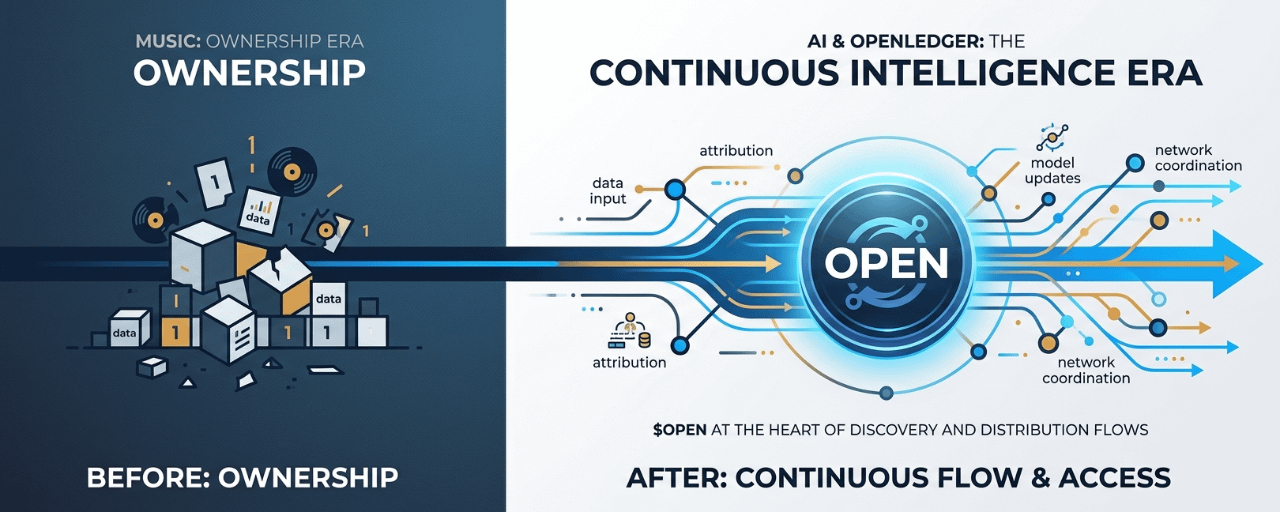
Who Really Owns the AI Economy? OpenLedger Is Giving the Answer On-ChainHere's a question most people never think to ask: when you interact with an AI chatbot, use a recommendation algorithm, or benefit from a medical diagnosis model — who actually built that intelligence?
The honest answer is: thousands, sometimes millions, of anonymous contributors. Data labelers who spent hours tagging images. Domain experts whose knowledge was scraped without consent. Developers who open-sourced models that became the backbone of billion-dollar products. These people built the AI economy. But they don't own any of it.
@Openledger ([https://www.binance.com/en/square/profile/openledger](https://www.binance.com/en/square/profile/openledger)) is the project asking the most important question in tech right now — and actually doing something about it.
The Silent Crisis in AI Development
The artificial intelligence industry is projected to be worth trillions of dollars over the next decade. Investment is pouring in from every corner of the globe, and headlines celebrate new model launches almost weekly. Yet the infrastructure that makes all of this possible — quality data — remains one of the most undervalued and exploited resources in the world.
Consider this: large language models are trained on vast quantities of human-generated text, creative work, scientific research, and personal expression. The people who generated that content receive no compensation, no attribution, and no say in how their contributions are used. This is not a minor inefficiency — it is a structural flaw at the heart of modern AI development.
OpenLedger was designed specifically to address this flaw, not through policy lobbying or legal frameworks, but through blockchain-enforced transparency and programmable compensation.
Datanets: A New Model for AI Collaboration
The centerpiece of OpenLedger's architecture is the concept of "Datanets" — community-owned, on-chain datasets that anyone can contribute to, curate, and monetize. Think of a Datanet as a living dataset with built-in economic logic: every time data is uploaded, validated, or used to train a model, the contributors are automatically identified and rewarded through smart contracts.
This is a radical departure from how AI data works today. In the current model, data is collected by a centralized entity, cleaned and labeled by underpaid contractors, and then used to build proprietary models that generate enormous value — none of which flows back to contributors. Datanets flip this model entirely. Contribution is tracked. Attribution is verifiable. Rewards are automatic and transparent.
Specialized Language Models (SLMs) trained on these Datanets are purpose-built for specific domains — healthcare, legal, finance, science — where accuracy and data provenance matter enormously. Rather than relying on one massive generalist model, OpenLedger enables a diverse ecosystem of specialized, community-trained models with clear data lineage.
Proof of Attribution: Transparency as Infrastructure
The technical backbone of OpenLedger's fairness model is its "Proof of Attribution" protocol. Every interaction with the platform — data uploads, model training jobs, reward distributions, governance votes — is recorded on-chain in real time. This creates an immutable, auditable history of who contributed what and what value was generated as a result.
This has profound implications beyond just compensation. It means AI models built on OpenLedger come with verifiable data provenance — something that is increasingly critical as regulators around the world begin scrutinizing AI systems for bias, copyright infringement, and data sourcing practices. In a world where AI accountability is becoming a legal requirement, having on-chain attribution is not just an ethical advantage — it's a competitive one.
OpenChat and the Expanding Ecosystem
In July 2025, OpenLedger launched OpenChat — an AI platform that goes beyond typical chatbot functionality by logging every user interaction and contribution on-chain via the Proof of Attribution protocol. Users who engage with OpenChat don't just consume AI — they actively contribute to improving it, and they are rewarded for doing so through the Open token.
This is just one example of how OpenLedger is building a full ecosystem around its core protocol. The platform supports the creation of AI agents — autonomous programs that execute tasks, interact with other agents, and generate value — all with on-chain accountability. As AI agents become more prevalent and more powerful, having a transparent ledger of their actions and outputs becomes essential infrastructure.
$OPEN: Owning a Piece of the AI Future
Open is not simply a speculative asset — it is the economic engine of a new kind of AI economy. As a governance token, it gives holders a direct voice in how the protocol evolves. As a staking asset, it allows participants to earn passive rewards while contributing to network security. As a medium of exchange within the ecosystem, it connects data contributors, model builders, and AI consumers in a single, coherent incentive structure.
The tokenomics reflect a genuine commitment to community ownership: 61.7% of the total supply is allocated to the community and ecosystem, with careful vesting schedules designed to prevent short-term dumping and align incentives over the long haul. Combined with a $5 million token buyback program funded entirely by corporate revenue, the foundation has put real money behind its commitment to token value.
With a total supply of 1 billion tokens and a Mainnet already live since November 2025, $OPEN is not a promise — it is a functioning economic system.
The Bigger Picture
We are entering an era where AI will touch every industry, every profession, and every aspect of daily life. The question is not whether AI will be powerful — it clearly already is. The question is whether the benefits of that power will be concentrated in the hands of a few corporations, or distributed fairly among the people who made it possible.
OpenLedger is making a clear bet: decentralized, transparent, contributor-rewarded AI is not just more ethical — it is more resilient, more innovative, and ultimately more valuable than the closed alternative. By creating the infrastructure for a truly open AI economy, it is staking a claim on what the next decade of artificial intelligence actually looks like.
The AI economy is being built right now. The only question is whether you're a spectator — or a contributor.
👉 Follow @Openledger ([https://www.binance.com/en/square/profile/openledger](https://www.binance.com/en/square/profile/openledger)) and be part of the open AI revolution.
$OPEN #OpenLedger #DecentralizedAI #PayableAI #Web3 #BinanceSquare
{spot}(OPENUSDT)
Who Really Owns the AI Economy? OpenLedger Is Giving the Answer On-Chain
Here's a question most people never think to ask: when you interact with an AI chatbot, use a recommendation algorithm, or benefit from a medical diagnosis model — who actually built that intelligence?
The honest answer is: thousands, sometimes millions, of anonymous contributors. Data labelers who spent hours tagging images. Domain experts whose knowledge was scraped without consent. Developers who open-sourced models that became the backbone of billion-dollar products. These people built the AI economy. But they don't own any of it.
@OpenLedger (https://www.binance.com/en/square/profile/openledger) is the project asking the most important question in tech right now — and actually doing something about it.
The Silent Crisis in AI Development
The artificial intelligence industry is projected to be worth trillions of dollars over the next decade. Investment is pouring in from every corner of the globe, and headlines celebrate new model launches almost weekly. Yet the infrastructure that makes all of this possible — quality data — remains one of the most undervalued and exploited resources in the world.
Consider this: large language models are trained on vast quantities of human-generated text, creative work, scientific research, and personal expression. The people who generated that content receive no compensation, no attribution, and no say in how their contributions are used. This is not a minor inefficiency — it is a structural flaw at the heart of modern AI development.
OpenLedger was designed specifically to address this flaw, not through policy lobbying or legal frameworks, but through blockchain-enforced transparency and programmable compensation.
Datanets: A New Model for AI Collaboration
The centerpiece of OpenLedger's architecture is the concept of "Datanets" — community-owned, on-chain datasets that anyone can contribute to, curate, and monetize. Think of a Datanet as a living dataset with built-in economic logic: every time data is uploaded, validated, or used to train a model, the contributors are automatically identified and rewarded through smart contracts.
This is a radical departure from how AI data works today. In the current model, data is collected by a centralized entity, cleaned and labeled by underpaid contractors, and then used to build proprietary models that generate enormous value — none of which flows back to contributors. Datanets flip this model entirely. Contribution is tracked. Attribution is verifiable. Rewards are automatic and transparent.
Specialized Language Models (SLMs) trained on these Datanets are purpose-built for specific domains — healthcare, legal, finance, science — where accuracy and data provenance matter enormously. Rather than relying on one massive generalist model, OpenLedger enables a diverse ecosystem of specialized, community-trained models with clear data lineage.
Proof of Attribution: Transparency as Infrastructure
The technical backbone of OpenLedger's fairness model is its "Proof of Attribution" protocol. Every interaction with the platform — data uploads, model training jobs, reward distributions, governance votes — is recorded on-chain in real time. This creates an immutable, auditable history of who contributed what and what value was generated as a result.
This has profound implications beyond just compensation. It means AI models built on OpenLedger come with verifiable data provenance — something that is increasingly critical as regulators around the world begin scrutinizing AI systems for bias, copyright infringement, and data sourcing practices. In a world where AI accountability is becoming a legal requirement, having on-chain attribution is not just an ethical advantage — it's a competitive one.
OpenChat and the Expanding Ecosystem
In July 2025, OpenLedger launched OpenChat — an AI platform that goes beyond typical chatbot functionality by logging every user interaction and contribution on-chain via the Proof of Attribution protocol. Users who engage with OpenChat don't just consume AI — they actively contribute to improving it, and they are rewarded for doing so through the Open token.
This is just one example of how OpenLedger is building a full ecosystem around its core protocol. The platform supports the creation of AI agents — autonomous programs that execute tasks, interact with other agents, and generate value — all with on-chain accountability. As AI agents become more prevalent and more powerful, having a transparent ledger of their actions and outputs becomes essential infrastructure.
$OPEN : Owning a Piece of the AI Future
Open is not simply a speculative asset — it is the economic engine of a new kind of AI economy. As a governance token, it gives holders a direct voice in how the protocol evolves. As a staking asset, it allows participants to earn passive rewards while contributing to network security. As a medium of exchange within the ecosystem, it connects data contributors, model builders, and AI consumers in a single, coherent incentive structure.
The tokenomics reflect a genuine commitment to community ownership: 61.7% of the total supply is allocated to the community and ecosystem, with careful vesting schedules designed to prevent short-term dumping and align incentives over the long haul. Combined with a $5 million token buyback program funded entirely by corporate revenue, the foundation has put real money behind its commitment to token value.
With a total supply of 1 billion tokens and a Mainnet already live since November 2025, $OPEN is not a promise — it is a functioning economic system.
The Bigger Picture
We are entering an era where AI will touch every industry, every profession, and every aspect of daily life. The question is not whether AI will be powerful — it clearly already is. The question is whether the benefits of that power will be concentrated in the hands of a few corporations, or distributed fairly among the people who made it possible.
OpenLedger is making a clear bet: decentralized, transparent, contributor-rewarded AI is not just more ethical — it is more resilient, more innovative, and ultimately more valuable than the closed alternative. By creating the infrastructure for a truly open AI economy, it is staking a claim on what the next decade of artificial intelligence actually looks like.
The AI economy is being built right now. The only question is whether you're a spectator — or a contributor.
👉 Follow @OpenLedger (https://www.binance.com/en/square/profile/openledger) and be part of the open AI revolution.
$OPEN #OpenLedger #DecentralizedAI #PayableAI #Web3 #BinanceSquare
The honest answer is: thousands, sometimes millions, of anonymous contributors. Data labelers who spent hours tagging images. Domain experts whose knowledge was scraped without consent. Developers who open-sourced models that became the backbone of billion-dollar products. These people built the AI economy. But they don't own any of it.
@OpenLedger (https://www.binance.com/en/square/profile/openledger) is the project asking the most important question in tech right now — and actually doing something about it.
The Silent Crisis in AI Development
The artificial intelligence industry is projected to be worth trillions of dollars over the next decade. Investment is pouring in from every corner of the globe, and headlines celebrate new model launches almost weekly. Yet the infrastructure that makes all of this possible — quality data — remains one of the most undervalued and exploited resources in the world.
Consider this: large language models are trained on vast quantities of human-generated text, creative work, scientific research, and personal expression. The people who generated that content receive no compensation, no attribution, and no say in how their contributions are used. This is not a minor inefficiency — it is a structural flaw at the heart of modern AI development.
OpenLedger was designed specifically to address this flaw, not through policy lobbying or legal frameworks, but through blockchain-enforced transparency and programmable compensation.
Datanets: A New Model for AI Collaboration
The centerpiece of OpenLedger's architecture is the concept of "Datanets" — community-owned, on-chain datasets that anyone can contribute to, curate, and monetize. Think of a Datanet as a living dataset with built-in economic logic: every time data is uploaded, validated, or used to train a model, the contributors are automatically identified and rewarded through smart contracts.
This is a radical departure from how AI data works today. In the current model, data is collected by a centralized entity, cleaned and labeled by underpaid contractors, and then used to build proprietary models that generate enormous value — none of which flows back to contributors. Datanets flip this model entirely. Contribution is tracked. Attribution is verifiable. Rewards are automatic and transparent.
Specialized Language Models (SLMs) trained on these Datanets are purpose-built for specific domains — healthcare, legal, finance, science — where accuracy and data provenance matter enormously. Rather than relying on one massive generalist model, OpenLedger enables a diverse ecosystem of specialized, community-trained models with clear data lineage.
Proof of Attribution: Transparency as Infrastructure
The technical backbone of OpenLedger's fairness model is its "Proof of Attribution" protocol. Every interaction with the platform — data uploads, model training jobs, reward distributions, governance votes — is recorded on-chain in real time. This creates an immutable, auditable history of who contributed what and what value was generated as a result.
This has profound implications beyond just compensation. It means AI models built on OpenLedger come with verifiable data provenance — something that is increasingly critical as regulators around the world begin scrutinizing AI systems for bias, copyright infringement, and data sourcing practices. In a world where AI accountability is becoming a legal requirement, having on-chain attribution is not just an ethical advantage — it's a competitive one.
OpenChat and the Expanding Ecosystem
In July 2025, OpenLedger launched OpenChat — an AI platform that goes beyond typical chatbot functionality by logging every user interaction and contribution on-chain via the Proof of Attribution protocol. Users who engage with OpenChat don't just consume AI — they actively contribute to improving it, and they are rewarded for doing so through the Open token.
This is just one example of how OpenLedger is building a full ecosystem around its core protocol. The platform supports the creation of AI agents — autonomous programs that execute tasks, interact with other agents, and generate value — all with on-chain accountability. As AI agents become more prevalent and more powerful, having a transparent ledger of their actions and outputs becomes essential infrastructure.
$OPEN : Owning a Piece of the AI Future
Open is not simply a speculative asset — it is the economic engine of a new kind of AI economy. As a governance token, it gives holders a direct voice in how the protocol evolves. As a staking asset, it allows participants to earn passive rewards while contributing to network security. As a medium of exchange within the ecosystem, it connects data contributors, model builders, and AI consumers in a single, coherent incentive structure.
The tokenomics reflect a genuine commitment to community ownership: 61.7% of the total supply is allocated to the community and ecosystem, with careful vesting schedules designed to prevent short-term dumping and align incentives over the long haul. Combined with a $5 million token buyback program funded entirely by corporate revenue, the foundation has put real money behind its commitment to token value.
With a total supply of 1 billion tokens and a Mainnet already live since November 2025, $OPEN is not a promise — it is a functioning economic system.
The Bigger Picture
We are entering an era where AI will touch every industry, every profession, and every aspect of daily life. The question is not whether AI will be powerful — it clearly already is. The question is whether the benefits of that power will be concentrated in the hands of a few corporations, or distributed fairly among the people who made it possible.
OpenLedger is making a clear bet: decentralized, transparent, contributor-rewarded AI is not just more ethical — it is more resilient, more innovative, and ultimately more valuable than the closed alternative. By creating the infrastructure for a truly open AI economy, it is staking a claim on what the next decade of artificial intelligence actually looks like.
The AI economy is being built right now. The only question is whether you're a spectator — or a contributor.
👉 Follow @OpenLedger (https://www.binance.com/en/square/profile/openledger) and be part of the open AI revolution.
$OPEN #OpenLedger #DecentralizedAI #PayableAI #Web3 #BinanceSquare
1
53

·
--
Bullish
Your writing trained the AI that replaced your job.
Your feedback made it smarter. Your data made it confident.
You got a "Thank you for using our service."
I've been thinking about this for weeks. We keep calling AI "intelligent" but nobody asks whose intelligence it actually borrowed.
OpenLedger is the first thing I've seen that answers that question honestly.
Proof of Attribution. Your data footprint becomes a real, on-chain paycheck. Not a promise. Not a creator fund that pays $0.003.
$OPEN holding strong at key support. The smart money already knows.
The invisible contributors deserve better. This might finally be their protocol.
@Openledger #OpenLedger #PayableAI #Web3AI
$OPEN
{future}(OPENUSDT)
Your writing trained the AI that replaced your job.
Your feedback made it smarter. Your data made it confident.
You got a "Thank you for using our service."
I've been thinking about this for weeks. We keep calling AI "intelligent" but nobody asks whose intelligence it actually borrowed.
OpenLedger is the first thing I've seen that answers that question honestly.
Proof of Attribution. Your data footprint becomes a real, on-chain paycheck. Not a promise. Not a creator fund that pays $0.003.
$OPEN holding strong at key support. The smart money already knows.
The invisible contributors deserve better. This might finally be their protocol.
@OpenLedger #OpenLedger #PayableAI #Web3AI
$OPEN
Your feedback made it smarter. Your data made it confident.
You got a "Thank you for using our service."
I've been thinking about this for weeks. We keep calling AI "intelligent" but nobody asks whose intelligence it actually borrowed.
OpenLedger is the first thing I've seen that answers that question honestly.
Proof of Attribution. Your data footprint becomes a real, on-chain paycheck. Not a promise. Not a creator fund that pays $0.003.
$OPEN holding strong at key support. The smart money already knows.
The invisible contributors deserve better. This might finally be their protocol.
@OpenLedger #OpenLedger #PayableAI #Web3AI
$OPEN

27
1
13
162

#openledger $OPEN
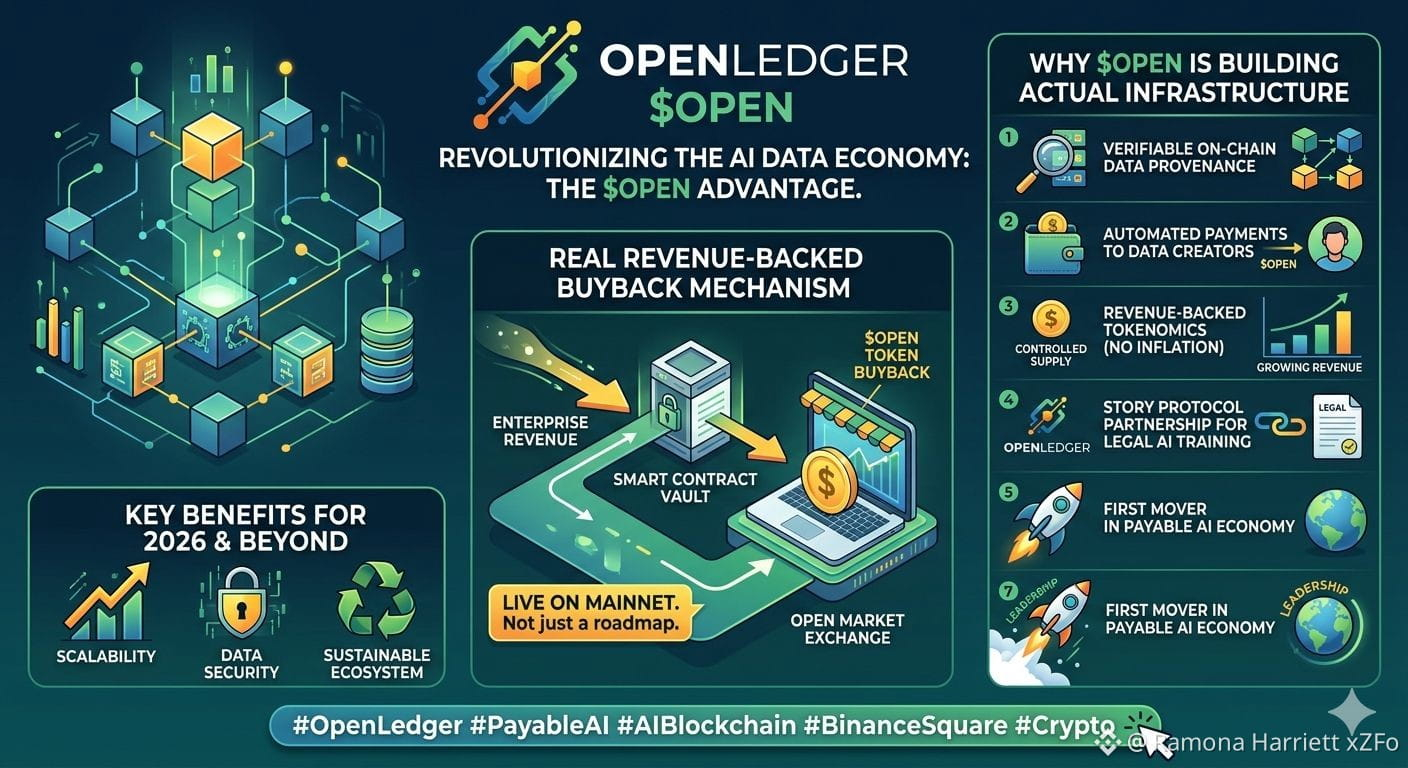
🔥 The AI data economy just leveled up.
@OpenLedger is doing something no one else is — using real enterprise revenue to buy back $OPEN directly from the market. Not promises. Not roadmaps. A live buyback mechanism running on mainnet right now.
Here's why I'm bullish on $OPEN in 2026:
✅ Verifiable on-chain data provenance
✅ Automated payments to data creators
✅ Revenue-backed tokenomics, not inflation
✅ Story Protocol partnership for legal AI training
✅ First mover in the Payable AI Economy
Most AI tokens are just hype. OpenLedger is building actual infrastructure. Big difference. #OpenLedger #PayableAI #AIBlockchain #BinanceSquare
#openledger $OPEN
🔥 The AI data economy just leveled up.
@OpenLedger is doing something no one else is — using real enterprise revenue to buy back $OPEN directly from the market. Not promises. Not roadmaps. A live buyback mechanism running on mainnet right now.
Here's why I'm bullish on $OPEN in 2026:
✅ Verifiable on-chain data provenance
✅ Automated payments to data creators
✅ Revenue-backed tokenomics, not inflation
✅ Story Protocol partnership for legal AI training
✅ First mover in the Payable AI Economy
Most AI tokens are just hype. OpenLedger is building actual infrastructure. Big difference. #OpenLedger #PayableAI #AIBlockchain #BinanceSquare
🔥 The AI data economy just leveled up.
@OpenLedger is doing something no one else is — using real enterprise revenue to buy back $OPEN directly from the market. Not promises. Not roadmaps. A live buyback mechanism running on mainnet right now.
Here's why I'm bullish on $OPEN in 2026:
✅ Verifiable on-chain data provenance
✅ Automated payments to data creators
✅ Revenue-backed tokenomics, not inflation
✅ Story Protocol partnership for legal AI training
✅ First mover in the Payable AI Economy
Most AI tokens are just hype. OpenLedger is building actual infrastructure. Big difference. #OpenLedger #PayableAI #AIBlockchain #BinanceSquare
50


·
--
Verified
Article
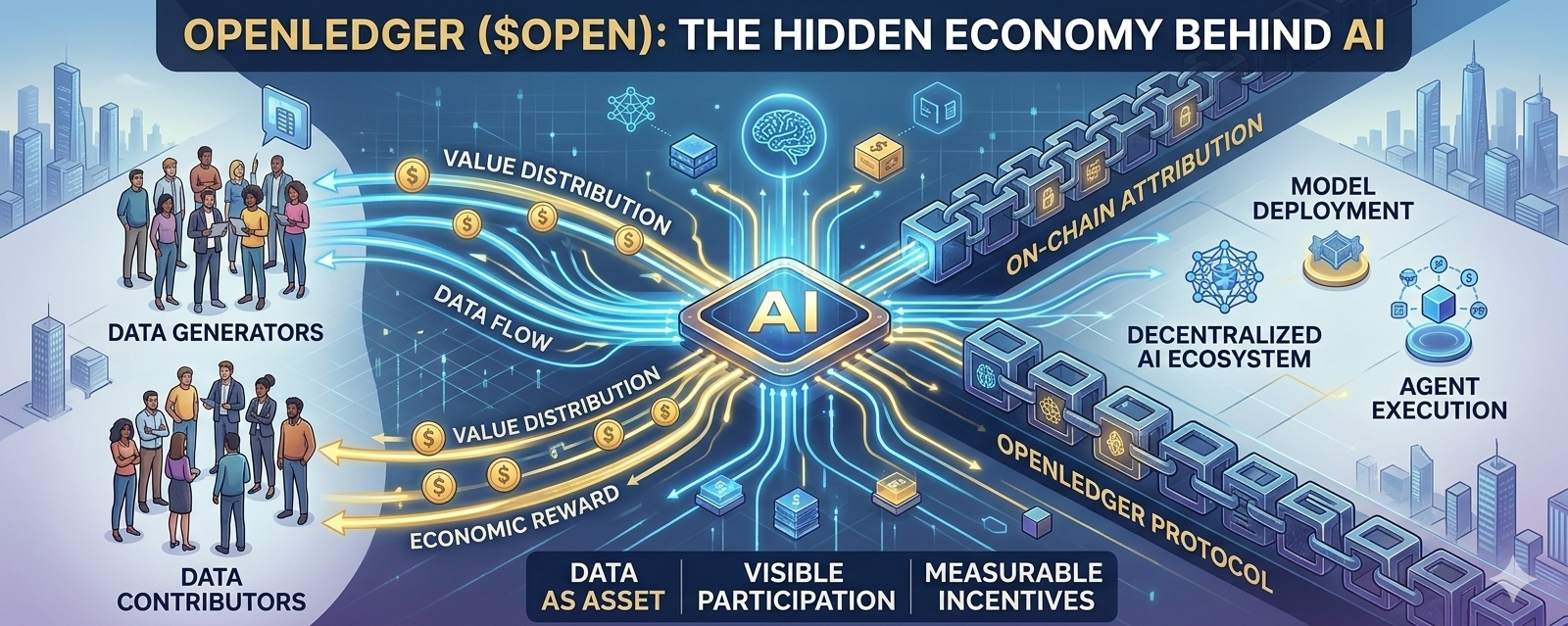
OPENLEDGER ($OPEN): THE HIDDEN ECONOMY BEHIND AIMost people see AI as a race between models.
Bigger models. Faster models. Smarter models.
But I think the more important battle may be happening somewhere most people are not looking.
The battle for value.
Every AI system is built on data. Without data, there is no training, no intelligence, and no useful output. Yet the people who generate, organize, and improve that data are often the least visible participants in the entire ecosystem.
That is why @Openledger caught my attention.
Not because it promises better AI.
Because it asks a different question:
What if the people contributing to AI could become part of its economic upside?
The idea sounds simple, but its implications are massive.
For years, data has flowed into AI systems like fuel into an engine. Once consumed, the connection between the contributor and the value created usually disappears. The model improves, companies benefit, users receive better experiences, and the original source becomes impossible to identify.
@Openledger is attempting to challenge that pattern.
Its vision is built around a future where data is not treated as a disposable input but as a productive asset within an AI-driven economy.
That is where the concept becomes interesting.
The project introduces mechanisms designed to connect contributions with outcomes. Instead of treating AI as a black box, the goal is to make participation visible and measurable.
If that works at scale, it could fundamentally change incentives across the industry.
But that is also where the difficult questions begin.
AI systems are becoming increasingly complex. Models learn from countless sources. Outputs are influenced by layers of information, interactions, and refinements that often overlap with one another.
In that environment, attribution is not just a technical challenge.
It becomes an economic challenge.
How accurately can a system determine who deserves credit?
How should value be distributed when thousands of contributors influence a single result?
And can that process remain fair as networks continue to grow?
These questions do not have easy answers.
Yet solving them may be one of the most important opportunities in the AI era.
Beyond attribution, @Openledger is also building infrastructure designed to support a more decentralized AI ecosystem. Model deployment, fine-tuning, and agent execution are all moving toward a future where AI becomes more accessible and potentially more efficient.
The vision is ambitious.
But history has shown that ambitious technology alone is not enough.
Real success comes when innovation meets sustained demand.
This is why I pay close attention to the difference between activity and adoption.
Transaction numbers can grow.
User counts can increase.
Models can multiply across a network.
But none of those metrics automatically guarantee long-term value creation.
The strongest ecosystems are not the ones generating the most noise.
They are the ones solving problems that people continue to care about years later.
Then there is the token economy.
Every decentralized network eventually faces the same reality: supply and demand must find balance.
Infrastructure can be impressive.
Narratives can be powerful.
Funding can create momentum.
But sustainable ecosystems require genuine participation and lasting utility.
Without that foundation, even the most promising systems can struggle once market conditions change.
This is what makes OpenLedger fascinating to watch.
It sits at the intersection of AI, ownership, incentives, and infrastructure.
Not all of its ideas are proven.
Not all of its assumptions will necessarily succeed.
But the questions it raises are becoming increasingly difficult to ignore.
Perhaps the future AI economy will not be defined by who builds the smartest model.
Perhaps it will be defined by who creates the fairest system for recognizing and rewarding contribution.
And if that turns out to be true, the value layer beneath AI may become just as important as the intelligence itself.
@Openledger
$OPEN
#OpenLedger #Aİ #Blockchain #DataOwnership #PayableAI
{future}(OPENUSDT)
OPENLEDGER ($OPEN): THE HIDDEN ECONOMY BEHIND AI
Most people see AI as a race between models.
Bigger models. Faster models. Smarter models.
But I think the more important battle may be happening somewhere most people are not looking.
The battle for value.
Every AI system is built on data. Without data, there is no training, no intelligence, and no useful output. Yet the people who generate, organize, and improve that data are often the least visible participants in the entire ecosystem.
That is why @OpenLedger caught my attention.
Not because it promises better AI.
Because it asks a different question:
What if the people contributing to AI could become part of its economic upside?
The idea sounds simple, but its implications are massive.
For years, data has flowed into AI systems like fuel into an engine. Once consumed, the connection between the contributor and the value created usually disappears. The model improves, companies benefit, users receive better experiences, and the original source becomes impossible to identify.
@OpenLedger is attempting to challenge that pattern.
Its vision is built around a future where data is not treated as a disposable input but as a productive asset within an AI-driven economy.
That is where the concept becomes interesting.
The project introduces mechanisms designed to connect contributions with outcomes. Instead of treating AI as a black box, the goal is to make participation visible and measurable.
If that works at scale, it could fundamentally change incentives across the industry.
But that is also where the difficult questions begin.
AI systems are becoming increasingly complex. Models learn from countless sources. Outputs are influenced by layers of information, interactions, and refinements that often overlap with one another.
In that environment, attribution is not just a technical challenge.
It becomes an economic challenge.
How accurately can a system determine who deserves credit?
How should value be distributed when thousands of contributors influence a single result?
And can that process remain fair as networks continue to grow?
These questions do not have easy answers.
Yet solving them may be one of the most important opportunities in the AI era.
Beyond attribution, @OpenLedger is also building infrastructure designed to support a more decentralized AI ecosystem. Model deployment, fine-tuning, and agent execution are all moving toward a future where AI becomes more accessible and potentially more efficient.
The vision is ambitious.
But history has shown that ambitious technology alone is not enough.
Real success comes when innovation meets sustained demand.
This is why I pay close attention to the difference between activity and adoption.
Transaction numbers can grow.
User counts can increase.
Models can multiply across a network.
But none of those metrics automatically guarantee long-term value creation.
The strongest ecosystems are not the ones generating the most noise.
They are the ones solving problems that people continue to care about years later.
Then there is the token economy.
Every decentralized network eventually faces the same reality: supply and demand must find balance.
Infrastructure can be impressive.
Narratives can be powerful.
Funding can create momentum.
But sustainable ecosystems require genuine participation and lasting utility.
Without that foundation, even the most promising systems can struggle once market conditions change.
This is what makes OpenLedger fascinating to watch.
It sits at the intersection of AI, ownership, incentives, and infrastructure.
Not all of its ideas are proven.
Not all of its assumptions will necessarily succeed.
But the questions it raises are becoming increasingly difficult to ignore.
Perhaps the future AI economy will not be defined by who builds the smartest model.
Perhaps it will be defined by who creates the fairest system for recognizing and rewarding contribution.
And if that turns out to be true, the value layer beneath AI may become just as important as the intelligence itself.
@OpenLedger
$OPEN
#OpenLedger #Aİ #Blockchain #DataOwnership #PayableAI
Bigger models. Faster models. Smarter models.
But I think the more important battle may be happening somewhere most people are not looking.
The battle for value.
Every AI system is built on data. Without data, there is no training, no intelligence, and no useful output. Yet the people who generate, organize, and improve that data are often the least visible participants in the entire ecosystem.
That is why @OpenLedger caught my attention.
Not because it promises better AI.
Because it asks a different question:
What if the people contributing to AI could become part of its economic upside?
The idea sounds simple, but its implications are massive.
For years, data has flowed into AI systems like fuel into an engine. Once consumed, the connection between the contributor and the value created usually disappears. The model improves, companies benefit, users receive better experiences, and the original source becomes impossible to identify.
@OpenLedger is attempting to challenge that pattern.
Its vision is built around a future where data is not treated as a disposable input but as a productive asset within an AI-driven economy.
That is where the concept becomes interesting.
The project introduces mechanisms designed to connect contributions with outcomes. Instead of treating AI as a black box, the goal is to make participation visible and measurable.
If that works at scale, it could fundamentally change incentives across the industry.
But that is also where the difficult questions begin.
AI systems are becoming increasingly complex. Models learn from countless sources. Outputs are influenced by layers of information, interactions, and refinements that often overlap with one another.
In that environment, attribution is not just a technical challenge.
It becomes an economic challenge.
How accurately can a system determine who deserves credit?
How should value be distributed when thousands of contributors influence a single result?
And can that process remain fair as networks continue to grow?
These questions do not have easy answers.
Yet solving them may be one of the most important opportunities in the AI era.
Beyond attribution, @OpenLedger is also building infrastructure designed to support a more decentralized AI ecosystem. Model deployment, fine-tuning, and agent execution are all moving toward a future where AI becomes more accessible and potentially more efficient.
The vision is ambitious.
But history has shown that ambitious technology alone is not enough.
Real success comes when innovation meets sustained demand.
This is why I pay close attention to the difference between activity and adoption.
Transaction numbers can grow.
User counts can increase.
Models can multiply across a network.
But none of those metrics automatically guarantee long-term value creation.
The strongest ecosystems are not the ones generating the most noise.
They are the ones solving problems that people continue to care about years later.
Then there is the token economy.
Every decentralized network eventually faces the same reality: supply and demand must find balance.
Infrastructure can be impressive.
Narratives can be powerful.
Funding can create momentum.
But sustainable ecosystems require genuine participation and lasting utility.
Without that foundation, even the most promising systems can struggle once market conditions change.
This is what makes OpenLedger fascinating to watch.
It sits at the intersection of AI, ownership, incentives, and infrastructure.
Not all of its ideas are proven.
Not all of its assumptions will necessarily succeed.
But the questions it raises are becoming increasingly difficult to ignore.
Perhaps the future AI economy will not be defined by who builds the smartest model.
Perhaps it will be defined by who creates the fairest system for recognizing and rewarding contribution.
And if that turns out to be true, the value layer beneath AI may become just as important as the intelligence itself.
@OpenLedger
$OPEN
#OpenLedger #Aİ #Blockchain #DataOwnership #PayableAI
21
12
812

·
--
Solving the AI Data Bottleneck Through Proof of AttributionArtificial intelligence has an insatiable appetite for data. However, the current AI landscape faces a critical challenge: centralized tech giants scraping public and private data without giving credit, compensation, or control back to the original creators. This data bottleneck slows down niche AI development and disincentivizes high-quality curation.
Enter @Openledger ([https://www.binance.com/en/square/profile/openledger](https://www.binance.com/en/square/profile/openledger)), the dedicated AI blockchain designed to build a "Payable AI" economy where contributors, developers, and users exist in a mutually beneficial system.
How DataNets & Proof of Attribution Change the Game
At the core of the @Openledger ecosystem are DataNets—decentralized on-chain data collaboration networks. These allow communities, experts, and organizations to co-create, securely store, and curate specialized datasets tailored for training custom AI models.
But how do you ensure that contributors are fairly compensated? OpenLedger solves this via Proof of Attribution. This innovative consensus and tracking mechanism guarantees that every piece of data contributed is verifiably logged on-chain. When models train on this data, or when the models are monetized, the rewards are automatically routed back to the exact contributors.
The Role of $OPEN in a Decentralized Economy
This entire mechanism is fueled by the $OPEN utility token. As the financial backbone of the network, $OPEN powers:
Transaction processing fees across the EVM-compatible OpenLedger infrastructure.
Rewards distribution to those running nodes and contributing data.
Governance over DataNet structures and validation parameters.
By converting static data files into liquid, composable on-chain assets, @Openledger is paving the path for ethical machine learning. Decentralizing global intelligence starts with giving ownership back to the people.
Explore more about the future of AI:
🔗 Visit the official profile: [https://www.binance.com/en/square/profile/openledger](https://www.binance.com/en/square/profile/openledger)
#OpenLedger #DePIN #ArtificialIntelligence #Web3 #PayableAI #CryptoAI
Solving the AI Data Bottleneck Through Proof of Attribution
Artificial intelligence has an insatiable appetite for data. However, the current AI landscape faces a critical challenge: centralized tech giants scraping public and private data without giving credit, compensation, or control back to the original creators. This data bottleneck slows down niche AI development and disincentivizes high-quality curation.
Enter @OpenLedger (https://www.binance.com/en/square/profile/openledger), the dedicated AI blockchain designed to build a "Payable AI" economy where contributors, developers, and users exist in a mutually beneficial system.
How DataNets & Proof of Attribution Change the Game
At the core of the @OpenLedger ecosystem are DataNets—decentralized on-chain data collaboration networks. These allow communities, experts, and organizations to co-create, securely store, and curate specialized datasets tailored for training custom AI models.
But how do you ensure that contributors are fairly compensated? OpenLedger solves this via Proof of Attribution. This innovative consensus and tracking mechanism guarantees that every piece of data contributed is verifiably logged on-chain. When models train on this data, or when the models are monetized, the rewards are automatically routed back to the exact contributors.
The Role of $OPEN in a Decentralized Economy
This entire mechanism is fueled by the $OPEN utility token. As the financial backbone of the network, $OPEN powers:
Transaction processing fees across the EVM-compatible OpenLedger infrastructure.
Rewards distribution to those running nodes and contributing data.
Governance over DataNet structures and validation parameters.
By converting static data files into liquid, composable on-chain assets, @OpenLedger is paving the path for ethical machine learning. Decentralizing global intelligence starts with giving ownership back to the people.
Explore more about the future of AI:
🔗 Visit the official profile: https://www.binance.com/en/square/profile/openledger
#OpenLedger #DePIN #ArtificialIntelligence #Web3 #PayableAI #CryptoAI
Enter @OpenLedger (https://www.binance.com/en/square/profile/openledger), the dedicated AI blockchain designed to build a "Payable AI" economy where contributors, developers, and users exist in a mutually beneficial system.
How DataNets & Proof of Attribution Change the Game
At the core of the @OpenLedger ecosystem are DataNets—decentralized on-chain data collaboration networks. These allow communities, experts, and organizations to co-create, securely store, and curate specialized datasets tailored for training custom AI models.
But how do you ensure that contributors are fairly compensated? OpenLedger solves this via Proof of Attribution. This innovative consensus and tracking mechanism guarantees that every piece of data contributed is verifiably logged on-chain. When models train on this data, or when the models are monetized, the rewards are automatically routed back to the exact contributors.
The Role of $OPEN in a Decentralized Economy
This entire mechanism is fueled by the $OPEN utility token. As the financial backbone of the network, $OPEN powers:
Transaction processing fees across the EVM-compatible OpenLedger infrastructure.
Rewards distribution to those running nodes and contributing data.
Governance over DataNet structures and validation parameters.
By converting static data files into liquid, composable on-chain assets, @OpenLedger is paving the path for ethical machine learning. Decentralizing global intelligence starts with giving ownership back to the people.
Explore more about the future of AI:
🔗 Visit the official profile: https://www.binance.com/en/square/profile/openledger
#OpenLedger #DePIN #ArtificialIntelligence #Web3 #PayableAI #CryptoAI
118

Article
🚀 Why OpenLedger ($OPEN) is Redefining the AI Data Economy in 2026The intersection of AI and blockchain is crowded with hype, but @Openledger is delivering actual infrastructure. While most projects rely on empty roadmaps and token inflation, OpenLedger has built a live buyback mechanism running on mainnet right now, using real enterprise revenue to buy back $OPEN directly from the market.
This isn't just theory—it's the foundation of the new Payable AI Economy. By establishing verifiable on-chain data provenance, the platform ensures that data creators receive automated, fair payments for their contributions. Furthermore, their strategic partnership with Story Protocol provides a robust legal framework for AI training, solving one of the industry's biggest compliance hurdles.
With revenue-backed tokenomics instead of hyper-inflationary rewards, $OPEN stands out as a true utility-driven asset. If you are looking for real web3 infrastructure that powers next-generation artificial intelligence, this is the first mover to watch.
@Openledger
#OpenLedger #PayableAI #AIBlockchain #BinanceSquare #Web3
🚀 Why OpenLedger ($OPEN) is Redefining the AI Data Economy in 2026
The intersection of AI and blockchain is crowded with hype, but @OpenLedger is delivering actual infrastructure. While most projects rely on empty roadmaps and token inflation, OpenLedger has built a live buyback mechanism running on mainnet right now, using real enterprise revenue to buy back $OPEN directly from the market.
This isn't just theory—it's the foundation of the new Payable AI Economy. By establishing verifiable on-chain data provenance, the platform ensures that data creators receive automated, fair payments for their contributions. Furthermore, their strategic partnership with Story Protocol provides a robust legal framework for AI training, solving one of the industry's biggest compliance hurdles.
With revenue-backed tokenomics instead of hyper-inflationary rewards, $OPEN stands out as a true utility-driven asset. If you are looking for real web3 infrastructure that powers next-generation artificial intelligence, this is the first mover to watch.
@OpenLedger
#OpenLedger #PayableAI #AIBlockchain #BinanceSquare #Web3
This isn't just theory—it's the foundation of the new Payable AI Economy. By establishing verifiable on-chain data provenance, the platform ensures that data creators receive automated, fair payments for their contributions. Furthermore, their strategic partnership with Story Protocol provides a robust legal framework for AI training, solving one of the industry's biggest compliance hurdles.
With revenue-backed tokenomics instead of hyper-inflationary rewards, $OPEN stands out as a true utility-driven asset. If you are looking for real web3 infrastructure that powers next-generation artificial intelligence, this is the first mover to watch.
@OpenLedger
#OpenLedger #PayableAI #AIBlockchain #BinanceSquare #Web3
41
Log in to explore more content
Join global crypto users on Binance Square
⚡️ Get latest and useful information about crypto.
💬 Trusted by the world’s largest crypto exchange.
👍 Discover real insights from verified creators.
Email / Phone number
Trending Topics
1
#BinancePick
2.5M views
137,704 Discussing
2
#EarningsSeason
4.9M views
23,879 Discussing
3
#ElectrumWalletBugLetRogueServersStealFunds
2,066 views
123 Discussing
4
#ArgentineCourtDismissesLIBRACaseAgainstMilei
10,021 views
218 Discussing
5
#SKHynixReportedlyPlansSpecialDividendFromKioxiaStakeSale
2,223 views
35 Discussing
6
#KeystoneWebsiteBreachExposesBuyersShippingAddresses
1,177 views
25 Discussing
7
#USQ3GDPAndSeptemberPCEDueNextWeek
83,037 views
1,034 Discussing
8
#SouthKoreaDelaysCryptoIncomeTax
152,872 views
1,073 Discussing
9
#ElectrumFixesHighRiskExploitInVersionsBefore4.8.3
67,327 views
770 Discussing
10
#SouthKoreaPlansToRegulateStablecoinsUnderFXLaw
65,414 views
686 Discussing