

#kospicrashes11
kospicrashes11
188 views
10 Discussing
Hot
Latest

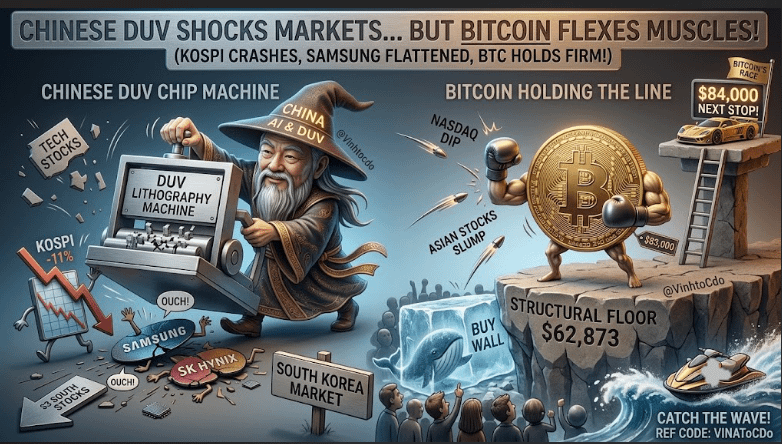
The South Korean Kospi plunged -11% today, the worst day in years, after China threatened to restrict exports of DUV equipment (deep ultraviolet lithography) used to make advanced chips. Samsung and SK Hynix led the losses, and leveraged ETFs tied to those stocks sparked volatility to levels not seen since 2021.
Why does this matter for crypto? Because the correlation between the Kospi and the Nasdaq 100 is at its highest point since 2021, and South Korean retail is one of the largest net buyers of U.S. stocks and crypto (they bought $5 trillion worth of won in U.S. equities just in this session). When Korea shakes, global risk appetite contracts.
But here’s the interesting part: Bitcoin hit 62.7K during the Asian session, swept liquidity below previous lows (PDL and PWL), and bounced back to 63.7K. While the Kospi collapsed, BTC found buyers in a liquidity zone. That doesn’t mean a reversal (the multi-timeframe bias remains bearish), but it does suggest price is reacting to structure, not just macro panic.
Now there’s a debate in South Korea’s Congress about state compensation for losses in leveraged ETFs. If that moves forward, it could set a dangerous precedent (moral hazard) but also bring short-term relief.
Do you think Korea’s collapse is an isolated event or the start of something bigger? Share your take in the comments.
#KospiCrashes11%OnChinaDUVChipThreat
The South Korean Kospi plunged -11% today, the worst day in years, after China threatened to restrict exports of DUV equipment (deep ultraviolet lithography) used to make advanced chips. Samsung and SK Hynix led the losses, and leveraged ETFs tied to those stocks sparked volatility to levels not seen since 2021.
Why does this matter for crypto? Because the correlation between the Kospi and the Nasdaq 100 is at its highest point since 2021, and South Korean retail is one of the largest net buyers of U.S. stocks and crypto (they bought $5 trillion worth of won in U.S. equities just in this session). When Korea shakes, global risk appetite contracts.
But here’s the interesting part: Bitcoin hit 62.7K during the Asian session, swept liquidity below previous lows (PDL and PWL), and bounced back to 63.7K. While the Kospi collapsed, BTC found buyers in a liquidity zone. That doesn’t mean a reversal (the multi-timeframe bias remains bearish), but it does suggest price is reacting to structure, not just macro panic.
Now there’s a debate in South Korea’s Congress about state compensation for losses in leveraged ETFs. If that moves forward, it could set a dangerous precedent (moral hazard) but also bring short-term relief.
Do you think Korea’s collapse is an isolated event or the start of something bigger? Share your take in the comments.
#KospiCrashes11%OnChinaDUVChipThreat
Why does this matter for crypto? Because the correlation between the Kospi and the Nasdaq 100 is at its highest point since 2021, and South Korean retail is one of the largest net buyers of U.S. stocks and crypto (they bought $5 trillion worth of won in U.S. equities just in this session). When Korea shakes, global risk appetite contracts.
But here’s the interesting part: Bitcoin hit 62.7K during the Asian session, swept liquidity below previous lows (PDL and PWL), and bounced back to 63.7K. While the Kospi collapsed, BTC found buyers in a liquidity zone. That doesn’t mean a reversal (the multi-timeframe bias remains bearish), but it does suggest price is reacting to structure, not just macro panic.
Now there’s a debate in South Korea’s Congress about state compensation for losses in leveraged ETFs. If that moves forward, it could set a dangerous precedent (moral hazard) but also bring short-term relief.
Do you think Korea’s collapse is an isolated event or the start of something bigger? Share your take in the comments.
#KospiCrashes11%OnChinaDUVChipThreat
64

·
--
Picture this: Korean equities get hit hard, the Kospi drops 11%, and suddenly crypto traders are watching Seoul like it’s the next macro domino.
The pain is familiar: you think you’re trading $BTC or $ETH, but then a regional stock market shock moves risk appetite before your chart even gives a clean signal. In fear-driven markets, exits feel late and entries feel like traps.
Here’s the case study. Korea isn’t just “another stock market” for crypto. It’s a high-retail-participation market, deeply tied to semiconductors, leverage, and fast sentiment shifts. When Kospi volatility spikes, it can spill into crypto because the same traders often rotate between tech stocks, leveraged products, and digital assets.
We’ve seen versions of this before. In 2021, China property stress rattled risk assets before crypto found its own footing. In 2022, yen and Treasury yield shocks changed the mood across every high-beta trade. Today’s difference is that stablecoin behavior matters more: when fear rises, traders often park in $USDT first, then decide whether the dip is opportunity or warning.
The lesson isn’t “Korea crashed, sell everything.” It’s that local market stress can become global liquidity stress faster than people expect, especially with Fear & Greed sitting in fear territory. The cleanest traders aren’t guessing the bottom; they’re watching whether $BTC holds structure while equities, yields, and stablecoin flows calm down.
Is this just a regional scare, or the first sign of broader risk-off pressure? #KospiCrashes11 #BitcoinRecoversFromAsianSessionLows #USTreasuryYieldsRetreat
Picture this: Korean equities get hit hard, the Kospi drops 11%, and suddenly crypto traders are watching Seoul like it’s the next macro domino.
The pain is familiar: you think you’re trading $BTC or $ETH , but then a regional stock market shock moves risk appetite before your chart even gives a clean signal. In fear-driven markets, exits feel late and entries feel like traps.
Here’s the case study. Korea isn’t just “another stock market” for crypto. It’s a high-retail-participation market, deeply tied to semiconductors, leverage, and fast sentiment shifts. When Kospi volatility spikes, it can spill into crypto because the same traders often rotate between tech stocks, leveraged products, and digital assets.
We’ve seen versions of this before. In 2021, China property stress rattled risk assets before crypto found its own footing. In 2022, yen and Treasury yield shocks changed the mood across every high-beta trade. Today’s difference is that stablecoin behavior matters more: when fear rises, traders often park in $USDT first, then decide whether the dip is opportunity or warning.
The lesson isn’t “Korea crashed, sell everything.” It’s that local market stress can become global liquidity stress faster than people expect, especially with Fear & Greed sitting in fear territory. The cleanest traders aren’t guessing the bottom; they’re watching whether $BTC holds structure while equities, yields, and stablecoin flows calm down.
Is this just a regional scare, or the first sign of broader risk-off pressure? #KospiCrashes11 #BitcoinRecoversFromAsianSessionLows #USTreasuryYieldsRetreat
The pain is familiar: you think you’re trading $BTC or $ETH , but then a regional stock market shock moves risk appetite before your chart even gives a clean signal. In fear-driven markets, exits feel late and entries feel like traps.
Here’s the case study. Korea isn’t just “another stock market” for crypto. It’s a high-retail-participation market, deeply tied to semiconductors, leverage, and fast sentiment shifts. When Kospi volatility spikes, it can spill into crypto because the same traders often rotate between tech stocks, leveraged products, and digital assets.
We’ve seen versions of this before. In 2021, China property stress rattled risk assets before crypto found its own footing. In 2022, yen and Treasury yield shocks changed the mood across every high-beta trade. Today’s difference is that stablecoin behavior matters more: when fear rises, traders often park in $USDT first, then decide whether the dip is opportunity or warning.
The lesson isn’t “Korea crashed, sell everything.” It’s that local market stress can become global liquidity stress faster than people expect, especially with Fear & Greed sitting in fear territory. The cleanest traders aren’t guessing the bottom; they’re watching whether $BTC holds structure while equities, yields, and stablecoin flows calm down.
Is this just a regional scare, or the first sign of broader risk-off pressure? #KospiCrashes11 #BitcoinRecoversFromAsianSessionLows #USTreasuryYieldsRetreat

26
·
--
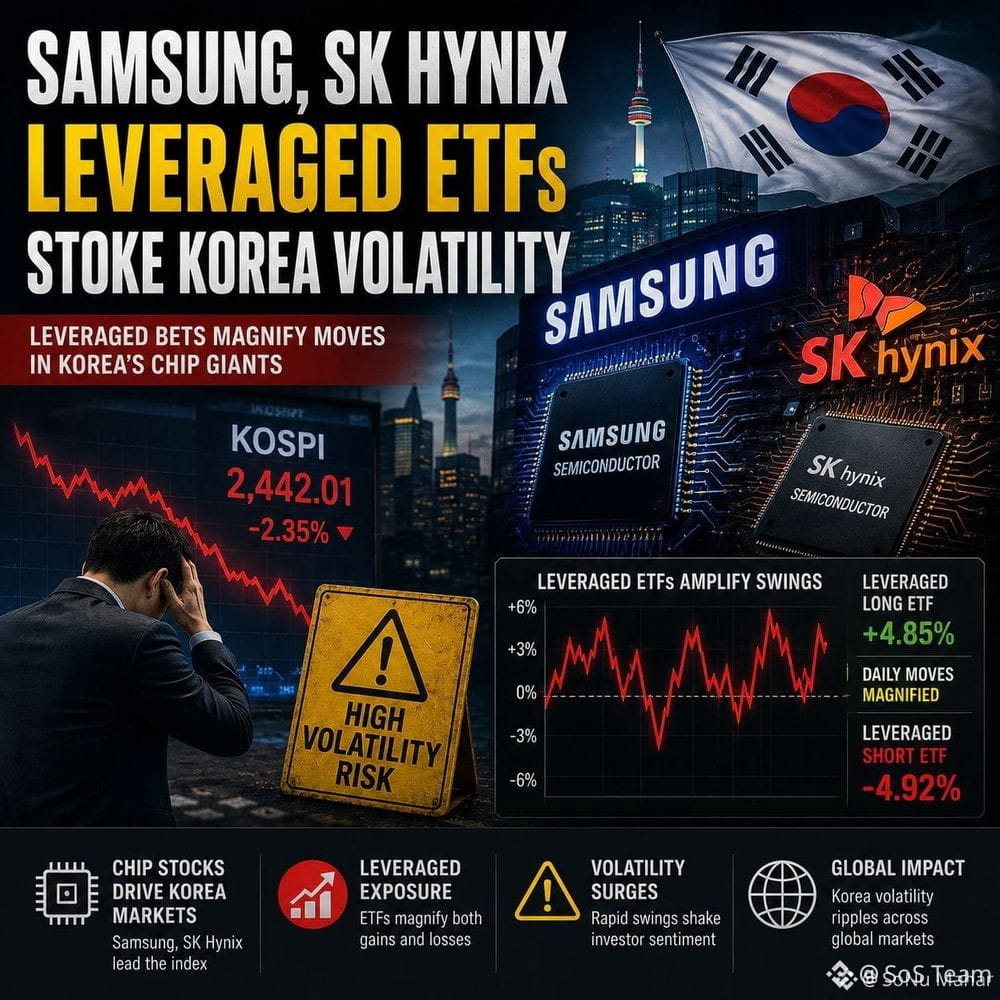
Here’s what happened when retail flows piled into leveraged Samsung and SK Hynix ETFs just as Korea’s chip trade became the market’s favorite momentum story.
The pain point is familiar in crypto: traders see a clean narrative, buy the acceleration, then realize too late that leverage can turn a normal pullback into forced selling. It’s the same trap people hit chasing $ETH breakouts or parking in $USDT after the damage is already done.
The case study is Korea’s equity volatility. Samsung and SK Hynix have been riding the AI semiconductor wave, but leveraged ETF demand added a second layer of risk. These products don’t just “track the theme.” They rebalance, amplify intraday moves, and can make crowded trades more fragile when sentiment flips.
What most people missed is the cross-market signal. When a major equity index like the Kospi gets hit by leveraged chip exposure, it tells you risk appetite is thinner than headlines suggest. With Fear & Greed sitting in fear territory, crypto traders should be careful assuming $BTC or $ETH strength is isolated from broader de-risking.
The lesson isn’t that chips are bad or leverage is always wrong. It’s that crowded narratives become dangerous when everyone is using the same vehicle to express the same trade. If Korea’s volatility keeps spilling over, crypto may not ignore it for long.
Anyone else watching whether this turns into a broader risk-off signal? #SamsungSKHynixLeveragedETFsStokeKoreaVolatility #KospiCrashes11 #BitcoinRecoversFromAsianSessionLows
Here’s what happened when retail flows piled into leveraged Samsung and SK Hynix ETFs just as Korea’s chip trade became the market’s favorite momentum story.
The pain point is familiar in crypto: traders see a clean narrative, buy the acceleration, then realize too late that leverage can turn a normal pullback into forced selling. It’s the same trap people hit chasing $ETH breakouts or parking in $USDT after the damage is already done.
The case study is Korea’s equity volatility. Samsung and SK Hynix have been riding the AI semiconductor wave, but leveraged ETF demand added a second layer of risk. These products don’t just “track the theme.” They rebalance, amplify intraday moves, and can make crowded trades more fragile when sentiment flips.
What most people missed is the cross-market signal. When a major equity index like the Kospi gets hit by leveraged chip exposure, it tells you risk appetite is thinner than headlines suggest. With Fear & Greed sitting in fear territory, crypto traders should be careful assuming $BTC or $ETH strength is isolated from broader de-risking.
The lesson isn’t that chips are bad or leverage is always wrong. It’s that crowded narratives become dangerous when everyone is using the same vehicle to express the same trade. If Korea’s volatility keeps spilling over, crypto may not ignore it for long.
Anyone else watching whether this turns into a broader risk-off signal? #SamsungSKHynixLeveragedETFsStokeKoreaVolatility #KospiCrashes11 #BitcoinRecoversFromAsianSessionLows
The pain point is familiar in crypto: traders see a clean narrative, buy the acceleration, then realize too late that leverage can turn a normal pullback into forced selling. It’s the same trap people hit chasing $ETH breakouts or parking in $USDT after the damage is already done.
The case study is Korea’s equity volatility. Samsung and SK Hynix have been riding the AI semiconductor wave, but leveraged ETF demand added a second layer of risk. These products don’t just “track the theme.” They rebalance, amplify intraday moves, and can make crowded trades more fragile when sentiment flips.
What most people missed is the cross-market signal. When a major equity index like the Kospi gets hit by leveraged chip exposure, it tells you risk appetite is thinner than headlines suggest. With Fear & Greed sitting in fear territory, crypto traders should be careful assuming $BTC or $ETH strength is isolated from broader de-risking.
The lesson isn’t that chips are bad or leverage is always wrong. It’s that crowded narratives become dangerous when everyone is using the same vehicle to express the same trade. If Korea’s volatility keeps spilling over, crypto may not ignore it for long.
Anyone else watching whether this turns into a broader risk-off signal? #SamsungSKHynixLeveragedETFsStokeKoreaVolatility #KospiCrashes11 #BitcoinRecoversFromAsianSessionLows
1
79

#KospiCrashes11%OnChinaDUVChipThreat
🚨 BREAKING: MAJOR GLOBAL MARKET SHOCKWAVE 🚨
The South Korean KOSPI Index has CRASHED 11% TODAY, sparking global panic. Trillions wiped out in minutes! 📉
The cause? A new, major DUV Chip Threat from China that has targeted South Korea’s tech giants, Samsung and SK Hynix.
If you have tech or semiconductor stocks, you need to pay attention.$BTC
What you need to know NOW:
⚠️ China Breakthrough: Reported progress in Chinese semiconductor tools is direct competition for South Korea.$BNB
⚡ Korean Giants Fall: Samsung and SK Hynix stock are plunging.
🌍 Global Supply Chain Crisis: This shifts everything in the global chip war.$ETH
Are we looking at the start of a broader tech collapse? 👇 Drop your predictions below!
#KospiCrashes11 #Semiconductors #CryptoNews #GlobalEconomy
#KospiCrashes11%OnChinaDUVChipThreat
🚨 BREAKING: MAJOR GLOBAL MARKET SHOCKWAVE 🚨
The South Korean KOSPI Index has CRASHED 11% TODAY, sparking global panic. Trillions wiped out in minutes! 📉
The cause? A new, major DUV Chip Threat from China that has targeted South Korea’s tech giants, Samsung and SK Hynix.
If you have tech or semiconductor stocks, you need to pay attention.$BTC
What you need to know NOW:
⚠️ China Breakthrough: Reported progress in Chinese semiconductor tools is direct competition for South Korea.$BNB
⚡ Korean Giants Fall: Samsung and SK Hynix stock are plunging.
🌍 Global Supply Chain Crisis: This shifts everything in the global chip war.$ETH
Are we looking at the start of a broader tech collapse? 👇 Drop your predictions below!
#KospiCrashes11 #Semiconductors #CryptoNews #GlobalEconomy
🚨 BREAKING: MAJOR GLOBAL MARKET SHOCKWAVE 🚨
The South Korean KOSPI Index has CRASHED 11% TODAY, sparking global panic. Trillions wiped out in minutes! 📉
The cause? A new, major DUV Chip Threat from China that has targeted South Korea’s tech giants, Samsung and SK Hynix.
If you have tech or semiconductor stocks, you need to pay attention.$BTC
What you need to know NOW:
⚠️ China Breakthrough: Reported progress in Chinese semiconductor tools is direct competition for South Korea.$BNB
⚡ Korean Giants Fall: Samsung and SK Hynix stock are plunging.
🌍 Global Supply Chain Crisis: This shifts everything in the global chip war.$ETH
Are we looking at the start of a broader tech collapse? 👇 Drop your predictions below!
#KospiCrashes11 #Semiconductors #CryptoNews #GlobalEconomy
1
3
119

$XRP keeps breaking lower.
Selling pressure builds.
Another push lower looks likely.
Follow for more market updates.
#KospiCrashes11%OnChinaDUVChipThreat #USTreasuryYieldsRetreat #VisaToCut2600JobsExpandStablecoins
$XRP keeps breaking lower.
Selling pressure builds.
Another push lower looks likely.
Follow for more market updates.
#KospiCrashes11%OnChinaDUVChipThreat #USTreasuryYieldsRetreat #VisaToCut2600JobsExpandStablecoins
Selling pressure builds.
Another push lower looks likely.
Follow for more market updates.
#KospiCrashes11%OnChinaDUVChipThreat #USTreasuryYieldsRetreat #VisaToCut2600JobsExpandStablecoins

1
1
65

🚨 The #KospiCrashes11%OnChinaDUVChipThreat is a wake-up call! As global tensions rise, crypto thrives amid chaos. Look at #COTI surging 65%! Are we witnessing a shift where digital assets become a safe haven? What’s your take on this volatility? 💹💥 #COTI
🚨 The #KospiCrashes11%OnChinaDUVChipThreat is a wake-up call! As global tensions rise, crypto thrives amid chaos. Look at #COTI surging 65%! Are we witnessing a shift where digital assets become a safe haven? What’s your take on this volatility? 💹💥 #COTI

55
Log in to explore more content
Join global crypto users on Binance Square
⚡️ Get latest and useful information about crypto.
💬 Trusted by the world’s largest crypto exchange.
👍 Discover real insights from verified creators.
Email / Phone number
Trending Topics
1
#BinancePick
2.7M views
144,206 Discussing
2
#EarningsSeason
5M views
24,749 Discussing
3
#SouthKoreaReportedlyWeighsFourthCryptoTaxDelay
3,523 views
149 Discussing
4
#FranklinTempletonFilesForTwoDividendToBitcoinETFs
8,801 views
266 Discussing
5
#StrategyMSTRSurpassesNasdaqInMarketCap
8,399 views
224 Discussing
6
#CanadaProposesStablecoinRedemptionWithin3BusinessDays
285 views
20 Discussing
7
#ElectrumWalletBugLetRogueServersStealFunds
13,786 views
346 Discussing
8
#ArgentineCourtDismissesLIBRACaseAgainstMilei
23,973 views
409 Discussing
9
#SKHynixReportedlyPlansSpecialDividendFromKioxiaStakeSale
3,638 views
49 Discussing
10
#KeystoneWebsiteBreachExposesBuyersShippingAddresses
1,864 views
41 Discussing