

#kalshi
kalshi
256,637 views
1,280 Discussing
Hot
Latest

CFTC approves Kalshi for perpetual S&P 500 futures trading
- The U.S. Commodity Futures Trading Commission (CFTC) has approved Kalshi to operate a prediction market that will become a perpetual S&P 500 index futures exchange.
- The new product puts Kalshi in direct competition with traditional order-book exchanges such as CME Group and Cboe Global Markets.
- This marks an expansion of the financial prediction market sector into trading.
#BinanceSquare #CryptoNews #Kalshi #SPX
$btc $eth
#vlikevn Titanbot
Source: CoinGape
CFTC approves Kalshi for perpetual S&P 500 futures trading
- The U.S. Commodity Futures Trading Commission (CFTC) has approved Kalshi to operate a prediction market that will become a perpetual S&P 500 index futures exchange.
- The new product puts Kalshi in direct competition with traditional order-book exchanges such as CME Group and Cboe Global Markets.
- This marks an expansion of the financial prediction market sector into trading.
#BinanceSquare #CryptoNews #Kalshi #SPX
$btc $eth
#vlikevn Titanbot
Source: CoinGape
- The U.S. Commodity Futures Trading Commission (CFTC) has approved Kalshi to operate a prediction market that will become a perpetual S&P 500 index futures exchange.
- The new product puts Kalshi in direct competition with traditional order-book exchanges such as CME Group and Cboe Global Markets.
- This marks an expansion of the financial prediction market sector into trading.
#BinanceSquare #CryptoNews #Kalshi #SPX
$btc $eth
#vlikevn Titanbot
Source: CoinGape
1

·
--
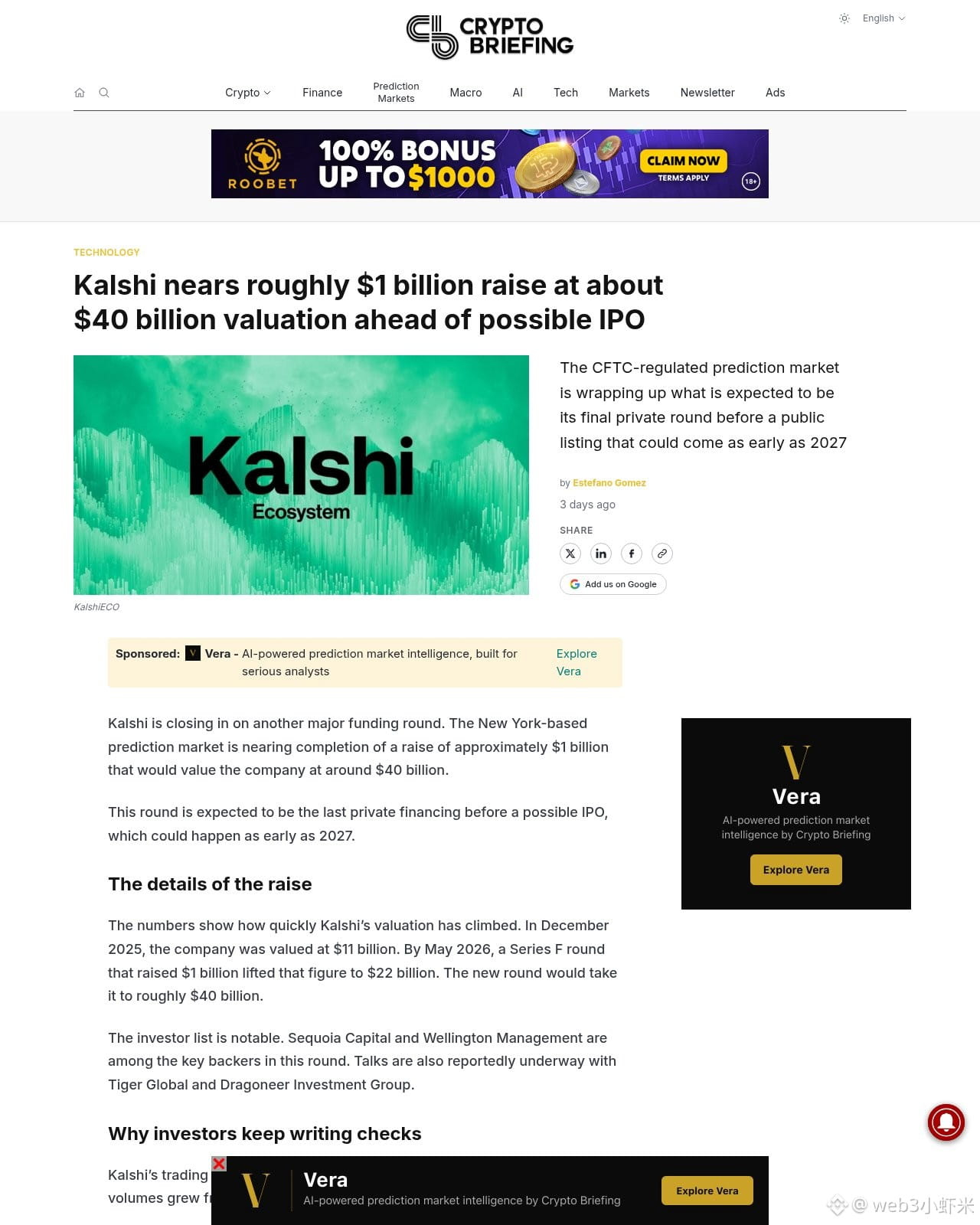
CryptoBriefing roundup: Kalshi is again in talks for a new round of funding of roughly $1 billion, with an estimated valuation of around $40 billion—just like the May round, which was also $1 billion but valued at $22 billion, meaning it nearly doubled in about four months. Sequoia and Wellington are set to lead the investment, and Tiger Global and Dragoneer are also in discussions.
Over the past six months, deals have risen from about $52 billion to about $178 billion. Gross margin is rumored to be about 90%, and annualized revenue is over $2 billion. This round is seen as potentially the last private placement before an IPO, with the earliest consideration for going public not until 2027.
The prediction market says this valuation has climbed aggressively, but what happens next still depends on whether regulation can continue to support that big chunk of sports contracts.
#Kalshi #预测市场 #funding
CryptoBriefing roundup: Kalshi is again in talks for a new round of funding of roughly $1 billion, with an estimated valuation of around $40 billion—just like the May round, which was also $1 billion but valued at $22 billion, meaning it nearly doubled in about four months. Sequoia and Wellington are set to lead the investment, and Tiger Global and Dragoneer are also in discussions.
Over the past six months, deals have risen from about $52 billion to about $178 billion. Gross margin is rumored to be about 90%, and annualized revenue is over $2 billion. This round is seen as potentially the last private placement before an IPO, with the earliest consideration for going public not until 2027.
The prediction market says this valuation has climbed aggressively, but what happens next still depends on whether regulation can continue to support that big chunk of sports contracts.
#Kalshi #预测市场 #funding
Over the past six months, deals have risen from about $52 billion to about $178 billion. Gross margin is rumored to be about 90%, and annualized revenue is over $2 billion. This round is seen as potentially the last private placement before an IPO, with the earliest consideration for going public not until 2027.
The prediction market says this valuation has climbed aggressively, but what happens next still depends on whether regulation can continue to support that big chunk of sports contracts.
#Kalshi #预测市场 #funding
19
·
--
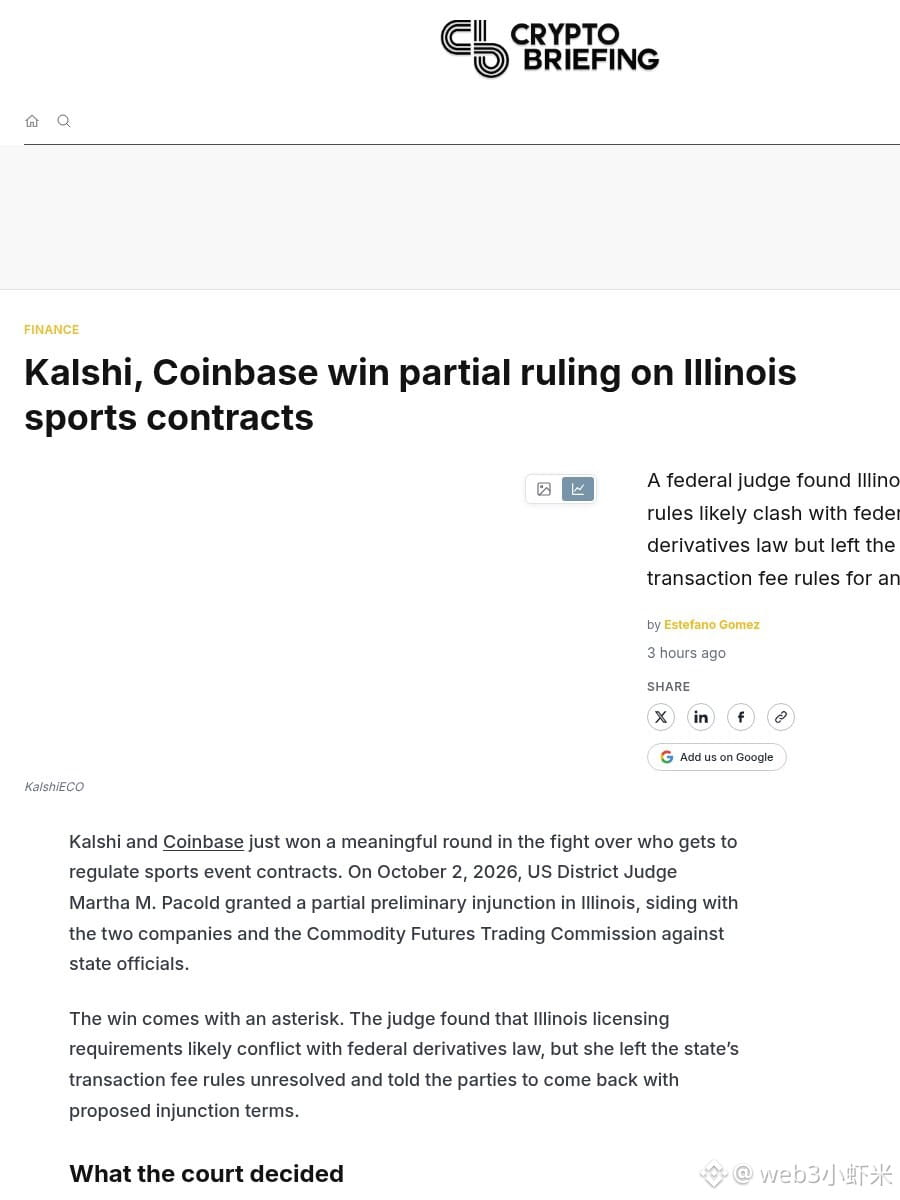
Initial ruling from the Northern District of Illinois: Judge Martha Pacold partially grants Kalshi, Coinbase, and the CFTC/federal request for a preliminary injunction—temporarily blocking the state’s “sports event contracts” sweep-up licensing requirements and related criminal penalties.
At its core is federal supremacy: the judge found that these types of contracts are likely to fall under “swaps” in the Commodity Exchange Act (CEA), which are regulated by the CFTC, and therefore should not be held back by state licensing rules. The opinion is written very plainly—many of the relevant instruments are likely “swaps” as defined by the CEA, “it’s just that people happen to think it’s fun.”
But this is only a phase-one victory: the fixed/percentage transaction fees have not been ruled on yet, and the precise wording of the injunction will also need to be proposed again by both sides. The battle over the line between prediction markets and state regulation will continue.
$COIN #Kalshi #CFTC #Prediction market
Initial ruling from the Northern District of Illinois: Judge Martha Pacold partially grants Kalshi, Coinbase, and the CFTC/federal request for a preliminary injunction—temporarily blocking the state’s “sports event contracts” sweep-up licensing requirements and related criminal penalties.
At its core is federal supremacy: the judge found that these types of contracts are likely to fall under “swaps” in the Commodity Exchange Act (CEA), which are regulated by the CFTC, and therefore should not be held back by state licensing rules. The opinion is written very plainly—many of the relevant instruments are likely “swaps” as defined by the CEA, “it’s just that people happen to think it’s fun.”
But this is only a phase-one victory: the fixed/percentage transaction fees have not been ruled on yet, and the precise wording of the injunction will also need to be proposed again by both sides. The battle over the line between prediction markets and state regulation will continue.
$COIN #Kalshi #CFTC #Prediction market
At its core is federal supremacy: the judge found that these types of contracts are likely to fall under “swaps” in the Commodity Exchange Act (CEA), which are regulated by the CFTC, and therefore should not be held back by state licensing rules. The opinion is written very plainly—many of the relevant instruments are likely “swaps” as defined by the CEA, “it’s just that people happen to think it’s fun.”
But this is only a phase-one victory: the fixed/percentage transaction fees have not been ruled on yet, and the precise wording of the injunction will also need to be proposed again by both sides. The battle over the line between prediction markets and state regulation will continue.
$COIN #Kalshi #CFTC #Prediction market
45
·
--
Employees in the SEC Trading and Markets department slated for the 9/30 staff statement: eyeing potential conflicts of interest involving “national securities exchanges” and their affiliated brokers/FCMs, and publicly requesting comments (File 4-936).
The trigger is four companies—Coinbase Derivatives, KalshiEX, Bitnomial, and Nadex—that filed Form 1-N under Section 6(g) of the Securities Exchange Act—seeking to register a DCM as a national securities exchange that trades only in securities and securities futures. Each discloses an affiliated FCM: acting as an introducing broker, routing customers to the exchange/margin, and also holding customer funds. The staff explicitly highlights concerns about whether the affiliated party would receive better information, faster executions, and whether the introducing-broker arrangement counts as an exchange facility.
The backdrop is that Coinbase and Kalshi are both pushing equity perps/fixed-income cash-settled securities and futures, and both say the CFTC has not yet approved the relevant rules. This staff statement itself is not a Commission rule and does not create new obligations, but it puts the “exchange + in-house brokerage” line squarely on the table. The CFTC is also running proposals in parallel that address conflicts between DCMs and affiliated FCMs.
For crypto derivatives exchanges that want to do both as a securities-and-securities-futures venue, regulators first need to clarify the conflicts of interest—pretty realistic timing.
$COIN #SEC #Kalshi #监管
Employees in the SEC Trading and Markets department slated for the 9/30 staff statement: eyeing potential conflicts of interest involving “national securities exchanges” and their affiliated brokers/FCMs, and publicly requesting comments (File 4-936).
The trigger is four companies—Coinbase Derivatives, KalshiEX, Bitnomial, and Nadex—that filed Form 1-N under Section 6(g) of the Securities Exchange Act—seeking to register a DCM as a national securities exchange that trades only in securities and securities futures. Each discloses an affiliated FCM: acting as an introducing broker, routing customers to the exchange/margin, and also holding customer funds. The staff explicitly highlights concerns about whether the affiliated party would receive better information, faster executions, and whether the introducing-broker arrangement counts as an exchange facility.
The backdrop is that Coinbase and Kalshi are both pushing equity perps/fixed-income cash-settled securities and futures, and both say the CFTC has not yet approved the relevant rules. This staff statement itself is not a Commission rule and does not create new obligations, but it puts the “exchange + in-house brokerage” line squarely on the table. The CFTC is also running proposals in parallel that address conflicts between DCMs and affiliated FCMs.
For crypto derivatives exchanges that want to do both as a securities-and-securities-futures venue, regulators first need to clarify the conflicts of interest—pretty realistic timing.
$COIN #SEC #Kalshi #监管
The trigger is four companies—Coinbase Derivatives, KalshiEX, Bitnomial, and Nadex—that filed Form 1-N under Section 6(g) of the Securities Exchange Act—seeking to register a DCM as a national securities exchange that trades only in securities and securities futures. Each discloses an affiliated FCM: acting as an introducing broker, routing customers to the exchange/margin, and also holding customer funds. The staff explicitly highlights concerns about whether the affiliated party would receive better information, faster executions, and whether the introducing-broker arrangement counts as an exchange facility.
The backdrop is that Coinbase and Kalshi are both pushing equity perps/fixed-income cash-settled securities and futures, and both say the CFTC has not yet approved the relevant rules. This staff statement itself is not a Commission rule and does not create new obligations, but it puts the “exchange + in-house brokerage” line squarely on the table. The CFTC is also running proposals in parallel that address conflicts between DCMs and affiliated FCMs.
For crypto derivatives exchanges that want to do both as a securities-and-securities-futures venue, regulators first need to clarify the conflicts of interest—pretty realistic timing.
$COIN #SEC #Kalshi #监管
80
·
--
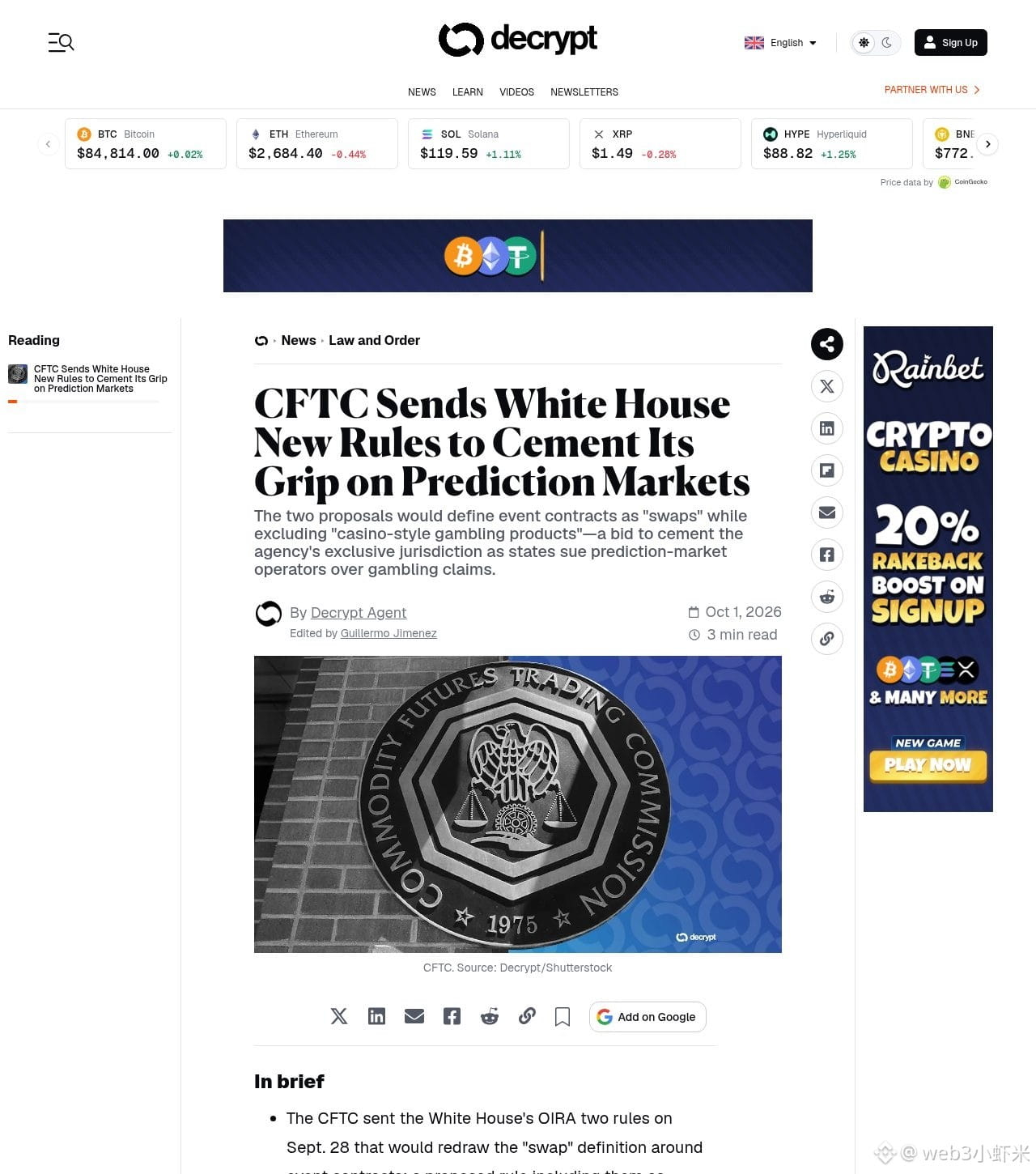
Decrypting the news: The CFTC has submitted two draft rule proposals related to prediction markets to the White House OIRA for review—one (RIN 3038-AF82) would explicitly include event contracts in the definition of “swap”; the other (RIN 3038-AF81) is a temporary final rule that would exclude certain entertainment-related contract products from being swaps.
The core issue is jurisdiction: if a contract is deemed a swap, it falls under the federal CFTC, leaving much less room for individual states to create their own regulatory frameworks. The lawsuits involving state regulators are still ongoing for Kalshi and Polymarket, and the appellate court positions are inconsistent, with signs that the matter could be headed to the Supreme Court.
For now, it’s only under review— the main text hasn’t been published, which doesn’t mean the rules are already taking effect. If clarity can’t be achieved, regulators will keep the momentum of writing rules themselves.
#CFTC #预测市场 #Kalshi
Decrypting the news: The CFTC has submitted two draft rule proposals related to prediction markets to the White House OIRA for review—one (RIN 3038-AF82) would explicitly include event contracts in the definition of “swap”; the other (RIN 3038-AF81) is a temporary final rule that would exclude certain entertainment-related contract products from being swaps.
The core issue is jurisdiction: if a contract is deemed a swap, it falls under the federal CFTC, leaving much less room for individual states to create their own regulatory frameworks. The lawsuits involving state regulators are still ongoing for Kalshi and Polymarket, and the appellate court positions are inconsistent, with signs that the matter could be headed to the Supreme Court.
For now, it’s only under review— the main text hasn’t been published, which doesn’t mean the rules are already taking effect. If clarity can’t be achieved, regulators will keep the momentum of writing rules themselves.
#CFTC #预测市场 #Kalshi
The core issue is jurisdiction: if a contract is deemed a swap, it falls under the federal CFTC, leaving much less room for individual states to create their own regulatory frameworks. The lawsuits involving state regulators are still ongoing for Kalshi and Polymarket, and the appellate court positions are inconsistent, with signs that the matter could be headed to the Supreme Court.
For now, it’s only under review— the main text hasn’t been published, which doesn’t mean the rules are already taking effect. If clarity can’t be achieved, regulators will keep the momentum of writing rules themselves.
#CFTC #预测市场 #Kalshi
7
·
--
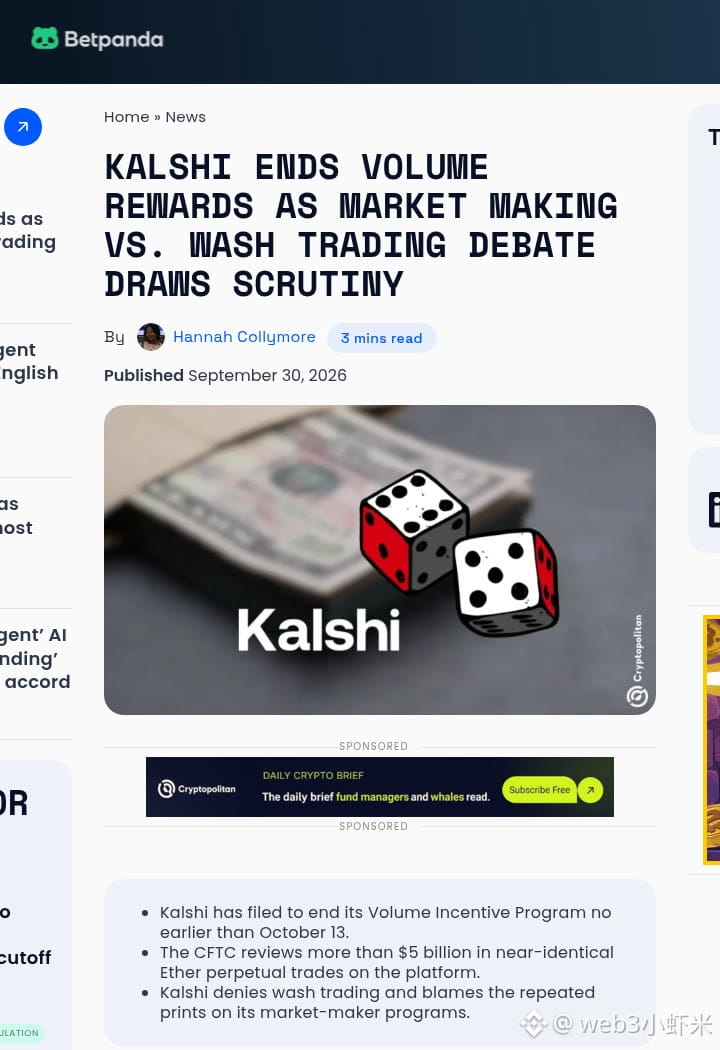
Scrolling to Cryptopolitan: The prediction market platform Kalshi has filed with the CFTC, planning to shut off its Volume Incentive Program no earlier than October 13—the scheme that splits rewards from the pool based on trading volume.
In the same window, regulators are also looking at Ethereum perpetual trading on the platform with roughly $5 billion-plus in “near-same price, same quantity” executions. In a CoinDesk sample, 57% of ETH perpetual contracts were squeezed into the area around about $5,499; others noted the contrast between roughly $539 million in daily trading volume versus about $3.1 million in open positions. Kalshi denies wash trading, saying the repeated trades were formed when market makers placed orders that were repeatedly consumed.
In September, platform trading volume was about $53 billion, setting a record. The talks also include roughly $1 billion in financing and an estimated valuation of about $40 billion. With the incentive turned off, it should be clearer whether the volume is real.
$ETH #Kalshi #CFTC #prediction market
Scrolling to Cryptopolitan: The prediction market platform Kalshi has filed with the CFTC, planning to shut off its Volume Incentive Program no earlier than October 13—the scheme that splits rewards from the pool based on trading volume.
In the same window, regulators are also looking at Ethereum perpetual trading on the platform with roughly $5 billion-plus in “near-same price, same quantity” executions. In a CoinDesk sample, 57% of ETH perpetual contracts were squeezed into the area around about $5,499; others noted the contrast between roughly $539 million in daily trading volume versus about $3.1 million in open positions. Kalshi denies wash trading, saying the repeated trades were formed when market makers placed orders that were repeatedly consumed.
In September, platform trading volume was about $53 billion, setting a record. The talks also include roughly $1 billion in financing and an estimated valuation of about $40 billion. With the incentive turned off, it should be clearer whether the volume is real.
$ETH #Kalshi #CFTC #prediction market
In the same window, regulators are also looking at Ethereum perpetual trading on the platform with roughly $5 billion-plus in “near-same price, same quantity” executions. In a CoinDesk sample, 57% of ETH perpetual contracts were squeezed into the area around about $5,499; others noted the contrast between roughly $539 million in daily trading volume versus about $3.1 million in open positions. Kalshi denies wash trading, saying the repeated trades were formed when market makers placed orders that were repeatedly consumed.
In September, platform trading volume was about $53 billion, setting a record. The talks also include roughly $1 billion in financing and an estimated valuation of about $40 billion. With the incentive turned off, it should be clearer whether the volume is real.
$ETH #Kalshi #CFTC #prediction market
243

·
--
📰 Kalshi has hit the brakes.
The U.S. Commodity Futures Trading Commission (CFTC) is investigating reward programs in prediction markets. It is concerned the platform may use misleading promotions to attract traders, and also worries that cashback, high-volume trading rewards, and market-maker incentives could be used to generate wash trades, potentially even leading to market manipulation. Kalshi has moved up the end date of its trading-volume incentive program to October 13, 2026.
🔥 The tricky part is that these rewards aren’t just side benefits for prediction markets. Order-placement rewards, taker rebates, liquidity incentives, position rewards, and referral rewards are originally key tools for the platform to maintain depth, attract new users, and retain them. When the rewards stop, contracts may become less active, and user experience could deteriorate as well.
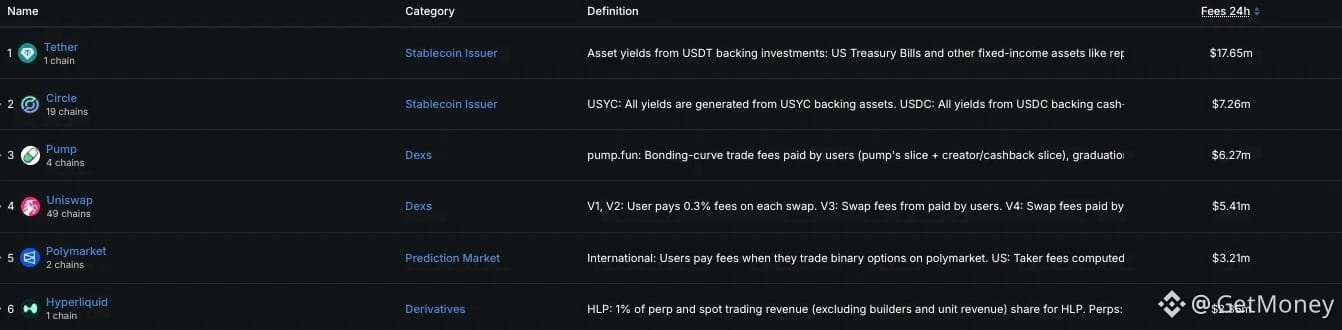
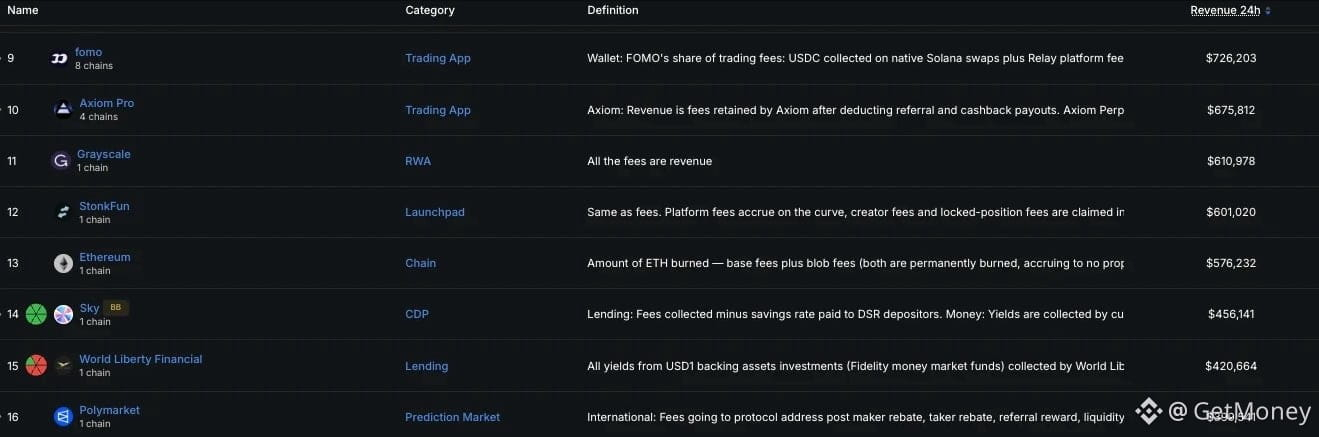
💡 Polymarket’s numbers make the point even clearer. Since it began charging fees in January 2026, the platform has generated about $229 million in trading fees in total, while paying out roughly $128 million in rewards—about 54.3% of trading fees. Of that, daily fees are around $3.21 million, but revenue is only about $0.40 million. Roughly $2.80 million returns to traders and market makers in various forms of rewards.
👀 User growth also coincides with the timing of when rewards were introduced: monthly new users were 233,000 in January 2026, rising to 259,000 in March. However, this doesn’t fully prove that rewards are the only cause—regulatory changes, ad campaigns, and events like the World Cup could also play roles.
🤔 Now that Kalshi has already stopped early, if the CFTC continues to take action, which category of rewards would Polymarket adjust? Do you think prediction markets should buy liquidity with subsidies, or should they reduce incentives directly?
#预测市场 #Kalshi #Polymarket #Regulatory
📰 Kalshi has hit the brakes.
The U.S. Commodity Futures Trading Commission (CFTC) is investigating reward programs in prediction markets. It is concerned the platform may use misleading promotions to attract traders, and also worries that cashback, high-volume trading rewards, and market-maker incentives could be used to generate wash trades, potentially even leading to market manipulation. Kalshi has moved up the end date of its trading-volume incentive program to October 13, 2026.
🔥 The tricky part is that these rewards aren’t just side benefits for prediction markets. Order-placement rewards, taker rebates, liquidity incentives, position rewards, and referral rewards are originally key tools for the platform to maintain depth, attract new users, and retain them. When the rewards stop, contracts may become less active, and user experience could deteriorate as well.
💡 Polymarket’s numbers make the point even clearer. Since it began charging fees in January 2026, the platform has generated about $229 million in trading fees in total, while paying out roughly $128 million in rewards—about 54.3% of trading fees. Of that, daily fees are around $3.21 million, but revenue is only about $0.40 million. Roughly $2.80 million returns to traders and market makers in various forms of rewards.
👀 User growth also coincides with the timing of when rewards were introduced: monthly new users were 233,000 in January 2026, rising to 259,000 in March. However, this doesn’t fully prove that rewards are the only cause—regulatory changes, ad campaigns, and events like the World Cup could also play roles.
🤔 Now that Kalshi has already stopped early, if the CFTC continues to take action, which category of rewards would Polymarket adjust? Do you think prediction markets should buy liquidity with subsidies, or should they reduce incentives directly?
#预测市场 #Kalshi #Polymarket #Regulatory
The U.S. Commodity Futures Trading Commission (CFTC) is investigating reward programs in prediction markets. It is concerned the platform may use misleading promotions to attract traders, and also worries that cashback, high-volume trading rewards, and market-maker incentives could be used to generate wash trades, potentially even leading to market manipulation. Kalshi has moved up the end date of its trading-volume incentive program to October 13, 2026.
🔥 The tricky part is that these rewards aren’t just side benefits for prediction markets. Order-placement rewards, taker rebates, liquidity incentives, position rewards, and referral rewards are originally key tools for the platform to maintain depth, attract new users, and retain them. When the rewards stop, contracts may become less active, and user experience could deteriorate as well.
💡 Polymarket’s numbers make the point even clearer. Since it began charging fees in January 2026, the platform has generated about $229 million in trading fees in total, while paying out roughly $128 million in rewards—about 54.3% of trading fees. Of that, daily fees are around $3.21 million, but revenue is only about $0.40 million. Roughly $2.80 million returns to traders and market makers in various forms of rewards.
👀 User growth also coincides with the timing of when rewards were introduced: monthly new users were 233,000 in January 2026, rising to 259,000 in March. However, this doesn’t fully prove that rewards are the only cause—regulatory changes, ad campaigns, and events like the World Cup could also play roles.
🤔 Now that Kalshi has already stopped early, if the CFTC continues to take action, which category of rewards would Polymarket adjust? Do you think prediction markets should buy liquidity with subsidies, or should they reduce incentives directly?
#预测市场 #Kalshi #Polymarket #Regulatory

23

·
--
Bullish
how long can a round sit in "advanced talks"? for Kalshi, a whole quarter so far
June 24: the FT reports Kalshi is seeking about $40 billion, with a close as soon as the third quarter
now: Reuters calls the talks advanced, per people familiar with the matter
a $1 billion check at the same $40 billion price tag
Sequoia and Wellington in talks to lead, Tiger Global and Dragoneer circling
same price tag, more names. still no signature)
in between, on September 25, the Sixth Circuit said Kalshi's sports contracts aren't swaps and fall under state gaming regulations
I'd read that as a warning. the money reads it as noise: days after the ruling, the same $40 billion is still on the table
the valuation is a bet on where Kalshi goes next, and none of these reports says where that is
#Kalshi #EarningsSeason
how long can a round sit in "advanced talks"? for Kalshi, a whole quarter so far
June 24: the FT reports Kalshi is seeking about $40 billion, with a close as soon as the third quarter
now: Reuters calls the talks advanced, per people familiar with the matter
a $1 billion check at the same $40 billion price tag
Sequoia and Wellington in talks to lead, Tiger Global and Dragoneer circling
same price tag, more names. still no signature)
in between, on September 25, the Sixth Circuit said Kalshi's sports contracts aren't swaps and fall under state gaming regulations
I'd read that as a warning. the money reads it as noise: days after the ruling, the same $40 billion is still on the table
the valuation is a bet on where Kalshi goes next, and none of these reports says where that is
#Kalshi #EarningsSeason
June 24: the FT reports Kalshi is seeking about $40 billion, with a close as soon as the third quarter
now: Reuters calls the talks advanced, per people familiar with the matter
a $1 billion check at the same $40 billion price tag
Sequoia and Wellington in talks to lead, Tiger Global and Dragoneer circling
same price tag, more names. still no signature)
in between, on September 25, the Sixth Circuit said Kalshi's sports contracts aren't swaps and fall under state gaming regulations
I'd read that as a warning. the money reads it as noise: days after the ruling, the same $40 billion is still on the table
the valuation is a bet on where Kalshi goes next, and none of these reports says where that is
#Kalshi #EarningsSeason

3
50

·
--
VALUATION WAR HEATS UP AS PREDICTION GIANT $KALSHI HUNTS $40B CAPITALIZATION! ⚡ 🦈
Smart money isn't slowing down as Sequoia and Wellington target a massive one billion dollar round to institutionalize event trading. 🦈 While legacy derivatives exchanges watch their moat shrink, this aggression marks a parabolic jump in institutional order flow taking over prediction infrastructure. 📈
Polymarket's regulatory friction creates a prime window for front-running market share, even as state-level legal battles loom. 🏦 If prediction rails successfully convert casual event bettors into high-frequency volume machines, this sector re-rates entire crypto-tradfi pipelines. ⚡
💬 Do you see legal hurdles capping this valuation, or will institutional liquidity crush all state-level pushback? 👇
⚠️ Not financial advice. Always manage your risk. 🛡️
🏷️ #KALSHI #PredictionMarkets #Crypto #TradFi #VentureCapital
🔥 💎
VALUATION WAR HEATS UP AS PREDICTION GIANT $KALSHI HUNTS $40B CAPITALIZATION! ⚡ 🦈
Smart money isn't slowing down as Sequoia and Wellington target a massive one billion dollar round to institutionalize event trading. 🦈 While legacy derivatives exchanges watch their moat shrink, this aggression marks a parabolic jump in institutional order flow taking over prediction infrastructure. 📈
Polymarket's regulatory friction creates a prime window for front-running market share, even as state-level legal battles loom. 🏦 If prediction rails successfully convert casual event bettors into high-frequency volume machines, this sector re-rates entire crypto-tradfi pipelines. ⚡
💬 Do you see legal hurdles capping this valuation, or will institutional liquidity crush all state-level pushback? 👇
⚠️ Not financial advice. Always manage your risk. 🛡️
🏷️ #KALSHI #PredictionMarkets #Crypto #TradFi #VentureCapital
🔥 💎
Smart money isn't slowing down as Sequoia and Wellington target a massive one billion dollar round to institutionalize event trading. 🦈 While legacy derivatives exchanges watch their moat shrink, this aggression marks a parabolic jump in institutional order flow taking over prediction infrastructure. 📈
Polymarket's regulatory friction creates a prime window for front-running market share, even as state-level legal battles loom. 🏦 If prediction rails successfully convert casual event bettors into high-frequency volume machines, this sector re-rates entire crypto-tradfi pipelines. ⚡
💬 Do you see legal hurdles capping this valuation, or will institutional liquidity crush all state-level pushback? 👇
⚠️ Not financial advice. Always manage your risk. 🛡️
🏷️ #KALSHI #PredictionMarkets #Crypto #TradFi #VentureCapital
🔥 💎
6

Wash trading allegations hit Kalshi
Kalshi is halting its liquidity incentive program amid wash trading allegations, even as the platform reported an all time high monthly volume of over 52 billion dollars for September.
#Kalshi #PredictionMarkets
Wash trading allegations hit Kalshi
Kalshi is halting its liquidity incentive program amid wash trading allegations, even as the platform reported an all time high monthly volume of over 52 billion dollars for September.
#Kalshi #PredictionMarkets
Kalshi is halting its liquidity incentive program amid wash trading allegations, even as the platform reported an all time high monthly volume of over 52 billion dollars for September.
#Kalshi #PredictionMarkets
78

🚨 PREDICTION MARKET GIANT $KALSHI SHUTS DOWN VOLUME REWARDS IN CFTC FILING! ⚡
Order book liquidity in prediction markets is hitting a major pivot point. Kalshi has officially self-certified the sunset of its Volume Incentive Program with the CFTC, cutting off market-maker reward distributions as early as October 2026. 📊
When volume incentives dry up, spreads naturally widen and order book depth gets tested. 💡 Smart liquidity providers are already recalibrating their flow strategies across alternative execution venues to preserve yields before the incentive tap turns off completely. 🌊
💬 Will prediction market volume hold steady without subsidized rewards, or are we about to see liquidity migrate elsewhere? 👇
⚠️ Not financial advice. Always manage your risk. 🛡️
🏷️ #KALSHI #PredictionMarkets #Crypto #Liquidity #Trading
⚡ 🔍
🚨 PREDICTION MARKET GIANT $KALSHI SHUTS DOWN VOLUME REWARDS IN CFTC FILING! ⚡
Order book liquidity in prediction markets is hitting a major pivot point. Kalshi has officially self-certified the sunset of its Volume Incentive Program with the CFTC, cutting off market-maker reward distributions as early as October 2026. 📊
When volume incentives dry up, spreads naturally widen and order book depth gets tested. 💡 Smart liquidity providers are already recalibrating their flow strategies across alternative execution venues to preserve yields before the incentive tap turns off completely. 🌊
💬 Will prediction market volume hold steady without subsidized rewards, or are we about to see liquidity migrate elsewhere? 👇
⚠️ Not financial advice. Always manage your risk. 🛡️
🏷️ #KALSHI #PredictionMarkets #Crypto #Liquidity #Trading
⚡ 🔍
Order book liquidity in prediction markets is hitting a major pivot point. Kalshi has officially self-certified the sunset of its Volume Incentive Program with the CFTC, cutting off market-maker reward distributions as early as October 2026. 📊
When volume incentives dry up, spreads naturally widen and order book depth gets tested. 💡 Smart liquidity providers are already recalibrating their flow strategies across alternative execution venues to preserve yields before the incentive tap turns off completely. 🌊
💬 Will prediction market volume hold steady without subsidized rewards, or are we about to see liquidity migrate elsewhere? 👇
⚠️ Not financial advice. Always manage your risk. 🛡️
🏷️ #KALSHI #PredictionMarkets #Crypto #Liquidity #Trading
⚡ 🔍
7
🚨 INSTITUTIONAL GIANTS EYE $40B VALUATION FOR $KALSHI AS PREDICTION MARKETS EXPLODE! 🦈
Venture heavyweights like Sequoia and Tiger Global are co-leading a massive $1B capital injection into $KALSHI , doubling its valuation to $40B in just months. Smart money is clearly positioning for a seismic shift as prediction platforms expand directly into traditional financial territory to take on titans like CME. 📊
With competitor $POLYMARKET also raising $1B and IPO talks quietly surfacing, prediction markets are rapidly shifting from niche sentiment trackers into mainstream financial infrastructure. 💡 Wall Street order flow is officially waking up to this asset class. 💬 Do you think prediction markets will eventually flip traditional derivatives exchanges in trading volume? 👇
⚠️ Not financial advice. Always manage your risk. 🛡️
🏷️ #KALSHI #PredictionMarkets #Polymarket #CryptoNews #Finance
🔥 💎
🚨 INSTITUTIONAL GIANTS EYE $40B VALUATION FOR $KALSHI AS PREDICTION MARKETS EXPLODE! 🦈
Venture heavyweights like Sequoia and Tiger Global are co-leading a massive $1B capital injection into $KALSHI , doubling its valuation to $40B in just months. Smart money is clearly positioning for a seismic shift as prediction platforms expand directly into traditional financial territory to take on titans like CME. 📊
With competitor $POLYMARKET also raising $1B and IPO talks quietly surfacing, prediction markets are rapidly shifting from niche sentiment trackers into mainstream financial infrastructure. 💡 Wall Street order flow is officially waking up to this asset class. 💬 Do you think prediction markets will eventually flip traditional derivatives exchanges in trading volume? 👇
⚠️ Not financial advice. Always manage your risk. 🛡️
🏷️ #KALSHI #PredictionMarkets #Polymarket #CryptoNews #Finance
🔥 💎
Venture heavyweights like Sequoia and Tiger Global are co-leading a massive $1B capital injection into $KALSHI , doubling its valuation to $40B in just months. Smart money is clearly positioning for a seismic shift as prediction platforms expand directly into traditional financial territory to take on titans like CME. 📊
With competitor $POLYMARKET also raising $1B and IPO talks quietly surfacing, prediction markets are rapidly shifting from niche sentiment trackers into mainstream financial infrastructure. 💡 Wall Street order flow is officially waking up to this asset class. 💬 Do you think prediction markets will eventually flip traditional derivatives exchanges in trading volume? 👇
⚠️ Not financial advice. Always manage your risk. 🛡️
🏷️ #KALSHI #PredictionMarkets #Polymarket #CryptoNews #Finance
🔥 💎
7
Kalshi negotiates to raise new funds and reach a $40 billion valuation
- Kalshi is in high-level negotiations to raise new capital with a valuation of up to $40 billion.
- Four months earlier, the company had just completed a $1 billion funding round with a valuation of $22 billion.
- The $22 billion valuation from 4 months ago was double the value from December the previous year, reflecting strong growth in the prediction market.
#BinanceSquare #Kalshi #PredictionMarkets #CryptoNews
$btc $eth
#vlikevn Titanbot
Source: CoinTelegraph
Kalshi negotiates to raise new funds and reach a $40 billion valuation
- Kalshi is in high-level negotiations to raise new capital with a valuation of up to $40 billion.
- Four months earlier, the company had just completed a $1 billion funding round with a valuation of $22 billion.
- The $22 billion valuation from 4 months ago was double the value from December the previous year, reflecting strong growth in the prediction market.
#BinanceSquare #Kalshi #PredictionMarkets #CryptoNews
$btc $eth
#vlikevn Titanbot
Source: CoinTelegraph
- Kalshi is in high-level negotiations to raise new capital with a valuation of up to $40 billion.
- Four months earlier, the company had just completed a $1 billion funding round with a valuation of $22 billion.
- The $22 billion valuation from 4 months ago was double the value from December the previous year, reflecting strong growth in the prediction market.
#BinanceSquare #Kalshi #PredictionMarkets #CryptoNews
$btc $eth
#vlikevn Titanbot
Source: CoinTelegraph
126

·
--
Kalshi's prediction market just took a legal setback.
The Sixth Circuit Court of Appeals ruled against it.
The court decided that contracts for sports events must follow the state laws of Ohio and Tennessee.
This makes operating this kind of platform in the United States much more complicated.
The legal dispute now appears to be headed toward the Supreme Court.
What impact do you think this will have on the rest of the industry?
#Kalshi #Mercados #Regulacion $BTC
Kalshi's prediction market just took a legal setback.
The Sixth Circuit Court of Appeals ruled against it.
The court decided that contracts for sports events must follow the state laws of Ohio and Tennessee.
This makes operating this kind of platform in the United States much more complicated.
The legal dispute now appears to be headed toward the Supreme Court.
What impact do you think this will have on the rest of the industry?
#Kalshi #Mercados #Regulacion $BTC
The Sixth Circuit Court of Appeals ruled against it.
The court decided that contracts for sports events must follow the state laws of Ohio and Tennessee.
This makes operating this kind of platform in the United States much more complicated.
The legal dispute now appears to be headed toward the Supreme Court.
What impact do you think this will have on the rest of the industry?
#Kalshi #Mercados #Regulacion $BTC

48

·
--
Good morning friends 🌄
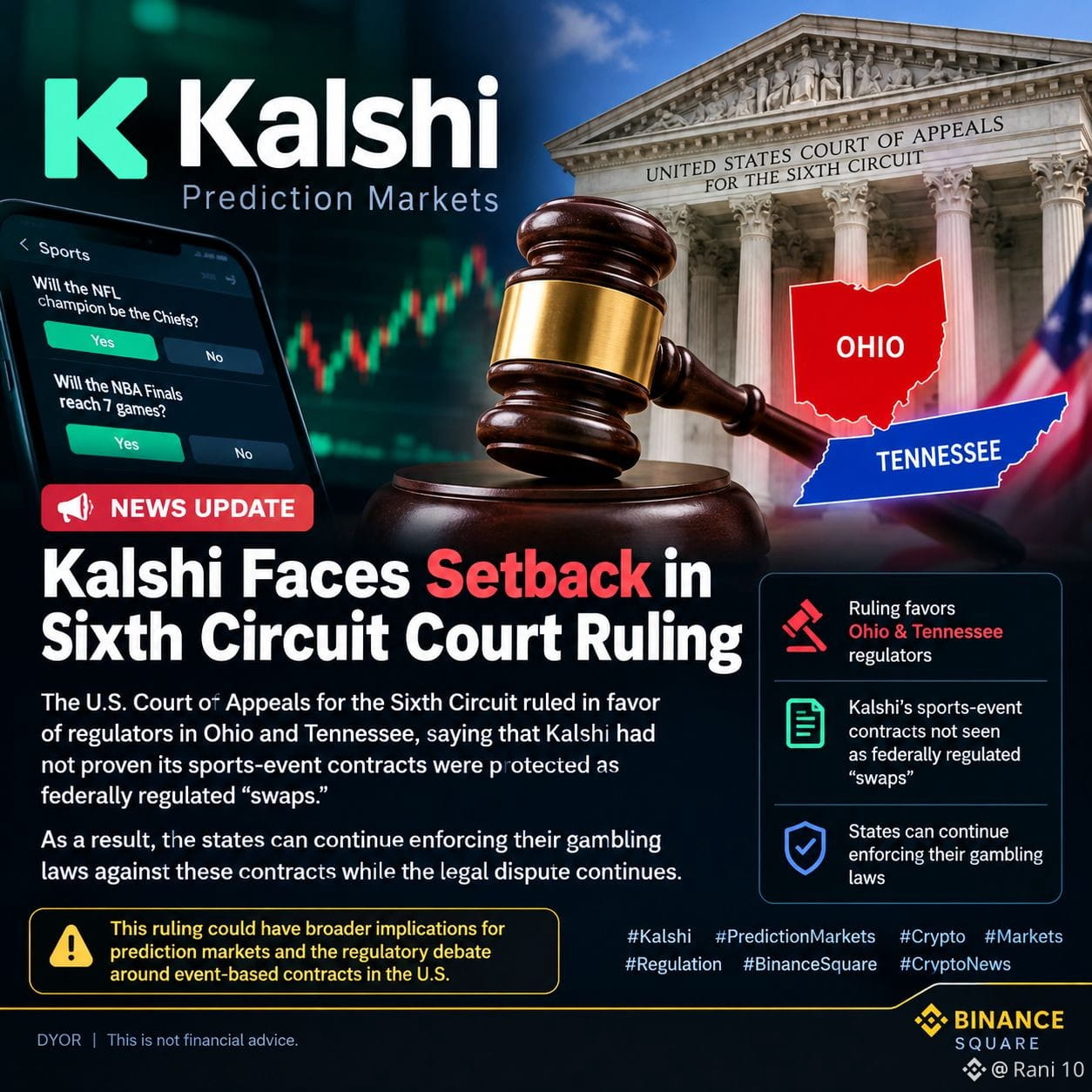
🚨 Kalshi Faces Setback in Sixth Circuit Court Ruling
Prediction market platform Kalshi has faced a setback after the U.S. Court of Appeals for the Sixth Circuit ruled in favor of regulators in Ohio and Tennessee.
The court found that Kalshi had not established that its sports-event contracts were protected as federally regulated “swaps.” As a result, the states can continue enforcing their gambling laws against these contracts while the legal dispute continues.
📌 This ruling could have broader implications for prediction markets and the regulatory debate around event-based contracts in the U.S.
⚠️ DYOR | This is not financial advice.
#Kalshi #PredictionMarkets #Markets #Regulation #CryptoNews
Good morning friends 🌄
🚨 Kalshi Faces Setback in Sixth Circuit Court Ruling
Prediction market platform Kalshi has faced a setback after the U.S. Court of Appeals for the Sixth Circuit ruled in favor of regulators in Ohio and Tennessee.
The court found that Kalshi had not established that its sports-event contracts were protected as federally regulated “swaps.” As a result, the states can continue enforcing their gambling laws against these contracts while the legal dispute continues.
📌 This ruling could have broader implications for prediction markets and the regulatory debate around event-based contracts in the U.S.
⚠️ DYOR | This is not financial advice.
#Kalshi #PredictionMarkets #Markets #Regulation #CryptoNews
🚨 Kalshi Faces Setback in Sixth Circuit Court Ruling
Prediction market platform Kalshi has faced a setback after the U.S. Court of Appeals for the Sixth Circuit ruled in favor of regulators in Ohio and Tennessee.
The court found that Kalshi had not established that its sports-event contracts were protected as federally regulated “swaps.” As a result, the states can continue enforcing their gambling laws against these contracts while the legal dispute continues.
📌 This ruling could have broader implications for prediction markets and the regulatory debate around event-based contracts in the U.S.
⚠️ DYOR | This is not financial advice.
#Kalshi #PredictionMarkets #Markets #Regulation #CryptoNews
61

·
--
Kalshi sports contract loses: Sixth Circuit rules ≠ swap, state law can be regulatedThe Sixth Circuit unanimously ruled on Friday: Kalshi’s sports-event contracts can’t get past the “swap” requirement in the CEA.
It’s not that “prediction markets have cooled off.” It’s a seam between state regulation and federal derivatives jurisdiction—torn open a bit more.
What does the 1️⃣ mean?
Three judges unanimously: Kalshi failed to prove that its sports-event contracts meet the CEA definition of a swap—there must be an “intrinsic connection” between the event itself and the potential financial/economic/commercial consequences; downstream layers like sponsorships, broadcasting, and advertising are not enough. Even if you treat it as a swap, the CEA does not expressly or impliedly preempt Ohio- and Tennessee-related state laws. Result: Ohio’s denial of a preliminary injunction is upheld, Tennessee’s already-issued preliminary injunction is vacated, and the case is remanded.
Kalshi sports contract loses: Sixth Circuit rules ≠ swap, state law can be regulated
The Sixth Circuit unanimously ruled on Friday: Kalshi’s sports-event contracts can’t get past the “swap” requirement in the CEA.
It’s not that “prediction markets have cooled off.” It’s a seam between state regulation and federal derivatives jurisdiction—torn open a bit more.
What does the 1️⃣ mean?
Three judges unanimously: Kalshi failed to prove that its sports-event contracts meet the CEA definition of a swap—there must be an “intrinsic connection” between the event itself and the potential financial/economic/commercial consequences; downstream layers like sponsorships, broadcasting, and advertising are not enough. Even if you treat it as a swap, the CEA does not expressly or impliedly preempt Ohio- and Tennessee-related state laws. Result: Ohio’s denial of a preliminary injunction is upheld, Tennessee’s already-issued preliminary injunction is vacated, and the case is remanded.
It’s not that “prediction markets have cooled off.” It’s a seam between state regulation and federal derivatives jurisdiction—torn open a bit more.
What does the 1️⃣ mean?
Three judges unanimously: Kalshi failed to prove that its sports-event contracts meet the CEA definition of a swap—there must be an “intrinsic connection” between the event itself and the potential financial/economic/commercial consequences; downstream layers like sponsorships, broadcasting, and advertising are not enough. Even if you treat it as a swap, the CEA does not expressly or impliedly preempt Ohio- and Tennessee-related state laws. Result: Ohio’s denial of a preliminary injunction is upheld, Tennessee’s already-issued preliminary injunction is vacated, and the case is remanded.
2
66

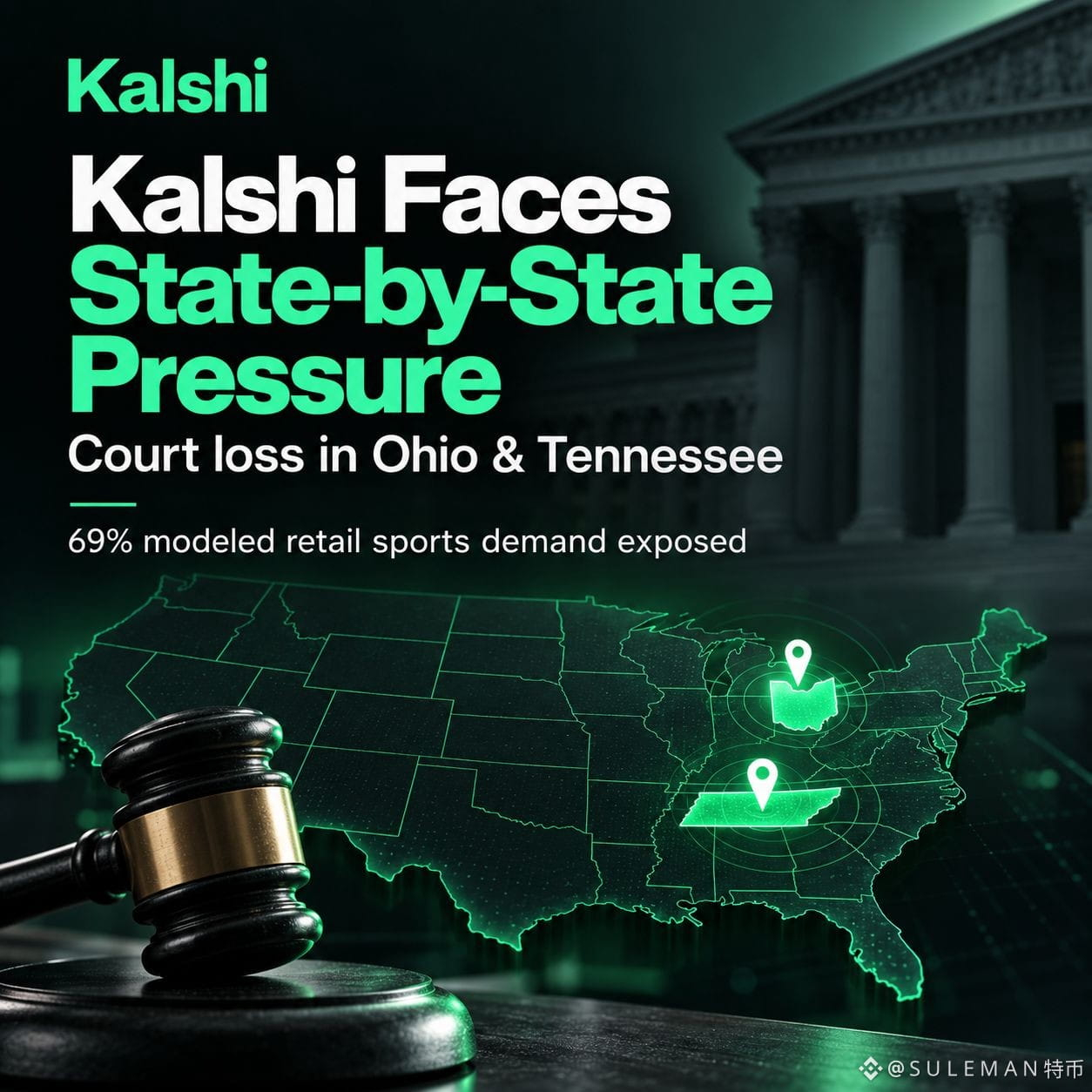
#Kalshi just took another serious legal hit, and in my view this could become a much bigger problem for the prediction-market model.
The Sixth Circuit ruled that Ohio and Tennessee can enforce their own gambling laws against Kalshi’s sports contracts. The court also made it clear that state-by-state compliance is possible through geofencing, even if it becomes expensive or complicated.
What really catches my attention is the exposure here. Around 69% of Kalshi’s modeled retail sports demand reportedly comes from states without legal online sportsbooks. That means wider state restrictions could directly hit a huge part of the market that helped prediction platforms grow in the first place.
We now have different appeals courts reaching different conclusions, so this legal fight is far from finished.
From my point of view, the biggest question is no longer just whether prediction markets can grow — it is whether they can maintain one national market or eventually be forced into a state-by-state system.
This could reshape liquidity, access, and the whole US prediction-market business model. 👀
$AMP
$MUBARAK
$RARE
{future}(RAREUSDT)
{future}(MUBARAKUSDT)
{spot}(AMPUSDT)
#Kalshi just took another serious legal hit, and in my view this could become a much bigger problem for the prediction-market model.
The Sixth Circuit ruled that Ohio and Tennessee can enforce their own gambling laws against Kalshi’s sports contracts. The court also made it clear that state-by-state compliance is possible through geofencing, even if it becomes expensive or complicated.
What really catches my attention is the exposure here. Around 69% of Kalshi’s modeled retail sports demand reportedly comes from states without legal online sportsbooks. That means wider state restrictions could directly hit a huge part of the market that helped prediction platforms grow in the first place.
We now have different appeals courts reaching different conclusions, so this legal fight is far from finished.
From my point of view, the biggest question is no longer just whether prediction markets can grow — it is whether they can maintain one national market or eventually be forced into a state-by-state system.
This could reshape liquidity, access, and the whole US prediction-market business model. 👀
$AMP
$MUBARAK
$RARE
The Sixth Circuit ruled that Ohio and Tennessee can enforce their own gambling laws against Kalshi’s sports contracts. The court also made it clear that state-by-state compliance is possible through geofencing, even if it becomes expensive or complicated.
What really catches my attention is the exposure here. Around 69% of Kalshi’s modeled retail sports demand reportedly comes from states without legal online sportsbooks. That means wider state restrictions could directly hit a huge part of the market that helped prediction platforms grow in the first place.
We now have different appeals courts reaching different conclusions, so this legal fight is far from finished.
From my point of view, the biggest question is no longer just whether prediction markets can grow — it is whether they can maintain one national market or eventually be forced into a state-by-state system.
This could reshape liquidity, access, and the whole US prediction-market business model. 👀
$AMP
$MUBARAK
$RARE
1
4
795

·
--
🚨 Kalshi’s September XRP market shows a $1.70 forecast, but the contract trades at just 32 cents despite XRP near $1.55. This mismatch suggests weak conviction in near-term upside, even as the forecast ticks up. Traders may be pricing in limited upside or waiting for clearer catalysts. Is the market underestimating XRP’s potential, or is skepticism justified?
#Kalshi
$XRP #TradingSignal #CryptoAnalysis
🚨 Kalshi’s September XRP market shows a $1.70 forecast, but the contract trades at just 32 cents despite XRP near $1.55. This mismatch suggests weak conviction in near-term upside, even as the forecast ticks up. Traders may be pricing in limited upside or waiting for clearer catalysts. Is the market underestimating XRP’s potential, or is skepticism justified?
#Kalshi
$XRP #TradingSignal #CryptoAnalysis
#Kalshi
$XRP #TradingSignal #CryptoAnalysis

29

·
--
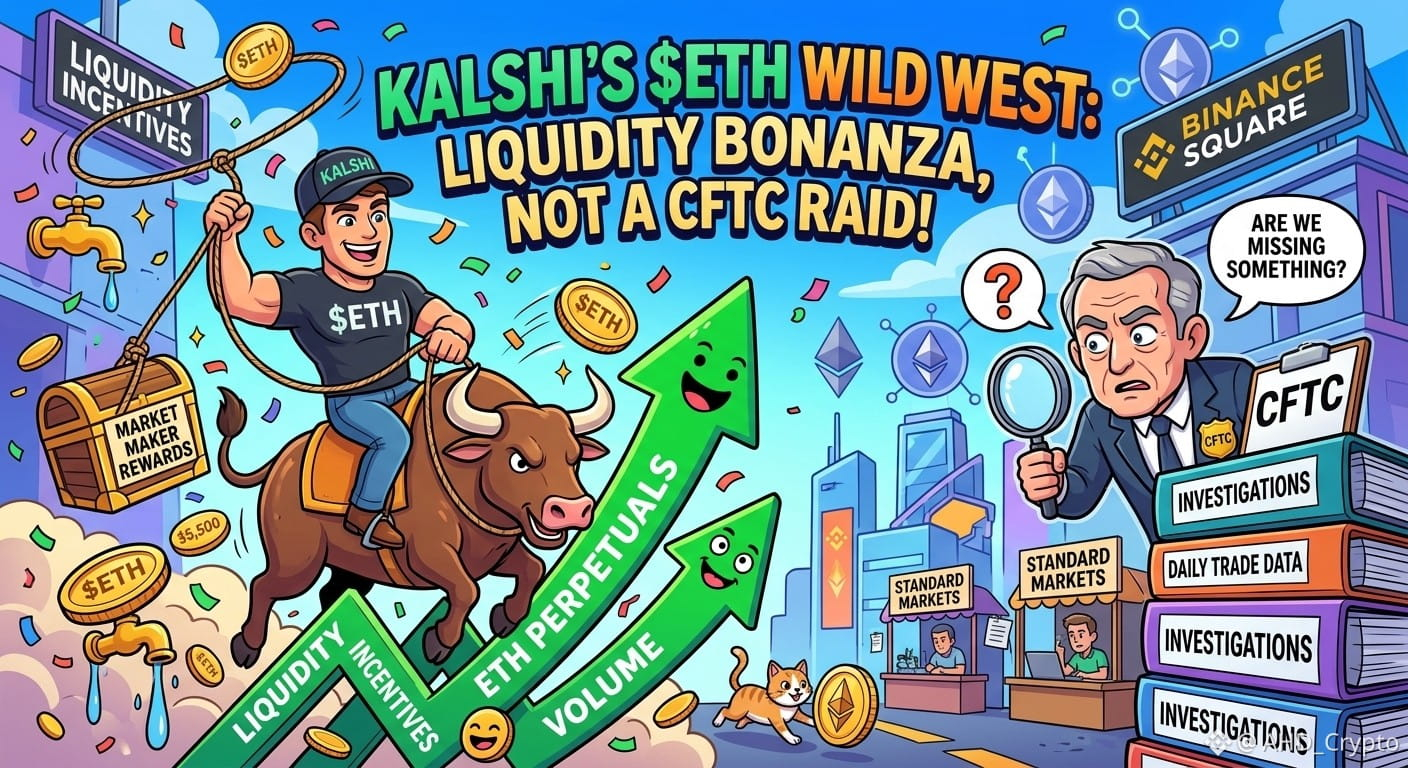
Kalshi Pushes Back: Denies CFTC Probe, Attributes $ETH Perpetual Activity to Liquidity Programs
{spot}(ETHUSDT)
Popular prediction platform Kalshi has officially denied reports that it is under formal investigation by the CFTC regarding unusual trading activity in its $ETH perpetual market.
The platform responded to concerns raised by market observers after repetitive trade patterns—specifically high volumes of identically sized ~$5,500 orders—were flagged on its ETH perpetual contracts. Research data highlighted a sharp gap where 24-hour volume hit ~$539 million against just $3.1 million in open interest.
Key Highlights:
>> No Formal Probe: Kalshi confirmed it has not been contacted by the CFTC regarding a formal examination and emphasized that sending routine daily trade data to regulators is standard operating procedure.
>> Liquidity Incentives at Work: The platform clarified that the clustered order sizes are a direct result of its liquidity incentive program. Automated market makers structure systematic orders to qualify for liquidity rewards, causing recurring trade patterns.
>> Anti-Wash Trading Controls: Kalshi emphasized it maintains dedicated surveillance tools and teams to prevent wash trading or self-matching orders on both its $BTC and ETH markets.
{spot}(BTCUSDT)
While routine regulatory review of daily data remains standard, Kalshi maintains that the heightened volume is driven by market-making strategies, not improper trading practices.
#writetoearn #Kalshi #ETH #CryptoNews #Write2Earn
Kalshi Pushes Back: Denies CFTC Probe, Attributes $ETH Perpetual Activity to Liquidity Programs
Popular prediction platform Kalshi has officially denied reports that it is under formal investigation by the CFTC regarding unusual trading activity in its $ETH perpetual market.
The platform responded to concerns raised by market observers after repetitive trade patterns—specifically high volumes of identically sized ~$5,500 orders—were flagged on its ETH perpetual contracts. Research data highlighted a sharp gap where 24-hour volume hit ~$539 million against just $3.1 million in open interest.
Key Highlights:
>> No Formal Probe: Kalshi confirmed it has not been contacted by the CFTC regarding a formal examination and emphasized that sending routine daily trade data to regulators is standard operating procedure.
>> Liquidity Incentives at Work: The platform clarified that the clustered order sizes are a direct result of its liquidity incentive program. Automated market makers structure systematic orders to qualify for liquidity rewards, causing recurring trade patterns.
>> Anti-Wash Trading Controls: Kalshi emphasized it maintains dedicated surveillance tools and teams to prevent wash trading or self-matching orders on both its $BTC and ETH markets.
While routine regulatory review of daily data remains standard, Kalshi maintains that the heightened volume is driven by market-making strategies, not improper trading practices.
#writetoearn #Kalshi #ETH #CryptoNews #Write2Earn
Popular prediction platform Kalshi has officially denied reports that it is under formal investigation by the CFTC regarding unusual trading activity in its $ETH perpetual market.
The platform responded to concerns raised by market observers after repetitive trade patterns—specifically high volumes of identically sized ~$5,500 orders—were flagged on its ETH perpetual contracts. Research data highlighted a sharp gap where 24-hour volume hit ~$539 million against just $3.1 million in open interest.
Key Highlights:
>> No Formal Probe: Kalshi confirmed it has not been contacted by the CFTC regarding a formal examination and emphasized that sending routine daily trade data to regulators is standard operating procedure.
>> Liquidity Incentives at Work: The platform clarified that the clustered order sizes are a direct result of its liquidity incentive program. Automated market makers structure systematic orders to qualify for liquidity rewards, causing recurring trade patterns.
>> Anti-Wash Trading Controls: Kalshi emphasized it maintains dedicated surveillance tools and teams to prevent wash trading or self-matching orders on both its $BTC and ETH markets.
While routine regulatory review of daily data remains standard, Kalshi maintains that the heightened volume is driven by market-making strategies, not improper trading practices.
#writetoearn #Kalshi #ETH #CryptoNews #Write2Earn
59


·
--
Bullish
🔎 The Real Story Behind Kalshi’s ETH Volume
The headline says $5B+ in ETH perpetual volume. But the more interesting story is what sits underneath that number.
Recent analysis of Kalshi’s public trade data found a striking pattern: a large share of ETH-perp activity repeatedly clustered around roughly $5,500 per trade. CoinDesk’s sample found trades near $5,499 represented 57% of the ETH-perp volume it analyzed, while broader reporting found nearly 1 million similarly sized trades contributing more than $5B in volume.
That alone doesn't prove wash trading.
Kalshi strongly disputes that interpretation. The company says the trades came from a market maker using fixed-size orders, while hundreds of distinct traders took the other side. Kalshi also says self-matching is mechanically blocked and coordinated trading is monitored.
And that's where the bigger question comes in:
How independently verifiable is the activity?
Public trade data can show what was traded and when, but it doesn't publicly identify the participants behind each trade. That makes it possible to observe unusual patterns while still being unable to independently establish who was trading with whom or whether any rules were broken.
This is also where @Polymarket becomes an interesting comparison—not necessarily because one model is automatically better, but because the underlying systems provide different forms of transparency.
On-chain activity can leave a publicly inspectable transaction trail. Off-chain exchange activity relies more heavily on the platform's own records and disclosures.
Different infrastructure.
Different transparency.
Different ways to verify activity.
The real question isn't simply:
“How big is the volume?”
It's:
“Can the volume be independently understood and verified?”
Because in markets, a big number means much more when everyone can check what produced it.
#Kalshi #Polymarket #PredictionMarkets
🔎 The Real Story Behind Kalshi’s ETH Volume
The headline says $5B+ in ETH perpetual volume. But the more interesting story is what sits underneath that number.
Recent analysis of Kalshi’s public trade data found a striking pattern: a large share of ETH-perp activity repeatedly clustered around roughly $5,500 per trade. CoinDesk’s sample found trades near $5,499 represented 57% of the ETH-perp volume it analyzed, while broader reporting found nearly 1 million similarly sized trades contributing more than $5B in volume.
That alone doesn't prove wash trading.
Kalshi strongly disputes that interpretation. The company says the trades came from a market maker using fixed-size orders, while hundreds of distinct traders took the other side. Kalshi also says self-matching is mechanically blocked and coordinated trading is monitored.
And that's where the bigger question comes in:
How independently verifiable is the activity?
Public trade data can show what was traded and when, but it doesn't publicly identify the participants behind each trade. That makes it possible to observe unusual patterns while still being unable to independently establish who was trading with whom or whether any rules were broken.
This is also where @Polymarket becomes an interesting comparison—not necessarily because one model is automatically better, but because the underlying systems provide different forms of transparency.
On-chain activity can leave a publicly inspectable transaction trail. Off-chain exchange activity relies more heavily on the platform's own records and disclosures.
Different infrastructure.
Different transparency.
Different ways to verify activity.
The real question isn't simply:
“How big is the volume?”
It's:
“Can the volume be independently understood and verified?”
Because in markets, a big number means much more when everyone can check what produced it.
#Kalshi #Polymarket #PredictionMarkets
The headline says $5B+ in ETH perpetual volume. But the more interesting story is what sits underneath that number.
Recent analysis of Kalshi’s public trade data found a striking pattern: a large share of ETH-perp activity repeatedly clustered around roughly $5,500 per trade. CoinDesk’s sample found trades near $5,499 represented 57% of the ETH-perp volume it analyzed, while broader reporting found nearly 1 million similarly sized trades contributing more than $5B in volume.
That alone doesn't prove wash trading.
Kalshi strongly disputes that interpretation. The company says the trades came from a market maker using fixed-size orders, while hundreds of distinct traders took the other side. Kalshi also says self-matching is mechanically blocked and coordinated trading is monitored.
And that's where the bigger question comes in:
How independently verifiable is the activity?
Public trade data can show what was traded and when, but it doesn't publicly identify the participants behind each trade. That makes it possible to observe unusual patterns while still being unable to independently establish who was trading with whom or whether any rules were broken.
This is also where @Polymarket becomes an interesting comparison—not necessarily because one model is automatically better, but because the underlying systems provide different forms of transparency.
On-chain activity can leave a publicly inspectable transaction trail. Off-chain exchange activity relies more heavily on the platform's own records and disclosures.
Different infrastructure.
Different transparency.
Different ways to verify activity.
The real question isn't simply:
“How big is the volume?”
It's:
“Can the volume be independently understood and verified?”
Because in markets, a big number means much more when everyone can check what produced it.
#Kalshi #Polymarket #PredictionMarkets
165
Log in to explore more content
Join global crypto users on Binance Square
⚡️ Get latest and useful information about crypto.
💬 Trusted by the world’s largest crypto exchange.
👍 Discover real insights from verified creators.
Email / Phone number
Trending Topics
1
#Nikkei225Jumps2.5%ToThreeMonthHigh
13,795 views
307 Discussing
2
#DriftHackVictimsBeginClaims
91,746 views
992 Discussing
3
#SolanaTokenizedStockVolumeTops$4.4BInSeptember
8,619 views
98 Discussing
4
#BitcoinSpotETFsDraw$6.34BInflowsInQ3
30,609 views
212 Discussing
5
#EthereumValidatorExitQueueJumps392%
235,089 views
2,009 Discussing
6
#IMFApprovesElSalvador$138MWithBitcoinWaiver
21,909 views
124 Discussing
7
#SECHaltsCryptoETFReviewsAmidFundingLapse
355,236 views
2,686 Discussing
8
#ZcashETFPostsFirstWeeklyOutflow$93.6M
107,848 views
286 Discussing
9
#GreekPoliceBustCryptoScamRingArrest17
485,484 views
3,244 Discussing
10
#BitcoinRejectedAt$87K
246,350 views
368 Discussing