

#bittensor
bittensor
2.6M views
5,602 Discussing
Hot
Latest

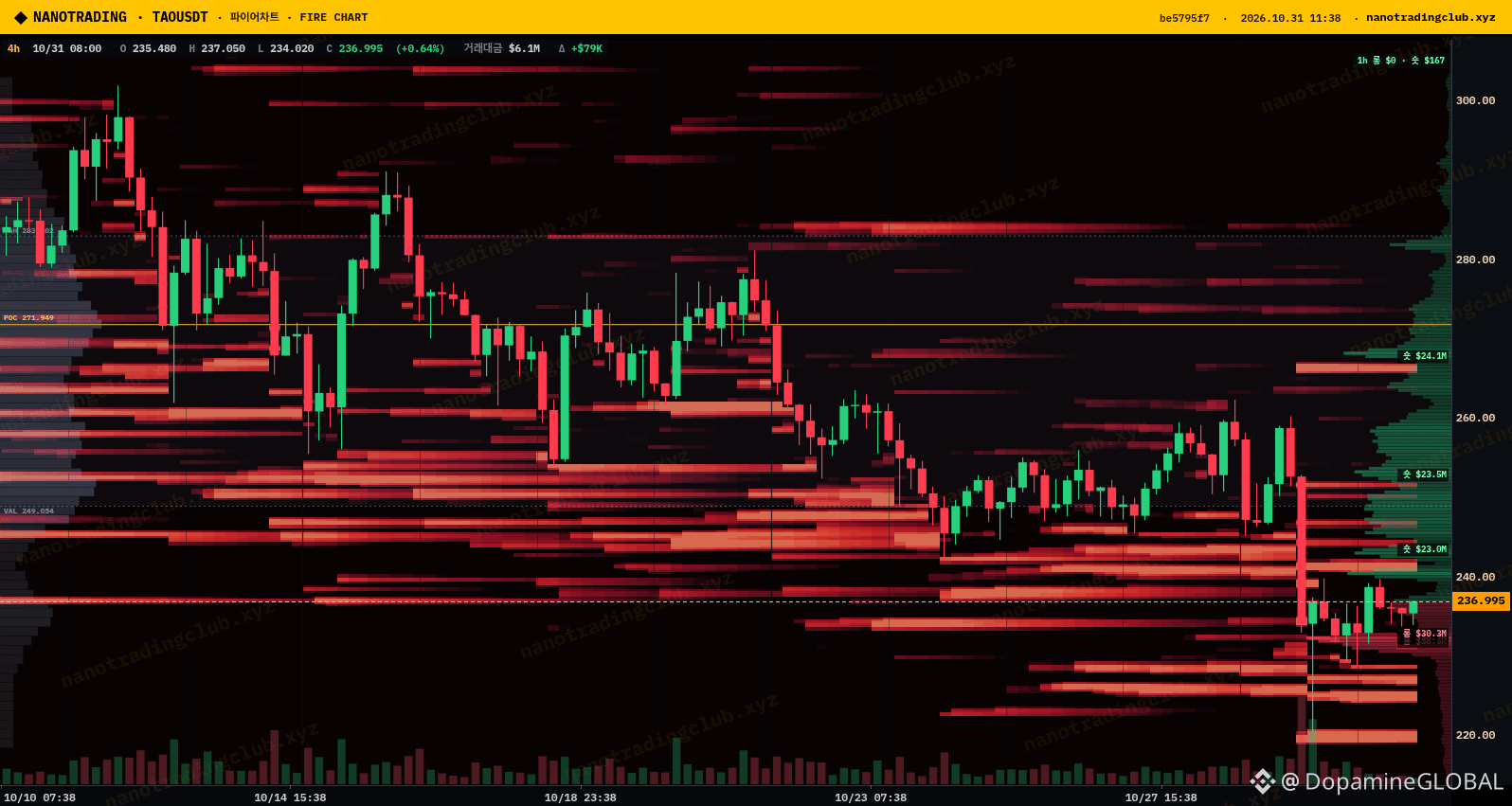
$TAO wicked down to 219.6 two days ago, got bought right back, and has been grinding sideways around 236 since. 24h range is 228.7 to 239.8. Ten days ago it was trading near 257, so it's still well under where this dump started.
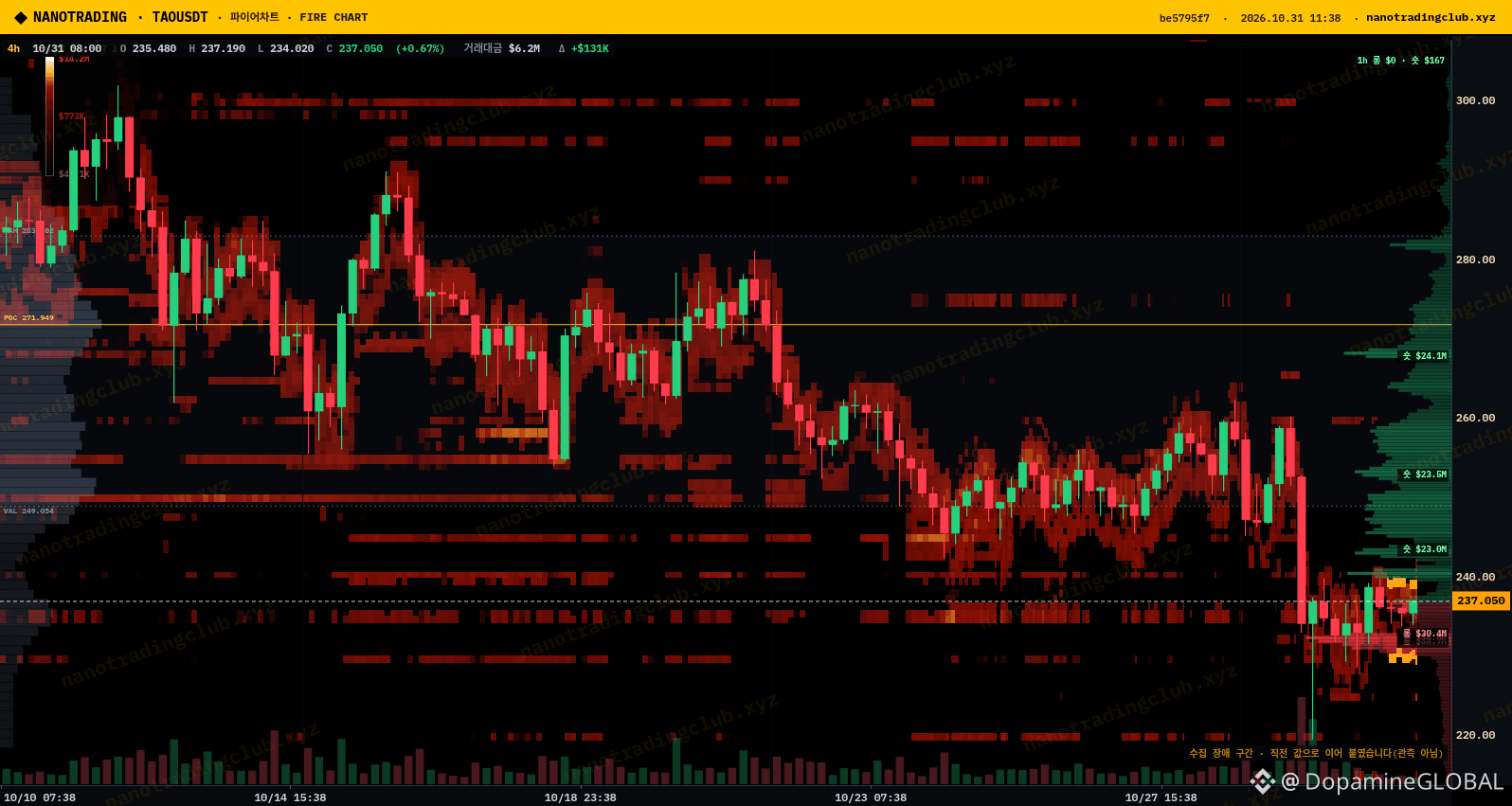
On the NanoTrading Fire chart (4h) the biggest liquidation cluster sits right under price: roughly $30M of long liquidations at 232 to 234. Above, short liquidation bands stack at 242 to 243 (~$23M), around 250 (~$23.5M) and 268 to 270 (~$24M). Volume POC is way up at about 272 and value area low is near 249, so price is trading well below value.
Positioning is split. Accounts are only about 55% long (L/S 1.23), but top traders are around 75% long by position (ratio 3.0). Funding is barely positive at 0.005% and OI is flat at about $53M. So no fresh money chasing either way.
My read: 232 to 234 is the line. That long pocket is close enough that I think it gets tested first. If it holds and $TAO closes a 4h above 243, I think the short bands at 250 get pulled in. Lose 232 and the 220 wick area is back in play.
Do you trust the big wallets being 75% long here, or is that the liquidity sitting under 232?
NFA, just my read 🧠
Source: NanoTrading Fire chart (nanotradingclub.xyz)
#TAO #Bittensor #NanoTrading
1
492

·
--
$TAO is back on the trending board this morning, even though it's actually a touch soft near $237, down less than 1%. That split caught my eye — plenty of chatter while the price just chops sideways. $BTC is the calmer backdrop, up about 0.3% near $77,440, so this doesn't look like a broad move lifting everything. I'm watching whether it holds the $235 area; if it does, the trending-board attention might turn into something more. #Bittensor
$TAO is back on the trending board this morning, even though it's actually a touch soft near $237, down less than 1%. That split caught my eye — plenty of chatter while the price just chops sideways. $BTC is the calmer backdrop, up about 0.3% near $77,440, so this doesn't look like a broad move lifting everything. I'm watching whether it holds the $235 area; if it does, the trending-board attention might turn into something more. #Bittensor
78

Verified
$TAO closed October 29 around $234.20, down approximately 9% in 24 hours.
Selling pressure increased alongside spot volume, with the token breaking its previous low.
Another development deserves attention:
Binance announced the removal of the TAO/BTC trading pair, scheduled for October 30 at 03:00 UTC.
Important distinction: removing one trading pair does not mean Binance is delisting TAO entirely.
My perspective:
Bittensor’s long-term proposition remains interesting: creating an incentive-driven marketplace for decentralized AI services.
But a strong narrative doesn’t automatically justify any valuation.
I am watching three things:
• Whether TAO can stabilize above its recent lows.
• Whether subnet activity translates into real demand.
• Whether AI infrastructure adoption produces sustainable economic value.
The next opportunity may come from understanding the ecosystem before the market reprices it.
Fundamentals first. Price second.
#bittensor #TAO #DeAI #MannequinCrypto

1
449

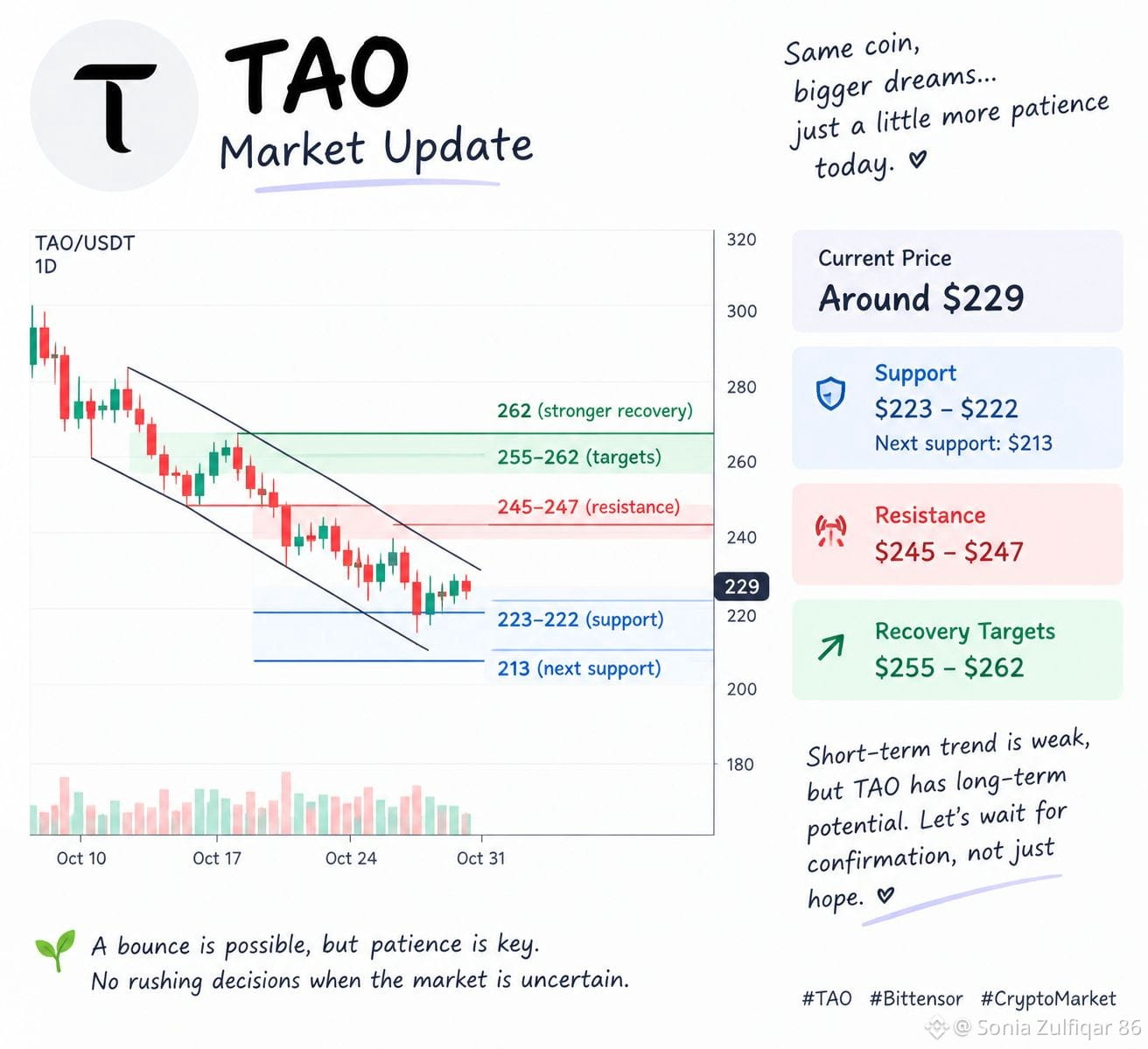
$TAO is facing a tough day, and buyers still haven't shown enough strength to turn the trend around.
📉 Current price: Around $229
- Support: $223–$222
- Next support: $213
- Resistance: $245–$247
- Recovery targets: $255–$262
A bounce is possible, but confirmation matters. TAO has potential, yet patience is more important than chasing a falling market.
#TAO #Bittensor #CryptoMarket
{spot}(TAOUSDT)
$TAO is facing a tough day, and buyers still haven't shown enough strength to turn the trend around.
📉 Current price: Around $229
- Support: $223–$222
- Next support: $213
- Resistance: $245–$247
- Recovery targets: $255–$262
A bounce is possible, but confirmation matters. TAO has potential, yet patience is more important than chasing a falling market.
#TAO #Bittensor #CryptoMarket
📉 Current price: Around $229
- Support: $223–$222
- Next support: $213
- Resistance: $245–$247
- Recovery targets: $255–$262
A bounce is possible, but confirmation matters. TAO has potential, yet patience is more important than chasing a falling market.
#TAO #Bittensor #CryptoMarket
1
683
BITTENSOR ($TAO )
AI exposure is attractive. But the token still has to prove its strength.
🧠 BITTENSOR: THE AI THESIS IS ALIVE. THE CHART NEEDS CONFIRMATION.
$TAO has struggled to recover after falling from above $320 in late September toward the $250 region.
That pullback raises an important question for investors: is the market building a base, or is it simply pausing before another leg down?
Three developments deserve attention:
1️⃣ PRICE STRUCTURE
The $245–$247 region has been identified as a key short-term support zone.
Holding it could help stabilize sentiment. Losing it would weaken the recovery thesis.
2️⃣ INSTITUTIONAL ACCESS
Grayscale has outlined an exchange-listing route for its proposed Bittensor ETF.
This is a meaningful development for potential market access, but a filing is not an approval, and approval would not guarantee buying pressure.
3️⃣ REAL NETWORK UTILITY
Bittensor’s long-term proposition depends on whether its subnets can deliver useful AI services, attract demand and sustain competitive incentives.
AI enthusiasm alone cannot establish the value of TAO.
My view: I remain interested in the infrastructure thesis, but I want to see price confirmation and measurable network progress.
The opportunity is not simply to buy an AI narrative. It is to identify an ecosystem that can turn that narrative into durable demand.
#bittensor #TAO #AI #CryptoInvesting #MannequinCrypto
📊 POLL: What would strengthen your conviction in TAO the most?
sustained recovery above $280
100%
Progress institutional ETF
0%
Stronger subnet revenue and
0%
11 votes • Voting closed
1k

·
--
Bearish
$TAO Price Prediction Today (Oct 29): Bittensor Crypto Signal & Technical Analysis 📊
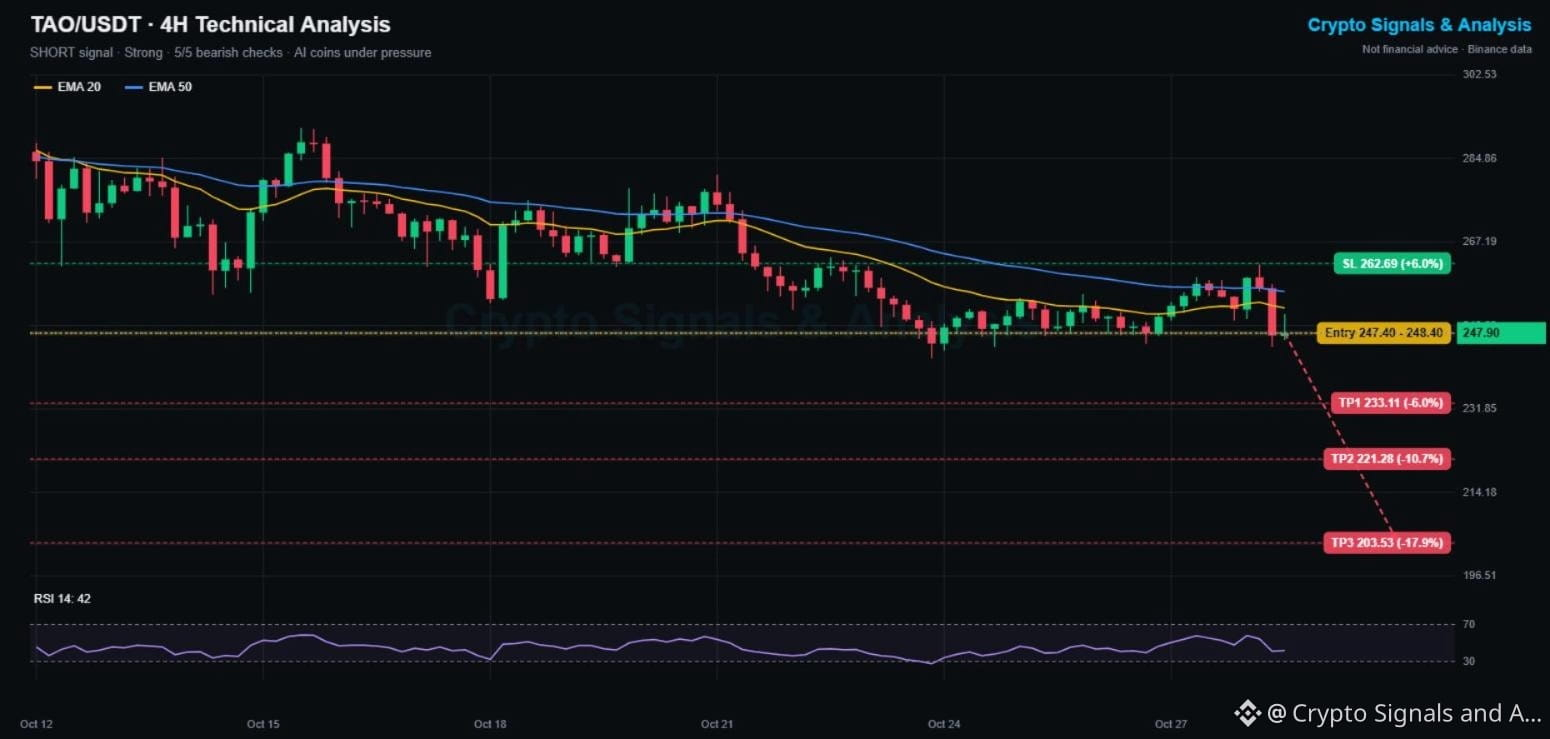
🔴 SHORT | Entry 247.40 - 248.40 | TP1 233.11 | SL 262.69
👉 Tap $TAO to place your trade fast
🕒 Updated: Oct 29, 06:53 UTC · price 247.90
AI coins are among the weakest today: Bittensor -3.5%, Render -3.6%, Fetch.ai -2.3%. Bittensor's bounce to 262 was rejected at the 4H EMA50, and price is back at the bottom of its 5-day range.
📌 BITTENSOR TRADING SIGNAL (Strong, 5/5 signals agree)
Entry: 247.40 - 248.40
Take profit 1: 233.11 (-6.0%)
Take profit 2: 221.28 (-10.7%)
Take profit 3: 203.53 (-17.9%)
Stop loss: 262.69 (+6.0%)
📊 TAO TECHNICAL ANALYSIS (4H CHART)
Price is below the EMA20 (253.2) and EMA50 (256.7), both sloping down. RSI 42 favors sellers. The lows at 242.6 (Oct 24) and 245 are the floor that has held so far.
🔑 KEY LEVELS
Support: 245, then 242.6
Resistance: 253.2 (EMA20), then 262.4
📉 Bearish scenario: a 4H close under 242.6 breaks the floor and opens TP1 at 233.
📈 Bullish scenario: reclaiming 256.7 ends the downtrend. A close above 262.69 cancels this signal.
💡 Bottom line: lower highs into a flat floor. The break of 242.6 is the trigger.
👉 Tap $TAO
to open the live chart. NFA
🔥 NEW TO BINANCE?
✅ No Binance account yet? Sign up with referral code SQUAREGINOS and get a 10% kickback on your Futures trading fees.
👇👇👇
{spot}(TAOUSDT)
[Sign up on Binance here (10% Futures fee kickback)](https://www.binance.com/join?ref=SQUAREGINOS)
━━━━━━━━━━
Are AI coins oversold, or is there more downside? 👇
Follow Crypto Signals and Analysis for daily signals.
#cryptosignals #Bittensor #FOMCWatch
⚠️ Crypto is volatile: risk only what you can afford to lose.
$TAO Price Prediction Today (Oct 29): Bittensor Crypto Signal & Technical Analysis 📊
🔴 SHORT | Entry 247.40 - 248.40 | TP1 233.11 | SL 262.69
👉 Tap $TAO to place your trade fast
🕒 Updated: Oct 29, 06:53 UTC · price 247.90
AI coins are among the weakest today: Bittensor -3.5%, Render -3.6%, Fetch.ai -2.3%. Bittensor's bounce to 262 was rejected at the 4H EMA50, and price is back at the bottom of its 5-day range.
📌 BITTENSOR TRADING SIGNAL (Strong, 5/5 signals agree)
Entry: 247.40 - 248.40
Take profit 1: 233.11 (-6.0%)
Take profit 2: 221.28 (-10.7%)
Take profit 3: 203.53 (-17.9%)
Stop loss: 262.69 (+6.0%)
📊 TAO TECHNICAL ANALYSIS (4H CHART)
Price is below the EMA20 (253.2) and EMA50 (256.7), both sloping down. RSI 42 favors sellers. The lows at 242.6 (Oct 24) and 245 are the floor that has held so far.
🔑 KEY LEVELS
Support: 245, then 242.6
Resistance: 253.2 (EMA20), then 262.4
📉 Bearish scenario: a 4H close under 242.6 breaks the floor and opens TP1 at 233.
📈 Bullish scenario: reclaiming 256.7 ends the downtrend. A close above 262.69 cancels this signal.
💡 Bottom line: lower highs into a flat floor. The break of 242.6 is the trigger.
👉 Tap $TAO
to open the live chart. NFA
🔥 NEW TO BINANCE?
✅ No Binance account yet? Sign up with referral code SQUAREGINOS and get a 10% kickback on your Futures trading fees.
👇👇👇
Sign up on Binance here (10% Futures fee kickback)
━━━━━━━━━━
Are AI coins oversold, or is there more downside? 👇
Follow Crypto Signals and Analysis for daily signals.
#cryptosignals #Bittensor #FOMCWatch
⚠️ Crypto is volatile: risk only what you can afford to lose.
31

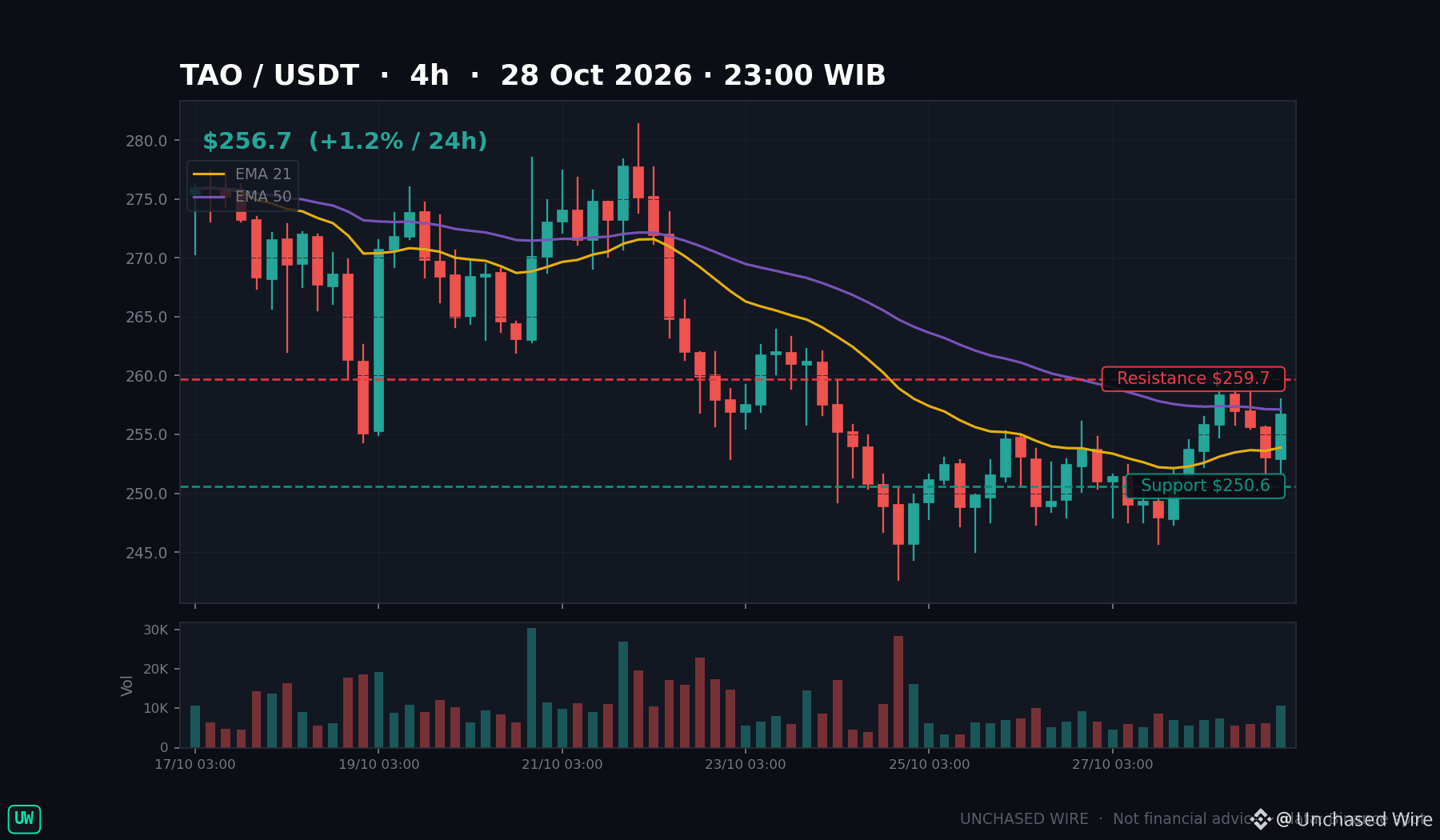
$259.70 is the ceiling $TAO keeps hitting — and yesterday it held all day.
Grayscale filed on October 23 to convert its Bittensor Trust into an ETF listed on NYSE Arca under GTAO. I am not calling this an ETF rally: the filing sets no launch date and still needs regulatory and exchange approval, so the headline is a route, not a done deal.
What the tape actually shows is a coil. Lows lifted from $245.70 on October 27 to $250.60 yesterday, while the morning push printed $259.70 and then $259.10 twice before the last finished candle closed back at $253.00. Buyers are defending higher ground; sellers are defending one ceiling.
So the map is simple: a 4-hour close under $250.60 breaks the coil, and a close above $259.70 reopens the climb. Which side breaks first — the floor or the ceiling?
Not financial advice. Do your own research.
$TAO #Bittensor #ETF #CryptoMarkets #AI
13

·
--
Bearish
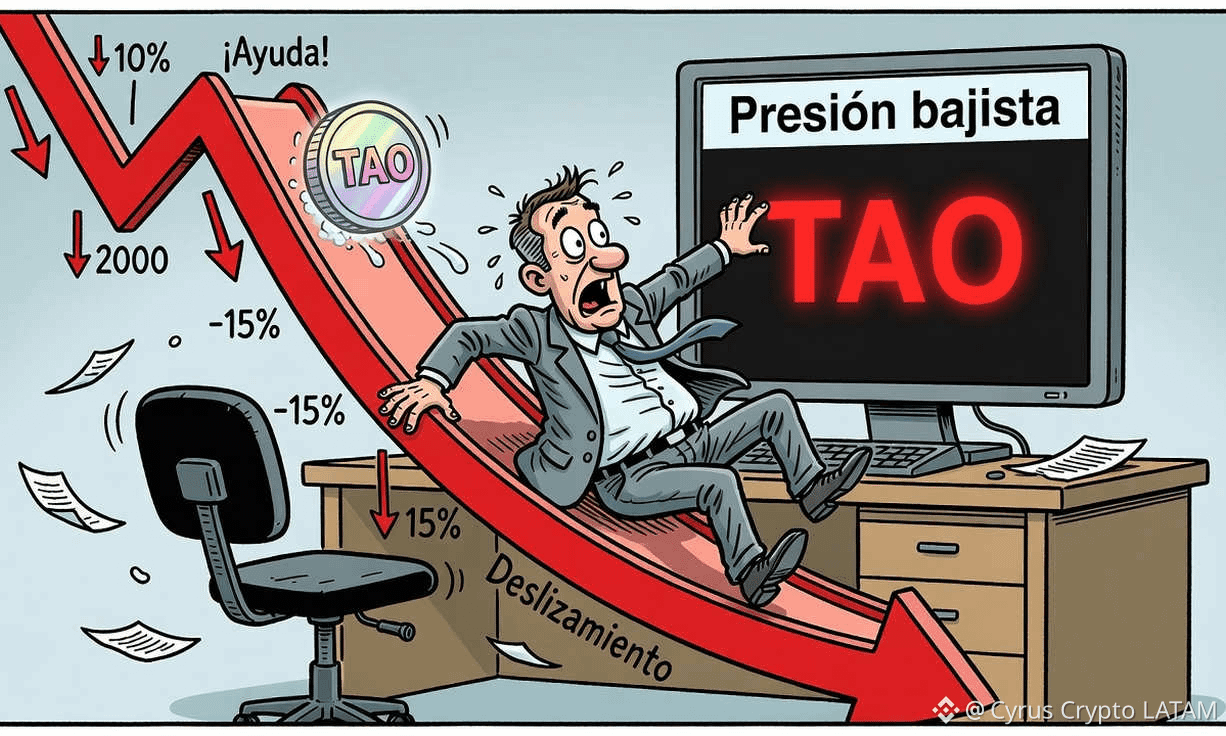
$TAO cae 6.30% from the open and tests the intraday low on October 30
TAO trades at USD $233.34, 6.30% below the open, although the decline versus the previous close is 1.93%. The price is below its main moving averages and volume is above average. Widespread liquidations provide a plausible context for market pressure, but do not confirm a Bittensor-specific catalyst; the technical levels and available fundamental information call for caution.
TAO's pullback requires specifying the comparison base: the record shows a quote of USD $233.34, an open of USD $249.03 and a previous close of USD $237.94. The difference versus the open is approximately -6.30%, while the change versus the prior close is -1.93%.
#bittensor is presented as a protocol associated with decentralized artificial intelligence networks and its TAO token; however, the available information does not include metrics on subnet activity, users, revenue, total value locked, or token demand.
Recommendation: HOLD. The methodology considers five signals: structure versus moving averages, MACD, RSI and stochastic, relative volume and position versus VWAP. Three are unfavorable —price below the averages, bearish MACD and price below VWAP—; one is mixed —elevated volume during the decline— and another points to possible seller exhaustion, but without confirmation —weak oscillators, although RSI remains above 30—. The balance favors preserving capital rather than opening an aggressive position.
For the short term, a tactical entry only after reclaiming USD $239.94 can use USD $242.78 and USD $249.92 as exit references. The stop-loss should be defined according to volatility and risk profile, taking into account that the ATR of USD $16.44 implies wide swings.
TAO combines a sharp correction over the last month with elevated relative volume
{future}(TAOUSDT)
$TAO cae 6.30% from the open and tests the intraday low on October 30
TAO trades at USD $233.34, 6.30% below the open, although the decline versus the previous close is 1.93%. The price is below its main moving averages and volume is above average. Widespread liquidations provide a plausible context for market pressure, but do not confirm a Bittensor-specific catalyst; the technical levels and available fundamental information call for caution.
TAO's pullback requires specifying the comparison base: the record shows a quote of USD $233.34, an open of USD $249.03 and a previous close of USD $237.94. The difference versus the open is approximately -6.30%, while the change versus the prior close is -1.93%.
#bittensor is presented as a protocol associated with decentralized artificial intelligence networks and its TAO token; however, the available information does not include metrics on subnet activity, users, revenue, total value locked, or token demand.
Recommendation: HOLD. The methodology considers five signals: structure versus moving averages, MACD, RSI and stochastic, relative volume and position versus VWAP. Three are unfavorable —price below the averages, bearish MACD and price below VWAP—; one is mixed —elevated volume during the decline— and another points to possible seller exhaustion, but without confirmation —weak oscillators, although RSI remains above 30—. The balance favors preserving capital rather than opening an aggressive position.
For the short term, a tactical entry only after reclaiming USD $239.94 can use USD $242.78 and USD $249.92 as exit references. The stop-loss should be defined according to volatility and risk profile, taking into account that the ATR of USD $16.44 implies wide swings.
TAO combines a sharp correction over the last month with elevated relative volume
779

·
--
Everyone, I looked at a few sources on Bittensor. Here’s my own take.
$TAO is currently at 234.8, with a 20-day range of 219.6 to 301.99, putting it at the 18.4th percentile.
Over the past 7 days, it’s down 4.378%. Over the same period, $BTC is down 2.974% and $ETH is down 3.238%—it’s fallen a little more than the major assets.
Honestly, nothing has gone wrong with the network itself.
It’s a decentralized machine-learning network. A bunch of subnets each run their own models, and the ones that perform best earn TAO. Compute power and incentives are tied together.
So whether the price is falling and whether the subnets are still running are two different things. It’s the price that’s down, not the compute power. Can you really equate the two?
Based on daily ATR14, the average daily volatility is 6.545%. A drop of around seven points is just business as usual for it.
It closed at 245.55 seven days ago, climbed to 258.83 along the way, then got hammered back to 234.8 two days later. The buyers from that rebound didn’t stick around at all.
It’s like a machine that keeps running: the gauge needle is swinging wildly, but the RPM hasn’t actually changed.
The sector is still in its early stages. To know whether compute power is really migrating into it, we need to see whether it can hold at this level.
There’s only so much in the pot; whoever’s closest gets served first. #Bittensor
By my read, this is a level to keep an eye on for now and see whether it can hold the 219.6 floor. Do you think liquidity is drying up, or is the narrative cooling off? Let’s discuss in the comments.
#BTW #ENA #加密货币
The above is a record of my personal trading system and observations of the data; it does not constitute investment advice.
1
376

5,000 TAO is not a particularly large position on its own, but KR1 staked it directly, and that move sends a stronger signal than simply buying it—it suggests that institutions are starting to treat TAO as an asset capable of generating cash flow, rather than just a token to hold while waiting for the next AI rally.
First, consider the scale. At current prices, the position is worth roughly a million dollars, or less than 0.1% of TAO's circulating supply. In terms of size, its direct impact on the market is negligible. What really affects sentiment is the nature of the capital: a London-listed crypto investment company is willing to put its tokens into a staking contract rather than leave them in an exchange account. That means it is calculating annualized returns, not intraday price spreads. At a time when valuations across the AI sector are largely propped up by narratives, this is a rare move.
The three details worth following are not “how much it bought.”
First, which subnet the tokens were staked in. Bittensor emissions are not distributed across the network as a whole; they are allocated by subnet, and returns for delegators can range from single digits to double digits, a huge difference. Subnets are also dynamic: if a subnet falls in the rankings, it can lose its registration slot, and its emissions drop to zero. So “staking TAO” and “staking TAO on a specific subnet” are two entirely different things. The former is beta; the latter is active selection. If KR1 later discloses that it staked on a core subnet with high emissions, then the cash-flow thesis for this position holds up. If it simply delegated to some validator for average returns, it looks more like a symbolic gesture.
Second, the friction involved in unstaking. Bittensor staking cannot be turned into cash with a single click; undelegating involves queues and slippage, and when markets are highly volatile, you may not be able to get out in time. By locking up its tokens, the institution is effectively accepting a quantifiable liquidity discount in exchange for subnet emissions. Whether that trade-off is worthwhile depends on whether the annualized return it earns can offset TAO's own volatility—and given the daily swings typical of the AI sector, that is a high bar.
Third, and easiest to overlook: TAO's total emissions gradually shrink with each halving. The more subnets there are, the thinner the allocation to each one. So a staking yield that looks attractive today could be cut in half two years from now. By entering the market now, the institution is really betting on a combination of “yields decline, but the token price rises faster,” rather than simply chasing high returns.
At the narrative level, the significance of this move is that it gives the crypto AI sector a new valuation anchor. Until now, valuations in the sector have relied almost entirely on future potential, and no one could say for sure how much a subnet's token was worth. Now a listed company is putting real money into acquiring subnet emissions, effectively providing an external price signal for the “AI computing power + token incentives” model. The scale is small, but the direction is clear.
The risks are just as clear: this is a single action by a single company, so the sample size is one; KR1's own share price is highly sensitive to the net value of its crypto assets, and it may not hold the position long term; and news like this is often partly anticipated by the market before it is disclosed, so by the time details about the specific subnet and yield are announced, sentiment may already have peaked.
My view is that what is really worth watching next is not TAO's price, but whether KR1 names the specific subnet and gives a staking yield figure in its next disclosure. If it does, that suggests this was a carefully calculated allocation. If it says nothing, it was probably just a position dressed up to fit the narrative. In terms of position management, don't treat this news as a signal that a trend is starting. It's more like a new “cash flow” footnote for the AI sector, and it will take a second and third institution following suit before it means much.
#TAO #Bittensor #Crypto
16

·
--
🔥 $TAO
{future}(TAOUSDT)
TAO is showing strength at the support zone!
I highlighted the $247–$250 buying zone, and now $TAO is trading around $256. 📈
This support level is worth watching as bulls try to push the price higher.
🎯 Key levels to watch:
$260 → $270 → $280
No unrealistic promises — just important levels to monitor as price develops.
Will $TAO break above $260 next? 👀
#TAO #Bittensor #crypto #BinanceSquare
🔥 $TAO
TAO is showing strength at the support zone!
I highlighted the $247–$250 buying zone, and now $TAO is trading around $256. 📈
This support level is worth watching as bulls try to push the price higher.
🎯 Key levels to watch:
$260 → $270 → $280
No unrealistic promises — just important levels to monitor as price develops.
Will $TAO break above $260 next? 👀
#TAO #Bittensor #crypto #BinanceSquare
2
806

·
--
Bullish
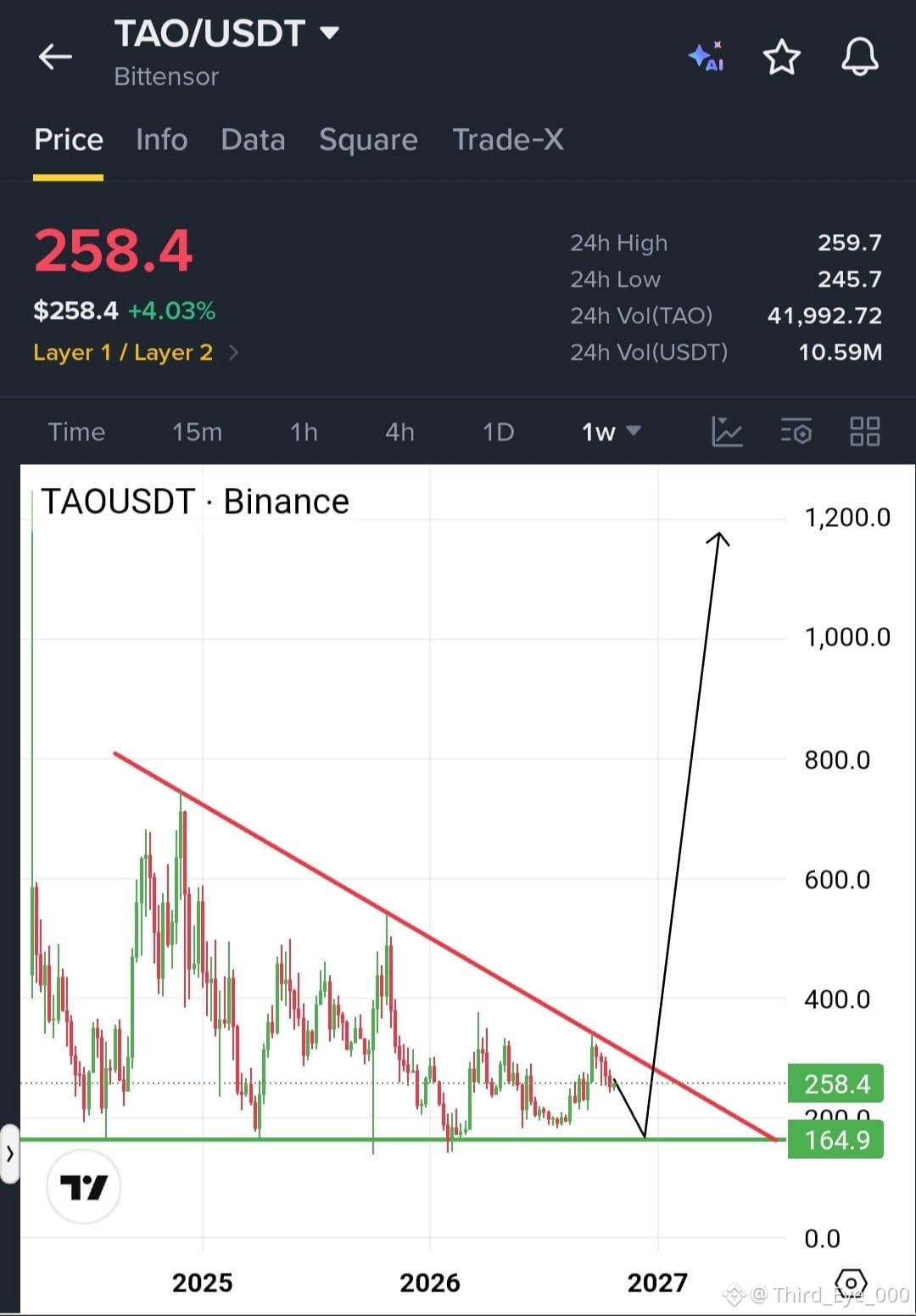
👀 $TAO TO $1,200? The bigger picture is getting interesting.
Everyone is watching the daily candles, but look at the weekly chart. 👀
🔻 A massive descending resistance
🟢 Strong historical support around $165
🚀 Current price: $258
If #TAO revisits support, holds it, and finally breaks that long-term descending trendline, could we see a massive trend reversal?
The $1,200 target is the bullish scenario — not a guarantee. But the potential is worth watching. 🔥
One question, fam: Is #bittensor preparing for its next big run, or will the bears win again?
Drop your prediction below 👇
{spot}(TAOUSDT)
👀 $TAO TO $1,200? The bigger picture is getting interesting.
Everyone is watching the daily candles, but look at the weekly chart. 👀
🔻 A massive descending resistance
🟢 Strong historical support around $165
🚀 Current price: $258
If #TAO revisits support, holds it, and finally breaks that long-term descending trendline, could we see a massive trend reversal?
The $1,200 target is the bullish scenario — not a guarantee. But the potential is worth watching. 🔥
One question, fam: Is #bittensor preparing for its next big run, or will the bears win again?
Drop your prediction below 👇
311

·
--
Bullish
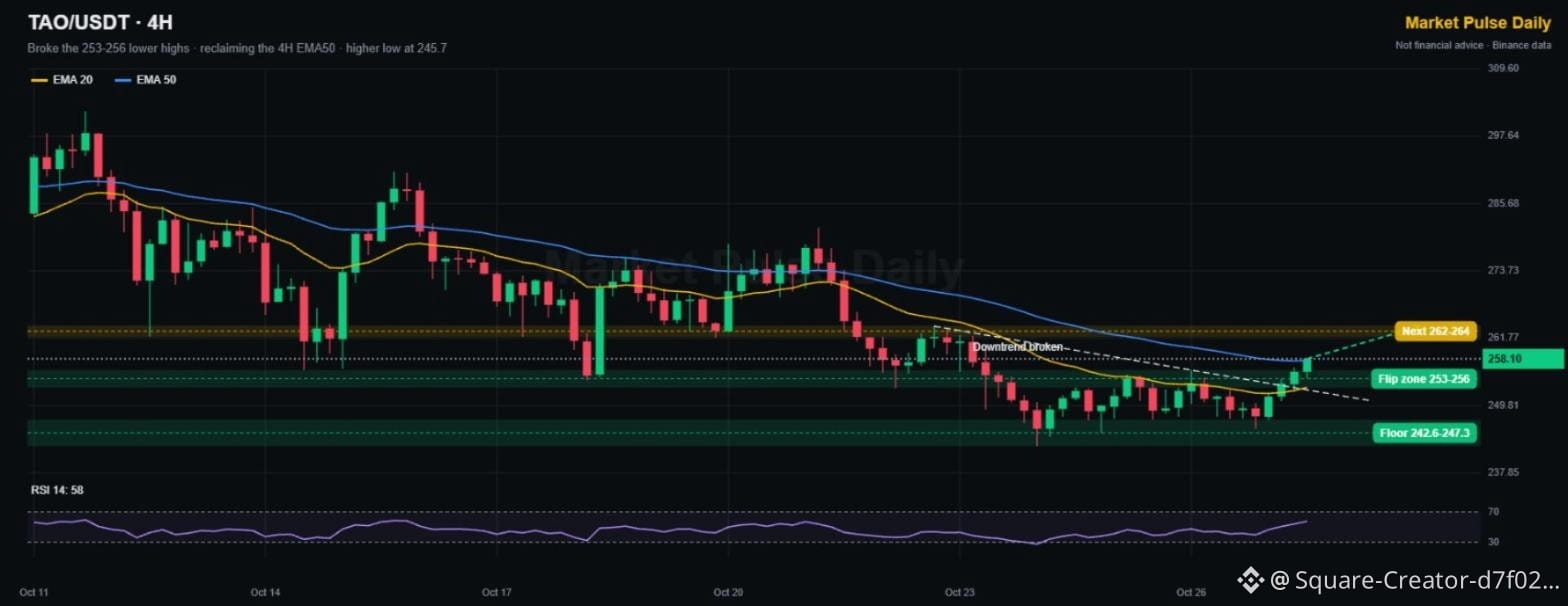
$TAO just broke its downtrend line 🧠
Bittensor made a higher low at 245.7, then pushed through the 253-256 lower highs that capped it since Oct 22. It's now pressing the 4H EMA50 at about 258, with RSI 58 and rising.
🟢 Flip zone: 253-256
🟢 Floor: 242.6-247.3
🎯 Next: 262-264
A 4H close above the EMA50 confirms the turn. Back under 253 and it's a fakeout.
👉 Tap $TAO
for the live chart. NFA
Is decentralized AI the play into earnings week? 👇
#Bittensor #AIcrypto #CanMicrosoftDeliverOnAI
No Binance account yet? Get 20% of your trading fees back 👉 [Sign up on Binance](https://www.binance.com/register?ref=TGCSTKKM)
{spot}(TAOUSDT)
$TAO just broke its downtrend line 🧠
Bittensor made a higher low at 245.7, then pushed through the 253-256 lower highs that capped it since Oct 22. It's now pressing the 4H EMA50 at about 258, with RSI 58 and rising.
🟢 Flip zone: 253-256
🟢 Floor: 242.6-247.3
🎯 Next: 262-264
A 4H close above the EMA50 confirms the turn. Back under 253 and it's a fakeout.
👉 Tap $TAO
for the live chart. NFA
Is decentralized AI the play into earnings week? 👇
#Bittensor #AIcrypto #CanMicrosoftDeliverOnAI
No Binance account yet? Get 20% of your trading fees back 👉 Sign up on Binance
71

·
--
$TAO October 28 close: 257.40 (+0.63%); spot price around 251
Binance Spot closed at 257.40 USDT, up from 255.80 the previous day (+0.63%); intraday high 262.40, low 250.60; trading volume around 45,000 TAO (about +14%)
Multiple sources put the spot price around 251 on the evening of the 29th, down about 1.9% over 24 hours; the next areas to watch are EMA25/99 (around 252–253) and the intraday low of 245
#Bittensor #TAO #Crypto #AI
69
🧠 $TAO : LOOK BEYOND THE PRICE CHART.
Bittensor is developing an increasingly competitive ecosystem for decentralized AI.
Recent developments include:
🔹 An expansion of subnet participant capacity from 256 to 2,500.
🔹 The eTAO upgrade, allowing subnet owners greater flexibility in allocating token emissions.
🔹 Continued growth and competition among specialized AI subnets.
These developments matter because decentralized AI needs more than a compelling narrative.
It needs useful products, competitive performance, sustainable incentives, and real demand.
📉 THE MARKET REALITY
$TAO traded around $250–$253 in recent market snapshots, following a weekly decline of roughly 6.7%.
The technology narrative remains interesting, but price weakness and subdued trading activity suggest that buyers have yet to establish convincing momentum.
The goal isn’t to predict every move.
It’s to recognize when the evidence begins supporting the thesis.
#TAO #Bittensor #DeAI #MannequinCrypto
1
300
·
--
$TAO 10 Month 27 close: 255.80 (+1.75%); spot around 255–256
Binance Spot closed at 255.80 USDT, up from 251.40 the previous day (+1.75%); intraday high 256.50, low 245.70; trading volume around 39,400 TAO / around 9.865 million USDT (volume approximately -6.35%)
Evening spot around 255–256; 24h high around 259–260, low around 247; next levels to watch are around 256.50 / 259.70
#Bittensor #TAO #Crypto #AI
66
·
--
Close on the 26th of month $TAO 10: 251.40 (-0.67%); spot around 248–249
Binance Spot close: 251.40 USDT, down 0.67% from the previous day’s 253.10; intraday high 256.10, low 247.30; trading volume about 42,000 coins (+23.72%)
Evening spot around 248.8; the next area to watch is around 245–247, near the intraday low and the 200-day moving average
#Bittensor #TAO #Crypto #AI
63

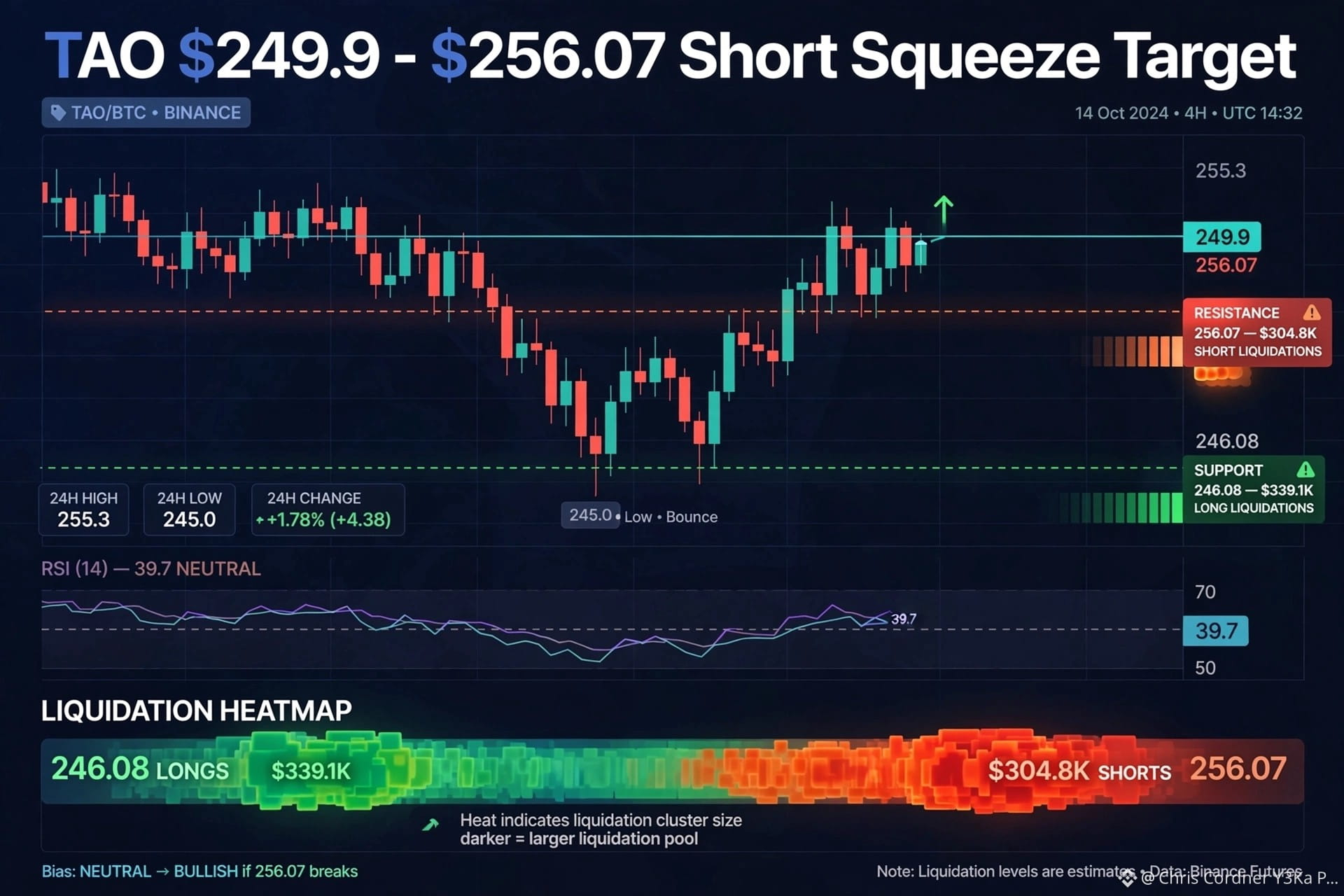
🚨 TAO $249.9 BOUNCING — $245 LOW SWEPT, $304K SHORTS AT $256.07 NEXT? 🚨
$TAO just bounced from $245.0 to $249.9 (+1.78%) — low swept, shorts next.
Live data Mon 10AM EAT Oct 26:
- Spot: $249.9 (+1.05%)
- Today: High $255.3 / Low $245.0
- OI: $373.9M (leverage building)
- 24h Vol: $219.8M
- Longs Rekt 24h: $77.6K
- Shorts Rekt 24h: $41.7K
Liquidation map RIGHT NOW:
- ABOVE: $256.07 = $304.8K short cluster (2.5% away) — LARGEST SHORT FUEL
- BELOW: $246.08 = $339.1K long cluster (1.5% away) — just swept at $245
- Spot bias: $3.2M shorts above vs $3.7M longs below — balanced, breakout incoming
Translation: Long liquidity at $246.08 / $245 taken, price bounced $5. Now path of least resistance is UP to $256.07 where $304.8K shorts get REKT.
I'm LONG $249.9 add $246.08 SL $244 TP1 $256.07 TP2 $260
RSI 39.7 neutral -> bullish reversal. Close 4H above $250 = squeeze to $256.07 FAST. Lose $246.08 we see $242.
👇 VOTE: Does TAO squeeze $256.07 today or retest $246.08 first? LONG or SHORT here? I reply to ALL!
#TAO #bittensor #crypto
1
2
273

·
--
$TAO bears are celebrating a 0.08% dip. That’s the tell.
Price is $252.10, with $9.22M traded, but this isn’t real panic. RSI sits at 43, volume is basically 0.0x its 20d average, and the 4h move is only -0.1%. Weak hands love that. 🥱
Yes, TAO is below the 20d and 50d MAs, while longs are paying 0.005% funding. Still, compared with $BTC, this looks more like neglect than capitulation.
At $250, I’d hold my line and watch for a reclaim, not chase strength. @taboracoin is boring right before it gets interesting. ⚡
#Bittensor #AI
$TAO bears are celebrating a 0.08% dip. That’s the tell.
Price is $252.10, with $9.22M traded, but this isn’t real panic. RSI sits at 43, volume is basically 0.0x its 20d average, and the 4h move is only -0.1%. Weak hands love that. 🥱
Yes, TAO is below the 20d and 50d MAs, while longs are paying 0.005% funding. Still, compared with $BTC , this looks more like neglect than capitulation.
At $250, I’d hold my line and watch for a reclaim, not chase strength. @taboracoin is boring right before it gets interesting. ⚡
#Bittensor #AI
52

🤖 AI hype is back: where to catch $TAO (Bittensor)?
While the market is getting bored, the artificial intelligence sector is gathering strength.
The main beneficiary of the trend — $TAO — is showing a clear structure. Buying a breakout above the highs is risky; we’re trading off support.
📊 Technical levels and strategy:
• Key support: $410–$440 (a strong historical buyer zone).
• Target (Take Profit): First take-profit at $680–$700 (the upper boundary of the global range).
• Strategy: Build a position with limit orders during local market dips. Be sure to place a stop-loss below the local low ($390).
🛑 Risk management:
The token is highly volatile, so keep your position size under control.
While waiting for your orders to fill, park your idle stablecoins in Binance Simple Earn so your capital can generate returns.
Do you believe in AI tokens, or is this just another bubble?
Share your thoughts! 👇
#TAO #bittensor #CryptoAi #TechnicalAnalysis
{future}(TAOUSDT)
🤖 AI hype is back: where to catch $TAO (Bittensor)?
While the market is getting bored, the artificial intelligence sector is gathering strength.
The main beneficiary of the trend — $TAO — is showing a clear structure. Buying a breakout above the highs is risky; we’re trading off support.
📊 Technical levels and strategy:
• Key support: $410–$440 (a strong historical buyer zone).
• Target (Take Profit): First take-profit at $680–$700 (the upper boundary of the global range).
• Strategy: Build a position with limit orders during local market dips. Be sure to place a stop-loss below the local low ($390).
🛑 Risk management:
The token is highly volatile, so keep your position size under control.
While waiting for your orders to fill, park your idle stablecoins in Binance Simple Earn so your capital can generate returns.
Do you believe in AI tokens, or is this just another bubble?
Share your thoughts! 👇
#TAO #bittensor #CryptoAi #TechnicalAnalysis
135
Log in to explore more content
Join global crypto users on Binance Square
⚡️ Get latest and useful information about crypto.
💬 Trusted by the world’s largest crypto exchange.
👍 Discover real insights from verified creators.
Email / Phone number
Trending Topics
1
#FBIConfirmsNorthKoreaIsResponsibleForBinanceCryptoHack
32 views
7 Discussing
2
#BinanceSAFUFundTransferCompleted7499BTC
43,831 views
879 Discussing
3
#BinanceRecovery90% of stolen assets
147,342 views
181 Discussing
4
#YiHe:ProofOfReserves:10TokensAt100%Backing
145,222 views
795 Discussing
5
#BackedNotBroken:RichardTengSaysUsersBearNoLoss
46,439 views
500 Discussing
6
#B14gReportsUnauthorizedTransferOfAbout97MCORE
194 views
13 Discussing
7
#USSpotETHETFsPost23StraightDaysOfNetOutflows
19 views
10 Discussing
8
#CZSaysCompensationIsinPlaceUsersAreProtected
132,610 views
1,415 Discussing
9
#IntelHasItsWorstDaySince1974
51,102 views
725 Discussing
10
#TRMCambodianCasinosReceived$1.07BInCrypto
14,253 views
75 Discussing