
#seastock
seastock
14,260 නැරඹීම්
269 සාකච්ඡා කරමින්
උණුසුම්
නවතම

·
--
ලිපිය
From Crypto to Stocks: Expand Your Investment Journey with Binance@BinanceBurmese
#SEAstock
#SEABstock
As digital asset ecosystems evolve, cryptocurrency investors are increasingly seeking strategies to diversify their financial holdings and reduce concentrated market volatility. While crypto assets provide innovative financial utilities, high-growth potential, and decentralized mechanics, integrating traditional financial instruments—such as US Stocks—offers a powerful way to stabilize long-term portfolio growth. Binance provides an exceptional platform for global investors to seamlessly bridge the gap between blockchain-based investments and traditional equity markets through resources, trading tools, and educational frameworks like BStocks. Transitioning from crypto to stocks is not merely about spreading risk; it represents a foundational shift toward building comprehensive, resilient, and multi-asset wealth.
Understanding the fundamental mechanics that separate traditional stock markets from cryptocurrency markets is essential for any modern investor seeking a balanced asset structure. The cryptocurrency market operates continuously—24 hours a day, 7 days a week, 365 days a year—leading to intense price volatility over short timeframes. Conversely, traditional US stock markets operate within standard business hours on weekdays. Stocks generally exhibit less extreme intraday price swings compared to lower-cap crypto tokens, providing a calmer investment environment for conservative asset allocators.
Furthermore, crypto assets often derive value from protocol utility, network activity, adoption rates, and general market sentiment. In contrast, corporate stocks reflect direct ownership in established real-world corporations. Their valuations depend on audited revenues, quarterly earnings reports, corporate management strategies, and physical or intellectual property. Additionally, crypto assets generate passive yield through staking, lending, or liquidity provisioning. Traditional stocks provide income through dividend payments—a portion of company profits distributed directly to shareholders on a regular, predictable schedule. By combining both asset classes into a unified investment model, investors can capture the high-growth potential of digital finance while maintaining the steady, audited stability of traditional corporations.
If you are ready to transition your mindset from pure crypto trading to stock market investing, follow a disciplined beginner framework:
Master Fundamental Terminology: Familiarize yourself with key financial metrics such as Market Capitalization, Price-to-Earnings (P/E) Ratio, Dividend Yield, Earnings Per Share (EPS), and Debt-to-Equity ratios.
Monitor Global Macroeconomic News: Keep track of major economic announcements, including Federal Reserve interest rate policy changes, Consumer Price Index (CPI) inflation metrics, and major corporate earnings releases.
Utilize Binance Square Educational Hubs: Explore guided articles, market insights, and community discussions directly on Binance Square to learn how equities, tokenized assets, and broad financial markets interact.
Implement Disciplined Portfolio Sizing: Avoid over-concentrating capital into a single stock or token. Allocate capital across diverse sectors—such as technology, healthcare, energy, and consumer goods—to insulate yourself against sudden sector-specific downturns.
In this context, BStocks serve as a vital link connecting Web3 users with global equity markets directly within the Binance ecosystem. Acquiring full shares of top-tier US corporations like Apple, Microsoft, or Nvidia can require substantial upfront capital. BStocks frameworks enable fractional share exposure, allowing investors to purchase small fractions of high-value stock shares according to their budget limits starting from small amounts. Rather than managing disparate accounts across traditional brokers, users can analyze, track, and manage their multi-asset trajectory directly within the Binance interface. This integration provides enhanced liquidity and convenience, making it easy for Web3 users to reallocate profits between crypto assets and traditional equity markets in just a few clicks. However, thorough fundamental analysis (DYOR) is just as necessary in stock markets as it is in crypto. Always review corporate debt levels, quarterly guidance, competitive moat, and market positioning before committing capital.
Beginning a financial journey in cryptocurrency teaches valuable lessons in chart reading, risk assessment, and market timing. However, learning about stock market fundamentals through Binance opens up a deeper perspective on global macroeconomic cycles. Allocating capital across both digital assets and equities balances overall portfolio volatility while building lasting financial discipline. Combining tech-forward crypto exposure with time-tested equity investments creates a robust financial foundation for long-term wealth accumulation. Expanding your investment perspective from cryptocurrency to US Stocks represents a meaningful milestone in financial maturity. Leverage the power of Binance Square to access high-quality educational content, stay informed on market updates, and take calculated steps toward multi-asset investment success today.Thank You.
$TSMB
From Crypto to Stocks: Expand Your Investment Journey with Binance
@Binance Burmese
#SEAstock
#SEABstock
As digital asset ecosystems evolve, cryptocurrency investors are increasingly seeking strategies to diversify their financial holdings and reduce concentrated market volatility. While crypto assets provide innovative financial utilities, high-growth potential, and decentralized mechanics, integrating traditional financial instruments—such as US Stocks—offers a powerful way to stabilize long-term portfolio growth. Binance provides an exceptional platform for global investors to seamlessly bridge the gap between blockchain-based investments and traditional equity markets through resources, trading tools, and educational frameworks like BStocks. Transitioning from crypto to stocks is not merely about spreading risk; it represents a foundational shift toward building comprehensive, resilient, and multi-asset wealth.
Understanding the fundamental mechanics that separate traditional stock markets from cryptocurrency markets is essential for any modern investor seeking a balanced asset structure. The cryptocurrency market operates continuously—24 hours a day, 7 days a week, 365 days a year—leading to intense price volatility over short timeframes. Conversely, traditional US stock markets operate within standard business hours on weekdays. Stocks generally exhibit less extreme intraday price swings compared to lower-cap crypto tokens, providing a calmer investment environment for conservative asset allocators.
Furthermore, crypto assets often derive value from protocol utility, network activity, adoption rates, and general market sentiment. In contrast, corporate stocks reflect direct ownership in established real-world corporations. Their valuations depend on audited revenues, quarterly earnings reports, corporate management strategies, and physical or intellectual property. Additionally, crypto assets generate passive yield through staking, lending, or liquidity provisioning. Traditional stocks provide income through dividend payments—a portion of company profits distributed directly to shareholders on a regular, predictable schedule. By combining both asset classes into a unified investment model, investors can capture the high-growth potential of digital finance while maintaining the steady, audited stability of traditional corporations.
If you are ready to transition your mindset from pure crypto trading to stock market investing, follow a disciplined beginner framework:
Master Fundamental Terminology: Familiarize yourself with key financial metrics such as Market Capitalization, Price-to-Earnings (P/E) Ratio, Dividend Yield, Earnings Per Share (EPS), and Debt-to-Equity ratios.
Monitor Global Macroeconomic News: Keep track of major economic announcements, including Federal Reserve interest rate policy changes, Consumer Price Index (CPI) inflation metrics, and major corporate earnings releases.
Utilize Binance Square Educational Hubs: Explore guided articles, market insights, and community discussions directly on Binance Square to learn how equities, tokenized assets, and broad financial markets interact.
Implement Disciplined Portfolio Sizing: Avoid over-concentrating capital into a single stock or token. Allocate capital across diverse sectors—such as technology, healthcare, energy, and consumer goods—to insulate yourself against sudden sector-specific downturns.
In this context, BStocks serve as a vital link connecting Web3 users with global equity markets directly within the Binance ecosystem. Acquiring full shares of top-tier US corporations like Apple, Microsoft, or Nvidia can require substantial upfront capital. BStocks frameworks enable fractional share exposure, allowing investors to purchase small fractions of high-value stock shares according to their budget limits starting from small amounts. Rather than managing disparate accounts across traditional brokers, users can analyze, track, and manage their multi-asset trajectory directly within the Binance interface. This integration provides enhanced liquidity and convenience, making it easy for Web3 users to reallocate profits between crypto assets and traditional equity markets in just a few clicks. However, thorough fundamental analysis (DYOR) is just as necessary in stock markets as it is in crypto. Always review corporate debt levels, quarterly guidance, competitive moat, and market positioning before committing capital.
Beginning a financial journey in cryptocurrency teaches valuable lessons in chart reading, risk assessment, and market timing. However, learning about stock market fundamentals through Binance opens up a deeper perspective on global macroeconomic cycles. Allocating capital across both digital assets and equities balances overall portfolio volatility while building lasting financial discipline. Combining tech-forward crypto exposure with time-tested equity investments creates a robust financial foundation for long-term wealth accumulation. Expanding your investment perspective from cryptocurrency to US Stocks represents a meaningful milestone in financial maturity. Leverage the power of Binance Square to access high-quality educational content, stay informed on market updates, and take calculated steps toward multi-asset investment success today.Thank You.
$TSMB
7
1
6
223

·
--

ලිපිය
Crypto ရဲ့ Volatility ကို ကြောက်နေပြီလား။ BStocks နဲ့ ဘယ်လို Balance လုပ်မလဲ ?Crypto ရဲ့ Volatility ကို ကြောက်နေပြီလား။ BStocks နဲ့ ဘယ်လို Balance လုပ်မလဲ
ကရစ်ပတို (Crypto) စျေးကွက်မှာ ကျင်လည်နေတဲ့ Trader တိုင်း၊ Investor တိုင်း စိတ်လှုပ်ရှားဖွယ် အခွင့်အလမ်းတွေနဲ့အတူ စျေးနှုန်း အတက်အကျ ကြမ်းလွန်းတဲ့ Volatility ကိုပါ ရင်ဆိုင်ကြရပါတယ်။ Crypto စျေးကွက်က မြန်ဆန်တဲ့ ဆုံးဖြတ်ချက်၊ စျေးကွက် စိတ်ဓာတ် လေ့လာဆန်းစစ်မှုနဲ့ Risk Management တွေကို သင်ကြားပေးတာ မှန်ပေမဲ့ ရေရှည်မှာ ဘဏ္ဍာရေး တည်ငြိမ်ဖို့ဆိုတာ ပိုင်ဆိုင်မှုတွေကို ခွဲဝေ ရင်းနှီးမြှုပ်နှံခြင်း (Portfolio Diversification) အပေါ်မှာ အများကြီး မူတည်နေပါတယ်။
အကျ လွန်လွန်းတဲ့ ရက်တွေမှာ စိတ်အေးအေးထားနိုင်ဖို့နဲ့ ကိုယ့်ရဲ့ Portfolio တန်ဖိုး တည်ငြိမ်နေစေဖို့အတွက် Binance BStocks က ဘယ်လို ကူညီပေးနိုင်မလဲ။
💡 ၁။ Crypto ရဲ့ High Risk ကို US Stocks နဲ့ Balance လုပ်ပါ
Crypto က High Risk - High Reward (အန္တရာယ်များပြီး အမြတ်များနိုင်တာ) ဖြစ်ပေမဲ့ US Stocks (အမေရိကန် စတော့များ) ကတော့ ယေဘုယျအားဖြင့် စျေးနှုန်း အတက်အကျ သက်သာပြီး တည်ငြိမ်မှု ပိုရှိပါတယ်။ BStocks မှတစ်ဆင့် US Stocks တွေမှာပါ ခွဲဝေ ရင်းနှီးမြှုပ်နှံထားခြင်းဖြင့် Crypto စျေးကွက် ထိုးကျနေချိန်မှာတောင် ကိုယ့် Portfolio တစ်ခုလုံး ပျက်စီးမသွားအောင် ထိန်းညှိ (Balance) ပေးထားနိုင်ပါတယ်။
🌍 ၂။ ရှုပ်ထွေးတဲ့ လုပ်ငန်းစဉ်တွေ မလိုတော့ပါဘူး
အရင်က အရှေ့တောင်အာရှနဲ့ ကမ္ဘာတစ်ဝန်းက Crypto သုံးစွဲသူတွေအတွက် အမေရိကန် စတော့စက်ဝိုင်းထဲ ဝင်ရောက်ဖို့ဆိုတာ နယ်စပ်ဖြတ်ကျော် ငွေလွှဲတာတွေ၊ ဘဏ် လုပ်ငန်းစဉ် အဆင့်ဆင့်နဲ့ အလွန် ရှုပ်ထွေးခဲ့ပါတယ်။ အခု Binance BStocks နဲ့ဆိုရင်တော့ Crypto Ecosystem ထဲကနေပဲ US Stocks တွေကို လွယ်လွယ်ကူကူ ချိတ်ဆက် ဝယ်ယူနိုင်တော့မှာ ဖြစ်ပါတယ်။
🎯 ၃။ ရေရှည် ဘဏ္ဍာရေး ခိုင်မာမှု (Long-term Growth)
ဝါရင့် ရင်းနှီးမြှုပ်နှံသူတိုင်း ကျင့်သုံးတဲ့ ရေရှည် အောင်မြင်ရေး ဗျူဟာကတော့ "ကြက်ဥအားလုံးကို ခြင်းတောင်းတစ်ခုတည်းမှာ မထည့်ဖို့" ပါပဲ။ BStocks ဟာ Crypto နဲ့ ရိုးရာ စတော့စျေးကွက် ကြားက တံတားတစ်စင်း ဖြစ်တာကြောင့် ကိုယ့်ရဲ့ အမြတ်အစဉ်တွေကို ပိုမို ခိုင်မာတဲ့ စတော့အကောင့်တွေဆလို ပြောင်းရွှေ့ သိမ်းဆည်းဖို့ အကောင်းဆုံး နည်းလမ်းတစ်ခု ဖြစ်ပါတယ်။
နိဂုံးချုပ်
Crypto စျေးကွက်ရဲ့ အတက်အကျတွေကို ကြောက်နေမယ့်အစား Binance BStocks နဲ့ သင့်ရဲ့ ရင်းနှီးမြှုပ်နှံမှုတွေကို စမတ်ကျကျ Balance လုပ်ပြီး လုံခြုံစိတ်ချရတဲ့ ဘဏ္ဍာရေး အနာဂတ်ကို အခုပဲ စတင် တည်ဆောက်လိုက်ပါ။ 🚀
@BinanceBurmese
#BinanceSquare
#bstock
#SEAstock
#SEABstock
Crypto ရဲ့ Volatility ကို ကြောက်နေပြီလား။ BStocks နဲ့ ဘယ်လို Balance လုပ်မလဲ ?
Crypto ရဲ့ Volatility ကို ကြောက်နေပြီလား။ BStocks နဲ့ ဘယ်လို Balance လုပ်မလဲ
ကရစ်ပတို (Crypto) စျေးကွက်မှာ ကျင်လည်နေတဲ့ Trader တိုင်း၊ Investor တိုင်း စိတ်လှုပ်ရှားဖွယ် အခွင့်အလမ်းတွေနဲ့အတူ စျေးနှုန်း အတက်အကျ ကြမ်းလွန်းတဲ့ Volatility ကိုပါ ရင်ဆိုင်ကြရပါတယ်။ Crypto စျေးကွက်က မြန်ဆန်တဲ့ ဆုံးဖြတ်ချက်၊ စျေးကွက် စိတ်ဓာတ် လေ့လာဆန်းစစ်မှုနဲ့ Risk Management တွေကို သင်ကြားပေးတာ မှန်ပေမဲ့ ရေရှည်မှာ ဘဏ္ဍာရေး တည်ငြိမ်ဖို့ဆိုတာ ပိုင်ဆိုင်မှုတွေကို ခွဲဝေ ရင်းနှီးမြှုပ်နှံခြင်း (Portfolio Diversification) အပေါ်မှာ အများကြီး မူတည်နေပါတယ်။
အကျ လွန်လွန်းတဲ့ ရက်တွေမှာ စိတ်အေးအေးထားနိုင်ဖို့နဲ့ ကိုယ့်ရဲ့ Portfolio တန်ဖိုး တည်ငြိမ်နေစေဖို့အတွက် Binance BStocks က ဘယ်လို ကူညီပေးနိုင်မလဲ။
💡 ၁။ Crypto ရဲ့ High Risk ကို US Stocks နဲ့ Balance လုပ်ပါ
Crypto က High Risk - High Reward (အန္တရာယ်များပြီး အမြတ်များနိုင်တာ) ဖြစ်ပေမဲ့ US Stocks (အမေရိကန် စတော့များ) ကတော့ ယေဘုယျအားဖြင့် စျေးနှုန်း အတက်အကျ သက်သာပြီး တည်ငြိမ်မှု ပိုရှိပါတယ်။ BStocks မှတစ်ဆင့် US Stocks တွေမှာပါ ခွဲဝေ ရင်းနှီးမြှုပ်နှံထားခြင်းဖြင့် Crypto စျေးကွက် ထိုးကျနေချိန်မှာတောင် ကိုယ့် Portfolio တစ်ခုလုံး ပျက်စီးမသွားအောင် ထိန်းညှိ (Balance) ပေးထားနိုင်ပါတယ်။
🌍 ၂။ ရှုပ်ထွေးတဲ့ လုပ်ငန်းစဉ်တွေ မလိုတော့ပါဘူး
အရင်က အရှေ့တောင်အာရှနဲ့ ကမ္ဘာတစ်ဝန်းက Crypto သုံးစွဲသူတွေအတွက် အမေရိကန် စတော့စက်ဝိုင်းထဲ ဝင်ရောက်ဖို့ဆိုတာ နယ်စပ်ဖြတ်ကျော် ငွေလွှဲတာတွေ၊ ဘဏ် လုပ်ငန်းစဉ် အဆင့်ဆင့်နဲ့ အလွန် ရှုပ်ထွေးခဲ့ပါတယ်။ အခု Binance BStocks နဲ့ဆိုရင်တော့ Crypto Ecosystem ထဲကနေပဲ US Stocks တွေကို လွယ်လွယ်ကူကူ ချိတ်ဆက် ဝယ်ယူနိုင်တော့မှာ ဖြစ်ပါတယ်။
🎯 ၃။ ရေရှည် ဘဏ္ဍာရေး ခိုင်မာမှု (Long-term Growth)
ဝါရင့် ရင်းနှီးမြှုပ်နှံသူတိုင်း ကျင့်သုံးတဲ့ ရေရှည် အောင်မြင်ရေး ဗျူဟာကတော့ "ကြက်ဥအားလုံးကို ခြင်းတောင်းတစ်ခုတည်းမှာ မထည့်ဖို့" ပါပဲ။ BStocks ဟာ Crypto နဲ့ ရိုးရာ စတော့စျေးကွက် ကြားက တံတားတစ်စင်း ဖြစ်တာကြောင့် ကိုယ့်ရဲ့ အမြတ်အစဉ်တွေကို ပိုမို ခိုင်မာတဲ့ စတော့အကောင့်တွေဆလို ပြောင်းရွှေ့ သိမ်းဆည်းဖို့ အကောင်းဆုံး နည်းလမ်းတစ်ခု ဖြစ်ပါတယ်။
နိဂုံးချုပ်
Crypto စျေးကွက်ရဲ့ အတက်အကျတွေကို ကြောက်နေမယ့်အစား Binance BStocks နဲ့ သင့်ရဲ့ ရင်းနှီးမြှုပ်နှံမှုတွေကို စမတ်ကျကျ Balance လုပ်ပြီး လုံခြုံစိတ်ချရတဲ့ ဘဏ္ဍာရေး အနာဂတ်ကို အခုပဲ စတင် တည်ဆောက်လိုက်ပါ။ 🚀
@Binance Burmese
#BinanceSquare
#bstock
#SEAstock
#SEABstock
41
2
42
160

·
--
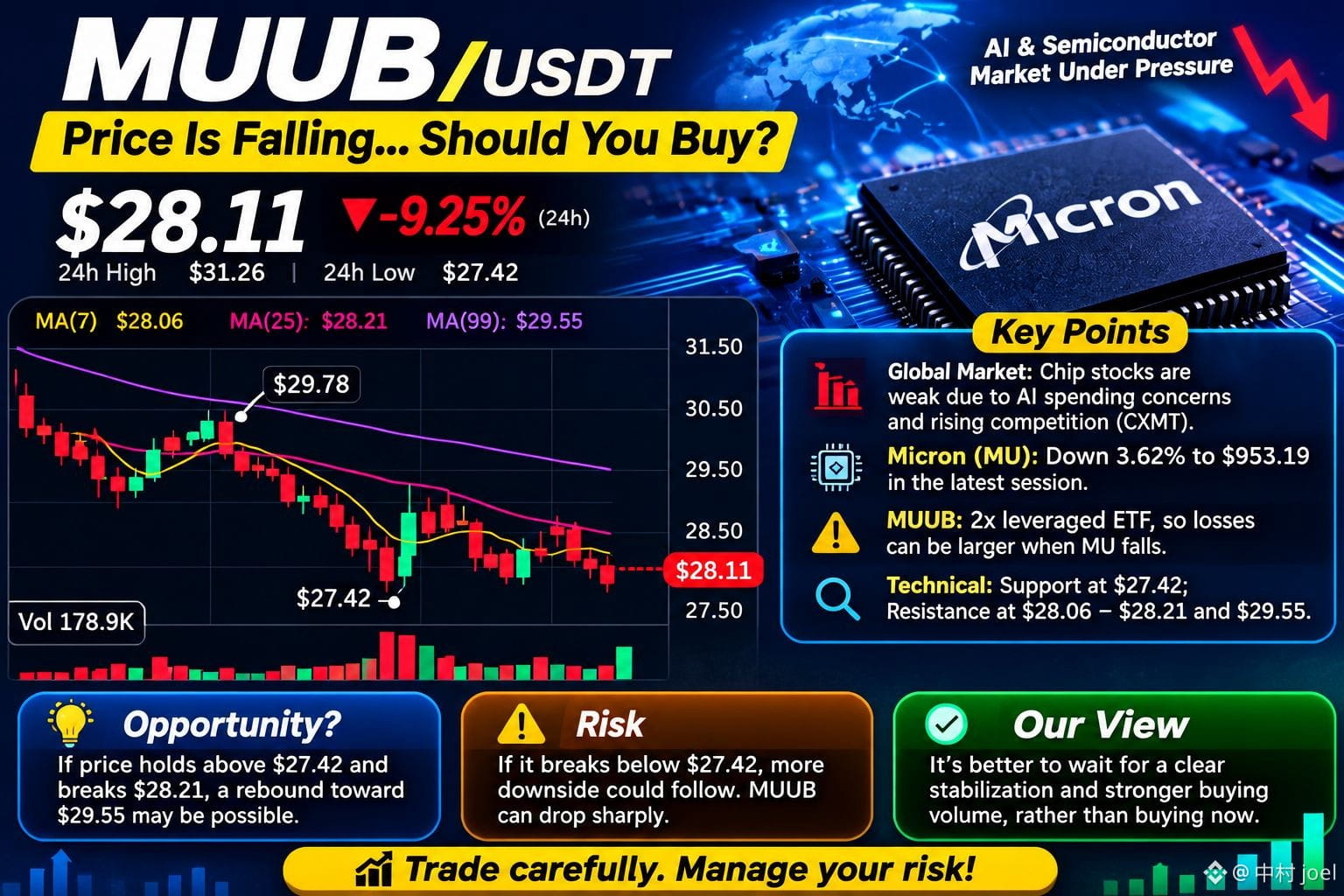
The global market is seeing growing investor concerns about the technology and AI sectors. In particular, reports about Chinese company CXMT’s advances in memory-chip technology have raised concerns about intensifying competition in the industry. This pressure is affecting semiconductor stocks, including Micron (MU).
On Binance, MUUB represents the Direxion MU Bull 2X ETF (bStocks). It is designed to target twice Micron’s daily stock-price performance. This means that when Micron’s stock falls, MUUB could experience even sharper losses. However, holding MUUB for the long term does not guarantee twice Micron’s returns because daily rebalancing can affect its performance over time.
Based on the latest available market data, MUUB is facing selling pressure, so it may be too early to assume that a rebound is coming. A falling price alone does not necessarily mean it is a good buying opportunity. It is important to watch for signs that selling pressure is easing, the price is stabilizing near support, and buying momentum is returning.
In my view, rather than buying immediately just because the price has dropped, it may be wiser to wait for clearer signs of stabilization and recovery. If you decide to trade, always determine how much you can afford to lose and manage your risk carefully.
What do you think about MUUB? 🤔 Do you expect a rebound, or could the price fall even further?
$MUU
$MUUB
@BinanceBurmese
#SEAstock
#BStocks
#Stocks
#Binance
The global market is seeing growing investor concerns about the technology and AI sectors. In particular, reports about Chinese company CXMT’s advances in memory-chip technology have raised concerns about intensifying competition in the industry. This pressure is affecting semiconductor stocks, including Micron (MU).
On Binance, MUUB represents the Direxion MU Bull 2X ETF (bStocks). It is designed to target twice Micron’s daily stock-price performance. This means that when Micron’s stock falls, MUUB could experience even sharper losses. However, holding MUUB for the long term does not guarantee twice Micron’s returns because daily rebalancing can affect its performance over time.
Based on the latest available market data, MUUB is facing selling pressure, so it may be too early to assume that a rebound is coming. A falling price alone does not necessarily mean it is a good buying opportunity. It is important to watch for signs that selling pressure is easing, the price is stabilizing near support, and buying momentum is returning.
In my view, rather than buying immediately just because the price has dropped, it may be wiser to wait for clearer signs of stabilization and recovery. If you decide to trade, always determine how much you can afford to lose and manage your risk carefully.
What do you think about MUUB? 🤔 Do you expect a rebound, or could the price fall even further?
$MUU
$MUUB
@Binance Burmese
#SEAstock
#BStocks
#Stocks
#Binance
1
310

Understanding the Market Before Making a DecisionThe financial market is always changing. Some days are exciting, while other days remind us that every market comes with uncertainty and risk.
For people who are interested in both Crypto and BStocks, learning how different markets work can be a valuable part of financial education. 📚
🔹 Research before you act
Before considering an asset, learn what it represents, how it works, and what factors can affect its price.
🔹 Look beyond price movements
A price chart tells only part of the story. Company performance, economic conditions, interest rates, industry trends, liquidity, and market sentiment can all matter.
🔹 Understand risk
There is no guaranteed profit in investing. Prices can move up or down, and different assets have different levels of risk.
🔹 Don't follow FOMO
An asset becoming popular doesn't automatically mean it is suitable for everyone. Taking time to research can help reduce emotional decisions.
🔹 Build knowledge over time
You don't need to understand everything in one day. Small steps—learning about stocks, crypto, market cycles, and risk management—can gradually build stronger financial knowledge.
For me, the most important lesson is:
Don't invest because someone says “buy.”
Learn why an asset moves, understand the risks, and make your own informed decision. 💡
Whether you're exploring Crypto 🔶, Stocks 📈, or BStocks 🌍, keep learning and keep doing your own research.
📚 Learn. Research. Understand. Decide.
What are you learning about today? 👇
@BinanceBurmese
#Binance #BinanceSquare #Bstocks #SEABstock #SEAstock
⚠️ Disclaimer: This content is for educational purposes only and is not financial or investment advice. Investing involves risk, including possible loss of capital. Always conduct your own research and review the latest official product information before making any investment decision.
Understanding the Market Before Making a Decision
The financial market is always changing. Some days are exciting, while other days remind us that every market comes with uncertainty and risk.
For people who are interested in both Crypto and BStocks, learning how different markets work can be a valuable part of financial education. 📚
🔹 Research before you act
Before considering an asset, learn what it represents, how it works, and what factors can affect its price.
🔹 Look beyond price movements
A price chart tells only part of the story. Company performance, economic conditions, interest rates, industry trends, liquidity, and market sentiment can all matter.
🔹 Understand risk
There is no guaranteed profit in investing. Prices can move up or down, and different assets have different levels of risk.
🔹 Don't follow FOMO
An asset becoming popular doesn't automatically mean it is suitable for everyone. Taking time to research can help reduce emotional decisions.
🔹 Build knowledge over time
You don't need to understand everything in one day. Small steps—learning about stocks, crypto, market cycles, and risk management—can gradually build stronger financial knowledge.
For me, the most important lesson is:
Don't invest because someone says “buy.”
Learn why an asset moves, understand the risks, and make your own informed decision. 💡
Whether you're exploring Crypto 🔶, Stocks 📈, or BStocks 🌍, keep learning and keep doing your own research.
📚 Learn. Research. Understand. Decide.
What are you learning about today? 👇
@Binance Burmese
#Binance #BinanceSquare #Bstocks #SEABstock #SEAstock
⚠️ Disclaimer: This content is for educational purposes only and is not financial or investment advice. Investing involves risk, including possible loss of capital. Always conduct your own research and review the latest official product information before making any investment decision.
1
124

·
--
ලිපිය
BStocks 101: A Beginners Guide to Exploring US Stocks on BinanceFor many crypto users, the world of traditional stocks can feel unfamiliar at first. We are used to seeing crypto prices move 24/7, but the stock market works differently. With Binance introducing ways for users to explore Stocks and BStocks, this can be an interesting opportunity to learn about another major part of the financial market.
In this article, I want to explain some basic concepts about US Stocks and BStocks in a simple way for beginners.
What Are Stocks?
A stock represents an ownership intest in a company. When you buy shares of a public company, you are purchasing an investment linked to that company’s value and performance.
For example, companies such as Apple, Microsoft, Amazon, and other publicly traded businesses have shares that can be bought and sold in financial markets.
Stock prices can move because of many factors, including company earnings, economic data, interest rates, industry developments, investor expectations, and market sentiment.
This is one reason why learning the basics is important before putting money into any investment.
What Are BStocks?
BStocks are designed to provide users with access to stock-related products through the Binance ecosystem. For someone who is already familiar with Binance and crypto, having stock-related products available in a familiar environment may make it easier to begin learning about traditional markets.
However, beginners should still understand that Stocks and BStocks are not the same thing as buying cryptocurrency.
The underlying structure, trading hours, market behavior, risks, and product terms can be different. Before trading, users should always check the specific product information and eligibility available in their region.
Stocks vs Crypto: What Is Different?
One of the biggest differences is market hours.
Crypto markets generally operate 24 hours a day, seven days a week. Traditional US stock markets operate according to scheduled market hours, with holidays and other closures.
Another important difference is what drives the market.
Crypto prices can be strongly affected by market sentiment, liquidity, adoption, regulations, and developments within the crypto ecosystem. Stock prices are also influenced by sentiment, but company earnings, revenue, business growth, economic conditions, interest rates, and industry performance can play major roles.
Neither market should simply be considered “easy money.” Both involve risk.
What Should Beginners Learn First?
If you are a crypto user interested in exploring Stocks, I think a good starting point is education rather than immediately focusing on making profits.
Here are some useful things to learn:
Understand what a stock represents.Learn how stock prices move.Understand market orders and limit orders.Learn about market hours.Understand basic company financial information.Learn how earnings reports can affect prices.Understand the risks of volatility.Check fees, product terms, and eligibility before trading.Never use money you cannot afford to lose.Keep learning from reliable sources.
From Crypto to Stocks
Crypto users already have experience watching charts, understanding volatility, and following market news. Some of these skills can be useful when learning about Stocks, but they should not be applied blindly.
For example, a crypto trader may be comfortable watching support and resistance or studying price action. However, stock investors may also need to pay attention to company fundamentals, earnings, revenue, valuation, economic data, and sector performance.
This makes learning Stocks an opportunity to expand your financial knowledge rather than simply replacing one market with another.
My Takeaway
The most important lesson for me is that understanding an investment product should come before taking unnecessary risks. Whether someone is interested in Crypto, Stocks, or BStocks, learning how the product works is an important first step.
For beginners, the goal should not be to find a shortcut to profit. A better approach is to understand the market, learn how risks work, start carefully, and continue improving your knowledge.
If you are already a Binance user and curious about US Stocks, exploring educational resources about Stocks and BStocks can be a useful way to broaden your understanding of different financial markets.
Always do your own research and carefully review the specific product information before making any investment decision.
What do you think—would you be interested in learning about US Stocks alongside Crypto? 📈
@BinanceBurmese
#SEAstock #Binance #BStocks #Investing #FinancialEducation
BStocks 101: A Beginners Guide to Exploring US Stocks on Binance
For many crypto users, the world of traditional stocks can feel unfamiliar at first. We are used to seeing crypto prices move 24/7, but the stock market works differently. With Binance introducing ways for users to explore Stocks and BStocks, this can be an interesting opportunity to learn about another major part of the financial market.
In this article, I want to explain some basic concepts about US Stocks and BStocks in a simple way for beginners.
What Are Stocks?
A stock represents an ownership intest in a company. When you buy shares of a public company, you are purchasing an investment linked to that company’s value and performance.
For example, companies such as Apple, Microsoft, Amazon, and other publicly traded businesses have shares that can be bought and sold in financial markets.
Stock prices can move because of many factors, including company earnings, economic data, interest rates, industry developments, investor expectations, and market sentiment.
This is one reason why learning the basics is important before putting money into any investment.
What Are BStocks?
BStocks are designed to provide users with access to stock-related products through the Binance ecosystem. For someone who is already familiar with Binance and crypto, having stock-related products available in a familiar environment may make it easier to begin learning about traditional markets.
However, beginners should still understand that Stocks and BStocks are not the same thing as buying cryptocurrency.
The underlying structure, trading hours, market behavior, risks, and product terms can be different. Before trading, users should always check the specific product information and eligibility available in their region.
Stocks vs Crypto: What Is Different?
One of the biggest differences is market hours.
Crypto markets generally operate 24 hours a day, seven days a week. Traditional US stock markets operate according to scheduled market hours, with holidays and other closures.
Another important difference is what drives the market.
Crypto prices can be strongly affected by market sentiment, liquidity, adoption, regulations, and developments within the crypto ecosystem. Stock prices are also influenced by sentiment, but company earnings, revenue, business growth, economic conditions, interest rates, and industry performance can play major roles.
Neither market should simply be considered “easy money.” Both involve risk.
What Should Beginners Learn First?
If you are a crypto user interested in exploring Stocks, I think a good starting point is education rather than immediately focusing on making profits.
Here are some useful things to learn:
Understand what a stock represents.Learn how stock prices move.Understand market orders and limit orders.Learn about market hours.Understand basic company financial information.Learn how earnings reports can affect prices.Understand the risks of volatility.Check fees, product terms, and eligibility before trading.Never use money you cannot afford to lose.Keep learning from reliable sources.
From Crypto to Stocks
Crypto users already have experience watching charts, understanding volatility, and following market news. Some of these skills can be useful when learning about Stocks, but they should not be applied blindly.
For example, a crypto trader may be comfortable watching support and resistance or studying price action. However, stock investors may also need to pay attention to company fundamentals, earnings, revenue, valuation, economic data, and sector performance.
This makes learning Stocks an opportunity to expand your financial knowledge rather than simply replacing one market with another.
My Takeaway
The most important lesson for me is that understanding an investment product should come before taking unnecessary risks. Whether someone is interested in Crypto, Stocks, or BStocks, learning how the product works is an important first step.
For beginners, the goal should not be to find a shortcut to profit. A better approach is to understand the market, learn how risks work, start carefully, and continue improving your knowledge.
If you are already a Binance user and curious about US Stocks, exploring educational resources about Stocks and BStocks can be a useful way to broaden your understanding of different financial markets.
Always do your own research and carefully review the specific product information before making any investment decision.
What do you think—would you be interested in learning about US Stocks alongside Crypto? 📈
@Binance Burmese
#SEAstock #Binance #BStocks #Investing #FinancialEducation
1
85

·
--
ලිපිය
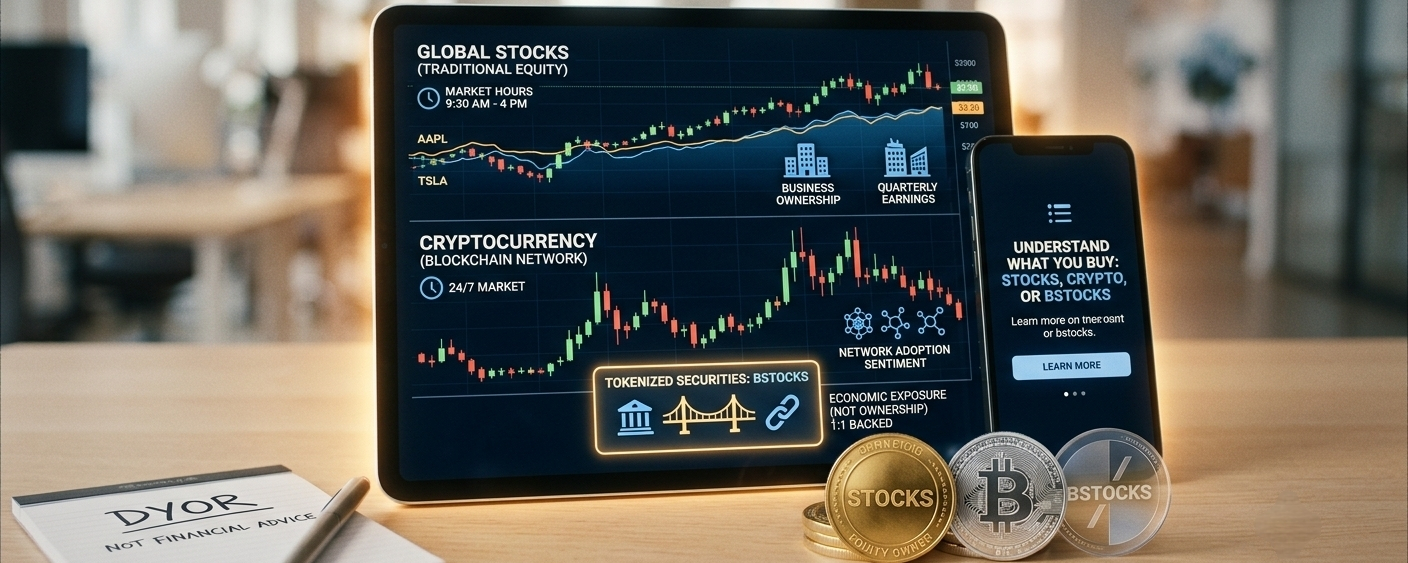
How are Stocks different from Crypto? Differences, risks, and opportunities 📈🪙If you already use crypto, you’ve probably noticed that stocks are becoming much easier to access through platforms like Binance. And honestly, at first glance, stocks and crypto can look very similar.
You see a price chart.
You choose an asset.
You buy it.
The price goes up or down.
So… are they really that different?
Yes. Quite a lot, actually.
But I don’t think the useful way to look at it is simply “Stocks are safe and crypto is risky.” Both can lose money, and both require you to understand what you’re buying.
The bigger difference is what the asset represents, how the market works, and what kind of risks you are taking.
🏢 First: What is a Stock?
A stock represents an ownership interest in a publicly traded company.
If you buy shares of a company through a traditional stock-market structure, your investment is connected to that company’s equity. Depending on the type of security and the arrangement, shareholders can have rights such as voting rights and rights related to dividends.
Stock prices are influenced by things that happen to the company and the wider economy.
For example:
• Company earnings
• Revenue growth
• New products
• Competition
• Interest rates
• Economic conditions
• Investor expectations
• Industry trends
That means when you buy a stock, you are essentially investing in the future performance of a business.
Of course, that doesn't mean a good company automatically means a good investment at every price. The market can change its expectations very quickly.
🪙 So how is Crypto different?
Crypto assets don't generally represent ownership in a traditional company.
Bitcoin, for example, isn't a share of a company. Its value isn't based on quarterly company earnings or ownership of a business.
Different crypto assets have different purposes and structures. Some are designed as networks, some as digital assets, some provide utility within an ecosystem, and some are connected to other applications.
The crypto market also operates differently from traditional stock markets.
Crypto markets are generally available 24/7, which is one reason crypto can feel so fast-moving. There is always another price movement, another piece of news, another token trending.
And this is where I think crypto users need to be careful.
Just because you can trade something 24/7 doesn't mean you need to trade it 24/7.
📊 The biggest difference: what moves the price?
This is probably one of the most useful things for someone moving from crypto into stocks to understand.
A stock's price is strongly connected to expectations about a company's future business performance.
Crypto prices can be influenced by many different factors, including network adoption, market liquidity, regulation, technology, sentiment, and supply and demand.
Both markets have speculation.
Both markets have volatility.
But the underlying structures are different.
That's why I wouldn't automatically apply the same thinking to a stock that I would use when looking at a crypto token.
⚠️ What about the risks?
This is where things become interesting.
Stocks have risks such as company-specific risk, economic risk, interest-rate risk and market risk. A company can report disappointing results, lose market share, face stronger competition, or simply become less attractive to investors.
Crypto has market volatility too, but there can also be additional risks connected to technology, custody, cybersecurity, regulation, liquidity and the particular design of an individual digital asset.
And there is another lesson I learned from using crypto:
The fact that something is available on an exchange doesn't automatically mean that I understand it.
That's true for both stocks and crypto.
Before buying something, I want to know what the asset actually represents.
🔗 Where do bStocks fit into this?
This is the part that I find particularly interesting.
Binance's bStocks are tokenized securities that provide exposure to selected underlying US equities. Binance says each bStock is backed 1:1 by the corresponding underlying US share held with a regulated custodian.
But there is an important detail here:
A bStock is not the same thing as directly owning the underlying company's stock.
Binance explicitly states that bStocks are not stocks or shares and don't give holders direct ownership or shareholder rights in the underlying company. Instead, they provide economic exposure to the underlying security.
So I think of bStocks as an interesting bridge between two worlds.
You have an underlying traditional financial asset, but its representation uses blockchain technology.
According to Binance, bStocks can also trade on Binance Spot 24/7 and can be withdrawn to compatible BNB Smart Chain wallets. Binance says fractional exposure can start from $5 for supported bStocks.
For someone who is already familiar with crypto wallets and blockchain transactions, this structure may feel more familiar than traditional stock infrastructure.
But familiar does not mean risk-free.
🧩 Stocks, Crypto and bStocks aren't interchangeable
This is probably the most important takeaway.
A traditional stock is not the same as a cryptocurrency.
A bStock is not the same as directly owning the underlying stock.
And a crypto user shouldn't assume that because an asset is traded on Binance, all three products work in the same way.
They don't.
They have different structures, different risks and potentially different rights.
For example, Binance notes that bStocks can have market, liquidity, issuer/custody, regulatory, technology and operational risks. Availability also depends on jurisdiction and user eligibility.
That's why reading the product information matters.
🌱 But there are opportunities too
The differences aren't only about risks.
Stocks give people a way to participate in the growth of publicly traded businesses.
Crypto gives users access to blockchain-based financial ecosystems that work differently from traditional markets.
And tokenized securities such as bStocks are an interesting development because they attempt to connect traditional financial exposure with blockchain infrastructure.
For crypto users, that creates an opportunity to learn about another asset class without completely leaving the environment they're already familiar with.
But I don't think the goal should be to choose between “Stocks vs Crypto” as if one has to replace the other.
The better question is:
Do I understand what I'm buying, and do I understand the risks involved?
💭 My biggest takeaway
When I first started learning about different financial markets, it was tempting to focus mainly on the price chart.
Green candle = good.
Red candle = bad.
But the more useful question is actually:
What is behind this price?
With a stock, look at the business.
With crypto, understand the asset, network and ecosystem.
With a tokenized security such as a bStock, understand both the underlying asset and the tokenized structure.
The chart only tells you what the market price is doing. It doesn't tell you everything about what you own.
That's why I think learning the differences between Stocks, Crypto and bStocks is more useful than simply asking which one will make more money.
Markets will always move.
The important part is knowing what you're actually holding when they do.
Not financial advice. Always do your own research and check the latest official product information, availability and applicable rules before making any financial decision.
@BinanceBurmese
#SEAstock
How are Stocks different from Crypto? Differences, risks, and opportunities 📈🪙
If you already use crypto, you’ve probably noticed that stocks are becoming much easier to access through platforms like Binance. And honestly, at first glance, stocks and crypto can look very similar.
You see a price chart.
You choose an asset.
You buy it.
The price goes up or down.
So… are they really that different?
Yes. Quite a lot, actually.
But I don’t think the useful way to look at it is simply “Stocks are safe and crypto is risky.” Both can lose money, and both require you to understand what you’re buying.
The bigger difference is what the asset represents, how the market works, and what kind of risks you are taking.
🏢 First: What is a Stock?
A stock represents an ownership interest in a publicly traded company.
If you buy shares of a company through a traditional stock-market structure, your investment is connected to that company’s equity. Depending on the type of security and the arrangement, shareholders can have rights such as voting rights and rights related to dividends.
Stock prices are influenced by things that happen to the company and the wider economy.
For example:
• Company earnings
• Revenue growth
• New products
• Competition
• Interest rates
• Economic conditions
• Investor expectations
• Industry trends
That means when you buy a stock, you are essentially investing in the future performance of a business.
Of course, that doesn't mean a good company automatically means a good investment at every price. The market can change its expectations very quickly.
🪙 So how is Crypto different?
Crypto assets don't generally represent ownership in a traditional company.
Bitcoin, for example, isn't a share of a company. Its value isn't based on quarterly company earnings or ownership of a business.
Different crypto assets have different purposes and structures. Some are designed as networks, some as digital assets, some provide utility within an ecosystem, and some are connected to other applications.
The crypto market also operates differently from traditional stock markets.
Crypto markets are generally available 24/7, which is one reason crypto can feel so fast-moving. There is always another price movement, another piece of news, another token trending.
And this is where I think crypto users need to be careful.
Just because you can trade something 24/7 doesn't mean you need to trade it 24/7.
📊 The biggest difference: what moves the price?
This is probably one of the most useful things for someone moving from crypto into stocks to understand.
A stock's price is strongly connected to expectations about a company's future business performance.
Crypto prices can be influenced by many different factors, including network adoption, market liquidity, regulation, technology, sentiment, and supply and demand.
Both markets have speculation.
Both markets have volatility.
But the underlying structures are different.
That's why I wouldn't automatically apply the same thinking to a stock that I would use when looking at a crypto token.
⚠️ What about the risks?
This is where things become interesting.
Stocks have risks such as company-specific risk, economic risk, interest-rate risk and market risk. A company can report disappointing results, lose market share, face stronger competition, or simply become less attractive to investors.
Crypto has market volatility too, but there can also be additional risks connected to technology, custody, cybersecurity, regulation, liquidity and the particular design of an individual digital asset.
And there is another lesson I learned from using crypto:
The fact that something is available on an exchange doesn't automatically mean that I understand it.
That's true for both stocks and crypto.
Before buying something, I want to know what the asset actually represents.
🔗 Where do bStocks fit into this?
This is the part that I find particularly interesting.
Binance's bStocks are tokenized securities that provide exposure to selected underlying US equities. Binance says each bStock is backed 1:1 by the corresponding underlying US share held with a regulated custodian.
But there is an important detail here:
A bStock is not the same thing as directly owning the underlying company's stock.
Binance explicitly states that bStocks are not stocks or shares and don't give holders direct ownership or shareholder rights in the underlying company. Instead, they provide economic exposure to the underlying security.
So I think of bStocks as an interesting bridge between two worlds.
You have an underlying traditional financial asset, but its representation uses blockchain technology.
According to Binance, bStocks can also trade on Binance Spot 24/7 and can be withdrawn to compatible BNB Smart Chain wallets. Binance says fractional exposure can start from $5 for supported bStocks.
For someone who is already familiar with crypto wallets and blockchain transactions, this structure may feel more familiar than traditional stock infrastructure.
But familiar does not mean risk-free.
🧩 Stocks, Crypto and bStocks aren't interchangeable
This is probably the most important takeaway.
A traditional stock is not the same as a cryptocurrency.
A bStock is not the same as directly owning the underlying stock.
And a crypto user shouldn't assume that because an asset is traded on Binance, all three products work in the same way.
They don't.
They have different structures, different risks and potentially different rights.
For example, Binance notes that bStocks can have market, liquidity, issuer/custody, regulatory, technology and operational risks. Availability also depends on jurisdiction and user eligibility.
That's why reading the product information matters.
🌱 But there are opportunities too
The differences aren't only about risks.
Stocks give people a way to participate in the growth of publicly traded businesses.
Crypto gives users access to blockchain-based financial ecosystems that work differently from traditional markets.
And tokenized securities such as bStocks are an interesting development because they attempt to connect traditional financial exposure with blockchain infrastructure.
For crypto users, that creates an opportunity to learn about another asset class without completely leaving the environment they're already familiar with.
But I don't think the goal should be to choose between “Stocks vs Crypto” as if one has to replace the other.
The better question is:
Do I understand what I'm buying, and do I understand the risks involved?
💭 My biggest takeaway
When I first started learning about different financial markets, it was tempting to focus mainly on the price chart.
Green candle = good.
Red candle = bad.
But the more useful question is actually:
What is behind this price?
With a stock, look at the business.
With crypto, understand the asset, network and ecosystem.
With a tokenized security such as a bStock, understand both the underlying asset and the tokenized structure.
The chart only tells you what the market price is doing. It doesn't tell you everything about what you own.
That's why I think learning the differences between Stocks, Crypto and bStocks is more useful than simply asking which one will make more money.
Markets will always move.
The important part is knowing what you're actually holding when they do.
Not financial advice. Always do your own research and check the latest official product information, availability and applicable rules before making any financial decision.
@Binance Burmese
#SEAstock
148

·
--
របៀបដែល bStocks ដំណើរការ និងអ្វីដែលអ្នកចាប់ផ្តើមគួរដឹងសម្រាប់អ្នកប្រើប្រាស់ Crypto ជាច្រើន ការចាប់ផ្តើមស្វែងយល់ពីភាគហ៊ុនអាចមានអារម្មណ៍ថាដូចជាចូលទៅក្នុងពិភពហិរញ្ញវត្ថុមួយផ្សេងទៀត។ ភាគហ៊ុនបែបប្រពៃណីជាទូទៅត្រូវបានជួញដូរតាមរយៈផ្សារហ៊ុន និងគណនីឈ្មួញកណ្ដាល ខណៈដែល Crypto ដំណើរការលើបណ្តាញ Blockchain និងអាចជួញដូរបាន 24/7។
bStocks របស់ Binance មានគោលបំណងភ្ជាប់ពិភពទាំងពីរនេះ ដោយនាំយកការទទួលបាន Exposure ទៅកាន់ភាគហ៊ុនអាមេរិកដែលបានចុះបញ្ជី មកកាន់បរិយាកាសដែលប្រើប្រាស់បច្ចេកវិទ្យា Blockchain។
ប៉ុន្តែ តើ bStocks ជាអ្វីពិតប្រាកដ ហើយអ្នកចាប់ផ្តើមគួរយល់អ្វីខ្លះ មុនពេលធ្វើការជួញដូរ?
តើ bStocks ជាអ្វី?
bStocks គឺជាមូលបត្រដែលត្រូវបាន Tokenize ដែលតំណាងឱ្យការទទួលបាន Exposure ទៅកាន់ភាគហ៊ុនអាមេរិកដែលបានចុះបញ្ជី។ វាត្រូវបានរចនាឡើងដើម្បីផ្តល់ Exposure ផ្នែកសេដ្ឋកិច្ចទៅនឹងការអនុវត្តរបស់ភាគហ៊ុនមូលដ្ឋាន ដោយប្រើប្រាស់បច្ចេកវិទ្យា Blockchain។
យោងតាម Binance ភាគហ៊ុនមូលដ្ឋានត្រូវបានរក្សាទុកជាមួយអ្នករក្សាទ្រព្យសម្បត្តិដែលមានការគ្រប់គ្រងត្រឹមត្រូវ ខណៈដែល bStock ដែលត្រូវគ្នាត្រូវបានចេញជាថូខឹនដែលប្រើប្រាស់លើ Blockchain។
នេះមានន័យថា bStock មិនមែនគ្រាន់តែជា Cryptocurrency មួយប្រភេទទៀតនោះទេ។ តម្លៃរបស់វាត្រូវបានភ្ជាប់ជាមួយភាគហ៊ុនប្រពៃណីមូលដ្ឋាន។
ឧទាហរណ៍ ប្រសិនបើអ្នកចាប់អារម្មណ៍លើក្រុមហ៊ុនអាមេរិកមួយដែលត្រូវបានគាំទ្រ អ្នកអាចទទួលបាន Exposure តាមរយៈ bStock ដែលត្រូវគ្នារបស់វានៅលើ Binance ជំនួសឱ្យការចូលទៅកាន់ភាគហ៊ុនតាមរយៈឈ្មួញកណ្ដាលប្រពៃណី។
តើ bStocks ដំណើរការយ៉ាងដូចម្តេច?
គោលគំនិតជាមូលដ្ឋានគឺសាមញ្ញ៖
ភាគហ៊ុនមូលដ្ឋាន → ការរក្សាទុក → Tokenization → ការជួញដូរ
ភាគហ៊ុនមូលដ្ឋានត្រូវបានរក្សាទុកជាមួយអ្នករក្សាទ្រព្យសម្បត្តិដែលមានការគ្រប់គ្រងត្រឹមត្រូវ។ bStock ដែលត្រូវគ្នាតំណាងឱ្យ Exposure ផ្នែកសេដ្ឋកិច្ចទៅកាន់ភាគហ៊ុនទាំងនោះ ហើយបន្ទាប់មកអាចត្រូវបានជួញដូរតាមរយៈសេវាកម្ម Binance ដែលគាំទ្រ។
ដោយសារ bStocks ប្រើប្រាស់ហេដ្ឋារចនាសម្ព័ន្ធ Blockchain វាអាចផ្តល់នូវមុខងារមួយចំនួនដែលអ្នកប្រើប្រាស់ Crypto ស្គាល់ច្បាស់។
ចំណុចខុសគ្នាមួយដែលគួរឱ្យកត់សម្គាល់គឺ ពេលវេលាជួញដូរ។
ផ្សារហ៊ុនអាមេរិកបែបប្រពៃណីដំណើរការតាមម៉ោងជាក់លាក់ ខណៈដែល bStocks អាចជួញដូរនៅលើ Binance ជុំវិញនាឡិកា រួមទាំងចុងសប្តាហ៍ និងថ្ងៃឈប់សម្រាក ដោយអាស្រ័យលើលក្ខខណ្ឌ និងភាពអាចប្រើបាននៃផលិតផលរបស់ Binance។
bStocks មិនដូចគ្នានឹងការកាន់កាប់ភាគហ៊ុនដោយផ្ទាល់ទេ
នេះគឺជាចំណុចសំខាន់បំផុតមួយដែលអ្នកចាប់ផ្តើមគួរយល់។
ការទិញ bStock មិនមានន័យថាអ្នកទទួលបានសិទ្ធិជាម្ចាស់ភាគហ៊ុនដូចគ្នានឹងការកាន់កាប់ភាគហ៊ុនមូលដ្ឋានតាមរយៈឈ្មួញកណ្ដាលប្រពៃណីនោះទេ។
ឧទាហរណ៍ អ្នកកាន់កាប់ភាគហ៊ុនប្រពៃណីអាចមានសិទ្ធិបោះឆ្នោតក្នុងនាមជាម្ចាស់ភាគហ៊ុន អាស្រ័យលើប្រភេទភាគហ៊ុនដែលពួកគេកាន់កាប់។
ប៉ុន្តែអ្នកកាន់ bStock ទទួលបាន Exposure ផ្នែកសេដ្ឋកិច្ច ទៅកាន់ភាគហ៊ុនមូលដ្ឋាន។ Binance បញ្ជាក់ថា អ្នកកាន់ bStock មិនទទួលបានសិទ្ធិបោះឆ្នោតជាម្ចាស់ភាគហ៊ុនតាមប្រពៃណីទេ។
ដូច្នេះ អ្នកចាប់ផ្តើមគួរយល់ពីភាពខុសគ្នារវាង Exposure ផ្នែកសេដ្ឋកិច្ច និង ការកាន់កាប់ភាគហ៊ុនដោយផ្ទាល់។
ចុះភាគលាភវិញ?
ភាគលាភ (Dividends) ក៏ដំណើរការខុសគ្នាជាមួយ bStocks ផងដែរ។
ជាមួយភាគហ៊ុនប្រពៃណីដែលបង់ភាគលាភ ម្ចាស់ភាគហ៊ុនអាចទទួលបានភាគលាភទៅតាមគោលការណ៍ចែកចាយរបស់ក្រុមហ៊ុន។
សម្រាប់ bStocks Binance ពន្យល់ថា តម្លៃភាគលាភត្រូវបានដំណើរការតាមយន្តការរបស់ Tokenization ជំនួសឱ្យការបង់ជាសាច់ប្រាក់ដោយផ្ទាល់ទៅអ្នកប្រើប្រាស់។
ចំនួនភាគលាភសុទ្ធ បន្ទាប់ពីកាត់ពន្ធកាត់ទុកដែលអាចអនុវត្តបាន ត្រូវបានវិនិយោគឡើងវិញទៅក្នុងភាគហ៊ុនមូលដ្ឋាន ហើយត្រូវបានឆ្លុះបញ្ចាំងតាមរយៈយន្តការ Multiplier របស់ bStock។
ដូច្នេះ ប្រសិនបើអ្នកធ្លាប់ទទួលភាគលាភជាសាច់ប្រាក់ពីភាគហ៊ុនប្រពៃណី វាមានសារៈសំខាន់ណាស់ក្នុងការយល់ថា bStocks មានយន្តការខុសគ្នា។
ហេតុអ្វីបានជាអ្នកប្រើប្រាស់ Crypto អាចចាប់អារម្មណ៍លើ bStocks?
bStocks រួមបញ្ចូលមុខងារពីទីផ្សារប្រពៃណីជាមួយនឹងហេដ្ឋារចនាសម្ព័ន្ធ Blockchain។
មុខងារមួយចំនួនដែលអាចទាក់ទាញអ្នកប្រើប្រាស់ Crypto រួមមាន៖
ការជួញដូរ 24/7: មិនត្រូវបានកំណត់ត្រឹមម៉ោងផ្សារហ៊ុនអាមេរិកប្រពៃណីទេ។
Fractional Exposure: អ្នកប្រើប្រាស់អាចទទួលបាន Exposure ទៅកាន់ភាគហ៊ុនដែលគាំទ្រ ដោយមិនចាំបាច់ទិញភាគហ៊ុនពេញមួយ។
ហេដ្ឋារចនាសម្ព័ន្ធ Blockchain: bStocks អាចប្រើប្រាស់មុខងារ Blockchain ដែលគាំទ្រ។
ជម្រើស Self-Custody: bStocks ដែលគាំទ្រអាចដកទៅកាន់ Wallet ដែលឆបគ្នាជាមួយ BNB Smart Chain។
Crypto និង TradFi ក្នុងប្រព័ន្ធតែមួយ: អ្នកប្រើប្រាស់អាចស្វែងយល់ពី Exposure ទៅទីផ្សារប្រពៃណីជាមួយទ្រព្យសម្បត្តិ Digital ដែលពួកគេមានស្រាប់។
មុខងារទាំងនេះអាចធ្វើឱ្យការផ្លាស់ប្តូរពី Crypto ទៅកាន់ Exposure ទីផ្សារប្រពៃណីកាន់តែងាយស្រួលសម្រាប់អ្នកដែលស្គាល់ប្រព័ន្ធ Blockchain។
តើអ្នកចាប់ផ្តើមគួរប្រុងប្រយ័ត្នចំពោះអ្វីខ្លះ?
ការដែល bStocks ប្រើប្រាស់បច្ចេកវិទ្យា Blockchain មិនមានន័យថាវាលុបបំបាត់ហានិភ័យនៃការវិនិយោគនោះទេ។
តម្លៃភាគហ៊ុនមូលដ្ឋាននៅតែអាចកើនឡើង ឬធ្លាក់ចុះយ៉ាងខ្លាំង។
អ្នកចាប់ផ្តើមគួរពិចារណាអំពីហានិភ័យជាច្រើនប្រភេទ៖
1. ហានិភ័យទីផ្សារ
តម្លៃភាគហ៊ុនមូលដ្ឋានអាចធ្លាក់ចុះ។ ការធ្វើ Tokenization មិនអាចការពារអ្នកវិនិយោគពីការខាតបង់ដែលបណ្តាលមកពីការផ្លាស់ប្តូរនៅក្នុងទីផ្សារភាគហ៊ុនបានទេ។
2. ភាពខុសគ្នានៃផលិតផល
bStock មិនដូចគ្នាទាំងស្រុងនឹងការកាន់កាប់ភាគហ៊ុនមូលដ្ឋានដោយផ្ទាល់ទេ។ សិទ្ធិ និងយន្តការអាចខុសគ្នា ដូច្នេះអ្នកប្រើប្រាស់គួរយល់ពីលក្ខខណ្ឌជាក់លាក់របស់ផលិតផល មុនពេលធ្វើការជួញដូរ។
3. ហានិភ័យ Blockchain
ប្រសិនបើអ្នកដក bStock ទៅកាន់ Wallet ដែលអ្នកគ្រប់គ្រងដោយខ្លួនឯង អ្នកត្រូវទទួលខុសត្រូវក្នុងការប្រើប្រាស់ Wallet និងបណ្តាញត្រឹមត្រូវ។
ការផ្ញើទ្រព្យសម្បត្តិទៅកាន់បណ្តាញដែលមិនគាំទ្រ ឬអាសយដ្ឋានខុស អាចបណ្តាលឱ្យបាត់បង់ទ្រព្យសម្បត្តិជាអចិន្ត្រៃយ៍។
4. បទប្បញ្ញត្តិ និងពន្ធ
ភាពអាចប្រើបាន និងការអនុវត្តពន្ធអាចខុសគ្នាទៅតាមប្រទេស ឬតំបន់ដែលអ្នករស់នៅ។
អ្នកប្រើប្រាស់គួរតែពិនិត្យមើលថាតើ bStocks អាចប្រើបាននៅក្នុងតំបន់របស់ពួកគេឬអត់ និងស្វែងយល់ពីតម្រូវការពន្ធក្នុងតំបន់ដែលអាចអនុវត្តបាន។ Binance ក៏បញ្ជាក់ថា bStocks មិនមាននៅគ្រប់ Jurisdiction ទាំងអស់ទេ។
5. សាច់ប្រាក់ងាយស្រួល និងការកំណត់តម្លៃ
ទោះបីជា bStocks អាចជួញដូរបានក្រៅម៉ោងផ្សារហ៊ុនអាមេរិកប្រពៃណីក៏ដោយ ក៏ផ្សារហ៊ុនមូលដ្ឋានអាចបិទនៅពេលនោះ។
ដូច្នេះ អ្នកប្រើប្រាស់គួរយល់ពីរបៀបដែលតម្លៃត្រូវបានកំណត់ក្នុងអំឡុងពេលដែលទីផ្សារមូលដ្ឋានមិនដំណើរការ។
ឧទាហរណ៍សាមញ្ញ
សន្មតថា ភាគហ៊ុនអាមេរិកមួយដែលត្រូវបានគាំទ្រ កំពុងជួញដូរក្នុងតម្លៃ $100។
ជំនួសឱ្យការទិញភាគហ៊ុនពេញមួយតាមរយៈឈ្មួញកណ្ដាល អ្នកប្រើប្រាស់ដែលមានសិទ្ធិអាចទទួលបាន Fractional Exposure តាមរយៈ bStock ដែលត្រូវគ្នា។
ប្រសិនបើតម្លៃភាគហ៊ុនមូលដ្ឋានកើនឡើង តម្លៃ bStock ជាទូទៅនឹងឆ្លុះបញ្ចាំងពីការកើនឡើងនោះ។
ប្រសិនបើតម្លៃភាគហ៊ុនមូលដ្ឋានធ្លាក់ចុះ តម្លៃ bStock ក៏អាចធ្លាក់ចុះផងដែរ។
ចំណុចសំខាន់គឺ ទម្រង់ Blockchain មិនបានផ្លាស់ប្តូរហានិភ័យទីផ្សារជាមូលដ្ឋានដែលពាក់ព័ន្ធនឹងភាគហ៊ុននោះទេ។
bStocks ប្រៀបធៀបនឹង Crypto
សម្រាប់អ្នកប្រើប្រាស់ Crypto វិធីងាយស្រួលបំផុតក្នុងការយល់ពីភាពខុសគ្នាគឺ៖
Crypto: ទ្រព្យសម្បត្តិ Digital ដែលមានដើមកំណើតនៅក្នុងប្រព័ន្ធ Blockchain។
bStock: មូលបត្រដែលត្រូវបាន Tokenize និងប្រើប្រាស់ Blockchain ដើម្បីផ្តល់ Exposure ផ្នែកសេដ្ឋកិច្ចទៅកាន់ភាគហ៊ុនប្រពៃណីមូលដ្ឋាន។
ដូច្នេះ ទោះបីជាទាំងពីរអាចមាននៅក្នុងបរិយាកាស Blockchain ក៏ដោយ ក៏វាតំណាងឱ្យប្រភេទទ្រព្យសម្បត្តិដែលមានលក្ខណៈខុសគ្នាយ៉ាងសំខាន់។
ការយល់ពីភាពខុសគ្នានេះមានសារៈសំខាន់ជាពិសេសសម្រាប់អ្នកចាប់ផ្តើមដែលកំពុងផ្លាស់ប្តូរពី Crypto ទៅកាន់ Tokenized Stocks។
បញ្ជីត្រួតពិនិត្យសម្រាប់អ្នកចាប់ផ្តើម មុនពេលជួញដូរ bStocks
មុនពេលធ្វើការជួញដូរ សូមសួរខ្លួនឯងថា៖
☐ តើខ្ញុំយល់ថាក្រុមហ៊ុនមូលដ្ឋានធ្វើអាជីវកម្មអ្វី?
☐ តើខ្ញុំយល់ថា bStocks ខុសពីការកាន់កាប់ភាគហ៊ុនដោយផ្ទាល់យ៉ាងដូចម្តេច?
☐ តើខ្ញុំយល់ពីរបៀបដែលភាគលាភត្រូវបានដំណើរការឬទេ?
☐ តើខ្ញុំបានពិនិត្យថា bStocks អាចប្រើបាននៅក្នុងប្រទេសរបស់ខ្ញុំឬនៅ?
☐ តើខ្ញុំយល់ពីហានិភ័យនៃភាគហ៊ុនមូលដ្ឋានឬទេ?
☐ ប្រសិនបើប្រើ Self-Custody តើខ្ញុំយល់ពីបណ្តាញ Blockchain ដែលត្រូវបានគាំទ្រឬទេ?
☐ តើខ្ញុំបានពិនិត្យលក្ខខណ្ឌផលិតផល និងការព្រមានអំពីហានិភ័យចុងក្រោយរបស់ Binance ឬនៅ?
☐ តើចំនួនទឹកប្រាក់ដែលខ្ញុំកំពុងវិនិយោគ សមស្របនឹងកម្រិតហានិភ័យដែលខ្ញុំអាចទទួលយកបានឬទេ?
គំនិតចុងក្រោយ
bStocks បង្កើតការតភ្ជាប់គួរឱ្យចាប់អារម្មណ៍មួយរវាងហិរញ្ញវត្ថុប្រពៃណី និងបច្ចេកវិទ្យា Blockchain។
វាអនុញ្ញាតឱ្យអ្នកប្រើប្រាស់ Binance ដែលមានសិទ្ធិ ស្វែងយល់ពី Exposure ទៅកាន់ភាគហ៊ុនអាមេរិកដែលត្រូវបានគាំទ្រ ខណៈពេលដែលប្រើប្រាស់មុខងារដែលពាក់ព័ន្ធនឹងប្រព័ន្ធ Crypto ដូចជា Blockchain-based tokens និងការជួញដូរ 24/7។
ទោះជាយ៉ាងណា bStocks មិនគួរត្រូវបានចាត់ទុកថាគ្រាន់តែជា Cryptocurrency មួយប្រភេទទៀតនោះទេ។ វាផ្តល់ Exposure ផ្នែកសេដ្ឋកិច្ចទៅកាន់ភាគហ៊ុនប្រពៃណី ហើយមានរចនាសម្ព័ន្ធផលិតផល ហានិភ័យ និងតម្រូវការផ្ទាល់ខ្លួន។
សម្រាប់អ្នកចាប់ផ្តើម កន្លែងដែលល្អបំផុតក្នុងការចាប់ផ្តើម មិនមែនជាសំណួរ “តើខ្ញុំគួរទិញភាគហ៊ុនមួយណា?” ទេ។
ផ្ទុយទៅវិញ ចាប់ផ្តើមជាមួយសំណួរ៖
> “តើផលិតផលនេះដំណើរការយ៉ាងដូចម្តេច?”
នៅពេលអ្នកយល់ពីទ្រព្យសម្បត្តិមូលដ្ឋាន រចនាសម្ព័ន្ធកម្មសិទ្ធិ យន្តការជួញដូរ ហានិភ័យ និងតម្រូវការដែលពាក់ព័ន្ធ អ្នកនឹងអាចវាយតម្លៃបានកាន់តែច្បាស់ថា តើ bStocks សមស្របនឹងគោលដៅ និងការទទួលយកហានិភ័យរបស់អ្នកឬអត់។
@BinanceKhmer #SEAstock
របៀបដែល bStocks ដំណើរការ និងអ្វីដែលអ្នកចាប់ផ្តើមគួរដឹង
សម្រាប់អ្នកប្រើប្រាស់ Crypto ជាច្រើន ការចាប់ផ្តើមស្វែងយល់ពីភាគហ៊ុនអាចមានអារម្មណ៍ថាដូចជាចូលទៅក្នុងពិភពហិរញ្ញវត្ថុមួយផ្សេងទៀត។ ភាគហ៊ុនបែបប្រពៃណីជាទូទៅត្រូវបានជួញដូរតាមរយៈផ្សារហ៊ុន និងគណនីឈ្មួញកណ្ដាល ខណៈដែល Crypto ដំណើរការលើបណ្តាញ Blockchain និងអាចជួញដូរបាន 24/7។
bStocks របស់ Binance មានគោលបំណងភ្ជាប់ពិភពទាំងពីរនេះ ដោយនាំយកការទទួលបាន Exposure ទៅកាន់ភាគហ៊ុនអាមេរិកដែលបានចុះបញ្ជី មកកាន់បរិយាកាសដែលប្រើប្រាស់បច្ចេកវិទ្យា Blockchain។
ប៉ុន្តែ តើ bStocks ជាអ្វីពិតប្រាកដ ហើយអ្នកចាប់ផ្តើមគួរយល់អ្វីខ្លះ មុនពេលធ្វើការជួញដូរ?
តើ bStocks ជាអ្វី?
bStocks គឺជាមូលបត្រដែលត្រូវបាន Tokenize ដែលតំណាងឱ្យការទទួលបាន Exposure ទៅកាន់ភាគហ៊ុនអាមេរិកដែលបានចុះបញ្ជី។ វាត្រូវបានរចនាឡើងដើម្បីផ្តល់ Exposure ផ្នែកសេដ្ឋកិច្ចទៅនឹងការអនុវត្តរបស់ភាគហ៊ុនមូលដ្ឋាន ដោយប្រើប្រាស់បច្ចេកវិទ្យា Blockchain។
យោងតាម Binance ភាគហ៊ុនមូលដ្ឋានត្រូវបានរក្សាទុកជាមួយអ្នករក្សាទ្រព្យសម្បត្តិដែលមានការគ្រប់គ្រងត្រឹមត្រូវ ខណៈដែល bStock ដែលត្រូវគ្នាត្រូវបានចេញជាថូខឹនដែលប្រើប្រាស់លើ Blockchain។
នេះមានន័យថា bStock មិនមែនគ្រាន់តែជា Cryptocurrency មួយប្រភេទទៀតនោះទេ។ តម្លៃរបស់វាត្រូវបានភ្ជាប់ជាមួយភាគហ៊ុនប្រពៃណីមូលដ្ឋាន។
ឧទាហរណ៍ ប្រសិនបើអ្នកចាប់អារម្មណ៍លើក្រុមហ៊ុនអាមេរិកមួយដែលត្រូវបានគាំទ្រ អ្នកអាចទទួលបាន Exposure តាមរយៈ bStock ដែលត្រូវគ្នារបស់វានៅលើ Binance ជំនួសឱ្យការចូលទៅកាន់ភាគហ៊ុនតាមរយៈឈ្មួញកណ្ដាលប្រពៃណី។
តើ bStocks ដំណើរការយ៉ាងដូចម្តេច?
គោលគំនិតជាមូលដ្ឋានគឺសាមញ្ញ៖
ភាគហ៊ុនមូលដ្ឋាន → ការរក្សាទុក → Tokenization → ការជួញដូរ
ភាគហ៊ុនមូលដ្ឋានត្រូវបានរក្សាទុកជាមួយអ្នករក្សាទ្រព្យសម្បត្តិដែលមានការគ្រប់គ្រងត្រឹមត្រូវ។ bStock ដែលត្រូវគ្នាតំណាងឱ្យ Exposure ផ្នែកសេដ្ឋកិច្ចទៅកាន់ភាគហ៊ុនទាំងនោះ ហើយបន្ទាប់មកអាចត្រូវបានជួញដូរតាមរយៈសេវាកម្ម Binance ដែលគាំទ្រ។
ដោយសារ bStocks ប្រើប្រាស់ហេដ្ឋារចនាសម្ព័ន្ធ Blockchain វាអាចផ្តល់នូវមុខងារមួយចំនួនដែលអ្នកប្រើប្រាស់ Crypto ស្គាល់ច្បាស់។
ចំណុចខុសគ្នាមួយដែលគួរឱ្យកត់សម្គាល់គឺ ពេលវេលាជួញដូរ។
ផ្សារហ៊ុនអាមេរិកបែបប្រពៃណីដំណើរការតាមម៉ោងជាក់លាក់ ខណៈដែល bStocks អាចជួញដូរនៅលើ Binance ជុំវិញនាឡិកា រួមទាំងចុងសប្តាហ៍ និងថ្ងៃឈប់សម្រាក ដោយអាស្រ័យលើលក្ខខណ្ឌ និងភាពអាចប្រើបាននៃផលិតផលរបស់ Binance។
bStocks មិនដូចគ្នានឹងការកាន់កាប់ភាគហ៊ុនដោយផ្ទាល់ទេ
នេះគឺជាចំណុចសំខាន់បំផុតមួយដែលអ្នកចាប់ផ្តើមគួរយល់។
ការទិញ bStock មិនមានន័យថាអ្នកទទួលបានសិទ្ធិជាម្ចាស់ភាគហ៊ុនដូចគ្នានឹងការកាន់កាប់ភាគហ៊ុនមូលដ្ឋានតាមរយៈឈ្មួញកណ្ដាលប្រពៃណីនោះទេ។
ឧទាហរណ៍ អ្នកកាន់កាប់ភាគហ៊ុនប្រពៃណីអាចមានសិទ្ធិបោះឆ្នោតក្នុងនាមជាម្ចាស់ភាគហ៊ុន អាស្រ័យលើប្រភេទភាគហ៊ុនដែលពួកគេកាន់កាប់។
ប៉ុន្តែអ្នកកាន់ bStock ទទួលបាន Exposure ផ្នែកសេដ្ឋកិច្ច ទៅកាន់ភាគហ៊ុនមូលដ្ឋាន។ Binance បញ្ជាក់ថា អ្នកកាន់ bStock មិនទទួលបានសិទ្ធិបោះឆ្នោតជាម្ចាស់ភាគហ៊ុនតាមប្រពៃណីទេ។
ដូច្នេះ អ្នកចាប់ផ្តើមគួរយល់ពីភាពខុសគ្នារវាង Exposure ផ្នែកសេដ្ឋកិច្ច និង ការកាន់កាប់ភាគហ៊ុនដោយផ្ទាល់។
ចុះភាគលាភវិញ?
ភាគលាភ (Dividends) ក៏ដំណើរការខុសគ្នាជាមួយ bStocks ផងដែរ។
ជាមួយភាគហ៊ុនប្រពៃណីដែលបង់ភាគលាភ ម្ចាស់ភាគហ៊ុនអាចទទួលបានភាគលាភទៅតាមគោលការណ៍ចែកចាយរបស់ក្រុមហ៊ុន។
សម្រាប់ bStocks Binance ពន្យល់ថា តម្លៃភាគលាភត្រូវបានដំណើរការតាមយន្តការរបស់ Tokenization ជំនួសឱ្យការបង់ជាសាច់ប្រាក់ដោយផ្ទាល់ទៅអ្នកប្រើប្រាស់។
ចំនួនភាគលាភសុទ្ធ បន្ទាប់ពីកាត់ពន្ធកាត់ទុកដែលអាចអនុវត្តបាន ត្រូវបានវិនិយោគឡើងវិញទៅក្នុងភាគហ៊ុនមូលដ្ឋាន ហើយត្រូវបានឆ្លុះបញ្ចាំងតាមរយៈយន្តការ Multiplier របស់ bStock។
ដូច្នេះ ប្រសិនបើអ្នកធ្លាប់ទទួលភាគលាភជាសាច់ប្រាក់ពីភាគហ៊ុនប្រពៃណី វាមានសារៈសំខាន់ណាស់ក្នុងការយល់ថា bStocks មានយន្តការខុសគ្នា។
ហេតុអ្វីបានជាអ្នកប្រើប្រាស់ Crypto អាចចាប់អារម្មណ៍លើ bStocks?
bStocks រួមបញ្ចូលមុខងារពីទីផ្សារប្រពៃណីជាមួយនឹងហេដ្ឋារចនាសម្ព័ន្ធ Blockchain។
មុខងារមួយចំនួនដែលអាចទាក់ទាញអ្នកប្រើប្រាស់ Crypto រួមមាន៖
ការជួញដូរ 24/7: មិនត្រូវបានកំណត់ត្រឹមម៉ោងផ្សារហ៊ុនអាមេរិកប្រពៃណីទេ។
Fractional Exposure: អ្នកប្រើប្រាស់អាចទទួលបាន Exposure ទៅកាន់ភាគហ៊ុនដែលគាំទ្រ ដោយមិនចាំបាច់ទិញភាគហ៊ុនពេញមួយ។
ហេដ្ឋារចនាសម្ព័ន្ធ Blockchain: bStocks អាចប្រើប្រាស់មុខងារ Blockchain ដែលគាំទ្រ។
ជម្រើស Self-Custody: bStocks ដែលគាំទ្រអាចដកទៅកាន់ Wallet ដែលឆបគ្នាជាមួយ BNB Smart Chain។
Crypto និង TradFi ក្នុងប្រព័ន្ធតែមួយ: អ្នកប្រើប្រាស់អាចស្វែងយល់ពី Exposure ទៅទីផ្សារប្រពៃណីជាមួយទ្រព្យសម្បត្តិ Digital ដែលពួកគេមានស្រាប់។
មុខងារទាំងនេះអាចធ្វើឱ្យការផ្លាស់ប្តូរពី Crypto ទៅកាន់ Exposure ទីផ្សារប្រពៃណីកាន់តែងាយស្រួលសម្រាប់អ្នកដែលស្គាល់ប្រព័ន្ធ Blockchain។
តើអ្នកចាប់ផ្តើមគួរប្រុងប្រយ័ត្នចំពោះអ្វីខ្លះ?
ការដែល bStocks ប្រើប្រាស់បច្ចេកវិទ្យា Blockchain មិនមានន័យថាវាលុបបំបាត់ហានិភ័យនៃការវិនិយោគនោះទេ។
តម្លៃភាគហ៊ុនមូលដ្ឋាននៅតែអាចកើនឡើង ឬធ្លាក់ចុះយ៉ាងខ្លាំង។
អ្នកចាប់ផ្តើមគួរពិចារណាអំពីហានិភ័យជាច្រើនប្រភេទ៖
1. ហានិភ័យទីផ្សារ
តម្លៃភាគហ៊ុនមូលដ្ឋានអាចធ្លាក់ចុះ។ ការធ្វើ Tokenization មិនអាចការពារអ្នកវិនិយោគពីការខាតបង់ដែលបណ្តាលមកពីការផ្លាស់ប្តូរនៅក្នុងទីផ្សារភាគហ៊ុនបានទេ។
2. ភាពខុសគ្នានៃផលិតផល
bStock មិនដូចគ្នាទាំងស្រុងនឹងការកាន់កាប់ភាគហ៊ុនមូលដ្ឋានដោយផ្ទាល់ទេ។ សិទ្ធិ និងយន្តការអាចខុសគ្នា ដូច្នេះអ្នកប្រើប្រាស់គួរយល់ពីលក្ខខណ្ឌជាក់លាក់របស់ផលិតផល មុនពេលធ្វើការជួញដូរ។
3. ហានិភ័យ Blockchain
ប្រសិនបើអ្នកដក bStock ទៅកាន់ Wallet ដែលអ្នកគ្រប់គ្រងដោយខ្លួនឯង អ្នកត្រូវទទួលខុសត្រូវក្នុងការប្រើប្រាស់ Wallet និងបណ្តាញត្រឹមត្រូវ។
ការផ្ញើទ្រព្យសម្បត្តិទៅកាន់បណ្តាញដែលមិនគាំទ្រ ឬអាសយដ្ឋានខុស អាចបណ្តាលឱ្យបាត់បង់ទ្រព្យសម្បត្តិជាអចិន្ត្រៃយ៍។
4. បទប្បញ្ញត្តិ និងពន្ធ
ភាពអាចប្រើបាន និងការអនុវត្តពន្ធអាចខុសគ្នាទៅតាមប្រទេស ឬតំបន់ដែលអ្នករស់នៅ។
អ្នកប្រើប្រាស់គួរតែពិនិត្យមើលថាតើ bStocks អាចប្រើបាននៅក្នុងតំបន់របស់ពួកគេឬអត់ និងស្វែងយល់ពីតម្រូវការពន្ធក្នុងតំបន់ដែលអាចអនុវត្តបាន។ Binance ក៏បញ្ជាក់ថា bStocks មិនមាននៅគ្រប់ Jurisdiction ទាំងអស់ទេ។
5. សាច់ប្រាក់ងាយស្រួល និងការកំណត់តម្លៃ
ទោះបីជា bStocks អាចជួញដូរបានក្រៅម៉ោងផ្សារហ៊ុនអាមេរិកប្រពៃណីក៏ដោយ ក៏ផ្សារហ៊ុនមូលដ្ឋានអាចបិទនៅពេលនោះ។
ដូច្នេះ អ្នកប្រើប្រាស់គួរយល់ពីរបៀបដែលតម្លៃត្រូវបានកំណត់ក្នុងអំឡុងពេលដែលទីផ្សារមូលដ្ឋានមិនដំណើរការ។
ឧទាហរណ៍សាមញ្ញ
សន្មតថា ភាគហ៊ុនអាមេរិកមួយដែលត្រូវបានគាំទ្រ កំពុងជួញដូរក្នុងតម្លៃ $100។
ជំនួសឱ្យការទិញភាគហ៊ុនពេញមួយតាមរយៈឈ្មួញកណ្ដាល អ្នកប្រើប្រាស់ដែលមានសិទ្ធិអាចទទួលបាន Fractional Exposure តាមរយៈ bStock ដែលត្រូវគ្នា។
ប្រសិនបើតម្លៃភាគហ៊ុនមូលដ្ឋានកើនឡើង តម្លៃ bStock ជាទូទៅនឹងឆ្លុះបញ្ចាំងពីការកើនឡើងនោះ។
ប្រសិនបើតម្លៃភាគហ៊ុនមូលដ្ឋានធ្លាក់ចុះ តម្លៃ bStock ក៏អាចធ្លាក់ចុះផងដែរ។
ចំណុចសំខាន់គឺ ទម្រង់ Blockchain មិនបានផ្លាស់ប្តូរហានិភ័យទីផ្សារជាមូលដ្ឋានដែលពាក់ព័ន្ធនឹងភាគហ៊ុននោះទេ។
bStocks ប្រៀបធៀបនឹង Crypto
សម្រាប់អ្នកប្រើប្រាស់ Crypto វិធីងាយស្រួលបំផុតក្នុងការយល់ពីភាពខុសគ្នាគឺ៖
Crypto: ទ្រព្យសម្បត្តិ Digital ដែលមានដើមកំណើតនៅក្នុងប្រព័ន្ធ Blockchain។
bStock: មូលបត្រដែលត្រូវបាន Tokenize និងប្រើប្រាស់ Blockchain ដើម្បីផ្តល់ Exposure ផ្នែកសេដ្ឋកិច្ចទៅកាន់ភាគហ៊ុនប្រពៃណីមូលដ្ឋាន។
ដូច្នេះ ទោះបីជាទាំងពីរអាចមាននៅក្នុងបរិយាកាស Blockchain ក៏ដោយ ក៏វាតំណាងឱ្យប្រភេទទ្រព្យសម្បត្តិដែលមានលក្ខណៈខុសគ្នាយ៉ាងសំខាន់។
ការយល់ពីភាពខុសគ្នានេះមានសារៈសំខាន់ជាពិសេសសម្រាប់អ្នកចាប់ផ្តើមដែលកំពុងផ្លាស់ប្តូរពី Crypto ទៅកាន់ Tokenized Stocks។
បញ្ជីត្រួតពិនិត្យសម្រាប់អ្នកចាប់ផ្តើម មុនពេលជួញដូរ bStocks
មុនពេលធ្វើការជួញដូរ សូមសួរខ្លួនឯងថា៖
☐ តើខ្ញុំយល់ថាក្រុមហ៊ុនមូលដ្ឋានធ្វើអាជីវកម្មអ្វី?
☐ តើខ្ញុំយល់ថា bStocks ខុសពីការកាន់កាប់ភាគហ៊ុនដោយផ្ទាល់យ៉ាងដូចម្តេច?
☐ តើខ្ញុំយល់ពីរបៀបដែលភាគលាភត្រូវបានដំណើរការឬទេ?
☐ តើខ្ញុំបានពិនិត្យថា bStocks អាចប្រើបាននៅក្នុងប្រទេសរបស់ខ្ញុំឬនៅ?
☐ តើខ្ញុំយល់ពីហានិភ័យនៃភាគហ៊ុនមូលដ្ឋានឬទេ?
☐ ប្រសិនបើប្រើ Self-Custody តើខ្ញុំយល់ពីបណ្តាញ Blockchain ដែលត្រូវបានគាំទ្រឬទេ?
☐ តើខ្ញុំបានពិនិត្យលក្ខខណ្ឌផលិតផល និងការព្រមានអំពីហានិភ័យចុងក្រោយរបស់ Binance ឬនៅ?
☐ តើចំនួនទឹកប្រាក់ដែលខ្ញុំកំពុងវិនិយោគ សមស្របនឹងកម្រិតហានិភ័យដែលខ្ញុំអាចទទួលយកបានឬទេ?
គំនិតចុងក្រោយ
bStocks បង្កើតការតភ្ជាប់គួរឱ្យចាប់អារម្មណ៍មួយរវាងហិរញ្ញវត្ថុប្រពៃណី និងបច្ចេកវិទ្យា Blockchain។
វាអនុញ្ញាតឱ្យអ្នកប្រើប្រាស់ Binance ដែលមានសិទ្ធិ ស្វែងយល់ពី Exposure ទៅកាន់ភាគហ៊ុនអាមេរិកដែលត្រូវបានគាំទ្រ ខណៈពេលដែលប្រើប្រាស់មុខងារដែលពាក់ព័ន្ធនឹងប្រព័ន្ធ Crypto ដូចជា Blockchain-based tokens និងការជួញដូរ 24/7។
ទោះជាយ៉ាងណា bStocks មិនគួរត្រូវបានចាត់ទុកថាគ្រាន់តែជា Cryptocurrency មួយប្រភេទទៀតនោះទេ។ វាផ្តល់ Exposure ផ្នែកសេដ្ឋកិច្ចទៅកាន់ភាគហ៊ុនប្រពៃណី ហើយមានរចនាសម្ព័ន្ធផលិតផល ហានិភ័យ និងតម្រូវការផ្ទាល់ខ្លួន។
សម្រាប់អ្នកចាប់ផ្តើម កន្លែងដែលល្អបំផុតក្នុងការចាប់ផ្តើម មិនមែនជាសំណួរ “តើខ្ញុំគួរទិញភាគហ៊ុនមួយណា?” ទេ។
ផ្ទុយទៅវិញ ចាប់ផ្តើមជាមួយសំណួរ៖
> “តើផលិតផលនេះដំណើរការយ៉ាងដូចម្តេច?”
នៅពេលអ្នកយល់ពីទ្រព្យសម្បត្តិមូលដ្ឋាន រចនាសម្ព័ន្ធកម្មសិទ្ធិ យន្តការជួញដូរ ហានិភ័យ និងតម្រូវការដែលពាក់ព័ន្ធ អ្នកនឹងអាចវាយតម្លៃបានកាន់តែច្បាស់ថា តើ bStocks សមស្របនឹងគោលដៅ និងការទទួលយកហានិភ័យរបស់អ្នកឬអត់។
@Binance Khmer #SEAstock
11


ලිපිය
📈 You Know Binance for Crypto. But What If Your Next Investment Lesson Starts With US Stocks?You know Binance for Crypto. But what if your next investment lesson starts with US Stocks? 📈👀
If you already understand Bitcoin and other digital assets, exploring the stock market can be a completely different learning experience. And for eligible Binance users, BStocks can be another way to explore exposure to US Stocks within the Binance ecosystem.
But before jumping in, there are a few important things to understand.
🔹 1. Stocks are different from Crypto
Crypto markets can trade 24/7, while traditional US stock markets operate during specific market hours. Stock prices are also heavily influenced by company earnings, economic data, interest rates, and major business news.
🔹 2. Know what you are buying
Seeing a famous company everywhere doesn’t automatically make its stock a good investment. Before investing, learn about the company, its business model, financial performance, valuation, and future growth potential.
🔹 3. Understand risk
Stocks can rise, but they can also fall. Even large and well-known companies can experience significant price drops. Never assume that a familiar company means a risk-free investment.
🔹 4. Think about diversification
Putting all your money into one company means your portfolio depends heavily on that company. Learning about different companies, sectors, and diversification can help you understand how investors manage risk.
🔹 5. BStocks can be another learning opportunity
For Binance users interested in US Stocks, BStocks can provide another way to explore the stock market. However, availability, product structure, fees, and risks can vary by region and product, so always check the details before participating.
The most important lesson is simple:
Don’t invest in something just because it’s popular. Understand it first. 🧠📊
Crypto and Stocks are different markets, but learning about both can help you become a more informed market participant.
Would you explore US Stocks after learning about Crypto? 👀
@BinanceKhmer
#SEAstock #Binance #bstock
📈 You Know Binance for Crypto. But What If Your Next Investment Lesson Starts With US Stocks?
You know Binance for Crypto. But what if your next investment lesson starts with US Stocks? 📈👀
If you already understand Bitcoin and other digital assets, exploring the stock market can be a completely different learning experience. And for eligible Binance users, BStocks can be another way to explore exposure to US Stocks within the Binance ecosystem.
But before jumping in, there are a few important things to understand.
🔹 1. Stocks are different from Crypto
Crypto markets can trade 24/7, while traditional US stock markets operate during specific market hours. Stock prices are also heavily influenced by company earnings, economic data, interest rates, and major business news.
🔹 2. Know what you are buying
Seeing a famous company everywhere doesn’t automatically make its stock a good investment. Before investing, learn about the company, its business model, financial performance, valuation, and future growth potential.
🔹 3. Understand risk
Stocks can rise, but they can also fall. Even large and well-known companies can experience significant price drops. Never assume that a familiar company means a risk-free investment.
🔹 4. Think about diversification
Putting all your money into one company means your portfolio depends heavily on that company. Learning about different companies, sectors, and diversification can help you understand how investors manage risk.
🔹 5. BStocks can be another learning opportunity
For Binance users interested in US Stocks, BStocks can provide another way to explore the stock market. However, availability, product structure, fees, and risks can vary by region and product, so always check the details before participating.
The most important lesson is simple:
Don’t invest in something just because it’s popular. Understand it first. 🧠📊
Crypto and Stocks are different markets, but learning about both can help you become a more informed market participant.
Would you explore US Stocks after learning about Crypto? 👀
@Binance Khmer
#SEAstock #Binance #bstock
85

·
--
ලිපිය
Bstock market🚀 BStocks 101: How to Get Started with US Stocks on Binance
If you’ve ever wanted to invest in US stocks but didn’t know where to begin, BStocks on Binance make it easier than ever! 📈 Through Binance’s ecosystem, you can gain exposure to major US companies without needing a traditional brokerage account.
🔹 What are BStocks?
BStocks (Blockchain Stocks) are tokenized representations of real-world stocks. They allow you to trade popular US equities in a crypto-friendly environment, combining the flexibility of blockchain with the value of traditional markets.
🔹 How to get started:
Create and verify your Binance accountDeposit funds (USDT or other supported assets)Explore available BStocks pairsStart small and learn market movementsUse charts, news, and risk management tools
🔹 Why learn US stocks through Binance?
Easy access for global users 🌍Trade anytime with crypto convenience ⏱️Diversify beyond crypto into traditional marketsGreat for beginners learning price action and fundamentals
💡 Tip: Start by following big names like tech or energy stocks and observe how global news impacts prices. Learning this connection will level up your trading skills fast. Trading BStocks is not just about profit—it’s about understanding how global markets work. Start your journey today and grow step by step!
@BinanceKhmer
#Bstock #BStock
#SEAstock
Bstock market
🚀 BStocks 101: How to Get Started with US Stocks on Binance
If you’ve ever wanted to invest in US stocks but didn’t know where to begin, BStocks on Binance make it easier than ever! 📈 Through Binance’s ecosystem, you can gain exposure to major US companies without needing a traditional brokerage account.
🔹 What are BStocks?
BStocks (Blockchain Stocks) are tokenized representations of real-world stocks. They allow you to trade popular US equities in a crypto-friendly environment, combining the flexibility of blockchain with the value of traditional markets.
🔹 How to get started:
Create and verify your Binance accountDeposit funds (USDT or other supported assets)Explore available BStocks pairsStart small and learn market movementsUse charts, news, and risk management tools
🔹 Why learn US stocks through Binance?
Easy access for global users 🌍Trade anytime with crypto convenience ⏱️Diversify beyond crypto into traditional marketsGreat for beginners learning price action and fundamentals
💡 Tip: Start by following big names like tech or energy stocks and observe how global news impacts prices. Learning this connection will level up your trading skills fast. Trading BStocks is not just about profit—it’s about understanding how global markets work. Start your journey today and grow step by step!
@Binance Khmer
#Bstock #BStock
#SEAstock
97
·
--

ලිපිය
BStocks 101: How to get started and learn about US Stocks through Binance 📈If you are familiar with crypto but curious about US Stocks, BStocks can be a useful starting point to explore a different type of market through Binance. Before getting started, beginners should first learn the basics: what stocks are, how stock prices move, and what factors can affect a company’s value. It is also important to understand the risks, do your own research, and avoid making decisions based only on hype. Start small, learn consistently, and build your knowledge step by step. Investing is not about getting rich quickly—it is about understanding what you are doing before taking a risk. @BinanceKhmer #SEAstock
BStocks 101: How to get started and learn about US Stocks through Binance 📈
If you are familiar with crypto but curious about US Stocks, BStocks can be a useful starting point to explore a different type of market through Binance. Before getting started, beginners should first learn the basics: what stocks are, how stock prices move, and what factors can affect a company’s value. It is also important to understand the risks, do your own research, and avoid making decisions based only on hype. Start small, learn consistently, and build your knowledge step by step. Investing is not about getting rich quickly—it is about understanding what you are doing before taking a risk. @Binance Khmer #SEAstock
2
92

·
--
Crypto vs. Stocks: How BStocks on Binance Bridge the Gap for Modern InvestorsFor years, the financial world has felt divided into two separate camps: the fast-paced, 24/7 digital asset ecosystem of Cryptocurrency, and the battle-tested, foundational wealth-building engine of the Traditional Stock Market.
If you are a crypto-native investor, venturing into Wall Street often meant navigating complex traditional brokerage accounts, currency conversions, and cumbersome onboarding processes. Conversely, if you came from traditional finance, crypto volatility might have felt unfamiliar.
However, the investment landscape is evolving rapidly. With the introduction of BStocks on Binance, the boundary between traditional finance and Web3 is disappearing. Investors can now gain exposure to top-performing US Stocks directly within the crypto ecosystem they already know and trust.
In this guide, we will explore the fundamental differences between Crypto and Stocks, how BStocks work, and why bridging these two asset classes is a game-changer for your portfolio.
1️⃣ Crypto vs. Traditional Stocks: Understanding the Core Differences
To build a resilient portfolio, it is essential to understand how these two asset classes behave, what drives their value, and where their unique risks and opportunities lie:
Underlying Value:Cryptocurrency: Driven by decentralized networks, protocol utility, and supply/demand dynamics.Traditional US Stocks: Backed by corporate equity, revenue, earnings reports, and physical/intellectual assets.Market Hours:Cryptocurrency: Operating 24/7/365 continuous trading globally.Traditional US Stocks: Bound by standard market exchange hours (e.g., NYSE/NASDAQ opening and closing bells).Volatility & Risk:Cryptocurrency: High volatility with potential for rapid price discovery.Traditional US Stocks: Moderate to lower volatility, backed by historical corporate performance.Regulation:Cryptocurrency: Operating within evolving global regulatory frameworks.Traditional US Stocks: Strictly regulated by government bodies (e.g., US SEC).
💡 The Opportunity in Diversification:Crypto offers high growth potential, innovation, and continuous market access. Meanwhile, traditional US stocks offer historical stability, dividend opportunities, and exposure to battle-tested global giants like Apple, Microsoft, and Tesla. Holding both asset classes allows you to balance high-risk, high-reward innovation with steady, proven corporate equity.
2️⃣ What are BStocks and How Do They Work?
BStocks represent a revolutionary bridge between traditional equities and digital asset flexibility. They allow users to access the price performance of leading US stocks directly through Binance.
Instead of liquidating your crypto into fiat, withdrawing to a local bank, opening a foreign brokerage account, and wiring funds to trade US equities, BStocks streamline the entire process:
⚡ Seamless Access: Trade exposure to top US stocks using your existing Binance wallet balance.🧩 Fractional Ownership Mindset: You don't need thousands of dollars to invest in high-value companies. Access fractional exposure according to your available capital.📊 Unified Portfolio Management: Track your Bitcoin, Altcoins, Stablecoins, and Stock exposure in one single dashboard.💸 Efficiency: Avoid multiple intermediary fees, foreign exchange overheads, and long banking delay periods.
3️⃣ Getting Started with US Stocks via Binance: A Beginner’s Checklist
If you are transitioning from pure crypto trading to exploring US equities via Binance, follow this simple checklist to ensure a smooth start:
[x] Step 1: Complete Verification (KYC)Ensure your Binance account is fully verified. Compliance and security are essential for accessing advanced product suites.[ ] Step 2: Understand Market Hours vs. Crypto TradingRemember that traditional stock movements are tied to real-world exchange hours. Pay attention to pre-market and post-market news events in the US.[ ] Step 3: Research Fundamental Earnings & NewsUnlike crypto, which relies heavily on tokenomics, GitHub commits, and on-chain metrics, stocks move on quarterly earnings reports (EPS), revenue growth, macro interest rates, and sector health.[ ] Step 4: Define Your Risk Management StrategyAllocate your capital wisely. Use stablecoins or existing balances to diversify into stocks to hedge against crypto-market drawdown cycles.
4️⃣ Expanding Your Investment Journey: Why Blending Crypto & Stocks Makes Sense
The modern investor no longer needs to choose between being "100% Crypto" or "100% TradFi." The real power lies in portfolio asset allocation.
When crypto markets experience consolidation or bear cycles, capital often flows into traditional safe havens or high-performing tech stocks. By keeping your capital within the Binance ecosystem through BStocks, you retain full flexibility:
Reallocate gains from crypto bull runs into stable US tech equities to lock in long-term value.Pivot back into digital assets effortlessly when strategic crypto entry points emerge.Enjoy smooth liquidity management without leaving your primary exchange platform.
🎯 Conclusion: The Future of Unified Wealth Management
The integration of US Stocks into Binance via BStocks marks a major milestone in financial access. It empowers global users to learn, invest, and build a truly diversified wealth portfolio using a single, secure interface.
Whether you are a seasoned trader looking to hedge your crypto portfolio or a beginner taking your first steps into global equity markets, the tools are now at your fingertips. Take control of your financial journey, explore BStocks on Binance today, and build a portfolio designed for all market conditions!
@BinanceBurmese
#SEABstock #SEAstock
Crypto vs. Stocks: How BStocks on Binance Bridge the Gap for Modern Investors
For years, the financial world has felt divided into two separate camps: the fast-paced, 24/7 digital asset ecosystem of Cryptocurrency, and the battle-tested, foundational wealth-building engine of the Traditional Stock Market.
If you are a crypto-native investor, venturing into Wall Street often meant navigating complex traditional brokerage accounts, currency conversions, and cumbersome onboarding processes. Conversely, if you came from traditional finance, crypto volatility might have felt unfamiliar.
However, the investment landscape is evolving rapidly. With the introduction of BStocks on Binance, the boundary between traditional finance and Web3 is disappearing. Investors can now gain exposure to top-performing US Stocks directly within the crypto ecosystem they already know and trust.
In this guide, we will explore the fundamental differences between Crypto and Stocks, how BStocks work, and why bridging these two asset classes is a game-changer for your portfolio.
1️⃣ Crypto vs. Traditional Stocks: Understanding the Core Differences
To build a resilient portfolio, it is essential to understand how these two asset classes behave, what drives their value, and where their unique risks and opportunities lie:
Underlying Value:Cryptocurrency: Driven by decentralized networks, protocol utility, and supply/demand dynamics.Traditional US Stocks: Backed by corporate equity, revenue, earnings reports, and physical/intellectual assets.Market Hours:Cryptocurrency: Operating 24/7/365 continuous trading globally.Traditional US Stocks: Bound by standard market exchange hours (e.g., NYSE/NASDAQ opening and closing bells).Volatility & Risk:Cryptocurrency: High volatility with potential for rapid price discovery.Traditional US Stocks: Moderate to lower volatility, backed by historical corporate performance.Regulation:Cryptocurrency: Operating within evolving global regulatory frameworks.Traditional US Stocks: Strictly regulated by government bodies (e.g., US SEC).
💡 The Opportunity in Diversification:Crypto offers high growth potential, innovation, and continuous market access. Meanwhile, traditional US stocks offer historical stability, dividend opportunities, and exposure to battle-tested global giants like Apple, Microsoft, and Tesla. Holding both asset classes allows you to balance high-risk, high-reward innovation with steady, proven corporate equity.
2️⃣ What are BStocks and How Do They Work?
BStocks represent a revolutionary bridge between traditional equities and digital asset flexibility. They allow users to access the price performance of leading US stocks directly through Binance.
Instead of liquidating your crypto into fiat, withdrawing to a local bank, opening a foreign brokerage account, and wiring funds to trade US equities, BStocks streamline the entire process:
⚡ Seamless Access: Trade exposure to top US stocks using your existing Binance wallet balance.🧩 Fractional Ownership Mindset: You don't need thousands of dollars to invest in high-value companies. Access fractional exposure according to your available capital.📊 Unified Portfolio Management: Track your Bitcoin, Altcoins, Stablecoins, and Stock exposure in one single dashboard.💸 Efficiency: Avoid multiple intermediary fees, foreign exchange overheads, and long banking delay periods.
3️⃣ Getting Started with US Stocks via Binance: A Beginner’s Checklist
If you are transitioning from pure crypto trading to exploring US equities via Binance, follow this simple checklist to ensure a smooth start:
[x] Step 1: Complete Verification (KYC)Ensure your Binance account is fully verified. Compliance and security are essential for accessing advanced product suites.[ ] Step 2: Understand Market Hours vs. Crypto TradingRemember that traditional stock movements are tied to real-world exchange hours. Pay attention to pre-market and post-market news events in the US.[ ] Step 3: Research Fundamental Earnings & NewsUnlike crypto, which relies heavily on tokenomics, GitHub commits, and on-chain metrics, stocks move on quarterly earnings reports (EPS), revenue growth, macro interest rates, and sector health.[ ] Step 4: Define Your Risk Management StrategyAllocate your capital wisely. Use stablecoins or existing balances to diversify into stocks to hedge against crypto-market drawdown cycles.
4️⃣ Expanding Your Investment Journey: Why Blending Crypto & Stocks Makes Sense
The modern investor no longer needs to choose between being "100% Crypto" or "100% TradFi." The real power lies in portfolio asset allocation.
When crypto markets experience consolidation or bear cycles, capital often flows into traditional safe havens or high-performing tech stocks. By keeping your capital within the Binance ecosystem through BStocks, you retain full flexibility:
Reallocate gains from crypto bull runs into stable US tech equities to lock in long-term value.Pivot back into digital assets effortlessly when strategic crypto entry points emerge.Enjoy smooth liquidity management without leaving your primary exchange platform.
🎯 Conclusion: The Future of Unified Wealth Management
The integration of US Stocks into Binance via BStocks marks a major milestone in financial access. It empowers global users to learn, invest, and build a truly diversified wealth portfolio using a single, secure interface.
Whether you are a seasoned trader looking to hedge your crypto portfolio or a beginner taking your first steps into global equity markets, the tools are now at your fingertips. Take control of your financial journey, explore BStocks on Binance today, and build a portfolio designed for all market conditions!
@Binance Burmese
#SEABstock #SEAstock
1
70

·
--
Stocks & BStocks: Bridging Traditional and Digital Markets
The financial world is entering a new digital chapter. Stocks & BStocks bring together familiar market concepts and blockchain-based innovation, creating a new way to explore modern financial products.
Stocks provide exposure to established companies, while BStocks represent a digital approach to stock-related products. This connection between traditional finance and blockchain technology highlights how market infrastructure continues to evolve.
For anyone exploring this space, understanding product structure, fees, risks, and availability is essential. Research first, stay informed, and make decisions carefully.
How do you see the future of Stocks & BStocks? #SEAstock @BinanceBurmese
Stocks & BStocks: Bridging Traditional and Digital Markets
The financial world is entering a new digital chapter. Stocks & BStocks bring together familiar market concepts and blockchain-based innovation, creating a new way to explore modern financial products.
Stocks provide exposure to established companies, while BStocks represent a digital approach to stock-related products. This connection between traditional finance and blockchain technology highlights how market infrastructure continues to evolve.
For anyone exploring this space, understanding product structure, fees, risks, and availability is essential. Research first, stay informed, and make decisions carefully.
How do you see the future of Stocks & BStocks? #SEAstock @Binance Burmese

6
8
215

·
--
Stocks & BStocks
Exploring the Future of Digital Markets
Financial markets are evolving as technology creates new ways to explore global opportunities. Binance Stocks & BStocks bring traditional market concepts closer to the digital asset experience.
Stocks can connect users with established companies, while BStocks introduce a blockchain-based approach to stock exposure. Understanding product structure, fees, risks, and availability is essential.
Stay informed and discover new perspectives as digital finance evolves.
What role could Stocks & BStocks play in the future of finance in 2026?
#SEAstock
@BinanceBurmese
Stocks & BStocks
Exploring the Future of Digital Markets
Financial markets are evolving as technology creates new ways to explore global opportunities. Binance Stocks & BStocks bring traditional market concepts closer to the digital asset experience.
Stocks can connect users with established companies, while BStocks introduce a blockchain-based approach to stock exposure. Understanding product structure, fees, risks, and availability is essential.
Stay informed and discover new perspectives as digital finance evolves.
What role could Stocks & BStocks play in the future of finance in 2026?
#SEAstock
@Binance Burmese
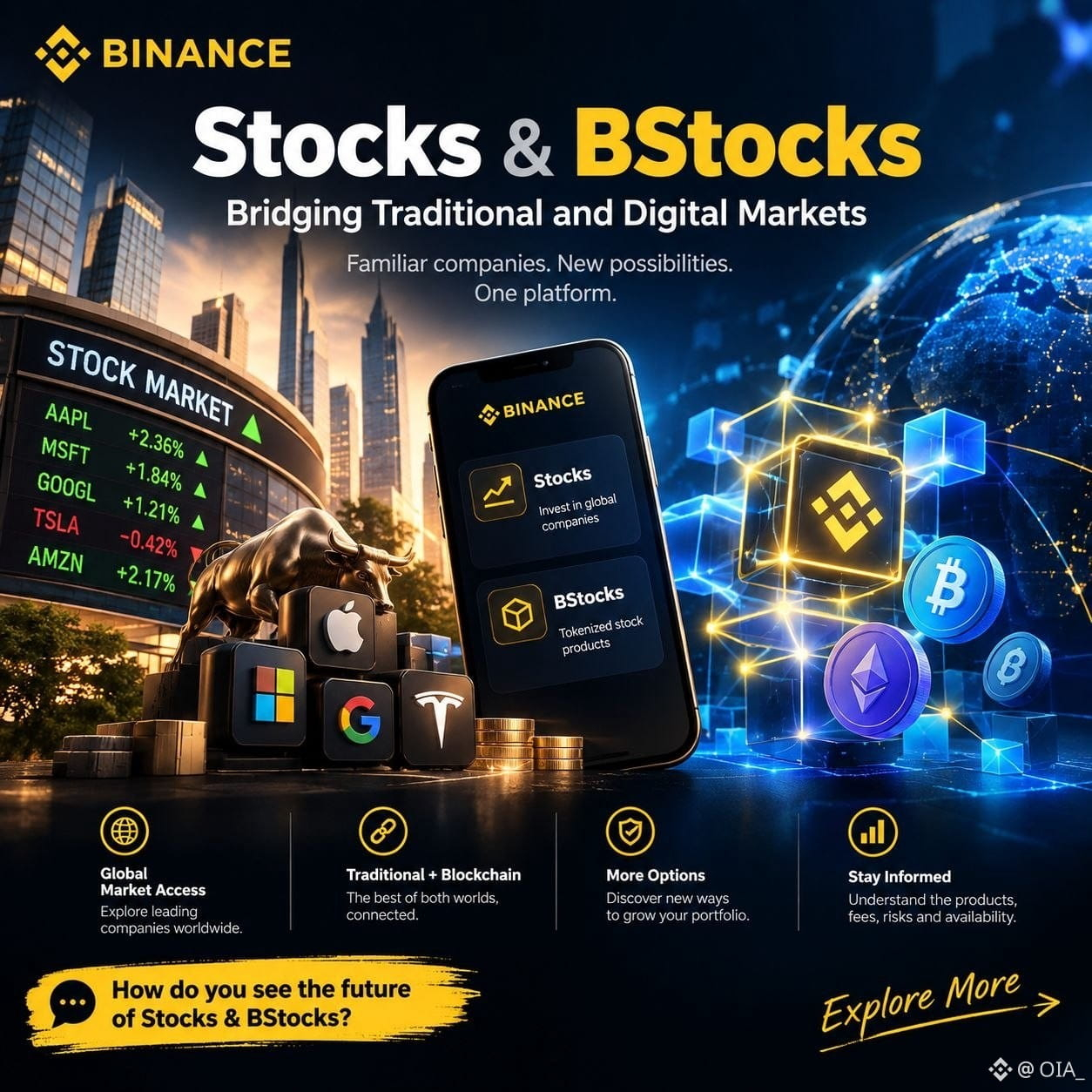
13
2
18
389

·
--
සත්යායනය කළ
ලිපිය
📊 What is the difference between Stocks and Crypto? How to invest with Binance BStocks?As an investor entering the market, it is essential to clearly understand the core differences between Stocks and Cryptocurrency. Crypto is a digital asset class well-known for its high volatility, rapid price movements, and the unique ability to be traded 24/7 without market closures. On the other hand, Stocks represent fractional ownership of established, real-world companies (such as Apple, Tesla, or Microsoft). They generally offer more long-term stability and operate within traditional stock market hours.
So, how can crypto enthusiasts seamlessly buy US Stocks? Now, through Binance, you can easily invest using their innovative product called BStocks (Binance Stocks). BStocks is highly suitable for beginners, allowing you to step directly into the US Stock Market right from your existing Binance account without going through any complicated external procedures.
Here is a quick checklist for beginners before starting your investment journey in BStocks:
Always research the company's background, fundamental value, and recent earnings reports.Clearly define your personal Risk Tolerance and invest accordingly.Establish a solid Investment Plan—decide early on whether you are aiming for short-term trades or a long-term holding strategy.Diversifying your overall portfolio by investing in both traditional Stocks and Cryptocurrency is an excellent way to balance potential risks and rewards. Wishing everyone a highly profitable and successful investment journey ahead!
@BinanceBurmese
#SEAStock #SEABStock
📊 What is the difference between Stocks and Crypto? How to invest with Binance BStocks?
As an investor entering the market, it is essential to clearly understand the core differences between Stocks and Cryptocurrency. Crypto is a digital asset class well-known for its high volatility, rapid price movements, and the unique ability to be traded 24/7 without market closures. On the other hand, Stocks represent fractional ownership of established, real-world companies (such as Apple, Tesla, or Microsoft). They generally offer more long-term stability and operate within traditional stock market hours.
So, how can crypto enthusiasts seamlessly buy US Stocks? Now, through Binance, you can easily invest using their innovative product called BStocks (Binance Stocks). BStocks is highly suitable for beginners, allowing you to step directly into the US Stock Market right from your existing Binance account without going through any complicated external procedures.
Here is a quick checklist for beginners before starting your investment journey in BStocks:
Always research the company's background, fundamental value, and recent earnings reports.Clearly define your personal Risk Tolerance and invest accordingly.Establish a solid Investment Plan—decide early on whether you are aiming for short-term trades or a long-term holding strategy.Diversifying your overall portfolio by investing in both traditional Stocks and Cryptocurrency is an excellent way to balance potential risks and rewards. Wishing everyone a highly profitable and successful investment journey ahead!
@Binance Burmese
#SEAStock #SEABStock
1
89

·
--
From Crypto to Stocks: What Beginners Should Know About Binance Stocks and bStocksIf you are already familiar with crypto, you may have noticed that Binance is expanding beyond crypto assets and giving eligible users access to U.S. stocks and ETFs. For someone who has only traded crypto before, this can raise an important question: what is the difference between Stocks and bStocks, and how should a beginner approach them?
In this post, I want to explain the basic ideas in simple terms rather than treating stocks as another “quick profit” opportunity.
First, what are Binance Stocks?
Binance Stocks gives eligible users access to U.S.-listed stocks and ETFs. For beginners, one useful feature is fractional investing, which can allow users to start with a smaller amount rather than needing enough money to purchase a whole share.
Stocks are different from crypto in several important ways. A company’s stock represents an ownership interest in that company through the traditional financial market structure. Stock prices can be affected by company earnings, economic conditions, interest rates, industry developments, investor expectations, and many other factors.
This does not mean stocks are automatically safe or guaranteed to rise. Even a well-known company can experience a major price decline.
Then what are bStocks?
bStocks are tokenized securities connected to U.S.-listed stocks. They are designed to provide exposure to the price performance of corresponding stocks while using blockchain-based infrastructure.
However, there is an important distinction for beginners: holding a bStock is not exactly the same thing as directly owning the underlying company share. Understanding this difference is important before buying anything.
One feature that may be interesting to crypto users is trading flexibility. Eligible bStocks can be traded on Binance Spot 24/7, unlike traditional stock markets that operate according to their market hours. Where supported, bStocks can also be held as tokens and may have blockchain-based transfer functionality.
For someone who is already familiar with crypto, this type of trading environment may feel more familiar.
But flexibility does not remove risk.
A common mistake for beginners is thinking that because a stock is represented by a token, it behaves exactly like a normal cryptocurrency. It does not. The value of a bStock is still connected to the underlying stock, so company news, earnings, market conditions and broader economic events can affect its price.
There are also additional considerations around tokenized securities, including issuer, custody, liquidity, technical and regulatory risks. Product availability and trading permissions can also depend on a user's country or region and verification status.
Stocks and bStocks can therefore be understood as different ways of getting exposure to U.S. equities, rather than simply treating them as another crypto trade.
For a beginner, I think the most important step is education before allocation.
Before buying a stock or bStock, ask yourself a few simple questions.
What am I actually buying?
Am I buying a traditional stock position or a tokenized security?
What risks am I taking?
How much money can I afford to lose without affecting my daily life?
Am I investing for the long term, or am I trying to make a short-term trade?
Do I understand why I am buying this particular asset?
These questions may sound basic, but they can help reduce emotional decisions.
Another useful difference between stocks and crypto is the information investors may want to follow. Crypto traders often focus heavily on price charts, market sentiment and blockchain-related developments. Stock investors may also need to pay attention to company earnings, revenue, business performance, economic data, interest rates and corporate announcements.
That means moving from crypto into stocks can also be an opportunity to learn a different side of investing.
For me, the biggest lesson is that having more markets available does not mean we need to trade everything.
Binance putting crypto, Stocks and bStocks into one ecosystem can make it easier to explore different asset classes, but convenience should not replace research. A beginner does not need to chase every new ticker or every market move.
Start by understanding the product. Learn how the asset works. Check whether it is available in your region. Understand the risks. Then decide whether it fits your own financial goals and risk tolerance.
Stocks are not a guaranteed way to make money, and bStocks are not a shortcut around investment risk. They are additional financial products that eligible Binance users can learn about.
If you are coming from crypto and thinking about exploring U.S. stocks, learning the difference between traditional Stocks and tokenized bStocks is a useful first step.
Always do your own research and never invest money that you cannot afford to lose.
@BinanceBurmese
#SEABstock
#SEAstock
From Crypto to Stocks: What Beginners Should Know About Binance Stocks and bStocks
If you are already familiar with crypto, you may have noticed that Binance is expanding beyond crypto assets and giving eligible users access to U.S. stocks and ETFs. For someone who has only traded crypto before, this can raise an important question: what is the difference between Stocks and bStocks, and how should a beginner approach them?
In this post, I want to explain the basic ideas in simple terms rather than treating stocks as another “quick profit” opportunity.
First, what are Binance Stocks?
Binance Stocks gives eligible users access to U.S.-listed stocks and ETFs. For beginners, one useful feature is fractional investing, which can allow users to start with a smaller amount rather than needing enough money to purchase a whole share.
Stocks are different from crypto in several important ways. A company’s stock represents an ownership interest in that company through the traditional financial market structure. Stock prices can be affected by company earnings, economic conditions, interest rates, industry developments, investor expectations, and many other factors.
This does not mean stocks are automatically safe or guaranteed to rise. Even a well-known company can experience a major price decline.
Then what are bStocks?
bStocks are tokenized securities connected to U.S.-listed stocks. They are designed to provide exposure to the price performance of corresponding stocks while using blockchain-based infrastructure.
However, there is an important distinction for beginners: holding a bStock is not exactly the same thing as directly owning the underlying company share. Understanding this difference is important before buying anything.
One feature that may be interesting to crypto users is trading flexibility. Eligible bStocks can be traded on Binance Spot 24/7, unlike traditional stock markets that operate according to their market hours. Where supported, bStocks can also be held as tokens and may have blockchain-based transfer functionality.
For someone who is already familiar with crypto, this type of trading environment may feel more familiar.
But flexibility does not remove risk.
A common mistake for beginners is thinking that because a stock is represented by a token, it behaves exactly like a normal cryptocurrency. It does not. The value of a bStock is still connected to the underlying stock, so company news, earnings, market conditions and broader economic events can affect its price.
There are also additional considerations around tokenized securities, including issuer, custody, liquidity, technical and regulatory risks. Product availability and trading permissions can also depend on a user's country or region and verification status.
Stocks and bStocks can therefore be understood as different ways of getting exposure to U.S. equities, rather than simply treating them as another crypto trade.
For a beginner, I think the most important step is education before allocation.
Before buying a stock or bStock, ask yourself a few simple questions.
What am I actually buying?
Am I buying a traditional stock position or a tokenized security?
What risks am I taking?
How much money can I afford to lose without affecting my daily life?
Am I investing for the long term, or am I trying to make a short-term trade?
Do I understand why I am buying this particular asset?
These questions may sound basic, but they can help reduce emotional decisions.
Another useful difference between stocks and crypto is the information investors may want to follow. Crypto traders often focus heavily on price charts, market sentiment and blockchain-related developments. Stock investors may also need to pay attention to company earnings, revenue, business performance, economic data, interest rates and corporate announcements.
That means moving from crypto into stocks can also be an opportunity to learn a different side of investing.
For me, the biggest lesson is that having more markets available does not mean we need to trade everything.
Binance putting crypto, Stocks and bStocks into one ecosystem can make it easier to explore different asset classes, but convenience should not replace research. A beginner does not need to chase every new ticker or every market move.
Start by understanding the product. Learn how the asset works. Check whether it is available in your region. Understand the risks. Then decide whether it fits your own financial goals and risk tolerance.
Stocks are not a guaranteed way to make money, and bStocks are not a shortcut around investment risk. They are additional financial products that eligible Binance users can learn about.
If you are coming from crypto and thinking about exploring U.S. stocks, learning the difference between traditional Stocks and tokenized bStocks is a useful first step.
Always do your own research and never invest money that you cannot afford to lose.
@Binance Burmese
#SEABstock
#SEAstock
72

·
--
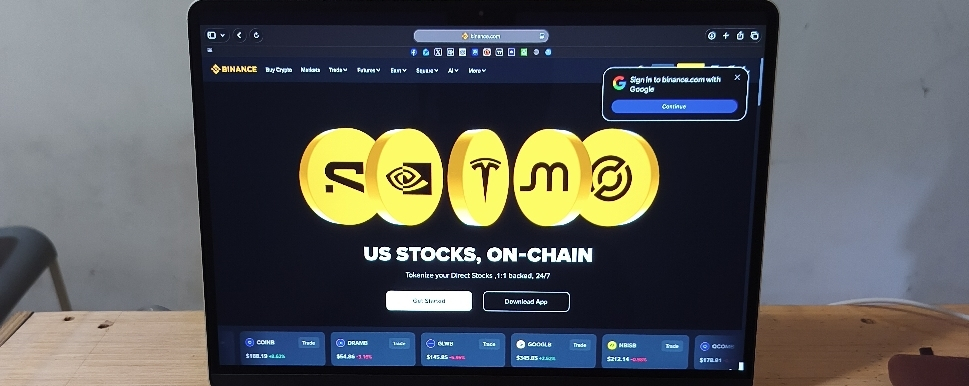
ලිපිය
I’m a Crypto User, But I’m Starting to Look at StocksI’ve mostly been following crypto, so I never really paid much attention to stocks. Recently, I started looking into bStocks on Binance, and I think the idea is pretty interesting.
At first, I wondered why someone would trade stocks on a crypto platform when traditional stock brokers already exist. After learning more about it, I can see why crypto users might be interested.
What are bStocks?
In simple terms, bStocks are tokenized securities that give eligible users exposure to certain U.S. stocks. But there is an important difference: a bStock is not exactly the same as directly owning the underlying stock through a traditional broker.
The underlying securities are held through the relevant custody structure, while the token represents an interest in the underlying asset. I think beginners should understand this before using the product.
The 24/7 part is interesting
As a crypto user, this is probably the feature that catches my attention most. Crypto markets operate 24/7, so we are used to checking prices and trading whenever we want.
Traditional stock markets are different because they have specific trading hours. According to Binance, eligible bStocks can be traded on Binance Spot 24/7.
Of course, this does not mean the actual U.S. stock market is open 24/7. It means the tokenized product can have a different trading schedule. Still, I think this makes the experience more familiar for crypto users.
Starting with a small amount
Another thing I noticed is that Binance says users can start with as little as $5 for bStocks.
For someone who is new to investing, I think this can make learning less intimidating. You do not need a large amount of money just to start learning how stock prices move.
But a low minimum does not mean low risk. The underlying stock can still fall, and there are also risks related to the tokenized product itself. I would still treat it as an investment and do some research first.
Crypto and stocks are different
This is probably the most important point for crypto users. Understanding crypto does not automatically mean you understand stocks.
Stock prices can be affected by company earnings, revenue, interest rates, economic data, competition and company news. Crypto has different factors, including market sentiment, liquidity, Bitcoin’s movement and regulation.
There can be connections between the markets, but they are not the same.
Why I find bStocks interesting
For me, the bigger idea is tokenization. Blockchain started with cryptocurrencies, but we are now seeing more traditional financial assets being brought onto blockchain infrastructure.
Stablecoins are already a major example, and tokenized securities are another part of this trend.
I don’t know whether tokenization will become a major part of the financial system, but I think it is worth watching. For crypto users, bStocks could be an interesting bridge between traditional finance and blockchain.
Personally, I would not buy something just because it is new or popular. I would first understand what I am buying, check whether it is available in my country, and understand the risks.
Would you use bStocks, or would you still prefer buying stocks through a traditional broker?
@BinanceBurmese #SEABstock #SEAstock #Stocks #crypto #Investing
I’m a Crypto User, But I’m Starting to Look at Stocks
I’ve mostly been following crypto, so I never really paid much attention to stocks. Recently, I started looking into bStocks on Binance, and I think the idea is pretty interesting.
At first, I wondered why someone would trade stocks on a crypto platform when traditional stock brokers already exist. After learning more about it, I can see why crypto users might be interested.
What are bStocks?
In simple terms, bStocks are tokenized securities that give eligible users exposure to certain U.S. stocks. But there is an important difference: a bStock is not exactly the same as directly owning the underlying stock through a traditional broker.
The underlying securities are held through the relevant custody structure, while the token represents an interest in the underlying asset. I think beginners should understand this before using the product.
The 24/7 part is interesting
As a crypto user, this is probably the feature that catches my attention most. Crypto markets operate 24/7, so we are used to checking prices and trading whenever we want.
Traditional stock markets are different because they have specific trading hours. According to Binance, eligible bStocks can be traded on Binance Spot 24/7.
Of course, this does not mean the actual U.S. stock market is open 24/7. It means the tokenized product can have a different trading schedule. Still, I think this makes the experience more familiar for crypto users.
Starting with a small amount
Another thing I noticed is that Binance says users can start with as little as $5 for bStocks.
For someone who is new to investing, I think this can make learning less intimidating. You do not need a large amount of money just to start learning how stock prices move.
But a low minimum does not mean low risk. The underlying stock can still fall, and there are also risks related to the tokenized product itself. I would still treat it as an investment and do some research first.
Crypto and stocks are different
This is probably the most important point for crypto users. Understanding crypto does not automatically mean you understand stocks.
Stock prices can be affected by company earnings, revenue, interest rates, economic data, competition and company news. Crypto has different factors, including market sentiment, liquidity, Bitcoin’s movement and regulation.
There can be connections between the markets, but they are not the same.
Why I find bStocks interesting
For me, the bigger idea is tokenization. Blockchain started with cryptocurrencies, but we are now seeing more traditional financial assets being brought onto blockchain infrastructure.
Stablecoins are already a major example, and tokenized securities are another part of this trend.
I don’t know whether tokenization will become a major part of the financial system, but I think it is worth watching. For crypto users, bStocks could be an interesting bridge between traditional finance and blockchain.
Personally, I would not buy something just because it is new or popular. I would first understand what I am buying, check whether it is available in my country, and understand the risks.
Would you use bStocks, or would you still prefer buying stocks through a traditional broker?
@Binance Burmese #SEABstock #SEAstock #Stocks #crypto #Investing
108
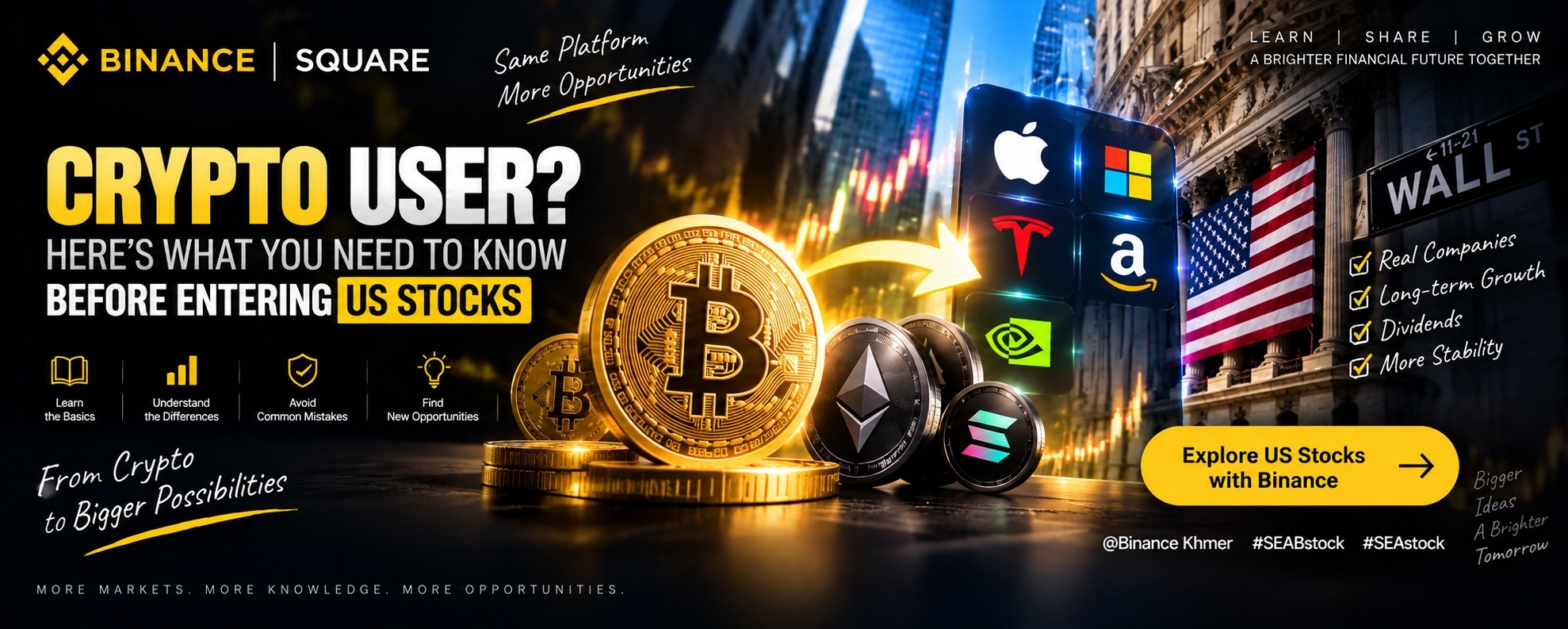
ලිපිය
From Crypto to US Stocks: 7 Things Every Binance User Should Know 📈If you already understand Bitcoin and crypto, exploring US Stocks can feel familiar—but the market works differently. Before buying your first stock or exploring BStocks, here are 7 things every crypto user should understand.
1️⃣ Stocks don’t trade 24/7
Crypto markets operate around the clock. Traditional US stock markets have specific trading sessions, so the market can be closed while crypto is still moving. This changes how you plan entries, exits, and reactions to news.
2️⃣ Stock prices can move because of company news
A stock can react strongly to earnings reports, product launches, management changes, economic data, or unexpected company news. Understanding why a stock moves is often more important than simply watching the price.
3️⃣ Crypto and stocks have different risk profiles
Crypto can experience extremely large price swings, while individual stocks can also be volatile. Neither market is automatically “safe.” Your risk depends on what you buy, how much you invest, and how diversified your portfolio is.
4️⃣ One famous company doesn’t equal a diversified portfolio
Buying one popular stock means your investment can still be heavily affected by that single company. Learning about diversification can help reduce the impact of one investment performing badly.
5️⃣ Dividends are something crypto users should learn about
Some companies distribute part of their profits to shareholders through dividends. Not every stock pays dividends, and the amount and schedule can vary.
6️⃣ Don’t buy just because everyone is talking about it
A stock trending on social media can be interesting, but popularity isn’t the same as value. Look at the company, its financial performance, valuation, growth prospects, and the risks involved before making a decision.
7️⃣ BStocks can be another way for Binance users to explore US Stocks
For crypto users who are already familiar with Binance, BStocks can provide a way to explore the US stock market within the Binance ecosystem. But before trading, always understand exactly what product you are using, its terms, fees, availability in your region, and the risks involved.
The biggest lesson? Don’t treat Stocks exactly like Crypto. Learn the market first, then decide how much risk you’re comfortable taking.
@BinanceKhmer
#SEABstock #SEAstock #bstock
From Crypto to US Stocks: 7 Things Every Binance User Should Know 📈
If you already understand Bitcoin and crypto, exploring US Stocks can feel familiar—but the market works differently. Before buying your first stock or exploring BStocks, here are 7 things every crypto user should understand.
1️⃣ Stocks don’t trade 24/7
Crypto markets operate around the clock. Traditional US stock markets have specific trading sessions, so the market can be closed while crypto is still moving. This changes how you plan entries, exits, and reactions to news.
2️⃣ Stock prices can move because of company news
A stock can react strongly to earnings reports, product launches, management changes, economic data, or unexpected company news. Understanding why a stock moves is often more important than simply watching the price.
3️⃣ Crypto and stocks have different risk profiles
Crypto can experience extremely large price swings, while individual stocks can also be volatile. Neither market is automatically “safe.” Your risk depends on what you buy, how much you invest, and how diversified your portfolio is.
4️⃣ One famous company doesn’t equal a diversified portfolio
Buying one popular stock means your investment can still be heavily affected by that single company. Learning about diversification can help reduce the impact of one investment performing badly.
5️⃣ Dividends are something crypto users should learn about
Some companies distribute part of their profits to shareholders through dividends. Not every stock pays dividends, and the amount and schedule can vary.
6️⃣ Don’t buy just because everyone is talking about it
A stock trending on social media can be interesting, but popularity isn’t the same as value. Look at the company, its financial performance, valuation, growth prospects, and the risks involved before making a decision.
7️⃣ BStocks can be another way for Binance users to explore US Stocks
For crypto users who are already familiar with Binance, BStocks can provide a way to explore the US stock market within the Binance ecosystem. But before trading, always understand exactly what product you are using, its terms, fees, availability in your region, and the risks involved.
The biggest lesson? Don’t treat Stocks exactly like Crypto. Learn the market first, then decide how much risk you’re comfortable taking.
@Binance Khmer
#SEABstock #SEAstock #bstock
111

·
--
Mastering Multi-Asset Trading: Bridging Crypto, Equities, and $BTC with BStocksAs financial markets evolve, the boundaries between decentralized crypto networks and traditional global equities are dissolving. Today's investors are no longer confined to choosing between $BTC volatility or standard stock market indices—integrated digital finance ecosystems allow you to capture gains across both asset classes seamlessly.
Whether you are seeking to hedge portfolio risk using traditional instruments or aiming to convert stablecoins into global stock exposure, tools like BStocks offer a powerful bridge.
Key Differences: Stocks vs. Crypto
To build a balanced strategy, every trader should understand how these two asset classes operate side by side:
Valuation Fundamentals:
Stocks: Valuation is anchored in real-world corporate earnings, balance sheet reports, and revenue performance.
Crypto ($BTC, $ETH,$BNB): Valuation depends heavily on network utility, token economics, adoption rates, and macro liquidity trends.
Market Dynamics & Trading Hours:
Stocks: Traditional exchanges operate within rigid local business hours (e.g., 9:30 AM – 4:00 PM EST).
Crypto: Operates 24/7/365, offering round-the-clock liquidity and instant exposure adjustments.
Risk & Volatility Profiles:
Stocks: Typically provide lower short-term volatility, making them an ideal core asset for multi-year capital preservation.
Crypto: Delivers rapid price moves and high upside potential, but requires active risk management and discipline.
Why Utilize BStocks for Portfolio Diversification?
Frictionless Allocation: Shift capital between crypto holdings like $ETH or stablecoins directly into stock-linked products without withdrawing to external bank accounts.
Fractional Participation: Access high-value traditional equities with flexible position sizing tailored to your portfolio.
Unified Dashboard: Track your cryptocurrency spot positions alongside traditional equity exposures in one place.
Hedging Market Downturns: Reallocate profits during crypto pullbacks into stable traditional assets to protect accumulated gains.
Core Risk Management Checklist
Avoid Over-Leveraging: Always maintain low leverage when trading around major macroeconomic announcements, such as interest rate updates or inflation data.
Diversify Across Sectors: Avoid concentration in a single asset type. Balance your core holdings ($BTC,$BNB) with stable equity-linked investments.
Do Your Own Research (DYOR): Analyze underlying fundamentals, market conditions, and risks prior to opening any position.
Combining the constant innovation of crypto with the stability of equities creates a highly adaptable investment framework for any market environment.
cc: @BinanceBurmese
#SEABstock #SEAstock $BTC $ETH
#Binance #BinanceSquareTalks
Mastering Multi-Asset Trading: Bridging Crypto, Equities, and $BTC with BStocks
As financial markets evolve, the boundaries between decentralized crypto networks and traditional global equities are dissolving. Today's investors are no longer confined to choosing between $BTC volatility or standard stock market indices—integrated digital finance ecosystems allow you to capture gains across both asset classes seamlessly.
Whether you are seeking to hedge portfolio risk using traditional instruments or aiming to convert stablecoins into global stock exposure, tools like BStocks offer a powerful bridge.
Key Differences: Stocks vs. Crypto
To build a balanced strategy, every trader should understand how these two asset classes operate side by side:
Valuation Fundamentals:
Stocks: Valuation is anchored in real-world corporate earnings, balance sheet reports, and revenue performance.
Crypto ($BTC , $ETH ,$BNB): Valuation depends heavily on network utility, token economics, adoption rates, and macro liquidity trends.
Market Dynamics & Trading Hours:
Stocks: Traditional exchanges operate within rigid local business hours (e.g., 9:30 AM – 4:00 PM EST).
Crypto: Operates 24/7/365, offering round-the-clock liquidity and instant exposure adjustments.
Risk & Volatility Profiles:
Stocks: Typically provide lower short-term volatility, making them an ideal core asset for multi-year capital preservation.
Crypto: Delivers rapid price moves and high upside potential, but requires active risk management and discipline.
Why Utilize BStocks for Portfolio Diversification?
Frictionless Allocation: Shift capital between crypto holdings like $ETH or stablecoins directly into stock-linked products without withdrawing to external bank accounts.
Fractional Participation: Access high-value traditional equities with flexible position sizing tailored to your portfolio.
Unified Dashboard: Track your cryptocurrency spot positions alongside traditional equity exposures in one place.
Hedging Market Downturns: Reallocate profits during crypto pullbacks into stable traditional assets to protect accumulated gains.
Core Risk Management Checklist
Avoid Over-Leveraging: Always maintain low leverage when trading around major macroeconomic announcements, such as interest rate updates or inflation data.
Diversify Across Sectors: Avoid concentration in a single asset type. Balance your core holdings ($BTC ,$BNB) with stable equity-linked investments.
Do Your Own Research (DYOR): Analyze underlying fundamentals, market conditions, and risks prior to opening any position.
Combining the constant innovation of crypto with the stability of equities creates a highly adaptable investment framework for any market environment.
cc: @Binance Burmese
#SEABstock #SEAstock $BTC $ETH
#Binance #BinanceSquareTalks
1
115

·
--
Here is an original, long-form post written specifically for the Binance Square ArticleBeyond the Hype: Building a Sustainable Crypto Portfolio with Effective Risk ManagementHere is an original, long-form post written specifically for the Binance Square Article Editor:@BinanceLaotian
**Title:** Beyond the Hype: Building a Sustainable Crypto Portfolio with Effective Risk Management
Navigating the cryptocurrency market can often feel like riding a rollercoaster blindfolded. With market sentiment shifting rapidly between extreme greed and intense fear, many traders focus solely on potential gains while completely ignoring downside risk. However, long-term success in Web3 isn’t determined by how much you make during a bull run—it’s defined by how much capital you preserve during market downturns.
**1. The Foundation: Capital Preservation First**
Before chasing 10x returns on low-cap altcoins, ensure your core portfolio rests on strong foundations. Allocating a significant portion of your capital to major assets like Bitcoin (BTC) and Ethereum (ETH) provides stability. These assets generally experience lower volatility compared to micro-cap tokens, helping buffer your total portfolio during sudden market sell-offs.
**2. Smart Diversification vs. Over-Diversification**
Holding 50 different tokens isn't effective diversification; it’s manageable chaos. Focus on strategic sector allocation across distinct narratives:
* **Layer 1 / Layer 2 Infrastructure:** The core settlement and scaling layers.
* **DeFi Protocols:** Yield, lending, and decentralized exchange liquidity providers.
* **Real-World Assets (RWA) & Privacy:** Emerging sectors bridging traditional finance and blockchain compliance.
**3. Implement Rigid Risk Parameters**
Never enter a trade or position without a predetermined exit plan:
* **Position Sizing:** Never risk more than 1–2% of your total portfolio on a single high-risk altcoin trade.
* **Use Stop-Losses:** Take emotion out of trading. Set mechanical stop-loss orders to automatically invalidate a trade setup if the market turns against you.
* **Take-Profit Discipline:** Taking profits incrementally on the way up (Dollar-Cost Selling) secures realized gains and prevents turning winning trades into losses.
**4. Beware of Common Pitfalls**
The most dangerous risks in crypto aren't just technical—they are psychological and operational. Beware of social engineering tactics, phishing links, and deceptive high-yield farm schemes. Always verify smart contract audits, test new protocols with small amounts first, and revoke unused token allowances regularly using security tools.
Market conditions will always fluctuate, but a disciplined strategy rooted in risk management, sector diversification, and continuous learning will keep you in the game for the long haul.
#SEABstock #SEAstock
Here is an original, long-form post written specifically for the Binance Square Article
Beyond the Hype: Building a Sustainable Crypto Portfolio with Effective Risk ManagementHere is an original, long-form post written specifically for the Binance Square Article Editor:@Binance Laotian
**Title:** Beyond the Hype: Building a Sustainable Crypto Portfolio with Effective Risk Management
Navigating the cryptocurrency market can often feel like riding a rollercoaster blindfolded. With market sentiment shifting rapidly between extreme greed and intense fear, many traders focus solely on potential gains while completely ignoring downside risk. However, long-term success in Web3 isn’t determined by how much you make during a bull run—it’s defined by how much capital you preserve during market downturns.
**1. The Foundation: Capital Preservation First**
Before chasing 10x returns on low-cap altcoins, ensure your core portfolio rests on strong foundations. Allocating a significant portion of your capital to major assets like Bitcoin (BTC) and Ethereum (ETH) provides stability. These assets generally experience lower volatility compared to micro-cap tokens, helping buffer your total portfolio during sudden market sell-offs.
**2. Smart Diversification vs. Over-Diversification**
Holding 50 different tokens isn't effective diversification; it’s manageable chaos. Focus on strategic sector allocation across distinct narratives:
* **Layer 1 / Layer 2 Infrastructure:** The core settlement and scaling layers.
* **DeFi Protocols:** Yield, lending, and decentralized exchange liquidity providers.
* **Real-World Assets (RWA) & Privacy:** Emerging sectors bridging traditional finance and blockchain compliance.
**3. Implement Rigid Risk Parameters**
Never enter a trade or position without a predetermined exit plan:
* **Position Sizing:** Never risk more than 1–2% of your total portfolio on a single high-risk altcoin trade.
* **Use Stop-Losses:** Take emotion out of trading. Set mechanical stop-loss orders to automatically invalidate a trade setup if the market turns against you.
* **Take-Profit Discipline:** Taking profits incrementally on the way up (Dollar-Cost Selling) secures realized gains and prevents turning winning trades into losses.
**4. Beware of Common Pitfalls**
The most dangerous risks in crypto aren't just technical—they are psychological and operational. Beware of social engineering tactics, phishing links, and deceptive high-yield farm schemes. Always verify smart contract audits, test new protocols with small amounts first, and revoke unused token allowances regularly using security tools.
Market conditions will always fluctuate, but a disciplined strategy rooted in risk management, sector diversification, and continuous learning will keep you in the game for the long haul.
#SEABstock #SEAstock
90
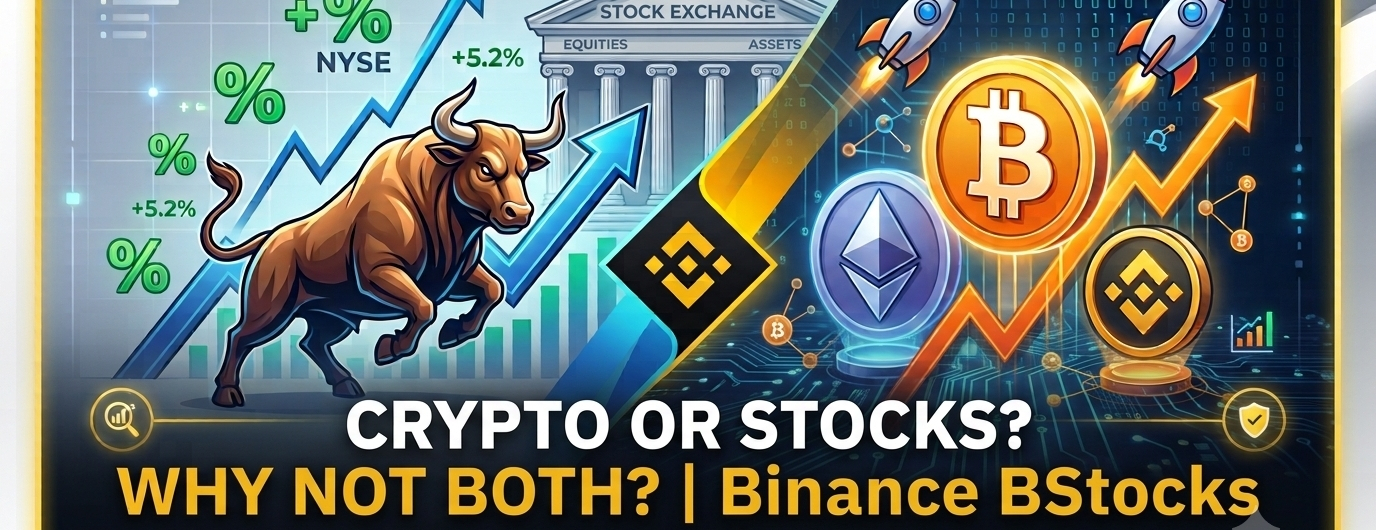
ලිපිය
Crypto မှ Stocks: Binance BStocks ဖြင့် သင့်ရဲ့ Investment Portfolio ကို အောင်မြင်စွာ ချဲ့ထွင်နည်းယနေ့ခေတ် Digital Financial လောကတွင် ရင်းနှီးမြှုပ်နှံသူများအတွက် အခွင့်အလမ်းသစ်များစွာ ပေါ်ပေါက်လာနေပြီဖြစ်သည်။ ရှေးယခင်က ရိုးရာ စတော့ဈေးကွက် (Traditional Stock Market) နှင့် ခရစ်ပတိုဈေးကွက် (Crypto Market) တို့သည် တစ်ခုနှင့်တစ်ခု လုံးဝ သီးခြားစီ တည်ရှိနေခဲ့ကြသော်လည်း၊ ယခုအခါ Binance ၏ BStocks Product များကြောင့် Crypto အသုံးပြုသူများသည် Crypto Ecosystem အတွင်းမှပင် ကမ္ဘာ့အကြီးဆုံး US Stocks များကို လွယ်ကူစွာ ဝင်ရောက်ကြည့်ရှု ရင်းနှီးမြှုပ်နှံနိုင်ခွင့် ရရှိလာခဲ့ပြီဖြစ်သည်။
အထူးသဖြင့် Beginner များနှင့် Crypto Investor များအတွက် ရိုးရာ Stock Trading နှင့် Crypto Trading အကြား ကွာခြားချက်များ၊ BStocks ၏ အားသာချက်များနှင့် ၎င်းမှတစ်ဆင့် စနစ်တကျ Portfolio Diversification ပြုလုပ်နည်းများကို အသေးစိတ် ရှင်းလင်းတင်ပြပေးသွားမည် ဖြစ်သည်။
### ၁။ ရိုးရာ Stock Trading နှင့် Crypto Trading ဘာကွာသလဲ?
ရင်းနှီးမြှုပ်နှံမှု မစတင်မီ ဤဈေးကွက် နှစ်ခု၏ အဓိက ကွာခြားချက်များနှင့် လက္ခဏာများကို နားလည်ထားရန် လိုအပ်သည်-
* Trading Hours (အရောင်းအဝယ်အချိန်): Crypto Market သည် ၂၄ နာရီ/၇ ရက် လုံးဝ မနားတမ်း ပွင့်လှစ်ထားသော်လည်း ရိုးရာ US Stock Market သည် တနင်္လာမှ သောကြာအထိ သတ်မှတ်ထားသော ရုံးချိန်အတိုင်းသာ အရောင်းအဝယ် လုပ်ဆောင်သည်။
* Market Volatility (ဈေးကွက်အပြောင်းအလဲ): Crypto ဈေးကွက်သည် ဈေးနှုန်းအတက်အကျ အလွန်မြန်ဆန်ပြီး Volatility မြင့်မားသည်။ US Stocks များသည် ကုမ္ပဏီများ၏ စီးပွားရေးအခြေခံ (Fundamentals)၊ ဝင်ငွေအစီရင်ခံစာ (Earnings Reports) နှင့် မက်ခရိုစီးပွားရေးဆိုင်ရာ သတင်းများအပေါ် ပိုမို အခြေခံသဖြင့် အတက်အကျ ပိုမို တည်ငြိမ်မှုရှိသည်။
* Regulation & Asset Ownership: Stock များသည် သက်ဆိုင်ရာ နိုင်ငံအလိုက် စည်းမျဉ်းစည်းကမ်း ထိန်းချုပ်မှုများ ခိုင်မာစွာရှိပြီး ကုမ္ပဏီတစ်ခု၏ ပိုင်ဆိုင်မှု အစုရှယ်ယာကို ကိုယ်စားပြုသည်။
### ၂။ BStocks ဆိုတာဘာလဲ? Beginner များ သိထားသင့်သည့် အချက်များ
BStocks (Binance Stocks) သည် Crypto အသုံးပြုသူများအတွက် အမေရိကန် စတော့ဈေးကွက် (US Stock Market) သို့ ကူးပြောင်းရာတွင် ကြုံတွေ့ရလေ့ရှိသည့် အဟန့်အတားများကို ရှင်းလင်းပေးထားသော Product တစ်ခုဖြစ်သည်။
* Direct Access: ရိုးရာ Broker Account များ သီးသန့်ဖွင့်လှစ်ရန် မလိုဘဲ Binance Platform ပေါ်မှပင် US Stocks များကို လေ့လာစောင့်ကြည့်နိုင်ခြင်း။
* Seamless Integration: သင့်၏ Crypto Assets များနှင့် Stocks များကို Platform တစ်ခုတည်းတွင် ခြုံငုံသုံးသပ်နိုင်ခြင်းကြောင့် Portfolio Management ပြုလုပ်ရလည် စနစ်ကျစေသည်။
* Diversification (အန္တရာယ်ခွဲဝေခြင်း): Crypto Assets များတွင်ချည်း 100% မြှုပ်နှံထားမည့်အစား အကျိုးအမြတ် တည်ငြိမ်သော Tech Giants သို့မဟုတ် Traditional Stocks များတွင် ခွဲဝေရင်းနှီးမြှုပ်နှံခြင်းဖြင့် Risk Management ကို စနစ်တကျ ပြုလုပ်နိုင်သည်။
### ၃။ US Stocks တွင် ရင်းနှီးမြှုပ်နှံမှု မစတင်မီ ကြိုတင်ပြင်ဆင်ရမည့် Checklist
US Stocks သို့မဟုတ် BStocks များတွင် စတင်လေ့လာ ရင်းနှီးမြှုပ်နှံတော့မည်ဆိုပါက အောက်ပါ Checklist ကို လိုက်နာရန် အကြံပြုပါသည်-
1. Market Research (ကုမ္ပဏီများကို လေ့လာပါ): သင်ရင်းနှီးမြှုပ်နှံလိုသော ကုမ္ပဏီ၏ စီးပွားရေးပုံစံ၊ ဘဏ္ဍာရေးအခြေအနေနှင့် အနာဂတ် တိုးတက်နိုင်ဆန်းများကို သေချာစွာ လေ့လာပါ။
2. Understand Macro Environment: US Federal Reserve ၏ အတိုးနှုန်းဆိုင်ရာ ဆုံးဖြတ်ချက်များ၊ ငွေကြေးဖောင်းပွမှု ညွှန်းကိန်းများ (CPI) နှင့် အလုပ်အကိုင် အစီရင်ခံစာများသည် US Stock Market ကို တိုက်ရိုက် ရိုက်ခတ်မှုရှိကြောင်း နားလည်ထားပါ။
3. Risk Management Strategy: Stock တစ်ခုတည်းတွင် ပုံအောခြင်း မပြုဘဲ အကျိုးအမြတ်နှင့် စွန့်စားရမှုကို မျှတအောင် ထိန်းညှိပါ။
4. Long-term vs Short-term Mindset: Crypto ကဲ့သို့ ရက်ပိုင်းအတွင်း အမြတ်အစွန်းကြီးကြီးမားမား ရရှိရန် ထက် Stocks များကို ရေရှည် (Long-term Value Growth) အဖြစ် ရှုမြင်တာဝန်ယူပါ။
### နိဂုံးချုပ်
Crypto အသုံးပြုသူတစ်ယောက်အနေဖြင့် Binance Platform ကို အသုံးပြု၍ BStocks မှတစ်ဆင့် Traditional Financial Assets များသို့ ခြေလှမ်းလှမ်းခြင်းသည် သင်၏ Investment Journey ကို ပိုမို ခိုင်မာစေမည့် နည်းလမ်းကောင်းတစ်ခု ဖြစ်သည်။ တည်ငြိမ်သော Stocks များနှင့် တိုးတက်မှုမြန်ဆန်သော Crypto Asset များကို ပညာပါပါ ပေါင်းစပ်ပြီး Balanced Portfolio တစ်ခုကို ယခုပင် စတင် တည်ဆောက်လိုက်ပါ။
Follow & Mention: @BinanceBurmese
Campaign Hashtags: #SEABstock #SEAstock
Crypto မှ Stocks: Binance BStocks ဖြင့် သင့်ရဲ့ Investment Portfolio ကို အောင်မြင်စွာ ချဲ့ထွင်နည်း
ယနေ့ခေတ် Digital Financial လောကတွင် ရင်းနှီးမြှုပ်နှံသူများအတွက် အခွင့်အလမ်းသစ်များစွာ ပေါ်ပေါက်လာနေပြီဖြစ်သည်။ ရှေးယခင်က ရိုးရာ စတော့ဈေးကွက် (Traditional Stock Market) နှင့် ခရစ်ပတိုဈေးကွက် (Crypto Market) တို့သည် တစ်ခုနှင့်တစ်ခု လုံးဝ သီးခြားစီ တည်ရှိနေခဲ့ကြသော်လည်း၊ ယခုအခါ Binance ၏ BStocks Product များကြောင့် Crypto အသုံးပြုသူများသည် Crypto Ecosystem အတွင်းမှပင် ကမ္ဘာ့အကြီးဆုံး US Stocks များကို လွယ်ကူစွာ ဝင်ရောက်ကြည့်ရှု ရင်းနှီးမြှုပ်နှံနိုင်ခွင့် ရရှိလာခဲ့ပြီဖြစ်သည်။
အထူးသဖြင့် Beginner များနှင့် Crypto Investor များအတွက် ရိုးရာ Stock Trading နှင့် Crypto Trading အကြား ကွာခြားချက်များ၊ BStocks ၏ အားသာချက်များနှင့် ၎င်းမှတစ်ဆင့် စနစ်တကျ Portfolio Diversification ပြုလုပ်နည်းများကို အသေးစိတ် ရှင်းလင်းတင်ပြပေးသွားမည် ဖြစ်သည်။
### ၁။ ရိုးရာ Stock Trading နှင့် Crypto Trading ဘာကွာသလဲ?
ရင်းနှီးမြှုပ်နှံမှု မစတင်မီ ဤဈေးကွက် နှစ်ခု၏ အဓိက ကွာခြားချက်များနှင့် လက္ခဏာများကို နားလည်ထားရန် လိုအပ်သည်-
* Trading Hours (အရောင်းအဝယ်အချိန်): Crypto Market သည် ၂၄ နာရီ/၇ ရက် လုံးဝ မနားတမ်း ပွင့်လှစ်ထားသော်လည်း ရိုးရာ US Stock Market သည် တနင်္လာမှ သောကြာအထိ သတ်မှတ်ထားသော ရုံးချိန်အတိုင်းသာ အရောင်းအဝယ် လုပ်ဆောင်သည်။
* Market Volatility (ဈေးကွက်အပြောင်းအလဲ): Crypto ဈေးကွက်သည် ဈေးနှုန်းအတက်အကျ အလွန်မြန်ဆန်ပြီး Volatility မြင့်မားသည်။ US Stocks များသည် ကုမ္ပဏီများ၏ စီးပွားရေးအခြေခံ (Fundamentals)၊ ဝင်ငွေအစီရင်ခံစာ (Earnings Reports) နှင့် မက်ခရိုစီးပွားရေးဆိုင်ရာ သတင်းများအပေါ် ပိုမို အခြေခံသဖြင့် အတက်အကျ ပိုမို တည်ငြိမ်မှုရှိသည်။
* Regulation & Asset Ownership: Stock များသည် သက်ဆိုင်ရာ နိုင်ငံအလိုက် စည်းမျဉ်းစည်းကမ်း ထိန်းချုပ်မှုများ ခိုင်မာစွာရှိပြီး ကုမ္ပဏီတစ်ခု၏ ပိုင်ဆိုင်မှု အစုရှယ်ယာကို ကိုယ်စားပြုသည်။
### ၂။ BStocks ဆိုတာဘာလဲ? Beginner များ သိထားသင့်သည့် အချက်များ
BStocks (Binance Stocks) သည် Crypto အသုံးပြုသူများအတွက် အမေရိကန် စတော့ဈေးကွက် (US Stock Market) သို့ ကူးပြောင်းရာတွင် ကြုံတွေ့ရလေ့ရှိသည့် အဟန့်အတားများကို ရှင်းလင်းပေးထားသော Product တစ်ခုဖြစ်သည်။
* Direct Access: ရိုးရာ Broker Account များ သီးသန့်ဖွင့်လှစ်ရန် မလိုဘဲ Binance Platform ပေါ်မှပင် US Stocks များကို လေ့လာစောင့်ကြည့်နိုင်ခြင်း။
* Seamless Integration: သင့်၏ Crypto Assets များနှင့် Stocks များကို Platform တစ်ခုတည်းတွင် ခြုံငုံသုံးသပ်နိုင်ခြင်းကြောင့် Portfolio Management ပြုလုပ်ရလည် စနစ်ကျစေသည်။
* Diversification (အန္တရာယ်ခွဲဝေခြင်း): Crypto Assets များတွင်ချည်း 100% မြှုပ်နှံထားမည့်အစား အကျိုးအမြတ် တည်ငြိမ်သော Tech Giants သို့မဟုတ် Traditional Stocks များတွင် ခွဲဝေရင်းနှီးမြှုပ်နှံခြင်းဖြင့် Risk Management ကို စနစ်တကျ ပြုလုပ်နိုင်သည်။
### ၃။ US Stocks တွင် ရင်းနှီးမြှုပ်နှံမှု မစတင်မီ ကြိုတင်ပြင်ဆင်ရမည့် Checklist
US Stocks သို့မဟုတ် BStocks များတွင် စတင်လေ့လာ ရင်းနှီးမြှုပ်နှံတော့မည်ဆိုပါက အောက်ပါ Checklist ကို လိုက်နာရန် အကြံပြုပါသည်-
1. Market Research (ကုမ္ပဏီများကို လေ့လာပါ): သင်ရင်းနှီးမြှုပ်နှံလိုသော ကုမ္ပဏီ၏ စီးပွားရေးပုံစံ၊ ဘဏ္ဍာရေးအခြေအနေနှင့် အနာဂတ် တိုးတက်နိုင်ဆန်းများကို သေချာစွာ လေ့လာပါ။
2. Understand Macro Environment: US Federal Reserve ၏ အတိုးနှုန်းဆိုင်ရာ ဆုံးဖြတ်ချက်များ၊ ငွေကြေးဖောင်းပွမှု ညွှန်းကိန်းများ (CPI) နှင့် အလုပ်အကိုင် အစီရင်ခံစာများသည် US Stock Market ကို တိုက်ရိုက် ရိုက်ခတ်မှုရှိကြောင်း နားလည်ထားပါ။
3. Risk Management Strategy: Stock တစ်ခုတည်းတွင် ပုံအောခြင်း မပြုဘဲ အကျိုးအမြတ်နှင့် စွန့်စားရမှုကို မျှတအောင် ထိန်းညှိပါ။
4. Long-term vs Short-term Mindset: Crypto ကဲ့သို့ ရက်ပိုင်းအတွင်း အမြတ်အစွန်းကြီးကြီးမားမား ရရှိရန် ထက် Stocks များကို ရေရှည် (Long-term Value Growth) အဖြစ် ရှုမြင်တာဝန်ယူပါ။
### နိဂုံးချုပ်
Crypto အသုံးပြုသူတစ်ယောက်အနေဖြင့် Binance Platform ကို အသုံးပြု၍ BStocks မှတစ်ဆင့် Traditional Financial Assets များသို့ ခြေလှမ်းလှမ်းခြင်းသည် သင်၏ Investment Journey ကို ပိုမို ခိုင်မာစေမည့် နည်းလမ်းကောင်းတစ်ခု ဖြစ်သည်။ တည်ငြိမ်သော Stocks များနှင့် တိုးတက်မှုမြန်ဆန်သော Crypto Asset များကို ပညာပါပါ ပေါင်းစပ်ပြီး Balanced Portfolio တစ်ခုကို ယခုပင် စတင် တည်ဆောက်လိုက်ပါ။
Follow & Mention: @Binance Burmese
Campaign Hashtags: #SEABstock #SEAstock
162
තවත් අන්තර්ගතයන් ගවේෂණය කිරීමට ඇතුල් වන්න
Binance චතුරශ්රය හි ගෝලීය ක්රිප්ටෝ පරිශීලකයින් හා එක්වන්න
⚡️ ක්රිප්ටෝ පිළිබඳ නවතම සහ ප්රයෝජනවත් තොරතුරු ලබා ගන්න.
💬 ලොව විශාලතම ක්රිප්ටෝ හුවමාරුව මගින් විශ්වාස කෙරේ.
👍 සත්යායනය කරන ලද නිර්මාණකරුවන්ගෙන් සැබෑ විදසුන් සොයා ගන්න.
විද්යුත් තැපෑල / දුරකථන අංකය
නැගී එන මාතෘකා
1
#BinanceReopensWithdrawalsForMoreAssets
51,516 නැරඹීම්
1,112 සාකච්ඡා කරමින්
2
#BinanceHourlyDepositsExceedWithdrawals
15,820 නැරඹීම්
414 සාකච්ඡා කරමින්
3
#AnthropicIPOPricedDownasInvestorsEye$1.5T
11 නැරඹීම්
11 සාකච්ඡා කරමින්
4
#AppleReportsMixedResults
29,630 නැරඹීම්
765 සාකච්ඡා කරමින්
5
#PalantirSlides3PercentOn$2BRevenue
1,450 නැරඹීම්
25 සාකච්ඡා කරමින්
6
#FrenchAssemblyRejectsTwoCryptoExitTaxProposals
784 නැරඹීම්
70 සාකච්ඡා කරමින්
7
#USMidtermElections
762,218 නැරඹීම්
4,174 සාකච්ඡා කරමින්
8
#ThailandSECProposesDerivativesLicensesForDigitalAssetOperators
89 නැරඹීම්
8 සාකච්ඡා කරමින්
9
#Nasdaq100EntersCorrection
3,196 නැරඹීම්
103 සාකච්ඡා කරමින්
10
#USOctoberNFP-AreRateCutsStillPossible
133,566 නැරඹීම්
1,089 සාකච්ඡා කරමින්