

#modelhub
modelhub
2,280 views
10 සාකච්ඡා කරමින්
උණුසුම්
නවතම

·
--
I realized something after comparing a few models instead of just trying one.
The issue was never about finding a model.
It was about reaching a point where I felt confident enough to stop comparing and actually run it.
The title got my attention. The summary explained the purpose. The metrics looked acceptable.
But confidence did not arrive at the same speed.
I kept opening benchmark pages, checking version history, and wondering if someone else had already solved the same problem more efficiently.
That extra five minutes sounds small.
Repeated across hundreds of developers, it becomes a much bigger cost than most dashboards ever show.
The strongest AI ecosystem is not the one with the biggest catalog.
It is the one that quietly removes hesitation from every decision between discovery and execution.
That changed the way I look at Model Hub quality.
The real question is no longer: "How many models are available?"
It is: "How quickly can a developer trust one enough to use it?"
If @OpenGradient keeps reducing uncertainty instead of simply increasing listings, the long-term value of the Hub could grow much faster than the model count itself.
Small improvements in confidence often create much bigger improvements in adoption.
@OpenGradient
$OPG #OPG #OpenGradient #AI #ModelHub
📊 Poll: What increases your confidence in a Model Hub the most?
I realized something after comparing a few models instead of just trying one.
The issue was never about finding a model.
It was about reaching a point where I felt confident enough to stop comparing and actually run it.
The title got my attention. The summary explained the purpose. The metrics looked acceptable.
But confidence did not arrive at the same speed.
I kept opening benchmark pages, checking version history, and wondering if someone else had already solved the same problem more efficiently.
That extra five minutes sounds small.
Repeated across hundreds of developers, it becomes a much bigger cost than most dashboards ever show.
The strongest AI ecosystem is not the one with the biggest catalog.
It is the one that quietly removes hesitation from every decision between discovery and execution.
That changed the way I look at Model Hub quality.
The real question is no longer: "How many models are available?"
It is: "How quickly can a developer trust one enough to use it?"
If @OpenGradient keeps reducing uncertainty instead of simply increasing listings, the long-term value of the Hub could grow much faster than the model count itself.
Small improvements in confidence often create much bigger improvements in adoption.
@OpenGradient
$OPG #OPG #OpenGradient #AI #ModelHub
📊 Poll: What increases your confidence in a Model Hub the most?
The issue was never about finding a model.
It was about reaching a point where I felt confident enough to stop comparing and actually run it.
The title got my attention. The summary explained the purpose. The metrics looked acceptable.
But confidence did not arrive at the same speed.
I kept opening benchmark pages, checking version history, and wondering if someone else had already solved the same problem more efficiently.
That extra five minutes sounds small.
Repeated across hundreds of developers, it becomes a much bigger cost than most dashboards ever show.
The strongest AI ecosystem is not the one with the biggest catalog.
It is the one that quietly removes hesitation from every decision between discovery and execution.
That changed the way I look at Model Hub quality.
The real question is no longer: "How many models are available?"
It is: "How quickly can a developer trust one enough to use it?"
If @OpenGradient keeps reducing uncertainty instead of simply increasing listings, the long-term value of the Hub could grow much faster than the model count itself.
Small improvements in confidence often create much bigger improvements in adoption.
@OpenGradient
$OPG #OPG #OpenGradient #AI #ModelHub
📊 Poll: What increases your confidence in a Model Hub the most?
Clear benchmark results
0%
Transparent version history
0%
Better documentation
0%
Simple deployment process
0%
0 ඡන්ද • ඡන්දය අවසන්
67

·
--
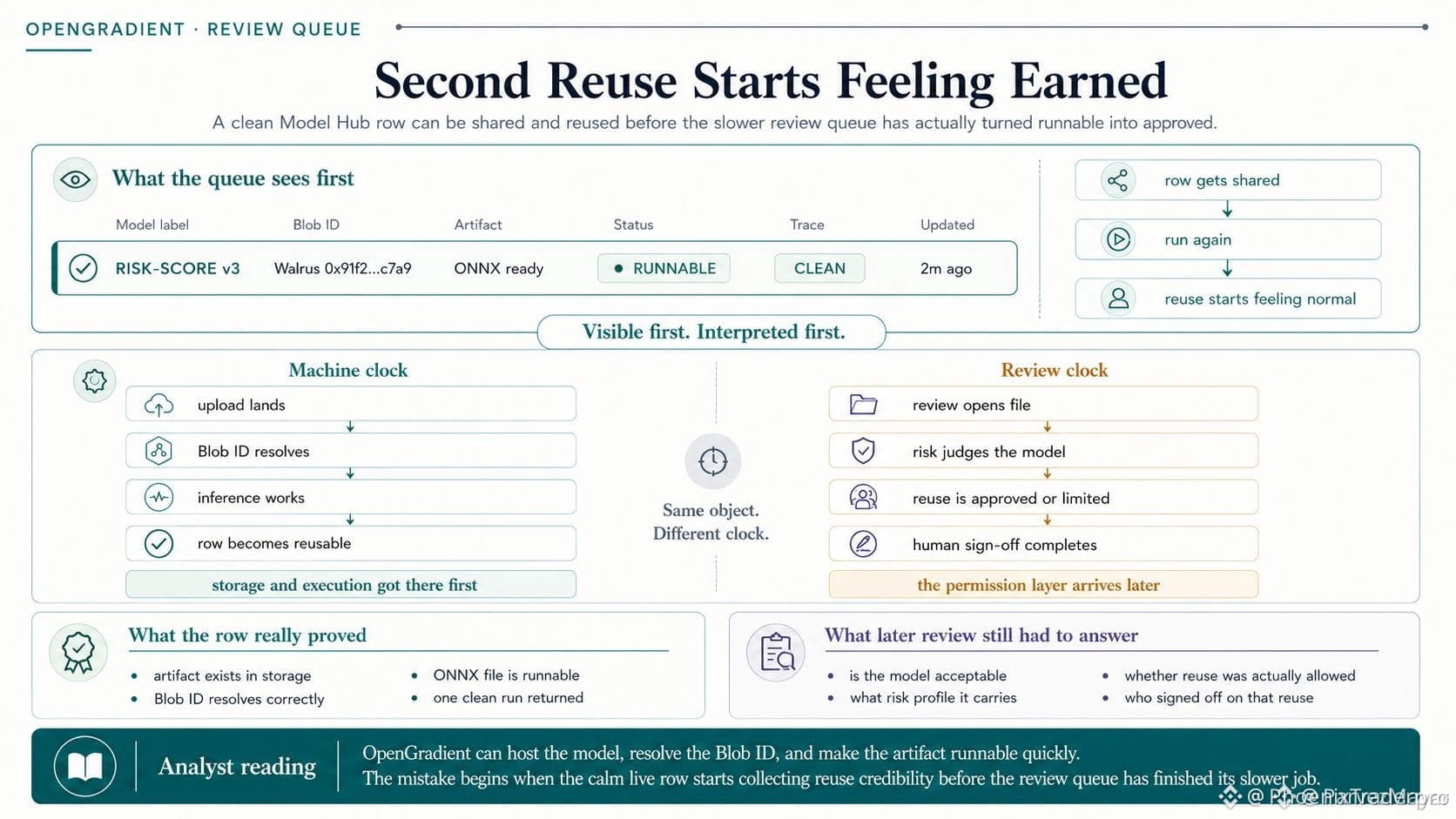
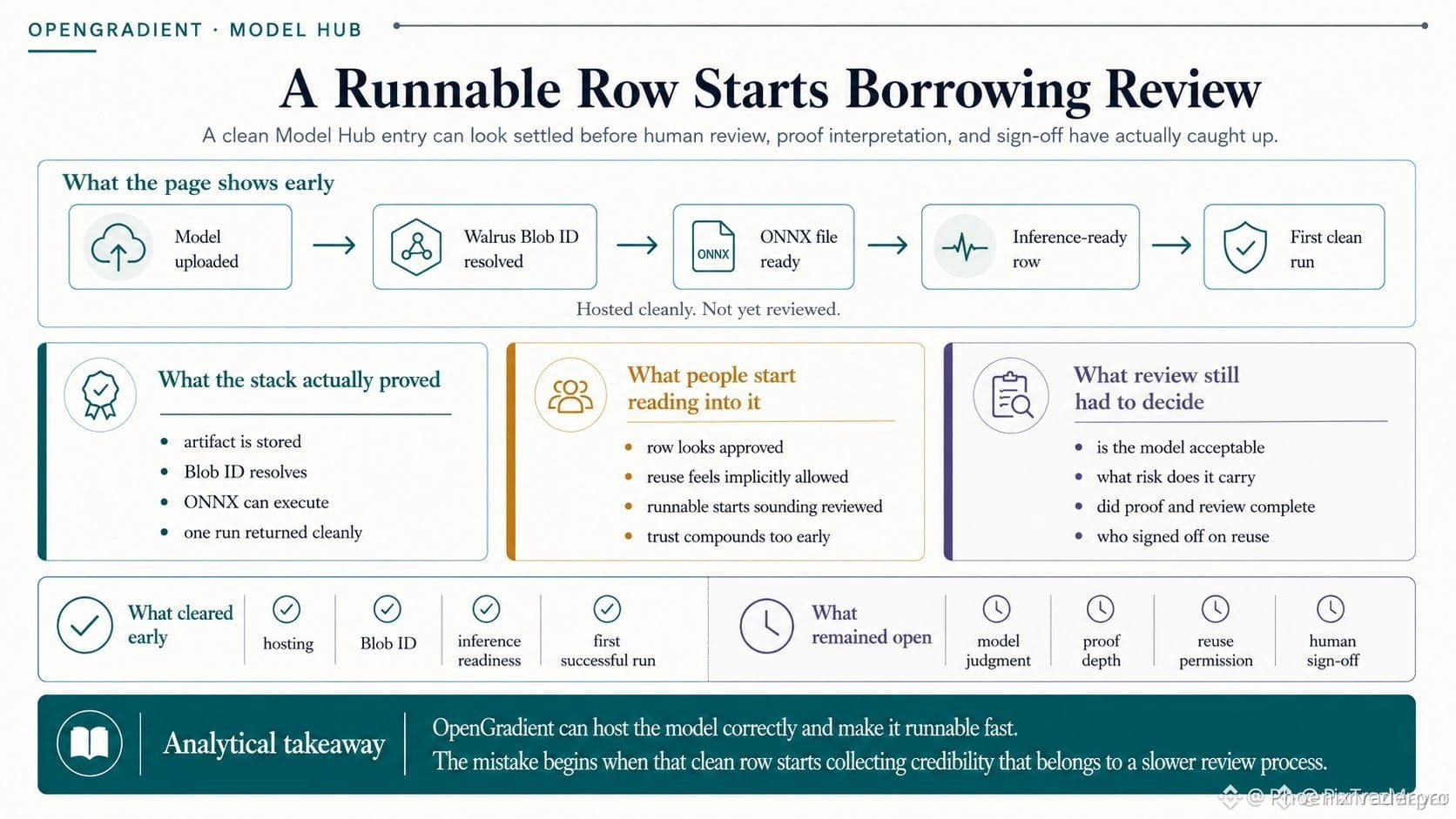
$OPG INFERENCE RUNS AHEAD OF THE REVIEW QUEUE 🔥
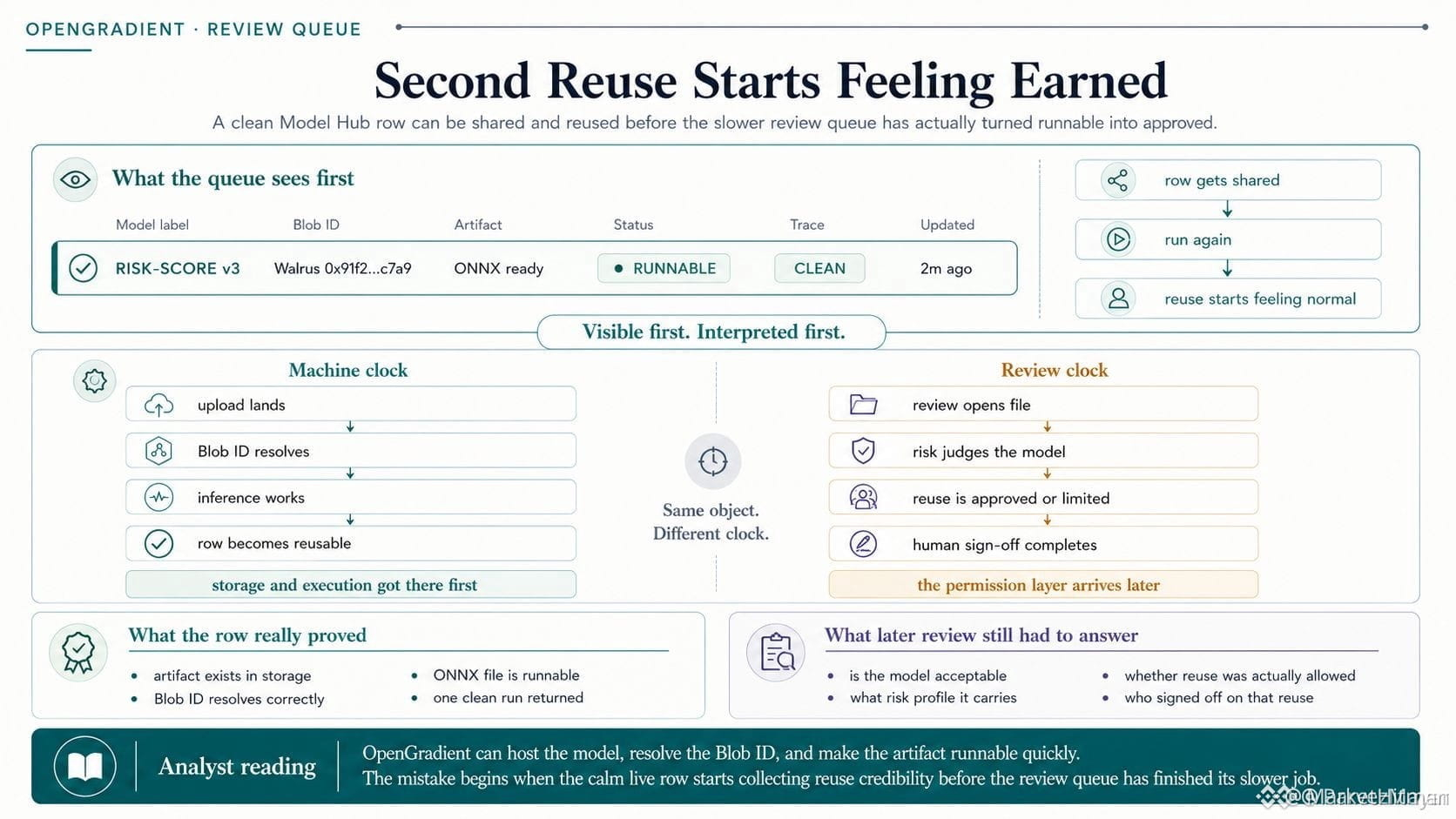
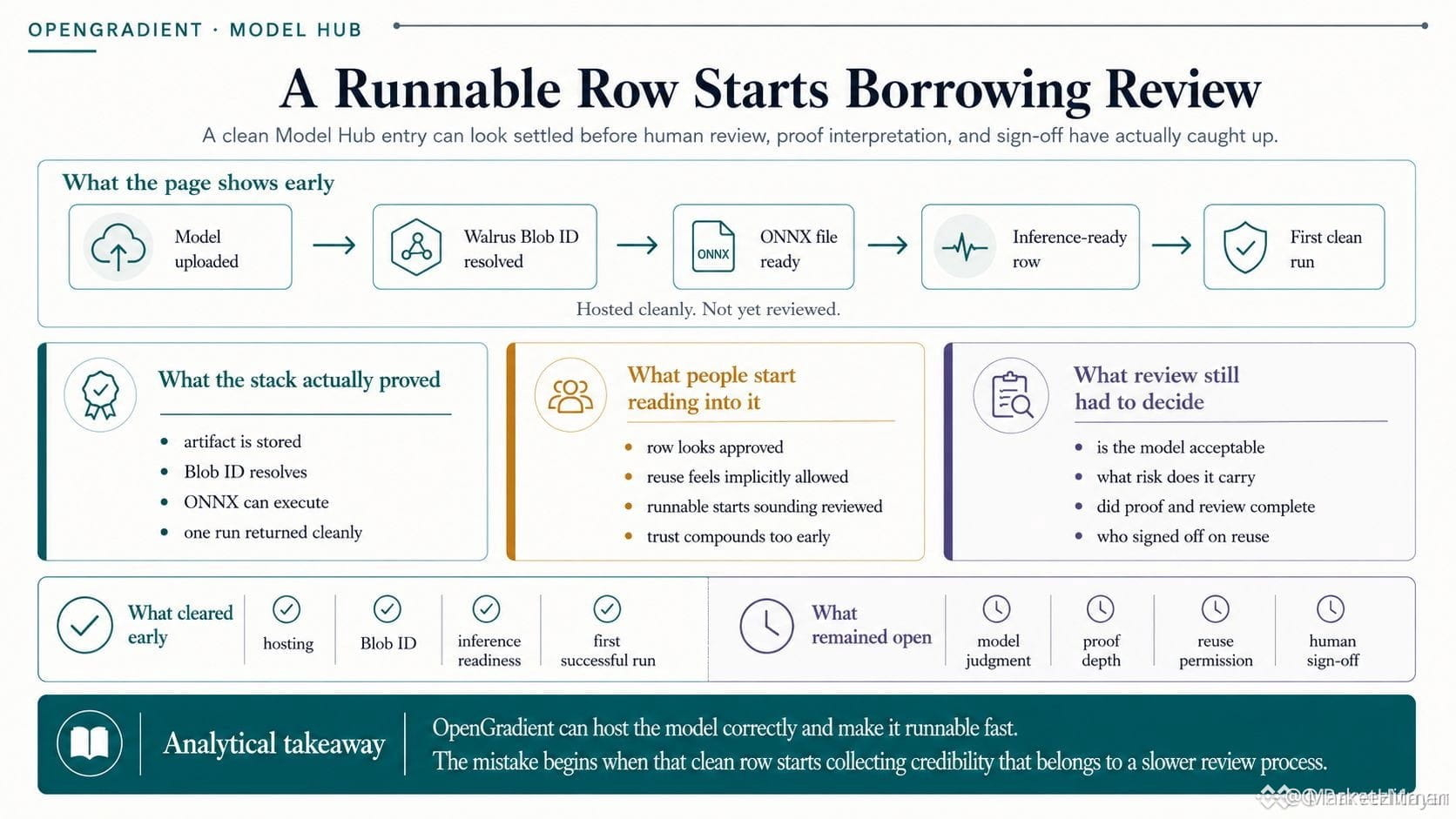
A model row in OpenGradient Model Hub gets verified in seconds — trace clean, Walrus blob ID ready, ONNX file live. But human review lags behind. By the third reuse, that row starts acting reviewed before it ever earned the sign-off. The system works perfectly. The process does not.
This gap between machine efficiency and human oversight creates a blind spot. The model was sound, but was it truly vetted? Trusting speed over sequence is a quiet edge — or a quiet leak.
Are you running models that passed the machine but skipped the human gate?
Not financial advice. Always manage your risk.
#OPG #ModelHub #Inference #CryptoAI
🔥
$OPG INFERENCE RUNS AHEAD OF THE REVIEW QUEUE 🔥
A model row in OpenGradient Model Hub gets verified in seconds — trace clean, Walrus blob ID ready, ONNX file live. But human review lags behind. By the third reuse, that row starts acting reviewed before it ever earned the sign-off. The system works perfectly. The process does not.
This gap between machine efficiency and human oversight creates a blind spot. The model was sound, but was it truly vetted? Trusting speed over sequence is a quiet edge — or a quiet leak.
Are you running models that passed the machine but skipped the human gate?
Not financial advice. Always manage your risk.
#OPG #ModelHub #Inference #CryptoAI
🔥
A model row in OpenGradient Model Hub gets verified in seconds — trace clean, Walrus blob ID ready, ONNX file live. But human review lags behind. By the third reuse, that row starts acting reviewed before it ever earned the sign-off. The system works perfectly. The process does not.
This gap between machine efficiency and human oversight creates a blind spot. The model was sound, but was it truly vetted? Trusting speed over sequence is a quiet edge — or a quiet leak.
Are you running models that passed the machine but skipped the human gate?
Not financial advice. Always manage your risk.
#OPG #ModelHub #Inference #CryptoAI
🔥
10

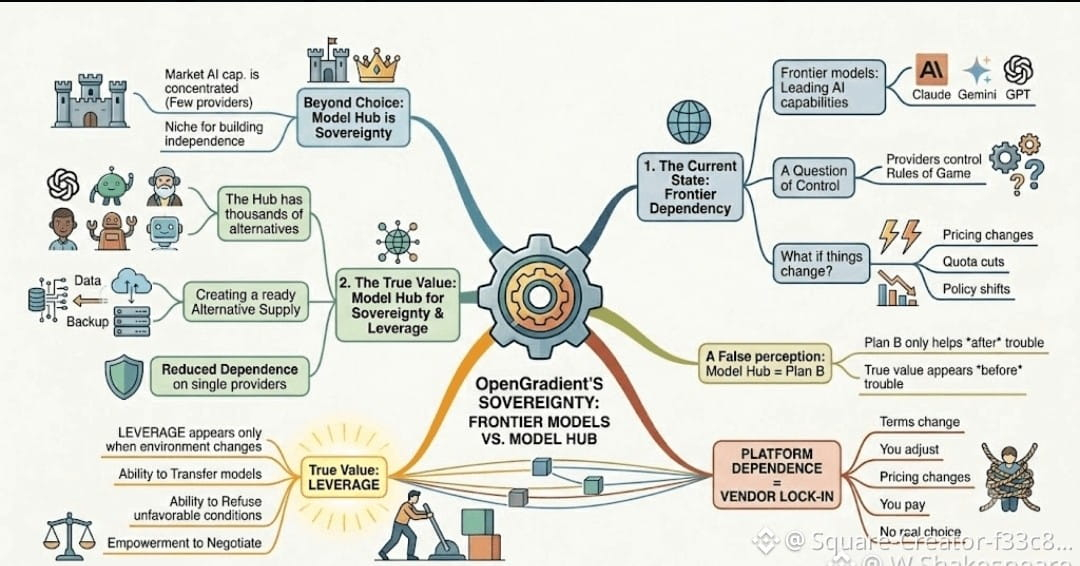
What if the biggest risk in AI isn't building a weak model... but depending on a strong one?
Most AI platforms are built on top of leading model providers. It works perfectly—until the rules change. Prices increase, API limits tighten, or policies shift overnight. Suddenly, your entire business depends on decisions you don't control.
This is where @OpenGradient OpenGradient stands out.
Model Hub isn't just a collection of AI models, and it isn't simply a backup plan. It's a strategy for independence. By supporting thousands of models, OpenGradient ensures it always has alternatives ready, reducing reliance on any single provider.
The real value isn't replacing the best models—it's having the freedom to choose. That freedom creates leverage, strengthens resilience, and gives OpenGradient the ability to adapt instead of simply accepting whatever changes come its way.
In the future, the strongest AI platforms may not be those with access to the most powerful models, but those that are never locked into a single one.
That's what makes OpenGradient more than an AI platform—it's building AI sovereignty.
$OPG $BEAT #OpenGradient #AI #Web3 #ModelHub
What if the biggest risk in AI isn't building a weak model... but depending on a strong one?
Most AI platforms are built on top of leading model providers. It works perfectly—until the rules change. Prices increase, API limits tighten, or policies shift overnight. Suddenly, your entire business depends on decisions you don't control.
This is where @OpenGradient OpenGradient stands out.
Model Hub isn't just a collection of AI models, and it isn't simply a backup plan. It's a strategy for independence. By supporting thousands of models, OpenGradient ensures it always has alternatives ready, reducing reliance on any single provider.
The real value isn't replacing the best models—it's having the freedom to choose. That freedom creates leverage, strengthens resilience, and gives OpenGradient the ability to adapt instead of simply accepting whatever changes come its way.
In the future, the strongest AI platforms may not be those with access to the most powerful models, but those that are never locked into a single one.
That's what makes OpenGradient more than an AI platform—it's building AI sovereignty.
$OPG $BEAT #OpenGradient #AI #Web3 #ModelHub
Most AI platforms are built on top of leading model providers. It works perfectly—until the rules change. Prices increase, API limits tighten, or policies shift overnight. Suddenly, your entire business depends on decisions you don't control.
This is where @OpenGradient OpenGradient stands out.
Model Hub isn't just a collection of AI models, and it isn't simply a backup plan. It's a strategy for independence. By supporting thousands of models, OpenGradient ensures it always has alternatives ready, reducing reliance on any single provider.
The real value isn't replacing the best models—it's having the freedom to choose. That freedom creates leverage, strengthens resilience, and gives OpenGradient the ability to adapt instead of simply accepting whatever changes come its way.
In the future, the strongest AI platforms may not be those with access to the most powerful models, but those that are never locked into a single one.
That's what makes OpenGradient more than an AI platform—it's building AI sovereignty.
$OPG $BEAT #OpenGradient #AI #Web3 #ModelHub
15
3
179
$OPG MODEL HUB IS RUNNING AHEAD OF REVIEW – SPEED IS THE RISK 🔥
OpenGradient's Model Hub processes models so fast that the output looks validated before human reviewers even get a look. The Walrus Blob ID checks out, the ONNX file is ready, the trace is clean. But that speed masks a basic flaw: reusing a model row three times without proper sign-off.
The gap between machine speed and human governance is widening. Every quick reuse builds false confidence. The third reuse barely gets questioned.
Are you checking the model or just the speed?
Not financial advice. Always manage your risk.
#OPG #ModelHub #CryptoAnalysis #Risk
🔥
$OPG MODEL HUB IS RUNNING AHEAD OF REVIEW – SPEED IS THE RISK 🔥
OpenGradient's Model Hub processes models so fast that the output looks validated before human reviewers even get a look. The Walrus Blob ID checks out, the ONNX file is ready, the trace is clean. But that speed masks a basic flaw: reusing a model row three times without proper sign-off.
The gap between machine speed and human governance is widening. Every quick reuse builds false confidence. The third reuse barely gets questioned.
Are you checking the model or just the speed?
Not financial advice. Always manage your risk.
#OPG #ModelHub #CryptoAnalysis #Risk
🔥
OpenGradient's Model Hub processes models so fast that the output looks validated before human reviewers even get a look. The Walrus Blob ID checks out, the ONNX file is ready, the trace is clean. But that speed masks a basic flaw: reusing a model row three times without proper sign-off.
The gap between machine speed and human governance is widening. Every quick reuse builds false confidence. The third reuse barely gets questioned.
Are you checking the model or just the speed?
Not financial advice. Always manage your risk.
#OPG #ModelHub #CryptoAnalysis #Risk
🔥
34

·
--
What's more valuable: creating knowledge or making it accessible?@OpenGradient
Nobody builds a library because they expect to read every book.
In fact, most books on the shelves will probably remain unopened for years. Which is probably why I've always found libraries a little strange. They occupy enormous amounts of space for knowledge that may never be used. At least that's how I used to think about them.
For some reason, that thought kept coming back while I was reading about @OpenGradient . At first, I assumed intelligence was mostly about creating new things. Better ideas. Better models. Better outputs. That seemed obvious. At least that's what I thought.
But the more I thought about it, the less obvious that assumption felt. Because knowledge becomes surprisingly valuable when it can be found again. A book hidden in a box isn't very different from a book that doesn't exist. What makes a library useful isn't just the information it stores. It's the ability to discover, access, and build upon what is already there.
Maybe that's why model hubs feel interesting to me. As AI agents and developers create more models, I'm starting to wonder whether the future depends less on creating knowledge and more on organizing it. The more I learn about OpenGradient's Model Hub, the more I wonder whether intelligence grows not only from invention, but from accessibility. I'm not sure. But for some reason, libraries kept coming to mind.
#OPG #ModelHub #AIAgents #AIInfrastructure #verifiableAI $OPG $HEI $BEAT
A Library is valuable because.....?
What's more valuable: creating knowledge or making it accessible?@OpenGradient
Nobody builds a library because they expect to read every book.
In fact, most books on the shelves will probably remain unopened for years. Which is probably why I've always found libraries a little strange. They occupy enormous amounts of space for knowledge that may never be used. At least that's how I used to think about them.
For some reason, that thought kept coming back while I was reading about @OpenGradient . At first, I assumed intelligence was mostly about creating new things. Better ideas. Better models. Better outputs. That seemed obvious. At least that's what I thought.
But the more I thought about it, the less obvious that assumption felt. Because knowledge becomes surprisingly valuable when it can be found again. A book hidden in a box isn't very different from a book that doesn't exist. What makes a library useful isn't just the information it stores. It's the ability to discover, access, and build upon what is already there.
Maybe that's why model hubs feel interesting to me. As AI agents and developers create more models, I'm starting to wonder whether the future depends less on creating knowledge and more on organizing it. The more I learn about OpenGradient's Model Hub, the more I wonder whether intelligence grows not only from invention, but from accessibility. I'm not sure. But for some reason, libraries kept coming to mind.
#OPG #ModelHub #AIAgents #AIInfrastructure #verifiableAI $OPG $HEI $BEAT
A Library is valuable because.....?
Nobody builds a library because they expect to read every book.
In fact, most books on the shelves will probably remain unopened for years. Which is probably why I've always found libraries a little strange. They occupy enormous amounts of space for knowledge that may never be used. At least that's how I used to think about them.
For some reason, that thought kept coming back while I was reading about @OpenGradient . At first, I assumed intelligence was mostly about creating new things. Better ideas. Better models. Better outputs. That seemed obvious. At least that's what I thought.
But the more I thought about it, the less obvious that assumption felt. Because knowledge becomes surprisingly valuable when it can be found again. A book hidden in a box isn't very different from a book that doesn't exist. What makes a library useful isn't just the information it stores. It's the ability to discover, access, and build upon what is already there.
Maybe that's why model hubs feel interesting to me. As AI agents and developers create more models, I'm starting to wonder whether the future depends less on creating knowledge and more on organizing it. The more I learn about OpenGradient's Model Hub, the more I wonder whether intelligence grows not only from invention, but from accessibility. I'm not sure. But for some reason, libraries kept coming to mind.
#OPG #ModelHub #AIAgents #AIInfrastructure #verifiableAI $OPG $HEI $BEAT
A Library is valuable because.....?
it stores knowledge
100%
it organizes knowledge
0%
it shares knowledge
0%
it inspire new knowledge
0%
2 ඡන්ද • ඡන්දය අවසන්
196
88
19.2k
·
--
#opg $OPG Forget gatekeepers. @OpenGradient 's permissionless Model Hub hosts 2,000+ models from developers worldwide—no approval queue, no censorship. Upload your model in seconds, monetize instantly, and join a decentralized Hugging Face built on verifiable infrastructure. Powered by $OPG. This is open intelligence. #OPG #ModelHu #DecentralizedAI #ModelHub
#opg $OPG Forget gatekeepers. @OpenGradient 's permissionless Model Hub hosts 2,000+ models from developers worldwide—no approval queue, no censorship. Upload your model in seconds, monetize instantly, and join a decentralized Hugging Face built on verifiable infrastructure. Powered by $OPG . This is open intelligence. #OPG #ModelHu #DecentralizedAI #ModelHub
41

·
--
#opg $OPG @OpenGradient
I did not start questioning Model Hub demand because a model failed.
The model loaded. The listing existed. The payment path worked. Nothing looked broken enough to raise an alarm.
The hesitation appeared somewhere smaller.
I opened a model, read the description, checked the version notes, looked for benchmark context, then opened another tab to verify the runtime environment. A few minutes later, I realized I still had not run the model.
That is the strange part about demand.
Most demand does not disappear because of a catastrophic failure. It leaks away through small uncertainties.
Is this the latest version?
How does it perform outside the benchmark?
Can I trust the published results?
Will the runtime behave the same way tomorrow?
Is another model already solving this problem better?
None of these questions stop usage individually.
Together, they do.
That made the Model Hub Utility Equation feel more practical than theoretical:
(D × P × V × I × C) / (F × R)
Demand, performance, verification, integration, and confidence all push adoption forward.
Friction and risk do not need to become large. They only need to appear often enough.
The interesting thing about OPG is that payments and settlement may eventually become the easiest part of the experience. The harder challenge could be reducing the amount of re-evaluation every time someone returns.
Because the real test for a Model Hub is not:
"How many models exist?"
It is:
"How many developers run the same model again next week without re-auditing the entire path?"
That second execution might matter more than the first.
#DecentralizedAI #ModelHub #Web3AI #TradebStocks
Question for builders:
What blocks Model Hub demand first for you?
Discovery
Trust
Performance uncertainty
Integration friction
Pricing and payment complexity
#opg $OPG @OpenGradient
I did not start questioning Model Hub demand because a model failed.
The model loaded. The listing existed. The payment path worked. Nothing looked broken enough to raise an alarm.
The hesitation appeared somewhere smaller.
I opened a model, read the description, checked the version notes, looked for benchmark context, then opened another tab to verify the runtime environment. A few minutes later, I realized I still had not run the model.
That is the strange part about demand.
Most demand does not disappear because of a catastrophic failure. It leaks away through small uncertainties.
Is this the latest version?
How does it perform outside the benchmark?
Can I trust the published results?
Will the runtime behave the same way tomorrow?
Is another model already solving this problem better?
None of these questions stop usage individually.
Together, they do.
That made the Model Hub Utility Equation feel more practical than theoretical:
(D × P × V × I × C) / (F × R)
Demand, performance, verification, integration, and confidence all push adoption forward.
Friction and risk do not need to become large. They only need to appear often enough.
The interesting thing about OPG is that payments and settlement may eventually become the easiest part of the experience. The harder challenge could be reducing the amount of re-evaluation every time someone returns.
Because the real test for a Model Hub is not:
"How many models exist?"
It is:
"How many developers run the same model again next week without re-auditing the entire path?"
That second execution might matter more than the first.
#DecentralizedAI #ModelHub #Web3AI #TradebStocks
Question for builders:
What blocks Model Hub demand first for you?
Discovery
Trust
Performance uncertainty
Integration friction
Pricing and payment complexity
I did not start questioning Model Hub demand because a model failed.
The model loaded. The listing existed. The payment path worked. Nothing looked broken enough to raise an alarm.
The hesitation appeared somewhere smaller.
I opened a model, read the description, checked the version notes, looked for benchmark context, then opened another tab to verify the runtime environment. A few minutes later, I realized I still had not run the model.
That is the strange part about demand.
Most demand does not disappear because of a catastrophic failure. It leaks away through small uncertainties.
Is this the latest version?
How does it perform outside the benchmark?
Can I trust the published results?
Will the runtime behave the same way tomorrow?
Is another model already solving this problem better?
None of these questions stop usage individually.
Together, they do.
That made the Model Hub Utility Equation feel more practical than theoretical:
(D × P × V × I × C) / (F × R)
Demand, performance, verification, integration, and confidence all push adoption forward.
Friction and risk do not need to become large. They only need to appear often enough.
The interesting thing about OPG is that payments and settlement may eventually become the easiest part of the experience. The harder challenge could be reducing the amount of re-evaluation every time someone returns.
Because the real test for a Model Hub is not:
"How many models exist?"
It is:
"How many developers run the same model again next week without re-auditing the entire path?"
That second execution might matter more than the first.
#DecentralizedAI #ModelHub #Web3AI #TradebStocks
Question for builders:
What blocks Model Hub demand first for you?
Discovery
Trust
Performance uncertainty
Integration friction
Pricing and payment complexity
4
1
109

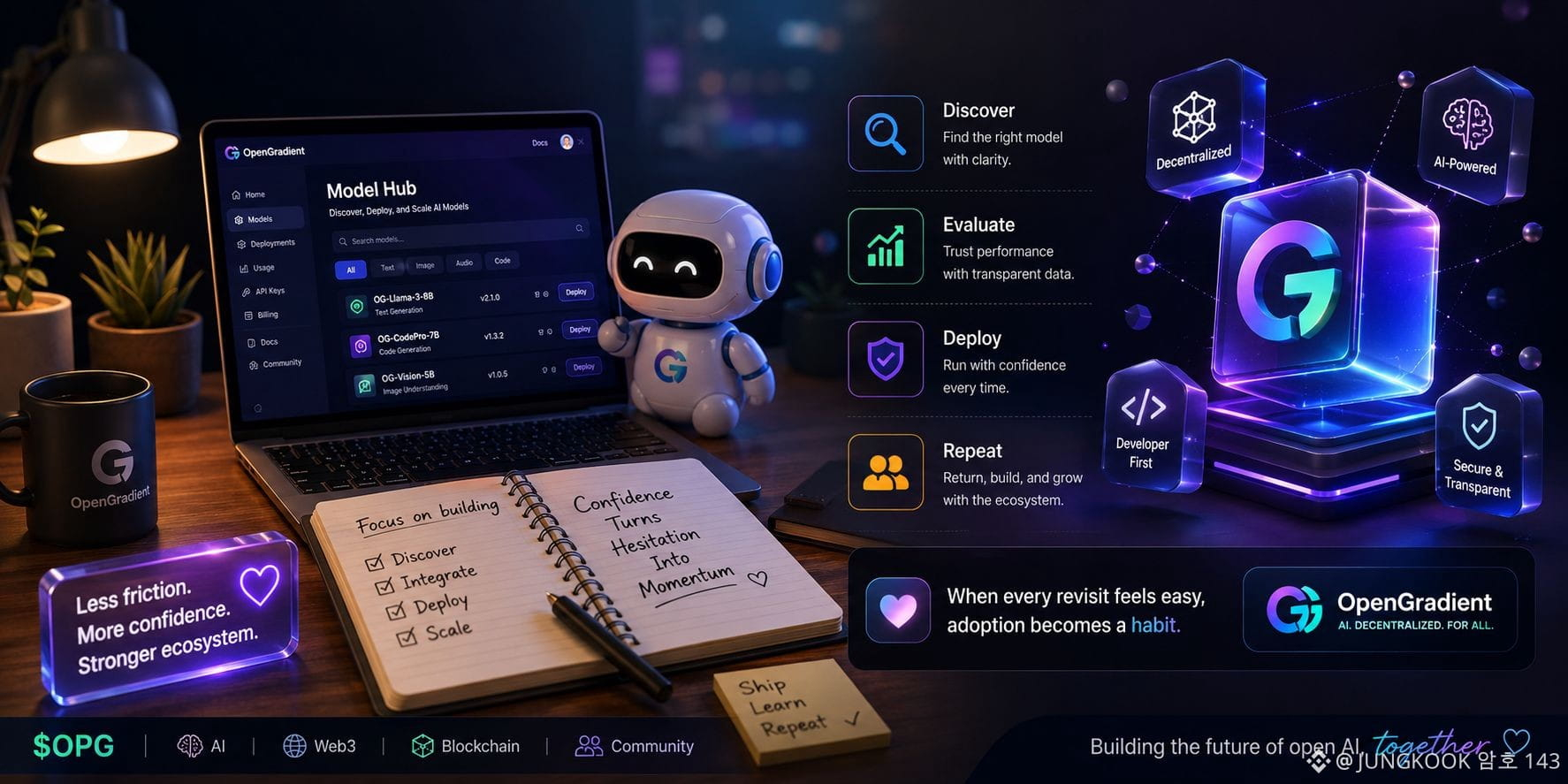
#opg $OPG One thought keeps coming back whenever I explore an AI Model Hub.
If I return to the same model tomorrow, will I launch it immediately, or will I feel the need to review the documentation, benchmarks, release notes, and runtime details all over again?
That question reveals more about a platform than the size of its model catalog.
Developers are naturally curious and willing to learn. What slows momentum is having to rebuild confidence every time they revisit a model. Trust should grow with each interaction, not reset to zero.
@OpenGradient For projects like Open gradient, long-term value isn't created by simply adding more models. It comes from creating an experience where discovery is clear, performance is transparent, version history is easy to understand, and deployment feels predictable. When those pieces come together, returning to a model becomes effortless instead of uncertain.
The strongest ecosystems are built on repeat participation. Every smooth revisit strengthens confidence, every successful deployment encourages the next experiment, and every positive experience contributes to lasting community growth.
When developers stop questioning the path and start focusing on building, adoption evolves from occasional experimentation into a natural habit. That is the kind of progress that creates a resilient AI ecosystem.
$OPG #OpenGradient $OPG #AI #ModelHub @OpenGradient #DecentralizedAI
#opg $OPG One thought keeps coming back whenever I explore an AI Model Hub.
If I return to the same model tomorrow, will I launch it immediately, or will I feel the need to review the documentation, benchmarks, release notes, and runtime details all over again?
That question reveals more about a platform than the size of its model catalog.
Developers are naturally curious and willing to learn. What slows momentum is having to rebuild confidence every time they revisit a model. Trust should grow with each interaction, not reset to zero.
@OpenGradient For projects like Open gradient, long-term value isn't created by simply adding more models. It comes from creating an experience where discovery is clear, performance is transparent, version history is easy to understand, and deployment feels predictable. When those pieces come together, returning to a model becomes effortless instead of uncertain.
The strongest ecosystems are built on repeat participation. Every smooth revisit strengthens confidence, every successful deployment encourages the next experiment, and every positive experience contributes to lasting community growth.
When developers stop questioning the path and start focusing on building, adoption evolves from occasional experimentation into a natural habit. That is the kind of progress that creates a resilient AI ecosystem.
$OPG #OpenGradient $OPG #AI #ModelHub @OpenGradient #DecentralizedAI
If I return to the same model tomorrow, will I launch it immediately, or will I feel the need to review the documentation, benchmarks, release notes, and runtime details all over again?
That question reveals more about a platform than the size of its model catalog.
Developers are naturally curious and willing to learn. What slows momentum is having to rebuild confidence every time they revisit a model. Trust should grow with each interaction, not reset to zero.
@OpenGradient For projects like Open gradient, long-term value isn't created by simply adding more models. It comes from creating an experience where discovery is clear, performance is transparent, version history is easy to understand, and deployment feels predictable. When those pieces come together, returning to a model becomes effortless instead of uncertain.
The strongest ecosystems are built on repeat participation. Every smooth revisit strengthens confidence, every successful deployment encourages the next experiment, and every positive experience contributes to lasting community growth.
When developers stop questioning the path and start focusing on building, adoption evolves from occasional experimentation into a natural habit. That is the kind of progress that creates a resilient AI ecosystem.
$OPG #OpenGradient $OPG #AI #ModelHub @OpenGradient #DecentralizedAI
26
11
248
තවත් අන්තර්ගතයන් ගවේෂණය කිරීමට ඇතුල් වන්න
Binance චතුරශ්රය හි ගෝලීය ක්රිප්ටෝ පරිශීලකයින් හා එක්වන්න
⚡️ ක්රිප්ටෝ පිළිබඳ නවතම සහ ප්රයෝජනවත් තොරතුරු ලබා ගන්න.
💬 ලොව විශාලතම ක්රිප්ටෝ හුවමාරුව මගින් විශ්වාස කෙරේ.
👍 සත්යායනය කරන ලද නිර්මාණකරුවන්ගෙන් සැබෑ විදසුන් සොයා ගන්න.
විද්යුත් තැපෑල / දුරකථන අංකය
නැගී එන මාතෘකා
1
#AnthropicIPOProspectusCouldValueItOver$2T
23 views
20 සාකච්ඡා කරමින්
2
#HackersDrainOver12.4MXRPFromDCENTWallets
22 views
17 සාකච්ඡා කරමින්
3
#SECSaysDecentralizedTokenBuybacksNotInvestmentContracts
0 views
1 සාකච්ඡා කරමින්
4
#UKFCAWinsCourtOrderToRecover851400Pounds
50,583 views
947 සාකච්ඡා කරමින්
5
#ChainlinkLaunchesCCIP2WithEnterpriseVerification
60,742 views
1,086 සාකච්ඡා කරමින්
6
#GoldFallsTo$4144
20,364 views
173 සාකච්ඡා කරමින්
7
#QNTFallsOver40%FromMorningHigh
109,614 views
1,470 සාකච්ඡා කරමින්
8
#USDTAdds845900HoldersInPast7Days
28,879 views
523 සාකච්ඡා කරමින්
9
#KospiFalls2.7%SamsungSKHynixDropOver5%
40,733 views
655 සාකච්ඡා කරමින්
10
#BitgetCEOConfirms$388MStolenInHack
6,006 views
45 සාකච්ඡා කරමින්