
#scaling
scaling
80,417 නැරඹීම්
638 සාකච්ඡා කරමින්
උණුසුම්
නවතම
·
--
ලිපිය
How Rollup Layer-2s Turn Blockchains into HighwaysI've been watching the daily price jitter of $BTC at $75,986 and $ETH at $2,234 and wondered how those numbers can move so fast without choking the network. The answer lies in rollup layer-2s, a clever way to stretch capacity while keeping the security guarantees of the base chain.
What a Rollup Is
A rollup is like a bus that gathers many passengers (transactions) and drops them off at a single stop on the main road (the L1). Instead of each rider paying a toll, the bus pays one larger toll, and the road only sees one big transaction. The rollup bundles data off-chain, then posts a concise proof to $BTC or $ETH that the bundle is valid.
Why It Matters
When $BNB nudged up 0.65% and SOL rose 0.44% I could see the market's appetite for cheaper, faster trades. Rollups shave the per-transaction fee because the L1 only processes the proof, not every individual move. This reduction in congestion is why we see lower volatility in the 24-hour range of $BTC ($74,888-$76,560) compared with the frantic swings of some altcoins.
How Data Gets Squashed
The rollup creates a cryptographic commitment, a Merkle root, that represents all the bundled transactions. Think of it as a fingerprint of the entire bus load. The L1 stores just that fingerprint and a small amount of calldata. Validators on the rollup verify the transactions locally, and the L1 can later challenge any misbehavior using the same fingerprint.
Security Trade-offs
Rollups inherit the security of the underlying chain, but they also introduce a trust model for the operator. If the operator withholds data, users can still retrieve it from the L1 proof, though the experience may be slower. The Fear & Greed Index sitting at 28 (Fear) reminds me that market sentiment can swing quickly, and a rollup's reputation can be tested during stress periods.
Real-world Signals
You can spot rollup activity in the volume numbers: $BTC's 24-hour volume of $1.51B and $ETH's $620M show how much data the base layers are still handling. When top gainers like CYBER jump +54.85% or ONE climbs +49.20%, many of those trades are likely flowing through rollups to keep costs down.
What rollup design do you think will shape the next wave of scaling?
Not financial advice
#CryptoTech #Layer2 #Scaling #Blockchain
How Rollup Layer-2s Turn Blockchains into Highways
I've been watching the daily price jitter of $BTC at $75,986 and $ETH at $2,234 and wondered how those numbers can move so fast without choking the network. The answer lies in rollup layer-2s, a clever way to stretch capacity while keeping the security guarantees of the base chain.
What a Rollup Is
A rollup is like a bus that gathers many passengers (transactions) and drops them off at a single stop on the main road (the L1). Instead of each rider paying a toll, the bus pays one larger toll, and the road only sees one big transaction. The rollup bundles data off-chain, then posts a concise proof to $BTC or $ETH that the bundle is valid.
Why It Matters
When $BNB nudged up 0.65% and SOL rose 0.44% I could see the market's appetite for cheaper, faster trades. Rollups shave the per-transaction fee because the L1 only processes the proof, not every individual move. This reduction in congestion is why we see lower volatility in the 24-hour range of $BTC ($74,888-$76,560) compared with the frantic swings of some altcoins.
How Data Gets Squashed
The rollup creates a cryptographic commitment, a Merkle root, that represents all the bundled transactions. Think of it as a fingerprint of the entire bus load. The L1 stores just that fingerprint and a small amount of calldata. Validators on the rollup verify the transactions locally, and the L1 can later challenge any misbehavior using the same fingerprint.
Security Trade-offs
Rollups inherit the security of the underlying chain, but they also introduce a trust model for the operator. If the operator withholds data, users can still retrieve it from the L1 proof, though the experience may be slower. The Fear & Greed Index sitting at 28 (Fear) reminds me that market sentiment can swing quickly, and a rollup's reputation can be tested during stress periods.
Real-world Signals
You can spot rollup activity in the volume numbers: $BTC 's 24-hour volume of $1.51B and $ETH 's $620M show how much data the base layers are still handling. When top gainers like CYBER jump +54.85% or ONE climbs +49.20%, many of those trades are likely flowing through rollups to keep costs down.
What rollup design do you think will shape the next wave of scaling?
Not financial advice
#CryptoTech #Layer2 #Scaling #Blockchain
164

·
--
think of a blockchain like a highway. it's got 1 main road - secure, but only so many lanes. every transaction is like a car. when traffic piles up, everything slows down and tolls spike. that's where L2 comes in - it's like adding express lanes. they batch dozens of transactions into 1 convoy, zip through the main road, then unpack at the exit. same destination, fraction of the congestion and cost. security stays intact since the main chain still settles the final tally. rollups like optimism and arbitrum do this for $ETH. lightning does it for $BTC. you get speed without giving up the trust model. that's the point - scale without sacrifice. L2 #Scaling #Ethereum #Bitcoin
think of a blockchain like a highway. it's got 1 main road - secure, but only so many lanes. every transaction is like a car. when traffic piles up, everything slows down and tolls spike. that's where L2 comes in - it's like adding express lanes. they batch dozens of transactions into 1 convoy, zip through the main road, then unpack at the exit. same destination, fraction of the congestion and cost. security stays intact since the main chain still settles the final tally. rollups like optimism and arbitrum do this for $ETH . lightning does it for $BTC . you get speed without giving up the trust model. that's the point - scale without sacrifice. L2 #Scaling #Ethereum #Bitcoin
34
·
--
ලිපිය
Layer 2 Rollups: How Ethereum Gets Faster Without Losing SecurityEthereum's price is sitting at $2,335 with a 24-hour gain of +3.07%, but the network still feels congested during peak hours. I've been watching the same pattern on $BTC ($78,656, +2.00% today) and wondering why a simple "off-ramp" can make such a difference. The answer lies in rollups, a clever way to batch transactions and push most of the work off-chain while still letting the main chain verify everything.
What Is A Rollup?
A rollup bundles dozens or hundreds of transactions into a single data package. Think of it like a shipping container: you load many small boxes, seal it, and then the truck (Ethereum) only needs to check the container's seal. The rollup posts a tiny proof and the raw data to the base layer, so the main chain can confirm the batch's validity without replaying each step.
How Data Is Packed
There are two main flavors: optimistic and zero-knowledge (zk) rollups. Optimistic rollups assume the batch is correct and give challengers a window to dispute it. Zk-rollups generate a cryptographic proof that the math checks out before the batch lands. In both cases the heavy lifting happens off-chain, which is why you see lower fees and faster confirmations. The trade-off is a short delay for optimism or a more complex proof generation for zk.
Security Guarantees
Because the rollup still posts data to Ethereum, the base layer can always reconstruct the state if something goes wrong. It's like keeping a backup copy on a secure server. This design means you don't have to trust a separate validator set the way you would with a sidechain. The Fear & Greed Index reads 34 (Fear) today, hinting that many traders are still cautious, so having that extra safety net feels reassuring.
When Rollups Shine
Rollups are most useful when demand spikes, like during a $BNB rally to $703.33 or a sudden surge in $SOL to $93.96. In those moments, the main chain's capacity can be stretched thin, and a rollup can absorb the excess traffic. I've tried a few DeFi apps on an optimistic rollup and noticed the gas cost dropping from a few dollars to a few cents, while the transaction still settled on Ethereum's secure ledger.
What rollup experience have you had, and what still feels fuzzy about the tech?
Not financial advice
#CryptoTech #Layer2 #Ethereum #Scaling
Layer 2 Rollups: How Ethereum Gets Faster Without Losing Security
Ethereum's price is sitting at $2,335 with a 24-hour gain of +3.07%, but the network still feels congested during peak hours. I've been watching the same pattern on $BTC ($78,656, +2.00% today) and wondering why a simple "off-ramp" can make such a difference. The answer lies in rollups, a clever way to batch transactions and push most of the work off-chain while still letting the main chain verify everything.
What Is A Rollup?
A rollup bundles dozens or hundreds of transactions into a single data package. Think of it like a shipping container: you load many small boxes, seal it, and then the truck (Ethereum) only needs to check the container's seal. The rollup posts a tiny proof and the raw data to the base layer, so the main chain can confirm the batch's validity without replaying each step.
How Data Is Packed
There are two main flavors: optimistic and zero-knowledge (zk) rollups. Optimistic rollups assume the batch is correct and give challengers a window to dispute it. Zk-rollups generate a cryptographic proof that the math checks out before the batch lands. In both cases the heavy lifting happens off-chain, which is why you see lower fees and faster confirmations. The trade-off is a short delay for optimism or a more complex proof generation for zk.
Security Guarantees
Because the rollup still posts data to Ethereum, the base layer can always reconstruct the state if something goes wrong. It's like keeping a backup copy on a secure server. This design means you don't have to trust a separate validator set the way you would with a sidechain. The Fear & Greed Index reads 34 (Fear) today, hinting that many traders are still cautious, so having that extra safety net feels reassuring.
When Rollups Shine
Rollups are most useful when demand spikes, like during a $BNB rally to $703.33 or a sudden surge in $SOL to $93.96. In those moments, the main chain's capacity can be stretched thin, and a rollup can absorb the excess traffic. I've tried a few DeFi apps on an optimistic rollup and noticed the gas cost dropping from a few dollars to a few cents, while the transaction still settled on Ethereum's secure ledger.
What rollup experience have you had, and what still feels fuzzy about the tech?
Not financial advice
#CryptoTech #Layer2 #Ethereum #Scaling
219

$BNB UNLEASHES LAYER-2 SCALING TODAY IGNITING A MASSIVE VOLATILITY EXPANSION WINDOW ⚡ 💥
The ecosystem is rolling out its Layer-2 execution engine to slash transaction fees and accelerate throughput on $BNB . 🌊 Capital rotation into ecosystem infrastructure is already building momentum as order books brace for heightened velocity.
⚡ While expanding transaction capacity unlocks deep network utility, early scaling phases notoriously test liquidity dynamics and trigger sharp two-way swings. 💡 Smart money is positioning around the structural bid rather than chasing the initial impulse.
💬 Does this architectural upgrade spark a sustained rally for $BNB , or will early volatility flush overleveraged positions first? 👇
⚠️ Not financial advice. Always manage your risk. 🛡️
🏷️ #BNB #Layer2 #Scaling #Crypto
⚡ 🐂


5

·
--
中文版:
以太坊测试网刚刚放大招!Sepolia测试网激活Glamsterdam升级,区块gas限制飙升至2亿,是主网的三倍多。看来ETH扩容又近一步了,这波操作真香!
$ETH #以太坊 #扩容
Ethereum's testnet just leveled up! Sepolia activated Glamsterdam with block gas limit jumping to 200M, over 3x mainnet's capacity. Looks like ETH scaling is heating up, big moves ahead!
$ETH #Ethereum #Scaling
279

·
--
🚨 Ethereum’s validator client patched hours before Sepolia test, enabling 200M gas per block.
This last-minute fix supports higher throughput without compromising stability.
Smart money may view this as prep for mainnet scaling, reducing congestion risk.
ETH could see reduced fee pressure if adoption follows.
Will this test boost confidence in Ethereum’s long-term scalability?
#Scaling
$ETH #TradingSignal #CryptoAnalysis
24

·
--

ලිපිය
Lightning Fast:Scaling Bitcoin for Global Commerce ⚡
As decentralized systems aim to serve billions of active global participants, secondary infrastructure layers are becoming essential. The Lightning Network represents a massive technological breakthrough, functioning as a vital Layer-2 scaling engine built directly on top of the base protocol. By shifting everyday transactional micro-payments off the primary chain into secure peer-to-peer payment channels, it solves scalability limitations. Users can transfer fractional $BTC
{spot}(BTCUSDT)
units instantaneously with near-zero network routing fees, unlocking true global retail commerce. This software design ensures that while @Bitcoinworld remains the ultimate secure settlement layer, everyday consumer economic velocity can scale infinitely. From tipping online creators to executing instant international cross-border remittances, this expanding network removes the payment friction inherent to legacy banking setups. Driving merchant adoption from local shops to global enterprises, Layer-2 innovations prove that decentralized digital cash is ready for real-world scaling. 🌍
#Lightning #Layer2Coin #Scaling #Web3Dev #Fintech
Lightning Fast:
Scaling Bitcoin for Global Commerce ⚡
As decentralized systems aim to serve billions of active global participants, secondary infrastructure layers are becoming essential. The Lightning Network represents a massive technological breakthrough, functioning as a vital Layer-2 scaling engine built directly on top of the base protocol. By shifting everyday transactional micro-payments off the primary chain into secure peer-to-peer payment channels, it solves scalability limitations. Users can transfer fractional $BTC
units instantaneously with near-zero network routing fees, unlocking true global retail commerce. This software design ensures that while @Bitcoinworld remains the ultimate secure settlement layer, everyday consumer economic velocity can scale infinitely. From tipping online creators to executing instant international cross-border remittances, this expanding network removes the payment friction inherent to legacy banking setups. Driving merchant adoption from local shops to global enterprises, Layer-2 innovations prove that decentralized digital cash is ready for real-world scaling. 🌍
#Lightning #Layer2Coin #Scaling #Web3Dev #Fintech
67


·
--
උසබ තත්ත්වය
More TPS Creates More Network Traffic ⚡
$APT and $SUI were designed around the idea that blockchains shouldn’t accept the throughput limits of earlier architectures.
Parallel execution, optimized consensus and increasingly powerful validator hardware can all increase how much work a network performs.
But every additional transaction creates information that eventually has to move somewhere.
Transactions need to reach infrastructure, blocks need to propagate, validators need to communicate and applications need data returned through RPC systems.
That creates a second scaling curve outside execution itself.
DoubleZero is designed around that curve, aggregating dedicated bandwidth into a transport layer where distributed-system traffic can move over routes optimized for high throughput and low latency.
#Scaling #Layer1

329
සත්යායනය කළ
$BNB CHAIN DROPS NEXT-GEN L1 ROADMAP WITH 50MS LATENCY 🚀
BNB Chain is building a new Layer1 network targeting sub-50 millisecond latency and 100,000 TPS — numbers that would put it ahead of most current chains. Testnet is slated for 2026, which means the development cycle is real and backed by serious resources.
This isn't vaporware. The team has been scaling consistently, and this roadmap confirms they're playing the long game on infrastructure. For anyone holding $BNB , this is a fundamental catalyst that could drive long-term demand for the ecosystem token.
What's your take — does a 2026 testnet timeline make this a sleeper play or just noise?
Not financial advice. Always manage your risk.
#BNB #Layer1 #Scaling #CryptoNews
🚀
1
1.7k
·
--
🚨 Ethereum’s scaling could leap forward by reducing redundant work—cheaper proofs let more participants verify without repeating tasks. Builders and provers still need data flow, but efficiency gains may lower costs and boost throughput. This shift could strengthen ETH’s utility as rollups scale.
What if less repetition means more adoption?
#Scaling
$ETH #TradingSignal #CryptoAnalysis
What if less repetition means more adoption?
#Scaling
$ETH #TradingSignal #CryptoAnalysis
17

Why is nobody talking about the Ethereum Foundation quietly launching ZKAPION Mainnet while everyone else chases the latest narrative?
Traders keep getting wrecked by unpredictable gas fees that wipe out gains and leave them second-guessing every entry they make on $ETH. Missing the window because of congestion is a story too many of us know too well.
The zero-knowledge technology behind this launch is designed to scale blockchain activity without the compromises we have grown used to. Ethereum’s L2 and ZK ecosystem continues to grow around it, giving $ETH a clearer path toward real usability at volume.
I am not saying this changes everything overnight. But ignoring the shift in infrastructure while focusing only on price action is how people miss the actual opportunities.
Look at your current positions, see how cheaper transactions could change your strategy on $ETH, and pay attention to tokens in the ZK space such as $ZK.
Anyone else seeing this as more than just another mainnet announcement?
#Ethereum #ZK #Scaling
Why is nobody talking about the Ethereum Foundation quietly launching ZKAPION Mainnet while everyone else chases the latest narrative?
Traders keep getting wrecked by unpredictable gas fees that wipe out gains and leave them second-guessing every entry they make on $ETH . Missing the window because of congestion is a story too many of us know too well.
The zero-knowledge technology behind this launch is designed to scale blockchain activity without the compromises we have grown used to. Ethereum’s L2 and ZK ecosystem continues to grow around it, giving $ETH a clearer path toward real usability at volume.
I am not saying this changes everything overnight. But ignoring the shift in infrastructure while focusing only on price action is how people miss the actual opportunities.
Look at your current positions, see how cheaper transactions could change your strategy on $ETH , and pay attention to tokens in the ZK space such as $ZK .
Anyone else seeing this as more than just another mainnet announcement?
#Ethereum #ZK #Scaling

221

Scaling Narratives in Focus
$OP | $TIA | $SEI
OP, TIA, and SEI continue to represent important scaling and high-performance blockchain narratives. As liquidity conditions change, these assets can become increasingly sensitive to renewed market momentum.
The current phase remains focused on structural stability.
Key Takeaway: Consolidation around strong narratives can precede renewed volatility.
#OP #TIA #SEI #Scaling #Crypto
{future}(OPUSDT)
{future}(TIAUSDT)
{future}(SEIUSDT)
Scaling Narratives in Focus
$OP | $TIA | $SEI
OP, TIA, and SEI continue to represent important scaling and high-performance blockchain narratives. As liquidity conditions change, these assets can become increasingly sensitive to renewed market momentum.
The current phase remains focused on structural stability.
Key Takeaway: Consolidation around strong narratives can precede renewed volatility.
#OP #TIA #SEI #Scaling #Crypto
1
33
·
--
🚨 Ethereum’s L1 scaling gains momentum as Prysm 7.2.0 readies for the fork. Validators can now opt into a 200M gas limit—explicit config required. This signals stronger throughput ambitions without Layer 2 reliance. Watch for increased on-chain activity and potential ETH demand shifts.
Is the network ready for the gas surge?
#Scaling
$ETH #TradingSignal #CryptoAnalysis
Is the network ready for the gas surge?
#Scaling
$ETH #TradingSignal #CryptoAnalysis
21

◎ What Are Layer-2 Solutions: Scaling Blockchains Without Sacrificing Security
On July 4, 2026, Ethereum $ETH at $1,759.89 supports a massive ecosystem but processes limited transactions per second on its base layer. Layer-2 solutions solve this by handling transactions off-chain while using L1 for security.
Popular L2 types include rollups (Optimistic and ZK) and sidechains. They bundle many transactions together and submit a single proof to the main chain, dramatically reducing fees and increasing throughput.
These solutions are critical for Ethereum's scaling roadmap. They allow $ETH to theoretically process millions of transactions per second while inheriting the security of the mainnet.
📌 Key Takeaway:
Layer-2 solutions are the key to blockchain scalability. They allow networks like Ethereum to handle global transaction volumes without compromising decentralization.
#Layer2 #Scaling #Educational
#BinanceAlphaAlert
42
🚀 $ETH SET TO SLASH GAS WITH RECURSIVE STARK MEMPOOL! 🟢
📊 Vitalik’s EIP‑8288 pushes signatures and proofs out of the core, letting nodes batch STARKs in the mempool. The result? Quantum‑safe transactions could tumble from 10 M Gas to mere tens of thousands, opening the door for Falcon, ML‑DSA and private account abstraction without a single EVM tweak. 🌊
⚡ This low‑overhead design (≈100‑300 KB per block + 96 bytes per statement) is a classic smart‑money play, priming the network for RISC‑V‑based recursive proof engines and a fresh wave of privacy‑first dApps. 🦈
💬 How will this reshape your $ETH strategy in the next upgrade cycle? 👇
⚠️ Not financial advice. Always manage your risk. 🛡️
🏷️ #ETH #EIP8288 #Scaling #Crypto
🔥 💎
47

Robinhood Chain is defying expectations right now. While daily volume remains steady at an impressive $1.5 billion, average transaction fees have plummeted by a staggering 97 percent. This massive drop in costs without a slowdown in network activity highlights brilliant scaling in action. Lower friction is attracting everyday users and developers alike, paving the way for sustainable mass adoption. Networks that manage to stay cheap while scaling efficiently always win long-term. #CryptoNews #Layer2 #Scaling
Robinhood Chain is defying expectations right now. While daily volume remains steady at an impressive $1.5 billion, average transaction fees have plummeted by a staggering 97 percent. This massive drop in costs without a slowdown in network activity highlights brilliant scaling in action. Lower friction is attracting everyday users and developers alike, paving the way for sustainable mass adoption. Networks that manage to stay cheap while scaling efficiently always win long-term. #CryptoNews #Layer2 #Scaling
1
22
◎ Layer-2 Solutions for Beginners: Scaling blockchain without sacrificing security
On July 16, 2026, layer-2 solutions are critical for blockchain scalability. A layer-2 is a secondary protocol built on top of a base layer (like Ethereum $ETH) that processes transactions off-chain before settling them on the main chain.
Popular L2 types include rollups (Optimistic and ZK), state channels, and sidechains. They offer lower fees and higher throughput while inheriting the security of the underlying layer-1 blockchain.
The trade-off is complexity. Users must bridge assets between layers, and fragmentation across multiple L2s creates a poor user experience. The ideal L2 is invisible — users shouldn't even know they're using one.
📌 Key Takeaway:
Layer-2 solutions scale blockchains by processing transactions off-chain. They offer lower fees and higher speed while inheriting base-layer security. Fragmentation remains the key challenge.
#Layer2 #Scaling
#BinanceAlphaAlert
◎ Layer-2 Solutions for Beginners: Scaling blockchain without sacrificing security
On July 16, 2026, layer-2 solutions are critical for blockchain scalability. A layer-2 is a secondary protocol built on top of a base layer (like Ethereum $ETH ) that processes transactions off-chain before settling them on the main chain.
Popular L2 types include rollups (Optimistic and ZK), state channels, and sidechains. They offer lower fees and higher throughput while inheriting the security of the underlying layer-1 blockchain.
The trade-off is complexity. Users must bridge assets between layers, and fragmentation across multiple L2s creates a poor user experience. The ideal L2 is invisible — users shouldn't even know they're using one.
📌 Key Takeaway:
Layer-2 solutions scale blockchains by processing transactions off-chain. They offer lower fees and higher speed while inheriting base-layer security. Fragmentation remains the key challenge.
#Layer2 #Scaling
#BinanceAlphaAlert
49
📚 Layer 2 Explained: How Ethereum Scales Without Sacrificing Security
On July 11, 2026, as Ethereum $ETH processes billions in value daily, Layer 2 solutions are critical for scaling. L2s are secondary protocols built on top of $ETH that handle transactions off-chain and post proofs to the main chain.
This architecture allows Ethereum to process thousands of transactions per second while maintaining the security of the base layer. Popular L2s include Optimistic Rollups and ZK-Rollups.
With $ETH at $1,795 and $7.44B in daily volume, the demand for L2 scaling is evident. These solutions reduce fees and increase throughput without compromising decentralization.
📌 Key Takeaway:
Layer 2 solutions let Ethereum scale to millions of users — handling thousands of TPS while staying secure.
#Ethereum #Layer2 #Scaling
#BinanceAlphaAlert
30


·
--
සත්යායනය කළ
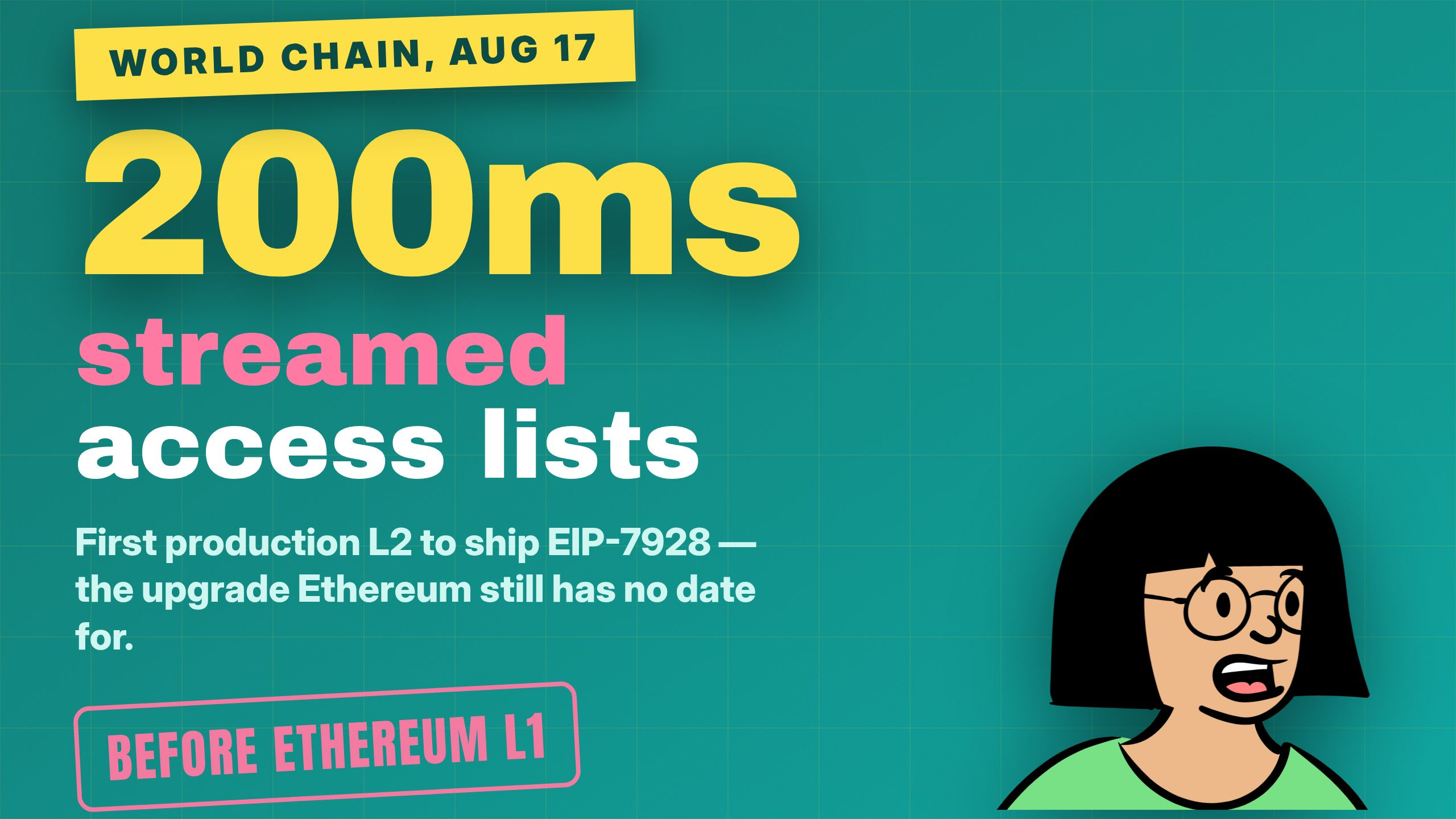
World Chain ships Ethereum's EIP-7928 tomorrow, streaming access lists every 200ms — before Ethereum itself has a date for it.
The bull case: on August 17 $WLD's chain becomes the first production L2 running streamed Block-Level Access Lists. BALs record every account and storage slot a block touches, letting validators verify in parallel rather than sequentially. World Chain extends the draft standard by streaming that list every ~200ms inside each flashblock, so verification starts while the block is still being assembled — targeting up to 1 gigagas per second without raising validator hardware. The deployment detail is the interesting one: a runtime flag rather than a hard fork, so no coordinated network-wide upgrade is needed. $ETH gets the same EIP via Glamsterdam, which still has no locked date.
The bear case: shipping first is not shipping proven. One gigagas per second is a target, not a measurement, and a runtime flag means less adversarial testing than a coordinated fork forces. More importantly, World Chain is extending an EIP that is still a proposal — if the final Ethereum spec diverges, the first mover inherits the migration cost. And throughput was never the constraint here. This chain's ceiling is set by the adoption and regulatory position of the identity product it serves, not by how fast it validates blocks.
Our read: a real engineering result that says more about L2 governance speed than token value. Falsifiable — watch measured throughput after August 17 and whether other L2s copy the streaming approach. If they do, this was standard-setting. If it stays solo until Glamsterdam lands, it was a headline.
Not financial advice. DYOR.
#WorldChain #Ethereum #L2 #Scaling
World Chain ships Ethereum's EIP-7928 tomorrow, streaming access lists every 200ms — before Ethereum itself has a date for it.
The bull case: on August 17 $WLD 's chain becomes the first production L2 running streamed Block-Level Access Lists. BALs record every account and storage slot a block touches, letting validators verify in parallel rather than sequentially. World Chain extends the draft standard by streaming that list every ~200ms inside each flashblock, so verification starts while the block is still being assembled — targeting up to 1 gigagas per second without raising validator hardware. The deployment detail is the interesting one: a runtime flag rather than a hard fork, so no coordinated network-wide upgrade is needed. $ETH gets the same EIP via Glamsterdam, which still has no locked date.
The bear case: shipping first is not shipping proven. One gigagas per second is a target, not a measurement, and a runtime flag means less adversarial testing than a coordinated fork forces. More importantly, World Chain is extending an EIP that is still a proposal — if the final Ethereum spec diverges, the first mover inherits the migration cost. And throughput was never the constraint here. This chain's ceiling is set by the adoption and regulatory position of the identity product it serves, not by how fast it validates blocks.
Our read: a real engineering result that says more about L2 governance speed than token value. Falsifiable — watch measured throughput after August 17 and whether other L2s copy the streaming approach. If they do, this was standard-setting. If it stays solo until Glamsterdam lands, it was a headline.
Not financial advice. DYOR.
#WorldChain #Ethereum #L2 #Scaling
139
තවත් අන්තර්ගතයන් ගවේෂණය කිරීමට ඇතුල් වන්න
Binance චතුරශ්රය හි ගෝලීය ක්රිප්ටෝ පරිශීලකයින් හා එක්වන්න
⚡️ ක්රිප්ටෝ පිළිබඳ නවතම සහ ප්රයෝජනවත් තොරතුරු ලබා ගන්න.
💬 ලොව විශාලතම ක්රිප්ටෝ හුවමාරුව මගින් විශ්වාස කෙරේ.
👍 සත්යායනය කරන ලද නිර්මාණකරුවන්ගෙන් සැබෑ විදසුන් සොයා ගන්න.
විද්යුත් තැපෑල / දුරකථන අංකය
නැගී එන මාතෘකා
1
#BitcoinRebounds$75KAsChipsLead
3,487 නැරඹීම්
86 සාකච්ඡා කරමින්
2
#JobsReportRaisesHikeOdds
69,620 නැරඹීම්
773 සාකච්ඡා කරමින්
3
#US Data Center Rules May Constrain AI Expansion
8,245 නැරඹීම්
88 සාකච්ඡා කරමින්
4
#$2TWipedOutHedgeFundsFaceLiquidation
10,358 නැරඹීම්
92 සාකච්ඡා කරමින්
5
#WillAnthropicListOnTime
7,391 නැරඹීම්
195 සාකච්ඡා කරමින්
6
#USNovemberMichiganExpectationsIndexPrelimAt50.9
14,723 නැරඹීම්
298 සාකච්ඡා කරමින්
7
#OilPlungesBelow$100
16,308 නැරඹීම්
37 සාකච්ඡා කරමින්
8
#TradFiForBeginners
8,929 නැරඹීම්
183 සාකච්ඡා කරමින්
9
#USMidtermsCouldShakeUpUS-IranTies
32,378 නැරඹීම්
465 සාකච්ඡා කරමින්
10
#RussianCentralBankNamesBTCETHUSDTForNonQualifiedInvestors
584 නැරඹීම්
11 සාකච්ඡා කරමින්