
TheStreet Roundtable
2.5k Публикации

TheStreet Roundtable
 Square Verified+
Отправить жалобу
Заблокировать пользователя
TheStreet covers the most engaging stories about how to make money, invest your money, save your money, and spend your money.
1 подписок(и/а)
516 подписчиков(а)
2.2K+ понравилось
Посты
В ПО для майнинга биткоина обнаружена уязвимость безопасности высокой степени опасностиTheStreet
Майнеры биткоина используют специализированные компьютеры, чтобы на скорость добавить следующий допустимый блок. Добавляя блоки и проверяя транзакции, они получают вознаграждение.
На этой неделе разработчики Bitcoin Core сообщили об уязвимости программного обеспечения «высокой степени опасности» в отчете от 10 ноября. Из-за этой уязвимости затронутые узлы для майнинга могут не суметь подготовить новые блоки.
Объяснение: что такое майнинг биткоина? (6:23)
Это потенциально может лишить майнеров возможности получать вознаграждение.
Согласно отчету, об уязвимости сообщили разработчикам в сентябре 2025 года, а в октябре того же года ее устранили — более чем за год до публичного раскрытия. Разработчики ждали, пока срок поддержки последней уязвимой версии программного обеспечения не истечет 27 октября 2026 года, и только после этого опубликовали дополнительные сведения.
В ПО для майнинга биткоина обнаружена уязвимость безопасности высокой степени опасности
TheStreet
Майнеры биткоина используют специализированные компьютеры, чтобы на скорость добавить следующий допустимый блок. Добавляя блоки и проверяя транзакции, они получают вознаграждение.
На этой неделе разработчики Bitcoin Core сообщили об уязвимости программного обеспечения «высокой степени опасности» в отчете от 10 ноября. Из-за этой уязвимости затронутые узлы для майнинга могут не суметь подготовить новые блоки.
Объяснение: что такое майнинг биткоина? (6:23)
Это потенциально может лишить майнеров возможности получать вознаграждение.
Согласно отчету, об уязвимости сообщили разработчикам в сентябре 2025 года, а в октябре того же года ее устранили — более чем за год до публичного раскрытия. Разработчики ждали, пока срок поддержки последней уязвимой версии программного обеспечения не истечет 27 октября 2026 года, и только после этого опубликовали дополнительные сведения.
51
Ветеран Ripple объяснил, почему продал криптовалюты на миллионы и что у него осталосьГендиректор HIVE ответил на предупреждение Илона Маска о неооблаках (4:14)
Почётный технический директор Ripple Labs Дэвид Шварц рассказал в цифрах, насколько он отошёл от криптовалют.
В публикации на X он сообщил, что уже давно не покупал XRP и продал почти все цифровые активы, которыми когда-либо владел. Некоторые пользователи восприняли это как полный выход с рынка. Однако его собственные цифры говорят об обратном.
«Я уже давно не покупал XRP. Я очень некомфортно чувствую себя, когда приходится рисковать, и продал почти все цифровые активы, которыми когда-либо владел. У меня всё ещё довольно много акций Ripple, и один лишь этот факт означает, что я рискую больше, чем хотел бы», — написал он в публикации.
Ветеран Ripple объяснил, почему продал криптовалюты на миллионы и что у него осталось
Гендиректор HIVE ответил на предупреждение Илона Маска о неооблаках (4:14)
Почётный технический директор Ripple Labs Дэвид Шварц рассказал в цифрах, насколько он отошёл от криптовалют.
В публикации на X он сообщил, что уже давно не покупал XRP и продал почти все цифровые активы, которыми когда-либо владел. Некоторые пользователи восприняли это как полный выход с рынка. Однако его собственные цифры говорят об обратном.
«Я уже давно не покупал XRP. Я очень некомфортно чувствую себя, когда приходится рисковать, и продал почти все цифровые активы, которыми когда-либо владел. У меня всё ещё довольно много акций Ripple, и один лишь этот факт означает, что я рискую больше, чем хотел бы», — написал он в публикации.
148
Статья
Состоятельный город США вводит масштабный запрет на банкоматыВывеска с упоминанием криптовалюты Bitcoin на криптовалютном банкомате, принадлежащем компании Coinhero, в Гонконге, Китай, в среду, 26 ноября 2025 года. Источник: Getty Images
Недавно Фрамингем, состоятельный город в штате Массачусетс, ввёл всеобъемлющий запрет на криптовалютные банкоматы из-за мошенничества.
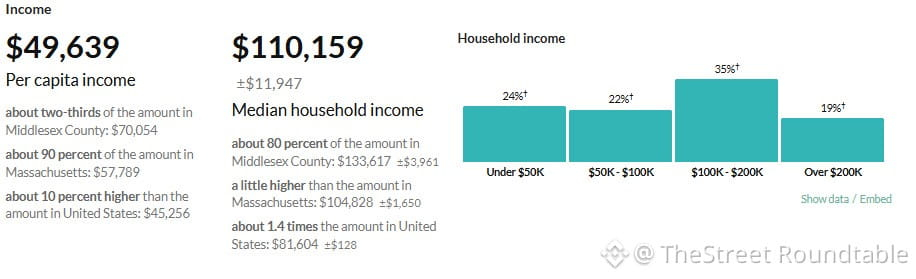
По данным Census Reporter, в 2024 году медианный доход домохозяйства в городе составлял 110 159 долларов, что значительно превышало общенациональный медианный доход домохозяйства в 81 604 доллара.
В 2024 году доход 35% домохозяйств Фрамингема составлял от 100 000 до 200 000 долларов, а 19% домохозяйств зарабатывали более 200 000 долларов.
Состоятельный город США вводит масштабный запрет на банкоматы
Вывеска с упоминанием криптовалюты Bitcoin на криптовалютном банкомате, принадлежащем компании Coinhero, в Гонконге, Китай, в среду, 26 ноября 2025 года. Источник: Getty Images
Недавно Фрамингем, состоятельный город в штате Массачусетс, ввёл всеобъемлющий запрет на криптовалютные банкоматы из-за мошенничества.
По данным Census Reporter, в 2024 году медианный доход домохозяйства в городе составлял 110 159 долларов, что значительно превышало общенациональный медианный доход домохозяйства в 81 604 доллара.
В 2024 году доход 35% домохозяйств Фрамингема составлял от 100 000 до 200 000 долларов, а 19% домохозяйств зарабатывали более 200 000 долларов.
186
TikTok поддерживает биткоин-компанию на фоне падения выручки на 44%Fold Holdings, первая публичная компания в сфере финансовых услуг на основе биткоина, 10 ноября сообщила, что TikTok Shop стал её крупнейшим каналом продаж подарочных карт и привлечения клиентов. Это произошло в квартале, когда общая выручка компании снизилась на 44% по сравнению с аналогичным периодом годом ранее.
Компания из Финикса, акции которой торгуются на Nasdaq под тикером FLD, сообщила о выручке в размере 4,16 млн долларов за квартал, закончившийся 30 сентября, по сравнению с 7,40 млн долларов за аналогичный период прошлого года. Чистый убыток составил 2,65 млн долларов, или 5 центов на акцию, тогда как годом ранее чистая прибыль равнялась 554 242 долларам.
TikTok поддерживает биткоин-компанию на фоне падения выручки на 44%
Fold Holdings, первая публичная компания в сфере финансовых услуг на основе биткоина, 10 ноября сообщила, что TikTok Shop стал её крупнейшим каналом продаж подарочных карт и привлечения клиентов. Это произошло в квартале, когда общая выручка компании снизилась на 44% по сравнению с аналогичным периодом годом ранее.
Компания из Финикса, акции которой торгуются на Nasdaq под тикером FLD, сообщила о выручке в размере 4,16 млн долларов за квартал, закончившийся 30 сентября, по сравнению с 7,40 млн долларов за аналогичный период прошлого года. Чистый убыток составил 2,65 млн долларов, или 5 центов на акцию, тогда как годом ранее чистая прибыль равнялась 554 242 долларам.
Компания из Финикса, акции которой торгуются на Nasdaq под тикером FLD, сообщила о выручке в размере 4,16 млн долларов за квартал, закончившийся 30 сентября, по сравнению с 7,40 млн долларов за аналогичный период прошлого года. Чистый убыток составил 2,65 млн долларов, или 5 центов на акцию, тогда как годом ранее чистая прибыль равнялась 554 242 долларам.
88
Статья
Опционы указывают на возможное колебание акций CoreWeave на 15% после отчётаGetty Images
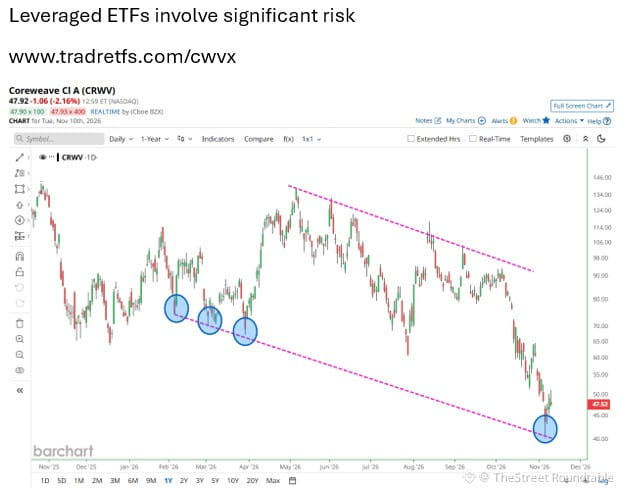
CoreWeave (Nasdaq: CRWV) должна отчитаться о результатах третьего квартала после закрытия американского рынка 10 ноября. По оценкам трейдеров опционами, акции могут измениться в цене на двузначную величину.
Отчёт выйдет после непростого месяца для компании, занимающейся инфраструктурой ИИ: её акции и растущий долг подвергли критике ведущий CNBC Джим Крамер и генеральный директор Tesla Илон Маск.
Связанные новости: Goldman Sachs пересматривает рейтинг и целевую цену акций компании в сфере ИИ, сильно просевших в цене
От майнинга Ethereum к инфраструктуре ИИ
Опционы указывают на возможное колебание акций CoreWeave на 15% после отчёта
Getty Images
CoreWeave (Nasdaq: CRWV) должна отчитаться о результатах третьего квартала после закрытия американского рынка 10 ноября. По оценкам трейдеров опционами, акции могут измениться в цене на двузначную величину.
Отчёт выйдет после непростого месяца для компании, занимающейся инфраструктурой ИИ: её акции и растущий долг подвергли критике ведущий CNBC Джим Крамер и генеральный директор Tesla Илон Маск.
Связанные новости: Goldman Sachs пересматривает рейтинг и целевую цену акций компании в сфере ИИ, сильно просевших в цене
От майнинга Ethereum к инфраструктуре ИИ
CRWV+26,95%
CWVXETF+48,03%
32
Статья
См. перевод
Binance’s bStocks leads $4.8B tokenized stock market with 31% shareExclusive: Binance CMO says crypto will be “omnipresent” (4:27)
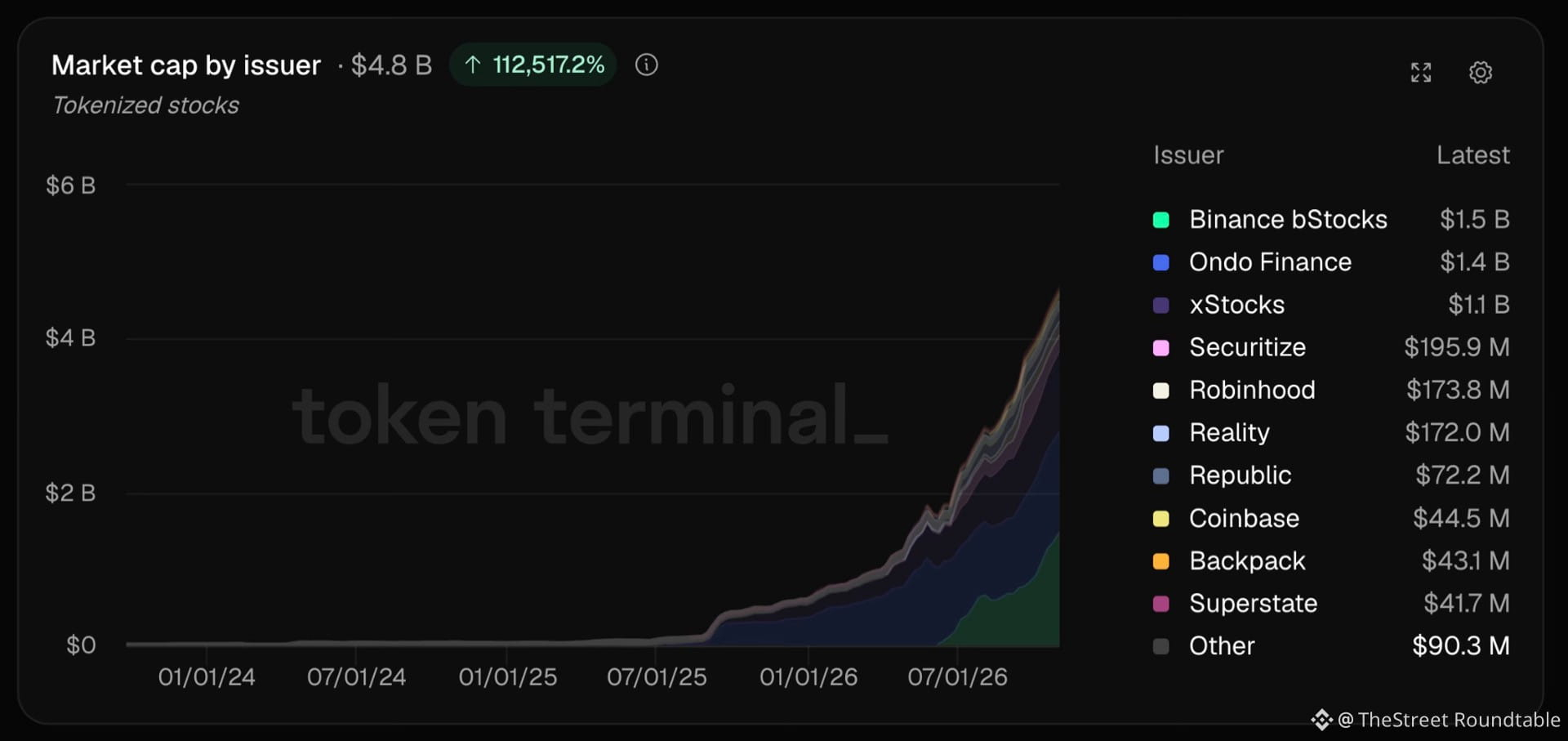
Binance’s bStocks is now the largest tokenized stock product, with $1.5 billion in assets under management, according to Token Terminal data. That’s more than 31% of the category.
Tokenized stocks are shares of companies issued as digital tokens on a blockchain. They let investors trade around the clock without a traditional brokerage account.
bStocks reached the top as the market hit a new high. Tokenized equities reached a record $4.8 billion in assets on Nov. 10, according to blockchain data firm Token Terminal.
Binance says that growth makes tokenized stocks the fastest-growing category of real-world assets (RWAs) in 2026. RWAs are traditional investments, such as stocks and bonds, brought onto a blockchain.
“Tokenized equities reaching an all-time high is a market-level signal, and bStocks becoming the largest product in the category shows where that demand is concentrating,” said Shunyet Jan, Binance’s head of exchange and trading.
Related: $13 trillion brokerage giant offers cheapest ways to trade crypto
bStocks outpaces the rest of the market
According to Binance, the tokenized equity market grew 164% between June and early November. Without bStocks, that growth would have been 81%.
bStocks launched on June 11 on BNB Chain, a blockchain network. Each token tracks a U.S. stock or exchange-traded fund (ETF) one-to-one. It started with five names: Circle, Micron, Nvidia, Sandisk and Tesla.
Source: Token Terminal
It passed $1 billion on Oct. 15, which Binance says made it the fastest tokenized equity product to reach that mark. It hit $1.5 billion in 145 days.
Cumulative trading volume has passed $45 billion. Users have also converted $7.5 billion between regular stock holdings and bStocks at a 1:1 ratio.
“We built the product to provide simple 1:1 access to stocks and ETFs without the need for a separate brokerage account, and the market is responding positively as we continue to expand our listings and TradFi offerings,” Jan said.
A younger, global investor base
Part of the appeal is timing.
bStocks trade 24/7, including weekends,and converting between stocks and bStocks carries no conversion fees, according to Binance.
About 56% of bStocks trading volume has happened outside regular U.S. market hours.
Users in emerging and frontier markets account for about 70% of volume, according to Binance Research. Gen Z investors make up 46% of bStocks users.
Trending on TheStreet Roundtable:
Mysterious trader buys millions ahead of Nov. 10 inflation report
Digital Asset CEO says Treasury will issue bills on-chain within five years
Analyst warns Bitcoin should be down 40% after two weeks of chaos
Tokens put to work in DeFi
Holders aren’t just buying and holding.
A growing share are using bStocks in DeFi (decentralized finance), the lending and trading apps that run on blockchains.
In early October, 11.2% of bStocks were deployed in DeFi. That’s about 3.8% points higher than comparable tokenized stocks.
Borrowing against bStocks also picked up.
The share of deposited bStocks collateral being borrowed against rose to 46.2% by Sept. 10, from 5.5% at the end of June.
Across the market, on-chain transfers of tokenized stocks topped $100 billion in the third quarter.
That’s more than 16 times the $6 billion in the first quarter, according to a September Binance Research report.
bStocks are offered under an approved prospectus in the Abu Dhabi Global Market (ADGM) financial center and aren’t available to U.S. persons.
Holders don’t directly own the underlying shares. Binance says each token is backed 1:1 by a share held with a regulated custodian.
The Roundtable 100
If you follow our market coverage, don’t miss the Roundtable 100. Updated every Friday, it’s a power ranking of the 100 most investable tech stocks, including digital assets. Check out the latest RTB 100 rankings at roundtable100.com.
Related: Treasury Secretary Bessent has final say on next reserve move, says ex-White House official
Binance’s bStocks leads $4.8B tokenized stock market with 31% share
Exclusive: Binance CMO says crypto will be “omnipresent” (4:27)
Binance’s bStocks is now the largest tokenized stock product, with $1.5 billion in assets under management, according to Token Terminal data. That’s more than 31% of the category.
Tokenized stocks are shares of companies issued as digital tokens on a blockchain. They let investors trade around the clock without a traditional brokerage account.
bStocks reached the top as the market hit a new high. Tokenized equities reached a record $4.8 billion in assets on Nov. 10, according to blockchain data firm Token Terminal.
Binance says that growth makes tokenized stocks the fastest-growing category of real-world assets (RWAs) in 2026. RWAs are traditional investments, such as stocks and bonds, brought onto a blockchain.
“Tokenized equities reaching an all-time high is a market-level signal, and bStocks becoming the largest product in the category shows where that demand is concentrating,” said Shunyet Jan, Binance’s head of exchange and trading.
Related: $13 trillion brokerage giant offers cheapest ways to trade crypto
bStocks outpaces the rest of the market
According to Binance, the tokenized equity market grew 164% between June and early November. Without bStocks, that growth would have been 81%.
bStocks launched on June 11 on BNB Chain, a blockchain network. Each token tracks a U.S. stock or exchange-traded fund (ETF) one-to-one. It started with five names: Circle, Micron, Nvidia, Sandisk and Tesla.
Source: Token Terminal
It passed $1 billion on Oct. 15, which Binance says made it the fastest tokenized equity product to reach that mark. It hit $1.5 billion in 145 days.
Cumulative trading volume has passed $45 billion. Users have also converted $7.5 billion between regular stock holdings and bStocks at a 1:1 ratio.
“We built the product to provide simple 1:1 access to stocks and ETFs without the need for a separate brokerage account, and the market is responding positively as we continue to expand our listings and TradFi offerings,” Jan said.
A younger, global investor base
Part of the appeal is timing.
bStocks trade 24/7, including weekends,and converting between stocks and bStocks carries no conversion fees, according to Binance.
About 56% of bStocks trading volume has happened outside regular U.S. market hours.
Users in emerging and frontier markets account for about 70% of volume, according to Binance Research. Gen Z investors make up 46% of bStocks users.
Trending on TheStreet Roundtable:
Mysterious trader buys millions ahead of Nov. 10 inflation report
Digital Asset CEO says Treasury will issue bills on-chain within five years
Analyst warns Bitcoin should be down 40% after two weeks of chaos
Tokens put to work in DeFi
Holders aren’t just buying and holding.
A growing share are using bStocks in DeFi (decentralized finance), the lending and trading apps that run on blockchains.
In early October, 11.2% of bStocks were deployed in DeFi. That’s about 3.8% points higher than comparable tokenized stocks.
Borrowing against bStocks also picked up.
The share of deposited bStocks collateral being borrowed against rose to 46.2% by Sept. 10, from 5.5% at the end of June.
Across the market, on-chain transfers of tokenized stocks topped $100 billion in the third quarter.
That’s more than 16 times the $6 billion in the first quarter, according to a September Binance Research report.
bStocks are offered under an approved prospectus in the Abu Dhabi Global Market (ADGM) financial center and aren’t available to U.S. persons.
Holders don’t directly own the underlying shares. Binance says each token is backed 1:1 by a share held with a regulated custodian.
The Roundtable 100
If you follow our market coverage, don’t miss the Roundtable 100. Updated every Friday, it’s a power ranking of the 100 most investable tech stocks, including digital assets. Check out the latest RTB 100 rankings at roundtable100.com.
Related: Treasury Secretary Bessent has final say on next reserve move, says ex-White House official
23
Статья
См. перевод
This crypto firm lets AI agents take the first vote on startup dealsTribute Labs co-founder Aaron Wright on Aiden using AI agents for vetting startups (8:11)
A venture fund where the first pass on every deal comes from AI agents is no longer a futuristic experiment.
Aaron Wright, a lawyer turned crypto builder, is betting that AI will soon pick startups better than humans do. His new venture product, ADIN, puts artificial intelligence at the center of the investment process.
"People need to get comfortable with the fact that these agentic systems are probably gonna be able to generate a higher rate of return," Wright told TheStreet Roundtable in an episode of the video series, Against the Odds.
Related: This AI startup is betting it can end insurance claim denials
Behind America’s first DAO law
Wright co-founded Tribute Labs, along with Priyanka Desai. It began as the Ethereum legal-tech startup OpenLaw before rebranding in 2021 to focus on building decentralized autonomous organizations, or DAOs. He is also a former law professor at Cardozo School of Law in New York.
Wright has helped write Wyoming’s DAO law, which passed the state Senate in a 28-2 vote in 2021. The law let DAOs register as limited liability companies, and Wyoming approved America’s first legally recognized DAO that same year.
Tribute has since supported a network of about 20 DAOs that try to replace a fund’s general partner with democratic voting. Wright says they have collectively backed six of the top 12 DeFi projects. Aiden takes that idea a step further, replacing much of the crowd with AI.
A billion dollars on paper
The crowd-picking model also produced one of the most visible boom-and-bust trades in crypto.
In 2020, Wright co-founded Flamingo DAO, a members-only collective that pooled capital to buy NFTs. By early 2022, the group’s collection of CryptoPunks, Bored Apes and generative art was valued at about $1 billion, up from roughly $10 million in member contributions.
NFTs, or non-fungible tokens, are blockchain records that prove someone owns a digital item, usually an image. During the 2021 boom, collectors paid millions of dollars for cartoon apes and pixelated portraits.
Then the market collapsed.
NFT trading volume came to about $5.5 billion in 2025, well below 2024 levels and far from the peak. CryptoPunks, a centerpiece of Flamingo’s collection, saw their floor price fall roughly 78% from the 2021 high.
The projects that lasted mostly turned into something else. Pudgy Penguins, a 2021 collection of cartoon penguin NFTs, now sells plush toys in about 2,000 Walmart stores, TheStreet reported. Even that model has limits: in October, parent company Igloo shut down Abstract, the blockchain it launched in January 2025.
Asked what the collection is worth today and what the bust taught him, Wright did not give a number. He said Flamingo bought “before there was any boom” and that he expects the works to carry “cultural and also hopefully financial” value in the long run.
The episode is a useful test for ADIN.
A $1 billion mark in a thin, momentum-driven market is not the same as a realized return. If AI agents are built to spot what comes next, investors will want to know whether they can tell a trend from a bubble.
More on TheStreet Roundtable
Pudgy Penguins maker shuts down its next big bet within 18 months
Binance hackers turn to Elon Musk memecoins to hide $6.3 billion
GTA 6 may be the last blockbuster built without AI
A vote followed by an hour of diligence
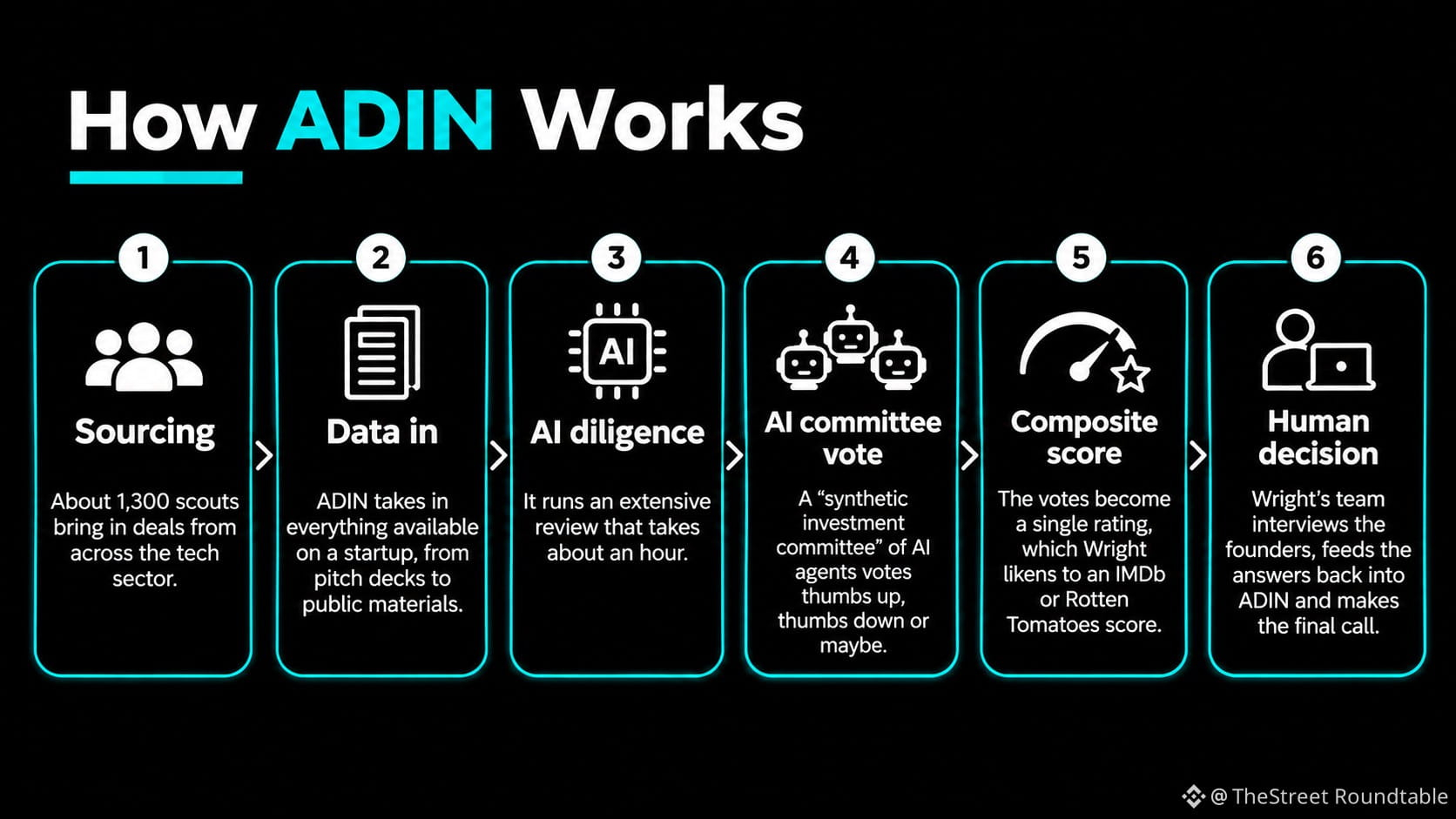
Aiden starts by taking in whatever information exists on a startup, from pitch decks to public materials. It then runs an extensive diligence process that lasts about an hour.
At the end, a “synthetic investment committee” made up of multiple AI agents votes on the deal, giving it a thumbs up, a thumbs down or a maybe. The result is a composite score that Wright compares to an IMDb rating or a Rotten Tomatoes score.
For now, humans make the final call.
Wright’s team interviews the founders, feeds the answers back into Aiden and then decides whether to invest. Tribute has also paired Aiden with a network of about 1,300 scouts who source deals across the technology sector.
ADIN follows a pre-determined sequence to finally arrive at a final decision.
The legal ramifications
Because people make the final decisions, legal liability for Aiden’s picks rests with the firm. But Wright says U.S. law is already ready for something much stranger.
"Today in the U.S., with a little bit of legal work, you can have an AI that owns a legal entity and doesn't have any humans overseeing that enterprise," he said. "That may sound odd, but I think that's the future."
He expects AI agents to become regular players in finance. “They’ll be generating income and revenue, they’ll be making a profit for themselves and possibly even investors,” he said.
Taking on a 60% failure rate
Wright says roughly 60% to 70% of venture-backed projects never return any capital. Cutting that even slightly, he said, “just changes the entire game.”
He also sees a fairness angle. Founders often feel they must be in Silicon Valley, New York, Boston or Austin to raise money. An AI that can judge a startup from anywhere “should democratize access to capital,” Wright said.
Related: Mace Ai founders warn of AI double agents amid banks detecting unauthorized AI agents
From filter to decision-maker
Wright expects ADIN to take on more of the process over the next few years, possibly including writing the check itself.
He compares the shift to the rise of algorithmic hedge funds, when data science reshaped trading. AI systems, he said, will “first assist and then ultimately obliterate” the way venture funds work today.
“Agentic finance is coming,” he said.
The Roundtable 100
If you follow our market coverage, don’t miss the Roundtable 100. Updated every Friday, it’s a power ranking of the 100 most investable tech stocks, including digital assets. Check out the latest RTB 100 rankings at roundtable100.com.
This crypto firm lets AI agents take the first vote on startup deals
Tribute Labs co-founder Aaron Wright on Aiden using AI agents for vetting startups (8:11)
A venture fund where the first pass on every deal comes from AI agents is no longer a futuristic experiment.
Aaron Wright, a lawyer turned crypto builder, is betting that AI will soon pick startups better than humans do. His new venture product, ADIN, puts artificial intelligence at the center of the investment process.
"People need to get comfortable with the fact that these agentic systems are probably gonna be able to generate a higher rate of return," Wright told TheStreet Roundtable in an episode of the video series, Against the Odds.
Related: This AI startup is betting it can end insurance claim denials
Behind America’s first DAO law
Wright co-founded Tribute Labs, along with Priyanka Desai. It began as the Ethereum legal-tech startup OpenLaw before rebranding in 2021 to focus on building decentralized autonomous organizations, or DAOs. He is also a former law professor at Cardozo School of Law in New York.
Wright has helped write Wyoming’s DAO law, which passed the state Senate in a 28-2 vote in 2021. The law let DAOs register as limited liability companies, and Wyoming approved America’s first legally recognized DAO that same year.
Tribute has since supported a network of about 20 DAOs that try to replace a fund’s general partner with democratic voting. Wright says they have collectively backed six of the top 12 DeFi projects. Aiden takes that idea a step further, replacing much of the crowd with AI.
A billion dollars on paper
The crowd-picking model also produced one of the most visible boom-and-bust trades in crypto.
In 2020, Wright co-founded Flamingo DAO, a members-only collective that pooled capital to buy NFTs. By early 2022, the group’s collection of CryptoPunks, Bored Apes and generative art was valued at about $1 billion, up from roughly $10 million in member contributions.
NFTs, or non-fungible tokens, are blockchain records that prove someone owns a digital item, usually an image. During the 2021 boom, collectors paid millions of dollars for cartoon apes and pixelated portraits.
Then the market collapsed.
NFT trading volume came to about $5.5 billion in 2025, well below 2024 levels and far from the peak. CryptoPunks, a centerpiece of Flamingo’s collection, saw their floor price fall roughly 78% from the 2021 high.
The projects that lasted mostly turned into something else. Pudgy Penguins, a 2021 collection of cartoon penguin NFTs, now sells plush toys in about 2,000 Walmart stores, TheStreet reported. Even that model has limits: in October, parent company Igloo shut down Abstract, the blockchain it launched in January 2025.
Asked what the collection is worth today and what the bust taught him, Wright did not give a number. He said Flamingo bought “before there was any boom” and that he expects the works to carry “cultural and also hopefully financial” value in the long run.
The episode is a useful test for ADIN.
A $1 billion mark in a thin, momentum-driven market is not the same as a realized return. If AI agents are built to spot what comes next, investors will want to know whether they can tell a trend from a bubble.
More on TheStreet Roundtable
Pudgy Penguins maker shuts down its next big bet within 18 months
Binance hackers turn to Elon Musk memecoins to hide $6.3 billion
GTA 6 may be the last blockbuster built without AI
A vote followed by an hour of diligence
Aiden starts by taking in whatever information exists on a startup, from pitch decks to public materials. It then runs an extensive diligence process that lasts about an hour.
At the end, a “synthetic investment committee” made up of multiple AI agents votes on the deal, giving it a thumbs up, a thumbs down or a maybe. The result is a composite score that Wright compares to an IMDb rating or a Rotten Tomatoes score.
For now, humans make the final call.
Wright’s team interviews the founders, feeds the answers back into Aiden and then decides whether to invest. Tribute has also paired Aiden with a network of about 1,300 scouts who source deals across the technology sector.
ADIN follows a pre-determined sequence to finally arrive at a final decision.
The legal ramifications
Because people make the final decisions, legal liability for Aiden’s picks rests with the firm. But Wright says U.S. law is already ready for something much stranger.
"Today in the U.S., with a little bit of legal work, you can have an AI that owns a legal entity and doesn't have any humans overseeing that enterprise," he said. "That may sound odd, but I think that's the future."
He expects AI agents to become regular players in finance. “They’ll be generating income and revenue, they’ll be making a profit for themselves and possibly even investors,” he said.
Taking on a 60% failure rate
Wright says roughly 60% to 70% of venture-backed projects never return any capital. Cutting that even slightly, he said, “just changes the entire game.”
He also sees a fairness angle. Founders often feel they must be in Silicon Valley, New York, Boston or Austin to raise money. An AI that can judge a startup from anywhere “should democratize access to capital,” Wright said.
Related: Mace Ai founders warn of AI double agents amid banks detecting unauthorized AI agents
From filter to decision-maker
Wright expects ADIN to take on more of the process over the next few years, possibly including writing the check itself.
He compares the shift to the rise of algorithmic hedge funds, when data science reshaped trading. AI systems, he said, will “first assist and then ultimately obliterate” the way venture funds work today.
“Agentic finance is coming,” he said.
The Roundtable 100
If you follow our market coverage, don’t miss the Roundtable 100. Updated every Friday, it’s a power ranking of the 100 most investable tech stocks, including digital assets. Check out the latest RTB 100 rankings at roundtable100.com.
1
См. перевод
American Express jumps 28 places on the Roundtable 100Roundtable 100 analyst is bullish on Solana (2:32)
American Express (NYSE: AXP) rose 28 places on the Roundtable 100 in the Nov. 6 ranking, rising to No. 42.
Founded as a freight forwarding company in 1850, American Express is a leading bank holding and financial services corporation that specializes in payment cards.
American Express
Published with TheStreet, The Roundtable 100 ranks the top 100 publicly traded technology growth assets. Each is scored from 0 to 100 by the analysts of the Blue Ribbon Committee on five variables, Team, Safety, Value, Innovation, and Market Dominance, with the average forming the asset’s Power Ranking. The list refreshes every Friday after the U.S. market close.
The Blue Ribbon Committee committee’s analysts rank a company on the basis of its potential to grow in the future, not its current dominance.
Popular on TheStreet Roundtable:
Treasury Secretary Bessent has final say on next reserve move, says ex-White House official
Mysterious trader buys millions ahead of Nov. 10 inflation report
Ripple veteran says he threw IRS letter in trash
Committee member John Slazas is the founder of MKT.TRADE and has more than 40 years of experience across trading and market structure.
Slazas said American Express’ business position should be scored separately from its valuation. He said his case rests on scale as the company posted $454 billion in quarterly billed business in the third quarter of 2026.
Follow American Express on the Roundtable 100
"American Express is the card issuer, the payment network and the merchant relationship at once. Most rivals are only one of the three."
The RTB 100 analyst said it’s a qualitative judgment from the scale, not a measured market share. He also highlighted that the company’s adjusted earnings per share (EPS) benefited from two accounting factors:
When American Express sold its stake in the Global Business Travel Group or “Amex GBT” (NYSE: GBTG), it recorded a gain from the transaction but also incurred restructuring-related costs. For adjusted EPS, Amex excluded the net impact of these items, Slazas stressed.
The effective tax rate is the percentage of pre-tax income a company pays in taxes. A lower tax rate allows American Express to retain more of its earnings after taxes, thereby boosting reported EPS, Slazas suggested.
The analysts granted American Express scores above 80 on Team, Market Dominance, and Safety factors but low scores on Innovation and Value. The company has an overall RTB 100 score of 70 out of 100.
See the full ranking.
Disclaimer: This article is for informational purposes only and does not constitute financial advice. Investments are subject to market risk. Always conduct your own research before making any investment decisions.
Disclosure: RTB Digital, Inc. (Nasdaq: RTB), publisher of the Roundtable 100, is itself a ranked constituent of the index. The Roundtable 100 is published for informational purposes only and is not investment advice, an offer, or a recommendation to buy or sell any security, commodity or digital asset. Rankings reflect the views of Roundtable analysts as of the ranking date. Investing involves risk, including loss of principal.
Related: Roundtable 100 holds Solana at No. 5 following Alpenglow upgrade
American Express jumps 28 places on the Roundtable 100
Roundtable 100 analyst is bullish on Solana (2:32)
American Express (NYSE: AXP) rose 28 places on the Roundtable 100 in the Nov. 6 ranking, rising to No. 42.
Founded as a freight forwarding company in 1850, American Express is a leading bank holding and financial services corporation that specializes in payment cards.
American Express
Published with TheStreet, The Roundtable 100 ranks the top 100 publicly traded technology growth assets. Each is scored from 0 to 100 by the analysts of the Blue Ribbon Committee on five variables, Team, Safety, Value, Innovation, and Market Dominance, with the average forming the asset’s Power Ranking. The list refreshes every Friday after the U.S. market close.
The Blue Ribbon Committee committee’s analysts rank a company on the basis of its potential to grow in the future, not its current dominance.
Popular on TheStreet Roundtable:
Treasury Secretary Bessent has final say on next reserve move, says ex-White House official
Mysterious trader buys millions ahead of Nov. 10 inflation report
Ripple veteran says he threw IRS letter in trash
Committee member John Slazas is the founder of MKT.TRADE and has more than 40 years of experience across trading and market structure.
Slazas said American Express’ business position should be scored separately from its valuation. He said his case rests on scale as the company posted $454 billion in quarterly billed business in the third quarter of 2026.
Follow American Express on the Roundtable 100
"American Express is the card issuer, the payment network and the merchant relationship at once. Most rivals are only one of the three."
The RTB 100 analyst said it’s a qualitative judgment from the scale, not a measured market share. He also highlighted that the company’s adjusted earnings per share (EPS) benefited from two accounting factors:
When American Express sold its stake in the Global Business Travel Group or “Amex GBT” (NYSE: GBTG), it recorded a gain from the transaction but also incurred restructuring-related costs. For adjusted EPS, Amex excluded the net impact of these items, Slazas stressed.
The effective tax rate is the percentage of pre-tax income a company pays in taxes. A lower tax rate allows American Express to retain more of its earnings after taxes, thereby boosting reported EPS, Slazas suggested.
The analysts granted American Express scores above 80 on Team, Market Dominance, and Safety factors but low scores on Innovation and Value. The company has an overall RTB 100 score of 70 out of 100.
See the full ranking.
Disclaimer: This article is for informational purposes only and does not constitute financial advice. Investments are subject to market risk. Always conduct your own research before making any investment decisions.
Disclosure: RTB Digital, Inc. (Nasdaq: RTB), publisher of the Roundtable 100, is itself a ranked constituent of the index. The Roundtable 100 is published for informational purposes only and is not investment advice, an offer, or a recommendation to buy or sell any security, commodity or digital asset. Rankings reflect the views of Roundtable analysts as of the ranking date. Investing involves risk, including loss of principal.
Related: Roundtable 100 holds Solana at No. 5 following Alpenglow upgrade
AXPUS-0,73%
GBTGUS0,00%
См. перевод
Apple users get urgent security warning over iPhone flawA consumer experiences Apple’s first folding screen smartphone, the iPhone Duo, in Apple’s flagship store on Nanjing Road Walkway in Shanghai, China, on November 7, 2026.
NurPhoto / GettyImages
Binance, the world’s largest cryptocurrency exchange by spot trading volume, has warned iPhone users against a security vulnerability. The warning came days after a cyberattack impacted billions of dollars in digital assets under the exchange’s custody.
On Oct. 29, Binance suffered a massive cyberattack affecting approximately $6.34 billion in digital assets.
Now, it has flagged a separate security threat that could potentially expose private information of crypto users.
How did hackers drain $6.3 billion from Binance in about 20 minutes (3:39)
Binance’s alert to crypto holders using iPhones
In a Nov. 10 warning, Binance alerted Apple users about an iOS vulnerability called worse_query, that could allow malicious applications to access files tied to other apps.
The researcher described the vulnerability as a “sandbox escape,” meaning a malicious application could bypass security barriers designed to prevent apps from accessing each other’s data.
A malicious app using the flaw could potentially expose crypto wallet recovery phrases, private keys and login credentials if those files are accessible on an affected device.
More on TheStreet Roundtable
Democrats’ sweep sends Trump-linked assets reeling
Bitcoin, stocks crash in steepest selloff since Liberation Day
Circle crushes Q3 estimates as staff shrinks 5%
The reach of this threat is estimated to be wide, given that roughly one in four active smartphones worldwide is an iPhone.
Binance says the flaw is an iOS-level issue, not one unique to its app. The risk to any user depends on a malicious app reaching their device and finding such files accessible.
According to a researcher’s GitHub repository, the vulnerability seems to affect a broader range of iOS versions, although the published proof of concept requires additional configuration to work.
Neither Binance nor the researcher, as of now, has reported attacks or thefts involving the vulnerability, and no specific wallet application has been identified as exposed, as per The Hacker News.
What Apple users need to do
Binance advised users to remove applications downloaded from untrusted sources and install official iOS and app updates.
Users who suspect their devices have been compromised should create new wallets on clean devices, transfer their assets and reset active login sessions.
Meanwhile, Apple released iOS 27.2.1 and iOS 26.7.3 on Nov. 9, addressing several security issues. Apple’s release notes, however, do not confirm whether either update fixes the worse_query vulnerability.
The Binance attack
The attack on Binance earlier, that was brought to light by the company earlier last week, involved compromised employee computers.
Through these computers, the attackers managed to access the exchange’s internal wallet-signing service and initiate unauthorized transactions.
Binance said it had set aside more than enough funds to cover the loss and would absorb the financial impact. As of its Nov. 3 report, approximately $2.85 billion in assets had been frozen or intercepted, subject to reconciliation and market price changes.
The Roundtable 100
If you follow our market coverage, don’t miss the Roundtable 100. Updated every Friday, it’s a power ranking of the 100 most investable tech stocks, including digital assets. Check out the latest RTB 100 rankings at roundtable100.com.
Related: Binance hackers turn to Elon Musk memecoins to hide $6.3 billion
Apple users get urgent security warning over iPhone flaw
A consumer experiences Apple’s first folding screen smartphone, the iPhone Duo, in Apple’s flagship store on Nanjing Road Walkway in Shanghai, China, on November 7, 2026.
NurPhoto / GettyImages
Binance, the world’s largest cryptocurrency exchange by spot trading volume, has warned iPhone users against a security vulnerability. The warning came days after a cyberattack impacted billions of dollars in digital assets under the exchange’s custody.
On Oct. 29, Binance suffered a massive cyberattack affecting approximately $6.34 billion in digital assets.
Now, it has flagged a separate security threat that could potentially expose private information of crypto users.
How did hackers drain $6.3 billion from Binance in about 20 minutes (3:39)
Binance’s alert to crypto holders using iPhones
In a Nov. 10 warning, Binance alerted Apple users about an iOS vulnerability called worse_query, that could allow malicious applications to access files tied to other apps.
The researcher described the vulnerability as a “sandbox escape,” meaning a malicious application could bypass security barriers designed to prevent apps from accessing each other’s data.
A malicious app using the flaw could potentially expose crypto wallet recovery phrases, private keys and login credentials if those files are accessible on an affected device.
More on TheStreet Roundtable
Democrats’ sweep sends Trump-linked assets reeling
Bitcoin, stocks crash in steepest selloff since Liberation Day
Circle crushes Q3 estimates as staff shrinks 5%
The reach of this threat is estimated to be wide, given that roughly one in four active smartphones worldwide is an iPhone.
Binance says the flaw is an iOS-level issue, not one unique to its app. The risk to any user depends on a malicious app reaching their device and finding such files accessible.
According to a researcher’s GitHub repository, the vulnerability seems to affect a broader range of iOS versions, although the published proof of concept requires additional configuration to work.
Neither Binance nor the researcher, as of now, has reported attacks or thefts involving the vulnerability, and no specific wallet application has been identified as exposed, as per The Hacker News.
What Apple users need to do
Binance advised users to remove applications downloaded from untrusted sources and install official iOS and app updates.
Users who suspect their devices have been compromised should create new wallets on clean devices, transfer their assets and reset active login sessions.
Meanwhile, Apple released iOS 27.2.1 and iOS 26.7.3 on Nov. 9, addressing several security issues. Apple’s release notes, however, do not confirm whether either update fixes the worse_query vulnerability.
The Binance attack
The attack on Binance earlier, that was brought to light by the company earlier last week, involved compromised employee computers.
Through these computers, the attackers managed to access the exchange’s internal wallet-signing service and initiate unauthorized transactions.
Binance said it had set aside more than enough funds to cover the loss and would absorb the financial impact. As of its Nov. 3 report, approximately $2.85 billion in assets had been frozen or intercepted, subject to reconciliation and market price changes.
The Roundtable 100
If you follow our market coverage, don’t miss the Roundtable 100. Updated every Friday, it’s a power ranking of the 100 most investable tech stocks, including digital assets. Check out the latest RTB 100 rankings at roundtable100.com.
Related: Binance hackers turn to Elon Musk memecoins to hide $6.3 billion
1

Статья
Бессент примет окончательное решение о следующем шаге по резерву, заявил бывший сотрудник Белого домаПатрик Витт, занимавший тогда пост исполнительного директора Совета советников президента по цифровым активам, на саммите Solana компании SPI в Вашингтоне, округ Колумбия, США, в понедельник, 14 сентября 2026 года. Источник: Getty Images
Министр финансов США Скотт Бессент будет принимать окончательное решение о следующем крупном шаге ведомства, заявил бывший сотрудник Белого дома Патрик Витт.
Именно Бессенту предстоит предпринять юридические действия, чтобы приобрести больше биткоина (BTC) для стратегического резерва, заявил Витт.
Председатель HIVE Фрэнк Холмс заявил, что резерв биткоина США может вызвать «экспоненциальные» изменения (1:17)
Бессент примет окончательное решение о следующем шаге по резерву, заявил бывший сотрудник Белого дома
Патрик Витт, занимавший тогда пост исполнительного директора Совета советников президента по цифровым активам, на саммите Solana компании SPI в Вашингтоне, округ Колумбия, США, в понедельник, 14 сентября 2026 года. Источник: Getty Images
Министр финансов США Скотт Бессент будет принимать окончательное решение о следующем крупном шаге ведомства, заявил бывший сотрудник Белого дома Патрик Витт.
Именно Бессенту предстоит предпринять юридические действия, чтобы приобрести больше биткоина (BTC) для стратегического резерва, заявил Витт.
Председатель HIVE Фрэнк Холмс заявил, что резерв биткоина США может вызвать «экспоненциальные» изменения (1:17)
1
150
Хакеры Binance обращаются к мемкоинам Илона Маска, чтобы скрыть $6,3 млрдГлава HIVE ответил на предупреждение Илона Маска о неооблаках (4:14)
Хакеры, совершившие крупнейшую в истории кражу криптовалюты, отмывают добычу через мемкоины, которые сами же и выпускают.
Связанные с Северной Кореей отмывальщики создали ничего не стоящие токены в сетях NEAR, Tron и Solana, а затем провели через пулы децентрализованных бирж, созданные вокруг этих токенов, средства, украденные с Binance. Об этом сообщает аналитическая блокчейн-компания Elliptic. У самих токенов нет никакой ценности. Их задача — создать видимость торговли при отмывании денег, чтобы украденные активы проходили через обмены, которые сложнее отличить от обычных спекулятивных операций.
Хакеры Binance обращаются к мемкоинам Илона Маска, чтобы скрыть $6,3 млрд
Глава HIVE ответил на предупреждение Илона Маска о неооблаках (4:14)
Хакеры, совершившие крупнейшую в истории кражу криптовалюты, отмывают добычу через мемкоины, которые сами же и выпускают.
Связанные с Северной Кореей отмывальщики создали ничего не стоящие токены в сетях NEAR, Tron и Solana, а затем провели через пулы децентрализованных бирж, созданные вокруг этих токенов, средства, украденные с Binance. Об этом сообщает аналитическая блокчейн-компания Elliptic. У самих токенов нет никакой ценности. Их задача — создать видимость торговли при отмывании денег, чтобы украденные активы проходили через обмены, которые сложнее отличить от обычных спекулятивных операций.
190
Проверено
BitGo увеличивает долю в APT, укрепляя связи с AptosСтарший вице-президент Aptos Эш Пампати объясняет, почему нельзя откладывать подготовку к квантовым вычислениям (3:22)
Компании, предоставляющие услуги хранения криптовалют, обычно выступают в роли нейтрального посредника.
Они хранят цифровые активы для банков, фондов и бирж и редко рискуют собственными деньгами в сетях, которые поддерживают.
BitGo, одна из крупнейших компаний такого рода, теперь вкладывает собственные средства в Aptos.
В пресс-релизе BitGo сообщила, что заняла «стратегическую позицию» в APT — нативном токене блокчейна Aptos.
Aptos — это сеть первого уровня, базовый блокчейн, на котором создаются приложения. Изначально проект развивался при поддержке Meta. APT используется для оплаты комиссий за транзакции и обеспечения безопасности сети.
BitGo увеличивает долю в APT, укрепляя связи с Aptos
Старший вице-президент Aptos Эш Пампати объясняет, почему нельзя откладывать подготовку к квантовым вычислениям (3:22)
Компании, предоставляющие услуги хранения криптовалют, обычно выступают в роли нейтрального посредника.
Они хранят цифровые активы для банков, фондов и бирж и редко рискуют собственными деньгами в сетях, которые поддерживают.
BitGo, одна из крупнейших компаний такого рода, теперь вкладывает собственные средства в Aptos.
В пресс-релизе BitGo сообщила, что заняла «стратегическую позицию» в APT — нативном токене блокчейна Aptos.
Aptos — это сеть первого уровня, базовый блокчейн, на котором создаются приложения. Изначально проект развивался при поддержке Meta. APT используется для оплаты комиссий за транзакции и обеспечения безопасности сети.
153
Статья
Будущий председатель сенатского комитета установил срочный срок для проектов, связанных с ТрампомКак хакеры вывели 6,3 миллиарда долларов с Binance примерно за 20 минут (3:39)
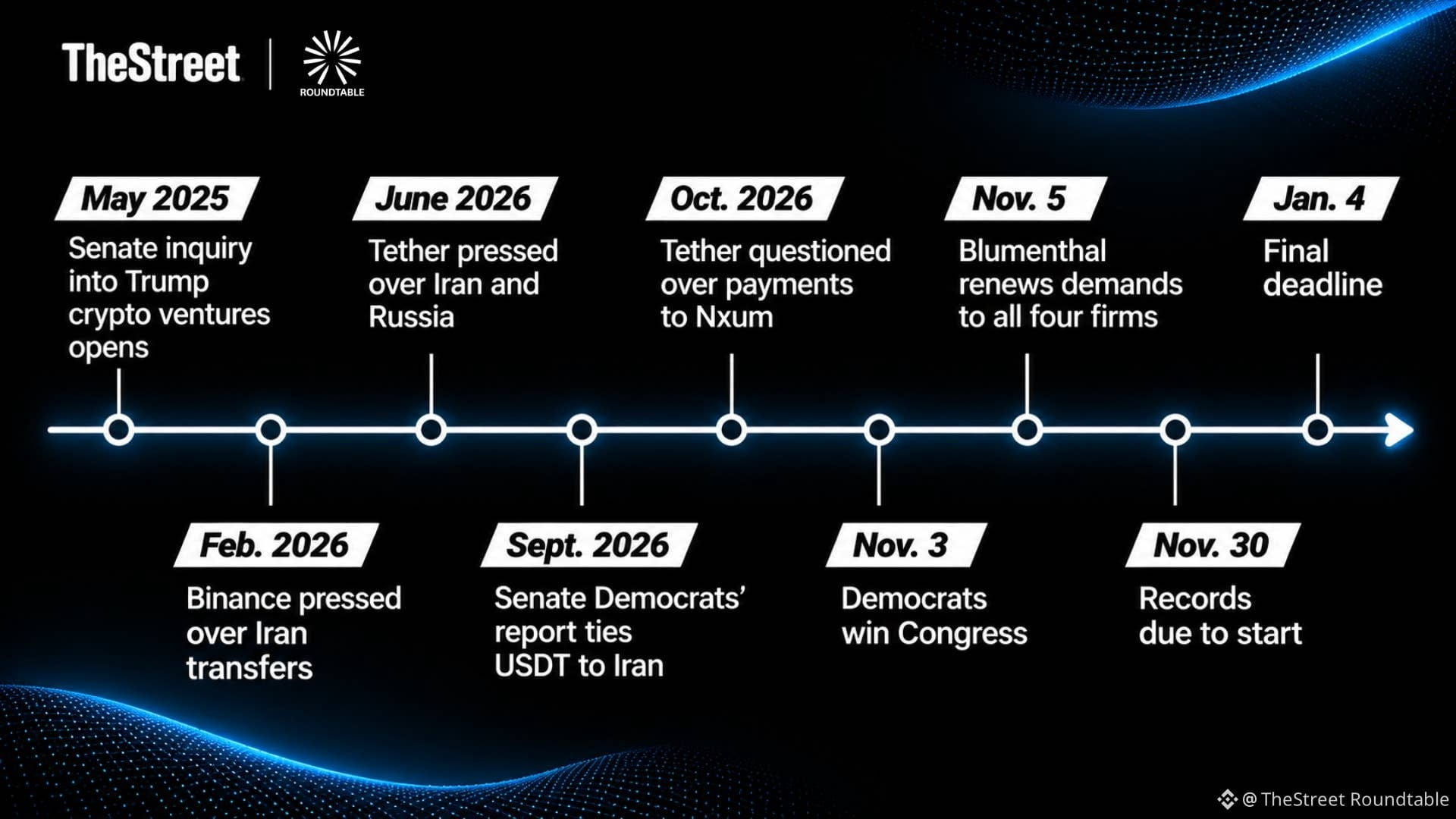
Сенатор Ричард Блументаль (демократ от Коннектикута) потребовал от Binance, Tether и двух криптовалютных проектов, связанных с президентом Дональдом Трампом, начать передавать документы до 30 ноября и завершить передачу до 4 января — иначе им грозят, по его словам, «альтернативные меры».
Блументаль направил письма 5 ноября, через два дня после промежуточных выборов, которые обеспечили его партии контроль над Конгрессом. Каждой компании также сообщили, что она должна подтвердить получение письма до 9 ноября.
Пока эти запросы носят добровольный характер.
Будущий председатель сенатского комитета установил срочный срок для проектов, связанных с Трампом
Как хакеры вывели 6,3 миллиарда долларов с Binance примерно за 20 минут (3:39)
Сенатор Ричард Блументаль (демократ от Коннектикута) потребовал от Binance, Tether и двух криптовалютных проектов, связанных с президентом Дональдом Трампом, начать передавать документы до 30 ноября и завершить передачу до 4 января — иначе им грозят, по его словам, «альтернативные меры».
Блументаль направил письма 5 ноября, через два дня после промежуточных выборов, которые обеспечили его партии контроль над Конгрессом. Каждой компании также сообщили, что она должна подтвердить получение письма до 9 ноября.
Пока эти запросы носят добровольный характер.
269
Проверено
См. перевод
Hive posts $84.9 million fiscal Q2 2027 revenue with AI cloud sales up 70%HIVE CEO responds to Elon Musk's neocloud warning (4:14)
For most Bitcoin miners, a falling coin price feeds almost directly into falling revenue. HIVE Digital Technologies has spent the past year building a second business to cushion that blow, and its latest quarterly results show that effort starting to pull its weight.
The Nasdaq– and TSX-listed company reported revenue of $84.9 million for its fiscal second quarter, which ended Sept. 30.
That was up 7.3% from the previous quarter and down just 2.7% from a year earlier, according to results released Nov. 9.
“Revenue was broadly stable year over year despite a 27% decline in Bitcoin prices,” said Frank Holmes, HIVE’s co-founder and executive chairman.
Related: HIVE CEO says Elon Musk is right about neoclouds but wrong about HIVE
BUZZ HPC grows its AI cloud revenue by 70%
The quarter’s fastest growth came from BUZZ HPC. The HIVE subsidiary rents out Nvidia graphics processing units (GPUs), the chips used to train and run AI models.
BUZZ HPC’s revenue reached $8.8 million, up 70.7% from a year earlier and 25.3% from the previous quarter.
That is still roughly a tenth of HIVE’s total. Contracts already signed suggest the share is set to grow.
HIVE puts the unit’s live annual recurring revenue (ARR) at about $40 million. ARR is a snapshot of what a business would earn over a full year at its current pace.
Contracted ARR, which also counts capacity not yet switched on, stands at about $185 million, the company said.
Two agreements drive most of that number. The first is a three-year sovereign AI contract worth about $225 million, supporting AI company Cohere.
The second is a five-year deal worth about $350 million with an investment-grade enterprise customer.
HIVE is aiming for about $200 million in GPU cloud ARR by the end of calendar 2026. Its longer-term goal is roughly $700 million in total high-performance computing ARR by the end of 2028.
The company notes that both targets depend on financing, construction and customer commitments.
The 2,304 Nvidia GB200 chips for the Cohere contract are paid for through the $129 million financing HIVE announced in October.
“We anticipate these GPUs will ship before calendar year-end,” said HIVE President and CEO Aydin Kilic.
More Bitcoin mined in an easier network
Bitcoin mining still brings in most of HIVE’s revenue. Digital currency revenue came to $76.0 million, up 5.5% from the previous quarter but down 7.4% from a year earlier.
HIVE received 1,070 Bitcoin in rewards during the quarter, up from 1,004 in the quarter before. Part of that came from an easier network.
Bitcoin’s difficulty measures how hard it is to mine a new coin, and it adjusts as more or less computing power competes for rewards. It averaged about 128 trillion, down from 135 trillion the quarter before.
More on Hive on TheStreet Roundtable:
Hive lines up $129 million to buy Nvidia AI chips
Frank Holmes: Bitcoin can hit $100,000 by year-end
HIVE joins Google, Microsoft, and Amazon in new Canada data center pledge
HIVE says it accounts for roughly 2% of all the computing power securing the Bitcoin network. It operates about 440 megawatts of power capacity, including a platform of about 300 megawatts in Paraguay.
The company expects to reach about 540 megawatts once another 100 megawatts at its Yguazú site in Paraguay is switched on in the fourth quarter of calendar 2026.
Operating profit climbs while write-downs weigh on the bottom line
HIVE’s core operations became more profitable during the quarter. Gross operating margin, which is revenue minus direct operating costs, rose to $30.2 million.
That is 35.6% of revenue, up from 30.6% the quarter before.
Adjusted EBITDA came to $24.8 million, an 85% jump from the previous quarter. Adjusted EBITDA is a common measure of operating profit that strips out interest, taxes, depreciation and certain non-cash costs.
On a standard accounting basis, HIVE posted a net loss of $78.7 million. Most of that loss came from charges that don’t involve cash leaving the business:
Depreciation of $54.9 million
A $31.2 million impairment, an accounting write-down of the value of equipment on the books. HIVE says it reflects tougher mining economics and lower market prices for ASICs, the specialized computers built only to mine Bitcoin
$8.6 million in share-based compensation
A $7.3 million loss on derivatives tied mainly to its convertible notes
HIVE ended September with $139.0 million in cash and $22.6 million in digital currencies.
During the quarter, the company raised about $43.2 million by selling roughly 13.7 million new shares through its at-the-market program.
That program lets a company sell shares gradually at prevailing market prices. The shares sold for an average of $3.15 each.
Chief Financial Officer Darcy Daubaras said the company’s financial priorities remain “disciplined capital allocation, liquidity management.”
Sweden and Ontario widen the pipeline
HIVE is also lining up more space for AI computing. It signed a letter of intent for long-term colocation at its 32-megawatt Big Boden facility in Sweden.
The company says the deal could bring in about $45 million in annual revenue.
The company has also set aside about 400 megawatts of utility power across Canada for AI-grade data centers, more than 320 megawatts of it in Ontario.
Kilic said the Ontario Premier’s office has committed to approving new data centers “sooner rather than later.”
Craig Tavares, president and chief operating officer of BUZZ HPC, argues that limits on U.S. permitting could make sites in Canada and Sweden more valuable.
“Canada has an opportunity to skate to where the puck is going,” he said.
The Big Boden deal still needs definitive agreements. Until those are signed, none of its potential revenue counts toward HIVE’s $185 million in contracted ARR.
The Roundtable 100
If you follow our market coverage, don’t miss the Roundtable 100. Updated every Friday, it’s a power ranking of the 100 most investable tech stocks, including digital assets. Check out the latest RTB 100 rankings at roundtable100.com.
Related: $13 trillion brokerage giant offers cheapest ways to trade crypto
Hive posts $84.9 million fiscal Q2 2027 revenue with AI cloud sales up 70%
HIVE CEO responds to Elon Musk's neocloud warning (4:14)
For most Bitcoin miners, a falling coin price feeds almost directly into falling revenue. HIVE Digital Technologies has spent the past year building a second business to cushion that blow, and its latest quarterly results show that effort starting to pull its weight.
The Nasdaq– and TSX-listed company reported revenue of $84.9 million for its fiscal second quarter, which ended Sept. 30.
That was up 7.3% from the previous quarter and down just 2.7% from a year earlier, according to results released Nov. 9.
“Revenue was broadly stable year over year despite a 27% decline in Bitcoin prices,” said Frank Holmes, HIVE’s co-founder and executive chairman.
Related: HIVE CEO says Elon Musk is right about neoclouds but wrong about HIVE
BUZZ HPC grows its AI cloud revenue by 70%
The quarter’s fastest growth came from BUZZ HPC. The HIVE subsidiary rents out Nvidia graphics processing units (GPUs), the chips used to train and run AI models.
BUZZ HPC’s revenue reached $8.8 million, up 70.7% from a year earlier and 25.3% from the previous quarter.
That is still roughly a tenth of HIVE’s total. Contracts already signed suggest the share is set to grow.
HIVE puts the unit’s live annual recurring revenue (ARR) at about $40 million. ARR is a snapshot of what a business would earn over a full year at its current pace.
Contracted ARR, which also counts capacity not yet switched on, stands at about $185 million, the company said.
Two agreements drive most of that number. The first is a three-year sovereign AI contract worth about $225 million, supporting AI company Cohere.
The second is a five-year deal worth about $350 million with an investment-grade enterprise customer.
HIVE is aiming for about $200 million in GPU cloud ARR by the end of calendar 2026. Its longer-term goal is roughly $700 million in total high-performance computing ARR by the end of 2028.
The company notes that both targets depend on financing, construction and customer commitments.
The 2,304 Nvidia GB200 chips for the Cohere contract are paid for through the $129 million financing HIVE announced in October.
“We anticipate these GPUs will ship before calendar year-end,” said HIVE President and CEO Aydin Kilic.
More Bitcoin mined in an easier network
Bitcoin mining still brings in most of HIVE’s revenue. Digital currency revenue came to $76.0 million, up 5.5% from the previous quarter but down 7.4% from a year earlier.
HIVE received 1,070 Bitcoin in rewards during the quarter, up from 1,004 in the quarter before. Part of that came from an easier network.
Bitcoin’s difficulty measures how hard it is to mine a new coin, and it adjusts as more or less computing power competes for rewards. It averaged about 128 trillion, down from 135 trillion the quarter before.
More on Hive on TheStreet Roundtable:
Hive lines up $129 million to buy Nvidia AI chips
Frank Holmes: Bitcoin can hit $100,000 by year-end
HIVE joins Google, Microsoft, and Amazon in new Canada data center pledge
HIVE says it accounts for roughly 2% of all the computing power securing the Bitcoin network. It operates about 440 megawatts of power capacity, including a platform of about 300 megawatts in Paraguay.
The company expects to reach about 540 megawatts once another 100 megawatts at its Yguazú site in Paraguay is switched on in the fourth quarter of calendar 2026.
Operating profit climbs while write-downs weigh on the bottom line
HIVE’s core operations became more profitable during the quarter. Gross operating margin, which is revenue minus direct operating costs, rose to $30.2 million.
That is 35.6% of revenue, up from 30.6% the quarter before.
Adjusted EBITDA came to $24.8 million, an 85% jump from the previous quarter. Adjusted EBITDA is a common measure of operating profit that strips out interest, taxes, depreciation and certain non-cash costs.
On a standard accounting basis, HIVE posted a net loss of $78.7 million. Most of that loss came from charges that don’t involve cash leaving the business:
Depreciation of $54.9 million
A $31.2 million impairment, an accounting write-down of the value of equipment on the books. HIVE says it reflects tougher mining economics and lower market prices for ASICs, the specialized computers built only to mine Bitcoin
$8.6 million in share-based compensation
A $7.3 million loss on derivatives tied mainly to its convertible notes
HIVE ended September with $139.0 million in cash and $22.6 million in digital currencies.
During the quarter, the company raised about $43.2 million by selling roughly 13.7 million new shares through its at-the-market program.
That program lets a company sell shares gradually at prevailing market prices. The shares sold for an average of $3.15 each.
Chief Financial Officer Darcy Daubaras said the company’s financial priorities remain “disciplined capital allocation, liquidity management.”
Sweden and Ontario widen the pipeline
HIVE is also lining up more space for AI computing. It signed a letter of intent for long-term colocation at its 32-megawatt Big Boden facility in Sweden.
The company says the deal could bring in about $45 million in annual revenue.
The company has also set aside about 400 megawatts of utility power across Canada for AI-grade data centers, more than 320 megawatts of it in Ontario.
Kilic said the Ontario Premier’s office has committed to approving new data centers “sooner rather than later.”
Craig Tavares, president and chief operating officer of BUZZ HPC, argues that limits on U.S. permitting could make sites in Canada and Sweden more valuable.
“Canada has an opportunity to skate to where the puck is going,” he said.
The Big Boden deal still needs definitive agreements. Until those are signed, none of its potential revenue counts toward HIVE’s $185 million in contracted ARR.
The Roundtable 100
If you follow our market coverage, don’t miss the Roundtable 100. Updated every Friday, it’s a power ranking of the 100 most investable tech stocks, including digital assets. Check out the latest RTB 100 rankings at roundtable100.com.
Related: $13 trillion brokerage giant offers cheapest ways to trade crypto
64
Статья
Таинственный трейдер скупает активы на миллионы накануне публикации отчета об инфляции 10 ноябряЗдание Министерства труда США в Вашингтоне, округ Колумбия, 31 марта 2019 года. Источник: Getty Images
Бюро статистики труда США (BLS) опубликует отчет об индексе потребительских цен (CPI) за октябрь 10 ноября в 8:30 утра по восточному времени.
Индекс инфляции, отражающий рост или снижение цен на товары и услуги, также влияет на политику Федеральной резервной системы в отношении корректировки процентных ставок.
Если инфляция будет под контролем, центральный банк сможет удерживать ставки в диапазоне 3,75–4%. Но ускорение инфляции может повысить вероятность очередного повышения ставки — в зависимости от общей экономической ситуации.
Таинственный трейдер скупает активы на миллионы накануне публикации отчета об инфляции 10 ноября
Здание Министерства труда США в Вашингтоне, округ Колумбия, 31 марта 2019 года. Источник: Getty Images
Бюро статистики труда США (BLS) опубликует отчет об индексе потребительских цен (CPI) за октябрь 10 ноября в 8:30 утра по восточному времени.
Индекс инфляции, отражающий рост или снижение цен на товары и услуги, также влияет на политику Федеральной резервной системы в отношении корректировки процентных ставок.
Если инфляция будет под контролем, центральный банк сможет удерживать ставки в диапазоне 3,75–4%. Но ускорение инфляции может повысить вероятность очередного повышения ставки — в зависимости от общей экономической ситуации.
125
См. перевод
Digital Asset CEO says Treasury will issue bills on-chain within five yearsDigital Asset CEO says Treasury will issue bills on-chain within five years (3:52)
Yuval Rooz, co-founder and CEO of Digital Asset, which built the Canton Network, told TheStreet Roundtable at Token2049 that the Treasury will issue bills directly on blockchain rails, and that it could happen within two to five years.
“A hundred percent,” Rooz said when asked whether the Treasury would issue on-chain instead of relying on secondary tokenized markets.
Related: Gold moves up 24 places on Roundtable 100 despite analyst warning
Why treasuries went on-chain first
Rooz says Treasuries were the natural starting point because they drive the funding, financing and repo markets that keep the economy running. They are also a simpler asset to tokenize.
“Stocks have corporate actions, they have proxy votes, they have issuers,” Rooz said. “(Treasuries are) a much simpler asset.”
Treasuries already sit behind stablecoins and money market funds as the main reserve asset. Tokenized U.S. Treasuries surged 2.5 times in the last year.
The repo math crypto misses
Rooz says crypto natives often doubt Canton’s numbers. The network handles $300 billion to $400 billion in repo every day, more than all crypto trading volume combined, much of it coming through Broadridge’s Distributed Ledger Repo platform.
“I explain, that’s nothing,” Rooz said, pointing to the U.S. Treasury repo, which he put at about $13.5 trillion a day. The Office of Financial Research sized the full U.S. repo market at about $12.6 trillion in average daily exposures in the third quarter of 2025.
More news:
Jack Dorsey-led Block’s DOJ settlement overshadows Q3 profit
Popular tech stock rallies 15% after disclosing $1.5B Bitcoin sale
Explained: What is Shared Liquidity?
DTCC brings Treasuries to Canton
The Depository Trust and Clearing Corporation (DTCC) plans to mint a subset of DTC-custodied Treasuries on Canton. The settlement giant is also working with other tokenization firms, as Ondo became the first tokenization company on DTCC’s Fund/SERV.
Rooz expects native on-chain creation and redemption of money market funds and stablecoins, which today only happens during operating hours.
Institutions remain cautious though. Rooz compared the hesitation to banks’ early resistance to online banking.
“We also as an industry need to prove that we can operate what we would call systemically critical infrastructure,” Rooz said. “When that happens, you’re just going to see these assets issued natively into these networks.”
Until then, tokenized Treasuries will keep running alongside the old system rather than replacing it.
Digital Asset CEO says Treasury will issue bills on-chain within five years
Digital Asset CEO says Treasury will issue bills on-chain within five years (3:52)
Yuval Rooz, co-founder and CEO of Digital Asset, which built the Canton Network, told TheStreet Roundtable at Token2049 that the Treasury will issue bills directly on blockchain rails, and that it could happen within two to five years.
“A hundred percent,” Rooz said when asked whether the Treasury would issue on-chain instead of relying on secondary tokenized markets.
Related: Gold moves up 24 places on Roundtable 100 despite analyst warning
Why treasuries went on-chain first
Rooz says Treasuries were the natural starting point because they drive the funding, financing and repo markets that keep the economy running. They are also a simpler asset to tokenize.
“Stocks have corporate actions, they have proxy votes, they have issuers,” Rooz said. “(Treasuries are) a much simpler asset.”
Treasuries already sit behind stablecoins and money market funds as the main reserve asset. Tokenized U.S. Treasuries surged 2.5 times in the last year.
The repo math crypto misses
Rooz says crypto natives often doubt Canton’s numbers. The network handles $300 billion to $400 billion in repo every day, more than all crypto trading volume combined, much of it coming through Broadridge’s Distributed Ledger Repo platform.
“I explain, that’s nothing,” Rooz said, pointing to the U.S. Treasury repo, which he put at about $13.5 trillion a day. The Office of Financial Research sized the full U.S. repo market at about $12.6 trillion in average daily exposures in the third quarter of 2025.
More news:
Jack Dorsey-led Block’s DOJ settlement overshadows Q3 profit
Popular tech stock rallies 15% after disclosing $1.5B Bitcoin sale
Explained: What is Shared Liquidity?
DTCC brings Treasuries to Canton
The Depository Trust and Clearing Corporation (DTCC) plans to mint a subset of DTC-custodied Treasuries on Canton. The settlement giant is also working with other tokenization firms, as Ondo became the first tokenization company on DTCC’s Fund/SERV.
Rooz expects native on-chain creation and redemption of money market funds and stablecoins, which today only happens during operating hours.
Institutions remain cautious though. Rooz compared the hesitation to banks’ early resistance to online banking.
“We also as an industry need to prove that we can operate what we would call systemically critical infrastructure,” Rooz said. “When that happens, you’re just going to see these assets issued natively into these networks.”
Until then, tokenized Treasuries will keep running alongside the old system rather than replacing it.
См. перевод
Brave’s Leo assistant uses NEAR AI to prove its AI chats stay private, paving the way for busines...Most of the AI tools businesses have adopted so far handle low-risk work, such as drafting emails, summarizing calls and cleaning up slide decks.
The material companies would most like to hand over is the material they guard most closely.
That includes financial research before it’s published, legal files covered by attorney-client privilege and internal data on pricing, products and deals.
What holds that work back is usually not what the models can do. It’s what happens to the data once it leaves the building.
Sending a confidential document to an AI model means trusting the cloud provider, the chip operator and the AI company not to see it. Most of the time, that trust rests on a privacy policy.
Related: Bernie Sanders spots opportunity as 66% of Americans oppose AI data centers
The pressure is showing up in corporate budgets. In Cisco’s 2026 Data and Privacy Benchmark Study, 90% of the more than 5,200 IT and security professionals surveyed said their privacy programs have expanded because of AI. Cisco puts it plainly:
“AI ambition is outpacing readiness.”
The cost of getting it wrong is rising too. IBM’s 2026 Cost of a Data Breach Report puts the average breach at $4.99 million, a record. Attacks that pull sensitive data back out of AI models cost even more, at $6 million on average.
NEAR AI, the AI arm of the NEAR ecosystem, is building its business around replacing that policy with proof.
On October 15, the company announced that Leo, the AI assistant built into the Brave browser, now runs on private inference from NEAR AI Cloud.
Inference is the step where a model reads a prompt and produces an answer, and it’s where user data is most exposed.
A locked room the operator can’t enter
According to NEAR AI, Leo conversations on the GLM 5.3 Flash model run inside trusted execution environments, or TEEs.
A TEE is a walled-off section of a processor where code and data are shielded from the rest of the machine. NEAR AI says its TEEs are built on Intel TDX and NVIDIA Confidential Compute.
The company says the cloud host, the GPU operator and NEAR AI itself are “cryptographically locked out.” Leo encrypts each prompt in the browser with a protocol called Oblivious HTTP, using a key that exists only inside the enclave.
Brave’s relay strips the user’s IP address before passing the request on. NEAR AI says memory stays encrypted while the model runs, and every response is signed inside the enclave.
The bigger point is who does the checking. Before Leo receives the enclave’s key, Brave’s own open-source verifier checks the hardware against Intel’s signature and NVIDIA’s attestation service.
Attestation is a cryptographic proof of what hardware and software are running.
The verifier also rebuilds NEAR AI’s code from public source to confirm it matches what is deployed. As the post puts it: “No pass, no key.”
NEAR AI’s Trust Center puts it in business terms. It says privacy is “enforced by hardware, not policy,” and verifiable through attestation “checked against Intel and NVIDIA, not NEAR AI.”
Trending on TheStreet Roundtable:
Veteran economist says investors are watching the wrong bubble
Billionaire Ray Dalio sounds alarm on AI’s $4.4 trillion debt squeeze
Two big U.S.-listed Bitcoin miners plan major exit for AI
Brave’s reach as a distribution channel
Distribution may matter as much as the technology. Privacy tools usually struggle because users have to go find them. Inside a browser, private inference becomes a setting.
Brave currently serves over 130 million monthly active users. That figure shows the size of the potential audience.
Private inference applies only to Brave Leo users who choose GLM 5.3 Flash in the model settings.
The rollout came in stages. Brave began testing NEAR AI’s TEEs in November 2025 with DeepSeek V3.1 in Brave Nightly, its experimental build. The October release takes it to the full production browser.
Brendan Eich, co-founder and CEO of Brave, called the integration “a first for AI chats in browsers.” Illia Polosukhin, co-founder of NEAR, framed it as a question of ownership.
“Browsers are a primary computing interface that handles all of our personal information, so it’s critical that AI is introduced in a user-owned way,” Polosukhin said.
NEAR AI says Brave joins Venice AI, Abound and the Government of Bermuda among organizations running production workloads on NEAR AI Cloud.
That mix of consumer apps and a public-sector user hints at the same distribution model at work: privacy delivered through software people already use, rather than a standalone product.
Guarantees that stop at the model
For businesses weighing sensitive workloads, the fine print matters. The privacy guarantee in the
Brave announcement covers one model in one deployment. NEAR AI describes GLM 5.3 Flash as an open-weights model under the MIT license, meaning its underlying parameters are public.
NEAR AI’s Trust Center specifies that open-weight models hosted by NEAR AI run inside the TEEs. Third-party models are also offered, but NEAR AI says those are “proxied without revealing the customer’s identity and processed under the provider’s own data terms.”
In other words, the hardware guarantee applies only where NEAR AI controls the hardware.
That distinction will likely shape how companies buy. A guarantee tied to a named model, a named deployment and an attestation anyone can check gives them something to audit.
NEAR AI also says a hardware-attested deployment log confirms that the model a user picks is the one answering.
Publishing open-source verification and relying on chipmakers’ attestation services rather than its own word lets NEAR AI’s approach be tested from outside.
For businesses that have kept their most sensitive files away from AI, that offers a way to bring them in without taking anyone’s word for it.
Related: $13 trillion brokerage giant offers cheapest ways to trade crypto
Brave’s Leo assistant uses NEAR AI to prove its AI chats stay private, paving the way for busines...
Most of the AI tools businesses have adopted so far handle low-risk work, such as drafting emails, summarizing calls and cleaning up slide decks.
The material companies would most like to hand over is the material they guard most closely.
That includes financial research before it’s published, legal files covered by attorney-client privilege and internal data on pricing, products and deals.
What holds that work back is usually not what the models can do. It’s what happens to the data once it leaves the building.
Sending a confidential document to an AI model means trusting the cloud provider, the chip operator and the AI company not to see it. Most of the time, that trust rests on a privacy policy.
Related: Bernie Sanders spots opportunity as 66% of Americans oppose AI data centers
The pressure is showing up in corporate budgets. In Cisco’s 2026 Data and Privacy Benchmark Study, 90% of the more than 5,200 IT and security professionals surveyed said their privacy programs have expanded because of AI. Cisco puts it plainly:
“AI ambition is outpacing readiness.”
The cost of getting it wrong is rising too. IBM’s 2026 Cost of a Data Breach Report puts the average breach at $4.99 million, a record. Attacks that pull sensitive data back out of AI models cost even more, at $6 million on average.
NEAR AI, the AI arm of the NEAR ecosystem, is building its business around replacing that policy with proof.
On October 15, the company announced that Leo, the AI assistant built into the Brave browser, now runs on private inference from NEAR AI Cloud.
Inference is the step where a model reads a prompt and produces an answer, and it’s where user data is most exposed.
A locked room the operator can’t enter
According to NEAR AI, Leo conversations on the GLM 5.3 Flash model run inside trusted execution environments, or TEEs.
A TEE is a walled-off section of a processor where code and data are shielded from the rest of the machine. NEAR AI says its TEEs are built on Intel TDX and NVIDIA Confidential Compute.
The company says the cloud host, the GPU operator and NEAR AI itself are “cryptographically locked out.” Leo encrypts each prompt in the browser with a protocol called Oblivious HTTP, using a key that exists only inside the enclave.
Brave’s relay strips the user’s IP address before passing the request on. NEAR AI says memory stays encrypted while the model runs, and every response is signed inside the enclave.
The bigger point is who does the checking. Before Leo receives the enclave’s key, Brave’s own open-source verifier checks the hardware against Intel’s signature and NVIDIA’s attestation service.
Attestation is a cryptographic proof of what hardware and software are running.
The verifier also rebuilds NEAR AI’s code from public source to confirm it matches what is deployed. As the post puts it: “No pass, no key.”
NEAR AI’s Trust Center puts it in business terms. It says privacy is “enforced by hardware, not policy,” and verifiable through attestation “checked against Intel and NVIDIA, not NEAR AI.”
Trending on TheStreet Roundtable:
Veteran economist says investors are watching the wrong bubble
Billionaire Ray Dalio sounds alarm on AI’s $4.4 trillion debt squeeze
Two big U.S.-listed Bitcoin miners plan major exit for AI
Brave’s reach as a distribution channel
Distribution may matter as much as the technology. Privacy tools usually struggle because users have to go find them. Inside a browser, private inference becomes a setting.
Brave currently serves over 130 million monthly active users. That figure shows the size of the potential audience.
Private inference applies only to Brave Leo users who choose GLM 5.3 Flash in the model settings.
The rollout came in stages. Brave began testing NEAR AI’s TEEs in November 2025 with DeepSeek V3.1 in Brave Nightly, its experimental build. The October release takes it to the full production browser.
Brendan Eich, co-founder and CEO of Brave, called the integration “a first for AI chats in browsers.” Illia Polosukhin, co-founder of NEAR, framed it as a question of ownership.
“Browsers are a primary computing interface that handles all of our personal information, so it’s critical that AI is introduced in a user-owned way,” Polosukhin said.
NEAR AI says Brave joins Venice AI, Abound and the Government of Bermuda among organizations running production workloads on NEAR AI Cloud.
That mix of consumer apps and a public-sector user hints at the same distribution model at work: privacy delivered through software people already use, rather than a standalone product.
Guarantees that stop at the model
For businesses weighing sensitive workloads, the fine print matters. The privacy guarantee in the
Brave announcement covers one model in one deployment. NEAR AI describes GLM 5.3 Flash as an open-weights model under the MIT license, meaning its underlying parameters are public.
NEAR AI’s Trust Center specifies that open-weight models hosted by NEAR AI run inside the TEEs. Third-party models are also offered, but NEAR AI says those are “proxied without revealing the customer’s identity and processed under the provider’s own data terms.”
In other words, the hardware guarantee applies only where NEAR AI controls the hardware.
That distinction will likely shape how companies buy. A guarantee tied to a named model, a named deployment and an attestation anyone can check gives them something to audit.
NEAR AI also says a hardware-attested deployment log confirms that the model a user picks is the one answering.
Publishing open-source verification and relying on chipmakers’ attestation services rather than its own word lets NEAR AI’s approach be tested from outside.
For businesses that have kept their most sensitive files away from AI, that offers a way to bring them in without taking anyone’s word for it.
Related: $13 trillion brokerage giant offers cheapest ways to trade crypto
Статья
Брокерский гигант с активами на 13 трлн долларов предлагает самые дешёвые способы торговли криптовалютойВывеска у отделения банка Charles Schwab в Лос-Анджелесе, штат Калифорния, 21 июля 2026 года.
Крупнейшие брокерские компании Уолл-стрит весь 2026 год наперегонки запускали возможность для обычных инвесторов покупать криптовалюту наряду с акциями и вкладывать в неё средства пенсионных фондов. Теперь конкуренция перемещается в сферу цен.
Charles Schwab, управляющая активами клиентов на сумму 13,33 трлн долларов и 40,3 млн брокерских счетов по состоянию на 30 сентября 2026 года, 9 ноября сообщила, что теперь клиенты со счетами Schwab Crypto могут покупать и продавать Solana, Avalanche и Chainlink.
Брокерский гигант с активами на 13 трлн долларов предлагает самые дешёвые способы торговли криптовалютой
Вывеска у отделения банка Charles Schwab в Лос-Анджелесе, штат Калифорния, 21 июля 2026 года.
Крупнейшие брокерские компании Уолл-стрит весь 2026 год наперегонки запускали возможность для обычных инвесторов покупать криптовалюту наряду с акциями и вкладывать в неё средства пенсионных фондов. Теперь конкуренция перемещается в сферу цен.
Charles Schwab, управляющая активами клиентов на сумму 13,33 трлн долларов и 40,3 млн брокерских счетов по состоянию на 30 сентября 2026 года, 9 ноября сообщила, что теперь клиенты со счетами Schwab Crypto могут покупать и продавать Solana, Avalanche и Chainlink.
155
Ветеран Ripple рассказал, что выбросил письмо IRS в мусорное ведроGetty Images
Дэвид Шварц, почётный технический директор Ripple Labs и один из архитекторов-основателей XRP Ledger, недавно рассказал, что выбросил письмо 6174 от Налогового управления США (IRS) «прямиком в мусорное ведро». Он получил его всего за несколько дней до этого.
Ветеран Ripple сделал это заявление в ответ на слова эксперта по налогообложению криптовалют Клинтона Доннелли, который утверждал, что IRS «резко» увеличивает число уведомлений — писем 6174, отправляемых трейдерам криптовалют.
«Масштабная кампания по рассылке писем» призвана оказать давление на налогоплательщиков, работающих с криптовалютами, чтобы они проверили свои прошлые налоговые декларации и исправили ошибки, но это не аудит, заверил Доннелли.
Ветеран Ripple рассказал, что выбросил письмо IRS в мусорное ведро
Getty Images
Дэвид Шварц, почётный технический директор Ripple Labs и один из архитекторов-основателей XRP Ledger, недавно рассказал, что выбросил письмо 6174 от Налогового управления США (IRS) «прямиком в мусорное ведро». Он получил его всего за несколько дней до этого.
Ветеран Ripple сделал это заявление в ответ на слова эксперта по налогообложению криптовалют Клинтона Доннелли, который утверждал, что IRS «резко» увеличивает число уведомлений — писем 6174, отправляемых трейдерам криптовалют.
«Масштабная кампания по рассылке писем» призвана оказать давление на налогоплательщиков, работающих с криптовалютами, чтобы они проверили свои прошлые налоговые декларации и исправили ошибки, но это не аудит, заверил Доннелли.
96
XRP может быть готов к отскоку на 13%, но важен один уровеньПочему токенизированные депозиты не заменят стейблкоины: мнение Джамала Раиса из Solana (4:13)
XRP достиг решающей зоны.
Криптоаналитик Ali Charts написал в X, что токен коснулся нижней границы нисходящего канала, который определял динамику его цены в течение последнего месяца.
«Похоже, XRP готов отскочить», — написал криптоаналитик.
Если уровень $1.14 устоит как поддержка, XRP может отскочить к верхней границе канала на отметке $1.30. Это будет рост примерно на 13% от текущих уровней.
«XRP достиг нижней границы нисходящего канала, который определял динамику его цены в течение последнего месяца», — написал он.
XRP может быть готов к отскоку на 13%, но важен один уровень
Почему токенизированные депозиты не заменят стейблкоины: мнение Джамала Раиса из Solana (4:13)
XRP достиг решающей зоны.
Криптоаналитик Ali Charts написал в X, что токен коснулся нижней границы нисходящего канала, который определял динамику его цены в течение последнего месяца.
«Похоже, XRP готов отскочить», — написал криптоаналитик.
Если уровень $1.14 устоит как поддержка, XRP может отскочить к верхней границе канала на отметке $1.30. Это будет рост примерно на 13% от текущих уровней.
«XRP достиг нижней границы нисходящего канала, который определял динамику его цены в течение последнего месяца», — написал он.
47
Войдите, чтобы посмотреть больше материала
Присоединяйтесь к пользователям криптовалют по всему миру на Binance Square
⚡️ Получайте новейшую и полезную информацию о криптоактивах.
💬 Нам доверяет крупнейшая в мире криптобиржа.
👍 Получите достоверные аналитические данные от верифицированных создателей контента.
Эл. почта/номер телефона
В тренде
ПротоколFOMC
Просмотров: 139,485
318 обсуждают
Сейчас всё внимание приковано к решениям ФРС 🇺🇸
Рынок внимательно следит за сигналами от FOMC, ведь даже одно изменение в риторике представителей ФРС может повлиять на настроение инвесторов.
Особенно интересно наблюдать за реакцией BTC и ETH. Иногда рынок начинает двигаться ещё до официальных заявлений, а после публикации протокола волатильность может заметно вырасти.
$BTC
$ETH
Я бы сейчас не торопился с выводами. Лучше следить за новостями, объёмами и реакцией цены, чем пытаться угадать направление заранее.
А вы как думаете, чего сейчас больше ждёт рынок — снижения ставки или сохранения текущей политики?
#fomcотслеживание #ПротоколFOMC
Saymontop20
·Лайков: 0
·Просмотров: 31
fomcотслеживание
Просмотров: 116,064
570 обсуждают
HotCPIDecemberHikePriced
Просмотров: 274,933
2,908 обсуждают