


I had one of those moments today where a concept didn't click immediately but once it did, everything suddenly made sense.🙄
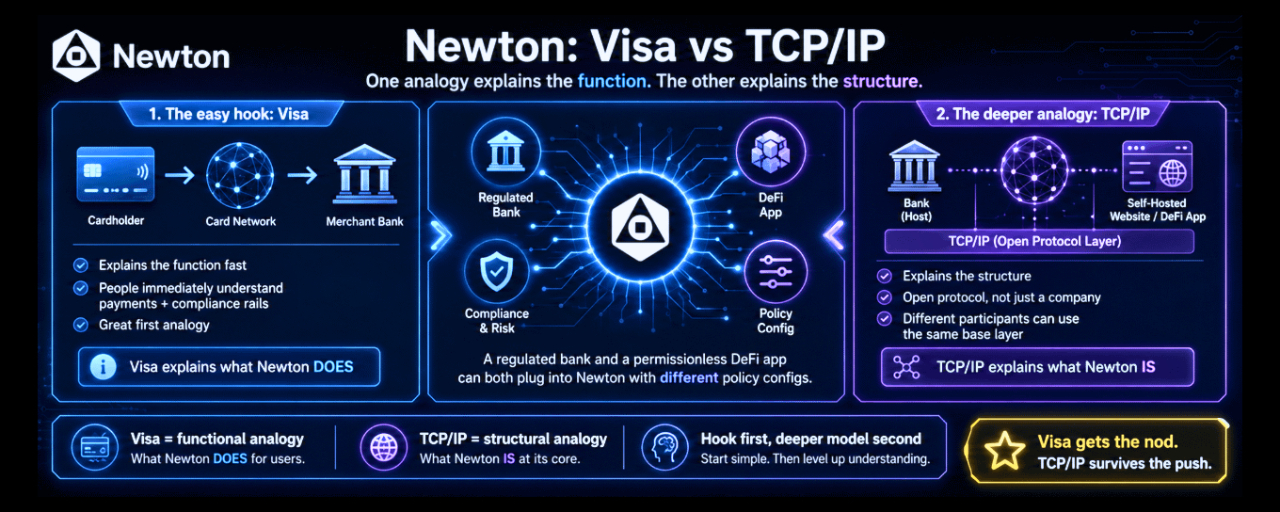
While reading about Newton, I noticed it uses two different analogies to describe itself: Visa and TCP/IP.
My first reaction was simple: Why use both? If one analogy is stronger, why not just stick with that?
At first, I assumed TCP/IP was the only comparison that really mattered, and that Visa was just unnecessary marketing. But after sitting with it for a while, I realized I was asking the wrong question.
The two analogies aren't trying to explain the same thing.
Imagine you're introducing Newton to someone who's never heard of authorization layers or decentralized infrastructure. Starting with TCP/IP would probably leave them confused.
Visa, on the other hand, is something almost everyone recognizes. People immediately understand that it's a network connecting different participants so transactions can happen securely and efficiently.
That's why Visa works so well as the opening analogy. It explains Newton's function in a way that's instantly familiar.
But once you start looking beneath the surface, Visa stops being the perfect comparison.
Visa is a centralized company with its own governance, policies, and permission structure. Everyone participating ultimately operates within that centralized network.
That's where TCP/IP becomes the more meaningful analogy.
The internet doesn't belong to any single organization. A global bank, a university, an independent developer, or someone's personal website can all use the same protocol without asking a central authority for permission. They follow the protocol, but each operates according to its own rules.
Structurally, that's much closer to what Newton is trying to build.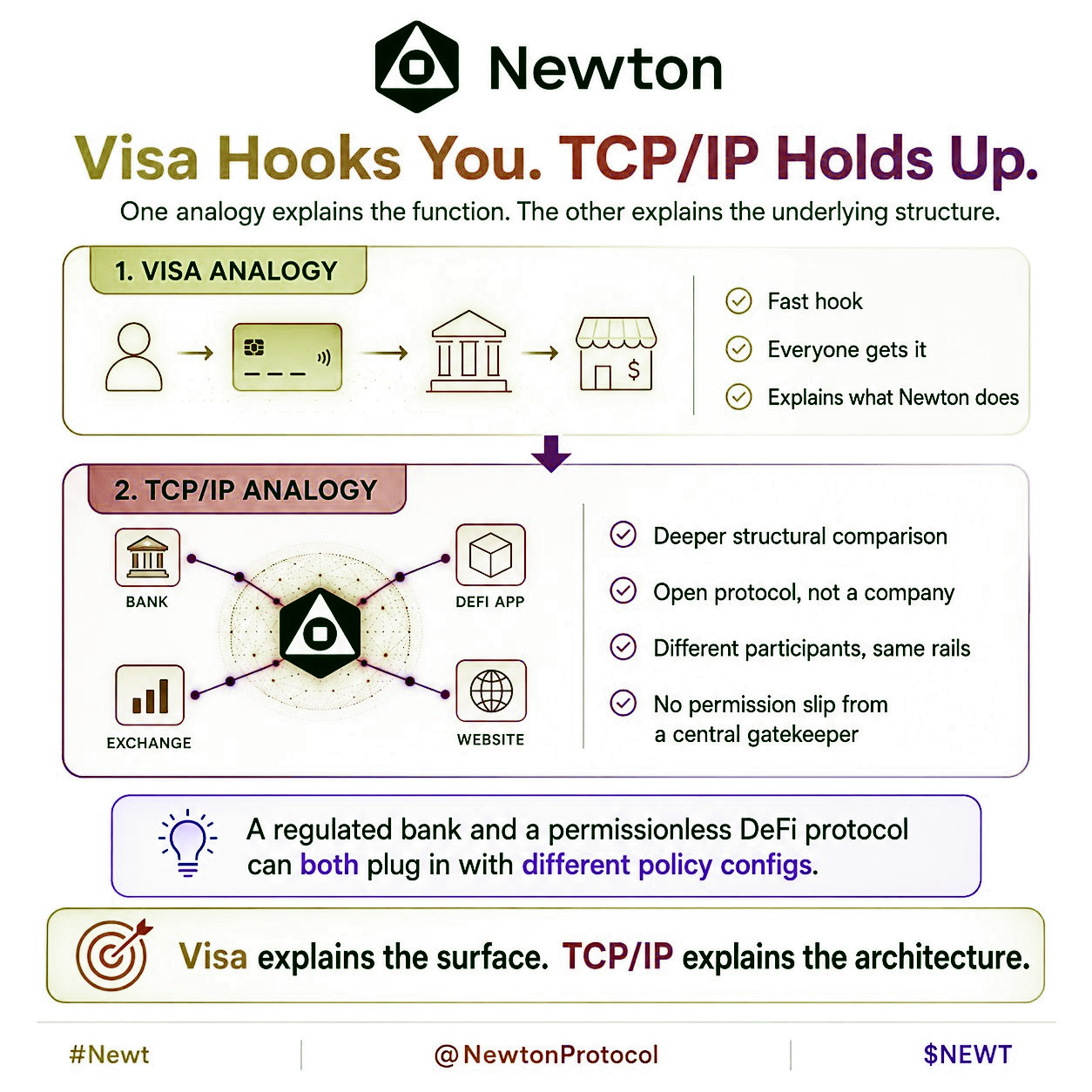
A regulated financial institution and a permissionless DeFi protocol could both connect to the same authorization layer while maintaining completely different policies and compliance requirements.
Neither depends on approval from the other, and neither requires Newton to act as a gatekeeper.
That was the part I initially had backwards.
I thought Visa explained the deeper architecture and TCP/IP was just the simple example. After thinking it through, I realized it's actually the opposite.
Visa explains what Newton does.
TCP/IP explains what Newton is trying to become.
That small shift completely changed how I understood the project. Sometimes it's not about choosing the "better" analogy it's about recognizing that different analogies answer different questions.